EP1497130B2 - Procede de lavage automatique du circuit d'encrage de rotatives, et installation pour la mise en oeuvre du procede - Google Patents
Procede de lavage automatique du circuit d'encrage de rotatives, et installation pour la mise en oeuvre du procede Download PDFInfo
- Publication number
- EP1497130B2 EP1497130B2 EP03722393A EP03722393A EP1497130B2 EP 1497130 B2 EP1497130 B2 EP 1497130B2 EP 03722393 A EP03722393 A EP 03722393A EP 03722393 A EP03722393 A EP 03722393A EP 1497130 B2 EP1497130 B2 EP 1497130B2
- Authority
- EP
- European Patent Office
- Prior art keywords
- tank
- line
- solvent
- lines
- chamber
- Prior art date
- Legal status (The legal status is an assumption and is not a legal conclusion. Google has not performed a legal analysis and makes no representation as to the accuracy of the status listed.)
- Expired - Lifetime
Links
- 238000005406 washing Methods 0.000 title claims abstract description 33
- 238000000034 method Methods 0.000 title claims abstract description 20
- 238000007639 printing Methods 0.000 title claims abstract description 20
- 239000002904 solvent Substances 0.000 claims abstract description 82
- 230000002572 peristaltic effect Effects 0.000 claims abstract description 8
- 230000009471 action Effects 0.000 claims abstract description 7
- 238000005086 pumping Methods 0.000 claims abstract description 5
- 230000001133 acceleration Effects 0.000 claims abstract description 4
- 230000002441 reversible effect Effects 0.000 claims abstract description 3
- 238000000926 separation method Methods 0.000 claims abstract description 3
- 230000008878 coupling Effects 0.000 claims description 20
- 238000010168 coupling process Methods 0.000 claims description 20
- 238000005859 coupling reaction Methods 0.000 claims description 20
- 238000007599 discharging Methods 0.000 claims description 5
- 238000003780 insertion Methods 0.000 claims description 4
- 230000037431 insertion Effects 0.000 claims description 4
- 238000004891 communication Methods 0.000 claims description 2
- 238000001035 drying Methods 0.000 claims description 2
- 230000005484 gravity Effects 0.000 claims description 2
- 238000011144 upstream manufacturing Methods 0.000 claims 2
- 238000007664 blowing Methods 0.000 claims 1
- 238000002347 injection Methods 0.000 description 3
- 239000007924 injection Substances 0.000 description 3
- 238000004140 cleaning Methods 0.000 description 2
- 230000008569 process Effects 0.000 description 2
- 238000007774 anilox coating Methods 0.000 description 1
- 230000015572 biosynthetic process Effects 0.000 description 1
- 230000008859 change Effects 0.000 description 1
- 238000010586 diagram Methods 0.000 description 1
- 239000012530 fluid Substances 0.000 description 1
- 239000007788 liquid Substances 0.000 description 1
- 238000007645 offset printing Methods 0.000 description 1
- 239000013557 residual solvent Substances 0.000 description 1
Images


Classifications
-
- B—PERFORMING OPERATIONS; TRANSPORTING
- B41—PRINTING; LINING MACHINES; TYPEWRITERS; STAMPS
- B41F—PRINTING MACHINES OR PRESSES
- B41F31/00—Inking arrangements or devices
- B41F31/02—Ducts, containers, supply or metering devices
- B41F31/027—Ink rail devices for inking ink rollers
-
- B—PERFORMING OPERATIONS; TRANSPORTING
- B41—PRINTING; LINING MACHINES; TYPEWRITERS; STAMPS
- B41F—PRINTING MACHINES OR PRESSES
- B41F35/00—Cleaning arrangements or devices
-
- B—PERFORMING OPERATIONS; TRANSPORTING
- B41—PRINTING; LINING MACHINES; TYPEWRITERS; STAMPS
- B41P—INDEXING SCHEME RELATING TO PRINTING, LINING MACHINES, TYPEWRITERS, AND TO STAMPS
- B41P2251/00—Details or accessories of printing machines not otherwise provided for
- B41P2251/10—Pumps
- B41P2251/112—Peristaltic pumps
Definitions
- the present invention relates to rotary printing presses such as, for example, flexographic printing presses or offset printing presses, and more particularly relates to a method for automatically washing the inking assembly of the printing cylinders in these presses and the parts associated with the circuit thereof, in particular, although not exclusively in presses of the abovementioned type for polychromatic printing.
- the present invention relates furthermore to a plant for implementing this method.
- EP-0,780,228 discloses a method and a device for cleaning the doctor device of an inking assembly of a rotary printing press.
- the ink is returned from the inking compartment to the ink tank again.
- solvent is pumped into the inking compartment and is then conveyed into the ink tank via the ink supply and discharge lines.
- the solvent contaminated by the ink is pumped into the dirty-solvent tank, clean solvent being then pumped in a closed circuit along the ink supply and discharge lines for a certain period of time and then discharged into the dirty-solvent tank.
- EP-A-612618 discloses a plant according to the preamble of claim 1.
- the solvent used in the washing operation is not recycled - even partly - for the subsequent washing cycles, therefore negatively affecting the costs of the process.
- the object of the present invention is to overcome the disadvantages of the known methods for washing the lines for supplying and discharging the ink from the inking chamber of a rotary printing press. According to a main characteristic feature of the present invention, this object is achieved by using a plant according to claim 1.
- the semi-dirty washing solvent is stored and used in the subsequent washing cycle.
- the whole washing process is automated, and this process requires only very limited manual intervention for implementation thereof, which, if necessary, could also be automated.
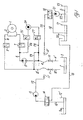
- 1 denotes the inking cylinder and for example the screened cylinder (anilox cylinder) of a flexographic printing press.
- 2 denotes the chamber for supplying the ink to the cylinder 1, which also contains a scraper or doctor blade (not shown) having the purpose of ensuring a uniform layer of the ink film on the surface of the cylinder 1.
- 3 denotes the ink collection tray into which the line 4', connected by means of the quick-action coupling 10 and the line 4 to the pump 5, leads.
- the pump 5 is of the type having a reversible delivery and intake, and in particular said pump is a peristaltic pump.
- the pump 5 is connected in turn by means of the line 6 and the pneumatically controlled diaphragm valve 7 to the chamber 2.
- the chamber 2 is in turn connected by means of the line 8, the diaphragm valve 9, the line 8', the quick-action coupling 11 and the line 8'' to the tank 3.
- the ink I contained in the tank 3 is circulated by the pump 5, being sucked via the line 4', the coupling 10, the line 4, the line 6 and the valve 7 into the chamber 2, where it is spread onto the inking cylinder 3, and is made to flow from the chamber 2 via the line 8, the valve 9, the line 8', the quick-action coupling 11 and the line 8'' back into the tank 3 from where the ink is again supplied to the cylinder 3, thus closing a continuous cycle for supplying ink to the inking cylinder 1.
- the plant is completed by a line 12 provided at one end with a quick-action coupling element 11' and connected to the double-diaphragm pneumatic pump 13 connected to the twin valve 14 which in a first position discharges, by means of the line 15, into the tank 12' for the dirty solvent Sp and in a second position discharges, by means of the line 16, into the tank 17 for the semi-dirty solvent SSp.
- the tank 17 is in turn connected, by means of a line 18 comprising a twin valve 19 which, in one of its switched positions, connects the line 18 to the line 20 terminating in the quick-action coupling element 10', while, in the other switched position of the valve 19, the line 20 is connected to the delivery of the pump 21, the intake side of which is connected to the line 22 which leads into the tank 23 containing the clean solvent S.
- a line 18 comprising a twin valve 19 which, in one of its switched positions, connects the line 18 to the line 20 terminating in the quick-action coupling element 10', while, in the other switched position of the valve 19, the line 20 is connected to the delivery of the pump 21, the intake side of which is connected to the line 22 which leads into the tank 23 containing the clean solvent S.
- a compressed-air source 24 comprising a branch supplying air at a low pressure, for example at a pressure of about 0.5 bar, connected by means of the shut-off valve 25 and the line 26 to the line 6 at a point between the pump 5 and the valve 7 and a branch supplying air at medium pressure, for example at a pressure of about 2 bar connected, by means of the shut-off valve 27 and the line 28 to the line 4 at a point thereof between the pump 5 and the quick-action coupling 10 and connected by means of the branch 29 to the line 8 at a point thereof between the quick-action coupling 11 and the shut-off valve 9, for the purposes which will be described below.
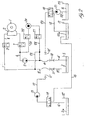
- This step comprises preliminarily disconnection of the quick-action coupling elements 10 and 11 from the pipe sections 4' and 8'', respectively, and their connection to the quick-action coupling elements 10' and 11', respectively.
- This operation of disconnection and subsequent connection of the quick-action couplings is preferably performed manually. However, this operation could also be automated by means of suitable robotized devices.
- the valve element 19 is switched so as to establish a connection between the line 18 and the line 20; the valve element 14 is switched so as to establish a connection between the delivery of the pump 13. and the line 15 which discharges into the tank 12' and the valve element 25 is intermittently switched so as to establish communication between the source of low-pressure air supplied from 24 and the line 26.
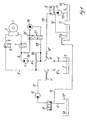
- the valve 14 is switched so as to connect the delivery of the pump 13 to the line 16. All the other connections remain, during this step, unchanged.
- the semi-dirty solvent from the tank 17 is circulated as described with reference to the step in Figure 3 , with the sole difference that, instead of being discharged into the tank 12', it is recycled along the line 16 back into the tank 17.
- the pulsed injection of air into the flow of solvent continues via the line 26.
- emptying of the semi-dirty solvent from the lines is performed by means of reversal of the peristaltic pump 5.
- the semi-dirty solvent is therefore conveyed back into the tank 17.
- the valve 19 (see diagram in Figure 5 ) is switched so as to interrupt the connection between the tank 17 and the line 20, and the latter is connected to the delivery of the pump 21 associated with the tank 23 for the clean solvent.
- the pulsed injection of air into the flow of clean solvent is continued via the line 26, and the solvent circulated in this way, as described with reference to the step illustrated in Figure 4 , is collected inside the tank 17 for the semi-dirty solvent.
- the final step of the automatic washing operation commences.
- the direction of the pump 5 is reversed firstly so as to empty the pipes and the chamber 2 of the clean solvent, which is collected inside the tank 17.
- the flow of low-pressure air from the line 26 is interrupted by means of switching of the valve 25, and the valve 19 is reset to the switched position shown in Figure 4 .
- the valves 7 and 9 in turn are switched into the closed position so as to prevent the air at a pressure of 2 bar from pressurising the chamber 2.
- the valve 27 is switched so as to convey a flow of air at a high pressure along the pipes, so as to discharge completely the solvent contained in them, performing also drying of the residual solvent in the said pipes.
- washing method according to the present invention is not limited to the operating steps described and illustrated.
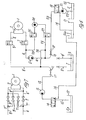
- Figure 7 illustrates a variant of the cycle for washing the inking chamber 2 of the printing cylinder 1.
- the lines 6' and 8' are connected together by means of a line 9'', with insertion of a valve 9' and, likewise, the lines 6 and 8 have been connected together by means of a line 7'' with the insertion of a valve 7'.
- solvent which is both clean and semi-dirty from those holes which under normal conditions are the discharge holes of the chamber 2 and discharge solvent from the hole which under normal conditions is the hole supplying the doctor blade.
- the valves 7 and 9 and opening the valves 7' and 8' the result is obtained whereby the pipe section 8 is completely washed, first with semi-dirty solvent and then with clean solvent.
- the washing system according to the invention may be completely automated and its electronics may be incorporated into the electronics of the printing press. It may be controlled by means of software which allows the washing cycles to be programmed according to the specific requirements of the individual users.
Landscapes
- Inking, Control Or Cleaning Of Printing Machines (AREA)
Abstract
Claims (13)
- Installation de lavage automatique du circuit d'encrage de presses d'impression rotatives comprenant: une chambre (2) d'encrage du cylindre (1) d'encrage; des circuits (4', 4, 6, 8, 8', 8"), qui mettent la chambre (2) en communication avec un encrier (3); des moyens (5) de pompage de l'encre de l'encrier (3) à la chambre (2) le long des conduits (4', 4, 6, 8, 8', 8") et de la chambre à l'encrier (3); une cuve (23) pour le solvant propre; des conduits (22, 20) munis de moyens permettant de mettre la cuve (23) en communication avec le conduit (4); une cuve pour le solvant (12) sale et des conduits (15, 12) munis de moyens permettant de mettre la cuve (12') en communication avec le conduit (8'), lesquels moyens (5) de pompage de l'encre consistent en une pompe péristaltique dont le rotor est actionné par un moteur ayant un sens de rotation qui peut être inversé, caractérisée en ce qu'elle comprend en outre une source d'air comprimé sous basse pression communiquant à l'aide de moyens (25) d'arrêt avec un conduit (26) qui est en dérivation sur le conduit (6) en amont de la chambre (2) d'encrage et des moyens pour envoyer de l'air sous basse pression dans le conduit (6) au moyen d'impulsions intermittentes proches.
- Installation selon la revendication 1, dans laquelle les moyens permettant de mettre la cuve (23) en communication avec le conduit (4) et la cuve (12') en communication avec le conduit (8') consistent en des accouplements à action rapide.
- Installation selon la revendication 1, comprenant en outre une cuve (17) pour le solvant à moitié sale, des moyens (14; 19) à vanne de commutation permettant de mettre la cuve (17) en communication avec les conduits (12) et (20), respectivement, par l'intermédiaire des conduits (16) et (18) qui sont prévus.
- Installation selon la revendication 1, comprenant en outre une source d'air comprimé sous haute pression communiquant à l'aide de moyens (27) d'arrêt avec un premier conduit (28) qui est en dérivation de la ligne (4) en amont de la pompe (5) et avec un deuxième conduit (29) qui est en dérivation du conduit (8') en aval de la chambre (2) d'encrage.
- Installation selon l'une quelconque des revendications précédentes, dans laquelle une deuxième pompe (13) est montée dans le circuit entre le conduit (12) et les moyens (14) à vanne de commutation.
- Installation selon l'une quelconque des revendications précédentes, dans laquelle une troisième pompe (21) est montée dans le circuit entre le conduit (22) et les moyens (19) à vanne de commutation.
- Installation selon la revendication 5 et 6, dans laquelle la deuxième et la troisième pompe (13, 21) sont des pompes pneumatiques du type à double diaphragme.
- Installation selon la revendication 1, dans laquelle la source d'air sous basse pression est une source d'air à une pression comprise entre 0,3 et 0,7 bar et, de préférence, à une pression de 0,5 bar.
- Installation selon la revendication 4, dans laquelle la source d'air à haute pression est une source d'air à une pression comprise entre 1,5 et 3 bars et, de préférence, à une pression de 2 bars.
- Installation selon les revendications précédentes, dans laquelle, au voisinage de la chambre (2), les conduits (6') et (8') communiquent ensemble au moyen d'un conduit (9") avec montage d'une vanne (9'), et de la même façon les conduits (6) et (8) communiquent ensemble au moyen d'un conduit (7") avec montage d'une vanne (7'), de manière à permettre à la fois au solvant propre et au solvant à moitié sale d'être pompés de ce qui est, dans les conditions normales, le trou d'évacuation de la chambre (2) et de permettre d'évacuer le solvant du trou qui, dans des conditions normales, est le trou d'alimentation de la chambre (2), de sorte qu'à l'aide de moyens fermant les vannes (7) et (9) et ouvrant les vannes (7') et (8'), il est possible de laver à fond, premièrement par du solvant à moitié sale, puis par du solvant propre, le tronçon (8) de conduit.
- Procédé de lavage automatique du circuit dans des presses d'impression rotatives utilisant l'installation selon l'une quelconque des revendications 1 à 10, comprenant les stades dans lesquels:- on inverse le sens de rotation du rotor de la pompe (5) péristaltique, de manière à vider la chambre (2) et les conduits (6, 4, 4') de l'encre qui y est contenue, en retournant l'encre à l'encrier (3) et en faisant en même temps que l'encre contenue dans les conduits (8, 8' et 8") retourne au moyen de la gravité dans le même encrier (3);- on déconnecte les éléments de couplage (10, 11) à action rapide des conduits (4', 8") et on les connecte aux éléments (10' et 11') de couplage à action rapide;- on commute l'élément (19) de vanne, de manière à établir une communication entre le conduit (18) fournissant le solvant à moitié sale provenant de la cuve (17) et le conduit (20) communiquant par l'intermédiaire des accouplements (10, 10') avec le conduit (4);- on commute l'élément (14) de vanne, de manière à mettre le conduit (8, 8'), les accouplements (11', 11), le conduit (12) et la deuxième pompe (13) en communication avec le conduit (15) menant à la cuve (12') pour recueillir le solvant sale;- on inverse à nouveau le sens de rotation du rotor de la pompe (5) péristaltique, de manière à pomper le solvant en provenance de la cuve (17) pour le solvant à moitié sale par l'intermédiaire du conduit (6), de la chambre (2), des conduits (8, 8', 12 et 15) dans la cuve (12'), avec ouverture simultanée de la vanne (25), de manière à injecter de façon intermittente de l'air comprimé sous basse pression dans le conduit (6) dans le courant de solvant à moitié sale;- on commute la vanne (14), de manière à mettre le refoulement de la deuxième pompe (13) en communication avec le conduit (16) menant dans la cuve (17) et à poursuivre une circulation en circuit fermé du solvant à moitié sale dans le circuit de la chambre (2), en continuant l'introduction par intermittence d'air sous basse pression dans le solvant qui est en circulation;- on vide les conduits du solvant à moitié sale au moyen d'une inversion de la pompe (5) péristaltique avec renvoi du solvant à moitié sale dans la cuve (17);- on commute la vanne (19) de manière à mettre la cuve (23) pour le solvant propre en communication avec le circuit d'écoulement de la chambre (2), en évacuant le solvant à moitié sale obtenu à la fin du cycle dans la cuve (17) pour le solvant à moitié sale, en continuant l'introduction par intermittence d'air sous basse pression dans le solvant propre qui est en circulation;- on commute la vanne (19), de manière à mettre le conduit (20) en communication avec la cuve (17) pour le solvant à moitié sale, on interrompt l'alimentation en air sous basse pression; on inverse le sens de rotation du rotor de la pompe (5) péristaltique, de manière à faire que tout le solvant contenu dans les conduits retourne dans la cuve (17) pour le solvant à moitié sale; on commute les vannes (7) et (9) en les mettant dans la position d'interception; on commute la vanne (27), de manière à envoyer de l'air sous haute pression dans les conduits où passe du solvant ; et on insuffle ensuite de l'air sous haute pression dans la vanne (27), de manière à effectuer une vidange et un séchage partiel des conduits en utilisant l'air sous haute pression;- on remet en communication l'encrier (3).
- Procédé selon la revendication 11 précédente, dans lequel, pendant le premier stade de lavage utilisant du solvant à moitié sale, on fait tourner le cylindre (1) encreur à petite vitesse, tandis que pendant les stades de lavage suivants utilisant du solvant à moitié sale et du solvant propre, on fait tourne le cylindre (1) d'encrage à grande vitesse, en alternant la rotation dans les deux sens, de manière à créer une turbulence qui enlève l'encre résiduelle de la chambre (2) et des cellules du cylindre (1).
- Procédé de lavage automatique du circuit d'encrage dans des presses d'impression rotatives selon les revendications 11 et 12, en utilisant l'installation selon l'une quelconque des revendications 1 à 10, caractérisé par le stade d'introduction par intermittence d'air dans le courant de solvant circulant dans les conduits à laver, en provoquant une accélération par intermittence du corps du solvant à l'intérieur des conduits, ce qui augmente l'effet de séparation de l'encre des parois des conduits par le solvant.
Applications Claiming Priority (3)
| Application Number | Priority Date | Filing Date | Title |
|---|---|---|---|
| IT2002GE000033A ITGE20020033A1 (it) | 2002-04-24 | 2002-04-24 | Metodo di lavaggio automatico del circuito di inchiostrazione nelle macchine da stampa rotative, ed impianto per l'attuazione di detto metod |
| ITGE20020033 | 2002-04-24 | ||
| PCT/EP2003/003476 WO2003091027A1 (fr) | 2002-04-24 | 2003-04-03 | Procede de lavage automatique du circuit d'encrage de rotatives, et installation pour la mise en oeuvre du procede |
Publications (3)
| Publication Number | Publication Date |
|---|---|
| EP1497130A1 EP1497130A1 (fr) | 2005-01-19 |
| EP1497130B1 EP1497130B1 (fr) | 2006-02-08 |
| EP1497130B2 true EP1497130B2 (fr) | 2011-01-05 |
Family
ID=11442867
Family Applications (1)
| Application Number | Title | Priority Date | Filing Date |
|---|---|---|---|
| EP03722393A Expired - Lifetime EP1497130B2 (fr) | 2002-04-24 | 2003-04-03 | Procede de lavage automatique du circuit d'encrage de rotatives, et installation pour la mise en oeuvre du procede |
Country Status (7)
| Country | Link |
|---|---|
| US (1) | US20050103217A1 (fr) |
| EP (1) | EP1497130B2 (fr) |
| AU (1) | AU2003229602A1 (fr) |
| DE (1) | DE60303510T2 (fr) |
| ES (1) | ES2258222T5 (fr) |
| IT (1) | ITGE20020033A1 (fr) |
| WO (1) | WO2003091027A1 (fr) |
Families Citing this family (19)
| Publication number | Priority date | Publication date | Assignee | Title |
|---|---|---|---|---|
| DE20302462U1 (de) * | 2003-02-15 | 2003-04-17 | MAN Roland Druckmaschinen AG, 63075 Offenbach | Waschvorrichtung für Druck- und/oder Beschichtungswerke in einer Verarbeitungsmaschine |
| DK176343B1 (da) | 2004-03-19 | 2007-09-03 | Tresu Anlaeg As | Fremgangsmåde samt anlæg til rensning af et trykværks farvekammer samt rensedyse til brug i sådant anlæg |
| DE102004063336A1 (de) * | 2004-12-23 | 2006-07-06 | Baldwin Germany Gmbh | Flüssigkeitsversorgungseinrichtung für eine Druckmaschinen-Reinigungsvorrichtung |
| ES2264643B1 (es) * | 2005-06-22 | 2007-10-01 | Comexi, S.A. | Dipositivo y metodo de impresion usando tintas curables por energia para impresora flexografica. |
| EP1762390B1 (fr) * | 2005-09-13 | 2016-11-30 | Bobst Mex Sa | Installation pour le changement de l'encre dans une station d'impression d'une imprimeuse flexographique |
| ES2323215B1 (es) * | 2007-11-19 | 2010-04-23 | Enviroxi S.L. | Metodo de limpieza de un dispositivo de rasquetas. |
| DE102009033046A1 (de) * | 2008-07-25 | 2010-01-28 | Heidelberger Druckmaschinen Ag | System zum Beschichteen eines Bedruckstoffes mit einem Fluid |
| US8322831B2 (en) * | 2009-03-04 | 2012-12-04 | Hewlett-Packard Development Company, L.P. | Automatic cleaning in a liquid ink printing system |
| DE102009046078A1 (de) | 2009-10-28 | 2011-05-05 | Koenig & Bauer Aktiengesellschaft | Vorrichtung zur Druckeinstellung in einer Kammerrakel |
| JP5529497B2 (ja) * | 2009-11-05 | 2014-06-25 | 三菱重工印刷紙工機械株式会社 | フレキソ印刷機のインキ洗浄方法及び装置 |
| US20110149000A1 (en) * | 2009-12-23 | 2011-06-23 | Ulvac, Inc. | Inkjet printhead module with adjustable alignment |
| DE102012103850B3 (de) * | 2012-05-02 | 2013-07-25 | Windmöller & Hölscher Kg | Vorrichtung zur Einstellung eines Betriebsparameters einer Farbe für einen Druckprozess einer Rotationsdruckmaschine sowie Verfahren hierzu |
| DE102012103851A1 (de) * | 2012-05-02 | 2013-11-21 | Windmöller & Hölscher Kg | Verfahren zum Reinigen eines Farbsystems einer Rotationsdruckmaschine sowie Farbsystem |
| ES2402291B1 (es) * | 2012-12-14 | 2013-10-21 | Lr Converting Peripheral Products, S.L. | Dispositivo de alimentación de fluido a depositar en máquinas de deposición de fluido sobre sustrato vía cilindro de alimentación |
| US20140216502A1 (en) * | 2013-02-05 | 2014-08-07 | Ecochem Australia Pty Ltd | System and method for automatically cleaning converters |
| EP2933103B1 (fr) * | 2014-04-14 | 2018-08-01 | Mayr-Melnhof Karton AG | Procédé de nettoyage d'un dispositif d'encrage et dispositif d'encrage |
| JP6421093B2 (ja) * | 2015-08-05 | 2018-11-07 | Viscon Japan株式会社 | 粘度コントローラ |
| CN105128506B (zh) * | 2015-10-15 | 2017-10-13 | 西安航天华阳机电装备有限公司 | 一种卫星式柔版印刷机集中供墨系统 |
| US10656563B2 (en) * | 2016-10-25 | 2020-05-19 | Hp Indigo B.V. | Transferring print agent in print apparatus |
Citations (2)
| Publication number | Priority date | Publication date | Assignee | Title |
|---|---|---|---|---|
| EP0574124A1 (fr) † | 1992-05-06 | 1993-12-15 | DeMoore, Howard W. | Dispositif de revêtement pour une presse rotative offset à imprimer des feuilles |
| GB2317924A (en) † | 1996-10-07 | 1998-04-08 | Watson Marlow Limited | Peristaltic pumps |
Family Cites Families (9)
| Publication number | Priority date | Publication date | Assignee | Title |
|---|---|---|---|---|
| FR2648393B2 (fr) * | 1988-07-07 | 1991-09-20 | Sarda Jean | Perfectionnements apportes aux centrales de nettoyage et traitement pour l'entretien des presses a imprimer |
| US5003876A (en) * | 1989-02-10 | 1991-04-02 | The Ward Machinery Company | Printing apparatus with dual inking system |
| US5213044A (en) * | 1990-11-30 | 1993-05-25 | Como Technologies, Incorporated | Method and apparatus for use in printing |
| US5367982A (en) * | 1993-02-25 | 1994-11-29 | Howard W. DeMoore | Automatic coating circulation and wash-up system for printing presses |
| US5402724A (en) * | 1993-10-29 | 1995-04-04 | Paper Converting Machine Company | Method and apparatus for washing the deck of a press or coater |
| US5683508A (en) * | 1995-08-25 | 1997-11-04 | Fit Group, Inc. | Coating apparatus and method for dispensing a liquid, and draining and cleaning a coating apparatus |
| DE19548535C2 (de) | 1995-12-22 | 1999-12-30 | Windmoeller & Hoelscher | Verfahren und Vorrichtung zur Reinigung einer Rakelvorrichtung für ein Spülfarbwerk einer Rotationsdruckmaschine |
| DE19757094A1 (de) * | 1997-12-20 | 1999-06-24 | Roland Man Druckmasch | Einrichtung zum Beschichten von Bedruckstoffen in einer Druckmaschine |
| US6576059B2 (en) * | 1999-11-22 | 2003-06-10 | Harris & Bruno Company, Inc. | Chambered doctor blade system for water-based and UV-based coatings |
-
2002
- 2002-04-24 IT IT2002GE000033A patent/ITGE20020033A1/it unknown
-
2003
- 2003-04-03 DE DE60303510T patent/DE60303510T2/de not_active Expired - Lifetime
- 2003-04-03 EP EP03722393A patent/EP1497130B2/fr not_active Expired - Lifetime
- 2003-04-03 ES ES03722393T patent/ES2258222T5/es not_active Expired - Lifetime
- 2003-04-03 US US10/505,363 patent/US20050103217A1/en not_active Abandoned
- 2003-04-03 AU AU2003229602A patent/AU2003229602A1/en not_active Abandoned
- 2003-04-03 WO PCT/EP2003/003476 patent/WO2003091027A1/fr not_active Ceased
Patent Citations (2)
| Publication number | Priority date | Publication date | Assignee | Title |
|---|---|---|---|---|
| EP0574124A1 (fr) † | 1992-05-06 | 1993-12-15 | DeMoore, Howard W. | Dispositif de revêtement pour une presse rotative offset à imprimer des feuilles |
| GB2317924A (en) † | 1996-10-07 | 1998-04-08 | Watson Marlow Limited | Peristaltic pumps |
Also Published As
| Publication number | Publication date |
|---|---|
| US20050103217A1 (en) | 2005-05-19 |
| EP1497130A1 (fr) | 2005-01-19 |
| ES2258222T5 (es) | 2011-03-14 |
| ITGE20020033A1 (it) | 2003-10-24 |
| EP1497130B1 (fr) | 2006-02-08 |
| ES2258222T3 (es) | 2006-08-16 |
| AU2003229602A1 (en) | 2003-11-10 |
| ITGE20020033A0 (it) | 2002-04-24 |
| DE60303510T2 (de) | 2006-09-28 |
| DE60303510D1 (de) | 2006-04-20 |
| WO2003091027A1 (fr) | 2003-11-06 |
Similar Documents
| Publication | Publication Date | Title |
|---|---|---|
| EP1497130B2 (fr) | Procede de lavage automatique du circuit d'encrage de rotatives, et installation pour la mise en oeuvre du procede | |
| JP4021510B2 (ja) | 輪転機の洗浄可能なカラーインキユニットのドクターブレード装置の洗浄方法及び装置 | |
| US5348058A (en) | Clean-in-place filling machine | |
| KR101509297B1 (ko) | 플렉소 인쇄기의 잉크 세정 방법 및 시스템 | |
| EP0650834B1 (fr) | Procédé et dispositif pour nettoyer l'élément d'encrage d'une machine à imprimer ou dispositif de laquage | |
| WO2000055507A1 (fr) | Pompe pneumatique automatique | |
| CN105473338B (zh) | 柔性版印刷机的油墨清洗装置及油墨清洗方法 | |
| WO1992002306A1 (fr) | Procede de distribution notamment d'un produit adhesif et/ou d'etancheite | |
| KR20220160011A (ko) | 코팅제 펌프, 코팅 설비 및 관련 작동 방법 | |
| KR20010005688A (ko) | 인쇄유니트에 인쇄잉크와 세척액을 공급하는 방법과 펌프유니트 | |
| JP2627865B2 (ja) | 輪転印刷機のインク供給及び洗浄装置 | |
| JP4421695B2 (ja) | 液体吐出装置 | |
| JP4386247B2 (ja) | 塗布ノズルの洗浄装置 | |
| US20100295892A1 (en) | Method of cleaning a scraper device | |
| JP2003136685A (ja) | インクポンプの洗浄方法及び装置 | |
| JPH1134302A (ja) | フレキソ印刷機のインキ回収管洗浄装置 | |
| US11413858B2 (en) | Prin ung machine | |
| JPH0826851B2 (ja) | 残留粘性流体の排出方法 | |
| JPH0970957A (ja) | 印刷機のシリンダ洗浄装置 | |
| JP2008213305A (ja) | 印刷輪転機の洗浄廃液回収装置 | |
| JPH0825617A (ja) | 印刷機あるいは塗工機のデッキを洗浄するための装置と方法 | |
| JPH0828500A (ja) | 負圧形成装置 | |
| JPH03149360A (ja) | コンクリートポンプの洗浄装置 | |
| JPH10339265A (ja) | コンクリートポンプ車の残コンクリート排出清掃機能を有する圧送装置及びコンクリートポンプ車の残コンクリート排出清掃方法 | |
| EP1308503B1 (fr) | Filtre déstiné aux appareils de vinification et appareils de vinification contenant ce filtre |
Legal Events
| Date | Code | Title | Description |
|---|---|---|---|
| PUAI | Public reference made under article 153(3) epc to a published international application that has entered the european phase |
Free format text: ORIGINAL CODE: 0009012 |
|
| AK | Designated contracting states |
Kind code of ref document: A1 Designated state(s): AT BE BG CH CY CZ DE DK EE ES FI FR GB GR HU IE IT LI LU MC NL PT RO SE SI SK TR |
|
| AX | Request for extension of the european patent |
Extension state: AL LT LV MK |
|
| 17P | Request for examination filed |
Effective date: 20040809 |
|
| GRAP | Despatch of communication of intention to grant a patent |
Free format text: ORIGINAL CODE: EPIDOSNIGR1 |
|
| GRAS | Grant fee paid |
Free format text: ORIGINAL CODE: EPIDOSNIGR3 |
|
| GRAA | (expected) grant |
Free format text: ORIGINAL CODE: 0009210 |
|
| AK | Designated contracting states |
Kind code of ref document: B1 Designated state(s): DE ES FR GB IT |
|
| REG | Reference to a national code |
Ref country code: GB Ref legal event code: FG4D |
|
| REF | Corresponds to: |
Ref document number: 60303510 Country of ref document: DE Date of ref document: 20060420 Kind code of ref document: P |
|
| REG | Reference to a national code |
Ref country code: ES Ref legal event code: FG2A Ref document number: 2258222 Country of ref document: ES Kind code of ref document: T3 |
|
| PLBI | Opposition filed |
Free format text: ORIGINAL CODE: 0009260 |
|
| PLAB | Opposition data, opponent's data or that of the opponent's representative modified |
Free format text: ORIGINAL CODE: 0009299OPPO |
|
| PLAX | Notice of opposition and request to file observation + time limit sent |
Free format text: ORIGINAL CODE: EPIDOSNOBS2 |
|
| 26 | Opposition filed |
Opponent name: MAN ROLAND DRUCKMASCHINEN AG Effective date: 20061108 |
|
| R26 | Opposition filed (corrected) |
Opponent name: MAN ROLAND DRUCKMASCHINEN AG Effective date: 20061108 |
|
| EN | Fr: translation not filed | ||
| PLAF | Information modified related to communication of a notice of opposition and request to file observations + time limit |
Free format text: ORIGINAL CODE: EPIDOSCOBS2 |
|
| RAP2 | Party data changed (patent owner data changed or rights of a patent transferred) |
Owner name: BOBST GROUP ITALIA SPA |
|
| PLBB | Reply of patent proprietor to notice(s) of opposition received |
Free format text: ORIGINAL CODE: EPIDOSNOBS3 |
|
| GBPC | Gb: european patent ceased through non-payment of renewal fee |
Effective date: 20070403 |
|
| PG25 | Lapsed in a contracting state [announced via postgrant information from national office to epo] |
Ref country code: GB Free format text: LAPSE BECAUSE OF NON-PAYMENT OF DUE FEES Effective date: 20070403 Ref country code: FR Free format text: LAPSE BECAUSE OF FAILURE TO SUBMIT A TRANSLATION OF THE DESCRIPTION OR TO PAY THE FEE WITHIN THE PRESCRIBED TIME-LIMIT Effective date: 20070330 |
|
| PLAB | Opposition data, opponent's data or that of the opponent's representative modified |
Free format text: ORIGINAL CODE: 0009299OPPO |
|
| PG25 | Lapsed in a contracting state [announced via postgrant information from national office to epo] |
Ref country code: FR Free format text: LAPSE BECAUSE OF FAILURE TO SUBMIT A TRANSLATION OF THE DESCRIPTION OR TO PAY THE FEE WITHIN THE PRESCRIBED TIME-LIMIT Effective date: 20060430 |
|
| PG25 | Lapsed in a contracting state [announced via postgrant information from national office to epo] |
Ref country code: FR Free format text: LAPSE BECAUSE OF FAILURE TO SUBMIT A TRANSLATION OF THE DESCRIPTION OR TO PAY THE FEE WITHIN THE PRESCRIBED TIME-LIMIT Effective date: 20060208 |
|
| PLAB | Opposition data, opponent's data or that of the opponent's representative modified |
Free format text: ORIGINAL CODE: 0009299OPPO |
|
| R26 | Opposition filed (corrected) |
Opponent name: MANROLAND AG Effective date: 20061108 |
|
| PUAH | Patent maintained in amended form |
Free format text: ORIGINAL CODE: 0009272 |
|
| STAA | Information on the status of an ep patent application or granted ep patent |
Free format text: STATUS: PATENT MAINTAINED AS AMENDED |
|
| 27A | Patent maintained in amended form |
Effective date: 20110105 |
|
| AK | Designated contracting states |
Kind code of ref document: B2 Designated state(s): DE ES FR GB IT |
|
| REG | Reference to a national code |
Ref country code: ES Ref legal event code: DC2A Effective date: 20110302 |
|
| REG | Reference to a national code |
Ref country code: DE Ref legal event code: R135 Ref document number: 60303510 Country of ref document: DE |
|
| PGFP | Annual fee paid to national office [announced via postgrant information from national office to epo] |
Ref country code: DE Payment date: 20120419 Year of fee payment: 10 |
|
| PG25 | Lapsed in a contracting state [announced via postgrant information from national office to epo] |
Ref country code: DE Free format text: LAPSE BECAUSE OF FAILURE TO SUBMIT A TRANSLATION OF THE DESCRIPTION OR TO PAY THE FEE WITHIN THE PRESCRIBED TIME-LIMIT Effective date: 20110406 |
|
| PGFP | Annual fee paid to national office [announced via postgrant information from national office to epo] |
Ref country code: ES Payment date: 20160311 Year of fee payment: 14 |
|
| PGFP | Annual fee paid to national office [announced via postgrant information from national office to epo] |
Ref country code: IT Payment date: 20160418 Year of fee payment: 14 |
|
| PG25 | Lapsed in a contracting state [announced via postgrant information from national office to epo] |
Ref country code: IT Free format text: LAPSE BECAUSE OF NON-PAYMENT OF DUE FEES Effective date: 20170403 |
|
| REG | Reference to a national code |
Ref country code: ES Ref legal event code: FD2A Effective date: 20180629 |
|
| PG25 | Lapsed in a contracting state [announced via postgrant information from national office to epo] |
Ref country code: ES Free format text: LAPSE BECAUSE OF NON-PAYMENT OF DUE FEES Effective date: 20170404 |