EP1497937B1 - Appareil et procede de synchronisation de flux audio et video - Google Patents
Appareil et procede de synchronisation de flux audio et video Download PDFInfo
- Publication number
- EP1497937B1 EP1497937B1 EP03718410.8A EP03718410A EP1497937B1 EP 1497937 B1 EP1497937 B1 EP 1497937B1 EP 03718410 A EP03718410 A EP 03718410A EP 1497937 B1 EP1497937 B1 EP 1497937B1
- Authority
- EP
- European Patent Office
- Prior art keywords
- audio
- video
- delay
- temporal
- Prior art date
- Legal status (The legal status is an assumption and is not a legal conclusion. Google has not performed a legal analysis and makes no representation as to the accuracy of the status listed.)
- Expired - Lifetime
Links
- 238000000034 method Methods 0.000 title claims description 29
- 230000002123 temporal effect Effects 0.000 claims description 45
- 230000003111 delayed effect Effects 0.000 claims description 23
- 238000005315 distribution function Methods 0.000 claims description 9
- 230000001747 exhibiting effect Effects 0.000 claims description 6
- 230000004044 response Effects 0.000 claims description 5
- 230000005236 sound signal Effects 0.000 claims description 5
- 230000005540 biological transmission Effects 0.000 claims description 4
- 238000004519 manufacturing process Methods 0.000 claims description 2
- 230000001939 inductive effect Effects 0.000 claims 2
- 238000012544 monitoring process Methods 0.000 claims 2
- 238000004891 communication Methods 0.000 description 11
- 230000006870 function Effects 0.000 description 8
- 230000001934 delay Effects 0.000 description 7
- 238000010586 diagram Methods 0.000 description 7
- 238000009826 distribution Methods 0.000 description 7
- 230000008569 process Effects 0.000 description 7
- 230000009471 action Effects 0.000 description 2
- 230000006978 adaptation Effects 0.000 description 2
- 238000005457 optimization Methods 0.000 description 2
- 230000000644 propagated effect Effects 0.000 description 2
- 238000010420 art technique Methods 0.000 description 1
- 230000015556 catabolic process Effects 0.000 description 1
- 150000001875 compounds Chemical class 0.000 description 1
- 230000006835 compression Effects 0.000 description 1
- 238000007906 compression Methods 0.000 description 1
- 230000001186 cumulative effect Effects 0.000 description 1
- 238000006731 degradation reaction Methods 0.000 description 1
- 230000000694 effects Effects 0.000 description 1
- 239000000284 extract Substances 0.000 description 1
- 238000001172 liquid--solid extraction Methods 0.000 description 1
- 238000012986 modification Methods 0.000 description 1
- 230000004048 modification Effects 0.000 description 1
- 230000003287 optical effect Effects 0.000 description 1
- 230000009467 reduction Effects 0.000 description 1
- 238000005070 sampling Methods 0.000 description 1
- 238000003860 storage Methods 0.000 description 1
- 230000001360 synchronised effect Effects 0.000 description 1
Images

Classifications
-
- H—ELECTRICITY
- H04—ELECTRIC COMMUNICATION TECHNIQUE
- H04N—PICTORIAL COMMUNICATION, e.g. TELEVISION
- H04N5/00—Details of television systems
- H04N5/04—Synchronising
-
- H—ELECTRICITY
- H04—ELECTRIC COMMUNICATION TECHNIQUE
- H04J—MULTIPLEX COMMUNICATION
- H04J3/00—Time-division multiplex systems
- H04J3/02—Details
- H04J3/06—Synchronising arrangements
-
- H—ELECTRICITY
- H04—ELECTRIC COMMUNICATION TECHNIQUE
- H04N—PICTORIAL COMMUNICATION, e.g. TELEVISION
- H04N21/00—Selective content distribution, e.g. interactive television or video on demand [VOD]
- H04N21/20—Servers specifically adapted for the distribution of content, e.g. VOD servers; Operations thereof
- H04N21/23—Processing of content or additional data; Elementary server operations; Server middleware
- H04N21/236—Assembling of a multiplex stream, e.g. transport stream, by combining a video stream with other content or additional data, e.g. inserting a URL [Uniform Resource Locator] into a video stream, multiplexing software data into a video stream; Remultiplexing of multiplex streams; Insertion of stuffing bits into the multiplex stream, e.g. to obtain a constant bit-rate; Assembling of a packetised elementary stream
- H04N21/2368—Multiplexing of audio and video streams
-
- H—ELECTRICITY
- H04—ELECTRIC COMMUNICATION TECHNIQUE
- H04N—PICTORIAL COMMUNICATION, e.g. TELEVISION
- H04N21/00—Selective content distribution, e.g. interactive television or video on demand [VOD]
- H04N21/40—Client devices specifically adapted for the reception of or interaction with content, e.g. set-top-box [STB]; Operations thereof
- H04N21/43—Processing of content or additional data, e.g. demultiplexing additional data from a digital video stream; Elementary client operations, e.g. monitoring of home network or synchronising decoder's clock; Client middleware
- H04N21/4302—Content synchronisation processes, e.g. decoder synchronisation
- H04N21/4305—Synchronising client clock from received content stream, e.g. locking decoder clock with encoder clock, extraction of the PCR packets
-
- H—ELECTRICITY
- H04—ELECTRIC COMMUNICATION TECHNIQUE
- H04N—PICTORIAL COMMUNICATION, e.g. TELEVISION
- H04N21/00—Selective content distribution, e.g. interactive television or video on demand [VOD]
- H04N21/40—Client devices specifically adapted for the reception of or interaction with content, e.g. set-top-box [STB]; Operations thereof
- H04N21/43—Processing of content or additional data, e.g. demultiplexing additional data from a digital video stream; Elementary client operations, e.g. monitoring of home network or synchronising decoder's clock; Client middleware
- H04N21/4302—Content synchronisation processes, e.g. decoder synchronisation
- H04N21/4307—Synchronising the rendering of multiple content streams or additional data on devices, e.g. synchronisation of audio on a mobile phone with the video output on the TV screen
- H04N21/43072—Synchronising the rendering of multiple content streams or additional data on devices, e.g. synchronisation of audio on a mobile phone with the video output on the TV screen of multiple content streams on the same device
-
- H—ELECTRICITY
- H04—ELECTRIC COMMUNICATION TECHNIQUE
- H04N—PICTORIAL COMMUNICATION, e.g. TELEVISION
- H04N21/00—Selective content distribution, e.g. interactive television or video on demand [VOD]
- H04N21/40—Client devices specifically adapted for the reception of or interaction with content, e.g. set-top-box [STB]; Operations thereof
- H04N21/43—Processing of content or additional data, e.g. demultiplexing additional data from a digital video stream; Elementary client operations, e.g. monitoring of home network or synchronising decoder's clock; Client middleware
- H04N21/434—Disassembling of a multiplex stream, e.g. demultiplexing audio and video streams, extraction of additional data from a video stream; Remultiplexing of multiplex streams; Extraction or processing of SI; Disassembling of packetised elementary stream
- H04N21/4341—Demultiplexing of audio and video streams
-
- H—ELECTRICITY
- H04—ELECTRIC COMMUNICATION TECHNIQUE
- H04N—PICTORIAL COMMUNICATION, e.g. TELEVISION
- H04N21/00—Selective content distribution, e.g. interactive television or video on demand [VOD]
- H04N21/80—Generation or processing of content or additional data by content creator independently of the distribution process; Content per se
- H04N21/85—Assembly of content; Generation of multimedia applications
- H04N21/854—Content authoring
- H04N21/8547—Content authoring involving timestamps for synchronizing content
-
- H—ELECTRICITY
- H04—ELECTRIC COMMUNICATION TECHNIQUE
- H04N—PICTORIAL COMMUNICATION, e.g. TELEVISION
- H04N5/00—Details of television systems
- H04N5/44—Receiver circuitry for the reception of television signals according to analogue transmission standards
- H04N5/60—Receiver circuitry for the reception of television signals according to analogue transmission standards for the sound signals
Definitions
- the invention relates to the field of multimedia communication systems and, more specifically, to the minimization of lip sync errors induced by variable delay transport networks.
- lip synchronization or lip sync is well known. Briefly, temporal errors in the presentation of audio and video streams by a presentation device may result in a condition whereby audio information is presented before (leading) or after (lagging) corresponding video information, resulting in, for example, poor synchronization between the audio representation of a speaker's voice and the video representation of the speaker's lips.
- Prior art techniques to solve the so-called lip sync problem are relatively complex, and sometimes cause degradation in the audio and/or video information. For example, it is known to drop video frames such that a temporal advance of video imagery is induced to thereby correct for a leading audio signal.
- Lip sync errors may be caused by many sources.
- variable delay networks such as the Internet and other packet switching networks.
- audio and video information is transported as separate and independent streams.
- a transport layer header containing a timestamp as well as other metadata e.g., encoder sampling rate, packet order and the like
- the timestamps for the audio and video information are typically derived from a common source, such as a real-time clock.
- WIPO Publication No. 99/44363 discloses a method for detecting a mismatch in synchronization between audio and video outputs and adjusting a variable delay in a gateway to synchronize the audio and video outputs.
- Kay, S. discloses a Bayesian estimator that employs a cost function to determine an estimate of an unknown parameter using a probability distribution function for the unknown parameter.
- U.S. Patent No. 5,847,769 discloses a pulse detector that ascertains variable processing delays associated with a tracked signal.
- U.S. Patent No. 5,623,483 discloses a synchronization system for networked multimedia streams and provides an example of a network packet delay distribution curve.
- the invention comprises a method and apparatus for reducing the lip sync problems inb corresponding audio and video streams by adapting a statistical distribution of temporal errors into a range of error deemed less offensive or noticeable to a listener.
- the invention also comprises a respective computer readable medium.
- a method comprises: receiving video access units and corresponding audio access units, said video and corresponding audio access units representing audio-visual information exhibiting an audio-visual temporal synchronization error described by a first probability distribution function (pdf); and temporally delaying one of said received audio and video access units by a delay amount, wherein the delayed access units and the other than delayed access units represent audiovisual information exhibiting an audio-visual temporal synchronization error described by a second pdf, and wherein the area underneath said second pdf which is within an asymmetrical lip sync error tolerance (LSET) window is larger than the area underneath said first pdf which is within said asymmetrical LSET window.
- LSET lip sync error tolerance
- a method for producing and receiving encoded video and corresponding encoded audio streams adapted fo use in a variable delay network comprises temporally delaying one of said video and audio streams by a temporal delay amount to produce a temporally delayed stream; and encoding said temporally delayed stream and the other non-delayed stream at a transmitter to produce encoded video and audio streams for transmission in a variable delayed network, wherein at the receiver, said temporal delay causes a second pdf describing a synchronization error between received video and audio streams to be such that the area underneath the second pdf which is within an asymmetrical lip sync error tolerance (LSET) window is larger than the area underneath a first pdf which is within said asymmetrical LSET window, and wherein said first pdf describes a synchronization error between received audio and video streams if no temporal delay had been applied at the transmitter.
- LSET lip sync error tolerance
- the apparatus is a system comprising a delay element, for imparting a temporal delay to at least one of an audio signal and a corresponding video signal to produce delay-output audio and video streams; and an encoder, for encoding the delay-output audio and video streams to produce encoded audio and video streams for transmission in a variable delayed network, wherein at the receiver, said temporal delay causes a second probability distribution function (pdf) describing a synchronization error between the received audio signal and corresponding video signal to be such that the area underneath the second pdf which is within an asymmetrical lip sync error tolerance (LSET) window is larger than the area underneath a first pdf which is within said asymmetrical LSET window, and wherein said first pdf describes a synchronization error between received audio and video streams if no temporal delay had been applied in said delay element.
- a second probability distribution function PDF
- LSET lip sync error tolerance
- variable delay network such as the Internet
- variable delay network tends to impart temporal errors in video and/or audio packets passing through such that lip sync errors may result.
- the methodology of the present invention can be readily adapted to any source of temporal errors.
- the invention operates on video and/or audio presentation units such as video and audio frames, which presentation units may be packetized for suitable transport via a network such as a variable delay network.
- lip sync refers to the synchronization of any action represented in video corresponding to an audio track or bitstream, such that the sound purportedly generated by the action is matched appropriately with the video purportedly producing that sound.
- lip sync refers to synchronization between sounds represented by an audio information signal and corresponding video represented by a video information signal; regardless of the corresponding audio and video subject matter. Therefore, reference to a "lip sync error” is general in nature and is construed as any type of "audio-visual temporal synchronization error.”
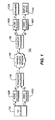
- FIG. 1 depicts a high-level block diagram of a communications system including the present invention.
- the communications system 100 comprises an audiovisual source 110, such as a mass storage device, camera, microphone, network feed or other source of audiovisual information.
- the audiovisual source 110 provides a video stream V to a video encoder 120V and a corresponding audio stream A to an audio encoder 120A, respectively.
- the encoders 120V AND 120A illustratively forming an MPEG or other compression encoders, encode the video stream V and audio stream A to produce, respectively, encoded video stream VE and encoded audio stream AE.
- the encoded video VE and audio AE streams are processed by a transport processor 130 in accordance with the particular transport format appropriate to the variable delayed network 140, illustratively an Ethernet, ATM or other transport stream encoder, which encodes the video VE and audio AE streams in accordance with the particular transport format appropriate to the variable delay network 140.
- a transport processor 130 in accordance with the particular transport format appropriate to the variable delayed network 140, illustratively an Ethernet, ATM or other transport stream encoder, which encodes the video VE and audio AE streams in accordance with the particular transport format appropriate to the variable delay network 140.
- the transport stream T is propagated by a variable delay network 140, such as the Internet, intranet, ATM, Ethernet, LAN, WAN, public switched telephone network (PSTN), satellite, or other network; to a destination where it is received as transport stream T'.
- Transport stream T' comprises the original transport stream T including any delay or other errors introduced by conveyance over the variable delay network 140.
- the resultant transport stream T' is received by a transport processor 150, illustratively an Ethernet, ATM or other transport stream decoder, which extracts from the received transport stream T' an encoded video stream VE' and a corresponding encoded audio stream AE'.
- the encoded video VE' and audio AE' streams comprise the initial encoded video VE and audio AE streams including any errors such as temporal errors induced by the transport processor 130, variable delay network 140 and/or transport processor 150.
- the received encoded video VE' and audio AE' streams are decoded by a decoder 160 to produce resulting video V' and audio A' streams.
- the resulting video V' and audio A' streams are presented by a presentation device 170, such as a television or other display device, 170V having associated with it audio presentation means such as speakers 170A.
- FIG. 2 depicts a block diagram of a controller suitable for use in the systems and apparatus, in accordance with the principles of the present invention.
- the controller 200 of FIG. 2 may be used to implement one or more of the functional elements described above with respect to FIG. 1 , as well as the various functional elements described below with respect to FIGS. 7 and 8 .
- the exemplary controller 200 of FIG. 2 comprises a processor 230 as well as memory 240 for storing various programs 245.
- the processor 230 cooperates with conventional support circuitry 220 such as power supplies, clock circuits, cache memory and the like as well as circuits that assist in executing the software routine stored in the memory 240.
- conventional support circuitry 220 such as power supplies, clock circuits, cache memory and the like as well as circuits that assist in executing the software routine stored in the memory 240.
- the controller 200 also contains input/output (I/O) circuitry 210 that forms an interface between the various functional elements communicating with a functional element including the controller 200.
- I/O input/output
- controller 200 of FIG. 2 is depicted as a general-purpose computer that is programmed to perform various temporal modifications of audio and/or video streams in accordance with the present invention
- the invention can be implemented in hardware as, for example, an application specific integrated circuit (ASIC).
- ASIC application specific integrated circuit
- t d a and t d v are the time of the related audio and video frames arriving at the presentation device 170 at the receiver side, respectively; and t e a and t e v are the time of the audio and video frames arriving at the audio and video encoders, respectively.
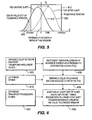
- FIG. 3 depicts a graphical representation of a probability density function p(e) of a lip sync error e useful in understanding the present invention. Due to the random delay introduced, for example, by the variable delay network 140, the delay between an audio packet and its corresponding video packet at the receiver side is a random variable. This random variable is confined by its probability density function (pdf), p ( e ), as the solid line 310 of FIG. 3 . Specifically, the graphical representation of FIG. 3 depicts a horizontal axis defining a temporal relationship between video data and corresponding audio data. A time zero is selected to represent a time at which the video data represents content having associated with it synchronized audio data.
- PDF probability density function
- audio data is said to increasingly lag the video data (i.e., audio packets are increasingly delayed with respect to corresponding video packets).
- audio data is said to increasingly lead the video data (i.e., video packets are increasingly delayed with respect to corresponding audio packets).
- FIG. 4 depicts a graphical representation of a lip sync error tolerance (LSET) window 410 useful in understanding the present invention.
- the inventors note that the asymmetric error tolerances for audio and video packets and numerous problems arising from cases when an audio packet is received before the corresponding video packet.
- FIG 5 depicts a graphical representation of a pdf shift within a tolerance window.
- the graphical representation of FIG. 5 depicts a horizontal axis defining a temporal relationship between video data and corresponding audio data.
- a time zero is selected in the manner described above with respect to FIGS. 3 and 4 .
- the delay tolerance window 410 represents the delay tolerance or temporal errors associated with lip sync that will not be found objectionable to a viewer. It is noted that the delay tolerance window 410 of FIG. 5 extends from -20 milliseconds (i.e., audio packets leading video packets by up to 20 milliseconds) up to +40 milliseconds (i.e., audio packets lagging video packets by up to 40 milliseconds).
- lip sync errors where audio information leads video information tend to be more objectionable (e.g. - more noticeable and/or distracting to a viewer) than those where audio information lags video information, thus the asymmetry in the delay tolerance window 410 of FIG. 5 .
- the left "tail” portion of a pdf curve 510 falls into a region 540 beyond a lower delay tolerance window range. It is noted that the right “tail” portion of the pdf curve 510 is substantially zero well prior to the upper end of the delay window tolerance range.
- the error window tolerance range is defined as the range in which temporal errors such as lip sync errors are deemed less offensive. Thus, delays exceeding, either positively or negatively, the delay tolerance range (i.e., delays outside of a error tolerance window) comprise those delays that are deemed objectionable or highly objectionable to the average viewer.
- a shifted pdf curve 520 represents the initial probability distribution curve 510 shifted in time such that a larger area underneath the pdf curve is within the error tolerance window 410.
- the initial or first pdf has been shifted in time such that an increased area (preferably a maximum area) under the final or second pdf is included within the error tolerance window 410.
- This shift in pdf is caused by adapting timing parameter(s) associated with video and/or audio information, such as presentation timestamps of video and/or audio access units.
- timing parameter(s) associated with video and/or audio information such as presentation timestamps of video and/or audio access units.
- Equation 3 p ( e ) is the pdf of the LSE, P ( e ) is the cumulative distribution function and W(e) is the LSET window function defined in [2], respectively.
- the process of the optimization is to maximize the area enclosed by the pdf curve bounded by [a, b]. This is equivalent to the process of minimization of the "tail" area outsides of the window.
- the optimal t 0 may have a positive or negative value, depending on the relative geographical locations between the pdf and the error tolerance window.
- a positive t 0 means delays in audio frames and negative t 0 delays in video frames to shift the LSE and to maximize equation 4.
- FIG. 6 depicts a method for processing audio and/or video packets according to the invention. Specifically, FIG. 6 depicts a method for adapting corresponding video and/or audio frame or access unit packets such that lip sync errors and, more particularly, leading audio type lip sync errors are minimized.
- lip sync errors are induced by, per box 605, an error source comprising one or more of a variable delay network, an encoder, a transport processor or other error source.
- the temporal errors likely to be produced by an error source are represented as a probability density function (pdf).
- PDF probability density function
- a pdf associated with temporal errors likely to be induced by a variable delay network are shown.
- This pdf comprises, illustratively, a random number distribution having a Gaussian shape (may or may not centered at zero), where zero represents no lip sync error (i.e., temporal alignment of video and audio data).
- an error tolerance window associated with the pdf is defined.
- the error tolerance window may be defined with respect to lip sync error or other errors.
- a delay tolerance window associated with lip sync errors is defined as, illustratively, those delays between-20 milliseconds and +40 milliseconds. That is, an asymmetrical audio delay tolerance value (with respect to the zero time point) is provided with audio access units leading corresponding video access units by up to 20 milliseconds or lagging corresponding video packets by up to 40 milliseconds is deemed tolerable.
- Other delay tolerance windows may be defined, depending upon the factors associated with a communications system utilizing the present invention.
- the method adapts timing parameters such as timestamps associated with at least one of the video and audio frames forming a content stream.
- timing parameters such as timestamps associated with at least one of the video and audio frames forming a content stream.
- one or both of non-compressed audio and video streams are delayed prior to encoding.
- This adaptation is performed in a manner tending to cause a shift in the pdf associated with the error source from an initial position (e.g., centered about zero) towards a position maximally utilizing the delay tolerance window. It is noted in box 625 that such adaptation may occur during an encoding process, a transport process or other process. Referring back to FIG. 5 , an appropriate pdf shift is shown as one that increases the amount of area under the probability distribution curve that is within the bounds established by the delay tolerance window.
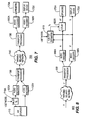
- FIG. 7 depicts a high-level block diagram of a communication system according to an alternate embodiment of the invention.
- the communication system 700 of FIG. 7 is substantially the same as the communication system 100 of FIG. 1 .
- the main difference is that a delay element 710A is used to delay the initial audio stream A prior to the encoding of this audio stream by the audio encoder 120A.
- the delay element 710A imparts a delay of t 0 to the audio stream to shift a corresponding pdf in accordance with the lip sync error tolerance (LSET) model discussed above.
- LSET lip sync error tolerance
- the communication system 700 of FIG. 7 may be modified to include a corresponding video delay element 710V (not shown) for delaying the video source signal V prior to encoding by the video encoder 120V.
- One or both of the audio 710A and video 710V delay elements may be utilized.
- each, illustratively, audio frame or access unit is delayed by approximately t 0 milliseconds with respect to each video frame prior to encoding.
- the pdf associated with the errors induced by the variable delay network is shifted in the manner described above with respect to FIG. 5 . That is, the pdf is shifted forward or backward, depending on the sign of t 0 , in time from a tendency to have a leading audio packet lip sync error to a tendency for no lip sync error or a lagging audio packet lip sync error (which is less objectionable than a leading audio packet lip sync error).
- the probability is increased that any audio packet delay will remain within the error tolerance limits set by the error tolerance window 410.
- the timestamps of the audio or video frames are modified to minimize the timing mismatch.
- the video timestamp is optionally modified in a manner tending to increase the probability of the timing mismatch remaining within the LSET on the decoder side.
- the above technique introduces a uniformly distributed delay in audio packets in the range from 0 to 9 millisecond.
- Other ranges may be selected (e.g.., mod 15, mod 20, etc.), and audio packets may also be processed in this manner.
- the LSE pdf's are known and presumed to be somewhat stable. As a result, a predetermined time shift is performed on all audio (or video) access units. In a more advanced embodiment where the LSE pdf may be not known or is not stable, the LSE pdf is monitored and estimated, and the time shift is not predetermined.
- FIG. 8 depicts the LSE in the embodiment where a pdf estimator is implemented at the receiver side.
- receiver-side apparatus such as depicted above in FIGS. 1 and 7 is modified to include an LSE pdf estimator 810 and an audio delay element 820A. While not shown, a video delay element 820V may also be utilized.
- the LSE pdf estimator 810 receives the decoded audio A' and video V' signals and, in response to LSET model information, produces a delay indicative signal t 0 .
- the delay indicative signal t 0 is processed by the audio delay element 820A to impart a corresponding amount of delay to the decoded audio stream A', thereby producing a delayed audio stream A".
- the estimator 810 constantly collects presentation time stamps of audio and video access units. Each LSE e is calculated using equation 1. All the LSEs are used to form the pdf of the LSE. By using the LSET model, the optimal time shift t 0 can be derived by solving equation 4 for the time shift t 0 . Delay in either the audio frame ( t 0 > 0) or video frame ( t 0 ⁇ 0) is added to shift the LSE pdf.
- the determined optical timeshift is propagated from the receiver to the encoder such that at least one of the audio and video streams to be encoded and transmitted is delayed prior to encoding, prior to transport processing and/or prior to transport to the receiver.
Landscapes
- Engineering & Computer Science (AREA)
- Signal Processing (AREA)
- Multimedia (AREA)
- Computer Security & Cryptography (AREA)
- Computer Networks & Wireless Communication (AREA)
- Two-Way Televisions, Distribution Of Moving Picture Or The Like (AREA)
- Synchronisation In Digital Transmission Systems (AREA)
- Data Exchanges In Wide-Area Networks (AREA)
- Television Systems (AREA)
- Compression Or Coding Systems Of Tv Signals (AREA)
- Testing, Inspecting, Measuring Of Stereoscopic Televisions And Televisions (AREA)
Claims (18)
- Procédé comprenant :la réception (610) d'unités d'accès vidéo et d'unités d'accès audio correspondantes, représentant des informations audiovisuelles indiquant une erreur de synchronisation temporelle audiovisuelle décrite par une première fonction de distribution de probabilité (pdf) (510) ; etun retardement temporel (630) de l'une desdites unités d'accès audio et vidéo à l'aide d'une quantité de retard, dans lequel les unités d'accès retardées et les unités d'accès non retardées représentent des informations audiovisuelles indiquant une erreur de synchronisation temporelle audiovisuelle décrite par une seconde fonction de distribution de probabilité (pdf) (520), et dans lequel la zone située sous ladite seconde fonction de distribution de probabilité (pdf) se trouvant dans une fenêtre de tolérance d'erreur de synchronisation asymétrique (LSET) (410) est plus grande que la zone située sous ladite première fonction de distribution de probabilité (pdf) (510) se trouvant dans ladite fenêtre LSET asymétrique (410).
- Procédé selon la revendication 1, dans lequel :ladite fenêtre LSET asymétrique (410) est associée à une valeur d'écart temporel négative etune valeur d'écart temporel positive, représentant deux valeurs absolues différentes ; etladite quantité de retard est sélectionnée pour optimiser la zone de ladite fenêtre de tolérance de synchronisation asymétrique (410) occupée par ladite seconde fonction de distribution de probabilité (pdf) entre lesdites valeurs d'écart temporel positive et négative (630).
- Procédé selon la revendication 1 ou 2, dans lequel ladite quantité de retard est transmise avant un codage des flux audio et vidéo produisant lesdites unités d'accès audio et vidéo (710).
- Procédé selon la revendication 1, comprenant en outre l'adaptation (810, 820) de ladite quantité de retard en réponse aux changements dans ladite première fonction de distribution de probabilité (pdf) (510).
- Procédé selon la revendication 4, dans lequel lesdits changements sont déterminés en examinant les estampilles temporelles de présentation des unités d'accès audio et vidéo au niveau d'un récepteur.
- Procédé selon l'une des revendications 1 à 5, comprenant en outre l'adaptation de ladite quantité de retard en réponse aux changements dans une source d'erreur de synchronisation temporelle audiovisuelle.
- Procédé selon la revendication 6, dans lequel ladite source d'erreur de synchronisation temporelle audiovisuelle comprend un réseau à retard variable (140).
- Procédé selon l'une des revendications 1 ou 3 à 7, dans lequel ladite quantité de retard permet de maximiser la zone de la fenêtre de tolérance de synchronisation asymétrique occupée par ladite seconde fonction de distribution de probabilité (pdf) (520).
- Procédé de production et de réception de vidéos codées et de flux audio codés correspondants comprenant :un retardement temporel (710) de l'un desdits flux audio et vidéo grâce à une quantité de retard temporel, afin de produire un flux à retard temporel ; etun codage (120) dudit flux à retard temporel et de l'autre flux non retardé au niveau d'un émetteur, afin de produire des flux audio et vidéo codés pouvant être transmis dans un réseau à retard variable,dans lequel ledit retard temporel pousse au niveau du récepteur une seconde fonction de distribution de probabilité (pdf) (520) décrivant une erreur de synchronisation entre les flux audio et vidéo reçus à être telle que la zone située sous ladite seconde fonction de distribution de probabilité (pdf) (520) se trouvant dans une fenêtre de tolérance d'erreur de synchronisation asymétrique (LSET) (410) soit plus grande que la zone située sous ladite première fonction de distribution de probabilité (pdf) (510) se trouvant dans ladite fenêtre LSET asymétrique (410), et dans lequel ladite première fonction de distribution de probabilité (pdf) (510) décrit une erreur de synchronisation entre les flux audio et vidéo reçus si aucun retard temporel n'a été appliqué au niveau de l'émetteur.
- Procédé selon la revendication 9, dans lequel chacun desdits flux audio et vidéo codés comprend une pluralité d'unités d'accès audio et vidéo respectives ; et ladite étape de retardement temporel comprend l'adaptation d'estampilles temporelles associées à au moins l'une desdites unités d'accès audio et vidéo grâce à ladite quantité de retard.
- Procédé selon la revendication 9 ou 10, dans lequel ladite quantité de retard permet de maximiser la zone de la fenêtre de tolérance de synchronisation asymétrique (410) occupée par ladite fonction de distribution de probabilité (pdf) retardée (520).
- Système comprenant :un élément de retard (710), permettant de transmettre un retard temporel à au moins un de signal audio et de signal vidéo correspondant pour produire des flux audio et vidéo de sortie retardés; et un encodeur (120), permettant de coder les flux audio et vidéo de sortie retardés pour produire des flux audio et vidéo codés pouvant être transmis dans un réseau à retard variable,dans lequel ledit retard temporel pousse, au niveau du récepteur, une seconde fonction de distribution de probabilité (pdf) (520) décrivant une erreur de synchronisation entre les flux audio et vidéo reçus et le signal vidéo correspondant à être telle que la zone située sous ladite seconde fonction de distribution de probabilité (pdf) (520) se trouvant dans une fenêtre de tolérance d'erreur de synchronisation asymétrique (LSET) (410) soit plus grande que la zone située sous ladite première fonction de distribution de probabilité (pdf) (510) se trouvant dans ladite fenêtre LSET asymétrique (410), et dans lequel ladite première fonction de distribution de probabilité (pdf) (510) décrit une erreur de synchronisation entre les flux audio et vidéo reçus si aucun retard temporel n'a été appliqué dans ledit élément de retard.
- Système selon la revendication 12, dans lequel ladite fenêtre de tolérance de synchronisation asymétrique (410) est associée à une valeur d'écart temporel négative et une valeur d'écart temporel positive, représentant deux valeurs absolues différentes.
- Système selon la revendication 12 ou 13, dans lequel ledit retard temporel permet de maximiser la zone de la fenêtre de tolérance de synchronisation asymétrique (410) occupée par ladite fonction de distribution de probabilité (pdf) retardée.
- Système selon la revendication 12, dans lequel ledit retard est prédéfini lorsque la fonction de distribution de probabilité (pdf) de l'erreur de synchronisation est connue et stable, ou non prédéfinie dans les autres cas, dans lequel le retard non prédéfini résulte de l'évaluation et de la surveillance de la fonction de distribution de probabilité (pdf) de l'erreur de synchronisation, et dans lequel ledit récepteur comprend un estimateur de fonction de distribution de probabilité (pdf) pour la réception de flux audio et vidéo décodés et la production dudit retard en réponse aux informations du modèle de tolérance d'erreur de synchronisation.
- Support lisible par ordinateur comportant des instructions exécutables par un ordinateur pour effectuer des étapes comprenant :la réception (610) d'unités d'accès vidéo et d'unités d'accès audio correspondantes,représentant des informations audiovisuelles indiquant une erreur de synchronisation temporelle audiovisuelle décrite par une première fonction de distribution de probabilité (pdf) (510) ; etun retardement temporel (630) de l'une desdites unités d'accès audio et vidéo à l'aide d'une quantité de retard, dans lequel les unités d'accès retardées et les unités d'accès non retardées représentent des informations audiovisuelles indiquant une erreur de synchronisation temporelle audiovisuelle décrite par une seconde fonction de distribution de probabilité (pdf) (520), et dans lequel la zone située sous ladite seconde fonction de distribution de probabilité (pdf) se trouvant dans une fenêtre de tolérance d'erreur de synchronisation asymétrique (LSET) (410) est plus grande que la zone située sous ladite première fonction de distribution de probabilité (pdf) (510) se trouvant dans ladite fenêtre LSET asymétrique (410).
- Support lisible par ordinateur selon la revendication 16, dans lequel ladite quantité de retard permet de maximiser la zone de la fenêtre de tolérance de synchronisation asymétrique occupée par ladite seconde fonction de distribution de probabilité (pdf) (520).
- Support lisible par ordinateur selon la revendication 16, dans lequel ledit retard est prédéfini lorsque la fonction de distribution de probabilité (pdf) de l'erreur de synchronisation est connue et stable, ou non prédéfinie dans les autres cas, dans lequel le retard non prédéfini résulte de l'évaluation et de la surveillance de la fonction de distribution de probabilité (pdf) de l'erreur de synchronisation, et dans lequel ledit récepteur comprend un estimateur de fonction de distribution de probabilité (pdf) pour la réception de flux audio et vidéo décodés et la production dudit retard en réponse aux informations du modèle de tolérance d'erreur de synchronisation.
Applications Claiming Priority (5)
| Application Number | Priority Date | Filing Date | Title |
|---|---|---|---|
| US37426902P | 2002-04-19 | 2002-04-19 | |
| US374269P | 2002-04-19 | ||
| US10/340,477 US6956871B2 (en) | 2002-04-19 | 2003-01-10 | Apparatus and method for synchronization of audio and video streams |
| US340477 | 2003-01-10 | ||
| PCT/US2003/011630 WO2003090443A2 (fr) | 2002-04-19 | 2003-04-15 | Appareil et procede de synchronisation de flux audio et video |
Publications (3)
| Publication Number | Publication Date |
|---|---|
| EP1497937A2 EP1497937A2 (fr) | 2005-01-19 |
| EP1497937A4 EP1497937A4 (fr) | 2010-01-20 |
| EP1497937B1 true EP1497937B1 (fr) | 2015-04-01 |
Family
ID=29218754
Family Applications (1)
| Application Number | Title | Priority Date | Filing Date |
|---|---|---|---|
| EP03718410.8A Expired - Lifetime EP1497937B1 (fr) | 2002-04-19 | 2003-04-15 | Appareil et procede de synchronisation de flux audio et video |
Country Status (10)
| Country | Link |
|---|---|
| US (1) | US6956871B2 (fr) |
| EP (1) | EP1497937B1 (fr) |
| JP (1) | JP4472360B2 (fr) |
| KR (1) | KR100968928B1 (fr) |
| CN (1) | CN1745526B (fr) |
| AU (1) | AU2003221949A1 (fr) |
| BR (2) | BRPI0304532B1 (fr) |
| MX (1) | MXPA04010330A (fr) |
| MY (1) | MY136919A (fr) |
| WO (1) | WO2003090443A2 (fr) |
Families Citing this family (40)
| Publication number | Priority date | Publication date | Assignee | Title |
|---|---|---|---|---|
| US7120168B2 (en) * | 2001-11-20 | 2006-10-10 | Sony Corporation | System and method for effectively performing an audio/video synchronization procedure |
| US8133115B2 (en) | 2003-10-22 | 2012-03-13 | Sony Computer Entertainment America Llc | System and method for recording and displaying a graphical path in a video game |
| JP3856792B2 (ja) * | 2004-01-16 | 2006-12-13 | 松下電器産業株式会社 | 信号処理装置 |
| DE102004017215A1 (de) * | 2004-04-05 | 2005-10-20 | Sennheiser Electronic | Audiovisuelles System |
| US7333150B2 (en) * | 2004-05-14 | 2008-02-19 | Pixel Instruments Corporation | Method, system, and program product for eliminating error contribution from production switchers with internal DVEs |
| US7471337B2 (en) * | 2004-06-09 | 2008-12-30 | Lsi Corporation | Method of audio-video synchronization |
| US7400653B2 (en) * | 2004-06-18 | 2008-07-15 | Dolby Laboratories Licensing Corporation | Maintaining synchronization of streaming audio and video using internet protocol |
| US20060071933A1 (en) | 2004-10-06 | 2006-04-06 | Sony Computer Entertainment Inc. | Application binary interface for multi-pass shaders |
| US7636126B2 (en) * | 2005-06-22 | 2009-12-22 | Sony Computer Entertainment Inc. | Delay matching in audio/video systems |
| US20070067472A1 (en) * | 2005-09-20 | 2007-03-22 | Lsi Logic Corporation | Accurate and error resilient time stamping method and/or apparatus for the audio-video interleaved (AVI) format |
| CN100442858C (zh) * | 2005-10-11 | 2008-12-10 | 华为技术有限公司 | 分组网络中多媒体实时传输的唇同步方法及其装置 |
| US7822073B2 (en) * | 2005-11-03 | 2010-10-26 | George Mason Intellectual Properties, Inc. | Packet flow side channel |
| EP1801786B1 (fr) * | 2005-12-20 | 2014-12-10 | Oticon A/S | Système audio avec délai temporel variable et procédé de traitement des signaux audio. |
| US7880746B2 (en) | 2006-05-04 | 2011-02-01 | Sony Computer Entertainment Inc. | Bandwidth management through lighting control of a user environment via a display device |
| US7965859B2 (en) | 2006-05-04 | 2011-06-21 | Sony Computer Entertainment Inc. | Lighting control of a user environment via a display device |
| US20080043144A1 (en) * | 2006-08-21 | 2008-02-21 | International Business Machines Corporation | Multimodal identification and tracking of speakers in video |
| US7953118B2 (en) * | 2006-12-08 | 2011-05-31 | Microsoft Corporation | Synchronizing media streams across multiple devices |
| US20080147728A1 (en) * | 2006-12-15 | 2008-06-19 | Tal Reichert | Exposure-based scheduling |
| JP4948147B2 (ja) | 2006-12-15 | 2012-06-06 | 富士通株式会社 | 複合コンテンツファイルの編集方法および装置 |
| US20080148327A1 (en) * | 2006-12-18 | 2008-06-19 | General Instrument Corporation | Method and Apparatus for Providing Adaptive Trick Play Control of Streaming Digital Video |
| CN101212690B (zh) * | 2006-12-26 | 2011-04-20 | 中兴通讯股份有限公司 | 多媒体视音频流唇音同步的调测方法 |
| KR20090015455A (ko) * | 2007-08-08 | 2009-02-12 | 삼성전자주식회사 | 오디오 신호 및 비디오 신호를 상호 의존적으로 제어하는방법과 그 장치 |
| WO2010021966A1 (fr) * | 2008-08-21 | 2010-02-25 | Dolby Laboratories Licensing Corporation | Estimation de l’optimisation et de la fiabilité d’une propriété pour la génération et la détection de signatures audio et vidéo |
| US8731370B2 (en) * | 2009-01-12 | 2014-05-20 | At&T Intellectual Property I, L.P. | Method and device for transmitting audio and video for playback |
| EP2323392B1 (fr) * | 2009-11-03 | 2012-01-04 | Tektronix International Sales GmbH | Procédé et appareil de mesure de délai dans un flux numérique compressé |
| US9819840B2 (en) * | 2010-01-11 | 2017-11-14 | Bryan Nunes | Audio device that extracts the audio of a multimedia stream and serves the audio on a network while the video is displayed |
| US10786736B2 (en) | 2010-05-11 | 2020-09-29 | Sony Interactive Entertainment LLC | Placement of user information in a game space |
| US8988489B2 (en) | 2010-09-15 | 2015-03-24 | Hewlett-Packard Development Company, L. P. | Determining a synchronization relationship |
| US8878894B2 (en) | 2010-09-15 | 2014-11-04 | Hewlett-Packard Development Company, L.P. | Estimating video cross-talk |
| US9565426B2 (en) | 2010-11-12 | 2017-02-07 | At&T Intellectual Property I, L.P. | Lip sync error detection and correction |
| US9014170B2 (en) * | 2011-02-11 | 2015-04-21 | Interdigital Patent Holdings, Inc. | Method and apparatus for synchronizing mobile station media flows during a collaborative session |
| US9342817B2 (en) | 2011-07-07 | 2016-05-17 | Sony Interactive Entertainment LLC | Auto-creating groups for sharing photos |
| US9525900B2 (en) | 2011-09-15 | 2016-12-20 | Google Inc. | Video management system |
| US9516262B2 (en) * | 2012-05-07 | 2016-12-06 | Comigo Ltd. | System and methods for managing telephonic communications |
| CN103475906B (zh) * | 2012-06-08 | 2016-08-10 | 华为技术有限公司 | 用于多媒体流的测量方法和测量装置 |
| CN103581604A (zh) * | 2012-08-01 | 2014-02-12 | 希姆通信息技术(上海)有限公司 | 视频通话装置及方法 |
| US10158927B1 (en) * | 2012-09-05 | 2018-12-18 | Google Llc | Systems and methods for detecting audio-video synchronization using timestamps |
| CN105704506A (zh) * | 2016-01-19 | 2016-06-22 | 北京流金岁月文化传播股份有限公司 | 一种解决视音频编码唇音同步的装置和方法 |
| US11871068B1 (en) * | 2019-12-12 | 2024-01-09 | Amazon Technologies, Inc. | Techniques for detecting non-synchronization between audio and video |
| CN112770165B (zh) * | 2020-12-28 | 2022-11-18 | 杭州电子科技大学 | 一种音视频流分布式同步方法 |
Family Cites Families (21)
| Publication number | Priority date | Publication date | Assignee | Title |
|---|---|---|---|---|
| US5467139A (en) * | 1993-09-30 | 1995-11-14 | Thomson Consumer Electronics, Inc. | Muting apparatus for a compressed audio/video signal receiver |
| US5559999A (en) | 1994-09-09 | 1996-09-24 | Lsi Logic Corporation | MPEG decoding system including tag list for associating presentation time stamps with encoded data units |
| US5818514A (en) | 1994-12-01 | 1998-10-06 | Lucent Technologies Inc. | Video conferencing system and method for providing enhanced interactive communication |
| US5588029A (en) | 1995-01-20 | 1996-12-24 | Lsi Logic Corporation | MPEG audio synchronization system using subframe skip and repeat |
| US5543853A (en) * | 1995-01-19 | 1996-08-06 | At&T Corp. | Encoder/decoder buffer control for variable bit-rate channel |
| US5623483A (en) * | 1995-05-11 | 1997-04-22 | Lucent Technologies Inc. | Synchronization system for networked multimedia streams |
| US5570372A (en) | 1995-11-08 | 1996-10-29 | Siemens Rolm Communications Inc. | Multimedia communications with system-dependent adaptive delays |
| US5703877A (en) | 1995-11-22 | 1997-12-30 | General Instrument Corporation Of Delaware | Acquisition and error recovery of audio data carried in a packetized data stream |
| US6169843B1 (en) | 1995-12-01 | 2001-01-02 | Harmonic, Inc. | Recording and playback of audio-video transport streams |
| US5617502A (en) | 1996-03-22 | 1997-04-01 | Cirrus Logic, Inc. | System and method synchronizing audio and video digital data signals during playback |
| KR100244745B1 (ko) | 1996-06-29 | 2000-02-15 | 김영환 | 싱크 워드 검출회로 |
| US5949410A (en) | 1996-10-18 | 1999-09-07 | Samsung Electronics Company, Ltd. | Apparatus and method for synchronizing audio and video frames in an MPEG presentation system |
| US6151443A (en) | 1997-05-16 | 2000-11-21 | Indigita Corporation | Digital video and data recorder |
| GB2326781B (en) * | 1997-05-30 | 2001-10-10 | British Broadcasting Corp | Video and audio signal processing |
| US6115422A (en) | 1997-09-26 | 2000-09-05 | International Business Machines Corporation | Protocol and procedure for time base change in an MPEG-2 compliant datastream |
| DE19754296A1 (de) | 1997-12-08 | 1999-06-10 | Thomson Brandt Gmbh | Synchronisationseinrichtung |
| KR100294663B1 (ko) | 1997-12-29 | 2001-09-17 | 구자홍 | 엠펙디코더및디코딩제어방법 |
| EP1057337B1 (fr) | 1998-02-27 | 2003-04-23 | Ridgeway Systems and Software Ltd. | Synchronisation de paquet audio-video au niveau d'une passerelle reseau |
| US6285405B1 (en) * | 1998-10-14 | 2001-09-04 | Vtel Corporation | System and method for synchronizing data signals |
| US6363429B1 (en) | 1999-04-20 | 2002-03-26 | 3Com Corporation | Method and system for automatic determination of priority data streams on computer networks |
| US7346698B2 (en) * | 2000-12-20 | 2008-03-18 | G. W. Hannaway & Associates | Webcasting method and system for time-based synchronization of multiple, independent media streams |
-
2003
- 2003-01-10 US US10/340,477 patent/US6956871B2/en not_active Expired - Lifetime
- 2003-04-15 JP JP2003587092A patent/JP4472360B2/ja not_active Expired - Fee Related
- 2003-04-15 BR BRPI0304532-3A patent/BRPI0304532B1/pt unknown
- 2003-04-15 CN CN038087499A patent/CN1745526B/zh not_active Expired - Fee Related
- 2003-04-15 AU AU2003221949A patent/AU2003221949A1/en not_active Abandoned
- 2003-04-15 EP EP03718410.8A patent/EP1497937B1/fr not_active Expired - Lifetime
- 2003-04-15 MX MXPA04010330A patent/MXPA04010330A/es active IP Right Grant
- 2003-04-15 WO PCT/US2003/011630 patent/WO2003090443A2/fr not_active Ceased
- 2003-04-15 KR KR1020047016369A patent/KR100968928B1/ko not_active Expired - Fee Related
- 2003-04-15 BR BR0304532-3A patent/BR0304532A/pt not_active IP Right Cessation
- 2003-04-18 MY MYPI20031477A patent/MY136919A/en unknown
Also Published As
| Publication number | Publication date |
|---|---|
| US20030198256A1 (en) | 2003-10-23 |
| EP1497937A2 (fr) | 2005-01-19 |
| KR20040105869A (ko) | 2004-12-16 |
| US6956871B2 (en) | 2005-10-18 |
| AU2003221949A1 (en) | 2003-11-03 |
| AU2003221949A8 (en) | 2003-11-03 |
| BRPI0304532B1 (pt) | 2018-02-06 |
| WO2003090443A2 (fr) | 2003-10-30 |
| MXPA04010330A (es) | 2005-02-03 |
| CN1745526B (zh) | 2010-09-29 |
| EP1497937A4 (fr) | 2010-01-20 |
| WO2003090443A3 (fr) | 2004-04-22 |
| BR0304532A (pt) | 2004-07-06 |
| KR100968928B1 (ko) | 2010-07-14 |
| JP4472360B2 (ja) | 2010-06-02 |
| CN1745526A (zh) | 2006-03-08 |
| MY136919A (en) | 2008-11-28 |
| JP2005523650A (ja) | 2005-08-04 |
Similar Documents
| Publication | Publication Date | Title |
|---|---|---|
| EP1497937B1 (fr) | Appareil et procede de synchronisation de flux audio et video | |
| US7711244B2 (en) | Video/audio synchronizing apparatus | |
| US8351762B2 (en) | Adaptive media playout method and apparatus for intra-media synchronization | |
| US7983345B2 (en) | Content receiving apparatus, video/audio output timing control method, and content provision system | |
| US7787500B2 (en) | Packet receiving method and device | |
| JP4782973B2 (ja) | オーディオおよびビデオ信号の同期化 | |
| KR100722707B1 (ko) | 멀티미디어 신호를 전송하기 위한 전송 시스템 | |
| CN108259964B (zh) | 一种视频播放速率调整方法及系统 | |
| CN111741248A (zh) | 一种数据传输方法、装置、终端设备和存储介质 | |
| KR100918598B1 (ko) | 이산 시간 레이블된 비디오를 아날로그 출력 신호로변환하는 시간 기반 복원 | |
| US6775301B1 (en) | System and method for compensating for channel jitter | |
| US8854964B2 (en) | Method and apparatus for determining a transport bit rate for a Multiprogram transport stream | |
| EP1528724A1 (fr) | Dispositif et procede de traitement d'informations, support d'enregistrement et programme | |
| US7983309B2 (en) | Buffering time determination | |
| JP3299185B2 (ja) | 符号化装置 | |
| JP4298262B2 (ja) | 映像音声同期装置 | |
| Krämer et al. | Network music performance with ultra-low-delay audio coding under unreliable network conditions | |
| US6829304B1 (en) | Method for clock recovery in MPEG systems | |
| CN109889876B (zh) | 一种基于直通音频的ts传输流音视频同步装置和方法 | |
| CA2651701C (fr) | Generation d'horodatages valides d'horloge de reference de programme pour paquets dupliques de flux de transport | |
| JP4882213B2 (ja) | コンテンツ受信装置、ビデオオーディオ出力タイミング制御方法及びコンテンツ提供システム | |
| JP2005159679A (ja) | 映像音声通信システム | |
| CN119729083A (zh) | 音视频处理方法、装置、电子设备及计算机程序产品 | |
| Deshpande | Underflow prevention for AV streaming media under varying channel conditions | |
| CN121284308A (zh) | 多路网络流的同步方法、装置、设备及存储介质 |
Legal Events
| Date | Code | Title | Description |
|---|---|---|---|
| PUAI | Public reference made under article 153(3) epc to a published international application that has entered the european phase |
Free format text: ORIGINAL CODE: 0009012 |
|
| 17P | Request for examination filed |
Effective date: 20041008 |
|
| AK | Designated contracting states |
Kind code of ref document: A2 Designated state(s): AT BE BG CH CY CZ DE DK EE ES FI FR GB GR HU IE IT LI LU MC NL PT RO SE SI SK TR |
|
| AX | Request for extension of the european patent |
Extension state: AL LT LV MK |
|
| RAP1 | Party data changed (applicant data changed or rights of an application transferred) |
Owner name: THOMSON LICENSING |
|
| A4 | Supplementary search report drawn up and despatched |
Effective date: 20091217 |
|
| RIC1 | Information provided on ipc code assigned before grant |
Ipc: H04J 3/06 20060101AFI20041011BHEP Ipc: H04N 5/04 20060101ALI20091211BHEP Ipc: H04N 9/475 20060101ALI20091211BHEP |
|
| RAP1 | Party data changed (applicant data changed or rights of an application transferred) |
Owner name: THOMSON LICENSING |
|
| 17Q | First examination report despatched |
Effective date: 20100318 |
|
| GRAP | Despatch of communication of intention to grant a patent |
Free format text: ORIGINAL CODE: EPIDOSNIGR1 |
|
| INTG | Intention to grant announced |
Effective date: 20141127 |
|
| GRAS | Grant fee paid |
Free format text: ORIGINAL CODE: EPIDOSNIGR3 |
|
| GRAA | (expected) grant |
Free format text: ORIGINAL CODE: 0009210 |
|
| AK | Designated contracting states |
Kind code of ref document: B1 Designated state(s): DE ES FR GB IT |
|
| REG | Reference to a national code |
Ref country code: GB Ref legal event code: FG4D |
|
| REG | Reference to a national code |
Ref country code: DE Ref legal event code: R084 Ref document number: 60347458 Country of ref document: DE |
|
| REG | Reference to a national code |
Ref country code: DE Ref legal event code: R096 Ref document number: 60347458 Country of ref document: DE Effective date: 20150521 |
|
| REG | Reference to a national code |
Ref country code: DE Ref legal event code: R084 Ref document number: 60347458 Country of ref document: DE Effective date: 20150414 |
|
| PG25 | Lapsed in a contracting state [announced via postgrant information from national office to epo] |
Ref country code: ES Free format text: LAPSE BECAUSE OF FAILURE TO SUBMIT A TRANSLATION OF THE DESCRIPTION OR TO PAY THE FEE WITHIN THE PRESCRIBED TIME-LIMIT Effective date: 20150401 |
|
| REG | Reference to a national code |
Ref country code: DE Ref legal event code: R097 Ref document number: 60347458 Country of ref document: DE |
|
| PG25 | Lapsed in a contracting state [announced via postgrant information from national office to epo] |
Ref country code: IT Free format text: LAPSE BECAUSE OF FAILURE TO SUBMIT A TRANSLATION OF THE DESCRIPTION OR TO PAY THE FEE WITHIN THE PRESCRIBED TIME-LIMIT Effective date: 20150401 |
|
| PLBE | No opposition filed within time limit |
Free format text: ORIGINAL CODE: 0009261 |
|
| STAA | Information on the status of an ep patent application or granted ep patent |
Free format text: STATUS: NO OPPOSITION FILED WITHIN TIME LIMIT |
|
| 26N | No opposition filed |
Effective date: 20160105 |
|
| GBPC | Gb: european patent ceased through non-payment of renewal fee |
Effective date: 20150701 |
|
| REG | Reference to a national code |
Ref country code: FR Ref legal event code: PLFP Year of fee payment: 14 |
|
| PG25 | Lapsed in a contracting state [announced via postgrant information from national office to epo] |
Ref country code: GB Free format text: LAPSE BECAUSE OF NON-PAYMENT OF DUE FEES Effective date: 20150701 |
|
| REG | Reference to a national code |
Ref country code: FR Ref legal event code: PLFP Year of fee payment: 15 |
|
| REG | Reference to a national code |
Ref country code: DE Ref legal event code: R082 Ref document number: 60347458 Country of ref document: DE Representative=s name: HOFSTETTER, SCHURACK & PARTNER PATENT- UND REC, DE |
|
| REG | Reference to a national code |
Ref country code: FR Ref legal event code: PLFP Year of fee payment: 16 |
|
| PGFP | Annual fee paid to national office [announced via postgrant information from national office to epo] |
Ref country code: DE Payment date: 20180426 Year of fee payment: 16 |
|
| PGFP | Annual fee paid to national office [announced via postgrant information from national office to epo] |
Ref country code: FR Payment date: 20180424 Year of fee payment: 16 |
|
| REG | Reference to a national code |
Ref country code: DE Ref legal event code: R119 Ref document number: 60347458 Country of ref document: DE |
|
| PG25 | Lapsed in a contracting state [announced via postgrant information from national office to epo] |
Ref country code: DE Free format text: LAPSE BECAUSE OF NON-PAYMENT OF DUE FEES Effective date: 20191101 |
|
| PG25 | Lapsed in a contracting state [announced via postgrant information from national office to epo] |
Ref country code: FR Free format text: LAPSE BECAUSE OF NON-PAYMENT OF DUE FEES Effective date: 20190430 |