EP1498061A1 - Elektrohaushaltsgerät mit einen Motor und Verfahren zum Steuern eines solchen Motors - Google Patents
Elektrohaushaltsgerät mit einen Motor und Verfahren zum Steuern eines solchen Motors Download PDFInfo
- Publication number
- EP1498061A1 EP1498061A1 EP04356121A EP04356121A EP1498061A1 EP 1498061 A1 EP1498061 A1 EP 1498061A1 EP 04356121 A EP04356121 A EP 04356121A EP 04356121 A EP04356121 A EP 04356121A EP 1498061 A1 EP1498061 A1 EP 1498061A1
- Authority
- EP
- European Patent Office
- Prior art keywords
- motor
- carriage
- voltage
- appliance according
- sign
- Prior art date
- Legal status (The legal status is an assumption and is not a legal conclusion. Google has not performed a legal analysis and makes no representation as to the accuracy of the status listed.)
- Withdrawn
Links
- 238000000034 method Methods 0.000 title claims abstract description 11
- 230000033001 locomotion Effects 0.000 claims description 25
- 238000005259 measurement Methods 0.000 claims description 14
- 230000007246 mechanism Effects 0.000 claims description 12
- 235000021168 barbecue Nutrition 0.000 claims description 4
- 230000010354 integration Effects 0.000 claims description 3
- 235000008429 bread Nutrition 0.000 description 15
- 238000010438 heat treatment Methods 0.000 description 11
- 238000010411 cooking Methods 0.000 description 6
- 238000009423 ventilation Methods 0.000 description 4
- 238000004804 winding Methods 0.000 description 4
- 238000010586 diagram Methods 0.000 description 3
- 238000006073 displacement reaction Methods 0.000 description 3
- 235000013305 food Nutrition 0.000 description 3
- 210000000056 organ Anatomy 0.000 description 3
- 230000000694 effects Effects 0.000 description 2
- 230000006872 improvement Effects 0.000 description 2
- 230000003068 static effect Effects 0.000 description 2
- 230000001133 acceleration Effects 0.000 description 1
- 230000005540 biological transmission Effects 0.000 description 1
- 230000000903 blocking effect Effects 0.000 description 1
- 230000002860 competitive effect Effects 0.000 description 1
- 230000005347 demagnetization Effects 0.000 description 1
- 238000001514 detection method Methods 0.000 description 1
- 238000009413 insulation Methods 0.000 description 1
- 238000012423 maintenance Methods 0.000 description 1
- 238000012544 monitoring process Methods 0.000 description 1
- 230000008569 process Effects 0.000 description 1
- 230000000630 rising effect Effects 0.000 description 1
- 238000013519 translation Methods 0.000 description 1
- 230000000007 visual effect Effects 0.000 description 1
Images

Classifications
-
- A—HUMAN NECESSITIES
- A47—FURNITURE; DOMESTIC ARTICLES OR APPLIANCES; COFFEE MILLS; SPICE MILLS; SUCTION CLEANERS IN GENERAL
- A47J—KITCHEN EQUIPMENT; COFFEE MILLS; SPICE MILLS; APPARATUS FOR MAKING BEVERAGES
- A47J37/00—Baking; Roasting; Grilling; Frying
- A47J37/12—Deep fat fryers, e.g. for frying fish or chips
- A47J37/1266—Control devices, e.g. to control temperature, level or quality of the frying liquid
-
- A—HUMAN NECESSITIES
- A47—FURNITURE; DOMESTIC ARTICLES OR APPLIANCES; COFFEE MILLS; SPICE MILLS; SUCTION CLEANERS IN GENERAL
- A47J—KITCHEN EQUIPMENT; COFFEE MILLS; SPICE MILLS; APPARATUS FOR MAKING BEVERAGES
- A47J37/00—Baking; Roasting; Grilling; Frying
- A47J37/06—Roasters; Grills; Sandwich grills
- A47J37/08—Bread-toasters
- A47J37/0814—Bread-toasters with automatic bread ejection or timing means
- A47J37/0842—Bread-toasters with automatic bread ejection or timing means with electronic timers
Definitions
- the invention relates to the appliance sector, and more particularly to electrical household appliances, generally intended for heating or cooking functions. It concerns more specifically an upgrade to appliances in which the displacement of an inner part forming either a carriage or a support, such as a grid or a cover, is provided by a mechanism motorized.
- the invention relates more particularly to devices whose motor control makes it possible to overcome the presence of sensors of position or end-of-travel sensors.
- a toaster comprises a bread carrier, which is able to move inside a chassis, to allow to come to position slices of toast next to heating elements. Move of the trolley can be performed under the effect of a force exerted by the user, or well by a spring or a return element, or by a mechanism motorized.
- Motorized mechanisms for moving the carriage bread therefore generally include a position sensor, allowing detect that the truck has reached its extreme positions.
- These position sensors may for example be contacts electrical devices that deliver electrical information when the truck reaches an extreme position.
- adding such a sensor in a toaster inevitably increases the cost price, especially since it is generally necessary to provide two sensors, corresponding to the extreme high and low positions of the truck.
- a problem to be solved by the invention is that of allow the correct control of the carriage movement in the absence of position sensor or limit switch sensor of the truck.
- the invention therefore relates to an electrical household appliance such as a toaster, a barbecue, or a deep fryer.
- such a device comprises a frame and a carriage mobile.
- the mobile carriage is able to move in a reciprocating motion relative to the chassis through a mechanism including an electric motor.
- This Electric motor is powered by an AC voltage source.
- the invention consists in controlling the electric motor in feeding it only during the half-waves of the mains voltage which generate a movement in the desired direction of rotation.
- the engine is not powered, and the tension prevailing at its terminals therefore corresponds only to the counter-electromotive force, since no current flows through it and the voltage drop in the winding resistance is therefore zero.
- This counter-electromotive force being directly related to the speed of rotation, it is thus possible to deduce from it the engine speed, thanks to this measurement during the half-cycles considered.
- the monitoring of this voltage allows the control means to detect a stop of the movement of the carriage, when the measurement of the tension at the motor terminals is zero, during one or more alternations of sign opposite to that of half-vibrations during which the engine is powered.
- the measurement of the voltage is zero when it is below a predetermined threshold which may take into account certain measurement tolerances and other phenomena, in particular mechanical phenomena, such as rebounds, or phenomena electrical (demagnetization), or an effect of temperature.
- the estimation of the movement speed of the trolley can be used to determine, after incorporating this estimate by the means of command, the distance traveled by the truck.
- the system can be controlled in such a way as to exercise an extra effort on the cart big enough to defeat this resistance, so as to unlock the carriage.
- the successive movements are carried out at bigger and bigger speeds in order to try to quickly unlock the carriage.
- the system can also be taken out of service, and ensure the reporting visual or sound.
- the engine used can be a motor a direct current, and more particularly a motor connected to the source of alternating voltage in series with a resistive component.
- a motor sized for low voltages typically of the order of ten volts, feeding it with a voltage alternative network of the order of several hundred volts, adapting the ohmic value of the resistance arranged in series.
- Another solution is to feed the motor from a continuous power supply, via a "H" bridge and PWM.
- the electrical diagram motor power supply may comprise a resistive component disposed in parallel to the engine, and that is powered only when the engine is running in a definite sense. So, it is possible to derive a part of current flowing through the motor when the carriage moves in a direction predetermined.
- the current flowing through the motor can be reduced when the cart is driven in the direction of the descent, so as to compensate for the effort generated by the weight of the bread carried on the trolley, so that the descent speed of the carriage is substantially identical to that of its back in the presence of bread on the cart, because of the presence of this additional resistance characteristic.
- this resistance acts as an electromagnetic brake since the engine then acts as a generator and must provide energy to power this resistance.
- the method detects a stopping of the carriage when the measurement of the voltage at the motor terminals is zero during the half-cycle the opposite sign.
- An improvement of this method consists in detecting the stopping of the motor after the measurement of a zero voltage on several half-waves of the same successive sign.
- the invention relates to an improvement made to the control method of a household appliance equipped with an organ mobile by means of a motorized mechanism.
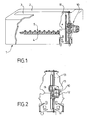
- this apparatus is a toaster (1), which as illustrated in Figure 1 comprises a frame (2) equipped with a slit (3) for introducing bread slices.
- This chassis (2) encloses a movable carriage (4), extending substantially over the entire length of the toaster, and whose upper face (5) is intended to receive and to support slices of bread.
- This carriage (4) is vertically movable between the heating elements (not shown) equipping the main faces inside the frame (2).
- This mobile carriage (4) can move vertically between two extreme positions, thanks to a motorized mechanism (10), mounted on a side plate (11), integral with the frame (2).
- this motorized mechanism comprises a motor (12) and a set of notched wheels and rods (13), allowing to convert the rotary motion of the motor into a translation movement straight.
- the invention covers other variants with regard to mechanical aspects of movement transmission since the motor (12) to the carriage (4).
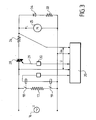
- the toaster is intended for be powered by an alternating voltage source (16), which is very usually the mains voltage source.
- An alternative embodiment uses an H bridge associated with an amplitude modulation pulse device (PWM).
- the electrical resistance or resistors (17) forming the heating elements of the toaster are connected to the alternating voltage via relay contacts (18, 19) providing complete insulation of the heating elements relative to the mains voltage (16) outside the heating phases.
- these electromechanical relays are ordered from information from a microcontroller (20) assuring most of the control / command functions relating to the invention.
- the movement of the carriage (4) is caused by the power supply of the motor electric motor (25), which is typically a DC motor, and advantageously dimensioned electrically to withstand voltages of the order of a few tens of volts.
- the engine is powered by series with a resistor (26) which therefore has an ohmic value of the order the ten times the value of the resistance of the motor winding (25).
- the power supply is made through a static switch, which can example be a triac (28) or any other component whose conduction state can be controlled.
- this triac (28) is controlled by a circuit controller (30) generating commands (29) from elaborate information by the microcontroller (20). More precisely, and in accordance with the invention, this triac (28) is controlled to ensure its conduction only during a part of the alternations be positive or negative.
- the sign of the alternations of the voltage U is chosen to ensure the sense desired rotation of the motor (25), and thus the direction of movement of the carriage (4).
- the passage of a current (i) positive in the motor (25) corresponds to a rotation causing a rise in. carriage.
- the triac (28) is fed only during a part of positive alternations.
- This command can be done in different ways, and for example as illustrated in FIG. 4, by adjusting a conduction duration continuous within the alternation, comparable to a steering phase angle.
- the triac (28) is blocked during the negative half-waves, so that the voltage (Um) measured across the motor corresponds substantially to the counter-electromotive force generated by the motor (25).
- This counter-electromotive force is measured by the microcontroller via appropriate measuring lines, including dividing bridges of voltage.
- This velocity information resulting from the measurement of the voltages Um makes it possible to regulate the motor by varying the phase angle and more generally by controlling the conduction time of the switch static (28).
- the voltage Um measured during Negative half-cycles indicate the power supply of the motor in the half-cycle previous positive.
- This measurement of the speed also makes it possible to determine, after integration, the estimated position of the carriage (4). It is thus possible to determine if the truck has reached the extreme position of its travel, so as to stop motor power supply, and generate actions at the level of other toaster. Thus, when the carriage (4) is considered to have arrived in low position, it is possible to authorize the feeding of the heating elements (17).
- the distances corresponding to the extreme positions of the trolley can be either preprogrammed in the microcontroller, or the initialization object, for example at each power-up of the toaster. More specifically, it is possible to provide when the device is turned on, a sequence in which the carriage is moved in one direction to reach a first extreme position (which is considered not to result from a blocking since the toaster is empty), then a displacement of the carriage in the opposite direction to reach the second extreme position. These distances The maximum values are then stored for subsequent comparisons.
- the microcontroller (20) can then program alternative movements near the area jamming, to trigger the unlocking of the truck. he is also it is possible to control the motor with a higher speed setpoint, way to try to induce loosening.
- This additional resistance (33) therefore makes it possible to compensate. the acceleration generated by the weight of the bread loaded on the cart, and which is added the force exerted by the engine.
- this resistor (33) is of the order of the size of the resistance of the motor winding (25). She may well understood to be adapted according to the configuration of the toaster, and especially the weight of moving parts.
- the different speed instructions can be influenced by settings made by the user, with regard to the type of bread used, or any desired cooking method, which for various reasons would necessitate the movement of bread in relation to heating elements. This influence can also result from a microcontroller programming.
- control process and the equipped devices according to the invention make it possible to overcome the presence of a position or limit sensor, which reduces the price of returns from such devices, and increases their reliability.
- This specific command provides access to information from position of the truck, despite the absence of sensors, which ensures particular features, for example attempts to unblock the carriage.
- the invention can be applied to other types of household appliances.
- We examples include electric fryers in which the trolley previously cited then carries a basket for receiving the products to be fried, and being able to move vertically in order to introduce and take out frying bath products.
- the movement of the basket can be realized in accordance with the invention, that is to say without position sensor or stop.
- the truck when the distance traveled by the trolley corresponds to a predetermined value, the truck is stopped and then animated by fast back and forth movements around this position, allowing, for example, these small reciprocating movements, to cause a dripping of food fried.
- the predetermined value then corresponds to a position where the basket is totally out of the frying bath.
Landscapes
- Engineering & Computer Science (AREA)
- Food Science & Technology (AREA)
- Control Of Electric Motors In General (AREA)
- Electric Stoves And Ranges (AREA)
- Control Of Ac Motors In General (AREA)
Applications Claiming Priority (2)
| Application Number | Priority Date | Filing Date | Title |
|---|---|---|---|
| FR0308611A FR2857573B1 (fr) | 2003-07-15 | 2003-07-15 | Appareil electromenager electrique equipe d'un moteur electrique, et procede de commande d'un tel moteur |
| FR0308611 | 2003-07-15 |
Publications (1)
| Publication Number | Publication Date |
|---|---|
| EP1498061A1 true EP1498061A1 (de) | 2005-01-19 |
Family
ID=33462526
Family Applications (1)
| Application Number | Title | Priority Date | Filing Date |
|---|---|---|---|
| EP04356121A Withdrawn EP1498061A1 (de) | 2003-07-15 | 2004-07-02 | Elektrohaushaltsgerät mit einen Motor und Verfahren zum Steuern eines solchen Motors |
Country Status (3)
| Country | Link |
|---|---|
| EP (1) | EP1498061A1 (de) |
| CN (1) | CN1575711A (de) |
| FR (1) | FR2857573B1 (de) |
Cited By (1)
| Publication number | Priority date | Publication date | Assignee | Title |
|---|---|---|---|---|
| CN111542248A (zh) * | 2018-01-04 | 2020-08-14 | 格鲁普西姆贝利有限公司 | 浓缩咖啡的分配单元 |
Citations (5)
| Publication number | Priority date | Publication date | Assignee | Title |
|---|---|---|---|---|
| JPH0341917A (ja) * | 1989-07-07 | 1991-02-22 | Kunimori Kagaku:Kk | 電動トースター |
| JPH03286717A (ja) * | 1990-04-02 | 1991-12-17 | Kunimori Kagaku:Kk | 電動トースター |
| US6112646A (en) * | 1998-09-14 | 2000-09-05 | Henny Penny Corporation | Horizontal stabilizing system for fryer lifting lid |
| US20010016222A1 (en) * | 1998-10-05 | 2001-08-23 | Tomsich Robert J. | Toaster |
| US6336395B1 (en) * | 2001-03-05 | 2002-01-08 | Henny Penny Corporation | Lateral fryer lid lifting apparatus |
-
2003
- 2003-07-15 FR FR0308611A patent/FR2857573B1/fr not_active Expired - Fee Related
-
2004
- 2004-07-02 EP EP04356121A patent/EP1498061A1/de not_active Withdrawn
- 2004-07-15 CN CNA2004100696476A patent/CN1575711A/zh active Pending
Patent Citations (5)
| Publication number | Priority date | Publication date | Assignee | Title |
|---|---|---|---|---|
| JPH0341917A (ja) * | 1989-07-07 | 1991-02-22 | Kunimori Kagaku:Kk | 電動トースター |
| JPH03286717A (ja) * | 1990-04-02 | 1991-12-17 | Kunimori Kagaku:Kk | 電動トースター |
| US6112646A (en) * | 1998-09-14 | 2000-09-05 | Henny Penny Corporation | Horizontal stabilizing system for fryer lifting lid |
| US20010016222A1 (en) * | 1998-10-05 | 2001-08-23 | Tomsich Robert J. | Toaster |
| US6336395B1 (en) * | 2001-03-05 | 2002-01-08 | Henny Penny Corporation | Lateral fryer lid lifting apparatus |
Non-Patent Citations (2)
| Title |
|---|
| PATENT ABSTRACTS OF JAPAN vol. 015, no. 177 (C - 0829) 7 May 1991 (1991-05-07) * |
| PATENT ABSTRACTS OF JAPAN vol. 016, no. 114 (C - 0921) 23 March 1992 (1992-03-23) * |
Cited By (1)
| Publication number | Priority date | Publication date | Assignee | Title |
|---|---|---|---|---|
| CN111542248A (zh) * | 2018-01-04 | 2020-08-14 | 格鲁普西姆贝利有限公司 | 浓缩咖啡的分配单元 |
Also Published As
| Publication number | Publication date |
|---|---|
| FR2857573A1 (fr) | 2005-01-21 |
| FR2857573B1 (fr) | 2006-01-20 |
| CN1575711A (zh) | 2005-02-09 |
Similar Documents
| Publication | Publication Date | Title |
|---|---|---|
| EP0115982B1 (de) | Elektronische Schutzvorrichtung für elektrisches Bügeleisen | |
| EP0617909B1 (de) | Elektrisches Gargerät | |
| EP0029991A2 (de) | Elektrisches Kochgerät | |
| FR2474803A1 (fr) | Appareil de chauffage par induction, notamment element de cuisiniere, a dispositif de securite contre l'emploi de recipients non magnetisables et a regulation de temperature | |
| EP3100656A1 (de) | Schnellkochtopf mit einer unterstützung und einem bewegbaren deckel | |
| EP0883364B1 (de) | Elektrisches fritiergerät und verfahren zum steuern des kochvorgangs solches fritiergerät | |
| FR2805143A1 (fr) | Grille-pain a parois chauffantes transparentes | |
| FR2509108A1 (fr) | Appareil de chauffage par micro-ondes a microprocesseur | |
| EP1318742A1 (de) | Multifunktionelles kochgerät mit einer automatisch öffnenden scharniervorrichtung | |
| FR2713908A1 (fr) | Appareil électrique pour le grillage ou réchauffage d'aliments, en particulier grille-pain, à sous-ensembles de grillages déplaçables à l'aide de bras de déplacement. | |
| FR2701374A1 (fr) | Dispositif de commande pour un appareil ménager électrique destiné à la préparation de boissons infusées. | |
| EP1498061A1 (de) | Elektrohaushaltsgerät mit einen Motor und Verfahren zum Steuern eines solchen Motors | |
| EP0623303B1 (de) | Elektrisches Kochgerät | |
| FR2632510A1 (fr) | Grille-pain dont le chauffage est reglable en fonction de la forme et de la qualite des tranches de pain a griller | |
| FR2642293A1 (fr) | Dispositif mecanique de verrouillage et de deverrouillage du chariot porte-pains d'un grille-pain | |
| FR2483725A1 (fr) | Dispositif de circuits de commande pour grille-pain | |
| EP0609138A1 (de) | Mikrowellenkochgerät | |
| EP2035618A1 (de) | Bügelvorrichtung mit sicherheitseinrichtung und verfahren zum sichern einer bügelvorrichtung | |
| EP3651624B1 (de) | Nahrungsmittelzubereitungsvorrichtung und verfahren zu ihrer steuerung | |
| EP2172143B1 (de) | Steuerverfahren zum Bewegen eines Elementes eines Elektrohaushaltgeräts, insbesondere einer Bedienblende eines Backofens | |
| EP0786222B1 (de) | Behandlungsverfahren eines Nahrungsmittels in einem Brotröster | |
| EP0783860B1 (de) | Kochgerät mit mehreren Kochleistungen | |
| FR2701827A1 (fr) | Appareil de cuisson. | |
| WO2025162861A1 (fr) | Procédé de cuisson et de marquage d'un aliment avec un appareil de cuisson électrique, et appareil de cuisson pour la mise en œuvre dudit procédé | |
| FR2606229A1 (fr) | Systeme de commande d'un moteur asynchrone monophase destine a l'entrainement d'un objet tel qu'un store du type a lames orientables |
Legal Events
| Date | Code | Title | Description |
|---|---|---|---|
| PUAI | Public reference made under article 153(3) epc to a published international application that has entered the european phase |
Free format text: ORIGINAL CODE: 0009012 |
|
| AK | Designated contracting states |
Kind code of ref document: A1 Designated state(s): AT BE BG CH CY CZ DE DK EE ES FI FR GB GR HU IE IT LI LU MC NL PL PT RO SE SI SK TR |
|
| AX | Request for extension of the european patent |
Extension state: AL HR LT LV MK |
|
| 17P | Request for examination filed |
Effective date: 20050510 |
|
| AKX | Designation fees paid |
Designated state(s): AT BE BG CH CY CZ DE DK EE ES FI FR GB GR HU IE IT LI LU MC NL PL PT RO SE SI SK TR |
|
| 17Q | First examination report despatched |
Effective date: 20070404 |
|
| STAA | Information on the status of an ep patent application or granted ep patent |
Free format text: STATUS: THE APPLICATION IS DEEMED TO BE WITHDRAWN |
|
| 18D | Application deemed to be withdrawn |
Effective date: 20071016 |