EP1498088A2 - Gehörknöchelchenprothese - Google Patents
Gehörknöchelchenprothese Download PDFInfo
- Publication number
- EP1498088A2 EP1498088A2 EP04400036A EP04400036A EP1498088A2 EP 1498088 A2 EP1498088 A2 EP 1498088A2 EP 04400036 A EP04400036 A EP 04400036A EP 04400036 A EP04400036 A EP 04400036A EP 1498088 A2 EP1498088 A2 EP 1498088A2
- Authority
- EP
- European Patent Office
- Prior art keywords
- spring joint
- prosthesis according
- auditory ossicle
- ossicle prosthesis
- spring
- Prior art date
- Legal status (The legal status is an assumption and is not a legal conclusion. Google has not performed a legal analysis and makes no representation as to the accuracy of the status listed.)
- Granted
Links
Images
Classifications
-
- A—HUMAN NECESSITIES
- A61—MEDICAL OR VETERINARY SCIENCE; HYGIENE
- A61F—FILTERS IMPLANTABLE INTO BLOOD VESSELS; PROSTHESES; DEVICES PROVIDING PATENCY TO, OR PREVENTING COLLAPSING OF, TUBULAR STRUCTURES OF THE BODY, e.g. STENTS; ORTHOPAEDIC, NURSING OR CONTRACEPTIVE DEVICES; FOMENTATION; TREATMENT OR PROTECTION OF EYES OR EARS; BANDAGES, DRESSINGS OR ABSORBENT PADS; FIRST-AID KITS
- A61F2/00—Filters implantable into blood vessels; Prostheses, i.e. artificial substitutes or replacements for parts of the body; Appliances for connecting them with the body; Devices providing patency to, or preventing collapsing of, tubular structures of the body, e.g. stents
- A61F2/02—Prostheses implantable into the body
- A61F2/18—Internal ear or nose parts, e.g. ear-drums
-
- A—HUMAN NECESSITIES
- A61—MEDICAL OR VETERINARY SCIENCE; HYGIENE
- A61F—FILTERS IMPLANTABLE INTO BLOOD VESSELS; PROSTHESES; DEVICES PROVIDING PATENCY TO, OR PREVENTING COLLAPSING OF, TUBULAR STRUCTURES OF THE BODY, e.g. STENTS; ORTHOPAEDIC, NURSING OR CONTRACEPTIVE DEVICES; FOMENTATION; TREATMENT OR PROTECTION OF EYES OR EARS; BANDAGES, DRESSINGS OR ABSORBENT PADS; FIRST-AID KITS
- A61F2/00—Filters implantable into blood vessels; Prostheses, i.e. artificial substitutes or replacements for parts of the body; Appliances for connecting them with the body; Devices providing patency to, or preventing collapsing of, tubular structures of the body, e.g. stents
- A61F2/02—Prostheses implantable into the body
- A61F2/18—Internal ear or nose parts, e.g. ear-drums
- A61F2002/183—Ear parts
Definitions
- the invention relates to a ossicle prosthesis for the transmission of Sound vibrations in the middle ear taking into account the changing static Pressure or greater momentary pressure loads, such. When sneezing.
- Ear ossicle prostheses are already known that not only their actual Function, the transmission of sound vibrations, meet, but also able are changes in the distance between eardrum and oval window of the inner ear to follow through static or momentarily larger pressure fluctuations.
- the prosthesis consists essentially of a spring wire angle.
- One of his arms is approximately parallel to the eardrum and takes the Distance changes on.
- the other is directed approximately perpendicular to the oval window and transmits the sound vibrations. It is difficult, the spring stiffness of both Spring wire arms independently to their specific tasks to optimize.
- the solution according to DE 196 47 579 is characterized in that the Middle ear implant over at least two sections with different Has elasticity properties that are perpendicular to each other. In principle, you can Both areas are largely optimized independently of each other. The production but is a total of consuming. There is little room for necessary adjustments to the given dimensions and other conditions in the middle ear of each Patients.
- the prostheses each consist of two rod-shaped parts, which have a kind of sliding sleeve or with a ball joint connected to each other. Their length or the mutual angular position of Connections can be well adjusted to circumstances in the ear of each patient become.
- the object of the invention is to provide another auditory ossicle prosthesis for transmission of sound vibrations in the middle ear taking into account the changing static pressure or larger instantaneous pressure loads that simply is manufacturable and customizable.
- this object is achieved in that in a prosthesis with two rod-like links for transmission of sound between the eardrum and oval Window both bar parts are connected to each other via a spring joint.
- the sound is from the two rod parts and the connecting spring joint transmitted longitudinally.
- the two rod parts buckle in Spring joint from the side, the sound continues in almost unchanged quality is forwarded.
- the prosthesis may be made of biocompatible materials, such as titanium in particular all solid parts and silicone for the joint, are manufactured. In the simplest way may currently be in production ossicular prostheses with a rod-like transmission element to be changed. The final length of the bar parts can be adapted on site.
- the rod parts close an obtuse angle.
- the Prosthesis is easier to buckle in this condition.
- the direction of the Buckling is predetermined from the outset in adaptation to the anatomy of the ear.
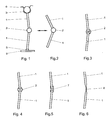
- a ossicle prosthesis is shown, with a spring cage 4 am Hammer handle 3 is connected and a foot 5 and a plate 6 on the Stirrup (not shown) touches down.
- Fig. 2 is shown how the bar parts buckle laterally under higher pressure.
- the prosthesis can use it to make momentary or longer distance changes between the Hammer handle 3 and the stirrup follow almost easily, without the Sound transmission is interrupted or significantly impaired.
- the elastic restoring forces of the kinked prosthesis should not exceed 10 mN.
- the direction of the kink is given by the obtuse angle. It is adapted to the anatomy of the middle ear.
- Fig. 1 the spring joint is realized by means of a silicone ball 2.
- Figures 3 and 4 show two different embodiments of this variant.
- Fig. 3 encounter the End faces of the rod parts 1 to each other. They are designed to be spherical To follow angle changes.
- Fig. 4 is a part of the silicone between the Front sides of the rod parts 1. The sound is transmitted very well here as well.
- the spring joint is an elastic sleeve 7. Between the end faces of Bar parts 1 is as in the embodiment of FIG. 4 silicone.
- the rod lengths may possibly still on site the conditions of the middle ear, in which the prosthesis are used, should be adapted. That does not apply only on the length of the rod members 1, but also on the connection elements spring cage. 4 or feet 5 and plate 6.
- the upper rod 1 with Federkorb 4 uncomplicated against a rod 1 with a known connection element, which should rest directly on the eardrum, be replaced.
- the hinge is formed as a leaf spring 8.
- the leaf spring 8 is on both sides with the Rod members 1 connected.
Landscapes
- Health & Medical Sciences (AREA)
- Otolaryngology (AREA)
- Pulmonology (AREA)
- Cardiology (AREA)
- Oral & Maxillofacial Surgery (AREA)
- Transplantation (AREA)
- Engineering & Computer Science (AREA)
- Biomedical Technology (AREA)
- Heart & Thoracic Surgery (AREA)
- Vascular Medicine (AREA)
- Life Sciences & Earth Sciences (AREA)
- Animal Behavior & Ethology (AREA)
- General Health & Medical Sciences (AREA)
- Public Health (AREA)
- Veterinary Medicine (AREA)
- Prostheses (AREA)
Abstract
Description
Claims (9)
- Gehörknöchelchenprothese mit Anschlusselementen zum Trommelfell und zum ovalen Fenster des Innenohrs bzw. zu den an diese angeschlossenen, noch vorhanden Resten der Gehörknöchel, wie insbesondere Hammergriff und Steigbügel oder deren zur Operation noch verwendbare Teile, und zwei miteinander verbundenen stabartigen Gliedern zur Übertragung des Schalls, gekennzeichnet dadurch, dass beide Stabteile (1) über ein Federgelenk (2 bzw. 7) miteinander verbunden sind.
- Gehörknöchelchenprothese nach Anspruch 1, gekennzeichnet dadurch, dass das Federgelenk eine elastische Kugel (2) ist.
- Gehörknöchelchenprothese nach Anspruch 1, gekennzeichnet dadurch, dass das Federgelenk eine elastische Hülse (7) ist.
- Gehörknöchelchenprothese nach den Ansprüchen 2 oder 3, gekennzeichnet dadurch, dass im Federgelenk (2 bzw. 7) zwischen den Stirnseiten der Stabteile (1) elastisches Material vorgesehen ist, das eng an diesen Stirnseiten anliegt.
- Gehörknöchelchenprothese nach den Ansprüchen 2 oder 3, gekennzeichnet dadurch, dass wenigstens eine der im Federgelenk (2 bzw. 7) liegenden Stirnseiten der Stabteile (1) ballig ist und die Stirnseiten aufeinander abrollen.
- Gehörknöchelchenprothese nach Anspruch 1, gekennzeichnet dadurch, dass das Federgelenk (2 bzw. 7) aus einem Silikonmaterial gefertigt ist.
- Gehörknöchelchenprothese nach Anspruch 1, gekennzeichnet dadurch, dass das Federgelenk eine Blattfeder (8) ist.
- Gehörknöchelchenprothese nach Anspruch 1, gekennzeichnet dadurch, dass die Stabteile (1) im entspannten Zustand einen stumpfen Winkel einschließen.
- Gehörknöchelchenprothese nach Anspruch 1, gekennzeichnet dadurch, dass die elastischen Rückstellkräfte im Federgelenk bei ausgeknickter Prothese 10 mN nicht überschreiten.
Applications Claiming Priority (2)
| Application Number | Priority Date | Filing Date | Title |
|---|---|---|---|
| DE10331644 | 2003-07-08 | ||
| DE2003131644 DE10331644B3 (de) | 2003-07-08 | 2003-07-08 | Gehörknöchelchenprothese |
Publications (3)
| Publication Number | Publication Date |
|---|---|
| EP1498088A2 true EP1498088A2 (de) | 2005-01-19 |
| EP1498088A3 EP1498088A3 (de) | 2005-06-01 |
| EP1498088B1 EP1498088B1 (de) | 2014-10-22 |
Family
ID=33461911
Family Applications (1)
| Application Number | Title | Priority Date | Filing Date |
|---|---|---|---|
| EP20040400036 Expired - Lifetime EP1498088B1 (de) | 2003-07-08 | 2004-07-06 | Gehörknöchelchenprothese |
Country Status (3)
| Country | Link |
|---|---|
| EP (1) | EP1498088B1 (de) |
| DE (1) | DE10331644B3 (de) |
| ES (1) | ES2527944T3 (de) |
Cited By (5)
| Publication number | Priority date | Publication date | Assignee | Title |
|---|---|---|---|---|
| JP2010519999A (ja) * | 2007-03-03 | 2010-06-10 | センティエント メディカル リミテッド | 人工耳小骨 |
| WO2011080363A1 (es) * | 2009-12-30 | 2011-07-07 | Universidad De Valladolid (40%) | Prótesis de sustitución osicular total |
| US8864645B2 (en) | 2005-01-13 | 2014-10-21 | Sentient Medical Limited | Hearing implant |
| US9686623B2 (en) | 2007-05-11 | 2017-06-20 | Sentient Medical Limited | Middle ear implant |
| WO2018089101A1 (en) | 2016-11-08 | 2018-05-17 | Kartush Jack M | Systems and methods for performing ossicular chain reconstructions |
Family Cites Families (11)
| Publication number | Priority date | Publication date | Assignee | Title |
|---|---|---|---|---|
| US3196462A (en) * | 1961-09-05 | 1965-07-27 | Robinson Mendell | Stapedial prosthesis |
| US3710399A (en) * | 1970-06-23 | 1973-01-16 | H Hurst | Ossicle replacement prosthesis |
| US4624672A (en) * | 1984-03-15 | 1986-11-25 | Edmundas Lenkauskas | Coiled wire prosthesis for complete or partial ossicular reconstruction |
| US4957507A (en) * | 1987-12-14 | 1990-09-18 | Edmundas Lenkauskas | Wire spring prosthesis for ossicular reconstruction |
| DE19647579A1 (de) * | 1996-11-18 | 1998-05-20 | Bartels Mikrotechnik Gmbh | Mittelohrimplantat |
| FR2769492B1 (fr) * | 1997-10-10 | 1999-12-17 | Nogitek Sa | Prothese d'oreille moyenne |
| DE19923403C2 (de) * | 1999-05-21 | 2002-11-14 | Phonak Ag Staefa | Vorrichtung zum mechanischen Ankoppeln eines in einer Mastoidhöhle implantierbaren elektromechanischen Hörgerätewandlers |
| DE19935029C2 (de) * | 1999-07-26 | 2003-02-13 | Phonak Ag Staefa | Implantierbare Anordnung zum mechanischen Ankoppeln eines Treiberteils an eine Ankoppelstelle |
| DE19948375B4 (de) * | 1999-10-07 | 2004-04-01 | Phonak Ag | Anordnung zum mechanischen Ankoppeln eines Treibers an eine Ankoppelstelle der Ossikelkette |
| DE19948336C2 (de) * | 1999-10-07 | 2002-02-28 | Implex Hear Tech Ag | Anordnung zum Ankoppeln eines Treibers an eine Ankoppelstelle der Ossikelkette |
| DE20014659U1 (de) * | 2000-08-24 | 2000-11-30 | Heinz Kurz GmbH Medizintechnik, 72144 Dußlingen | Vorrichtung zum Ankoppeln |
-
2003
- 2003-07-08 DE DE2003131644 patent/DE10331644B3/de not_active Expired - Lifetime
-
2004
- 2004-07-06 ES ES04400036.2T patent/ES2527944T3/es not_active Expired - Lifetime
- 2004-07-06 EP EP20040400036 patent/EP1498088B1/de not_active Expired - Lifetime
Cited By (8)
| Publication number | Priority date | Publication date | Assignee | Title |
|---|---|---|---|---|
| US8864645B2 (en) | 2005-01-13 | 2014-10-21 | Sentient Medical Limited | Hearing implant |
| JP2010519999A (ja) * | 2007-03-03 | 2010-06-10 | センティエント メディカル リミテッド | 人工耳小骨 |
| US8920496B2 (en) | 2007-03-03 | 2014-12-30 | Sentient Medical Limited | Ossicular replacement prosthesis |
| US9686623B2 (en) | 2007-05-11 | 2017-06-20 | Sentient Medical Limited | Middle ear implant |
| WO2011080363A1 (es) * | 2009-12-30 | 2011-07-07 | Universidad De Valladolid (40%) | Prótesis de sustitución osicular total |
| ES2362766A1 (es) * | 2009-12-30 | 2011-07-13 | Universidad De Valladolid | Prótesis de sustitución osicular total. |
| WO2018089101A1 (en) | 2016-11-08 | 2018-05-17 | Kartush Jack M | Systems and methods for performing ossicular chain reconstructions |
| EP3538023A4 (de) * | 2016-11-08 | 2020-11-11 | Jack M. Kartush | Systeme und verfahren zur durchführung von rekonstruktionen der gehörknöchelchenkette |
Also Published As
| Publication number | Publication date |
|---|---|
| EP1498088B1 (de) | 2014-10-22 |
| DE10331644B3 (de) | 2005-01-20 |
| EP1498088A3 (de) | 2005-06-01 |
| ES2527944T3 (es) | 2015-02-02 |
Similar Documents
| Publication | Publication Date | Title |
|---|---|---|
| DE102007013708B3 (de) | Gehörknöchelchenprothese mit sensibler Kopfplatte | |
| EP1706071B1 (de) | Gehörknöchelchenprothese | |
| DE102005010705B3 (de) | Gehörknöchelchenprothese | |
| DE102007008851B3 (de) | Gehörknöchelchenprothese | |
| DE10045158C2 (de) | Längenverstellbare Prothese zum Ersatz und zur Rekonstruktion von Gehörknöchelchen | |
| DE10109804C2 (de) | Gelenkprothese | |
| EP1745762B1 (de) | Gehörknöchelchenprothese | |
| EP2103280B1 (de) | Gehörknöchelchenprothese mit variablen Ankopplungsflächen | |
| DE2908898A1 (de) | Prothesengelenk | |
| DE60015724T2 (de) | Mittelohrimplantat | |
| EP1774925B1 (de) | Gehörknöchelchenprothese mit elastischem Drehgelenk | |
| DE10331644B3 (de) | Gehörknöchelchenprothese | |
| EP2926771A1 (de) | Gehörknöchelchenprothese mit längs-perforierter Schlinge | |
| DE102008015114A1 (de) | Gehörknöchelchenprothese mit variablen Ankopplungsflächen | |
| DE102010020412B3 (de) | Testeinrichtung mit Thermo-Dummy für Gehörknöchelchenprothese mit Formgedächtnis | |
| DE102012012382A1 (de) | Hüftabspreiz-Orthese, insbesondere für Patienten mit spastischem Muskeltonus | |
| DE102005034103B3 (de) | Gehörknöchelchenprothese mit doppelwandigem Clip | |
| WO1998016175A1 (de) | Gehörknöchelchenprothese zur schallübertragung im mittelohr | |
| DE202010006737U1 (de) | Testeinrichtung mit Thermo-Dummy für Gehörknöchelchenprothese mit Formgedächtnis | |
| DE19744789A1 (de) | Gehörknöchelchenprothese zur Schallübertragung im Mittelohr | |
| DE202005003782U1 (de) | Gehörknöchelchenprothese | |
| DE202005015944U1 (de) | Gehörknöchelchenprothese mit elastischem Drehgelenk | |
| DE202005005515U1 (de) | Gehörknöchelchenprothese mit Beschichtung | |
| DE102024121204B3 (de) | Aus einem Gebinde auswählbare Gehörknöchelchenprothese | |
| DE202005011485U1 (de) | Gehörknöchelchenprothese mit doppelwandigem Clip |
Legal Events
| Date | Code | Title | Description |
|---|---|---|---|
| PUAI | Public reference made under article 153(3) epc to a published international application that has entered the european phase |
Free format text: ORIGINAL CODE: 0009012 |
|
| AK | Designated contracting states |
Kind code of ref document: A2 Designated state(s): AT BE BG CH CY CZ DE DK EE ES FI FR GB GR HU IE IT LI LU MC NL PL PT RO SE SI SK TR |
|
| AX | Request for extension of the european patent |
Extension state: AL HR LT LV MK |
|
| PUAL | Search report despatched |
Free format text: ORIGINAL CODE: 0009013 |
|
| AK | Designated contracting states |
Kind code of ref document: A3 Designated state(s): AT BE BG CH CY CZ DE DK EE ES FI FR GB GR HU IE IT LI LU MC NL PL PT RO SE SI SK TR |
|
| AX | Request for extension of the european patent |
Extension state: AL HR LT LV MK |
|
| 17P | Request for examination filed |
Effective date: 20051125 |
|
| RAP1 | Party data changed (applicant data changed or rights of an application transferred) |
Owner name: HEINZ KURZ GMBH MEDIZINTECHNIK |
|
| AKX | Designation fees paid |
Designated state(s): AT BE BG CH CY CZ DE DK EE ES FI FR GB GR HU IE IT LI LU MC NL PL PT RO SE SI SK TR |
|
| RBV | Designated contracting states (corrected) |
Designated state(s): AT BE BG CH CY CZ DE DK EE ES FI FR GB GR HU IE IT LI LU MC NL PL PT RO SE SI SK TR |
|
| GRAP | Despatch of communication of intention to grant a patent |
Free format text: ORIGINAL CODE: EPIDOSNIGR1 |
|
| INTG | Intention to grant announced |
Effective date: 20140724 |
|
| RBV | Designated contracting states (corrected) |
Designated state(s): AT BE BG CH CY CZ DE DK EE ES FI FR GB GR HU IE IT LI LU MC NL PL PT RO SE SI SK TR |
|
| GRAS | Grant fee paid |
Free format text: ORIGINAL CODE: EPIDOSNIGR3 |
|
| GRAA | (expected) grant |
Free format text: ORIGINAL CODE: 0009210 |
|
| AK | Designated contracting states |
Kind code of ref document: B1 Designated state(s): AT BE BG CH CY CZ DE DK EE ES FI FR GB GR HU IE IT LI LU MC NL PL PT RO SE SI SK TR |
|
| REG | Reference to a national code |
Ref country code: GB Ref legal event code: FG4D Free format text: NOT ENGLISH |
|
| REG | Reference to a national code |
Ref country code: CH Ref legal event code: EP |
|
| REG | Reference to a national code |
Ref country code: AT Ref legal event code: REF Ref document number: 692233 Country of ref document: AT Kind code of ref document: T Effective date: 20141115 |
|
| REG | Reference to a national code |
Ref country code: IE Ref legal event code: FG4D Free format text: LANGUAGE OF EP DOCUMENT: GERMAN |
|
| REG | Reference to a national code |
Ref country code: DE Ref legal event code: R096 Ref document number: 502004014742 Country of ref document: DE Effective date: 20141204 |
|
| REG | Reference to a national code |
Ref country code: NL Ref legal event code: T3 |
|
| REG | Reference to a national code |
Ref country code: ES Ref legal event code: FG2A Ref document number: 2527944 Country of ref document: ES Kind code of ref document: T3 Effective date: 20150202 |
|
| PG25 | Lapsed in a contracting state [announced via postgrant information from national office to epo] |
Ref country code: PT Free format text: LAPSE BECAUSE OF FAILURE TO SUBMIT A TRANSLATION OF THE DESCRIPTION OR TO PAY THE FEE WITHIN THE PRESCRIBED TIME-LIMIT Effective date: 20150223 Ref country code: FI Free format text: LAPSE BECAUSE OF FAILURE TO SUBMIT A TRANSLATION OF THE DESCRIPTION OR TO PAY THE FEE WITHIN THE PRESCRIBED TIME-LIMIT Effective date: 20141022 |
|
| PG25 | Lapsed in a contracting state [announced via postgrant information from national office to epo] |
Ref country code: SE Free format text: LAPSE BECAUSE OF FAILURE TO SUBMIT A TRANSLATION OF THE DESCRIPTION OR TO PAY THE FEE WITHIN THE PRESCRIBED TIME-LIMIT Effective date: 20141022 Ref country code: PL Free format text: LAPSE BECAUSE OF FAILURE TO SUBMIT A TRANSLATION OF THE DESCRIPTION OR TO PAY THE FEE WITHIN THE PRESCRIBED TIME-LIMIT Effective date: 20141022 Ref country code: GR Free format text: LAPSE BECAUSE OF FAILURE TO SUBMIT A TRANSLATION OF THE DESCRIPTION OR TO PAY THE FEE WITHIN THE PRESCRIBED TIME-LIMIT Effective date: 20150123 Ref country code: CY Free format text: LAPSE BECAUSE OF FAILURE TO SUBMIT A TRANSLATION OF THE DESCRIPTION OR TO PAY THE FEE WITHIN THE PRESCRIBED TIME-LIMIT Effective date: 20141022 |
|
| REG | Reference to a national code |
Ref country code: FR Ref legal event code: PLFP Year of fee payment: 12 |
|
| REG | Reference to a national code |
Ref country code: DE Ref legal event code: R097 Ref document number: 502004014742 Country of ref document: DE |
|
| PG25 | Lapsed in a contracting state [announced via postgrant information from national office to epo] |
Ref country code: EE Free format text: LAPSE BECAUSE OF FAILURE TO SUBMIT A TRANSLATION OF THE DESCRIPTION OR TO PAY THE FEE WITHIN THE PRESCRIBED TIME-LIMIT Effective date: 20141022 Ref country code: RO Free format text: LAPSE BECAUSE OF FAILURE TO SUBMIT A TRANSLATION OF THE DESCRIPTION OR TO PAY THE FEE WITHIN THE PRESCRIBED TIME-LIMIT Effective date: 20141022 Ref country code: CZ Free format text: LAPSE BECAUSE OF FAILURE TO SUBMIT A TRANSLATION OF THE DESCRIPTION OR TO PAY THE FEE WITHIN THE PRESCRIBED TIME-LIMIT Effective date: 20141022 Ref country code: DK Free format text: LAPSE BECAUSE OF FAILURE TO SUBMIT A TRANSLATION OF THE DESCRIPTION OR TO PAY THE FEE WITHIN THE PRESCRIBED TIME-LIMIT Effective date: 20141022 Ref country code: SK Free format text: LAPSE BECAUSE OF FAILURE TO SUBMIT A TRANSLATION OF THE DESCRIPTION OR TO PAY THE FEE WITHIN THE PRESCRIBED TIME-LIMIT Effective date: 20141022 |
|
| PLBE | No opposition filed within time limit |
Free format text: ORIGINAL CODE: 0009261 |
|
| STAA | Information on the status of an ep patent application or granted ep patent |
Free format text: STATUS: NO OPPOSITION FILED WITHIN TIME LIMIT |
|
| 26N | No opposition filed |
Effective date: 20150723 |
|
| REG | Reference to a national code |
Ref country code: DE Ref legal event code: R119 Ref document number: 502004014742 Country of ref document: DE |
|
| PG25 | Lapsed in a contracting state [announced via postgrant information from national office to epo] |
Ref country code: MC Free format text: LAPSE BECAUSE OF FAILURE TO SUBMIT A TRANSLATION OF THE DESCRIPTION OR TO PAY THE FEE WITHIN THE PRESCRIBED TIME-LIMIT Effective date: 20141022 Ref country code: SI Free format text: LAPSE BECAUSE OF FAILURE TO SUBMIT A TRANSLATION OF THE DESCRIPTION OR TO PAY THE FEE WITHIN THE PRESCRIBED TIME-LIMIT Effective date: 20141022 |
|
| REG | Reference to a national code |
Ref country code: CH Ref legal event code: PL |
|
| PG25 | Lapsed in a contracting state [announced via postgrant information from national office to epo] |
Ref country code: LU Free format text: LAPSE BECAUSE OF FAILURE TO SUBMIT A TRANSLATION OF THE DESCRIPTION OR TO PAY THE FEE WITHIN THE PRESCRIBED TIME-LIMIT Effective date: 20150706 |
|
| REG | Reference to a national code |
Ref country code: IE Ref legal event code: MM4A |
|
| PG25 | Lapsed in a contracting state [announced via postgrant information from national office to epo] |
Ref country code: LI Free format text: LAPSE BECAUSE OF NON-PAYMENT OF DUE FEES Effective date: 20150731 Ref country code: DE Free format text: LAPSE BECAUSE OF NON-PAYMENT OF DUE FEES Effective date: 20160202 Ref country code: CH Free format text: LAPSE BECAUSE OF NON-PAYMENT OF DUE FEES Effective date: 20150731 |
|
| REG | Reference to a national code |
Ref country code: FR Ref legal event code: PLFP Year of fee payment: 13 |
|
| PG25 | Lapsed in a contracting state [announced via postgrant information from national office to epo] |
Ref country code: IE Free format text: LAPSE BECAUSE OF NON-PAYMENT OF DUE FEES Effective date: 20150706 |
|
| REG | Reference to a national code |
Ref country code: AT Ref legal event code: MM01 Ref document number: 692233 Country of ref document: AT Kind code of ref document: T Effective date: 20150706 |
|
| PG25 | Lapsed in a contracting state [announced via postgrant information from national office to epo] |
Ref country code: AT Free format text: LAPSE BECAUSE OF NON-PAYMENT OF DUE FEES Effective date: 20150706 |
|
| PGFP | Annual fee paid to national office [announced via postgrant information from national office to epo] |
Ref country code: ES Payment date: 20160712 Year of fee payment: 13 |
|
| PG25 | Lapsed in a contracting state [announced via postgrant information from national office to epo] |
Ref country code: HU Free format text: LAPSE BECAUSE OF FAILURE TO SUBMIT A TRANSLATION OF THE DESCRIPTION OR TO PAY THE FEE WITHIN THE PRESCRIBED TIME-LIMIT; INVALID AB INITIO Effective date: 20040706 Ref country code: BG Free format text: LAPSE BECAUSE OF FAILURE TO SUBMIT A TRANSLATION OF THE DESCRIPTION OR TO PAY THE FEE WITHIN THE PRESCRIBED TIME-LIMIT Effective date: 20141022 |
|
| REG | Reference to a national code |
Ref country code: FR Ref legal event code: PLFP Year of fee payment: 14 |
|
| PG25 | Lapsed in a contracting state [announced via postgrant information from national office to epo] |
Ref country code: BE Free format text: LAPSE BECAUSE OF NON-PAYMENT OF DUE FEES Effective date: 20150731 |
|
| PG25 | Lapsed in a contracting state [announced via postgrant information from national office to epo] |
Ref country code: TR Free format text: LAPSE BECAUSE OF FAILURE TO SUBMIT A TRANSLATION OF THE DESCRIPTION OR TO PAY THE FEE WITHIN THE PRESCRIBED TIME-LIMIT Effective date: 20141022 |
|
| REG | Reference to a national code |
Ref country code: FR Ref legal event code: PLFP Year of fee payment: 15 |
|
| REG | Reference to a national code |
Ref country code: ES Ref legal event code: FD2A Effective date: 20181107 |
|
| PG25 | Lapsed in a contracting state [announced via postgrant information from national office to epo] |
Ref country code: ES Free format text: LAPSE BECAUSE OF NON-PAYMENT OF DUE FEES Effective date: 20170707 |
|
| PGFP | Annual fee paid to national office [announced via postgrant information from national office to epo] |
Ref country code: IT Payment date: 20200731 Year of fee payment: 17 |
|
| PG25 | Lapsed in a contracting state [announced via postgrant information from national office to epo] |
Ref country code: IT Free format text: LAPSE BECAUSE OF NON-PAYMENT OF DUE FEES Effective date: 20210706 |
|
| PGFP | Annual fee paid to national office [announced via postgrant information from national office to epo] |
Ref country code: NL Payment date: 20230720 Year of fee payment: 20 |
|
| PGFP | Annual fee paid to national office [announced via postgrant information from national office to epo] |
Ref country code: GB Payment date: 20230724 Year of fee payment: 20 |
|
| PGFP | Annual fee paid to national office [announced via postgrant information from national office to epo] |
Ref country code: FR Payment date: 20230724 Year of fee payment: 20 |
|
| REG | Reference to a national code |
Ref country code: NL Ref legal event code: MK Effective date: 20240705 |
|
| REG | Reference to a national code |
Ref country code: GB Ref legal event code: PE20 Expiry date: 20240705 |
|
| PG25 | Lapsed in a contracting state [announced via postgrant information from national office to epo] |
Ref country code: GB Free format text: LAPSE BECAUSE OF EXPIRATION OF PROTECTION Effective date: 20240705 |
|
| PG25 | Lapsed in a contracting state [announced via postgrant information from national office to epo] |
Ref country code: GB Free format text: LAPSE BECAUSE OF EXPIRATION OF PROTECTION Effective date: 20240705 |