EP1498886A2 - Steuerverfahren für Testaufzeichnungssverfahren und optisches Plattengerät - Google Patents
Steuerverfahren für Testaufzeichnungssverfahren und optisches Plattengerät Download PDFInfo
- Publication number
- EP1498886A2 EP1498886A2 EP04254269A EP04254269A EP1498886A2 EP 1498886 A2 EP1498886 A2 EP 1498886A2 EP 04254269 A EP04254269 A EP 04254269A EP 04254269 A EP04254269 A EP 04254269A EP 1498886 A2 EP1498886 A2 EP 1498886A2
- Authority
- EP
- European Patent Office
- Prior art keywords
- test
- light beam
- laser light
- optical disk
- partitions
- Prior art date
- Legal status (The legal status is an assumption and is not a legal conclusion. Google has not performed a legal analysis and makes no representation as to the accuracy of the status listed.)
- Ceased
Links
- 238000012360 testing method Methods 0.000 title claims abstract description 296
- 230000003287 optical effect Effects 0.000 title claims abstract description 144
- 238000000034 method Methods 0.000 title claims abstract description 71
- 238000004886 process control Methods 0.000 title claims description 47
- 238000005192 partition Methods 0.000 claims abstract description 154
- 230000008569 process Effects 0.000 claims abstract description 57
- 230000007246 mechanism Effects 0.000 claims description 42
- 230000007547 defect Effects 0.000 claims description 24
- 238000012545 processing Methods 0.000 claims description 19
- 230000035945 sensitivity Effects 0.000 abstract description 4
- 230000006870 function Effects 0.000 description 15
- 238000010586 diagram Methods 0.000 description 7
- 238000012937 correction Methods 0.000 description 3
- 239000004065 semiconductor Substances 0.000 description 3
- 230000008859 change Effects 0.000 description 1
- 238000010276 construction Methods 0.000 description 1
- 230000003247 decreasing effect Effects 0.000 description 1
- 230000006866 deterioration Effects 0.000 description 1
- 239000000284 extract Substances 0.000 description 1
- 238000005259 measurement Methods 0.000 description 1
- 238000012986 modification Methods 0.000 description 1
- 230000004048 modification Effects 0.000 description 1
Images






Classifications
-
- G—PHYSICS
- G11—INFORMATION STORAGE
- G11B—INFORMATION STORAGE BASED ON RELATIVE MOVEMENT BETWEEN RECORD CARRIER AND TRANSDUCER
- G11B7/00—Recording or reproducing by optical means, e.g. recording using a thermal beam of optical radiation by modifying optical properties or the physical structure, reproducing using an optical beam at lower power by sensing optical properties; Record carriers therefor
- G11B7/12—Heads, e.g. forming of the optical beam spot or modulation of the optical beam
- G11B7/125—Optical beam sources therefor, e.g. laser control circuitry specially adapted for optical storage devices; Modulators, e.g. means for controlling the size or intensity of optical spots or optical traces
- G11B7/126—Circuits, methods or arrangements for laser control or stabilisation
- G11B7/1267—Power calibration
-
- G—PHYSICS
- G11—INFORMATION STORAGE
- G11B—INFORMATION STORAGE BASED ON RELATIVE MOVEMENT BETWEEN RECORD CARRIER AND TRANSDUCER
- G11B7/00—Recording or reproducing by optical means, e.g. recording using a thermal beam of optical radiation by modifying optical properties or the physical structure, reproducing using an optical beam at lower power by sensing optical properties; Record carriers therefor
- G11B7/004—Recording, reproducing or erasing methods; Read, write or erase circuits therefor
- G11B7/006—Overwriting
- G11B7/0062—Overwriting strategies, e.g. recording pulse sequences with erasing level used for phase-change media
Definitions
- the present invention relates to a test recording process control method for a rewritable optical disk, such as a phase-change type optical disk, and relates to an optical disk apparatus.
- a recording power calibration operation called OPC (Optimum Power Control) is performed before recording information data on an optical disk to determine an optimum recording power of a laser light beam emitted from a laser power source, such as a semi-conductor laser.
- OPC Optimum Power Control
- the OPC operation is described, for example, in Published Japanese Patent application No. 10-64064.
- the recording surface of an optical disk includes a data area used for recording various types of data, and a power calibration area (PCA) which is a test recording area used for determining an optimum recording power of a laser light beam.
- the power calibration area includes a test area and a count area.
- the test area includes 100 partitions. Each of these partitions includes 15 frames.
- One OPC operation uses one of these partitions, and test signals are recorded on these 15 frames of the partition by variously changing each intensity value of at least two recording powers of laser light beam step by step from a minimum intensity value to a maximum intensity value (i.e., 15 intensity values).
- the test signal in each of the 15 frames is reproduced.
- the recording power at which the value of the reproduced signal equals a target value is determined as an optimum recording power, and subsequent recording is carried out on the data area based on the determined optimum recording power.
- the recording quality of the recorded information data may become a target quality.
- the recording condition of the test signals may vary according to a condition of frames of a test area on which the test signals are recorded. For example, if the frames of the test area had been used for test recording before, the frames may have been irradiated with a laser light beam of a high power because test signals are recorded on 15 frames by variously changing each intensity value of at least two recording powers of laser light beam step by step from a minimum intensity value to a maximum intensity value in an OPC operation.
- test signals are recorded (i.e., overwritten) on such frames, as compared to a case in which test signals are recorded on non-recorded frames for the first time, the recording condition of the test signals may significantly differ depending on the condition of frames, even if the test signals are recorded by use of a laser light beam of the same light-emitting power emitted from the same semi-conductor laser. In this condition, an optimum recording power determined based on a reproduced test signal varies depending on the condition of frames. As a result, an optimum recording power of a laser light beam may not be accurately determined.
- an optimum recording power of a laser light beam determined in each OPC operation may vary.
- the variation of the optimum recording power of the laser light beam may cause the deterioration of the recording quality when actual information data is overwritten on a data area of a recording surface of an optical disk.
- the recording quality of the new information data may deteriorate.
- the variation of the optimum recording power of the laser light beam may be caused by various reasons, but one of the reasons is a variation of the characteristic of recording sensitivity of a test area in a power calibration area.
- test recording process control method and an optical disk apparatus for a rewritable optical disk which can determine an accurate optimum recording power of a laser light beam by minimizing or avoiding the variation of an optimum recording power of a laser light beam obtained in each OPC operation.
- a test recording process control method includes emitting a laser light beam of a DC erase power to a test area of a rewritable optical disk, and recording test data on the test area to determine an optimum recording power of a laser light beam.
- the emitting may include emitting the laser light beam of the DC erase power to a partition of a plurality of partitions of the test area on which the test data is to be recorded.
- an optical disk apparatus includes an optical pick-up including a laser power source configured to emit a laser light beam to a rewritable optical disk including a test area including a plurality of partitions, a test recording processing mechanism configured to determine an optimum recording power of the laser light beam emitted from the laser power source by recording test data on one of the partitions of the test area while changing a light-emitting power of the laser light beam emitted from the laser power source step by step and by reproducing the test data by the optical pick-up, and an erasing mechanism configured to perform an erase process by emitting a laser light beam of a DC erase power to the test area from the laser power source before the test recording processing mechanism records the test data on the one of the partitions of the test area.
- the erasing mechanism may be configured to perform the erase process by emitting the laser light beam of the DC erase power to the one of the partitions of the test area where the test data is to be recorded by the test recording processing mechanism.
- the present invention is applied to an optical disk apparatus, such as a CD-R drive, and a CD-RW drive.
- the optical disk apparatus is used for an optical disk, such as a CD-ROM, a pigment-system optical disk (a recordable optical disk), such as a CD-R, and a phase-change-type optical disk (a rewritable optical disk), such as a CD-RW.
- FIG. 1 is a block diagram of a configuration of an optical disk apparatus according to an embodiment of the present invention.
- the optical disk apparatus includes a spindle motor 2, a motor driver 3, a servo circuit 4, an optical pick-up 5, an analog signal process circuit 6, a CD decoder 7, a CD-ROM decoder 8, a buffer manager 9, a buffer RAM 10, an ATAPI/SCSI interface 11, a D/A converter 12, an ATIP decoder 13, a CD encoder 14, a CD-ROM encoder 15, a laser control circuit 16, a CPU 17, a ROM 18, a RAM 19, and a microcomputer 20.
- FIG. 1 directions indicated by arrows indicate the directions in which data flow mainly.
- FIG. 1 a detail connection relation between the CPU 17 and each block controlled by the CPU 17 is not shown in FIG. 1.
- a readable control program for the CPU 17 is stored in the ROM 18.
- the control program When turning on a power supply of the optical disk apparatus, the control program is loaded into a main memory (not shown).
- the CPU 17 controls operations in each of the blocks according to the control program, and temporarily stores data necessary for controlling the blocks in the RAM 19.
- the CPU 17, the ROM 18, and the RAM 19 construct the microcomputer 20.
- the spindle motor 2 is controlled to a constant linear velocity (CLV) or to a constant angular velocity (CAV), by the motor driver 3 and the servo circuit 4. It is possible to change the linear velocity in phase.
- the optical pick-up 5 includes a semi-conductor laser, such as a laser diode (LD) 5a functioning as a laser power source, an optical system (not shown), a focus actuator (not shown), a track actuator (not shown), a photo detector 5b, and a position sensor (not shown).
- the LD 5a emits a laser light beam "L" to a recording surface of the optical disk 1.
- the optical pick-up 5 is configured to be moved in a sledge direction (i.e., a radial direction of the optical disk 1) by a seek motor (not shown).
- the focus actuator, the track actuator, and the seek motor are controlled to locate a light spot of the laser light beam "L" at a desired position on the optical disk 1 by using the motor driver 3 and the servo circuit 4 based on signals from the photo detector 5b and the position sensor of the optical pick-up 5.
- a reproducing signal obtained from the optical pick-up 5 is amplified by the analog signal process circuit 6 to convert into binary data.
- the binary data is input to the CD decoder 7, where de-interleave and error correction are carried out.
- the CD decoder 7 performs an EFM (Eight to Fourteen bit Modulation) to decode the binary data into decoded data.
- Decoded data is de-interleaved and error-corrected. Subsequently, the data is input to the CD-ROM decoder 8 and subjected to an additional error-correction to improve data reliability. Then, the data is stored in the buffer RAM 10 once by the buffer manager 9. If the stored data gets into sector datum, the sector datum is transferred to a host computer through the ATAPI/SCSI interface 11 in a condition as a sector datum unit. In the case of audio data, data output from the CD decoder 7 is input to the D/A converter 12 and is output as analog audio output signals.
- the wobble signal contains information on absolute time referred to as ATIP (Absolute Time In Pre-groove).
- ATIP Absolute Time In Pre-groove
- the information on absolute time is obtained from the ATIP decoder 13.
- a synchronization signal generated by the ATIP decoder 13 is input to the CD encoder 14, and this signal makes it possible to write data into an accurate position on the optical disk 1.
- Error-correction codes are added to the data in the buffer RAM 10, and the data is interleaved in the CD-ROM encoder 15 and the CD encoder 14, before data is written in the optical disk 1 through the laser control circuit 16 and the optical pick-up 5.
- a recording power calibration operation called OPC Optimum Power Control
- OPC Optimum Power Control
- FIG. 2 is a diagram for explaining a format of a recording surface of the recordable or rewritable optical disk 1.
- the recording surface of the optical disk 1 includes a data area 21 used for recording various types of data, and a power calibration area (PCA) 22 where an OPC operation is performed.
- the PCA 22 is a test recording area used for determining an optimum recording power of a laser light beam.
- the PCA 22 is located on the inner radius side of the optical disk 1, and includes a test area 23 and a count area 24.
- the test area 23 includes 100 partitions. Each of these partitions includes 15 frames.
- One OPC operation uses one of the 100 partitions, and test signals are recorded on the 15 frames of the partition by variously changing each intensity value of at least two recording powers (pw) of laser light beam step by step from a minimum intensity value to a maximum intensity value (i.e., 15 intensity values).
- the test signal in each of the 15 frames is reproduced.
- a characteristic value ⁇ of the reproduced signal is compared with a target value.
- the recording power at which the characteristic value ⁇ of the reproduced signal equals the target value is determined as an optimum recording power.
- the count area 24 includes 100 partitions. Each of these partitions includes 1 frame.
- the partition in the count area 24 corresponds to the partition in the test area 23. When the partition in the test area 23 is used, data is recorded in the corresponding partition in the count area 24 and is used for searching a test recording start position of the test area 23.
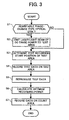
- FIG. 3 is a flowchart of test recording process control operation steps of the CPU 17 according to an embodiment of the present invention.
- the test recording process control operation starts when the CPU 17 outputs the instruction for starting an OPC operation.
- the CPU 17 determines if the optical disk 1 is a rewritable phase-change-type optical disk in step S1.
- the CPU 17 determines a type of the optical disk 1 in step S1, for example, by reading disk construction data in a lead-in area located at an inner most portion of the optical disk 1.
- the CPU 17 performs an erase process by emitting a laser light beam of a DC erase power from the LD 5a to the test area 23 of the PCA 22 before performing an OPC operation in step S2. In step S2, the CPU 17 functions as an erasing mechanism configured to perform the erase process. If the optical disk 1 is not a rewritable phase-change-type optical disk (i.e., the answer is NO in step S1), the test recording process control operation proceeds to step S3.
- the CPU 17 determines a test recording start position of the test area 23 where the OPC operation is to be performed by counting the count area 24 in step S3. Then, the CPU 17 performs a test recording operation (i.e., an OPC operation) by recording test data on a predetermined partition of the test area 23 while variously changing each intensity value of at least two recording powers of laser light beam emitted from the LD 5a step by step in step S4. Subsequently, the CPU 17 obtains a characteristic value of a reproduction signal by reproducing the test data by the optical pick-up 5 in step S5. Then, the CPU 17 calculates an optimum recording power of a laser light beam based on the obtained characteristic value in step S6. In steps S4 through S6, the CPU 17 functions as a test recording processing mechanism configured to determine an optimum recording power of a laser light beam emitted from the LD 5a.
- a test recording operation i.e., an OPC operation
- the CPU 17 records data on the count area 24 in step S7.
- the data recorded on the count area 24 indicates that the partition of the test area 23 which corresponds to the partition of the count area 24, is used for test recording operation. Then, the test recording process control operation ends.
- an erase process is performed by emitting a laser light beam of a DC erase power to the test area 23 of the PCA 22 from the LD 5a before performing an OPC operation, that is, before recording test data on one of the partitions of the test area 23.
- DC erase power here means an erase power of a laser light beam which is emitted continuously to the test area 23 of the PCA 22 at a constant power intensity during a predetermined period.
- the DC erase power is preferably higher than an erase power used in a regular erasing operation.
- an optimum recording power of a laser light beam caused by the unsteady condition of the test area 23, such as the variation of the characteristic of recording sensitivity of the test area 23, can be minimized or avoided.
- an optimum recording power of a laser light beam can be accurately and stably determined in each OPC operation.
- test data on the test area 23 of the PCA 22 it is generally performed such that the test data is recorded by variously changing each intensity value of at least two recording powers of laser light beam step by step from a low power intensity lower than a regular recording power intensity to a high power intensity higher than the regular recording power intensity.
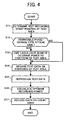
- the erase process is performed only in a predetermined partition of the test area 23 where an OPC operation is to be performed, not in the entire test area 23 before performing an OPC operation.
- the CPU 17 determines a test recording start position of the test area 23 where the OPC operation is to be performed by counting the count area 24 in step S11. Subsequently, the CPU 17 determines if the optical disk 1 is a rewritable phase-change-type optical disk in step S12.
- the CPU 17 performs an erase process by emitting a laser light beam of a DC erase power from the LD 5a to a predetermined partition of the test area 23 of the PCA 22 before performing the OPC operation in step S13.
- the CPU 17 functions as an erasing mechanism configured to perform the erase process. If the optical disk 1 is not a rewritable phase-change-type optical disk (i.e., the answer is NO in step S12), the test recording process control operation proceeds to step S14.
- the CPU 17 performs a test recording operation (i.e., an OPC operation) by recording test data on the predetermined partition of the test area 23 while variously changing each intensity value of at least two recording powers of laser light beam emitted from the LD 5a step by step in step S14. Subsequently, the CPU 17 obtains a characteristic value of a reproduction signal by reproducing the test data by the optical pick-up 5 in step S15. Then, the CPU 17 calculates an optimum recording power of a laser light beam based on the obtained characteristic value in step S16. In steps S14 through S16, the CPU 17 functions as a test recording processing mechanism configured to determine an optimum recording power of a laser light beam emitted from the LD 5a.
- a test recording operation i.e., an OPC operation
- the CPU 17 records data in the count area 24 in step S17.
- the data recorded on the count area 24 indicates that the partition of the test area 23 which corresponds to the partition of the count area 24, is used for test recording operation. Then, the test recording process control operation ends.
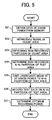
- test recording process control operation steps S11 through S17 may be alternatively shown as in a brief flowchart of FIG. 5.
- the data of erase power corresponding to the type of the optical disk 1 and the recording speed for performing an OPC operation stored in a memory, such as the RAM 19, is obtained in step S21.
- the type of the optical disk 1 is, such as a CD-RW disk, DVD-RW disk, or DVD+RW disk.
- the signal in the count area 24 is reproduced by emitting a laser light beam from the LD 5a to the count area 24, and the reproduction signal is detected by the analog signal processing circuit 6 in step S22.
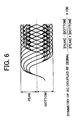
- FIG. 6 is a diagram for explaining a peak level and a bottom level of the reproduction signal detected by the analog signal processing circuit 6.
- the following expression indicates a symmetry of AC coupled RF signal, ⁇ (
- the CPU 17 determines a non-recorded partition of the test area 23 (for example, the N-th partition) corresponding to the partition of the count area 24 which was determined as a non-recorded partition in step S24.
- the non-recorded N-th partition of the test area 23 determined by the CPU 17 in step S24 is used for performing an OPC operation.
- the CPU 17 performs an erase process by emitting a laser light beam of a predetermined DC erase power from the LD 5a to the N-th partition of the test area 23 in step S25.
- the predetermined DC erase power is set to be higher than the erase power, the data of which is obtained from the memory in step S21.
- the CPU 17 performs a test recording operation (i.e., an OPC operation) by recording test data on the N-th partition of the test area 23 while variously changing each intensity value of at least two recording powers of laser light beam emitted from the LD 5a step by step in step S26. Subsequently, the CPU 17 measures the amplitude of a reproduction signal of the test data, and determines a recording power which provides an optimum recording quality based on the amplitude of the reproduction signal of the test data in step S27.
- a test recording operation i.e., an OPC operation
- the erase process is performed only in a predetermined partition of the test area 23 on which test data is to be recorded, not in all the partitions of the test area 23.
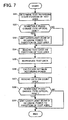
- FIG. 7 is a flowchart of test recording process control operation steps of the CPU 17 according to another embodiment of the present invention.
- This embodiment can be applied to any of the above-described test recording process control operation in the flowcharts of FIGS. 3 and 4.
- the test recording process control operation of the present embodiment is applied to the test recording process control operation in FIG. 4.
- the test recording process control operation steps S31 through S37 in FIG. 7 are similar to the test recording process control operation steps S11 through S17 in FIG. 4. Therefore, their descriptions are omitted here.
- the CPU 17 determines if the optical disk 1 is a rewritable phase-change-type optical disk in step S38. If the optical disk 1 is a rewritable phase-change-type optical disk (i.e., the answer is YES in step S38), the CPU 17 performs another erase process by emitting a laser light beam of a DC erase power from the LD 5a to the partition of the test area 23 on which the test data is recorded in step S39. Then, the test recording process control operation ends.
- the partition of the test area 23 on which the test data was recorded in the OPC operation is subjected to the erase process again.
- the test data in the partition of the test area 23 can be erased by emitting a laser light beam of a high erase power to the partition.
- the variation of an optimum recording power of a laser light beam that may occur in a subsequent OPC operation performed in the same partition of the test area 23 can be minimized or avoided.
- a test recording quality in the OPC operation is enhanced, and thereby an optimum recording power of a laser light beam can be accurately determined.
- FIG. 8 is a flowchart of test recording process control operation steps of the CPU 17 according to another embodiment of the present invention.
- the optical disk 1 has a DVD format.
- the optical disk apparatus of FIG. 1 may include an alternative configuration adapted to a DVD-R disk and DVD-RW disk.
- the test recording process control operation starts when the CPU 17 outputs the instruction for starting an OPC operation.
- the CPU 17 determines if the optical disk 1 has a DVD format based on the information in the lead-in area of the optical disk 1 in step S41. If the optical disk 1 has a DVD format (i.e., the answer is YES in step S41), the CPU 17 selects a partition of the count area 24 at random, and determines a test recording start position of a partition of the test area 23 corresponding to the selected partition of the count area 24 for performing an OPC operation in step S42. Next, the CPU 17 determines if the optical disk 1 is a rewritable phase-change-type optical disk in step S43.
- the CPU 17 performs an erase process by emitting a laser light beam of a DC erase power from the LD 5a to the partition of the test area 23 before performing an OPC operation in step S44.
- the CPU 17 functions as an erasing mechanism configured to perform the erase process. If the optical disk 1 is not a rewritable phase-change-type optical disk (i.e., the answer is NO in step S43), the test recording process control operation proceeds to step S45.
- the CPU 17 performs a test recording operation (i.e., an OPC operation) by recording test data on the partition of the test area 23 while variously changing each intensity value of at least two recording powers of laser light beam emitted from the LD 5a step by step in step S45. Subsequently, the CPU 17 obtains a characteristic value of a reproduction signal by reproducing the test data by the optical pick-up 5 in step S46. Then, the CPU 17 calculates an optimum recording power of a laser light beam based on the obtained characteristic value in step S47. In steps S45 through S47, the CPU 17 functions as a test recording processing mechanism configured to determine an optimum recording power of a laser light beam emitted from the LD 5a.
- a test recording operation i.e., an OPC operation
- the CPU 17 determines again if the optical disk 1 is a rewritable phase-change-type optical disk in step S48. If the optical disk 1 is a rewritable phase-change-type optical disk (i.e., the answer is YES in step S48), the CPU 17 performs another erase process by emitting a laser light beam of a DC erase power from the LD 5a to the partition of the test area 23 on which the test data is recorded in step S49. Further, the CPU 17 records a pattern including specific information as the predetermined main data necessary for the DVD format on the partition of the test area 23 where another erase process has been performed in step S50.
- step S50 the CPU 17 functions as a specific information recording mechanism configured to record a pattern including specific information on one of the partitions of the test area 23 of the optical disk 1 of a DVD format which is subjected to the another erase process. Then, the test recording process control operation ends.
- FIG. 9 is a flowchart of test recording process control operation steps of the CPU 17 according to another embodiment of the present invention. In this embodiment, all the partitions of the test area 23 of the PCA 22 are subjected to an erase process when necessary.
- the data of erase power corresponding to the type of the optical disk 1 and the recording speed for performing an OPC operation stored in a memory, such as the RAM 19, is obtained in step S61.
- the type of the optical disk 1 is, such as a CD-RW disk, DVD-RW disk, or DVD+RW disk.
- the signal in the count area 24 is reproduced by emitting a laser light beam from the LD 5a to the count area 24, and the reproduction signal is detected by the analog signal processing circuit 6 in step S62.
- the CPU 17 determines if the partitions of the count area 24 are recorded or non-recorded based on a difference between a peak level and a bottom level of the reproduction signal in step S63.
- the CPU 17 determines the number of the recorded partitions of the test area 23 on which test data is recorded based on the recorded partitions of the count area 24 in step S64. Further, the CPU 17 determines if the number of the recorded partitions of the test area 23 is greater than 0 (nil) and less than 100 (full) in step S65. In step S65, the CPU 17 functions as a number determining mechanism configured to determine the number of the partitions of the test area 23 on which the test data is recorded.
- step S65 If the number of the recorded partitions of the test area 23 is 0 (nil) or 100 (full) in step S65 (i.e., the answer is NO in step S65), the CPU 17 performs an erase process by emitting a laser light beam of a predetermined DC erase power from the LD 5a to all the partitions of the test area 23 before performing an OPC operation in step S66.
- the predetermined DC erase power is set to be higher than the erase power, the data of which is obtained from the memory in step S61, and the CPU 17 functions as an erasing mechanism configured to perform an erase process.
- the test recording process control operation proceeds to step S67.
- step S67 the CPU 17 performs a test recording operation (i.e., an OPC operation) by recording test data, for example, on the N-th partition of the test area 23 while variously changing each intensity value of at least two recording powers of laser light beam emitted from the LD 5a step by step. Subsequently, the CPU 17 measures the amplitude of the reproduction signal of the test data, and determines a recording power which provides an optimum recording quality based on the amplitude of the reproduction signal of the test data in step S68. In steps S67 and S68, the CPU 17 functions as a test recording processing mechanism configured to determine an optimum recording power of a laser light beam emitted from the LD 5a.
- a test recording operation i.e., an OPC operation
- an operation for moving the optical pick-up 5 including the LD 5a to the predetermined partition of the test area 23 and an operation for performing an erase process in the predetermined partition of the test area 23 need to be executed every time a test recording operation (i.e., an OPC operation) is performed. Such operations increase a time necessary for performing a test recording process control operation.
- an erase process is performed only when all the partitions of the test area 23 are non-recorded or recorded.
- the first erase process is performed in all the partitions of the test area 23 at one time when all the partitions are non-recorded (i.e., when the number of the recorded partitions is 0). Further, a subsequent erase process is performed in all the partitions of the test area 23 at one time when all the partitions are recorded (i.e., when the number of the recorded partitions is 100). Therefore, in the case of performing OPC operations several times in an optical disk, once the erase process is performed in all the partitions of the test area 23 at one time before performing the first OPC operation, the erase process need not be performed until all the partitions of the test area 23 are recorded with test data. Because the erase process is not performed every time an OPC operation is performed, a time necessary for performing a test recording process control operation can be decreased in the second test recording process control operation and after.
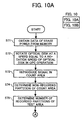
- FIGS. 10A and 10B are flowcharts of test recording process control operation steps of the CPU 17 according to. another embodiment of the present invention. This embodiment is similar to the embodiment described in the flowchart of FIG. 9 except for the rotation speed of the optical disk 1 in the test recording process control operation.
- the data of erase power corresponding to the type of the optical disk 1 and an erasing speed when erasing actual data recorded on the data area 21 in a regular erasing operation stored in a memory, such as the RAM 19, is obtained in step S71.
- the type of the optical disk 1 is, such as a CD-RW disk, DVD-RW disk, or DVD+RW disk.
- the CPU 17 causes the optical disk 1 to rotate at a speed equal to a rotation speed of the optical disk 1 in an OPC operation in step S72.
- the signal in the count area 24 is reproduced by emitting a laser light beam from the LD 5a to the count area 24, and the reproduction signal is detected by the analog signal processing circuit 6 in step S73.
- the CPU 17 determines if the partitions of the count area 24 are recorded or non-recorded based on a difference between a peak level and a bottom level of the reproduction signal in step S74. Then, the CPU 17 determines the number of the recorded partitions of the test area 23 on which test data is recorded based on the recorded partitions of the count area 24 in step S75.
- the CPU 17 determines if the number of the recorded partitions of the test area 23 is greater than 0 (nil) and less than 100 (full) in step S76. If the number of the recorded partitions of the test area 23 is 0 (nil) or 100 (full) in step S76 (i.e., the answer is NO in step S76), the CPU 17 causes the optical disk 1 to rotate at a predetermined erasing speed in step S77, and performs an erase process by emitting a laser light beam of a predetermined DC erase power from the LD 5a to all the partitions of the test area 23 before performing an OPC operation in step S78.
- the predetermined erasing speed may be set to be lower than the erasing speed when erasing actual data recorded on the data area 21 in a regular erasing operation.
- the predetermined DC erase power is set to be higher than the erase power, the data of which is obtained from the memory in step S71.
- step S76 the test recording process control operation proceeds to step S79.
- the CPU 17 causes the optical disk 1 to rotate at a speed equal to a rotation speed of the optical disk 1 in the OPC operation.
- the CPU 17 performs a test recording operation (i.e., an OPC operation) by recording test data, for example, on the Nth partition of the test area 23 while variously changing each intensity value of at least two recording powers of laser light beam emitted from the LD 5a step by step in step S80.
- the CPU 17 measures the amplitude of the reproduction signal of the test data, and determines a recording power which provides an optimum recording quality based on the amplitude of the reproduction signal of the test data in step S81.
- the CPU 17 may cause the optical disk 1 to rotate at a predetermined erasing speed in step S72 instead of step S77, that is, before reproducing the signal in the count area 24 in step S73. In this case, the CPU 17 does not cause the optical disk 1 to rotate at a speed equal to a rotation speed of the optical disk 1 in an OPC operation in step S72.
- the erasing speed of the optical disk 1 is not limited to a particular value, but it is preferable to select the speed that allows an adequate erasing performance.
- the optical disk 1 is rotated at the same erasing speed every time the CPU 17 performs the erase process before performing the OPC operation. If the rotation speed of the optical disk 1 changes every time the CPU 17 performs the erase process, an adequate value of a DC erase power of a laser light beam emitted in the erase process becomes different. This causes the condition of the test area 23 to become different in each erase process, thereby causing the variation of the optimum recording power determined in the OPC operation.
- the condition of the test area 23 subjected to the erase process can be uniform. Thus, the variation of the optimum recording power determined in the OPC operation can be minimized or avoided.
- FIG. 11 is a flowchart of test recording process control operation steps of the CPU 17 according to another embodiment of the present invention.
- the CPU 17 also functions as a defect determining mechanism configured to determine if the partition of the test area 23 has a defect. If the partition (even if a non-recorded partition) of the test area 23 has a defect, an amplitude obtained from the peak level and bottom level of a reproduction signal exceeds an amplitude of a reproduction signal obtained from a recorded partition of the test area 23 without a defect.
- the amplitude of the reproduction signal obtained from the recorded partition of the test area 23 may be used as a defect determination value (i.e., a threshold value), and the CPU 17 determines if the partition of the test area 23 has a defect by comparing an amplitude of a reproduction signal obtained from the partition of the test area 23 with the defect determination value.
- a defect determination value i.e., a threshold value
- the data of erase power corresponding to the type of the optical disk 1 and the recording speed for performing an OPC operation stored in a memory, such as the RAM 19, is obtained in step S91.
- the CPU 17 sets a defect determination value RFO (i.e., a threshold value) used for determining if the optical disk 1 has a defect in step S92.
- the signal in the count area 24 is reproduced by emitting a laser light beam from the LD 5a to the count area 24, and the reproduction signal is detected by the analog signal processing circuit 6 in step S93.
- the CPU 17 extracts the partition of the test area 23 (for example, the N-th partition) corresponding to the partition of the count area 24 which was determined as a non-recorded partition in step S94.
- the non-recorded N-th partition of the test area 23 extracted by the CPU 17 in step S94 is used for performing an OPC operation.
- the CPU 17 functions as an extracting mechanism configured to extract a non-recorded partition of the test area 23.
- step S95 the signal in the N-th partition is reproduced, and an amplitude of the reproduction signal (i.e., an RF signal) is measured in step S95.
- the CPU 17 determines if the amplitude of the reproduction signal falls below the defect determination value RFO in step 96.
- step S96 the CPU 17 functions as a defect determining mechanism configured to determine if the non-recorded partition extracted in step S94 has a defect. If the amplitude of the reproduction signal is equal to or greater than the defect determination value RFO in step 96 (i.e., the answer is NO in step S96), the CPU 17 increments the number "N" by 1 in step S97.
- step S95 the test recording process control operation returns to reexecute step S95.
- the signal in the N-th partition (the current "N" is greater than the preceding "N” by 1) is reproduced, and an amplitude of the reproduction signal (i.e., an RF signal) is measured in step S95.
- the measurement of the amplitude of the reproduction signal is repeated until the amplitude of the signal reproduced from the N-th partition falls below the defect determination value RFO.
- the N-th partition is determined as a partition without a defect, and is used for performing an OPC operation.
- the CPU 17 performs an erase process by emitting a laser light beam of a predetermined DC erase power from the LD 5a to the N-th partition of the test area 23 in step S98.
- the predetermined DC erase power is set to be higher than the erase power, the data of which is obtained from the memory in step S91, and the CPU 17 functions as an erasing mechanism configured to perform an erase process.
- the CPU 17 performs a test recording operation (i.e., an OPC operation) by recording test data on the N-th partition of the test area 23 while variously changing each intensity value of at least two recording powers of laser light beam emitted from the LD 5a step by step in step S99. Subsequently, the CPU 17 measures the amplitude of the reproduction signal of the test data, and determines a recording power which provides an optimum recording quality based on the amplitude of the reproduction signal of the test data in step S100. In steps S99 and S100, the CPU 17 functions as a test recording processing mechanism configured to determine an optimum recording power of a laser light beam emitted from the LD 5a.
- a test recording operation i.e., an OPC operation
- the erase process and test recording operation are performed only in the partition of the test area 23 without a defect.
- an optimum recording power can be determined with accuracy, so that a recording quality can be enhanced.
- an erase process is performed by emitting a laser light beam of a DC erase power to the test area 23 of the PCA 22 from the LD 5a before performing an OPC operation, that is, before recording test data on one of the partitions of the test area 23.
Landscapes
- Physics & Mathematics (AREA)
- Optics & Photonics (AREA)
- Optical Recording Or Reproduction (AREA)
- Optical Head (AREA)
Applications Claiming Priority (2)
| Application Number | Priority Date | Filing Date | Title |
|---|---|---|---|
| JP2003197514 | 2003-07-16 | ||
| JP2003197514A JP2005038466A (ja) | 2003-07-16 | 2003-07-16 | 試し書き処理制御方法及び光ディスク装置 |
Publications (2)
| Publication Number | Publication Date |
|---|---|
| EP1498886A2 true EP1498886A2 (de) | 2005-01-19 |
| EP1498886A3 EP1498886A3 (de) | 2007-09-26 |
Family
ID=33475501
Family Applications (1)
| Application Number | Title | Priority Date | Filing Date |
|---|---|---|---|
| EP04254269A Ceased EP1498886A3 (de) | 2003-07-16 | 2004-07-16 | Steuerverfahren für Testaufzeichnungssverfahren und optisches Plattengerät |
Country Status (3)
| Country | Link |
|---|---|
| US (1) | US20050030861A1 (de) |
| EP (1) | EP1498886A3 (de) |
| JP (1) | JP2005038466A (de) |
Cited By (3)
| Publication number | Priority date | Publication date | Assignee | Title |
|---|---|---|---|---|
| WO2006048810A1 (en) | 2004-11-04 | 2006-05-11 | Koninklijke Philips Electronics N.V. | Method, optical recording apparatus using such method and optical recording medium for use by the method and the apparatus |
| EP1764789A1 (de) | 2005-09-14 | 2007-03-21 | Samsung Electronics Co., Ltd. | Vorrichtung und Verfahren zur Steuerung eines Löschleistungspegels |
| EP1821298A3 (de) * | 2006-02-21 | 2009-03-04 | Samsung Electronics Co.,Ltd. | Verfahren zur Bestimmung der optimalen Löschkraft in einer optischen Plattenvorrichtung |
Families Citing this family (14)
| Publication number | Priority date | Publication date | Assignee | Title |
|---|---|---|---|---|
| JP2005100549A (ja) * | 2003-09-26 | 2005-04-14 | Pioneer Electronic Corp | 情報記録装置及び方法、情報記録再生装置及び方法、並びにコンピュータプログラム |
| JP4389809B2 (ja) * | 2005-02-24 | 2009-12-24 | 船井電機株式会社 | 光ディスク装置 |
| KR100680710B1 (ko) * | 2005-03-14 | 2007-02-09 | 삼성전자주식회사 | 최적 기록 광파워의 편차 개선 방법 및 장치 |
| TW200634762A (en) * | 2005-03-25 | 2006-10-01 | Benq Corp | Determination of adaptive writing strategy for recording data onto optical information recording medium having full calibration area |
| JP2006309881A (ja) * | 2005-04-28 | 2006-11-09 | Samsung Electronics Co Ltd | 光情報記録装置および光情報記録方法 |
| TWI309413B (en) * | 2005-05-17 | 2009-05-01 | Via Tech Inc | Optimum power calibration method and optical disk drive |
| KR101150986B1 (ko) * | 2005-07-04 | 2012-06-08 | 삼성전자주식회사 | 최적 기록 파워 결정을 위한 광디스크 구동장치 및 그제어방법 |
| JP2007042187A (ja) * | 2005-08-02 | 2007-02-15 | Ricoh Co Ltd | 光ディスク装置 |
| JP4560798B2 (ja) * | 2005-09-26 | 2010-10-13 | 日本ビクター株式会社 | 光ディスク記録再生装置、光ディスク記録再生方法、及び光記録媒体 |
| JP4492543B2 (ja) * | 2005-10-31 | 2010-06-30 | 日本ビクター株式会社 | 光ディスク記録再生装置、光ディスク記録再生方法及び光記録媒体並びに光ディスク記録再生プログラム |
| KR100672112B1 (ko) * | 2005-10-11 | 2007-01-19 | 주식회사 히타치엘지 데이터 스토리지 코리아 | 광디스크장치의 오피씨 수행방법 |
| JP2010503137A (ja) * | 2006-09-07 | 2010-01-28 | コーニンクレッカ フィリップス エレクトロニクス エヌ ヴィ | 書込パワー較正を実施するための方法及び装置 |
| JP4775666B2 (ja) * | 2008-06-12 | 2011-09-21 | ソニー株式会社 | 情報処理装置および方法、並びにプログラム |
| JP2010044807A (ja) * | 2008-08-08 | 2010-02-25 | Hitachi-Lg Data Storage Inc | 記録パワーの調整方法及び光ディスク装置 |
Citations (3)
| Publication number | Priority date | Publication date | Assignee | Title |
|---|---|---|---|---|
| US20020085462A1 (en) * | 2000-12-04 | 2002-07-04 | Spruit Johannes Hendrikus Maria | Method and optical recording apparatus for determining the optimum write power |
| WO2002082433A1 (en) * | 2001-03-30 | 2002-10-17 | Mitsumi Electric Co., Ltd. | Optical disc apparatus |
| US6480449B1 (en) * | 1998-09-28 | 2002-11-12 | Matsushita Electric Industrial Co., Ltd. | Optical information recording medium, optical information recording apparatus, and method of recording test signal on the same |
Family Cites Families (7)
| Publication number | Priority date | Publication date | Assignee | Title |
|---|---|---|---|---|
| JPS62267926A (ja) * | 1986-05-16 | 1987-11-20 | Matsushita Electric Ind Co Ltd | 消去可能な光デイスク装置 |
| TW234182B (de) * | 1992-11-20 | 1994-11-11 | Philips Electronics Nv | |
| JP3787415B2 (ja) * | 1996-06-04 | 2006-06-21 | キヤノン株式会社 | テスト記録方法及び該方法を用いた光学的情報記録再生装置 |
| JP3429166B2 (ja) * | 1997-08-28 | 2003-07-22 | 富士通株式会社 | 光学的記憶装置 |
| TW468162B (en) * | 1999-10-13 | 2001-12-11 | Koninkl Philips Electronics Nv | Method of hiding areas on a disc like recording of the optically rewritable type |
| US6614735B2 (en) * | 2000-03-23 | 2003-09-02 | Matsushita Electric Industrial Co., Ltd. | Method and apparatus for determining optical recording power used for recording onto an optical disk |
| TW509928B (en) * | 2001-04-17 | 2002-11-11 | Via Tech Inc | Optimal writing power calibration method |
-
2003
- 2003-07-16 JP JP2003197514A patent/JP2005038466A/ja active Pending
-
2004
- 2004-07-08 US US10/886,096 patent/US20050030861A1/en not_active Abandoned
- 2004-07-16 EP EP04254269A patent/EP1498886A3/de not_active Ceased
Patent Citations (4)
| Publication number | Priority date | Publication date | Assignee | Title |
|---|---|---|---|---|
| US6480449B1 (en) * | 1998-09-28 | 2002-11-12 | Matsushita Electric Industrial Co., Ltd. | Optical information recording medium, optical information recording apparatus, and method of recording test signal on the same |
| US20020085462A1 (en) * | 2000-12-04 | 2002-07-04 | Spruit Johannes Hendrikus Maria | Method and optical recording apparatus for determining the optimum write power |
| WO2002082433A1 (en) * | 2001-03-30 | 2002-10-17 | Mitsumi Electric Co., Ltd. | Optical disc apparatus |
| US20040125720A1 (en) * | 2001-03-30 | 2004-07-01 | Junichi Ando | Optical disc apparatus |
Cited By (4)
| Publication number | Priority date | Publication date | Assignee | Title |
|---|---|---|---|---|
| WO2006048810A1 (en) | 2004-11-04 | 2006-05-11 | Koninklijke Philips Electronics N.V. | Method, optical recording apparatus using such method and optical recording medium for use by the method and the apparatus |
| EA010754B1 (ru) * | 2004-11-04 | 2008-10-30 | Конинклейке Филипс Электроникс Н.В. | Способ, устройство оптической записи, использующее такой способ, и носитель оптической записи для использования способом и устройством |
| EP1764789A1 (de) | 2005-09-14 | 2007-03-21 | Samsung Electronics Co., Ltd. | Vorrichtung und Verfahren zur Steuerung eines Löschleistungspegels |
| EP1821298A3 (de) * | 2006-02-21 | 2009-03-04 | Samsung Electronics Co.,Ltd. | Verfahren zur Bestimmung der optimalen Löschkraft in einer optischen Plattenvorrichtung |
Also Published As
| Publication number | Publication date |
|---|---|
| EP1498886A3 (de) | 2007-09-26 |
| JP2005038466A (ja) | 2005-02-10 |
| US20050030861A1 (en) | 2005-02-10 |
Similar Documents
| Publication | Publication Date | Title |
|---|---|---|
| EP1607947B1 (de) | Verfahren zur steuerung der versuchsschreiboperation auf ein optisches aufzeichnungsmedium | |
| EP1498886A2 (de) | Steuerverfahren für Testaufzeichnungssverfahren und optisches Plattengerät | |
| EP1150291B1 (de) | Optisches Plattenlaufwerk, und Verfahren zur Aufzeichnung/Wiedergabe | |
| US7349307B2 (en) | Method of recording data optimally onto a recording medium | |
| US20050185537A1 (en) | Evaluation method, recording method, program and recording medium, and optical disk apparatus | |
| US7391705B2 (en) | Optical information recording apparatus, information processing apparatus, optical information recording medium, optical information recording method, and computer-readable storage medium | |
| US20040233826A1 (en) | Laser power control device, information recording apparatus, optical disk apparatus, laser power source drive current value determining method, information recording method, optical disk recording method | |
| US7414935B2 (en) | Method of overwriting optical disk with adapting initial writing conditions | |
| JP2003067926A (ja) | 光ディスク装置 | |
| US7313064B2 (en) | Optical disk recording and reproducing apparatus and method for determining optimal power thereof | |
| US20070171794A1 (en) | Recording method, recording apparatus, and storage medium | |
| US7212481B2 (en) | Searching method and device for a recording medium having overlapped time address | |
| KR20080005266A (ko) | 기록 스트래티지를 설정하는 기록 시스템 | |
| KR100618276B1 (ko) | 최적 파워 결정을 위한 pca 소거 방법 | |
| JP4329731B2 (ja) | 光ディスク装置 | |
| CN100433147C (zh) | 改善最优功率校准的偏差的装置和方法 | |
| US20050147001A1 (en) | Method or recording information, computer program, computer readable storage medium, and optical disk apparatus that stably record information on optical disk with high recording quality | |
| US20070263507A1 (en) | Optical disc apparatus and method of determining writing power of the same | |
| US20050254380A1 (en) | Information recording method and apparatus | |
| JP2002056536A (ja) | 光ディスク及び光ディスク装置 | |
| US7796481B2 (en) | Information recording apparatus, information recording method and information recording program | |
| JP4479583B2 (ja) | 光ディスク装置 | |
| US20080130438A1 (en) | Optical disk apparatus and control method therefor | |
| JP2006127752A (ja) | 光情報記録媒体 | |
| KR20080102525A (ko) | 광디스크장치의 반복기록방법 및 장치 |
Legal Events
| Date | Code | Title | Description |
|---|---|---|---|
| PUAI | Public reference made under article 153(3) epc to a published international application that has entered the european phase |
Free format text: ORIGINAL CODE: 0009012 |
|
| 17P | Request for examination filed |
Effective date: 20040803 |
|
| AK | Designated contracting states |
Kind code of ref document: A2 Designated state(s): AT BE BG CH CY CZ DE DK EE ES FI FR GB GR HU IE IT LI LU MC NL PL PT RO SE SI SK TR |
|
| AX | Request for extension of the european patent |
Extension state: AL HR LT LV MK |
|
| PUAL | Search report despatched |
Free format text: ORIGINAL CODE: 0009013 |
|
| AK | Designated contracting states |
Kind code of ref document: A3 Designated state(s): AT BE BG CH CY CZ DE DK EE ES FI FR GB GR HU IE IT LI LU MC NL PL PT RO SE SI SK TR |
|
| AX | Request for extension of the european patent |
Extension state: AL HR LT LV MK |
|
| AKX | Designation fees paid |
Designated state(s): DE ES FR GB IT NL |
|
| 17Q | First examination report despatched |
Effective date: 20080514 |
|
| STAA | Information on the status of an ep patent application or granted ep patent |
Free format text: STATUS: THE APPLICATION HAS BEEN REFUSED |
|
| 18R | Application refused |
Effective date: 20110920 |