EP1499062B1 - System und Verfahren zur individuellen Video-Verschlüsselung - Google Patents
System und Verfahren zur individuellen Video-Verschlüsselung Download PDFInfo
- Publication number
- EP1499062B1 EP1499062B1 EP20040016791 EP04016791A EP1499062B1 EP 1499062 B1 EP1499062 B1 EP 1499062B1 EP 20040016791 EP20040016791 EP 20040016791 EP 04016791 A EP04016791 A EP 04016791A EP 1499062 B1 EP1499062 B1 EP 1499062B1
- Authority
- EP
- European Patent Office
- Prior art keywords
- data
- stream
- multimedia data
- encrypted
- multimedia
- Prior art date
- Legal status (The legal status is an assumption and is not a legal conclusion. Google has not performed a legal analysis and makes no representation as to the accuracy of the status listed.)
- Expired - Lifetime
Links
Images


Classifications
-
- G—PHYSICS
- G09—EDUCATION; CRYPTOGRAPHY; DISPLAY; ADVERTISING; SEALS
- G09C—CIPHERING OR DECIPHERING APPARATUS FOR CRYPTOGRAPHIC OR OTHER PURPOSES INVOLVING THE NEED FOR SECRECY
- G09C5/00—Ciphering apparatus or methods not provided for in the preceding groups, e.g. involving the concealment or deformation of graphic data such as designs, written or printed messages
-
- H—ELECTRICITY
- H04—ELECTRIC COMMUNICATION TECHNIQUE
- H04L—TRANSMISSION OF DIGITAL INFORMATION, e.g. TELEGRAPHIC COMMUNICATION
- H04L9/00—Cryptographic mechanisms or cryptographic arrangements for secret or secure communications; Network security protocols
- H04L9/06—Cryptographic mechanisms or cryptographic arrangements for secret or secure communications; Network security protocols the encryption apparatus using shift registers or memories for block-wise or stream coding, e.g. DES systems or RC4; Hash functions; Pseudorandom sequence generators
- H04L9/065—Encryption by serially and continuously modifying data stream elements, e.g. stream cipher systems, RC4, SEAL or A5/3
- H04L9/0656—Pseudorandom key sequence combined element-for-element with data sequence, e.g. one-time-pad [OTP] or Vernam's cipher
-
- H—ELECTRICITY
- H04—ELECTRIC COMMUNICATION TECHNIQUE
- H04L—TRANSMISSION OF DIGITAL INFORMATION, e.g. TELEGRAPHIC COMMUNICATION
- H04L9/00—Cryptographic mechanisms or cryptographic arrangements for secret or secure communications; Network security protocols
- H04L9/32—Cryptographic mechanisms or cryptographic arrangements for secret or secure communications; Network security protocols including means for verifying the identity or authority of a user of the system or for message authentication, e.g. authorization, entity authentication, data integrity or data verification, non-repudiation, key authentication or verification of credentials
- H04L9/3226—Cryptographic mechanisms or cryptographic arrangements for secret or secure communications; Network security protocols including means for verifying the identity or authority of a user of the system or for message authentication, e.g. authorization, entity authentication, data integrity or data verification, non-repudiation, key authentication or verification of credentials using a predetermined code, e.g. password, passphrase or PIN
-
- H—ELECTRICITY
- H04—ELECTRIC COMMUNICATION TECHNIQUE
- H04N—PICTORIAL COMMUNICATION, e.g. TELEVISION
- H04N21/00—Selective content distribution, e.g. interactive television or video on demand [VOD]
- H04N21/20—Servers specifically adapted for the distribution of content, e.g. VOD servers; Operations thereof
- H04N21/23—Processing of content or additional data; Elementary server operations; Server middleware
- H04N21/234—Processing of video elementary streams, e.g. splicing of video streams or manipulating encoded video stream scene graphs
- H04N21/2347—Processing of video elementary streams, e.g. splicing of video streams or manipulating encoded video stream scene graphs involving video stream encryption
-
- H—ELECTRICITY
- H04—ELECTRIC COMMUNICATION TECHNIQUE
- H04N—PICTORIAL COMMUNICATION, e.g. TELEVISION
- H04N21/00—Selective content distribution, e.g. interactive television or video on demand [VOD]
- H04N21/20—Servers specifically adapted for the distribution of content, e.g. VOD servers; Operations thereof
- H04N21/25—Management operations performed by the server for facilitating the content distribution or administrating data related to end-users or client devices, e.g. end-user or client device authentication, learning user preferences for recommending movies
- H04N21/258—Client or end-user data management, e.g. managing client capabilities, user preferences or demographics, processing of multiple end-users preferences to derive collaborative data
- H04N21/25866—Management of end-user data
- H04N21/25875—Management of end-user data involving end-user authentication
-
- H—ELECTRICITY
- H04—ELECTRIC COMMUNICATION TECHNIQUE
- H04N—PICTORIAL COMMUNICATION, e.g. TELEVISION
- H04N21/00—Selective content distribution, e.g. interactive television or video on demand [VOD]
- H04N21/20—Servers specifically adapted for the distribution of content, e.g. VOD servers; Operations thereof
- H04N21/25—Management operations performed by the server for facilitating the content distribution or administrating data related to end-users or client devices, e.g. end-user or client device authentication, learning user preferences for recommending movies
- H04N21/266—Channel or content management, e.g. generation and management of keys and entitlement messages in a conditional access system, merging a VOD unicast channel into a multicast channel
- H04N21/26613—Channel or content management, e.g. generation and management of keys and entitlement messages in a conditional access system, merging a VOD unicast channel into a multicast channel for generating or managing keys in general
-
- H—ELECTRICITY
- H04—ELECTRIC COMMUNICATION TECHNIQUE
- H04N—PICTORIAL COMMUNICATION, e.g. TELEVISION
- H04N21/00—Selective content distribution, e.g. interactive television or video on demand [VOD]
- H04N21/20—Servers specifically adapted for the distribution of content, e.g. VOD servers; Operations thereof
- H04N21/25—Management operations performed by the server for facilitating the content distribution or administrating data related to end-users or client devices, e.g. end-user or client device authentication, learning user preferences for recommending movies
- H04N21/266—Channel or content management, e.g. generation and management of keys and entitlement messages in a conditional access system, merging a VOD unicast channel into a multicast channel
- H04N21/2668—Creating a channel for a dedicated end-user group, e.g. insertion of targeted commercials based on end-user profiles
-
- H—ELECTRICITY
- H04—ELECTRIC COMMUNICATION TECHNIQUE
- H04N—PICTORIAL COMMUNICATION, e.g. TELEVISION
- H04N21/00—Selective content distribution, e.g. interactive television or video on demand [VOD]
- H04N21/40—Client devices specifically adapted for the reception of or interaction with content, e.g. set-top-box [STB]; Operations thereof
- H04N21/43—Processing of content or additional data, e.g. demultiplexing additional data from a digital video stream; Elementary client operations, e.g. monitoring of home network or synchronising decoder's clock; Client middleware
- H04N21/44—Processing of video elementary streams, e.g. splicing a video clip retrieved from local storage with an incoming video stream or rendering scenes according to encoded video stream scene graphs
- H04N21/4405—Processing of video elementary streams, e.g. splicing a video clip retrieved from local storage with an incoming video stream or rendering scenes according to encoded video stream scene graphs involving video stream decryption
-
- H—ELECTRICITY
- H04—ELECTRIC COMMUNICATION TECHNIQUE
- H04N—PICTORIAL COMMUNICATION, e.g. TELEVISION
- H04N21/00—Selective content distribution, e.g. interactive television or video on demand [VOD]
- H04N21/40—Client devices specifically adapted for the reception of or interaction with content, e.g. set-top-box [STB]; Operations thereof
- H04N21/45—Management operations performed by the client for facilitating the reception of or the interaction with the content or administrating data related to the end-user or to the client device itself, e.g. learning user preferences for recommending movies, resolving scheduling conflicts
- H04N21/462—Content or additional data management e.g. creating a master electronic programme guide from data received from the Internet and a Head-end or controlling the complexity of a video stream by scaling the resolution or bit-rate based on the client capabilities
- H04N21/4623—Processing of entitlement messages, e.g. ECM [Entitlement Control Message] or EMM [Entitlement Management Message]
-
- H—ELECTRICITY
- H04—ELECTRIC COMMUNICATION TECHNIQUE
- H04N—PICTORIAL COMMUNICATION, e.g. TELEVISION
- H04N21/00—Selective content distribution, e.g. interactive television or video on demand [VOD]
- H04N21/60—Network structure or processes for video distribution between server and client or between remote clients; Control signalling between clients, server and network components; Transmission of management data between server and client, e.g. sending from server to client commands for recording incoming content stream; Communication details between server and client
- H04N21/63—Control signaling related to video distribution between client, server and network components; Network processes for video distribution between server and clients or between remote clients, e.g. transmitting basic layer and enhancement layers over different transmission paths, setting up a peer-to-peer communication via Internet between remote STB's; Communication protocols; Addressing
- H04N21/633—Control signals issued by server directed to the network components or client
- H04N21/6332—Control signals issued by server directed to the network components or client directed to client
- H04N21/6334—Control signals issued by server directed to the network components or client directed to client for authorisation, e.g. by transmitting a key
- H04N21/63345—Control signals issued by server directed to the network components or client directed to client for authorisation, e.g. by transmitting a key by transmitting keys
-
- H—ELECTRICITY
- H04—ELECTRIC COMMUNICATION TECHNIQUE
- H04N—PICTORIAL COMMUNICATION, e.g. TELEVISION
- H04N21/00—Selective content distribution, e.g. interactive television or video on demand [VOD]
- H04N21/80—Generation or processing of content or additional data by content creator independently of the distribution process; Content per se
- H04N21/83—Generation or processing of protective or descriptive data associated with content; Content structuring
- H04N21/835—Generation of protective data, e.g. certificates
-
- H—ELECTRICITY
- H04—ELECTRIC COMMUNICATION TECHNIQUE
- H04N—PICTORIAL COMMUNICATION, e.g. TELEVISION
- H04N7/00—Television systems
- H04N7/16—Analogue secrecy systems; Analogue subscription systems
- H04N7/167—Systems rendering the television signal unintelligible and subsequently intelligible
- H04N7/1675—Providing digital key or authorisation information for generation or regeneration of the scrambling sequence
-
- H—ELECTRICITY
- H04—ELECTRIC COMMUNICATION TECHNIQUE
- H04L—TRANSMISSION OF DIGITAL INFORMATION, e.g. TELEGRAPHIC COMMUNICATION
- H04L2209/00—Additional information or applications relating to cryptographic mechanisms or cryptographic arrangements for secret or secure communication H04L9/00
- H04L2209/60—Digital content management, e.g. content distribution
Definitions
- This invention is related to a method and apparatus for encrypting multimedia data, in particular multimedia data that is encrypted before being transmitted.
- Codecs are typically implemented through a combination of software and hardware. This system is used for encoding multimedia data representing a media object at a transmission end of a communications network and for decoding data at a receiver end of the communications network. Design considerations for codecs include such issues as bandwidth scalability over a network, computational complexity of encoding/decoding data, resilience to network losses (loss of data), and encoder/decoder latencies for transmitting data representing media streams.
- codecs utilizing both Discrete Cosine Transformation (DCT) (such as a video encoder as described in Video Coding for Low Bit Rate Communications H.263, published by the International Telecommunications Union) and non-DCT techniques (such as wavelets and fractals) are examples of codecs that consider these above detailed issues. Codecs are also used to compress and decompress data because of the limited bandwidth available through a communications network.
- DCT Discrete Cosine Transformation
- H.263 Video Coding for Low Bit Rate Communications H.263
- non-DCT techniques such as wavelets and fractals
- Quality of service issues relate to the delivery of audio and video information and the overall experience for a user watching a media object.
- Media objects are delivered through a communications network in discrete units known as packets. These units of information, typically transmitted in sequential order, are sent via a data network through nodes commonly known as servers and routers. It is therefore possible that two sequentially transmitted packets arrive at a destination device at different times because the packets may take different paths through the Internet. Consequentially, a QoS problem known as dispersion could result where a packet transmitted later in time may be processed and displayed by a destination device before an earlier transmitted packet, leading to discontinuity of displayed events. Similarly, it is possible for packets to be lost when being transmitted. A destination device typically performs an error concealment technique to hide the loss of data. Methods of ensuring QoS over a network such as over-allocating the number of transmitted packets or improving quality of a network under a load state may be used, but these methods introduce additional overhead requirements affecting communication network performance.
- TCP Transmission Control Protocol
- IETF Internet Engineering Task Force
- RRC Request For Comments
- a transport protocol attempts to stabilize a communications network by maintaining parameters such as flow control, error control, and the time-organized delivery of data packets.
- These types of controls are administered through the use of commands that exist in a header of a packet or separately from packets transmitted between devices through the communications network. This control information works well for a communications network that operates in a "synchronous" manner where the transmission of data packets tends to be orderly.
- the producer of such multimedia data wants the transmitted product to only be received and used by users who have legitimate access to such transmitted data.
- multimedia data is hijacked and used by people known as pirates who do not have legitimate access to such data.
- a producer protects data by conditional access means to make it difficult for an unauthorized user to access and use such data.
- conditional access Some common techniques of conditional access include requiring the use of a password to access data, data scrambling, data encryption, and the like. With the frequent use of conditional access systems, pirates are savvy when breaking such systems to illegally access such protected data. This is the case, if a pirate knows forehand what technique or techniques are being used to protect data.
- US-5,285,497 teaches a variation on the traditional three-tier encryption scheme for protecting digital content in a digital transport stream.
- Data blocks and their parity data resulting from Forward Error Coding are split up and an one-bit error is inserted into each data block, while the parity data is encrypted using a code word, which is encrypted using a multi-session key, which in turn is encrypted using the secret serial number of the receiving decoder.
- the data blocks, encrypted parity data, encrypted code words, and encrypted multi-session key are then multiplexed and sent to the decoder.
- US-6,304,659 teaches a method of packet transfer to receivers each having an individual identifier. Data is included in a signal that has destination addresses encrypted by control words and receiver identifiers, and control messages that contain encrypted control words, address flags and control flags. A receiver constructs receiver addresses from the control words and the receiver identifier, may update a receiver address register, and accepts packets having a destination address that matches its receiver address.
- a subject of the invention is a process for protecting multimedia data, wherein it comprises the steps of:
- An aspect of the invention presents an apparatus for multiplexing multimedia data into a multiplexed data stream.
- An aspect to the invention presents a method for demultiplexing a multiplexed data stream in view of a stream key data included in the data stream.
- An aspect to the invention presents an apparatus for demultiplexing a multiplexed data stream in view of stream key data included in the data stream.
- multimedia data represents any combination of text, image, video, and audio data.
- Streaming media comprises audio, video, multimedia, textual, and interactive data that are delivered to a user device via the Internet or other communications data network where such media may be played back before completely receiving all of the multimedia data of the media.
- the exemplary embodiment pertains to the realm of a video on demand server, that delivers multimedia data, as a movie, television program, broadcast program, and the like, to user via a data network.
- This invention however is not just limited to this exemplary embodiment and applies to any system where multimedia data is transferred to a user, where there is a need to protect such data from the unauthorized access of a third party.
- FIG. 1 is a system diagram of an encoder that processes multimedia data of a media object into a protected multiplexed data stream, in accordance with an exemplary embodiment of the present invention.
- multimedia data is processed for transmission to a data subscriber by a service provider, where such data is protected to prevent a third party from using such data.
- the data subscriber operates a decoder that has a unique identification number (UID), which is used for an indicator for identifying the data subscriber.
- UID unique identification number
- Such a number may be assigned to the decoder based on the identification number used by a Network Interface Card (NIC) in a IEEE 802.3 compliant connection to a data network, a Media Access Control (MAC) address used in a decoding operation, or a UID that is assigned by a service provider to a data subscriber, and the like.
- the service provider optionally uses the UID to identify and to ascertain the access privileges of a data subscriber corresponding to such a UID.
- Multimedia data server 110 stores and transmits multimedia data preferably to a data subscriber.
- Multimedia data represents audio and/or video data of a media object content such as movies, television programming, radio programming, and the like.
- Multimedia data server 110 may be a hard drive, removable hard disc, compact disc, a digital versatile disc, or a multiple thereof, and any other devices used to store and deliver multimedia data for an encoding operation.
- multimedia data server 110 is replaced with a data feed of real time generated multimedia data that is eventually encoded for transmission.
- Encoder 120 coupled to multimedia data server 110, encodes multimedia data into format suitable for processing.
- multimedia data received by encoder 120 is formatted into an MPEG-2 compliant format.
- the use of encoder 120 in this type of encoding operation is known in the art, as using encoder 120 for encoding multimedia data into a different multimedia format such as MPEG-2, MPEG-4, Joint Video Team Compression, and the like.
- Encoder 120 is also used to protect multimedia data into format that makes it more difficult for third parties to access such protected data.
- encoder 120 makes use of coding tables to code MPEG-2 formatted data into an encrypted format. Hence, a third party is limited from being able to directly access the encoded multimedia format, without knowing how such data was encrypted.
- encoder 120 may use an encryption process such as Data Encryption Standard (DES), International Data Encryption Algorithm (IDEA), Secure and Fast Encryption Routine (SAFER), or any other types of encryption method as known in the art for encrypting multimedia data.
- DES Data Encryption Standard
- IDEA International Data Encryption Algorithm
- SAFER Secure and Fast Encryption Routine
- the product of the encryption operation produces data referred to as encrypted multimedia data.
- pattern multiplexer 140 receives encrypted multimedia data from encoder 120.
- Pattern multiplexer 140 performs a second step of data protection by multiplexing the encrypted multimedia data received from encoder 120 with other types of data, such a multiplexing operation being referred to as a multiplexing pattern (MUXP).
- MUXP multiplexing pattern
- the MUXP operation begins with a service provider randomly choosing a value or term known as a stream key, as performed by stream key generator 115.
- pattern multiplexer 140 obtains a UID corresponding to a user or user's device from instrument identification number 130. The stream key and the UID are used by pattern multiplexer 140 for determining how to multiplex the data from encoder 120 with the stream key and decryption information used for decrypting the data from encoder 120.
- the multiplexing of a stream key, decryption information, and encrypted multimedia data by pattern multiplexer 140 is performed by using the stream key and UID as seed values in a MUXP in view of a mathematical formula, or any other technique used for allocating the positions of at least three different data types in a data stream.
- a MUXP used by pattern multiplexer 140 is a statistical multiplexing operation using the stream key and the UID as seed values, although other types of formulas or processes may be used for determining the MUXP. It is important that the MUXP pattern change, if either the UID value or stream key value change.
- protected multiplexed data stream 200 (hereafter data stream 200) is transmitted in the form of data packets, although data stream 200 may be any data format.
- the composition of data stream 200 comprises at least three different data types: stream key 210, encrypted multimedia data 220, and decryption information 230.
- Stream key 210 represents stream key data used for multiplexing and/or demultiplexing data stream 200.
- stream key 210 always occupies the same packet positions in data stream 200, such positions may be repeated in accordance with a predetermined sequence.
- Encrypted multimedia data 220 represents multiplexed data received from encoder 120.
- Decryption information 230 is data used for decrypting encrypted multimedia data 220, as part of the data stream 200. Decryption information 230 is preferably used for performing the inverse operation of the encryption process used to produce encrypted multimedia data 220. The contents of the decryption information may be cipher information, keys, or other data used for decrypting protected data.
- data stream 200 is formatted by transport encoder 150 into a format suitable for transmission, such as data packets to be used over a TCP/IP compliant network.
- Transport encoder 150 transmits the formatted data via data network160 for use in a decoder for a decoding operation.
- the MUXP used to distribute data for creating data stream 200 is selected in view of the application for the playback or storage of decoded multimedia data.
- the MUXP pattern would tend to put most of the decryption information at the beginning of data stream 200, with multimedia data being multiplexed in data stream 200 at a later point.
- the operation of a decoder with the stream buffering of multimedia data is more efficient when such an arrangement is used when streaming multimedia data.
- the MUXP would spread decryption data evenly throughout data stream 200, because data is not being directly played back in a real time operation.
- FIG. 3 is a block diagram for a method of encoding multimedia data into a protected multiplexed data stream, in accordance with an exemplary embodiment of the present invention.
- multimedia data representing an audio and/or video media object is encoded and preferably encrypted into encrypted multimedia data by encoder 120 (referring to FIG. 1), in accordance with the principles of the present invention.
- the encoding and encryption processes may be of any type, as described above.
- step 320 the encrypted multimedia data is multiplexed into a conditional access protected multiplexed data stream with decryption information and stream key data.
- pattern multiplexer 140 multiplexes of three data types into a protected multiplex data stream 200 (referring to FIG. 2), in accordance with a MUXP dependent on a stream key (from stream key generator 115) and an UID from instrument identification number 130. The location of the respective data types in the multiplexed data stream will change if either the stream key data or UID change.
- step 330 data stream 200 is formatted by transport encoder 150 into a format suitable for transport via data network160.
- data stream 200 is transmitted to a decoder to which the UID corresponds.
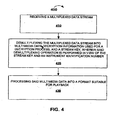
- FIG. 4 is a block diagram of a method for demultiplexing a conditional access protected data stream, in accordance with an exemplary embodiment of the present invention.
- data stream 200 is demultiplexed into the data types of: stream key 210, encrypted multimedia data 220, and decryption information 230. These data types are then used to process encrypted multimedia data 220 into unencrypted multimedia data that is in a format suitable for playback or storage.
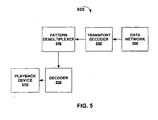
- FIG. 4 The steps of FIG. 4 are explained in view of decoding system 500 shown in FIG. 5 as a system diagram of a decoder that demultiplexes a multiplexed data stream into multimedia data, in accordance with an exemplary embodiment of the present invention.
- demultiplexing method 400 begins with the receipt of a multiplexed data stream as from data network 560.
- a device capable of receiving data from a data network is used for this step such as transport decoder 550, although any device able to receive data may be used.
- Transport decoder 550 formats the received data stream for processing by pattern demultiplexer 540.
- the received multiplexed data stream is demultiplexed in step 420 by a demultiplexer 540 (that performs an inverse operation of pattern multiplexer 140).
- the demultiplexing process makes use of stream key information that is transmitted as part of the composition of the multiplexed data stream.
- pattern demultiplexer 540 knows where to extract such stream key information from a received data stream. Additionally, pattern demultiplexer 540 uses the UID corresponding to itself or a coupled decoder for the demultiplexing operation.
- the demultiplexing operation is the inverse of the operation used to create the multiplexed data stream.
- pattern demultiplexer 540 uses an inverse MUXP operation that uses the stream key and UID to reconstitute a multiplexed data stream into decryption information and encrypted multimedia data.
- step 430 the encrypted multimedia data is processed into a format suitable for playback or storage.
- This step is performed with the use of a decoding device (that performs the inverse operations of encoder 120 of encoding and encrypting), such as decoder 520.
- Decoder 520 uses the decryption information demultiplexed from the multiplexed data stream to decrypt encrypted multimedia information into an encoded multimedia data.
- Such data is then decoded into a data format suitable for playback or storage on multimedia device 510 such as a television set, computer, CD player, and the like, such data ideally representing multimedia data similar to data from multimedia data server 110 (from FIG. 1).
- the present invention may be embodied in the form of computer-implemented processes and apparatus for practicing those processes.
- the present invention may also be embodied in the form of computer program code embodied in tangible media, such as floppy diskettes, read only memories (ROMs), CD-ROMs, hard drives, high density disk, or any other computer-readable storage medium, wherein, when the computer program code is loaded into and executed by a computer, the computer becomes an apparatus for practicing the invention.
- the present invention may also be embodied in the form of computer program code, for example, whether stored in a storage medium, loaded into and/or executed by a computer, or transmitted over some transmission medium, such as over electrical wiring or cabling, through fiber optics, or via electromagnetic radiation, wherein, when the computer program code is loaded into and executed by a computer, the computer becomes an apparatus for practicing the invention.
- computer program code segments configure the processor to create specific logic circuits.
Landscapes
- Engineering & Computer Science (AREA)
- Signal Processing (AREA)
- Multimedia (AREA)
- Computer Security & Cryptography (AREA)
- Databases & Information Systems (AREA)
- Computer Networks & Wireless Communication (AREA)
- Physics & Mathematics (AREA)
- General Physics & Mathematics (AREA)
- Theoretical Computer Science (AREA)
- Computer Graphics (AREA)
- Two-Way Televisions, Distribution Of Moving Picture Or The Like (AREA)
Claims (11)
- Verfahren zum Multiplexen von Datentypen zu einem gemultiplexten Datenstrom, das die folgenden Schritte umfasst:Codieren (310) von Multimedia-Daten zu verschlüsselten Multimedia-Daten; undMultiplexen (320) der codierten Multimedia-Daten mit Stream-Key-Daten und Entschlüsselungsinformationen;dadurch gekennzeichnet, dass die Stream-Key-Daten und eine Geräte-Identifikationsnummer dazu verwendet werden zu bestimmen, wie die codierten Multimedia-Daten mit den Stream-Key-Daten und Entschlüsselungsinformationen zu multiplexen sind.
- Verfahren gemäß Anspruch 1, dadurch gekennzeichnet, dass die Stream-Key-Daten an vorab festgelegten Positionen in den Datenstrom eingefügt werden.
- Verfahren gemäß Anspruch 1, dadurch gekennzeichnet, dass der Schritt des Codierens Folgendes umfasst:Codieren der Multimedia-Daten in ein Multimedia-Format wie beispielsweise MPEG-2, undVerschlüsseln der codierten Multimedia-Daten.
- Verfahren gemäß Anspruch 1, dadurch gekennzeichnet, dass der Datenstrom für den Transport über ein Datennetzwerk verarbeitet wird.
- Verfahren gemäß Anspruch 1, dadurch gekennzeichnet, dass die Geräte-Identifikationsnummer dem Empfänger des gemultiplexten Datenstroms entspricht.
- Verfahren gemäß Anspruch 1, dadurch gekennzeichnet, dass der Schritt des Multiplexens ferner in Bezug auf eine Anwendung ausgeführt wird, für die die verschlüsselten Multimedia-Daten genutzt werden sollen.
- Vorrichtung zum Durchführen von Multiplexing-Operationen, wobei die Vorrichtung Folgendes umfasst:einen Codierer (120) zum Codieren von Multimedia-Daten in verschlüsselte Multimedia-Daten; undeinen Paketmultiplexer (140) zum Multiplexen der codierten Multimedia-Daten mit Stream-Key-Daten und Entschlüsselungsinformationen;dadurch gekennzeichnet, dass der Paketmultiplexer (140) ferner dafür vorgesehen ist, mithilfe der Stream-Key-Daten und einer Geräte-Identifikationsnummer zu bestimmen, wie die codierten Multimedia-Daten mit den Stream-Key-Daten und Entschlüsselungsinformationen zu multiplexen sind.
- Verfahren zum Demultiplexen eines gemultiplexten Datenstroms in verschlüsselte Multimedia-Daten, Entschlüsselungsinformationen und Stream-Key-Daten, dadurch gekennzeichnet, das die Stream-Key-Daten und eine Geräte-Identifikationsnummer dazu genutzt werden zu bestimmen, wie die gemultiplexten Daten zu demultiplexen sind.
- Verfahren gemäß Anspruch 8, dadurch gekennzeichnet, dass die Stream-Key-Daten auf der Basis der vorab definierten Einfügung der Stream-Key-Daten lokalisiert werden.
- Verfahren gemäß Anspruch 8, dadurch gekennzeichnet, dass die verschlüsselten Multimedia-Daten mithilfe der Entschlüsselungsinformationen in ein für die Wiedergabe geeignetes Format entschlüsselt werden.
- Vorrichtung zum Ausführen des Demultiplexens eines gemultiplexten Datenstroms, welcher verschlüsselte Multimedia-Daten, Entschlüsselungsinformationen und Stream-Key-Daten enthält, wobei die Vorrichtung Folgendes umfasst:einen Paketdemultiplexer (540), der die Stream-Key-Daten und eine Geräte-Identifikationsnummer dazu verwendet, den gemultiplexten Datenstrom zu demultiplexen; undeinen Decodierer (520), um die Entschlüsselungsinformationen dazu zu nutzen, den demultiplexten Datenstrom in ein für die Wiedergabe oder Speicherung geeignetes Format zu decodieren.
Priority Applications (1)
| Application Number | Priority Date | Filing Date | Title |
|---|---|---|---|
| EP20040016791 EP1499062B1 (de) | 2003-07-17 | 2004-07-16 | System und Verfahren zur individuellen Video-Verschlüsselung |
Applications Claiming Priority (3)
| Application Number | Priority Date | Filing Date | Title |
|---|---|---|---|
| EP03102202A EP1499061A1 (de) | 2003-07-17 | 2003-07-17 | System und Verfahren zur individuellen Video-Verschlüsselung |
| EP03102202 | 2003-07-17 | ||
| EP20040016791 EP1499062B1 (de) | 2003-07-17 | 2004-07-16 | System und Verfahren zur individuellen Video-Verschlüsselung |
Publications (2)
| Publication Number | Publication Date |
|---|---|
| EP1499062A1 EP1499062A1 (de) | 2005-01-19 |
| EP1499062B1 true EP1499062B1 (de) | 2007-12-12 |
Family
ID=33477640
Family Applications (1)
| Application Number | Title | Priority Date | Filing Date |
|---|---|---|---|
| EP20040016791 Expired - Lifetime EP1499062B1 (de) | 2003-07-17 | 2004-07-16 | System und Verfahren zur individuellen Video-Verschlüsselung |
Country Status (1)
| Country | Link |
|---|---|
| EP (1) | EP1499062B1 (de) |
Cited By (1)
| Publication number | Priority date | Publication date | Assignee | Title |
|---|---|---|---|---|
| AU2007200636B2 (en) * | 2006-02-15 | 2011-03-31 | Irdeto Access B.V. | Method and system providing scrambled content |
Family Cites Families (3)
| Publication number | Priority date | Publication date | Assignee | Title |
|---|---|---|---|---|
| US5285497A (en) * | 1993-04-01 | 1994-02-08 | Scientific Atlanta | Methods and apparatus for scrambling and unscrambling compressed data streams |
| US5420866A (en) * | 1994-03-29 | 1995-05-30 | Scientific-Atlanta, Inc. | Methods for providing conditional access information to decoders in a packet-based multiplexed communications system |
| GB9605472D0 (en) * | 1996-03-15 | 1996-05-15 | Digi Media Vision Ltd | A secure method and apparatus for data transmission in digital video broadcast data services |
-
2004
- 2004-07-16 EP EP20040016791 patent/EP1499062B1/de not_active Expired - Lifetime
Cited By (1)
| Publication number | Priority date | Publication date | Assignee | Title |
|---|---|---|---|---|
| AU2007200636B2 (en) * | 2006-02-15 | 2011-03-31 | Irdeto Access B.V. | Method and system providing scrambled content |
Also Published As
| Publication number | Publication date |
|---|---|
| EP1499062A1 (de) | 2005-01-19 |
Similar Documents
| Publication | Publication Date | Title |
|---|---|---|
| US20260122321A1 (en) | Systems and Methods for Secure Playback of Encrypted Elementary Bitstreams | |
| US7356147B2 (en) | Method, system and program product for attaching a title key to encrypted content for synchronized transmission to a recipient | |
| EP1593265B1 (de) | System zur sicheren entschlüsselung von medienströmen mittels selektiver entschlüsselung von paketkopf-daten | |
| US7480385B2 (en) | Hierarchical encryption key system for securing digital media | |
| JP4838422B2 (ja) | 伝送システム | |
| US7447313B2 (en) | Pointers to encrypted data in RTP header | |
| US20100195827A1 (en) | Method and apparatus for encrypting transport stream of multimedia content, and method and apparatus for decrypting transport stream of multimedia content | |
| JP2007518294A (ja) | 動画ファイルの暗号化方法及びそれを利用したデジタル著作権の管理方法 | |
| EP1913776A2 (de) | Schutz von elementarstrominhalten | |
| KR20060002787A (ko) | 컨텐츠 처리 방법, 장치 및 제품 | |
| US8548164B2 (en) | Method and device for the encryption and decryption of data | |
| US20050047449A1 (en) | Individual video encryption system and method | |
| KR20060064469A (ko) | 멀티캐스트 방식으로 스트리밍 서비스되는 동영상 파일의보호 장치 및 그 방법 | |
| CN1295763B (zh) | 传输系统 | |
| CN102598690A (zh) | 用于视听数据流的加密方法和设备 | |
| EP1499062A1 (de) | System und Verfahren zur individuellen Video-Verschlüsselung | |
| Chang et al. | Layered access control schemes on watermarked scalable media | |
| AU2004224936A1 (en) | Encryption of MPEG Bitstreams |
Legal Events
| Date | Code | Title | Description |
|---|---|---|---|
| PUAI | Public reference made under article 153(3) epc to a published international application that has entered the european phase |
Free format text: ORIGINAL CODE: 0009012 |
|
| AK | Designated contracting states |
Kind code of ref document: A1 Designated state(s): AT BE BG CH CY CZ DE DK EE ES FI FR GB GR HU IE IT LI LU MC NL PL PT RO SE SI SK TR |
|
| AX | Request for extension of the european patent |
Extension state: AL HR LT LV MK |
|
| 17P | Request for examination filed |
Effective date: 20050708 |
|
| AKX | Designation fees paid |
Designated state(s): DE ES FR GB IT TR |
|
| RAP1 | Party data changed (applicant data changed or rights of an application transferred) |
Owner name: THOMSON LICENSING |
|
| GRAP | Despatch of communication of intention to grant a patent |
Free format text: ORIGINAL CODE: EPIDOSNIGR1 |
|
| GRAS | Grant fee paid |
Free format text: ORIGINAL CODE: EPIDOSNIGR3 |
|
| GRAA | (expected) grant |
Free format text: ORIGINAL CODE: 0009210 |
|
| AK | Designated contracting states |
Kind code of ref document: B1 Designated state(s): DE ES FR GB IT TR |
|
| REG | Reference to a national code |
Ref country code: GB Ref legal event code: FG4D |
|
| REF | Corresponds to: |
Ref document number: 602004010577 Country of ref document: DE Date of ref document: 20080124 Kind code of ref document: P |
|
| PG25 | Lapsed in a contracting state [announced via postgrant information from national office to epo] |
Ref country code: ES Free format text: LAPSE BECAUSE OF FAILURE TO SUBMIT A TRANSLATION OF THE DESCRIPTION OR TO PAY THE FEE WITHIN THE PRESCRIBED TIME-LIMIT Effective date: 20080323 |
|
| ET | Fr: translation filed | ||
| PLBE | No opposition filed within time limit |
Free format text: ORIGINAL CODE: 0009261 |
|
| STAA | Information on the status of an ep patent application or granted ep patent |
Free format text: STATUS: NO OPPOSITION FILED WITHIN TIME LIMIT |
|
| 26N | No opposition filed |
Effective date: 20080915 |
|
| PG25 | Lapsed in a contracting state [announced via postgrant information from national office to epo] |
Ref country code: TR Free format text: LAPSE BECAUSE OF FAILURE TO SUBMIT A TRANSLATION OF THE DESCRIPTION OR TO PAY THE FEE WITHIN THE PRESCRIBED TIME-LIMIT Effective date: 20071212 |
|
| PG25 | Lapsed in a contracting state [announced via postgrant information from national office to epo] |
Ref country code: IT Free format text: LAPSE BECAUSE OF NON-PAYMENT OF DUE FEES Effective date: 20080731 |
|
| PGFP | Annual fee paid to national office [announced via postgrant information from national office to epo] |
Ref country code: FR Payment date: 20110726 Year of fee payment: 8 |
|
| PGFP | Annual fee paid to national office [announced via postgrant information from national office to epo] |
Ref country code: GB Payment date: 20110726 Year of fee payment: 8 Ref country code: DE Payment date: 20110713 Year of fee payment: 8 |
|
| GBPC | Gb: european patent ceased through non-payment of renewal fee |
Effective date: 20120716 |
|
| REG | Reference to a national code |
Ref country code: FR Ref legal event code: ST Effective date: 20130329 |
|
| PG25 | Lapsed in a contracting state [announced via postgrant information from national office to epo] |
Ref country code: DE Free format text: LAPSE BECAUSE OF NON-PAYMENT OF DUE FEES Effective date: 20130201 Ref country code: GB Free format text: LAPSE BECAUSE OF NON-PAYMENT OF DUE FEES Effective date: 20120716 Ref country code: FR Free format text: LAPSE BECAUSE OF NON-PAYMENT OF DUE FEES Effective date: 20120731 |
|
| REG | Reference to a national code |
Ref country code: DE Ref legal event code: R119 Ref document number: 602004010577 Country of ref document: DE Effective date: 20130201 |