EP1499143A2 - Terminal de communication sans fil - Google Patents
Terminal de communication sans fil Download PDFInfo
- Publication number
- EP1499143A2 EP1499143A2 EP04005488A EP04005488A EP1499143A2 EP 1499143 A2 EP1499143 A2 EP 1499143A2 EP 04005488 A EP04005488 A EP 04005488A EP 04005488 A EP04005488 A EP 04005488A EP 1499143 A2 EP1499143 A2 EP 1499143A2
- Authority
- EP
- European Patent Office
- Prior art keywords
- threshold value
- level
- base station
- level detection
- detection means
- Prior art date
- Legal status (The legal status is an assumption and is not a legal conclusion. Google has not performed a legal analysis and makes no representation as to the accuracy of the status listed.)
- Withdrawn
Links
Images


Classifications
-
- H—ELECTRICITY
- H04—ELECTRIC COMMUNICATION TECHNIQUE
- H04W—WIRELESS COMMUNICATION NETWORKS
- H04W48/00—Access restriction; Network selection; Access point selection
- H04W48/16—Discovering, processing access restriction or access information
-
- H—ELECTRICITY
- H04—ELECTRIC COMMUNICATION TECHNIQUE
- H04W—WIRELESS COMMUNICATION NETWORKS
- H04W52/00—Power management, e.g. Transmission Power Control [TPC] or power classes
- H04W52/02—Power saving arrangements
- H04W52/0209—Power saving arrangements in terminal devices
- H04W52/0225—Power saving arrangements in terminal devices using monitoring of external events, e.g. the presence of a signal
- H04W52/0245—Power saving arrangements in terminal devices using monitoring of external events, e.g. the presence of a signal according to signal strength
-
- H—ELECTRICITY
- H04—ELECTRIC COMMUNICATION TECHNIQUE
- H04W—WIRELESS COMMUNICATION NETWORKS
- H04W88/00—Devices specially adapted for wireless communication networks, e.g. terminals, base stations or access point devices
- H04W88/02—Terminal devices
-
- Y—GENERAL TAGGING OF NEW TECHNOLOGICAL DEVELOPMENTS; GENERAL TAGGING OF CROSS-SECTIONAL TECHNOLOGIES SPANNING OVER SEVERAL SECTIONS OF THE IPC; TECHNICAL SUBJECTS COVERED BY FORMER USPC CROSS-REFERENCE ART COLLECTIONS [XRACs] AND DIGESTS
- Y02—TECHNOLOGIES OR APPLICATIONS FOR MITIGATION OR ADAPTATION AGAINST CLIMATE CHANGE
- Y02D—CLIMATE CHANGE MITIGATION TECHNOLOGIES IN INFORMATION AND COMMUNICATION TECHNOLOGIES [ICT], I.E. INFORMATION AND COMMUNICATION TECHNOLOGIES AIMING AT THE REDUCTION OF THEIR OWN ENERGY USE
- Y02D30/00—Reducing energy consumption in communication networks
- Y02D30/70—Reducing energy consumption in communication networks in wireless communication networks
Definitions
- This invention relates to a communication terminal apparatus in a radio communication system such as a mobile telephone system.
- W-CDMA wideband code division multiple access
- the intermittent reception scheme operates the communication function during a period when a paging signal notify presence or absence of an incoming call is transmitted intermittently from a base station (ready state), and operates an operating section, a display section and their related portions during other periods (sleep state).
- the intermittent reception is stopped, the communication function is continuously operated to make communication. If the incoming call is not detected, a timer is reset, a power supply of each section is turned off, and the sleep state is maintained again until the following paging signal is transmitted.
- the consumed power can be reduced at the incoming call standby time by employing the intermittent reception scheme.
- the present invention has been accomplished to solve the above-described problem.
- the object of the present invention is to provide a communication terminal apparatus capable of reducing the power consumption by efficiently executing the cell search in the communication of the intermittent reception.
- a communication terminal apparatus capable of making communication via a base station connectable with a communication network.
- the apparatus comprises receiving means for receiving a signal transmitted from the base station, first control means for controlling the receiving means to receive a signal transmitted from a serving base station transmitting a paging signal to the communication terminal apparatus if a preset time has passed, first level detection means for detecting a level of the signal received by the receiving means under control of the first control means, second control means for controlling the receiving means to stop the operation of the receiving means if the level detected by the first level detection means is equal to or higher than a threshold value, third control means for controlling the receiving means to receive a signal transmitted from a base station other than the serving base station if the level detected by the first level detection means is lower than the threshold value, second level detection means for detecting a level of the signal received by the receiving means under control of the third control means, and threshold value varying means for varying the threshold value in accordance with which of the level detected by the first level detection means and the
- FIG. 1 is a block diagram showing a mobile communication terminal according to an embodiment of the present invention.
- a W-CDMA mobile communication terminal is explained below.
- the terminal comprises an antenna 1, a circulator 2, a receiving unit 3, a transmitting unit 4, a modulating-demodulating unit 5, a D/A-converter and driver 6, a speech-electric converter and A/D converter 7, a speaker 8, a microphone 9, a control unit 10, a display unit 11, an operating unit 12, a power supply unit 13, a battery 14 and a memory 15.
- the control unit 10 is composed of a microprocessor or the like.
- the control unit 10 wholly controls the units of the mobile communication terminal and executes detecting an incoming call according to a paging signal, processing hand-off, processing outgoing calls in response to an outgoing call request made by a user through the operating unit 12, speech communication processing and the like.
- An intermittent reception control unit 10a included in the control unit 10 executes intermittent reception by controlling operations of the units of the mobile communication terminal.
- the memory 15 is a memory unit composed of semiconductors such as RAM, ROM and the like.
- the memory 15 stores control data and control programs of the control unit 10, reception control data used to receive signals from base stations in serving cells, known cells and unknown cells, parameters used by the control unit 10a, and telephone directory data which is formed by the user and which correspond to telephone numbers, names and the like.
- the reception control data includes data to identify cells, data to identify spreading codes used to receive signals from the base stations in the cells.
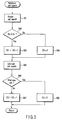
- FIGS. 2 and 3 are flowcharts showing the operation of the intermittent reception control. The processings shown in the figures are executed by the control unit 10a when the power is turned on.
- control unit 10a sets an initial value So as a threshold value S and sets "0" at a reset timer T, a known cell counter CK and an unknown cell counter CU, in step S1.
- the control unit 10a starts the reset timer T and the operation proceeds to step S2.
- the threshold value S is a threshold value corresponding to a power Sn of a signal received from a base station synchronized in the previous ready state, i.e. a base station of the serving cell.
- the initial value So is instructed to the mobile communication terminal by the system or is set in advance at the control unit 10a of the mobile communication terminal.
- the known cell counter CK represents the number of times of the cell search at the known cell by which the receiving power higher than the power Sn of the signal received from the base station of the serving cell cannot be received.
- the known cell is a base station which has been a serving cell.
- the unknown cell counter CU represents the number of times of the cell search by which the signal cannot be received from the unknown cell.
- the unknown cell is a base station which has not been a serving cell.
- the control unit 10a determines whether the count value of the reset timer T is more than to in step S2. If the count value is more than to, the control returns to step S1. If the count value is less than to, the operation proceeds to step S3.
- step S3 the control unit 10a determines whether the control unit 10 starts the outgoing call processing, whether the control unit 10 detects the incoming call from the paging signal, or whether the control unit 10 executes the hand-off processing.
- step 54 If the outgoing call processing is started, the incoming call is detected or the hand-off processing is executed, the operation proceeds to a step 54. If the outgoing call processing is not started, the incoming call is not detected or the hand-off processing is not executed, the operation proceeds to a step S5.
- step S4 the control unit 10a waits for end of the processings executed by the control unit 10.
- the processings include the outgoing call processing, response to the incoming call, communication executed after these processings, the hand-off processing and the like, which cannot be executed in the sleep state. If these processings end, the operation returns to step S3.
- step S5 the control unit 10a determines whether the period to switch the ready state to the sleep state has come. If the period has come, the operation proceeds to step S6. If the period has not yet come, the operation returns to step S3.
- step S6 the control unit 10a starts a sleep timer Ts built in the mobile communication terminal, stops the power supply to the receiving unit 3 and the transmitting unit 4 and switches the ready state to the sleep state. After that, if the sleep timer Ts counts that a predetermined time has passed, the operation proceeds to step S7.
- the predetermined time is a time when the base station of the serving cell finishes transmitting the paging signal for the mobile communication terminal.
- step S7 the control unit 10a starts the power supply to the receiving unit 3 and the receiving unit 4 and switches the sleep state to the ready state.
- the control unit 10a controls the receiving unit 4 on the basis of the reception control data stored in the memory 15 to synchronize with the base station of the serving cell and execute the serving cell search of receiving a signal from the base station.
- the control unit 10a also controls the modulating-demodulating unit 5 to demodulate the received signal and detect the power level Sn of the signal received from the base station. The operation proceeds to step S8.
- step S8 the control unit 10a determines whether the power level Sn detected in step S7 is equal to or greater than the threshold value S or not. If the power level Sn is equal to or greater than the threshold value S, the control unit 10a determines that peripheral cell search is unnecessary, and the operation returns to step S2. If the power level Sn is smaller than the threshold value S, the control unit 10a determines that peripheral cell search is required, and the operation proceeds to step S9.
- step S9 the control unit 10a executes the peripheral cell search as shown in FIG. 3.
- the peripheral cell search is explained below with reference to FIG. 3.
- step S91 the control unit 10a controls the receiving unit 4 on the basis of the reception control data stored in the memory 15 to synchronize with the base station of the known cell and execute the known cell search of receiving a signal from the base station.
- the control unit 10a also controls the modulating-demodulating unit 5 to demodulate the received signal and detect the power level Sk of the signal received from the base station. The operation proceeds to step S92.
- step S92 the control unit 10a determines whether the power level Sk detected in step S91 is equal to or smaller than the power level Sn of the base station of the serving cell detected in step S7 or not. If the power level Sk is greater than the power level Sn, the control unit 10a determines that the known cell search is valid (effective), and the operation proceeds to step S94. If the power level Sk is equal to or smaller than the power level Sn, the control unit 10a determines that the known cell search is invalid (ineffective), and the operation proceeds to step S93.
- step S93 the control unit 10a adds "1" to the known cell counter CK, and the operation proceeds to step S95.
- step S94 the control unit 10a resets the known cell counter CK to "0".
- the control unit 10a makes communication with the base station of the known cell searched in step S91 and regards this base station as the base station of the serving cell, and the operation proceeds to step S95.
- step S95 the control unit 10a controls the receiving unit 4 on the basis of the reception control data stored in the memory 15 to execute the known cell search of receiving the signal from the base station of the unknown cell.
- step S96 the control unit 10a detects correlation in the timings of code lengths of spread codes to be searched.
- step S96 the control unit 10a determines whether the signal could be received from the base station of the unknown cell in step S95, i.e. whether a base station of a new unknown cell could be found. If the base station of the unknown cell could be found, the control unit 10a determines that the unknown cell search is valid (effective), and the operation proceeds to step S98. If the base station of the unknown cell could not be found, the control unit 10a determines that the unknown cell search is invalid (ineffective), and the operation proceeds to step S97.
- step S97 the control unit 10a adds "1" to the unknown cell counter CU, and the operation proceeds to step S10 of FIG. 2.
- step S98 the control unit 10a resets the unknown cell counter CU to "0".
- the control unit 10a regards the base station of the new unknown cell detected in step S95 as the base station of the known cell, and the operation proceeds to step S10 of FIG. 2.
- step S10 the control unit 10a determines which of the known cell counter CK and an upper limit NK of the cell counter is greater, and which of the unknown cell counter CU and an upper limit Nu of the cell counter is greater. If the known cell counter CK is smaller than the upper limit NK thereof and the unknown cell counter CU is smaller than the upper limit Nu thereof, the operation returns to step S2. If at least any one of the known cell counter CK and the unknown cell counter CU is equal to or greater than the corresponding upper limit, the operation proceeds to step S11.
- step S11 the control unit 10a determines whether the threshold value S is smaller than a smallest value SL. If the threshold value S is equal to or greater than the smallest value SL, the operation proceeds to step S12. If the threshold value S is smaller than the smallest value SL, the operation returns to step S2.
- the smallest value SL is preliminarily stored in the memory 15.
- step S12 the control unit 10a subtracts an adjustment value d from the threshold value S and handles the remainder as a new threshold value S.
- the operation proceeds to step S13.
- the adjustment value d is preliminarily stored in the memory 15.
- step S13 the control unit 10a sets "0" at the known cell counter CK and the unknown cell counter CU. The operation returns to step S2.
- the value of the known cell counter CK or the unknown cell counter CU is counted up. If the value of the known cell counter CK or the unknown cell counter CU reaches the upper limit, the value of the threshold value S used to determine whether the peripheral cell search should be executed becomes smaller to prevent the peripheral cell search from being easily executed.
- the peripheral cell search cannot easily be executed and unnecessary cell search is not executed. Therefore, the cell search at the intermittent reception can be efficiently executed and the consumed power can be reduced.
- step S96 of the above embodiment it is determined whether a base station of a new unknown cell can be found.
- a base station of a new unknown cell may be detected and it may be determined whether the power level Su of the signal received from the base station is greater than the power level Sn of the base station of the serving cell detected in step S7. If the power level Su is greater than the power level Sn, the known cell search may be determined valid (effective) and the operation may proceed to step 598. If the power level Su is equal to or smaller than the power level Sn, the known cell search may be determined invalid (ineffective) and the operation may proceed to step S97.
- the control unit 10a may count down the counter value, or add the threshold value S to the value such that the peripheral cell search can easily be executed if the counter value reaches a determined value. In this case, an upper limit of the threshold value S that cannot become greater than the threshold value S should preferably be set.
- the mobile communication terminal used in the W-CDMA system has been explained in the above embodiment.
- the present invention is not limited to this, and can be applied to a cellular mobile communication system in the intermittent reception scheme.
Landscapes
- Engineering & Computer Science (AREA)
- Computer Networks & Wireless Communication (AREA)
- Signal Processing (AREA)
- Computer Security & Cryptography (AREA)
- Mobile Radio Communication Systems (AREA)
Applications Claiming Priority (2)
| Application Number | Priority Date | Filing Date | Title |
|---|---|---|---|
| JP2003197854A JP2005039367A (ja) | 2003-07-16 | 2003-07-16 | 移動通信端末のセルサーチ制御方法及び移動通信端末 |
| JP2003197854 | 2003-07-16 |
Publications (2)
| Publication Number | Publication Date |
|---|---|
| EP1499143A2 true EP1499143A2 (fr) | 2005-01-19 |
| EP1499143A3 EP1499143A3 (fr) | 2005-10-12 |
Family
ID=33475506
Family Applications (1)
| Application Number | Title | Priority Date | Filing Date |
|---|---|---|---|
| EP04005488A Withdrawn EP1499143A3 (fr) | 2003-07-16 | 2004-03-08 | Terminal de communication sans fil |
Country Status (3)
| Country | Link |
|---|---|
| US (1) | US20050014504A1 (fr) |
| EP (1) | EP1499143A3 (fr) |
| JP (1) | JP2005039367A (fr) |
Cited By (2)
| Publication number | Priority date | Publication date | Assignee | Title |
|---|---|---|---|---|
| EP1890508A4 (fr) * | 2005-05-20 | 2012-04-04 | Ntt Docomo Inc | Procede de commande de recherche de cellules et appareil mobile d'utilisation |
| WO2013138577A1 (fr) * | 2012-03-14 | 2013-09-19 | Qualcomm Incorporated | Procédé et appareil de mesure et de resélection de cellules |
Families Citing this family (4)
| Publication number | Priority date | Publication date | Assignee | Title |
|---|---|---|---|---|
| KR101236549B1 (ko) | 2006-09-08 | 2013-02-22 | 엘지전자 주식회사 | 네트워크 탐색 주기 설정 방법 및 그 단말기 |
| JP5245789B2 (ja) * | 2008-12-12 | 2013-07-24 | 日本電気株式会社 | 移動体通信機器、及び移動体通信機器の制御方法 |
| US10009819B2 (en) * | 2012-11-02 | 2018-06-26 | Apple Inc. | Network cell transitions for VoLTE devices at call initiation |
| WO2021237578A1 (fr) * | 2020-05-28 | 2021-12-02 | Qualcomm Incorporated | Recherche d'arrière-plan 5g à base de niveau de batterie |
Family Cites Families (12)
| Publication number | Priority date | Publication date | Assignee | Title |
|---|---|---|---|---|
| GB9300310D0 (en) * | 1993-01-08 | 1993-03-03 | Ncr Int Inc | Handover method for mobile wireless station |
| US5566366A (en) * | 1994-11-30 | 1996-10-15 | Motorola, Inc. | Method of power conservation in a data communications system |
| JP3352593B2 (ja) * | 1996-05-22 | 2002-12-03 | 株式会社エヌ・ティ・ティ・ドコモ | 移動通信システムおよび移動通信システムにおけるソフトハンドオーバ中送信電力制御方法 |
| US6067460A (en) * | 1996-05-23 | 2000-05-23 | Nokia Mobile Phones Limited | Mobile station having enhanced standby mode |
| US6819927B1 (en) * | 1996-10-18 | 2004-11-16 | Matsushita Electric Industrial Co., Ltd. | Communication method for use by a mobile station in a mobile communication system of CDMA |
| JP3369063B2 (ja) * | 1996-10-18 | 2003-01-20 | 松下電器産業株式会社 | 移動通信端末 |
| JPH10191419A (ja) * | 1996-12-27 | 1998-07-21 | Matsushita Electric Ind Co Ltd | 移動局装置 |
| JP3310209B2 (ja) * | 1998-01-28 | 2002-08-05 | 株式会社エヌ・ティ・ティ・ドコモ | 通信チャネル選択方法および基地局装置 |
| KR100388924B1 (ko) * | 1999-09-06 | 2003-06-25 | 가부시키가이샤 엔.티.티.도코모 | 인접 셀 검색 제어 방법, 이동국, 및 이동 통신 시스템 |
| US6832098B1 (en) * | 2000-11-13 | 2004-12-14 | Mitsubishi Denki Kabushiki Kaisha | Portable telephone |
| JP4173293B2 (ja) * | 2001-08-28 | 2008-10-29 | 株式会社エヌ・ティ・ティ・ドコモ | 移動通信システム、基地局、無線ネットワーク制御装置、移動局及び移動局の消費電力削減方法 |
| US7133702B2 (en) * | 2002-08-27 | 2006-11-07 | Qualcomm Incorporated | Idle mode cell reacquisition and reselection |
-
2003
- 2003-07-16 JP JP2003197854A patent/JP2005039367A/ja not_active Withdrawn
-
2004
- 2004-03-04 US US10/793,290 patent/US20050014504A1/en not_active Abandoned
- 2004-03-08 EP EP04005488A patent/EP1499143A3/fr not_active Withdrawn
Cited By (5)
| Publication number | Priority date | Publication date | Assignee | Title |
|---|---|---|---|---|
| EP1890508A4 (fr) * | 2005-05-20 | 2012-04-04 | Ntt Docomo Inc | Procede de commande de recherche de cellules et appareil mobile d'utilisation |
| WO2013138577A1 (fr) * | 2012-03-14 | 2013-09-19 | Qualcomm Incorporated | Procédé et appareil de mesure et de resélection de cellules |
| CN104170473A (zh) * | 2012-03-14 | 2014-11-26 | 高通股份有限公司 | 用于测量和重选蜂窝小区的方法和装置 |
| US9125126B2 (en) | 2012-03-14 | 2015-09-01 | Qualcomm Incorporated | Method and apparatus of measuring and reselecting cells |
| CN104170473B (zh) * | 2012-03-14 | 2018-06-05 | 高通股份有限公司 | 用于测量和重选蜂窝小区的方法和装置 |
Also Published As
| Publication number | Publication date |
|---|---|
| JP2005039367A (ja) | 2005-02-10 |
| US20050014504A1 (en) | 2005-01-20 |
| EP1499143A3 (fr) | 2005-10-12 |
Similar Documents
| Publication | Publication Date | Title |
|---|---|---|
| KR101032242B1 (ko) | 동적 다중-모드 서비스 포착 기능을 구비한 가입자국 | |
| EP1427240B1 (fr) | Procédé de recherche de cellule dans un terminal radio mobile adaptable au moins à deux types de systèmes de téléphonie mobile | |
| US7003315B2 (en) | Mobile terminal apparatus and system selecting method | |
| JP3722055B2 (ja) | 携帯端末装置 | |
| KR20060081374A (ko) | 이동 무선 통신 방법, 이동 무선 통신 시스템, 기지국 제어장치 및 이동 무선 단말 장치 | |
| JP2005039471A (ja) | 移動通信端末の間欠受信制御方法及び移動通信端末 | |
| US20070111751A1 (en) | Communication terminal apparatus | |
| US20100105381A1 (en) | Radio communication terminal and in-cell return processing method | |
| US7738436B2 (en) | Wireless communication system, wireless communication control apparatus, wireless communication apparatus and wireless communication method | |
| CA2184533C (fr) | Reenregistrement dans un systeme de telecommunication | |
| EP1499143A2 (fr) | Terminal de communication sans fil | |
| CN101155390B (zh) | 一种双模终端及其选择驻留网络的方法 | |
| KR100703505B1 (ko) | 무전 통신이 가능한 이동 통신 단말의 통신 수행 방법 | |
| JP4250991B2 (ja) | 移動通信端末および通信制御方法 | |
| WO2006037377A1 (fr) | Gestion de ressources d'energie d'un terminal d'utilisateur | |
| GB2346293A (en) | Mobile station with intelligent control of scan time between home band scans when roaming | |
| EP1549094A1 (fr) | Adaptation dynamique de la fréquence de teleappels dans un réseau Bluetooth | |
| JPH10209943A (ja) | 受信装置 | |
| US8848688B1 (en) | System and method for using a handoff threshold associated with a slot cycle index to determine whether to perform an access terminal handoff | |
| KR100282962B1 (ko) | 셀룰러 시스템에서 슬롯 사이클 인덱스 설정방법 | |
| WO2004045236A1 (fr) | Reacquisition rapide apres un long sommeil dans une operation en mode crenele | |
| JP4561985B2 (ja) | 無線端末機 | |
| JP2009296194A (ja) | 移動端末、並びにその通信制御方法及びプログラム | |
| KR20010046664A (ko) | 긴급 호를 위한 전원 제어 장치 및 방법 | |
| JP3341282B2 (ja) | W−cdma端末の節電システム及び方法 |
Legal Events
| Date | Code | Title | Description |
|---|---|---|---|
| PUAI | Public reference made under article 153(3) epc to a published international application that has entered the european phase |
Free format text: ORIGINAL CODE: 0009012 |
|
| 17P | Request for examination filed |
Effective date: 20040308 |
|
| AK | Designated contracting states |
Kind code of ref document: A2 Designated state(s): AT BE BG CH CY CZ DE DK EE ES FI FR GB GR HU IE IT LI LU MC NL PL PT RO SE SI SK TR |
|
| AX | Request for extension of the european patent |
Extension state: AL LT LV MK |
|
| PUAL | Search report despatched |
Free format text: ORIGINAL CODE: 0009013 |
|
| AK | Designated contracting states |
Kind code of ref document: A3 Designated state(s): AT BE BG CH CY CZ DE DK EE ES FI FR GB GR HU IE IT LI LU MC NL PL PT RO SE SI SK TR |
|
| AX | Request for extension of the european patent |
Extension state: AL LT LV MK |
|
| STAA | Information on the status of an ep patent application or granted ep patent |
Free format text: STATUS: THE APPLICATION HAS BEEN WITHDRAWN |
|
| 18W | Application withdrawn |
Effective date: 20051027 |