EP1499218B9 - Presentoirs a revetements antibuee, et procedes d'elaboration - Google Patents
Presentoirs a revetements antibuee, et procedes d'elaboration Download PDFInfo
- Publication number
- EP1499218B9 EP1499218B9 EP03726542A EP03726542A EP1499218B9 EP 1499218 B9 EP1499218 B9 EP 1499218B9 EP 03726542 A EP03726542 A EP 03726542A EP 03726542 A EP03726542 A EP 03726542A EP 1499218 B9 EP1499218 B9 EP 1499218B9
- Authority
- EP
- European Patent Office
- Prior art keywords
- mixture
- coating
- grams
- door
- coatings
- Prior art date
- Legal status (The legal status is an assumption and is not a legal conclusion. Google has not performed a legal analysis and makes no representation as to the accuracy of the status listed.)
- Expired - Lifetime
Links
- 238000000576 coating method Methods 0.000 title claims description 165
- 238000000034 method Methods 0.000 title claims description 43
- 239000000203 mixture Substances 0.000 claims description 95
- 239000011248 coating agent Substances 0.000 claims description 76
- 239000000758 substrate Substances 0.000 claims description 72
- 150000003077 polyols Chemical class 0.000 claims description 39
- XLYOFNOQVPJJNP-UHFFFAOYSA-N water Substances O XLYOFNOQVPJJNP-UHFFFAOYSA-N 0.000 claims description 39
- 239000012948 isocyanate Substances 0.000 claims description 38
- 229920005862 polyol Polymers 0.000 claims description 38
- 150000002513 isocyanates Chemical class 0.000 claims description 37
- 238000012360 testing method Methods 0.000 claims description 33
- 239000002904 solvent Substances 0.000 claims description 19
- 239000003054 catalyst Substances 0.000 claims description 17
- 229920001223 polyethylene glycol Polymers 0.000 claims description 14
- 229920000642 polymer Polymers 0.000 claims description 10
- 230000004584 weight gain Effects 0.000 claims description 9
- 235000019786 weight gain Nutrition 0.000 claims description 9
- 239000003795 chemical substances by application Substances 0.000 claims description 8
- 238000002156 mixing Methods 0.000 claims description 8
- 239000004094 surface-active agent Substances 0.000 claims description 8
- DVKJHBMWWAPEIU-UHFFFAOYSA-N toluene 2,4-diisocyanate Chemical compound CC1=CC=C(N=C=O)C=C1N=C=O DVKJHBMWWAPEIU-UHFFFAOYSA-N 0.000 claims description 8
- 238000002834 transmittance Methods 0.000 claims description 8
- 239000005057 Hexamethylene diisocyanate Substances 0.000 claims description 7
- 239000002202 Polyethylene glycol Substances 0.000 claims description 6
- RRAMGCGOFNQTLD-UHFFFAOYSA-N hexamethylene diisocyanate Chemical compound O=C=NCCCCCCN=C=O RRAMGCGOFNQTLD-UHFFFAOYSA-N 0.000 claims description 6
- 230000005661 hydrophobic surface Effects 0.000 claims description 6
- 238000004519 manufacturing process Methods 0.000 claims description 6
- 229920001451 polypropylene glycol Polymers 0.000 claims description 6
- 230000005855 radiation Effects 0.000 claims description 6
- LTMRRSWNXVJMBA-UHFFFAOYSA-L 2,2-diethylpropanedioate Chemical compound CCC(CC)(C([O-])=O)C([O-])=O LTMRRSWNXVJMBA-UHFFFAOYSA-L 0.000 claims description 4
- SDXAWLJRERMRKF-UHFFFAOYSA-N 3,5-dimethyl-1h-pyrazole Chemical compound CC=1C=C(C)NN=1 SDXAWLJRERMRKF-UHFFFAOYSA-N 0.000 claims description 4
- 150000002923 oximes Chemical class 0.000 claims description 3
- 239000004971 Cross linker Substances 0.000 claims 1
- 239000011521 glass Substances 0.000 description 82
- SWXVUIWOUIDPGS-UHFFFAOYSA-N diacetone alcohol Chemical compound CC(=O)CC(C)(C)O SWXVUIWOUIDPGS-UHFFFAOYSA-N 0.000 description 58
- 125000006850 spacer group Chemical group 0.000 description 44
- 229910052751 metal Inorganic materials 0.000 description 28
- 239000002184 metal Substances 0.000 description 28
- 239000000243 solution Substances 0.000 description 27
- 238000003756 stirring Methods 0.000 description 25
- 229920003023 plastic Polymers 0.000 description 24
- 239000004033 plastic Substances 0.000 description 24
- 239000010408 film Substances 0.000 description 23
- 239000000047 product Substances 0.000 description 22
- 239000000463 material Substances 0.000 description 21
- UKLDJPRMSDWDSL-UHFFFAOYSA-L [dibutyl(dodecanoyloxy)stannyl] dodecanoate Chemical compound CCCCCCCCCCCC(=O)O[Sn](CCCC)(CCCC)OC(=O)CCCCCCCCCCC UKLDJPRMSDWDSL-UHFFFAOYSA-L 0.000 description 18
- 239000003570 air Substances 0.000 description 18
- 239000012975 dibutyltin dilaurate Substances 0.000 description 18
- 239000005056 polyisocyanate Substances 0.000 description 18
- 229920001228 polyisocyanate Polymers 0.000 description 18
- 239000004814 polyurethane Substances 0.000 description 15
- 229920002635 polyurethane Polymers 0.000 description 14
- 238000010438 heat treatment Methods 0.000 description 13
- CSCPPACGZOOCGX-UHFFFAOYSA-N Acetone Chemical compound CC(C)=O CSCPPACGZOOCGX-UHFFFAOYSA-N 0.000 description 12
- DNIAPMSPPWPWGF-UHFFFAOYSA-N monopropylene glycol Natural products CC(O)CO DNIAPMSPPWPWGF-UHFFFAOYSA-N 0.000 description 12
- -1 polypropylene Polymers 0.000 description 12
- IQPQWNKOIGAROB-UHFFFAOYSA-N isocyanate group Chemical group [N-]=C=O IQPQWNKOIGAROB-UHFFFAOYSA-N 0.000 description 11
- 239000004809 Teflon Substances 0.000 description 10
- 229920006362 Teflon® Polymers 0.000 description 10
- 238000006243 chemical reaction Methods 0.000 description 10
- 238000000465 moulding Methods 0.000 description 9
- 239000000126 substance Substances 0.000 description 9
- YRKCREAYFQTBPV-UHFFFAOYSA-N acetylacetone Chemical compound CC(=O)CC(C)=O YRKCREAYFQTBPV-UHFFFAOYSA-N 0.000 description 8
- 238000009833 condensation Methods 0.000 description 8
- 230000005494 condensation Effects 0.000 description 8
- 230000000694 effects Effects 0.000 description 8
- 230000002209 hydrophobic effect Effects 0.000 description 8
- 239000007787 solid Substances 0.000 description 8
- 238000007654 immersion Methods 0.000 description 7
- 239000004970 Chain extender Substances 0.000 description 6
- KFZMGEQAYNKOFK-UHFFFAOYSA-N Isopropanol Chemical compound CC(C)O KFZMGEQAYNKOFK-UHFFFAOYSA-N 0.000 description 6
- YXFVVABEGXRONW-UHFFFAOYSA-N Toluene Chemical compound CC1=CC=CC=C1 YXFVVABEGXRONW-UHFFFAOYSA-N 0.000 description 6
- 125000001931 aliphatic group Chemical group 0.000 description 6
- 239000002981 blocking agent Substances 0.000 description 6
- 235000013611 frozen food Nutrition 0.000 description 6
- 239000010410 layer Substances 0.000 description 6
- 229920001515 polyalkylene glycol Polymers 0.000 description 6
- 238000007789 sealing Methods 0.000 description 6
- POAOYUHQDCAZBD-UHFFFAOYSA-N 2-butoxyethanol Chemical compound CCCCOCCO POAOYUHQDCAZBD-UHFFFAOYSA-N 0.000 description 5
- LYCAIKOWRPUZTN-UHFFFAOYSA-N Ethylene glycol Chemical compound OCCO LYCAIKOWRPUZTN-UHFFFAOYSA-N 0.000 description 5
- 238000005299 abrasion Methods 0.000 description 5
- 230000004888 barrier function Effects 0.000 description 5
- 150000001875 compounds Chemical class 0.000 description 5
- 229920001577 copolymer Polymers 0.000 description 5
- 229920001296 polysiloxane Polymers 0.000 description 5
- 238000002360 preparation method Methods 0.000 description 5
- 150000003217 pyrazoles Chemical class 0.000 description 5
- 229920002574 CR-39 Polymers 0.000 description 4
- LFQSCWFLJHTTHZ-UHFFFAOYSA-N Ethanol Chemical compound CCO LFQSCWFLJHTTHZ-UHFFFAOYSA-N 0.000 description 4
- IAYPIBMASNFSPL-UHFFFAOYSA-N Ethylene oxide Chemical compound C1CO1 IAYPIBMASNFSPL-UHFFFAOYSA-N 0.000 description 4
- PEDCQBHIVMGVHV-UHFFFAOYSA-N Glycerine Chemical compound OCC(O)CO PEDCQBHIVMGVHV-UHFFFAOYSA-N 0.000 description 4
- DKGAVHZHDRPRBM-UHFFFAOYSA-N Tert-Butanol Chemical compound CC(C)(C)O DKGAVHZHDRPRBM-UHFFFAOYSA-N 0.000 description 4
- 125000000217 alkyl group Chemical group 0.000 description 4
- 239000007795 chemical reaction product Substances 0.000 description 4
- 125000005442 diisocyanate group Chemical group 0.000 description 4
- HJOVHMDZYOCNQW-UHFFFAOYSA-N isophorone Chemical compound CC1=CC(=O)CC(C)(C)C1 HJOVHMDZYOCNQW-UHFFFAOYSA-N 0.000 description 4
- 229940113125 polyethylene glycol 3000 Drugs 0.000 description 4
- 230000008569 process Effects 0.000 description 4
- 238000010992 reflux Methods 0.000 description 4
- 239000005871 repellent Substances 0.000 description 4
- QTBSBXVTEAMEQO-UHFFFAOYSA-N Acetic acid Chemical compound CC(O)=O QTBSBXVTEAMEQO-UHFFFAOYSA-N 0.000 description 3
- 239000004698 Polyethylene Substances 0.000 description 3
- 239000000654 additive Substances 0.000 description 3
- 150000001298 alcohols Chemical class 0.000 description 3
- 239000007864 aqueous solution Substances 0.000 description 3
- 125000003710 aryl alkyl group Chemical group 0.000 description 3
- 125000003118 aryl group Chemical group 0.000 description 3
- 239000008199 coating composition Substances 0.000 description 3
- 238000001816 cooling Methods 0.000 description 3
- 238000004132 cross linking Methods 0.000 description 3
- 125000002887 hydroxy group Chemical group [H]O* 0.000 description 3
- 239000007788 liquid Substances 0.000 description 3
- VLKZOEOYAKHREP-UHFFFAOYSA-N n-Hexane Chemical compound CCCCCC VLKZOEOYAKHREP-UHFFFAOYSA-N 0.000 description 3
- 230000003287 optical effect Effects 0.000 description 3
- 230000002093 peripheral effect Effects 0.000 description 3
- 239000002985 plastic film Substances 0.000 description 3
- 229920006255 plastic film Polymers 0.000 description 3
- 229920000515 polycarbonate Polymers 0.000 description 3
- 239000004417 polycarbonate Substances 0.000 description 3
- 229920000573 polyethylene Polymers 0.000 description 3
- 230000003014 reinforcing effect Effects 0.000 description 3
- 239000006254 rheological additive Substances 0.000 description 3
- 229920006395 saturated elastomer Polymers 0.000 description 3
- 238000010998 test method Methods 0.000 description 3
- PUPZLCDOIYMWBV-UHFFFAOYSA-N (+/-)-1,3-Butanediol Chemical compound CC(O)CCO PUPZLCDOIYMWBV-UHFFFAOYSA-N 0.000 description 2
- QEJORCUFWWJJPP-UHFFFAOYSA-N 2-butoxyethanol Chemical group CCCCOCCO.CCCCOCCO QEJORCUFWWJJPP-UHFFFAOYSA-N 0.000 description 2
- UPMLOUAZCHDJJD-UHFFFAOYSA-N 4,4'-Diphenylmethane Diisocyanate Chemical compound C1=CC(N=C=O)=CC=C1CC1=CC=C(N=C=O)C=C1 UPMLOUAZCHDJJD-UHFFFAOYSA-N 0.000 description 2
- QGZKDVFQNNGYKY-UHFFFAOYSA-N Ammonia Chemical compound N QGZKDVFQNNGYKY-UHFFFAOYSA-N 0.000 description 2
- XKRFYHLGVUSROY-UHFFFAOYSA-N Argon Chemical compound [Ar] XKRFYHLGVUSROY-UHFFFAOYSA-N 0.000 description 2
- RTZKZFJDLAIYFH-UHFFFAOYSA-N Diethyl ether Chemical compound CCOCC RTZKZFJDLAIYFH-UHFFFAOYSA-N 0.000 description 2
- OAKJQQAXSVQMHS-UHFFFAOYSA-N Hydrazine Chemical compound NN OAKJQQAXSVQMHS-UHFFFAOYSA-N 0.000 description 2
- VEXZGXHMUGYJMC-UHFFFAOYSA-N Hydrochloric acid Chemical compound Cl VEXZGXHMUGYJMC-UHFFFAOYSA-N 0.000 description 2
- CTQNGGLPUBDAKN-UHFFFAOYSA-N O-Xylene Chemical compound CC1=CC=CC=C1C CTQNGGLPUBDAKN-UHFFFAOYSA-N 0.000 description 2
- 239000004952 Polyamide Substances 0.000 description 2
- WTKZEGDFNFYCGP-UHFFFAOYSA-N Pyrazole Chemical compound C=1C=NNC=1 WTKZEGDFNFYCGP-UHFFFAOYSA-N 0.000 description 2
- GWEVSGVZZGPLCZ-UHFFFAOYSA-N Titan oxide Chemical compound O=[Ti]=O GWEVSGVZZGPLCZ-UHFFFAOYSA-N 0.000 description 2
- 238000007792 addition Methods 0.000 description 2
- 230000000996 additive effect Effects 0.000 description 2
- 239000002318 adhesion promoter Substances 0.000 description 2
- 230000001070 adhesive effect Effects 0.000 description 2
- 125000003342 alkenyl group Chemical group 0.000 description 2
- 239000012080 ambient air Substances 0.000 description 2
- 150000001412 amines Chemical class 0.000 description 2
- 239000002585 base Substances 0.000 description 2
- 229920005601 base polymer Polymers 0.000 description 2
- 238000005452 bending Methods 0.000 description 2
- OHJMTUPIZMNBFR-UHFFFAOYSA-N biuret Chemical compound NC(=O)NC(N)=O OHJMTUPIZMNBFR-UHFFFAOYSA-N 0.000 description 2
- 125000004432 carbon atom Chemical group C* 0.000 description 2
- 238000005266 casting Methods 0.000 description 2
- 230000003750 conditioning effect Effects 0.000 description 2
- 238000010276 construction Methods 0.000 description 2
- 125000004122 cyclic group Chemical group 0.000 description 2
- 239000008367 deionised water Substances 0.000 description 2
- 229910021641 deionized water Inorganic materials 0.000 description 2
- 238000010494 dissociation reaction Methods 0.000 description 2
- 230000005593 dissociations Effects 0.000 description 2
- 238000001035 drying Methods 0.000 description 2
- 230000009977 dual effect Effects 0.000 description 2
- 239000003995 emulsifying agent Substances 0.000 description 2
- 238000002474 experimental method Methods 0.000 description 2
- 239000011888 foil Substances 0.000 description 2
- 235000013305 food Nutrition 0.000 description 2
- 238000007710 freezing Methods 0.000 description 2
- 230000008014 freezing Effects 0.000 description 2
- 230000006870 function Effects 0.000 description 2
- 235000011187 glycerol Nutrition 0.000 description 2
- 150000002334 glycols Chemical class 0.000 description 2
- 229910052736 halogen Inorganic materials 0.000 description 2
- 150000002367 halogens Chemical class 0.000 description 2
- 125000000623 heterocyclic group Chemical group 0.000 description 2
- 235000015243 ice cream Nutrition 0.000 description 2
- 238000009413 insulation Methods 0.000 description 2
- 239000012212 insulator Substances 0.000 description 2
- ZXEKIIBDNHEJCQ-UHFFFAOYSA-N isobutanol Chemical compound CC(C)CO ZXEKIIBDNHEJCQ-UHFFFAOYSA-N 0.000 description 2
- ZFSLODLOARCGLH-UHFFFAOYSA-N isocyanuric acid Chemical compound OC1=NC(O)=NC(O)=N1 ZFSLODLOARCGLH-UHFFFAOYSA-N 0.000 description 2
- 239000002609 medium Substances 0.000 description 2
- 239000012454 non-polar solvent Substances 0.000 description 2
- 239000003960 organic solvent Substances 0.000 description 2
- 125000001997 phenyl group Chemical group [H]C1=C([H])C([H])=C(*)C([H])=C1[H] 0.000 description 2
- DGTNSSLYPYDJGL-UHFFFAOYSA-N phenyl isocyanate Chemical compound O=C=NC1=CC=CC=C1 DGTNSSLYPYDJGL-UHFFFAOYSA-N 0.000 description 2
- 239000002798 polar solvent Substances 0.000 description 2
- 229920002647 polyamide Polymers 0.000 description 2
- 229920002523 polyethylene Glycol 1000 Polymers 0.000 description 2
- 229940113116 polyethylene glycol 1000 Drugs 0.000 description 2
- 150000003138 primary alcohols Chemical class 0.000 description 2
- 239000003223 protective agent Substances 0.000 description 2
- 230000002940 repellent Effects 0.000 description 2
- 150000003333 secondary alcohols Chemical class 0.000 description 2
- 239000007921 spray Substances 0.000 description 2
- 238000003860 storage Methods 0.000 description 2
- IMNIMPAHZVJRPE-UHFFFAOYSA-N triethylenediamine Chemical compound C1CN2CCN1CC2 IMNIMPAHZVJRPE-UHFFFAOYSA-N 0.000 description 2
- 150000004072 triols Chemical class 0.000 description 2
- 150000003673 urethanes Chemical class 0.000 description 2
- 239000008096 xylene Substances 0.000 description 2
- 125000004178 (C1-C4) alkyl group Chemical group 0.000 description 1
- VNMOIBZLSJDQEO-UHFFFAOYSA-N 1,10-diisocyanatodecane Chemical compound O=C=NCCCCCCCCCCN=C=O VNMOIBZLSJDQEO-UHFFFAOYSA-N 0.000 description 1
- GFNDFCFPJQPVQL-UHFFFAOYSA-N 1,12-diisocyanatododecane Chemical compound O=C=NCCCCCCCCCCCCN=C=O GFNDFCFPJQPVQL-UHFFFAOYSA-N 0.000 description 1
- ZWVMLYRJXORSEP-UHFFFAOYSA-N 1,2,6-Hexanetriol Chemical compound OCCCCC(O)CO ZWVMLYRJXORSEP-UHFFFAOYSA-N 0.000 description 1
- MTZUIIAIAKMWLI-UHFFFAOYSA-N 1,2-diisocyanatobenzene Chemical compound O=C=NC1=CC=CC=C1N=C=O MTZUIIAIAKMWLI-UHFFFAOYSA-N 0.000 description 1
- ZTNJGMFHJYGMDR-UHFFFAOYSA-N 1,2-diisocyanatoethane Chemical compound O=C=NCCN=C=O ZTNJGMFHJYGMDR-UHFFFAOYSA-N 0.000 description 1
- ZGDSDWSIFQBAJS-UHFFFAOYSA-N 1,2-diisocyanatopropane Chemical compound O=C=NC(C)CN=C=O ZGDSDWSIFQBAJS-UHFFFAOYSA-N 0.000 description 1
- AZYRZNIYJDKRHO-UHFFFAOYSA-N 1,3-bis(2-isocyanatopropan-2-yl)benzene Chemical compound O=C=NC(C)(C)C1=CC=CC(C(C)(C)N=C=O)=C1 AZYRZNIYJDKRHO-UHFFFAOYSA-N 0.000 description 1
- 229940058015 1,3-butylene glycol Drugs 0.000 description 1
- AGJCSCSSMFRMFQ-UHFFFAOYSA-N 1,4-bis(2-isocyanatopropan-2-yl)benzene Chemical compound O=C=NC(C)(C)C1=CC=C(C(C)(C)N=C=O)C=C1 AGJCSCSSMFRMFQ-UHFFFAOYSA-N 0.000 description 1
- OVBFMUAFNIIQAL-UHFFFAOYSA-N 1,4-diisocyanatobutane Chemical compound O=C=NCCCCN=C=O OVBFMUAFNIIQAL-UHFFFAOYSA-N 0.000 description 1
- LHENQXAPVKABON-UHFFFAOYSA-N 1-methoxypropan-1-ol Chemical compound CCC(O)OC LHENQXAPVKABON-UHFFFAOYSA-N 0.000 description 1
- ARXJGSRGQADJSQ-UHFFFAOYSA-N 1-methoxypropan-2-ol Chemical compound COCC(C)O ARXJGSRGQADJSQ-UHFFFAOYSA-N 0.000 description 1
- AXFVIWBTKYFOCY-UHFFFAOYSA-N 1-n,1-n,3-n,3-n-tetramethylbutane-1,3-diamine Chemical compound CN(C)C(C)CCN(C)C AXFVIWBTKYFOCY-UHFFFAOYSA-N 0.000 description 1
- JCTXKRPTIMZBJT-UHFFFAOYSA-N 2,2,4-trimethylpentane-1,3-diol Chemical compound CC(C)C(O)C(C)(C)CO JCTXKRPTIMZBJT-UHFFFAOYSA-N 0.000 description 1
- XNWFRZJHXBZDAG-UHFFFAOYSA-N 2-METHOXYETHANOL Chemical compound COCCO XNWFRZJHXBZDAG-UHFFFAOYSA-N 0.000 description 1
- OFQCJVVJRNPSET-UHFFFAOYSA-N 3,5-dimethyl-4-nitro-1h-pyrazole Chemical compound CC1=NNC(C)=C1[N+]([O-])=O OFQCJVVJRNPSET-UHFFFAOYSA-N 0.000 description 1
- RISOHYOEPYWKOB-UHFFFAOYSA-N 4-bromo-3,5-dimethyl-1h-pyrazole Chemical compound CC1=NNC(C)=C1Br RISOHYOEPYWKOB-UHFFFAOYSA-N 0.000 description 1
- NNWNNQTUZYVQRK-UHFFFAOYSA-N 5-bromo-1h-pyrrolo[2,3-c]pyridine-2-carboxylic acid Chemical compound BrC1=NC=C2NC(C(=O)O)=CC2=C1 NNWNNQTUZYVQRK-UHFFFAOYSA-N 0.000 description 1
- XKVUYEYANWFIJX-UHFFFAOYSA-N 5-methyl-1h-pyrazole Chemical compound CC1=CC=NN1 XKVUYEYANWFIJX-UHFFFAOYSA-N 0.000 description 1
- LEHOTFFKMJEONL-UHFFFAOYSA-M 6,8-dioxo-6,7,8,9-tetrahydro-1H-purin-2-olate Chemical compound [N-]1C(=O)N=C2NC(=O)NC2=C1O LEHOTFFKMJEONL-UHFFFAOYSA-M 0.000 description 1
- 230000005457 Black-body radiation Effects 0.000 description 1
- WKBOTKDWSSQWDR-UHFFFAOYSA-N Bromine atom Chemical compound [Br] WKBOTKDWSSQWDR-UHFFFAOYSA-N 0.000 description 1
- OKTJSMMVPCPJKN-UHFFFAOYSA-N Carbon Chemical compound [C] OKTJSMMVPCPJKN-UHFFFAOYSA-N 0.000 description 1
- ZAMOUSCENKQFHK-UHFFFAOYSA-N Chlorine atom Chemical compound [Cl] ZAMOUSCENKQFHK-UHFFFAOYSA-N 0.000 description 1
- XDTMQSROBMDMFD-UHFFFAOYSA-N Cyclohexane Chemical compound C1CCCCC1 XDTMQSROBMDMFD-UHFFFAOYSA-N 0.000 description 1
- FBPFZTCFMRRESA-FSIIMWSLSA-N D-Glucitol Natural products OC[C@H](O)[C@H](O)[C@@H](O)[C@H](O)CO FBPFZTCFMRRESA-FSIIMWSLSA-N 0.000 description 1
- FBPFZTCFMRRESA-JGWLITMVSA-N D-glucitol Chemical compound OC[C@H](O)[C@@H](O)[C@H](O)[C@H](O)CO FBPFZTCFMRRESA-JGWLITMVSA-N 0.000 description 1
- 239000001856 Ethyl cellulose Substances 0.000 description 1
- ZZSNKZQZMQGXPY-UHFFFAOYSA-N Ethyl cellulose Chemical compound CCOCC1OC(OC)C(OCC)C(OCC)C1OC1C(O)C(O)C(OC)C(CO)O1 ZZSNKZQZMQGXPY-UHFFFAOYSA-N 0.000 description 1
- 229920004142 LEXAN™ Polymers 0.000 description 1
- 239000004418 Lexan Substances 0.000 description 1
- 229920001730 Moisture cure polyurethane Polymers 0.000 description 1
- QORUGOXNWQUALA-UHFFFAOYSA-N N=C=O.N=C=O.N=C=O.C1=CC=C(C(C2=CC=CC=C2)C2=CC=CC=C2)C=C1 Chemical compound N=C=O.N=C=O.N=C=O.C1=CC=C(C(C2=CC=CC=C2)C2=CC=CC=C2)C=C1 QORUGOXNWQUALA-UHFFFAOYSA-N 0.000 description 1
- JCXJVPUVTGWSNB-UHFFFAOYSA-N Nitrogen dioxide Chemical compound O=[N]=O JCXJVPUVTGWSNB-UHFFFAOYSA-N 0.000 description 1
- 229920003171 Poly (ethylene oxide) Polymers 0.000 description 1
- 229920002535 Polyethylene Glycol 1500 Polymers 0.000 description 1
- 229920001030 Polyethylene Glycol 4000 Polymers 0.000 description 1
- 229920002593 Polyethylene Glycol 800 Polymers 0.000 description 1
- 229920002367 Polyisobutene Polymers 0.000 description 1
- 239000004721 Polyphenylene oxide Substances 0.000 description 1
- 239000004743 Polypropylene Substances 0.000 description 1
- FAPWRFPIFSIZLT-UHFFFAOYSA-M Sodium chloride Chemical compound [Na+].[Cl-] FAPWRFPIFSIZLT-UHFFFAOYSA-M 0.000 description 1
- 229910000831 Steel Inorganic materials 0.000 description 1
- CZMRCDWAGMRECN-UGDNZRGBSA-N Sucrose Chemical compound O[C@H]1[C@H](O)[C@@H](CO)O[C@@]1(CO)O[C@@H]1[C@H](O)[C@@H](O)[C@H](O)[C@@H](CO)O1 CZMRCDWAGMRECN-UGDNZRGBSA-N 0.000 description 1
- 229930006000 Sucrose Natural products 0.000 description 1
- 241001122767 Theaceae Species 0.000 description 1
- ATJFFYVFTNAWJD-UHFFFAOYSA-N Tin Chemical compound [Sn] ATJFFYVFTNAWJD-UHFFFAOYSA-N 0.000 description 1
- ZJCCRDAZUWHFQH-UHFFFAOYSA-N Trimethylolpropane Chemical compound CCC(CO)(CO)CO ZJCCRDAZUWHFQH-UHFFFAOYSA-N 0.000 description 1
- XSQUKJJJFZCRTK-UHFFFAOYSA-N Urea Chemical compound NC(N)=O XSQUKJJJFZCRTK-UHFFFAOYSA-N 0.000 description 1
- 230000002745 absorbent Effects 0.000 description 1
- 239000002250 absorbent Substances 0.000 description 1
- 238000009825 accumulation Methods 0.000 description 1
- NIXOWILDQLNWCW-UHFFFAOYSA-N acrylic acid group Chemical group C(C=C)(=O)O NIXOWILDQLNWCW-UHFFFAOYSA-N 0.000 description 1
- 239000003522 acrylic cement Substances 0.000 description 1
- 229920006397 acrylic thermoplastic Polymers 0.000 description 1
- 230000009471 action Effects 0.000 description 1
- 230000002411 adverse Effects 0.000 description 1
- 230000032683 aging Effects 0.000 description 1
- 238000007605 air drying Methods 0.000 description 1
- 125000003545 alkoxy group Chemical group 0.000 description 1
- 230000004075 alteration Effects 0.000 description 1
- 229910052782 aluminium Inorganic materials 0.000 description 1
- XAGFODPZIPBFFR-UHFFFAOYSA-N aluminium Chemical compound [Al] XAGFODPZIPBFFR-UHFFFAOYSA-N 0.000 description 1
- 229910021529 ammonia Inorganic materials 0.000 description 1
- 238000004873 anchoring Methods 0.000 description 1
- 239000012736 aqueous medium Substances 0.000 description 1
- 229910052786 argon Inorganic materials 0.000 description 1
- 239000012298 atmosphere Substances 0.000 description 1
- 239000011324 bead Substances 0.000 description 1
- 230000008901 benefit Effects 0.000 description 1
- 235000013361 beverage Nutrition 0.000 description 1
- 230000015572 biosynthetic process Effects 0.000 description 1
- VBIAXKVXACZQFW-OWOJBTEDSA-N bis(2-isocyanatoethyl) (e)-but-2-enedioate Chemical compound O=C=NCCOC(=O)\C=C\C(=O)OCCN=C=O VBIAXKVXACZQFW-OWOJBTEDSA-N 0.000 description 1
- IISBACLAFKSPIT-UHFFFAOYSA-N bisphenol A Chemical class C=1C=C(O)C=CC=1C(C)(C)C1=CC=C(O)C=C1 IISBACLAFKSPIT-UHFFFAOYSA-N 0.000 description 1
- 238000009835 boiling Methods 0.000 description 1
- 239000004327 boric acid Substances 0.000 description 1
- GDTBXPJZTBHREO-UHFFFAOYSA-N bromine Substances BrBr GDTBXPJZTBHREO-UHFFFAOYSA-N 0.000 description 1
- 229910052794 bromium Inorganic materials 0.000 description 1
- 235000019437 butane-1,3-diol Nutrition 0.000 description 1
- 239000004202 carbamide Substances 0.000 description 1
- 230000003197 catalytic effect Effects 0.000 description 1
- 239000000460 chlorine Substances 0.000 description 1
- 229910052801 chlorine Inorganic materials 0.000 description 1
- WBLIXGSTEMXDSM-UHFFFAOYSA-N chloromethane Chemical compound Cl[CH2] WBLIXGSTEMXDSM-UHFFFAOYSA-N 0.000 description 1
- 230000000295 complement effect Effects 0.000 description 1
- 238000007906 compression Methods 0.000 description 1
- 230000006835 compression Effects 0.000 description 1
- 239000004020 conductor Substances 0.000 description 1
- 239000012792 core layer Substances 0.000 description 1
- 238000012936 correction and preventive action Methods 0.000 description 1
- 238000005336 cracking Methods 0.000 description 1
- VEIOBOXBGYWJIT-UHFFFAOYSA-N cyclohexane;methanol Chemical compound OC.OC.C1CCCCC1 VEIOBOXBGYWJIT-UHFFFAOYSA-N 0.000 description 1
- HHNHBFLGXIUXCM-GFCCVEGCSA-N cyclohexylbenzene Chemical compound [CH]1CCCC[C@@H]1C1=CC=CC=C1 HHNHBFLGXIUXCM-GFCCVEGCSA-N 0.000 description 1
- NLUNLVTVUDIHFE-UHFFFAOYSA-N cyclooctylcyclooctane Chemical compound C1CCCCCCC1C1CCCCCCC1 NLUNLVTVUDIHFE-UHFFFAOYSA-N 0.000 description 1
- 230000006378 damage Effects 0.000 description 1
- 239000002274 desiccant Substances 0.000 description 1
- 238000013461 design Methods 0.000 description 1
- KORSJDCBLAPZEQ-UHFFFAOYSA-N dicyclohexylmethane-4,4'-diisocyanate Chemical compound C1CC(N=C=O)CCC1CC1CCC(N=C=O)CC1 KORSJDCBLAPZEQ-UHFFFAOYSA-N 0.000 description 1
- 239000000539 dimer Substances 0.000 description 1
- 150000002009 diols Chemical class 0.000 description 1
- 239000000428 dust Substances 0.000 description 1
- 238000009429 electrical wiring Methods 0.000 description 1
- 235000019325 ethyl cellulose Nutrition 0.000 description 1
- 229920001249 ethyl cellulose Polymers 0.000 description 1
- 230000003203 everyday effect Effects 0.000 description 1
- 230000001747 exhibiting effect Effects 0.000 description 1
- 230000002349 favourable effect Effects 0.000 description 1
- 238000001914 filtration Methods 0.000 description 1
- 239000005357 flat glass Substances 0.000 description 1
- 238000009472 formulation Methods 0.000 description 1
- 238000009432 framing Methods 0.000 description 1
- 239000007789 gas Substances 0.000 description 1
- 229910002804 graphite Inorganic materials 0.000 description 1
- 239000010439 graphite Substances 0.000 description 1
- 239000011874 heated mixture Substances 0.000 description 1
- 125000004836 hexamethylene group Chemical group [H]C([H])([*:2])C([H])([H])C([H])([H])C([H])([H])C([H])([H])C([H])([H])[*:1] 0.000 description 1
- XXMIOPMDWAUFGU-UHFFFAOYSA-N hexane-1,6-diol Chemical compound OCCCCCCO XXMIOPMDWAUFGU-UHFFFAOYSA-N 0.000 description 1
- 238000000265 homogenisation Methods 0.000 description 1
- 239000003845 household chemical Substances 0.000 description 1
- 150000002430 hydrocarbons Chemical group 0.000 description 1
- 239000001257 hydrogen Substances 0.000 description 1
- 229910052739 hydrogen Inorganic materials 0.000 description 1
- 125000004435 hydrogen atom Chemical class [H]* 0.000 description 1
- 230000005660 hydrophilic surface Effects 0.000 description 1
- 150000002443 hydroxylamines Chemical class 0.000 description 1
- 238000002329 infrared spectrum Methods 0.000 description 1
- 239000004615 ingredient Substances 0.000 description 1
- 230000002401 inhibitory effect Effects 0.000 description 1
- 238000013101 initial test Methods 0.000 description 1
- 239000003999 initiator Substances 0.000 description 1
- 238000003780 insertion Methods 0.000 description 1
- 230000037431 insertion Effects 0.000 description 1
- NIMLQBUJDJZYEJ-UHFFFAOYSA-N isophorone diisocyanate Chemical compound CC1(C)CC(N=C=O)CC(C)(CN=C=O)C1 NIMLQBUJDJZYEJ-UHFFFAOYSA-N 0.000 description 1
- 150000002576 ketones Chemical class 0.000 description 1
- 229910052743 krypton Inorganic materials 0.000 description 1
- DNNSSWSSYDEUBZ-UHFFFAOYSA-N krypton atom Chemical compound [Kr] DNNSSWSSYDEUBZ-UHFFFAOYSA-N 0.000 description 1
- 230000000670 limiting effect Effects 0.000 description 1
- 239000005344 low-emissivity glass Substances 0.000 description 1
- 238000005259 measurement Methods 0.000 description 1
- 238000002844 melting Methods 0.000 description 1
- 230000008018 melting Effects 0.000 description 1
- 239000011140 metalized polyester Substances 0.000 description 1
- 229920000609 methyl cellulose Polymers 0.000 description 1
- 239000001923 methylcellulose Substances 0.000 description 1
- 235000010981 methylcellulose Nutrition 0.000 description 1
- 238000013508 migration Methods 0.000 description 1
- 230000005012 migration Effects 0.000 description 1
- 239000002808 molecular sieve Substances 0.000 description 1
- SLCVBVWXLSEKPL-UHFFFAOYSA-N neopentyl glycol Chemical compound OCC(C)(C)CO SLCVBVWXLSEKPL-UHFFFAOYSA-N 0.000 description 1
- 125000002524 organometallic group Chemical group 0.000 description 1
- 239000003973 paint Substances 0.000 description 1
- 230000036961 partial effect Effects 0.000 description 1
- WXZMFSXDPGVJKK-UHFFFAOYSA-N pentaerythritol Chemical compound OCC(CO)(CO)CO WXZMFSXDPGVJKK-UHFFFAOYSA-N 0.000 description 1
- 239000003208 petroleum Substances 0.000 description 1
- 150000002989 phenols Chemical class 0.000 description 1
- 238000005375 photometry Methods 0.000 description 1
- 230000000704 physical effect Effects 0.000 description 1
- 229920003229 poly(methyl methacrylate) Polymers 0.000 description 1
- 229920002492 poly(sulfone) Polymers 0.000 description 1
- 229920001230 polyarylate Polymers 0.000 description 1
- 229920001610 polycaprolactone Polymers 0.000 description 1
- 239000004632 polycaprolactone Substances 0.000 description 1
- 229920006267 polyester film Polymers 0.000 description 1
- 229920000570 polyether Polymers 0.000 description 1
- 229940093430 polyethylene glycol 1500 Drugs 0.000 description 1
- 229920000139 polyethylene terephthalate Polymers 0.000 description 1
- 229920005644 polyethylene terephthalate glycol copolymer Polymers 0.000 description 1
- 229920000151 polyglycol Polymers 0.000 description 1
- 239000010695 polyglycol Substances 0.000 description 1
- 229920000098 polyolefin Polymers 0.000 description 1
- 229920001155 polypropylene Polymers 0.000 description 1
- 239000005077 polysulfide Substances 0.000 description 1
- 229920001021 polysulfide Polymers 0.000 description 1
- 150000008117 polysulfides Polymers 0.000 description 1
- 239000011527 polyurethane coating Substances 0.000 description 1
- 150000003254 radicals Chemical class 0.000 description 1
- 239000011541 reaction mixture Substances 0.000 description 1
- 230000002829 reductive effect Effects 0.000 description 1
- 238000002310 reflectometry Methods 0.000 description 1
- 238000005057 refrigeration Methods 0.000 description 1
- 238000009877 rendering Methods 0.000 description 1
- 239000011369 resultant mixture Substances 0.000 description 1
- 238000005096 rolling process Methods 0.000 description 1
- 239000006120 scratch resistant coating Substances 0.000 description 1
- 230000003678 scratch resistant effect Effects 0.000 description 1
- 239000005394 sealing glass Substances 0.000 description 1
- URGAHOPLAPQHLN-UHFFFAOYSA-N sodium aluminosilicate Chemical compound [Na+].[Al+3].[O-][Si]([O-])=O.[O-][Si]([O-])=O URGAHOPLAPQHLN-UHFFFAOYSA-N 0.000 description 1
- 239000011780 sodium chloride Substances 0.000 description 1
- 239000011877 solvent mixture Substances 0.000 description 1
- 239000000600 sorbitol Substances 0.000 description 1
- 230000003595 spectral effect Effects 0.000 description 1
- 238000002798 spectrophotometry method Methods 0.000 description 1
- 238000001228 spectrum Methods 0.000 description 1
- 238000007655 standard test method Methods 0.000 description 1
- 239000010959 steel Substances 0.000 description 1
- 238000006467 substitution reaction Methods 0.000 description 1
- 239000005720 sucrose Substances 0.000 description 1
- 239000002344 surface layer Substances 0.000 description 1
- 210000004243 sweat Anatomy 0.000 description 1
- ISXSCDLOGDJUNJ-UHFFFAOYSA-N tert-butyl prop-2-enoate Chemical compound CC(C)(C)OC(=O)C=C ISXSCDLOGDJUNJ-UHFFFAOYSA-N 0.000 description 1
- VUYXVWGKCKTUMF-UHFFFAOYSA-N tetratriacontaethylene glycol monomethyl ether Chemical compound COCCOCCOCCOCCOCCOCCOCCOCCOCCOCCOCCOCCOCCOCCOCCOCCOCCOCCOCCOCCOCCOCCOCCOCCOCCOCCOCCOCCOCCOCCOCCOCCOCCOCCO VUYXVWGKCKTUMF-UHFFFAOYSA-N 0.000 description 1
- 239000002562 thickening agent Substances 0.000 description 1
- 239000010409 thin film Substances 0.000 description 1
- XOLBLPGZBRYERU-UHFFFAOYSA-N tin dioxide Chemical compound O=[Sn]=O XOLBLPGZBRYERU-UHFFFAOYSA-N 0.000 description 1
- 229910001887 tin oxide Inorganic materials 0.000 description 1
- KSBAEPSJVUENNK-UHFFFAOYSA-L tin(ii) 2-ethylhexanoate Chemical compound [Sn+2].CCCCC(CC)C([O-])=O.CCCCC(CC)C([O-])=O KSBAEPSJVUENNK-UHFFFAOYSA-L 0.000 description 1
- 239000004408 titanium dioxide Substances 0.000 description 1
- 125000005628 tolylene group Chemical group 0.000 description 1
- 238000012546 transfer Methods 0.000 description 1
- 238000011282 treatment Methods 0.000 description 1
- QXJQHYBHAIHNGG-UHFFFAOYSA-N trimethylolethane Chemical compound OCC(C)(CO)CO QXJQHYBHAIHNGG-UHFFFAOYSA-N 0.000 description 1
- 238000001429 visible spectrum Methods 0.000 description 1
- 230000003313 weakening effect Effects 0.000 description 1
- 238000005303 weighing Methods 0.000 description 1
- 239000002023 wood Substances 0.000 description 1
Images





Classifications
-
- C—CHEMISTRY; METALLURGY
- C09—DYES; PAINTS; POLISHES; NATURAL RESINS; ADHESIVES; COMPOSITIONS NOT OTHERWISE PROVIDED FOR; APPLICATIONS OF MATERIALS NOT OTHERWISE PROVIDED FOR
- C09D—COATING COMPOSITIONS, e.g. PAINTS, VARNISHES OR LACQUERS; FILLING PASTES; CHEMICAL PAINT OR INK REMOVERS; INKS; CORRECTING FLUIDS; WOODSTAINS; PASTES OR SOLIDS FOR COLOURING OR PRINTING; USE OF MATERIALS THEREFOR
- C09D175/00—Coating compositions based on polyureas or polyurethanes; Coating compositions based on derivatives of such polymers
- C09D175/04—Polyurethanes
-
- A—HUMAN NECESSITIES
- A47—FURNITURE; DOMESTIC ARTICLES OR APPLIANCES; COFFEE MILLS; SPICE MILLS; SUCTION CLEANERS IN GENERAL
- A47F—SPECIAL FURNITURE, FITTINGS, OR ACCESSORIES FOR SHOPS, STOREHOUSES, BARS, RESTAURANTS OR THE LIKE; PAYING COUNTERS
- A47F3/00—Show cases or show cabinets
- A47F3/04—Show cases or show cabinets air-conditioned, refrigerated
- A47F3/0404—Cases or cabinets of the closed type
- A47F3/0426—Details
- A47F3/0434—Glass or transparent panels
-
- C—CHEMISTRY; METALLURGY
- C03—GLASS; MINERAL OR SLAG WOOL
- C03C—CHEMICAL COMPOSITION OF GLASSES, GLAZES OR VITREOUS ENAMELS; SURFACE TREATMENT OF GLASS; SURFACE TREATMENT OF FIBRES OR FILAMENTS MADE FROM GLASS, MINERALS OR SLAGS; JOINING GLASS TO GLASS OR OTHER MATERIALS
- C03C17/00—Surface treatment of glass, not in the form of fibres or filaments, by coating
- C03C17/28—Surface treatment of glass, not in the form of fibres or filaments, by coating with organic material
- C03C17/32—Surface treatment of glass, not in the form of fibres or filaments, by coating with organic material with synthetic or natural resins
- C03C17/322—Polyurethanes or polyisocyanates
-
- C—CHEMISTRY; METALLURGY
- C08—ORGANIC MACROMOLECULAR COMPOUNDS; THEIR PREPARATION OR CHEMICAL WORKING-UP; COMPOSITIONS BASED THEREON
- C08G—MACROMOLECULAR COMPOUNDS OBTAINED OTHERWISE THAN BY REACTIONS ONLY INVOLVING UNSATURATED CARBON-TO-CARBON BONDS
- C08G18/00—Polymeric products of isocyanates or isothiocyanates
- C08G18/06—Polymeric products of isocyanates or isothiocyanates with compounds having active hydrogen
- C08G18/28—Polymeric products of isocyanates or isothiocyanates with compounds having active hydrogen characterised by the compounds used containing active hydrogen
- C08G18/2805—Compounds having only one group containing active hydrogen
- C08G18/2815—Monohydroxy compounds
- C08G18/283—Compounds containing ether groups, e.g. oxyalkylated monohydroxy compounds
-
- C—CHEMISTRY; METALLURGY
- C08—ORGANIC MACROMOLECULAR COMPOUNDS; THEIR PREPARATION OR CHEMICAL WORKING-UP; COMPOSITIONS BASED THEREON
- C08G—MACROMOLECULAR COMPOUNDS OBTAINED OTHERWISE THAN BY REACTIONS ONLY INVOLVING UNSATURATED CARBON-TO-CARBON BONDS
- C08G18/00—Polymeric products of isocyanates or isothiocyanates
- C08G18/06—Polymeric products of isocyanates or isothiocyanates with compounds having active hydrogen
- C08G18/28—Polymeric products of isocyanates or isothiocyanates with compounds having active hydrogen characterised by the compounds used containing active hydrogen
- C08G18/40—High-molecular-weight compounds
- C08G18/42—Polycondensates having carboxylic or carbonic ester groups in the main chain
- C08G18/4266—Polycondensates having carboxylic or carbonic ester groups in the main chain prepared from hydroxycarboxylic acids and/or lactones
- C08G18/4269—Lactones
- C08G18/4277—Caprolactone and/or substituted caprolactone
-
- C—CHEMISTRY; METALLURGY
- C08—ORGANIC MACROMOLECULAR COMPOUNDS; THEIR PREPARATION OR CHEMICAL WORKING-UP; COMPOSITIONS BASED THEREON
- C08G—MACROMOLECULAR COMPOUNDS OBTAINED OTHERWISE THAN BY REACTIONS ONLY INVOLVING UNSATURATED CARBON-TO-CARBON BONDS
- C08G18/00—Polymeric products of isocyanates or isothiocyanates
- C08G18/06—Polymeric products of isocyanates or isothiocyanates with compounds having active hydrogen
- C08G18/28—Polymeric products of isocyanates or isothiocyanates with compounds having active hydrogen characterised by the compounds used containing active hydrogen
- C08G18/40—High-molecular-weight compounds
- C08G18/48—Polyethers
- C08G18/4833—Polyethers containing oxyethylene units
-
- C—CHEMISTRY; METALLURGY
- C08—ORGANIC MACROMOLECULAR COMPOUNDS; THEIR PREPARATION OR CHEMICAL WORKING-UP; COMPOSITIONS BASED THEREON
- C08G—MACROMOLECULAR COMPOUNDS OBTAINED OTHERWISE THAN BY REACTIONS ONLY INVOLVING UNSATURATED CARBON-TO-CARBON BONDS
- C08G18/00—Polymeric products of isocyanates or isothiocyanates
- C08G18/06—Polymeric products of isocyanates or isothiocyanates with compounds having active hydrogen
- C08G18/70—Polymeric products of isocyanates or isothiocyanates with compounds having active hydrogen characterised by the isocyanates or isothiocyanates used
- C08G18/72—Polyisocyanates or polyisothiocyanates
- C08G18/80—Masked polyisocyanates
- C08G18/8061—Masked polyisocyanates masked with compounds having only one group containing active hydrogen
- C08G18/807—Masked polyisocyanates masked with compounds having only one group containing active hydrogen with nitrogen containing compounds
- C08G18/8074—Lactams
-
- C—CHEMISTRY; METALLURGY
- C08—ORGANIC MACROMOLECULAR COMPOUNDS; THEIR PREPARATION OR CHEMICAL WORKING-UP; COMPOSITIONS BASED THEREON
- C08G—MACROMOLECULAR COMPOUNDS OBTAINED OTHERWISE THAN BY REACTIONS ONLY INVOLVING UNSATURATED CARBON-TO-CARBON BONDS
- C08G18/00—Polymeric products of isocyanates or isothiocyanates
- C08G18/06—Polymeric products of isocyanates or isothiocyanates with compounds having active hydrogen
- C08G18/70—Polymeric products of isocyanates or isothiocyanates with compounds having active hydrogen characterised by the isocyanates or isothiocyanates used
- C08G18/72—Polyisocyanates or polyisothiocyanates
- C08G18/80—Masked polyisocyanates
- C08G18/8061—Masked polyisocyanates masked with compounds having only one group containing active hydrogen
- C08G18/8093—Compounds containing active methylene groups
-
- C—CHEMISTRY; METALLURGY
- C08—ORGANIC MACROMOLECULAR COMPOUNDS; THEIR PREPARATION OR CHEMICAL WORKING-UP; COMPOSITIONS BASED THEREON
- C08G—MACROMOLECULAR COMPOUNDS OBTAINED OTHERWISE THAN BY REACTIONS ONLY INVOLVING UNSATURATED CARBON-TO-CARBON BONDS
- C08G2290/00—Compositions for creating anti-fogging
Definitions
- Low temperature merchandisers for frozen foods are designed to maintain product temperatures in the display area less than about 0° C, and more particularly, less than or equal to about -15° C for frozen food and below about-24° C for ice cream, which in the past have required cooling coil temperatures in the range of about -24° C down to about - 37° C.
- Low temperature merchandisers are generally kept at temperatures less than about 0° C, and more particularly below -21° C.
- Medium temperature merchandisers maintain non-frozen food items, at temperatures generally in the range of about-1° C to about 5° C.
- Multi-shelf reach-in merchandisers for the storage and display of fresh and frozen food products provide a generally vertical display of the product for greater visibility and product accessibility to shoppers.
- a transparent glass or plastic front door typically closes the display area of the merchandisers. Glass and plastic are poor thermal insulators.
- the doors are conventionally formed by two or three spaced apart panes of glass, defining one or two air spaces to increase the thermal insulation of the door. The air spaces must be sealed for maximum insulating effect, and to prevent entry of moisture into these air spaces. Moisture in the air space condenses on the cold glass (or fogs) and obscures viewing of the product in the merchandiser.
- IG unit insulating glass unit
- glass pack which consists of opposing glass panes (called “lights” or “lites") separated by a metallic spacer secured by a suitable polymer (e.g., polysulfide, polyisobutylene, etc.).
- a suitable polymer e.g., polysulfide, polyisobutylene, etc.
- the glass pack is placed in a metal frame to complete the door.
- the door assembly process usually has involved two separate steps of forming the sealed air spacers because it has a good strength-to-weight ratio.
- metal is an excellent moisture barrier and when used as a spacer seals the air space from moisture for many years.
- metal has two important drawbacks when used in reach-in-doors. The first is that metal is a poor thermal insulator, and the second is that metal is an excellent electrical conductor.
- the electrical conductivity of metal has also been a hindrance because in the past electrical power was commonly used to heat one or more surfaces of the glass lites in the door in order to prevent condensation from collecting and obscuring vision through the glass or plastic panes. For instance, the moisture in the relatively warm ambient air of the store readily condenses on the outside of the door if it was not heated. Also, when the door is opened, moisture condenses on the cold inside glass surface. Without heating, this condensation would not clear quickly and so the view of the product in the merchandiser would be obscured.
- an anti-sweat heater wire is applied to the perimeter of the metal frame; and (2) a semi-conductive coating or film (e.g., fluorine-doped tin-oxide) on the inner surface of the outer glass lite in the door is powered by bus bars along opposing edges of the lite to provide an electrical potential causing a current to flow through the electrically-conductive film and produce heat.
- a semi-conductive coating or film e.g., fluorine-doped tin-oxide
- new ways are sought of preventing or inhibiting fogging of glass or plastic substrates when a door is exposed to a cool environment (as discussed above and in more detail below), and is then exposed to moist air ambient conditions upon being opened.
- the cool inside surface of a refrigerator door may be exposed to an ambient environment for a few seconds, thirty seconds, or longer, depending on how long the customers or employees keep the door open.
- new ways to optimize visibility for the marketing of frozen food products are sought.
- the invention provides a variety of fog-resistant coatings that can be used in a variety of applications. More particularly, the invention provides a variety of refrigerators and merchandisers including glass or plastic substrates having coatings thereon, rendering the substrates substantially fog-resistant.
- the invention provides a refrigerator door comprising a substantially transparent substrate having an anti-fog coating on at least a portion thereof.
- the portion of the substrate may not substantially fog when the portion has an initial surface temperature and is then exposed to a moist air ambient with a dewpoint temperature equal to or greater than the surface temperature for a period of time.
- the surface temperature may be less than about 0° C and the period of time may be greater than about 6 seconds.
- the invention provides a refrigerator door comprising a substantially transparent substrate having a polyurethane coating thereon.
- the coating may have a surface tension of less than about 60 dynes/cm.
- the invention provides a method of manufacturing a refrigerator door having a substantially transparent substrate.
- the method includes mixing an isocyanate with a polyol to form a mixture, applying the mixture to at least a portion of the substantially transparent substrate, and then curing the mixture.
- the substrate may be part of a refrigerator door or the substrate may be used to manufacture a refrigerator door.
- a wide variety of refrigerators, refrigerator doors, and merchandisers may be used in conjunction with the present invention. More particularly, the coatings disclosed below may be used in conjunction with existing merchandisers using heaters (as described above), or with merchandisers having no heaters. Examples may include, but are not to be limited to, the refrigerated merchandisers disclosed in U.S. Patent Nos. 6,148,563 and 6,401,399 , each of which issued to Roche, and each of which is hereby fully incorporated by reference. The following is a description of one particular embodiment of a merchandiser or refrigerator, upon which the coatings may be used. As used herein, “merchandisers” and “refrigerators” may be used interchangeably. Again, the coatings may be used with any refrigerators or merchandisers, and should not be limited in application to the following example.
- FIG 1 shows one example of a low temperature reach-in merchandiser, which is indicated generally at M for disclosure purposes.
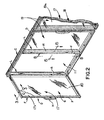
- the merchandiser has an outer insulated cabinet having a front opening 11 ( Figure 2 ) defined by a cabinet casing C and closed by doors D hingedly mounted on the casing C. More particularly, the reach-in door D is mounted on the door casing C of the refrigerated merchandiser M for swinging motion between a closed position in which the door covers the encased front opening 11 in the cabinet 10 (center door in Fig. 2 ), and an open position for access to the refrigerated display zone 13 within the cabinet (left door in Fig. 2 ).
- Multiple shelves 12 are selectively provided in the cabinet to hold and display product in the refrigerated interior product zone 13. As shown in Fig.
- the doors D are opened by handles H to access the refrigerated zone 13 inside the merchandiser where product is held for display.
- the refrigerated zone 13 may be illuminated by lighting L mounted on mullions 14 of the door casing C. These lights L are covered by diffusers 15 which spread the light within the merchandiser display area 13, as will be described more fully hereinafter.
- Figure 3 shows in more detail the low temperature door including three panes, lites or substrates G of glass, namely an inner lite 17, a middle lite 18 and an outer lite 19 that are assembled and held together by the molded frame F.
- the glass surfaces are generally sequentially numbered from 1 to 6 starting from the outermost ambient store or customer side. These correlate to the three lites 19, 18 and 17 as surfaces 19a, 19b, 18a, 18b, 17a and 17b, respectively ( Fig. 3 ).
- the precise number of lites may differ, but typically at least one, and more typically, at least two lites may be used in the door.
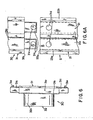
- the anti-fog coatings described herein may be applied using application techniques discussed in more detail below on any portion of any of the three lites. Typically, however, the anti-fog coatings described herein are applied on the exposed inner surface 17b of the inner lite 17 next to the low temperature product area 13 ( Figs. 2 , 3 and 9 ).
- the refrigerators used herein may also selectively utilize low-emissivity (Low-E) glass in combination with the inner glass 17 having an anti-fogging film 80.
- Low-E low-emissivity
- One or more of the lites (17, 18, or 19) may comprise low-E glass or have low-E coatings thereon (as described in more detail below), and in the three-lite door D of Fig. 3 both lites 18 and 19 may be provided with low-E coatings 85.
- any of the substrates 19a, 19b, 18a, 18b, 17a, 17b may comprise low-E glass or be coated with a low-E coating (i.e.
- substrates 19b, 18a, 18b, and 17a will have low-E properties
- substrates 19b and 18b may have low-E properties
- substrate 18a and 17a may possess low-E properties
- substrates 19b and 17a may comprise low-E glass or have a low-E coating thereon.
- the lites may or may not be heated. Accordingly, the efficacy of the door to resist fogging and/or to maintain high transparency may depend on the character and application of the surface coating described above (together with the no-metal door frame now to be described).
- the glass or plastic lites are held in parallel spaced apart, generally face-to-face positions relative to each other by a spacer S to form a basic glass panel subassembly preliminary to molding the frame F.
- the spacer may be made of polypropylene, or other suitable material, which has low thermal and electrical conductivity in a three lite door, two separator or spacer body portions 21 of the spacer S are inwardly disposed between adjacent pairs of the glass lites (i.e. 17,18 and 18,19), and these portions 21 are joined together by an integral, unitary outer wall portion 22.
- the number of separator portions depends upon the number of glass lites to be spaced by the separator portions.
- Each separator or spacer body portion 21 has a generally D shaped or rectangular configuration with spaced side walls 21a connected by a free inner wall 21b opposite to the outer wall member 22.
- the side walls 21a are engaged in surface contact with respective glass lites (17,18 or 18,19) adjacent to the free edge margins 23 thereof.
- a sealing lip 23a may be provided along the juncture of the outward side wall and free wall (21 a, 21b) of each spacer body 21 as an additional assurance of continuous sealing engagement of the spacer bodies 21 with the respective inner surfaces 17a,19b of the outermost glass lites 17,19. Continuous sealing contact of the spacer around the lites prevents molded material from encroaching the sealed air spaces 23b between adjacent lites during formation of the door frame F.
- the planar-outer wall 22 forms one wall of each spacer body 21 and has a connecting web 22a between the spacer bodies and also projects laterally outwardly to form flanges 22h at the outer longitudinal edges of the spacer.
- the laterally projecting flange portions 22b abut against the outer peripheral edge margins 23 of the inner and outer lites 17,19 in the door for additional sealing and also to maintain the spacer in position under frame molding pressure.
- the spacer bodies 21 are typically hollow (24), but filled with a suitable desiccant material 24a (e.g., molecular sieve) for trapping moisture.
- the spacer S is a flat extruded strip with four angle-cut or chamfered notches 25 being formed in the spacer body 21 corresponding to the four corners of the basic glass panel for the door D.
- the spacer S forms an outer peripheral covering for the three lites 17, 18, 19 by coming together at the corners (in the fashion of a miter joint) when the spacer is assembled around the lites so that the spacer segments extend continuously along the sides and mate together through the corners.
- the spacer S is constructed with five sequential segments identified in Fig. 4 as 26a-26e, and being interconnected at the angle cuts 25 by the continuous outer wall 22.
- the two alternate short segments 26b and 26d will be in opposed relation and form the short horizontal top and bottom walls of the panel.
- the long segment 26c will define the long vertical wall margin of the panel that will become the outer free (unhinged) handle margin of the door, and the two remaining segments 26a and 26e at the free ends 25a of the strip will close the inner hinged vertical margin of the panel and may be joined together by a spacer locking key 30.
- the locking key 30 has a main assembly or locking body section 31 (and originally included an electrical connector section 32 for conventional electrical heating of the inner lite 17).
- the main locking body section 31 is constructed and arranged to mate with and join the free ends 25a of the spacer S, and it is configured with spaced separator body portions 31a and a connecting wall 31b with outer flanges to match the configuration of the spacer 21.
- Connector blocks or keys 31c project longitudinally from both ends of the separator bodies 31a, and these are sized to fit into the hollow cavities 24 of the spacer bodies 21 ( Figs. 5, 5A and 6A ).
- each key 31 c has a chamfered locking detent 31 c to snap lock into these holes 3 id and form a secure interlock therewith.
- the reach-in door D incorporated a heated glass lite (17) requiring an electrical hook-up that was accommodated through an electrical connector section 32 and leads 50, 50a to connectors and bus bars constructed and arranged on the door to provide the electrical heating field across the inner lite 17.
- a non-heated door that still has excellent anti-fogging or rapid clearing action may be provided, it is possible to eliminate the electrical hook-up for heating the inner panel 17 including the protruding electrical connector section 32.
- the preferred reach-in door embodiment includes moisture barrier tape 33 which is applied to the outer surface of the outer wall 22 and flange 22b.
- This tape 33 may be an aluminum foil tape or, may be a thin substantially non-metallic tape of moisture-impervious metalized-polyester/polyethylene film that is electrically non-conductive.
- the tape 33 has a main body 33a that covers the entire outer wall 22 of the spacer S and has an edge wrap that extends around the outer flange segments 22b and, preferably, onto the adjacent outer surfaces of the inner and outer lites 17,19.
- the tape 33 may be provided as a unitary one-piece main body sheet 33a with integral edge wrap portions (33b) or as a series of main body sheets or segments corresponding to the five sections 26a-26e of the spacer strip 21.
- the foil or film sheets 33a may be applied to cover the outer wall 22 throughout its length so that the outer spacer wall surface is covered before it is assembled with the glass lites 17-19. In that event, the width of the tape or film would be only slightly greater than the width of the outer wall 22.
- the tape may wrap around and under the flanges 22b and would be in contact with the peripheral edge of the outer lites 17,19 when installed.
- the locking key 30 is also covered with the same film or tape 33c.
- the tape 33 provides a non-structural moisture barrier to inhibit significant transfer or migration of water vapor into the spaces 23b between the lites.
- this frame F has a main body portion 35 that surrounds the periphery of the glass panel subassembly, and has an outer wall margin 35a and side walls 35b that extend inwardly and capture the outer glass surface margins (35c) of the inner and outer lites 17,19.
- the reach-in door D is mounted on the door casing C of the refrigerated merchandiser M for swinging motion between a closed position in which the door covers the encased front opening 11 in the cabinet 10 (center door in Fig. 2 ), and an open position for access to the refrigerated display zone 13 within the cabinet (left door in Fig. 2 ).
- the hinge for mounting the door D are accommodated during the frame molding process by forming an upper cylindrical opening 38 receiving a metal sleeve or bushing 38a and a lower cylindrical opening 39 receiving a sleeve or bushing 39a.
- the upper bushing 38a preferably receives a plastic sleeve 38b ( Fig. 9 ) in which an upper hinge pin 40 is slidably received for free turning movement so that this hinge pin is free of any fixed connection to the molded frame F.
- the bushing 38a contains a compression spring 40a which biases the pin 40 for vertical outward movement relative to the frame F so that the pin projects upwardly to be received into an opening in an upper mounting plate 40b attached by bolts 40c to the door casing C of the merchandiser M.
- the bolts 40c are received through elongate slots 40e. Located at offset positions in the upper mounting plate 40b to permit the upper mounting plate 40b to be moved laterally on the door casing. In this way the pivot axis of the door D can be adjusted for optimum alignment within the casing opening.
- the upper bushing sleeve 38a for the upper hinge pin 40 may be part of an upper reinforcing member 40g molded into the door frame to rigidify and strengthen the frame E in the region of the upper door mounting connection.
- the member 40g also provides a hearing portion (41a) to receive a pivot pin 41b to connect one end of a hold open bar 41 to the door.
- the hold open bar 41 limits the maximum angle of opening of the door relative to the merchandiser, and functions to hold the door fully open when needed (e.g., as for stocking the merchandiser).
- the lower hinge pin 43 is provided for during the frame molding process by forming the lower cylindrical opening 39 for the bushing 39a, and after the molding process a plastic sleeve 39h is received in the metal bushing as a bearing for the lower hinge pin 43 which is free of an fixed connection to the molded frame F.
- the lower bushing 39a may be secured to a lower reinforcing member 43a for reinforcing the frame F in the door mounting area where the major weight of the door I) is translated to the casing C.
- the lower end 43b of the hinge pin projects outwardly below the frame F and is hexagonal (or otherwise shaped) to have a non-rotational fit into a complementary opening 43c in a casing bearing plate 43d bolted at 43e to the casing C, see Fig. 9A .
- the door D will turn on the lower hinge pin 43 as it is opened and closed while the lower hinge pin is stationary relative to the cabinet casing C.
- FIGS 8 and 8A show torsion rod assembly 144 for self-closing of the door.
- the assembly 144 is accommodated in the vertical opening 39 in the molded door frame F.
- the assembly 144 includes an upper torsion housing member 146 molded into the frame F, a torsion rod 145 having an upper hook-end 145b received in the housing member 146 and a lower end secured on a torque control member 148, and a lower bearing plate 143d having a toothed ratchet opening 143c therein.
- the vertical opening 139 is created with the sheath 139a at the time of molding the door frame, as before.
- the upper housing member 146 is constructed and arranged to receive the upper hook-end 145b of the torsion rod with a sliding fit in the final assembly 144.
- the housing member 146 is configured to provide a tubular section 146d with a vertical opening 146a having an end section 146b to accommodate the sleeve 139a and an extended opening 146c of rectangular cross-section in which the hook-end 145b is received in a fixed (relatively non-rotational) relationship with the door D per se.
- the housing member 146 is also formed with an integral rigid side section 146e extending laterally from the tubular section 146d to act as an anchor in the molded frame F.
- the hook-end 145b is bent over to facilitate holding the torsion rod 145 from turning about its axis at the upper end within the frame F.
- the two contact points of the hook-end 145b which engage the walls of the housing member 146 within the extended opening 146c are spaced apart for additional mechanical advantage in resisting turning about the axis of the torsion rod 145.
- bending of the torsion rod 145 to form the hook-end 145b is shown, the same effect could be achieved by initially forming the rod with a flat or wider upper (not shown).
- the upper end of the rod 145 (at least the portion received in the extended opening 146c) could be flattened.
- the housing member 146 is designed for universal use with right-hand or left-hand doors and is double-ended with a center web 146f extending across the side section 146e and through the center of the tubular section 146d intermediate of the ends (146b).
- the anchoring housing member 146 can be oriented for the side section 146e to extend in either direction.
- the side section 146e is constructed with a series of pockets or recesses 146g defined by spaced webs or ribs 146h to receive a mass of mold material and work with the forces on the housing member to prevent weakening or destruction of the molded frame, as exerted by the torsion rod 145 during opening and closing of the door D through continuous use over long time spans.
- the torque control member 148 on the lower end of the torsion rod 145 has a saw-toothed ratchet 148a with typical vertical lock edges 148b and sloping cam surfaces 148c.
- a hexagonal or like nut 148d is integral or locked to the ratchet 148a for selective pre-tensionsing of the self-closing torque applied to the door. More specifically, prior to insertion of the ratchet 148a into the opening 143c in the lower bearing plate 143d, the nut 148d is turned to twist the torsion rod 145 within the bushing 39a. The ratchet 148a is then inserted into the opening 143c, with the teeth of the ratchet engaging the teeth of the opening to hold the torsion rod 145 in a pre-tensioned configuration.
- the molded door D may eliminate metal framing and provides better insulation and thermal properties in closure of the low temperature product zone 13.
- one of the door lites and the inner surface of the outer Tile 19 may be was heated by applying an electrical potential across a transparent, electrically conducting film on that inner surface.
- the inner surface 17a of the inner lite 17 would be heated and thus the electrically conductive film would be applied to that surface (17a).
- the space between adjacent lites may be filled with a dry gas, such as argon or krypton, having low thermal conductivity. The increased thermal resistance of that arrangement may reduce concern over external condensation.
- the heated surface was shifted to the inside lite where it was still needed for door clearing. It was also believed that that embodiment was more energy efficient since only about half the power was required to clear the door in a commercially acceptable time.
- the reach-in door D of this embodiment may or may not have electrical heat applied thereto, but achieves commercially acceptable performance levels utilizing an anti-fogging coating (described in more detail below).
- the coating may be applied to any portion of the lites 17, 18, 19, and may be applied to other interior portions of the refrigerator, e.g., shelves or mirrors. Typically, the coating is applied on the innermost surface 17b of the inner lite 17 facing the product zone 13.
- the anti-fog coatings may be used in conjunction with low-emissivity (low-E) glass or coatings. Use of low-E glass or coatings on the lites is not required, however.
- a variety of application techniques that are well-known in the art, some of which are discussed below, may be used on the doors.
- the anti-fog coatings described herein are compatible with any refrigeration units having glass, plastic or similar substrates, especially when those substrates are substantially transparent.
- the anti-fog coatings work particularly well, however, when used in conjunction with one or more other lites (e.g. 18 and 19) at least partially made from or comprising low-E glass or coated with a low-E coating.
- the low-E glass may be selected to meet two primary criteria: 1) high reflective capability as to the infrared spectrum (thereby rejecting invisible radiant heat); and 2) high visibility transmittance (so that it does not obscure or cloud visibility through it).
- Low-E coatings typically are "interference" coatings of about one-fourth wave length with a emissivity rating from "zero" identifying a perfect infrared reflector to "one" which would be the least reflective and undesirable material.
- Clear window glass transmits radiation between 0.3 to 2.7 micron wavelength. 95% of the energy in blackbody radiation is contained within this spectrum.
- the visible spectrum is 0.4-0.7 microns.
- Infrared radiation is 0.7 to 1000 microns.
- Emissivity is the inverse of reflectivity.
- Low-E glass and low-E coated glass or plastic as used herein are meant to refer to glasses or plastics that are designed not to emit (thus reflect) radiation above 0.7 microns. This may be achieved by applying a thin coating (typically 1/4 the desired wavelength) to the surface of the glass or plastic. More specifically, the low-E glasses and plastics tend to possess a hemispherical spectral emissivity over 0.7, and more particularly from 0.7 to 2.7. Typically, several layers are used to reflects greater percentage in the 0.7 to 2.7 micron range.
- the low-E surfaces or coatings may have a visible transmittance of about 70% to about 90%.
- Low temperature and normal temperature merchandisers are typically used in the storage and display of food products merchandised in a supermarket or other food store having a temperature and humidity controlled ambient atmosphere.
- the ASHRAE design ambient for the best shopper comfort zone is about 24° C DB (dry bulb) with 55% RH (relative humidity).
- a low temperature merchandiser (M) with a product zone (13) temperature of -21° C will result in a surface temperature of -18° C on the inner surface 17b of the inner door lite 17.
- the resulting gradient across the door to the outer lite 19 depends, in part, on the use of low-E glass and store environment, but in the above example of 24° C DB and 55% RH, the resultant outer lite surface (19a) will have a temperature of about 15° C to 18° C.
- the ambient heat and humidity will impinge on the cold inner lite surface 17b when the door is opened by a customer, the immediate effect being to tend to cause water condensation (and fogging) on the inner cold surfaces of the door (and adjacent casing and into the product zone).
- the door D has an anti-fog coating applied to the exposed inwardly facing surface 17b of the inner glass lite 17, which may obviate the need for any electrical heating of any glass lite.
- Hydrophilic coatings or films may act to increase the surface energy of the substrate, thereby causing water condensate to sheet out on the surface (as opposed to beading up).
- the moisture condensation that occurs on this exposed cold inner lite surface 17b when the door D is opened presents a transparent see-through phenomenon as distinguished from a vision obscuring fog, and rapidly clears.
- Typical examples of anti-fog hydrophilic coatings are hydrophilic polyester films and hydrophilic titanium dioxide pyrolic coatings for glass that are compounded and applied to meet certain favorable performance criteria as compared with typical heated doors.
- coatings set forth herein produce a substantially-no-fog result on the inner glass surface 17b during the door opening periods of most shoppers, and this efficacy is enhanced by the use of low-E glass 85, particularly, for the middle and outer lites 18 and 19.
- the door opening periods may range from a second or two to several minutes or much longer.
- the use of two low-E coatings is disclosed on surface 19b (#2) of the outer lite and surface 18b (#4) of the middle lite, it will be understood that the two low-E coatings may be applied to surfaces 2 and 5 or surfaces 3 and 5 with equal effectiveness.
- the hydrophilic materials of the invention produce a hard, smooth impervious coating as through molecular bonding at its interface with the glass lite 17.
- a hardness of about 2 to 8 H (pencil hardness) is desirable.
- the hydrophilic films depress the freezing point of that surface to prevent freezing.
- hydrophilic coatings having a hydrophobic surface and hydrophilic interior may also be used to inhibit fogging on the substrate of the refrigerator or merchandiser. These coatings may be applied in a similar fashion as discussed above to inhibit fogging, thereby optimizing visibility for the marketing of frozen foods.
- polyurethane compositions may be used. Polyurethane compositions of the present invention may be non-fogging and water repellent, and may maintain excellent abrasion resistance, clarity, and adhesive properties on most plastics and glass.
- a hydrophilic layer of the composition possesses a water-repellent surface due to the unique material combinations put forth in the invention.
- composition system may comprise one or more of the following: an isocyanate prepolymer having reactive or blocked isocyanate groups or a blocked isocyanate, a water-soluble or water dispersible polyol, any compatible organic solvents or water (and emulsifier, if water-based), any required catalysts, and rheological additives.
- the invention can be also cast in a solvent-free state in order to produce a film, or casting molding composition.
- the coatings which are the result of curing mixtures that have been applied to a substrate, tend to possess permanent, non-fogging properties and remain hard enough to be used in the everyday situations required in applications such as refrigerator doors, shelves and mirrors within a refrigerator, other interior portions of a refrigerator, optical lenses, goggles, shields, sunglasses, windshields, sunroofs, shelves, mirrors etc. These coatings work particularly well when used in conjunction with the low-E glass described above, particularly, in a merchandiser application. By combining a porous, hydrophobic surface with a hydrophilic base polymer, it is possible to obtain a composition possessing excellent anti-fog characteristics and surface hardness.
- Composition hardness and adhesive properties may also be significantly improved in order to adapt the coatings to especially difficult substrates.
- Hydrophilic (anti-fog) properties can also be varied to suit the end product's intended use.
- Solvent-free, liquid compositions that can be used as coatings or in the casting of molded elements, are also within the scope of the invention. The desired properties of the coatings are discussed in more detail below.
- the polymeric composition exhibits excellent surface hardness and water repellent properties without the need for chain extenders or surfactant materials to provide the desired balance of physical and non-fogging properties. Although most of the mixtures do not employ surfactants or chain extenders, surfactants and chain extenders may be used in some instances. Accordingly, many of the coatings described herein are “substantially free” of chain extenders or surfactant materials. In this instance, “substantially free” means having less than about 3%, more particularly less than about 1%, and more typically, 0.5% to 0% of chain extender or surfactant.
- the hydrophobic nature of the surface reduces the presence of water deposited on the surface. Any water that is deposited thereon may be at least partially absorbed through the porous surface layers and absorbed into the coating's hydrophilic interior. This combination of hydrophilic and hydrophobic properties provides a very effective non-fogging and scratch resistant surface.
- the composition system typically comprises an isocyanate prepolymer with reactive isocyanate groups or a blocked isocyanate, and a water-soluble or water dispersible polyol.
- the system may further comprise, although it need not, appropriate organic solvents or water, emulsifiers, and coalescent, catalysts, and paint additives (typically at levels below 1% by weight).
- the reaction of the isocyanate and the polyol forms a part hydrophilic and part hydrophobic polyurethane composition when reacted and cured under particular conditions.
- the type of isocyanate the type and molecular weight of the polyol, the percent solids of the material and the catalyst, the hardness, fog resistance, efficacy, and other physical and chemical properties can be varied.
- the coating may be the product of the reaction, usually under heat, of an isocyanate prepolymer and a polyalkylene glycol.
- Isocyanate adducts and prepolymers particularly effective in the invention include blocked and unblocked cyclic or aliphatic diisocyanates.
- Polyalkylene glycol polymers that may be used include diols, multi-functional variants such as tri- and tetrahydroxy glycols, branched ethylene oxide/propylene glycol copolymers and block polymers of the above.
- Catalysts may include the common organometallic materials normally used to produce polyurethane substances. Specifically, dibutyl tin dilaurate may be used as an acceptable catalyst. Other additions include solvents, and rheological additives. The inclusion of catalytic substances is pendent on the choice of polymeric functionality and the intended cure schedule. Thus, some materials function well without the usual polyurethane initiators.
- the isocyanate prepolymers used to prepare the coatings contain 2 or 3 isocyanate groups, although more groups are certainly acceptable.
- isocyanate systems include a biuret or an isocyanurate of a diisocyanate, triisocyanate or polyisocyanate. The following are typical diisocyanates prepolymers that may be used:
- Mixtures having the blocked polyisocyanates may be applied using any of the application techniques discussed herein. Typically, mixtures having the blocked polyisocyanates are cured or heated after having been applied to a plastic or glass substrate. During heating, the blocked polyisocyanates dissociate so that the isocyanate groups become available to react with the active groups of the polyols (discussed in more detail below), thereby leading to substantial crosslinking and hardening of the coating.
- Blocked isocyanates are isocyanates in which at least one isocyanate group has reacted with a protecting or blocking agent to form a derivative which will dissociate on heating to remove the protecting or blocking agent and release the reactive isocyanate group.
- blocking agents for polyisocyanates include aliphatic, cyclo-aliphatic or aralkyl monobydric alcohols, hydroxylamines and ketoximes.
- Other examples of applicable blocking agent functionalities include the following: oximes (compounds containing the radical -CH(:N . OH)), pyrazoles, phenols and caprolactams.
- Typical pyrazoles are 4 membered rings having the following formula: Blocked isocyanates and combinations of the above also produce effective formulations.
- blocked polyisocyanates tend to dissociate at temperatures of about 90°C to about 180° C (160° C).
- Other blocked polyisocyanates may dissociate at lower temperatures, especially when used in the company of a catalyst.
- the temperature to which the coated article must be heated may generally fall to about 100 to 140° C when using the polyisocyanates discussed below.
- the presence of a catalyst may increase the rate of reaction between the liberated polyisocyanate and the active hydroxyl group of the polyol.
- blocked polyisocyanates having a lower dissociation temperature examples include compounds having the following formulas: R - Y m FORMULA A wherein R is a cycloaliphatic, heterocyclic, m valent aliphatic, or aromatic residue and each Y, which may be the same or different, is
- each R 1 which may be the same or different, is an alkyl, alkenyl, aralkyl, N-substituted carbamyl, phenyl, NO 2 , halogen or group where R 2 is a C 1 -C 4 alkyl group,
- R 1 represents an alkyl or alkenyl group it may contain up to 4 carbon atoms.
- R 1 may also be an aralkyl group, wherein the aryl portion may be phenyl and that the alkyl portion may contain 1 to 4 carbon atoms.
- R 1 is a halogen, it may typically be chlorine or bromine.
- the blocked polyisocyanate of the formula A is formed by admixing the polyisocyanate R(NCO) m with a sufficient quantity of a pyrazole of the formula: such that the reaction product contains substantially no free isocyanate groups and is a urea of formula I.
- This reaction is exothermic and since the reaction product will dissociate if the temperature is raised sufficiently, cooling may be required to keep the temperature of the reaction mixture down, preferably to 80° C or less.
- blocking agents used in the present invention may be pyrazoles of the formula: where R 1 and n are as defined above.
- examples of the pyrazoles include, but are not limited to, 3,5-dimethylpyrazole, 3-methylpyrazole, 4-nitro-3,5-dimethylpyrazole and 4-bromo-3,5-dimethylpyrazole.
- the polyisocyanate which is to be blocked may be any organic polyisocyanate suitable for crosslinking compounds containing active hydrogen, e.g., those listed above as well as aliphatics including cycloaliphatic, aromatic, heterocyclic, and mixed aliphatic aromatic polyisocyanates containing 2, 3 or more isocyanate groups.
- the group R will normally be a hydrocarbon group but substitution, e.g., by alkoxy groups is possible.
- blocked isocyanates may include, but should not be limited to, hexamethylene diisocyanate, toluene diisocyanate, diphenylmethane diisocyanate, bis(methylcyclohexyl) diisocyanate, oxime blocked hexamethylene diisocyanate, diethyl malonate blocked toluene diisocyanate.
- the isocyanate may also be a biurate, e.g., defined as the partial reaction of a polyisocyanate with hydroxyl or amine components to increase terminal isocyanate groups. All isocyanates listed as Desmodur tradenames may also be used, including, Desmodur 75, which is a hexamethylene diisocyanate.
- isocyanate compounds may be, for example, ethylene diisocyanate, propylene diisocyanate, tetramethylene diisocyanate, decamethylene diisocyanate, dodecamethylene diisocyanate, 2,4,4-trimethylhexamethylene-1,6 diisocyanate, phenylene diisocyanate, tolylene or naphthylene diisocyanate, 4,4'-methylene-bis (phenyl isocyanate), 4,4'-ethylene-bis (phenyl isocyanate), ⁇ , ⁇ '-diisocyanato-1,3-dimethyl benzene, ⁇ , ⁇ '-diisocyanato-1,3-dimethylcyclohexane, 1-methyl-2,,4-diisocyanato cyclohexane, 4,4'-methylene-bis (cyclohexyl isocyanate), 3-isocyanato-methyl-3,5,5-trimethyl cyclohexyl
- isocyanates are commercially available from manufacturers and distributors such as DuPont, Dow, Cytec, PPG, Crompton, Bayer, and Baxenden.
- the isocyanates that are used have low molecular weights, e.g., hexamethylene diisocyanate and toluene diisocyanate, in order to maximize the available anti-fog effect.
- polyisocyanates obtained by reaction of an excess amount of the isocyanate with a) water, b) a lower molecular weight polyol (e.g. m.w. ⁇ 300) or c) a medium molecular weight polyol, e.g. a polyol of greater than 300 and less than 8000 m.w., eg sucrose, or by the reaction of the isocyanate with itself to give an isocyanurate.
- a lower molecular weight polyol e.g. m.w. ⁇ 300
- a medium molecular weight polyol e.g. a polyol of greater than 300 and less than 8000 m.w., eg sucrose
- the lower molecular weight polyol comprises, for example, ethylene glycol, propylene glycol, 1,3-butylene glycol, neopentyl glycol, 2,2,4-trimethyl-1,3-pentane diol, hexamethylene glycol, cyclohexane dimethanol, hydrogenated bisphenol-A, trimethylol propane, trimethylol ethane, 1,2,6-hexane triol, glycerine, sorbitol or pentaerythritol, and combinations thereof.
- Typical polyols used in conjunction with the invention have a molecular weight of at least about 90, and more particularly at least about 600, and most typically at least about 800.
- the molecular weight of the polyols will generally be less than about 30,000, more particularly less than about 12,000, even more particularly less than about 4000, and typically below 1500.
- the polyols used in conjunction with the invention may be straight, branched, or cyclic.
- polyalkylene glycols such as polyethylene glycols (PEGs), and polypropylene glycols (PPGs).
- a general formula for polyalkylene glycols follows: H(OR) n OH, wherein R is an alkyl group and n > 10.
- a general formula for polyethylene glycols is H(OCH 2 CH 2 ) n OH, wherein n is > 2.
- a general formula for polypropylene glycol is H(OCH 2 CH 2 CH 2 ) n OH, wherein n is > 2.
- the polyols are water soluble or dispersible.
- Block polymers of polyalkylene glycols and more particularly, block polymers of polyethylene glycol and polypropylene glycols may be used. Even more particularly, polyethylene-90 or polyethylene-180 may commonly be used. Polyoxyethylene glycols can also be employed.
- polystyrene resin While a very wide variety of polyols may be used, the typical system will employ at least one of polyalkylene glycols, water soluble triols, tetrahydroxy-functional branched ethylene oxide/propylene glycol copolymers, block polymers thereof, and combinations thereof. Other variations include water soluble triols or glycerin polymers and other multi-functional, branched polyhydroxyl compounds such as tetrahydroxy functional copolymer of ethylene oxide and propylene glycol, and/or block polymer combinations of any of the above. Tetrahydoxy functional-branched/ethylene oxide/propylene glycol co-polymers may also be used.
- Catalysts may or may not be employed in conjunction with the mixtures and coatings of the present invention.
- a wide variety of catalysts that are known in the art may be employed.
- catalysts such as dibutyl tin dilaurate or triethylene diamine may be used.
- other catalysts that may be used include, but are not limited to, the following: amines such as tetramethylbutanediamine; azines such as 1,4 diaza(2,2,2)bicyclooctane; and other organotin compounds such as tinoctoate. These catalysts may facilitate the reaction and may be used to complete the cure of the mixture.
- catalysts may be effective, during heating, to facilitate the dissociation of the blocked polyisocyanates so that the isocyanate groups become available to react with the active groups of the polyols, thereby leading to substantial crosslinking and hardening of the coating.
- the mixtures of the present invention may or may not comprise at least one solvent.
- solvents may be used and will be understood by those of ordinary skill in the art.
- tertiary butyl alcohol as shown below, may be used:
- Other solvents that may be used include diacetone alcohol, primary and secondary alcohol.
- a non-polar solvent that may be used is xylene, although polar solvents tend to work better.
- non-reactive solvents such as tertiary butyl alcohol, diacetone alcohol, isophorone, glycol ether EB (2-butoxy ethanol), and the like are used.
- the greater part of the solvent mixture is composed of polar solvents without primary or secondary alcohols. Smaller amounts of aliphatics, aromatics and other non-polar solvents may then make up the remainder, if so desired.
- the systems can be prepared solvent free.
- This form of the invention may be used to produce film, cast/molded objects, and co-extruded materials. Using methods well known to the industry, the production of thin films, solids sheets, and monolithic shapes, (i.e., lenses, 3-dimensional objects, etc.) is thus possible.
- solvents are applicable. Any of various solvents including alcohols, ketones, aromatics, and aliphatics may be used depending upon the specific substrate and/or application and curing environments.
- the mixtures and coatings of the present invention may also comprise rheological additives.
- Rheological agents may be added to increase film thickness without increasing solids, to stabilize the coatings, control slip, flow and/or leveling difficulties.
- examples of rheological agents include, but are not limited to, ethyl cellulose, methyl cellulose, associative PUR thickeners, anti-mar agents, and combinations thereof.
- Examples may include DC 28 distributed by Dow Corning, or L-7602 and L-7608 obtained from Crompton of Pittsburg, PA, some of which are polyether silicone flow/level agents.
- the mixtures of the present invention comprise the following: Polyol About 10.0 % to about 85.0 % by weight; Isocyanate About 15.0 % to about 90.0 % by weight; Catalyst About 0.0 % to about 2.0 % by weight; Solvent About 0.0 % to about 95.0 % by weight; and Rheological Agent About 0.0 % to about 2.0 % by weight.
- the mixtures may then be applied to a variety of substrates using a variety of techniques that are well-known in the art.
- the mixtures discussed herein may be applied directly or indirectly to glass and plastic.
- one or more substrates, coatings, layers, or other substances may exist between the mixture (and subsequently, the coating) and the glass or plastic substrate.
- “applying a mixture to a substrate,” "a substrate having a coating” thereon or a “substrate having a coating or at least a portion thereof” may mean that one or more substrates, coatings, layers or other substances exist therebetween unless otherwise specified.
- the mixtures or coatings described herein may be applied to a plastic film (e.g.
- the hardness, tintability, water repellency, and hydrophilicity are properties to consider when choosing the glass.
- the properties to consider are hardness, tintability using hot dye at 90° C, water repellency, hydrophilicity, flexibility, thermoformability using heat and/or pressure, and adhesion.
- plastic substrates include, but are not limited to, polycarbonate, allyl diglycol carbonates or copolymers thereof, acrylic, acrylics, urethanes, polysulfone, polyarylate, PETG, PET, polyolefins, and combinations thereof.
- the selection of the base components may be as important.
- the selection of an aliphatic polyurethane base contributes to good resistance to adverse weather conditions and solar aging/ultraviolet rays. Again, using the low-E surfaces and coatings discussed above produces superior results.
- the mixtures may be applied to these substrates using a variety of techniques that are well-known in the art. For example, the mixtures may be sprayed onto the substrate using high pressure spray applications. Additionally, the substrate may be dipped into the mixture. Flow, spin, curtain, and blade techniques may also be used.
- the mixture is exposed to ambient conditions. Typically, the exposure will be for greater than about one minute, and more particularly greater than about 10 minutes.
- the exposure to ambient conditions after application is generally less than about 60 minutes, and more particularly less than about 40 minutes.
- the mixtures are generally exposed to ambient conditions in order to let any solvents in the mixture evaporate.
- the mixture is then cured.
- the mixture is at least briefly cured at a temperature that is greater than 80° C, more particularly greater than 100° C, and even more particularly greater than 125° C. Curing is usually performed at temperatures that are less than about 180° C, more particularly less than about 135° C, and even more particularly less than about 125° C. Curing times may vary. Typically, the mixture is cured for at least about 10 minutes, more particularly at least about 20 minutes, and even more particularly at least about 40 minutes. Curing times are generally less than about 60 minutes, and more particularly less than about 40 minutes. Overall, the curing temperature and time will depend on the substrate's melting point, as well as the types and molecular weights of the isocyanate, polyol, blocking agent being used.
- the intended use of the part may also dictate the curing time and temperature. Again, when using a blocked isocyanate, the curing time and temperature must be sufficient to enable the blocker to dissociate, thereby allowing the isocyanate group to react with the hydroxyl groups and cross-link.
- the mixtures that are applied to the substrates are the result of at least one of the pre-polymers isocyanates at least partially reacting with at least one of the polyols.
- the resultant mixture accordingly, typically comprises a cross-linked polyurethane.
- the coatings and compositions of the present invention may possess a variety of chemical and physical properties and functionalities.
- the resulting cured coating is part hydrophilic and part hydrophobic. More particularly, the surface is substantially hydrophobic, while the interior is substantially hydrophilic.
- the absorbent polymer coating of the invention possesses a water-repellant surface due to the unique material combinations set forth in the application. This hydrophobic surface may be achieved, while maintaining a hydrophilic core layer, by substantially excluding surfactants and using higher molecular weight polyols as discussed herein. Increasing the molecular weight of the polyols tends to produce increasingly more non-polar polyurethanes after reaction with the isocyanates discussed above. These higher molecular weight polyurethanes contribute to the water-repellancy of the coatings.
- water may run off part of the coating when applied to a substrate. Part of the water is actually repelled.
- the surfaces of these particular coatings generally do not tend to sheet and generally do not tend to be wet by water. This is due to the surface tension of the coating, which substantiates the water-repellancy or hydrophobicity of the coatings.
- the surface tension of the surface of the coatings will be greater than about 15 dynes/cm, more particularly, greater than about 20 dynes/cm, and even more particularly, greater than about 25 dynes/cm.
- the surface tension is typically less than about 60 dynes/cm, although the surface tension may be less than about 50 dynes/cm, or even less than about 45 dynes/cm.
- the surface tension of the coatings was tested according to the Wilhelmy Plate Method, which is well-known or readily ascertainable by those having ordinary skill in the art.
- Cured coatings of the present invention that are products of the reaction of polyols having molecular weights of less than about 600 (see Example 1 below) may tend to have a surface tension of about 56 to about 61 dynes/cm.
- Polyurethanes made from polyols having molecular weights of about 600-800 (see Example 6), about 800-1500 (see Example 4), about 1500-4600 (see Example 3), and even about 12,000 tend to have surface tensions of about 50-57 dynes/cm, about 27-38 dynes/cm, about 23-25 dynes/cm and about 21 dynes/cm, respectively. The lower the measurement in terms of dynes/cm, the more hydrophobic the surface.
- the low surface tension means that water is actually repelled (i.e. it beads off), rather than being sheeted or absorbed. Accordingly, by using polyols having higher molecular weights, the resulting polyurethanes exhibit more hydrophobic tendencies, at least at the surface.
- the coatings described herein also have a hydrophilic interior portion. Hydrophilicity may be measured according to weight gain the coatings experience upon aqueous immersion. More specifically, ''hydrophilicity'' is a measure of the percent weight gain experienced by a coating that has been fully immersed in an aqueous medium for 96 hours at about 20 to 25° C. In other words, during this period, the coating will tend to attract a certain amount of water. The difference between the weight of the coating after being immersed and the weight of the coating before immersion, as expressed as a percent weight gain (as compared to the weight of the non-immersed coating) measures the hydrophilicity of the coating.
- the difference between the mass of the soaked coating and the dry coating measures the hydrophilicity of the coatings.
- the coatings described herein tend to gain greater than about 20 % weight, more particularly greater than about 30 % weight, and often times greater than about 35 % weight. Weight gain is generally less than about 150 %, and typically the weight gain is less than about 140 %, and more particularly less than about 110 %.
- polyurethanes made from polyols having a molecular weight around 400 may experience a weight gain of about 140 % when exposed to the conditions discussed above.
- Polyurethanes made from polyols having molecular weights of about 800-1500 may experience a weight gain of somewhere between about 75 and about 105 %, while polyurethanes made from polyols having molecular weights of about 4600 may exhibit a weight gain of around 35 %.
- the higher the molecular weight of the polyol being used to form the coating the less hydrophilic the hydrophilic portion of the coating will be.
- general interpolation may be used to roughly determine the hydrophilicity of coatings discussed herein based on these numbers.
- the coatings possess excellent anti-fogging characteristics after being cured. Accordingly, the coatings are suitable for a variety of applications including, but not limited to, eyewear, optics, automotive and residential glass surfaces, and flat, sheet stock.
- the cured anti-fog coatings have the ability to both repel and absorb water, rather than just sheet water. More particularly, many of the coatings of the present invention have the ability to pass EN-166, EN-168, and ENE-2205 (analogous to the ASTM D 4060 abrasion test described herein) tests, each of which is a standardized test, the specifications for which can be obtained from the European Union. More particularly, the coatings described herein may be able to pass the EN-166 test for over a minute, and often times for over five minutes.
- Glass or plastic (that is usually transparent) coated with the coatings described herein tends not to fog when first exposed to a "cool environment," in which the temperature is between about 10° C to about -25° C, for greater than about thirty seconds and then subsequently exposed to humid ambient conditions. At these temperatures, the relative humidity, of course, will be very low. Even after being exposed to the cool environment as set forth above for more than one minute, many of the glass or plastic substrates will not fog regardless of the amount of time they are exposed to ambient conditions. In more detail, the substrates will not fog after being exposed to the cool environment for a minute or more, and then being exposed to ambient conditions for ten seconds, thirty seconds, and even three minutes or more of exposure. Again, many of the coated substrates will not fog after humid ambient exposure for more than five minutes, more than ten minutes, and even indefinitely after being removed from the cool environment, after having been there for a minute or longer.
- transparent glass and plastic substrates coated with the coatings set forth herein were exposed to a variety of temperatures falling with the cool environment for about one minute, and then were exposed to ambient conditions. Many of the substrates did not fog after being exposed to the ambient conditions for 10 seconds, thirty seconds, and even three minutes and longer. Many of the coatings never fogged at all under these conditions.
- different coated transparent glass and plastic substrates were exposed to different temperatures within the cool environment for about five minutes and longer. The substrates were then removed and exposed to different ambient conditions. The substrates did not fog after 10 seconds. Many of the substrates did not fog after thirty seconds, after three minutes, after five minutes, after ten minutes and longer. Again, many of the substrates never fogged.
- portions of substrates that are coated with the anti-fog coatings may not substantially fog when the coated portion has an initial surface temperature and is then exposed to a moist air ambient with a dewpoint temperature equal to or greater than the surface temperature for a period of time. More particularly, the substrates may not fog when the initial surface temperature is less than one or more of the following: 20° C, 10° C, 5° C, 0° C, -5° C, -10° C, -15° C, -18° C, -20° C and -25° C.
- the period of time of exposure to the dewpoint temperature equal to or greater than the surface temperature may be greater than one or more of the following: 0 seconds, about 1 second, about 3 seconds, about 5 seconds, about 6 seconds, about 10 seconds, about 30 seconds, about 1 minute, about 2 minutes, about 15 minutes, about 30 minutes and about 1 hour.
- the substrate when coated substrates are first exposed to any of the temperatures or below the temperatures set forth above, and then exposed to a dewpoint temperature equal to or greater than the surface temperature for any of the periods of time set forth above, the substrate may not substantially fog. Not every coating described herein will prevent fog at each and every one of these parameters, although some of the coatings will.
- the dewpoint temperature that is equal to or greater than the surface temperature may encompass ambient conditions.
- ambient conditions include any temperature or humidity that falls with the ambient temperatures and humidities discussed below.
- Ambient temperatures include temperatures that are typically greater than 10° C, and generally greater than 15° C.
- Ambient temperatures are usually less than about 60° C, typically less than about 55° C, and more particularly less than about 50° C.
- Ambient relative humidities mean some moisture was present in the air.
- the relative humidities are generally greater than about 20 %, typically greater than about 30 %, and more typically greater than about 35%.
- the relative humidity is typically less than about 100%, more typically less than about 95 %, and more particularly, less than about 90 %. Most typical of the ambient conditions is about 18° C to about 30°C and a relative humidity about 40 to about 70%.
- misist ambient conditions and “moist air ambient” are meant to refer to temperatures and relative humidities, falling within the ranges of this paragraph, that are most typically associated with the humid ambient conditions in a grocery store, convenience store, or supermarket, or the conditions immediately adjacent a beverage cooler. Moisture is typically present in these conditions. Substrates first exposed to the cool environment may not fog when exposed to some or all of the ambient conditions.
- Curing the mixtures also results in coatings that have excellent hardness characteristics as demonstrated by testing as specified by ASTM D 4060. More particularly, the coatings tend to have a taber haze of less than about 10% at 100 cycles with 500 gram load and a CS-10F load, and more specifically less than about 5 %. Some of the coatings described herein may have a taber haze of less than about 3% or even about 1%. Typically, known anti-fog coatings exhibit a taber haze of greater than 15 %. Most polysiloxane hardcoats typically exhibit a taber haze of 3 or greater.
- the coatings tend to exhibit a hardness of greater than about 2H, and typically greater than about 4H. Generally, the hardness is less than about 8H, and less than about 6H.
- the pencil's lower 10-15mm is trimmed of wood, leaving only the central lead core extending out of the body of the pencil. Then the lead is held perpendicular to a flat surface upon which a piece of fine sandpaper is mounted. The protruding section of lead then is abraded at 90°, so as to render the tip of the lead perfectly flat and perpendicular to the pencil's length.
- the hardness test is performed by applying a pencil hardness tester consisting of a rolling tester weighing 200g and fixing the pencil at a 45° angle through the body of the tester and extending onto the test surface below.
- the device is moved across the sample (laid flat, horizontally on a hard, level surface) for a distance of about 24 mm.
- the pencil's lead (at a 45° angle) will incise/etch a scratch/line into the sample surface if the pencil's graphite/hardness rating is harder than the sample's coated surface.
- Hardness is rated as the hardest lead that does not leave a visible score.
- the coatings of the present invention may also have excellent adhesion properties as indicated by the coatings' ability to pass the ASTM B 3359 Method B discussed herein. For example, many of the coatings can withstand at least one, three and even five pulls with standard Scotch tape 3M 160 on 100 square hatch with no pull up. Moreover, some of the coatings can even withstand boiling water exposure, and pass 120 minute adhesion tests.
- the coatings also tend to be substantially clear. This property makes the coatings ideal for substrates that are transparent. In other words, the coatings do not blur or obstruct vision through transparent substrates.
- the coatings may exhibit less than 0.5 % detectable haze by hazemeter, more particularly less than 0.3 % detectable haze by hazemeter, and even more particularly less than 0.2 % detectable haze by hazemeter.
- the life of the coating, when applied to a substrate, is typically greater than about 2 years, but may be greater than about 5 years, and may even be longer than about 10 years.
- the shelf-life of the mixtures is also excellent.
- Compositions may be formulated into single- or dual-component (2K) forms. This allows the selection of unique reactive materials to suit the various needs of the end product.
- the shelf life of the mixtures is at least about 6 months, sometimes at least about 1 year, and at times at least about 2 years.
- the coatings also exhibit exceptional thermoformability. More particularly, the coatings have been applied to substrates and then bent between two pieces of curve metal under high heat, more particularly, temperatures greater than about 150° C, and even greater than about 180° C for about 1 to about 2 minutes. The coatings did not crack or lose adhesion properties during this test.
- the coatings after being cured tend to have a thickness of at least about one-half micron, more particularly greater than about one micron, more particularly greater than about 3 microns, and typically greater than about 5 microns.
- the thicknesses also tend to be less than about 30 microns, more particularly less than about 20 microns, and typically less that about 15 microns.
- Resulting urethanes also accept commercially-available color tints and functional solution treatments (i.e. non-fogging, uv-filtration, anti-static) utilized by the retail optical industry.
- Part A was mixed using simple mixing, namely, a magnetic stir bar and plate with Part B.
- Part A comprised about 28.1 grams Desmodur N-75 (Bayer) well mixed with about 21.9 grams of diacetone alcohol.
- Part B comprised about 37.8 grams of diacetone well mixed with about 11.0 grams PEG-90, 0.2 grams dibutyltin dilaurate, and DC-57 additive (Dow Corning).
- the mixture was immediately applied to a 4" square of Lexan polycarbonate, via an airbrush. The mixture was then allowed to stand at ambient conditions for about 10 minutes. It was then baked for one hour at 125° C.
- the sample had excellent anti-fog properties when blown on.
- a 100-cycle taber abrasion test resulted in a haze of less than 5% using a dual, 500-gram load and a CS-10F abraser wheel. Note that the light transmittance of the coated sample exceeded the uncoated polycarbonate (approx. 92% before coating application). Separately, each part exhibited a shelf life of over 6 months with no loss of performance properties after mixing appropriately. The pot life of the prepared/mixed composition was about 24 to 36 hours. See Table I for summarized performance properties.
- Part A was mixed with Part B using simple stirring, namely, a magnetic stir bar and plate to form the mixture.
- Part A comprised 28.1 grams of Desmodur N-75 (Bayer) well mixed with 21.9 grams of diacetone alcohol.
- Part B comprised 35.8 grams of diacetone well mixed with 13.9 grams of polyethylene glycol-180, 0.2 grams of dibutyl tin dilaurate, and 0.05 grams of DC-57 manufactured by Dow Corning.
- the mixture was immediately applied by flow-coating to a 4" square of Teflon coated metal, and allowed to stand at ambient conditions for about 5-10 minutes.
- the cooled, cured film was peeled from the teflon surface and wrapped around a 0.5" steel rod to observe the flexibility of the film.
- the film shows excellent anti-fog properties when blown on or exposed to changes in humidity and temperatures. Condensed water vapor reduces clarity after a few minutes of exposure. The film exhibited excellent anti-fog properties when blown on, it fills light scratches produced by 6H pencil, and had exceptional flexibility. These coatings resist cracking when rolled into a circular shape. See Table I for summarized performance properties.
- Example 3 illustrates the preparation of a water-repellant, anti-fog coating for low-temperature usage.
- a 1-L beaker equipped with a magnetic stirrer and a heating mantle about 200 grams Baxenden 7683 obtained by Baxenden was stirred with about 281 grams of diacetone alcohol to produce a solution of blocked polyisocyante in solvent.
- the solution was then heated to 60° C.
- stirring solution was added a solution of 179 g of PEG-4600 in about 179 grams of diacetone alcohol. The solution was stirred and maintained at 60° C for about 10 minutes.
- the surface tension was found to be about 23 dynes/sq cm compared to the untreated glass having a surface tension of about 76 - 78 dynes/sq cm (this quantifies the hydrophobic nature of the surface of the invention when prepared with higher molecular weight polyols). See Table I for summarized performance properties.
- the sample was cast between two glass plates that were sealed with a silicone elastomeric gasket, and cured at 165° C for 2 hours. After cooling and removal from the mold, the solidified sample exhibited excellent optical properties and good hardness. Non-fogging properties were excellent on all surfaces.
- the lenses were also tinted and treated to block UV using a hot (90-92C) aqueous solution of Electron Beam Gray and UV-Shield (BPI of Miami FL). After 10 minutes of exposure, the lenses were rinsed and dried. Luminous transmittance of the gray lenses was less than 40%; UV transmittance was ⁇ 2%. See Table I for summarized performance properties.
- ASTM D 3359 Method B Standard Test Methods of Measuring Adhesion by Tape Test 5.
- ASTM D 3363 Test Method for Film Hardness 6.
- ASTM D 1308 Test Method for Effects of Household Chemicals on Clear Organic Finishes. Chemicals include: isopropanol 70%, acetone, petroleum ether/hexane, xylene, ammonia, acetic acid, hydrochloric acid, Windex, cola/coffee/tea, sweat/saline, and water.
- ASTM D 2794 Test for Method of Resistance of Organic Coatings to the Effects of Rapid Deformation (Impact). 8.
- Example 7 illustrates the preparation of another water-repellant, anti-fog coating for low-temperature usage.
- the prepolymer solution follows: In a 10-L polyethylene tank equipped with a gear-driven stirrer and an immersion heater, 1948 grams of caprolactam-blocked TDI prepolymer with an equivalent weight of 1395 was stirred with 400 grams of 4-hydroxy-4-methyl-2-pentanone and 200 grams of 2-butoxy ethanol to produce a solution of blocked polyisocyante in solvent.
- a 3-L dual-necked round-bottomed flask was equipped with a magnetic stirrer, reflux condenser, and a heating mantle.
- a mixture of 855 grams of powdered PEG-4600 and 200 grams of PEG-1000 was poured into the flask and 400 grams of tert-butanol was added. Heat was then applied, and the solution was brought to reflux for 10 minutes to dissolve the PEG solids.
- the solution was cooled to 60° C, and then added to the prepolymer solution, with stirring. 2.8 grams of dibutyltin dilaurate. (DBTDL) was stirred in for 15 minutes, and then 0.4 g each of L-7602 and L-7608 was added.
- DBTDL dibutyltin dilaurate
- the solution was maintained at 50 - 55° C via the immersion heater and filtered through a 0.5 micron cartridge filter. Glass panels were sprayed with a 0.25% of an amino-functional silicone adhesion-promoter (Silquest A- 1106) in a 50/50 aqueous solution ethanol. After drying for 5 minutes at 20° C, the primed glass was exposed to IR lamps for 15 minutes to cure the primed surface, and then allowed to cool to room temperature.
- an amino-functional silicone adhesion-promoter Silquest A- 1106
- the filtered, hot coating solution was applied to the primed glass panels and allowed to hang vertically at ambient conditions for 25 minutes. Samples were cured for 45 minutes at 150° C via a forced-air convection oven. After curing, the samples were cooled to room temperature. The surface tension was found to be about 29 dynes/sq. cm, and the samples possessed excellent surface hardness.
- the prepared samples were exposed to -10° C for 5 minutes, and then exposed to a humidity test cabinet maintained at 20° C and 80% relative humidity.
- the coated glass was found to maintain clarity indefinitely, and did not collect excessive moisture on its coated surfaces, i.e., the surface did not fog.
- Samples were also saturated in deionized water via immersion for 96 hours. After removal from the water, samples were subjected to low-temperature testing as above. The samples collected excessive moisture on their surfaces after 5 minutes of humidity cabinet exposure but did not fog. However, after allowing 30 minutes at 20° C and 75% relative humidity for the saturated samples to equilibrate/dry out samples performed analogously to the initial test set. See Table II for summarized performance properties.
- a 3-L dual-necked round-bottomed flask was equipped with a magnetic stirrer, reflux condenser, and a heating machine. Powdered PEG-4600, 1060 g, was poured in and 400 g of 4-hydroxy-4-methyl-2-pentanone was added. Heat was then applied, and the solution was brought to reflux for 2 minutes to dissolve the PEG solids. The solution was cooled to 60° C, and then added to the prepolymer solution, with stirring. DBTDL 175 g, was stirred in for 60 minutes, and then 0.4 g each of L-7602 & L-7608 was added.
- the solution was maintained at 50-55° C via the immersion heater and filtered through a 1.0 micron cartridge filter. Glass panels were sprayed with a 0.25% of an amino-functional silicone adhesion-promoter (Silquest A-1106) in a 50/50 aqueous solution ethanol. After drying for 5 minutes at 20° C, the primed glass was cured for 15 minutes in a thermal convection oven at 60° C, and then allowed to cool to room temperature. The filtered, hot coating solution was applied to the primed glass panels and allowed to hang vertically at ambient conditions for 15 minutes. Samples were cured for 30 minutes at 125° C via a convection oven. Samples were cooled to room temperature.
- Example 9 was conducted as set forth above with respect to Example 7, except that 2-butoxyethanol was replaced with diacetone alcohol (DAA), using the same amount.
- Example 9 exhibited similar properties to Example 7, except Example 9 exhibited superior hardness. This Example shows the effect solvents have on the final surface hardness. See Table II for summarized performance properties.
- Example 10 was conducted as set forth above with respect to Example 9, except the mixture was applied with a spray appliance, which produces a much thinner coating - about 2-3 microns.
- the anti-fog results were similar to Example 7, however, the coating fogged only after saturation and repetition of low-temperature exposure to test chamber. It did not fog if allowed to equilibrate/dry out. See Table II for summarized performance properties.
- Example 8 This Example was the same as Example 8, except it was sprayed. The results were essentially identical to Example 8. It was a more hydrophilic/anti-fog due to the reduced molecular weight of the polyol(s), despite thickness variance. See Table II for summarized performance properties.
- This Example was the same as Example 8, except that PEG-1000 in the same amount was substituted for the PEG of Example 8.
- 2-butoxyethanol was replaced with 200 g of isophorone, and 2 grams of DC-57 was added.
- the coating fogged in 25 seconds upon removal from low low-temperature (-12° C for 5 minutes) and exposure to humidity cabinet. After saturation and soak, the substrate fogged immediately when brought from freezer to test chamber. This shows the effect of using a lower molecular weight polyol. See Table II for summarized performance properties.
- Example 8 was the same as Example 8, except Baxenden BI 7986 (an HDI biuret blocked with dimethylpyrazole) was substituted for the blocked isocyanate of Example 8. In addition, 1250 grams of PEG 4000 was substituted for the PEG of Example 8. This is an example of an alternated polyisocyante. See Table II for summarized performance properties.
- Part A was mixed with Part B using simple stirring, namely, a magnetic stir bar and plate to form the mixture.
- Part A comprised 51.45 grams of trixene 7683 (commercially available from Baxenden of Lancashire, England) well mixed with 20.67 grams of diacetone alcohol.
- Part B comprised 20.67 grams of diacetone alcohol well mixed with 27.79 grams of polyethylene glycol 4600 (i.e. PEG having a molecular weight of 4600), 0.053 grams of dibutyl tin dilaurate (obtained from Gelest of PA, USA) and 0.037 grams of DC-28 (obtained from Dow Corning).
- PEG polyethylene glycol 4600
- DC-28 obtained from Dow Corning
- Part A was mixed with Part B using simple stirring, namely, a magnetic stir bar and plate to form the mixture.
- Part A comprised 51.45 grams of trixene 7683 (commercially available from Baxenden of Lancashire, England) well mixed with 20.68 grams of diacetone alcohol.
- Part B comprised 20.68 grams of diacetone alcohol well mixed with 27.79 grams of polyethylene glycol 4600, 0.053 grams of dibutyl tin dilaurate (obtained from Gelest of PA, USA), and 0.018 grams of L-7602 (obtained from Crompton of Pittsburg, PA, USA) and 0.018 grams of L-7608 (obtained from Crompton). These last two components are flow/leveling aids and slip-aids, respectively.
- the mixture was immediately applied using flow-coating to a 4" square of Teflon coated metal, and allowed to stand at ambient conditions for about 10 minutes. The mixture was then baked for about 1 hour at about 125° C to produce the coating.
- Part A was mixed with Part B using simple stirring, namely, a magnetic stir bar and plate to form the mixture.
- Part A comprised 42.88 grams of trixene 7683 (commercially available from Baxenden of Lancashire, England) well mixed with 33.85 grams of diacetone alcohol.
- Part B comprised 33.85 grams of diacetone alcohol well mixed with 23.18 grams of polyethylene glycol 3000 (i.e. having a molecular weight of 3000), 0.053 grams of dibutyl tin dilaurate (obtained from Gelest of PA, USA) and 0.037 grams of DC-28 (obtained from Dow Corning).
- the mixture was immediately applied using flow-coating to a 4" square of Teflon coated metal, and allowed to stand at ambient conditions for about 10 minutes. The mixture was then baked for about 1 hour at about 125° C to produce the coating.
- Part A was mixed with Part B using simple stirring, namely, a magnetic stir bar and plate to form the mixture.
- Part A comprised 42.67 grams of trixene 7683 (commercially available from Baxenden of Lancashire, England) well mixed with 33.75 grams of diacetone alcohol.
- Part B comprised 33.75 grams of diacetone alcohol well mixed with 23.49 grams of polyethylene glycol 3000, 0.053 grams of dibutyl tin dilaurate (obtained from Gelest of PA, USA) and 0.037 grams of DC-28 (obtained from Dow Corning).
- the mixture was immediately applied using flow-coating to a 4" square of Teflon coated metal, and allowed to stand at ambient conditions for about 0 minutes.
- the mixture was then baked for about 1 hour at about 125° C to produce the coating.
- Part A was mixed with Part B using simple stirring, namely, a magnetic stir bar and plate to form the mixture.
- Part A comprised 42.88 grams of trixene 7683 (commercially available from Baxenden of Lancashire, England) well mixed with 33.91 grams of diacetone alcohol.
- Part B comprised 33.91 grams of diacetone alcohol well mixed with 11.56 grams of polyethylene glycol 3000, 11.56 grams of polyethylene glycol 3000, 0.053 grams of dibutyl tin dilaurate (obtained from Gelest of PA, USA) and 0.037 grams of DC-28 (obtained from Dow Corning).
- the mixture was immediately applied using flow-coating to a 4" square of Teflon coated metal, and allowed to stand at ambient conditions for about 10 minutes. The mixture was then baked for about 1 hour at about 125° C to produce the coating.
- Part A was mixed with Part B using simple stirring, namely, a magnetic stir bar and plate to form the mixture.
- Part A comprised 42.88 grams of trixene 7683 (commercially available from Baxenden of Lancashire, England) well mixed with 33.91 grams of diacetone alcohol.
- Part B comprised 33.91 grams of diacetone well mixed with 11.56 grams of polyethylene glycol 12000 (i.e. molecular weight 12000), 11.56 grams of polyethylene glycol 1000, 0.053 grams of dibutyl tin dilaurate (obtained by Gelest of PA, USA) and 0.037 grams of DC-28 (obtained from Dow Corning).
- the mixture was immediately applied using flow coating to a 4" square of Teflon coated metal, and allowed to stand at ambient conditions for about 10 minutes. The mixture was then baked for about 1 hour at about 125° C to produce the coating.
- Part A was mixed with Part B using simple stirring, namely, a magnetic stir bar and plate to form the mixture.
- Part A comprised 35.75 grams of trixene 7683 (commercially available from Baxenden of Lancashire, England) well mixed with 42.98 grams of diacetone alcohol.
- Part B comprised 42.98 grams of diacetone alcohol well mixed with 21.22 grams of polyethylene glycol 1000, 0.028 grams of dibutyl tin dilaurate (obtained by Gelest of PA, USA), 0.011 grams of L-7602 (obtained from Crompton of Pittsburgh, PA, USA) and 0.011 grams of L-7608 (obtained from Crompton).
- the mixture was immediately applied using flow-coating to a 4" square of Teflon coated metal, and allowed to stand at ambient conditions for about 10 minutes.
- the mixture was then baked for about 1 hour at about 125° C to produce the coating.
- Part A was mixed with Part B using simple stirring, namely, a magnetic stir bar and plate to form the mixture.
- Part A comprised 35.75 grams of trixene 7683 (commercially available from Baxenden of Lancashire, England) well mixed with 42.98 grams of diacetone alcohol.
- Part B comprised 42.98 grams of diacetone well mixed with 21.22 grams of polyethylene glycol 1500, 0.028 grams of dibutyl tin dilaurate (obtained by Gelest of PA, USA), and 0.011 grams of L-7602 (obtained from Crompton of Pittsburgh, PA, USA) and 0.011 grams of L-7608 (obtained from Crompton).
- the mixture was immediately applied using flow-coating to a 4" square of Teflon coated metal, and allowed to stand at ambient conditions for about 10 minutes.
- the mixture was then baked for about 1 hour at about 125° C to produce the coating.
- Anti-fog testing was performed on refrigerator doors having, among others, the coating set forth in Example 14. More particularly, testing was performed on refrigerators having a plurality of adjacent doors with the coatings thereon. Testing was conducted on both no-heat doors and heated doors. The test conditions for the no-heat doors follow: dry bulb temperature 75° F; relative humidity 55%, discharge air temperature -12°F; door surface temperature on the product side -3° F; and door surface temperature on the customer side of 64° F. The test conditions for the heated door follow: dry bulb temperature 75° F; relative humidity 55%, discharge air temperature -12°F; door surface temperature on the product side 9° F; and door surface temperature on the customer side of 74° F.
- the coated surface was dry and had substantially no dust accumulation. Visible trans. was about 40 to about 50 %.
- Anti-fogging properties were tested at certain time intervals. More particularly, the following time intervals were tested: 6 seconds, 15 seconds, 30 seconds, 1 minute, 2 minutes, 2 minutes and 30 seconds, 3 minutes, 4 minutes and 5-15 minutes.
- substantially no fogging occurred at any of these time intervals.
- the doors in the refrigerator adjacent the open door also did not fog during any of these time intervals. In other words, when one door was opened, allowing ambient air to flood the refrigerator, the closed doors adjacent the opened door exhibited substantially no fogging.
Landscapes
- Chemical & Material Sciences (AREA)
- Organic Chemistry (AREA)
- Chemical Kinetics & Catalysis (AREA)
- Health & Medical Sciences (AREA)
- Polymers & Plastics (AREA)
- Medicinal Chemistry (AREA)
- Engineering & Computer Science (AREA)
- Materials Engineering (AREA)
- Life Sciences & Earth Sciences (AREA)
- Geochemistry & Mineralogy (AREA)
- General Chemical & Material Sciences (AREA)
- Wood Science & Technology (AREA)
- Physics & Mathematics (AREA)
- Thermal Sciences (AREA)
- Refrigerator Housings (AREA)
- Application Of Or Painting With Fluid Materials (AREA)
Claims (23)
- Procédé de fabrication d'une porte de réfrigérateur ayant un substrat substantiellement transparent, le procédé comprenant les étapes de :mélange d'un isocyanate avec un polyol pour former un mélange, ledit isocyanate étant un isocyanate bloqué comprenant au moins un choisi parmi un diisocyanate d'hexaméthylène bloqué avec une oxime, un diisocyanate de toluène bloqué avec du malonate de diéthyle, un diisocyanate de toluène bloqué avec du 3,5-diméthylpyrazole et des combinaisons de ceux-ci ;application du mélange sur au moins une portion d'un substrat substantiellement transparent ; etdurcissement du mélange,dans lequel le substrat fait partie d'une porte de réfrigérateur ou est utilisé pour fabriquer une porte de réfrigérateur.
- Procédé selon la revendication 1, dans lequel l'isocyanate bloqué comprend du diisocyanate de toluène bloqué avec du 3,5-diméthylpyrazole.
- Procédé selon la revendication 1, dans lequel le durcissement du mélange est effectué à une température allant de 80 à 180 °C.
- Procédé selon la revendication 1, dans lequel le durcissement du mélange est effectué à une température allant de 125 à 135 °C.
- Procédé selon la revendication 1, dans lequel le durcissement du mélange a lieu pendant au moins 10 minutes.
- Procédé selon la revendication 1, dans lequel le polyol comprend au moins l'un du polyéthylène glycol, du polypropylène glycol, des polymères séquencés de ceux-ci, et des combinaisons de ceux-ci.
- Procédé selon la revendication 1, dans lequel le polyol a un poids moléculaire de 600 ou plus.
- Procédé selon la revendication 1, dans lequel le mélange est substantiellement dépourvu d'agents de réticulation.
- Procédé selon la revendication 1, dans lequel le mélange est substantiellement dépourvu d'agents tensioactifs.
- Procédé selon la revendication 1, dans lequel l'étape de mélange comprend en outre l'ajout d'un catalyseur au mélange.
- Procédé selon la revendication 1, dans lequel le mélange comprend de 10 à 85 pour cent de polyol et de 15 à 90 pour cent en poids d'isocyanate.
- Procédé selon la revendication 11, dans lequel le mélange comprend en outre au moins l'un d'un catalyseur, d'un solvant, d'un agent rhéologique et des combinaisons de ceux-ci.
- Procédé selon la revendication 1, dans lequel la porte de réfrigérateur comprend un substrat supplémentaire ayant une surface ou un revêtement à faible émissivité sur celui-ci qui n'émet aucun rayonnement supérieur à 0,7 µm (microns).
- Procédé selon la revendication 13, dans lequel la surface ou le revêtement à faible émissivité n'émet aucun rayonnement entre 0,7 et 2,7 µm (microns).
- Procédé selon la revendication 13, dans lequel la surface à faible émissivité a une transmittance visible allant de 70 à 90 %.
- Procédé selon la revendication 1, dans lequel le revêtement comprend une surface hydrophobe ayant une tension superficielle et un intérieur hydrophile ayant une hydrophilie comprise entre 20 et 150 % de gain de poids lorsque le revêtement est immergé dans de l'eau pendant environ 96 heures entre 20 et 25°C.
- Procédé selon la revendication 16, dans lequel la tension superficielle est inférieure à 3,0 x 10⁻⁴ N/cm (30 dynes/cm).
- Procédé selon la revendication 1, dans lequel le revêtement a un voile taber de moins de 10 % à 100 cycles avec 500 grammes de charge et une charge CS-10F en utilisant la norme d'essai ASTM D 4060.
- Procédé selon la revendication 1, dans lequel substantiellement aucune buée ne se forme sur la portion du substrat ayant le revêtement sur celui-ci lorsque le substrat a une température superficielle initiale de moins de 0 °C, et est ensuite exposé à un air ambiant humide avec une température de point de rosée égale ou supérieure à la température superficielle pendant une période de temps, la période de temps étant supérieure à 6 secondes.
- Procédé selon la revendication 19, dans lequel la période de temps est supérieure à cinq minutes.
- Procédé selon la revendication 1, dans lequel substantiellement aucune buée ne se forme sur la portion du substrat ayant le revêtement sur celui-ci lorsque le substrat a une température superficielle initiale de moins de -18 °C, et est ensuite exposé à un air ambiant humide avec une température du point de rosée égale ou supérieure à la température superficielle pendant une période de temps, la période de temps étant supérieure à 6 secondes.
- Procédé selon la revendication 21, dans lequel la période de temps est supérieure à cinq minutes.
- Porte de réfrigérateur susceptible d'être obtenue par le procédé selon l'une quelconque des revendications 1 à 22.
Priority Applications (2)
| Application Number | Priority Date | Filing Date | Title |
|---|---|---|---|
| EP07025248.1A EP1935292B1 (fr) | 2002-05-02 | 2003-04-30 | Procédé et fabrication d'une porte de réfrigérateur |
| EP07018950A EP1875836A3 (fr) | 2002-05-02 | 2003-04-30 | Réfrigérateur et son procédé de préparation |
Applications Claiming Priority (5)
| Application Number | Priority Date | Filing Date | Title |
|---|---|---|---|
| US341525 | 1982-01-21 | ||
| US37733402P | 2002-05-02 | 2002-05-02 | |
| US377334P | 2002-05-02 | ||
| US10/341,525 US20030205059A1 (en) | 2002-05-02 | 2003-01-13 | Merchandisers having anti-fog coatings and methods for making the same |
| PCT/US2003/013416 WO2003092448A1 (fr) | 2002-05-02 | 2003-04-30 | Presentoirs a revetements antibuee, et procedes d'elaboration |
Related Child Applications (2)
| Application Number | Title | Priority Date | Filing Date |
|---|---|---|---|
| EP07018950A Division EP1875836A3 (fr) | 2002-05-02 | 2003-04-30 | Réfrigérateur et son procédé de préparation |
| EP07025248.1A Division EP1935292B1 (fr) | 2002-05-02 | 2003-04-30 | Procédé et fabrication d'une porte de réfrigérateur |
Publications (3)
| Publication Number | Publication Date |
|---|---|
| EP1499218A1 EP1499218A1 (fr) | 2005-01-26 |
| EP1499218B1 EP1499218B1 (fr) | 2008-01-02 |
| EP1499218B9 true EP1499218B9 (fr) | 2008-09-10 |
Family
ID=29272948
Family Applications (1)
| Application Number | Title | Priority Date | Filing Date |
|---|---|---|---|
| EP03726542A Expired - Lifetime EP1499218B9 (fr) | 2002-05-02 | 2003-04-30 | Presentoirs a revetements antibuee, et procedes d'elaboration |
Country Status (6)
| Country | Link |
|---|---|
| US (6) | US20030205059A1 (fr) |
| EP (1) | EP1499218B9 (fr) |
| AU (1) | AU2003228772A1 (fr) |
| DE (2) | DE07018950T1 (fr) |
| ES (3) | ES2299699T3 (fr) |
| WO (1) | WO2003092448A1 (fr) |
Families Citing this family (62)
| Publication number | Priority date | Publication date | Assignee | Title |
|---|---|---|---|---|
| USD850499S1 (en) * | 2015-09-17 | 2019-06-04 | Pepsico, Inc. | Cooler |
| FR2794225B3 (fr) * | 1999-05-25 | 2001-06-15 | Saint Gobain Vitrage | Porte d'enceinte refrigeree comportant un vitrage sous vide |
| US7976916B2 (en) | 1999-05-25 | 2011-07-12 | Saint-Gobain Vitrage | Refrigerated display case having a transparent insulating glazing unit |
| US20030205059A1 (en) * | 2002-05-02 | 2003-11-06 | Hussmann Corporation | Merchandisers having anti-fog coatings and methods for making the same |
| US20050202178A1 (en) * | 2002-05-02 | 2005-09-15 | Hussmann Corporation | Merchandisers having anti-fog coatings and methods for making the same |
| US7544390B2 (en) * | 2004-06-04 | 2009-06-09 | Visual Ice, Inc. | System and method for creating graphics on glass surfaces |
| NZ554581A (en) | 2004-09-20 | 2011-03-31 | Agc Flat Glass Na Inc | Anti-fog refrigeration door and method of making the same |
| US20080187728A1 (en) * | 2005-09-30 | 2008-08-07 | General Electric Company | Anti-frost film assemblies, method of manufacture, and articles made thereof |
| US20070077399A1 (en) * | 2005-09-30 | 2007-04-05 | Matthew Borowiec | Anti-fog film assemblies, method of manufacture, and articles made thereof |
| CN101211670B (zh) * | 2006-12-29 | 2011-12-21 | 鸿富锦精密工业(深圳)有限公司 | 显示装置 |
| CN101221820B (zh) * | 2007-01-09 | 2012-11-21 | 鸿富锦精密工业(深圳)有限公司 | 显示装置 |
| US7886983B2 (en) * | 2007-07-10 | 2011-02-15 | Liebert Corporation | Condensation prevention system and methods of use |
| US7766497B2 (en) * | 2007-12-21 | 2010-08-03 | Lumination Llc | Cool environment lamp with anti-fog component |
| CN100593557C (zh) * | 2008-01-31 | 2010-03-10 | 中国科学院化学研究所 | 防冰霜涂料及其使用方法 |
| US20090293523A1 (en) | 2008-06-02 | 2009-12-03 | Dover Systems, Inc. | System and method for using a photovoltaic power source with a secondary coolant refrigeration system |
| US9657973B2 (en) | 2008-06-02 | 2017-05-23 | Hill Phoenix, Inc. | Refrigeration system with photovoltaic power source |
| US8613161B2 (en) * | 2008-08-20 | 2013-12-24 | Anthony, Inc. | Refrigerator door construction including a laminated package |
| USD612517S1 (en) | 2008-08-20 | 2010-03-23 | Anthony, Inc. | Door |
| US8215921B2 (en) | 2009-01-23 | 2012-07-10 | Rbc Manufacturing Corporation | Methods and systems for defogging transparent doors in display cases |
| GB2468036B (en) * | 2009-02-20 | 2013-03-13 | Hussmann Corp | High efficacy LED light assembly for a merchandiser |
| NL1036681C2 (nl) * | 2009-03-09 | 2010-09-13 | Zeffex Ventures B V | Zelfklevende, optisch transparante anti-condens film. |
| US20110088324A1 (en) * | 2009-10-20 | 2011-04-21 | Wessel Robert B | Apparatus and method for solar heat gain reduction in a window assembly |
| US8845045B2 (en) * | 2010-06-09 | 2014-09-30 | Hill Phoenix, Inc. | Door closing control and electrical connectivity system for refrigerated case |
| US8776439B2 (en) | 2010-06-09 | 2014-07-15 | Hill Phoenix, Inc. | Modular door system for refrigerated case |
| US9157675B2 (en) | 2010-06-09 | 2015-10-13 | Hill Phoenix, Inc. | Insulated case construction |
| US8393130B2 (en) | 2010-06-09 | 2013-03-12 | Hill Phoenix, Inc. | Door module for a refrigerated case |
| IT1404030B1 (it) * | 2010-07-15 | 2013-11-08 | Mondial Group Srl | Porta isolante a vetro perfezionata, in particolare per apparecchi refrigeranti. |
| US8683745B2 (en) * | 2011-05-10 | 2014-04-01 | Anthony, Inc. | Refrigerated display case door with transparent LCD panel |
| US9052536B2 (en) * | 2011-05-10 | 2015-06-09 | Anthony, Inc. | Display case door with transparent LCD panel |
| US8419179B2 (en) * | 2011-06-30 | 2013-04-16 | Xerox Corporation | Methods for UV gel ink leveling and direct-to-substrate digital radiation curable gel ink printing, apparatus and systems having leveling member with a metal oxide surface |
| US9532660B2 (en) * | 2011-06-30 | 2017-01-03 | Pepsico, Inc. | Refrigerated merchandise display system |
| US8764179B2 (en) | 2011-07-08 | 2014-07-01 | Xerox Corporation | Methods for radiation curable gel ink leveling and direct-to-substrate digital radiation curable gel ink printing, apparatus and systems having pressure member with hydrophobic surface |
| US20130019616A1 (en) * | 2011-07-20 | 2013-01-24 | Hussmann Corporation | Heat absorbing door for a refrigerated merchandiser |
| EP2791256B1 (fr) | 2011-12-15 | 2017-06-07 | 3M Innovative Properties Company | Revêtement antibuée comprenant une dispersion aqueuse polymère, un agent de réticulation d'aziridine et un tensioactif |
| JP5855277B2 (ja) | 2011-12-15 | 2016-02-09 | スリーエム イノベイティブ プロパティズ カンパニー | 水性ポリマー分散液、架橋剤、及びポリアルキレンオキシドの酸又は塩を含む防曇性コーティング |
| NL1039440C2 (nl) * | 2012-03-06 | 2013-09-09 | Polyplastic Groep B V | Koelinrichting en toegangsdeur. |
| US20140265758A1 (en) * | 2013-03-13 | 2014-09-18 | Hussmann Corporation | Three side silver frit on heated glass |
| RU2015150391A (ru) * | 2013-04-26 | 2017-06-02 | Дорс, Каверс Энд Мор Б.В. | Двустенная акриловая дверца для охлаждаемой витрины |
| US9840639B2 (en) | 2014-03-27 | 2017-12-12 | Innosense Llc | Hydrophilic anti-fog coatings |
| FR3027596A1 (fr) * | 2014-10-24 | 2016-04-29 | Saint Gobain | Substrat transparent monolithique anti-condensation |
| ES2597727B1 (es) * | 2015-07-20 | 2017-12-26 | Bsh Electrodomésticos España, S.A. | Componente de aparato doméstico que comprende un elemento base con un recubrimiento funcional |
| US9687087B1 (en) | 2016-06-16 | 2017-06-27 | Anthony, Inc. | Display case door assembly with vacuum panel and lighting features |
| WO2018049176A1 (fr) * | 2016-09-09 | 2018-03-15 | Andersen Corporation | Ensembles espaceurs de fenêtre à haute énergie de surface |
| US10672032B2 (en) | 2017-08-10 | 2020-06-02 | Cooler Screens Inc. | Intelligent marketing and advertising platform |
| US12118510B2 (en) | 2017-08-10 | 2024-10-15 | Cooler Screens Inc. | Intelligent marketing and advertising platform |
| US11768030B2 (en) | 2017-08-10 | 2023-09-26 | Cooler Screens Inc. | Smart movable closure system for cooling cabinet |
| US10769666B2 (en) | 2017-08-10 | 2020-09-08 | Cooler Screens Inc. | Intelligent marketing and advertising platform |
| US11763252B2 (en) | 2017-08-10 | 2023-09-19 | Cooler Screens Inc. | Intelligent marketing and advertising platform |
| US11698219B2 (en) | 2017-08-10 | 2023-07-11 | Cooler Screens Inc. | Smart movable closure system for cooling cabinet |
| CN107654175B (zh) * | 2017-10-11 | 2019-02-26 | 深圳市创艺智能门窗科技有限公司 | 一种基于物联网的具有自动除雾除冰功能的智能玻璃窗 |
| CA3087353A1 (fr) | 2018-01-17 | 2019-07-25 | Anthony, Inc. | Porte pour le montage d'un affichage electronique amovible |
| US10492630B2 (en) | 2018-02-26 | 2019-12-03 | Anthony, Inc. | Plastic panel door |
| CN108577372A (zh) * | 2018-05-21 | 2018-09-28 | 佛山市业鹏机械有限公司 | 一种酒水类商品销售展示系统 |
| US10514722B1 (en) | 2019-03-29 | 2019-12-24 | Anthony, Inc. | Door for mounting a removable electronic display |
| US11116333B2 (en) | 2019-05-07 | 2021-09-14 | Carrier Corporation | Refrigerated display cabinet including microchannel heat exchangers |
| US11559147B2 (en) | 2019-05-07 | 2023-01-24 | Carrier Corporation | Refrigerated display cabinet utilizing a radial cross flow fan |
| CN111109943B (zh) * | 2019-12-31 | 2020-12-11 | 南京永茂科技有限公司 | 模块化展柜 |
| CN111961364A (zh) * | 2020-08-12 | 2020-11-20 | 福建省春天生态科技股份有限公司 | 一种乡村体验型蓄光发光材料的制备方法 |
| RU2742680C1 (ru) * | 2020-09-18 | 2021-02-09 | Федеральное государственное бюджетное научное учреждение "Федеральный научный агроинженерный центр ВИМ" (ФГБНУ ФНАЦ ВИМ) | Оконная створка со встроенным фотоэлектрическим модулем с увеличенным сроком службы и способ её изготовления |
| US11864669B2 (en) | 2020-11-25 | 2024-01-09 | Hussmann Corporation | Merchandiser including track door system |
| WO2025093387A1 (fr) | 2023-10-30 | 2025-05-08 | Saint-Gobain Glass France | Vitrage chauffant pour dispositif de refroidissement |
| WO2025168497A1 (fr) | 2024-02-06 | 2025-08-14 | Saint-Gobain Glass France | Ensemble comprenant un vitrage d'appareil de refroidissement et une source de rayonnement ir |
Family Cites Families (87)
| Publication number | Priority date | Publication date | Assignee | Title |
|---|---|---|---|---|
| US1893525A (en) * | 1927-12-27 | 1933-01-10 | Reuben E Ottenheimer | Antifogging device |
| US3635756A (en) * | 1966-07-26 | 1972-01-18 | Nat Patent Dev Corp | Nonfogging transparent material |
| US3488215A (en) * | 1968-06-21 | 1970-01-06 | Nat Patent Dev Corp | Nonfogging transparent material |
| CS148449B1 (fr) * | 1970-03-13 | 1973-02-22 | ||
| US4018939A (en) * | 1972-11-24 | 1977-04-19 | Arthur D. Little, Inc. | Method of rendering surfaces nonfogging |
| US3900672A (en) * | 1973-04-04 | 1975-08-19 | Hoya Lens Co Ltd | Process for coating an optical material and the resulting product |
| US3896589A (en) * | 1973-11-30 | 1975-07-29 | Crossley Window Co Inc | Thermally improved window frame and sash |
| US4223482A (en) * | 1978-01-16 | 1980-09-23 | Barroero Louis F | Refrigerator door structure |
| EP0003432B1 (fr) * | 1978-01-30 | 1982-04-07 | CIN Industrial Investments Limited | Laminés de verre/résine synthétique et procédé pour la fabrication de ces laminés |
| US4127765A (en) * | 1978-02-17 | 1978-11-28 | Anthony's Manufacturing Company, Inc. | Anti-condensation system for refrigerator doors |
| US4242719A (en) * | 1979-06-01 | 1980-12-30 | Interconnection Technology, Inc. | Solder-weld P.C. board apparatus |
| AU6603881A (en) * | 1980-03-25 | 1981-10-01 | Ardco Inc. | Infrared reflective window |
| US4490423A (en) * | 1980-11-12 | 1984-12-25 | Tyndale Plains-Hunter, Ltd. | Polyurethane polyene compositions |
| US4467073A (en) * | 1982-10-20 | 1984-08-21 | Hydromer, Inc. | Transparent anti-fog coating compositions |
| FR2549482B1 (fr) * | 1983-07-22 | 1986-09-26 | Saint Gobain Vitrage | Couche transparente en matiere plastique resistant a l'embuage et procede de fabrication |
| DE3341888A1 (de) * | 1983-11-19 | 1985-05-30 | Bayer Ag, 5090 Leverkusen | Anorganisch-organische fuellstoffe, verfahren zu deren herstellung sowie deren verwendung in polymerisierbaren massen |
| US4797494A (en) * | 1984-01-25 | 1989-01-10 | Ivanov Mikhail G | Carbamic acid derivatives and method for preparing same |
| GB8405320D0 (en) * | 1984-02-29 | 1984-04-04 | Baxenden Chem | Blocked isocyanates |
| US5986033A (en) * | 1984-02-29 | 1999-11-16 | The Baxenden Chemical Co. | Blocked isocyanates |
| US5352755A (en) * | 1984-02-29 | 1994-10-04 | The Baxenden Chemical Co. | Blocked isocyanates |
| FR2574395B1 (fr) * | 1984-12-06 | 1987-01-02 | Saint Gobain Vitrage | Couche de revetement transparente ayant des proprietes d'autocicatrisation et de resistance a la buee utilisable dans des vitrages |
| ATE75709T1 (de) * | 1985-08-20 | 1992-05-15 | Smith & Nephew | Beschichtete gegenstaende und verfahren zu ihrer herstellung. |
| JPS62187018A (ja) | 1986-02-13 | 1987-08-15 | Mitsubishi Petrochem Co Ltd | 発泡成形体の製造方法 |
| AU607939B2 (en) * | 1986-10-06 | 1991-03-21 | Saint-Gobain Vitrage | Transparent coating layer for windscreens or other transparent glass or plastics substrates |
| JPS63131892A (ja) | 1986-11-21 | 1988-06-03 | Shibaura Eng Works Co Ltd | ポンプ装置 |
| FR2610326B1 (fr) * | 1987-02-02 | 1989-05-05 | Saint Gobain Vitrage | Couche transparente en polyurethane resistant a l'embuage, procede de fabrication et vitrage muni de cette couche |
| FR2623516B1 (fr) * | 1987-11-19 | 1994-04-15 | Saint Gobain Vitrage | Composition pour revetement antibuee, produit revetu de cette composition et procede de preparation de ce produit |
| AU2800489A (en) * | 1987-12-02 | 1989-07-05 | Tyndale Plains-Hunter Ltd. | Hydrophilic polyurethanes of improved strength |
| US4789720A (en) * | 1988-03-09 | 1988-12-06 | Tyndale Plains-Hunter, Ltd. | Hydrophilic polyurethanes prepared from mixed oxyalkylene glycols |
| FR2631628B1 (fr) * | 1988-05-20 | 1992-04-30 | Saint Gobain Vitrage | Couche de polyurethane transparente resistant a la rayure et a l'abrasion ayant les proprietes d'absorbeur d'energie et d'anti-buee, procede de fabrication et vitrages qui l'utilisent |
| JPH01302091A (ja) | 1988-05-30 | 1989-12-06 | Matsushita Refrig Co Ltd | 冷蔵庫 |
| JP2580020B2 (ja) | 1988-12-05 | 1997-02-12 | 住友重機械工業株式会社 | 空気圧縮機の潤滑方法 |
| US5329736A (en) * | 1989-06-30 | 1994-07-19 | Termofrost Ab | Door construction for vertical refrigerator and freezer spaces |
| US5273812A (en) * | 1990-02-27 | 1993-12-28 | Dai Nippon Insatsu Kabushiki Kaisha | Non-fogging sheet and its production |
| FR2660317B1 (fr) * | 1990-03-27 | 1994-01-14 | Seppic | Produit filmogene destine a l'enrobage des formes solides; son procede de fabrication et produits revetus de ce produit. |
| US5363611A (en) * | 1990-09-20 | 1994-11-15 | Anthony's Manufacturing Company, Inc. | Foam rail door |
| US5097642A (en) * | 1990-09-20 | 1992-03-24 | Anthony's Manufacturing Company, Inc. | Glass refrigerator door structure |
| US5110169A (en) * | 1990-10-03 | 1992-05-05 | Deere & Company | Grease loaded grapple dampener |
| EP0500495A3 (en) * | 1991-02-21 | 1993-04-07 | Ciba-Geigy Ag | Thermosetting composition |
| FR2673521B1 (fr) * | 1991-03-05 | 1995-07-07 | Saint Gobain Vitrage Int | Vitrage chauffant pour vitrine refrigeree et son procede de fabrication. |
| US5228240A (en) * | 1992-01-28 | 1993-07-20 | 2420 Door Co. | Refrigerator door assembly and method |
| JPH05296648A (ja) | 1992-04-17 | 1993-11-09 | Toshiba Corp | 冷凍冷蔵庫 |
| US5262475A (en) * | 1992-05-12 | 1993-11-16 | Film Specialties, Inc. | Hydrophilic compositions which are fog-resistant |
| GB9217625D0 (en) | 1992-08-19 | 1992-09-30 | Smith & Nephew Res | Polymer materials |
| FR2728559B1 (fr) * | 1994-12-23 | 1997-01-31 | Saint Gobain Vitrage | Substrats en verre revetus d'un empilement de couches minces a proprietes de reflexion dans l'infrarouge et/ou dans le domaine du rayonnement solaire |
| FR2730990B1 (fr) * | 1995-02-23 | 1997-04-04 | Saint Gobain Vitrage | Substrat transparent a revetement anti-reflets |
| US5725294A (en) * | 1995-03-30 | 1998-03-10 | General Electric Company | Antisweat refrigerator cabinet |
| JPH08298237A (ja) | 1995-04-27 | 1996-11-12 | Matsushita Electron Corp | 重ね合わせ測定用マークを有する半導体装置およびその製造方法 |
| US5804612A (en) * | 1995-06-08 | 1998-09-08 | Arkwright, Incorporated | Transparent anti-fog coating |
| US5766739A (en) * | 1995-07-13 | 1998-06-16 | Nippon Arc Co., Ltd. | Panel composed of synthetic resins and coated with an antifogging layer and a method of making the panel |
| FR2740859B1 (fr) * | 1995-11-08 | 1999-06-04 | Chanel | Dispositif et poste d'eclairage capable de reconstituer de nombreuses qualites d'eclairage differentes |
| JP3943162B2 (ja) * | 1996-02-28 | 2007-07-11 | 旭化成ケミカルズ株式会社 | 接着性付与剤組成物及びそれを含有するプラスチゾル組成物 |
| JP4097728B2 (ja) | 1996-05-07 | 2008-06-11 | 日本ケーブル株式会社 | リフトカーのロープ破断検出制動装置 |
| US5612240A (en) * | 1996-06-13 | 1997-03-18 | Taiwan Semiconductor Manufacturing Company Ltd. | Method for making electrical connections to self-aligned contacts that extends beyond the photo-lithographic resolution limit |
| US5877254A (en) | 1996-07-22 | 1999-03-02 | Film Specialties, Inc. | Scratch-resistant anti-fog coating composition incorporating isocyanate-reactive surfactants |
| AUPO578997A0 (en) * | 1997-03-20 | 1997-04-17 | Unisearch Limited | Hydrophobic film |
| WO1998043733A1 (fr) * | 1997-04-01 | 1998-10-08 | Otsuka Kagaku Kabushiki Kaisha | Photocatalyseur, procede de production correspondant et elements multifonctionnels |
| CA2234281C (fr) * | 1997-04-11 | 2006-10-17 | Jean-Michel Florentin | Paroi ou porte d'enceinte climatique |
| FR2766910B1 (fr) | 1997-07-31 | 1999-08-27 | Saint Gobain Vitrage | Paroi ou porte d'enceinte climatique |
| JP4045377B2 (ja) | 1997-04-18 | 2008-02-13 | 株式会社ニコン | 情報処理装置および記録媒体 |
| JPH1150009A (ja) * | 1997-07-31 | 1999-02-23 | Canon Kasei Kk | 防曇性塗膜、防曇性物品および防曇性塗膜形成用組成物 |
| FR2775696B1 (fr) * | 1998-03-05 | 2000-04-14 | Saint Gobain Vitrage | Substrat a revetement photocatalytique |
| FR2777762B1 (fr) * | 1998-04-23 | 2000-06-09 | Sovis | Facade de meuble d'enceinte climatique. |
| DE19844046C2 (de) * | 1998-09-25 | 2001-08-23 | Schott Glas | Mehrscheibenisolierglas |
| FR2787350B1 (fr) * | 1998-12-21 | 2002-01-04 | Saint Gobain Vitrage | Vitrage a revetement mesoporeux fonctionnel, notamment hydrophobe |
| US6024084A (en) * | 1999-02-22 | 2000-02-15 | Engineered Glass Products, Llc | Double sided heat barrier glass with clear CVD coating and method of making the same |
| US6148563A (en) * | 1999-03-25 | 2000-11-21 | Hussmann Corporation | Reach-in door for refrigerated merchandiser |
| FR2793889B1 (fr) * | 1999-05-20 | 2002-06-28 | Saint Gobain Vitrage | Substrat transparent a revetement anti-reflets |
| FR2794225B3 (fr) * | 1999-05-25 | 2001-06-15 | Saint Gobain Vitrage | Porte d'enceinte refrigeree comportant un vitrage sous vide |
| US7976916B2 (en) * | 1999-05-25 | 2011-07-12 | Saint-Gobain Vitrage | Refrigerated display case having a transparent insulating glazing unit |
| US6531215B2 (en) * | 1999-11-19 | 2003-03-11 | Central Glass Company, Limited | Article with antifogging film and process for producing same |
| US6475626B1 (en) * | 1999-12-06 | 2002-11-05 | Guardian Industries Corp. | Low-E matchable coated articles and methods of making same |
| JP2002001869A (ja) | 2000-06-21 | 2002-01-08 | Tokin Corp | 曇り防止機能を有するガラス及びその加熱方法 |
| SE517085C2 (sv) * | 2000-08-09 | 2002-04-09 | Electrolux Ab | Kyl- eller frysskåp |
| KR100386277B1 (ko) * | 2001-04-04 | 2003-06-02 | 엘지전자 주식회사 | 왕복동식 압축기 |
| FR2827855B1 (fr) * | 2001-07-25 | 2004-07-02 | Saint Gobain | Vitrage muni d'un empilement de couches minces reflechissant les infrarouges et/ou le rayonnement solaire |
| JP3918502B2 (ja) * | 2001-10-25 | 2007-05-23 | 株式会社デンソー | 沸騰冷却装置 |
| US6875011B2 (en) * | 2002-03-20 | 2005-04-05 | Masasuke Soeda | Lighter and flint holder |
| US20030205059A1 (en) * | 2002-05-02 | 2003-11-06 | Hussmann Corporation | Merchandisers having anti-fog coatings and methods for making the same |
| US20050202178A1 (en) * | 2002-05-02 | 2005-09-15 | Hussmann Corporation | Merchandisers having anti-fog coatings and methods for making the same |
| JP4381742B2 (ja) | 2002-08-01 | 2009-12-09 | セントラル硝子株式会社 | 防曇性膜及びその形成方法並びに防曇性膜形成用塗布剤 |
| US20040137155A1 (en) * | 2003-01-13 | 2004-07-15 | Exxene Corporation | Fog-resistant coatings and methods of making the same |
| US6874329B2 (en) * | 2003-05-30 | 2005-04-05 | Carrier Corporation | Refrigerant cooled variable frequency drive and method for using same |
| JP2005003239A (ja) * | 2003-06-10 | 2005-01-06 | Sanyo Electric Co Ltd | 冷媒サイクル装置 |
| JP2005106431A (ja) * | 2003-10-01 | 2005-04-21 | Denso Corp | 熱交換器モジュール |
| EP1724135A3 (fr) * | 2003-10-03 | 2007-05-23 | Sanyo Electric Co., Ltd | Compresseur et son procédé de fabrication |
| US20050072334A1 (en) * | 2003-10-07 | 2005-04-07 | Saint-Gobain Performance Plastics, Inc. | Thermal interface material |
-
2003
- 2003-01-13 US US10/341,525 patent/US20030205059A1/en not_active Abandoned
- 2003-04-30 AU AU2003228772A patent/AU2003228772A1/en not_active Abandoned
- 2003-04-30 ES ES03726542T patent/ES2299699T3/es not_active Expired - Lifetime
- 2003-04-30 EP EP03726542A patent/EP1499218B9/fr not_active Expired - Lifetime
- 2003-04-30 ES ES07018950T patent/ES2296572T1/es active Pending
- 2003-04-30 ES ES07025248.1T patent/ES2626985T3/es not_active Expired - Lifetime
- 2003-04-30 WO PCT/US2003/013416 patent/WO2003092448A1/fr not_active Ceased
- 2003-04-30 DE DE07018950T patent/DE07018950T1/de active Pending
- 2003-04-30 DE DE60318422T patent/DE60318422T2/de not_active Expired - Fee Related
-
2004
- 2004-04-19 US US10/827,598 patent/US8534006B2/en active Active
-
2006
- 2006-02-02 US US11/346,129 patent/US20060127586A1/en not_active Abandoned
- 2006-06-16 US US11/454,247 patent/US20070003700A1/en not_active Abandoned
-
2009
- 2009-09-21 US US12/563,478 patent/US20100068398A1/en not_active Abandoned
- 2009-09-21 US US12/563,488 patent/US20100062152A1/en not_active Abandoned
Also Published As
| Publication number | Publication date |
|---|---|
| US20070003700A1 (en) | 2007-01-04 |
| US20030205059A1 (en) | 2003-11-06 |
| DE60318422T2 (de) | 2009-01-02 |
| ES2299699T3 (es) | 2008-06-01 |
| WO2003092448A1 (fr) | 2003-11-13 |
| US20040194388A1 (en) | 2004-10-07 |
| DE60318422D1 (de) | 2008-02-14 |
| AU2003228772A1 (en) | 2003-11-17 |
| US20060127586A1 (en) | 2006-06-15 |
| US8534006B2 (en) | 2013-09-17 |
| DE07018950T1 (de) | 2009-06-04 |
| ES2626985T3 (es) | 2017-07-26 |
| US20100062152A1 (en) | 2010-03-11 |
| EP1499218A1 (fr) | 2005-01-26 |
| US20100068398A1 (en) | 2010-03-18 |
| ES2296572T1 (es) | 2008-05-01 |
| EP1499218B1 (fr) | 2008-01-02 |
Similar Documents
| Publication | Publication Date | Title |
|---|---|---|
| EP1499218B9 (fr) | Presentoirs a revetements antibuee, et procedes d'elaboration | |
| US8221846B2 (en) | Merchandisers having anti-fog coatings and methods for making the same | |
| EP1937755B1 (fr) | Ensembles film antibuee, procede de fabrication, et articles produits a partir de ceux-ci | |
| US8613179B2 (en) | Anti-fog refrigeration door and method of making the same | |
| US20040137155A1 (en) | Fog-resistant coatings and methods of making the same | |
| KR100989604B1 (ko) | 성에 방지용 박막 조립체, 제조 방법 및 이 조립체로제조된 물품 | |
| EP2174920A1 (fr) | Procédé pour assurer la visibilité à travers une fenêtre à carreaux de verre | |
| EP1935292B1 (fr) | Procédé et fabrication d'une porte de réfrigérateur | |
| KR20080065618A (ko) | 흐림 방지 냉장문 및 그의 제조방법 | |
| EP1926868A2 (fr) | Porte de refrigeration anti-buee et son procede de production | |
| HK1157002B (en) | Anti-fog refrigeration door and method of making the same |
Legal Events
| Date | Code | Title | Description |
|---|---|---|---|
| PUAI | Public reference made under article 153(3) epc to a published international application that has entered the european phase |
Free format text: ORIGINAL CODE: 0009012 |
|
| 17P | Request for examination filed |
Effective date: 20041102 |
|
| AK | Designated contracting states |
Kind code of ref document: A1 Designated state(s): AT BE BG CH CY CZ DE DK EE ES FI FR GB GR HU IE IT LI LU MC NL PT RO SE SI SK TR |
|
| AX | Request for extension of the european patent |
Extension state: AL LT LV MK |
|
| DAX | Request for extension of the european patent (deleted) | ||
| RBV | Designated contracting states (corrected) |
Designated state(s): DE ES FR GB |
|
| 17Q | First examination report despatched |
Effective date: 20051110 |
|
| GRAP | Despatch of communication of intention to grant a patent |
Free format text: ORIGINAL CODE: EPIDOSNIGR1 |
|
| GRAS | Grant fee paid |
Free format text: ORIGINAL CODE: EPIDOSNIGR3 |
|
| GRAA | (expected) grant |
Free format text: ORIGINAL CODE: 0009210 |
|
| AK | Designated contracting states |
Kind code of ref document: B1 Designated state(s): DE ES FR GB |
|
| REG | Reference to a national code |
Ref country code: GB Ref legal event code: FG4D |
|
| REF | Corresponds to: |
Ref document number: 60318422 Country of ref document: DE Date of ref document: 20080214 Kind code of ref document: P |
|
| REG | Reference to a national code |
Ref country code: ES Ref legal event code: FG2A Ref document number: 2299699 Country of ref document: ES Kind code of ref document: T3 |
|
| PGFP | Annual fee paid to national office [announced via postgrant information from national office to epo] |
Ref country code: DE Payment date: 20080602 Year of fee payment: 6 |
|
| ET | Fr: translation filed | ||
| PLBE | No opposition filed within time limit |
Free format text: ORIGINAL CODE: 0009261 |
|
| STAA | Information on the status of an ep patent application or granted ep patent |
Free format text: STATUS: NO OPPOSITION FILED WITHIN TIME LIMIT |
|
| PGFP | Annual fee paid to national office [announced via postgrant information from national office to epo] |
Ref country code: FR Payment date: 20080417 Year of fee payment: 6 |
|
| 26N | No opposition filed |
Effective date: 20081003 |
|
| REG | Reference to a national code |
Ref country code: FR Ref legal event code: ST Effective date: 20091231 |
|
| PG25 | Lapsed in a contracting state [announced via postgrant information from national office to epo] |
Ref country code: DE Free format text: LAPSE BECAUSE OF NON-PAYMENT OF DUE FEES Effective date: 20091103 |
|
| PG25 | Lapsed in a contracting state [announced via postgrant information from national office to epo] |
Ref country code: FR Free format text: LAPSE BECAUSE OF NON-PAYMENT OF DUE FEES Effective date: 20091222 |
|
| PGFP | Annual fee paid to national office [announced via postgrant information from national office to epo] |
Ref country code: GB Payment date: 20170427 Year of fee payment: 15 |
|
| PGFP | Annual fee paid to national office [announced via postgrant information from national office to epo] |
Ref country code: ES Payment date: 20170503 Year of fee payment: 15 |
|
| GBPC | Gb: european patent ceased through non-payment of renewal fee |
Effective date: 20180430 |
|
| PG25 | Lapsed in a contracting state [announced via postgrant information from national office to epo] |
Ref country code: GB Free format text: LAPSE BECAUSE OF NON-PAYMENT OF DUE FEES Effective date: 20180430 |
|
| REG | Reference to a national code |
Ref country code: ES Ref legal event code: FD2A Effective date: 20190912 |
|
| PG25 | Lapsed in a contracting state [announced via postgrant information from national office to epo] |
Ref country code: ES Free format text: LAPSE BECAUSE OF NON-PAYMENT OF DUE FEES Effective date: 20180501 |