EP1499582B1 - Verfahren zur chlorierung tertiärer alkohole - Google Patents
Verfahren zur chlorierung tertiärer alkohole Download PDFInfo
- Publication number
- EP1499582B1 EP1499582B1 EP03722529A EP03722529A EP1499582B1 EP 1499582 B1 EP1499582 B1 EP 1499582B1 EP 03722529 A EP03722529 A EP 03722529A EP 03722529 A EP03722529 A EP 03722529A EP 1499582 B1 EP1499582 B1 EP 1499582B1
- Authority
- EP
- European Patent Office
- Prior art keywords
- compound
- process according
- tertiary
- group
- diastereomers
- Prior art date
- Legal status (The legal status is an assumption and is not a legal conclusion. Google has not performed a legal analysis and makes no representation as to the accuracy of the status listed.)
- Expired - Lifetime
Links
- 238000000034 method Methods 0.000 title claims abstract description 39
- 150000003509 tertiary alcohols Chemical class 0.000 title claims description 7
- YXFVVABEGXRONW-UHFFFAOYSA-N Toluene Chemical compound CC1=CC=CC=C1 YXFVVABEGXRONW-UHFFFAOYSA-N 0.000 claims abstract description 45
- FYSNRJHAOHDILO-UHFFFAOYSA-N thionyl chloride Chemical compound ClS(Cl)=O FYSNRJHAOHDILO-UHFFFAOYSA-N 0.000 claims abstract description 37
- 150000002894 organic compounds Chemical class 0.000 claims abstract description 21
- 239000002904 solvent Substances 0.000 claims abstract description 21
- 239000000203 mixture Substances 0.000 claims abstract description 16
- CTQNGGLPUBDAKN-UHFFFAOYSA-N O-Xylene Chemical group CC1=CC=CC=C1C CTQNGGLPUBDAKN-UHFFFAOYSA-N 0.000 claims abstract description 12
- URLKBWYHVLBVBO-UHFFFAOYSA-N Para-Xylene Chemical group CC1=CC=C(C)C=C1 URLKBWYHVLBVBO-UHFFFAOYSA-N 0.000 claims abstract description 11
- IVSZLXZYQVIEFR-UHFFFAOYSA-N m-xylene Chemical group CC1=CC=CC(C)=C1 IVSZLXZYQVIEFR-UHFFFAOYSA-N 0.000 claims abstract description 11
- 125000002887 hydroxy group Chemical group [H]O* 0.000 claims abstract description 5
- 229940078552 o-xylene Drugs 0.000 claims abstract description 5
- 150000001875 compounds Chemical class 0.000 claims description 43
- 238000006243 chemical reaction Methods 0.000 claims description 32
- VEXZGXHMUGYJMC-UHFFFAOYSA-N Hydrochloric acid Chemical compound Cl VEXZGXHMUGYJMC-UHFFFAOYSA-N 0.000 claims description 23
- HBAQYPYDRFILMT-UHFFFAOYSA-N 8-[3-(1-cyclopropylpyrazol-4-yl)-1H-pyrazolo[4,3-d]pyrimidin-5-yl]-3-methyl-3,8-diazabicyclo[3.2.1]octan-2-one Chemical class C1(CC1)N1N=CC(=C1)C1=NNC2=C1N=C(N=C2)N1C2C(N(CC1CC2)C)=O HBAQYPYDRFILMT-UHFFFAOYSA-N 0.000 claims description 16
- 150000003839 salts Chemical class 0.000 claims description 16
- AFVFQIVMOAPDHO-UHFFFAOYSA-N Methanesulfonic acid Chemical compound CS(O)(=O)=O AFVFQIVMOAPDHO-UHFFFAOYSA-N 0.000 claims description 13
- 239000007795 chemical reaction product Substances 0.000 claims description 11
- 238000005984 hydrogenation reaction Methods 0.000 claims description 10
- 150000004677 hydrates Chemical class 0.000 claims description 8
- 238000002156 mixing Methods 0.000 claims description 8
- 239000012453 solvate Substances 0.000 claims description 8
- KDLHZDBZIXYQEI-UHFFFAOYSA-N Palladium Chemical compound [Pd] KDLHZDBZIXYQEI-UHFFFAOYSA-N 0.000 claims description 7
- OKTJSMMVPCPJKN-UHFFFAOYSA-N Carbon Chemical compound [C] OKTJSMMVPCPJKN-UHFFFAOYSA-N 0.000 claims description 6
- LCGLNKUTAGEVQW-UHFFFAOYSA-N Dimethyl ether Chemical compound COC LCGLNKUTAGEVQW-UHFFFAOYSA-N 0.000 claims description 6
- FFEARJCKVFRZRR-BYPYZUCNSA-N L-methionine Chemical compound CSCC[C@H](N)C(O)=O FFEARJCKVFRZRR-BYPYZUCNSA-N 0.000 claims description 6
- 238000001816 cooling Methods 0.000 claims description 6
- 238000005661 deetherification reaction Methods 0.000 claims description 6
- 150000003840 hydrochlorides Chemical class 0.000 claims description 6
- 229930182817 methionine Natural products 0.000 claims description 6
- 239000000725 suspension Substances 0.000 claims description 5
- 239000003054 catalyst Substances 0.000 claims description 4
- 239000011541 reaction mixture Substances 0.000 claims description 4
- 229910052763 palladium Inorganic materials 0.000 claims description 3
- 238000001556 precipitation Methods 0.000 claims description 3
- 229910052799 carbon Inorganic materials 0.000 claims description 2
- 238000009903 catalytic hydrogenation reaction Methods 0.000 claims description 2
- DKAGJZJALZXOOV-UHFFFAOYSA-N hydrate;hydrochloride Chemical compound O.Cl DKAGJZJALZXOOV-UHFFFAOYSA-N 0.000 claims description 2
- 239000007787 solid Substances 0.000 claims description 2
- 125000003944 tolyl group Chemical group 0.000 claims description 2
- 150000001721 carbon Chemical group 0.000 claims 1
- 239000012320 chlorinating reagent Substances 0.000 abstract description 3
- 239000000047 product Substances 0.000 description 11
- WEVYAHXRMPXWCK-UHFFFAOYSA-N Acetonitrile Chemical compound CC#N WEVYAHXRMPXWCK-UHFFFAOYSA-N 0.000 description 9
- RAHZWNYVWXNFOC-UHFFFAOYSA-N Sulphur dioxide Chemical compound O=S=O RAHZWNYVWXNFOC-UHFFFAOYSA-N 0.000 description 8
- 238000002360 preparation method Methods 0.000 description 7
- XEKOWRVHYACXOJ-UHFFFAOYSA-N Ethyl acetate Chemical compound CCOC(C)=O XEKOWRVHYACXOJ-UHFFFAOYSA-N 0.000 description 6
- OKKJLVBELUTLKV-UHFFFAOYSA-N Methanol Chemical compound OC OKKJLVBELUTLKV-UHFFFAOYSA-N 0.000 description 6
- HEMHJVSKTPXQMS-UHFFFAOYSA-M Sodium hydroxide Chemical compound [OH-].[Na+] HEMHJVSKTPXQMS-UHFFFAOYSA-M 0.000 description 6
- 239000007789 gas Substances 0.000 description 6
- IXCSERBJSXMMFS-UHFFFAOYSA-N hydrogen chloride Substances Cl.Cl IXCSERBJSXMMFS-UHFFFAOYSA-N 0.000 description 6
- 229910000041 hydrogen chloride Inorganic materials 0.000 description 6
- 229940098779 methanesulfonic acid Drugs 0.000 description 6
- 230000003287 optical effect Effects 0.000 description 6
- 239000000126 substance Substances 0.000 description 6
- JEJFFMUJOCTNHU-KUARMEPBSA-N 1-[(1s,2s)-2-chloro-2-(3-methoxyphenyl)cyclohexyl]-n,n-dimethylmethanamine;hydrochloride Chemical compound Cl.COC1=CC=CC([C@@]2(Cl)[C@@H](CCCC2)CN(C)C)=C1 JEJFFMUJOCTNHU-KUARMEPBSA-N 0.000 description 5
- XLYOFNOQVPJJNP-UHFFFAOYSA-N water Substances O XLYOFNOQVPJJNP-UHFFFAOYSA-N 0.000 description 5
- CSCPPACGZOOCGX-UHFFFAOYSA-N Acetone Chemical compound CC(C)=O CSCPPACGZOOCGX-UHFFFAOYSA-N 0.000 description 4
- 230000000202 analgesic effect Effects 0.000 description 4
- GZUXJHMPEANEGY-UHFFFAOYSA-N bromomethane Chemical compound BrC GZUXJHMPEANEGY-UHFFFAOYSA-N 0.000 description 4
- 238000001035 drying Methods 0.000 description 4
- 238000004128 high performance liquid chromatography Methods 0.000 description 4
- 239000007858 starting material Substances 0.000 description 4
- KFZMGEQAYNKOFK-UHFFFAOYSA-N Isopropanol Chemical compound CC(C)O KFZMGEQAYNKOFK-UHFFFAOYSA-N 0.000 description 3
- ZMXDDKWLCZADIW-UHFFFAOYSA-N N,N-Dimethylformamide Chemical compound CN(C)C=O ZMXDDKWLCZADIW-UHFFFAOYSA-N 0.000 description 3
- 230000009918 complex formation Effects 0.000 description 3
- 238000001514 detection method Methods 0.000 description 3
- 238000010828 elution Methods 0.000 description 3
- 230000014759 maintenance of location Effects 0.000 description 3
- 238000004519 manufacturing process Methods 0.000 description 3
- VLKZOEOYAKHREP-UHFFFAOYSA-N n-Hexane Chemical compound CCCCCC VLKZOEOYAKHREP-UHFFFAOYSA-N 0.000 description 3
- 239000003960 organic solvent Substances 0.000 description 3
- 238000001953 recrystallisation Methods 0.000 description 3
- 238000000926 separation method Methods 0.000 description 3
- 238000003786 synthesis reaction Methods 0.000 description 3
- 238000000870 ultraviolet spectroscopy Methods 0.000 description 3
- 238000010626 work up procedure Methods 0.000 description 3
- PIWJOWRKZFCXSQ-DMLYUBSXSA-N 1-[(1r,2r)-2-(3-methoxyphenyl)cyclohexyl]-n,n-dimethylmethanamine;hydrochloride Chemical compound Cl.COC1=CC=CC([C@H]2[C@@H](CCCC2)CN(C)C)=C1 PIWJOWRKZFCXSQ-DMLYUBSXSA-N 0.000 description 2
- SLOIWIHZXQWWIY-SLHAJLBXSA-N 3-[(1r,2r)-2-[(dimethylamino)methyl]cyclohexyl]phenol;hydrochloride Chemical compound Cl.CN(C)C[C@@H]1CCCC[C@H]1C1=CC=CC(O)=C1 SLOIWIHZXQWWIY-SLHAJLBXSA-N 0.000 description 2
- LFQSCWFLJHTTHZ-UHFFFAOYSA-N Ethanol Chemical compound CCO LFQSCWFLJHTTHZ-UHFFFAOYSA-N 0.000 description 2
- CPELXLSAUQHCOX-UHFFFAOYSA-N Hydrogen bromide Chemical compound Br CPELXLSAUQHCOX-UHFFFAOYSA-N 0.000 description 2
- IMNFDUFMRHMDMM-UHFFFAOYSA-N N-Heptane Chemical compound CCCCCCC IMNFDUFMRHMDMM-UHFFFAOYSA-N 0.000 description 2
- WYURNTSHIVDZCO-UHFFFAOYSA-N Tetrahydrofuran Chemical compound C1CCOC1 WYURNTSHIVDZCO-UHFFFAOYSA-N 0.000 description 2
- 239000002253 acid Substances 0.000 description 2
- 230000015572 biosynthetic process Effects 0.000 description 2
- 239000006227 byproduct Substances 0.000 description 2
- 125000004432 carbon atom Chemical group C* 0.000 description 2
- 239000000470 constituent Substances 0.000 description 2
- 238000007210 heterogeneous catalysis Methods 0.000 description 2
- 239000000543 intermediate Substances 0.000 description 2
- 229940102396 methyl bromide Drugs 0.000 description 2
- 239000002244 precipitate Substances 0.000 description 2
- 239000000376 reactant Substances 0.000 description 2
- TVYLLZQTGLZFBW-GOEBONIOSA-N (S,S)-tramadol Chemical compound COC1=CC=CC([C@@]2(O)[C@@H](CCCC2)CN(C)C)=C1 TVYLLZQTGLZFBW-GOEBONIOSA-N 0.000 description 1
- PPKXEPBICJTCRU-KUARMEPBSA-N (S,S)-tramadol hydrochloride Chemical compound Cl.COC1=CC=CC([C@@]2(O)[C@@H](CCCC2)CN(C)C)=C1 PPKXEPBICJTCRU-KUARMEPBSA-N 0.000 description 1
- QLMHVJYCCMDWGV-LMRHVHIWSA-N 1-[(1r,2r)-2-(2-methoxyphenyl)cyclohexyl]-n,n-dimethylmethanamine;hydrochloride Chemical compound Cl.COC1=CC=CC=C1[C@H]1[C@H](CN(C)C)CCCC1 QLMHVJYCCMDWGV-LMRHVHIWSA-N 0.000 description 1
- VTXTVLAQPBIPPF-HOCLYGCPSA-N 1-[(1r,2r)-2-(3-methoxyphenyl)cyclohexyl]-n,n-dimethylmethanamine Chemical compound COC1=CC=CC([C@H]2[C@@H](CCCC2)CN(C)C)=C1 VTXTVLAQPBIPPF-HOCLYGCPSA-N 0.000 description 1
- UTXIQBQAEVCBPH-GOEBONIOSA-N 1-[(1s,2s)-2-chloro-2-(3-methoxyphenyl)cyclohexyl]-n,n-dimethylmethanamine Chemical compound COC1=CC=CC([C@@]2(Cl)[C@@H](CCCC2)CN(C)C)=C1 UTXIQBQAEVCBPH-GOEBONIOSA-N 0.000 description 1
- WBUIRWUUSPTUQK-ARASBNDYSA-N 3-[(1R,2R)-2-[(dimethylamino)methyl]cyclohexyl]phenol dihydrate hydrochloride Chemical compound O.O.Cl.CN(C)C[C@@H]1CCCC[C@H]1c1cccc(O)c1 WBUIRWUUSPTUQK-ARASBNDYSA-N 0.000 description 1
- BMYNFMYTOJXKLE-UHFFFAOYSA-N 3-azaniumyl-2-hydroxypropanoate Chemical compound NCC(O)C(O)=O BMYNFMYTOJXKLE-UHFFFAOYSA-N 0.000 description 1
- IJGRMHOSHXDMSA-UHFFFAOYSA-N Atomic nitrogen Chemical compound N#N IJGRMHOSHXDMSA-UHFFFAOYSA-N 0.000 description 1
- VEXZGXHMUGYJMC-UHFFFAOYSA-M Chloride anion Chemical compound [Cl-] VEXZGXHMUGYJMC-UHFFFAOYSA-M 0.000 description 1
- XDTMQSROBMDMFD-UHFFFAOYSA-N Cyclohexane Chemical compound C1CCCCC1 XDTMQSROBMDMFD-UHFFFAOYSA-N 0.000 description 1
- UFHFLCQGNIYNRP-UHFFFAOYSA-N Hydrogen Chemical compound [H][H] UFHFLCQGNIYNRP-UHFFFAOYSA-N 0.000 description 1
- 206010022998 Irritability Diseases 0.000 description 1
- 238000005481 NMR spectroscopy Methods 0.000 description 1
- CBENFWSGALASAD-UHFFFAOYSA-N Ozone Chemical compound [O-][O+]=O CBENFWSGALASAD-UHFFFAOYSA-N 0.000 description 1
- ISWSIDIOOBJBQZ-UHFFFAOYSA-N Phenol Chemical compound OC1=CC=CC=C1 ISWSIDIOOBJBQZ-UHFFFAOYSA-N 0.000 description 1
- HCHKCACWOHOZIP-UHFFFAOYSA-N Zinc Chemical compound [Zn] HCHKCACWOHOZIP-UHFFFAOYSA-N 0.000 description 1
- YUDRVAHLXDBKSR-UHFFFAOYSA-N [CH]1CCCCC1 Chemical compound [CH]1CCCCC1 YUDRVAHLXDBKSR-UHFFFAOYSA-N 0.000 description 1
- 125000005233 alkylalcohol group Chemical group 0.000 description 1
- 150000001412 amines Chemical class 0.000 description 1
- 239000008346 aqueous phase Substances 0.000 description 1
- 125000004429 atom Chemical group 0.000 description 1
- 238000009835 boiling Methods 0.000 description 1
- 239000003153 chemical reaction reagent Substances 0.000 description 1
- 238000005660 chlorination reaction Methods 0.000 description 1
- 238000004587 chromatography analysis Methods 0.000 description 1
- 239000012043 crude product Substances 0.000 description 1
- 239000013078 crystal Substances 0.000 description 1
- 125000000113 cyclohexyl group Chemical group [H]C1([H])C([H])([H])C([H])([H])C([H])(*)C([H])([H])C1([H])[H] 0.000 description 1
- 125000002147 dimethylamino group Chemical group [H]C([H])([H])N(*)C([H])([H])[H] 0.000 description 1
- 229910001873 dinitrogen Inorganic materials 0.000 description 1
- 238000004821 distillation Methods 0.000 description 1
- 239000003814 drug Substances 0.000 description 1
- 229940079593 drug Drugs 0.000 description 1
- 238000010438 heat treatment Methods 0.000 description 1
- 239000012456 homogeneous solution Substances 0.000 description 1
- 229910052739 hydrogen Inorganic materials 0.000 description 1
- 239000001257 hydrogen Substances 0.000 description 1
- 239000012454 non-polar solvent Substances 0.000 description 1
- 150000002989 phenols Chemical class 0.000 description 1
- 239000000843 powder Substances 0.000 description 1
- 230000001376 precipitating effect Effects 0.000 description 1
- 238000004886 process control Methods 0.000 description 1
- 230000035484 reaction time Effects 0.000 description 1
- 238000006467 substitution reaction Methods 0.000 description 1
- 231100000331 toxic Toxicity 0.000 description 1
- 230000002588 toxic effect Effects 0.000 description 1
- 239000008096 xylene Substances 0.000 description 1
- 239000011701 zinc Substances 0.000 description 1
- 229910052725 zinc Inorganic materials 0.000 description 1
Classifications
-
- C—CHEMISTRY; METALLURGY
- C07—ORGANIC CHEMISTRY
- C07B—GENERAL METHODS OF ORGANIC CHEMISTRY; APPARATUS THEREFOR
- C07B39/00—Halogenation
-
- C—CHEMISTRY; METALLURGY
- C07—ORGANIC CHEMISTRY
- C07C—ACYCLIC OR CARBOCYCLIC COMPOUNDS
- C07C17/00—Preparation of halogenated hydrocarbons
- C07C17/093—Preparation of halogenated hydrocarbons by replacement by halogens
- C07C17/16—Preparation of halogenated hydrocarbons by replacement by halogens of hydroxyl groups
-
- C—CHEMISTRY; METALLURGY
- C07—ORGANIC CHEMISTRY
- C07C—ACYCLIC OR CARBOCYCLIC COMPOUNDS
- C07C213/00—Preparation of compounds containing amino and hydroxy, amino and etherified hydroxy or amino and esterified hydroxy groups bound to the same carbon skeleton
- C07C213/08—Preparation of compounds containing amino and hydroxy, amino and etherified hydroxy or amino and esterified hydroxy groups bound to the same carbon skeleton by reactions not involving the formation of amino groups, hydroxy groups or etherified or esterified hydroxy groups
-
- C—CHEMISTRY; METALLURGY
- C07—ORGANIC CHEMISTRY
- C07B—GENERAL METHODS OF ORGANIC CHEMISTRY; APPARATUS THEREFOR
- C07B2200/00—Indexing scheme relating to specific properties of organic compounds
- C07B2200/07—Optical isomers
-
- C—CHEMISTRY; METALLURGY
- C07—ORGANIC CHEMISTRY
- C07C—ACYCLIC OR CARBOCYCLIC COMPOUNDS
- C07C2601/00—Systems containing only non-condensed rings
- C07C2601/12—Systems containing only non-condensed rings with a six-membered ring
- C07C2601/14—The ring being saturated
Definitions
- the present invention relates to a process for the conversion of a tertiary OH group of an organic compound into a tertiary Cl group of the organic compound.
- the invention relates to a process for the preparation of a compound of general formula (I) in the form of their racemates, their pure stereoisomers, in particular enantiomers or diastereomers, or in the form of mixtures of the stereoisomers, in particular the enantiomers or diastereomers, in any desired mixing ratio; in the form shown or in the form of their salts, in particular the physiologically tolerated salts, more preferably in the form of the hydrochloride, or in the form of their solvates, especially the hydrates.
- the compound of formula (I) is analgesic effective and also serves as an intermediate for the preparation of other analgesic substances.
- the EP 0 753 506 A1 disclosed a process for the preparation of the compound of the formula (I) starting from a compound of the general formula (II) whose preparation is known from the literature ( K. Flick et al., Arzneistoff-Forsch./Drug Res.
- the object is achieved by a process for the conversion of a tertiary OH group of an organic compound into a tertiary Cl group of the organic compound, which is characterized in that the tertiary alcohol in a solvent selected from the group consisting of toluene, o-xylene, m-xylene, p-xylene and mixtures thereof comprises, suspended or dissolved, the resulting suspension or solution with thionyl chloride and then separating the resulting organic compound with the tertiary Cl group of the other reaction components.
- Preferred solvent is toluene.
- the separation of the resulting organic compound with the tertiary Cl group can be done in different ways.
- the organic compound with the tertiary Cl group can be isolated after the reaction by distilling off the other reaction components with the solvent.
- distilling off is also to be understood as meaning the partial removal of the solvent with the further reaction constituents with the introduction of heat in a vacuum.
- the organic compound having the tertiary Cl group after the reaction by cooling under room temperature as a solid and then drying them at temperatures between 35 ° C and 75 ° C, preferably in vacuo.
- the halogenated organic compound is obtained in the form of its hydrochloride.
- This inventive method allows the synthesis of organic compounds having a tertiary Cl group starting from the corresponding tertiary alcohol to obtain the stereochemistry at the stereogenic center in high yields of about 70% and with reduction of the amount of thionyl chloride to be used.
- the separation (c) of the reaction product of formula (I) is carried out by distilling off the solvent with the other reaction components.
- distilling off is also to be understood as meaning the partial removal of the solvent with the further reaction constituents with the introduction of heat in a vacuum.
- the separation (c) can be carried out by precipitating the reaction product of formula (I) by cooling the reaction mixture below room temperature and then drying the reaction product at temperatures between 35 ° C and 75 ° C, preferably in vacuo.
- Toluene is preferred as solvent or solubilizer.
- non-polar solvents other than toluene and / or xylene (s) for example THF, heptane, hexane, cyclohexane, have proved to be not advantageous, because then the reaction proceeds to form numerous by-products, ie not sufficiently selective.
- the reaction of the compound (II) is preferably carried out at elevated temperature, in particular at a temperature of 30 to 50 ° C, preferably 35 to 45 ° C, for 1 to 4 h, preferably 2 to 3 h, wherein the reaction time are also higher or lower can.
- the starting compound (II) is used in the form of its hydrochloride. It is suspended in the inert and non-polar solubilizer toluene, in which it dissolves neither in the cold nor in the heat.
- the addition of the relatively non-polar thionyl chloride should not change this, but it is observed during the reaction that the starting material (11) completely dissolves.
- it is surprising and very advantageous for the entire process control that - unlike in reactions with thionyl chloride, such as in the literature known method of EP 0 753 506 A1 , common - no sulfur dioxide gas and no hydrogen chloride gas developed during heating.
- the reactant of the formula (II) and / or the product of the formula (I) form a complex with sulfur dioxide and hydrogen chloride, so that the compounds (I) and (II) remain in solution and SO 2 and HCl do not be released as gases.
- the complex formation of amines with SO 2 in organic solvents is known in the literature (see for example J. Grundnes, SD Christian, J. Am. Chem. Soc. (1968) 90, 2239-2245 ), whereas the - hypothetical - complex formation with HCl has not been observed so far.
- the surprising fact that the reactants of the reaction remain in homogeneous solution proves to be advantageous in terms of yield and conversion.
- Another advantage is that it is possible to separate the desired reaction product from the solubilizer and the other reaction components, that the solubilizer, preferably toluene, is distilled off, preferably in vacuo; while the formed sulfur dioxide and hydrogen chloride are removed at the same time.
- the reaction according to the invention with thionyl chloride leads, as expected, to obtaining (retention) of the stereochemistry on Reaction center - to the corresponding stereoisomers of the compound (I). It is further preferred to use the compound (II) in the process according to the invention as an enantiomer having the absolute configuration (IIa), ie as (1S, 2S) -2-dimethylaminomethyl-1- (3-methoxyphenyl) -cyclohexanol, in particular as hydrochloride, use.
- the product thereby obtained is (1S, 2S) - [2-chloro-2- (3-methoxyphenyl) cyclohexylmethyl] -dimethylamine, especially in the form of the HCl salt.
- the compounds of the formula (I) have analgesic activity and can be used as intermediates for the preparation of further analgesically active cyclohexyl compounds.
- the hydrogenation is carried out by heterogeneous catalysis with palladium on activated carbon, the amount of which can be varied in a wide range between 1% over 5% to 10% palladium on activated carbon.
- Suitable solvents are alkyl alcohols, in particular methanol and ethanol.
- the compound (I) is used as the hydrochloride.
- the hydrogenation step (d) is preferably carried out with retention of the stereochemistry on the C atom in formula (I) or (III) which is marked with an asterisk (*).
- the optionally formed amount of compound (III) with inverted stereochemistry at the C * atom is so small that it can be readily separated in the usual work-up.
- this method is well suited for starting from the enantiomer having the absolute configuration (IIa) via the corresponding enantiomer of the compound (Ia).
- the compound (III) as an enantiomer having the absolute configuration (IIIa) manufacture.
- the (IIIa) mirror-inverted compound (IIIb) can be prepared.
- the compound of the formula (III) can also be obtained by hydrogenation with complex zinc borohydrides from (I), as described in US Pat EP 0 753 506 A1 is described.
- the compound of the formula (III), preferably prepared by the process according to the invention can be converted into the compound of the formula (IV) in a further step (e) by means of methyl ether cleavage:
- the desired phenol (IV) is obtained in high yields without by-products and at most very small amounts of unreacted starting material (III), preferably as the hydrochloride; by recrystallization from water, (IV) is obtained in the form of hydrochloride hydrates. It is surprising that the dimethylamino group, which is otherwise quite labile in the acid medium, turns out to be stable to the methanesulfonic acid present in large excess.
- the reaction mixture was cooled to 2 ° C and stirred for 4 h.
- the precipitate formed was centrifuged off and dried in a drying oven at 40 ° C. and a vacuum of ⁇ 150 mbar for 17 h.
- the product thus obtained could be used for the subsequent hydrogenation.
- the yield was 2.55 kg (80% of theory) (1S, 2S) - [2-chloro-2- (3-methoxy-phenyl) -cyclohexylmethyl] -dimethylamine hydrochloride.
- the identification was carried out by comparing the analytical data of the product obtained in variant A or B and that of EP 0 753 506 A1 known compound that showed identity.
- the determination of the chemical and optical purity was carried out by HPLC on a Nucleosil 100-5 C8 HD column (250 x 3 mm) with gradient elution with acetonitrile / water; the detection was carried out by UV spectrometry at 210 nm.
- the identification was carried out by comparing the analytical data of the obtained product and that of EP 0 753 506 A1 known compound that showed identity.
- the determination of the chemical and optical purity was carried out by HPLC on a Nucleosil 100-5 C8 HD column (250 x 3 mm) with gradient elution with acetonitrile / water; the detection was carried out by UV spectrometry at 210 nm.
- the identification was carried out by comparing the analytical data of the obtained product and that of EP 0 753 506 A1 known compound that showed identity.
- the determination of the chemical and optical purity was carried out by HPLC on a Nucleosil 100-5 C8 HD column (250 x 3 mm) with gradient elution with acetonitrile / water; the detection was carried out by UV spectrometry at 210 nm.
Landscapes
- Chemical & Material Sciences (AREA)
- Organic Chemistry (AREA)
- Chemical Kinetics & Catalysis (AREA)
- Organic Low-Molecular-Weight Compounds And Preparation Thereof (AREA)
Description
- Die vorliegende Erfindung betrifft ein Verfahren zur Umwandlung einer tertiären OH-Gruppe einer organischen Verbindung in eine tertiäre Cl-Gruppe der organischen Verbindung.
- Insbesondere betrifft die Erfindung ein Verfahren zur Herstellung einer Verbindung der allgemeinen Formel (I)

in dargestellter Form oder in Form ihrer Salze, insbesondere der physiologisch verträglichen Salze, besonders bevorzugt in Form des Hydrochlorids, oder in Form ihrer Solvate, insbesondere der Hydrate. - Wie aus der
EP 0 753 506 A1 bekannt, ist die Verbindung der Formel (I) analgetisch wirksam und dient ferner als Zwischenprodukt zur Herstellung weiterer analgetisch wirksamer Substanzen. DieEP 0 753 506 A1 offenbart ein Verfahren zur Herstellung der Verbindung der Formel (I) ausgehend von einer Verbindung der allgemeinen Formel (II)
- Es ist daher eine Aufgabe der vorliegenden Erfindung, ein Verfahren bereitzustellen, mit dem eine organische Verbindung mit einer tertiären OH-Gruppe, insbesondere eine Verbindung der Formel (II), zu einer entsprechenden organischen Verbindung mit einer tertiären Cl-Gruppe, insbesondere zu einer Verbindung der Formel (I), in hoher Ausbeute umgewandelt wird. Ferner ist es wünschenswert, durch dieses Verfahren die Menge des einzusetzenden Chlorierungsmittels im Vergleich zum literaturbekannten Verfahren zu verringern.
- Die Aufgabe wird gelöst durch ein Verfahren zur Umwandlung einer tertiären OH-Gruppe einer organischen Verbindung in eine tertiäre Cl-Gruppe der organischen Verbindung, das dadurch gekennzeichnet ist, daß der tertiäre Alkohol in einem Lösungsmittel, das aus der Gruppe ausgewählt ist, die Toluol, o-Xylol, m-Xylol, p-Xylol und Gemische davon umfaßt, suspendiert beziehungsweise gelöst, die entstehende Suspension beziehungsweise Lösung mit Thionylchlorid versetzt und dann die entstehende organische Verbindung mit der tertiären Cl-Gruppe von den weiteren Reaktionsbestandteilen abgetrennt wird.
- Bevorzugt ist es dabei, mindestens 1 Äquivalent und nicht mehr als 3 Äquivalente Thionylchlorid einzusetzen. Bevorzugtes Lösungsmittel ist Toluol.
- Die Abtrennung der entstehenden organischen Verbindung mit der tertiären Cl-Gruppe kann auf unterschiedliche Art und Weise erfolgen. So kann die organische Verbindung mit der tertiären Cl-Gruppe nach erfolgter Umsetzung durch Abdestillieren der weiteren Reaktionsbestandteile mit dem Lösungsmittel isoliert werden. Dabei ist unter Abdestillieren auch das teilweise Entfernen des Lösungsmittels mit den weiteren Reaktionsbestandteilen unter Wärmezufuhr im Vakuum zu verstehen. Es ist auch möglich, die organische Verbindung mit der tertiären Cl-Gruppe nach erfolgter Umsetzung durch Abkühlen unter Raumtemperatur als Feststoff zu erhalten und sie dann bei Temperaturen zwischen 35°C und 75°C, vorzugsweise im Vakuum, zu trocknen. Bevorzugt wird die halogenierte organische Verbindung in Form ihres Hydrochlorids erhalten.
- Dieses erfindungsgemäße Verfahren erlaubt die Synthese organischer Verbindungen mit einer tertiären Cl-Gruppe ausgehend von dem korrespondierenden tertiären Alkohol unter Erhalt der Stereochemie am stereogenen Zentrum in hohen Ausbeuten von über 70% und unter Reduktion der einzusetzenden Thionylchlorid-Menge.
- Als besonders vorteilhaft hat sich das erfindungsgemäße Verfahren zur Herstellung einer Verbindung der Formel (I)

in dargestellter Form oder in Form ihrer Salze, insbesondere der physiologisch verträglichen Salze, besonders bevorzugt in Form des Hydrochlorids, und/oder in Form ihrer Solvate, insbesondere der Hydrate; erwiesen, wobei das Verfahren dadurch gekennzeichnet ist , daß eine Verbindung der Formel (II)
in dargestellter Form oder in Form ihrer Salze, insbesondere der physiologisch verträglichen Salze, besonders bevorzugt in Form des Hydrochlorids, und/oder in Form ihrer Solvate, insbesondere der Hydrate; - (a) in einem Lösungsmittel, das aus der Gruppe ausgewählt ist, die Toluol, o-Xylol, m-Xylol, p-Xylol und Gemische davon umfaßt, suspendiert wird;
- (b) die entstehende Suspension mit Thionylchlorid versetzt wird; und
- (c) das Reaktionsprodukt mit der tertiären Cl-Gruppe der Formel (I) von den weiteren Reaktionsbestandteilen abgetrennt wird.
- Es ist dabei vorteilhaft, daß die Abtrennung (c) des Reaktionsprodukts der Formel (I) durch Abdestillieren des Lösungsmittels mit den weiteren Reaktionsbestandteilen erfolgt. Dabei ist unter Abdestillieren auch das teilweise Entfernen des Lösungsmittels mit den weiteren Reaktionsbestandteilen unter Wärmezufuhr im Vakuum zu verstehen. Alternativ kann die Abtrennung (c) durch Ausfällen des Reaktionsprodukts der Formel (I) mittels Abkühlen des Reaktionsgemischs unter Raumtemperatur durchgeführt und das Reaktionsprodukt anschließend bei Temperaturen zwischen 35°C und 75°C, vorzugsweise im Vakuum, getrocknet werden.
- Als Lösungsmittel beziehungsweise Lösungsvermittler ist Toluol bevorzugt. Die Verwendung anderer unpolarer Lösungsmittel als Toluol und/oder Xylol(e), zum Beispiel THF, Heptan, Hexan, Cyclohexan, haben sich als nicht vorteilhaft erwiesen, weil dann die Umsetzung unter Bildung zahlreicher Nebenprodukte, d.h. nicht ausreichend selektiv abläuft. Ferner ist es bevorzugt, 1 bis 2 Äquivalente, insbesondere 1,5 bis 1,7 Äquivalente, besonders bevorzugt 1,6 Äquivalente Thionylchlorid - bezogen auf die Verbindung der Formel (II) - einzusetzen. Dies stellt eine drastische Verminderung der einzusetzenden Menge an Thionylchlorid gegenüber dem aus der
EP 0 753 506 A1 bekannten Verfahren dar. Auch werden bei vollständigem Umsatz der Ausgangsverbindung (II) deutlich höhere Ausbeuten erzielt, die über 70% der Theorie liegen. - Die Umsetzung der Verbindung (II) erfolgt bevorzugt bei erhöhter Temperatur, insbesondere bei einer Temperatur von 30 bis 50°C bevorzugt 35 bis 45 °C, für 1 bis 4 h, bevorzugt 2 bis 3 h, wobei die Reaktionszeit auch darüber oder darunter liegen kann.
- Es hat sich gezeigt, daß die erfindungsgemäße Umsetzung von (II) zu (I) in Gegenwart von Katalysatoren, zum Beispiel Dimethylformamid, weder höhere Umsatzraten noch bessere Ausbeuten ergibt; allerdings stören diese Katalysatoren auch nicht den Verlauf der Reaktion.
- Zumeist wird die Ausgangsverbindung (II) in Form ihres Hydrochlorids eingesetzt. Sie wird in dem inerten und unpolaren Lösungsvermittler Toluol suspendiert, in dem sie sich weder in der Kälte noch in der Wärme löst. Die Zugabe des seinerseits relativ unpolaren Thionylchlorids sollte daran nichts ändern, jedoch beobachtet man im Laufe der Reaktion, daß sich das Edukt (11) vollständig auflöst. Ferner ist es überraschend und für die gesamte Prozeßführung sehr vorteilhaft, daß sich - anders als bei Umsetzungen mit Thionylchlorid, wie z.B. in dem literaturbekannten Verfahren der
EP 0 753 506 A1 , üblich - kein Schwefeldioxid-Gas und kein Chlorwasserstoff-Gas beim Erwärmen entwickelt. Es ist möglich, daß das Edukt der Formel (II) und/oder das Produkt der Formel (I) einen Komplex mit Schwefeldioxid und Chlorwasserstoff eingehen, so daß die Verbindungen (I) und (II) in Lösung bleiben und SO2 und HCl nicht als Gase freigesetzt werden. Die Komplexbildung von Aminen mit SO2 in organischen Lösungsmitteln ist in der Literatur bekannt (siehe zum Beispiel J. Grundnes, S. D. Christian, J. Am. Chem. Soc. (1968) 90, 2239-2245), während die - hypothetische - Komplexbildung mit HCl bislang nicht beobachtet wurde. - Unabhängig davon, ob die Hypothese der Komplexbildung zutrifft, erweist sich der überraschende Umstand, daß die Reaktanten der Umsetzung in homogener Lösung verbleiben, als vorteilhaft im Hinblick auf Ausbeute und Umsetzung. Ein weiterer Vorteil besteht darin, daß es möglich ist, das gewünschte Reaktionsprodukt dadurch vom Lösungsvermittler und den weiteren Reaktionsbestandteilen abzutrennen, daß der Lösungsvermittler, bevorzugt Toluol, abdestilliert wird, vorzugsweise im Vakuum; dabei werden zugleich das gebildete Schwefeldioxid und der Chlorwasserstoff entfernt.
- Ebenso vorteilhaft ist es, die Abtrennung des Produkts (I) durch Abkühlung des Reaktionsgemischs auf eine Temperatur unterhalb der Raumtemperatur, bevorzugt auf 0 bis 10°C, insbesondere auf etwa 2° bis 4°C, zu erreichen, was zum Ausfällen des Rohprodukts führt. Anschließende Behandlung im Trockenschrank bei erhöhten Temperaturen von vorzugsweise 35 bis 75°C, insbesondere 40°C, und bevorzugt im Vakuum, insbesondere bei einem Druck von 1 bis 300 mbar, bevorzugt 50 bis 180 mbar, ganz besonders bevorzugt 50 bis 150 mbar, liefert das Reinprodukt (I), vorzugsweise als Hydrochlorid.
- Es ist besonders bevorzugt, das erfindungsgemäße Verfahren mit den Stereoisomeren der Verbindung (II) auszuführen, die die Konfiguration (IIa) und/oder (IIb) aufweisen:

- Die erfindungsgemäße Umsetzung mit Thionylchlorid führt - erwartungsgemäß unter Erhalt (Retention) der Stereochemie am Reaktionszentrum - zu den entsprechenden Stereoisomeren der Verbindung (I). Weiter bevorzugt ist es, die Verbindung (II) in dem erfindungsgemäßen Verfahren als Enantiomer mit der absoluten Konfiguration (IIa), d.h. als (1S,2S)-2-Dimethylaminomethyl-1-(3-methoxyphenyl)-cyclohexanol, insbesondere als Hydrochlorid, einzusetzen. Als Produkt wird dabei (1S,2S)-[2-Chlor-2-(3-methoxyphenyl)-cyclohexylmethyl]-dimethylamin, insbesondere in Form des HCl-Salzes, erhalten.
- Wie aus der
EP 753 506 A1 - Es ist daher ebenfalls bevorzugt, eine nach dem erfindungsgemäßen Verfahren hergestellte Verbindung der Formel (I) durch (d) katalytische Hydrierung in eine Verbindung der Formel (III) überzuführen:

- Vorzugsweise erfolgt die Hydrierung durch heterogene Katalyse mit Palladium auf Aktivkohle, dessen Menge in einem weiten Bereich zwischen 1 % über 5 % bis 10 % Palladium auf Aktivkohle variiert werden kann. Geeignete Lösungsmittel sind Alkylalkohole, insbesondere Methanol und Ethanol. Üblicherweise wird die Verbindung (I) als Hydrochlorid eingesetzt. Bevorzugt wird der Hydrierungsschritt (d) unter Retention der Stereochemie an dem mit einem Stern (*) gekennzeichneten C-Atom in Formel (I) bzw. (III) ausgeführt. Die gegebenenfalls gebildete Menge an Verbindung (III) mit invertierter Stereochemie am C*-Atom ist derart gering, daß sie ohne weiteres bei der üblichen Aufarbeitung abgetrennt werden kann. Somit eignet sich dieses Verfahren hervorragend, um ausgehend von dem Enantiomer mit der absoluten Konfiguration (IIa) über das entsprechende Enantiomer der Verbindung (Ia)


- Alternativ zu der Hydrierung mittels heterogener Katalyse ist die Verbindung der Formel (III) auch durch Hydrierung mit komplexen Zinkborhydriden aus (I) zugänglich, wie dies in
EP 0 753 506 A1 beschrieben ist. - Ferner kann die Verbindung der Formel (III), vorzugsweise nach dem erfindungsgemäßen Verfahren hergestellt, in einem weiteren Schritt (e) mittels Methyletherspaltung in die Verbindung der Formel (IV) überführt werden:

- Für diese Methyletherspaltung wurde bislang wäßrige BromwasserstoffSäure verwendet (
EP 0 753 506 A1 ). Diese Reaktionsführung hat jedoch verschiedene Nachteile. So muß zur Erzielung befriedigender Ausbeuten ein hoher Überschuß der Säure eingesetzt werden, der nach erfolgter Umsetzung aufwendig abdestilliert und vernichtet werden muß. Besonders gravierend ist die Tatsache, daß bei der Verwendung von HBr als Reaktionsprodukt Methylbromid anfällt; Methylbromid ist ein giftiges, leicht entzündliches Gas mit einem Siedepunkt von 4°C, das vermutlich die Ozonschicht der Erdatmosphäre schädigt und für das daher in der Europäischen Union ein Produktionsverbot erwogen wird. - Es ist daher ein Verfahren erforderlich, das die gewünschte Methyletherspaltung unter Vermeidung des Einsatzes von HBr ermöglicht und zugleich hohe Ausbeuten des Produkts (IV) garantiert.
- Es wurde nun gefunden, daß durch die gleichzeitige Verwendung von Methionin und Methansulfonsäure die Methyletherspaltung von (III) zu (IV) außerordentlich leicht und in sehr hohen Ausbeuten von über 70 % ausgeführt werden kann. (Die Verwendung von Methionin/Methansulfonsäure zur Herstellung von Phenolen wurde von N. Fujii et al., J. Chem. Soc. Perkin I (1977) 2288-2298, beschrieben, die jedoch keine aminsubstituierten Verbindungen umsetzten.) Dabei wird die Verbindung (III), bevorzugt in Form des Hydrochlorids, in einem Gemisch aus einem großen Überschuß an Methansulfonsäure, üblicherweise zwischen 5 und 40 Äquivalente, insbesondere 10 bis 30 Äquivalente, besonders bevorzugt etwa 20 Äquivalente,und 1 bis 2 Äquivalenten, bevorzugt etwa 1,1 bis 1,3 Äquivalenten Methionin suspendiert und dann für 1 bis 12 h, bevorzugt 3 bis 8 h, insbesondere 5 h erwärmt auf Temperaturen von 50 bis 100°C, bevorzugt 70 bis 90°C. Nach Abkühlen und übliche Aufarbeitung wird das gewünschte Phenol (IV) in hohen Ausbeuten ohne Nebenprodukte und allenfalls geringsten Mengen an nicht umgesetztem Ausgangsmaterial (III) erhalten, bevorzugt als Hydrochlorid; durch Umkristallisation aus Wasser wird (IV) in Form von Hydrochlorid-Hydraten erhalten. Es ist dabei überraschend, daß sich die ansonsten im sauren Medium recht labile Dimethylamino-Gruppe gegenüber der in großem Überschuß vorhandenen Methansulfonsäure als stabil erweist.
- Somit steht nunmehr ein effizientes Verfahren zur Herstellung der aus der
EP 0 753 506 A1 als analgetisch bekannten Verbindung mit der absoluten Konfiguration (IVa) ausgehend von dem tertiären Alkohol (II) mit der absoluten Konfiguration (IIa) zur Verfügung, das auch im technischen Maßstab durchgeführt werden kann. Die Synthesesequenz ist in Schema 1 wiedergegeben. (Entsprechendes gilt für den optischen Antipoden von (IVa)) mit (1S,2S)-Konfiguration).
- Die Erfindung wird nachfolgend durch Beispiele veranschaulicht, ohne sie darauf zu beschränken.
- Die Synthesen wurden mit handelsüblichen Reagenzien und Substanzen oder mit Verbindungen, die nach literaturbekannten Verfahren hergestellt wurden, durchgeführt.
- Die Identifizierung der Reaktionsprodukte und die Bestimmung der chemischen und der optischen Reinheit erfolgte mittels NMR-Spektroskopie und HPLC-Chromatögraphie.
- 3 kg (10 mol) (1S,2S)-2-Dimethylaminomethyl-1-(3-methoxy-phenyl)-cyclohexanolhydrochlorid wurden in 10 l Toluol suspendiert und auf 30°C erwärmt. Innerhalb von 10 min wurden 1,9 kg (16 mol) Thionylchlorid zugetropft. Die Mischung wurde auf 35° - 45°C erwärmt. Nach 2 - 3 h war eine klare Lösung entstanden. Die weitere Verarbeitung erfolgte nach Variante A beziehungsweise B.
- Es wurden 3 kg Toluol im Vakuum über einen Gaswäscher abdestilliert. Es entwichen Chlorwasserstoffgas und Schwefeldioxid mit dem Abdestillieren des Toluols. Danach wurde auf 2°C abgekühlt und 2 h bei dieser Temperatur gerührt. Der ausgefallene Niederschlag wurde abzentrifugiert und gründlich mit Toluol nachgewaschen. Das Produkt konnte direkt oder nach Trocknung für die nachfolgende Hydrierung eingesetzt werden. Die Ausbeute betrug 2,87 kg (90 % d. Th.) (1 S,2S)-[2-Chlor-2-(3-methoxyphenyl)-cyclohexylmethyl]-dimethylaminhydrochlorid.
- Die Reaktionsmischung wurde auf 2°C gekühlt und 4 h gerührt. Der gebildete Niederschlag wurde abzentrifugiert und im Trockenschrank bei 40°C und einem Vakuum von < 150 mbar 17 h getrocknet. Das so erhaltene Produkt konnte für die nachfolgende Hydrierung eingesetzt werden. Die Ausbeute betrug 2,55 kg (80 % d. Th.) (1 S,2S)-[2-Chlor-2-(3-methoxy-phenyl)-cyclohexylmethyl]-dimethylaminhydrochlorid.
- Die Identifizierung erfolgte mittels Vergleich der analytischen Daten des in Variante A beziehungsweise B erhaltenen Produkts und der aus der
EP 0 753 506 A1 bekannten Verbindung, der Identität zeigte. Die Bestimmung der chemischen und optischen Reinheit erfolgte durch HPLC an einer Nucleosil 100-5 C8 HD-Säule (250 x 3 mm) mit Gradienten-Elution mit Acetonitril/Wasser; die Detektion erfolgte UV-spektrometrisch bei 210 nm. - 3,18 kg (10 mol) (1S,2S)-[2-Chlor-2-(3-methoxy-phenyl)-cyclohexylmethyl] dimethylaminhydrochlorid (aus Beispiel 1) wurden in 15 l Methanol gelöst, und 350 g Palladium auf Aktivkohle 5 % wurden hinzugegeben. Bei Normaldruck und Raumtemperatur wurde solange Wasserstoff eingeleitet, bis die Hydrierung vollständig abgelaufen war. Der Katalysator wurde abgesaugt, das Lösungsmittel eingeengt und die Base mit wäßriger Natriumhydroxidlösung freigesetzt. Nach Ausschütteln der wäßrigen Phase mit Essigsäureethylester und Abdestillieren des organischen Lösungsmittels verblieben 2,47 kg (100 % d. Th.) (1R,2R)-[2-(3-Methoxyphenyl)-cyclohexylmethyl]-dimethylamin als leicht gelb gefärbtes Öl.
- Das Öl wurde in Aceton gelöst, und mit Salzsäuregas wurde das Hydrochlorid gefällt. Man erhielt 2,27 kg (80 % d. Th.) (1 R,2R)-[2-(3-Methoxy-phenyl)-cyclohexylmethyl]-dimethylaminhydrochlorid als farbloses Pulver mit einem Gehalt von < 10 % an (1 R,2S)-[2-(3-Methoxy-phenyl)-cyclohexylmethyl]-dimethylaminhydrochlorid, das durch Umkristallisieren aus 2-Propanol entfernt wurde.
- Die Identifizierung erfolgte mittels Vergleich der analytischen Daten des erhaltenen Produkts und der aus der
EP 0 753 506 A1 bekannten Verbindung, der Identität zeigte. Die Bestimmung der chemischen und optischen Reinheit erfolgte durch HPLC an einer Nucleosil 100-5 C8 HD-Säule (250 x 3 mm) mit Gradienten-Elution mit Acetonitril/Wasser; die Detektion erfolgte UV-spektrometrisch bei 210 nm. - 2,83 kg (10 mol) (1R,2R)-[2-(3-Methoxyphenyl)-cyclohexy-methyl]-dimethylaminhydrochlorid wurden in einer Mischung aus 8,70 l Methansulfonsäure und 1,50 kg (D,L)-Methionin suspendiert und für 5 h auf 70° - 90°C erwärmt. Es wurde auf 30°C gekühlt und mit 32 %iger wäßriger Natronlauge ein pH-Wert von 12 -14 eingestellt. Die Base wurde mit Essigsäureethylester extrahiert. Nach Einengen des organischen Lösungsmittel und der Fällung in Aceton mit Salzsäuregas (oder wäßriger Salzsäure) verblieben 1,86 kg (80 %) (1R,2R)-3-(2-Dimethylaminomethyl-cyclohexyl)-phenolhydrochlorid mit einem Gehalt von < 1 % des Ausgangsproduktes (1R,2R)-[2-(Methoxyphenyl)-cyclohexyl-methyl]-dimethylaminhydrochlorid.
- Umkristallisation aus Wasser erbrachte farblose Kristalle (1,5 kg, 80 %) des (1R,2R)-3-(2-Dimethylaminomethyl-cyclohexyl)-phenolhydrochloriddihydrats.
- Die Identifizierung erfolgte mittels Vergleich der analytischen Daten des erhaltenen Produkts und der aus der
EP 0 753 506 A1 bekannten Verbindung, der Identität zeigte. Die Bestimmung der chemischen und optischen Reinheit erfolgte durch HPLC an einer Nucleosil 100-5 C8 HD-Säule (250 x 3 mm) mit Gradienten-Elution mit Acetonitril/Wasser; die Detektion erfolgte UV-spektrometrisch bei 210 nm.
Claims (15)
- Verfahren zur Umwandlung einer tertiären OH-Gruppe einer organischen Verbindung in eine tertiäre Cl-Gruppe der organischen Verbindung, dadurch gekennzeichnet, daß der tertiäre Alkohol in einem Lösungsmittel, das aus der Gruppe ausgewählt ist, die Toluol, o-Xylol, m-Xylol, p-Xylol und Gemische davon umfaßt, suspendiert beziehungsweise gelöst, die entstehende Suspension beziehungsweise Lösung mit Thionylchlorid versetzt und dann die entstehende organische Verbindung mit der tertiären Cl-Gruppe von den weiteren Reaktionsbestandteilen abgetrennt wird.
- Verfahren nach Anspruch 1, dadurch gekennzeichnet, daß die organische Verbindung mit der tertiären Cl-Gruppe nach erfolgter Umsetzung durch Abdestillleren der weiteren Reaktionsbestandtelle mit dem Lösungsmittel erhalten wird.
- Verfahren nach Anspruch 1, dadurch gekennzeichnet, daß die organische Verbindung mit der tertiären Cl-Gruppe nach erfolgter Umsetzung durch Abkühlen unter Raumtemperatur als Feststoff erhalten und bei Temperaturen zwischen 35°C und 75°C, vorzugsweise im Vakuum, getrocknet wird.
- Verfahren zur Herstellung einer organischen Verbindung mit einer tertiären Cl-Gruppe nach Anspruch 1, dadurch gekennzeichnet, dass
die organische Verbindung mit einer tertiären Cl-Gruppe eine Verbindung der allgemeinen Formel (I) ist
In dargestellter Form oder in Form ihrer Salze, insbesondere der physiologisch verträglichen Salze, besonders bevorzugt in Form des Hydrochlorids, und/oder in Form ihrer Solvate, insbesondere der Hydrate;
der tertiäre Alkohol eine Verbindung der allgemeinen Formel (II) ist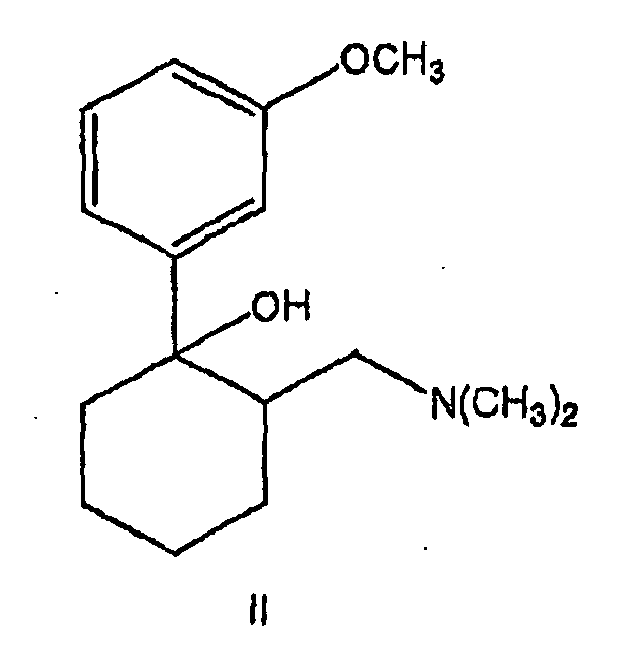
In dargestellter Form oder In Form ihrer Salze, Insbesondere der physiologisch verträglichen Salze, besonders bevorzugt in Form des Hydrochlorids, und/oder in Form ihrer Solvate, insbesondere der Hyd rate;
und die Verbindung der allgemeinen Formel (II)(a) in einem Lösungsmittel, das aus der Gruppe ausgewählt ist, die Toluol, o-Xylol, m-Xylol, p-Xylol und Gemische davon umfaßt, suspendiert wird;(b) die entstehende Suspension mit Thionylchlorid versetzt wird; und(c) das Reaktionsprodukt mit der tertiären Cl-Gruppe der Formel (i) von den weiteren Reaktionsbestandteilen abgetrennt wird. - Verfahren nach Anspruch 4, dadurch gekennzeichnet, daß die Abtrennung (c) des Reaktionsprodukts der Formel (I) durch Abdestillieren des Lösungsmittels mit den weiteren Reaktionsbestandtellen erfolgt.
- Verfahren nach Anspruch 4, dadurch gekennzeichnet, daß die Abtrennung (c) durch Ausfällen des Reaktionsprodukts der Formel (i) mittels Abkühlen des Reaktionsgemischs unter Raumtemperatur erfolgt und das Reaktionsprodukt bei Temperaturen zwischen 35°C und 75°C, vorzugsweise im Vakuum, getrocknet wird.
- Verfahren nach Irgendeinem der Ansprüche 1 bis 6, dadurch gekennzeichnet, daß das Lösungsmittel Toluol ist.
- Verfahren nach irgendeinem der Ansprüche 1 bis 7, dadurch gekennzeichnet, daß 1 bis 2 Äquivalente, insbesondere 1,5 bis 1,7 Äquivalente, besonders bevorzugt 1,6 Äquivalente Thionylchlorid - bezogen auf die Verbindung der Formel (II) - eingesetzt werden.
- Verfahren nach irgendeinem der Ansprüche 1 bis 8, dadurch gekennzeichnet, daß die Umsetzung mit Thionylchlorid bei einer Temperatur von 30 bis 50°C, bevorzugt 35 bis 45 °C, für 1 bis 4 h, bevorzugt 2 bis 3 h, erfolgt.
- Verfahren nach irgendeinem der Ansprüche 4 bis 9, dadurch gekennzeichnet, daß die Verbindung (ii) die Konfiguration (IIa) und/oder (IIb) aufweist:

- Verfahren nach irgeneinem der Ansprüche 4 bis 10; dadurch gekennzeichnet, daß die Verbindung (ii) als Enantiomer mit der absoluten Konfiguration (IIa) eingesetzt wird:

- Verfahren nach irgendeinem der Ansprüche 4 bis 11
zur Herstellung einer Verbindung der allgemeinen Formel (III)
in dargestellter Form oder in Form ihrer Salze, insbesondere der physiologisch verträglichen Salze, besonders bevorzugt in Form des Hydrochlorids, und/oder in Form ihrer Solvate, insbesondere der Hydrate;
dadurch gekennzeichnet, daß die Verbindung der Formel (I) in einem Schritt(d) einer katalytischen Hydrierung mit Palladium-auf-Aktivkohle als Katalysator unterworfen wird. - Verfahren nach Anspruch 12, dadurch gekennzeichnet, daß die Hydrierung (d) unter Retention der Stereochemie an dem mit einem Stern (*) gekennzeichneten C-Atom in Formel (I) bzw. (III) erfolgt.
- Verfahren nach irgendeinem der Ansprüche 12 oder 13
zur Herstellung einer Verbindung (IV)
in dargestellter Form oder in Form ihrer Salze, insbesondere der physiologisch verträglichen Salze, besonders bevorzugt In Form des Hydrochlorids, oder In Form ihrer Solvate, insbesondere der Hydrate; dadurch gekennzeichnet, daß die Verbindung (III), in Form ihrer Racemate, ihrer reinen Stereoisomeren, insbesondere Enantiomeren oder Diastereomeren, oder in Form von Mischungen der Stereoisomeren, insbesondere der Enantiomeren oder Diastereomeren, in einem beliebigen Mischungsverhältnis;
in dargestellter Form oder in Form ihrer Salze, insbesondere der physiologisch verträglichen Salze, besonders bevorzugt in Form des Hydrochlorids, und/oder in Form ihrer Solvate, insbesondere der Hydrate;
in einem Schritt(e) einer Methyletherspaltung mit Methionin/Methansulfonsäure unterworfen wird. - Verfahren nach Anspruch 14, dadurch gekennzeichnet, daß ausgehend von der Verbindung mit der absoluten Konfiguration (IIa)


Priority Applications (1)
| Application Number | Priority Date | Filing Date | Title |
|---|---|---|---|
| SI200331932T SI1499582T1 (sl) | 2002-04-26 | 2003-04-23 | Postopek za kloriranje tercarnih alkoholov |
Applications Claiming Priority (3)
| Application Number | Priority Date | Filing Date | Title |
|---|---|---|---|
| DE10218862A DE10218862A1 (de) | 2002-04-26 | 2002-04-26 | Verfahren zur Chlorierung tertiärer Alkohole |
| DE10218862 | 2002-04-26 | ||
| PCT/EP2003/004213 WO2003091199A1 (de) | 2002-04-26 | 2003-04-23 | Verfahren zur chlorierung tertiärer alkohole |
Publications (2)
| Publication Number | Publication Date |
|---|---|
| EP1499582A1 EP1499582A1 (de) | 2005-01-26 |
| EP1499582B1 true EP1499582B1 (de) | 2010-12-15 |
Family
ID=28798843
Family Applications (1)
| Application Number | Title | Priority Date | Filing Date |
|---|---|---|---|
| EP03722529A Expired - Lifetime EP1499582B1 (de) | 2002-04-26 | 2003-04-23 | Verfahren zur chlorierung tertiärer alkohole |
Country Status (11)
| Country | Link |
|---|---|
| US (2) | US7235693B2 (de) |
| EP (1) | EP1499582B1 (de) |
| CN (1) | CN100338027C (de) |
| AT (1) | ATE491681T1 (de) |
| AU (1) | AU2003229715A1 (de) |
| DE (2) | DE10218862A1 (de) |
| ES (1) | ES2354355T3 (de) |
| IL (2) | IL164807A0 (de) |
| PT (1) | PT1499582E (de) |
| SI (1) | SI1499582T1 (de) |
| WO (1) | WO2003091199A1 (de) |
Families Citing this family (3)
| Publication number | Priority date | Publication date | Assignee | Title |
|---|---|---|---|---|
| DE102005034974A1 (de) * | 2005-07-22 | 2007-04-19 | Grünenthal GmbH | Salz von Dimethylaminomethyl-phenyl-cyclohexan und dessen kristalline Formen |
| DE102005034973A1 (de) * | 2005-07-22 | 2007-02-15 | Grünenthal GmbH | Salz von Dimethylaminomethyl-phenyl-cyclohexan und dessen kristalline Formen |
| JP5323480B2 (ja) * | 2005-07-22 | 2013-10-23 | グリュネンタール・ゲゼルシャフト・ミト・ベシュレンクテル・ハフツング | 3−[2−(ジメチルアミノ)メチル−(シクロヘキシ−1−イル)]−フェノールのHCl多形体 |
Family Cites Families (5)
| Publication number | Priority date | Publication date | Assignee | Title |
|---|---|---|---|---|
| GB8525954D0 (en) * | 1985-10-21 | 1985-11-27 | Mcneilab Inc | Chlorination of carbohydrates &c alcohols |
| DE19525137C2 (de) * | 1995-07-11 | 2003-02-27 | Gruenenthal Gmbh | 6-Dimethylaminomethyl-1-phenyl-cyclohexanverbin -dungen als Zwischenprodukte zur Herstellung pharmazeutischer Wirkstoffe |
| IL119121A (en) * | 1996-08-22 | 2000-11-21 | Chemagis Ltd | Process for the purification of (RR-SS)-2-dimethylaminomethyl-1-(3-methoxyphenyl)cyclohexanol hydrochloride |
| DE19941062A1 (de) * | 1999-08-28 | 2001-03-01 | Aventis Pharma Gmbh | Verfahren zur Herstellung und Reinigung von 2-Acetamino-3-chlor-propionsäuremethylester |
| TWI249540B (en) * | 2002-08-19 | 2006-02-21 | Rohm & Haas | Resin functionalization method |
-
2002
- 2002-04-26 DE DE10218862A patent/DE10218862A1/de not_active Withdrawn
-
2003
- 2003-04-23 PT PT03722529T patent/PT1499582E/pt unknown
- 2003-04-23 WO PCT/EP2003/004213 patent/WO2003091199A1/de not_active Ceased
- 2003-04-23 AU AU2003229715A patent/AU2003229715A1/en not_active Abandoned
- 2003-04-23 SI SI200331932T patent/SI1499582T1/sl unknown
- 2003-04-23 DE DE50313325T patent/DE50313325D1/de not_active Expired - Lifetime
- 2003-04-23 CN CNB038146525A patent/CN100338027C/zh not_active Expired - Fee Related
- 2003-04-23 AT AT03722529T patent/ATE491681T1/de active
- 2003-04-23 ES ES03722529T patent/ES2354355T3/es not_active Expired - Lifetime
- 2003-04-23 EP EP03722529A patent/EP1499582B1/de not_active Expired - Lifetime
- 2003-04-23 IL IL16480703A patent/IL164807A0/xx unknown
-
2004
- 2004-10-25 IL IL164807A patent/IL164807A/en not_active IP Right Cessation
- 2004-10-26 US US10/972,773 patent/US7235693B2/en not_active Expired - Fee Related
-
2007
- 2007-02-09 US US11/704,257 patent/US20070142681A1/en not_active Abandoned
Also Published As
| Publication number | Publication date |
|---|---|
| DE10218862A1 (de) | 2003-11-06 |
| US20050119349A1 (en) | 2005-06-02 |
| WO2003091199A1 (de) | 2003-11-06 |
| IL164807A (en) | 2012-10-31 |
| CN1662486A (zh) | 2005-08-31 |
| DE50313325D1 (de) | 2011-01-27 |
| PT1499582E (pt) | 2010-12-28 |
| US7235693B2 (en) | 2007-06-26 |
| ATE491681T1 (de) | 2011-01-15 |
| ES2354355T3 (es) | 2011-03-14 |
| HK1074038A1 (en) | 2005-10-28 |
| SI1499582T1 (sl) | 2011-02-28 |
| US20070142681A1 (en) | 2007-06-21 |
| AU2003229715A1 (en) | 2003-11-10 |
| CN100338027C (zh) | 2007-09-19 |
| IL164807A0 (en) | 2005-12-18 |
| EP1499582A1 (de) | 2005-01-26 |
Similar Documents
| Publication | Publication Date | Title |
|---|---|---|
| DE69207601T2 (de) | Verfahren zur herstellung von sertralin-zwischenprodukten | |
| EP2303828B1 (de) | Verfahren zur herstellung von substituierten biphenylen | |
| DE4406949A1 (de) | Verfahren zur Herstellung von aliphatischen Iminen | |
| DE69810815T2 (de) | Verfahren zur herstellung eines ketimins | |
| EP2243768A1 (de) | Phenolisches Diazoniumsalz, Verfahren zu dessen Herstellung und dessen Verwendung | |
| EP1499582B1 (de) | Verfahren zur chlorierung tertiärer alkohole | |
| DE69619685T2 (de) | Galanthaminderivate und verfahren zu deren herstellung | |
| EP2321241B1 (de) | Verfahren zur herstellung von phenylalkan-1-olen | |
| DE69910867T2 (de) | Verbessertes Verfahren zur Herstellung von Chloroalkylen und Alkynylaminen | |
| DE102005023953A1 (de) | Verfahren zur Cyclisierung von Citronellal zu Isopulegol | |
| DE2804263C3 (de) | Verfahren zur Herstellung von Indolin-Derivaten | |
| EP0923534B1 (de) | Verfahren zur herstellung von racemischen phenethylaminen | |
| DD298777A5 (de) | 1,3-di-arylmethoxy-4,6-dinitro-benzole, verfahren zu ihrer herstellung und verfahren zur herstellung von 4,6-diaminoresorcin | |
| DE69104299T2 (de) | Verfahren zur Herstellung von 2,6-Di-t-butyl-4-merkaptophenol. | |
| DE69913517T2 (de) | Verfahren zur herstellung einer kristallsuspensionhenonen | |
| EP0673917A1 (de) | Verfahren zur Herstellung von Arylbenzylaminen | |
| DE3877648T2 (de) | Verfahren zur herstellung von naproxen. | |
| US6930205B2 (en) | Process for preparing aminostilbene derivatives | |
| EP0653414B1 (de) | Verfahren zur Herstellung von Fluorbenzoesäurealkylestern durch Reaktion eines Fluorbenzoylchlorids mit einem Alkohol in Gegenwart eines Alkalimetallalkoholates | |
| DE19525098A1 (de) | Verfahren zur Herstellung von Hydroxycarbonsäureaniliden | |
| US4215074A (en) | Process for preparing cis-bicyclooctylamines | |
| DE2264663C3 (de) | Ungesättigte Sulfoxyde und Verfahren zu ihrer Herstellung | |
| HU207709B (en) | Process for producing n-/n-propyl/-n-/2-/2,4,6-trichloro-phenoxy/-ethyl/-amine | |
| EP1603868A1 (de) | Verfahren zur herstellung von alpha-(3-arylthio)-acetophenonen | |
| HK1074038B (en) | Method for chlorinating tertiary alcohols |
Legal Events
| Date | Code | Title | Description |
|---|---|---|---|
| PUAI | Public reference made under article 153(3) epc to a published international application that has entered the european phase |
Free format text: ORIGINAL CODE: 0009012 |
|
| 17P | Request for examination filed |
Effective date: 20041007 |
|
| AK | Designated contracting states |
Kind code of ref document: A1 Designated state(s): AT BE BG CH CY CZ DE DK EE ES FI FR GB GR HU IE IT LI LU MC NL PT RO SE SI SK TR |
|
| AX | Request for extension of the european patent |
Extension state: AL LT LV MK |
|
| REG | Reference to a national code |
Ref country code: HK Ref legal event code: DE Ref document number: 1074038 Country of ref document: HK |
|
| 17Q | First examination report despatched |
Effective date: 20091106 |
|
| GRAP | Despatch of communication of intention to grant a patent |
Free format text: ORIGINAL CODE: EPIDOSNIGR1 |
|
| GRAS | Grant fee paid |
Free format text: ORIGINAL CODE: EPIDOSNIGR3 |
|
| GRAA | (expected) grant |
Free format text: ORIGINAL CODE: 0009210 |
|
| AK | Designated contracting states |
Kind code of ref document: B1 Designated state(s): AT BE BG CH CY CZ DE DK EE ES FI FR GB GR HU IE IT LI LU MC NL PT RO SE SI SK TR |
|
| AX | Request for extension of the european patent |
Extension state: LT LV |
|
| REG | Reference to a national code |
Ref country code: GB Ref legal event code: FG4D Free format text: NOT ENGLISH Ref country code: CH Ref legal event code: EP |
|
| REG | Reference to a national code |
Ref country code: PT Ref legal event code: SC4A Free format text: AVAILABILITY OF NATIONAL TRANSLATION Effective date: 20101220 |
|
| REG | Reference to a national code |
Ref country code: NL Ref legal event code: T3 |
|
| REG | Reference to a national code |
Ref country code: IE Ref legal event code: FG4D |
|
| REF | Corresponds to: |
Ref document number: 50313325 Country of ref document: DE Date of ref document: 20110127 Kind code of ref document: P |
|
| REG | Reference to a national code |
Ref country code: ES Ref legal event code: FG2A Effective date: 20110302 |
|
| REG | Reference to a national code |
Ref country code: HU Ref legal event code: AG4A Ref document number: E009632 Country of ref document: HU |
|
| REG | Reference to a national code |
Ref country code: SK Ref legal event code: T3 Ref document number: E 8536 Country of ref document: SK |
|
| LTIE | Lt: invalidation of european patent or patent extension |
Effective date: 20101215 |
|
| PG25 | Lapsed in a contracting state [announced via postgrant information from national office to epo] |
Ref country code: CY Free format text: LAPSE BECAUSE OF FAILURE TO SUBMIT A TRANSLATION OF THE DESCRIPTION OR TO PAY THE FEE WITHIN THE PRESCRIBED TIME-LIMIT Effective date: 20101215 Ref country code: BG Free format text: LAPSE BECAUSE OF FAILURE TO SUBMIT A TRANSLATION OF THE DESCRIPTION OR TO PAY THE FEE WITHIN THE PRESCRIBED TIME-LIMIT Effective date: 20110315 Ref country code: SE Free format text: LAPSE BECAUSE OF FAILURE TO SUBMIT A TRANSLATION OF THE DESCRIPTION OR TO PAY THE FEE WITHIN THE PRESCRIBED TIME-LIMIT Effective date: 20101215 Ref country code: FI Free format text: LAPSE BECAUSE OF FAILURE TO SUBMIT A TRANSLATION OF THE DESCRIPTION OR TO PAY THE FEE WITHIN THE PRESCRIBED TIME-LIMIT Effective date: 20101215 |
|
| PG25 | Lapsed in a contracting state [announced via postgrant information from national office to epo] |
Ref country code: EE Free format text: LAPSE BECAUSE OF FAILURE TO SUBMIT A TRANSLATION OF THE DESCRIPTION OR TO PAY THE FEE WITHIN THE PRESCRIBED TIME-LIMIT Effective date: 20101215 Ref country code: GR Free format text: LAPSE BECAUSE OF FAILURE TO SUBMIT A TRANSLATION OF THE DESCRIPTION OR TO PAY THE FEE WITHIN THE PRESCRIBED TIME-LIMIT Effective date: 20110316 |
|
| PG25 | Lapsed in a contracting state [announced via postgrant information from national office to epo] |
Ref country code: RO Free format text: LAPSE BECAUSE OF FAILURE TO SUBMIT A TRANSLATION OF THE DESCRIPTION OR TO PAY THE FEE WITHIN THE PRESCRIBED TIME-LIMIT Effective date: 20101215 |
|
| REG | Reference to a national code |
Ref country code: HK Ref legal event code: GR Ref document number: 1074038 Country of ref document: HK |
|
| PLBE | No opposition filed within time limit |
Free format text: ORIGINAL CODE: 0009261 |
|
| STAA | Information on the status of an ep patent application or granted ep patent |
Free format text: STATUS: NO OPPOSITION FILED WITHIN TIME LIMIT |
|
| PG25 | Lapsed in a contracting state [announced via postgrant information from national office to epo] |
Ref country code: DK Free format text: LAPSE BECAUSE OF FAILURE TO SUBMIT A TRANSLATION OF THE DESCRIPTION OR TO PAY THE FEE WITHIN THE PRESCRIBED TIME-LIMIT Effective date: 20101215 |
|
| 26N | No opposition filed |
Effective date: 20110916 |
|
| PG25 | Lapsed in a contracting state [announced via postgrant information from national office to epo] |
Ref country code: MC Free format text: LAPSE BECAUSE OF NON-PAYMENT OF DUE FEES Effective date: 20110430 |
|
| REG | Reference to a national code |
Ref country code: DE Ref legal event code: R097 Ref document number: 50313325 Country of ref document: DE Effective date: 20110916 |
|
| PGFP | Annual fee paid to national office [announced via postgrant information from national office to epo] |
Ref country code: TR Payment date: 20120327 Year of fee payment: 10 |
|
| PGFP | Annual fee paid to national office [announced via postgrant information from national office to epo] |
Ref country code: ES Payment date: 20120510 Year of fee payment: 10 |
|
| PGFP | Annual fee paid to national office [announced via postgrant information from national office to epo] |
Ref country code: AT Payment date: 20120327 Year of fee payment: 10 |
|
| PG25 | Lapsed in a contracting state [announced via postgrant information from national office to epo] |
Ref country code: LU Free format text: LAPSE BECAUSE OF NON-PAYMENT OF DUE FEES Effective date: 20110423 |
|
| PGFP | Annual fee paid to national office [announced via postgrant information from national office to epo] |
Ref country code: SK Payment date: 20130416 Year of fee payment: 11 Ref country code: BE Payment date: 20130415 Year of fee payment: 11 Ref country code: IE Payment date: 20130410 Year of fee payment: 11 Ref country code: GB Payment date: 20130417 Year of fee payment: 11 Ref country code: CZ Payment date: 20130417 Year of fee payment: 11 Ref country code: DE Payment date: 20130430 Year of fee payment: 11 Ref country code: CH Payment date: 20130412 Year of fee payment: 11 |
|
| PGFP | Annual fee paid to national office [announced via postgrant information from national office to epo] |
Ref country code: HU Payment date: 20130411 Year of fee payment: 11 Ref country code: IT Payment date: 20130422 Year of fee payment: 11 Ref country code: PT Payment date: 20130422 Year of fee payment: 11 Ref country code: NL Payment date: 20130410 Year of fee payment: 11 Ref country code: FR Payment date: 20130625 Year of fee payment: 11 Ref country code: SI Payment date: 20130318 Year of fee payment: 11 |
|
| REG | Reference to a national code |
Ref country code: DE Ref legal event code: R082 Ref document number: 50313325 Country of ref document: DE |
|
| REG | Reference to a national code |
Ref country code: DE Ref legal event code: R082 Ref document number: 50313325 Country of ref document: DE |
|
| REG | Reference to a national code |
Ref country code: PT Ref legal event code: MM4A Free format text: LAPSE DUE TO NON-PAYMENT OF FEES Effective date: 20141023 |
|
| REG | Reference to a national code |
Ref country code: DE Ref legal event code: R119 Ref document number: 50313325 Country of ref document: DE |
|
| REG | Reference to a national code |
Ref country code: NL Ref legal event code: V1 Effective date: 20141101 |
|
| REG | Reference to a national code |
Ref country code: CH Ref legal event code: PL |
|
| REG | Reference to a national code |
Ref country code: AT Ref legal event code: MM01 Ref document number: 491681 Country of ref document: AT Kind code of ref document: T Effective date: 20140423 |
|
| GBPC | Gb: european patent ceased through non-payment of renewal fee |
Effective date: 20140423 |
|
| REG | Reference to a national code |
Ref country code: SK Ref legal event code: MM4A Ref document number: E 8536 Country of ref document: SK Effective date: 20140423 |
|
| REG | Reference to a national code |
Ref country code: DE Ref legal event code: R119 Ref document number: 50313325 Country of ref document: DE Effective date: 20141101 |
|
| REG | Reference to a national code |
Ref country code: FR Ref legal event code: ST Effective date: 20141231 |
|
| REG | Reference to a national code |
Ref country code: IE Ref legal event code: MM4A |
|
| PG25 | Lapsed in a contracting state [announced via postgrant information from national office to epo] |
Ref country code: CH Free format text: LAPSE BECAUSE OF NON-PAYMENT OF DUE FEES Effective date: 20140430 Ref country code: CZ Free format text: LAPSE BECAUSE OF NON-PAYMENT OF DUE FEES Effective date: 20140423 Ref country code: SK Free format text: LAPSE BECAUSE OF NON-PAYMENT OF DUE FEES Effective date: 20140423 Ref country code: DE Free format text: LAPSE BECAUSE OF NON-PAYMENT OF DUE FEES Effective date: 20141101 Ref country code: PT Free format text: LAPSE BECAUSE OF NON-PAYMENT OF DUE FEES Effective date: 20141023 Ref country code: GB Free format text: LAPSE BECAUSE OF NON-PAYMENT OF DUE FEES Effective date: 20140423 Ref country code: LI Free format text: LAPSE BECAUSE OF NON-PAYMENT OF DUE FEES Effective date: 20140430 |
|
| REG | Reference to a national code |
Ref country code: SI Ref legal event code: KO00 Effective date: 20141209 |
|
| PG25 | Lapsed in a contracting state [announced via postgrant information from national office to epo] |
Ref country code: HU Free format text: LAPSE BECAUSE OF NON-PAYMENT OF DUE FEES Effective date: 20140424 Ref country code: NL Free format text: LAPSE BECAUSE OF NON-PAYMENT OF DUE FEES Effective date: 20141101 Ref country code: FR Free format text: LAPSE BECAUSE OF NON-PAYMENT OF DUE FEES Effective date: 20140430 Ref country code: SI Free format text: LAPSE BECAUSE OF NON-PAYMENT OF DUE FEES Effective date: 20140424 Ref country code: AT Free format text: LAPSE BECAUSE OF NON-PAYMENT OF DUE FEES Effective date: 20140423 |
|
| PG25 | Lapsed in a contracting state [announced via postgrant information from national office to epo] |
Ref country code: IT Free format text: LAPSE BECAUSE OF NON-PAYMENT OF DUE FEES Effective date: 20140423 |
|
| PG25 | Lapsed in a contracting state [announced via postgrant information from national office to epo] |
Ref country code: IE Free format text: LAPSE BECAUSE OF NON-PAYMENT OF DUE FEES Effective date: 20140423 |
|
| REG | Reference to a national code |
Ref country code: ES Ref legal event code: FD2A Effective date: 20150527 |
|
| PG25 | Lapsed in a contracting state [announced via postgrant information from national office to epo] |
Ref country code: ES Free format text: LAPSE BECAUSE OF NON-PAYMENT OF DUE FEES Effective date: 20140424 |
|
| PG25 | Lapsed in a contracting state [announced via postgrant information from national office to epo] |
Ref country code: BE Free format text: LAPSE BECAUSE OF NON-PAYMENT OF DUE FEES Effective date: 20140430 |
|
| PG25 | Lapsed in a contracting state [announced via postgrant information from national office to epo] |
Ref country code: TR Free format text: LAPSE BECAUSE OF NON-PAYMENT OF DUE FEES Effective date: 20140423 |