EP1499734B1 - Verfahren zur herstellung umwelt sicherer transgener organismen - Google Patents
Verfahren zur herstellung umwelt sicherer transgener organismen Download PDFInfo
- Publication number
- EP1499734B1 EP1499734B1 EP02748684A EP02748684A EP1499734B1 EP 1499734 B1 EP1499734 B1 EP 1499734B1 EP 02748684 A EP02748684 A EP 02748684A EP 02748684 A EP02748684 A EP 02748684A EP 1499734 B1 EP1499734 B1 EP 1499734B1
- Authority
- EP
- European Patent Office
- Prior art keywords
- trait
- splicing
- interest
- trans
- organism
- Prior art date
- Legal status (The legal status is an assumption and is not a legal conclusion. Google has not performed a legal analysis and makes no representation as to the accuracy of the status listed.)
- Expired - Lifetime
Links
Images




Classifications
-
- C—CHEMISTRY; METALLURGY
- C12—BIOCHEMISTRY; BEER; SPIRITS; WINE; VINEGAR; MICROBIOLOGY; ENZYMOLOGY; MUTATION OR GENETIC ENGINEERING
- C12N—MICROORGANISMS OR ENZYMES; COMPOSITIONS THEREOF; PROPAGATING, PRESERVING, OR MAINTAINING MICROORGANISMS; MUTATION OR GENETIC ENGINEERING; CULTURE MEDIA
- C12N15/00—Mutation or genetic engineering; DNA or RNA concerning genetic engineering, vectors, e.g. plasmids, or their isolation, preparation or purification; Use of hosts therefor
- C12N15/09—Recombinant DNA-technology
- C12N15/63—Introduction of foreign genetic material using vectors; Vectors; Use of hosts therefor; Regulation of expression
- C12N15/79—Vectors or expression systems specially adapted for eukaryotic hosts
- C12N15/82—Vectors or expression systems specially adapted for eukaryotic hosts for plant cells, e.g. plant artificial chromosomes (PACs)
- C12N15/8241—Phenotypically and genetically modified plants via recombinant DNA technology
- C12N15/8261—Phenotypically and genetically modified plants via recombinant DNA technology with agronomic (input) traits, e.g. crop yield
- C12N15/8271—Phenotypically and genetically modified plants via recombinant DNA technology with agronomic (input) traits, e.g. crop yield for stress resistance, e.g. heavy metal resistance
- C12N15/8279—Phenotypically and genetically modified plants via recombinant DNA technology with agronomic (input) traits, e.g. crop yield for stress resistance, e.g. heavy metal resistance for biotic stress resistance, pathogen resistance, disease resistance
- C12N15/8286—Phenotypically and genetically modified plants via recombinant DNA technology with agronomic (input) traits, e.g. crop yield for stress resistance, e.g. heavy metal resistance for biotic stress resistance, pathogen resistance, disease resistance for insect resistance
-
- C—CHEMISTRY; METALLURGY
- C12—BIOCHEMISTRY; BEER; SPIRITS; WINE; VINEGAR; MICROBIOLOGY; ENZYMOLOGY; MUTATION OR GENETIC ENGINEERING
- C12N—MICROORGANISMS OR ENZYMES; COMPOSITIONS THEREOF; PROPAGATING, PRESERVING, OR MAINTAINING MICROORGANISMS; MUTATION OR GENETIC ENGINEERING; CULTURE MEDIA
- C12N15/00—Mutation or genetic engineering; DNA or RNA concerning genetic engineering, vectors, e.g. plasmids, or their isolation, preparation or purification; Use of hosts therefor
- C12N15/09—Recombinant DNA-technology
- C12N15/63—Introduction of foreign genetic material using vectors; Vectors; Use of hosts therefor; Regulation of expression
- C12N15/79—Vectors or expression systems specially adapted for eukaryotic hosts
- C12N15/82—Vectors or expression systems specially adapted for eukaryotic hosts for plant cells, e.g. plant artificial chromosomes (PACs)
- C12N15/8241—Phenotypically and genetically modified plants via recombinant DNA technology
- C12N15/8261—Phenotypically and genetically modified plants via recombinant DNA technology with agronomic (input) traits, e.g. crop yield
- C12N15/8262—Phenotypically and genetically modified plants via recombinant DNA technology with agronomic (input) traits, e.g. crop yield involving plant development
- C12N15/8263—Ablation; Apoptosis
-
- C—CHEMISTRY; METALLURGY
- C12—BIOCHEMISTRY; BEER; SPIRITS; WINE; VINEGAR; MICROBIOLOGY; ENZYMOLOGY; MUTATION OR GENETIC ENGINEERING
- C12N—MICROORGANISMS OR ENZYMES; COMPOSITIONS THEREOF; PROPAGATING, PRESERVING, OR MAINTAINING MICROORGANISMS; MUTATION OR GENETIC ENGINEERING; CULTURE MEDIA
- C12N15/00—Mutation or genetic engineering; DNA or RNA concerning genetic engineering, vectors, e.g. plasmids, or their isolation, preparation or purification; Use of hosts therefor
- C12N15/09—Recombinant DNA-technology
- C12N15/63—Introduction of foreign genetic material using vectors; Vectors; Use of hosts therefor; Regulation of expression
- C12N15/79—Vectors or expression systems specially adapted for eukaryotic hosts
- C12N15/82—Vectors or expression systems specially adapted for eukaryotic hosts for plant cells, e.g. plant artificial chromosomes (PACs)
- C12N15/8241—Phenotypically and genetically modified plants via recombinant DNA technology
- C12N15/8261—Phenotypically and genetically modified plants via recombinant DNA technology with agronomic (input) traits, e.g. crop yield
- C12N15/8262—Phenotypically and genetically modified plants via recombinant DNA technology with agronomic (input) traits, e.g. crop yield involving plant development
- C12N15/8265—Transgene containment, e.g. gene dispersal
-
- C—CHEMISTRY; METALLURGY
- C12—BIOCHEMISTRY; BEER; SPIRITS; WINE; VINEGAR; MICROBIOLOGY; ENZYMOLOGY; MUTATION OR GENETIC ENGINEERING
- C12N—MICROORGANISMS OR ENZYMES; COMPOSITIONS THEREOF; PROPAGATING, PRESERVING, OR MAINTAINING MICROORGANISMS; MUTATION OR GENETIC ENGINEERING; CULTURE MEDIA
- C12N15/00—Mutation or genetic engineering; DNA or RNA concerning genetic engineering, vectors, e.g. plasmids, or their isolation, preparation or purification; Use of hosts therefor
- C12N15/09—Recombinant DNA-technology
- C12N15/63—Introduction of foreign genetic material using vectors; Vectors; Use of hosts therefor; Regulation of expression
- C12N15/79—Vectors or expression systems specially adapted for eukaryotic hosts
- C12N15/82—Vectors or expression systems specially adapted for eukaryotic hosts for plant cells, e.g. plant artificial chromosomes (PACs)
- C12N15/8241—Phenotypically and genetically modified plants via recombinant DNA technology
- C12N15/8261—Phenotypically and genetically modified plants via recombinant DNA technology with agronomic (input) traits, e.g. crop yield
- C12N15/8271—Phenotypically and genetically modified plants via recombinant DNA technology with agronomic (input) traits, e.g. crop yield for stress resistance, e.g. heavy metal resistance
-
- C—CHEMISTRY; METALLURGY
- C12—BIOCHEMISTRY; BEER; SPIRITS; WINE; VINEGAR; MICROBIOLOGY; ENZYMOLOGY; MUTATION OR GENETIC ENGINEERING
- C12N—MICROORGANISMS OR ENZYMES; COMPOSITIONS THEREOF; PROPAGATING, PRESERVING, OR MAINTAINING MICROORGANISMS; MUTATION OR GENETIC ENGINEERING; CULTURE MEDIA
- C12N15/00—Mutation or genetic engineering; DNA or RNA concerning genetic engineering, vectors, e.g. plasmids, or their isolation, preparation or purification; Use of hosts therefor
- C12N15/09—Recombinant DNA-technology
- C12N15/63—Introduction of foreign genetic material using vectors; Vectors; Use of hosts therefor; Regulation of expression
- C12N15/79—Vectors or expression systems specially adapted for eukaryotic hosts
- C12N15/82—Vectors or expression systems specially adapted for eukaryotic hosts for plant cells, e.g. plant artificial chromosomes (PACs)
- C12N15/8241—Phenotypically and genetically modified plants via recombinant DNA technology
- C12N15/8261—Phenotypically and genetically modified plants via recombinant DNA technology with agronomic (input) traits, e.g. crop yield
- C12N15/8271—Phenotypically and genetically modified plants via recombinant DNA technology with agronomic (input) traits, e.g. crop yield for stress resistance, e.g. heavy metal resistance
- C12N15/8273—Phenotypically and genetically modified plants via recombinant DNA technology with agronomic (input) traits, e.g. crop yield for stress resistance, e.g. heavy metal resistance for drought, cold, salt resistance
-
- C—CHEMISTRY; METALLURGY
- C12—BIOCHEMISTRY; BEER; SPIRITS; WINE; VINEGAR; MICROBIOLOGY; ENZYMOLOGY; MUTATION OR GENETIC ENGINEERING
- C12N—MICROORGANISMS OR ENZYMES; COMPOSITIONS THEREOF; PROPAGATING, PRESERVING, OR MAINTAINING MICROORGANISMS; MUTATION OR GENETIC ENGINEERING; CULTURE MEDIA
- C12N15/00—Mutation or genetic engineering; DNA or RNA concerning genetic engineering, vectors, e.g. plasmids, or their isolation, preparation or purification; Use of hosts therefor
- C12N15/09—Recombinant DNA-technology
- C12N15/63—Introduction of foreign genetic material using vectors; Vectors; Use of hosts therefor; Regulation of expression
- C12N15/79—Vectors or expression systems specially adapted for eukaryotic hosts
- C12N15/82—Vectors or expression systems specially adapted for eukaryotic hosts for plant cells, e.g. plant artificial chromosomes (PACs)
- C12N15/8241—Phenotypically and genetically modified plants via recombinant DNA technology
- C12N15/8261—Phenotypically and genetically modified plants via recombinant DNA technology with agronomic (input) traits, e.g. crop yield
- C12N15/8271—Phenotypically and genetically modified plants via recombinant DNA technology with agronomic (input) traits, e.g. crop yield for stress resistance, e.g. heavy metal resistance
- C12N15/8274—Phenotypically and genetically modified plants via recombinant DNA technology with agronomic (input) traits, e.g. crop yield for stress resistance, e.g. heavy metal resistance for herbicide resistance
- C12N15/8277—Phosphinotricin
-
- C—CHEMISTRY; METALLURGY
- C12—BIOCHEMISTRY; BEER; SPIRITS; WINE; VINEGAR; MICROBIOLOGY; ENZYMOLOGY; MUTATION OR GENETIC ENGINEERING
- C12N—MICROORGANISMS OR ENZYMES; COMPOSITIONS THEREOF; PROPAGATING, PRESERVING, OR MAINTAINING MICROORGANISMS; MUTATION OR GENETIC ENGINEERING; CULTURE MEDIA
- C12N15/00—Mutation or genetic engineering; DNA or RNA concerning genetic engineering, vectors, e.g. plasmids, or their isolation, preparation or purification; Use of hosts therefor
- C12N15/09—Recombinant DNA-technology
- C12N15/63—Introduction of foreign genetic material using vectors; Vectors; Use of hosts therefor; Regulation of expression
- C12N15/79—Vectors or expression systems specially adapted for eukaryotic hosts
- C12N15/85—Vectors or expression systems specially adapted for eukaryotic hosts for animal cells
-
- C—CHEMISTRY; METALLURGY
- C12—BIOCHEMISTRY; BEER; SPIRITS; WINE; VINEGAR; MICROBIOLOGY; ENZYMOLOGY; MUTATION OR GENETIC ENGINEERING
- C12N—MICROORGANISMS OR ENZYMES; COMPOSITIONS THEREOF; PROPAGATING, PRESERVING, OR MAINTAINING MICROORGANISMS; MUTATION OR GENETIC ENGINEERING; CULTURE MEDIA
- C12N15/00—Mutation or genetic engineering; DNA or RNA concerning genetic engineering, vectors, e.g. plasmids, or their isolation, preparation or purification; Use of hosts therefor
- C12N15/09—Recombinant DNA-technology
- C12N15/63—Introduction of foreign genetic material using vectors; Vectors; Use of hosts therefor; Regulation of expression
- C12N15/79—Vectors or expression systems specially adapted for eukaryotic hosts
- C12N15/85—Vectors or expression systems specially adapted for eukaryotic hosts for animal cells
- C12N15/8509—Vectors or expression systems specially adapted for eukaryotic hosts for animal cells for producing genetically modified animals, e.g. transgenic
-
- A—HUMAN NECESSITIES
- A01—AGRICULTURE; FORESTRY; ANIMAL HUSBANDRY; HUNTING; TRAPPING; FISHING
- A01K—ANIMAL HUSBANDRY; AVICULTURE; APICULTURE; PISCICULTURE; FISHING; REARING OR BREEDING ANIMALS, NOT OTHERWISE PROVIDED FOR; NEW BREEDS OF ANIMALS
- A01K2217/00—Genetically modified animals
- A01K2217/05—Animals comprising random inserted nucleic acids (transgenic)
-
- A—HUMAN NECESSITIES
- A01—AGRICULTURE; FORESTRY; ANIMAL HUSBANDRY; HUNTING; TRAPPING; FISHING
- A01K—ANIMAL HUSBANDRY; AVICULTURE; APICULTURE; PISCICULTURE; FISHING; REARING OR BREEDING ANIMALS, NOT OTHERWISE PROVIDED FOR; NEW BREEDS OF ANIMALS
- A01K2217/00—Genetically modified animals
- A01K2217/20—Animal model comprising regulated expression system
-
- A—HUMAN NECESSITIES
- A01—AGRICULTURE; FORESTRY; ANIMAL HUSBANDRY; HUNTING; TRAPPING; FISHING
- A01K—ANIMAL HUSBANDRY; AVICULTURE; APICULTURE; PISCICULTURE; FISHING; REARING OR BREEDING ANIMALS, NOT OTHERWISE PROVIDED FOR; NEW BREEDS OF ANIMALS
- A01K2227/00—Animals characterised by species
- A01K2227/10—Mammal
-
- C—CHEMISTRY; METALLURGY
- C12—BIOCHEMISTRY; BEER; SPIRITS; WINE; VINEGAR; MICROBIOLOGY; ENZYMOLOGY; MUTATION OR GENETIC ENGINEERING
- C12N—MICROORGANISMS OR ENZYMES; COMPOSITIONS THEREOF; PROPAGATING, PRESERVING, OR MAINTAINING MICROORGANISMS; MUTATION OR GENETIC ENGINEERING; CULTURE MEDIA
- C12N2800/00—Nucleic acids vectors
- C12N2800/30—Vector systems comprising sequences for excision in presence of a recombinase, e.g. loxP or FRT
-
- C—CHEMISTRY; METALLURGY
- C12—BIOCHEMISTRY; BEER; SPIRITS; WINE; VINEGAR; MICROBIOLOGY; ENZYMOLOGY; MUTATION OR GENETIC ENGINEERING
- C12N—MICROORGANISMS OR ENZYMES; COMPOSITIONS THEREOF; PROPAGATING, PRESERVING, OR MAINTAINING MICROORGANISMS; MUTATION OR GENETIC ENGINEERING; CULTURE MEDIA
- C12N2800/00—Nucleic acids vectors
- C12N2800/40—Systems of functionally co-operating vectors
-
- C—CHEMISTRY; METALLURGY
- C12—BIOCHEMISTRY; BEER; SPIRITS; WINE; VINEGAR; MICROBIOLOGY; ENZYMOLOGY; MUTATION OR GENETIC ENGINEERING
- C12N—MICROORGANISMS OR ENZYMES; COMPOSITIONS THEREOF; PROPAGATING, PRESERVING, OR MAINTAINING MICROORGANISMS; MUTATION OR GENETIC ENGINEERING; CULTURE MEDIA
- C12N2840/00—Vectors comprising a special translation-regulating system
- C12N2840/10—Vectors comprising a special translation-regulating system regulates levels of translation
-
- C—CHEMISTRY; METALLURGY
- C12—BIOCHEMISTRY; BEER; SPIRITS; WINE; VINEGAR; MICROBIOLOGY; ENZYMOLOGY; MUTATION OR GENETIC ENGINEERING
- C12N—MICROORGANISMS OR ENZYMES; COMPOSITIONS THEREOF; PROPAGATING, PRESERVING, OR MAINTAINING MICROORGANISMS; MUTATION OR GENETIC ENGINEERING; CULTURE MEDIA
- C12N2840/00—Vectors comprising a special translation-regulating system
- C12N2840/44—Vectors comprising a special translation-regulating system being a specific part of the splice mechanism, e.g. donor, acceptor
- C12N2840/445—Vectors comprising a special translation-regulating system being a specific part of the splice mechanism, e.g. donor, acceptor for trans-splicing, e.g. polypyrimidine tract, branch point splicing
-
- Y—GENERAL TAGGING OF NEW TECHNOLOGICAL DEVELOPMENTS; GENERAL TAGGING OF CROSS-SECTIONAL TECHNOLOGIES SPANNING OVER SEVERAL SECTIONS OF THE IPC; TECHNICAL SUBJECTS COVERED BY FORMER USPC CROSS-REFERENCE ART COLLECTIONS [XRACs] AND DIGESTS
- Y02—TECHNOLOGIES OR APPLICATIONS FOR MITIGATION OR ADAPTATION AGAINST CLIMATE CHANGE
- Y02A—TECHNOLOGIES FOR ADAPTATION TO CLIMATE CHANGE
- Y02A40/00—Adaptation technologies in agriculture, forestry, livestock or agroalimentary production
- Y02A40/10—Adaptation technologies in agriculture, forestry, livestock or agroalimentary production in agriculture
- Y02A40/146—Genetically Modified [GMO] plants, e.g. transgenic plants
Definitions
- the present invention relates to a process of producing a transgenic multicellular plant organism expressing a trait of interest and having a controlled distribution of said trait to progeny or to other organisms.
- the invention further relates to a multicellular plant organism expressing a trait, whereby the distribution of said trait to progeny is controlled, i.e. the probability of transferring said trait to progeny, notably by cross-pollination, is very low.
- This inventions relates preferably to multi-cellular plants.
- transgenes especially antibiotic resistance genes used as transformation markers
- horizontal transfer into surrounding microorganisms ( Chiter et al., 2000, FEBS Lett., 481, 164-168 ), thus modifying the microflora in an undesirable way.
- Any transgenic material created by current technology and released into the environment has a potential of persisting there for a very long time.
- Common practice of plant genetic engineering is based on the use of expression cassettes and vectors that contain continuous coding sequence for the gene of interest.
- Such expression cassettes are integrated into a host chromosome and upon hybridization or another genetic information exchange between a GM plant and another organism, whether licit or illicit, the expression cassette is transmitted with a high probability to the progeny or another recipient as a functional transcriptional unit.
- a process (i) of producing a transgenic multi-cellular plant organism expressing a trait of interest and having a controlled distribution of said trait to progeny comprises hybridising a first multi-cellular organism or a cell thereof having a first heterologous DNA sequence comprising a first fragment of a sequence encoding said trait of interest and a second multi-cellular organism or a cell thereof having a second heterologous DNA sequence comprising a second fragment of the sequence encoding said trait of interest, whereby said first and said second heterologous sequences are designed such that said trait of interest arises due to RNA trans-splicing after said hybridisation, and whereby said first and said second fragment of a nucleotide sequence encoding said trait of interest are present on allelic chromosomes, as defined in new claims 1 and 2.
- the invention provides transgenic plant organisms obtained or obtainable by the process of the invention or as defined in claim 25.
- the inventors of this invention have developed for the first time a method of rendering transgenic organisms environmentall safe in that the transgene or a trait of interest expressed by said organism has a controlled distribution to progeny of said organism.
- the invention solves a major problem of biotechnology, notably of plant biotechnology, since transfer of a transgene from a GM organism to other organisms can now be effectively controlled and limited. Transfer of a transgene to other organisms includes transfer to sexual progeny by cross-pollination as well as lateral gene transfer.
- the above processes make obtainable genetically modified multi-cellular organisms with a controlled containment of a trait of interest.
- the nucleotide sequence encoding or involved in said trait is split into two or more fragments.
- said nucleotide sequence is split into two fragments.
- Said nucleotide sequence is typically a coding sequence (or an open reading frame) of an RNA or, preferably, of a protein involved in said trait.
- said nucleotide sequence is preferably split such that each obtained fragment, upon expression, is incapable of generating said trait.
- Expression of said trait requires the presence of both said fragments in the same organism, notably in the same cells thereof, and linking by trans-splicing of said fragments.
- expression includes transcription, preferably expression includes transcription and translation.
- Each fragment preferably contains a sequence portion necessary for the function of the RNA or protein involved in said trait.
- each fragment preferably contains amino acids necessary for catalysis or substrate binding of the enzyme.
- both heterologous sequences are DNA sequences.
- said first heterologous sequence is DNA
- said second heterologous sequence may be an RNA or a DNA sequence.
- Each heterologous sequence preferably contains, apart from said fragment, sequences required e.g. for transcription like a promoter and a transcription termination signal, or sequences required for translation.
- Said first and/or said second heterologous sequence further contains or codes for a sequence capable of RNA trans-splicing with said second and/or said first heterologous sequence, respectively, for linking said first and said second fragment by trans-splicing.
- Said sequence capable of RNA trans-splicing may be a ribozyme (Rz) capable of trans-splicing.
- the trans-splicing ribozyme may be selected from the following group: group I intron-derived ribozymes, group II intron-derived ribozymes, and other natural or artificially designed ribozymes capable of specific RNA trans-splicing. Further, said trans-splicing may be spliceosome-mediated.
- the process of the invention may also be used to assemble two or more traits by trans-splicing. This may be done as examplified in example 1 and Fig. 5 by having 2 fragments involved in a trait (or involved a two traits) on each heterologous sequence.
- Efficient trans-splicing of the first and the second heterologous sequences poses certain requirements to said heterologous sequences.
- homology of the P1 loop of the ribozyme to the 3' end of the 5' splicing fragment may lead to restrictions of the base sequence of the 5' splicing fragment.
- said first and/or said second heterologous sequence may contain an intron or a part thereof such that the RNA product of the trans-splicing reaction contains an intron capable of cis-splicing.
- sequences necessary for trans-splicing on the first and the second heterologous DNA sequences are incorporated in such a self-splicing intron.
- Said self-splicing intron may then be assembled in the trans-splicing reaction.
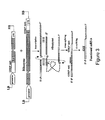
- any non-desired sequences or sequences necessary for trans-splicing may be excised from the product of the trans-splicing reaction by cis-splicing (cf. Fig. 4 ).
- the design of cis-splicing introns is known in the art.
- said first and said second heterologous DNA sequence are each incorporated in a multi-cellular plant organism or cells thereof according to methods generally known in the art.
- at least one, more preferably both, of said heterologous sequences are stably incorporated into a chromosome of the nuclear genome of the organism.
- Said first and said second multi-cellular organisms obtained thereby are preferably made homozygous with respect to the respective heterologous DNA sequences according to procedures known in the art.
- Said first and said second multi-cellular organisms belong preferably to the same family, more preferably to the same genus, and most preferably to the same species of organisms.
- Said first heterologous DNA sequence in said first multi-cellular organism and said second heterologous DNA sequence in said second multi-cellular organism may be incorporated into the same (homologous) or into different (non-homologous) chromosomes. It is preferred that they are incorporated into the same chromosome. Most preferably, they are incorporated into the same locus of the same chromosome. Methods for obtaining such relative locations of said first and said second heterologous sequences are known in the art. One possibility is to produce many transformants with each of said heterologous sequences. Then, the chromosome having said heterologous sequence incorporated as well as the location of the transformed sequence in the chromosome is determined by genetic or molecular biological methods.
- a transformed multi-cellular organism having said heterologous sequence at a suitable location may be selected. This may be done with said first and said second multi-cellular organism, and a suitable pair of first and second organisms may be chosen.
- a further possibility is to use targeted integration into a desired locus of a particular chromosome making use of homologous recombination.
- Targeted integration may preferably be done using a multi-cellular plant having a targeting site pre-integrated into a chromosome in combination with site-specific recombination. The latter approach is particularly useful for introducing said first and said second heterologous sequence into the same locus of the same chromosome, as the same starting organism line having a pre-integrated targeting site may be used for transforming said heterologous sequences.
- Targeted integration is described e.g. in international patent application PCT/EP02/03266 .
- said first and said second multi-cellular organism or cells thereof are then hybridised for obtaining the transgenic multi-celllular plant organism of the invention.
- Hybridising may be sexual crossing of organisms or fusion of cells of said organisms.
- Cell fusion may be fusion of germ cells or of somatic cells.
- Hybridising may involve pollination of plants or somatic cell fusion of protoplasts. Sexual crossing of plants is most preferred. Said hybridising brings said fragments encoding or being involved in said trait together in one organism such that said trait of interest arises due to RNA trans-splicing. Arising due to RNA trans-splicing means that trans-splicing is a necessary condition for the expression of said trait of interest.
- the production of the transgenic organism of the invention may comprise further steps in addition to said hybridising. In the case of plants, examples of such further steps include: growing and harvesting seeds, seeding, and growing the plant of the invention. In the case of protoplast fusion, such further steps include: propagating the fused protoplasts to obtain colonies, regeneration of plants.
- first and said second heterologous sequences and the respective fragments exist in the transgenic multi-celllular plant organism of the invention.
- Said first and said second heterologous sequences in said transgenic multi-cellular plant or animal should be positioned such that they segregate as unlinked loci.
- Said unlinked loci are preferably positioned so as to minimize recombination and creation of linkage between said loci.
- Said relative locations are generally shown in Fig. 2B using a diploid organism as an example.
- said fragments are located on the same chromosome, i.e. they are physically linked on the same DNA molecule but are separated from each other by chromosome sequences native to the organism.
- the fragments will belong to different transcriptional units. Since crossing-over in meiosis may lead to separation of the fragments (or the heterologous sequences containing the fragments), the probability of transferring the trait encoded by both fragments to progeny is significantly reduced compared to the conventional case, where the trait is encoded by a continuous coding sequence.
- said first and said second fragment are located on different chromosomes (non-homologous chromosomes as opposed to allelic chromosomes).
- the frequency of inheriting said trait encoded by two fragments on different chromosomes upon self-crossing is about 50% and upon crossing with an organism not carrying any of these fragments 25%. Case II is preferred over case I.
- Controlled distribution of said trait to progeny means that the probability of transferring said trait to progeny is significantly reduced compared to conventional transgenic organisms that have a transgene involved in said trait encoded in one locus of a chromosome, notably as a single transcriptional unit.
- the frequency of appearance of said trait in progeny upon crossing said transgenic multi-cellular organism of the invention with an organism devoid of said first and said second heterologous sequences is less than 10%, preferably less than 1 %, more preferably 0.1%, even more preferably less than 0.01%, an most preferably less than 0.001%.
- the frequency of appearance of a transgene in progeny upon crossing a conventional transgenic (diploid) organism having said transgene in a single transcriptional unit and being heterozygous with respect to the transgene with another organism of the same species not having said transgene is about 50%.
- said first heterologous sequence is typically DNA that is integrated into the nuclear genome of said multi-cellular organism.
- Said second heterologous sequence may be RNA or DNA. If it is DNA, sequences allowing transcription (e.g. a promoter functional in the organism) in said organism have to be provided with said second heterologous sequence for producing trans-spliceable RNA.
- Said second heterologous sequence may be RNA, e.g. when viral infection based on an RNA virus is used.
- An RNA viral second heterologous RNA may however be introduced indirectly by introducing DNA transcribable to RNA.
- Said second heterologous DNA or RNA sequence may or may not be incorporated into the nuclear genome of the multi-cellular organism. Preferably, it is not incorporated into the nuclear genome. This allows an extremely high degree of control of the distribution to progeny of the trait encoded in said first and second fragment.
- the multi-cellular organism or cell thereof having a first heterologous DNA sequence may be provided as described for process (i).
- the multi-cellular organism is preferably heterozygous with respect to the first heterologous sequence.
- the introduction of said first and said second heterologous sequences may be a one-step or a two-step procedure.
- said first and said second heterologous sequences are introduced into a multi-cellular organism together or at the same time and, preferably, by the same transformation method.
- Said first and said second heterologous sequences may e.g. be introduced as a mixture (e.g. a mixture of Agrobacterium strains each containing one of said heterologous sequences in T-DNA of Ti plasmids).
- the two-step procedure the multi-cellular organism or a cell thereof having the first heterologous DNA sequence is produced first, and said second heterologous sequence is introduced in an independent step.
- These two introductions may be performed by different transformation or transfection methods.
- Said introducing may be done by viral infection, Agrobacterium- mediated infection or non-biological transformation methods.
- transgenic multi-cellular plant organisms are produced.
- the processes of the invention may be applied to diploid and to polyploid plants.
- traits expressible according to the invention are male sterility, herbicide resistance, insecticide resistance, a counter-selectable marker, organism morphology, seed content, seed stability, climate adaption, vitamine content, carbohydrate content and composition, fat content and composition etc.
- said trait may be expression of a protein of interest, notably a pharmaceutical protein. Examples for such proteins are given below.
- two traits are expressed in a plant of the invention, e.g. a selectible marker gene and a gene of interest conferring a useful trait like insect resistance.
- Said multi-cellular organisms and said transgenic multi-cellular organisms of the invention may be further genetically or transiently modified e.g. for providing functions necessary for said trans-splicing and/or said expressing of the trait of interest. Further, a second transgene involved in expression of said trait of interest or of a different trait may expressed.
- the process of the invention may be used for a wide variety of applications. It may e.g. be used for expressing a trait of interest in said transgenic organism. Said trait may be any property of said organism, whether encoded by a single or by several genes. Said trait may be caused by expression of at least one RNA or, preferably, by the expression of at least one protein. Two or more RNAs and/or proteins may be necessary for said trait. In this case, it may be sufficient to control the expression of only one RNA or protein as described herein. It is, however, environmentally safer to control all the RNAs or proteins producing a trait by the processes of the invention (cf. example 1, Fig. 5 ).
- the invention also allows to assemble sequence coding for a protein with modules of e.g. signal peptides, binding domains, retention signals, compartmentalisation signals, activation domains, domains with enzymatic activities, affinity tags, and regulatory sequences.
- modules of e.g. signal peptides, binding domains, retention signals, compartmentalisation signals, activation domains, domains with enzymatic activities, affinity tags, and regulatory sequences Such a modular approach makes it simple to find an optimal expression cassette for a specific purpose or for finding an optimal secretory or transit peptide for a specific gene to be overexpressed and accumulated in the cell or a specific compartment thereof. It can be a valuable tool for functional genomics and proteomics studies.
- a library of plants may e.g. be created, whereby each member of the library contains a particular module (e.g. a specifec signal peptide) of one of the above module classes e.g. as said first fragment.
- the second fragment will then code for a protein of interest.
- the coding RNA sequence of said protein is linked to said module by trans-splicing. It is preferred to carry out this modular approach with process (ii) of the invention and without stable integration of said second heterologous sequence into a chromosome.
- a trait may also be expressed in a transgenic multi-cellular organism by down-regulating a gene native to said organism.
- a gene may be down-regulated by any known methods, e.g. by anti-sense technology or by small interfering RNAs (siRNA).
- siRNA small interfering RNAs
- an anti-sense RNA or a siRNA is provided by the product of the trans-splicing reaction, optionally after further processing like cis-splicing.
- a siRNA may be produced in the transgenic organism by designing said first and second heterologous sequences such that the product of trans-splicing comprises sequence portions having self-complementarity for forming a double-stranded RNA structure.
- Said double-stranded RNA structure may have a portion of sequence identity to a gene of the host cell and may be of sufficient length to inhibit expression of said gene in said cell.
- This method is particularly useful for functional genomics studies, notably in combination with the second process of the invention.
- the method of genetic inhibition by double-stranded RNA is generally described in WO 99/32619 .
- An efficient method of down-regulating any desired target gene using small interfering RNAs is described in Brummelkamp et al. (Science 296, 550-553 ). These methods can easily be combined with the processes of the invention.
- process (i) is the production of hybrid seeds for generating plants for agrocultural purposes or for protein production in said plants, whereby said plants have a controlled distribution of a trait to progeny.
- Said hybrid seeds allow the generation of plants expressing a trait of interest that is neither expressed in a parental line and quickly segregates in progeny.
- process (ii) The most important application of process (ii) is control of expression of a trait of interest. Expression of said trait may be triggered by introducing said second heterologous DNA sequence. If said second heterologous DNA sequence is incorporated into a nuclear chromosome, the same level of control of distribution of said trait is achievable as in process (i). If said second heterologous DNA sequence is not incorporated into a nuclear chromosome, the distribution of said trait is even further controlled, since transfer of said trait to progeny is extremely unlikely.
- the invention further provides a transgenic multi-cellular plant organism expressing a trait of interest, said organism having a controlled distribution of said trait to progeny, wherein expression of said trait involves production of an RNA molecule by trans-splicing of RNA fragments, whereby said RNA fragments are encoded or are located on different heterologous nucleotide molecules.
- Said different heterologous nucleotide molecules may be on different chromosomes.
- said RNA fragments are encoded on allelic chromosomes.
- said RNA fragments code, after trans-splicing, for a heterologous protein
- the invention further comprises parts or products of the transgenic organisms of the invention and plant seeds obtained by said hybridising.
- RNA transgene involved in expression of a trait in two or more fragments capable of trans-splicing on the RNA level, and introduce these fragments into different chromosomes of the host genome, preferably in allelic chromosomes, of a transgenic multi-cellular organism.
- these fragments can be assembled by RNA trans-splicing, thus forming functional RNA, notably mRNA, which can provide for the trait of interest.
- RNA trans-splicing thus forming functional RNA, notably mRNA, which can provide for the trait of interest. Since the breeding process usually involves very specific parental crosses, managing such two-allele system does not pose serious additional problems. Any undesired, spontaneous cross between the transgenic organism (notably a plant organism) of the invention and unwanted organisms effectively disassembles said trait, thus abolishing expression and greatly reducing the chance of functional gene transfer to illicit progeny.
- the system of this invention also allows one skilled in the art to design schemes for selecting primary transformants based on a selectable marker that is effective and operable in the To progeny, but alleles of which, upon subsequent crosses, segregate to different transgenic progeny and thus disappear as a functional selectable gene.
- the invention allows rapid in vivo assembly of different genes by crossing parents that contain different fragments of a transcriptional unit of interest, thus allowing to swap different functional domains, such as translational enhancers, transit or signal or targeting peptides, purification tags, different functional domains of proteins, etc., by simply crossing plants carrying desired fragments of such a functional gene/transcriptional unit.
- different functional domains such as translational enhancers, transit or signal or targeting peptides, purification tags, different functional domains of proteins, etc.
- RNA trans-splicing can be achieved by using engineered ribozymes.
- One of the early applications of the trans-splicing phenomenon was proposed by Sullenger and Cech (Nature, 1994, 371, 619-622 ,) who described experiments in which ribozyme-mediated trans-splicing is used to replace a defective portion of RNA with a functional structure by using a reengineered Tetrahymena group I intron to generate translatable lacZ transcripts in E . coli .
- trans-splicing Another use of trans-splicing was proposed by Ayre and colleagues (1999, Proc. Natl. Acad. Sci. USA, 96, 3507-3512 ) who developed a technology that utilizes ribozyme-mediated trans-splicing to target cytotoxins into cells in a highly specific manner. They used group I introns to splice the mRNA for Diphteria toxin A with virus mRNA to inactivate cells expressing viral mRNA, thus selectively inactivating infected yeast cells. The general principle of group 1 intron-derived ribozyme-mediated trans-splicing is shown in Fig.1 .
- trans-splicing mediated trait assembly in F 1 progeny is shown in Figure 2A .
- None of two parental lines (P 1 and P 2 ) has a fully functional linear gene encoding said trait.
- each contains fragments (A or B) of said gene preferably located on allelic chromosomes.
- a or B fragments of said gene preferably located on allelic chromosomes.
- the trans-splicing of the invention is not limited to the use of group I introns and their derivatives.
- group I introns There are different groups/classes of introns classified according to their internal organization and mechanism of splicing.
- Nuclear introns have in common that they have GT-AG dinucleotides at the 5' and 3' ends and usually require spliceosome formation for their splicing.
- Group I and group II introns were named after introns found in different fungal mitochondrial genes. They are classified according to their internal organization but have in common the ability to autocatalyze their own splicing.
- Nuclear introns are spliced by a snRNP-mediated (spliceosome-mediated) mechanism.
- snRNP-mediated spliceosome-mediated
- snRNP-mediated mechanism Naturally occurring trans-splicing with the involvement of a snRNP-mediated mechanism is described for an attachement SL (spliced leader) RNA to the 5' end of mRNAs in trypanosomes ( Agabian, N., 1990, Cell, 61, 1157-1160 ; Luo et al., 1999, J. Biol. Chem., 274, 31947-31954 ) and Caenorhabditis elegans ( Hirsh & Huang, 1990, Mol. Biol. Rep., 14,115 ).
- These small "spliced leader" RNAs consist of the 5' exon fused to sequences that can functionally substitute for U1 snRNA in mammalian snRNP-splicing extracts.
- Group I and II introns have the ability to splice themselves out of pre-mRNA. This reaction can be performed in vitro by the RNA alone. Such RNAs with catalytic activities are generally called ribozymes. In this invention, the term ribozyme is used to name catalytic RNAs capable of performing trans-splicing reactions between separate RNA molecules. Both group I and group II introns are capable of trans-splicing in artificial systems ( Been et al., 1986, Cell, 47, 207-216 ; Jacquier et al., 1986, Science, 234, 1099-1194 ; Jarrell et al., 1988, Mol. Cell Biol. 8, 2361-2366 ).
- Trans-splicing was also found for group II introns in split genes of chloroplasts ( Kohchi et al., 1988, Nucl. Acids Res., 16,10025-10036 ), and for a group I intron in an artificially split gene in Escherichia coli ( Galloway-Salvo et al., 1990, J. Mol. Biol., 211, 537-549 ).
- Group I introns were first discovered in Tetrahymena thermophila rRNA ( Cech, T.R., 1990, Annu. Rev. Biochem., 59, 543-568 ).
- the processes of the invention may be used as a convenient way of assembling a desired sequence and/or expression unit from different parts in trans , using as modules or building blocks different transgenic plants (see Fig. 4 ).
- Their hybrid progeny would put together modules inherited from different parents through engineered ribozyme-mediated trans-splicing. It is possible to form a trait of interest by choosing the appropriate pair of transgenic parents containing required modules, very much like by choosing an appropriate pair of parental plants for producing high value hybrid seeds in traditional breeding.
- the examples of such modules include different signal peptides, binding domains, retention signals, compartmentalization signals, activation domains, domains with enzymatic activities, affinity tags, regulatory sequences, different genes of interest and parts thereof.
- trans-splicing contemplated in our invention is the formation of herbicide-resistance and insect resistance by trans-splicing from non-functional precursors.
- EXAMPLES 1 and 2 we describe the design of a system for ribozyme-mediated formation of BAR and CrylllA mRNAs in plants.
- the first example we describe the design of two constructs containing said first and said second fragment of the invention of trans-splicing system for each gene of interest in trans.
- the formation of traits conferring PPT (herbicide phosphinothricin) and insect resistance occurs exclusively in plant cells harboring the two T-DNAs shown in Figure 5 .
- T-DNA linkage analysis is described in EXAMPLE 2, allowing to select the most appropriate transformant containing different T-DNAs on different allelic chromosomes, e.g. linked in repulsion.
- heterologous DNA sequences of interest may be introduced in cells, notably in plant cells.
- One approach is based on generating two independent transformants, each of them containing one of the two heterologous DNA sequences involved in trans-splicing. These sequences can be brought together by sexual crossing or somatic cell hybridization through protoplasts fusion ( Melchers, G.,1976, Basic Life Sci., 8: 455-467 ; Ratushnyak et al., 1993, Mol. Gen. Genet., 236: 427-432 ), thus providing for a trait of interest in their progeny.
- two heterologous DNA sequences can be stably integrated into the same plant cell during single or two independent transformation events.
- genetic analysis of the progenies of such plants is preferably done in order to determine the linkage between said DNA fragments and to choose the most preferable location of said fragments relatively to each other. If said heterologous DNA sequences containing said fragments are introduced in different plants, they are not physically linked in a hybrid plant, but are located on different or allelic (linked in repulsion) chromosomes. In addition, there is a relatively high chance of said fragments being physically linked (located on the same chromosome) in case of stable integration of said fragments in the same plant.
- said two fragments are physically linked, e.g. are located on the same chromosome( Figure 2B , case I).
- the fragments may segregate in progeny due to meiotic crossing over, thus giving better control over trait expression and movement than in the prior art, where said trait is encoded by one continuous sequence.
- said fragments are not physically linked, e.g. are located on two different (non-homologous) chromosomes ( Fig. 2B , case II). In this case, only half of self-progeny and one quarter of cross-progeny of the plant heterozygous for both fragments will inherit the trait.
- said fragments are on different allelic chromosomes ( Fig. 2B , case III).
- allelic chromosomes Fig. 2B , case III.
- all self-progeny will inherit the trait, but no trait will be inherited by progeny resulting from crossing with plants possessing neither of said fragments if meiotic crossing-over is neglected or absent.
- Meiotic recombination between the two allelic chromosomes may, however, physically link said fragments A and B. The frequency of such recombination events directly depends from the relative distance between said fragments on two allelic chromosomes.
- said fragments are preferably positioned at short relative distance or, most preferably, at the same locus on different allelic chromosomes ( Fig. 2B , case IV), thus minimizing the frequency of meiotic recombination between such fragments practically to zero.
- allelic chromosomes Fig. 2B , case IV
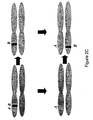
- Said fragments A and B can be integrated within chromosomal DNA as one construct AB ( Fig. 2C ).
- the design of the construct shall allow selectable removal of one of heterologous DNA fragments (A or B) using mechanism of controllable DNA rearrangement (excision, inversion or transposition), thus generating progeny containing either fragment A or fragment B in the same locus, or having selectively transcribed either fragment A or fragment B without removing them.
- Bringing together both fragments or their transcripts by crossing plants possessing only one of said fragments or both fragments, but only one of required transcripts, will lead to expressing a trait of interest.
- An example of controlled DNA recombination can be flanking fragments A and B with sequences recognized by different site-specific recombinases, and upon such recognition selectively removing either fragment A or fragment B.
- both fragments can be flanked by sequences for site specific recombination in such orientation, that exposure to the source of recombinase recognizing said sequences will lead to inversion of DNA fragment with both fragments.
- transcription initiation region promoter
- Another approach comprises the use of transposition, where, for example fragment B is located and transcribed within a non-autonomous transposable element, but its excision from the construct will trigger transcription of fragment A. Excision of the transposon does not necessarily lead to its reinsertion elsewhere, so progeny can be selected that contains fragment A only.
- Agrobacterium-mediated T-DNA delivery in plant cells, whereby said T-DNA contains said first and/or said second heteologous sequence as a vector.
- Different methods may be used for the delivery of vectors into plant cells such as direct introduction of said vector into the cells by the means of microprojectile bombardment, electroporation or PEG-mediated transformation of protoplasts.
- Agrobacterium -mediated plant transformation is preferred, notably for process (i) and for said first heterologous sequence of process (ii).
- DNA may be transformed into plant cells by various suitable technologies such as by a Ti-plasmid vector carried by Agrobacterium ( US 5,591,616 ; US 4,940,838 ; US 5,464,763 ), particle or microprojectile bombardment ( US 05100792 ; EP 00444882B1 ; EP 00434616B1 ).
- other plant transformation methods can also be used e.g. microinjection ( WO 09209696 ; WO 09400583A1 ; EP 175966B1 ), electroporation ( EP00564595B1 ; EP00290395B1 ; WO 08706614A1 ), etc.
- the choice of the transformation method depends on the plant species to be transformed. For example, microprojectile bombardment may be preferred for monocots transformation, while for dicots, Agrobacterium- mediated transformation gives generally better results.
- trans-splicing system described in our invention consists of two or more fragments which are provided in trans. This means that our system is better controlled and safer, e.g. it can have zero expression level in the uninduced state.
- Genes of interest, or fragments thereof, that can be expressed, in sense or antisense orientation, using this invention include: starch modifying enzymes (starch synthase, starch phosphorylation enzyme, debranching enzyme, starch branching enzyme, starch branching enzyme II, granule bound starch synthase), sucrose phosphate synthase, sucrose phosphorylase, polygalacturonase, polyfructan sucrase, ADP glucose pyrophosphorylase, cyclodextrin glycosyltransferase, fructosyl transferase, glycogen synthase, pectin esterase, aprotinin, avidin, bacterial levansucrase, E.coli gIgA protein, MAPK4 and orthologues, nitrogen assimilation/methabolism enzyme, glutamine synthase, plant osmotin, 2S albumin, thaumatin, site-specific recombinase/integra
- coli inorganic pyrophosphatase seed storage protein, Erwinia herbicola lycopen synthase, ACC oxidase, pTOM36 encoded protein, phytase, ketohydrolase, acetoacetyl CoA reductase, PHB (polyhydroxybutanoate) synthase, acyl carrier protein, napin, EA9, non-higher plant phytoene synthase, pTOM5 encoded protein, ETR (ethylene receptor), plastidic pyruvate phosphate dikinase, nematode-inducible transmembrane pore protein, trait enhancing photosynthetic or plastid function of the plant cell, stilbene synthase, an enzyme capable of hydroxylating phenols, catechol dioxygenase, catechol 2,3-dioxygenase, chloromuconate cycloisomerase, anthranilate synthase, Brassica A
- Any human or animal protein can be expressed using the trans-splicing system.
- proteins of interest include inter alia immune response proteins (monoclonal antibodies, single chain antibodies, T cell receptors etc.), antigens, colony stimulating factors, relaxins, polypeptide hormones, cytokines and their receptors, interferons, growth factors and coagulation factors, enzymatically active lysosomal enzyme, fibrinolytic polypeptides, blood clotting factors, trypsinogen, 1-antitrypsin (AAT), as well as function-conservative proteins like fusions, mutant versions and synthetic derivatives of the above proteins.
- AAT 1-antitrypsin
- the process of the invention may further comprise expressing a gene encoding a post-transcriptional gene silencing (PTGS) suppressor protein or a function-conservative variant or fragment thereof into a plant for suppressing PTGS of said transgenic coding sequence.
- PTGS suppressor protein gene or function-conservative variant or fragment thereof may be provided to a plant on the same vector carrying said transgenic coding sequence or on an extra vector.
- Said PTGS suppressor protein is preferably of viral or plant origin.
- PTGS suppressor proteins are potato virus X p25 protein, african cassava mosaic virus AC2 protein, rice yellow mottle virus P1 protein, tomato bushy stunt virus 19K protein, rgs CAM or a function-conservative variant or fragment of one of these proteins. Said function-conservative variant or fragment preferably has a sequence identity of 75% to one of the above protein. Details on PTGS suppressor proteins and their use can be found in WO0138512 .
- selectable/scorable marker genes are also applicable for selectable/scorable marker genes and their fusions with different genes of interest, thus allowing for the direct selection of the best recombinant protein producer.
- selectable/scorable markers include inter alia genes or fragments of: neomycin phosphotransferase II (NPTII), hygromycin phosphotransferase, aminoglycoside 6'-N- acetyltransferase, 5-enolpyruvylshikimate-3-phosphate synthase, phosphinothricin acetyl transferase (BAR), betaine aldehyde dehydrogenase (BADH), dihydrofolate reductase (DFR1), 6' gentamicin acetyltransferase (6' GAT), acetolactate synthase (ALS), phosphomannose-isomerase (PMI), glyphosate oxidoreductase,
- Two T-DNA constructs (see Fig. 5 ), one with ribozyme linked to 3' end of BAR gene (Gene Bank Accession X17220) and 5' end of CryIIIA gene (Gene Bank Accession X70979) and another - with 5' end of BAR gene and ribozyme linked with 3' end of CryIIIA gene, were designed using standard molecular biology techniques ( Sambrook, Fritsch & Maniatis, 1989, Molecular Cloning: A Laboratory Manual, Cold Spring Harbor Lab Press, Plainview, NY, 2nd editi on).
- the first construct ( Fig. 5 , top) carries the 5' end of a 35S promoter-driven transcriptional unit containing a CryIIIA gene linked to a 200 b.p.
- the second construct ( Fig. 5 , second from the top) has a 35S promoter-driven 200 b. p HPT gene fragment in anti-sense orientation followed by a ribozyme linked to the 3'end of the CryIIIA gene and a nos promoter-driven 5' end of the BAR gene linked with a 300 b. p. HPT fragment in sense orientation.
- Schematic presentations of the constructs as well as the products of trans-splicing are shown in Figure 5 .
- Figure 6 shows a detailed picture of the trans-splicing process yielding a functional BAR gene.
- HPT HPT is a bacterial gene, it is not related to any of the plant genes.
- the G/C content is about 60%, so base pairing between 5' and 3' parts of the viral vector should be quite efficient:
- the coding sequence of BAR gene was split in two parts at the middle of acetyltransferase domain (AA residues 60-142) to ensure there is no phosphinothricin resistance provided by any of separate parts.
- the primers used to PCR the fragments of interest are:
- the 5' end of BAR gene together with nos promoter was PCR amplified using pICBV19 plasmid DNA ( Fig. 7 ) as template and primers pnos1 and bar1r.
- This PCR fragment was digested with Xho1 and EcoRI and cloned into the large fragment of Kpn1-EcoRI digested binary pICBV19 together with targhpt1-targhpt5 amplified and digested with Kpn1 and Xho1 restriction enzymes HPT fragment.
- Construct pICH1600, containing HPT gene was taken as template for PCR amplification of the HPT fragments.
- This ribozyme sequence was ordered at ATG:Biosynthetics GmbH (P0202001), inserted into pBluescript II SK(+) between HindIII and Xbal restriction sites (plasmid pICH080) and used for further cloning steps. Then ribozyme from pIC080 (HindIII/XbaI) was fused to the antisense version of the HPT-target (300 bp XbaI/Sal1 PCR fragment (amplified with primers Targhpt3 and Targhpt4) to get the intermediate plasmid based on pBS(KS+). This plasmid was used to isolate Hind III/Sal 1 fragment of ribozyme linked with 300 b.p of HPT fragment in antisense orientation.
- the final step in cloning of this expression cassette included three-way ligation of Hind III/SalI ribozyme-HPT fragment with HindIII/NcoI -treated PCR fragment (primers bar2f and bar3r) of 3' end of the BAR gene and Ncol/Sal1 digested modified binary vector pICBV19 ( Fig. 7 ).
- the final cloning yielded pICBV19 containing ribozyme linked to the 3' end of the BAR gene under control of NOS promoter (intermediate construct 2).
- HPT gene 180 nucleotides, Gene Bank Accession No. V014999, the sequence is shown below was chosen as the target sequence in this case.
- This sequence does not overlap with the 300 b.p. HPT fragment used for designing ribozyme-mediated trans-splicing system for the BAR gene.
- the 180 b.p. HPT fragment was amplified with hpt1f ( 5'- gcat ctcgag ttactagact gaactcaccg cgacgtct gtc-3') and hpt2r (5'-ctgc ggatc c aaacataac gatcttgtag aaaccatcc-3') primers, digested with Xho1 and BamH1 and ligated together with Cla1/Xho1 synthetic fragment of CryIIIA gene (ATG:Biosynthetics GmbH) into gel-purified large CIa1/BamH1 fragment of intermediate construct 2. The restriction sites for Xho1 and BamH1 in primer sequences are shown in bold. The final construct is shown in Figure 5 (top).
- the Hind111/ Xba1 fragment of ribozyme was cloned together with 180 b.p. Sac1/Xba1 HPT fragment into Sac1/Hind 111 sites pBS(KS+), creating ribozyme fragment linked with HPT gene fragment in anti-sense orientation.
- the HPT fragment was PCR-amplified with primers hpt3f ( 5'- gcata gatct ct gaactcaccg cgacgtct gtc-3') and hpt4r (5'-ctgc gagctc aaacataac gatcttgtag aaaccatcc-3') using the plasmid pICH1600 as the template.
- T-DNA of constructs shown in Figure 5 were co-introduced in Arabidopsis thaliana (Col-0) plants as descried by Bent et al., (1994, Science, 285, 1856-1860 ). Seeds were harvested three weeks after vacuum-infiltration germinated and screened for transformants, by spraying several times with 50 mg/L of phosphinothricin (PPT) solution. The same constructs were also used for Agrobacterium-mediated leaf disc cotransformation of Nicotiana plants ( Horsh et al., 1985, Science, 227, 1229-1231 ) using 10mg/L of PPT.
- PPT phosphinothricin
- the transgenic plants showing resistance to PPT shall harbor two different T-DNAs, carrying the different parts of BAR gene. No PPT resistant plants were recovered by using only one of two constructs. This suggests that CryIIIA also shalI be present in the cell, as its parts are linked with BAR gene fragments.
- the latter case will preferable to work with, as the transfer of herbicide resistance and insect resistance traits through cross-polination will be very limited.
Landscapes
- Health & Medical Sciences (AREA)
- Genetics & Genomics (AREA)
- Life Sciences & Earth Sciences (AREA)
- Engineering & Computer Science (AREA)
- Wood Science & Technology (AREA)
- Zoology (AREA)
- Organic Chemistry (AREA)
- Biomedical Technology (AREA)
- Chemical & Material Sciences (AREA)
- Biotechnology (AREA)
- General Engineering & Computer Science (AREA)
- Bioinformatics & Cheminformatics (AREA)
- Molecular Biology (AREA)
- Plant Pathology (AREA)
- Microbiology (AREA)
- Physics & Mathematics (AREA)
- Biophysics (AREA)
- Biochemistry (AREA)
- General Health & Medical Sciences (AREA)
- Cell Biology (AREA)
- Insects & Arthropods (AREA)
- Pest Control & Pesticides (AREA)
- Veterinary Medicine (AREA)
- Breeding Of Plants And Reproduction By Means Of Culturing (AREA)
- Micro-Organisms Or Cultivation Processes Thereof (AREA)
- Compounds Of Unknown Constitution (AREA)
- Preparation Of Compounds By Using Micro-Organisms (AREA)
- Agricultural Chemicals And Associated Chemicals (AREA)
Claims (26)
- Verfahren zur Herstellung eines transgenen multizellulären Pflanzenorganismus, der ein gewünschtes Merkmal exprimiert und eine kontrollierte Weitergabe des Merkmals an Nachkommen aufweist, wobei das Verfahren umfasst ein Hybridisieren
eines ersten multizellulären Pflanzenorganismus oder einer Zelle desselben, der/die eine erste heterologe DNA-Sequenz aufweist mit einem ersten Fragment einer Nukleotidsequenz, die für das gewünschte Merkmal kodiert, und
eines zweiten multizellulären Pflanzenorganismus oder einer Zelle desselben, der/die eine zweite heterologe DNA-Sequenz aufweist mit einem zweites Fragment einer Nukleotidsequenz, die für das gewünschte Merkmal kodiert,
wobei die erste und die zweite heterologe Nukleotidsequenz so entworfen sind, dass das gewünschte Merkmal infolge RNA-Trans-Spleißens nach dem Hybridisieren entsteht und wobei das erste und das zweite Fragment einer Nukleotidsequenz, die für das gewünschte Merkmal kodiert, auf allelischen Chromosomen liegen;
wobei im wesentlichen biologische Verfahren zur Züchtung von Pflanzen ausgeschlossen sind. - Verfahren zur Herstellung eines transgenen multizellulären Pflanzenorganismus, der ein gewünschtes Merkmal exprimiert und eine kontrollierte Weitergabe des Merkmals an Nachkommen aufweist, wobei das Verfahren umfasst:(a) Einführen einer ersten heterologen DNA-Sequenz umfassend ein erstes Fragment einer Nukleotidsequenz, die für das gewünschte Merkmal kodiert, in einen multizellulären Pflanzenorganismus oder eine Zelle desselben, um einen ersten multizellulären Pflanzenorganismus oder eine Zelle desselben zu erhalten, und(b) Einführen einer zweiten heterologen DNA-Sequenz umfassend ein zweites Fragment einer Nukleotidsequenz, die für das gewünschte Merkmal kodiert, in einen multizellulären Pflanzenorganismus oder eine Zelle desselben, um einen zweiten multizellulären Pflanzenorganismus oder eine Zelle desselben zu erhalten, und(c) Hybridisieren des ersten multizellulären Pflanzenorganismus oder einer Zelle desselben und des zweiten multizellulären Pflanzenorganismus oder einer Zelle desselben;wobei die erste und die zweite heterologe Sequenz so entworfen sind, dass das gewünschte Merkmal infolge RNA-Trans-Spleißens nach dem Hybridisieren entsteht und wobei das erste und das zweite Fragment einer Nukleotidsequenz, die für das gewünschte Merkmal kodiert, auf allelischen Chromosomen liegen.
- Das Verfahren gemäß Anspruch 1 oder 2, wobei die kontrollierte Weitergabe bedeutet, dass beim Kreuzen des transgenen multizellulären Organismus mit einem Organismus, der die erste und die zweite heterologen Sequenzen nicht aufweist, die Häufigkeit des Auftretens des Merkmals in Nachkommen weniger als 1 %, vorzugsweise weniger als 0,1 %, bevorzugter weniger als 0,01 % und am bevorzugtesten weniger als 0,001 % beträgt.
- Das Verfahren gemäß einem der Ansprüche 1 bis 3, wobei zumindest die erste oder die zweite heterologe DNA Sequenz ein Ribozym zum Trans-Spleißen enthält.
- Das Verfahren gemäß Anspruch 4, wobei das trans-spleißende Ribozym ausgewählt ist aus der Gruppe bestehend aus: Gruppe-I-Intron-abgeleitete Ribozyme, Gruppe-II-Intron-abgeleitete Ribozyme und andere natürliche oder künstlich entworfene Riobzyme, die zum spezifischen Trans-Spleißen von RNA befähigt sind.
- Das Verfahren gemäß einem der Ansprüche 1 bis 3, wobei das Trans-Spleißen Spleißosom-vermittelt ist.
- Das Verfahren gemäß einem der Ansprüche 1 bis 6, wobei der transgene multizelluläre Pflanzenorganismus das gewünschte Merkmal in Abwesenheit entweder der ersten oder der zweiten heterologen Sequenz nicht exprimieren kann.
- Das Verfahren gemäß einem der Ansprüche 1 bis 7, wobei das Trans-Spleißen zu Messenger-RNA führt, die translatieren und ein Protein produzieren kann, wodurch der transgene multizelluläre Pflanzenorganismus mit dem gewünschten Merkmal ausgestattet wird.
- Das Verfahren gemäß einem der Ansprüche 1 bis 8, wobei das Trans-Spleißen zu einer Mehrzahl von exprimierbaren Messenger-RNAs führt, wodurch mehrere Proteine oder verschiedene chimäre Proteine erzeugt werden.
- Das Verfahren gemäß einem der Ansprüche 1 bis 9, wobei das Trans-Spleißen zu doppelsträngiger RNA führt.
- Das Verfahren gemäß Anspruch 10, wobei die doppelsträngige RNA einen Sequenzbereich aufweist, der identisch zu einem Zielgen ist und ausreichend lang ist, um die Expression des Zielgens in dem transgenen multizellulären Pflanzenorganismus zu inhibieren.
- Das Verfahren gemäß einem der Ansprüche 1 bis 11, wobei der multizelluläre Organismus mit der ersten oder der zweiten heterologen Sequenz mittels viraler Transfektion, Agrobacterium-vermittelter Verabreichung, nicht-biologischer Verabreichung oder mittels Umwandlung von einem Polynukleotidmolekül oder von Polynukleotidmolekülen, das/die in eine Kern-DNA vorintegriert wurde(n) oder im Kern autonom aufrecht erhalten wurde(n), ausgestattet wird, um die erste oder die zweite heterologe Sequenz zu bilden.
- Das Verfahren gemäß Anspruch 12, umfassend stabile Transformation und stabile Integration der ersten und/oder der zweiten heterologen Sequenz in ein Chromosom des multizellulären Organismus.
- Das Verfahren gemäß einem der Ansprüche 1 bis 13, wobei das erste und/oder das zweite Fragment operativ an mehr als ein trans-spleißendes Ribozym oder an zwei oder mehr verschiedene trans-spleißende Ribozyme gekoppelt ist.
- Das Verfahren gemäß einem der Ansprüche 1 bis 14, wobei die erste und/oder die zweite heterologe Sequenz ein Intron oder einen Teil davon enthält, so dass das RNA-Produkt der Trans-Spleiß-Reaktion ein Intron enthält, das zum Cis-Spleißen befähigt ist.
- Das Verfahren gemäß einem der Ansprüche 1 bis 15, wobei das gewünschte Merkmal an männlicher Sterilität beteiligt ist.
- Das Verfahren gemäß einem der Ansprüche 1 bis 16, wobei das Merkmal ausgewählt ist aus der folgenden Gruppe: Herbizidresistenz, Insektizidresistenz, selektierbarer Marker, negativ selektierbarer Marker.
- Das Verfahren gemäß einem der Ansprüche 1 bis 17, wobei die Expression des gewünschten Merkmals von der korrekten Prozessierung der ersten und/oder der zweiten heterologen Sequenz(en) abhängt.
- Das Verfahren gemäß einem der Ansprüche 1 bis 18, wobei die erste und die zweite heterologe Sequenz in dem transgenen multizellulären Pflanzenorganismus als nichtgekoppelte Genorte segregieren.
- Das Verfahren gemäß Anspruch 19, wobei die nichtgekoppelten Genorte so positioniert sind, dass Rekombination und die Bildung einer Kopplung zwischen den Genorten minimiert wird.
- Das Verfahren gemäß einem der Ansprüche 1 bis 20, wobei die erste und die zweite heterologen Sequenzen in dem transgenen multizellulären Pflanzenorganismus im gleichen Lokus auf den allelischen Chromosomen lokalisiert sind.
- Das Verfahren gemäß einem der Ansprüche 1 bis 21, wobei die Trans-Spleiß-Reaktion und die Translation des Produkts der Trans-Spleiß-Reaktion ein Protein bilden, das ein durch die Trans-Spleiß-Reaktion verknüpftes Polypeptid aufweist,
wobei das Polypeptid ausgewählt ist aus der folgenden Gruppe: Signalpeptid, Targeting-Peptid und Membrantransduktionspolypeptid; ein Erkennungs- und ein Reinigungstag. - Das Verfahren gemäß einem der Ansprüche 1 bis 22, wobei der transgene multizelluläre Organismus Nachkommen produzieren kann.
- Das Verfahren gemäß einem der Ansprüche 1 bis 23, wobei der erste multizelluläre Organismus bezüglich der ersten heterologen DNA-Sequenz homozygot gemacht wird, und der zweite multizelluläre Organismus bezüglich der zweiten heterologen DNA-Sequenz homozygot gemacht wird.
- Das Verfahren gemäß einem der Ansprüche 1 bis 24, wobei das Verfahren zur Herstellung hybrider Samen der transgenen multizellulären Pflanze verwendet wird.
- Transgener multizellulärer Pflanzenorganismus, der ein gewünschtes Merkmal exprimiert, wobei der Organismus eine kontrollierte Weitergabe des Merkmals an Nachkommen aufweist, wobei der Pflanzenorganismus umfasst:(i) eine erste heterologe DNA-Sequenz umfassend ein erstes Fragment einer Nukleotidsequenz, die für das Merkmal kodiert,(ii) eine zweite heterologe DNA-Sequenz umfassend ein zweites Fragment einer Nukleotidsequenz, die für das Merkmal kodiert,
wobei die erste und die zweite heterologe Sequenz so entworfen sind, dass das gewünschte Merkmal infolge RNA-Trans-Spleißens entsteht, und
wobei das erste und das zweite Fragment einer Nukleotidsequenz, die für das gewünschte Merkmal kodiert, auf allelischen Chromosomen vorliegen.
Applications Claiming Priority (1)
| Application Number | Priority Date | Filing Date | Title |
|---|---|---|---|
| PCT/EP2002/004724 WO2002096192A2 (en) | 2002-04-29 | 2002-04-29 | Process of producing environmentally safe transgenic organisms |
Publications (2)
| Publication Number | Publication Date |
|---|---|
| EP1499734A2 EP1499734A2 (de) | 2005-01-26 |
| EP1499734B1 true EP1499734B1 (de) | 2009-07-29 |
Family
ID=8164798
Family Applications (1)
| Application Number | Title | Priority Date | Filing Date |
|---|---|---|---|
| EP02748684A Expired - Lifetime EP1499734B1 (de) | 2002-04-29 | 2002-04-29 | Verfahren zur herstellung umwelt sicherer transgener organismen |
Country Status (11)
| Country | Link |
|---|---|
| US (1) | US7632981B2 (de) |
| EP (1) | EP1499734B1 (de) |
| JP (1) | JP4518741B2 (de) |
| AT (1) | ATE437952T1 (de) |
| AU (1) | AU2002319157B2 (de) |
| CA (1) | CA2484900C (de) |
| DE (1) | DE60233169D1 (de) |
| DK (1) | DK1499734T3 (de) |
| ES (1) | ES2329450T3 (de) |
| MX (1) | MXPA04010800A (de) |
| WO (1) | WO2002096192A2 (de) |
Families Citing this family (3)
| Publication number | Priority date | Publication date | Assignee | Title |
|---|---|---|---|---|
| US7642404B2 (en) | 2002-05-31 | 2010-01-05 | Icon Genetics Gmbh | Transgenic plants with controlled distribution of a trait to progeny |
| KR20080109094A (ko) | 2006-04-21 | 2008-12-16 | 다우 아그로사이언시즈 엘엘씨 | 조류 인플루엔자 백신 및 이용방법 |
| WO2014089348A1 (en) * | 2012-12-07 | 2014-06-12 | Synthetic Genomics, Inc. | Nannochloropsis spliced leader sequences and uses therefor |
Family Cites Families (6)
| Publication number | Priority date | Publication date | Assignee | Title |
|---|---|---|---|---|
| NZ314629A (en) * | 1991-01-17 | 2000-08-25 | Gen Hospital Corp | Use trans-splicing ribozymes to prepare medicaments for gene therapies |
| US6392119B1 (en) * | 1997-01-24 | 2002-05-21 | Dna Plant Technology Corporation | Two component plant cell lethality methods and compositions |
| CA2362737A1 (en) * | 1999-03-05 | 2000-09-08 | Maxygen, Inc. | Recombination of insertion modified nucleic acids |
| CN1231583C (zh) * | 1999-05-24 | 2005-12-14 | 新英格兰生物实验室公司 | 产生能够表达活性蛋白产物的断裂、不可传递的基因的方法 |
| US6852911B1 (en) * | 1999-08-31 | 2005-02-08 | Fertiseed Ltd. | Method of producing a male sterile plant by exogenic allelism |
| EP2159288A3 (de) | 2000-02-11 | 2014-02-12 | Metabolix, Inc. | Intein enthaltende Multigen-Expressionskonstrukte |
-
2002
- 2002-04-29 ES ES02748684T patent/ES2329450T3/es not_active Expired - Lifetime
- 2002-04-29 EP EP02748684A patent/EP1499734B1/de not_active Expired - Lifetime
- 2002-04-29 US US10/512,879 patent/US7632981B2/en not_active Expired - Fee Related
- 2002-04-29 CA CA2484900A patent/CA2484900C/en not_active Expired - Fee Related
- 2002-04-29 AU AU2002319157A patent/AU2002319157B2/en not_active Ceased
- 2002-04-29 MX MXPA04010800A patent/MXPA04010800A/es active IP Right Grant
- 2002-04-29 WO PCT/EP2002/004724 patent/WO2002096192A2/en not_active Ceased
- 2002-04-29 AT AT02748684T patent/ATE437952T1/de active
- 2002-04-29 JP JP2002592714A patent/JP4518741B2/ja not_active Expired - Fee Related
- 2002-04-29 DE DE60233169T patent/DE60233169D1/de not_active Expired - Lifetime
- 2002-04-29 DK DK02748684T patent/DK1499734T3/da active
Also Published As
| Publication number | Publication date |
|---|---|
| WO2002096192A3 (en) | 2003-07-31 |
| EP1499734A2 (de) | 2005-01-26 |
| DE60233169D1 (de) | 2009-09-10 |
| ATE437952T1 (de) | 2009-08-15 |
| US7632981B2 (en) | 2009-12-15 |
| ES2329450T3 (es) | 2009-11-26 |
| AU2002319157B2 (en) | 2008-01-03 |
| CA2484900C (en) | 2014-07-15 |
| CA2484900A1 (en) | 2002-12-05 |
| MXPA04010800A (es) | 2005-03-07 |
| US20060174365A1 (en) | 2006-08-03 |
| DK1499734T3 (da) | 2009-10-05 |
| JP4518741B2 (ja) | 2010-08-04 |
| WO2002096192A2 (en) | 2002-12-05 |
| JP2005522181A (ja) | 2005-07-28 |
Similar Documents
| Publication | Publication Date | Title |
|---|---|---|
| US20250137003A1 (en) | Organelle genome modification using polynucleotide guided endonuclease | |
| US8003381B2 (en) | Amplification vectors based on trans-splicing | |
| Lutz et al. | A guide to choosing vectors for transformation of the plastid genome of higher plants | |
| US8604281B2 (en) | Transgenic plants with controlled distribution of a trait to progeny | |
| CN108165573A (zh) | 叶绿体基因组编辑方法 | |
| US20230313212A1 (en) | Plastid transformation by complementation of nuclear mutations | |
| US20220372523A1 (en) | Organelle genome modification | |
| BR112015002918B1 (pt) | Construção de ácido nucleico compreendeendo uma região não traduzida, vetor e métodos para produção de um peptídeo ou uma proteína e para a expressão de um gene em uma planta ou células vegetais | |
| US20230272408A1 (en) | Plastid transformation by complementation of plastid mutations | |
| CA2484900C (en) | Process of producing environmentally safe transgenic organisms | |
| AU2002319157A1 (en) | Process of producing environmentally safe transgenic organisms | |
| US20260132412A1 (en) | Plastid transformation by complementation of plastid mutations | |
| JP2026510011A (ja) | ミトコンドリア形質転換のための除草剤耐性遺伝子 | |
| Liu et al. | Promoters and Marker Genes |
Legal Events
| Date | Code | Title | Description |
|---|---|---|---|
| PUAI | Public reference made under article 153(3) epc to a published international application that has entered the european phase |
Free format text: ORIGINAL CODE: 0009012 |
|
| 17P | Request for examination filed |
Effective date: 20041015 |
|
| AK | Designated contracting states |
Kind code of ref document: A2 Designated state(s): AT BE CH CY DE DK ES FI FR GB GR IE IT LI LU MC NL PT SE TR |
|
| AX | Request for extension of the european patent |
Extension state: AL LT LV RO SI |
|
| 17Q | First examination report despatched |
Effective date: 20060913 |
|
| RAP1 | Party data changed (applicant data changed or rights of an application transferred) |
Owner name: ICON GENETICS GMBH |
|
| GRAP | Despatch of communication of intention to grant a patent |
Free format text: ORIGINAL CODE: EPIDOSNIGR1 |
|
| GRAJ | Information related to disapproval of communication of intention to grant by the applicant or resumption of examination proceedings by the epo deleted |
Free format text: ORIGINAL CODE: EPIDOSDIGR1 |
|
| GRAP | Despatch of communication of intention to grant a patent |
Free format text: ORIGINAL CODE: EPIDOSNIGR1 |
|
| GRAS | Grant fee paid |
Free format text: ORIGINAL CODE: EPIDOSNIGR3 |
|
| GRAA | (expected) grant |
Free format text: ORIGINAL CODE: 0009210 |
|
| AK | Designated contracting states |
Kind code of ref document: B1 Designated state(s): AT BE CH CY DE DK ES FI FR GB GR IE IT LI LU MC NL PT SE TR |
|
| REG | Reference to a national code |
Ref country code: GB Ref legal event code: FG4D |
|
| REG | Reference to a national code |
Ref country code: CH Ref legal event code: EP Ref country code: CH Ref legal event code: NV Representative=s name: BOHEST AG |
|
| REG | Reference to a national code |
Ref country code: IE Ref legal event code: FG4D |
|
| REF | Corresponds to: |
Ref document number: 60233169 Country of ref document: DE Date of ref document: 20090910 Kind code of ref document: P |
|
| REG | Reference to a national code |
Ref country code: DK Ref legal event code: T3 |
|
| REG | Reference to a national code |
Ref country code: ES Ref legal event code: FG2A Ref document number: 2329450 Country of ref document: ES Kind code of ref document: T3 |
|
| PG25 | Lapsed in a contracting state [announced via postgrant information from national office to epo] |
Ref country code: FI Free format text: LAPSE BECAUSE OF FAILURE TO SUBMIT A TRANSLATION OF THE DESCRIPTION OR TO PAY THE FEE WITHIN THE PRESCRIBED TIME-LIMIT Effective date: 20090729 Ref country code: SE Free format text: LAPSE BECAUSE OF FAILURE TO SUBMIT A TRANSLATION OF THE DESCRIPTION OR TO PAY THE FEE WITHIN THE PRESCRIBED TIME-LIMIT Effective date: 20090729 |
|
| PG25 | Lapsed in a contracting state [announced via postgrant information from national office to epo] |
Ref country code: PT Free format text: LAPSE BECAUSE OF FAILURE TO SUBMIT A TRANSLATION OF THE DESCRIPTION OR TO PAY THE FEE WITHIN THE PRESCRIBED TIME-LIMIT Effective date: 20091129 |
|
| PLBE | No opposition filed within time limit |
Free format text: ORIGINAL CODE: 0009261 |
|
| STAA | Information on the status of an ep patent application or granted ep patent |
Free format text: STATUS: NO OPPOSITION FILED WITHIN TIME LIMIT |
|
| 26N | No opposition filed |
Effective date: 20100503 |
|
| PG25 | Lapsed in a contracting state [announced via postgrant information from national office to epo] |
Ref country code: GR Free format text: LAPSE BECAUSE OF FAILURE TO SUBMIT A TRANSLATION OF THE DESCRIPTION OR TO PAY THE FEE WITHIN THE PRESCRIBED TIME-LIMIT Effective date: 20091030 |
|
| PG25 | Lapsed in a contracting state [announced via postgrant information from national office to epo] |
Ref country code: MC Free format text: LAPSE BECAUSE OF NON-PAYMENT OF DUE FEES Effective date: 20100430 |
|
| REG | Reference to a national code |
Ref country code: DE Ref legal event code: R082 Ref document number: 60233169 Country of ref document: DE Representative=s name: WAECHTERSHAEUSER UND KOLLEGEN, DE |
|
| REG | Reference to a national code |
Ref country code: DE Ref legal event code: R082 Ref document number: 60233169 Country of ref document: DE Representative=s name: WAECHTERSHAEUSER & HARTZ PATENTANWALTSPARTNERS, DE Effective date: 20120530 Ref country code: DE Ref legal event code: R081 Ref document number: 60233169 Country of ref document: DE Owner name: BAYER CROPSCIENCE NV, BE Free format text: FORMER OWNER: ICON GENETICS GMBH, 80333 MUENCHEN, DE Effective date: 20120530 |
|
| REG | Reference to a national code |
Ref country code: GB Ref legal event code: 732E Free format text: REGISTERED BETWEEN 20120712 AND 20120718 |
|
| REG | Reference to a national code |
Ref country code: GB Ref legal event code: 732E Free format text: REGISTERED BETWEEN 20120719 AND 20120725 |
|
| PG25 | Lapsed in a contracting state [announced via postgrant information from national office to epo] |
Ref country code: CY Free format text: LAPSE BECAUSE OF FAILURE TO SUBMIT A TRANSLATION OF THE DESCRIPTION OR TO PAY THE FEE WITHIN THE PRESCRIBED TIME-LIMIT Effective date: 20090729 |
|
| PG25 | Lapsed in a contracting state [announced via postgrant information from national office to epo] |
Ref country code: LU Free format text: LAPSE BECAUSE OF NON-PAYMENT OF DUE FEES Effective date: 20100429 |
|
| PG25 | Lapsed in a contracting state [announced via postgrant information from national office to epo] |
Ref country code: TR Free format text: LAPSE BECAUSE OF FAILURE TO SUBMIT A TRANSLATION OF THE DESCRIPTION OR TO PAY THE FEE WITHIN THE PRESCRIBED TIME-LIMIT Effective date: 20090729 |
|
| REG | Reference to a national code |
Ref country code: CH Ref legal event code: PUE Owner name: BAYER CROPSCIENCE N.V., BE Free format text: FORMER OWNER: ICON GENETICS GMBH, DE |
|
| REG | Reference to a national code |
Ref country code: NL Ref legal event code: SD Effective date: 20131017 |
|
| REG | Reference to a national code |
Ref country code: FR Ref legal event code: TP Owner name: BAYER CROPSCIENCE NV, BE Effective date: 20131008 |
|
| REG | Reference to a national code |
Ref country code: CH Ref legal event code: PCAR Free format text: NEW ADDRESS: HOLBEINSTRASSE 36-38, 4051 BASEL (CH) |
|
| REG | Reference to a national code |
Ref country code: ES Ref legal event code: PC2A Owner name: BAYER CROPSCIENCE N.V. Effective date: 20150209 |
|
| REG | Reference to a national code |
Ref country code: AT Ref legal event code: PC Ref document number: 437952 Country of ref document: AT Kind code of ref document: T Owner name: BAYER CROPSCIENCE NV, BE Effective date: 20150803 |
|
| REG | Reference to a national code |
Ref country code: FR Ref legal event code: PLFP Year of fee payment: 15 |
|
| REG | Reference to a national code |
Ref country code: FR Ref legal event code: PLFP Year of fee payment: 16 |
|
| REG | Reference to a national code |
Ref country code: FR Ref legal event code: PLFP Year of fee payment: 17 |
|
| PGFP | Annual fee paid to national office [announced via postgrant information from national office to epo] |
Ref country code: NL Payment date: 20190426 Year of fee payment: 18 |
|
| PGFP | Annual fee paid to national office [announced via postgrant information from national office to epo] |
Ref country code: IE Payment date: 20190429 Year of fee payment: 18 Ref country code: DK Payment date: 20190426 Year of fee payment: 18 Ref country code: IT Payment date: 20190419 Year of fee payment: 18 Ref country code: ES Payment date: 20190524 Year of fee payment: 18 Ref country code: DE Payment date: 20190621 Year of fee payment: 18 |
|
| REG | Reference to a national code |
Ref country code: DE Ref legal event code: R082 Ref document number: 60233169 Country of ref document: DE Representative=s name: WAECHTERSHAEUSER & HARTZ PATENTANWALTSPARTNERS, DE Ref country code: DE Ref legal event code: R081 Ref document number: 60233169 Country of ref document: DE Owner name: BASF AGRICULTURAL SOLUTIONS SEED US LLC, FLORH, US Free format text: FORMER OWNER: BAYER CROPSCIENCE NV, DIEGEM, BE |
|
| PGFP | Annual fee paid to national office [announced via postgrant information from national office to epo] |
Ref country code: FR Payment date: 20190426 Year of fee payment: 18 Ref country code: BE Payment date: 20190425 Year of fee payment: 18 |
|
| PGFP | Annual fee paid to national office [announced via postgrant information from national office to epo] |
Ref country code: CH Payment date: 20190426 Year of fee payment: 18 |
|
| PGFP | Annual fee paid to national office [announced via postgrant information from national office to epo] |
Ref country code: GB Payment date: 20190429 Year of fee payment: 18 Ref country code: AT Payment date: 20190425 Year of fee payment: 18 |
|
| REG | Reference to a national code |
Ref country code: DE Ref legal event code: R119 Ref document number: 60233169 Country of ref document: DE |
|
| REG | Reference to a national code |
Ref country code: DK Ref legal event code: EBP Effective date: 20200430 |
|
| REG | Reference to a national code |
Ref country code: CH Ref legal event code: PL |
|
| REG | Reference to a national code |
Ref country code: NL Ref legal event code: MM Effective date: 20200501 |
|
| REG | Reference to a national code |
Ref country code: AT Ref legal event code: MM01 Ref document number: 437952 Country of ref document: AT Kind code of ref document: T Effective date: 20200429 |
|
| PG25 | Lapsed in a contracting state [announced via postgrant information from national office to epo] |
Ref country code: AT Free format text: LAPSE BECAUSE OF NON-PAYMENT OF DUE FEES Effective date: 20200429 Ref country code: DE Free format text: LAPSE BECAUSE OF NON-PAYMENT OF DUE FEES Effective date: 20201103 Ref country code: CH Free format text: LAPSE BECAUSE OF NON-PAYMENT OF DUE FEES Effective date: 20200430 Ref country code: LI Free format text: LAPSE BECAUSE OF NON-PAYMENT OF DUE FEES Effective date: 20200430 Ref country code: FR Free format text: LAPSE BECAUSE OF NON-PAYMENT OF DUE FEES Effective date: 20200430 |
|
| REG | Reference to a national code |
Ref country code: BE Ref legal event code: MM Effective date: 20200430 |
|
| PG25 | Lapsed in a contracting state [announced via postgrant information from national office to epo] |
Ref country code: BE Free format text: LAPSE BECAUSE OF NON-PAYMENT OF DUE FEES Effective date: 20200430 |
|
| GBPC | Gb: european patent ceased through non-payment of renewal fee |
Effective date: 20200429 |
|
| PG25 | Lapsed in a contracting state [announced via postgrant information from national office to epo] |
Ref country code: NL Free format text: LAPSE BECAUSE OF NON-PAYMENT OF DUE FEES Effective date: 20200501 |
|
| PG25 | Lapsed in a contracting state [announced via postgrant information from national office to epo] |
Ref country code: GB Free format text: LAPSE BECAUSE OF NON-PAYMENT OF DUE FEES Effective date: 20200429 Ref country code: IE Free format text: LAPSE BECAUSE OF NON-PAYMENT OF DUE FEES Effective date: 20200429 Ref country code: DK Free format text: LAPSE BECAUSE OF NON-PAYMENT OF DUE FEES Effective date: 20200430 |
|
| REG | Reference to a national code |
Ref country code: ES Ref legal event code: FD2A Effective date: 20210906 |
|
| PG25 | Lapsed in a contracting state [announced via postgrant information from national office to epo] |
Ref country code: IT Free format text: LAPSE BECAUSE OF NON-PAYMENT OF DUE FEES Effective date: 20200429 |
|
| PG25 | Lapsed in a contracting state [announced via postgrant information from national office to epo] |
Ref country code: ES Free format text: LAPSE BECAUSE OF NON-PAYMENT OF DUE FEES Effective date: 20200430 |