EP1500724A1 - Lyocellmultifilamente - Google Patents
Lyocellmultifilamente Download PDFInfo
- Publication number
- EP1500724A1 EP1500724A1 EP04015336A EP04015336A EP1500724A1 EP 1500724 A1 EP1500724 A1 EP 1500724A1 EP 04015336 A EP04015336 A EP 04015336A EP 04015336 A EP04015336 A EP 04015336A EP 1500724 A1 EP1500724 A1 EP 1500724A1
- Authority
- EP
- European Patent Office
- Prior art keywords
- lyocell
- multifilament
- cellulose
- nmmo
- stress
- Prior art date
- Legal status (The legal status is an assumption and is not a legal conclusion. Google has not performed a legal analysis and makes no representation as to the accuracy of the status listed.)
- Granted
Links
- 229920000433 Lyocell Polymers 0.000 title claims abstract description 57
- 229920002678 cellulose Polymers 0.000 claims abstract description 66
- 239000001913 cellulose Substances 0.000 claims abstract description 65
- LFTLOKWAGJYHHR-UHFFFAOYSA-N N-methylmorpholine N-oxide Chemical compound CN1(=O)CCOCC1 LFTLOKWAGJYHHR-UHFFFAOYSA-N 0.000 claims abstract description 52
- 238000006116 polymerization reaction Methods 0.000 claims abstract description 15
- 238000001035 drying Methods 0.000 claims abstract description 14
- UFHFLCQGNIYNRP-UHFFFAOYSA-N Hydrogen Chemical compound [H][H] UFHFLCQGNIYNRP-UHFFFAOYSA-N 0.000 claims abstract description 13
- 229920000875 Dissolving pulp Polymers 0.000 claims abstract description 6
- 238000000034 method Methods 0.000 claims description 31
- 238000009987 spinning Methods 0.000 claims description 21
- 238000005345 coagulation Methods 0.000 claims description 12
- 230000015271 coagulation Effects 0.000 claims description 12
- 239000000463 material Substances 0.000 claims description 10
- 238000004519 manufacturing process Methods 0.000 claims description 9
- 238000005406 washing Methods 0.000 claims description 8
- XLYOFNOQVPJJNP-UHFFFAOYSA-N water Substances O XLYOFNOQVPJJNP-UHFFFAOYSA-N 0.000 claims description 7
- 230000002787 reinforcement Effects 0.000 claims description 6
- 238000007598 dipping method Methods 0.000 claims description 4
- 238000004804 winding Methods 0.000 claims description 4
- 239000004533 oil dispersion Substances 0.000 claims description 3
- 229920001131 Pulp (paper) Polymers 0.000 claims description 2
- 230000001112 coagulating effect Effects 0.000 claims description 2
- 239000011877 solvent mixture Substances 0.000 claims description 2
- 239000000835 fiber Substances 0.000 abstract description 18
- 235000010980 cellulose Nutrition 0.000 description 64
- 239000000243 solution Substances 0.000 description 45
- 229920000297 Rayon Polymers 0.000 description 18
- 230000008569 process Effects 0.000 description 14
- 239000004372 Polyvinyl alcohol Substances 0.000 description 11
- 235000019422 polyvinyl alcohol Nutrition 0.000 description 11
- 229920002451 polyvinyl alcohol Polymers 0.000 description 11
- 239000000843 powder Substances 0.000 description 11
- 239000007788 liquid Substances 0.000 description 9
- 238000010586 diagram Methods 0.000 description 8
- 230000000704 physical effect Effects 0.000 description 8
- 239000002964 rayon Substances 0.000 description 8
- 230000000694 effects Effects 0.000 description 7
- 238000007711 solidification Methods 0.000 description 7
- 230000008023 solidification Effects 0.000 description 7
- 230000000052 comparative effect Effects 0.000 description 5
- 239000002904 solvent Substances 0.000 description 5
- 239000007787 solid Substances 0.000 description 4
- QGJOPFRUJISHPQ-UHFFFAOYSA-N Carbon disulfide Chemical compound S=C=S QGJOPFRUJISHPQ-UHFFFAOYSA-N 0.000 description 3
- HEMHJVSKTPXQMS-UHFFFAOYSA-M Sodium hydroxide Chemical compound [OH-].[Na+] HEMHJVSKTPXQMS-UHFFFAOYSA-M 0.000 description 3
- 230000008901 benefit Effects 0.000 description 3
- 238000005520 cutting process Methods 0.000 description 3
- 238000001891 gel spinning Methods 0.000 description 3
- 238000010791 quenching Methods 0.000 description 3
- 230000000171 quenching effect Effects 0.000 description 3
- 239000000126 substance Substances 0.000 description 3
- 230000008961 swelling Effects 0.000 description 3
- QAOWNCQODCNURD-UHFFFAOYSA-N Sulfuric acid Chemical compound OS(O)(=O)=O QAOWNCQODCNURD-UHFFFAOYSA-N 0.000 description 2
- 238000005452 bending Methods 0.000 description 2
- 239000011248 coating agent Substances 0.000 description 2
- 238000000576 coating method Methods 0.000 description 2
- 238000004807 desolvation Methods 0.000 description 2
- 230000006866 deterioration Effects 0.000 description 2
- 238000004090 dissolution Methods 0.000 description 2
- 239000007789 gas Substances 0.000 description 2
- 230000014759 maintenance of location Effects 0.000 description 2
- 238000005259 measurement Methods 0.000 description 2
- 239000002245 particle Substances 0.000 description 2
- 239000007790 solid phase Substances 0.000 description 2
- 230000003068 static effect Effects 0.000 description 2
- NLXLAEXVIDQMFP-UHFFFAOYSA-N Ammonia chloride Chemical compound [NH4+].[Cl-] NLXLAEXVIDQMFP-UHFFFAOYSA-N 0.000 description 1
- UXVMQQNJUSDDNG-UHFFFAOYSA-L Calcium chloride Chemical compound [Cl-].[Cl-].[Ca+2] UXVMQQNJUSDDNG-UHFFFAOYSA-L 0.000 description 1
- RWSOTUBLDIXVET-UHFFFAOYSA-N Dihydrogen sulfide Chemical compound S RWSOTUBLDIXVET-UHFFFAOYSA-N 0.000 description 1
- 208000012902 Nervous system disease Diseases 0.000 description 1
- 239000004677 Nylon Substances 0.000 description 1
- 229910000831 Steel Inorganic materials 0.000 description 1
- 230000002159 abnormal effect Effects 0.000 description 1
- 239000000654 additive Substances 0.000 description 1
- 239000007864 aqueous solution Substances 0.000 description 1
- 239000004760 aramid Substances 0.000 description 1
- 229920003235 aromatic polyamide Polymers 0.000 description 1
- 230000005540 biological transmission Effects 0.000 description 1
- 230000015572 biosynthetic process Effects 0.000 description 1
- ATSGLBOJGVTHHC-UHFFFAOYSA-N bis(ethane-1,2-diamine)copper(2+) Chemical compound [Cu+2].NCCN.NCCN ATSGLBOJGVTHHC-UHFFFAOYSA-N 0.000 description 1
- 239000001110 calcium chloride Substances 0.000 description 1
- 229910001628 calcium chloride Inorganic materials 0.000 description 1
- 238000004364 calculation method Methods 0.000 description 1
- 229910052799 carbon Inorganic materials 0.000 description 1
- QGJOPFRUJISHPQ-NJFSPNSNSA-N carbon disulfide-14c Chemical compound S=[14C]=S QGJOPFRUJISHPQ-NJFSPNSNSA-N 0.000 description 1
- 230000008859 change Effects 0.000 description 1
- 238000001816 cooling Methods 0.000 description 1
- 238000002425 crystallisation Methods 0.000 description 1
- 230000008025 crystallization Effects 0.000 description 1
- 239000006185 dispersion Substances 0.000 description 1
- 238000004821 distillation Methods 0.000 description 1
- 230000007613 environmental effect Effects 0.000 description 1
- 238000011156 evaluation Methods 0.000 description 1
- 238000013213 extrapolation Methods 0.000 description 1
- 239000002657 fibrous material Substances 0.000 description 1
- 238000001914 filtration Methods 0.000 description 1
- 229910000037 hydrogen sulfide Inorganic materials 0.000 description 1
- XLYOFNOQVPJJNP-UHFFFAOYSA-M hydroxide Chemical compound [OH-] XLYOFNOQVPJJNP-UHFFFAOYSA-M 0.000 description 1
- 239000012770 industrial material Substances 0.000 description 1
- 238000004898 kneading Methods 0.000 description 1
- 230000007774 longterm Effects 0.000 description 1
- 238000012423 maintenance Methods 0.000 description 1
- 238000002844 melting Methods 0.000 description 1
- 230000008018 melting Effects 0.000 description 1
- 238000002156 mixing Methods 0.000 description 1
- 229920001778 nylon Polymers 0.000 description 1
- 231100000614 poison Toxicity 0.000 description 1
- 230000007096 poisonous effect Effects 0.000 description 1
- 229920000728 polyester Polymers 0.000 description 1
- 239000011148 porous material Substances 0.000 description 1
- 230000009467 reduction Effects 0.000 description 1
- 238000007127 saponification reaction Methods 0.000 description 1
- 238000010008 shearing Methods 0.000 description 1
- 239000010959 steel Substances 0.000 description 1
- 238000012360 testing method Methods 0.000 description 1
- 238000012546 transfer Methods 0.000 description 1
- 238000002166 wet spinning Methods 0.000 description 1
- 239000012991 xanthate Substances 0.000 description 1
- NWONKYPBYAMBJT-UHFFFAOYSA-L zinc sulfate Chemical compound [Zn+2].[O-]S([O-])(=O)=O NWONKYPBYAMBJT-UHFFFAOYSA-L 0.000 description 1
- 229910000368 zinc sulfate Inorganic materials 0.000 description 1
- 239000011686 zinc sulphate Substances 0.000 description 1
Images



Classifications
-
- D—TEXTILES; PAPER
- D01—NATURAL OR MAN-MADE THREADS OR FIBRES; SPINNING
- D01F—CHEMICAL FEATURES IN THE MANUFACTURE OF ARTIFICIAL FILAMENTS, THREADS, FIBRES, BRISTLES OR RIBBONS; APPARATUS SPECIALLY ADAPTED FOR THE MANUFACTURE OF CARBON FILAMENTS
- D01F2/00—Monocomponent artificial filaments or the like of cellulose or cellulose derivatives; Manufacture thereof
-
- D—TEXTILES; PAPER
- D02—YARNS; MECHANICAL FINISHING OF YARNS OR ROPES; WARPING OR BEAMING
- D02G—CRIMPING OR CURLING FIBRES, FILAMENTS, THREADS, OR YARNS; YARNS OR THREADS
- D02G3/00—Yarns or threads, e.g. fancy yarns; Processes or apparatus for the production thereof, not otherwise provided for
- D02G3/44—Yarns or threads characterised by the purpose for which they are designed
- D02G3/48—Tyre cords
-
- Y—GENERAL TAGGING OF NEW TECHNOLOGICAL DEVELOPMENTS; GENERAL TAGGING OF CROSS-SECTIONAL TECHNOLOGIES SPANNING OVER SEVERAL SECTIONS OF THE IPC; TECHNICAL SUBJECTS COVERED BY FORMER USPC CROSS-REFERENCE ART COLLECTIONS [XRACs] AND DIGESTS
- Y10—TECHNICAL SUBJECTS COVERED BY FORMER USPC
- Y10T—TECHNICAL SUBJECTS COVERED BY FORMER US CLASSIFICATION
- Y10T428/00—Stock material or miscellaneous articles
- Y10T428/29—Coated or structually defined flake, particle, cell, strand, strand portion, rod, filament, macroscopic fiber or mass thereof
- Y10T428/2913—Rod, strand, filament or fiber
-
- Y—GENERAL TAGGING OF NEW TECHNOLOGICAL DEVELOPMENTS; GENERAL TAGGING OF CROSS-SECTIONAL TECHNOLOGIES SPANNING OVER SEVERAL SECTIONS OF THE IPC; TECHNICAL SUBJECTS COVERED BY FORMER USPC CROSS-REFERENCE ART COLLECTIONS [XRACs] AND DIGESTS
- Y10—TECHNICAL SUBJECTS COVERED BY FORMER USPC
- Y10T—TECHNICAL SUBJECTS COVERED BY FORMER US CLASSIFICATION
- Y10T428/00—Stock material or miscellaneous articles
- Y10T428/29—Coated or structually defined flake, particle, cell, strand, strand portion, rod, filament, macroscopic fiber or mass thereof
- Y10T428/2913—Rod, strand, filament or fiber
- Y10T428/2933—Coated or with bond, impregnation or core
- Y10T428/2964—Artificial fiber or filament
- Y10T428/2965—Cellulosic
Definitions
- the present invention relates to a high tenacity, high modulus and low shrinkage lyocell multifilament yarn suitable for industrial fibers, and preferably fibers for tire cords or MRG. More particularly, the invention relates to the production of a lyocell filament suitable for tire cords or MRG (mechanical rubber goods), in which the lyocell filament is produced by dissolving cellulose having a degree of polymerization (DP w ) of 700-2,000, and a ⁇ -cellulose content of more than 90% in N-methylmorpholine N-oxide (hereinafter, referred to as NMMO)/water and spinning the cellulose solution by a dry-wet spinning process.
- DP w degree of polymerization
- NMMO N-methylmorpholine N-oxide
- a tire cord As a frame forming the inner part of a tire, a tire cord is used at large amounts, and regarded as an important factor in the maintenance of a tire shape or ride comfort.
- Various tire cord materials such as polyester, nylon, aramid, rayon and steel, are currently used, but they do not satisfy perfectly various functions required in the tire cord. Basic performances required in such tire cord materials are as follows: (1) high tenacity and high initial modulus; (2) thermal resistance, and non-deterioration in dry and wet heat; (3) fatigue resistance; (4) dimensional stability; (5) excellent adhesion to rubber, and the like.
- the tire cord materials are used in applications according to their intrinsic physical properties.
- the greatest advantages of the rayon tire cord are its excellent thermal resistance and dimensional stability, and its elastic coefficient is maintained even at high temperature. Owing to such low shrinkage and excellent dimensional stability, it has been mainly used in high-speed radial tires for automobiles and the like.
- the rayon tire cord produced according to prior art has disadvantages in that tenacity and modulus are low, and a reduction in tenacity is shown due to its chemical and physical structures easy to absorb moisture.
- Fiber materials are used as a reinforcement material for hoses with gas or liquid conveyance and transport functions, conveyer belts with solid conveyance function, and transmission belts with power transfer function. Performance requirements of such materials include excellent tenacity, elasticity, creep, adhesion, thermal resistance, bending resistance and impact resistance.
- the prior industrial rayon which is used for tire cords or MRG is a fiber which is produced by the same wet spinning process as in viscose rayon except that several spinning conditions are changed to increase the tenacity of the fiber. Namely, it is produced by a method of increasing degree of orientation by increasing draw ratio in a drawing step after coagulation, and a method of increasing the amount of adding of ZnSO 4 in a coagulation step to increase crystallinity while increasing a fiber skin layer (i.e., skin portion) to increase tenacity.
- cellulose is reacted with carbon disulfide to produce celluose-xanthate and dissolved in dilute sodium hydroxide solution to make a cellulose spinning solution.
- the spinning solution is spun in an aqueous sulfuric acid solution to produce a fiber.
- this production method has disadvantages in that a process is lengthened, large amounts of chemicals are used, and highly inflammable poisonous chemicals, such as carbon disulfide, must be handled. Also, it has an environmental problem in that hydrogen sulfide gas causing a nervous system disorder is generated during the production process.
- the manufactured cellulose filaments have a high elongation of about 9.0-13.0% due to low draw ratio, but they are disadvantageous in that they have a tenacity lower than 6.0 g/d, which makes it difficult to provide a lyocell fiber having superior physical properties to the prior rayon fiber for tire cords and MRG.
- an object of the present invention is to provide a lyocell monofilament and a lyocell multifilament consisting of an aggregate of lyocell monofilaments with a stress-strain curve suitable for industrial applications, particularly tire cords or MRG, in which the lyocell monofilament is produced by dissolving cellulose directly in NMMO hydrate as a solvent, and suitably adjusting the conditions of the spinning, water-washing, oil-treating and drying of the cellulose solution.
- the stress-strain profile of a viscose rayon monofilament which is commercially used, was first analyzed. Also, in order to improve the low tenacity and low initial modulus of the viscose rayon, a method of dissolving cellulose in NMMO and dry-wet spinning process using air gap, which are distinguished from the prior process of producing viscose rayon, were used to produce a lyocell multifilament.
- the dry-wet spinning process has an advantage in that it allows independent setting of solution spinning temperature and desolvation bath temperature, such that it can induce a contact fiber structure by the adjustment of desolvation rate to increase mechanical properties, and it can increase the molecular orientation of a fiber by tensile stress that is applied depending on the winding speed of solution spun from a nozzle.
- a fiber structure having high degree of molecular orientation and crystallinity an attempt was made to improve the low tenacity and low initial modulus of a rayon fiber produced by the prior viscose rayon process.
- a lyocell monofilament which has a stress-strain curve wherein (A) the lyocell monofilament analyzed after drying is elongated by less than 3.0% and has an initial modulus of 150-400 g/d, when it was subjected to an initial stress of 3.0 g/d, (B) it is elongated by 3.0-7.0% when it was subjected to a stress greater than the initial stress but smaller than 6.0 g/d, and (C) it is elongated from a tensile tenacity of at least 6.0 g/d until the yarn is broken.
- a lyocell multifilament which consists of an aggregate of 40-4,000 of the said lyocell monofilaments.
- the heat shrinkage of the said lyocell multifilament is 0.1-3.0%.
- the tensile tenacity of the said lyocell multifilament is 4.5-10.0 g/d.
- the number of interlacing per meter in the said lyocell multifilament is 2-40.
- a method for producing lyocell multifilaments which comprises the step of: (A) dissolving cellulose in a solvent mixture of N-methylmorpholine N-oxide (NMMO) and water, to produce a dope; (B) extruding the dope through a spinning nozzle including orifices with a diameter of 100-300 ⁇ m, a length of 200-2,400 ⁇ m, a length-to-diameter ratio (L/D) of 2-8 and an orifice density of 4-100 orifices/cm 2 , and passing the fibrous dope through an air gap to a coagulation bath, and then coagulating the fibrous dope to obtain a multifilament; (C) introducing the multifilament into a water-washing bath to water-wash the multifilament; (D) continuously passing the water-washed multifilament through oil-treating device and an interlacing nozzle located at the back of the oil-
- NMMO N-methylmorpholine N
- the said cellulose is single or mixed wood pulp having a degree of polymerization (DP w ) of 700-2,000 and a ⁇ -cellulose content of more than 90%.
- DP w degree of polymerization
- the said interlacing nozzle has an air pressure of 0.5-4.0 kg/cm 2 .
- a lyocell tire cord produced by a method comprising the steps of: twisting the said lyocell multifilament with a twisting machine to produce a greige cord; and dipping the greige cord in a dipping solution.
- a tire comprising the said lyocell tire cord at a carcass or a cap ply.
- a hose comprising the said lyocell multifilament as a reinforcement material.
- a belt comprising the said lyocell multifilament as a reinforcement material.
- FIG. 1 is a block diagram illustrating an embodiment of the method of preparing cellulose solution that is homogeneous by dissolving a small amount of cellulose powder in NMMO solvent.
- FIG. 2 is a block diagram illustrating an embodiment of the method of preparing cellulose solution that is homogeneous by dissolving a small amount of polyvinylalcohol in NMMO solvent.
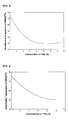
- FIG. 3 is a graph illustrating the history of shift of the solidification temperature of the NMMO solution versus the concentration of the cellulose pulp.
- FIG. 4 is a graph illustrating the history of shift of the solidification temperature of the NMMO solution versus the concentration of the polyvinylalcohol.
- Fig. 5 is a scheme of the manufacturing apparatus for making cellulose solution according to the present invention.
- Fig. 6 is a graph illustrating crystalline core forming time versus the surface temperature of the screw element of the manufacturing apparatus for making cellulose solution according to the present invention.
- FIG. 7 is a schematic diagram showing a spinning process for producing a high tenacity lyocell filament for tire cords according to the present invention.
- FIG. 8 is a graphic diagram showing an example of the strain-stress (S-S) curve of a lyocell monofilament produced according to the present invention.
- FIG. 9 is a graphic diagram showing the stress-strain (S-S) curve of the viscose rayon (Super-III) monofilament used as a comparative example in the present invention.
- pulp with high cellulose purity is used, and to produce a high-quality cellulose-based fiber, pulp with high ⁇ -cellulose content is used.
- cellulose molecules with the high degree of polymerization (DP) results in the high orientation and high crystallization of the filament, so that the high tenacity and high initial modulus of the filament can be expected.
- cellulose used in the present invention is characterized in that it is pulp having a degree of polymerization (DP w ) of 700-2,000 and a ⁇ -cellulose content of at least 90%.
- DP w degree of polymerization
- a homogeneous cellulose solution that is an element essential to produce the lyocell filament for tire cords and MRG with high tenacity and high modulus is preferably produced by the following method.
- a small amount of cellulose powders or polyvinylalcohol is dissolved in concentrated liquid NMMO such that NMMO can be fed into an extruder in a liquid state at relatively low temperature.
- a process temperature range can be widen and also cellulose powders can be smoothly swollen in NMMO solution at low temperature, so that a phenomenon where NMMO is previously dissolved on the outer surface of the cellulose powders to form a coating film making it difficult to penetrate NMMO into the cellulose powders (i.e., a phenomenon where a coating film is formed on the surface of the cellulose powders) can be prevented.
- a homogeneous cellulose solution can be produced even at low temperature finally.
- FIG. 1 and FIG. 2 are examples of this invention, and they are block diagrams illustrating an embodiment of the method of preparing cellulose solution which is homogeneous at relatively low temperature by dissolving a small amount of cellulose powder or polyvinylalcohol in NMMO solvent.
- FIG. 3 is a graph illustrating the history of shift of the solidification temperature of the NMMO solution versus the concentration of the cellulose pulp. In this figure, the solidification temperature of the NMMO is greatly lowered from 75°C to 30°C by dissolving a small amount of cellulose (about 0.1 to 6% by weight).
- FIG. 4 is a graph illustrating the history of shift of the solidification temperature of the NMMO solution versus the concentration of the polyvinylalcohol. In this figure, the solidification temperature of the NMMO is greatly lowered from 75°C to 50°C by dissolving a small amount of polyvinylalcohol(about 0.1 to 6% by weight).
- a highly concentrated liquid NMMO is cooled below its melting point in a separate screw system maintained at low temperature to produce a solid NMMO, and then the NMMO powders maintained at a solid phase are fed into an extruder in which they are uniformly dispersed and mixed with cellulose, compressed and sheared, so that a homogeneous cellulose solution, which was dissolved after sufficient swelling, can be produced.
- FIG. 5 schematically shows a process of producing cellulose solution, in which NMMO powders maintained at a solid phase are fed into an extruder.
- FIG. 6 relates to a NMMO hydrate-feeding device of a twin screw extruder type in a system for producing a cellulose solution according to the present invention, and shows the result of measurement of crystalline core forming time versus the surface temperature of a screw element when contacted with liquid NMMO hydrate with a 2-mm thickness.
- FIG. 6 provides the evaluation of the time required for the production of solid NMMO hydrate from the liquid NMMO hydrate. As shown in FIG. 6, it can be found that, when the temperature of NMMO is 90 °C and the temperature of the screw element surface is below 30 °C, the crystalline core is formed within 10 seconds.
- lyocell filaments can be obtained through a process shown in FIG. 7.
- Producing the lyocell filament through the process as shown in FIG. 7 is a characteristic of the present invention, and will now be described in detail.
- a solution extruded from a spinning nozzle 1 is passed through an air gap in a vertical direction, and solidified in a coagulation bath 2.
- the spinning process is performed adjusting an air gap to the range of about 10-300 mm.
- the filament passed through the coagulation bath 2 is passed through a water-washing tank 3.
- the coagulation bath 2 and water-washing tank 3 are maintained at a temperature of 5-30 °C, in order to prevent a deterioration of the physical properties of the filaments, which is caused by the formation of pores within fiber tissues, which results from rapid solvent removal.
- the fiber passed through the water-washing tank 3 is passed through a squeezing roller 4 to remove water, and then passed through a first oil-treating device 5.
- the filament yarn obtained as described above has high flatness by virtue of the effects of the squeezing roller 4 and the first oil-treating device 5, and contains both oil and water.
- the filament is passed through an interlacing nozzle 6.
- the interlacing nozzle is maintained at an air pressure of 0.5-4.0 kg/cm 2 , and the number of interlacing per meter of the filament is 2-40.
- the interlacing nozzle may also be used before winding.
- the filament yarn passed through the interlacing nozzle 6 is dried through a drying device 7.
- the drying temperature and manner in this step will have a great effect on a subsequent process for the filament and the physical properties of the filament.
- the drying temperature is controlled such that process water content can become about 8-12%.
- the filament passed through the drying device 7 is passed through a second oil-treating device 8 and wound up on a winder 9 finally.
- the filament which was passed through the spinning, coagulation, water-washing, oil-treating, drying and winding-up processes as described above, is provided as a filament yarn for industrial materials, such as tire cords, and for clothes.
- a sample is applied with a initial load of 200 mg using the monofilament tensile tester Vibrojet 2000 (Lenzing Co.). Then, the tenacity of the sample is measured at a test speed of 20 mm/min to the gauge length of 20 mm. Initial modulus indicates the slope of a graph before yield point.
- the shrinkage is obtained by the ratio of the length (L0) measured at 20g static load after being treated at 25°C, 65% RH for 24hours to the length(L1) measured at 20g static load after being treated at 150°C for 30minutes.
- S (%) (L 0 -L 1 ) /L 0 ⁇ 100
- the number of interlacing per unit length in the length direction of a yarn was measured by running a filament yarn through an interlace measurement machine and then placing a sharp pin on the middle of the running yarn.
- the number of interlacing per meter is indicated.
- Pulp with a degree of polymerization (DP w ) of 800-1,650 was pulverized into powders with a size of less than 500 ⁇ m. Then, the powders were forcibly fed into a twin-screw extruder by a side feeder for pulp supply.
- NMMO hydrate with a water content of 13.0 wt% was maintained at 90 °C and continuously fed into a side feeder for NMMO supply using a metering pump. At this time, a screw within the side feeder for NMMO supply was adjusted to 30 °C to solidify the NMMO which had been fed in a liquid state.
- the cellulose powders and the solid NMMO were introduced into the twin-screw extruder adjusted to a temperature of 50-110°C, they were subjected to mixing, shearing and dissolution steps to prepare homogeneous cellulose solution. Then, the cellulose solution was spun at 150 m/min.
- the number of orifices in a spinning nozzle was 1,000, and the orifice diameter was 120-200 ⁇ m.
- the solution spun from the spinning nozzle with an orifice length-to-diameter (L/D) ratio of 6 and an outer diameter of 100 mm ⁇ was passed through an air gap with an 80 mm length, and the final filament fineness was 1,500 deniers.
- Coagulation liquid was adjusted to a temperature of 20 °C and a concentration of 20% NMMO aqueous solution. The temperature and concentration of the coagulation liquid were continuously monitored with a refractometer. The filament released from the coagulation bath was subjected to a water-washing process to remove the remaining NMMO.
- the water-washed filament was passed through a first oil-treating device and then through an interlacing nozzle having an air pressure of 0.5-3.5 kg/cm 2 . Next, the filament was dried and wound up. The OPU(Oil-Pick Up) of the wound-up filament yarn was adjusted to 0.5%.
- Table 1 The spinning conditions and parameters in this Example are summarized in Table 1 below, and the physical properties of the produced monofilament yarn are given in Table 2 below.
- a cellulose solution was produced as described below and then spun through a nozzle in the same manner in Example 1.
- a cellulose sheet that the weight mean degree of polymerization is 1,200 were fed into a pulverizer to produce cellulose powder having a particle size of less than 500 micrometers, and then, the cellulose powder were dissolved in NMMO to produce a NMMO solution containing cellulose of 0.1 to 3.0% by weight.
- NMMO solution in which the cellulose had been dissolved at 0.1-3.0% by weight was fed into the feed portion of an extruder having an internal temperature of 65 °C using a metering pump.
- this Example is characterized by the method where the solution in which a small amount of cellulose had been dissolved in molten NMMO was introduced into the extruder.
- the concentration of cellulose dissolved in NMMO is termed "first cellulose concentration”.
- the cellulose powders were adjusted to a given concentration in view of total cellulose concentration and forcibly fed into the extruder by a screw-type feeder.
- the total concentration of cellulose, which is fed into the extruder was adjusted to 8-15% by weight.
- the concentration of cellulose fed into the extruder is termed "second cellulose concentration”.
- the first and second celluloses which had been fed into the extruder, were sufficiently swollen by kneading with the NMMO solution for a retention time of 0.1-3 minutes in the swelling section of the extruder. Then, they were dissolved in the dissolution section of the extruder while maintaining the temperature of each block at 70-110 °C and applying sufficient shear by rotation of the extruder screw. Then, the cellulose solution was passed through a brake plate, passed through a given filtering device, and spun through a nozzle at a speed of 150 m/min.
- Table 3 The spinning conditions and parameters in this Example are summarized in Table 3 below, and the physical properties of the produced monofilament yarn are given in Table 4 below.
- a cellulose solution was produced as described below and then spun through a nozzle in the same manner in Example 1.
- Polyvinylalcohol having a weight mean degree of polymerization of 1,700 and a saponification value of 99.5% were dissolved in NMMO to produce a NMMO solution containing polyvinylalcohol of 1% by weight.
- the NMMO solution containing polyvinylalcohol of 1% by weight was fed into a twin-screw type extruder having its inner temperature maintained at 78°C through a metering pump at a speed of 6,900g/hour.
- the cellulose sheet having a weight mean degree of polymerization of 1,200 was pulverized into cellulose powder having a particle size of less than 500 micrometer using a pulverizer, and then, the cellulose powder was fed into the twin-screw type extruder through a screw-type feeder at the speed of 853g/hour. Meanwhile, the liquid-state NMMO solution containing polyvinylalcohol of 1% by weight was fed into the extruder with it maintained at 74°C. And then, cellulose powder was fully swollen during the retention time of 0.1 to 3 minutes in the cellulose swelling zone of the extruder.
- the lyocell filament produced according to the present invention has an initial modulus of 265-325 g/d, and a high tenacity of at least 7.0 g/d.
- the present invention improves the problems of low tenacity and low initial modulus with the prior viscose rayon, and hence, provides the lyocell filament for tire cords or MRG having excellent dimentional stability and thermal resistance.
- FIG. 8 is a graphic diagram showing an Example of the strain-stress (S-S) curve of a lyocell monofilament produced according to the present invention.
- FIG. 9 is a graphic diagram showing the stress-strain (S-S) curve of the viscose rayon (Super-III) monofilament used as a comparative Example in the present invention.
- the lyocell monofilament produced according to the present invention has a stress-strain curve wherein (1) the lyocell monofilament analyzed after drying is elongated by less than 3% and has an initial modulus of 150-400 g/d, when it was subjected to an initial stress of 3.0 g/d; (2) it is elongated by 3.0-7.0% when it was subjected to a stress greater than the initial stress but smaller than 6.0 g/d; and (3) it is elongated from a tensile tenacity of at least 6.0 g/d until the yarn is broken.
- the present invention has the effect of improving the problems of low tenacity and low initial modulus with the prior viscose rayon, to provide a lyocell tire cord or lyocell filaments having excellent dimensional stability and thermal stability.
Landscapes
- Engineering & Computer Science (AREA)
- Textile Engineering (AREA)
- Chemical & Material Sciences (AREA)
- Chemical Kinetics & Catalysis (AREA)
- General Chemical & Material Sciences (AREA)
- Mechanical Engineering (AREA)
- Artificial Filaments (AREA)
- Tires In General (AREA)
- Yarns And Mechanical Finishing Of Yarns Or Ropes (AREA)
- Medicines Containing Plant Substances (AREA)
- Medicines Containing Material From Animals Or Micro-Organisms (AREA)
Applications Claiming Priority (2)
| Application Number | Priority Date | Filing Date | Title |
|---|---|---|---|
| KR10-2003-0051416A KR100488604B1 (ko) | 2003-07-25 | 2003-07-25 | 라이오셀 멀티 필라멘트 |
| KR2003051416 | 2003-07-25 |
Publications (2)
| Publication Number | Publication Date |
|---|---|
| EP1500724A1 true EP1500724A1 (de) | 2005-01-26 |
| EP1500724B1 EP1500724B1 (de) | 2009-09-02 |
Family
ID=33487942
Family Applications (1)
| Application Number | Title | Priority Date | Filing Date |
|---|---|---|---|
| EP04015336A Expired - Lifetime EP1500724B1 (de) | 2003-07-25 | 2004-06-30 | Lyocellmultifilamente |
Country Status (7)
| Country | Link |
|---|---|
| US (1) | US6902804B2 (de) |
| EP (1) | EP1500724B1 (de) |
| JP (1) | JP4326401B2 (de) |
| KR (1) | KR100488604B1 (de) |
| CN (1) | CN1280460C (de) |
| AT (1) | ATE441744T1 (de) |
| DE (1) | DE602004022897D1 (de) |
Cited By (5)
| Publication number | Priority date | Publication date | Assignee | Title |
|---|---|---|---|---|
| WO2006071101A1 (en) | 2004-12-30 | 2006-07-06 | Hyosung Coproration | Method for producing cellulose fiber |
| EP1849895A1 (de) * | 2006-04-27 | 2007-10-31 | Hyosung Corporation | Roher Reifenkord aus Zellulose für Kautschuk Verstärkung |
| EP1849896A1 (de) * | 2006-04-27 | 2007-10-31 | Hyosung Corporation | Getauchte Reifenkord aus Lyocell für Kautschuk Verstärkung |
| EP2185754A4 (de) * | 2007-09-07 | 2010-12-01 | Kolon Inc | Lyocell-fadenfaser und reifencord auf cellulosebasis |
| CN109195812A (zh) * | 2016-06-09 | 2019-01-11 | 大陆轮胎德国有限公司 | 用于由弹性体材料制成的制品、优选用于充气车辆轮胎的加强层以及充气车辆轮胎 |
Families Citing this family (34)
| Publication number | Priority date | Publication date | Assignee | Title |
|---|---|---|---|---|
| AU2003273105A1 (en) * | 2003-06-30 | 2005-01-13 | Hyosung Corporation | A jomogeneous cellulose solution and high tenacity lyocell multifilament using the same |
| US7214727B2 (en) * | 2003-06-30 | 2007-05-08 | Hyosung Corporation | Solution containing cellulose dissolved in N-methylmorpholine-N-oxide and high tenacity lyocell multifilament using the same |
| KR100966111B1 (ko) * | 2005-03-15 | 2010-06-28 | 주식회사 효성 | 셀룰로오스 멀티 필라멘트의 제조방법 |
| JP2007196898A (ja) * | 2006-01-27 | 2007-08-09 | Yokohama Rubber Co Ltd:The | 空気入りラジアルタイヤ |
| KR100995932B1 (ko) * | 2006-05-25 | 2010-11-22 | 코오롱인더스트리 주식회사 | 타이어 코오드용 필라멘트, 이를 포함하는 필라멘트 번들,이를 포함하는 연사물, 및 이를 포함하는 타이어 코오드 |
| KR100865135B1 (ko) | 2007-04-11 | 2008-10-24 | 주식회사 효성 | 의류용 라이오셀 필라멘트의 제조방법 |
| EP1990362A1 (de) * | 2007-05-09 | 2008-11-12 | Borealis Technology Oy | Polyolefinzusammensetzungen mit hochkristallinen regenerierten Zellulosefasern |
| KR100989148B1 (ko) * | 2007-05-23 | 2010-10-20 | 코오롱인더스트리 주식회사 | 타이어 코오드용 셀룰로오스계 필라멘트, 이를 포함하는필라멘트 번들, 이를 포함하는 연사물, 및 이를 포함하는타이어 코오드 |
| KR101205940B1 (ko) * | 2007-06-11 | 2012-11-28 | 코오롱인더스트리 주식회사 | 라이오셀 번들 및 이를 포함하는 타이어 코드 |
| KR101106734B1 (ko) * | 2007-09-07 | 2012-01-18 | 코오롱인더스트리 주식회사 | 셀룰로오스계 타이어 코오드 |
| KR101267948B1 (ko) | 2007-09-07 | 2013-05-23 | 코오롱인더스트리 주식회사 | 셀룰로오스계 타이어 코오드 |
| KR101271583B1 (ko) * | 2007-09-07 | 2013-06-11 | 코오롱인더스트리 주식회사 | 셀룰로오스계 타이어 코오드 |
| KR101271581B1 (ko) * | 2008-03-25 | 2013-06-11 | 코오롱인더스트리 주식회사 | 라이오셀 필라멘트 섬유용 방사구금 및 이를 이용한라이오셀 필라멘트 섬유의 제조방법 |
| US9845575B2 (en) | 2009-05-14 | 2017-12-19 | International Paper Company | Fibrillated blend of lyocell low DP pulp |
| CN101694019B (zh) * | 2009-09-30 | 2011-08-10 | 上海里奥纤维企业发展有限公司 | 溶剂法高湿模量竹纤维及其制备方法 |
| KR101627768B1 (ko) * | 2009-12-23 | 2016-06-08 | 코오롱인더스트리 주식회사 | 라이오셀 필라멘트 섬유의 제조방법, 라이오셀 필라멘트 섬유, 및 타이어 코오드 |
| TWI392781B (zh) * | 2009-12-31 | 2013-04-11 | Preparation of Natural Cellulose Nonwoven by Wet Spunbond Method | |
| TWI392779B (zh) * | 2009-12-31 | 2013-04-11 | A method for preparing natural cellulose nonwoven fabric by wet meltblowing | |
| CN102127840B (zh) * | 2010-01-13 | 2014-07-16 | 聚隆纤维股份有限公司 | 使用湿式纺黏方式制备天然纤维素不织布的方法 |
| EP2589689B1 (de) * | 2010-06-30 | 2018-02-28 | Kolon Industries, Inc. | Spinnlösung zum spinnen einer lyozelle, verfahren zur herstellung einer lyozellenfilamentfaser und verfahren zur herstellung einer lyozellenstapelfaser damit |
| KR101455002B1 (ko) | 2013-06-28 | 2014-11-03 | 코오롱인더스트리 주식회사 | 담배필터용 라이오셀 소재 및 그 제조방법 |
| CN105658852B (zh) * | 2013-09-26 | 2017-12-22 | 可隆工业株式会社 | 香烟过滤嘴用莱赛尔材料及其制备方法 |
| KR102205529B1 (ko) * | 2014-03-31 | 2021-01-20 | 코오롱인더스트리 주식회사 | 라이오셀 섬유 |
| KR102211219B1 (ko) * | 2014-06-30 | 2021-02-03 | 코오롱인더스트리 주식회사 | 담배필터용 이형단면 라이오셀 소재 및 그 제조방법 |
| KR102157887B1 (ko) * | 2014-09-30 | 2020-09-18 | 코오롱인더스트리 주식회사 | 라이오셀 크림프 섬유 |
| KR102211186B1 (ko) | 2014-12-31 | 2021-02-03 | 코오롱인더스트리 주식회사 | 담배필터용 라이오셀 소재 및 그 제조방법 |
| CN106192188B (zh) * | 2016-07-05 | 2017-10-20 | 福建省晋江市华宇织造有限公司 | 一种四维网布及其加工方法 |
| MX2020003621A (es) * | 2017-10-06 | 2020-10-28 | Chemiefaser Lenzing Ag | Filamento de lyocell retardante de llama. |
| EP3674454A1 (de) * | 2018-12-28 | 2020-07-01 | Lenzing Aktiengesellschaft | Cellulosefilamentverfahren |
| JP7310192B2 (ja) * | 2019-03-20 | 2023-07-19 | 三菱ケミカル株式会社 | セルロース系マルチフィラメント |
| KR102440861B1 (ko) * | 2020-05-26 | 2022-09-05 | 오영세 | 라이오셀 섬유의 제조방법 및 이로부터 제조된 라이오셀 섬유 |
| CN112481723A (zh) * | 2020-10-22 | 2021-03-12 | 上海里奥纤维企业发展有限公司 | 一种溶剂法高湿模量细旦竹纤维及其制备方法 |
| EP4650499A1 (de) | 2024-05-17 | 2025-11-19 | Aurotec GmbH | Aufwickelvorrichtung und aufwickelverfahren |
| CN119980542B (zh) * | 2025-04-17 | 2025-10-10 | 河南东之美家居用品有限公司 | 一种可降解材料的清洁巾布及其制备方法 |
Citations (3)
| Publication number | Priority date | Publication date | Assignee | Title |
|---|---|---|---|---|
| US5942327A (en) * | 1994-12-12 | 1999-08-24 | Akzo Nobel Nv | Solvent-spun cellulose filaments |
| GB2374326A (en) * | 2001-04-11 | 2002-10-16 | Hyosung Corp | Lyocell carcass cord for a radial tyre |
| GB2389111A (en) * | 2002-05-31 | 2003-12-03 | Hyosung Corp | Process for producing cellulose solution comprising polyvinyl alcohol |
Family Cites Families (20)
| Publication number | Priority date | Publication date | Assignee | Title |
|---|---|---|---|---|
| US4142913A (en) * | 1977-07-26 | 1979-03-06 | Akzona Incorporated | Process for making a precursor of a solution of cellulose |
| US4144080A (en) * | 1977-07-26 | 1979-03-13 | Akzona Incorporated | Process for making amine oxide solution of cellulose |
| JPS62156312A (ja) * | 1985-12-26 | 1987-07-11 | Teijin Ltd | ポリエステル系繊維 |
| US5094690A (en) * | 1988-08-16 | 1992-03-10 | Lenzing Aktiengesellschaft | Process and arrangement for preparing a solution of cellulose |
| GB9219693D0 (en) * | 1992-09-17 | 1992-10-28 | Courtaulds Plc | Forming solutions |
| US5456748A (en) * | 1993-05-24 | 1995-10-10 | Courtaulds Fibres (Holdings) Ltd. | Premix storage hopper |
| US5370322A (en) * | 1993-05-24 | 1994-12-06 | Courtaulds Fibres (Holdings) Limited | Filtering particulate cellulosic-based material |
| KR970011096B1 (ko) * | 1993-09-09 | 1997-07-07 | 한국과학기술연구원 | 셀룰로오스와 3급 아민옥사이드의 펠렛상 혼합 분말과 셀룰로오스 방사 용액 및 그의 제조 방법 |
| GB9500388D0 (en) * | 1995-01-10 | 1995-03-01 | Courtaulds Fibres Ltd | Forming solutions |
| US5948905A (en) * | 1995-03-31 | 1999-09-07 | Akzo Nobel Nv | Method of producing in water-containing celluose solutions in water-containing tertiary amine N-oxides |
| US5856004A (en) * | 1995-03-31 | 1999-01-05 | Akzo Nobel Nv | Cellulose yarn and cord for industrial application |
| AT402411B (de) * | 1995-04-19 | 1997-05-26 | Chemiefaser Lenzing Ag | Anlage sowie integriertes folien- und faserwerk zur herstellung cellulosischer folien und fasern |
| AT409130B (de) * | 1995-04-25 | 2002-05-27 | Chemiefaser Lenzing Ag | Verwendung einer vorrichtung zum halten und abgeben einer homogenen cellulosesuspension |
| EP0906455B1 (de) | 1996-06-10 | 2003-02-26 | Korea Institute of Science and Technology | Verfahren zur herstellung einer homogenen celluloselösung in n-methylmorpholin-n-oxid |
| JPH108337A (ja) * | 1996-06-25 | 1998-01-13 | Asahi Chem Ind Co Ltd | エアージェットルーム緯糸用マルチフィラメント糸条 |
| CA2268792C (fr) * | 1996-10-18 | 2006-07-11 | Michelin Recherche Et Technique S.A. | Agent coagulant aqueux pour solutions cristal-liquide a base de matieres cellulosiques |
| JP2001301028A (ja) * | 2000-04-26 | 2001-10-30 | Toyobo Co Ltd | セルロースフィルムの製造方法及びフラットヤーン |
| JP2001316936A (ja) * | 2000-05-10 | 2001-11-16 | Toyobo Co Ltd | 溶剤紡糸セルロース繊維の製造方法 |
| JP2001316934A (ja) * | 2000-05-12 | 2001-11-16 | Toyobo Co Ltd | 溶剤紡糸セルロース繊維の製造方法 |
| JP4538967B2 (ja) * | 2000-08-17 | 2010-09-08 | 東レ株式会社 | エアバッグ用布帛 |
-
2003
- 2003-07-25 KR KR10-2003-0051416A patent/KR100488604B1/ko not_active Expired - Lifetime
-
2004
- 2004-06-03 JP JP2004165226A patent/JP4326401B2/ja not_active Expired - Lifetime
- 2004-06-24 US US10/874,222 patent/US6902804B2/en not_active Expired - Lifetime
- 2004-06-25 CN CNB2004100618744A patent/CN1280460C/zh not_active Expired - Fee Related
- 2004-06-30 DE DE602004022897T patent/DE602004022897D1/de not_active Expired - Lifetime
- 2004-06-30 AT AT04015336T patent/ATE441744T1/de not_active IP Right Cessation
- 2004-06-30 EP EP04015336A patent/EP1500724B1/de not_active Expired - Lifetime
Patent Citations (3)
| Publication number | Priority date | Publication date | Assignee | Title |
|---|---|---|---|---|
| US5942327A (en) * | 1994-12-12 | 1999-08-24 | Akzo Nobel Nv | Solvent-spun cellulose filaments |
| GB2374326A (en) * | 2001-04-11 | 2002-10-16 | Hyosung Corp | Lyocell carcass cord for a radial tyre |
| GB2389111A (en) * | 2002-05-31 | 2003-12-03 | Hyosung Corp | Process for producing cellulose solution comprising polyvinyl alcohol |
Cited By (6)
| Publication number | Priority date | Publication date | Assignee | Title |
|---|---|---|---|---|
| WO2006071101A1 (en) | 2004-12-30 | 2006-07-06 | Hyosung Coproration | Method for producing cellulose fiber |
| EP1841905A4 (de) * | 2004-12-30 | 2009-08-19 | Hyosung Corp | Verfahren zur herstellung von cellulosefaser |
| EP1849895A1 (de) * | 2006-04-27 | 2007-10-31 | Hyosung Corporation | Roher Reifenkord aus Zellulose für Kautschuk Verstärkung |
| EP1849896A1 (de) * | 2006-04-27 | 2007-10-31 | Hyosung Corporation | Getauchte Reifenkord aus Lyocell für Kautschuk Verstärkung |
| EP2185754A4 (de) * | 2007-09-07 | 2010-12-01 | Kolon Inc | Lyocell-fadenfaser und reifencord auf cellulosebasis |
| CN109195812A (zh) * | 2016-06-09 | 2019-01-11 | 大陆轮胎德国有限公司 | 用于由弹性体材料制成的制品、优选用于充气车辆轮胎的加强层以及充气车辆轮胎 |
Also Published As
| Publication number | Publication date |
|---|---|
| US20050019564A1 (en) | 2005-01-27 |
| CN1576403A (zh) | 2005-02-09 |
| JP4326401B2 (ja) | 2009-09-09 |
| ATE441744T1 (de) | 2009-09-15 |
| CN1280460C (zh) | 2006-10-18 |
| EP1500724B1 (de) | 2009-09-02 |
| KR20050012446A (ko) | 2005-02-02 |
| DE602004022897D1 (de) | 2009-10-15 |
| KR100488604B1 (ko) | 2005-05-11 |
| US6902804B2 (en) | 2005-06-07 |
| JP2005042286A (ja) | 2005-02-17 |
Similar Documents
| Publication | Publication Date | Title |
|---|---|---|
| US6902804B2 (en) | Lyocell multifilament | |
| EP1433881B1 (de) | Multifilamentgarn aus Zellulose für Reifencorde und Herstellungsverfahren | |
| EP1493752B1 (de) | Homogene Celluloselösung und daraus hergestellte Lyocellmultifilamente mit hoher Festigkeit | |
| KR100575378B1 (ko) | 셀룰로오스 섬유의 제조방법 | |
| EP1493850B1 (de) | Imprägnierter Cord hergestellt aus hochhomogenen Zelluloselösungen und damit hergestellte Luftreifen | |
| US7713459B2 (en) | Cellulose fiber for using as industrial materials | |
| KR100486812B1 (ko) | 타이어 코드용 라이오셀 멀티 필라멘트 및 이의 제조방법 | |
| EP1849896A1 (de) | Getauchte Reifenkord aus Lyocell für Kautschuk Verstärkung | |
| EP2185753B1 (de) | Faser auf zellulosebasis und reifencord damit | |
| EP1859082B1 (de) | Cellulosemultifilament | |
| CA2511030C (en) | Lyocell multi-filament for tire cord and method of producing the same |
Legal Events
| Date | Code | Title | Description |
|---|---|---|---|
| PUAI | Public reference made under article 153(3) epc to a published international application that has entered the european phase |
Free format text: ORIGINAL CODE: 0009012 |
|
| AK | Designated contracting states |
Kind code of ref document: A1 Designated state(s): AT BE BG CH CY CZ DE DK EE ES FI FR GB GR HU IE IT LI LU MC NL PL PT RO SE SI SK TR |
|
| AX | Request for extension of the european patent |
Extension state: AL HR LT LV MK |
|
| 17P | Request for examination filed |
Effective date: 20050304 |
|
| AKX | Designation fees paid |
Designated state(s): AT BE BG CH CY CZ DE DK EE ES FI FR GB GR HU IE IT LI LU MC NL PL PT RO SE SI SK TR |
|
| GRAP | Despatch of communication of intention to grant a patent |
Free format text: ORIGINAL CODE: EPIDOSNIGR1 |
|
| GRAS | Grant fee paid |
Free format text: ORIGINAL CODE: EPIDOSNIGR3 |
|
| GRAA | (expected) grant |
Free format text: ORIGINAL CODE: 0009210 |
|
| AK | Designated contracting states |
Kind code of ref document: B1 Designated state(s): AT BE BG CH CY CZ DE DK EE ES FI FR GB GR HU IE IT LI LU MC NL PL PT RO SE SI SK TR |
|
| REG | Reference to a national code |
Ref country code: CH Ref legal event code: EP |
|
| REG | Reference to a national code |
Ref country code: IE Ref legal event code: FG4D |
|
| REF | Corresponds to: |
Ref document number: 602004022897 Country of ref document: DE Date of ref document: 20091015 Kind code of ref document: P |
|
| PG25 | Lapsed in a contracting state [announced via postgrant information from national office to epo] |
Ref country code: SE Free format text: LAPSE BECAUSE OF FAILURE TO SUBMIT A TRANSLATION OF THE DESCRIPTION OR TO PAY THE FEE WITHIN THE PRESCRIBED TIME-LIMIT Effective date: 20090902 Ref country code: FI Free format text: LAPSE BECAUSE OF FAILURE TO SUBMIT A TRANSLATION OF THE DESCRIPTION OR TO PAY THE FEE WITHIN THE PRESCRIBED TIME-LIMIT Effective date: 20090902 |
|
| NLV1 | Nl: lapsed or annulled due to failure to fulfill the requirements of art. 29p and 29m of the patents act | ||
| PG25 | Lapsed in a contracting state [announced via postgrant information from national office to epo] |
Ref country code: NL Free format text: LAPSE BECAUSE OF FAILURE TO SUBMIT A TRANSLATION OF THE DESCRIPTION OR TO PAY THE FEE WITHIN THE PRESCRIBED TIME-LIMIT Effective date: 20090902 Ref country code: PL Free format text: LAPSE BECAUSE OF FAILURE TO SUBMIT A TRANSLATION OF THE DESCRIPTION OR TO PAY THE FEE WITHIN THE PRESCRIBED TIME-LIMIT Effective date: 20090902 Ref country code: SI Free format text: LAPSE BECAUSE OF FAILURE TO SUBMIT A TRANSLATION OF THE DESCRIPTION OR TO PAY THE FEE WITHIN THE PRESCRIBED TIME-LIMIT Effective date: 20090902 |
|
| PG25 | Lapsed in a contracting state [announced via postgrant information from national office to epo] |
Ref country code: CY Free format text: LAPSE BECAUSE OF FAILURE TO SUBMIT A TRANSLATION OF THE DESCRIPTION OR TO PAY THE FEE WITHIN THE PRESCRIBED TIME-LIMIT Effective date: 20090902 |
|
| PG25 | Lapsed in a contracting state [announced via postgrant information from national office to epo] |
Ref country code: RO Free format text: LAPSE BECAUSE OF FAILURE TO SUBMIT A TRANSLATION OF THE DESCRIPTION OR TO PAY THE FEE WITHIN THE PRESCRIBED TIME-LIMIT Effective date: 20090902 Ref country code: CZ Free format text: LAPSE BECAUSE OF FAILURE TO SUBMIT A TRANSLATION OF THE DESCRIPTION OR TO PAY THE FEE WITHIN THE PRESCRIBED TIME-LIMIT Effective date: 20090902 Ref country code: PT Free format text: LAPSE BECAUSE OF FAILURE TO SUBMIT A TRANSLATION OF THE DESCRIPTION OR TO PAY THE FEE WITHIN THE PRESCRIBED TIME-LIMIT Effective date: 20100104 Ref country code: ES Free format text: LAPSE BECAUSE OF FAILURE TO SUBMIT A TRANSLATION OF THE DESCRIPTION OR TO PAY THE FEE WITHIN THE PRESCRIBED TIME-LIMIT Effective date: 20091213 Ref country code: EE Free format text: LAPSE BECAUSE OF FAILURE TO SUBMIT A TRANSLATION OF THE DESCRIPTION OR TO PAY THE FEE WITHIN THE PRESCRIBED TIME-LIMIT Effective date: 20090902 |
|
| PG25 | Lapsed in a contracting state [announced via postgrant information from national office to epo] |
Ref country code: SK Free format text: LAPSE BECAUSE OF FAILURE TO SUBMIT A TRANSLATION OF THE DESCRIPTION OR TO PAY THE FEE WITHIN THE PRESCRIBED TIME-LIMIT Effective date: 20090902 |
|
| PG25 | Lapsed in a contracting state [announced via postgrant information from national office to epo] |
Ref country code: BE Free format text: LAPSE BECAUSE OF FAILURE TO SUBMIT A TRANSLATION OF THE DESCRIPTION OR TO PAY THE FEE WITHIN THE PRESCRIBED TIME-LIMIT Effective date: 20090902 Ref country code: AT Free format text: LAPSE BECAUSE OF FAILURE TO SUBMIT A TRANSLATION OF THE DESCRIPTION OR TO PAY THE FEE WITHIN THE PRESCRIBED TIME-LIMIT Effective date: 20090902 |
|
| PLBE | No opposition filed within time limit |
Free format text: ORIGINAL CODE: 0009261 |
|
| STAA | Information on the status of an ep patent application or granted ep patent |
Free format text: STATUS: NO OPPOSITION FILED WITHIN TIME LIMIT |
|
| PG25 | Lapsed in a contracting state [announced via postgrant information from national office to epo] |
Ref country code: DK Free format text: LAPSE BECAUSE OF FAILURE TO SUBMIT A TRANSLATION OF THE DESCRIPTION OR TO PAY THE FEE WITHIN THE PRESCRIBED TIME-LIMIT Effective date: 20090902 |
|
| 26N | No opposition filed |
Effective date: 20100603 |
|
| PG25 | Lapsed in a contracting state [announced via postgrant information from national office to epo] |
Ref country code: GR Free format text: LAPSE BECAUSE OF FAILURE TO SUBMIT A TRANSLATION OF THE DESCRIPTION OR TO PAY THE FEE WITHIN THE PRESCRIBED TIME-LIMIT Effective date: 20091203 |
|
| PG25 | Lapsed in a contracting state [announced via postgrant information from national office to epo] |
Ref country code: MC Free format text: LAPSE BECAUSE OF NON-PAYMENT OF DUE FEES Effective date: 20100630 |
|
| REG | Reference to a national code |
Ref country code: CH Ref legal event code: PL |
|
| PG25 | Lapsed in a contracting state [announced via postgrant information from national office to epo] |
Ref country code: CH Free format text: LAPSE BECAUSE OF NON-PAYMENT OF DUE FEES Effective date: 20100630 Ref country code: IE Free format text: LAPSE BECAUSE OF NON-PAYMENT OF DUE FEES Effective date: 20100630 Ref country code: LI Free format text: LAPSE BECAUSE OF NON-PAYMENT OF DUE FEES Effective date: 20100630 |
|
| PG25 | Lapsed in a contracting state [announced via postgrant information from national office to epo] |
Ref country code: HU Free format text: LAPSE BECAUSE OF FAILURE TO SUBMIT A TRANSLATION OF THE DESCRIPTION OR TO PAY THE FEE WITHIN THE PRESCRIBED TIME-LIMIT Effective date: 20100303 Ref country code: BG Free format text: LAPSE BECAUSE OF FAILURE TO SUBMIT A TRANSLATION OF THE DESCRIPTION OR TO PAY THE FEE WITHIN THE PRESCRIBED TIME-LIMIT Effective date: 20090902 |
|
| PG25 | Lapsed in a contracting state [announced via postgrant information from national office to epo] |
Ref country code: TR Free format text: LAPSE BECAUSE OF FAILURE TO SUBMIT A TRANSLATION OF THE DESCRIPTION OR TO PAY THE FEE WITHIN THE PRESCRIBED TIME-LIMIT Effective date: 20090902 |
|
| REG | Reference to a national code |
Ref country code: FR Ref legal event code: PLFP Year of fee payment: 13 |
|
| REG | Reference to a national code |
Ref country code: FR Ref legal event code: PLFP Year of fee payment: 14 |
|
| REG | Reference to a national code |
Ref country code: FR Ref legal event code: PLFP Year of fee payment: 15 |
|
| REG | Reference to a national code |
Ref country code: DE Ref legal event code: R082 Ref document number: 602004022897 Country of ref document: DE Ref country code: DE Ref legal event code: R082 Ref document number: 602004022897 Country of ref document: DE Representative=s name: KUHNEN & WACKER PATENT- UND RECHTSANWALTSBUERO, DE Ref country code: DE Ref legal event code: R081 Ref document number: 602004022897 Country of ref document: DE Owner name: HYOSUNG ADVANCED MATERIALS CORP., KR Free format text: FORMER OWNER: HYOSUNG CORP., KYONGGI, KR |
|
| REG | Reference to a national code |
Ref country code: LU Ref legal event code: PD Owner name: HYOSUNG ADVANCED MATERIALS CORPORATION; KR Free format text: FORMER OWNER: HYOSUNG CORPORATION Effective date: 20181009 |
|
| REG | Reference to a national code |
Ref country code: GB Ref legal event code: 732E Free format text: REGISTERED BETWEEN 20181115 AND 20181130 |
|
| REG | Reference to a national code |
Ref country code: DE Ref legal event code: R082 Ref document number: 602004022897 Country of ref document: DE |
|
| PGFP | Annual fee paid to national office [announced via postgrant information from national office to epo] |
Ref country code: LU Payment date: 20200305 Year of fee payment: 17 |
|
| PGFP | Annual fee paid to national office [announced via postgrant information from national office to epo] |
Ref country code: GB Payment date: 20200408 Year of fee payment: 17 |
|
| GBPC | Gb: european patent ceased through non-payment of renewal fee |
Effective date: 20210630 |
|
| PG25 | Lapsed in a contracting state [announced via postgrant information from national office to epo] |
Ref country code: LU Free format text: LAPSE BECAUSE OF NON-PAYMENT OF DUE FEES Effective date: 20210630 |
|
| PG25 | Lapsed in a contracting state [announced via postgrant information from national office to epo] |
Ref country code: GB Free format text: LAPSE BECAUSE OF NON-PAYMENT OF DUE FEES Effective date: 20210630 |
|
| PGFP | Annual fee paid to national office [announced via postgrant information from national office to epo] |
Ref country code: FR Payment date: 20230306 Year of fee payment: 20 |
|
| PGFP | Annual fee paid to national office [announced via postgrant information from national office to epo] |
Ref country code: IT Payment date: 20230309 Year of fee payment: 20 |
|
| PGFP | Annual fee paid to national office [announced via postgrant information from national office to epo] |
Ref country code: DE Payment date: 20230306 Year of fee payment: 20 |