EP1501042B1 - Kartenverarbeitungseinheit - Google Patents
Kartenverarbeitungseinheit Download PDFInfo
- Publication number
- EP1501042B1 EP1501042B1 EP04016176A EP04016176A EP1501042B1 EP 1501042 B1 EP1501042 B1 EP 1501042B1 EP 04016176 A EP04016176 A EP 04016176A EP 04016176 A EP04016176 A EP 04016176A EP 1501042 B1 EP1501042 B1 EP 1501042B1
- Authority
- EP
- European Patent Office
- Prior art keywords
- card
- joint
- fulcrum
- passage
- pawl
- Prior art date
- Legal status (The legal status is an assumption and is not a legal conclusion. Google has not performed a legal analysis and makes no representation as to the accuracy of the status listed.)
- Expired - Lifetime
Links
Images




Classifications
-
- G—PHYSICS
- G06—COMPUTING OR CALCULATING; COUNTING
- G06K—GRAPHICAL DATA READING; PRESENTATION OF DATA; RECORD CARRIERS; HANDLING RECORD CARRIERS
- G06K13/00—Conveying record carriers from one station to another, e.g. from stack to punching mechanism
- G06K13/02—Conveying record carriers from one station to another, e.g. from stack to punching mechanism the record carrier having longitudinal dimension comparable with transverse dimension, e.g. punched card
- G06K13/08—Feeding or discharging cards
- G06K13/0868—Feeding or discharging cards using an arrangement for keeping the feeding or insertion slot of the card station clean of dirt, or to avoid feeding of foreign or unwanted objects into the slot
- G06K13/0875—Feeding or discharging cards using an arrangement for keeping the feeding or insertion slot of the card station clean of dirt, or to avoid feeding of foreign or unwanted objects into the slot the arrangement comprising a shutter for blocking at least part of the card insertion slot
-
- G—PHYSICS
- G06—COMPUTING OR CALCULATING; COUNTING
- G06K—GRAPHICAL DATA READING; PRESENTATION OF DATA; RECORD CARRIERS; HANDLING RECORD CARRIERS
- G06K13/00—Conveying record carriers from one station to another, e.g. from stack to punching mechanism
- G06K13/02—Conveying record carriers from one station to another, e.g. from stack to punching mechanism the record carrier having longitudinal dimension comparable with transverse dimension, e.g. punched card
- G06K13/08—Feeding or discharging cards
- G06K13/085—Feeding or discharging cards using an arrangement for locking the inserted card
-
- G—PHYSICS
- G06—COMPUTING OR CALCULATING; COUNTING
- G06K—GRAPHICAL DATA READING; PRESENTATION OF DATA; RECORD CARRIERS; HANDLING RECORD CARRIERS
- G06K13/00—Conveying record carriers from one station to another, e.g. from stack to punching mechanism
- G06K13/02—Conveying record carriers from one station to another, e.g. from stack to punching mechanism the record carrier having longitudinal dimension comparable with transverse dimension, e.g. punched card
- G06K13/08—Feeding or discharging cards
Definitions
- the present invention relates to a card processing unit such as a card reader writer used in an information processing equipment, and more particular, to a mechanism that locks a card in a manner to prevent pulling-out of the card while the card is subjected to data processing and releases locking when the processing is finished
- a card reader writer used in an information processing equipment such as automatic cash transaction apparatuses and electronic money transaction processing apparatuses performs reading or writing of data on a card when a card, such as an IC card or a magnetic card, that stores predetermined data is inserted by a user.
- a card such as an IC card or a magnetic card
- the card reader writer is provided with a mechanism that performs locking to block the passage of a card to prevent pulling-out of the card when the card is fully inserted inside and clears the passageway of the card and releases locking when the processing of the card is finished.
- Patent Documents 1 and 2 describe card reader writers provided with a lock mechanism that meets this need.
- Such lock mechanism is constructed so that when the card is locked, the central position of the crank pin becomes lower in level than a center of the motor shaft, if the card is pulled this pulling force is transmitted to the lock lever from the trailing end of the card, and the lock lever in turn applies force to rotate the crank in a clockwise direction so that the locked state is still more difficult to release.
- the push rod When the locking is released, the push rod is moved in the direction of card pulling-out by a spring, and together with that movement, the card lock hook is turned rearward to release locking of the card.
- the push rod since the push rod is locked by the lock lever, the push rod is not moved in the direction of card pulling-out if the user tries to pull the locked card out, and the card lock hook is not turned rearward, so that locking of the card is not released.
- a user of an information processing equipment continues in some cases to pull a card put in a locked state during the data processing since the user wants to pull out the card from a card reader writer immediately after the termination of data processing in the case where the user is in a rush to do data processing on the card.
- the card continues to be pulled in this manner, however, it is very difficult with a conventional card reader writer to release locking of a card after the termination of data processing even when release of locking is attempted.
- the invention solves the problems described above, and has its object to provide a card processing unit, in which locking is not released even when a card is pulled during data processing and locking can be easily released while the card is pulled after the data processing is finished.
- a card processing unit comprises a first beam that turns about a first fulcrumto thereby cause a pawl to spring into a passage of a card to block the passage, and that causes the pawl to retreat from the passage of a card to clear the passage, a second beam that turns about a second fulcrum, a third beam that connects rotatably to the first beam at a first joint other than the first fulcrum and connects rotatably to the second beam at a second joint other than the second fulcrum, a stopper adapted to restrict movements of the third beam, and an actuator that turns the second beam, and wherein when the pawl blocks the passage of a card, the first joint, the second joint, and the second fulcrum are aligned substantially on a straight line.
- the actuator turns the second beam about the second fulcrum in its predetermined direction after a card is fully inserted in the card processing unit
- the third beam connected to the second beam at the second joint is moved, and the third beam turns the first beam, which is connected to the third beam at the first joint, about the first fulcrum in its predetermined direction.
- the pawl provided on the first beam springs into the passage of a card to block the passage.
- a state thus results in which a card is locked so that it cannot be pulled out from within the unit.
- the first joint, the second joint, and the second fulcrum are aligned substantially on a straight line.
- the actuator turns the second beam about the second fulcrum in a direction opposed to the above predetermined direction after the data processing on a card which was inserted is finished
- the third beam is moved, and the third beam turns the first beam about the first fulcrum in a direction opposed to the predetermined direction.
- the pawl provided on the first beam retreats from the passage of a card to clear the passage. That is, a state results in which locking of a card is released, so that it becomes possible to pull out the card from within the unit.
- the first joint, the second joint, and the second fulcrum are aligned substantially on a straight line as described above, however, the above-mentioned force is cancelled by a reaction force from the second fulcrum that is a fixed point, and therefore the third beam will not be moved. Therefore, the first beam is not turned about the first fulcrum and the pawl that blocks the passage of a card will not be cleared from the passage. That is, locking will not be released even when a card is pulled while the data processing is performed on the card.
- the actuator turns the second beam in a direction opposed to the above predetermined direction, and thus an angular moment about the second fulcrum acts on the second beam.
- the angular moment turns the second beam, and a force in a direction perpendicular to a straight line that connects the first joint, the second joint, and the second fulcrum acts on the second joint, so that the third beam is moved.
- the third beam is moved and the first joint, the second joint, and the second fulcrum that have been aligned cease to form a straight line, and the second beam is easily turned and also the third beam is easily moved since the force with which a card is pulled exerts on the third beam a force to move the third beam in a direction parallel to a straight line that connects between the first joint and the second joint, and toward the second beam. Therefore, the first beam is easily turned about the first fulcrum in a direction opposed to the above predetermined direction and the pawl blocking the passage of the card is cleared from the passageway. That is, locking can be easily released even while the card is being pulled after the data processing on the card is finished.
- the straight line that connects the first joint, the second joint, and the second fulcrum intersects a straight line that connects the first joint and the first fulcrum substantially perpendicularly.
- the actuator turns the second beam in its predetermined direction, whereby the third beam is moved, and the third beam turns the first beam in its predetermined direction to cause the pawl to block the passage of a card and to align the first joint, the second joint, and the second fulcrum substantially in a straight line, and a stopper is provided to restrict movement of the third beam after the alignment substantially on a straight line is achieved.
- the pawl blocks the passage of a card, it is possible to prevent the first joint, the second joint, and the second fulcrum from getting out of alignment in a substantially straight line even if a card is pulled with an abnormally great force, and after this pulling force is transmitted the first beam and the third beam applies a force to turn the second beam in its predetermined direction.
- the actuator comprises a solenoid that exerts a force to turn the second beam in its predetermined direction, and a spring that biases the second beam in a direction opposed to this predetermined direction with a smaller force than the force of the solenoid.
- the elastic force of the spring turns the second beam in the direction opposite to its predetermined direction, whereby the third beam is moved, and the third beam turns the first beam in the direction opposite to the predetermined direction, so that the pawl retreats from the passage of a card to clear the passage.
- introduction of an electric current to the card reader writer is cut off and the solenoid is not energized, so that even when a card is inserted, the respective beams are not moved and the pawl will not spring into the passage of a card to block the passage.
- the card as inserted is not locked and can be pulled out from within the unit. Further, in the case where electric current to the card reader writer is cut off while a card is subj ected to data processing, driving of the solenoid is stopped, so that the respective beams are moved by the elastic force of the spring and the pawl retreats from the passage of a card to clear the passage. That is, the same state results as when locking of the card is released, and it becomes possible to pull out the card from within the unit.
- the lock mechanism can be made small in height to make the card processing unit small in size.
- Figs. 1 and 2 are views illustrating a construction of a card reader writer as an example of a card processing unit according to the invention.
- Fig. 1 is a perspective view showing the card reader writer
- Fig. 2 is a perspective view showing a lock mechanism of Fig. 1 in an exploded state.
- the reference numeral 1 denotes a card reader writer used in an information processing equipment such as automatic cash transaction apparatuses and electronic money transaction processing apparatuses.
- the reference numeral 2 denotes a card that stores predetermined data and has an IC contact 2a.
- the reference numeral 3 denotes a housing that constitutes a body of the card reader writer 1, 4 an insertion port, into which the card 2 is inserted, and 5 a FPC (Flexible Printed Circuit) that mounts IC contacts 5a.
- FPC Flexible Printed Circuit
- the reference numeral 6 denotes a lever that moves in the direction A when a leading end 2b of the card 2 abuts against the lever, and a projection 6a is formed at the upper surface.
- a substrate (not shown) is mounted on an upper portion of the card reader writer 1, and mounted thereon is a photo sensor that detects full insertion of the card 2.
- the photo microsensor detects the projection 6a of the lever 6 and is switched from an ON state to an OFF state, so that it is detected that the card 2 has been fully inserted into the card reader writer 1.
- the state in which the card 2 has been fully inserted means a state in which the card 2 has been inserted inside the housing 3 to a position where the IC contacts 5a are brought into contact with the IC contact 2a to afford performing the data processing.
- the reference numeral 10 denotes a lock mechanism that locks the card 2 inserted into the card reader writer 1 so as to prevent pulling-out.
- the reference numeral 11 denotes a first beam, and the beam 11 is rotatably fixed to the housing 3 by inserting a shaft 21 through a hole 11a shown in Fig. 2 and a hole 3b formed in a projection 3a of the housing 3.
- the shaft 21, about which the first beam 11 turns, is referred below to as first fulcrum 21.
- the reference numeral 11c denotes a pawl formed on a tip end of the first beam 11. When the first beam 11 turns about the first fulcrum 21 as described later, the pawl 11c springs into a passage 20 (shown in, for example, Fig. 3(a) ) of the card 2 to block the passage 20, or retreats from the passage 20 of the card 2 to clear the passage 20.
- the reference numeral 12 shown in Fig. 1 denotes a second beam, and the beam 12 is rotatably fixed to the housing 3 by inserting a shaft 22 through a hole 12a shown in Fig. 2 and a hole 3d formed in a projection 3c of the housing 3.
- the shaft 22, about which the second beam 12 turns, is referred below to as second fulcrum 22.
- the reference numeral 13 denotes a third beam, and the beam 13 is formed with a hole (not shown) at the portion toward direction B, and is rotatably connected to the first beam 11 by inserting a shaft 31 through the above hole and a hole 11b of the first beam 11.
- the third beam 13 and the first beam 11 are able to turn relative to each other about the shaft 31.
- the shaft 31, being a connection point of the third beam 13 and the first beam 11, is referred below to first joint 31.
- the third beam 13 is formed with a hole 13a in the portion toward the direction A, and is rotatably connected to the second beam 12 by inserting a shaft 32 through the hole 13a and a hole 12b of the second beam 12.
- the shaft 32 is not fixed to the housing 3, the third beam 13 and the second beam 12 can turn relative to each other about the shaft 32.
- the shaft 32, being a connection point of the third beam 13 and the second beam 12 is referred to below as second joint 32.
- the reference numeral 15 denotes coming-out preventive metallic parts for preventing coming-out of the respective shafts 21, 22, 31, 32 inserted into the corresponding holes.
- the reference numeral 16 denotes a stopper that restricts movements of the third beam 13.
- the housing 3 is protruded whereby the stopper 16 is formed integrally with the housing 3.
- a separate member may be fixed to and provided on the housing 3.
- the reference numeral 7 shown in Fig. 1 denotes a solenoid fixed to the housing 3, and 8 a plunger provided in the solenoid 7.
- the solenoid 7 attracts the plunger 8 to move the same in the direction A in which the card 2 is inserted. Then, when driving is stopped, the solenoid 7 ceases attracting the plunger 8.
- the reference numeral 9 denotes a spring having an elastic force (here, expanding force) smaller than the attractive force of the solenoid 7 and biasing the plunger 8 in the direction B in which the card 2 is pulled out.
- the reference numeral 14 denotes a fourth beam, and the beam 14 is rotatably connected to the plunger 8 by inserting a shaft portion 14a through a hole 8a of the plunger 8.
- the shaft portion 14a being the center of rotation of the fourth beam 14, is referred to below as third fulcrum 14a.
- the beam 14 is rotatably connected to the second beam 12 by inserting a shaft portion 14b through a hole 12c of the second beam 12 shown in Fig. 2 .
- the fourth beam 14 and the second beam 12 can turn relative to each other about the shaft portion 14b.
- the shaft portion 14b being the connection point of the fourth beam 14 and the second beam 12, is referred below to as third joint 14b.
- the fourth beam 14 By providing the fourth beam 14 as described above, when the solenoid 7 attracts the plunger 8 in the direction A, the fourth beam 14 is moved in the direction A as described later to cause the second beam 12 to turn about the second fulcrum 22. That is, the solenoid 7 turns the second beam 12 via the plunger 8 and the fourth beam 14. Also, when the solenoid 7 releases attraction of the plunger 8, the spring 9 biases the plunger 8 in the direction B whereby the fourth beam 14 is moved in the direction B as described later to cause the second beam 12 to turn about the second fulcrum 22 in a direction opposed to that when the plunger 8 is attracted. That is, the spring 9 turns the second beam 12 via the plunger 8 and the fourth beam 14 in a direction opposed to that when the solenoid 7 is driven.
- the first beam 11 constitutes an embodiment of a first beam in the invention
- the second beam 12 constitutes an embodiment of a second beam in the invention
- the third beam 13 constitutes an embodiment of a third beam in the invention.
- the first fulcrum 21 constitutes an embodiment of a first fulcrum in the invention
- the second fulcrum 22 constitutes an embodiment of a second fulcrum in the invention
- the first joint 31 constitutes an embodiment of a first joint in the invention
- the second joint 32 constitutes an embodiment of a second joint in the invention.
- the solenoid 7, the spring 9, and the fourth beam 14 constitute an embodiment of an actuator in the invention.
- the stopper 16 constitutes an embodiment of a stopper in the invention.
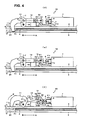
- Figs. 3 to 5 are views illustrating operations of the card reader writer 1, and Fig. 1 is a side view of the lock mechanism 10 as viewed in a direction Z.
- Fig. 3 (a) shows the standby state before the card 2 is inserted. In this state, the solenoid 7 is not energized, and the plunger 8 is biased by an elastic force F1 of the spring 9 to project in the direction B. Thereby, the fourth beam 14 is pushed by the plunger 8 in the direction B to turn the second beam 12 with an angular moment M1 about the second fulcrum 22 via the third joint 14b in a direction R.
- the second beam 12 pulls the third beam 13 via the second joint 32 with a force F3, and the third beam 13 turns the first beam 11 with an angular moment M3 about the first fulcrum 21 via the first joint 31 in a direction P. Therefore, the pawl 11c provided on the first beam 11 is put in a state, in which it does not spring into the passage 20 of the card 2 to clear the passage 20 to enable insertion of the card 2 from the insertion port 4.
- the solenoid 7 is supplied with an electric current to be magnetized and attract the plunger 8 with a force F2 in the direction A.
- the fourth beam 14 is pulled by the plunger 8 in the direction A, an angular moment M2 acts on the second beam 12 via the third joint 14b, and the second beam 12 is turned about the second fulcrum 22 in direction L.
- the third beam 13 is pushed via the second joint 32 by the second beam 12 with a force F4, and the movement of the third beam 13 turns the first beam 11 with an angular moment M4 about the first fulcrum 21 via the first joint 31 in direction Q. Therefore, the pawl 11c springs into the passage 20 as shown in Fig. 3(c) . Then, when the solenoid 7 fully attracts the plunger 8 in the direction A, movements of the respective beams 11 to 14 cause the pawl 11c to spring further into the passage 20 to completely block the passage 20 as shown in Fig. 4(d) . This state is one in which the card 2 is locked so that it cannot be pulled out from within the card reader writer 1.
- the first joint 31, the second joint 32, and the second fulcrum 22 are aligned substantially along straight line X.
- the third beam 13 is excessively moved downward due to errors in the dimensions of the respective parts, etc. , but downward movement of the third beam 13 is restricted by the stopper 16 after the state is reached in which the joints 31, 32, and the second fulcrum 22 are aligned on the straight line X, so that the joints 31, 32, and once the second fulcrum 22, have been aligned on the straight line X, they can be prevented from getting out alignment on the straight line X.
- the straight line X on which the joints 31, 32, and the second fulcrum 22 are aligned, perpendicularly intersects a straight line Y, which connects between the first joint 31 and the first fulcrum 21, to become parallel to the passage 20 of the card 2.
- the card reader writer 1 When in the locked state, the card reader writer 1 brings the IC contacts 5a ( Fig. 1 ) into contact with the IC contact 2a ( Fig. 1 ) of the card 2 to perform the data processing on the card 2.
- a processing termination signal is fed to the card reader writer 1 from the information processing equipment, and the card reader writer 1 that receives the processing termination signal stops introduction of an electric current to the solenoid 7.
- the driving of the solenoid 7 is ended, releasing pull on the plunger 8 so that the plunger 8 is biased by the elastic force F1 of the spring 9 in the direction B as shown in fig. 4(e) .
- the fourth beam 14 is pushed by the plunger 8 in the direction B and the angular moment M1 acts on the second beam 12 via the third joint 14b to turn the second beam 12 about the second fulcrum 22 in the direction R.
- the third beam 13 is pulled via the second joint 32 by the second beam 12 with the force F3 as shown in Fig. 4(f) , and movement of the third beam 13 turns the first beam 11 via the first joint 31 with the angular moment M3 about the first fulcrum 21 in the direction P.
- the pawl 11c retreats from the passage 20 to completely clear the passage 20. That is, the state results in which locking of the card 2 is released, and it becomes possible to pull out the card 2 from within the card reader writer 1.
- the force F6 is reliably cancelled by the reaction force F6' from the second fulcrum 22, this being a fixed point, so that the third beam 13 does not move.
- the card 2 is pulled in an abnormal way by a special jig or the like, there is a fear that an angular moment acting on the first beam 11 exerts on the third beam 13 a force that is going to turn the second beam 12 in the direction L (shown in, for example, Fig. 3(a) ) so that the third beam 13 is moved downward.
- the joints 31, 32, and the second fulcrum 22, which are aligned on the straight line X can be prevented from getting out of alignment on the straight line X, and the third beam 13 is not moved further.
- the third beam 13 is not moved as described above, the first beam 11 is not turned about the first fulcrum 21 in the direction P, and the pawl 11c blocking the passage 20 will not be cleared from the passage 20. That is, by virtue of the above, locking will not be released even when the card 2 is pulled while the data processing is performed on the card 2.
- frictional forces on the respective fulcrums 21, 22, 14a and the respective joints 31, 32, 14b serve as forces to obstruct turning of the second beam 12 and movements of the third beam 13 but all the shafts and the shaft portions which constitute such parts are small in radius of rotation, and so the frictional forces are minute and have little influence.
- a frictional force between the pawl 11c and the trailing end 2c of the card 2 serves as a force to obstruct turning of the first beam 11.
- the frictional force is minute as compared with the angular moments M1, M5 and so has little influence.
- the first beam 11 is turned in the direction P as described above whereby the pawl 11c having blocked the passage 20 is moved in the direction P to clear the passage 20. That is, by virtue of the above, locking can be easily released even when the card 2 is pulled after the data processing on the card 2 is finished.
- the lock mechanism for card processing units has the ability of allowing a card to be pulled out because the mechanism is not locked, even when after a user inserts the card, electricity is cut off, or an electric source for an information processing equipment is not made ON, in addition to the functions of the mechanism described above.
- electricity is cut off or so in the card reader writer 1 according to the embodiment, electric current to the card reader writer 1 is cut off and the solenoid 7 is not driven. Therefore, even when the card 2 is inserted from the insertion port 4 while the mechanism is in the standby state shown in Fig.
- the plunger 8 is not attracted and the respective beams 11, 12, 13, 14 are not moved, so that the pawl 11c will not spring into the passage 20 to block the passage 20. That is, the card which has been inserted is not locked in and can be pulled out from the card reader writer 1.
- information processing equipment is in some cases put in a state in which electric current is cut off by virtue of service interruption, etc. while the data processing on a card as inserted is performed.
- introduction of an electric current to a card reader writer is also cut off, so that locking of a card cannot be released and a user cannot pull out the card from the card reader writer.
- locking of a card is released by reversely rotating a motor, so that when introduction of an electric current is cut off, the motor cannot be reversely rotated and so locking of the card cannot be released.
- the plunger 8 is biased by the elastic force F1 of the spring 9 in the direction B as shown in Fig. 4(f) and the respective beams 11, 12, 13, 14, respectively, are moved, so that the pawl 11c retreats from the passage 20 to clear the passage 20. That is, the state results in which locking of the card 2 is released, and it becomes possible to pull out the card 2 from within the card reader writer 1.
- the lock mechanism 10 can be made small in height to make the card reader writer 1 small in size.
- the elastic force F1 of the spring 9 causes the second beam 12 to turn via the fourth beam 14 about the second fulcrum 22 in the direction L to move the third beam 13 downward. Therefore, the first beam 11 turns about the first fulcrum 21 in the direction P, so that the pawl 11c is cleared from the passage 20 as shown in Fig. 6(a) to put the card 2 in a released state.
- a lock mechanism 70 shown in Fig. 7 may be used, in which a solenoid 7 is mounted so that the direction of movements of a plunger 8 is perpendicular to the passage 20.
- the same parts in Fig. 7 as the respective parts shown in Figs. 3 to 5 are denoted by the same reference numerals.
- a second straight beam 12z is turned via a fourth beam 14 about a second fulcrum 22 in the direction L to move a third beam 13 downward.
- the first beam 11 turns about the first fulcrum 21 in the direction Q, and the pawl 11c blocks the passage 20 as shown in Fig. 7 (b) to put the card 2 in a locked state.
- the elastic force F1 of the spring 9 causes the second beam 12z to turn via the fourth beam 14 about the second fulcrum 22 in the direction R to move the third beam 13 upward. Therefore, the first beam 11 turns about the first fulcrum 21 in the direction P, and so the pawl 11c clears the passage 20 as shown in Fig. 7 (a) to put the card 2 in a released state.
- a second beam may be mounted at a tip end of the plunger so that the attractive force of the solenoid is imparted directly to the second beam from the plunger.
- one end of the spring may be mounted to the second beam and the other end of the spring may be mounted to the housing so that the elastic force of the spring be imparted directly to the second beam to bias the second beam in a predetermined turning direction.
- the card reader writer 1 for IC cards in which the data processing is performed on an IC card with IC contacts
- the invention is also applicable to a card processing unit that performs data processing on various types of cards, such as a card reader writer for magnetic cards that performs data processing on a magnetic card with a magnetic stripe, a card reader writer for hybrid cards, that performs the data processing on a hybrid card with both IC contacts and magnetic stripe, etc.
- the first joint, the second joint, and the second fulcrum are aligned substantially on a straight line when the pawl blocks the passage of a card to lock the card, even when the card is pulled during the data processing on the card, the pulling force is cancelled by the second fulcrum so that locking is not released.
- the second beam is turned about the second fulcrum whereby a force in a direction perpendicular to the straight line that connects the first joint, the second joint, and the second fulcrum acts on the second joint to cause the pawl blocking the passage to be cleared from the passage, so that locking of the card can be easily released.
Landscapes
- Physics & Mathematics (AREA)
- General Physics & Mathematics (AREA)
- Engineering & Computer Science (AREA)
- Theoretical Computer Science (AREA)
- Conveying Record Carriers (AREA)
- Details Of Connecting Devices For Male And Female Coupling (AREA)
Claims (5)
- Kartenverarbeitungseinheit, die dazu ausgelegt ist, eine Datenverarbeitung an einer eingeschobenen Karte (2) durchzuführen, wobei die Kartenverarbeitungseinheit aufweist
einen ersten Träger (11), der dazu ausgelegt ist, sich um einen ersten Drehpunkt zu drehen, um dadurch zu bewirken, dass eine Klinke (11c) in den Durchgang einer Karte (2) schnellt, um den Durchlass (20) der Karte zu blockieren, und zu bewirken, dass sich die Klinke (11c) aus dem Durchgang der Karte (2) zurückzieht, um den Durchgang freizugeben,
gekennzeichnet durch
einen zweiten Träger (12), der dazu ausgelegt ist, sich um einen zweiten Drehpunkt zu drehen,
einen dritten Träger (13), der dazu ausgelegt ist, mit dem ersten Träger (11) an einem ersten Gelenk drehbar verbunden zu sein, das sich vom ersten Drehpunkt unterscheidet, und mit dem zweiten Träger (12) an einem zweiten Gelenk drehbar verbunden zu sein, das sich vom zweiten Drehpunkt unterscheidet,
einen Anschlag (16), der dazu ausgelegt ist, Bewegungen des dritten Trägers (13) einzuschränken, und
einen Aktuator (7, 9), der dazu ausgelegt ist, den zweiten Träger (12) zu drehen,
wobei, wenn die Klinke (11c) den Durchlass (20) einer Karte (2) blockiert, das erste Gelenk, das zweite Gelenk und der zweite Drehpunkt im Wesentlichen auf einer geraden Linie ausgerichtet sind. - Kartenverarbeitungseinheit nach Anspruch 1, wobei, wenn die Klinke (11c) den Durchlass (20) einer Karte (2) blockiert, sich eine gerade Linie, die das erste Gelenk, das zweite Gelenk und den zweiten Drehpunkt miteinander verbindet, und eine gerade Linie, die das erste Gelenk und den ersten Drehpunkt miteinander verbindet, im Wesentlichen senkrecht miteinander schneiden.
- Kartenverarbeitungseinheit nach Anspruch 1 oder 2, wobei der Aktuator (7, 9) dazu ausgelegt ist, den zweiten Träger (12) in seiner vorbestimmten Richtung zu drehen, wodurch der dritte Träger (13) bewegt wird, und der dritte Träger (13) dazu ausgelegt ist, den ersten Träger (11) in seiner vorbestimmten Richtung zu drehen, um zu bewirken, dass die Klinke (11c) den Durchlass (20) einer Karte (2) blockiert, und um das erste Gelenk, das zweite Gelenk und den zweiten Drehpunkt im Wesentlichen auf einer geraden Linie auszurichten, und
der Anschlag (16) dazu ausgelegt ist, die Bewegung des dritten Trägers einzuschränken, nachdem die Ausrichtung im Wesentlichen auf einer geraden Linie erreicht ist. - Kartenverarbeitungseinheit nach einem der Ansprüche 1 bis 3, wobei der Aktuator (7, 9) ein Solenoid (7), das dazu ausgelegt ist, eine Kraft auszuüben, um den zweiten Träger (12) in seiner vorbestimmten Richtung zu drehen, und eine Feder (9), die dazu ausgelegt ist, den zweiten Träger (12) in einer Richtung entgegengesetzt zur vorbestimmten Richtung mit einer kleineren Kraft als der Kraft des Solenoids (7) vorzubelasten, aufweist.
- Kartenverarbeitungseinheit nach einem der Ansprüche 1 bis 4, wobei, wenn die Klinke (11c) den Durchlass (20) einer Karte (2) blockiert, das erste Gelenk, das zweite Gelenk und der zweite Drehpunkt im Wesentlichen auf einer geraden Linie parallel zum Durchlass (20) einer Karte (2) ausgerichtet sind.
Applications Claiming Priority (2)
| Application Number | Priority Date | Filing Date | Title |
|---|---|---|---|
| JP2003201570 | 2003-07-25 | ||
| JP2003201570A JP4079843B2 (ja) | 2003-07-25 | 2003-07-25 | カード処理装置 |
Publications (3)
| Publication Number | Publication Date |
|---|---|
| EP1501042A2 EP1501042A2 (de) | 2005-01-26 |
| EP1501042A3 EP1501042A3 (de) | 2006-04-05 |
| EP1501042B1 true EP1501042B1 (de) | 2012-06-13 |
Family
ID=33487662
Family Applications (1)
| Application Number | Title | Priority Date | Filing Date |
|---|---|---|---|
| EP04016176A Expired - Lifetime EP1501042B1 (de) | 2003-07-25 | 2004-07-09 | Kartenverarbeitungseinheit |
Country Status (4)
| Country | Link |
|---|---|
| EP (1) | EP1501042B1 (de) |
| JP (1) | JP4079843B2 (de) |
| BR (1) | BRPI0402991B1 (de) |
| ES (1) | ES2385979T3 (de) |
Families Citing this family (5)
| Publication number | Priority date | Publication date | Assignee | Title |
|---|---|---|---|---|
| WO2007110100A1 (en) * | 2006-03-29 | 2007-10-04 | Fci | Card reader with card ejection mechanism |
| US8783569B2 (en) | 2007-06-01 | 2014-07-22 | Nidec Sankyo Corporation | Card processing device |
| WO2015059719A1 (en) * | 2013-10-25 | 2015-04-30 | Te Connectivity India Private Limited | Card reader |
| JP2016122376A (ja) * | 2014-12-25 | 2016-07-07 | 日本電産サンキョー株式会社 | カードリーダ |
| KR102724176B1 (ko) * | 2024-03-05 | 2024-10-31 | 주식회사 부민더블유엔피(W&P) | 무선통신성능을 향상시킨 결제처리유닛을 구비한 음식물 쓰레기 종량제 수거장치 |
Family Cites Families (4)
| Publication number | Priority date | Publication date | Assignee | Title |
|---|---|---|---|---|
| ES2088779T3 (es) * | 1988-10-14 | 1996-09-16 | Omron Tateisi Electronics Co | Lector de tarjetas con mecanismo de enclavamiento. |
| JP2539678B2 (ja) * | 1989-02-15 | 1996-10-02 | 松下電器産業株式会社 | Icカ―ドリ―ダ・ライタ |
| JP3490285B2 (ja) * | 1998-03-11 | 2004-01-26 | 株式会社三協精機製作所 | カードリーダ |
| JP3362691B2 (ja) * | 1999-03-08 | 2003-01-07 | 松下電器産業株式会社 | Icカードリーダ |
-
2003
- 2003-07-25 JP JP2003201570A patent/JP4079843B2/ja not_active Expired - Fee Related
-
2004
- 2004-07-09 EP EP04016176A patent/EP1501042B1/de not_active Expired - Lifetime
- 2004-07-09 ES ES04016176T patent/ES2385979T3/es not_active Expired - Lifetime
- 2004-07-23 BR BRPI0402991A patent/BRPI0402991B1/pt not_active IP Right Cessation
Also Published As
| Publication number | Publication date |
|---|---|
| BRPI0402991B1 (pt) | 2016-07-12 |
| JP2005044063A (ja) | 2005-02-17 |
| EP1501042A2 (de) | 2005-01-26 |
| EP1501042A3 (de) | 2006-04-05 |
| JP4079843B2 (ja) | 2008-04-23 |
| BRPI0402991A (pt) | 2005-03-22 |
| ES2385979T3 (es) | 2012-08-06 |
Similar Documents
| Publication | Publication Date | Title |
|---|---|---|
| US6270365B1 (en) | IC card connector having IC card ejection mechanism | |
| US6338636B2 (en) | IC card connector having IC card ejection mechanism | |
| JP2007234231A (ja) | ロック装置及びそれを備えたコネクタ装置 | |
| US20010012712A1 (en) | Card connector having IC card ejection mechanism | |
| EP1324256B1 (de) | Kartenverbinder | |
| JP3362691B2 (ja) | Icカードリーダ | |
| EP1501042A2 (de) | Kartenverarbeitungseinheit | |
| US7556195B2 (en) | Card reader and writer | |
| US20190164024A1 (en) | Card reader | |
| US20110121078A1 (en) | Card reader | |
| EP1148586A3 (de) | Kartenverbinder | |
| JP2017146697A (ja) | カードリーダ | |
| US6464143B2 (en) | Card reader and electronic device | |
| US20050270688A1 (en) | Cartridge tray to be incorporated in cartridge drive apparatus | |
| US12180020B2 (en) | Image processing apparatus | |
| JPS63282989A (ja) | メモリ−カ−トリツジのドライブ装置 | |
| JP2000293639A (ja) | Icカードリーダライタおよびicカードリーダライタのインターロック方法 | |
| JP3109494B2 (ja) | Icカードリーダライタのインターロック機構 | |
| US20190164023A1 (en) | Card Reader | |
| JP3466496B2 (ja) | カード用コネクタ | |
| JP2839947B2 (ja) | Icカードリーダライタのイジェクト機構 | |
| JP3879660B2 (ja) | 手動式カードリーダ | |
| JP2004171302A (ja) | カードリーダライタ | |
| JPH01219973A (ja) | Icカードの取り出し防止装置 | |
| JP3029583B2 (ja) | 止め金付きキースイッチ装置 |
Legal Events
| Date | Code | Title | Description |
|---|---|---|---|
| PUAI | Public reference made under article 153(3) epc to a published international application that has entered the european phase |
Free format text: ORIGINAL CODE: 0009012 |
|
| AK | Designated contracting states |
Kind code of ref document: A2 Designated state(s): AT BE BG CH CY CZ DE DK EE ES FI FR GB GR HU IE IT LI LU MC NL PL PT RO SE SI SK TR |
|
| AX | Request for extension of the european patent |
Extension state: AL HR LT LV MK |
|
| PUAL | Search report despatched |
Free format text: ORIGINAL CODE: 0009013 |
|
| AK | Designated contracting states |
Kind code of ref document: A3 Designated state(s): AT BE BG CH CY CZ DE DK EE ES FI FR GB GR HU IE IT LI LU MC NL PL PT RO SE SI SK TR |
|
| AX | Request for extension of the european patent |
Extension state: AL HR LT LV MK |
|
| RAP1 | Party data changed (applicant data changed or rights of an application transferred) |
Owner name: HITACHI-OMRON TERMINAL SOLUTIONS, CORP. |
|
| 17P | Request for examination filed |
Effective date: 20060929 |
|
| AKX | Designation fees paid |
Designated state(s): DE ES FR GB |
|
| 17Q | First examination report despatched |
Effective date: 20070126 |
|
| GRAP | Despatch of communication of intention to grant a patent |
Free format text: ORIGINAL CODE: EPIDOSNIGR1 |
|
| RIN1 | Information on inventor provided before grant (corrected) |
Inventor name: NAKABO, AKINOBUC/O OMRON CORP. |
|
| GRAS | Grant fee paid |
Free format text: ORIGINAL CODE: EPIDOSNIGR3 |
|
| GRAA | (expected) grant |
Free format text: ORIGINAL CODE: 0009210 |
|
| AK | Designated contracting states |
Kind code of ref document: B1 Designated state(s): DE ES FR GB |
|
| REG | Reference to a national code |
Ref country code: GB Ref legal event code: FG4D |
|
| REG | Reference to a national code |
Ref country code: ES Ref legal event code: FG2A Ref document number: 2385979 Country of ref document: ES Kind code of ref document: T3 Effective date: 20120806 |
|
| REG | Reference to a national code |
Ref country code: DE Ref legal event code: R096 Ref document number: 602004038149 Country of ref document: DE Effective date: 20120809 |
|
| PLBE | No opposition filed within time limit |
Free format text: ORIGINAL CODE: 0009261 |
|
| STAA | Information on the status of an ep patent application or granted ep patent |
Free format text: STATUS: NO OPPOSITION FILED WITHIN TIME LIMIT |
|
| 26N | No opposition filed |
Effective date: 20130314 |
|
| REG | Reference to a national code |
Ref country code: DE Ref legal event code: R097 Ref document number: 602004038149 Country of ref document: DE Effective date: 20130314 |
|
| REG | Reference to a national code |
Ref country code: FR Ref legal event code: PLFP Year of fee payment: 13 |
|
| PGFP | Annual fee paid to national office [announced via postgrant information from national office to epo] |
Ref country code: ES Payment date: 20160613 Year of fee payment: 13 |
|
| PGFP | Annual fee paid to national office [announced via postgrant information from national office to epo] |
Ref country code: FR Payment date: 20160613 Year of fee payment: 13 |
|
| PGFP | Annual fee paid to national office [announced via postgrant information from national office to epo] |
Ref country code: DE Payment date: 20160705 Year of fee payment: 13 Ref country code: GB Payment date: 20160706 Year of fee payment: 13 |
|
| REG | Reference to a national code |
Ref country code: DE Ref legal event code: R119 Ref document number: 602004038149 Country of ref document: DE |
|
| GBPC | Gb: european patent ceased through non-payment of renewal fee |
Effective date: 20170709 |
|
| REG | Reference to a national code |
Ref country code: FR Ref legal event code: ST Effective date: 20180330 |
|
| PG25 | Lapsed in a contracting state [announced via postgrant information from national office to epo] |
Ref country code: GB Free format text: LAPSE BECAUSE OF NON-PAYMENT OF DUE FEES Effective date: 20170709 Ref country code: DE Free format text: LAPSE BECAUSE OF NON-PAYMENT OF DUE FEES Effective date: 20180201 |
|
| PG25 | Lapsed in a contracting state [announced via postgrant information from national office to epo] |
Ref country code: FR Free format text: LAPSE BECAUSE OF NON-PAYMENT OF DUE FEES Effective date: 20170731 |
|
| REG | Reference to a national code |
Ref country code: ES Ref legal event code: FD2A Effective date: 20181106 |
|
| PG25 | Lapsed in a contracting state [announced via postgrant information from national office to epo] |
Ref country code: ES Free format text: LAPSE BECAUSE OF NON-PAYMENT OF DUE FEES Effective date: 20170710 |