EP1501280B1 - Imprimante numérique - Google Patents
Imprimante numérique Download PDFInfo
- Publication number
- EP1501280B1 EP1501280B1 EP03016534A EP03016534A EP1501280B1 EP 1501280 B1 EP1501280 B1 EP 1501280B1 EP 03016534 A EP03016534 A EP 03016534A EP 03016534 A EP03016534 A EP 03016534A EP 1501280 B1 EP1501280 B1 EP 1501280B1
- Authority
- EP
- European Patent Office
- Prior art keywords
- colour
- output
- colorimeter
- profile
- fields
- Prior art date
- Legal status (The legal status is an assumption and is not a legal conclusion. Google has not performed a legal analysis and makes no representation as to the accuracy of the status listed.)
- Expired - Lifetime
Links
Images



Classifications
-
- H—ELECTRICITY
- H04—ELECTRIC COMMUNICATION TECHNIQUE
- H04N—PICTORIAL COMMUNICATION, e.g. TELEVISION
- H04N1/00—Scanning, transmission or reproduction of documents or the like, e.g. facsimile transmission; Details thereof
- H04N1/46—Colour picture communication systems
- H04N1/56—Processing of colour picture signals
- H04N1/60—Colour correction or control
- H04N1/603—Colour correction or control controlled by characteristics of the picture signal generator or the picture reproducer
- H04N1/6033—Colour correction or control controlled by characteristics of the picture signal generator or the picture reproducer using test pattern analysis
-
- G—PHYSICS
- G01—MEASURING; TESTING
- G01J—MEASUREMENT OF INTENSITY, VELOCITY, SPECTRAL CONTENT, POLARISATION, PHASE OR PULSE CHARACTERISTICS OF INFRARED, VISIBLE OR ULTRAVIOLET LIGHT; COLORIMETRY; RADIATION PYROMETRY
- G01J3/00—Spectrometry; Spectrophotometry; Monochromators; Measuring colours
- G01J3/46—Measurement of colour; Colour measuring devices, e.g. colorimeters
- G01J3/50—Measurement of colour; Colour measuring devices, e.g. colorimeters using electric radiation detectors
-
- H—ELECTRICITY
- H04—ELECTRIC COMMUNICATION TECHNIQUE
- H04N—PICTORIAL COMMUNICATION, e.g. TELEVISION
- H04N1/00—Scanning, transmission or reproduction of documents or the like, e.g. facsimile transmission; Details thereof
- H04N1/46—Colour picture communication systems
- H04N1/56—Processing of colour picture signals
- H04N1/60—Colour correction or control
- H04N1/603—Colour correction or control controlled by characteristics of the picture signal generator or the picture reproducer
- H04N1/6033—Colour correction or control controlled by characteristics of the picture signal generator or the picture reproducer using test pattern analysis
- H04N1/6044—Colour correction or control controlled by characteristics of the picture signal generator or the picture reproducer using test pattern analysis involving a sensor integrated in the machine or otherwise specifically adapted to read the test pattern
Definitions
- the invention relates to a digital printer according to the preamble of the independent claim 1.
- the most general object of this invention is to improve a digital printer having a built-in colorimeter and integrated color management so as to realize the following described aspects of a color management assisted workflow in a manner optimal to the user.
- the invention is concerned, according to a first main aspect, with the system optimization and the improvement of the susceptibility to interference during measured value acquisition.
- both the system costs are optimized and the behavior susceptibility of the method significantly improved by the need for measurement and profiling test fields in a row at a fixed position of the test chart, preferably at the edge of the paper, issued and be measured.
- Another more specific object of the present invention is to improve the handling of profiles.
- the selection of the correct color profile by the digital printer itself can be made automatically.
- the measurements made make further parameters such as e.g. classifies the impact behavior of the substrate and uses this knowledge to make appropriate corrections / classifications that allow to optimize the print result.
- Another more specific object of the invention relates to the verification of the profile selection.
- Another major aspect of the present invention demonstrates how the validity of the output profile based on measurements a test wedge and / or the issued pressure can be verified. In a further aspect, it is further shown how the validity of the profiling can be displayed to the user in an intuitive and user-friendly manner by printing additional information.
- a further more specific object of the present invention is therefore to correlate the internally measured values with the values measured externally in the dry state by means of mathematical and / or metrological means and to integrate this correlation into an ICC-compatible workflow seamlessly and optimally for the user ,
- the drying aspects can be characterized and compensated by measuring the same sample twice in the same sample interval with the color measuring system integrated in the digital printer.
- Another more concrete object of the present invention is to be able to use the built-in measuring system for the inherently important control of spot colors on digital printing.
- dynamically generated measuring strips can be excellently used for this purpose and / or how alternatively the colors can be measured directly in terms of their usefulness.
- this problem is solved by a calibration algorithm, which uses the built-in sensor and makes it possible to determine with the method shown, the optimum applied to the pressure amount of ink, on the one hand to achieve the largest possible color space and on the other hand apply only the sensible amount of ink to the print.
- Another aspect of the present invention shows one way in which the correct operation of such a color fast printer can be periodically checked.
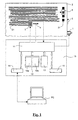
- FIG. 1 For the sake of clarity, only the components of the digital printer according to the invention which are relevant for the present invention are shown in FIG.
- One recognizes a transport device 1 typically realized by means of rollers for substrate (paper) 2 to be printed, a print head 3 equipped with a large number of individual nozzles, a drive symbolized only by a double arrow 4 for adjusting the print head 3 transversely to the feed direction 5 of the paper 2, a spectral measuring head 6 and a digital controller 10.
- the latter comprises a computer-based central control unit 11, a program memory 12, a data memory 13, a PC interface 14 and a user interface 15.
- the controller 10 can, in a manner known per se, inputs from a user accept and eg provide visual or audible information to the user.
- the digital printer or its controller 10 can be supplied with printing or other data (for example profiles) from a connected computer PC.
- the control unit 11 executes the device-specific control programs 12a located in the program memory 12 and controls the print head 3, its drive 4 and the transport device 1 for the paper 2 to be printed in a manner known per se.
- the control programs 12a also contain a color management system known per se. Module which performs a transformation of the print data in the printer color space based on stored in the data memory 13 or supplied with the print data or separately from the connected external PC output profiles, thereby causing the color correct print output.
- the control unit 10 also controls the spectral measuring head 6 and takes over and processes the digital measured values generated by the spectral measuring head.
- a suitable spectral measuring head with the associated electronics in order to process the electrical measuring signals into corresponding digital measured values is, for example, in US Pat EP-A-1041372 described.
- the illustrated digital printer corresponds to the state of the art, as described for example by the document US-A 2002/0080373 is represented.
- the differences according to the invention lie, on the one hand, in the arrangement of the spectral (or color) measuring head 6 and, on the other hand, and above all in new functionalities of the digital printer, which are implemented by special software 12b stored in the program memory 12.
- a computer outputs to a printer a 2-dimensional test chart containing a representative number of colors from the printable color space, typically defined in RGB or CMYK coordinates.
- the test chart is then measured with a colorimeter.
- an automatic xy-scanning color measuring system such as e.g. the Spectrolino / SpectroScan system from Gretag-Macbeth AG.
- color profiles for example ICC profiles
- ICC profiles can also be created for input devices such as cameras or scanners.
- PDF files with built-in profiles are created in prepress.
- the integrated profiles describe how the integrated images and the line type or the text are to be displayed correctly in color.
- the profiles generated for the output device e.g., the digital printer
- Such systems have been realized in a wide variety.
- An example of an application that can calculate printer output profiles according to the ICC standard is the system ProfileMaker from Gretag-Macbeth AG. Because the profiling A printer according to such a method by the large number of colors that has to be measured, is relatively time-consuming and error-prone, it is natural to further automate the color measurement and possibly already directly integrated into the output device.
- a typical embodiment of such a system is, for example, in US-A 2002/0080373 described.
- the motion of the print head which is present anyway in an inkjet printer, is utilized transversely to the paper travel direction in order to measure test charts which are output on the printer for the purpose of color management, directly during printing or with a time delay.
- the first significant disadvantage of this embodiment of the measuring device is that an additional mass must be moved with the print head. This has a negative effect on the printing speed and / or on the system costs.
- the drive motors must be strengthened accordingly.
- the color measurement becomes unreliable due to the high acceleration forces.
- the extra head movements necessary to measure the output after printing also slows down the perceived output speed.
- Another problem is that, in this arrangement, the measuring head, which is located directly next to the print head, is potentially contaminated by paint mist and therefore potentially returns erroneous readings.
- the ink is typically not fully absorbed or dried by the substrate shortly after printing. For this reason, the colorimetric values will change significantly.
- the inventive arrangement of a spectral or colorimetric measuring head for data acquisition described below solves this problem.
- the spectral / colorimetric measuring head 6 at a fixed position (preferably at the edge where the paper 2 is struck in the printer) somewhere in the direction of the paper after the pressure line 21 defined by the position of the print head 3 positioned.
- the measuring head does not necessarily have to be mounted at the height of the print head 3. It is even advantageous to position the measuring head 6 at a certain distance (eg 10 cm) in the direction of travel of the paper measured away from the printing head 3. Since the measuring head 6 can not move in this arrangement, it is now necessary for the calculation of an ICC profile required to position 31 in a row (ie a printed field per printed line 31). These measuring fields are then typically printed on the edge where the paper 2 is struck.
- All measuring fields 31, which are needed to create the profile, are then output in this manner and measured by the measuring head 6 spectrophotometrically or colorimetrically.
- the pressure data required for the output of the measuring fields are part of the software 12b or can also be supplied by the connected PC.
- the corresponding measured values are then a per se known profile calculation module contained in the software 12b located in the program memory 12 transmitted.
- This calculation module generates an output device profile (eg according to the ICC standard) which is stored internally in the data memory 13 of the printer (or possibly also externally in the connected PC) and then later in a manner known per se for color-correct output of images and spot colors in this printer is used.
- profile calculation module can be used with advantage the already mentioned software "Profile Maker" from Gretag-Macbeth AG.
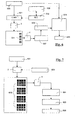
- Fig. 2 summarizes the above operations: 101 denotes the print data (e.g., CMYK) of the metering fields 31 to be output through the print head 3.
- the color measurement values (e.g., Lab) of the measurement fields 31 are symbolized by the box 102.
- the print data 101 and the corresponding color measurement values 102 go into the profile calculation module 103, which calculates the output profile 104 therefrom, which is then stored in the data memory 13.
- the color measurement values 102 of selected or all measurement fields 31 can also be integrated into the output profile 104. This can be done in a manner known per se, e.g. in a so-called private day of the profile.
- the integration of the color measurement values 102 is symbolized by the dotted line 105.
- the color measurement values integrated into the profile 104 are required, for example, in the further development of the invention explained below.
- the colorimeter is designed as a line spectrometer.
- a colorimeter typically has a number of monochromatic or narrowband light sources (e.g., 16 differently colored LEDs) in the illumination, with the light of which a line-shaped area on the paper is sequentially illuminated. The light is brought to the paper via an optical system at a 45 ° angle. At the zero degree angle, the illuminated line to be measured is then imaged onto a line sensor (e.g., CCD sensor) by an optical system.
- a line sensor e.g., CCD sensor
- imaging spectrophotometers Alternative designs of such a line spectrometer are the so-called imaging spectrophotometers.
- the line to be measured in the image is imaged by an optical system on a 2-dimensional detector. In one dimension of the detector, the image is spatially resolved, in the second dimension corresponding to the wavelengths.
- the illumination in such an imaging spectrophotometer is typically performed as white light illumination.
- the printer prints a 2-dimensional measurement chart anywhere on the paper.
- the line spectrophotometer is mounted (transversely to the paper feed direction) exactly at the same place where the chart is printed immovably. Paper feed moves the chart below the line spectrophotometer.
- the measurement data is fed into a profiling module and the corresponding output profiles (for example, according to the ICC standard) are calculated. These ICC profiles are then used in the output of images and spot colors to produce a true color output.
- a built-in colorimeter whether it be a fixed mounted single gauge, a fixed mounted row gauge or a moving single gauge or moving row gauge, can be used to substantially simplify the profiling workflow. Namely, an independent device profile is typically generated for each type of substrate (paper), ink type, etc. This is necessary because the color output on different papers and with different color inks at the same settings of the print parameters will be very different. It would therefore be extremely advantageous if the printer itself could recognize the currently used paper type and thereby select the corresponding Drukkerprofil without user assistance.
- the printer is profiled according to one of the methods described above and an independent device profile (eg ICC profile) 204_1... 204_n is generated for each common system configuration (ink types, paper types, etc.) and stored in the data memory 13 .
- an independent device profile eg ICC profile
- 204_1... 204_n is generated for each common system configuration (ink types, paper types, etc.) and stored in the data memory 13 .
- the color measurement values or the corresponding spectral measured values of a subset of the measuring fields or alternatively of all measuring fields are stored.
- the measurement fields whose color measurement values are stored in the profiles are referred to below as test fields to distinguish them from the measurement fields used for profile formation. These special test fields must always be output the same (ie without using a color profile or without adjusting the amount of ink or the printing speed).
- the storage For example, it can happen in an ICC profile by storing the measurement data in a so-called private tag of the profile.
- additional test fields can be printed out and the measurement data of these additional test fields can be stored in the profile.
- the types of field of view chosen are typically identical to the types of field in an offset print control strip.
- the test fields, whose data are stored, should be measuring fields, which strongly change in color on different papers. Typically, CMYK color fields or solid fields of these colors are used.
- the measured value of the paper white can also be saved ("white field", "paper white”).
- the automatic profile selection then runs according to the following method, which is also contained in or implemented by the software 12b:
- the printer first issues these few test fields 231 identifying a profile on the paper.
- the underlying print data are labeled 201.
- only a white field is output, so nothing printed at all.
- Only the paper white is used as the test field in this minimal case, the characterization consists only of the measurement of the paper.
- the test fields are measured spectrally and / or colorimetrically with the built-in color measuring device 6.
- the spectral or colorimetric differences to the corresponding measured values of the test fields of all profiles 204_1... 204_n stored in the data memory 13 of the printer (or in the connected computer) are calculated in an evaluation module 206.
- the corresponding measured values are read from the private tag of the respective ICC profile and the colorimetric differences to the current measured values of the corresponding measuring fields are generated.
- This can be eg a colorimetric difference ⁇ E according to CIELAB formula).
- the colorimetric differences .DELTA.E are summed over all test fields, the sum then yielding a colorimetric which defines and determines the applicability of an ICC profile to this substrate (in combination with the respectively used color inks).
- the summed colorimetric difference ⁇ E is almost 0 dE CIELAB, whereas the deviation of the summed ⁇ E differences for mismatched profiles reaches relatively high ⁇ E values.
- this profile is automatically displayed as an active profile 204 in the working flow (in the computer or directly in the Printer) and then used later for the full-color print output. If no matching profile is stored, the printer would either issue an error message or automatically switch to profiling mode (block 210) and then generate a matching profile as explained with reference to FIG. This check can optionally be triggered automatically (eg with each printout) or by a user input (user interface 15) on the printer.
- the system is expanded in such a way that after successful checking of the validity of the measured values of the test fields an additional mark 207 in the test strip (totality of the test fields) which indicates the validity of the profile to the user.
- this mark should be printed near the printed test fields so that the user immediately associates the mark with the test result.
- This can be either a graphic mark (check mark or similar) or a bookmark (for example "profile checked on dd.mm.yy").
- print data is communicated to the digital printer RGB or CMYK.
- RGB or CMYK values using the output profile in colorimetric target values for the output Pixel can be converted.
- setpoints can then be compared with the measured color measurements.
- a built-in measuring head usually has an aperture that is much larger than the pixels in the output (eg 1-5 mm diameter).
- the color measuring device 6 measures a suitable test pressure at various predetermined measuring points 331. These measuring points can be distributed across the print like a checkerboard. Any other arrangement of the measuring points is also possible.
- the software 12b in the program memory 12 of the printer determines the colorimetric desired values 303 for the measuring points 331 to be checked by averaging the calculated colorimetric values 302 of the individual pressure points, which are located within the aperture of a measurement, in an averaging stage 304.
- the colorimetric values 302 of the individual pressure points are calculated from the RGB or CMYK values 301 by transformation 305 into the LAB color space using the active output profile 306. These averaged LAB values or setpoint values 303 then serve as reference values for the measurement of the output image the individual measuring points 331.
- the colorimetric differences of the measured values 307 of the printout to the calculated setpoint values 303 of the printout at the individual measuring points 331 are calculated and averaged.
- the calculated average dE error 308 is then the measure of the deviation of the current print output from the desired print output. If this average error 308 is below a predetermined error limit (test 309), the print output is declared valid (OK signaling 310). Otherwise, the user is warned or, optionally, the system is automatically profiled again (profiling 311).
- the built-in color measuring device can be used not only to control subjects printed with the usual standard colors, but also to control spot color areas.
- Named Profiles it can be defined how a print output system can convert spot colors (which are typically denoted by color names such as "Pantone 405C”) into colorimetric coordinates. Such "Named Profiles" can be embedded in PDF files.
- An alternative way to pass the conversion tables of color names in colorimetric values to the printer is to embed an XML-coded conversion table (as defined, for example, in the CxF data exchange format of Gretag-Macbeth AG) in a PDF file and thus with the PDF file to submit the printer or printer driver.
- the special color to be output is transformed into a colorimetric value.
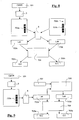
- Each special color in the print output can be assigned a colorimetric reference value 402 in this way. This colorimetric reference value is stored for the measurement. The verification of the special color with the built-in measuring device 6 then takes place according to the following principle:
- the spot color is measured by a built-in colorimetric XY measuring system and compared with the reference value.
- a test field 403 of eg 5 * 5 mm 2 size in the same special color can also be output at the edge of the sheet and measured with a fixed or movably mounted measuring head 6 at this point. If the theoretically determined reference value 402 does not deviate from the current color measurement value 404 or the deviation is smaller than a predefined threshold (eg 1.0 dB CIELAB) (comparison 405), the color is considered correctly printed. If all the colors have been printed correctly, the system signals the user of the correctness of the printed output.
- a predefined threshold eg 1.0 dB CIELAB
- the signaling can be effected, for example, by outputting a specific mark 406 on the printout becomes.
- the signaling can also take place via the user interface 15 of the printer or a message can also be output via the printer / PC interface 14 to the screen of the connected computer PC.
- the profile 502 to be used in conjunction with the color management module 501 is checked in accordance with the procedure described in connection with FIG. 4 (block 503).
- an additional test wedge with predefined test fields 504 is output.
- the typically colorimetrically or spectrally defined test fields 504 of the test wedge are output on the paper with the aid of the (possibly previously verified) ICC profile 502.
- the full tone densities or the colorimetric readings for full tone fields or the tone value increase values or the colorimetric readings for grids are typically known as digital default values 505.
- the built-in measuring device 6 measures the test fields 504 after printing, and from the measured values, the absolute densities, tone value increase values or colorimetric current values 506 of these test fields 504 are calculated (calculation block 507).
- a comparison stage 508 then compares the calculated current values 506 with the digital default values 505.
- a deviation from the default values 505 within the allowable tolerance may again be selectively selected by means of a graphic mark 509 or a corresponding bookmark printed near the test wedge. be signaled to the user.
- the following further aspect of the invention shows one way in which the built-in colorimetric measuring head 6 can be used to optimize the ink consumption of a digital printing output system.
- a digital printer must output a different amount of ink to print a color. This is essentially due to the fact that on the one hand the largest possible color space is to be achieved and thus tends to be applied much color and on the other hand from a certain color application (depending on the type of paper) no significant increase in the color space can be achieved more and other disturbing effects occur such as Fault of paper due to moisture. Likewise, it is nonsensical to waste an unnecessary amount of color in order to expand the color space only marginally. With the functionality according to the invention described below in connection with FIG. 7, the digital printer can be further improved. The functionality is also implemented by corresponding routines in the software 12b.
- a special test procedure is started.
- a plurality of measurement wedges 602 for example, 2 grid values each (30%, 70%) and one full tone (100%) are output in the primary colors CMYK, the underlying print data being designated 601.
- the output of these gauges is repeated with different colorant quantity settings 603.
- These gauges are then measured for each base color. For each measuring field of a measuring wedge, the achieved color saturation or the spanned color space 604 is determined thereon. For example, a simple method is to use the "C" coordinates of the LCh color system
- step 605 the relationship between the color spaces 604 achieved and the underlying colorant amount settings 603 is analyzed. If the achieved color space 604 no longer changes significantly as the applied amount of ink (colorant amount adjustment 603) increases, the optimum colorant amount adjustment (color amount) 606 is reached. With this selected amount of ink 606, the prints are then made on this printer or the printer is later profiled in compliance with this amount of ink 606.
- the following aspect of the invention shows how the colorimeter 6 built into the digital printer can be used to solve the so-called wet / dry problem.
- a typical problem that arises in the measurement of colors immediately after printing is the problem of comparing measured values of a measuring field which was measured immediately after printing (in the wet state) with the colorimetric / spectral measured values of a measuring field in total dried condition. Due to the drying process as well as other processes such as e.g. The colorimetric measured values change in the drying process when they are knocked off.
- Various approaches are known in the literature for making the measured values compatible in the wet and dry state. One approach to this is e.g. in the measurement with polarized light (use EP-Zzzzzzz Gretag Case !!!)
- the built-in colorimeter 6 is used to predict the color change of the ink in the drying process and thus from a wet color measurement (which is possible immediately after printing) to the user's measurement of the dry color close without waiting for the drying time.
- This functionality which is likewise implemented by routines in the software 12b, is explained below with reference to FIG.
- the digital printer is profiled in a first step.
- the printer issues a test chart in one of the previously described ways, with the underlying Print data are designated 701.
- the measuring head 6 detects the measuring fields 702a of the test chart immediately after the printing and generates therefrom the corresponding color measurement values 703a.
- a wet device profile 705a is calculated in profiling module 704. This device profile 705a therefore describes the transformation of RGB or CYMK to the CIELAB color space for wet measuring fields for the relevant type of paper.
- the printout is retracted a second time into the printer (this may, for example, happen by loading the printed paper a second time in the paper tray).
- the dry measuring fields in FIG. 8 are designated by 702b.
- the system recognizes that it is an already printed paper.
- the printer can determine which profile has already been assigned to that term when wet. This achieves a clear assignment to a defined paper.
- the printer is now placed in a mode in which the inserted test chart is merely measured.
- the measured values 703b are detected by all the measuring fields 702b of the test chart.
- a dry device profile 705b is then calculated in an analogous manner, which is characteristic for the conversion of CMYK or RGB values into colorimetric values of dry measurement fields.
- This second profile 705b is also assigned internally in the printer to the relevant paper type.
- the profile for the dry readings is used to output the colors correctly. This is justified by the fact that the user has correct colors in the dried Want to have state.
- the profile is used for the transformation of wet measurements. The use of the profile for wet values is particularly useful if measurement fields for the quality assurance or verification of the correct application of the profiles are to be measured directly in the sequence, as shown in various applications above.
- the measured values 703b of the dry sheet are calculated from the wet sheet measurements 703a by a physical model 706.
- the user specifies in which class 707 (coated, uncoated, matt, art print, etc.) the paper belongs.
- class 707 coated, uncoated, matt, art print, etc.
- two main parameters have to be considered.
- the change of the surface effect This can typically be modeled by adding to each reflectance value of each wet sample reading a small reflectance value (typically 1% to 4%).
- a further correction to take account of the impact on the paper it is often advisable to take into account the additional scatter introduced by the paper.
- the corresponding formulas are generally known (see models by Kubelka / Munk and Hoffmann / Schmelzer).
- R dry f R wet ⁇ S + O
- O typically a constant that is the same and characteristic of the surface effect in all wavelengths for all colors
- S is a constant or wavelength-dependent parameter that characterizes the scattering behavior of the paper.
- the values S and O required for the measurement correction depend on the type of paper used and are typical for a paper.
- the printer will therefore in a further step (based on the user preference of the paper type) the corresponding S and O Read values from a paper class database and use the Model 706 to convert all reflectance values to measured values 703b of a dry sheet.
- the profile 705b for the dry arc is again calculated. Thereafter, the procedure is again as in the previous case in which the two profiles 705a and 705b (for wet and dry) are assigned to a paper type and applied as in the previous case.
- the last aspect of the present invention explained below with reference to FIG. 10 shows how the digital printer can be periodically checked for compliance with a measurement tolerance and therefore for compliance with a maximum deviation from a standard.
- a calibration chart 801 with a palette of measuring fields 802 in colors which distribute as possible over the entire color space is printed out for suitable location. (These could be, for example, 12 saturated colors from the color wheel as well as black, gray and paper white.)
- the colorimetric values 803 of these measurement fields 802 are then recorded in a central calibration laboratory using a spectrophotometer 804.
- the calibration chart 801 is provided with a color code 805 for identification.
- the calibration chart 801 is constructed in such a way that white fields are interwoven periodically between the colored measurement fields, which serve to increase the accuracy of the system by means of an intermediate calibration on paper white.
- the printed calibration chart 801 and the associated measurement data 803 are transmitted to the user for checking the colorimetric correctness of his printer.
- the user loads the measurement data 803 onto the printer (via the PC or via a suitable interface on the printer itself). These measurement data 803 represent the reference value.
- the chart 801 is inserted into the paper slot of the printer.
- the printer automatically recognizes by the built-in colorimeter 6 (by detecting the color code 805 on the chart with the colorimeter 6) that this is a calibration chart 801.
- the printed color patches 802 are measured and the color measured values 806 determined thereby are compared with the previously fed reference values 803.
- a step 807 calculates the maximum colorimetric deviations and the mean colorimetric deviation of the colorimetric values 806 of all measurement fields 802 relative to the reference values 803. If the mean deviation and the maximum deviation of any color measurement field 802 are below a predetermined limit, the printer is considered to be calibrated. Compliance or non-compliance with the limits are signaled to the user by e.g. a certificate 808 or a deviation protocol is issued on the printer.
- the accuracy of the system can, as already mentioned, be further increased by performing an intermediate calibration on paper white on the basis of the white fields woven into the calibration chart.
Landscapes
- Physics & Mathematics (AREA)
- Spectroscopy & Molecular Physics (AREA)
- Engineering & Computer Science (AREA)
- Multimedia (AREA)
- Signal Processing (AREA)
- General Physics & Mathematics (AREA)
- Accessory Devices And Overall Control Thereof (AREA)
- Spectrometry And Color Measurement (AREA)
- Color Image Communication Systems (AREA)
Claims (25)
- Imprimante numérique comprenant un bouton d'impression (3), des moyens d'entraînement (4) pour le bouton d'impression, un dispositif de transport (1) pour le substrat (2) à imprimer, un colorimètre (6) pour la mesure colorimétrique de champs de mesure (31) se trouvant sur le substrat et une commande numérique (10) pour le dispositif de transport, le bouton d'impression, le bouton d'impression et les moyens d'entraînement et le colorimètre, la commande (10) présentant une interface (14) pour l'arrivée de données d'impression numériques et d'autres données et une mémoire de programme (12) et une mémoire de données (13), laquelle mémoire de programme (12) contient les programmes de commande nécessaires pour l'exploitation de l'imprimante, qui analysent les données de mesure générées par le colorimètre (6) et comprennent également un module de gestion de couleur, qui peut transformer à l'aide de profilés d'édition stockés ou amenés par l'interface (14) des données d'impression dans l'espace de couleur de l'imprimante et entraîne ainsi l'édition d'impression correcte au niveau des couleurs, caractérisée en ce queun profil d'édition (204_1-204_4_n) est déposé dans la mémoire de données (13) pour chaque configuration de système courante de l'imprimante numérique comme par exemple des types d'encre et des types de papier, en ce que, pour chaque profil d'édition (204_1-204_4_n), les valeurs de mesure, générées par le colorimètre, de champs test sont mémorisées en supplément des données de profilage proprement dites, et en ce que la commande (10) comprend une fonction de sélection de profil (201-231), qui sélectionne le profil d'édition (204) à appliquer pour l'édition d'impression sur la base de mesures effectuées automatiquement au moyen du colorimètre (6) sur des champs de colorimétrie (231) imprimés à partir d'un certain nombre des profils d'édition (204_1-204_4_n) mémorisés.
- Imprimante selon la revendication 1, caractérisée en ce que la commande (10) comprend une fonction de profilage (101-105), qui peut générer et stocker un profil d'édition (104) automatiquement ou déclenché par un utilisateur sans intervention manuelle.
- Imprimante selon la revendication 2, caractérisée en ce que la fonction de profilage (101-105) calcule le profil d'édition (104) sur la base des valeurs de colorimétrie (102) mesurées automatiquement au moyen du colorimètre (6) sur des champs de colorimétrie (31) imprimés et à l'aide des données d'impression (101) prises à la base de l'impression de ces champs de colorimétrie.
- Imprimante selon l'une quelconque des revendications précédentes, caractérisée en ce que la fonction de sélection de profil (201-231) ordonne un nouveau profilage automatique par la fonction de profilage (101-105), si aucun des profils d'édition mémorisés (204_1-204_4_n) n'est reconnu comme approprié.
- Imprimante selon l'une quelconque des revendications précédentes, caractérisée en ce que la commande (10) comprend une fonction de vérification de profil (301-331), qui vérifie si le profil d'édition (306) appliqué pour l'édition d'impression convient dans les conditions d'impression données sur la base de mesures effectuées automatiquement au moyen du colorimètre (6) sur des champs de colorimétrie (331) édités et signale cette aptitude de préférence par l'édition d'un repère d'image ou d'un repère de texte (310).
- Imprimante selon l'une quelconque des revendications précédentes, caractérisée en ce que la commande (10) comprend une fonction de vérification de profil (301-331), qui vérifie si le profil d'édition (306) appliqué pour l'édition d'impression convient dans les conditions d'impression données sur la base de mesures effectuées automatiquement au moyen du colorimètre (6) en des points de mesure (331) sélectionnés de l'impression et signale la qualification de préférence par l'édition d'un repère d'image ou d'un repère de texte (310), des valeurs de colorimétrie théoriques (303) étant calculées à partir des données d'impression (301) pour les points d'image appartenant aux points de mesure (331) par la transformation de couleur au moyen du profil d'édition (306) appliqué et ces valeurs de colorimétrie théoriques étant comparées avec des valeurs de colorimétrie (307) mesurées aux points de mesure (331), et le profil d'édition (306) appliqué étant reconnu approprié lorsque les écarts de colorimétrie entre les valeurs de colorimétrie théoriques (303) calculées et les valeurs de colorimétrie (307) mesurées sont situées au-dessous d'une valeur de référence prédéfinie.
- Imprimante selon la revendication 5 ou 6, caractérisée en ce que la fonction de vérification de profil (301-331) ordonne un nouveau profilage automatique par la fonction de profilage (101-105), lorsque le profil d'édition (306) appliqué n'est pas reconnu approprié.
- Imprimante selon l'une quelconque des revendications précédentes, caractérisée en ce que la commande (10) comprend une fonction de contrôle de couleur spéciale (401-405), qui contrôle l'aspect correct de couleurs spéciales imprimées sur la base de mesures effectuées automatiquement au moyen du colorimètre (6) sur un champ de colorimétrie (403) incluant la couleur spéciale et sur la base de la comparaison des valeurs de colorimétrie (404) incluses ici avec des valeurs de référence (402) amenées à l'imprimante et signale le résultat de la comparaison de préférence par un repère (406) imprimé.
- Imprimante selon l'une quelconque des revendications précédentes, caractérisée en ce que la commande (10) comprend une fonction de test (501-509) pour des conditions standard, qui vérifie le caractère correct de couleurs imprimées sur la base de mesures effectuées automatiquement au moyen du colorimètre (6) sur des champs de test de couleur (504) imprimés avec des valeurs prédéfinies (505) numériques connues et par comparaison des valeurs de mesure (507) obtenues ici avec les valeurs spécifiées (505) et signale le résultat de la comparaison de préférence par un repère (509) imprimé.
- Imprimante selon l'une quelconque des revendications précédentes, caractérisée en ce que la commande (10) comporte une fonction monotest (601-606) pour la quantité optimale de matière colorante, qui détermine le réglage optimal de la quantité de matière colorante (606) de l'imprimante sur la base de mesures effectuées automatiquement au moyen du colorimètre (6) sur des champs de colorimétrie (602) imprimés avec différents réglages de quantité de matière colorante, les espaces couleur obtenus avec les différents réglages de quantité de matière colorante étant déterminés et sensiblement le plus faible réglage de quantité de matière colorante, lors de l'élévation de laquelle on n'obtient plus une extension substantielle de l'espace de couleur, étant choisi comme réglage optimal des quantités de matière colorante (606).
- Imprimante selon l'une quelconque des revendications précédentes, caractérisée en ce que la commande (10) comprend une fonction de profilage (701-705b), qui génère deux profils d'édition (705a, 705b) pour chaque substrat (2) et les attribue à ce substrat, un profil (705a) décrivant le comportement dans le cas de couleurs humides et un profilé (705b) le comportement en cas de couleurs sèches.
- Imprimante selon l'une quelconque des revendications précédentes, caractérisée en ce que la commande (10) comporte une fonction de profilage (701-705b) pour des couleurs d'impression humides et séchées, qui calculent un profil d'édition (705a) pour des couleurs d'impression humides sur la base des valeurs de colorimétrie (703a) mesurées de façon automatique sur des champs de colorimétrie (702a) imprimés et encore humides au moyen du colorimètre (6) et à l'aide des données d'impression (701) à la base de l'impression de ces champs de colorimétrie et qui calcule un profil d'édition (705b) pour des couleurs d'impression séchées sur la base des valeurs de colorimétrie (703b) mesurées automatiquement sur des champs de colorimétrie (702b) imprimés et déjà séchés au moyen du colorimètre (6) et à l'aide des données d'impression (701) prises pour base de l'impression de ces champs de colorimétrie.
- Imprimante selon l'une quelconque des revendications précédentes, caractérisée en ce que la commande (10) comporte une fonction de profilage (701-707) pour des couleurs d'impression humides et séchées, qui calculent un profil d'édition (705a) pour des couleurs d'impression humides sur la base des valeurs de colorimétrie (703a) mesurées automatiquement sur des champs de colorimétrie (702a) imprimés et encore humides au moyen du colorimètre (6) et à l'aide des données d'impression (701) prises pour base de l'impression de ces champs de colorimétrie et qui calcule un profil d'édition (705b) pour des couleurs d'impression séchées sur la base de valeurs chromatiques (703b) synthétiques calculées pour des champs de colorimétrie et à l'aide des données d'impression (701) prises pour base de l'impression des champs de colorimétrie, les valeurs chromatiques (703b) synthétiques étant calculées par modélisation à partir des valeurs de colorimétrie (703a) mesurées sur les champs de colorimétrie (702a) humides.
- Imprimante selon la revendication 13, caractérisée en ce que les paramètres de correction utilisés lors de la modélisation peuvent être prédéfinis par l'utilisateur par l'indication d'un groupe substrat.
- Imprimante selon l'une quelconque des revendications précédentes, caractérisée en ce que la commande (10) comporte une fonction de calibrage (801-808) qui détermine à l'aide de mesures effectuées automatiquement sur les champs de colorimétrie (802) d'une charte de calibrage (801) introduite dans l'imprimante au moyen du colorimètre (6) et par comparaison (807) des valeurs de colorimétrie (806) alors mesurées des champs de mesure (802) avec des valeurs de colorimétrie de référence (803), amenées à l'imprimante, des champs de mesure (802) si l'imprimante est calibré à l'intérieur de limites de tolérance prédéfinies et signale le résultat de la comparaison de préférence par l'édition d'un certificat (808) ou d'un protocole d'écart.
- Imprimante selon la revendication 15, caractérisée en ce que la fonction de calibrage (801-808) est réalisée pour lire et détecter un code de couleur (805) prévu sur la charte de calibrage (801) au moyen du colorimètre (6).
- Imprimante selon la revendication 15 ou 16, caractérisée en ce que la fonction de calibrage (801-808) est conçue pour effectuer un calibrage intermédiaire du blanc de papier à l'aide de champs blancs prévus sur la charte de calibrage (801).
- Imprimante selon l'une quelconque des revendications précédentes, caractérisée en ce que le colorimètre (6) est disposé de façon fixe à proximité d'un bord longitudinal du substrat (2) à imprimer et dans le sens d'avancement du substrat après le bouton d'impression (3), et en ce que la commande (10) est conçue pour éditer au moyen du bouton d'impression (3) des champs de colorimétrie (31) dans le sens d'avancement du substrat les uns derrière les autres sur la position du colorimètre (6) sur le substrat (2).
- Imprimante selon l'une quelconque des revendications précédentes, caractérisée en ce que le colorimètre (6) est conçu comme un scanner linéaire disposé de façon immobile et en ce que la commande (10) est aménagée pour éditer au moyen du bouton d'impression (3) des champs de colorimétrie (31) dans un agencement en deux dimensions sur la position du colorimètre (6) sur le substrat (2).
- Imprimante selon l'une quelconque des revendications précédentes, caractérisée en ce que le colorimètre (6) est conçu de façon réglable par moteur transversalement au sens d'avancement du substrat (2) à imprimer et en ce que la commande (10) est aménagée pour éditer des champs de colorimétrie (31) sur le substrat au moyen du bouton d'impression (3) et pour déplacer le colorimètre (6) sur les positions des champs de colorimétrie.
- Imprimante selon l'une quelconque des revendications précédentes, caractérisée en ce que la commande (10) présente une fonction de sélection afin de sélectionner des valeurs chromatiques théoriques stockées dans un profil et pour les mettre à disposition pour l'utilisation ultérieure.
- Imprimante selon l'une quelconque des revendications précédentes, caractérisée en ce que la commande (10) contient une fonction qui peut éditer des valeurs colorimétriques mesurées automatiquement au moyen du colorimètre (6) sur un ordinateur (PC) externe raccordé.
- Imprimante selon l'une quelconque des revendications précédentes, caractérisée en ce que la commande (10) contient une fonction qui signale le profilage correct et/ou le respect de valeurs standard et/ou l'édition d'impression correcte par l'impression d'un repère d'image ou de texte.
- Imprimante selon l'une quelconque des revendications précédentes, caractérisée en ce que la commande (10) contient une fonction qui peut générer des champs de mesure réalisés spécialement pour le contrôle de qualité et peut l'éditer par le bouton d'impression (3) sur le substrat (2).
- Imprimante selon l'une quelconque des revendications précédentes, caractérisée en ce que la commande (10) contient une fonction qui mesure lors de l'édition de copies multiples chaque sortie d'impression au moyen du colorimètre (6) aux mêmes endroits et envoie les valeurs de colorimétrie ainsi obtenues à l'ordinateur raccordé.
Priority Applications (3)
| Application Number | Priority Date | Filing Date | Title |
|---|---|---|---|
| EP03016534A EP1501280B8 (fr) | 2003-07-23 | 2003-07-23 | Imprimante numérique |
| DE50308795T DE50308795D1 (de) | 2003-07-23 | 2003-07-23 | Digitaldrucker |
| US10/894,868 US8995010B2 (en) | 2003-07-23 | 2004-07-20 | Digital printer |
Applications Claiming Priority (1)
| Application Number | Priority Date | Filing Date | Title |
|---|---|---|---|
| EP03016534A EP1501280B8 (fr) | 2003-07-23 | 2003-07-23 | Imprimante numérique |
Publications (3)
| Publication Number | Publication Date |
|---|---|
| EP1501280A1 EP1501280A1 (fr) | 2005-01-26 |
| EP1501280B1 true EP1501280B1 (fr) | 2007-12-12 |
| EP1501280B8 EP1501280B8 (fr) | 2008-03-26 |
Family
ID=33483923
Family Applications (1)
| Application Number | Title | Priority Date | Filing Date |
|---|---|---|---|
| EP03016534A Expired - Lifetime EP1501280B8 (fr) | 2003-07-23 | 2003-07-23 | Imprimante numérique |
Country Status (3)
| Country | Link |
|---|---|
| US (1) | US8995010B2 (fr) |
| EP (1) | EP1501280B8 (fr) |
| DE (1) | DE50308795D1 (fr) |
Families Citing this family (26)
| Publication number | Priority date | Publication date | Assignee | Title |
|---|---|---|---|---|
| US20070258102A1 (en) * | 2006-05-05 | 2007-11-08 | Bielak Richard R | Proof printing adjustment system and method |
| US8253975B2 (en) * | 2006-05-24 | 2012-08-28 | Xerox Corporation | Method and apparatus for calibration of a color printer |
| WO2007137624A1 (fr) * | 2006-06-01 | 2007-12-06 | Hewlett-Packard Development Company, L.P. | Représentation de gamme de couleurs ad hoc |
| US8203749B2 (en) * | 2006-06-16 | 2012-06-19 | Hewlett-Packard Development Company, L.P. | Printing device, carriage and color measurement method |
| US7835043B2 (en) * | 2006-09-06 | 2010-11-16 | Hewlett-Packard Development Company, L.P. | Imaging device and calibration method therefor |
| US20080204771A1 (en) * | 2007-02-22 | 2008-08-28 | Albat Andreas M | Continuous calibration of proof printer |
| US7760397B2 (en) * | 2007-03-12 | 2010-07-20 | Xerox Corporation | Calibration sheet and method of calibrating a digital printer |
| US7869087B2 (en) * | 2007-03-31 | 2011-01-11 | Xerox Corporation | Color printer characterization or calibration to correct for spatial non-uniformity |
| US8184347B2 (en) * | 2007-12-13 | 2012-05-22 | Infoprint Solutions Company Llc | Opportunistic process control for printers |
| JP5137784B2 (ja) * | 2008-11-04 | 2013-02-06 | 富士フイルム株式会社 | 色変換方法及び装置 |
| EP2216981A1 (fr) | 2009-02-09 | 2010-08-11 | Thomson Licensing | Procédé, appareil et système pour la fourniture d'une caractérisation de dispositif couleur avec une évaluation de la qualité |
| DE102010011577B4 (de) * | 2009-03-25 | 2025-12-04 | Heidelberger Druckmaschinen Ag | Winkelabhängige Farbwertkorrektur |
| JP5631057B2 (ja) * | 2010-05-17 | 2014-11-26 | キヤノン株式会社 | インクジェット記録装置および校正方法 |
| JP5649337B2 (ja) * | 2010-06-02 | 2015-01-07 | キヤノン株式会社 | プロファイル処理装置、プロファイル処理方法並びにプログラム |
| WO2013081907A1 (fr) * | 2011-11-29 | 2013-06-06 | U.S. Coatings Ip Co. Llc | Kit de mesure en temps réel de liquide et de contrôle de la qualité |
| DE102014009429A1 (de) | 2013-07-24 | 2015-01-29 | Heidelberger Druckmaschinen Ag | Automatisierte Vorgabe von Testfarbwerten |
| US9195916B1 (en) | 2014-06-05 | 2015-11-24 | Electronics For Imaging, Inc. | Color prediction for color printing |
| JP6039618B2 (ja) | 2014-08-21 | 2016-12-07 | 富士フイルム株式会社 | 画像処理方法及びプログラム、インクジェット記録装置 |
| CN107181892B (zh) * | 2016-03-11 | 2020-01-17 | 海德堡印刷机械股份公司 | 数字印刷机中颜色偏差的修正 |
| US9917985B2 (en) * | 2016-04-29 | 2018-03-13 | Konica Minolta Laboratory U.S.A., Inc. | Method and system for checking color among a printer having an in-line sensor and printers without an in-line sensor |
| EP3815911A1 (fr) | 2019-10-31 | 2021-05-05 | Canon Production Printing Holding B.V. | Procédé d'impression sur un support d'un type de milieu donné |
| WO2021091534A1 (fr) * | 2019-11-05 | 2021-05-14 | Hewlett-Packard Development Company, L.P. | Détection de déviation de couleur d'imprimante |
| JP7503236B2 (ja) * | 2020-03-19 | 2024-06-20 | 京セラドキュメントソリューションズ株式会社 | 画像形成装置 |
| JP7500305B2 (ja) * | 2020-06-24 | 2024-06-17 | キヤノン株式会社 | 印刷装置とその制御方法、及びプログラム |
| US11283966B1 (en) | 2020-08-25 | 2022-03-22 | Kyocera Document Solutions Inc. | Methods and systems for dynamic sharing of ICC profiles |
| US11831849B2 (en) * | 2021-03-10 | 2023-11-28 | Canon Kabushiki Kaisha | Information processing device and method of controlling image forming apparatus |
Citations (1)
| Publication number | Priority date | Publication date | Assignee | Title |
|---|---|---|---|---|
| US6580524B1 (en) * | 1998-09-29 | 2003-06-17 | Man Roland Druckmaschinen Ag | Method for profiling and calibrating a digitally controllable printing machine having a permanent printing plate |
Family Cites Families (11)
| Publication number | Priority date | Publication date | Assignee | Title |
|---|---|---|---|---|
| US5680327A (en) | 1995-03-21 | 1997-10-21 | Light Source Computer Images, Inc. | Apparatus and process for a digital swatchbook |
| US5781206A (en) * | 1995-05-01 | 1998-07-14 | Minnesota Mining And Manufacturing Company | Apparatus and method for recalibrating a multi-color imaging system |
| US6075888A (en) * | 1996-01-11 | 2000-06-13 | Eastman Kodak Company | System for creating a device specific color profile |
| DE19722073C2 (de) | 1997-05-27 | 1999-12-16 | Techkon Elektronik Gmbh | Verfahren und Zeilendrucker für die digitale Ausgabe und farbmetrische Messung von farbigen Bildern |
| JP4843129B2 (ja) * | 2000-06-30 | 2011-12-21 | ルネサスエレクトロニクス株式会社 | 半導体装置およびその製造方法 |
| US7097269B2 (en) * | 2000-12-13 | 2006-08-29 | Eastman Kodak Company | Proofing head and proofer printer apparatus |
| US6985254B2 (en) * | 2001-04-30 | 2006-01-10 | Hewlett-Packard Development Company, L.P. | Calibration of a multi color imaging system using a predicted color shift |
| US20020162470A1 (en) | 2001-05-04 | 2002-11-07 | Yoshikazu Shimamura | Press profile production method, color management method, printed sheet, and color management system |
| US6621576B2 (en) * | 2001-05-22 | 2003-09-16 | Xerox Corporation | Color imager bar based spectrophotometer for color printer color control system |
| US6639669B2 (en) * | 2001-09-10 | 2003-10-28 | Xerox Corporation | Diagnostics for color printer on-line spectrophotometer control system |
| US7450281B2 (en) * | 2002-04-30 | 2008-11-11 | Canon Kabushiki Kaisha | Image processing apparatus and information processing apparatus, and method thereof |
-
2003
- 2003-07-23 EP EP03016534A patent/EP1501280B8/fr not_active Expired - Lifetime
- 2003-07-23 DE DE50308795T patent/DE50308795D1/de not_active Expired - Lifetime
-
2004
- 2004-07-20 US US10/894,868 patent/US8995010B2/en active Active
Patent Citations (1)
| Publication number | Priority date | Publication date | Assignee | Title |
|---|---|---|---|---|
| US6580524B1 (en) * | 1998-09-29 | 2003-06-17 | Man Roland Druckmaschinen Ag | Method for profiling and calibrating a digitally controllable printing machine having a permanent printing plate |
Also Published As
| Publication number | Publication date |
|---|---|
| EP1501280B8 (fr) | 2008-03-26 |
| US8995010B2 (en) | 2015-03-31 |
| EP1501280A1 (fr) | 2005-01-26 |
| US20050018219A1 (en) | 2005-01-27 |
| DE50308795D1 (de) | 2008-01-24 |
Similar Documents
| Publication | Publication Date | Title |
|---|---|---|
| EP1501280B1 (fr) | Imprimante numérique | |
| EP1744884B1 (fr) | Procede pour determiner des valeurs de densite et/ou d'encrage et dispositif d'impression pour la mise en oeuvre dudit procede | |
| EP0713447B1 (fr) | Dispositif de verification d'image d'un produit imprime | |
| EP1805979B1 (fr) | Procede de correction de valeurs mesurees d'images | |
| DE10218068B4 (de) | Verfahren zum Erstellen von Farbkalibrierungskennlinien | |
| DE69636188T2 (de) | Farbausscheidung für die Farbsteuerung von einer Druckmaschine | |
| DE19722073C2 (de) | Verfahren und Zeilendrucker für die digitale Ausgabe und farbmetrische Messung von farbigen Bildern | |
| DE69228462T2 (de) | Farbkopiergerät ausgerüstet mit einer Farbkorrekturschaltung | |
| EP2033789A2 (fr) | Calibrage d'appareils de mesure de couleur dans une machine d'impression | |
| EP2614958A1 (fr) | Procédé destinées à la mesure de champs de couleur. | |
| DE60111912T2 (de) | Überwachung der Farbkalibrierung in einer Vorrichtung zur Bildwiedergabe | |
| DE69801692T2 (de) | System und Verfahren zur Registerregelung in einer Druckmaschine während der Einstellung und des Bedruckens | |
| DE10241936A1 (de) | Farbwertkorrektur bei einer Farbkalibrierung | |
| EP0836942B1 (fr) | Bloc de mesure et procédé d'acquisition des données de qualité dans des machines d'impression multicoloré | |
| DE102005026127A1 (de) | Druckmaschine und ein Verfahren zur Herstellung eines Druckerzeugnisses | |
| DE102012004482A1 (de) | Nutzenfarboptimierung | |
| DE4209165A1 (de) | Verfahren zur einstellung der rasterpunktgroessen fuer eine offset-rotationsdruckmaschine | |
| DE102010051952B4 (de) | Analyse Farbauszüge | |
| EP1857280B1 (fr) | Presse rotative dotée d'au moins un système d'encrage et un système de mesure en ligne des couleurs | |
| DE19939154A1 (de) | Verfahren und Meßvorrichtung zur Druckkontrolle und Bildanalyse | |
| DE102007041673A1 (de) | Verfahren und Messeinrichtung zur Gewinnung von Druckbild- oder Druckplatteninformationen | |
| DE102007011344B4 (de) | Verfahren zur Farbmessung bei Druckmaschinen | |
| EP0916491A1 (fr) | Procédé pour déterminer des gradients colorimétriques | |
| EP2199765B1 (fr) | Procédé et appareil de mesure de couleur manuelle destinés à la mesure d'une échelle de mesure de couleur | |
| WO2007071376A1 (fr) | Dispositif et procede de determination de l'etat d'un processus par mesure de la valeur de la tonalite et de la reproduction des teintes |
Legal Events
| Date | Code | Title | Description |
|---|---|---|---|
| PUAI | Public reference made under article 153(3) epc to a published international application that has entered the european phase |
Free format text: ORIGINAL CODE: 0009012 |
|
| AK | Designated contracting states |
Kind code of ref document: A1 Designated state(s): AT BE BG CH CY CZ DE DK EE ES FI FR GB GR HU IE IT LI LU MC NL PT RO SE SI SK TR |
|
| AX | Request for extension of the european patent |
Extension state: AL LT LV MK |
|
| 17P | Request for examination filed |
Effective date: 20050217 |
|
| 17Q | First examination report despatched |
Effective date: 20050316 |
|
| AKX | Designation fees paid |
Designated state(s): CH DE FR GB IT LI |
|
| 17Q | First examination report despatched |
Effective date: 20050316 |
|
| GRAP | Despatch of communication of intention to grant a patent |
Free format text: ORIGINAL CODE: EPIDOSNIGR1 |
|
| GRAS | Grant fee paid |
Free format text: ORIGINAL CODE: EPIDOSNIGR3 |
|
| GRAA | (expected) grant |
Free format text: ORIGINAL CODE: 0009210 |
|
| AK | Designated contracting states |
Kind code of ref document: B1 Designated state(s): CH DE FR GB IT LI |
|
| REG | Reference to a national code |
Ref country code: GB Ref legal event code: FG4D Free format text: NOT ENGLISH |
|
| REG | Reference to a national code |
Ref country code: CH Ref legal event code: EP |
|
| GBT | Gb: translation of ep patent filed (gb section 77(6)(a)/1977) |
Effective date: 20071212 |
|
| RAP2 | Party data changed (patent owner data changed or rights of a patent transferred) |
Owner name: X-RITE EUROPE AG |
|
| REF | Corresponds to: |
Ref document number: 50308795 Country of ref document: DE Date of ref document: 20080124 Kind code of ref document: P |
|
| ET | Fr: translation filed | ||
| PLBE | No opposition filed within time limit |
Free format text: ORIGINAL CODE: 0009261 |
|
| STAA | Information on the status of an ep patent application or granted ep patent |
Free format text: STATUS: NO OPPOSITION FILED WITHIN TIME LIMIT |
|
| 26N | No opposition filed |
Effective date: 20080915 |
|
| REG | Reference to a national code |
Ref country code: FR Ref legal event code: ST Effective date: 20090331 |
|
| REG | Reference to a national code |
Ref country code: CH Ref legal event code: PFA Owner name: X-RITE EUROPE GMBH Free format text: X-RITE EUROPE AG#ALTHARDSTRASSE 70#8105 REGENSDORF (CH) -TRANSFER TO- X-RITE EUROPE GMBH#ALTHARDSTRASSE 70#8105 REGENSDORF (CH) |
|
| PG25 | Lapsed in a contracting state [announced via postgrant information from national office to epo] |
Ref country code: FR Free format text: LAPSE BECAUSE OF NON-PAYMENT OF DUE FEES Effective date: 20080731 Ref country code: IT Free format text: LAPSE BECAUSE OF NON-PAYMENT OF DUE FEES Effective date: 20080723 |
|
| REG | Reference to a national code |
Ref country code: DE Ref legal event code: R082 Ref document number: 50308795 Country of ref document: DE Representative=s name: SCHWABE SANDMAIR MARX, DE Ref country code: DE Ref legal event code: R081 Ref document number: 50308795 Country of ref document: DE Owner name: X-RITE SWITZERLAND GMBH, CH Free format text: FORMER OWNER: X-RITE EUROPE GMBH, REGENSDORF, CH Ref country code: DE Ref legal event code: R082 Ref document number: 50308795 Country of ref document: DE Representative=s name: SCHWABE SANDMAIR MARX PATENTANWAELTE RECHTSANW, DE |
|
| REG | Reference to a national code |
Ref country code: CH Ref legal event code: PFA Owner name: X-RITE SWITZERLAND GMBH, CH Free format text: FORMER OWNER: X-RITE EUROPE GMBH, CH |
|
| PGFP | Annual fee paid to national office [announced via postgrant information from national office to epo] |
Ref country code: CH Payment date: 20190718 Year of fee payment: 17 |
|
| REG | Reference to a national code |
Ref country code: CH Ref legal event code: PL |
|
| PG25 | Lapsed in a contracting state [announced via postgrant information from national office to epo] |
Ref country code: CH Free format text: LAPSE BECAUSE OF NON-PAYMENT OF DUE FEES Effective date: 20200731 Ref country code: LI Free format text: LAPSE BECAUSE OF NON-PAYMENT OF DUE FEES Effective date: 20200731 |
|
| PGFP | Annual fee paid to national office [announced via postgrant information from national office to epo] |
Ref country code: GB Payment date: 20220606 Year of fee payment: 20 |
|
| PGFP | Annual fee paid to national office [announced via postgrant information from national office to epo] |
Ref country code: DE Payment date: 20220531 Year of fee payment: 20 |
|
| REG | Reference to a national code |
Ref country code: DE Ref legal event code: R071 Ref document number: 50308795 Country of ref document: DE |
|
| REG | Reference to a national code |
Ref country code: GB Ref legal event code: PE20 Expiry date: 20230722 |
|
| PG25 | Lapsed in a contracting state [announced via postgrant information from national office to epo] |
Ref country code: GB Free format text: LAPSE BECAUSE OF EXPIRATION OF PROTECTION Effective date: 20230722 |