EP1502909A1 - Utilisation d'un dérivé d'acide (dihydro)jasmonique comme agent desquamant - Google Patents
Utilisation d'un dérivé d'acide (dihydro)jasmonique comme agent desquamant Download PDFInfo
- Publication number
- EP1502909A1 EP1502909A1 EP04291789A EP04291789A EP1502909A1 EP 1502909 A1 EP1502909 A1 EP 1502909A1 EP 04291789 A EP04291789 A EP 04291789A EP 04291789 A EP04291789 A EP 04291789A EP 1502909 A1 EP1502909 A1 EP 1502909A1
- Authority
- EP
- European Patent Office
- Prior art keywords
- radical
- denotes
- branched
- unsaturated
- linear
- Prior art date
- Legal status (The legal status is an assumption and is not a legal conclusion. Google has not performed a legal analysis and makes no representation as to the accuracy of the status listed.)
- Granted
Links
- KFVLGEXYZCZVRJ-UHFFFAOYSA-N CCCCCC(C(CC(OC)=O)CC1)C1OC Chemical compound CCCCCC(C(CC(OC)=O)CC1)C1OC KFVLGEXYZCZVRJ-UHFFFAOYSA-N 0.000 description 1
Classifications
-
- C—CHEMISTRY; METALLURGY
- C07—ORGANIC CHEMISTRY
- C07C—ACYCLIC OR CARBOCYCLIC COMPOUNDS
- C07C59/00—Compounds having carboxyl groups bound to acyclic carbon atoms and containing any of the groups OH, O—metal, —CHO, keto, ether, groups, groups, or groups
- C07C59/125—Saturated compounds having only one carboxyl group and containing ether groups, groups, groups, or groups
- C07C59/13—Saturated compounds having only one carboxyl group and containing ether groups, groups, groups, or groups containing rings
-
- A—HUMAN NECESSITIES
- A61—MEDICAL OR VETERINARY SCIENCE; HYGIENE
- A61K—PREPARATIONS FOR MEDICAL, DENTAL OR TOILETRY PURPOSES
- A61K8/00—Cosmetics or similar toiletry preparations
- A61K8/18—Cosmetics or similar toiletry preparations characterised by the composition
- A61K8/30—Cosmetics or similar toiletry preparations characterised by the composition containing organic compounds
- A61K8/33—Cosmetics or similar toiletry preparations characterised by the composition containing organic compounds containing oxygen
- A61K8/36—Carboxylic acids; Salts or anhydrides thereof
-
- A—HUMAN NECESSITIES
- A61—MEDICAL OR VETERINARY SCIENCE; HYGIENE
- A61Q—SPECIFIC USE OF COSMETICS OR SIMILAR TOILETRY PREPARATIONS
- A61Q19/00—Preparations for care of the skin
-
- C—CHEMISTRY; METALLURGY
- C07—ORGANIC CHEMISTRY
- C07C—ACYCLIC OR CARBOCYCLIC COMPOUNDS
- C07C69/00—Esters of carboxylic acids; Esters of carbonic or haloformic acids
- C07C69/66—Esters of carboxylic acids having esterified carboxylic groups bound to acyclic carbon atoms and having any of the groups OH, O—metal, —CHO, keto, ether, acyloxy, groups, groups, or in the acid moiety
- C07C69/67—Esters of carboxylic acids having esterified carboxylic groups bound to acyclic carbon atoms and having any of the groups OH, O—metal, —CHO, keto, ether, acyloxy, groups, groups, or in the acid moiety of saturated acids
- C07C69/708—Ethers
- C07C69/712—Ethers the hydroxy group of the ester being etherified with a hydroxy compound having the hydroxy group bound to a carbon atom of a six-membered aromatic ring
-
- A—HUMAN NECESSITIES
- A61—MEDICAL OR VETERINARY SCIENCE; HYGIENE
- A61K—PREPARATIONS FOR MEDICAL, DENTAL OR TOILETRY PURPOSES
- A61K2800/00—Properties of cosmetic compositions or active ingredients thereof or formulation aids used therein and process related aspects
- A61K2800/20—Chemical, physico-chemical or functional or structural properties of the composition as a whole
- A61K2800/28—Rubbing or scrubbing compositions; Peeling or abrasive compositions; Containing exfoliants
-
- C—CHEMISTRY; METALLURGY
- C07—ORGANIC CHEMISTRY
- C07C—ACYCLIC OR CARBOCYCLIC COMPOUNDS
- C07C2601/00—Systems containing only non-condensed rings
- C07C2601/06—Systems containing only non-condensed rings with a five-membered ring
- C07C2601/08—Systems containing only non-condensed rings with a five-membered ring the ring being saturated
Definitions
- the present invention relates to the cosmetic use of an acid derivative (dihydro) jasmonic as an desquamating agent.
- It also relates to a cosmetic process for reducing irregularities visible or tactile surface of the skin, especially to reduce wrinkles and fine lines and / or skin spots and / or smooth the skin, including topical application on the skin of a composition containing, in a physiologically acceptable, at least one such derivative of (dihydro) jasmonic acid and glycerin.
- the desquamation is a natural phenomenon related to the fact that the epidermis, which constitutes the upper layer of the skin, is in constant regeneration.
- the epidermis is constituted several layers of cells, the deepest of which is the basal base of undifferentiated cells. Over time, these cells will differentiate and migrate towards the surface of the epidermis by constituting the various bases of this one, until form on the surface of the epidermis the corneocytes which are dead cells which are eliminated by desquamation. This surface loss is offset by migration of basal cells to the surface of the epidermis.
- a forced elimination of the stratum corneum accelerates the renewal and allows to improve the quality of skin surface.
- ⁇ -hydroxy acids such as the acid
- lactic acid, glycolic acid or citric acid as well as ⁇ -hydroxyacids and especially salicylic acid and its derivatives (see WO-A-93/10756).
- the aim of the invention is to overcome these disadvantages of the prior art and to propose new compounds derived from (dihydro) jasmonic acid, likely to favor desquamation of the skin and / or stimulate epidermal renewal, of which the use does not cause tingling, tightness, warm-up or unpleasant redness for the user.
- compositions containing glycerin In addition, it is not suggested to use them in compositions containing glycerin.
- the compound of formula (I) is such that G denotes a CH-ORa group where Ra is a linear or branched C 1 -C 6 hydrocarbon radical, optionally substituted by a or more -OH, -COOH and -NH 2 groups , identical or different; R 1 is a -COOR radical in which R denotes a hydrogen atom or a linear, branched or cyclic, unsaturated or unsubstituted C 1 -C 12 hydrocarbon radical; and R 2 denotes a hydrocarbon radical, linear or branched, saturated or unsaturated, unsubstituted, having 5 carbon atoms.
- Ra mono- or polyhydroxylated or carboxylated
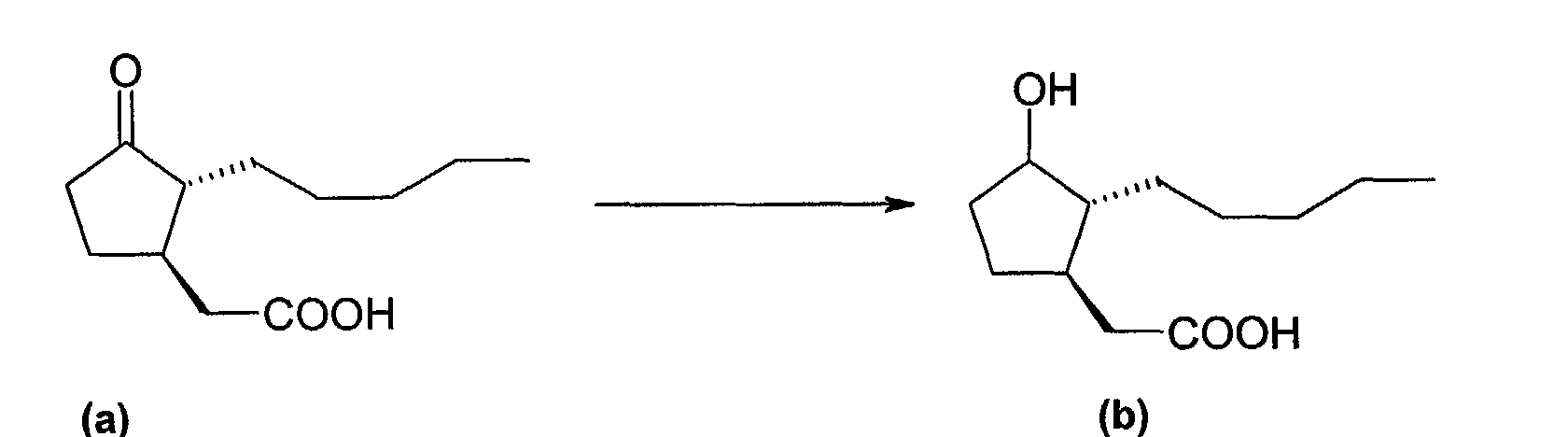
- the carbonyl function of dihydrojasmonate is reduced in ethanol absolute by sodium borohydride.
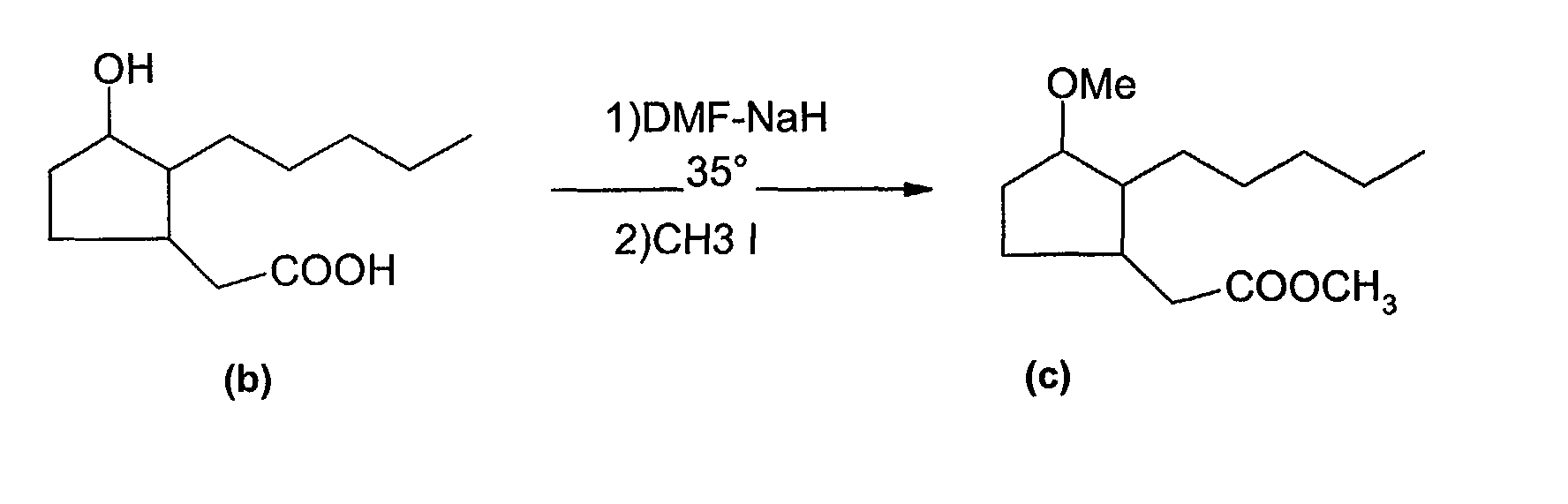
- the alcohol thus formed is then alkylated (in using sodium hydride as a base, in the case of hydroxylated compounds) in anhydrous DMF in the presence of the brominated alkylating agent.
- Ra comprises an amine function
- the amine function is preferably protected in the form of a phthalimide group, the amine function being subsequently deprotected by hydrazine in ethanol, as described in J. Org. Chem., 43, 2320 (1978).
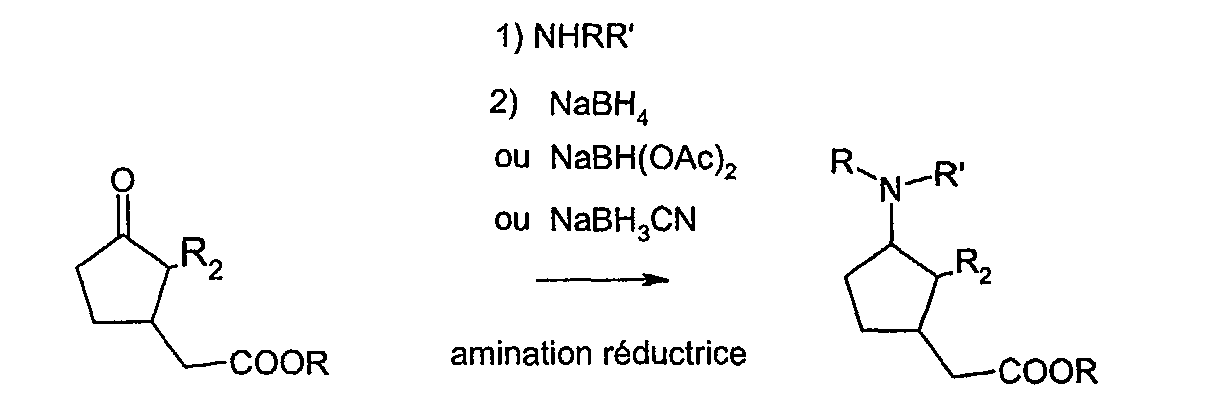
- the compound of formula (I) is such that G denotes a CH-NRR 'group where R and R' denote, independently of one another, a hydrogen atom or a hydrocarbon radical C 1 -C 12 linear, branched or cyclic, saturated or unsaturated, unsubstituted; R 1 is a -COOR radical in which R denotes a hydrogen atom or a linear, branched or cyclic, unsaturated or unsubstituted C 1 -C 12 hydrocarbon radical; and R 2 denotes a hydrocarbon radical, linear or branched, saturated or unsaturated, unsubstituted, having 5 carbon atoms, the radicals R of G and R 1 may be identical or different.
- the compound of formula (I) is such that G denotes a group CH-ORa where Ra denotes a radical -CO-Rd, Rd representing a saturated or unsaturated, linear or branched alkyl, aryl, aralkyl or alkoxy group, containing from 1 to 17 carbon atoms, optionally substituted with one or several hydroxy or methoxy groups
- the compound of formula (I) is such that G denotes a group CYY 'where Y and Y' denote an identical halogen atom or different.
- Examples of such compounds include compounds of formula (II) wherein: G is -CF 2 ; R 1 is a -COOR radical; and R 2 is an n-pentyl radical; and G is -CH-O-CO-CH 2 CH 3 or -CH-O-CO- (C 6 H 4 ) OH; R 1 is a -COOR radical; and R 2 is an n-pentyl radical.
- Examples of compounds of formula (III) are those for which G is selected from the groups: -CH-O-CH 2 -COOH; -CH-O-CH 2 -CH 2 -NH 2 ; and -CH-O-CH 2 -CH (OH) -CH 2 OH; R 1 is a -COOR radical; and R 2 denotes an n-pentyl radical.
- G denotes a CH-O-CH 2 -COOH group
- R 1 is a COOH radical
- R 2 is an n-pentyl radical.
- the subject of the invention is also a composition containing, in a medium physiologically acceptable, at least one compound of formula (II) or (III) such as previously defined.
- this composition is suitable for topical application to the skin or scalp.
- the subject of the present invention is also a cosmetic process for attenuating visible or tactile irregularities of the surface of the skin, in particular to wrinkles and / or skin spots and / or smooth the skin, including the application topically on the skin of a composition containing, in a physiologically at least one (dihydro) jasmonic acid derivative of the formula (I), such as previously defined, and glycerin.
- composition used according to the invention is in particular intended to be applied to the skin of human subjects having a sufficient production of sebum, that is to say a level of sebum at the forehead greater than 100 ⁇ g / cm 2 .
- a physiologically acceptable medium that is to say compatible with the skin and possibly with its integuments (eyelashes, nails, hair) and / or the mucous membranes.
- the amount of (dihydro) jasmonic acid derivative that can be used according to the invention is depending on the desired effect and can therefore vary to a large extent.
- the (dihydro) jasmonic acid derivative can be used in a quantity representing from 0.01% to 20% of the total weight of the composition, preferably in an amount of from 0.1% to 10% of the total weight of the composition and, more preferably, in an amount of from 0.5% to 5% of the total weight of the composition.
- glycerin may represent from 0.1 to 50%, and preferably from 1 to 10%, of the total weight of the composition.
- composition used according to the invention can be in any form galenics normally used in the cosmetic and dermatological fields, and it may especially be in the form of an optionally gelled solution, a dispersion of the lotion type, possibly two-phase, of an emulsion obtained by dispersion of a fatty phase in an aqueous phase (O / W) or vice versa (W / O), or a triple emulsion (W / O / W or H / E / H) or a vesicular dispersion type ionic and / or nonionic.
- These compositions are prepared according to the methods usual. It is preferred to use according to this invention a composition in the form of a oil-in-water emulsion.
- This composition can be more or less fluid and have the appearance of a white cream or colored, an ointment, a milk, a lotion, a serum, a paste, a foam. It can optionally be applied in the form of an aerosol. She can also be in solid form, especially in stick form. She can be used as a care product and / or as a make-up product for the skin.
- the composition used according to the invention may also contain the usual adjuvants in the cosmetic field, such as hydrophilic gelling agents or lipophilic agents, hydrophilic or lipophilic active agents, preservatives, antioxidants, solvents, perfumes, fillers, filters, pigments, odor absorbers and dyestuffs.
- the amounts of these various adjuvants are those classically used in the field in question, and for example from 0.01 to 20% of the total weight of the composition.
- These adjuvants depending on their nature, can be introduced in the fatty phase, in the aqueous phase or in the lipid vesicles. In all these adjuvants, as well as their proportions, will be chosen in such a way as to do not interfere with the desired properties of (dihydro) jasmonic acid derivatives according to the invention.
- the proportion of the fatty phase may range from 5 to 80% by weight, and preferably from 5 to 50% by weight relative to the total weight of the composition.
- Oils, emulsifiers and coemulsifiers used in the emulsion composition are chosen from those conventionally used in the cosmetic field.
- Emulsifier and co-emulsifier are present in the composition in a proportion ranging from 0.3 to 30% by weight, and preferably from 0.5 to 20% by weight relative to the total weight of the composition.
- mineral oils Vaseline
- vegetable oils avocado oil, soybean oil
- oils of animal origin lanolin
- synthetic oils perhydrosqualene
- oils silicone cyclomethicone
- fluorinated oils perfluoropolyethers
- emulsifiers and coemulsifiers usable in the invention mention may be made of for example fatty acid esters of polyethylene glycol such as stearate of PEG-100, and fatty acid esters of glycerin such as glyceryl stearate.
- hydrophilic gelling agents mention may in particular be made of polymers carboxyvinyl (carbomer), acrylic copolymers such as copolymers acrylates / alkylacrylates, polyacrylamides, polysaccharides, gums and clays, and, as lipophilic gelling agents, there may be mentioned clays modified like bentones, dextrin palmitate and hydrophobic silica.
- the keratolytic power of the compound prepared in Example 1 above was studied. This test consisted of counting the corneocytes released after incubation of batches of stratum corneum, isolated by trypsin / heat from surgical plasty, in presence of the test compound.
- stratum corneum discs 4 mm diameter stratum corneum discs were cut out piece and arranged at the bottom of a box of 96 wells. Two different samples of stratum corneum were used.
- a 1% by weight solution of the compound of Example 1 was prepared in a buffer PBS supplemented with 0.1% Triton X100. The pH of the solution was readjusted to 7.4.
- test solution or control solution 50 microliters of test solution or control solution were added to each well. (PBS buffer supplemented with 0.1% TritonX100). The experiment was repeated three times. Incubation was allowed to stir at 37 ° C for 24 hours.
- the number of corneocytes released after incubation of the isolated stratum corneum with the compound according to the invention is much greater than the number released in the presence of the buffer alone.
- composition is prepared in a conventional manner for the skilled person. The quantities are indicated in percentages by weight.
- Compound of Example 1 0.001% methylparaben 0.1% propylparaben 0.1% Lanolin 5% Vaseline oil 4% Sesame oil 4% Cetyl alcohol 5% Glycerol monostearate 2% triethanolamine 1% Propylene glycol 5% Carbomer 940 0.1% Water qsp 100%
Landscapes
- Organic Chemistry (AREA)
- Chemical & Material Sciences (AREA)
- Health & Medical Sciences (AREA)
- Life Sciences & Earth Sciences (AREA)
- General Health & Medical Sciences (AREA)
- Public Health (AREA)
- Veterinary Medicine (AREA)
- Animal Behavior & Ethology (AREA)
- Dermatology (AREA)
- Emergency Medicine (AREA)
- Epidemiology (AREA)
- Birds (AREA)
- Cosmetics (AREA)
- Organic Low-Molecular-Weight Compounds And Preparation Thereof (AREA)
- Nitrogen Condensed Heterocyclic Rings (AREA)
- Macromonomer-Based Addition Polymer (AREA)
- Nitrogen And Oxygen Or Sulfur-Condensed Heterocyclic Ring Systems (AREA)
- Fats And Perfumes (AREA)
Abstract
Description

- un radical hydrocarboné en C1-C12, linéaire, ramifié ou cyclique, saturé ou insaturé, éventuellement substitué par un à cinq groupements, identiques ou différents, choisis parmi -OR", -OCOR", -SR", -SCOR", NR"R"', -NHCOR", halogène, -CN, -COOR",
- COR" avec R" et R"' représentant, indépendamment l'un de l'autre, un atome d'hydrogène, un radical aryle ou un radical hydrocarboné, linéaire ou ramifié, saturé ou insaturé ayant 1 à 4 atomes de carbone ; ou
- un radical -CO-Rd où Rd désigne un groupe alkyle, aryle, aralkyle ou alcoxy saturé ou insaturé, linéaire ou ramifié, renfermant de 1 à 17 atomes de carbone, éventuellement substitués par un ou plusieurs groupes hydroxy ou methoxy ;


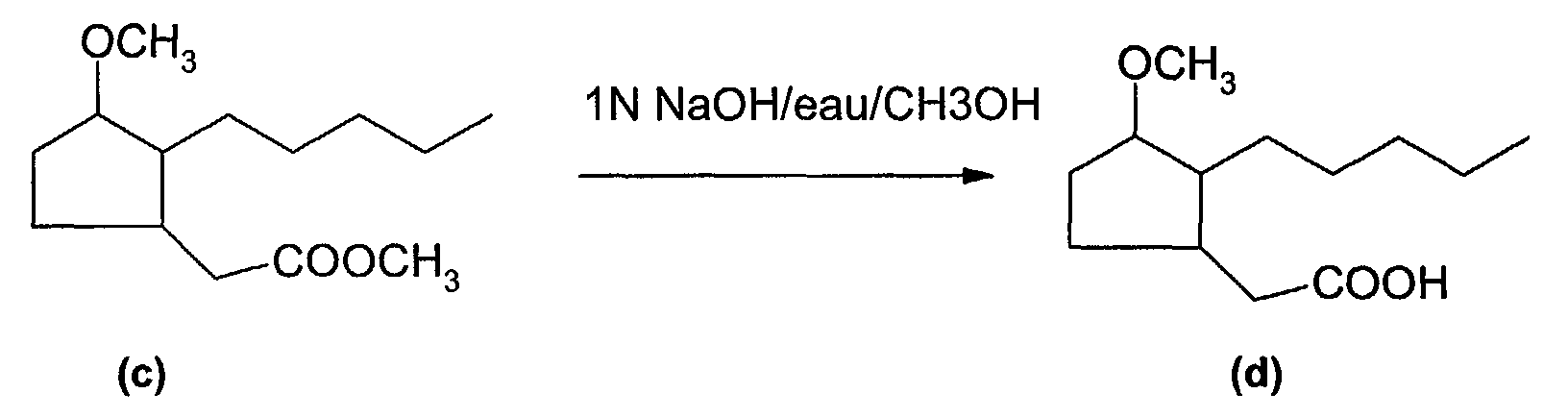
- G est choisi parmi les groupes : CH-OCH3 ; CH-O-CH2-COOH ; CH-O-CH2-CH2-NH2 ; et CH-O-CH2-CH(OH)-CH2OH ; R1 désigne un radical -COOR ; et R2 désigne un radical n-pentyle ; et par exemple G désigne un groupe CH-O-CH2-COOH ; R1 est un radical COOH ; et R2 est un radical n-pentyle
- G désigne un groupe CH-OH ; R1 désigne un radical COO-CH2-CHOH-CH2OH ; et R2 est un radical n-pentyle
- G désigne un groupe CF2 ; R1 est un radical -COOR ; et R2 est un radical n-pentyle
- G désigne un groupe CH-N-(CH3)2 ; R1 est un radical -COOR, par exemple -COOH ou -COO-CH3 ; et R2 est un radical n-pentyle
- G désigne un groupe CH-NH2 ou CH-NHCH3; R1 désigne un radical -COOH
- G désigne un groupe CH-O-CO-CH2CH3 ou CH-O-CO-(C6H4OH),
où :
| Moyenne (3 essais par échantillon) | ||
| Echantillon n°1 | Echantillon n°2 | |
| Composé 1 | 17 ± 6 | 16 ± 6 |
| Témoin | 6 ± 1 | 6 ± 2 |
| Composé de l'Exemple 1 | 0,001 % |
| Méthylparaben | 0,1 % |
| Propylparaben | 0,1 % |
| Lanoline | 5 % |
| Huile de vaseline | 4 % |
| Huile de sésame | 4 % |
| Alcool cétylique | 5 % |
| Monostéarate de glycérol | 2 % |
| Triéthanolamine | 1 % |
| Propylène glycol | 5 % |
| Carbomer 940 | 0,1 % |
| Eau | qsp 100 % |
Claims (23)
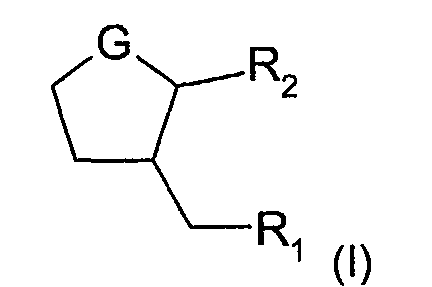
- Utilisation cosmétique comme agent desquamant d'un dérivé d'acide (dihydro)jasmonique choisi parmi les composés de formule (I) :dans laquelle :
 et leurs isomères, stéréoisomères et sels.G désigne un groupe choisi parmi les groupes : CH-ORa ; CH-NRR' ; C=CRbRc, CH-CHRR', CYY' , ;où :
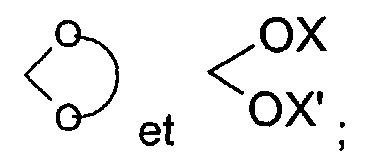 Ra désigne :un radical hydrocarboné en C1-C12, linéaire, ramifié ou cyclique, saturé ou insaturé, éventuellement substitué par un à cinq groupements, identiques ou différents, choisis parmi -OR", -OCOR", -SR", -SCOR", NR"R"', -NHCOR", halogène, -CN, -COOR",COR" avec R" et R"' représentant, indépendamment l'un de l'autre, un atome d'hydrogène, un radical aryle ou un radical hydrocarboné, linéaire ou ramifié, saturé ou insaturé ayant 1 à 4 atomes de carbone ; ouun radical -CO-Rd où Rd désigne un groupe alkyle, aryle, aralkyle ou alcoxy saturé ou insaturé, linéaire ou ramifié, renfermant de 1 à 17 atomes de carbone, éventuellement substitués par un ou plusieurs groupes hydroxy ou methoxy ;Rb et Rc désignent indépendamment l'un de l'autre un groupe R ou un groupe -COORe où Re est un radical hydrocarboné en C1-C4 ;R et R' désignent indépendamment l'un de l'autre un atome d'hydrogène ou un radical hydrocarboné en C1-C12, linéaire, ramifié ou cyclique, saturé ou insaturé, éventuellement substitué par un à cinq groupements, identiques ou différents, choisis parmi -OR", -OCOR", -SR", -SCOR", NR"R"', -NHCOR", halogène, -CN, -COOR", - COR" avec R" et R"' représentant, indépendamment l'un de l'autre, un atome d'hydrogène, un radical aryle ou un radical hydrocarboné, linéaire ou ramifié, saturé ou insaturé ayant 1 à 4 atomes de carbone, ou R et R' forment un cycle avec l'atome auquel ils sont reliés ;les pointillés désignent un radical hydrocarboné divalent, saturé ou insaturé, comportant de 2 à 3 atomes de carbone, éventuellement substitué par un radical alkyle en C1-C6 ou par un radical aryle ;X et X' désignent, indépendamment l'un de l'autre, un radical hydrocarboné saturé ou insaturé, comportant de 1 à 3 atomes de carbone ;Y et Y' désignent un atome d'halogène, identique ou différent ;R1 est un radical choisi parmi -COOR, -CONRR', -CH2OR, -COR, -CH2R', -SO2OR, -PO3RR', -NHR et -NRR', où R et R' ont la signification indiquée précédemment ;R2 est un radical hydrocarboné, linéaire, ramifié ou cyclique, saturé ou insaturé, en C1-C18, éventuellement substitué par 1 à 5 groupements, identiques ou différents, choisis parmi -OR", -OCOR", -SR", -SCOR", NR"R"', -NHCOR", -halogène, -CN, -COOR", - COR" où R" et R"' ont la signification indiquée précédemment,
 - Utilisation selon la revendication 1, caractérisée en ce que le composé de formule (I) est tel que G désigne un groupe CH-OH ; R1 désigne un radical COO-CH2-CHOH-CH2OH ; et R2 est un radical n-pentyle.
- Utilisation selon la revendication 1, caractérisée en ce que le composé de formule (I) est tel que G désigne un groupe -CH-ORa où Ra est un radical hydrocarboné en C1-C6, linéaire ou ramifié, éventuellement substitué par un ou plusieurs groupements -OH, -COOH et -NH2, identiques ou différents ; R1 est un radical -COOR où R désigne un atome d'hydrogène ou un radical hydrocarboné en C1-C12, linéaire, ramifié ou cyclique, saturé ou insaturé, non substitué ; et R2 désigne un radical hydrocarboné, linéaire ou ramifié, saturé ou insaturé, non substitué, comportant 5 atomes de carbone.
- Utilisation selon la revendication 3, caractérisée en ce que le composé de formule (I) est tel que : G est choisi parmi les groupes : CH-OCH3 ; CH-O-CH2-COOH ; CH-O-CH2-CH2-NH2 ; et CH-O-CH2-CH(OH)-CH2OH ; R1 désigne un radical -COOR ; et R2 désigne un radical n-pentyle.
- Utilisation selon la revendication 4, caractérisée en ce que le composé de formule (I) est tel que : G désigne un groupe CH-O-CH2-COOH ; R1 est un radical COOH ; et R2 est un radical n-pentyle.
- Utilisation selon la revendication 1, caractérisée en ce que le composé de formule (I) est tel que G désigne un groupe CH-NRR' où R et R' désignent indépendamment l'un de l'autre un atome d'hydrogène ou un radical hydrocarboné en C1-C12, linéaire, ramifié ou cyclique, saturé ou insaturé, non substitué ; R1 est un radical -COOR où R désigne un atome d'hydrogène ou un radical hydrocarboné en C1-C12, linéaire, ramifié ou cyclique, saturé ou insaturé, non substitué ; et R2 désigne un radical hydrocarboné, linéaire ou ramifié, saturé ou insaturé, non substitué, comportant 5 atomes de carbone, les radicaux R de G et de R1 pouvant être identiques ou différents.
- Utilisation selon la revendication 6, caractérisée en ce que le composé de formule (I) est tel que : G désigne un groupe CH-NH2 ; R1 désigne un radical -COOH ; et R2 désigne un radical n-pentyle.
- Utilisation selon la revendication 6, caractérisée en ce que le composé de formule (I) est tel que : G désigne un groupe CH-NHCH3 ; R1 désigne un radical -COOH ; et R2 désigne un radical n-pentyle.
- Utilisation selon la revendication 6, caractérisée en ce que le composé de formule (I) est tel que : G désigne un groupe CH-N(CH3)2 ; R1 désigne un radical -COOH ou -COO-CH3 ; et R2 désigne un radical n-pentyle.
- Utilisation selon la revendication 1, caractérisée en ce que le composé de formule (I) est tel que G désigne un groupe CH-ORa où Ra désigne un radical -CO-Rd, Rd représentant un groupe alkyle, aryle, aralkyle ou alcoxy saturé ou insaturé, linéaire ou ramifié, renfermant de 1 à 17 atomes de carbone, éventuellement substitués par un ou plusieurs groupes hydroxy ou methoxy.
- Utilisation selon la revendication 10, caractérisée en ce que le composé de formule (I) est tel que G désigne un groupe CH-O-CO-CH2CH3 ou CH-O-CO-(C6H4OH).
- Utilisation selon la revendication 1, caractérisée en ce que le composé de formule (I) est tel que G désigne un groupe CYY' où Y et Y' désignent un atome d'halogène identique ou différent.
- Utilisation selon la revendication 12, caractérisée en ce que le composé de formule (I) est tel que : G désigne un groupe CF2; R1 est un radical -COOR ; et R2 est un radical n-pentyle.
- Procédé cosmétique pour atténuer les irrégularités visibles ou tactiles de la surface de la peau, en particulier pour atténuer les rides et ridules et/ou les taches cutanées et/ou lisser la peau, comprenant l'application topique sur la peau d'une composition renfermant, dans un milieu physiologiquement acceptable, au moins un dérivé d'acide (dihydro)jasmonique de formule (I), tel que défini dans l'une quelconque des revendications 1 à 13, et de la glycérine.
- Procédé selon la revendication 14, caractérisé en ce que la composition est destinée à être appliquée sur la peau de sujets humains ayant un taux de sébum au niveau du front supérieur à 100 µg/cm2.
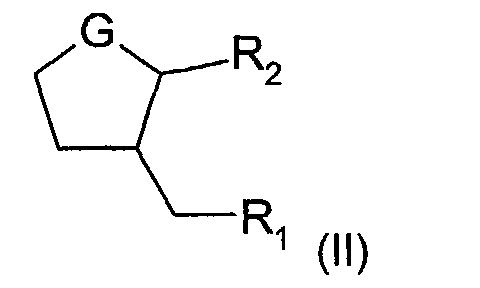
- Dérivé d'acide (dihydro)jasmonique caractérisé en ce qu'il est choisi parmi les composés de formule (II) :dans laquelle :
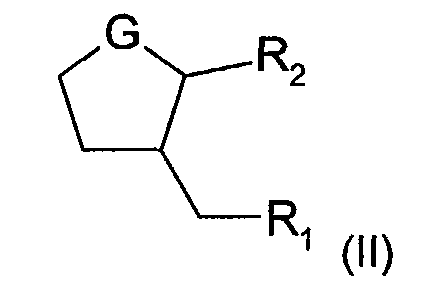 et leurs isomères, stéréoisomères et sels.G désigne un groupe choisi parmi les groupes : CH-ORa ; C=CRbRc, et CYY' ;
où :Ra est un radical -CO-Rd où Rd désigne un groupe alkyle, aryle, aralkyle ou alcoxy saturé ou insaturé, linéaire ou ramifié, renfermant de 2 à 17 atomes de carbone, éventuellement substitués par un ou plusieurs groupes hydroxy ou methoxy ;Rb désigne un groupe -COORe où Re est un radical hydrocarboné en C1-C4 ;Rc désigne un atome d'hydrogène ou un radical hydrocarboné en C1-C12, linéaire, ramifié ou cyclique, saturé ou insaturé, éventuellement substitué par un à cinq groupements, identiques ou différents, choisis parmi -OR", -OCOR", -SR", -SCOR", NR"R'", -NHCOR", halogène, -CN, -COOR", -COR" avec R" et R"' représentant, indépendamment l'un de l'autre, un atome d'hydrogène, un radical aryle ou un radical hydrocarboné, linéaire ou ramifié, saturé ou insaturé ayant 1 à 4 atomes de carbone ;Y et Y' désignent un atome d'halogène, identique ou différent ;R1 est un radical choisi parmi -COOR, -CONRR', -CH2OR, -COR, -CH2R', -SO2OR, -PO3RR', -NHR et -NRR' ;R2 est un radical hydrocarboné, linéaire, ramifié ou cyclique, saturé ou insaturé, en C1-C18, éventuellement substitué par 1 à 5 groupements, identiques ou différents, choisis parmi -OR", -OCOR", -SR", -SCOR", NR"R"', -NHCOR", -halogène, -CN, -COOR", - COR" ;R et R' désignent indépendamment l'un de l'autre un atome d'hydrogène ou un radical hydrocarboné en C1-C12, linéaire, ramifié ou cyclique, saturé ou insaturé, éventuellement substitué par un à cinq groupements, identiques ou différents, choisis parmi -OR", -OCOR", -SR", -SCOR", NR"R'", -NHCOR", halogène, -CN, -COOR", - COR" avec R" et R"' représentant, indépendamment l'un de l'autre, un atome d'hydrogène, un radical aryle ou un radical hydrocarboné, linéaire ou ramifié, saturé ou insaturé ayant 1 à 4 atomes de carbone, ou R et R' forment un cycle avec l'atome auquel ils sont reliés, - Dérivé selon la revendication 16, caractérisé en ce que G désigne un groupe -CF2 ; R1 est un radical -COOR ; et R2 est un radical n-pentyle.
- Dérivé selon la revendication 16, caractérisé en ce que G désigne un groupe -CH-O-CO-CH2CH3 ou -CH-O-CO-(C6H4)OH ; R1 est un radical -COOR ; et R2 est un radical n-pentyle.
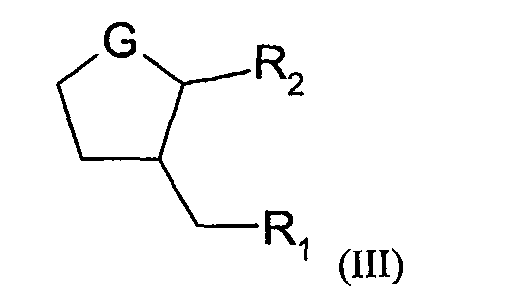
- Dérivé d'acide (dihydro)jasmonique, caractérisé en ce qu'il est choisi parmi les composés de formule (III) :dans laquelle :
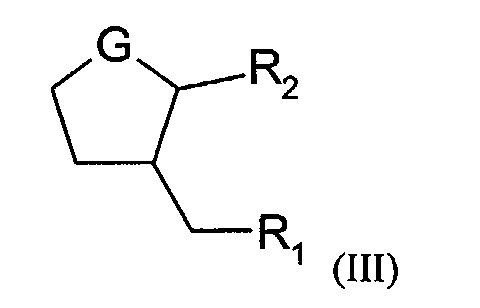 G désigne un groupe -CH-OR' où R' est un radical hydrocarboné en C1-C6, linéaire ou ramifié, substitué par un ou plusieurs groupements -OH, -COOH et -NH2, identiques
ou différents ;R1 est un radical -COOR où R désigne un atome d'hydrogène ou un radical hydrocarboné en C1-C12, linéaire, ramifié ou cyclique, saturé ou insaturé, non substitué ;R2 est un radical hydrocarboné, linéaire, ramifié ou cyclique, saturé ou insaturé, en C1-C18, éventuellement substitué par 1 à 5 groupements, identiques ou différents, choisis parmi -OR", -OCOR", -SR", -SCOR", NR"R"', -NHCOR", -halogène, -CN, -COOR", - COR" avec R" et R"' représentant, indépendamment l'un de l'autre, un atome d'hydrogène, un radical aryle ou un radical hydrocarboné, linéaire ou ramifié, saturé ou insaturé ayant 1 à 4 atomes de carbone.et leurs isomères, stéréoisomères et sels. - Dérivés selon la revendication 19, caractérisés en ce que G est choisi parmi les groupes : -CH-O-CH2-COOH ; -CH-O-CH2-CH2-NH2 ; et -CH-O-CH2-CH(OH)-CH2OH ; R1 est un radical -COOR ; et R2 désigne un radical n-pentyle.
- Dérivé selon la revendication 19 ou 20, caractérisé en ce qu'il est tel que : G désigne un groupe CH-O-CH2-COOH ; R1 est un radical COOH ; et R2 est un radical n-pentyle.
- Composition renfermant, dans un milieu physiologiquement acceptable, au moins un composé de formule (II) ou (III) tel que défini dans l'une quelconque des revendications 16 à 21.
- Composition selon la revendication 22, caractérisée en ce qu'elle est adaptée à une application topique sur la peau ou le cuir chevelu.
Applications Claiming Priority (2)
| Application Number | Priority Date | Filing Date | Title |
|---|---|---|---|
| FR0309233 | 2003-07-28 | ||
| FR0309233A FR2858320B1 (fr) | 2003-07-28 | 2003-07-28 | Utilisation d'un derive d'acide (dihydro)jasmonique comme agent desquamant. |
Publications (2)
| Publication Number | Publication Date |
|---|---|
| EP1502909A1 true EP1502909A1 (fr) | 2005-02-02 |
| EP1502909B1 EP1502909B1 (fr) | 2011-03-09 |
Family
ID=33523005
Family Applications (1)
| Application Number | Title | Priority Date | Filing Date |
|---|---|---|---|
| EP04291789A Expired - Lifetime EP1502909B1 (fr) | 2003-07-28 | 2004-07-13 | Utilisation d'un dérivé d'acide (dihydro)jasmonique comme agent desquamant |
Country Status (6)
| Country | Link |
|---|---|
| EP (1) | EP1502909B1 (fr) |
| JP (1) | JP3955585B2 (fr) |
| AT (1) | ATE501109T1 (fr) |
| DE (1) | DE602004031696D1 (fr) |
| ES (1) | ES2360393T3 (fr) |
| FR (1) | FR2858320B1 (fr) |
Cited By (5)
| Publication number | Priority date | Publication date | Assignee | Title |
|---|---|---|---|---|
| EP2223680A2 (fr) | 2008-12-30 | 2010-09-01 | L'Oréal | Association de monosaccharides et d'agents desquamants et son utilisation en cosmétique |
| FR2947447A1 (fr) * | 2009-07-02 | 2011-01-07 | Oreal | Methode de peeling cosmetique |
| WO2012022899A2 (fr) | 2010-07-28 | 2012-02-23 | L'oreal | Procédé pour diminuer les hyperpigmentations post-réactionnelles |
| WO2012117340A1 (fr) | 2011-03-01 | 2012-09-07 | L'oreal | Procédé pour le traitement cosmétique d'une rougeur de la peau |
| FR3033559A1 (fr) * | 2015-03-13 | 2016-09-16 | Oreal | Procede de synthese de nouveaux composes derives d'acide 3-hydroxy-cyclopentyl acetique |
Citations (6)
| Publication number | Priority date | Publication date | Assignee | Title |
|---|---|---|---|---|
| WO1993010756A1 (fr) * | 1991-11-25 | 1993-06-10 | Richardson-Vicks, Inc. | Emploi d'acide salicylique contre les rides et/ou l'atrophie cutanee |
| EP0585104A1 (fr) * | 1992-08-25 | 1994-03-02 | Japan Tobacco Inc. | Méthode de préparation d'un composé hydrocarboné monocyclique saturé et un intermédiaire pour celle-ci |
| JP2001199832A (ja) | 2000-01-13 | 2001-07-24 | Pola Chem Ind Inc | 角層の剥離・代謝正常化香料組成物 |
| JP2001207188A (ja) | 2000-01-28 | 2001-07-31 | Pola Chem Ind Inc | 過酸化脂質消去用の香料組成物 |
| EP1333022A2 (fr) * | 2002-02-04 | 2003-08-06 | L'oreal | Compositions comprenant des dérivés du cyclopentane, et utilisation pour favoriser la desquamation |
| EP1333021A2 (fr) * | 2002-02-04 | 2003-08-06 | L'oreal | Compositions comprenant des dérivés de l'acide jasmonique, et utilisation de ces dérivés pour favoriser la desquamation |
-
2003
- 2003-07-28 FR FR0309233A patent/FR2858320B1/fr not_active Expired - Fee Related
-
2004
- 2004-07-13 DE DE602004031696T patent/DE602004031696D1/de not_active Expired - Lifetime
- 2004-07-13 EP EP04291789A patent/EP1502909B1/fr not_active Expired - Lifetime
- 2004-07-13 ES ES04291789T patent/ES2360393T3/es not_active Expired - Lifetime
- 2004-07-13 AT AT04291789T patent/ATE501109T1/de not_active IP Right Cessation
- 2004-07-27 JP JP2004219010A patent/JP3955585B2/ja not_active Expired - Fee Related
Patent Citations (8)
| Publication number | Priority date | Publication date | Assignee | Title |
|---|---|---|---|---|
| WO1993010756A1 (fr) * | 1991-11-25 | 1993-06-10 | Richardson-Vicks, Inc. | Emploi d'acide salicylique contre les rides et/ou l'atrophie cutanee |
| EP0585104A1 (fr) * | 1992-08-25 | 1994-03-02 | Japan Tobacco Inc. | Méthode de préparation d'un composé hydrocarboné monocyclique saturé et un intermédiaire pour celle-ci |
| JP2001199832A (ja) | 2000-01-13 | 2001-07-24 | Pola Chem Ind Inc | 角層の剥離・代謝正常化香料組成物 |
| JP2001207188A (ja) | 2000-01-28 | 2001-07-31 | Pola Chem Ind Inc | 過酸化脂質消去用の香料組成物 |
| EP1333022A2 (fr) * | 2002-02-04 | 2003-08-06 | L'oreal | Compositions comprenant des dérivés du cyclopentane, et utilisation pour favoriser la desquamation |
| EP1333021A2 (fr) * | 2002-02-04 | 2003-08-06 | L'oreal | Compositions comprenant des dérivés de l'acide jasmonique, et utilisation de ces dérivés pour favoriser la desquamation |
| FR2835526A1 (fr) | 2002-02-04 | 2003-08-08 | Oreal | Nouveaux composes, compositions les comprenant et leur utilisation pour favoriser la desquamation |
| FR2835525A1 (fr) | 2002-02-04 | 2003-08-08 | Oreal | Nouveaux composes, compositions les comprenant et leur utilisation pour favoriser la desquamation |
Cited By (9)
| Publication number | Priority date | Publication date | Assignee | Title |
|---|---|---|---|---|
| EP2223680A2 (fr) | 2008-12-30 | 2010-09-01 | L'Oréal | Association de monosaccharides et d'agents desquamants et son utilisation en cosmétique |
| FR2947447A1 (fr) * | 2009-07-02 | 2011-01-07 | Oreal | Methode de peeling cosmetique |
| WO2012022899A2 (fr) | 2010-07-28 | 2012-02-23 | L'oreal | Procédé pour diminuer les hyperpigmentations post-réactionnelles |
| WO2012117340A1 (fr) | 2011-03-01 | 2012-09-07 | L'oreal | Procédé pour le traitement cosmétique d'une rougeur de la peau |
| FR3033559A1 (fr) * | 2015-03-13 | 2016-09-16 | Oreal | Procede de synthese de nouveaux composes derives d'acide 3-hydroxy-cyclopentyl acetique |
| WO2016146588A1 (fr) * | 2015-03-13 | 2016-09-22 | L'oreal | Procede de synthese de nouveaux composes derives d'acide 3-hydroxy-cyclopentyl acetique |
| US10654788B2 (en) | 2015-03-13 | 2020-05-19 | L'oreal | Method for synthesizing novel compounds derived from 3-hydroxy-cyclopentyl acetic acid |
| RU2726412C2 (ru) * | 2015-03-13 | 2020-07-14 | Л'Ореаль | Способ синтеза новых соединений, полученных из 3-гидроксициклопентилуксусной кислоты |
| US10995051B2 (en) | 2015-03-13 | 2021-05-04 | L'oreal | Method for synthesizing novel compounds derived from 3-hydroxy-cylopentyl acetic acid |
Also Published As
| Publication number | Publication date |
|---|---|
| EP1502909B1 (fr) | 2011-03-09 |
| JP3955585B2 (ja) | 2007-08-08 |
| DE602004031696D1 (de) | 2011-04-21 |
| ATE501109T1 (de) | 2011-03-15 |
| ES2360393T3 (es) | 2011-06-03 |
| JP2005047917A (ja) | 2005-02-24 |
| FR2858320A1 (fr) | 2005-02-04 |
| FR2858320B1 (fr) | 2005-09-02 |
Similar Documents
| Publication | Publication Date | Title |
|---|---|---|
| EP3168206B1 (fr) | Compositions comprenant des derives de l'acide jasmonique, et utilisation de ces derives pour favoriser la desquamation | |
| FR2746397A1 (fr) | Nouveaux derives silicies de l'acide salicylique a proprietes desquamantes | |
| US8461206B2 (en) | Use of at least one (dihydro)jasmonic acid derivative for treating dry skin | |
| EP1333022B1 (fr) | Compositions comprenant des dérivés du cyclopentane, et utilisation pour favoriser la desquamation | |
| FR2783517A1 (fr) | Nouveaux derives de l'acide 10-hyroxy-2-decenoique et utilisation dans une composition destinee a favoriser la desquamation de la peau, et composition le comprenant | |
| FR2762839A1 (fr) | Nouveaux derives de l'acide salicylique et leur utilisation dans une composition cosmetique et/ou dermatologique | |
| EP1442737B1 (fr) | Utilisation d'un dérivé d'acide (dihydro)jasmonique pour le traitement des peaux sèches | |
| EP0968221B1 (fr) | Nouveaux derives de l'acide salicylique et leur utilisation dans les compositions cosmetiques ou dermatologiques | |
| EP1502909B1 (fr) | Utilisation d'un dérivé d'acide (dihydro)jasmonique comme agent desquamant | |
| EP0819692A1 (fr) | Nouveau dérivé de l'acide kojique et son utilisation comme agent dépigmentant | |
| EP0677288B1 (fr) | Composition cosmétique ou pharmaceutique contenant un carbamate d'alkyle en tant qu'agent hydratant | |
| JP2022105049A (ja) | 3-ヒドロキシシクロペンチル酢酸から誘導される新規化合物の合成方法 | |
| EP0705599B1 (fr) | Utilisation de N-(hydroxyalkyl) carbamates d'alkyle dans une composition cosmétique en tant que tensioactifs | |
| EP1466590B1 (fr) | Utilisation cosmétique de nouveaux agents desquamants | |
| EP2838889B1 (fr) | Acide lichestérinique et ses dérivés comme inhibiteurs de pigmentation | |
| FR3015237A1 (fr) | Utilisation de derives de l'acide salicylique a titre d'actif prodesquamant | |
| FR3066492A1 (fr) | Derives de resorcinol pour leur utilisation cosmetique | |
| FR3029912A1 (fr) | Nouveaux derives de resveratrol pour lutter contre le vieillissement cutane, compositions et utilisation en cosmetique |
Legal Events
| Date | Code | Title | Description |
|---|---|---|---|
| PUAI | Public reference made under article 153(3) epc to a published international application that has entered the european phase |
Free format text: ORIGINAL CODE: 0009012 |
|
| AK | Designated contracting states |
Kind code of ref document: A1 Designated state(s): AT BE BG CH CY CZ DE DK EE ES FI FR GB GR HU IE IT LI LU MC NL PL PT RO SE SI SK TR |
|
| AX | Request for extension of the european patent |
Extension state: AL HR LT LV MK |
|
| 17P | Request for examination filed |
Effective date: 20050802 |
|
| AKX | Designation fees paid |
Designated state(s): AT BE BG CH CY CZ DE DK EE ES FI FR GB GR HU IE IT LI LU MC NL PL PT RO SE SI SK TR |
|
| 17Q | First examination report despatched |
Effective date: 20070420 |
|
| GRAP | Despatch of communication of intention to grant a patent |
Free format text: ORIGINAL CODE: EPIDOSNIGR1 |
|
| GRAS | Grant fee paid |
Free format text: ORIGINAL CODE: EPIDOSNIGR3 |
|
| GRAA | (expected) grant |
Free format text: ORIGINAL CODE: 0009210 |
|
| AK | Designated contracting states |
Kind code of ref document: B1 Designated state(s): AT BE BG CH CY CZ DE DK EE ES FI FR GB GR HU IE IT LI LU MC NL PL PT RO SE SI SK TR |
|
| REG | Reference to a national code |
Ref country code: GB Ref legal event code: FG4D Free format text: NOT ENGLISH |
|
| REG | Reference to a national code |
Ref country code: CH Ref legal event code: EP |
|
| REG | Reference to a national code |
Ref country code: IE Ref legal event code: FG4D Free format text: LANGUAGE OF EP DOCUMENT: FRENCH |
|
| REF | Corresponds to: |
Ref document number: 602004031696 Country of ref document: DE Date of ref document: 20110421 Kind code of ref document: P |
|
| REG | Reference to a national code |
Ref country code: DE Ref legal event code: R096 Ref document number: 602004031696 Country of ref document: DE Effective date: 20110421 |
|
| REG | Reference to a national code |
Ref country code: ES Ref legal event code: FG2A Ref document number: 2360393 Country of ref document: ES Kind code of ref document: T3 Effective date: 20110603 |
|
| REG | Reference to a national code |
Ref country code: NL Ref legal event code: VDEP Effective date: 20110309 |
|
| PG25 | Lapsed in a contracting state [announced via postgrant information from national office to epo] |
Ref country code: GR Free format text: LAPSE BECAUSE OF FAILURE TO SUBMIT A TRANSLATION OF THE DESCRIPTION OR TO PAY THE FEE WITHIN THE PRESCRIBED TIME-LIMIT Effective date: 20110610 Ref country code: SE Free format text: LAPSE BECAUSE OF FAILURE TO SUBMIT A TRANSLATION OF THE DESCRIPTION OR TO PAY THE FEE WITHIN THE PRESCRIBED TIME-LIMIT Effective date: 20110309 |
|
| PG25 | Lapsed in a contracting state [announced via postgrant information from national office to epo] |
Ref country code: AT Free format text: LAPSE BECAUSE OF FAILURE TO SUBMIT A TRANSLATION OF THE DESCRIPTION OR TO PAY THE FEE WITHIN THE PRESCRIBED TIME-LIMIT Effective date: 20110309 Ref country code: BG Free format text: LAPSE BECAUSE OF FAILURE TO SUBMIT A TRANSLATION OF THE DESCRIPTION OR TO PAY THE FEE WITHIN THE PRESCRIBED TIME-LIMIT Effective date: 20110609 Ref country code: CY Free format text: LAPSE BECAUSE OF FAILURE TO SUBMIT A TRANSLATION OF THE DESCRIPTION OR TO PAY THE FEE WITHIN THE PRESCRIBED TIME-LIMIT Effective date: 20110309 Ref country code: SI Free format text: LAPSE BECAUSE OF FAILURE TO SUBMIT A TRANSLATION OF THE DESCRIPTION OR TO PAY THE FEE WITHIN THE PRESCRIBED TIME-LIMIT Effective date: 20110309 Ref country code: NL Free format text: LAPSE BECAUSE OF FAILURE TO SUBMIT A TRANSLATION OF THE DESCRIPTION OR TO PAY THE FEE WITHIN THE PRESCRIBED TIME-LIMIT Effective date: 20110309 Ref country code: FI Free format text: LAPSE BECAUSE OF FAILURE TO SUBMIT A TRANSLATION OF THE DESCRIPTION OR TO PAY THE FEE WITHIN THE PRESCRIBED TIME-LIMIT Effective date: 20110309 |
|
| REG | Reference to a national code |
Ref country code: IE Ref legal event code: FD4D |
|
| PG25 | Lapsed in a contracting state [announced via postgrant information from national office to epo] |
Ref country code: PT Free format text: LAPSE BECAUSE OF FAILURE TO SUBMIT A TRANSLATION OF THE DESCRIPTION OR TO PAY THE FEE WITHIN THE PRESCRIBED TIME-LIMIT Effective date: 20110711 Ref country code: IE Free format text: LAPSE BECAUSE OF FAILURE TO SUBMIT A TRANSLATION OF THE DESCRIPTION OR TO PAY THE FEE WITHIN THE PRESCRIBED TIME-LIMIT Effective date: 20110309 Ref country code: EE Free format text: LAPSE BECAUSE OF FAILURE TO SUBMIT A TRANSLATION OF THE DESCRIPTION OR TO PAY THE FEE WITHIN THE PRESCRIBED TIME-LIMIT Effective date: 20110309 |
|
| PG25 | Lapsed in a contracting state [announced via postgrant information from national office to epo] |
Ref country code: RO Free format text: LAPSE BECAUSE OF FAILURE TO SUBMIT A TRANSLATION OF THE DESCRIPTION OR TO PAY THE FEE WITHIN THE PRESCRIBED TIME-LIMIT Effective date: 20110309 Ref country code: SK Free format text: LAPSE BECAUSE OF FAILURE TO SUBMIT A TRANSLATION OF THE DESCRIPTION OR TO PAY THE FEE WITHIN THE PRESCRIBED TIME-LIMIT Effective date: 20110309 Ref country code: CZ Free format text: LAPSE BECAUSE OF FAILURE TO SUBMIT A TRANSLATION OF THE DESCRIPTION OR TO PAY THE FEE WITHIN THE PRESCRIBED TIME-LIMIT Effective date: 20110309 |
|
| PLBE | No opposition filed within time limit |
Free format text: ORIGINAL CODE: 0009261 |
|
| STAA | Information on the status of an ep patent application or granted ep patent |
Free format text: STATUS: NO OPPOSITION FILED WITHIN TIME LIMIT |
|
| BERE | Be: lapsed |
Owner name: L'OREAL Effective date: 20110731 |
|
| 26N | No opposition filed |
Effective date: 20111212 |
|
| PG25 | Lapsed in a contracting state [announced via postgrant information from national office to epo] |
Ref country code: DK Free format text: LAPSE BECAUSE OF FAILURE TO SUBMIT A TRANSLATION OF THE DESCRIPTION OR TO PAY THE FEE WITHIN THE PRESCRIBED TIME-LIMIT Effective date: 20110309 Ref country code: PL Free format text: LAPSE BECAUSE OF FAILURE TO SUBMIT A TRANSLATION OF THE DESCRIPTION OR TO PAY THE FEE WITHIN THE PRESCRIBED TIME-LIMIT Effective date: 20110309 Ref country code: MC Free format text: LAPSE BECAUSE OF NON-PAYMENT OF DUE FEES Effective date: 20110731 |
|
| REG | Reference to a national code |
Ref country code: CH Ref legal event code: PL |
|
| REG | Reference to a national code |
Ref country code: DE Ref legal event code: R097 Ref document number: 602004031696 Country of ref document: DE Effective date: 20111212 |
|
| PG25 | Lapsed in a contracting state [announced via postgrant information from national office to epo] |
Ref country code: BE Free format text: LAPSE BECAUSE OF NON-PAYMENT OF DUE FEES Effective date: 20110731 Ref country code: CH Free format text: LAPSE BECAUSE OF NON-PAYMENT OF DUE FEES Effective date: 20110731 Ref country code: LI Free format text: LAPSE BECAUSE OF NON-PAYMENT OF DUE FEES Effective date: 20110731 |
|
| PG25 | Lapsed in a contracting state [announced via postgrant information from national office to epo] |
Ref country code: LU Free format text: LAPSE BECAUSE OF NON-PAYMENT OF DUE FEES Effective date: 20110713 |
|
| PG25 | Lapsed in a contracting state [announced via postgrant information from national office to epo] |
Ref country code: TR Free format text: LAPSE BECAUSE OF FAILURE TO SUBMIT A TRANSLATION OF THE DESCRIPTION OR TO PAY THE FEE WITHIN THE PRESCRIBED TIME-LIMIT Effective date: 20110309 |
|
| PG25 | Lapsed in a contracting state [announced via postgrant information from national office to epo] |
Ref country code: HU Free format text: LAPSE BECAUSE OF FAILURE TO SUBMIT A TRANSLATION OF THE DESCRIPTION OR TO PAY THE FEE WITHIN THE PRESCRIBED TIME-LIMIT Effective date: 20110309 |
|
| REG | Reference to a national code |
Ref country code: FR Ref legal event code: PLFP Year of fee payment: 13 |
|
| REG | Reference to a national code |
Ref country code: FR Ref legal event code: PLFP Year of fee payment: 14 |
|
| REG | Reference to a national code |
Ref country code: FR Ref legal event code: PLFP Year of fee payment: 15 |
|
| PGFP | Annual fee paid to national office [announced via postgrant information from national office to epo] |
Ref country code: FR Payment date: 20190619 Year of fee payment: 16 |
|
| PGFP | Annual fee paid to national office [announced via postgrant information from national office to epo] |
Ref country code: DE Payment date: 20190702 Year of fee payment: 16 Ref country code: IT Payment date: 20190719 Year of fee payment: 16 Ref country code: ES Payment date: 20190801 Year of fee payment: 16 |
|
| PGFP | Annual fee paid to national office [announced via postgrant information from national office to epo] |
Ref country code: GB Payment date: 20190710 Year of fee payment: 16 |
|
| REG | Reference to a national code |
Ref country code: DE Ref legal event code: R119 Ref document number: 602004031696 Country of ref document: DE |
|
| GBPC | Gb: european patent ceased through non-payment of renewal fee |
Effective date: 20200713 |
|
| PG25 | Lapsed in a contracting state [announced via postgrant information from national office to epo] |
Ref country code: GB Free format text: LAPSE BECAUSE OF NON-PAYMENT OF DUE FEES Effective date: 20200713 Ref country code: FR Free format text: LAPSE BECAUSE OF NON-PAYMENT OF DUE FEES Effective date: 20200731 |
|
| PG25 | Lapsed in a contracting state [announced via postgrant information from national office to epo] |
Ref country code: DE Free format text: LAPSE BECAUSE OF NON-PAYMENT OF DUE FEES Effective date: 20210202 |
|
| PG25 | Lapsed in a contracting state [announced via postgrant information from national office to epo] |
Ref country code: IT Free format text: LAPSE BECAUSE OF NON-PAYMENT OF DUE FEES Effective date: 20200713 |
|
| REG | Reference to a national code |
Ref country code: ES Ref legal event code: FD2A Effective date: 20211228 |
|
| PG25 | Lapsed in a contracting state [announced via postgrant information from national office to epo] |
Ref country code: ES Free format text: LAPSE BECAUSE OF NON-PAYMENT OF DUE FEES Effective date: 20200714 |