EP1503610A2 - Steuerungssystem und Mehrfachzugriffsverfahren in einem drahtlosen Kommunikationssystem - Google Patents
Steuerungssystem und Mehrfachzugriffsverfahren in einem drahtlosen Kommunikationssystem Download PDFInfo
- Publication number
- EP1503610A2 EP1503610A2 EP04018306A EP04018306A EP1503610A2 EP 1503610 A2 EP1503610 A2 EP 1503610A2 EP 04018306 A EP04018306 A EP 04018306A EP 04018306 A EP04018306 A EP 04018306A EP 1503610 A2 EP1503610 A2 EP 1503610A2
- Authority
- EP
- European Patent Office
- Prior art keywords
- base station
- wireless terminal
- time
- wireless
- reverse
- Prior art date
- Legal status (The legal status is an assumption and is not a legal conclusion. Google has not performed a legal analysis and makes no representation as to the accuracy of the status listed.)
- Granted
Links
Images



Classifications
-
- H—ELECTRICITY
- H04—ELECTRIC COMMUNICATION TECHNIQUE
- H04B—TRANSMISSION
- H04B7/00—Radio transmission systems, i.e. using radiation field
- H04B7/14—Relay systems
- H04B7/15—Active relay systems
- H04B7/204—Multiple access
-
- H—ELECTRICITY
- H04—ELECTRIC COMMUNICATION TECHNIQUE
- H04L—TRANSMISSION OF DIGITAL INFORMATION, e.g. TELEGRAPHIC COMMUNICATION
- H04L5/00—Arrangements affording multiple use of the transmission path
- H04L5/14—Two-way operation using the same type of signal, i.e. duplex
-
- H—ELECTRICITY
- H04—ELECTRIC COMMUNICATION TECHNIQUE
- H04W—WIRELESS COMMUNICATION NETWORKS
- H04W72/00—Local resource management
- H04W72/04—Wireless resource allocation
-
- H—ELECTRICITY
- H04—ELECTRIC COMMUNICATION TECHNIQUE
- H04W—WIRELESS COMMUNICATION NETWORKS
- H04W76/00—Connection management
- H04W76/10—Connection setup
-
- H—ELECTRICITY
- H04—ELECTRIC COMMUNICATION TECHNIQUE
- H04L—TRANSMISSION OF DIGITAL INFORMATION, e.g. TELEGRAPHIC COMMUNICATION
- H04L5/00—Arrangements affording multiple use of the transmission path
- H04L5/0001—Arrangements for dividing the transmission path
- H04L5/0003—Two-dimensional division
- H04L5/0005—Time-frequency
- H04L5/0007—Time-frequency the frequencies being orthogonal, e.g. OFDM(A) or DMT
-
- H—ELECTRICITY
- H04—ELECTRIC COMMUNICATION TECHNIQUE
- H04W—WIRELESS COMMUNICATION NETWORKS
- H04W74/00—Wireless channel access
- H04W74/02—Hybrid access
Definitions
- the present invention relates generally to an access method and a system therefor in a wireless communication system, and more particularly to a multiple access method and a system therefor in a wireless communication system using at least two multiple access techniques.
- a wireless communication system was developed to support the mobility of users and provide a voice communication service.
- a wireless communication system capable of providing a data communication service as well as the voice communication service has been commercialized.
- the current mobile communication technology called "third generation” is mainly divided into a 3GPP2 standard for synchronous systems and a 3GPP standard for asynchronous systems.
- the third generation technology is based on the voice communication service in terms of the traffic type but it is under study and development, focusing more on a multimedia service.
- the 4G mobile communication system which will be provided in the near future, needs to have improved system performance over the 3G mobile communication system.
- One of the most important requirements for the 4G mobile communication system is the ability to provide a multimedia service at a high rate. Efficient use of frequencies is necessary to meet this requirement. Additionally, high Quality of Service (QoS) must also be guaranteed in various channel environments.
- QoS Quality of Service
- the 3G mobile communication system uses Adaptive Modulation & Coding (AMC) or water filling per subcarrier in order to transmit data at a high rate in a limited frequency band.
- AMC Adaptive Modulation & Coding
- water filling technique can increase the frequency efficiency, these techniques can only be used under certain conditions.
- the technique requires real-time channel state information.
- channel feedback is required in a Frequency Division Duplexing (FDD) mode.
- FDD Frequency Division Duplexing
- a large amount of information is required for complete feedback transmission of rapidly varying channels. If the complete feedback transmission is not performed, channel states varying in real time cannot be reflected in the system. Additionally, if a mobile terminal moves at a high speed, the channel variation thereof increases. This makes appropriate use of the AMC technique difficult.
- the AMC and water filling techniques can be effectively used to increase frequency efficiency for channels that require no channel feedback, differently from the frequency division duplexing mode. That is, the techniques can be used in environments in which channel feedback information can be obtained with a minimum load.
- the AMC and water filling techniques can be applied more effectively.
- the AMC and water filling techniques can provide high rate data transmission with higher frequency efficiency.
- a frequency reuse factor needs to approach one to increase the frequency efficiency.
- Interference between neighboring cells must be suppressed to bring the frequency reuse factor near one.
- Some examples of the method for suppressing the interference are interference avoidance and interference averaging.
- the AMC and water filling based techniques which can increase the frequency efficiency, bring about no synergy with the interference avoidance technique that can bring the frequency reuse factor near one.
- next generation wireless communication system requires higher rate data transmission. Effective use of frequencies is necessary to transmit data at a higher rate.
- conventional techniques including ones currently in development, provide no solution for highly effective use of frequencies.
- the present invention has been designed in view of the above and other problems, and it is an object of the present invention to provide a method and system for effectively utilizing frequencies in a wireless communication system.
- a call control method in a base station of a wireless communication system that communicates with a wireless terminal in time and frequency division duplexing modes, the method comprising the steps of: a) checking a duplexing mode determination factor received from the wireless terminal when a call is allocated to the wireless terminal, and determining whether the wireless terminal is located in a local or remote area of the base station, based on the duplexing mode determination factor; and b), if the the wireless terminal is in the local area, allocating a time division duplexing channel to forward and reverse links of the wireless terminal, and, if the wireless terminal is in the remote area, allocating a time division duplexing channel to a forward link of the wireless terminal and determining a frequency hopping mode and a multiple access mode for the allocated channel, and then allocating a frequency division duplexing channel to a reverse link of the wireless to perform communication with the wireless terminal.
- wireless communication system including a base station for communicating with wireless terminals, the base station providing a service to the wireless terminals in time and frequency division duplexing modes depending on duplexing mode determination factors of the wireless terminals, the system comprising: a wireless terminal for transmitting a duplexing mode determination factor to the base station when a call is established, setting a time or frequency division duplexing mode for reverse transmission as set by the base station, and determining an access method and a hopping mode according to each of the time and frequency division duplexing modes and then establishing a forward channel and a reverse channel according to the set time or frequency division duplexing mode for reverse transmission to perform communication with the base station; and the base station for receiving a duplexing mode determination factor from the wireless terminal when a call is established, setting a time division duplexing mode or a frequency division duplexing mode for reverse transmission and setting a time division duplexing mode for forward transmission on the basis of the received duplexing mode determination factor, and determining a frequency
- the present invention provides a wireless communication system that uses both time and frequency division duplexing methods having different advantages. However, the present invention does not disclose a method using a mere aggregation of the time and frequency division duplexing methods.
- the cell area of a base station is divided into large and small cells or into macro and micro cells or into local and remote areas about the base station.
- one cell corresponds to one base station.
- the large cell is referred to as a "remote area”, which indicates an area relatively distant from the base station, in the following description.
- the small cell is referred to as a "local area”, which indicates an area relatively near to the base station.
- communication may be performed in different communication schemes in the local and remote areas divided in such a manner.
- terminals in the same location may also use different communication schemes
- terminals in the remote area may also use a communication scheme typically used in the local area.
- the present invention also discloses a method for performing uninterrupted communication with a wireless terminal when the wireless terminal moves from the local area to the remote area and also when it moves from the remote area to the local area, and provides a coordination method between systems when the time and frequency division duplexing methods are used at the same time.
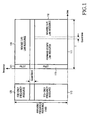
- FIG. 1 is a diagram illustrating a method of using frequency resources available in a wireless communication system according to the present invention.
- reference numeral 100 indicates frequency resources available to a base station.
- the available frequency resources are mainly divided into two frequency resource portions, i.e., a TDD (Time Division Duplexing)-only frequency resource portion 110 and an FDD (Frequency Division Duplexing)-only frequency resource portion 120. More frequency resources can be allocated to the TDD-only frequency resource portion 110 than to the FDD-only frequency resource portion 120.
- Frequency resources of the FDD-only frequency resource portion 120 are allocated to wireless terminals in a specific state, which will be described in more detail later, and they are allocated only to the reverse link in the present invention.
- the amount of data transmitted in the reverse direction is highly likely to be much smaller than the amount of data transmitted in the forward direction.
- the small amount of frequency resources of the FDD-only frequency resource portion 120 are capable of performing the reverse transmission. Accordingly, a narrower band of frequencies are allocated to the FDD-only frequency resource portion 120 than to the TDD-only frequency resource portion 110
- frequencies of the FDD-only frequency resource portion 120 are used only in the reverse link.
- the base station allocates the FDD-only frequency resource portion 120 to specific wireless terminals from among wireless terminals intending to transmit data in the reverse link, thereby enabling the specific wireless terminals to transmit data in the reverse direction.
- the TDD-only frequency resource portion 110 every frequency is divided in time to be used for transmission, and the same frequencies are used in the forward and reverse links. However, the same frequencies are used in different time intervals. As illustrated on the right side of FIG. 1, the TDD-only frequency resource portion 110 is divided into a time interval 111 for forward (or down)-link traffic transmission and a time interval 112 for reverse (or up)-link traffic transmission.
- the term "forward” refers to the direction from the base station to the terminal
- the term “reverse” refers to the direction from the terminal to the base station.
- a transmission period T comprises the two repeating time intervals 111 and 112 respectively for forward and reverse link traffic transmission and another repeating time interval 113 for pilot transmission.
- a guard time having a predetermined time interval is also needed between the two time intervals 111 and 112 for forward and reverse link traffic transmission. The transmission time separation using the guard time avoids overlap between the forward and reverse transmission due to a time delay of the forward and reverse transmission.
- the transmission period of the FDD-only frequency resource portion 120 used only for the reverse link transmission also has a time interval 121 for pilot transmission.
- the pilot transmission of the FDD-only frequency resource portion 120 may be performed at intervals of the same period as the period T of the TDD-only frequency resource portion 110.
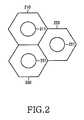
- FIG. 2 is a diagram showing service areas of base stations to which the FDD and TDD-only frequency resource portions are allocated according to the present invention.
- hexagonal cells 210, 220, and 230 are ideal models of the service areas of base stations when the base stations are composed of cellular communication systems.
- a base station is positioned in the center of each of the hexagonal cells 210 to 230.
- the hexagonal cells are only ideal models. Commonly, cells have different shapes when the base stations are composed of cellular communication systems. However, for convenience of illustration, the following description will be given under the assumption that the cells have a uniform hexagonal shape.
- circles 211, 221, and 231 in the hexagonal cells 210, 220, and 230 indicate positions within a predetermined distance from the base stations located in the center of the hexagonal cells 210, 220, and 230.
- the service areas of the base stations may be divided into local areas inside the circles 211, 221, and 231 and remote areas outside the circles 211, 221, and 231.
- the local and remote areas in Fig. 2 belong not to different cells but to a single cell in which communication is performed with a transceiver in the same base station.
- the division of the cell into the local and remote areas is only for explanation of the present invention.
- TDD and FDD areas in the present invention are not separated physically from each other. That is, terminals in a single cell may operate in the TDD mode or in the FDD mode depending on various conditions or circumstances.
- each of the base stations has service areas divided into a local area and a remote area.
- the base stations are sector type base stations, each of which is divided into sectors, each of the sectors has local and remote areas.
- Such a base station generally has three sectors. If the base station has at least two sectors, the sectors may have different local and remote areas. Practically, the division of local and remote areas of a base station may be based on the intensity or the like of a pilot signal reported by a wireless terminal or on transmission power level during communication.
- Duplexing mode determination factors may include the distance of the base station from a wireless terminal, the traveling speed of the wireless terminal, received signal power levels of the base station and the wireless terminal, or the like. For example, if the intensity of a pilot signal reported by a wireless terminal, as one duplexing mode determination factor, is lower than a predetermined threshold, it is determined that the wireless terminal is located in a remote area; otherwise it is determined that it is located in a local area.
- transmission power above a predetermined threshold is required to transmit traffic when the base station communicates with a wireless terminal, it is determined that the wireless terminal is located in a remote area; otherwise it is determined that the wireless terminal is located in a local area.
- the base station can determine whether the wireless terminal is located in a local or remote area, by comparing the map information with the location information reported by the wireless terminal.
- the above-described determination methods may be used individually or they may also be used jointly.
- duplexing mode determination factors refers to information containing all factors used to determine the duplexing mode, which is transmitted from the wireless terminal to the base station.
- the wireless terminal produces a duplexing mode determination factor in the form of a message and reports the message to the base station.
- Terminal users can receive the FDD service in the entire service area of a base station. That is, the FDD resources in the reverse link can be allocated not only to users located in the outer service area, but also to users located in the inner service area when the latter users are in a bad channel environment or in motion at high speed.
- the service area in which the terminals can operate in the TDD mode can be extended to the outer cell area. That is, even when the terminals are located at the cell edge, they can operate in the TDD mode. This indicates that the inner cell area is identical to the external cell area.
- the cell division of Fig. 2 is only a logical division for efficient mode allocation. Practically, the cell is not divided physically and it is a single cell, regardless of whether the terminal operates in the TDD or FDD mode. In the entire cell area, communication can be performed in a TDD-only mode and can also be performed in an FDD-only mode.
- the terminals can perform TDD mode transmission in the reverse link depending on control of the base station.
- TDD reverse-link channels are mainly used to transmit pilots for channel estimation of the TDD mode.
- the base station can instruct terminals in the entire service area, which are stationary or in motion at low speed, to transmit pilots for channel estimation through the TDD reverse channels. In this manner, the base station uses the pilots to perform channel estimation and to allocate TDD forward-link resources. This is to utilize channel reciprocity, which is an advantage of the TDD.
- Duplexing mode resources is generally allocated in such a manner that terminals in the local area are allocated TDD mode resources, whereas terminals in the remote area are allocated TDD resources in the forward link and FDD resources in the reverse link.
- This duplexing mode allocation method is not necessary. For example, even when the terminals are located in the local area, they can be allocated FDD reverse channel resources depending on determination of a duplexing mode allocation algorithm. In addition, even when the terminals are located in the local area, they can be allocated TDD reverse channel resources depending on determination of the duplexing mode allocation algorithm.
- the TDD scheme is used for communication in both the forward and reverse links.
- the TDD scheme is used for communication in the forward link and the FDD scheme is used for communication in the reverse link.
- traffic transmission in the forward link established between a base station and wireless terminals is always performed using the TDD-only frequency resource portion 110, regardless of whether the terminals are located in the local or remote area.
- wireless terminals located in the local area When wireless terminals located in the local area perform traffic transmission in the reverse link, they generally use the TDD-only frequency resource portion 110.
- wireless terminals located in the remote area When wireless terminals located in the remote area perform traffic transmission in the reverse link, they use the FDD-only frequency resource portion 120.
- the terminals can use TDD reverse link resource depending on determination of the duplexing mode allocation algorithm, and can also use the FDD reverse link resource and the TDD reverse link resource at the same time.
- the reason why the TDD reverse link resource is allocated to the terminals in the remote area is to instruct the terminals to transmit pilots through the TDD reverse channels to extract the CQI or CSI information from the terminals that are stationary or in motion at low speed. Not only pilots but also general data can be transmitted through the TDD reverse resources.
- the reason why the terminals in the remote area can operate in both the TDD and FDD modes is that they are in the same cell.
- the TDD-only frequency resource portion 110 of a predetermined period is divided into variable time intervals to be used for transmission in the forward and reverse links. This enables an asymmetric service with variable durations of the forward and reverse links, instead of an asymmetric service with fixed widths of the forward and reverse links.
- Simulations or experiments may be used to find an optimal division value (for example, an optimal division ratio) of the available frequency resource 100 into the TDD and FDD-only frequency resource portions 110 and 120.
- an optimal division value for example, an optimal division ratio
- Different allocations of the TDD and FDD-only frequency resource portions 110 and 120 can be made to different base stations, and the same allocation thereof can also be made to every base station.
- Resources corresponding to the time interval 111 in the TDD-only frequency resource portion 110 are allocated to terminals located in the local and remote areas for forward link transmission.
- Resources corresponding to the time interval 112 in the TDD-only frequency resource portion 110 are mainly allocated to terminals located in the local area for reverse link transmission.
- a specific terminal can be allocated TDD frequencies according to determination of the base station even when the terminal is in the remote area.
- While the resources of the TDD-only frequency resource portion 110 are divided according to the local and remote areas in this manner, resources of the FDD-only frequency resource portion 120 are all allocated to the terminals in the local and remote areas only for the reverse link.
- resources of the FDD-only frequency resource portion 120 are all allocated to the terminals in the local and remote areas only for the reverse link.
- all terminals located in the local and remote areas of a base station can notify the base station of their channel states. The following is an example of this channel state notification using the FDD-only frequency resource portion 120.
- All terminals located in the local and remote areas of a base station check the intensity, QoS, etc., of a pilot signal received from the base station in the forward direction. Through this pilot signal check, each of the terminals located in the local and remote areas can check the channel state of a frequency resource through which the pilot signal is received. Based on the received pilot channel state, each of the terminals generates channel state information to be fed back to the base station. This channel state information may be generated in the form of a message including a Channel Quality Indicator (CQI) or a Channel State Indicator (CSI). Each terminal can inform the base station of its received channel state by feeding the CQI or CSI message back to the base station in the reverse direction through the FDD-only frequency resource portion 120.
- CQI Channel Quality Indicator
- CSI Channel State Indicator
- Each of the terminals which can be divided into terminals in the local area and in the remote area or divided into stationary, slow-moving and fast-moving terminals, can conduct channel reciprocity with the base station by feeding the CQI or CSI information back to the base station.
- the duplexing mode determination factor described above includes the distance between the base station and the wireless terminal and the traveling speed of the wireless terminal.
- the terminal In order for a terminal to be determined to be located in the local area, the terminal must be located in a local area where data can be transmitted at a high transfer rate or be in motion at low speed.
- the local area can be implemented in the form of a spat cell. If terminals are determined to be located in the local area, allocation of the TDD-only frequency resource portion to the terminals simplifies their channel estimation.
- the determination as to whether the terminals are in the local area may also be based on the traveling speed of the terminals. In the local area, the channel fading is low. Accordingly, it is preferable or easy for the base station to use an AMC technology and an MIMO (Multiple Input Multiple Output) technology, which employs multiple antennas, for the terminals determined to be located in the local area.
- AMC Multiple Input Multiple Output
- Terminals are determined to be located in the remote area when they are located distant from the base station or are in motion at high speed. Terminals located in the remote area require channels robust against interference. It is thus preferable to allocate the FDD-only frequency resource to the terminals in the remote area, and it is also preferable not to use the MIMO and AMC technologies for the terminals in the remote area. However, the TDD mode, MIMO and AMC methods can be applied to a specific terminal according to determination of the base station.
- FIG. 3 is a block diagram illustrating a configuration of elements for transmitting and receiving traffic in a base station device in a wireless communication system that employs both the time and frequency division duplexing.
- the base station device includes a number of elements 310 to 320, each of which includes a controller 311, a TDD transmission/reception separator 313, an encoder processor 312, and a modem/wireless module.
- the encoder processor 312 includes an FDD decoder 312a, a TDD encoder 312b, and a TDD decoder 312c.
- the modem/wireless module includes an FDD receiver 314, a TDD transmitter 315, and a TDD receiver 316.
- the FDD decoder 312a decodes coded symbols received over the reverse link and converts them to corresponding data.
- the FDD decoder 312a is connected to the FDD receiver 314.
- the FDD receiver 314 down converts a reverse wireless signal received from a diplexer 302, and outputs the converted signal to the FDD decoder 312a.
- the TDD encoder 312b and the TDD decoder 312c are connected with the TDD transmission/reception separator 313.
- the TDD transmitter 315 and the TDD receiver 316 are also connected with the TDD transmission/reception separator 313.
- the TDD encoder 312b encodes traffic to be transmitted, and outputs the encoded traffic to the TDD transmission/reception separator 313.
- the TDD transmission/reception separator 313 outputs the encoded traffic to the TDD transmitter 315, which then up converts and outputs the encoded traffic to a switch 301.
- the TDD receiver 316 down converts a signal received from the switch 301 and outputs it to the TDD transmission/reception separator 313.
- the TDD transmission/reception separator 313 outputs a signal received from the TDD receiver 316 to the TDD decoder 312c.
- the TDD transmission/reception separator 313 separates and processes transmission and reception traffic under the control of the controller 311.
- the controller 311 controls the path of transmission and reception traffic of the TDD transmission/reception separator 313 depending on the forward and reverse link transmission as described above in FIG. 1.
- the controller 311 controls each block of the encoder processor 312 and controls modulation/demodulation and wireless processing of the modem/wireless module. Further, the controller 311 controls the switch 301 to switch to the TDD transmitter 315 or to the TDD transmitter 316 when it is time to perform the forward or reverse link transmission as illustrated in FIG. 1.
- the switch 301 connects the diplexer 302 to the TDD transmitter 315 or to the TDD receiver 316 under the control of the controller 311.
- the controller 311 further performs fast Frequency Hopping (FH), spreading, AMC, water filling, MIMO (Multiple Input Multiple Output) mode control, or comb-type AMC control. This will be described later in detail with reference to the flow chart in FIG. 4 and in the explanation of FIGs. 6 and 7.
- the diplexer 302 is connected to an antenna Ant and also to the FDD receiver 314 and the switch 301.
- the diplexer 302 separates a signal in a frequency band, which corresponds to the FDD-only frequency resource portion 120 as illustrated in FIG. 1, from the signal received from the antenna Ant, and outputs the separated signal to the FDD receiver 314.
- the diplexer 302 separates a signal in a frequency band, which corresponds to the TDD-only frequency resource portion 110 as illustrated in FIG. 1, from the signal received from the antenna Ant, and outputs the separated signal to the switch 310.
- the diplexer 302 also transmits a signal received from the switch 301 to wireless terminals through the antenna Ant. Traffic of the signal, which the diplexer 302 receives from the switch 301 and outputs to the antenna Ant, corresponds to the traffic transmitted in the time interval 111 for the forward link in the TDD-only frequency resource portion 110 as illustrated in FIG. 1.
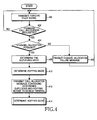
- FIG. 4 is a flow chart illustrating how a base station operates to allocate a forward call to a wireless terminal according to a preferred embodiment of the present invention.
- the controller 311 of the base station controls periodic or constant transmission of the pilot signal, and controls transmission of other information that must be broadcast. That is, the base station periodically or continually transmits the pilot signal and transmits information that must be broadcast to wireless terminals included in the cell of the base station.
- the controller 311 determines whether a forward call allocation has been requested by a specific wireless terminal.
- the call allocation request includes an outgoing call transmission request made by the specific wireless terminal, the receipt of an incoming call destined for the specific wireless terminal from a network upstream of the base station, and the like. If the forward call allocation has been requested, the controller 311 proceeds to step 404; otherwise it returns to step 400.
- the controller checks physical and channel resources currently remaining for the base station to determine whether it is possible to allocate a channel for the requested call. If channel allocation is possible, the controller 311 proceeds to step 408; otherwise it moves to step 406 to produce and transmit a channel allocation failure message.
- the produced channel allocation failure message is transmitted to the specific wireless terminal over a specific control channel.
- the produced channel allocation failure message is transmitted to the specific node.
- the controller 311 determines a duplexing mode for the wireless terminal in the manner described above in FIGs. 1 and 2. That is, the controller 311 detects duplexing mode determination factors received from the wireless terminal.
- the duplexing mode determination factors include the distance between the base station and the terminal, the traveling speed of the wireless terminal, the received signal power levels of the terminal and the base station, etc.
- the duplexing mode determination factors may additionally include a time offset of the call allocation request signal received from the wireless terminal over an access channel.
- the base station receives both intensity information of a pilot signal and geographical location information of a wireless terminal from the wireless terminal, or even if it receives one of the two pieces of information, the controller 311 checks the received information.
- the controller 311 selects the time division duplexing mode for the wireless terminal. However, if it is determined that the wireless terminal is in motion at a high speed or it is located in the remote area, the controller 311 selects the frequency division duplexing mode for the wireless terminal.
- the controller 311 uses the information received from the wireless terminal to detect duplexing mode determination factors of the terminal. Based on the detected duplexing mode determination factors, the controller 311 determines a duplexing mode for reverse transmission of the wireless terminal. Based on the information received from the wireless terminal, the controller 311 of the base station determines whether the wireless terminal is located in a local or remote area of the base station.
- the duplexing mode determination factors include a traveling speed of the wireless terminal, and if it indicates that the wireless terminal is in motion at a predetermined threshold speed or higher, the controller 311 determines that the wireless terminal is located in the remote area even if it is actually located in the local area, because wireless terminals in motion at high speed may enter the remote area in a short time even if they are currently located in the local area and also because they frequently cause handoff between cells. To decrease the load of the base station and more effectively use channel resources, it is assumed that wireless terminals in motion at high speed are located in the remote area.
- the wireless terminal Based on other duplexing mode determination factors such as geographical conditions, the state of buildings around the base station, etc., it is determined whether the wireless terminal is located in the local area inside of the circle as illustrated in FIG. 2 or the remote area outside the circle.
- the boundary of the local and remote areas of the base station may have various other shapes instead of the circles illustrated in FIG. 2.
- the following description will be given with reference to the circular boundary.
- the controller 311 of the base station determines the reverse transmission mode for the wireless terminal.
- the controller 311 enables wireless terminals located in the local area to perform transmission in the reverse direction using the TDD-only frequency resource portion and it enables wireless terminals located in the remote area to perform transmission in the reverse direction using the FDD-only frequency resource portion.
- the controller 311 of the base station sets the reverse transmission mode of the terminal. The determination can be performed not only by the controller 311 of the base station, but also by a scheduler of the BTS. Accordingly, the controller 311 of the base station determines reverse transmission timing, frequencies for the reverse transmission, etc., of the wireless terminal at the same time.
- the controller 311 determines a hopping mode according to the present invention. Different hopping modes are determined depending on the links and the frequency range in use. A detailed description of the hopping mode determination depending on the links and the frequency range in use will be described in more detail herein below with reference to FIGs. 6 and 7.
- the controller 311 determines a frequency hopping mode.
- the controller 311 transmits a call allocation message containing information of the determined duplexing and hopping modes to the wireless terminal.
- the base station transmits the call allocation message when it receives an outgoing call transmission request from the wireless terminal or when it receives an incoming call from a node upstream of the base station and then receives a response from the wireless terminal after paging.
- the controller 311 After transmitting the call allocation message at step 412, the controller 311 communicates with the terminal in the modes determined at steps 408 and 412.
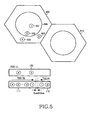
- FIG. 5 illustrates a method for allocating frequencies when a base station device of a wireless communication system, which uses time and frequency division duplexing according to the present invention, allocates a call to a wireless terminal.
- the hexagonal cells illustrated are ideal cell models of base stations when the wireless communication system is a cellular system as described above in FIG. 2.
- Hexagons denoted by 500 and 510 define respective service areas of two base stations.
- Wireless terminals 501, 502, 503, and 504 located in the service area 500 of the base station illustrate how frequencies and time slots are allocated depending on the locations of the wireless terminals.
- the first wireless terminal 501 is located in the local area at a position nearest to the base station, and the second wireless terminal 502 is located in the local area at a position farther away from the base station than the first wireless terminal 501.
- the third wireless terminal 503 is located in the remote area, and the fourth wireless terminal 504 is located in the remote area at a position farther away from the base station than the third wireless terminal 503.
- the TDD-only frequency resource portion 110 of the frequency resources available to the base station is divided into a time interval 111 for allocation to the forward link and a time interval 112 for allocation to the reverse link.
- the base station uses the TDD-only frequency resource portion 110 to perform traffic transmission to all the wireless terminals in the forward link.
- the base station allocates time slots in the time interval 111 to the wireless terminals, starting from a time slot adjacent to a guard time between the two time intervals 111 and 112.
- the wireless terminals are allocated the time slots in increasing order of distance from the base station.
- a first time slot nearest to the guard time is allocated to the first wireless terminal 501 nearest to the base station, and then a second time slot is allocated to the second wireless terminal 502, which is the second nearest to the base station. Then, a third time slot is allocated to the third wireless terminal, which is located in the remote area but nearest to the base station among the wireless terminals located in the remote area, and a fourth time slot coming first among the slots is allocated to the fourth wireless terminal most distant from the base station.
- frequency resource allocation for the transmission in the reverse direction is performed in the following manner.
- Reverse link time slots near the guard time are allocated to wireless terminals near the base station, which use the TTD-only frequency resource portion for the reverse transmission. That is, a reverse link time slot that is adjacent to the guard time is allocated to the first wireless terminal 501 nearest to the base station, and a next reverse link time slot is allocated to the second wireless terminal 502, which is the second nearest to the base station among the wireless terminals that use the TTD-only frequency resource portion for the reverse transmission.
- the time slot allocation method for the wireless terminals, which use the TDD-only frequency resource portion minimizes interference due to synchronization failure.
- the time slot allocation method also minimizes inter-terminal interference, which is caused by collisions between uplink and downlink time slots between neighboring cells due to a difference in the ratio of traffic asymmetry between the neighboring cells.
- the wireless terminals located in the remote area of the base station are free from the synchronization failure due to the time division because they use the frequency division duplexing method for transmission in the reverse direction.
- the interference caused by the difference in the traffic asymmetry ratio is also minimized.
- the base stations 500 and 510 use the TDD-only frequency resource portion to perform the reverse and forward link transmission, and they are synchronized in every transmission period.
- the ratio of the two time intervals respectively for forward and reverse transmission may vary depending on the time slots allocated to the forward and reverse links. This is described in detail as follows under the assumption that the period T is 20 ms and one slot in the period T is 1.25 ms.
- Each of the base stations has 32 time slots. If two time slots are assigned to the guard time, data transmission is performed in 30 time slots.
- the first base station 500 performs transmission in the forward direction in 24 time slots and in the reverse direction in 6 time slots.
- the second base station 510 performs transmission in the forward direction in 20 time slots and in the reverse direction in 10 time slots.
- the first base station 500 performs forward transmission in the 1st to 24th time slots, and performs reverse transmission in the 27th to 32nd time slots.
- a guard time is composed of the 25th and 26th time slots.
- the second base station 510 performs forward transmission in the 1st to 20th time slots, and performs reverse transmission in the 23rd to 32nd time slots.
- a guard time is composed of the 21st and 22nd time slots. Accordingly, in the 23rd and 24th time slots, the second base station 510 waits for signal reception, while the first base station 500 is transmitting signals, which may cause interference between the base stations.
- the terminal can perform transmission and reception to and from the base station with small power.
- the transmission power of the base station and the wireless terminal decreases, the interference with another base station or with wireless terminals belonging thereto decreases. Accordingly, the interference caused by the difference in the traffic asymmetry ratio between the cells is minimized.
- a comb-type allocation method is preferably used to allocate resources of the FDD-only frequency resource portion 120 so that their pilot signals are distributed uniformly over the resources.
- Hierarchical cell environment is used to describe a specific cell environment in which the cell is divided into local and remote areas as illustrated in FIG. 5. Effective technologies for data and traffic transmission in the forward and reverse directions in such a hierarchical cell environment will now be described.
- the first wireless terminal 501 receives data in the forward link
- the second wireless terminal 502 transmits data in the reverse link
- the third wireless terminal 503 receives data in the forward link
- the fourth wireless terminal 504 transmits data in the reverse link.
- the first and second wireless terminals 501 and 502 are located in the local area.
- the MIMO and AMC technologies can be used for the terminals located in the local area.
- the OFDMA technology which is applied in the embodiments of the present invention, can also be used for the terminals located in the local area. That is, a frequency-efficient multiple access method is used for the terminals located in the local area.
- the wireless terminals located in the local area are stationary or have nomadic mobility.
- the third and fourth wireless terminals 503 and 504 are located in the remote area or are in motion at high speed. It is thus preferable to allocate channels robust against interference to the terminals located in the remote area or in motion at high speed, and it may not be preferable to apply the MIMO or MAC technologies thereto in the same manner as in the local area. Instead, frequency Hopping (FH) and spreading methods, which will be described later, can be used for the terminals.
- FH frequency Hopping
- the MIMO method can use Div. or Mux techniques.
- the OFDMA technology which is applied in the embodiments of the present invention, can also be used for the third and fourth wireless terminals 503 and 504. That is, an interference avoidance/averaging based multiple access method is used for the terminals located in the remote area.
- Table 1 lists communication technologies suitable for each link under the above-described assumption of the locations and data transmission directions of the first to fourth wireless terminals 501 to 504.
- Optimum AMC Interleaved 2nd terminal MIMO resource SVD
- Pre-compensated OFDMA allocation Fast FH or 3rd terminal Spreading, DCA, Div. STBC/Diff STC OFDMA DPA Mux. 4th terminal Slow FH DCA, Div., OFDMA DPA Mux
- the communication link between the terminal and the base station can be equivalently expressed as N parallel spatial channels that are disjointed, where N is the smaller of the two numbers of the transmitting/receiving antennas.
- the SVD method is relatively sensitive to channel estimation errors, the SVD method can be used when it is desired to provide high transfer rates for terminals that are stationary or moving very slowly (i.e., when there is almost no change in channels during a relatively long time interval or when the terminals are located in the center of the cell where channel estimation is relatively correct). Accordingly, Table 1 illustrates that the SVD method is applied only to the first and second wireless terminals 501 and 502.
- a frequency hopping method can be additionally used according to the present invention.
- the frequency hopping method increases the throughput of wireless terminals near the base station and wireless terminals distant therefrom while changing their frequencies in addition to the time slots.
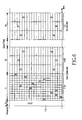
- FIG. 6 illustrates time division and frequency hopping methods of the TDD-only frequency resource portion according to a preferred embodiment of the present invention.
- FIG. 7 illustrates time division and frequency hopping methods of the FDD-only frequency resource portion for transmission in the reverse direction according to a preferred embodiment of the present invention.
- the TDD-only frequency resource portion is divided into a pilot signal transmission period Tpu, a first time interval T 1 for allocation to wireless terminals in the remote area for transmission in the forward link, and a second time interval T2 for allocation to wireless terminals in the local area for transmission in the forward link.
- the TDD-only frequency resource portion is further divided into a guard time next to the second time interval T2 and a third time interval T3 for allocation to wireless terminals for transmission in the reverse direction.
- Frequency resource cells denoted by "3 ⁇ " and "4 ⁇ " in the first frequency resource area 111a of the first time interval T1 define hopping frequencies and time slots for allocation to wireless terminals in the remote area.
- a fast frequency hopping OFDMA method can be used for the first frequency resource area 111a according to the present invention.
- An AMC OFDMA method, a water filling OFDMA method, or a MIMO OFDMA method can be used for the second frequency resource area 111b according to the present invention.
- Frequency resource cells denoted by "1 ⁇ " and "2 ⁇ " in a third frequency resource area 112, corresponding to the third time interval T3, define hopping frequencies and time slots for allocation to wireless terminals in the local area for transmission in the reverse link.
- the third frequency resource area 112 is based on the AMC OFDMA method for providing channel state information for the AMC and water filling according to the present invention, a comb-type or interleaved-type method may be used for subcarrier allocation to each user.
- the FDD-only frequency resource portion is divided into a pilot signal transmission period Tpd and a fourth time interval T4 for allocation to wireless terminals in the remote area for reverse transmission (i.e., transmission in the uplink).
- Fig. 6 shows that fast frequency hopping is performed in the first time interval T1 during which resources are allocated to the terminals in the remote area. That is, in Fig. 6, each time interval allocated to the terminals in the remote area occupies a small time interval.
- This figure also shows that slow frequency hopping is performed in the second time interval T2 during which resources are allocated to the terminals in the local area. That is, in Fig. 6, each time interval allocated to the terminals in the local area occupies a large time interval.
- the frequency hopping method and the MIMO and AMC techniques can be applied to the terminals in the local area.
- a slow frequency hopping OFDMA method which uses slow frequency hopping, compared to the fast frequency hopping OFDMA method used for the forward link resource area of the first time interval T1 for allocation to the wireless terminals in the remote area described in FIG. 6, may be used for the fourth frequency resource area T4.
- the frequency hopping As described above in FIGs. 6 and 7, because the frequency hopping is used for transmission in the forward and reverse directions, the frequency hopping must be performed according to a prescribed scheme or all the base stations and the wireless terminals must know the rule for frequency hopping. Accordingly, the step 410 of determining the hopping mode is needed as illustrated in FIG. 4.
- FIG. 8 is a conceptual diagram illustrating a method for transmitting data between a base station and terminals according to another embodiment of the present invention.
- the service area of a base station is divided into a local area 505 and a remote area 500 as described above.
- the determination of the local and remote areas 505 and 500 are based not only on the distance from the base station but also on the duplexing mode determination factors as described above. For example, the determination may also be based on the mobility or traveling speed of the terminals.
- first and second wireless terminals 501 and 502 are determined to be located in the local area
- third and fourth wireless terminals 503 and 504 are determined to be located in the remote area.
- the first and second wireless terminals 501 and 503 receive data in the forward link and the second and fourth wireless terminals 502 and 504 transmit data in the reverse link.
- frequencies are divided into a time interval for the forward link DL and a time interval for the reverse link UL.
- a switching time is defined between the time intervals for the forward and reverse links DL and UL to avoid data overlap.
- the wireless terminals transmit data in the forward link DL in decreasing order of distance from the base station (i.e., the terminal in the remote area and the terminal 501 in the local area perform data transmission in the named order).
- the wireless terminals transmit data in the reverse link UL in increasing order of distance from the base station (i.e., the terminal 502 in the local area and the terminal 504 in the remote area perform data transmission in the named order).
- the MIMO and AMC techniques can be applied to the terminals located in the local area, whereas the frequency hopping and/or spreading methods and the OFDMA method can be applied to the terminals located in the remote area.
- FIG. 9 is a conceptual diagram illustrating a method for transmitting data between a base station and terminals according to still another embodiment of the present invention.
- frequencies allocated to the forward link DL are separated from frequencies allocated to the reverse link UL as illustrated in FIG. 9.
- the wireless terminals are allocated the frequencies in decreasing order of distance from the base station. That is, terminals 503 and 504 located in the remote area are first allocated frequencies, after which terminals 501 and 502 located in the local area are allocated frequencies.
- the separate frequency allocation of this embodiment avoids a decrease in the total capacity caused by the switching time.
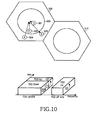
- Fig. 10 is a conceptual diagram illustrating data transmission between a base station and a terminal in accordance with a yet another preferred embodiment of the present invention.
- a data transmission method in accordance with a yet another preferred embodiment of the present invention will hereinafter be described with reference to Fig. 10.
- Fig. 10 depicts an exemplary case in which the TDD mode and FDD mode are used at the same time.
- a terminal in the remote area and a terminal in the local area are distinguished from each other in the same manner as in Fig. 1.
- Individual reverse links of the long-distance terminals perform reverse transmission using dedicated sub-carriers.
- Individual forward links of the long-distance and short-distance terminals perform time division using the remaining resources other than frequency resources equal to reverse-dedicated assignment frequency resources in a long-distance area usable by the base station, such that they establish data transmission.
- a reverse transmission operation is performed using the TDD dedicated frequency resources during a predetermined period of time.
- Fig. 10 depicts cell areas of terminals capable of performing forward/reverse transmission associated with individual directions and their associated resource division states.
- data of the TDD dedicated frequency resources is transmitted to the first wireless terminal 501 and the third wireless terminal 503 via a forward link.
- the second wireless terminal 502 of the TDD dedicated frequency resources transmits data via a reverse link.
- only the fourth wireless terminal 504 can transmit data.
- the reverse-dedicated frequency resources of the present invention may be adapted as only a feedback channel for checking a channel situation between the base station and terminals.
- the reverse-dedicated frequency resources may be added to either the long-distance reverse channel or the time-division frequency dedicated resources if needed.
- the present invention provides optimal communication service to users in motion by providing different division duplexing methods, such as the TDD and FDD, and also using various multiple access methods suitable for each of the duplexing methods.
- the AMC method and the frequency hopping method are used at the same time, thereby gaining each benefit of the two methods.
- a random frequency hopping technique is used for users in motion at a reference speed or higher, thereby enabling the frequency reuse factor in multiple cells to approach almost one.
Landscapes
- Engineering & Computer Science (AREA)
- Signal Processing (AREA)
- Computer Networks & Wireless Communication (AREA)
- Mobile Radio Communication Systems (AREA)
Applications Claiming Priority (2)
| Application Number | Priority Date | Filing Date | Title |
|---|---|---|---|
| KR2003053141 | 2003-07-31 | ||
| KR20030053141 | 2003-07-31 |
Publications (3)
| Publication Number | Publication Date |
|---|---|
| EP1503610A2 true EP1503610A2 (de) | 2005-02-02 |
| EP1503610A3 EP1503610A3 (de) | 2011-10-05 |
| EP1503610B1 EP1503610B1 (de) | 2017-12-27 |
Family
ID=33536465
Family Applications (1)
| Application Number | Title | Priority Date | Filing Date |
|---|---|---|---|
| EP04018306.3A Expired - Lifetime EP1503610B1 (de) | 2003-07-31 | 2004-08-02 | Steuerungssystem und Mehrfachzugriffsverfahren in einem drahtlosen Kommunikationssystem |
Country Status (4)
| Country | Link |
|---|---|
| US (2) | US7313126B2 (de) |
| EP (1) | EP1503610B1 (de) |
| KR (2) | KR100987286B1 (de) |
| CN (2) | CN101043313B (de) |
Cited By (7)
| Publication number | Priority date | Publication date | Assignee | Title |
|---|---|---|---|---|
| WO2007020292A1 (en) * | 2005-08-19 | 2007-02-22 | Ipwireless Inc | Duplex operation in a cellular communication system |
| EP2152044A1 (de) * | 2008-08-04 | 2010-02-10 | Fujitsu Limited | Frequenzzuweisungsverfahren in einer drahtlosen Basisstationsvorrichtung und drahtlose Basisstationsvorrichtung |
| FR2943884A1 (fr) * | 2009-03-26 | 2010-10-01 | Get Enst Bretagne Groupe Des E | Procede de transmission de donnees entre des terminaux et une station centrale,terminal,station centrale,signaux, produit programme d'ordinateur et moyen de stockage correspondants. |
| EP2237619A1 (de) * | 2005-08-19 | 2010-10-06 | Sony Corporation | Duplexbetrieb in einem mobilen Kommunikationssystem |
| EP1937012A3 (de) * | 2006-12-21 | 2011-05-25 | NTT DoCoMo, Inc. | Funkkommunikationsgerät und Funkkommunikationsverfahren |
| WO2012118839A1 (en) * | 2011-02-28 | 2012-09-07 | Qualcomm Incorporated | Methods and apparatus for employing different capabilities for different duplexing modes |
| EP2056613A4 (de) * | 2006-08-22 | 2013-04-03 | Ntt Docomo Inc | Mobilkommunikationssystem, basisstation, benutzergerät und verfahren |
Families Citing this family (122)
| Publication number | Priority date | Publication date | Assignee | Title |
|---|---|---|---|---|
| US7046678B2 (en) * | 2000-02-18 | 2006-05-16 | At & T Corp. | Channel efficiency based packet scheduling for interactive data in cellular networks |
| US7295509B2 (en) | 2000-09-13 | 2007-11-13 | Qualcomm, Incorporated | Signaling method in an OFDM multiple access system |
| US9130810B2 (en) * | 2000-09-13 | 2015-09-08 | Qualcomm Incorporated | OFDM communications methods and apparatus |
| WO2005086802A2 (en) | 2004-03-08 | 2005-09-22 | Proxense, Llc | Linked account system using personal digital key (pdk-las) |
| US9148256B2 (en) | 2004-07-21 | 2015-09-29 | Qualcomm Incorporated | Performance based rank prediction for MIMO design |
| US9137822B2 (en) | 2004-07-21 | 2015-09-15 | Qualcomm Incorporated | Efficient signaling over access channel |
| US8423070B2 (en) * | 2004-09-17 | 2013-04-16 | Volkmar Scharf-Katz | Method and system to model TCP throughput, assess power control measures, and compensate for fading and path loss, for highly mobile broadband systems |
| US8111789B2 (en) | 2004-10-06 | 2012-02-07 | Broadcom Corporation | Method and system for channel estimation in a single channel MIMO system with multiple RF chains for WCDMA/HSDPA |
| US8098776B2 (en) | 2004-10-06 | 2012-01-17 | Broadcom Corporation | Method and system for pre-equalization in a single weight spatial multiplexing MIMO system |
| RU2007127725A (ru) | 2004-12-20 | 2009-01-27 | ПРОКСЕНС, ЭлЭлСи (US) | Аутентификация по биометрическому ключу персональных данных (pdk) |
| US9246560B2 (en) | 2005-03-10 | 2016-01-26 | Qualcomm Incorporated | Systems and methods for beamforming and rate control in a multi-input multi-output communication systems |
| US20060203794A1 (en) * | 2005-03-10 | 2006-09-14 | Qualcomm Incorporated | Systems and methods for beamforming in multi-input multi-output communication systems |
| US9154211B2 (en) * | 2005-03-11 | 2015-10-06 | Qualcomm Incorporated | Systems and methods for beamforming feedback in multi antenna communication systems |
| US7751822B2 (en) * | 2005-03-14 | 2010-07-06 | Nextel Communications Inc. | Systems and methods for frequency reuse in wireless networks |
| US8446892B2 (en) * | 2005-03-16 | 2013-05-21 | Qualcomm Incorporated | Channel structures for a quasi-orthogonal multiple-access communication system |
| US9143305B2 (en) | 2005-03-17 | 2015-09-22 | Qualcomm Incorporated | Pilot signal transmission for an orthogonal frequency division wireless communication system |
| US20090213950A1 (en) * | 2005-03-17 | 2009-08-27 | Qualcomm Incorporated | Pilot signal transmission for an orthogonal frequency division wireless communication system |
| US9520972B2 (en) * | 2005-03-17 | 2016-12-13 | Qualcomm Incorporated | Pilot signal transmission for an orthogonal frequency division wireless communication system |
| US9461859B2 (en) | 2005-03-17 | 2016-10-04 | Qualcomm Incorporated | Pilot signal transmission for an orthogonal frequency division wireless communication system |
| US9184870B2 (en) | 2005-04-01 | 2015-11-10 | Qualcomm Incorporated | Systems and methods for control channel signaling |
| US9408220B2 (en) | 2005-04-19 | 2016-08-02 | Qualcomm Incorporated | Channel quality reporting for adaptive sectorization |
| US9036538B2 (en) | 2005-04-19 | 2015-05-19 | Qualcomm Incorporated | Frequency hopping design for single carrier FDMA systems |
| KR100703303B1 (ko) * | 2005-04-28 | 2007-04-03 | 삼성전자주식회사 | 무선 통신 시스템에서 확장 실시간 폴링 서비스의 상향링크 자원 할당 요청 방법 |
| KR100706620B1 (ko) * | 2005-05-17 | 2007-04-11 | 한국전자통신연구원 | 스위치 빔을 이용한 초기 동기 시의 빔 선택 방법 |
| US7574214B2 (en) * | 2005-05-25 | 2009-08-11 | Intel Corporation | Device, system and method of multiple access transmission |
| US8879511B2 (en) * | 2005-10-27 | 2014-11-04 | Qualcomm Incorporated | Assignment acknowledgement for a wireless communication system |
| US8565194B2 (en) | 2005-10-27 | 2013-10-22 | Qualcomm Incorporated | Puncturing signaling channel for a wireless communication system |
| US8611284B2 (en) | 2005-05-31 | 2013-12-17 | Qualcomm Incorporated | Use of supplemental assignments to decrement resources |
| US8462859B2 (en) | 2005-06-01 | 2013-06-11 | Qualcomm Incorporated | Sphere decoding apparatus |
| US8599945B2 (en) | 2005-06-16 | 2013-12-03 | Qualcomm Incorporated | Robust rank prediction for a MIMO system |
| US9179319B2 (en) * | 2005-06-16 | 2015-11-03 | Qualcomm Incorporated | Adaptive sectorization in cellular systems |
| US8081600B2 (en) * | 2005-07-29 | 2011-12-20 | Nextel Communications Inc. | Systems and methods for communicating between base stations and wireless stations |
| US8885628B2 (en) | 2005-08-08 | 2014-11-11 | Qualcomm Incorporated | Code division multiplexing in a single-carrier frequency division multiple access system |
| US20070041457A1 (en) | 2005-08-22 | 2007-02-22 | Tamer Kadous | Method and apparatus for providing antenna diversity in a wireless communication system |
| US9209956B2 (en) * | 2005-08-22 | 2015-12-08 | Qualcomm Incorporated | Segment sensitive scheduling |
| US8644292B2 (en) | 2005-08-24 | 2014-02-04 | Qualcomm Incorporated | Varied transmission time intervals for wireless communication system |
| KR20070027053A (ko) * | 2005-08-29 | 2007-03-09 | 연세대학교 산학협력단 | Ieee 802.11 망에서 릴레이 멀티캐스트의 성능을향상시키기 위한 멀티채널 할당 방법 |
| US20070047495A1 (en) * | 2005-08-29 | 2007-03-01 | Qualcomm Incorporated | Reverse link soft handoff in a wireless multiple-access communication system |
| US9136974B2 (en) | 2005-08-30 | 2015-09-15 | Qualcomm Incorporated | Precoding and SDMA support |
| KR100856207B1 (ko) * | 2005-09-13 | 2008-09-03 | 삼성전자주식회사 | 시분할 이중화 방식과 주파수분할 이중화 방식을 이용하는 통신 방법 및 시스템 |
| US7675888B2 (en) * | 2005-09-14 | 2010-03-09 | Texas Instruments Incorporated | Orthogonal frequency division multiplexing access (OFDMA) ranging |
| GB2431073B (en) * | 2005-10-10 | 2008-05-14 | Ipwireless Inc | Cellular communication system and method for co-existence of dissimilar systems |
| US8693405B2 (en) | 2005-10-27 | 2014-04-08 | Qualcomm Incorporated | SDMA resource management |
| US9144060B2 (en) * | 2005-10-27 | 2015-09-22 | Qualcomm Incorporated | Resource allocation for shared signaling channels |
| US9172453B2 (en) * | 2005-10-27 | 2015-10-27 | Qualcomm Incorporated | Method and apparatus for pre-coding frequency division duplexing system |
| US9210651B2 (en) | 2005-10-27 | 2015-12-08 | Qualcomm Incorporated | Method and apparatus for bootstraping information in a communication system |
| US8582509B2 (en) | 2005-10-27 | 2013-11-12 | Qualcomm Incorporated | Scalable frequency band operation in wireless communication systems |
| US8045512B2 (en) | 2005-10-27 | 2011-10-25 | Qualcomm Incorporated | Scalable frequency band operation in wireless communication systems |
| US9088384B2 (en) | 2005-10-27 | 2015-07-21 | Qualcomm Incorporated | Pilot symbol transmission in wireless communication systems |
| US8477684B2 (en) | 2005-10-27 | 2013-07-02 | Qualcomm Incorporated | Acknowledgement of control messages in a wireless communication system |
| US9225416B2 (en) * | 2005-10-27 | 2015-12-29 | Qualcomm Incorporated | Varied signaling channels for a reverse link in a wireless communication system |
| US9225488B2 (en) | 2005-10-27 | 2015-12-29 | Qualcomm Incorporated | Shared signaling channel |
| US20070104176A1 (en) * | 2005-11-10 | 2007-05-10 | Samsung Electronics Co., Ltd. | System and method for pilot signal utilization in an environment using dynamic frequency assignment |
| US8582548B2 (en) * | 2005-11-18 | 2013-11-12 | Qualcomm Incorporated | Frequency division multiple access schemes for wireless communication |
| US8433919B2 (en) | 2005-11-30 | 2013-04-30 | Proxense, Llc | Two-level authentication for secure transactions |
| JP2007174337A (ja) * | 2005-12-22 | 2007-07-05 | Toshiba Corp | セルラ通信システム、管理局装置および通信制御方法 |
| US8831607B2 (en) * | 2006-01-05 | 2014-09-09 | Qualcomm Incorporated | Reverse link other sector communication |
| US11206664B2 (en) | 2006-01-06 | 2021-12-21 | Proxense, Llc | Wireless network synchronization of cells and client devices on a network |
| US8340672B2 (en) | 2006-01-06 | 2012-12-25 | Proxense, Llc | Wireless network synchronization of cells and client devices on a network |
| US7567820B2 (en) * | 2006-02-09 | 2009-07-28 | Altair Semiconductor Ltd. | Scanning for network connnections with variable scan rate |
| US8160001B2 (en) * | 2006-05-25 | 2012-04-17 | Altair Semiconductor Ltd. | Multi-function wireless terminal |
| WO2007091235A2 (en) | 2006-02-09 | 2007-08-16 | Altair Semiconductor Ltd. | Low peak-to-average power ratio transmission in frequency-division multiple access systems |
| US7545787B2 (en) * | 2006-02-09 | 2009-06-09 | Altair Semiconductor Ltd. | Simultaneous operation of wireless LAN and long-range wireless connections |
| US7542728B2 (en) * | 2006-02-09 | 2009-06-02 | Altair Semiconductor Ltd. | Dual-function wireless data terminal |
| US9258833B2 (en) | 2006-02-09 | 2016-02-09 | Altair Semiconductor Ltd. | LTE/Wi-Fi coexistence |
| US7844265B2 (en) * | 2006-02-09 | 2010-11-30 | Motorola Mobility, Inc. | Method for aperiodic mobile assisted sleep mode |
| KR101285014B1 (ko) * | 2006-03-14 | 2013-07-10 | 삼성전자주식회사 | 무선 통신 시스템에서 자원 할당 및 통신을 위한 장치 및방법과 그 시스템 |
| US20070232349A1 (en) * | 2006-04-04 | 2007-10-04 | Jones Alan E | Simultaneous dual mode operation in cellular networks |
| US20080002598A1 (en) * | 2006-04-19 | 2008-01-03 | Telsima Corporation | Reducing inter-ss interference |
| US20070248043A1 (en) * | 2006-04-20 | 2007-10-25 | Nextel Communications, Inc. | Method, computer-readable medium, and apparatus for dynamic resource allocation across FDD and TDD systems |
| US7627325B2 (en) * | 2006-04-28 | 2009-12-01 | Freescale Semiconductor, Inc. | System and method for controlling a wireless device |
| JP4189410B2 (ja) * | 2006-06-12 | 2008-12-03 | 株式会社東芝 | 無線通信装置及び送信制御方法 |
| US8169955B2 (en) * | 2006-06-19 | 2012-05-01 | Atc Technologies, Llc | Systems and methods for orthogonal frequency division multiple access (OFDMA) communications over satellite links |
| US8259823B2 (en) | 2006-07-27 | 2012-09-04 | Altair Semiconductor Ltd. | Energy-efficient uplink slot allocation in time-frequency division multiple access systems |
| EP2067282A4 (de) * | 2006-09-29 | 2013-12-04 | Ericsson Telefon Ab L M | Verfahren und system zur verringerung von nachbarkanalstörungen unter verwendung von zeitduplex (tdd) |
| US9269221B2 (en) | 2006-11-13 | 2016-02-23 | John J. Gobbi | Configuration of interfaces for a location detection system and application |
| US8483038B2 (en) * | 2006-12-04 | 2013-07-09 | Ntt Docomo, Inc. | Radio communication apparatus and radio communication method |
| US8300591B1 (en) * | 2006-12-08 | 2012-10-30 | Apple Inc. | Allocating resources in a frequency-time space to mobile station data |
| KR101418114B1 (ko) * | 2006-12-18 | 2014-07-09 | 삼성전자주식회사 | 이동 통신 시스템에서 가변 크기의 리소스 단위를 통한리소스 할당 방법 및 장치 |
| US7881252B2 (en) * | 2006-12-27 | 2011-02-01 | Altair Semiconductor Ltd. | Wireless receiver with intermittent shut-off of RF circuits |
| US8462746B2 (en) * | 2006-12-27 | 2013-06-11 | Altair Semiconductor Ltd. | Wireless receiver with intermittent shut-off of RF circuits |
| CN101272175B (zh) * | 2007-03-21 | 2013-02-13 | 电信科学技术研究院 | 时分双工ofdma系统上行控制信令传输方法与装置 |
| US7813371B2 (en) * | 2007-03-21 | 2010-10-12 | Kapsch Trafficcom Ag | System and method for short range communication using adaptive channel intervals |
| KR101042790B1 (ko) * | 2007-04-05 | 2011-06-20 | 연세대학교 산학협력단 | 중계기를 사용하는 통신시스템에서의 데이터 송수신 방법및 장치 |
| KR101380582B1 (ko) * | 2007-07-06 | 2014-04-10 | 삼성전자주식회사 | 통신시스템에서 다중 이중화 모드를 위한 자원 할당 방법. |
| US8068877B1 (en) | 2007-07-20 | 2011-11-29 | Clear Wireless Llc | Systems and methods of antenna selection |
| GB2452481B (en) * | 2007-09-01 | 2012-05-02 | Jds Uniphase Corp | Method of categorising speed of a terminal, system and apparatus therefor |
| US8681666B2 (en) * | 2007-10-01 | 2014-03-25 | Qualcomm Incorporated | Partial discarding of cyclic prefix for efficient TDD or half-duplex FDD operation |
| US20090097452A1 (en) * | 2007-10-12 | 2009-04-16 | Qualcomm Incorporated | Femto cell synchronization and pilot search methodology |
| WO2009062194A1 (en) | 2007-11-09 | 2009-05-14 | Proxense, Llc | Proximity-sensor supporting multiple application services |
| US8121144B2 (en) * | 2007-11-20 | 2012-02-21 | Altair Semiconductor Ltd. | Multi-function wireless terminal |
| US8588147B2 (en) * | 2007-11-21 | 2013-11-19 | Samsung Electronics Co., Ltd. | Method and system for subcarrier division duplexing |
| US8171528B1 (en) | 2007-12-06 | 2012-05-01 | Proxense, Llc | Hybrid device having a personal digital key and receiver-decoder circuit and methods of use |
| US9251332B2 (en) | 2007-12-19 | 2016-02-02 | Proxense, Llc | Security system and method for controlling access to computing resources |
| WO2009102979A2 (en) | 2008-02-14 | 2009-08-20 | Proxense, Llc | Proximity-based healthcare management system with automatic access to private information |
| US11120449B2 (en) | 2008-04-08 | 2021-09-14 | Proxense, Llc | Automated service-based order processing |
| US8107884B2 (en) * | 2008-05-05 | 2012-01-31 | Institute For Information Industry | Base station, subordinated station and transmission method thereof |
| TWI390875B (zh) * | 2008-05-05 | 2013-03-21 | Inst Information Industry | 基地台、下級站台及其傳輸方法 |
| WO2009153773A1 (en) * | 2008-06-19 | 2009-12-23 | Marvell Israel (Misl) Ltd. | Balancing capacity between link directions using variable feedback rates |
| KR101511786B1 (ko) * | 2008-06-30 | 2015-04-14 | 엘지전자 주식회사 | 주파수 분할 이중 중계국을 포함하는 무선통신 시스템 및 이 무선통신 시스템에서의 무선자원의 이용 방법 |
| US7969923B2 (en) * | 2008-11-14 | 2011-06-28 | Dbsd Satellite Services G.P. | Asymmetric TDD in flexible use spectrum |
| US9100834B2 (en) * | 2009-01-23 | 2015-08-04 | Telefonaktiebolaget L M Ericsson (Publ) | Uplink reference signal allocation and assignment for cell clusters |
| KR101032074B1 (ko) * | 2009-01-29 | 2011-05-02 | 이화여자대학교 산학협력단 | 무선통신 시스템에서의 하이브리드 듀플렉싱 운영 방법 및 장치 |
| US20100279714A1 (en) * | 2009-05-01 | 2010-11-04 | Qualcomm Incorporated | Methods and systems for cdma evdo paging interval alignment with an overlaid wimax network |
| WO2011099586A1 (ja) | 2010-02-10 | 2011-08-18 | 株式会社日本触媒 | 吸水性樹脂粉末の製造方法 |
| US8515440B2 (en) | 2010-02-19 | 2013-08-20 | Qualcomm Incorporated | Computation of channel state feedback in systems using common reference signal interference cancelation |
| US9418205B2 (en) | 2010-03-15 | 2016-08-16 | Proxense, Llc | Proximity-based system for automatic application or data access and item tracking |
| US9322974B1 (en) | 2010-07-15 | 2016-04-26 | Proxense, Llc. | Proximity-based system for object tracking |
| US9807620B2 (en) * | 2010-07-19 | 2017-10-31 | Alcatel Lucent | Method and apparatus for interference management in heterogenous networks |
| WO2012104749A1 (en) | 2011-02-02 | 2012-08-09 | Altair Semiconductor Ltd. | Intermittent shut-down of rf circuitry in wireless communication terminals |
| US9265450B1 (en) | 2011-02-21 | 2016-02-23 | Proxense, Llc | Proximity-based system for object tracking and automatic application initialization |
| US9237572B2 (en) | 2011-06-12 | 2016-01-12 | Altair Semiconductor Ltd. | Mitigation of interference between communication terminals in TD-LTE |
| JP5945007B2 (ja) * | 2012-01-29 | 2016-07-05 | アルカテル−ルーセント | 時分割複信無線通信システムの高干渉インジケータ(hii) |
| US8811213B1 (en) | 2012-02-24 | 2014-08-19 | Sprint Communications Company, L.P. | Avoiding satellite interference to long term evolution systems |
| US9405898B2 (en) | 2013-05-10 | 2016-08-02 | Proxense, Llc | Secure element as a digital pocket |
| US9629187B1 (en) * | 2013-09-13 | 2017-04-18 | Sprint Spectrum L.P. | Dynamic selection of call setup procedure based on channel quality |
| WO2015066909A1 (zh) | 2013-11-11 | 2015-05-14 | 华为技术有限公司 | 跳频处理方法及装置 |
| EP3323260B1 (de) | 2015-07-13 | 2021-02-17 | Isolynx, LLC | System und verfahren zur dynamischen zeitplanung drahtloser übertragungen ohne kollision |
| CN106685608B (zh) * | 2015-11-05 | 2020-03-24 | 电信科学技术研究院 | 一种车路协同通信系统的资源调度方法、装置及节点 |
| WO2017183865A2 (ko) * | 2016-04-17 | 2017-10-26 | 엘지전자 주식회사 | FeD2D 환경에서 간섭을 고려하여 신호를 전송하기 위한 방법 및 이를 위한 장치 |
| US10531334B2 (en) * | 2016-06-28 | 2020-01-07 | International Business Machines Corporation | Determining a transmission number for a device |
| KR102774276B1 (ko) * | 2022-08-23 | 2025-02-26 | 국립한국교통대학교산학협력단 | V2x 통신 채널 추정 방법 |
Citations (3)
| Publication number | Priority date | Publication date | Assignee | Title |
|---|---|---|---|---|
| EP0975184A1 (de) | 1998-07-20 | 2000-01-26 | Motorola, Inc. | Verfahren zur Mittelzuteilung und Zuteilungsschema dafür |
| WO2001010159A1 (en) | 1999-07-30 | 2001-02-08 | Ari Hottinen | System and method for performing soft handoff between frequency division duplex and time division duplex communication systems |
| EP1168878A2 (de) | 2000-06-23 | 2002-01-02 | NTT DoCoMo, Inc. | Kanalzuweisungsverfahren und Kommunikationsgerät |
Family Cites Families (23)
| Publication number | Priority date | Publication date | Assignee | Title |
|---|---|---|---|---|
| JP3302168B2 (ja) * | 1994-04-05 | 2002-07-15 | 株式会社東芝 | 移動無線通信システム |
| FR2729027B1 (fr) * | 1995-01-02 | 1997-04-04 | Alcatel Mobile Comm France | Procede et dispositif pour allouer des voies de communication a des mobiles proches et lointains dans un systeme de radiocommunication cellulaire amrt, notamment un systeme gsm |
| US5754533A (en) * | 1995-08-23 | 1998-05-19 | Qualcomm Incorporated | Method and system for non-orthogonal noise energy based gain control |
| US6069885A (en) * | 1996-12-30 | 2000-05-30 | At&T Corp | Method and apparatus for providing high speed services using a wireless communications system |
| US6009428A (en) * | 1997-09-15 | 1999-12-28 | International Business Machines Corporation | System and method for providing a single application program interface for heterogeneous databases |
| US6351458B2 (en) * | 1997-09-22 | 2002-02-26 | Matsushita Electric Industrial Co., Ltd. | CDMA cellular wireless communication system |
| US6269086B1 (en) * | 1998-02-27 | 2001-07-31 | Legerity, Inc. | Arrangement and method for selectable time/frequency division multiplex communication |
| JP3881770B2 (ja) * | 1998-03-10 | 2007-02-14 | 松下電器産業株式会社 | 移動局装置および通信方法 |
| KR100272565B1 (ko) * | 1998-06-16 | 2000-11-15 | 서평원 | 역방향 링크의 최적 직교 코드 할당 방법 |
| GB9816207D0 (en) | 1998-07-25 | 1998-09-23 | Univ Edinburgh | Technique to improve through input in a cellular communication system |
| US6925068B1 (en) * | 1999-05-21 | 2005-08-02 | Wi-Lan, Inc. | Method and apparatus for allocating bandwidth in a wireless communication system |
| JP3659472B2 (ja) | 1999-06-22 | 2005-06-15 | 京セラ株式会社 | 情報端末機器のバックライト制御方式 |
| JP3349477B2 (ja) * | 1999-09-08 | 2002-11-25 | 三洋電機株式会社 | 移動体通信機、移動体通信システムおよび通話チャネル割当要求方法 |
| US7180873B1 (en) * | 2000-10-06 | 2007-02-20 | Globalstar, Inc. | Spread spectrum code division destination access (SS-CDDA) for satellite communication system with distributed gateways |
| JP3802372B2 (ja) * | 2001-05-16 | 2006-07-26 | 株式会社エヌ・ティ・ティ・ドコモ | 移動通信システム |
| SE0102200D0 (sv) * | 2001-06-18 | 2001-06-18 | Ericsson Telefon Ab L M | Method and system of channel allocation |
| JP2003087161A (ja) * | 2001-09-06 | 2003-03-20 | Ntt Docomo Inc | 無線基地局及び無線通信制御方法 |
| US7352717B2 (en) * | 2002-05-31 | 2008-04-01 | Lucent Technologies Inc. | Performing network control at active base transceiver stations and a base station controller |
| KR100467634B1 (ko) | 2002-07-16 | 2005-01-24 | 삼성에스디에스 주식회사 | 스마트 카드 및 그의 제조방법 |
| ITMI20021724A1 (it) * | 2002-08-01 | 2004-02-02 | Siemens Mobile Comm Spa | Controllore per stazioni radio base gsm e 3g in una core |
| US7046655B2 (en) * | 2002-08-15 | 2006-05-16 | Interdigital Technology Corporation | Wireless communication method and system for minimizing interference by determining mobile station zone locations and potential conflicts between cell zones |
| US7412212B2 (en) * | 2002-10-07 | 2008-08-12 | Nokia Corporation | Communication system |
| KR100547717B1 (ko) * | 2003-01-29 | 2006-01-31 | 삼성전자주식회사 | 하이브리드 듀플렉싱 통신 방식을 제공하기 위한 무선통신시스템 및 방법 |
-
2004
- 2004-07-30 KR KR1020040060569A patent/KR100987286B1/ko not_active Expired - Fee Related
- 2004-07-30 US US10/909,080 patent/US7313126B2/en not_active Expired - Fee Related
- 2004-08-02 CN CN2007100854933A patent/CN101043313B/zh not_active Expired - Fee Related
- 2004-08-02 CN CNB2004100556589A patent/CN100344079C/zh not_active Expired - Fee Related
- 2004-08-02 EP EP04018306.3A patent/EP1503610B1/de not_active Expired - Lifetime
-
2007
- 2007-10-15 US US11/872,502 patent/US7903619B2/en not_active Expired - Fee Related
-
2010
- 2010-05-19 KR KR1020100046786A patent/KR100981506B1/ko not_active Expired - Lifetime
Patent Citations (3)
| Publication number | Priority date | Publication date | Assignee | Title |
|---|---|---|---|---|
| EP0975184A1 (de) | 1998-07-20 | 2000-01-26 | Motorola, Inc. | Verfahren zur Mittelzuteilung und Zuteilungsschema dafür |
| WO2001010159A1 (en) | 1999-07-30 | 2001-02-08 | Ari Hottinen | System and method for performing soft handoff between frequency division duplex and time division duplex communication systems |
| EP1168878A2 (de) | 2000-06-23 | 2002-01-02 | NTT DoCoMo, Inc. | Kanalzuweisungsverfahren und Kommunikationsgerät |
Cited By (28)
| Publication number | Priority date | Publication date | Assignee | Title |
|---|---|---|---|---|
| CN103327569B (zh) * | 2005-08-19 | 2016-05-18 | 索尼公司 | 蜂窝通信系统、基站和用户设备 |
| US9774439B2 (en) | 2005-08-19 | 2017-09-26 | Sony Corporation | Duplex operation in a cellular communication system |
| US10256965B2 (en) | 2005-08-19 | 2019-04-09 | Sony Corporation | Duplex operation in a cellular communication system |
| EP2237619A1 (de) * | 2005-08-19 | 2010-10-06 | Sony Corporation | Duplexbetrieb in einem mobilen Kommunikationssystem |
| CN103298065A (zh) * | 2005-08-19 | 2013-09-11 | 索尼公司 | 蜂窝通信系统、基站和用户设备 |
| EP2237620A1 (de) * | 2005-08-19 | 2010-10-06 | Sony Corporation | Duplexbetrieb in einem mobilen Kommunikationssystem |
| EP2262324A1 (de) * | 2005-08-19 | 2010-12-15 | Sony Corporation | Duplexbetrieb in einem mobilen Kommunikationssystem |
| CN101292553B (zh) * | 2005-08-19 | 2013-06-12 | 索尼公司 | 蜂窝通信系统、基站和用户设备 |
| KR101109852B1 (ko) * | 2005-08-19 | 2012-02-14 | 소니 주식회사 | 셀룰러 통신 시스템의 듀플렉스 동작 |
| WO2007020292A1 (en) * | 2005-08-19 | 2007-02-22 | Ipwireless Inc | Duplex operation in a cellular communication system |
| CN103327570B (zh) * | 2005-08-19 | 2016-09-21 | 索尼公司 | 蜂窝通信系统、基站和用户设备 |
| CN103298065B (zh) * | 2005-08-19 | 2016-06-08 | 索尼公司 | 蜂窝通信系统、基站和用户设备 |
| US8493926B2 (en) | 2005-08-19 | 2013-07-23 | Sony Corporation | Duplex operation in a cellular communication system |
| US9407423B2 (en) | 2005-08-19 | 2016-08-02 | Sony Corporation | Duplex operation in a cellular communication system |
| EP2237622A1 (de) * | 2005-08-19 | 2010-10-06 | Sony Corporation | Duplexbetrieb in einem mobilen Kommunikationssystem |
| CN103327570A (zh) * | 2005-08-19 | 2013-09-25 | 索尼公司 | 蜂窝通信系统、基站和用户设备 |
| CN103327569A (zh) * | 2005-08-19 | 2013-09-25 | 索尼公司 | 蜂窝通信系统、基站和用户设备 |
| KR101318567B1 (ko) * | 2005-08-19 | 2013-10-16 | 소니 주식회사 | 셀룰러 통신 시스템의 듀플렉스 동작 |
| CN102291803B (zh) * | 2005-08-19 | 2015-08-05 | 索尼公司 | 蜂窝通信系统中的双工操作 |
| EP2056613A4 (de) * | 2006-08-22 | 2013-04-03 | Ntt Docomo Inc | Mobilkommunikationssystem, basisstation, benutzergerät und verfahren |
| EP1937012A3 (de) * | 2006-12-21 | 2011-05-25 | NTT DoCoMo, Inc. | Funkkommunikationsgerät und Funkkommunikationsverfahren |
| EP2152044A1 (de) * | 2008-08-04 | 2010-02-10 | Fujitsu Limited | Frequenzzuweisungsverfahren in einer drahtlosen Basisstationsvorrichtung und drahtlose Basisstationsvorrichtung |
| US8374620B2 (en) | 2008-08-04 | 2013-02-12 | Fujitsu Limited | Frequency allocation method in wireless base station apparatus and wireless base station apparatus |
| FR2943884A1 (fr) * | 2009-03-26 | 2010-10-01 | Get Enst Bretagne Groupe Des E | Procede de transmission de donnees entre des terminaux et une station centrale,terminal,station centrale,signaux, produit programme d'ordinateur et moyen de stockage correspondants. |
| US20160099788A1 (en) * | 2011-02-28 | 2016-04-07 | Qualcomm Incorporated | Methods and apparatus for employing different capabilities for different duplexing modes |
| US9264198B2 (en) | 2011-02-28 | 2016-02-16 | Qualcomm Incorporated | Methods and apparatus for employing different capabilities for different duplexing modes |
| US9698927B2 (en) | 2011-02-28 | 2017-07-04 | Qualcomm Incorporated | Methods and apparatus for employing different capabilities for different duplexing modes |
| WO2012118839A1 (en) * | 2011-02-28 | 2012-09-07 | Qualcomm Incorporated | Methods and apparatus for employing different capabilities for different duplexing modes |
Also Published As
| Publication number | Publication date |
|---|---|
| CN101043313A (zh) | 2007-09-26 |
| US20080037672A1 (en) | 2008-02-14 |
| US7313126B2 (en) | 2007-12-25 |
| CN100344079C (zh) | 2007-10-17 |
| CN1581730A (zh) | 2005-02-16 |
| CN101043313B (zh) | 2010-05-26 |
| EP1503610B1 (de) | 2017-12-27 |
| US20050025093A1 (en) | 2005-02-03 |
| KR20100059774A (ko) | 2010-06-04 |
| US7903619B2 (en) | 2011-03-08 |
| KR100987286B1 (ko) | 2010-10-12 |
| EP1503610A3 (de) | 2011-10-05 |
| KR20050014764A (ko) | 2005-02-07 |
| KR100981506B1 (ko) | 2010-09-10 |
Similar Documents
| Publication | Publication Date | Title |
|---|---|---|
| US7313126B2 (en) | Control system and multiple access method in wireless communication system | |
| US10736101B2 (en) | Flexible frame structure for OFDM systems | |
| US8824355B2 (en) | Communication system, communication apparatus, communication method and computer program product | |
| EP1766811B1 (de) | Funkbetriebsmittelzuweisung in einem orthogonalen frequenzmultiplexsystem | |
| EP1443794B1 (de) | Drahtloses Kommunikationssystem und Verfahren zum Anbieten einer hybriden Duplextechnologie | |
| US8537790B2 (en) | Hierarchical pilot structure in wireless communication systems | |
| US8027243B2 (en) | Allocation of radio resource in orthogonal frequency division multiplexing system | |
| EP1806884B1 (de) | Verfahren und System zur Übertragung/Empfang von Daten in einem Kommunikationssystem | |
| US20170244464A1 (en) | System and Method for Supporting Antenna Beamforming in a Cellular Network | |
| CN112703782A (zh) | 用于车辆到车辆通信中的多天线传输的方法和设备 | |
| US20080247340A1 (en) | Method and apparatus for transmitting and receiving data in a communication system | |
| KR20190124312A (ko) | 업링크 전력 제어를 위한 방법 및 장치 | |
| US20100080269A1 (en) | Method of transmitting reference signals for cooperative wireless communication system and method of allocating radio resources for relay-based wireless communication system | |
| JPWO2006038694A1 (ja) | 基地局装置、無線通信システムおよび無線送信方法 | |
| US9420485B2 (en) | Frame structure and signaling arrangement for interference aware scheduling | |
| JPH09238381A (ja) | 移動通信システム | |
| US9001799B2 (en) | Method of transmitting and receiving signal in a distributed antenna system | |
| EP1931089A2 (de) | Funkkommunikationsgerät und Funkkommunikationsverfahren | |
| KR20190131561A (ko) | 무선 통신 시스템에서 단말의 물리 사이드링크 제어 채널의 블라인드 디코딩 수행 방법 및 상기 방법을 이용하는 단말 | |
| EP1806944B1 (de) | Verfahren und System zur Betriebsmittelzuteilung in einem Kommunikationssystem | |
| US20070155377A1 (en) | Cellular communication system, management station and communication control method | |
| US7848276B2 (en) | Apparatus and method for supporting relay service in multihop relay broadband wireless access (BWA) communication system | |
| US20150124720A1 (en) | Radio communication system, radio base station, and communication control method | |
| US20200092812A1 (en) | Method for transmitting/receiving signal based on ps mode in wlan system and apparatus thereof | |
| EP3501223B1 (de) | Vorrichtung und verfahren zur zuweisung von funkressourcen |
Legal Events
| Date | Code | Title | Description |
|---|---|---|---|
| PUAI | Public reference made under article 153(3) epc to a published international application that has entered the european phase |
Free format text: ORIGINAL CODE: 0009012 |
|
| 17P | Request for examination filed |
Effective date: 20040802 |
|
| AK | Designated contracting states |
Kind code of ref document: A2 Designated state(s): AT BE BG CH CY CZ DE DK EE ES FI FR GB GR HU IE IT LI LU MC NL PL PT RO SE SI SK TR |
|
| AX | Request for extension of the european patent |
Extension state: AL HR LT LV MK |
|
| RIC1 | Information provided on ipc code assigned before grant |
Ipc: H04W 4/00 20090101AFI20110701BHEP |
|
| PUAL | Search report despatched |
Free format text: ORIGINAL CODE: 0009013 |
|
| AK | Designated contracting states |
Kind code of ref document: A3 Designated state(s): AT BE BG CH CY CZ DE DK EE ES FI FR GB GR HU IE IT LI LU MC NL PL PT RO SE SI SK TR |
|
| AX | Request for extension of the european patent |
Extension state: AL HR LT LV MK |
|
| 17Q | First examination report despatched |
Effective date: 20120425 |
|
| AKX | Designation fees paid |
Designated state(s): DE FI FR GB IT SE |
|
| RAP1 | Party data changed (applicant data changed or rights of an application transferred) |
Owner name: SAMSUNG ELECTRONICS CO., LTD. |
|
| REG | Reference to a national code |
Ref country code: DE Ref legal event code: R079 Ref document number: 602004052215 Country of ref document: DE Free format text: PREVIOUS MAIN CLASS: H04Q0007380000 Ipc: H04L0005140000 |
|
| GRAP | Despatch of communication of intention to grant a patent |
Free format text: ORIGINAL CODE: EPIDOSNIGR1 |
|
| RIC1 | Information provided on ipc code assigned before grant |
Ipc: H04L 5/14 20060101AFI20170705BHEP Ipc: H04L 5/00 20060101ALN20170705BHEP Ipc: H04W 76/02 20090101ALI20170705BHEP Ipc: H04W 74/02 20090101ALN20170705BHEP |
|
| INTG | Intention to grant announced |
Effective date: 20170720 |
|
| RIC1 | Information provided on ipc code assigned before grant |
Ipc: H04W 76/02 20090101ALI20170710BHEP Ipc: H04W 74/02 20090101ALN20170710BHEP Ipc: H04L 5/14 20060101AFI20170710BHEP Ipc: H04L 5/00 20060101ALN20170710BHEP |
|
| RIN1 | Information on inventor provided before grant (corrected) |
Inventor name: KIM, KI-HO, Inventor name: KIM, YUNG-SOO, Inventor name: YUN, SANG-BOH, |
|
| GRAS | Grant fee paid |
Free format text: ORIGINAL CODE: EPIDOSNIGR3 |
|
| GRAA | (expected) grant |
Free format text: ORIGINAL CODE: 0009210 |
|
| AK | Designated contracting states |
Kind code of ref document: B1 Designated state(s): DE FI FR GB IT SE |
|
| REG | Reference to a national code |
Ref country code: GB Ref legal event code: FG4D |
|
| REG | Reference to a national code |
Ref country code: DE Ref legal event code: R096 Ref document number: 602004052215 Country of ref document: DE |
|
| PG25 | Lapsed in a contracting state [announced via postgrant information from national office to epo] |
Ref country code: SE Free format text: LAPSE BECAUSE OF FAILURE TO SUBMIT A TRANSLATION OF THE DESCRIPTION OR TO PAY THE FEE WITHIN THE PRESCRIBED TIME-LIMIT Effective date: 20171227 Ref country code: FI Free format text: LAPSE BECAUSE OF FAILURE TO SUBMIT A TRANSLATION OF THE DESCRIPTION OR TO PAY THE FEE WITHIN THE PRESCRIBED TIME-LIMIT Effective date: 20171227 |
|
| PG25 | Lapsed in a contracting state [announced via postgrant information from national office to epo] |
Ref country code: IT Free format text: LAPSE BECAUSE OF FAILURE TO SUBMIT A TRANSLATION OF THE DESCRIPTION OR TO PAY THE FEE WITHIN THE PRESCRIBED TIME-LIMIT Effective date: 20171227 |
|
| REG | Reference to a national code |
Ref country code: DE Ref legal event code: R097 Ref document number: 602004052215 Country of ref document: DE |
|
| PGFP | Annual fee paid to national office [announced via postgrant information from national office to epo] |
Ref country code: DE Payment date: 20180725 Year of fee payment: 15 |
|
| PLBE | No opposition filed within time limit |
Free format text: ORIGINAL CODE: 0009261 |
|
| STAA | Information on the status of an ep patent application or granted ep patent |
Free format text: STATUS: NO OPPOSITION FILED WITHIN TIME LIMIT |
|
| PGFP | Annual fee paid to national office [announced via postgrant information from national office to epo] |
Ref country code: GB Payment date: 20180725 Year of fee payment: 15 |
|
| 26N | No opposition filed |
Effective date: 20180928 |
|
| PG25 | Lapsed in a contracting state [announced via postgrant information from national office to epo] |
Ref country code: FR Free format text: LAPSE BECAUSE OF NON-PAYMENT OF DUE FEES Effective date: 20180831 |
|
| REG | Reference to a national code |
Ref country code: DE Ref legal event code: R119 Ref document number: 602004052215 Country of ref document: DE |
|
| GBPC | Gb: european patent ceased through non-payment of renewal fee |
Effective date: 20190802 |
|
| PG25 | Lapsed in a contracting state [announced via postgrant information from national office to epo] |
Ref country code: DE Free format text: LAPSE BECAUSE OF NON-PAYMENT OF DUE FEES Effective date: 20200303 |
|
| PG25 | Lapsed in a contracting state [announced via postgrant information from national office to epo] |
Ref country code: GB Free format text: LAPSE BECAUSE OF NON-PAYMENT OF DUE FEES Effective date: 20190802 |