EP1505488A1 - Dispositif d'affichage de contenu, procede de commande d'affichage en fonction de la complexite du contenu et programme d'affichage de contenu - Google Patents
Dispositif d'affichage de contenu, procede de commande d'affichage en fonction de la complexite du contenu et programme d'affichage de contenu Download PDFInfo
- Publication number
- EP1505488A1 EP1505488A1 EP03725754A EP03725754A EP1505488A1 EP 1505488 A1 EP1505488 A1 EP 1505488A1 EP 03725754 A EP03725754 A EP 03725754A EP 03725754 A EP03725754 A EP 03725754A EP 1505488 A1 EP1505488 A1 EP 1505488A1
- Authority
- EP
- European Patent Office
- Prior art keywords
- content
- complexity
- display
- calculating
- displaying
- Prior art date
- Legal status (The legal status is an assumption and is not a legal conclusion. Google has not performed a legal analysis and makes no representation as to the accuracy of the status listed.)
- Withdrawn
Links
Images


Classifications
-
- G—PHYSICS
- G06—COMPUTING OR CALCULATING; COUNTING
- G06F—ELECTRIC DIGITAL DATA PROCESSING
- G06F3/00—Input arrangements for transferring data to be processed into a form capable of being handled by the computer; Output arrangements for transferring data from processing unit to output unit, e.g. interface arrangements
- G06F3/14—Digital output to display device ; Cooperation and interconnection of the display device with other functional units
-
- G—PHYSICS
- G06—COMPUTING OR CALCULATING; COUNTING
- G06T—IMAGE DATA PROCESSING OR GENERATION, IN GENERAL
- G06T11/00—Two-dimensional [2D] image generation
-
- H—ELECTRICITY
- H04—ELECTRIC COMMUNICATION TECHNIQUE
- H04N—PICTORIAL COMMUNICATION, e.g. TELEVISION
- H04N19/00—Methods or arrangements for coding, decoding, compressing or decompressing digital video signals
- H04N19/10—Methods or arrangements for coding, decoding, compressing or decompressing digital video signals using adaptive coding
- H04N19/134—Methods or arrangements for coding, decoding, compressing or decompressing digital video signals using adaptive coding characterised by the element, parameter or criterion affecting or controlling the adaptive coding
- H04N19/136—Incoming video signal characteristics or properties
- H04N19/14—Coding unit complexity, e.g. amount of activity or edge presence estimation
-
- H—ELECTRICITY
- H04—ELECTRIC COMMUNICATION TECHNIQUE
- H04N—PICTORIAL COMMUNICATION, e.g. TELEVISION
- H04N19/00—Methods or arrangements for coding, decoding, compressing or decompressing digital video signals
- H04N19/10—Methods or arrangements for coding, decoding, compressing or decompressing digital video signals using adaptive coding
- H04N19/134—Methods or arrangements for coding, decoding, compressing or decompressing digital video signals using adaptive coding characterised by the element, parameter or criterion affecting or controlling the adaptive coding
- H04N19/156—Availability of hardware or computational resources, e.g. encoding based on power-saving criteria
-
- H—ELECTRICITY
- H04—ELECTRIC COMMUNICATION TECHNIQUE
- H04N—PICTORIAL COMMUNICATION, e.g. TELEVISION
- H04N19/00—Methods or arrangements for coding, decoding, compressing or decompressing digital video signals
- H04N19/10—Methods or arrangements for coding, decoding, compressing or decompressing digital video signals using adaptive coding
- H04N19/189—Methods or arrangements for coding, decoding, compressing or decompressing digital video signals using adaptive coding characterised by the adaptation method, adaptation tool or adaptation type used for the adaptive coding
- H04N19/192—Methods or arrangements for coding, decoding, compressing or decompressing digital video signals using adaptive coding characterised by the adaptation method, adaptation tool or adaptation type used for the adaptive coding the adaptation method, adaptation tool or adaptation type being iterative or recursive
-
- H—ELECTRICITY
- H04—ELECTRIC COMMUNICATION TECHNIQUE
- H04N—PICTORIAL COMMUNICATION, e.g. TELEVISION
- H04N19/00—Methods or arrangements for coding, decoding, compressing or decompressing digital video signals
- H04N19/44—Decoders specially adapted therefor, e.g. video decoders which are asymmetric with respect to the encoder
-
- H—ELECTRICITY
- H04—ELECTRIC COMMUNICATION TECHNIQUE
- H04N—PICTORIAL COMMUNICATION, e.g. TELEVISION
- H04N19/00—Methods or arrangements for coding, decoding, compressing or decompressing digital video signals
- H04N19/90—Methods or arrangements for coding, decoding, compressing or decompressing digital video signals using coding techniques not provided for in groups H04N19/10-H04N19/85, e.g. fractals
-
- G—PHYSICS
- G06—COMPUTING OR CALCULATING; COUNTING
- G06T—IMAGE DATA PROCESSING OR GENERATION, IN GENERAL
- G06T2200/00—Indexing scheme for image data processing or generation, in general
- G06T2200/16—Indexing scheme for image data processing or generation, in general involving adaptation to the client's capabilities
-
- H—ELECTRICITY
- H04—ELECTRIC COMMUNICATION TECHNIQUE
- H04M—TELEPHONIC COMMUNICATION
- H04M1/00—Substation equipment, e.g. for use by subscribers
- H04M1/72—Mobile telephones; Cordless telephones, i.e. devices for establishing wireless links to base stations without route selection
- H04M1/724—User interfaces specially adapted for cordless or mobile telephones
- H04M1/72403—User interfaces specially adapted for cordless or mobile telephones with means for local support of applications that increase the functionality
- H04M1/72427—User interfaces specially adapted for cordless or mobile telephones with means for local support of applications that increase the functionality for supporting games or graphical animations
Definitions
- the present invention relates to content display apparatuses, content display programs, recording media recorded with the programs, and content display methods. More particularly, the present invention relates to a content display apparatus, a content display program, a recording medium recorded with the program, and a content display method that permit accurate display of the content.
- the device resources need to be used for communication, and thus, it is desirable to reduce the load on the device for display of the content.
- An object of the present invention is to provide a content display apparatus, a content display program, a recording medium recorded with the program, and a content display method that permit accurate display of the content.
- the content display apparatus displays a content including a plurality of objects. Priorities in display are assigned to the plurality of objects, respectively.
- the apparatus includes complexity calculating means for calculating complexity when displaying the content based on the plurality of objects, and control means for suppressing display of part of the objects included in the content based on the calculated complexity and the priorities.
- the content display apparatus displays a content, with priorities being assigned to respective functions for displaying the content.
- the apparatus includes complexity calculating means for calculating complexity when displaying the content, and control means for invalidating part of the functions for displaying the content based on the calculated complexity and the priorities.
- the content includes animation formed of a plurality of frames
- the complexity calculating means calculates complexity in display for each of the plurality of frames
- the control means performs control of display of each of the plurality of frames.
- the content display apparatus displays animation formed of a plurality of frames as a content.
- the apparatus includes complexity calculating means for calculating, for each of the plurality of frames, complexity when displaying the relevant frame, and control means for suppressing display of the frame for which the calculated complexity is at least a predetermined value.
- the content display program is for displaying a content including a plurality of objects. Priorities in display are assigned to the plurality of objects, respectively.
- the program causes a computer to perform the complexity calculating step of calculating complexity when displaying the content based on the plurality of objects, and the control step of suppressing display of part of the objects included in the content based on the calculated complexity and the priorities.
- the content display program is for displaying a content, with priorities being assigned to respective functions for displaying the content.
- the program causes a computer to perform the complexity calculating step of calculating complexity when displaying the content, and the control step of invalidating part of the functions for displaying the content based on the calculated complexity and the priorities.
- the content includes animation formed of a plurality of frames
- the complexity calculating step includes the step of calculating complexity in display for each of the plurality of frames
- the control step includes the step of performing control of display of each of the plurality of frames.
- the content display program is for displaying animation formed of a plurality of frames as a content.
- the program causes a computer to perform the complexity calculating step of calculating, for each of the plurality of frames, complexity when displaying the relevant frame, and the control step of suppressing display of the frame for which the calculated complexity is at least a predetermined value.
- the content display method is for displaying a content including a plurality of objects. Priorities in display are assigned to the plurality of objects, respectively.
- the method includes the complexity calculating step of calculating complexity when displaying the content based on the plurality of objects, and the control step of suppressing display of part of the objects included in the content based on the calculated complexity and the priorities.
- the content display method is for displaying a content, with priorities being assigned to respective functions for displaying the content.
- the method includes the complexity calculating step of calculating complexity when displaying the content, and the control step of invalidating part of the functions for displaying the content based on the calculated complexity and the priorities.
- the content includes animation formed of a plurality of frames
- the complexity calculating step includes the step of calculating complexity in display for each of the plurality of frames
- the control step includes the step of performing control of display of each of the plurality of frames.
- the content display method is for displaying animation formed of a plurality of frames as a content.
- the method includes the complexity calculating step of calculating, for each of the plurality of frames, complexity when displaying the relevant frame, and the control step of suppressing display of the frame for which the calculated complexity is at least a predetermined value.
- the computer readable recording medium is recorded with any of the content display programs described above.
- a terminal device such as a mobile phone performs the following process.
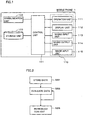
- Fig. 1 is a functional block diagram of a mobile phone 1 according to a first embodiment of the present invention.
- mobile phone 1 includes a control unit 101 formed of a CPU (Central Processing Unit) or the like and controlling the whole, a communication unit 102 performing communication via a relay station, a storage unit 103 storing a program performed in control unit 101, intermediate data of the program, data obtained from another apparatus and others, and an input/output unit 110 for input/output of various kinds of information and commands.
- control unit 101 formed of a CPU (Central Processing Unit) or the like and controlling the whole
- a communication unit 102 performing communication via a relay station
- a storage unit 103 storing a program performed in control unit 101, intermediate data of the program, data obtained from another apparatus and others
- an input/output unit 110 for input/output of various kinds of information and commands.
- Input/output unit 110 includes an operation unit 111 having ten keys and others used by a user of mobile phone 1 to input a telephone number of another telephone machine, input an item for retrieving a received e-mail, and input a display request of the received e-mail, for example, a display unit 112 formed of a display screen for display of information for the user, a sound input unit 113 formed of a microphone for input of sound, a sound output unit 114 formed of a speaker for output of sound, and an image input unit 115 formed of a camera for taking a picture image.
- an operation unit 111 having ten keys and others used by a user of mobile phone 1 to input a telephone number of another telephone machine, input an item for retrieving a received e-mail, and input a display request of the received e-mail, for example, a display unit 112 formed of a display screen for display of information for the user, a sound input unit 113 formed of a microphone for input of sound, a sound output unit 114 formed of
- Fig. 2 is a flowchart illustrating a content display process performed by mobile phone 1.
- step S201 storage unit 103 stores a content to be reproduced.
- control unit 101 performs data evaluation of the content to be reproduced. Specifically, complexity of the content is calculated. If the complexity obtained is less than the upper limit of complexity processible by the terminal, the content is reproduced in step S205.
- step S203 If it exceeds the upper limit of processing capability of the terminal, some functions of the terminal are invalidated to make part of the content not displayed, and complexity is calculated again (step S203). The process is repeated to calculate the complexity with which the content can be reproduced without exceeding the processing capability. When the relevant complexity is obtained, reproduction is performed. Otherwise, reproduction is not effected.
- Terminals capable of reproducing multimedia contents may roughly be divided into two groups, i.e., high-grade terminals provided with a sophisticated plotting function requiring heavy load of processing, and low-grade terminals unprovided with such a function.
- high-grade terminals provided with a sophisticated plotting function requiring heavy load of processing
- low-grade terminals unprovided with such a function.
- each terminal uses an expression to calculate complexity indicting the difficulty in reproducing a content for the terminal, based on the number of polygons, the number of vertexes and others of the content.
- an upper limit of complexity for reproduction is set for each terminal when the plotting functions of a plurality of objects are validated or invalidated.
- the terminal it is determined whether complexity exceeds the upper limit when the plotting functions of all objects are validated. If so, complexity is recalculated using the expression for calculating complexity, with part of the plotting functions being invalidated. The process is repeated to ensure that any content reproducible with a low-grade terminal can be reproduced with any higher-grade terminals.
- the plotting is cancelled in units of objects as necessary, to reduce the load on the terminal.
- Fig. 3 shows a specific example of the content of advertisement.
- the content shown in Fig. 3 includes a character object (character string of "BIG SALE FOR USED CARS! ... PARKING!), an image object of car, and a graphic symbol object of circular shape (eight white circles) surrounding and decorating the content.
- priority is assigned to each object as data by the producer of the content.
- priorities are set in order of the character object, the image object of the car, and the graphic symbol object.
- the character object directly indicating the subject of the advertisement needs to be displayed without fail, while it will not pose a problem if the graphic symbol object is not displayed.
- complexities are set for display of the characters, images and graphic symbols in accordance with the models of the mobile phones.
- Fig. 4 shows priorities of objects and complexities for plotting the objects. Specifically, Fig. 4 shows the priorities of the above-described objects, and values indicating the complexities for plotting the respective objects in terminals (mobile phones) of models A and B.
- an absolute plot is assigned to the character object.
- the objects of the car and the circle may be omitted, although the object of the car is higher in priority than the graphic symbol object of the circle merely decorating the content.
- the priority "1" is assigned to the car, and "2" to the circular object.
- the object assigned with the absolute plot "0" is plotted without fail. If the complexity of the object of the absolute plot "0" alone exceeds the reproduction limit, then the content is not reproduced. To enable these operations, control unit 101 can invalidate the plotting functions in units of objects.
- complexities of the objects vary in different models of terminals as shown in Fig. 4, since the terminals of different models have different plotting capabilities for characters, images and graphic symbols. Specifically, complexities of the character, image and graphic symbol are "60", “80” and “15” in the terminal A, while they are “80”, "200” and “20” in the terminal B.
- Fig. 5 shows the upper limit of complexity and the expression for calculating the complexity for each terminal.
- terminal A has the upper limit of complexity of "400", and the expression for calculating the same is set as (character) ⁇ (the number thereof) + (image) ⁇ 2 ⁇ (the number thereof) + (graphic symbol) ⁇ (the number thereof).
- the upper limit of complexity is "200", and the expression for calculating the same is set as (character) ⁇ (the number thereof) + (image) ⁇ (the number thereof) + (graphic symbol) ⁇ (the number thereof).
- control unit 101 of Fig. 1 calculates the complexity of the content based on the expression.
- the content is reproduced without alternation (that is, the display obtained is exactly as shown in Fig. 3).
- the control unit calculates the complexity of the content in the same manner.
- the control unit recalculates the complexity omitting one graphic symbol object having the lowest order of priority.
- Fig. 6 shows the display result with the objects other than the characters all omitted.
- the values in the expression and the values of complexity for the respective kinds of objects of character, image and others are determined in accordance with the reproduction property of the terminal. That is, the individual values and the expression for calculation are determined based on the plotting speed for each item of the respective objects and from experience.
- the configuration of the content may be as shown in Fig. 7 where a plurality of objects are present in one screen, or a content may be configured as shown in Fig. 8 where a plurality of pages are present in one file and the pages are switched successively for reproduction.
- Fig. 9 is a flowchart illustrating a method for calculating complexity that is performed in the mobile phone according to the present embodiment.
- step S101 0 is substituted for the variable i indicating the number of objects to be processed, and the total number of the objects within the content is substituted for n. Further, 0 is substituted for the variable c indicating complexity of the content.
- step S103 the i-th object is set to be an object to be processed.
- the target object is a graphic symbol in step S105
- complexity per graphic symbol is added to c in step S111.
- complexity per image is added to c in step S113.
- the target object is determined to be a character in step S109
- complexity per character object is added to c in step S115.
- Fig. 10 is a flowchart in the case of processing a content having a plurality of pages.
- complexity is calculated for each page.
- an object to be displayed on the page is omitted.
- step S201 0 is substituted for the page number p to be processed and the total number of pages included in the content is substituted for the variable m.
- step S203 An expression for calculating the complexity is set in step S203, and then, in step S205, complexity c of the page p is calculated in accordance with the flowchart shown in Fig. 9.
- step S209 the expression for calculation is modified, by reducing the content to be displayed in accordance with priorities. With the complexity c decreased in this manner, the process returns to step S205.
- step S209 If the expression cannot be modified in step S209, the current routine is terminated.
- the hardware configuration of the mobile phone according to the second embodiment is identical to that of the first embodiment, and thus, description thereof is not repeated here.
- a specific function of the terminal is invalidated based on the substance of the content.
- a content is formed of a graphic symbol (circle) and gradation coloring the interior thereof, as shown in Fig. 11.
- Fig. 12 shows object plotting functions and their complexities set in a terminal C.
- complexity of "20” is set for the function of plotting a graphic symbol
- complexity of "160” is set for the function of gradation for the graphic symbol.
- Fig. 13 shows the upper limit of complexity and the expression for calculating the complexity in terminal C.
- the complexity representing the upper limit for reproduction of terminal C is "100".
- the control unit recalculates the complexity, with the gradation function invalidated, and the result of "20" is obtained. This means that the content can be reproduced if the animation reproduction unit does not use the gradation function.
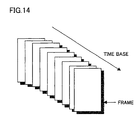
- complexity is calculated each time a frame is plotted, and the content is reproduced as much as possible using the configuration in the first or second embodiment.
- a certain process such as skipping of the frame may be performed.
- the content can be reproduced within the processing capability of the terminal.
- complexity may be calculated for every frame before commencement of reproduction, rather than calculating the same each time a frame is plotted. This can prevent a situation where a gradation function, for example, becomes unavailable during reproduction of animation and gradation is not obtained for a particular period of time during the reproduction. More specifically, when complexity is calculated for every frame prior to reproduction, a frame may be found which is reproducible only if the gradation function is set off for the frame. In such a case, the gradation function is set off for the entire content.
- a program may be provided as a program product recorded on a computer readable recording medium such as a flexible disk attached to a computer, a CD-ROM, a ROM, a RAM or a memory card.
- the program may be recorded on a recording medium such as a hard disk built in a computer, or downloaded via a network.
- the program product thus provided may be installed in a program storage unit such as the hard disk for execution, or may be executed directly from a ROM.
- a program product includes the program itself and a recording medium recorded with the program.
- the present invention is applicable to any of mobile phone, PDA device, personal computer and other computer apparatuses, as long as it is used to reproduce a content.
- the content display apparatus, the content display program, the recording medium recorded with the program, and the content display method according to the present invention are suitable for use in the techniques related to mobile terminals, mobile phones, computer apparatuses and others.
Landscapes
- Engineering & Computer Science (AREA)
- Multimedia (AREA)
- Signal Processing (AREA)
- Theoretical Computer Science (AREA)
- Physics & Mathematics (AREA)
- General Physics & Mathematics (AREA)
- Computing Systems (AREA)
- General Engineering & Computer Science (AREA)
- Human Computer Interaction (AREA)
- Controls And Circuits For Display Device (AREA)
- Telephone Function (AREA)
- Digital Computer Display Output (AREA)
- Two-Way Televisions, Distribution Of Moving Picture Or The Like (AREA)
- Information Transfer Between Computers (AREA)
- Mobile Radio Communication Systems (AREA)
- Processing Or Creating Images (AREA)
Applications Claiming Priority (3)
| Application Number | Priority Date | Filing Date | Title |
|---|---|---|---|
| JP2002140415 | 2002-05-15 | ||
| JP2002140415A JP3926203B2 (ja) | 2002-05-15 | 2002-05-15 | コンテンツ表示装置、コンテンツ表示プログラム、該プログラムを記録した記録媒体、およびコンテンツ表示方法 |
| PCT/JP2003/005640 WO2003098424A1 (fr) | 2002-05-15 | 2003-05-02 | Dispositif d'affichage de contenu, procede de commande d'affichage en fonction de la complexite du contenu et programme d'affichage de contenu |
Publications (2)
| Publication Number | Publication Date |
|---|---|
| EP1505488A1 true EP1505488A1 (fr) | 2005-02-09 |
| EP1505488A4 EP1505488A4 (fr) | 2006-11-02 |
Family
ID=29544923
Family Applications (1)
| Application Number | Title | Priority Date | Filing Date |
|---|---|---|---|
| EP03725754A Withdrawn EP1505488A4 (fr) | 2002-05-15 | 2003-05-02 | Dispositif d'affichage de contenu, procede de commande d'affichage en fonction de la complexite du contenu et programme d'affichage de contenu |
Country Status (6)
| Country | Link |
|---|---|
| US (1) | US20070165030A1 (fr) |
| EP (1) | EP1505488A4 (fr) |
| JP (1) | JP3926203B2 (fr) |
| CN (1) | CN1653417A (fr) |
| AU (1) | AU2003231413A1 (fr) |
| WO (1) | WO2003098424A1 (fr) |
Cited By (8)
| Publication number | Priority date | Publication date | Assignee | Title |
|---|---|---|---|---|
| WO2006099082A3 (fr) * | 2005-03-10 | 2007-09-20 | Qualcomm Inc | Classification de contenus pour traitement multimedia |
| WO2009147590A3 (fr) * | 2008-06-02 | 2010-02-04 | Koninklijke Philips Electronics N.V. | Appareil et procédé permettant d’accorder un système audiovisual au niveau d’attention d’un auditeur |
| EP1921866A3 (fr) * | 2005-03-10 | 2010-07-28 | QUALCOMM Incorporated | Classification de contenu pour traitement multimédia |
| US8654848B2 (en) | 2005-10-17 | 2014-02-18 | Qualcomm Incorporated | Method and apparatus for shot detection in video streaming |
| US8780957B2 (en) | 2005-01-14 | 2014-07-15 | Qualcomm Incorporated | Optimal weights for MMSE space-time equalizer of multicode CDMA system |
| US8948260B2 (en) | 2005-10-17 | 2015-02-03 | Qualcomm Incorporated | Adaptive GOP structure in video streaming |
| US9071822B2 (en) | 2005-09-27 | 2015-06-30 | Qualcomm Incorporated | Methods and device for data alignment with time domain boundary |
| US9131164B2 (en) | 2006-04-04 | 2015-09-08 | Qualcomm Incorporated | Preprocessor method and apparatus |
Families Citing this family (9)
| Publication number | Priority date | Publication date | Assignee | Title |
|---|---|---|---|---|
| JP4699080B2 (ja) * | 2005-04-22 | 2011-06-08 | 京セラ株式会社 | 携帯端末、携帯端末の制御方法及びプログラム |
| JP4908806B2 (ja) * | 2005-09-09 | 2012-04-04 | キヤノン株式会社 | 投射型映像表示装置 |
| JP4845570B2 (ja) * | 2006-04-05 | 2011-12-28 | シャープ株式会社 | 字幕表示方法及びデジタル放送受信機 |
| JP2008164894A (ja) * | 2006-12-28 | 2008-07-17 | Sharp Corp | コンテンツ表示装置 |
| JP2009009228A (ja) * | 2007-06-26 | 2009-01-15 | Mitsubishi Electric Corp | コンテンツ再生装置、コンテンツ再生方法及びコンテンツ再生装置の運用方法 |
| US8917277B2 (en) * | 2010-07-15 | 2014-12-23 | Panasonic Intellectual Property Corporation Of America | Animation control device, animation control method, program, and integrated circuit |
| CN103049429B (zh) * | 2011-10-14 | 2016-03-30 | 北大方正集团有限公司 | 一种转换电子文档的方法及装置 |
| JP6165394B2 (ja) * | 2015-07-17 | 2017-07-19 | 三菱電機株式会社 | アニメーション表示装置及びアニメーション表示方法 |
| CN115733999A (zh) * | 2022-10-31 | 2023-03-03 | 北京达佳互联信息技术有限公司 | 业务切换方法、装置、电子设备及存储介质 |
Family Cites Families (16)
| Publication number | Priority date | Publication date | Assignee | Title |
|---|---|---|---|---|
| JPH0685181B2 (ja) * | 1985-12-18 | 1994-10-26 | 松下電器産業株式会社 | 画像生成装置 |
| US5448686A (en) * | 1992-01-02 | 1995-09-05 | International Business Machines Corporation | Multi-resolution graphic representation employing at least one simplified model for interactive visualization applications |
| JP3025173B2 (ja) * | 1995-04-13 | 2000-03-27 | シャープ株式会社 | データベース検索システム |
| JP2858556B2 (ja) * | 1996-04-17 | 1999-02-17 | 日本電気株式会社 | 3次元形状通信システム |
| US5894308A (en) * | 1996-04-30 | 1999-04-13 | Silicon Graphics, Inc. | Interactively reducing polygon count in three-dimensional graphic objects |
| AU3718497A (en) * | 1996-06-28 | 1998-01-21 | Resolution Technologies, Inc. | Fly-through computer aided design method and apparatus |
| US6072498A (en) * | 1997-07-31 | 2000-06-06 | Autodesk, Inc. | User selectable adaptive degradation for interactive computer rendering system |
| US6313838B1 (en) * | 1998-02-17 | 2001-11-06 | Sun Microsystems, Inc. | Estimating graphics system performance for polygons |
| JPH11296157A (ja) * | 1998-04-13 | 1999-10-29 | Hitachi Ltd | グラフィックス表示制御方式 |
| US6163749A (en) * | 1998-06-05 | 2000-12-19 | Navigation Technologies Corp. | Method and system for scrolling a map display in a navigation application |
| US6178380B1 (en) * | 1998-10-22 | 2001-01-23 | Magellan, Dis, Inc. | Street identification for a map zoom of a navigation system |
| JP3638224B2 (ja) * | 1999-02-23 | 2005-04-13 | 富士通株式会社 | 3次元ポリゴン表示装置 |
| US6704024B2 (en) * | 2000-08-07 | 2004-03-09 | Zframe, Inc. | Visual content browsing using rasterized representations |
| JP4552290B2 (ja) * | 2000-08-21 | 2010-09-29 | ソニー株式会社 | データ伝送装置及び方法、データ処理装置及び方法 |
| JP3385320B2 (ja) * | 2001-03-06 | 2003-03-10 | シャープ株式会社 | アニメーション再生端末、アニメーションの再生方法、および、そのプログラム |
| JP2004094466A (ja) * | 2002-08-30 | 2004-03-25 | Fujitsu Ltd | 簡略化モデル作成支援装置 |
-
2002
- 2002-05-15 JP JP2002140415A patent/JP3926203B2/ja not_active Expired - Lifetime
-
2003
- 2003-05-02 EP EP03725754A patent/EP1505488A4/fr not_active Withdrawn
- 2003-05-02 AU AU2003231413A patent/AU2003231413A1/en not_active Abandoned
- 2003-05-02 US US10/511,539 patent/US20070165030A1/en not_active Abandoned
- 2003-05-02 CN CNA038109182A patent/CN1653417A/zh active Pending
- 2003-05-02 WO PCT/JP2003/005640 patent/WO2003098424A1/fr not_active Ceased
Cited By (11)
| Publication number | Priority date | Publication date | Assignee | Title |
|---|---|---|---|---|
| US8780957B2 (en) | 2005-01-14 | 2014-07-15 | Qualcomm Incorporated | Optimal weights for MMSE space-time equalizer of multicode CDMA system |
| WO2006099082A3 (fr) * | 2005-03-10 | 2007-09-20 | Qualcomm Inc | Classification de contenus pour traitement multimedia |
| EP1921866A3 (fr) * | 2005-03-10 | 2010-07-28 | QUALCOMM Incorporated | Classification de contenu pour traitement multimédia |
| US9197912B2 (en) | 2005-03-10 | 2015-11-24 | Qualcomm Incorporated | Content classification for multimedia processing |
| US9071822B2 (en) | 2005-09-27 | 2015-06-30 | Qualcomm Incorporated | Methods and device for data alignment with time domain boundary |
| US8654848B2 (en) | 2005-10-17 | 2014-02-18 | Qualcomm Incorporated | Method and apparatus for shot detection in video streaming |
| US8948260B2 (en) | 2005-10-17 | 2015-02-03 | Qualcomm Incorporated | Adaptive GOP structure in video streaming |
| US9131164B2 (en) | 2006-04-04 | 2015-09-08 | Qualcomm Incorporated | Preprocessor method and apparatus |
| WO2009147590A3 (fr) * | 2008-06-02 | 2010-02-04 | Koninklijke Philips Electronics N.V. | Appareil et procédé permettant d’accorder un système audiovisual au niveau d’attention d’un auditeur |
| US9032472B2 (en) | 2008-06-02 | 2015-05-12 | Koninklijke Philips N.V. | Apparatus and method for adjusting the cognitive complexity of an audiovisual content to a viewer attention level |
| US9749550B2 (en) | 2008-06-02 | 2017-08-29 | Koninklijke Philips N.V. | Apparatus and method for tuning an audiovisual system to viewer attention level |
Also Published As
| Publication number | Publication date |
|---|---|
| WO2003098424A1 (fr) | 2003-11-27 |
| AU2003231413A1 (en) | 2003-12-02 |
| US20070165030A1 (en) | 2007-07-19 |
| JP3926203B2 (ja) | 2007-06-06 |
| JP2003330696A (ja) | 2003-11-21 |
| EP1505488A4 (fr) | 2006-11-02 |
| CN1653417A (zh) | 2005-08-10 |
Similar Documents
| Publication | Publication Date | Title |
|---|---|---|
| EP1505488A1 (fr) | Dispositif d'affichage de contenu, procede de commande d'affichage en fonction de la complexite du contenu et programme d'affichage de contenu | |
| CN1781124B (zh) | 图像处理装置以及图像处理方法 | |
| CN112230923B (zh) | 用户界面渲染方法、用户界面渲染装置及服务器 | |
| US9224367B2 (en) | Image processing apparatus, image processing method, and image processing program | |
| CN109862293A (zh) | 终端喇叭的控制方法、设备及计算机可读存储介质 | |
| CN114630057B (zh) | 确定特效视频的方法、装置、电子设备及存储介质 | |
| CN113923515A (zh) | 视频制作方法、装置、电子设备及存储介质 | |
| CN108305310B (zh) | 一种文字动画实现方法、装置、终端和存储介质 | |
| EP2731099A1 (fr) | Dispositif d'émission d'image, procédé d'émission d'image et programme | |
| CN114168026B (zh) | 消息提示的方法、设备和存储介质 | |
| CN118537073B (zh) | 基于玩家操作习惯的游戏广告数据处理方法及系统 | |
| US6833841B2 (en) | Image forming method, computer program for forming image, and image forming apparatus | |
| CN113419873A (zh) | 聊天消息的提醒方法、装置、存储介质及终端设备 | |
| EP2346262A2 (fr) | Procédé et appareil pour configurer un effet stéréoscopique dans un terminal portable | |
| CN115082724B (zh) | 一种模型处理方法、装置、存储介质及电子设备 | |
| CN114419237B (zh) | 一种贴图处理方法、装置、计算机设备及存储介质 | |
| KR20160087590A (ko) | 사용자 단말에서의 인스턴트 메시징 서비스 제공 장치 | |
| CN112445318B (zh) | 一种对象显示方法、装置、电子设备及存储介质 | |
| JP3458108B1 (ja) | 動画像生成装置、動画像生成方法、動画像生成プログラムおよび動画像生成プログラムを記録したコンピュータ読取可能な記録媒体 | |
| CN112734949A (zh) | Vr内容的属性修改方法、装置、计算机设备及存储介质 | |
| CN111935534A (zh) | 一种回放录制视频的方法及装置 | |
| CN115695899B (zh) | 视频的生成方法、电子设备及其介质 | |
| CN116740241B (zh) | 一种图像处理方法及电子设备 | |
| KR100617797B1 (ko) | 휴대단말기에서 멀티미디어 데이터를 오버레이 표시하는 장치 및 방법 | |
| CN119094671A (zh) | 基于pag的动态环绕特效开发方法、装置、设备及介质 |
Legal Events
| Date | Code | Title | Description |
|---|---|---|---|
| PUAI | Public reference made under article 153(3) epc to a published international application that has entered the european phase |
Free format text: ORIGINAL CODE: 0009012 |
|
| 17P | Request for examination filed |
Effective date: 20041103 |
|
| AK | Designated contracting states |
Kind code of ref document: A1 Designated state(s): AT BE BG CH CY CZ DE DK EE ES FI FR GB GR HU IE IT LI LU MC NL PT RO SE SI SK TR |
|
| AX | Request for extension of the european patent |
Extension state: AL LT LV MK |
|
| DAX | Request for extension of the european patent (deleted) | ||
| RBV | Designated contracting states (corrected) |
Designated state(s): DE FR GB |
|
| A4 | Supplementary search report drawn up and despatched |
Effective date: 20060928 |
|
| RIC1 | Information provided on ipc code assigned before grant |
Ipc: G06T 13/00 20060101ALI20060922BHEP Ipc: G06F 3/14 20060101ALI20060922BHEP Ipc: G06T 11/00 20060101AFI20060922BHEP |
|
| 17Q | First examination report despatched |
Effective date: 20080227 |
|
| STAA | Information on the status of an ep patent application or granted ep patent |
Free format text: STATUS: THE APPLICATION IS DEEMED TO BE WITHDRAWN |
|
| 18D | Application deemed to be withdrawn |
Effective date: 20141202 |