EP1505583A1 - Optische platte und prozess zu ihrer herstellung - Google Patents
Optische platte und prozess zu ihrer herstellung Download PDFInfo
- Publication number
- EP1505583A1 EP1505583A1 EP03723345A EP03723345A EP1505583A1 EP 1505583 A1 EP1505583 A1 EP 1505583A1 EP 03723345 A EP03723345 A EP 03723345A EP 03723345 A EP03723345 A EP 03723345A EP 1505583 A1 EP1505583 A1 EP 1505583A1
- Authority
- EP
- European Patent Office
- Prior art keywords
- resin composition
- curable resin
- ultraviolet curable
- composition product
- optical disc
- Prior art date
- Legal status (The legal status is an assumption and is not a legal conclusion. Google has not performed a legal analysis and makes no representation as to the accuracy of the status listed.)
- Withdrawn
Links
- 0 CCC[C@](C(CC)CCC(C)C)[U](C#*)=N[U]#C Chemical compound CCC[C@](C(CC)CCC(C)C)[U](C#*)=N[U]#C 0.000 description 1
Images






Classifications
-
- G—PHYSICS
- G11—INFORMATION STORAGE
- G11B—INFORMATION STORAGE BASED ON RELATIVE MOVEMENT BETWEEN RECORD CARRIER AND TRANSDUCER
- G11B7/00—Recording or reproducing by optical means, e.g. recording using a thermal beam of optical radiation by modifying optical properties or the physical structure, reproducing using an optical beam at lower power by sensing optical properties; Record carriers therefor
- G11B7/24—Record carriers characterised by shape, structure or physical properties, or by the selection of the material
- G11B7/26—Apparatus or processes specially adapted for the manufacture of record carriers
-
- C—CHEMISTRY; METALLURGY
- C09—DYES; PAINTS; POLISHES; NATURAL RESINS; ADHESIVES; COMPOSITIONS NOT OTHERWISE PROVIDED FOR; APPLICATIONS OF MATERIALS NOT OTHERWISE PROVIDED FOR
- C09J—ADHESIVES; NON-MECHANICAL ASPECTS OF ADHESIVE PROCESSES IN GENERAL; ADHESIVE PROCESSES NOT PROVIDED FOR ELSEWHERE; USE OF MATERIALS AS ADHESIVES
- C09J157/00—Adhesives based on unspecified polymers obtained by reactions only involving carbon-to-carbon unsaturated bonds
-
- C—CHEMISTRY; METALLURGY
- C09—DYES; PAINTS; POLISHES; NATURAL RESINS; ADHESIVES; COMPOSITIONS NOT OTHERWISE PROVIDED FOR; APPLICATIONS OF MATERIALS NOT OTHERWISE PROVIDED FOR
- C09J—ADHESIVES; NON-MECHANICAL ASPECTS OF ADHESIVE PROCESSES IN GENERAL; ADHESIVE PROCESSES NOT PROVIDED FOR ELSEWHERE; USE OF MATERIALS AS ADHESIVES
- C09J175/00—Adhesives based on polyureas or polyurethanes; Adhesives based on derivatives of such polymers
- C09J175/04—Polyurethanes
- C09J175/14—Polyurethanes having carbon-to-carbon unsaturated bonds
-
- G—PHYSICS
- G11—INFORMATION STORAGE
- G11B—INFORMATION STORAGE BASED ON RELATIVE MOVEMENT BETWEEN RECORD CARRIER AND TRANSDUCER
- G11B7/00—Recording or reproducing by optical means, e.g. recording using a thermal beam of optical radiation by modifying optical properties or the physical structure, reproducing using an optical beam at lower power by sensing optical properties; Record carriers therefor
- G11B7/24—Record carriers characterised by shape, structure or physical properties, or by the selection of the material
- G11B7/241—Record carriers characterised by shape, structure or physical properties, or by the selection of the material characterised by the selection of the material
- G11B7/252—Record carriers characterised by shape, structure or physical properties, or by the selection of the material characterised by the selection of the material of layers other than recording layers
- G11B7/256—Record carriers characterised by shape, structure or physical properties, or by the selection of the material characterised by the selection of the material of layers other than recording layers of layers improving adhesion between layers
-
- C—CHEMISTRY; METALLURGY
- C08—ORGANIC MACROMOLECULAR COMPOUNDS; THEIR PREPARATION OR CHEMICAL WORKING-UP; COMPOSITIONS BASED THEREON
- C08G—MACROMOLECULAR COMPOUNDS OBTAINED OTHERWISE THAN BY REACTIONS ONLY INVOLVING UNSATURATED CARBON-TO-CARBON BONDS
- C08G2170/00—Compositions for adhesives
- C08G2170/40—Compositions for pressure-sensitive adhesives
-
- G—PHYSICS
- G11—INFORMATION STORAGE
- G11B—INFORMATION STORAGE BASED ON RELATIVE MOVEMENT BETWEEN RECORD CARRIER AND TRANSDUCER
- G11B7/00—Recording or reproducing by optical means, e.g. recording using a thermal beam of optical radiation by modifying optical properties or the physical structure, reproducing using an optical beam at lower power by sensing optical properties; Record carriers therefor
- G11B7/24—Record carriers characterised by shape, structure or physical properties, or by the selection of the material
- G11B7/2403—Layers; Shape, structure or physical properties thereof
- G11B7/24035—Recording layers
- G11B7/24038—Multiple laminated recording layers
Definitions
- the present invention relates to an optical disc in which at least two substrates are bonded together with a tacky adhesive layer and a manufacturing method thereof.
- optical discs in which a film such as a recording layer is formed on a single substrate are now available, there have been proposed an optical disc comprising a plurality of substrates bonded together.
- the ultraviolet curable resin is in use, then a thickness of the ultraviolet curable resin tends to be distributed in a wide range, it is easily smudged and it smells very bad. These factors will degrade work efficiency.
- the ultraviolet curable resin cannot overcome drawbacks in which it is contracted considerably and is easily warped when cured.
- the tacky adhesive such as the above-mentioned PSA
- creep strength is lowered and hence the tacky adhesive is easily affected by a slide stress and tends to absorb moisture
- the resultant optical disc cannot overcome problems such as the occurrence of warping.
- An optical disc according to the present invention is composed of a film in which at least two substrates are bonded together with a tacky adhesive layer, this tacky adhesive layer being formed of a film which results from curing an ultraviolet curable resin composition product containing an acrylic resin having a double bond at its side chain, a photopolymerization initiator and a thermal crosslinking agent by thermal crosslinking and ultraviolet crosslinking.
- an optical disc manufacturing method comprises a step of half-curing an ultraviolet curable resin composition product containing an acrylic resin having a double bond at its side chain, a photopolymerization initiator and a thermal crosslinking agent by thermal crosslinking, a process for attaching the ultraviolet curable resin composition product thus half-cured on one substrate, a process for bonding the other substrate to this one substrate and a process for forming a tacky adhesive layer for bonding one substrate and the other substrate by curing the ultraviolet curable resin composition product according to ultraviolet crosslinking using irradiation of ultraviolet rays.
- the tacky adhesive layer is composed of the film which results from curing the ultraviolet curable resin composition product containing the acrylic based resin having the double bond at its side chain, the photopolymerization initiator and the thermal crosslinking agent by thermal crosslinking and ultraviolet crosslinking
- the ultraviolet curable resin composition product is crosslinked at its portion in which it has the double bond at its side chain by ultraviolet crosslinking and other portion (e.g., carboxyl group) is crosslinked by thermal crosslinking. Since different portions of the ultraviolet curable resin composition product are respectively crosslinked by ultraviolet crosslinking and thermal crosslinking, there is constructed a network structure that has been crosslinked in a three-dimensional fashion.
- the optical disc becomes difficult to be affected by a slide stress and the tacky adhesive layer becomes difficult to absorb moisture.
- the process for half-curing the ultraviolet curable resin composition product containing the acrylic resin having the double bond at its side chain, the photopolymerization initiator and the thermal crosslinking agent by thermal crosslinking it becomes possible to increase strength of the ultraviolet curable resin composition product before it is being irradiated with ultraviolet rays because the ultraviolet curable resin is crosslinked at its other portion (e.g. carboxyl group) than the portion that includes the double bond at its side chain by thermal crosslinking. Therefore, the thickness of the thus half-cured ultraviolet curable resin composition product can be made stable, and hence when the ultraviolet curable resin composition product is formed as a film-like one, it becomes possible to stabilize the smoothness and thickness of the resultant film.
- the ultraviolet curable resin composition product containing the acrylic resin having the double bond at its side chain, the photopolymerization initiator and the thermal crosslinking agent by thermal crosslinking
- the tacky adhesive layer is formed by curing the ultraviolet curable resin composition product according to ultraviolet crosslinking, the two substrates can be bonded together easily and stably. Furthermore, since the ultraviolet curable resin composition product is crosslinked by ultraviolet crosslinking at its portion having the double bond at its side chain to form the three-dimensionally crosslinked network structure together with the previously-crosslinked portion by thermal crosslinking, the tacky adhesive layer can increase its adhesive strength so that it becomes able to fix and hold the two substrates reliably.
- FIG. 1 is a diagram (cross-sectional view) showing a schematic arrangement of an optical disc according to an embodiment of the present invention
- FIGS. 2A to 2C are cross-sectional views showing an optical disc according to other embodiment of the present invention
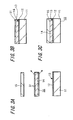
- FIGS. 3A to 3C are process diagrams showing a method of manufacturing the optical disc shown in FIG. 1 according to an embodiment of the present invention
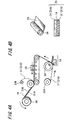
- FIGS. 4A and 4B are process diagrams showing a manufacturing process of the sheet shown in FIG. 3A
- FIGS. 5A to 5D are process diagrams showing manufacturing processes required when a tacky adhesive layer is directly formed on a disc substrate
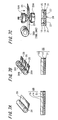
- FIGS. 6A and 6B are process diagrams showing manufacturing processes required when a tacky adhesive layer is directly formed on a cover film
- FIGS. 7A to 7C are process diagrams showing manufacturing processes required when a tacky adhesive layer is directly formed on a cover film
- FIGS. 8A to 8C are process diagrams showing manufacturing processes required when a tacky adhesive layer is directly formed on a cover film
- FIG. 9 is a diagram showing a reaction between an acrylic based resin having hydroxyl group and carboxyl group and methacrylic ester having isocyanate group
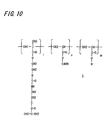
- FIG. 10 is a diagram showing an acrylic based resin having a double bond at its side chain and which is thus obtained by the reaction shown in FIG. 9
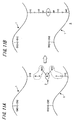
- FIGS. 11A and 11B are diagrams to which reference will be made in explaining the reaction between the acrylic based resin having the double bond at its side chain and the thermal crosslinking agent
- FIGS. 9 is a diagram showing a reaction between an acrylic based resin having hydroxyl group and carboxyl group and methacrylic ester having isocyanate group
- FIG. 10 is a diagram showing an acrylic based resin having a double bond at its side chain
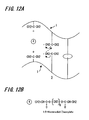
- FIGS. 12A and 12B are diagrams to which reference will be made in explaining the manner in which the acrylic based resin having the double bond at the side chain is crosslinked by ultraviolet crosslinking;
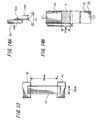
- FIG. 13 is a diagram showing a tension test method of films;
- FIGS. 14A and 14B are diagrams showing a test method for testing holding power of films.
- the present invention is to provide an optical disc in which a tacky adhesive layer is composed of a film in which an ultraviolet curable resin composition product containing an acrylic based resin having double bond at its side chain, a photopolymerization initiator and a thermal crosslinking agent are cured by thermal crosslinkng and ultraviolet crosslinking.
- the above-mentioned optical disc in which a substrate with a recording layer formed thereon and a film-like transparent substrate are bonded together with a tacky adhesive layer.
- an ultraviolet curable resin composition product contains 0.1 to 5 parts by weight of photopolymerization initiator and 0.1 to 5 parts by weight of thermal crosslinking agent for 100 parts by weight of acrylic resin.
- the acrylic resin having the double bond at its side chain is obtained by reacting 0.1 to 20 parts by weight of more than one kind selected from acrylic acid ester containing isocyanate group and methacrylic acid ester containing isocynanate group with 100 parts by weight of resin (C) which results from copolymerizing 0.1 to 20 parts by weight of monomer (B) of more than one kind selected from monomers containing at least hydroxyl group or carboxyl group to 100 parts by weight of monomer (A) whose main component is more than one kind selected from acrylic acid ester and methacrylic acid ester.
- a method for manufacturing an optical disc in which at least two substrates are bonded together with a tacky adhesive layer comprising a process for half-curing an ultraviolet curable resin composition product containing acrylic resin having a double bond at its side chain, a photopolymerization initiator and a thermal crosslinking agent by thermal crosslinking, a process for attaching the thus half-cured ultraviolet curable resin composition product to one substrate and a process for forming the adhesive layer for bonding the one substrate and the other substrate by curing the ultraviolet curable resin composition product by ultraviolet crosslinking using irradiation of ultraviolet rays.
- the above-described optical disc manufacturing method in which the ultraviolet curable resin composition product is processed such that both ends of the ultraviolet curable resin composition product are sandwiched by peel-apart films, the ultraviolet curable resin composition product is attached to the one substrate after the peel-apart film of one side has been peeled and the other substrate is bonded to the one substrate after the peel-apart film of the other side has been peeled.
- an optical disc in which at least two substrates are bonded together with a tacky adhesive layer.
- a transparent substrate and an opaque substrate are available as substrates that may be bonded together with the tacky adhesive layer.
- the transparent substrate should be used as a substrate that can allow light (laser light, etc.) for reproducing and recording information from and on at least the optical disc to pass therethrough.
- the substrate that may not allow light to pass therethrough is not limited to a particular substrate and an opaque substrate can be used as such substrate.
- the transparent substrate there can be enumerated a glass substrate, a polycarbonate resin, a polymethyl methacrylate resin (PMMA), a polyolefin resin, a vinyl chloride resin, a polystyrene resin, an epoxy resin, a polyallylate resin, a polyether sulfone resin, a silicon resin, a polyethylene terephthalate resin, etc. for example.
- a polycarbonate resin a polymethyl methacrylate resin (PMMA)
- PMMA polymethyl methacrylate resin
- a polyolefin resin a vinyl chloride resin
- a polystyrene resin an epoxy resin
- a polyallylate resin a polyallylate resin
- a polyether sulfone resin a silicon resin
- a polyethylene terephthalate resin etc.
- the opaque resin there can be enumerated an opaque resin class, a colored resin class containing pigments and dyes, metals, ceramics, etc.
- characteristics of the present invention lie in the material of, in particular, the tacky adhesive layer that is used to bond the substrates together.
- the tacky adhesive layer is formed such that an ultraviolet curable resin composition product containing an acrylic based resin having a double bond at its side chain, a photopolymerization initiator and a thermal crosslinking agent is cured by thermal crosslinking and ultraviolet crosslinking of the acrylic based resin.
- the ultraviolet curable resin composition product containing at least the acrylic based resin having the double bond at its side chain, the photopolymerization initiator and the thermal crosslinking agent is half-cured by thermal crosslinking, the thus half-cured ultraviolet curable resin composition product is attached to one of the two substrates to be bonded and the other substrate is bonded to the ultraviolet curable resin composition product, whereafter the ultraviolet curable resin composition product is cured by illumination of ultraviolet rays to thereby form the tacky adhesive layer.
- the acrylic based resin having the double bond at its side chain can be obtained in the manner which will follow.
- a monomer (B) of more than one kind selected from monomers containing at least hydroxyl group or carboxyl group is copolymerized with a monomer (A) having more than one kind selected from acrylic acid ester or methacrylic acid ester (i.e. (metha)acrylic acid ester), for example, to thereby obtain a resin (C) of 5000 to 1000000 weight-average molecular weights at temperature less than a glass transition point of 0°C.
- a resin (C1) in which hydroxyethyl methacrylate (B1) is copolymerized with butyl acrylate (shown by Al) that is one kind of acrylic acid ester corresponding to the above-mentioned (A) as a monomer containing hydroxyl group corresponding to the above-described (B) and acrylic acid (B2) is copolymerized with butyl acrylate as a monomer containing carboxyl group is mixed with methacryloiloxyethyl isocyanate (D1) corresponding to the above-described (D) and is then reacted with butyl acrylate which is a kind of acrylic acid ester corresponding to the above-described (A).
- the monomer having the acrylic acid ester or the methacrylic acid ester as the main component in addition to the above-mentioned butyl acrylate, there may be enumerated methacrylic acid butyl, (metha) acrylic acid - 2 - ethylhexyl, (metha) acrylic acid methyl, (metha) acrylic acid ether, (metha) acrylic acid propyl, (metha) acrylic acid isooctyl, (metha) acrylic acid nonyl, etc.
- vinyl based monomers that can be copolymerized with (metha) acrylic acid ester may be used together with the (metha) acrylic ester.
- the vinyl based monomer there may be enumerated acrylamide, styrene, (metha) acrylonitrile, N-vinylpyrrolidone, maleic acid, vinyl caprolactam, etc., for example.
- the monomers that can be copolymerized with this (metha) acrylic acid ester and which contain at least hydroxyl group or carboxyl group in addition to the above-mentioned hydroxyether methacrylate and acrylic acid, there can be used hydroxyethylacrylate, hydroxypropyl (metha) acrylate, butanediole (metha) acrylate, phenoxyhydroxypropyl (metha) acrylate, glyceroldi (metha) acrylate and ECH-denatured propylene glycoldi (metha) acrylate.
- acrylic acid ester containing isocyanate group or the methacrylic acid ester containing isocyanate group in addition to the above-mentioned methacryloiloxyethyl isocyanate, there can be used such one in which a polyisocyanate compound such as tolylenediisocyanate and xylenediisocyanate is reacted with monomers having hydroxyl group, such as hydroxyether (metha) acrylate and hydroxypropyl (metha) acrylate.
- a polyisocyanate compound such as tolylenediisocyanate and xylenediisocyanate is reacted with monomers having hydroxyl group, such as hydroxyether (metha) acrylate and hydroxypropyl (metha) acrylate.
- monomers (B) of more than one kind selected from the monomers containing at least the hydroxyl group or the carboxyl group should preferably be mixed into and copolymerized with 100 parts by weight of the monomer (A) having more than one kind of components selected from the acrylic acid ester or the methacrylic acid ester (i.e. (metha) acrylic acid ester) as the main component.
- the mixed amount is less than 0.1 parts by weight, there is then the risk that the resultant ultraviolet curable resin composition product will not have sufficient strength by ultraviolet crosslinking. If on the other hand the mixed amount is greater than 20 parts by weight, there is then the risk that a transparent tacky adhesive layer obtained before being cured with illumination of ultraviolet rays will become too hard.
- 0.1 to 20 parts by weight of the (D) of more than one kind selected from the acrylic acid ester containing the isocyanate group or the methacrylic acid ester containing the isocyanate group may be mixed into and reacted with 100 parts by weight of the copolymerized resin (C).
- the resin of the amount that can be sufficiently reacted with the hydroxyl group or the carboxyl group can be supplied and an extra component that does not contribute to the reaction can be decreased.
- photopolymerization initiator that is mixed into the acrylic based resin having the double bond at its side chain
- the mixed amount of this photopolymerization initiator is selected to be 0.1 to 5 parts by weight relative to 100 parts by weight of the acrylic based resin.
- the mixed amount of the photopolymerization initiator is too large, then there is the risk that the ultraviolet curable resin composition product will be yellowed and will produce a strong smell after it has been cured.
- an isocyanate based crosslinking agent e.g. crosslinking agent manufactured by Nippon Polyurethane Industry Co. Ltd., under the trade name of "COLONATE L
- an aziridine compound e.g. aziridine compound manufactured by Sogo Yakuhin Kogyo Kabushiki Kaisha under the trade name of "trimethylolpropane-tri- ⁇ -aziridinylpropionate
- a melamine resin e.g. melamine resin manufactured by Dainippon Ink & Chemicals Ind., under the trade name of "SUPERBECKAMINE J-820
- a melamine resin e.g. melamine resin manufactured by Dainippon Ink & Chemicals Ind., under the trade name of "SUPERBECKAMINE J-820
- the ultraviolet curable resin composition product is composed of the above-mentioned acrylic based resin and the above-mentioned photopolymerization initiator, then when this ultraviolet curable resin composition product is formed as the film-like one, this film is too soft and is easily deformed. Thus, smoothness of the film is lost so that optical characteristics will be degraded.
- the thermal crosslinking agent is mixed into the ultraviolet curable resin composition product together with the acrylic based resin and the photopolymerization initiator, whereby at least a part of the acrylic based resin is formed as a three-dimensional structure when the ultraviolet curable resin composition product is coated and dried.
- the strength of the film-like ultraviolet curable resin composition product can increase to a certain extent that the film-like ultraviolet curable resin composition product can be prevented from being wobbled.
- the thermal crosslinking agent 2 having more than two isocyanate groups NCO such as the above-mentioned COLONATE L (having three isocyanate groups NCO)
- the isocyanate group NCO of the thermal crosslinking agent 2 reacts with the carboxyl group COOH, for example, to thermally crosslink the acrylic based resin in a three-dimensional fashion.
- FIG. 11B it is possible to manufacture the resin composition product 3 of which the strength can be increased while the tackiness thereof is being retained.
- the mixed amount of this thermal crosslinking agent is selected to be 0.1 to 5 parts by weight with respect to 100 parts by weight of the acrylic based resin.
- the mixed amount of the thermal crosslinking agent is too large, then there is the risk that the transparent tacky adhesive layer becomes too hard before it is being cured by illumination of ultraviolet rays.
- the following components can be added to the ultraviolet curable resin composition product that should inevitably require the acrylic based resin having the double bond at its side chain, the photopolymerization initiator and the thermal crosslinking agent.
- triethanol amine, diethylethanol amine, Michler's ketone, 2-dimethylaminobenzoic acid ethyl, etc. can be added to the ultraviolet curable resin composition product as a photopolymerization initiator auxiliary.
- the photosensitive monomer and oligomer are interposed between the double bonds of the acrylic based resin to assist the ultraviolet crosslinking as shown by reference numerals 4 in FIGS. 12A and 12B.
- Vinyltriethoxy silane, ⁇ -glycidoxypropyl trimethoxy silane, ⁇ -aminopropyltriethoxy silane, ⁇ -metha clyloxypropyltrimethoxy silane, ⁇ -mercaptopropyltrimethoxy silane, etc., for example, may be used as a coupling agent.
- hydroquinone methoquinone, benzoquinone, anthraquinone, etc., for example, may be used as a thermal polymerization inhibitor.
- silicon oil polyvinyl butyral, etc., for example, may be used as a leveling agent.
- fatty acid ester, phosphate, fluorinated derivative, etc. may be used as a surfactant.
- the amount of illumination of ultraviolet rays for curing the above-mentioned ultraviolet curable resin composition product by ultraviolet crosslinking should preferably fall within a range of from 0.1 to 3.0 J/cm 2 .
- the amount of illumination of ultraviolet rays is smaller than 0.1 J/cm 2 , then there is the risk that the ultraviolet curable resin composition product will be cured unsatisfactorily. If on the other hand the amount of illumination of ultraviolet rays is larger than 3.0 J/cm 2 , then there is the risk that the resin composition product will be yellowed.
- the above-mentioned ultraviolet curable resin composition product can be used a film-like ultraviolet curable resin composition product in which a resin composition product was previously coated on a peel-apart sheet, for example.
- the film-like resin composition product is half-cured by the above-mentioned thermal crosslinking, for example.
- the film-like ultraviolet curable resin composition product becomes excellent in handling property and workability. Also, when the ultraviolet curable resin composition product is half-cured in advance, since the solvent has already been removed from the ultraviolet curable resin composition product, there is then the advantage that localized evacuation becomes unnecessary when this ultraviolet curable resin composition product is in use as compared with the case in which liquid adhesives are in use.
- the table 1 shows various characteristics obtained from the ultraviolet curable resin composition product before and after the ultraviolet curable resin composition product is cured, i.e. tensile elastic modulus, tensile breaking elongation, yield strength, holding power and adhesive strength, respectively.
- tensile elastic modulus [kg weight/cm2] 1.0 to 3.0 Increased (1.1 to 3.0 times)
- Tensile breaking elongation [%] 1000 to 10000 Decreased (1/3 to 1/10 times)
- Adhesive strength (180°peel test, acrylic plate and glass plate) More than 0.7kg weight/2 cm More than 0.7kg weight/2 cm
- the tensile elastic modulus, the tensile breaking elongation and the yield strength were obtained when a 1 mm-thick tacky adhesive film (10 mm wide and 50 mm long) made of the ultraviolet curable resin composition product was attached to a tensile testing machine 42 and measured at stretch speed 200 m/minute as shown in FIG. 13, respectively.
- the holding power was measured as follows. After a 25 ⁇ m-thick polyethylene terephthalate (PET) film has been attached to the tacky adhesive surface of the tacky adhesive film in which the ultraviolet curable resin composition product was formed on the peel-apart film and cut with a width of 25 mm, a measurement film 51 was manufactured by peeling the peel-apart film. As shown in FIGS. 14A and 14B, the slide amount was measured under the condition that the measurement film 51 composed of this ultraviolet curable resin composition product 52 and the PET film 53 was attached to a 2 mm-thick acrylic plate (trade name: PARAGLASS P) 54 so that an adhesive area S (see FIG.
- PARAGLASS P trade name: PARAGLASS P
- the adhesive strength was measured in such a manner that 180° peel strength was measured after a 20 mm-wide measurement film, which was produced similarly to the holding power measurement film 51, has been attached to the acrylic plate and the glass plate and left at room temperature for an hour. At that time, the adhesive strength was measured at stretch speed of 300 mm/minute. Obtained results were the same both in the acrylic plate and the glass plate.
- the ultraviolet curing condition of the ultraviolet curable resin composition product was selected to be illumination of ultraviolet rays of the illumination amount of 1.0 J/cm 2 using a metal halide lamp.
- the tensile elastic modulus, the tensile breaking elongation and the yield strength obtained before the ultraviolet curable resin composition product is cured by illumination of ultraviolet rays show the fact that the two substrates can be bonded together with ease.
- the holding power and the adhesive strength obtained after the ultraviolet curable resin composition product has been cured by illumination of ultraviolet rays show stability with which the two substrates can be fixed to and held together and reliability with which the two substrates can be bonded together.
- the ultraviolet curable resin composition product containing the acrylic based resin having the double bond at its side chain, the photopolymerization initiator and the thermal crosslinking agent has been in use, at least a part of the ultraviolet curable resin composition product is thermally crosslinked and the two substrates have been bonded together in this state, the acrylic based resin is crosslinked by ultraviolet crosslinking to cure the ultraviolet curable resin composition product, thereby resulting in the tacky adhesive layer being formed.
- the ultraviolet curable resin composition product is placed in the state in which it has proper softness and proper strength before it is cured by ultraviolet crosslinking (before it is irradiated with ultraviolet rays).
- the thickness of the ultraviolet curable resin composition product can be stabilized before it is being cured by ultraviolet crosslinking.
- the ultraviolet curable resin composition product is formed as the film-like one, it becomes possible to stabilize smoothness and thickness of the film. Since the two substrates are bonded together in this state, the two substrates can be bonded together easily and stably.
- bubbles can be prevented from being produced in the two substrates when the two substrates are bonded together, bubbles can be prevented from being produced when the ultraviolet curable resin composition product is cured by thermal crosslinking. If the resin composition product is too hard or too elastic, then bubbles are produced in the two substrates when the two substrates are bonded together so that bubbles are produced when the resin composition product is cured.
- the tacky adhesive layer to be formed has sufficient strength so that the two substrates can be fixed and held together with high reliability.
- FIG. 1 is a diagram (cross-sectional view) showing a schematic arrangement of an optical disc according to an embodiment of the present invention.
- An optical disc 10 is composed of a polycarbonate substrate 11 serving as a disc substrate on which a reflective layer 12 is formed and a transparent cover film 15 bonded to this polycarbonate substrate 11 with a tacky adhesive layer 14, e.g., UV-PSA, i.e., PSA (Pressure Sensitive Adhesive) that is cured by irradiation of ultraviolet rays.
- a tacky adhesive layer 14 e.g., UV-PSA, i.e., PSA (Pressure Sensitive Adhesive) that is cured by irradiation of ultraviolet rays.
- Pre-grooves are formed on the polycarbonate substrate 11, and a recording layer 13 is formed on the upper surface of the reflective layer 12.
- the recording layer 13 is read out and written, i.e. information is reproduced from or recorded on the recording layer by laser light L introduced from the side opposite to the disc substrate 11, i.e., from the side of the cover film 15.
- the tacky adhesive layer 14 is composed of a component which results from curing an ultraviolet curable resin composition product containing the above-mentioned acrylic based resin having the double bond at its side chain, a photopolymerization initiator and a thermal crosslinking agent by thermal crosslinking and ultraviolet crosslinking of the acrylic based resin.
- the tacky adhesive layer 14 which is composed of the above-mentioned cured ultraviolet curable resin composition product has to pass the laser light L sufficiently.
- the tacky adhesive layer 14 in which the disc substrate 11 and the cover film 15 are bonded together results from curing the ultraviolet curable resin composition product containing the acrylic based resin having the double bond at its side chain, the photopolymerization initiator and the thermal crosslinking agent by thermal crosslinking and ultraviolet crosslinking of the acrylic based resin, the ultraviolet curable resin is crosslinked at its portion having the double bond at its side chain by ultraviolet crosslinking and other portion (e.g. carboxyl group) is crosslinked by thermal crosslinking. Since the different portions of the ultraviolet curable resin composition product are respectively crosslinked by ultraviolet crosslinking and thermal crosslinking, a network structure that was crosslinked in a three-dimensional fashion is constructed in the tacky adhesive layer 14.
- the tacky adhesive layer has the above-mentioned network structure, the tacky adhesive layer 14 has a sufficient strength, and hence become difficult to be affected by a slide stress. At the same time, since the tacky adhesive layer 14 may absorb a lesser amount of moisture, the disc substrate can be prevented from being warped due to such moisture, and hence the highly-reliable optical disc 10 can be constructed.
- FIGS. 2A to 2C are shown in FIGS. 2A to 2C, respectively.
- an optical disc 21 shown in FIG. 2A includes a recording layer 13 of two layers comprising a first recording layer 13A and a second recording layer 13A, and hence a signal can be read out from and written on from one side (information is reproduced from or recorded on one side).
- This optical disc 21 includes a polycarbonate substrate 11 with pre-grooves formed thereon, not shown, on which a reflective layer 12 is formed, and the first recording layer 13A is formed on the upper surface of the reflective layer 12.
- a second recording layer 13B is formed on the lower surface of the reflective layer by a cover film 15 including the second recording layer 13B with pre-grooves formed thereon, not shown.
- the polycarbonate substrate 11 and the cover film 15 are bonded together with the tacky adhesive layer 14 to form the optical disc 21.
- a semi-transmission reflective layer 17 is provided between the cover film 15 and the tacky adhesive layer 14.
- the tacky adhesive layer 14 for bonding the polycarbonate substrate 11 and the cover film 15 there is formed the ultraviolet curable resin composition product having the aforementioned arrangement.
- the highly-reliable optical disc 21 can be realized.
- an optical disc 22 shown in FIG. 2B includes a recording layer of two layers comprising the first recording layer 13A and the second recording layer 13B to read out and write a signal from both sides (to reproduce or record information from or on both sides).
- the first and second recording layers 13A and 13B are constructed by forming reflective layers 12A, 12B on the two polycarbonate substrates 11A, 11B with pre-grooves formed thereon, not shown.
- the two polycarbonate substrates 11A, 11B are bonded together with the tacky adhesive layer 14 in such a manner that the reflective layers 12A, 12B and the recording layers 13A, 13B are formed inside and thereby the optical disc 22 is formed.
- the tacky adhesive layer 14 for bonding the two polycarbonate substrates 11A and 11B there is formed the ultraviolet curable resin composition product having the aforementioned arrangement.
- the highly-reliable optical disc 22 can be realized.
- a signal may be read out from and written on the recording layer 13 (information may be reproduced from or recorded on the recording layer) by irradiating the laser light L on the recording layer from the side of the cover film 19 on which the recording layer 13 is formed.
- the recording layer 13 is formed on the cover film 15 on which pre-grooves, not shown, are formed and this cover film 19 is bonded to the polycarbonate substrate 18 with the tacky adhesive layer 14. In this case, pre-grooves are not formed on the polycarbonate substrate 18.
- the ultraviolet curable resin composition product having the aforementioned arrangement is formed as the tacky adhesive layer 14 for bonding the cover film 19 and the polycarbonate substrate 18, whereby the highly-reliable optical disc 30 can be realized.
- a 1.1 mm-thick polycarbonate substrate 11 and a transparent cover film 15 made of a 75 ⁇ m-thick polycarbonate are prepared as the two substrates, for example.
- the pre-grooves are formed on the polycarbonate substrate 11 and the reflective layer 12 is formed on the polycarbonate substrate 11, thereby forming the recording layer 13 on the upper surface of the polycarbonate substrate.
- a sheet 20 having an arrangement in which the tacky adhesive layer 14 composed of the ultraviolet curable resin composition product which is in the half-caked state (in the thermally-crosslinked state) is sandwiched at its upper and lower surfaces by peel-apart sheets 31 formed of a polyethylene terephthalate (PET) film.
- PET polyethylene terephthalate
- This sheet 20 is a so-called dry film-like sheet of an ultraviolet curable resin composition product and a solvent is previously removed from the resin composition product when the ultraviolet curable resin composition product is half-caked by thermal crosslinking.
- the sheet shown in FIG. 3A can be manufactured as shown in FIG. 4, for example.
- FIG. 4A shows a series of processes.
- One peel-apart sheet 31 (31A) is pulled out from a roll 32A and brought to a backup roll 33 where it is coated with a tacky adhesive of an ultraviolet curable resin composition product with a solvent dispersed thereinto by a head 34.
- the resultant peel-apart sheet is heat-treated and dried by a dryer 35 and the ultraviolet curable resin composition product is thereby thermally crosslinked to produce the tacky adhesive layer 14.
- one peel-apart sheet 31A, the half-caked tacky adhesive layer 14 and the other peel-apart sheet 31B are rewound such that they are laminated with each other to thereby produce a roll 36.
- the ultraviolet curable resin composition product is half-caked by thermal crosslinking, the ultraviolet curable resin composition product has proper softness and proper strength, a distribution of thickness becomes satisfactory and accuracy of a thickness becomes high.
- the sheet 20 is cut in necessary size, one peel-apart sheet 31 (peel-apart sheet of lower surface side) is peeled from the sheet 20, and the tacky adhesive layer 14 is bonded to one substrate side (the side of the polycarbonate substrate 11 in the case of this sheet of drawing) of the polycarbonate substrate 11 or the cover sheet 15 as shown in FIG. 3B. Thereafter, the other peel-apart sheet 31 (in this case, the peel-apart sheet of the upper surface side) is peeled from the tacky adhesive layer 14.
- the other substrate in this case, the cover film 15 is attached to the tacky adhesive layer 14 as shown in FIG. 3C.
- the ultraviolet curable resin composition product of the tacky adhesive layer 14 is cured by illumination of ultraviolet rays.
- optical disc 10 shown in FIG. 1 can be manufactured.
- both ends of the tacky adhesive layer 14 composed of the ultraviolet curable resin composition product are sandwiched by the peel-apart films 31, the peel-apart film 31 of one side is peeled from the tacky adhesive layer and attached to one substrate, i.e. the polycarbonate substrate 11. Then, after the remaining peel-apart film 31 has been peeled from the tacky adhesive layer, this peel-apart film is bonded to the other substrate, i.e. the cover film 15 and the ultraviolet curable resin composition product of the tacky adhesive layer 14 is cured by irradiation of ultraviolet rays, thereby making it possible to manufacture the highly-reliable optical disc 10 in which the thickness of the tacky adhesive layer 14 is high in accuracy.
- the ultraviolet curable resin composition product is previously formed as the dry film to produce the sheet 20 by the method in which the thickness of the tacky adhesive layer 14 may become high in accuracy. Moreover, by the lamination method with high accuracy that has been established so far from a technology standpoint, this sheet is attached to the first substrate and then attached to the second substrate by a similar method.
- the tacky adhesive layer can be formed so as to have the stable thickness, there can be obtained the tacky adhesive layer with excellent distribution of thickness as compared with the case using an UV-curable resin.
- the ultraviolet curable resin composition product is formed as the dry film-like sheet in advance, resins can be prevented from being splashed during bonding work. Furthermore, since the solvent is removed by splashing in advance, a smell of the solvent can be alleviated and hence work efficiency can be improved.
- the ultraviolet curable resin composition product Since the ultraviolet curable resin composition product is less contracted when it is cured after the two substrates have been bonded, the ultraviolet curable resin composition product can be prevented from being warped in accordance with contraction.
- the solvent is decreased when the ultraviolet curable resin composition product is thermally crosslinked, the smell of the ultraviolet curable resin composition product can be alleviated and hence work efficiency can be improved. Further, the ultraviolet curable resin composition product is less contracted when it is cured by irradiation of ultraviolet rays after the two substrates have been bonded and hence the ultraviolet curable resin can be prevented from being warped substantially due to contraction.
- the optical disc can be prevented from being affected by slid stress and can be prevented from absorbing moisture. Hence, the optical disc can be prevented from being curved substantially due to the absorption of moisture.
- the ultraviolet curable resin composition product is not formed as the film-like ultraviolet curable resin composition product but the ultraviolet curable resin composition product is directly.attached to one substrate (e.g. disc substrate 11) is used, since the ultraviolet curable resin composition product that has been thermally crosslinked in advance has a proper strength, the amount of splashed resins can decrease.
- FIG. 5 shows an embodiment of a manufacturing process of this case.
- FIG. 5 shows manufacturing processes for attaching the tacky adhesive layer 14 composed of the ultraviolet curable resin composition product to the side of the disc substrate 11.
- liquid into which the raw materials were mixed is heated and thermally crosslinked to thereby manufacture the tacky adhesive agent 14 that is placed in the half-caked state.
- the raw materials are heated through the liquid (e.g. water or oil) and the vessel that contains therein the liquid of the mixed raw materials is rotated within a liquid tank as shown by arrows.
- the tacky adhesive 14A that has been heat-treated is supplied to the heating head and is thereby coated on the disc substrate 11.
- FIGS. 6 to 8 show the manufacturing processes for attaching the tacky adhesive layer 14 composed of the ultraviolet curable resin composition product to the side of the cover film 15.
- FIG. 6A shows a series of processes.
- the cover film 15 made of a polycarbonate resin, for example, is pulled out of a roll 37 and supplied to a backup roll 33, in which it is coated with the solvent of the adhesive of the ultraviolet curable resin composition product by a head 34.
- the resultant product is heat-treated and dried by a drying machine 35, whereby the ultraviolet curable resin composition product is thermally crosslinked and thereby formed as the tacky adhesive layer 14 that is placed in the half-caked state.
- the peel-apart sheet 31 is pulled out of the roll 32 and attached to the surface of the tacky adhesive layer.
- the ultraviolet curable resin composition product is rewound in the state in which the cover film 15, the tacky adhesive layer 14, which is in the half-caked state, and the peel-apart sheet 31 are laminated with each other to thereby form a roll 38.
- the ultraviolet curable resin composition product is placed in the half-caked state by thermal crosslinking, the resultant ultraviolet curable resin composition product has proper softness and strength, a distribution of thickness becomes satisfactory and accuracy of thickness can be improved.
- the roll 38 (in the same state as that shown in FIG. 6B) shown in FIG. 7B is cut at predetermined widths by a suitable means such as a slit to form rolls 38A, 38B, 38C of the sheets 25 of the predetermined width.
- a through-hole 26 is bored through the central portion of the optical disc by punching and notches 27 are formed at the portions of the outer peripheral portions of the optical disc by half-cutting.
- an unnecessary portion i.e. refuse 28 is removed from the sheet 25.
- This refuse 28 is composed of the tacky adhesive layer 14 and the cover film 15 of the unnecessary portion of the outside of the optical disc and can be peeled from the sheet at the portion of the notch 27.
- the lamination body of the tacky adhesive layer 14 and the cover film 15 of the optical disc shape having the through-hole 26 at the center are left on the peel-apart sheet 31.
- FIG. 8B shows the ultraviolet curable resin composition product in the shape of the roll obtained after the refuse 28 had been removed.
- a substrate 29 composed of the tacky adhesive layer 14 and the cover film 15 is obtained by removing the peel-apart sheet 31 from the ultraviolet curable resin composition product as shown in FIG. 8C.
- the above-mentioned compound was heated at 80°C for 8 hours and refluxed to obtain acrylic based resin solution containing hydroxyl group and carboxyl group having weight-average molecular weight of 500000 and solid content of 30%.
- This solution was coated on a 38 ⁇ m-thick polyester film thus treated by silicon so as to have a thickness of 100 ⁇ m and dried at 80°C for 5 minutes by an electric oven to produce a 30 ⁇ m-thick film.
- This film was obtained as the tacky adhesive film of the inventive example 1.
- This film-like ultraviolet curable resin composition product was used as the tacky adhesive film of the inventive example 2.
- adhesive strength (180° peel strength) and holding power obtained before and after the ultraviolet curable resin is cured were respectively measured from the tacky adhesive films obtained from the above-mentioned inventive examples and the comparative examples.
- the tacky adhesive films were irradiated with ultraviolet rays and adhesive strength and holding power were respectively measured from the resultant tacky adhesive films an hour later.
- the condition of this illumination of ultraviolet rays was such that ultraviolet rays of 1.0J/cm 2 were irradiated on the tacky adhesive surface of the film by using a metal halide lamp.
- the tacky adhesive film of the comparative example 1 does not contain the photopolymerization initiator and the acrylic based resin having the isocyanate group, it cannot be cured after it has been irradiated with ultraviolet rays. Therefore, the peel strength and the holding power of the tacky adhesive film of this comparative example cannot be measured because it was not cured.
- the tacky adhesive film of the comparative example 2 does not contain the thermal crosslinking agent, its holding power obtained before it is not cured was unsatisfactory.
- the tacky adhesive film of the comparative example 1 was used as the material comprising the optical disc 10 shown in FIG. 1 in actual practice, the two substrates could not be bonded/fixed and held stably. Moreover, since this tacky adhesive film had very large elasticity so that bubbles were left in the boundary surface between the tacky adhesive agent and the substrate.
- a table 5 shows results obtained when tensile breaking elongation, tensile breaking elongation, tensile elastic modulus and yield strength of the tacky adhesive films of the inventive example 1 and the comparative example 2 were measured by the method shown in FIG. 13. Curing by ultraviolet rays Tensile breaking elongation [%] Tensile breaking strength [kg weight/cm2) Tensile elastic modulus [kg weight/cm2] Yield strength [g weight/cm2] Inventive example 1 Before being Cured 1790 9.8 1.9 4.8 After being cured 539 5.3 2.2 7.2 Comparative example 2 Before being Cured > 10000 - 1.6 3.2 After being cured 840 4.0 5.0 5.0
- the tacky adhesive film of the inventive example 1 had large strength, small tensile breaking elongation and satisfactory results after it has been cured.
- the tacky adhesive film of the inventive example 1 that contains the three components of the acrylic based resin, the photopolymerization initiator and the thermal crosslinking agent had the satisfactory results and that the tacky adhesive film of the inventive example 2 that further contains the acryl oligomer component in addition to the above-mentioned three components also had the satisfactory results.
- an arrangement of a recording layer of the optical disc is not limited in particular.
- the recording layer can be formed on at least one of the two substrates by forming grooves (including the above-mentioned pre-grooves) or pits on the surface at which this substrate contacts with the tacky adhesive layer.
- the present invention is not limited to the above-mentioned embodiments and can take various modifications without departing from the gist of the present invention.
- the resultant tacky adhesive layer may have the three-dimensional network structure, and hence the bonded substrates can be fixed and held highly reliably.
- the optical disc becomes difficult to be affected by the slide stress, also becomes difficult to absorb moisture and the amount in which the optical disc is warped due to the absorption of moisture also can be decreased.
- the optical disc can become highly reliable.
- the ultraviolet curable resin composition product is half-cured by thermal crosslinking before it is cured by irradiation of ultraviolet rays, the ultraviolet curable resin is crosslinked at its portion other than the portion having the double bond at its side chain and hence has proper softness and proper strength before it is cured. Then, when the ultraviolet curable resin composition product is crosslinked by thermal crosslinking, the solvent is removed from the ultraviolet curable resin composition product.
- the accuracy of the thickness of the ultraviolet curable resin composition product can be increased and the substrates can be bonded together easily and stably. Moreover, when the substrates are bonded together, the resin can be prevented from being splashed and a smell of the ultraviolet curable resin composition product can be alleviated. Further, the ultraviolet curable resin composition product can be less contracted after it has been cured with irradiation of ultraviolet rays, and the amount in which the ultraviolet curable resin composition produce is contracted after it has been cured with irradiation of ultraviolet rays can be decreased. Furthermore, the amount in which the ultraviolet curable resin composition is warped when it is contracted can be decreased, and hence it becomes possible to avoid bubbles from being produced in the ultraviolet curable resin composition product when it is cured.
- the ultraviolet curable resin composition product when the ultraviolet curable resin composition product is processed such that both sides of the ultraviolet curable resin composition product are sandwiched by the peel-apart films, the ultraviolet curable resin composition product is attached to one substrate after the peel-apart film of one side has been peeled and the other substrate is bonded to one substrate after the peel-apart film of the other side has been peeled so that the optical disc may be manufactured, since both ends of the ultraviolet curable resin composition product are sandwiched by the peel-apart films so that the ultraviolet curable resin composition product is previously formed as the dry film and the solvent is removed from the ultraviolet curable resin, a smell of the ultraviolet curable resin composition product can be alleviated, and the amount in which the ultraviolet curable resin composition product is contracted after the two substrates have been bonded together can be decreased. Furthermore, the accuracy of the thickness of the ultraviolet curable resin composition product can be increased.
- the optical disc can be made more reliable and work efficiency can be improved more.
Landscapes
- Engineering & Computer Science (AREA)
- Manufacturing & Machinery (AREA)
- Chemical & Material Sciences (AREA)
- Organic Chemistry (AREA)
- Chemical Kinetics & Catalysis (AREA)
- Adhesives Or Adhesive Processes (AREA)
- Optical Record Carriers And Manufacture Thereof (AREA)
- Manufacturing Optical Record Carriers (AREA)
Applications Claiming Priority (3)
| Application Number | Priority Date | Filing Date | Title |
|---|---|---|---|
| JP2002137160A JP4158409B2 (ja) | 2002-05-13 | 2002-05-13 | 光ディスクの製造方法 |
| JP2002137160 | 2002-05-13 | ||
| PCT/JP2003/005948 WO2003096329A1 (fr) | 2002-05-13 | 2003-05-13 | Disque optique et son procede de production |
Publications (2)
| Publication Number | Publication Date |
|---|---|
| EP1505583A1 true EP1505583A1 (de) | 2005-02-09 |
| EP1505583A4 EP1505583A4 (de) | 2009-09-23 |
Family
ID=29416806
Family Applications (1)
| Application Number | Title | Priority Date | Filing Date |
|---|---|---|---|
| EP03723345A Withdrawn EP1505583A4 (de) | 2002-05-13 | 2003-05-13 | Optische platte und prozess zu ihrer herstellung |
Country Status (7)
| Country | Link |
|---|---|
| US (1) | US20040170119A1 (de) |
| EP (1) | EP1505583A4 (de) |
| JP (1) | JP4158409B2 (de) |
| KR (1) | KR20040111321A (de) |
| CN (1) | CN1290107C (de) |
| TW (1) | TWI236675B (de) |
| WO (1) | WO2003096329A1 (de) |
Cited By (2)
| Publication number | Priority date | Publication date | Assignee | Title |
|---|---|---|---|---|
| EP1855277A3 (de) * | 2006-05-11 | 2008-01-02 | Lintec Corporation | Platte zum Herstellen eines optischen Aufzeichnungsmediums, optisches Aufzeichnungsmedium und Herstellungsverfahren dafür |
| US10287463B2 (en) | 2012-11-16 | 2019-05-14 | 3M Innovative Properties Company | Adhesive including pendant (meth)acryloyl groups, article, and method |
Families Citing this family (20)
| Publication number | Priority date | Publication date | Assignee | Title |
|---|---|---|---|---|
| JP2004246959A (ja) * | 2003-02-13 | 2004-09-02 | Fuji Photo Film Co Ltd | 光情報記録媒体 |
| JP2004319045A (ja) * | 2003-04-18 | 2004-11-11 | Lintec Corp | 光ディスク製造用シートおよび光ディスク |
| WO2005042612A1 (ja) | 2003-11-04 | 2005-05-12 | Soken Chemical & Engineering Co., Ltd. | 重合性組成物及び(メタ)アクリル系熱伝導性シート |
| JP4682297B2 (ja) * | 2003-11-07 | 2011-05-11 | 綜研化学株式会社 | 重合性組成物及び(メタ)アクリル系熱伝導シートの製造方法 |
| DE102004044085A1 (de) * | 2004-09-09 | 2006-03-16 | Tesa Ag | Haftklebemasse mit dualem Vernetzungsmechanismus |
| JP2012063775A (ja) * | 2005-04-28 | 2012-03-29 | Nippon Synthetic Chem Ind Co Ltd:The | 粘着剤層付き光学積層体の製造方法 |
| JP4993245B2 (ja) * | 2005-05-13 | 2012-08-08 | 日東電工株式会社 | 光学部材用粘着剤層およびその製造方法、粘着剤付光学部材、ならびに画像表示装置 |
| US20070066698A1 (en) * | 2005-09-20 | 2007-03-22 | Yang Wenliang P | Dual cure compositions, methods of curing thereof and articles therefrom |
| JP2007299493A (ja) * | 2006-05-02 | 2007-11-15 | Canon Inc | 光記録媒体およびその製造方法 |
| DE102007017937A1 (de) * | 2007-04-13 | 2008-10-16 | Aacure Aadhesives Gmbh | Gewebeverklebung |
| JP5067549B2 (ja) * | 2007-10-26 | 2012-11-07 | 株式会社ブリヂストン | 光学機能部材一体型表示装置の製造方法 |
| JP5067548B2 (ja) * | 2007-10-26 | 2012-11-07 | 株式会社ブリヂストン | 光学機能部材一体型表示装置の製造方法 |
| US8077569B2 (en) * | 2008-05-05 | 2011-12-13 | Mediatek Inc. | Methods and devices for controlling access to an optical disc |
| EP2446438B1 (de) | 2009-06-23 | 2014-03-05 | Thomson Licensing | Datenplatte, verfahren und system zu deren herstellung |
| WO2010151243A1 (en) | 2009-06-23 | 2010-12-29 | Thomson Licensing | Hybrid disc, method and system of forming the disc |
| US20120138223A1 (en) | 2011-09-29 | 2012-06-07 | General Electric Company | Uv-ir combination curing system and method of use for wind blade manufacture and repair |
| WO2013061938A1 (ja) * | 2011-10-24 | 2013-05-02 | 王子ホールディングス株式会社 | 粘着シート及びその使用方法並びに積層体 |
| TWI436358B (zh) * | 2012-05-14 | 2014-05-01 | Princo Corp | 光碟片用之結構加強層、具有貼合膠層之光碟片、以及具有結構加強層之光碟片及其製造方法 |
| JP6056402B2 (ja) * | 2012-11-15 | 2017-01-11 | ソニー株式会社 | 光記録媒体用基板の製造方法 |
| JP2019114310A (ja) * | 2017-12-22 | 2019-07-11 | 三菱ケミカル株式会社 | 光ディスク及び光ディスクの製造方法 |
Family Cites Families (17)
| Publication number | Priority date | Publication date | Assignee | Title |
|---|---|---|---|---|
| JPS586536A (ja) * | 1981-07-01 | 1983-01-14 | Pioneer Electronic Corp | 光学式デイスク |
| JPS61117746A (ja) * | 1984-11-13 | 1986-06-05 | Hitachi Ltd | 光デイスク基板 |
| JPH0254444A (ja) * | 1988-08-19 | 1990-02-23 | Matsushita Electric Ind Co Ltd | 情報担体ディスク |
| JPH05144086A (ja) * | 1991-11-18 | 1993-06-11 | Pioneer Electron Corp | 光記録デイスク |
| JPH0765414A (ja) * | 1993-08-23 | 1995-03-10 | Hitachi Ltd | 情報記録用媒体 |
| US5972457A (en) * | 1996-12-03 | 1999-10-26 | Mitsubishi Chemical Corporation | Optical recording medium |
| JP2000063446A (ja) * | 1998-08-17 | 2000-02-29 | Jsr Corp | 光硬化型樹脂組成物 |
| JP2000207776A (ja) * | 1999-01-13 | 2000-07-28 | Bridgestone Corp | 記録媒体 |
| JP2001049198A (ja) * | 1999-08-06 | 2001-02-20 | Jsr Corp | 光ディスク用接着剤 |
| JP2001240842A (ja) * | 2000-02-28 | 2001-09-04 | Nitto Denko Corp | 紫外線硬化型粘着剤組成物とその粘着シ―ト類 |
| JP4982923B2 (ja) * | 2000-08-15 | 2012-07-25 | Jsr株式会社 | 光ディスク用接着剤組成物 |
| TW556185B (en) * | 2000-08-17 | 2003-10-01 | Matsushita Electric Industrial Co Ltd | Optical information recording medium and the manufacturing method thereof, record reproduction method and record reproduction device |
| JP2002241711A (ja) * | 2001-02-15 | 2002-08-28 | Hitachi Chem Co Ltd | 光記録媒体用フィルム状接着剤及び光記録媒体の製造方法 |
| JP4641108B2 (ja) * | 2001-03-15 | 2011-03-02 | 日本化薬株式会社 | 光ディスク用接着剤組成物、硬化物および物品 |
| JP3580280B2 (ja) * | 2001-10-25 | 2004-10-20 | 株式会社日立製作所 | 記録媒体とその製造方法 |
| JP2003157593A (ja) * | 2001-11-26 | 2003-05-30 | Dainippon Ink & Chem Inc | 紫外線硬化型組成物及びそれを用いた光ディスク |
| JP2003272237A (ja) * | 2002-03-20 | 2003-09-26 | Sony Corp | 光学記録媒体およびその製造方法 |
-
2002
- 2002-05-13 JP JP2002137160A patent/JP4158409B2/ja not_active Expired - Fee Related
-
2003
- 2003-05-09 TW TW092112706A patent/TWI236675B/zh not_active IP Right Cessation
- 2003-05-13 KR KR10-2004-7000527A patent/KR20040111321A/ko not_active Ceased
- 2003-05-13 EP EP03723345A patent/EP1505583A4/de not_active Withdrawn
- 2003-05-13 US US10/483,602 patent/US20040170119A1/en not_active Abandoned
- 2003-05-13 WO PCT/JP2003/005948 patent/WO2003096329A1/ja not_active Ceased
- 2003-05-13 CN CNB03800934XA patent/CN1290107C/zh not_active Expired - Fee Related
Cited By (2)
| Publication number | Priority date | Publication date | Assignee | Title |
|---|---|---|---|---|
| EP1855277A3 (de) * | 2006-05-11 | 2008-01-02 | Lintec Corporation | Platte zum Herstellen eines optischen Aufzeichnungsmediums, optisches Aufzeichnungsmedium und Herstellungsverfahren dafür |
| US10287463B2 (en) | 2012-11-16 | 2019-05-14 | 3M Innovative Properties Company | Adhesive including pendant (meth)acryloyl groups, article, and method |
Also Published As
| Publication number | Publication date |
|---|---|
| CN1290107C (zh) | 2006-12-13 |
| WO2003096329A1 (fr) | 2003-11-20 |
| TWI236675B (en) | 2005-07-21 |
| JP2003331475A (ja) | 2003-11-21 |
| US20040170119A1 (en) | 2004-09-02 |
| TW200407883A (en) | 2004-05-16 |
| CN1547742A (zh) | 2004-11-17 |
| EP1505583A4 (de) | 2009-09-23 |
| JP4158409B2 (ja) | 2008-10-01 |
| KR20040111321A (ko) | 2004-12-31 |
Similar Documents
| Publication | Publication Date | Title |
|---|---|---|
| EP1505583A1 (de) | Optische platte und prozess zu ihrer herstellung | |
| US6858316B2 (en) | Optical disk producing sheet | |
| EP1469466B1 (de) | Blatt zur Herstellung eines optischen Aufzeichnungsträgers sowie optische Aufzeichnungsträger | |
| EP1617429A1 (de) | Blatt zur herstellung eines optischen datenträgers und optischer datenträger | |
| JP4560523B2 (ja) | 光記録媒体製造用シート、ならびに光記録媒体およびその製造方法 | |
| EP1855277B1 (de) | Platte zum Herstellen eines optischen Aufzeichnungsmediums, optisches Aufzeichnungsmedium und Herstellungsverfahren dafür | |
| EP2166535A1 (de) | Bahnenmaterial für ein mehrschichtiges optisches aufzeichnungsmedium, mehrschichtiges strukturelement für ein optisches aufzeichnungsmedium und mehrschichtiges optisches aufzeichnungsmedium | |
| JP4455926B2 (ja) | 光ディスク製造方法および凹凸パターン転写方法 | |
| JP4262669B2 (ja) | 光ディスク用樹脂組成物、ドライフィルム、シート | |
| EP1752980A1 (de) | Blatt zur herstellung eines optischen aufzeichnungsmediums | |
| JP4658858B2 (ja) | 光硬化性転写シート、これを用いた光情報記録媒体の製造方法、及び光情報記録媒体 | |
| JP4657257B2 (ja) | 光ディスク製造用シート | |
| JP5158923B2 (ja) | 光硬化性転写シート、これを用いた光情報記録媒体の製造方法、及び光情報記録媒体 | |
| JPH09237440A (ja) | 光記録媒体およびその製法 | |
| JP4656991B2 (ja) | 光硬化性転写シート、これを用いた光情報記録媒体の製造方法、及び光情報記録媒体 | |
| JP4833737B2 (ja) | 光硬化性転写シート、これを用いた光情報記録媒体の製造方法、及び光情報記録媒体 | |
| JP4341968B2 (ja) | 光記録媒体製造用シートおよび光記録媒体 | |
| JP4547294B2 (ja) | 光硬化性転写シート、これを用いた光情報記録媒体の製造方法、及び光情報記録媒体 | |
| JP4244823B2 (ja) | 光ディスク用紫外線硬化型組成物並びに前記組成物を用いた光ディスク及び製造方法 | |
| JP5619201B2 (ja) | 多層光記録媒体製造用シート及び多層光記録媒体 | |
| JP2006236518A (ja) | 光記録媒体の保護層形成用シート、光記録媒体およびそれらの製造方法 | |
| JPH0286488A (ja) | 光記録媒体 |
Legal Events
| Date | Code | Title | Description |
|---|---|---|---|
| PUAI | Public reference made under article 153(3) epc to a published international application that has entered the european phase |
Free format text: ORIGINAL CODE: 0009012 |
|
| 17P | Request for examination filed |
Effective date: 20040123 |
|
| AK | Designated contracting states |
Kind code of ref document: A1 Designated state(s): AT BE BG CH CY CZ DE DK EE ES FI FR GB GR HU IE IT LI LU MC NL PT RO SE SI SK TR |
|
| AX | Request for extension of the european patent |
Extension state: AL LT LV MK |
|
| DAX | Request for extension of the european patent (deleted) | ||
| RBV | Designated contracting states (corrected) |
Designated state(s): AT DE FR GB NL |
|
| A4 | Supplementary search report drawn up and despatched |
Effective date: 20090820 |
|
| STAA | Information on the status of an ep patent application or granted ep patent |
Free format text: STATUS: THE APPLICATION IS DEEMED TO BE WITHDRAWN |
|
| 18D | Application deemed to be withdrawn |
Effective date: 20091119 |