EP1506246B1 - Bioabbaubare thermoplastische polyester - Google Patents
Bioabbaubare thermoplastische polyester Download PDFInfo
- Publication number
- EP1506246B1 EP1506246B1 EP03732292A EP03732292A EP1506246B1 EP 1506246 B1 EP1506246 B1 EP 1506246B1 EP 03732292 A EP03732292 A EP 03732292A EP 03732292 A EP03732292 A EP 03732292A EP 1506246 B1 EP1506246 B1 EP 1506246B1
- Authority
- EP
- European Patent Office
- Prior art keywords
- acid
- moles
- containers
- expanded
- polyester
- Prior art date
- Legal status (The legal status is an assumption and is not a legal conclusion. Google has not performed a legal analysis and makes no representation as to the accuracy of the status listed.)
- Expired - Lifetime
Links
Classifications
-
- C—CHEMISTRY; METALLURGY
- C08—ORGANIC MACROMOLECULAR COMPOUNDS; THEIR PREPARATION OR CHEMICAL WORKING-UP; COMPOSITIONS BASED THEREON
- C08G—MACROMOLECULAR COMPOUNDS OBTAINED OTHERWISE THAN BY REACTIONS ONLY INVOLVING UNSATURATED CARBON-TO-CARBON BONDS
- C08G63/00—Macromolecular compounds obtained by reactions forming a carboxylic ester link in the main chain of the macromolecule
- C08G63/02—Polyesters derived from hydroxycarboxylic acids or from polycarboxylic acids and polyhydroxy compounds
- C08G63/12—Polyesters derived from hydroxycarboxylic acids or from polycarboxylic acids and polyhydroxy compounds derived from polycarboxylic acids and polyhydroxy compounds
- C08G63/16—Dicarboxylic acids and dihydroxy compounds
- C08G63/20—Polyesters having been prepared in the presence of compounds having one reactive group or more than two reactive groups
-
- C—CHEMISTRY; METALLURGY
- C08—ORGANIC MACROMOLECULAR COMPOUNDS; THEIR PREPARATION OR CHEMICAL WORKING-UP; COMPOSITIONS BASED THEREON
- C08L—COMPOSITIONS OF MACROMOLECULAR COMPOUNDS
- C08L67/00—Compositions of polyesters obtained by reactions forming a carboxylic ester link in the main chain; Compositions of derivatives of such polymers
-
- Y—GENERAL TAGGING OF NEW TECHNOLOGICAL DEVELOPMENTS; GENERAL TAGGING OF CROSS-SECTIONAL TECHNOLOGIES SPANNING OVER SEVERAL SECTIONS OF THE IPC; TECHNICAL SUBJECTS COVERED BY FORMER USPC CROSS-REFERENCE ART COLLECTIONS [XRACs] AND DIGESTS
- Y10—TECHNICAL SUBJECTS COVERED BY FORMER USPC
- Y10T—TECHNICAL SUBJECTS COVERED BY FORMER US CLASSIFICATION
- Y10T428/00—Stock material or miscellaneous articles
- Y10T428/13—Hollow or container type article [e.g., tube, vase, etc.]
- Y10T428/1334—Nonself-supporting tubular film or bag [e.g., pouch, envelope, packet, etc.]
-
- Y—GENERAL TAGGING OF NEW TECHNOLOGICAL DEVELOPMENTS; GENERAL TAGGING OF CROSS-SECTIONAL TECHNOLOGIES SPANNING OVER SEVERAL SECTIONS OF THE IPC; TECHNICAL SUBJECTS COVERED BY FORMER USPC CROSS-REFERENCE ART COLLECTIONS [XRACs] AND DIGESTS
- Y10—TECHNICAL SUBJECTS COVERED BY FORMER USPC
- Y10T—TECHNICAL SUBJECTS COVERED BY FORMER US CLASSIFICATION
- Y10T428/00—Stock material or miscellaneous articles
- Y10T428/13—Hollow or container type article [e.g., tube, vase, etc.]
- Y10T428/1334—Nonself-supporting tubular film or bag [e.g., pouch, envelope, packet, etc.]
- Y10T428/1338—Elemental metal containing
-
- Y—GENERAL TAGGING OF NEW TECHNOLOGICAL DEVELOPMENTS; GENERAL TAGGING OF CROSS-SECTIONAL TECHNOLOGIES SPANNING OVER SEVERAL SECTIONS OF THE IPC; TECHNICAL SUBJECTS COVERED BY FORMER USPC CROSS-REFERENCE ART COLLECTIONS [XRACs] AND DIGESTS
- Y10—TECHNICAL SUBJECTS COVERED BY FORMER USPC
- Y10T—TECHNICAL SUBJECTS COVERED BY FORMER US CLASSIFICATION
- Y10T428/00—Stock material or miscellaneous articles
- Y10T428/13—Hollow or container type article [e.g., tube, vase, etc.]
- Y10T428/1348—Cellular material derived from plant or animal source [e.g., wood, cotton, wool, leather, etc.]
-
- Y—GENERAL TAGGING OF NEW TECHNOLOGICAL DEVELOPMENTS; GENERAL TAGGING OF CROSS-SECTIONAL TECHNOLOGIES SPANNING OVER SEVERAL SECTIONS OF THE IPC; TECHNICAL SUBJECTS COVERED BY FORMER USPC CROSS-REFERENCE ART COLLECTIONS [XRACs] AND DIGESTS
- Y10—TECHNICAL SUBJECTS COVERED BY FORMER USPC
- Y10T—TECHNICAL SUBJECTS COVERED BY FORMER US CLASSIFICATION
- Y10T428/00—Stock material or miscellaneous articles
- Y10T428/13—Hollow or container type article [e.g., tube, vase, etc.]
- Y10T428/1352—Polymer or resin containing [i.e., natural or synthetic]
-
- Y—GENERAL TAGGING OF NEW TECHNOLOGICAL DEVELOPMENTS; GENERAL TAGGING OF CROSS-SECTIONAL TECHNOLOGIES SPANNING OVER SEVERAL SECTIONS OF THE IPC; TECHNICAL SUBJECTS COVERED BY FORMER USPC CROSS-REFERENCE ART COLLECTIONS [XRACs] AND DIGESTS
- Y10—TECHNICAL SUBJECTS COVERED BY FORMER USPC
- Y10T—TECHNICAL SUBJECTS COVERED BY FORMER US CLASSIFICATION
- Y10T428/00—Stock material or miscellaneous articles
- Y10T428/13—Hollow or container type article [e.g., tube, vase, etc.]
- Y10T428/1352—Polymer or resin containing [i.e., natural or synthetic]
- Y10T428/1362—Textile, fabric, cloth, or pile containing [e.g., web, net, woven, knitted, mesh, nonwoven, matted, etc.]
-
- Y—GENERAL TAGGING OF NEW TECHNOLOGICAL DEVELOPMENTS; GENERAL TAGGING OF CROSS-SECTIONAL TECHNOLOGIES SPANNING OVER SEVERAL SECTIONS OF THE IPC; TECHNICAL SUBJECTS COVERED BY FORMER USPC CROSS-REFERENCE ART COLLECTIONS [XRACs] AND DIGESTS
- Y10—TECHNICAL SUBJECTS COVERED BY FORMER USPC
- Y10T—TECHNICAL SUBJECTS COVERED BY FORMER US CLASSIFICATION
- Y10T428/00—Stock material or miscellaneous articles
- Y10T428/249921—Web or sheet containing structurally defined element or component
-
- Y—GENERAL TAGGING OF NEW TECHNOLOGICAL DEVELOPMENTS; GENERAL TAGGING OF CROSS-SECTIONAL TECHNOLOGIES SPANNING OVER SEVERAL SECTIONS OF THE IPC; TECHNICAL SUBJECTS COVERED BY FORMER USPC CROSS-REFERENCE ART COLLECTIONS [XRACs] AND DIGESTS
- Y10—TECHNICAL SUBJECTS COVERED BY FORMER USPC
- Y10T—TECHNICAL SUBJECTS COVERED BY FORMER US CLASSIFICATION
- Y10T428/00—Stock material or miscellaneous articles
- Y10T428/249921—Web or sheet containing structurally defined element or component
- Y10T428/249953—Composite having voids in a component [e.g., porous, cellular, etc.]
-
- Y—GENERAL TAGGING OF NEW TECHNOLOGICAL DEVELOPMENTS; GENERAL TAGGING OF CROSS-SECTIONAL TECHNOLOGIES SPANNING OVER SEVERAL SECTIONS OF THE IPC; TECHNICAL SUBJECTS COVERED BY FORMER USPC CROSS-REFERENCE ART COLLECTIONS [XRACs] AND DIGESTS
- Y10—TECHNICAL SUBJECTS COVERED BY FORMER USPC
- Y10T—TECHNICAL SUBJECTS COVERED BY FORMER US CLASSIFICATION
- Y10T428/00—Stock material or miscellaneous articles
- Y10T428/29—Coated or structually defined flake, particle, cell, strand, strand portion, rod, filament, macroscopic fiber or mass thereof
- Y10T428/2913—Rod, strand, filament or fiber
-
- Y—GENERAL TAGGING OF NEW TECHNOLOGICAL DEVELOPMENTS; GENERAL TAGGING OF CROSS-SECTIONAL TECHNOLOGIES SPANNING OVER SEVERAL SECTIONS OF THE IPC; TECHNICAL SUBJECTS COVERED BY FORMER USPC CROSS-REFERENCE ART COLLECTIONS [XRACs] AND DIGESTS
- Y10—TECHNICAL SUBJECTS COVERED BY FORMER USPC
- Y10T—TECHNICAL SUBJECTS COVERED BY FORMER US CLASSIFICATION
- Y10T428/00—Stock material or miscellaneous articles
- Y10T428/29—Coated or structually defined flake, particle, cell, strand, strand portion, rod, filament, macroscopic fiber or mass thereof
- Y10T428/2913—Rod, strand, filament or fiber
- Y10T428/2915—Rod, strand, filament or fiber including textile, cloth or fabric
-
- Y—GENERAL TAGGING OF NEW TECHNOLOGICAL DEVELOPMENTS; GENERAL TAGGING OF CROSS-SECTIONAL TECHNOLOGIES SPANNING OVER SEVERAL SECTIONS OF THE IPC; TECHNICAL SUBJECTS COVERED BY FORMER USPC CROSS-REFERENCE ART COLLECTIONS [XRACs] AND DIGESTS
- Y10—TECHNICAL SUBJECTS COVERED BY FORMER USPC
- Y10T—TECHNICAL SUBJECTS COVERED BY FORMER US CLASSIFICATION
- Y10T428/00—Stock material or miscellaneous articles
- Y10T428/31504—Composite [nonstructural laminate]
- Y10T428/31786—Of polyester [e.g., alkyd, etc.]
Definitions
- biodegradable aliphatic thermoplastic polyesters useful for the production of various objects such as films, sheets, nets, expanded molded products, and the like, and the process for their production.
- the present invention refers biodegradable polyesters of the diacid/diol type comprising at least one at least trifunctional compound in order to obtain articles with enhanced permeability, low gels content and an improved transparency.
- polyesters according to the invention can be conveniently used for the production of various types of articles.
- the present invention relates to a biodegradable thermoplastic aliphatic polyester from dicarboxylic acids, diols and one or more at least trifunctional compound, the polyester according to the invention comprising as repeating base units the following monomers:
- the above formula allows to determine the concentration range of the polyfunctional compound according to its chemical nature and to the viscosity and the chemical structure of the polyester. For instance a high viscosity polyesamethylensebacate with low gel content can be obtained with a high percentage of polyfunctional molecule whereas a high viscosity polyethylensebacate shows high gel content with lower polyfunctional compound percentage.
- Polyesters according to the invention are characterized by high permeability values which render them particularly useful for the production of breathable articles such as packaging films and packaging foams for fruit and vegetables.
- a further characteristic of the present polyesters is their improved transparency which render them particularly suitable for applications in the packaging area and agricultural field.
- the polyesters do not exhibit significant crosslinking phenomena which would lead to gel formation rendering them unsuitable for various processing types, such as for instance film blowing.
- the polyesters according to the invention exhibit a high permeability which is determined as water vapor transmission rate and measured on films according to ASTM E 96-90.
- the values are higher than 550 g ⁇ 30 ⁇ m m 2 ⁇ 24 h , preferably higher than 600 g ⁇ 30 ⁇ m m 2 ⁇ 24 h .
- polyesters according to the present invention are obtained with a gel fraction lower than 2,0 % (w/w) with respect to the polyester.
- Polyesters of the present invention can be blown in films with thicknesses of 25-30 ⁇ m which have characteristics of improved light transparency and Haze.
- Polyesters of the present invention have low values of Acid Number which render them particularly stable to hydrolysis.
- dicarboxylic acids examples include azelaic, sebacic, undecandioic, dodecandioic, and brassylic acids.
- diols examples include 1,2-ethanediol, 1,2-propanediol, 1,3-propanediol, 1,4-butanediol, 1,5-pentanediol, 1,6-hexanediol, 1,7-heptanediol, 1,8-octanediol, 1,9-nonanediol, 1,10-decanediol, 1,11-undecanediol, 1,12-dodecanediol, 1,13-tridecanediol, 1,4-cyclohexandimethanol, propylene glycol, neopentylglycol, 2-methyl-1,3-propandiol, dianhydrosorbitol, dianhydroman-nitol, dianhydroiditol, cyclohexanediol, cyclohexanmethanediol.
- Examples of the at least trifunctional compound include glycerol, pentaerythritol, trimethylolpropane, citric acid, densipolic acid, auripolic acid, epoxydized soybean oil and castor oil.
- one or more unsaturated acids may be added.
- unsaturated acids of synthetic origin are maleic acid, fumaric acid, vinylacetate, acrylic acids, methacrylic acids, hydroxyalkylacrilates and hydroxyalkylmethacrilates.
- unsaturated acids of natural origin are fatty acids, among which monounsaturated hydroxy acids, such as ricinoleic and lesquerolic acid, and mono-, or polyunsaturated monocarboxylic acids, such as oleic acid, erucic acid, linoleic acid, linolenic acid.
- the unsaturated acids of natural origin can be used either pure or mixed with other fatty acids, saturated or unsaturated. In particular they can be used as blends obtained from saponification or transesterification of the vegetable oils which they originate from.
- ricinoleic acid in the form of methylricinoleate, can be used in a more or less pure form deriving from a transesterification reaction of castor oil with methanol, and subsequent removal of glycerin (a byproduct of the reaction) and excess methanol.
- the concentration of the unsaturated acid of natural origin is lower than 15 % in moles based on the sum of the moles of unsaturated acid and the moles of the aliphatic dicarboxylic acid or esters thereof, preferably in the range 0,5-6 and more preferably 1-5%.
- the polyesters according to the invention have a Molecular weight M n comprised between 30,000 - 150,000 preferably 40,000 - 120,000.
- polyesters according to the invention have an inherent viscosity (as measured with an Ubbelhode viscometer for solutions in CHCl 3 at a concentration of 0.2 g/dl at 25°C) which is comprised in the range from 0,6 to 1,5 preferably from 0,7 to 1,4 dl/g.
- the Melt Flow Rate (MFR) of the polyesters according to the invention when used for typical applications of plastics (for instance, film blowing, foams, etc.), is within the range of 0.5 to 150 g/10 min, preferably 1,5 to 70 g/10 min, more preferably 3.0 to 50 g/10 min (measured at 150°C/2.16 kg, according to ASTM D1238).
- Polyesters have a density measured with a Mohr-Westphal scale lower than 1.25 g/cm 3 , preferably lower than 1.15 g/cm 3 .
- the polyester according to the invention may comprise, besides the base monomers, at least an hydroxy acid in an amount within the range of 0-50%, preferably 0-30% moles based on the moles of the aliphatic dicarboxylic acid.
- hydroxy acids are glycolic acid, hydroxybutyric acid, hydroxycaproic acid, hydroxyvaleric acid, 7-hydroxyheptanoic acid, 8-hydroxycaproic acid, 9-hydroxynonanoic acid and lactic acid.
- the polyester according to the invention may comprise, while actually maintaining biodegradability, up to 50 moles % - based on the content of dicarboxylic acid and of possibly any other acid included in the chain - of a polyfunctional aromatic compound such as, for instance, phthalic acids, in particular terephthalic acid, bisphenol A, hydroquinone and the like.
- a polyfunctional aromatic compound such as, for instance, phthalic acids, in particular terephthalic acid, bisphenol A, hydroquinone and the like.
- the polyester according to the invention may be used in blends, obtained also by reactive extrusion either with polyesters of the same type or with other biodegradable polyesters (e.g. polylactic acid, poly- ⁇ -caprolactone, polyhydroxyalkanoates, polyalkylensuccinates) or polymers other than polyesters; it may also be used in blends with polymers of natural origin, such as, e.g., starch, cellulose, chitosan alginates or natural rubbers. Starches and celluloses may be modified and among them there may be mentioned, for instance, starch or cellulose esters with a substitution level within the range of 0.2 to 2.5, hydroxypropylated starches, starches modified with fat chains. Starch may be used either destructurized, in a gel or in a filler form.
- biodegradable polyesters e.g. polylactic acid, poly- ⁇ -caprolactone, polyhydroxyalkanoates, polyalkylensuccinates
- polymers other than polyesters such
- polyesters according to the invention have, as such, viscosity values that make them suitable for use, by appropriate control of the relevant molecular weight, in many practical applications such as films, foams, thermoformed products, etc.
- polymers according to the invention are suitable for the production of:
- the biodegradable polyester according to the invention can be prepared according to the known processes for the synthesis of polyesters.
- the polyester can be advantageously obtained through a polycondensation reaction wherein a first esterification or transesterification step - carried out at temperatures comprised between 180°C and 230°C, up to the distillation of at least 85%, preferably at least 90% of the byproducts (water or monovalent alcohol) - is followed by a second deglycolation step carried out preferably at temperatures between 200°C and 250°C under hard vacuum, i.e. at a pressure lower than 10 mmHg, preferably lower than 5 mmHg.
- the polymerization process of the polyester can be carried out in the presence of a suitable catalyst.
- Suitable catalysts are, e.g., organometallic tin compounds, for instance the derivatives of stannoic acid, titanium compounds, for instance orthobutyltitanate, aluminum compounds, for instance triisopropoxy aluminum, antimony and zinc compounds.
- the diol is provided in the reaction system in an amount comprised between 1 and 1.5 moles per mole of diacid or ester thereof.
- MFR was measured at 2,16 Kg and 150°C according to ASTM D 1238-89.
- the gel fraction is measured by placing a sample of polyester (X 1 ) in chloroform (so as to prepare a solution of a concentration close to 0,02 g/cm 3 ), heating until refluxing of chloroform for 8 h, filtering the mixture on a sieve under vacuum , and weighing the weight of the material that remains on the filtering grid (X 2 ).
- the gel fraction was determined as the ratio of the material so obtained with respect to the weight of the sample (X 2 /X 1 ) x 100.
- the temperature was then increased to 240°C and a pressure of 2 mmHg was applied to the system.
- the reaction was carried on for 240 min.
- the gel fraction was 0 %.
- the water vapor transmission rate was measured (ASTM E 96-90) on the 25 ⁇ m film, obtaining a value of 670 g ⁇ 30 ⁇ m m 2 ⁇ 24 h .
- the temperature was then increased to 240°C and a pressure of 1 mmHg was applied to the system.
- the reaction was carried on for 140 min.
- a polymer having an inherent viscosity of 1,23 dl/g, MFR 5,3 g/10 min, an Acid Number of 1,2 mg KOH/g was obtained.
- the gel fraction was 0,2 %.
- the water vapor transmission rate was measured (ASTM E 96-90) on the 25 ⁇ m film, obtaining a value of 650 g ⁇ 30 ⁇ m m 2 ⁇ 24 h .
- the temperature was then increased to 240°C and the system was set at a pressure of 0,5 mmHg.
- the reaction was carried on for 270 min.
- a polymer having an inherent viscosity of 1,4 dl/g was obtained.
- the gel fraction was 1,3 %.
- the temperature was then increased to 240°C and the system was set at a pressure of 0,5 mmHg. After 100 min a product having an inherent viscosity of 0.7 dl/g was obtained. After 120 min the product was crosslinked and it was not processable. The gel fraction was 15 %.
- the temperature was then increased to 240°C and the system was set at a pressure of 0,5 mmHg. After 110 min a product having an inherent viscosity of 0.75 dl/g was obtained. After 120 min the product was crosslinked and it was not processable. The gel fraction was 50 %.
- the water vapor transmission rate was measured (ASTM E 96-90) on the 25 ⁇ m film , obtaining a value of 400 g ⁇ 30 ⁇ m m 2 ⁇ 24 h .
- ASTM D1003 was 36 % and light transmittance at the source port (Ts) (ASTM D1003) was 60% (measured 15 days after film blowing).
- the temperature was then increased to 240°C and a pressure of 0,6 mmHg was applied to the system.
- the gel fraction was 0,3%.
- the temperature was then increased to 240°C and a pressure of 0,6 mmHg was applied to the system.
- the copolyester according to Example 4 is less stiff and has an improved tearing resistance in the transversal direction as well as a best balancing (the break strength in the longitudinal and transversal direction of the polymer of Example 4 are, in fact, comparable).
- the temperature was then increased to 240°C and the system was set at a pressure of 0,5 mmHg.
Landscapes
- Chemical & Material Sciences (AREA)
- Health & Medical Sciences (AREA)
- Chemical Kinetics & Catalysis (AREA)
- Medicinal Chemistry (AREA)
- Polymers & Plastics (AREA)
- Organic Chemistry (AREA)
- Polyesters Or Polycarbonates (AREA)
- Biological Depolymerization Polymers (AREA)
- Compositions Of Macromolecular Compounds (AREA)
- Materials For Medical Uses (AREA)
- Manufacture Of Macromolecular Shaped Articles (AREA)
- Addition Polymer Or Copolymer, Post-Treatments, Or Chemical Modifications (AREA)
Claims (29)
- Thermoplastischer bioabbaubarer aliphatischer Polyester vom zweiwertigen Säure/Diol-Typ, umfassend als Basiseinheiten die folgenden Monomere:a) mindestens eine aliphatische Dicarbonsäure oder Ester davon mit C9-C13-Atomen;b) mindestens ein aliphatisches oder cycloaliphatisches Diol mit 2 bis 20 C-Atomen;c) mindestens ein mindestens trifunktionelles Molekül;wobei die Komponente c), basierend auf der Summe der Molzahl der aliphatischen Dicarbonsäure und des mindestens trifunktionellen Moleküls in einem Bereich von 0,05 % bis als Obergrenze einem Wert gemäß der folgenden Formel vorliegt

die für ηinh > 0,6 dl/g anwendbar ist,
worinP= Prozent in Mol im Hinblick auf die Summe der Mol des mindestens trifunktionellen Moleküls und der Dicarbonsäuremole ist;N = durchschnittliche Zahl von C-Atomen in der sich wiederholenden zweiwertigen Säure/Diol-Einheit in der Hauptpolymerkette;ηinh = logarithmische Viskositätszahl in 0,2 g/dl CHCl3-Lösung bei 25°C;f = Zahl der reaktiven Bestandteile in dem mindestens trifunktionellen Molekül ist,dadurch gekennzeichnet, dass:- eine ungesättigte Säure von natürlichem oder synthetischem Ursprung vorliegt, wobei die ungesättigte Säure von natürlichem Ursprung in einer Konzentration von 0,5 bis 15 % pro Mol, basierend auf der Summe der Mol der ungesättigten Säure und der Mol der aliphatischen Dicarbonsäure oder Ester davon vorliegt;- der bioabbaubare Polyester eine Gelfraktion von weniger als 2,0 % (G/G) im Hinblick auf den Polyester und eine Wasserdampfpermeabilität von mehr als
- Bioabbaubarer Polyester gemäß Anspruch 1, gekennzeichnet durch eine Wasserdampfpermeabilität von mehr als

- Bioabbaubarer Polyester gemäß Anspruch 1, gekennzeichnet durch eine logarithmische Viskositätszahl in einem Bereich von 0,6 bis 1,5 dl/g.
- Bioabbaubarer Polyester gemäß Anspruch 3, gekennzeichnet durch eine Schmelzflussrate in einem Bereich von 0,5 bis 150 g/10 min.
- Bioabbaubarer Polyester gemäß Anspruch 4, wobei das aliphatische oder cycloaliphatische Diol gewählt ist aus der Gruppe, umfassend 1,2-Ethandiol, 1,2-Propandiol, 1,3-Propandiol, 1,4-Butandiol, 1,5-Pentandiol, 1,6-Hexandiol, 1,7-Heptandiol, 1,8-Octandiol, 1,9-Nonandiol, 1,10-Decandiol, 1,11-Undecandiol; 1,12-Dodecandiol, 1,13-Tridecandiol, 1,4-Cyclohexandimethanol, Neo-Pentylglycol, 2-Methyl-1,3-propandiol, Dianhydrosorbitol, Dianhydromannitol, Dianhydroiditol, Cyclohexandiol, Cyclohexanmethandiol.
- Bioabbaubarer Polyester gemäß Anspruch 5, wobei das mindestens trifunktionelle Molekül gewählt ist aus der Gruppe, umfassend Gylcerin, Pentaerythrit, Trimethylolpropan, Zitronensäure, Densipolinsäure, Auripolinsäure, epoxidiertes Sojaöl und Castoröl.
- Bioabbaubarer Polyester gemäß Anspruch 1, wobei die ungesättigte Säure von natürlichem Ursprung gewählt ist aus der Gruppe, umfassend Ricinolsäure, Lequerolsäure, Ölsäure, Erucasäure, Linolsäure und Linolensäure.
- Bioabbaubarer Polyester gemäß Anspruch 1, wobei die ungesättigten Säuren von synthetischem Ursprung Maleinsäure, Fumarsäure, Vinylacetat, Acrylsäuren, Methacrylsäuren, Hydroxyalkylacrylate und Hydroxyalkylmethacrylate sind.
- Polyester gemäß einem der vorstehenden Ansprüche, wobei mindestens eine Hydroxysäure in einer Menge von bis zu 30 % mol, basierend auf den Molen der Dicarbonaliphatischen Säure beinhaltet ist.
- Polyester gemäß Anspruch 9, wobei die Hydroxysäure gewählt ist aus der Gruppe, umfassend Glycolsäure, Hydroxybuttersäure, Hydroxycapronsäure, Hydroxyvaleriansäure, 7-Hydroxyheptansäure, 8-Hydroxycarpronsäure, 9-Hydroxynonansäure, Milchsäure.
- Polyester gemäß einem der vorstehenden Ansprüche, umfassend bis zu 50 % mol, basierend auf dem Gehalt der Dicarbonsäure und jeder anderen möglichen Säure, die in der Kette vorliegt, einer polyfunktionellen aromatischen Verbindung.
- Polyester gemäß Anspruch 11, wobei die polyfunktionelle aromatische Verbindung gewählt ist aus der Gruppe, umfassend Phthalsäuren, insbesondere Terephthalsäure, Bisphenol A, Hydrochinon.
- Polyester gemäß dem vorstehenden Anspruch in Mischung mit Polymeren von natürlichem Ursprung, gewählt aus der Gruppe, umfassend Stärke, Cellulose, Chitosan, Alginate oder natürliche Kautschuks.
- Polyester gemäß dem vorstehenden Anspruch, wobei Stärken und Cellulosen modifiziert sind oder die Stärke sich in destrukturisierter, gelatinierter Form oder Füllstoffform befindet.
- Verfahren für die Erzeugung eines bioabbaubaren thermoplastischen Polyesters, wie definiert in Anspruch 1, umfassend einen ersten Veresterungs- oder Transveresterungsschritt und einen zweiten Vakuum-Deglycolisierungsschritt in Gegenwart eines Katalysators.
- Verfahren gemäß dem vorstehenden Anspruch, wobei der Katalysator eine Organometallverbindung ist.
- Verfahren gemäß Anspruch 15, wobei der Veresterungs- oder Transveresterungsschritt bei Umgebungsdruck und Temperaturen in einem Bereich von 180 bis 230°C durchgeführt wird, bis zu einer Destillation von mindestens 85 % Nebenprodukte.
- Verfahren gemäß Anspruch 17, wobei der Deglycolierungsschritt in einem dynamischen Vakuum und bei Temperaturen in einem Bereich von 220 bis 250°C durchgeführt wird.
- Verfahren gemäß dem vorstehenden Anspruch, wobei die Menge des verwendeten Diols in einem Bereich von 1 bis 1,5 mol pro mol Dicarbonsäure oder Ester davon liegt.
- Verwendung eines Polyesters gemäß einem der Ansprüche 1 bis 14 für die Produktion von:- mono- oder bidirektionalen Filmen und vielschichtigen Filmen mit anderen polymeren Materialien;- Filmen für die landwirtschaftliche Verwendung, wie z.B. Mulchfilmen;- Taschen und Auskleidungen für die Sammlung von organischem Abfall;- einzel- oder vielschichtige Nahrungsmittelverpackungen, wie z.B. Behälter für Milch, Jogurt, Fleisch, Getränke, usw.;- Beschichtungen, erhalten durch die Extrusionsbeschichtungstechnik;- vielschichtige Laminate mit Schichten aus Papier, Kunststoff, Aluminium, metallisierten Filmen;- expandierte oder expandierbare Kügelchen zur Erzeugung von Artikeln, erhalten durch PulverMetallurgie (Syntherisation);- expandierte und semi-expandierte Produkte, einschließlich expandierte Blocks, erhalten von prä-expandierten Teilchen;- expandierte und thermogeformte Blätter und Behälter, erhalten daraus für die Nahrungsmittelverpackung;- Behälter im allgemeinen für Früchte und Gemüse;- Komposite mit gelatinisierter, destrukturisierter und/oder komplexierter Stärke, natürlicher Stärke, Mehlen, anderen natürlichen, pflanzlichen oder anorganischen Füllstoffen zur Verwendung als Füllstoff;- Fasern, Stoffen und Vliesstoffen für sanitäre und Hygiene-Sektoren.
- Formartikel, erhältlich aus dem bioabbaubaren Copolyester gemäß einem der Ansprüche 1 bis 14.
- Formartikel gemäß Anspruch 21, wobei die Artikel gewählt sind aus monodirektionalen Filmen, bidirektionalen Filmen, vielschichtigen Filmen mit anderen Polymermaterialien, Mulchfilmen, Beschichtungen, erhalten durch die Extrusionsbeschichtungstechnik.
- Formartikel gemäß Anspruch 21, wobei die Artikel gewählt sind aus Taschen oder Auskleidungen für die Sammlung von organischem Abfall.
- Formartikel gemäß Anspruch 21, wobei die Artikel einzel- oder vielschichtige Nahrungsmittelbehälter sind, gewählt aus Milchbehältern, Jogurtbehältern, Fleischbehältern, Getränkebehältern, Fruchtbehälter, Gemüsebehältern.
- Formartikel gemäß Anspruch 21, wobei die Artikel vielschichtige Laminate sind, umfassend eine Schicht eines Materials, gewählt aus Papier, Kunststoff, Aluminium, metallisiertem Film.
- Formartikel gemäß Anspruch 21, wobei die Artikel gewählt sind aus semi-expandierten Produkten, expandierten Produkten, expandierten Blöcken aus prä-expandierten Teilchen, expandierten Blättern, thermogeformten Blättern, Behälter für die Nahrungsmittelverpackung, hergestellt aus expandierten Blättern oder thermogeformten Blättern.
- Formartikel gemäß Anspruch 21, wobei die Artikel gewählt sind aus Kompositen mit gelatinisierter, destrukturierter und/oder komplexierte oder natürlicher Stärke als Füllstoff.
- Formartikel gemäß Anspruch 21, wobei die Artikel gewählt sind aus Fasern, Stoffen oder Vliesstoffen für sanitäre oder Hygiene-Sektoren.
- Verfahren zur Kontrolle des Gelgehalts eines thermoplastischen bioabbaubaren aliphatischen Polyesters vom zweiwertigen Säure/Diol-Typ mit einer logarithmischen Viskositätszahl ηinh > 0,6 dl/g, umfassend als Basiseinheiten die folgenden Monomere:a) mindestens eine aliphatische Dicarbonsäure oder Ester davon mit C9-C13-Atomen;b) mindestens ein aliphatisches oder cycloaliphatisches Diol mit 2 bis 20 C-Atomen;c) mindestens ein mindestens trifunktionelles Molekül;d) eine ungesättigte Säure von natürlichem oder synthetischem Ursprung, wobei die ungesättigte Säure von natürlichem Ursprung in einer Konzentration von weniger als 15 % pro Mol, basierend auf der Summe der Mol der ungesättigten Säure und der Mol der aliphatischen Dicarbonsäure oder Ester davon vorliegt;dadurch gekennzeichnet, dass der Gelgehalt niedriger als 2,0 % (G/G) liegt, wenn die Menge der Komponente (c), basierend auf der Summe der Mole der aliphatischen Dicarbonsäure und des mindestens trifunktionellen Moleküls in einem Bereich liegt von 0,05 % bis als Obergrenze einem Wert gemäß der folgenden Formel
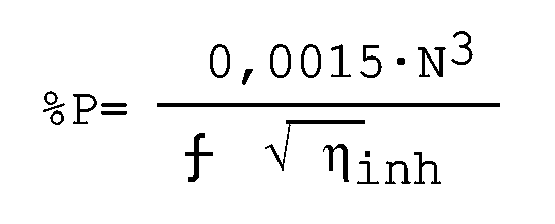
worinP= Prozent in Mol im Hinblick auf die Summe der Mol des mindestens trifunktionellen Moleküls und der Dicarbonsäuremole ist;N = durchschnittliche Zahl von C-Atomen in der sich wiederholenden zweiwertigen Säure/Diol-Einheit in der Hauptpolymerkette;ηinh = logarithmische Viskositätszahl in 0,2 g/dl CHCl3-Lösung bei 25°C;f = Zahl der reaktiven Bestandteile in dem mindestens trifunktionellen Molekül ist.
Applications Claiming Priority (3)
| Application Number | Priority Date | Filing Date | Title |
|---|---|---|---|
| IT2002MI000867A ITMI20020867A1 (it) | 2002-04-22 | 2002-04-22 | Copoliesteri termoplastici saturi/insaturi biodegradabili |
| ITMI20020867 | 2002-04-22 | ||
| PCT/EP2003/004200 WO2003089492A1 (en) | 2002-04-22 | 2003-04-17 | Biodegradable thermoplastic polyesters |
Publications (2)
| Publication Number | Publication Date |
|---|---|
| EP1506246A1 EP1506246A1 (de) | 2005-02-16 |
| EP1506246B1 true EP1506246B1 (de) | 2006-09-06 |
Family
ID=11449762
Family Applications (1)
| Application Number | Title | Priority Date | Filing Date |
|---|---|---|---|
| EP03732292A Expired - Lifetime EP1506246B1 (de) | 2002-04-22 | 2003-04-17 | Bioabbaubare thermoplastische polyester |
Country Status (12)
| Country | Link |
|---|---|
| US (1) | US7288618B2 (de) |
| EP (1) | EP1506246B1 (de) |
| JP (1) | JP2005523356A (de) |
| CN (1) | CN1308369C (de) |
| AT (1) | ATE338783T1 (de) |
| AU (1) | AU2003239817A1 (de) |
| DE (1) | DE60308175T2 (de) |
| DK (1) | DK1506246T3 (de) |
| ES (1) | ES2271592T3 (de) |
| IT (1) | ITMI20020867A1 (de) |
| TW (1) | TWI267526B (de) |
| WO (1) | WO2003089492A1 (de) |
Families Citing this family (32)
| Publication number | Priority date | Publication date | Assignee | Title |
|---|---|---|---|---|
| EP1602600B1 (de) * | 2004-06-03 | 2019-12-11 | NOVAMONT S.p.A. | Belüftbares System zum Sammeln von organischen Abfällen |
| US8003751B2 (en) | 2005-03-08 | 2011-08-23 | Valspar Sourcing, Inc. | Oxygen scavenging polymers |
| KR101297937B1 (ko) | 2006-07-14 | 2013-08-19 | 킴벌리-클라크 월드와이드, 인크. | 부직 웹에 사용하기 위한 생분해성 지방족 폴리에스테르 |
| DE602006018078D1 (de) | 2006-07-14 | 2010-12-16 | Kimberly Clark Co | Biologisch abbaubarer aliphatisch-aromatischer copolyester zur verwendung in vliesstoffen |
| MX2009000527A (es) | 2006-07-14 | 2009-01-27 | Kimberly Clark Co | Acido polilactico biodegradable para su uso en telas no tejidas. |
| US8729176B2 (en) | 2006-09-06 | 2014-05-20 | Keio University | Polyricinoleate composition and process for producing the same |
| US7557167B2 (en) | 2006-09-28 | 2009-07-07 | Gore Enterprise Holdings, Inc. | Polyester compositions, methods of manufacturing said compositions, and articles made therefrom |
| GB2443625A (en) * | 2006-11-08 | 2008-05-14 | Tate & Lyle Plc | Lactic acid polymer |
| US7887893B2 (en) * | 2006-12-12 | 2011-02-15 | The Board Of Trustees Of The Leland Stanford Junior University | Bacterial poly(hydroxy alkanoate) polymer and natural fiber composites |
| JP2010513594A (ja) * | 2006-12-15 | 2010-04-30 | キンバリー クラーク ワールドワイド インコーポレイテッド | 繊維の形成に使用する生分解性ポリエステル |
| WO2008073101A1 (en) * | 2006-12-15 | 2008-06-19 | Kimberly-Clark Worldwide, Inc. | Biodegradable polylactic acids for use in forming fibers |
| US7794645B2 (en) | 2007-07-02 | 2010-09-14 | Teknimed S.A. | Method for producing a biodegradable, synthetic and flexible diaphyseal obturator |
| FR2918307B1 (fr) * | 2007-07-02 | 2009-10-09 | Teknimed Sas Soc Par Actions S | Procede de fabrication d'un obturateur diaphysaire biodegradable, synthetique et souple |
| KR101422317B1 (ko) | 2007-08-22 | 2014-07-30 | 킴벌리-클라크 월드와이드, 인크. | 다성분 생분해성 필라멘트 및 그로부터 형성되는 부직 웹 |
| JP5568011B2 (ja) * | 2007-08-27 | 2014-08-06 | ヴァルスパー・ソーシング・インコーポレーテッド | 酸素消去組成物 |
| US9156940B2 (en) * | 2007-08-27 | 2015-10-13 | Valspar Sourcing, Inc. | Oxygen scavenging composition |
| EP2220277A2 (de) * | 2007-12-13 | 2010-08-25 | Kimberly-Clark Worldwide, Inc. | Biologisch abbaubare fasern aus einer thermoplastischen zusammensetzung mit einem gehalt an polymilchsäure und einem polyethercopolymer |
| US8071690B2 (en) | 2008-01-23 | 2011-12-06 | Tate & Lyle Ingredients Americas Llc | Lactic acid based compositions with enhanced properties |
| WO2009145778A1 (en) | 2008-05-30 | 2009-12-03 | Kimberly-Clark Worldwide, Inc. | Polylactic acid fibers |
| CN101717493B (zh) * | 2009-11-09 | 2012-12-26 | 浙江杭州鑫富药业股份有限公司 | 一种脂肪族-芳香族共聚酯及其制备方法和用途 |
| US8461262B2 (en) | 2010-12-07 | 2013-06-11 | Kimberly-Clark Worldwide, Inc. | Polylactic acid fibers |
| CN102807670B (zh) * | 2011-05-31 | 2015-09-09 | 东丽纤维研究所(中国)有限公司 | 一种聚乳酸共聚物及其制备方法 |
| KR101068030B1 (ko) * | 2011-06-03 | 2011-09-28 | 주식회사 지오솔테크 | 내가수분해성 및 생분해성 지방족/방향족 코폴리에스테르 수지 조성물 |
| US9708444B2 (en) * | 2013-11-25 | 2017-07-18 | Dow Global Technologies Llc | Biodegradable aliphatic polyesters |
| CN108409990B (zh) * | 2018-03-20 | 2020-11-03 | 青岛科技大学 | 一种石墨烯/聚酯热塑性弹性体复合材料及其制备方法 |
| CN111040397B (zh) * | 2019-08-22 | 2021-09-24 | 广州绿徽新材料研究院有限公司 | 一种组合发泡聚乳酸耐热阻燃改性材料和产品的制备方法 |
| TWI796542B (zh) * | 2020-01-02 | 2023-03-21 | 長春人造樹脂廠股份有限公司 | 高延展性脂肪族聚酯 |
| CN111101227B (zh) * | 2020-01-03 | 2021-03-26 | 东华大学 | 一种全生物降解共聚酯纤维及其制备方法 |
| CN111923546B (zh) * | 2020-08-13 | 2022-06-28 | 安庆市芊芊纸业有限公司 | 一种环保降解防水涂层包装纸及其制备方法 |
| JP2021008639A (ja) * | 2020-10-30 | 2021-01-28 | 三菱ケミカル株式会社 | ポリエステル樹脂およびポリエステル樹脂の製造方法 |
| IT202000032663A1 (it) * | 2020-12-29 | 2022-06-29 | Novamont Spa | Film biodegradabile multistrato ad alta disintegrazione |
| CN114523103B (zh) * | 2022-03-03 | 2023-11-07 | 浙江同擎科技有限公司 | 一种3d打印用陶瓷颗粒增强钛基复合材料及其制备方法 |
Family Cites Families (6)
| Publication number | Priority date | Publication date | Assignee | Title |
|---|---|---|---|---|
| US5436056A (en) * | 1991-12-20 | 1995-07-25 | Showa Highpolymer Co., Ltd. | Method of producing a high molecular weight aliphatic polyester and film thereof |
| US5480962A (en) * | 1993-07-22 | 1996-01-02 | Eastman Chemical Company | Copolyesters having repeat units derived from succinic acid |
| DE69533745T2 (de) * | 1994-12-21 | 2005-10-27 | Showa Denko K.K. | Aliphatisches polyesterharz und verfahren zu seiner herstellung |
| US6124384A (en) * | 1997-08-19 | 2000-09-26 | Mitsui Chemicals, Inc. | Composite resin composition |
| JP3000149B1 (ja) * | 1999-03-08 | 2000-01-17 | 工業技術院長 | 生分解性高分子量脂肪族ポリエステル及びその製造方法 |
| IT1307022B1 (it) * | 1999-03-15 | 2001-10-23 | Novamont Spa | Processo semplificato per l'ottenimento di poliesteri alifaticibiodegradabili. |
-
2002
- 2002-04-22 IT IT2002MI000867A patent/ITMI20020867A1/it unknown
-
2003
- 2003-04-17 DK DK03732292T patent/DK1506246T3/da active
- 2003-04-17 JP JP2003586210A patent/JP2005523356A/ja active Pending
- 2003-04-17 ES ES03732292T patent/ES2271592T3/es not_active Expired - Lifetime
- 2003-04-17 WO PCT/EP2003/004200 patent/WO2003089492A1/en not_active Ceased
- 2003-04-17 AT AT03732292T patent/ATE338783T1/de not_active IP Right Cessation
- 2003-04-17 EP EP03732292A patent/EP1506246B1/de not_active Expired - Lifetime
- 2003-04-17 CN CNB038090864A patent/CN1308369C/zh not_active Expired - Fee Related
- 2003-04-17 DE DE60308175T patent/DE60308175T2/de not_active Expired - Lifetime
- 2003-04-17 AU AU2003239817A patent/AU2003239817A1/en not_active Abandoned
- 2003-04-22 TW TW092109347A patent/TWI267526B/zh not_active IP Right Cessation
-
2004
- 2004-10-21 US US10/969,002 patent/US7288618B2/en not_active Expired - Lifetime
Also Published As
| Publication number | Publication date |
|---|---|
| CN1646596A (zh) | 2005-07-27 |
| ITMI20020867A1 (it) | 2003-10-22 |
| ES2271592T3 (es) | 2007-04-16 |
| ITMI20020867A0 (it) | 2002-04-22 |
| TWI267526B (en) | 2006-12-01 |
| US7288618B2 (en) | 2007-10-30 |
| TW200400213A (en) | 2004-01-01 |
| WO2003089492A1 (en) | 2003-10-30 |
| JP2005523356A (ja) | 2005-08-04 |
| US20050059796A1 (en) | 2005-03-17 |
| DK1506246T3 (da) | 2007-01-15 |
| ATE338783T1 (de) | 2006-09-15 |
| DE60308175D1 (en) | 2006-10-19 |
| CN1308369C (zh) | 2007-04-04 |
| DE60308175T2 (de) | 2007-08-02 |
| EP1506246A1 (de) | 2005-02-16 |
| AU2003239817A1 (en) | 2003-11-03 |
Similar Documents
| Publication | Publication Date | Title |
|---|---|---|
| EP1506246B1 (de) | Bioabbaubare thermoplastische polyester | |
| EP1497353B1 (de) | Bioabbaubare gesättigte/ungesättigte thermoplastische polyester | |
| EP1512709B1 (de) | Copolymere aus bioabbaubaren aliphatischen Polyestern | |
| US20080214724A1 (en) | Process for forming biodegradeable polyesters by reactive extrusion | |
| EP1497352B1 (de) | Amorphe-kristalline blockcopolymere | |
| WO2006097354A1 (en) | Biodegradable aliphatic-aromatic copolyester | |
| JP2023528591A (ja) | 生分解性ポリエステル及びそれから作られた粘着性包装フィルム | |
| EP2836535B1 (de) | Polyester mit 2-methylglutarinsäure, verfahren zur herstellung dieser polyester und in diesem verfahren hergestellte produkte |
Legal Events
| Date | Code | Title | Description |
|---|---|---|---|
| PUAI | Public reference made under article 153(3) epc to a published international application that has entered the european phase |
Free format text: ORIGINAL CODE: 0009012 |
|
| 17P | Request for examination filed |
Effective date: 20041117 |
|
| AK | Designated contracting states |
Kind code of ref document: A1 Designated state(s): AT BE BG CH CY CZ DE DK EE ES FI FR GB GR HU IE IT LI LU MC NL PT RO SE SI SK TR |
|
| AX | Request for extension of the european patent |
Extension state: AL LT LV MK |
|
| 17Q | First examination report despatched |
Effective date: 20050217 |
|
| GRAP | Despatch of communication of intention to grant a patent |
Free format text: ORIGINAL CODE: EPIDOSNIGR1 |
|
| GRAS | Grant fee paid |
Free format text: ORIGINAL CODE: EPIDOSNIGR3 |
|
| GRAA | (expected) grant |
Free format text: ORIGINAL CODE: 0009210 |
|
| AK | Designated contracting states |
Kind code of ref document: B1 Designated state(s): AT BE BG CH CY CZ DE DK EE ES FI FR GB GR HU IE IT LI LU MC NL PT RO SE SI SK TR |
|
| PG25 | Lapsed in a contracting state [announced via postgrant information from national office to epo] |
Ref country code: SK Free format text: LAPSE BECAUSE OF FAILURE TO SUBMIT A TRANSLATION OF THE DESCRIPTION OR TO PAY THE FEE WITHIN THE PRESCRIBED TIME-LIMIT Effective date: 20060906 Ref country code: IT Free format text: LAPSE BECAUSE OF FAILURE TO SUBMIT A TRANSLATION OF THE DESCRIPTION OR TO PAY THE FEE WITHIN THE PRESCRIBED TIME-LIMIT;WARNING: LAPSES OF ITALIAN PATENTS WITH EFFECTIVE DATE BEFORE 2007 MAY HAVE OCCURRED AT ANY TIME BEFORE 2007. THE CORRECT EFFECTIVE DATE MAY BE DIFFERENT FROM THE ONE RECORDED. Effective date: 20060906 Ref country code: RO Free format text: LAPSE BECAUSE OF FAILURE TO SUBMIT A TRANSLATION OF THE DESCRIPTION OR TO PAY THE FEE WITHIN THE PRESCRIBED TIME-LIMIT Effective date: 20060906 Ref country code: AT Free format text: LAPSE BECAUSE OF FAILURE TO SUBMIT A TRANSLATION OF THE DESCRIPTION OR TO PAY THE FEE WITHIN THE PRESCRIBED TIME-LIMIT Effective date: 20060906 Ref country code: SI Free format text: LAPSE BECAUSE OF FAILURE TO SUBMIT A TRANSLATION OF THE DESCRIPTION OR TO PAY THE FEE WITHIN THE PRESCRIBED TIME-LIMIT Effective date: 20060906 |
|
| REG | Reference to a national code |
Ref country code: GB Ref legal event code: FG4D |
|
| REG | Reference to a national code |
Ref country code: CH Ref legal event code: EP |
|
| REG | Reference to a national code |
Ref country code: IE Ref legal event code: FG4D |
|
| REF | Corresponds to: |
Ref document number: 60308175 Country of ref document: DE Date of ref document: 20061019 Kind code of ref document: P |
|
| PG25 | Lapsed in a contracting state [announced via postgrant information from national office to epo] |
Ref country code: BG Free format text: LAPSE BECAUSE OF FAILURE TO SUBMIT A TRANSLATION OF THE DESCRIPTION OR TO PAY THE FEE WITHIN THE PRESCRIBED TIME-LIMIT Effective date: 20061206 |
|
| REG | Reference to a national code |
Ref country code: CH Ref legal event code: NV Representative=s name: ISLER & PEDRAZZINI AG |
|
| REG | Reference to a national code |
Ref country code: SE Ref legal event code: TRGR |
|
| REG | Reference to a national code |
Ref country code: DK Ref legal event code: T3 |
|
| PG25 | Lapsed in a contracting state [announced via postgrant information from national office to epo] |
Ref country code: PT Free format text: LAPSE BECAUSE OF FAILURE TO SUBMIT A TRANSLATION OF THE DESCRIPTION OR TO PAY THE FEE WITHIN THE PRESCRIBED TIME-LIMIT Effective date: 20070219 |
|
| ET | Fr: translation filed | ||
| REG | Reference to a national code |
Ref country code: ES Ref legal event code: FG2A Ref document number: 2271592 Country of ref document: ES Kind code of ref document: T3 |
|
| PLBE | No opposition filed within time limit |
Free format text: ORIGINAL CODE: 0009261 |
|
| STAA | Information on the status of an ep patent application or granted ep patent |
Free format text: STATUS: NO OPPOSITION FILED WITHIN TIME LIMIT |
|
| 26N | No opposition filed |
Effective date: 20070607 |
|
| REG | Reference to a national code |
Ref country code: CH Ref legal event code: PCAR Free format text: ISLER & PEDRAZZINI AG;POSTFACH 1772;8027 ZUERICH (CH) |
|
| PG25 | Lapsed in a contracting state [announced via postgrant information from national office to epo] |
Ref country code: GR Free format text: LAPSE BECAUSE OF FAILURE TO SUBMIT A TRANSLATION OF THE DESCRIPTION OR TO PAY THE FEE WITHIN THE PRESCRIBED TIME-LIMIT Effective date: 20061207 |
|
| PG25 | Lapsed in a contracting state [announced via postgrant information from national office to epo] |
Ref country code: IE Free format text: LAPSE BECAUSE OF NON-PAYMENT OF DUE FEES Effective date: 20070417 |
|
| PG25 | Lapsed in a contracting state [announced via postgrant information from national office to epo] |
Ref country code: EE Free format text: LAPSE BECAUSE OF FAILURE TO SUBMIT A TRANSLATION OF THE DESCRIPTION OR TO PAY THE FEE WITHIN THE PRESCRIBED TIME-LIMIT Effective date: 20060906 |
|
| PG25 | Lapsed in a contracting state [announced via postgrant information from national office to epo] |
Ref country code: MC Free format text: LAPSE BECAUSE OF NON-PAYMENT OF DUE FEES Effective date: 20070430 |
|
| PG25 | Lapsed in a contracting state [announced via postgrant information from national office to epo] |
Ref country code: CY Free format text: LAPSE BECAUSE OF FAILURE TO SUBMIT A TRANSLATION OF THE DESCRIPTION OR TO PAY THE FEE WITHIN THE PRESCRIBED TIME-LIMIT Effective date: 20060906 Ref country code: LU Free format text: LAPSE BECAUSE OF NON-PAYMENT OF DUE FEES Effective date: 20070417 |
|
| PG25 | Lapsed in a contracting state [announced via postgrant information from national office to epo] |
Ref country code: HU Free format text: LAPSE BECAUSE OF FAILURE TO SUBMIT A TRANSLATION OF THE DESCRIPTION OR TO PAY THE FEE WITHIN THE PRESCRIBED TIME-LIMIT Effective date: 20070307 |
|
| PGFP | Annual fee paid to national office [announced via postgrant information from national office to epo] |
Ref country code: DK Payment date: 20100427 Year of fee payment: 8 Ref country code: FI Payment date: 20100429 Year of fee payment: 8 |
|
| PGFP | Annual fee paid to national office [announced via postgrant information from national office to epo] |
Ref country code: CH Payment date: 20100426 Year of fee payment: 8 |
|
| PG25 | Lapsed in a contracting state [announced via postgrant information from national office to epo] |
Ref country code: IT Free format text: LAPSE BECAUSE OF NON-PAYMENT OF DUE FEES Effective date: 20100417 |
|
| PGRI | Patent reinstated in contracting state [announced from national office to epo] |
Ref country code: IT Effective date: 20110616 |
|
| REG | Reference to a national code |
Ref country code: CH Ref legal event code: PL |
|
| PG25 | Lapsed in a contracting state [announced via postgrant information from national office to epo] |
Ref country code: LI Free format text: LAPSE BECAUSE OF NON-PAYMENT OF DUE FEES Effective date: 20110430 Ref country code: FI Free format text: LAPSE BECAUSE OF NON-PAYMENT OF DUE FEES Effective date: 20110417 Ref country code: CH Free format text: LAPSE BECAUSE OF NON-PAYMENT OF DUE FEES Effective date: 20110430 |
|
| REG | Reference to a national code |
Ref country code: DK Ref legal event code: EBP |
|
| PG25 | Lapsed in a contracting state [announced via postgrant information from national office to epo] |
Ref country code: DK Free format text: LAPSE BECAUSE OF NON-PAYMENT OF DUE FEES Effective date: 20110430 |
|
| REG | Reference to a national code |
Ref country code: FR Ref legal event code: PLFP Year of fee payment: 14 |
|
| PGFP | Annual fee paid to national office [announced via postgrant information from national office to epo] |
Ref country code: NL Payment date: 20160426 Year of fee payment: 14 |
|
| PGFP | Annual fee paid to national office [announced via postgrant information from national office to epo] |
Ref country code: CZ Payment date: 20160413 Year of fee payment: 14 |
|
| PGFP | Annual fee paid to national office [announced via postgrant information from national office to epo] |
Ref country code: SE Payment date: 20160427 Year of fee payment: 14 Ref country code: TR Payment date: 20160406 Year of fee payment: 14 |
|
| REG | Reference to a national code |
Ref country code: FR Ref legal event code: PLFP Year of fee payment: 15 |
|
| REG | Reference to a national code |
Ref country code: NL Ref legal event code: MM Effective date: 20170501 |
|
| PG25 | Lapsed in a contracting state [announced via postgrant information from national office to epo] |
Ref country code: CZ Free format text: LAPSE BECAUSE OF NON-PAYMENT OF DUE FEES Effective date: 20170417 Ref country code: NL Free format text: LAPSE BECAUSE OF NON-PAYMENT OF DUE FEES Effective date: 20170501 |
|
| PG25 | Lapsed in a contracting state [announced via postgrant information from national office to epo] |
Ref country code: SE Free format text: LAPSE BECAUSE OF NON-PAYMENT OF DUE FEES Effective date: 20170418 |
|
| REG | Reference to a national code |
Ref country code: FR Ref legal event code: PLFP Year of fee payment: 16 |
|
| PG25 | Lapsed in a contracting state [announced via postgrant information from national office to epo] |
Ref country code: TR Free format text: LAPSE BECAUSE OF NON-PAYMENT OF DUE FEES Effective date: 20170417 |
|
| PGFP | Annual fee paid to national office [announced via postgrant information from national office to epo] |
Ref country code: IT Payment date: 20220415 Year of fee payment: 20 Ref country code: GB Payment date: 20220427 Year of fee payment: 20 Ref country code: FR Payment date: 20220425 Year of fee payment: 20 Ref country code: ES Payment date: 20220503 Year of fee payment: 20 Ref country code: DE Payment date: 20220427 Year of fee payment: 20 |
|
| PGFP | Annual fee paid to national office [announced via postgrant information from national office to epo] |
Ref country code: BE Payment date: 20220427 Year of fee payment: 20 |
|
| REG | Reference to a national code |
Ref country code: DE Ref legal event code: R071 Ref document number: 60308175 Country of ref document: DE |
|
| REG | Reference to a national code |
Ref country code: ES Ref legal event code: FD2A Effective date: 20230427 |
|
| REG | Reference to a national code |
Ref country code: BE Ref legal event code: MK Effective date: 20230417 |
|
| REG | Reference to a national code |
Ref country code: GB Ref legal event code: PE20 Expiry date: 20230416 |
|
| PG25 | Lapsed in a contracting state [announced via postgrant information from national office to epo] |
Ref country code: ES Free format text: LAPSE BECAUSE OF EXPIRATION OF PROTECTION Effective date: 20230418 |
|
| PG25 | Lapsed in a contracting state [announced via postgrant information from national office to epo] |
Ref country code: GB Free format text: LAPSE BECAUSE OF EXPIRATION OF PROTECTION Effective date: 20230416 |