EP1506640B1 - Verfahren zum verteilen von netzwerkparametern unter netzwerkknoten - Google Patents
Verfahren zum verteilen von netzwerkparametern unter netzwerkknoten Download PDFInfo
- Publication number
- EP1506640B1 EP1506640B1 EP02727866A EP02727866A EP1506640B1 EP 1506640 B1 EP1506640 B1 EP 1506640B1 EP 02727866 A EP02727866 A EP 02727866A EP 02727866 A EP02727866 A EP 02727866A EP 1506640 B1 EP1506640 B1 EP 1506640B1
- Authority
- EP
- European Patent Office
- Prior art keywords
- network
- node
- information
- nodes
- network node
- Prior art date
- Legal status (The legal status is an assumption and is not a legal conclusion. Google has not performed a legal analysis and makes no representation as to the accuracy of the status listed.)
- Expired - Lifetime
Links
Images


Classifications
-
- H—ELECTRICITY
- H04—ELECTRIC COMMUNICATION TECHNIQUE
- H04W—WIRELESS COMMUNICATION NETWORKS
- H04W40/00—Communication routing or communication path finding
- H04W40/02—Communication route or path selection, e.g. power-based or shortest path routing
-
- H—ELECTRICITY
- H04—ELECTRIC COMMUNICATION TECHNIQUE
- H04L—TRANSMISSION OF DIGITAL INFORMATION, e.g. TELEGRAPHIC COMMUNICATION
- H04L45/00—Routing or path finding of packets in data switching networks
- H04L45/02—Topology update or discovery
- H04L45/03—Topology update or discovery by updating link state protocols
-
- H—ELECTRICITY
- H04—ELECTRIC COMMUNICATION TECHNIQUE
- H04L—TRANSMISSION OF DIGITAL INFORMATION, e.g. TELEGRAPHIC COMMUNICATION
- H04L45/00—Routing or path finding of packets in data switching networks
- H04L45/12—Shortest path evaluation
-
- H—ELECTRICITY
- H04—ELECTRIC COMMUNICATION TECHNIQUE
- H04L—TRANSMISSION OF DIGITAL INFORMATION, e.g. TELEGRAPHIC COMMUNICATION
- H04L45/00—Routing or path finding of packets in data switching networks
- H04L45/48—Routing tree calculation
-
- H—ELECTRICITY
- H04—ELECTRIC COMMUNICATION TECHNIQUE
- H04W—WIRELESS COMMUNICATION NETWORKS
- H04W28/00—Network traffic management; Network resource management
- H04W28/16—Central resource management; Negotiation of resources or communication parameters, e.g. negotiating bandwidth or QoS [Quality of Service]
- H04W28/18—Negotiating wireless communication parameters
-
- H—ELECTRICITY
- H04—ELECTRIC COMMUNICATION TECHNIQUE
- H04W—WIRELESS COMMUNICATION NETWORKS
- H04W40/00—Communication routing or communication path finding
- H04W40/24—Connectivity information management, e.g. connectivity discovery or connectivity update
- H04W40/246—Connectivity information discovery
Definitions
- the present invention relates to a method and network node for distributing a network parameter information, which may consist of link utilization, node utilization, Macro Diversity Combining (MDC) load, and any other Quality of Service (QoS) related parameters associated to a given network node, among network nodes of a transmission network such as a radio access network for providing a connection to an Internet Protocol (IP) based a core network.
- a network parameter information may consist of link utilization, node utilization, Macro Diversity Combining (MDC) load, and any other Quality of Service (QoS) related parameters associated to a given network node, among network nodes of a transmission network such as a radio access network for providing a connection to an Internet Protocol (IP) based a core network.
- IP Internet Protocol
- the distributed network parameter information may be used by a procedure for selecting an MDC point in the radio access network (RAN).
- the interference tolerance enables universal frequency reuse. This enables new functions such as soft handover, but also causes strict requirements on power control. Due to the universal frequency reuse, the connection of a radio terminal, e.g. a mobile terminal, mobile station or user equipment to the cellular network can include several radio links. When the radio terminal is connected through more than one radio link, it is said to be in soft handover. If, in particular, the radio terminal has more than one radio link to two cells on the same side, it is in softer handover. Soft handover is a form of diversity, increasing the signal-to-noise ratio when the transmission power is constant.
- CDMA Code Division Multiple Access
- soft handover smoothes the movement of a mobile terminal from one cell to another. It helps to minimize the transmission power needed in both uplink and downlink.
- a radio terminal of a network subscriber can transmit the same information on a plurality of redundant transmission parts that are set up parallel via a radio transmission interface from the cellular network to the radio terminal or from the radio terminal to the cellular network in order to achieve an optimal transmission quality.
- a transmission structure is called macrodiversity.
- the redundant transmission paths can be dynamically set up and cleared down while the radio terminal changes its location.
- the information sent out by the radio terminal in the transmission frames on various transmission paths can be merged in the transmission network at combination points at which respectively two transmission paths are combined into a single transmission path in one transmission direction (uplink) and the single transmission path is divided into two transmission paths in the other transmission direction (downlink).
- a corresponding network architecture is described for example in the US 6,198,737 B1 .
- a network element known as Base Station Controller (BSC) or Radio Network Controller (RNC) is no longer required, although this functionality must remain in the RAN architecture. Therefore, a location of a combining point, e.g. MDC point, can no longer be centralized for all base stations in the RAN. Consequently, some RNC functionality has been transferred to the base stations in order to enable soft handover and associated signaling to happen along the shortest path, producing minimum delay and signaling load to those paths of the network where this is not necessary.
- This new RAN architecture is described e.g. in the White Paper "IP-RAN, IP-the future of mobility", Nokia Networks, 2000.
- the MDC point can be selected dynamically e.g. by a serving base station instead of having this functionality in one pre-selected point like the RNC in the conventional RAN architecture or in the base station that initiates the call.
- base stations are able to act as MDC points.
- the corresponding network node or entity needs up-to-date information of the RAN network, e.g. its parameters such as link state, link utilization, node utilization, MDC load, and any other QoS-related parameters.
- the change parameter needs to be distributed among the network nodes or entities.
- any change of a parameter will invoke a tide of messages or packets in the network for keeping all network nodes updated.
- a parameter change can, in the worst case, invoke as many messages or packets as twice the total number of links in the RAN.
- updating traffic may become a source of network congestion itself.
- the flooding scheme is not scalable with an increase of the dimension of the RAN. Given the on-changing nature of the RAN, a scalable and efficient distribution scheme is therefore required for this purpose.
- Document US-A-2002/027887 describes a dynamic routing control system and method for radio access network.
- the system comprises a spanning tree producing portion provided in a master node of a radio access network.
- the spanning tree producing portion produces a spanning tree of the network whenever it receives connection information sent from slave nodes of the network.
- the spanning tree is delivered to each slave node.
- a memorizing portion is provided in each of the nodes and memorizes the spanning tree as a routing table.
- a health check portion is provided in each of the nodes and transmits the connection information to the spanning tree producing portion when topology change of the network is detected. The said health check portion updates the routing table in cooperation with those of adjacent nodes.
- a network node is provided as specified in claim 17.
- the distributed network parameters may be used by a procedure to dynamically select an MDC point In a RAN. As the other nodes get informed about the changed parameters, they can have an up-to-date view of the network e.g. so as to select a MDC point for a given call.
- one parameter change only invokes as many updating messages or packets as a small fraction of the total number of links in the transmission network.
- updating messages or packets initiated by a given node only travel through a given spanning tree of the transmission network.
- the delivery of the parameter information can be optimized and improved e.g. to avoid the conventional flooding scheme. Thereby, the updating message or packet traffic can be reduced dramatically as compared to the traffic of the flooding scheme under the same condition.
- the network parameter information may relate to a QoS related parameter.
- the network parameter information may comprise at least one of a link state, a link utilization, a node utilization, and a macro diversity combining load.
- the topology information may be derived from at least one routing table, which may be provided for each network node.
- the routing table may provide a branch information for each offspring node of the network node.
- the branch information may indicate branches of the concerned offspring node.
- the topology information may be derived from a link state database of a routing protocol of the transmission network.
- the topology information may be obtained by running a flooding scheme and a shortest-path-first algorithm. If the network topology is relatively stable, the overhead caused by running such a flooding scheme can be considered rather small.
- the network parameter information may comprise an updating information sent to each offspring node.
- Each updating information may comprise a branch information, a parameter update information and a node identification of the network node at which said network parameter change has occurred.
- a received updating information may then be distributed from an offspring node to an offspring node of said offspring node based on said branch information.
- a parameter information stored at said offspring node can be updated using said updating information.
- the network parameter information may be used in an MDC point selection procedure.
- a mobile terminal M is connected to a RAN via two redundant transmission paths Indicated by respective dash-dot lines.
- the RAN architecture comprises a plurality of network nodes A to E, e.g. IP-based base stations, wherein the shaded nodes D and E are currently connected to the mobile terminal M via the redundant transmission paths.
- the network node E indicated with the bold circle is used as the serving base station, i.e. the base station terminating the core network interfaces data stream, and performing Radio Resource Management (RRM) functions like scheduling, power control and the like.
- RRM Radio Resource Management
- the other shaded base station D is used as a drift base station providing only resources and radio L1 layer functions for the respective connections to the mobile terminal M.
- a former centralized controller e.g. RNC or BSC
- all radio interface protocols are terminated in the base stations. Entities outside the base stations are needed to perform common configuration and some radio resource functions, or interworking with legacy, gateways to a core network, etc.
- An interface is needed between the base stations, supporting both control plane signaling and user plane traffic.
- Full connectivity among the entities may be supported over an IPv6 (Internet Protocol Version 6) transport network.
- RNGW Internet Protocol Version 6
- RNGW RAN Gateway
- the RAN returns to the core network transport addresses owned by the RNGW where the user plane shall be terminated. Additionally, packet-switched and circuit-switched interfaces are connected through the RNGW.
- one network node has to be selected as the MDC point for the connections to the mobile terminal M, e.g. by the serving node E.
- This selection can be optimized if the required network parameter information is continuously updated based on a distribution scheme.
- a distribution scheme for distributing up-to-date information of the whole RAN, e.g. its parameters such as link state, link utilization, node utilization, MDC load, and any other QoS-related parameters, among the network nodes or entities A to E, which may be used e.g. to dynamically select the MDC point.
- a corresponding parameter change information is initiated by Node A and distributed among the network nodes B to E. This is achieved by utilizing a topology information of the network to optimize or improve the delivery of the parameters and to avoid the use of a flooding scheme.
- OSPF Open Shortest Path First
- a router constructs a complete topological map of the entire system. The router then locally runs the shortest-path algorithm to determine a shortest-path tree to all networks with itself as the route node. The routers' routing table is then obtained from this shortest-path tree. Individual link costs can be configured by the network administrator.
- the network topology information can be obtained from an ISIS routing protocol.
- the routing table of a given node and the network topology of the RAN can be learned by running a flooding scheme and a shortest-path-first algorithm individually when the used routing protocol such as the Routing Information Protocol (RIP) does not provide such an information. Due to the fact that the network topology is relatively stable, the overhead of running the flooding scheme and the shortest-path-first algorithm can be considered rather small for this case. Then, the graph G(N, L) can be derived from the learned or imported network topology information.
- the used routing protocol such as the Routing Information Protocol (RIP)
- their data type can be defined via configuration according to specific requirements.
- the required parameters of the parameter sets Pi may be measured on demand, whenever needed, or may be provided or measured at predetermined intervals.
- this network node When a parameter change is detected at a specific network node, this network node becomes the initiating node of the following update procedure:
- the parameter sets Pi are updated according to the new value of the parameter Pis. Then, the initiating node generates for each of its immediate offspring nodes a respective updating information, e.g. an updating tuple, comprising the branch information Rin, the updated parameter value Pis and a node identification Ni-ID of the concerned network node Ni, and sends the respective updating information to all immediate offspring node.
- a respective updating information e.g. an updating tuple, comprising the branch information Rin, the updated parameter value Pis and a node identification Ni-ID of the concerned network node Ni
- An offspring node receiving such an update information performs the following procedure:
- the offspring node updates the changed parameter Pis in its parameter sets Pi recorded in the offspring node. If the branch information Rin is empty, i.e. this branch does not include any further node, the offspring node only updates its parameter sets Pi. On the other hand, if the branch information Rin is not empty, the offspring nodes partitions or separates the branch information into its branches of immediate offspring and sends a respective updating information with the new (partitioned) branch information to all its immediate offspring nodes.
- the updating information is transmitted through the network based on the initial branch information defined by the initiating node.
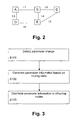
- Fig. 3 shows a basic flow diagram indicating the distribution or updating procedure according to the preferred embodiment.
- a parameter change is detected at a specific network node.
- this network node generates a parameter information based on a routing table corresponding to the network location of this network node.
- the parameter information comprises the branch information obtained from the routing table, the updated parameter, and the identification of the network node at which the parameter has been changed (step S102).
- the network node distributes the generated parameter information to its offspring nodes in step S103, so that the offspring nodes forward the parameter information based on the received branch information.
- Fig. 4 shows a table of link state database indicating the network topology of the radio access network shown in Figs. 1 and 2 .
- cost 1/bandwidth.
- the routing table for a specific network node is then obtained on the basis of a spanning tree calculated by the network node on account of the known network topology.
- the spanning tree can be understood here as a loop-less graph.
- the spanning tree is defined by the sending or initiating node or entity instead of e.g.some centralized controller node like RNC or BSC.
- routing of data in loops can be prevented. Due to the fact that network nodes know the network topology, they can calculate optimal distribution paths for the network parameter information based on the spanning tree algorithm.
- a spanning tree is a subset of the original network topology, which has no loops.
- Fig. 5 shows a routing table for the network node A in Figs. 1 and 2 , which has been obtained from a spanning tree algorithm.
- the term "in the order" in the last column means the routing order of visited nodes when sending a packet from a source node, i.e. the network node A, to a destination node, i.e. the node indicated in the first column, along a routing path indicated in the second column. For example, if a packet comprising an updated parameter information is transmitted from the network node A to the network node C, it is routed through the link L1 and via the network node B, while two links are used as indicated as by the cost parameter in the third column.
- the value of the last column for routing a packet from the network node A to the network node F would be "BC", as the updated parameter would be routed via the networks nodes B and C.
- Fig. 6 shows the spanning tree obtained for the network node A. This spanning tree is used for distributing a packet to another node in the network, wherein the spanning tree shows the shortest routing paths from the network node A to all other nodes. These shortest paths are indicated by the broken arrows in Fig. 6 .
- the upper network node A is connected to two immediate offspring nodes, i.e. the network nodes D and B, wherein the branch L3 of the network node D contains only the network node D itself while the branch L1 to the network node B contains another two branches L4 (BE) and L2 (BC).
- the network node D when receiving the updating tuple (NULL, Pa, A), the network node D will only update its own Pa in its set of parameters, and will not route this updating tuple to any other network node. Thereby, the link L6 in Fig. 2 is not used in the distribution scheme.
- the network node B when receiving the updating tuple ((BC,BE), Pa, A), the network node B will first update its own Pa and then send to the network node E a revised tuple (NULL, Pa, A) indicating that the branch ends at the network node E, and to the network node C a revised tuple (NULL, Pa, A) indicating that the branch ends at the network node C.
- a revised tuple NULL, Pa, A
- one parameter change invokes only four updating messages, while the flooding scheme can invoke twelve messages in the worst case.
- the present invention is not restricted to the above embodiments, but can be used in any network environment where a network parameter information has to be distributed from a specific network node to a plurality of other network nodes.
- the preferred embodiments may vary within the scope of the attached claims.
Landscapes
- Engineering & Computer Science (AREA)
- Computer Networks & Wireless Communication (AREA)
- Signal Processing (AREA)
- Data Exchanges In Wide-Area Networks (AREA)
- Nitrogen And Oxygen Or Sulfur-Condensed Heterocyclic Ring Systems (AREA)
Claims (20)
- Verteilungsverfahren für eine Netzwerkparameterinformation zwischen Netzwerkknoten (A - E) eines Funkzugangsnetzwerks, wobei das Verfahren aufweist:Erfassen einer Netzwerkparameteränderung an einem Initialnetzwerkknoten (A) des Übertragungsnetzwerks;Bestimmen am Initialnetzwerkknoten (A) basierend auf einer Topologieinformation des Funkzugangsnetzwerks eines aufspannenden Baum der Routing-Wege, welche den kürzesten Wegen vom Initialnetzwerkknoten (A) zu anderen Knoten (B - E) entsprechen;Verteilen durch den Initialnetzwerkknoten (A) der Netzwerkparameterinformation, welche die Netzwerkparameteränderung anzeigt, vom Initialnetzwerkknoten (A) an die anderen Knoten (B - E) gemäß dem aufspannenden Baum,
wobei der Initialnetzwerkknoten (A) für jeden seiner unmittelbar nachkommenden Knoten (B, D) eine jeweilige Aktualisierungsinformation erzeugt und die jeweilige Aktualisierungsinformation an alle unmittelbar nachkommenden Knoten (B, D) sendet. - Verfahren gemäß Anspruch 1, wobei die Netzwerkparameterinformation in einer Netzwerkbetriebs- und Verwaltungsprozedur in einem Funkzugangsnetzwerk verwendet wird.
- Verfahren gemäß Anspruch 2, wobei die Netzwerkbetriebs- und Verwaltungsprozedur eine Auswahlprozedur für einen Makro-Diversity-Kombinierungspunkt ist.
- Verfahren gemäß einem der vorhergehenden Ansprüche, wobei die Netzwerkparameterinformation sich auf einen Parameter, der die Dienstqualität betrifft, bezieht.
- Verfahren gemäß Anspruch 4, wobei die Netzwerkparameterinformation einen Link-Zustand und/oder eine Link-Auslastung und/oder eine Knoten-Auslastung und/oder eine Makro-Diversity-Kombinierungslast enthält.
- Verfahren gemäß einem der vorhergehenden Ansprüche weiter mit einem Ableiten der Topologieinformation aus wenigstens einer Routing-Tabelle.
- Verfahren gemäß Anspruch 6, wobei eine Routing-Tabelle für jeden Netzwerkknoten vorgesehen ist.
- Verfahren gemäß Anspruch 7, wobei die eine Routing-Tabelle eine Verzweigungsinformation für jeden nachkommenden Knoten des Initialknotens (A) bereitstellt.
- Verfahren gemäß Anspruch 8, wobei die Verzweigungsinformation Verzweigungen der betroffenen nachkommenden Knoten anzeigt.
- Verfahren gemäß einem der vorhergehenden Ansprüche weiter mit einem Ableiten der Topologieinformation aus einer Link-Zustand-Datenbank eines Routing-Protokolls des Übertragungsnetzwerks.
- Verfahren gemäß einem der Ansprüche 1 bis 9 weiter mit einem Erhalten der Topologieinformation durch Ablaufen eines "Flooding"-Schemas und eines "Shortest Path First"-Algorithmus.
- Verfahren gemäß einem der der vorhergehenden Ansprüche, weiter aufweisend ein Entscheiden über diejenigen Parameter, die in die Netzwerkparameterinformation einzuschließen sind, basierend auf der Topologieinformation.
- Verfahren gemäß einem der vorhergehenden Ansprüche, wobei die Aktualisierungsinformation eine Verzweigungsinformation, eine Parameteraktualisierungsinformation und eine Knotenkennung des Netzwerkknotens, an dem die Netzwerkparameteränderung aufgetreten ist, aufweist.
- Verfahren gemäß Anspruch 13 weiter mit einem Verteilen durch einen nachkommenden Knoten (B) einer vom nachkommenden Knoten (B) des Initialknotens (A) empfangenen Aktualisierungsinformation an einen nachkommenden Knoten (C, E) des nachkommenden Knotens (B) basierend auf der Verzweigungsinformation.
- Verfahren gemäß Anspruch 13 oder 14, weiter mit einem Aktualisieren einer Parameterinformation, die am abstammenden Knoten (B) gespeichert ist, unter Verwendung der Aktualisierungsinformation.
- Verfahren gemäß Anspruch 1, wobei das Übertragungsnetzwerk ein Funkzugangsnetzwerk ist, welches auf einer Internetprotokolltechnologie basiert.
- Netzwerkknoten zum Verteilen einer Netzwerkparameterinformation an andere Netzwerkknoten (B - E) eines Übertragungsnetzwerks, wobei der Netzwerkknoten (A) eingerichtet ist, eine Änderung in einem Netzwerkparameter, der den Netzwerkknoten (A) betrifft, zu erfassen, um basierend auf einer Topologieinformation des Funkzugangsnetzwerk einen aufspannenden Baum aus Routing-Wegen, die den kürzesten Wegen vom Netzwerkknoten (A) zu anderen Knoten (B - D) entsprechen, zu bestimmen und die Netzwerkparameterinformation, welche die Netzwerkparameteränderung anzeigt, in Richtung seiner unmittelbaren nachkommenden Knoten (B, D) in Reaktion auf das Erfassen und in Übereinstimmung mit dem aufspannenden Baum zu verteilen, wobei der Netzwerksknoten (A) für jeden seiner unmittelbar abstammenden Knoten (B, D) eine jeweilige Aktualisierungsinformation erzeugt und die jeweilige Aktualisierungsinformation an alle unmittelbar nachkommenden Knoten (B, D) sendet.
- Netzwerkknoten gemäß Anspruch 17, wobei der aufspannende Baum aus einer Topologieinformation des Übertragungsnetzwerks abgeleitet wird.
- Netzwerkknoten gemäß Anspruch 18, wobei der Netzwerkknoten eingerichtet ist, über die Parameter, die in die Netzwerkparameterinformation einzuschließen sind, basierend auf der Topologieinformation zu entscheiden.
- Netzwerkknoten gemäß einem der Ansprüche 17 bis 19, wobei der Netzwerkknoten (A) eine Basisstationseinrichtung eines Funkzugangsnetzwerks ist.
Applications Claiming Priority (1)
| Application Number | Priority Date | Filing Date | Title |
|---|---|---|---|
| PCT/IB2002/001605 WO2003096632A1 (en) | 2002-05-08 | 2002-05-08 | Distribution scheme for distributing information in a network |
Publications (2)
| Publication Number | Publication Date |
|---|---|
| EP1506640A1 EP1506640A1 (de) | 2005-02-16 |
| EP1506640B1 true EP1506640B1 (de) | 2009-09-16 |
Family
ID=29415739
Family Applications (1)
| Application Number | Title | Priority Date | Filing Date |
|---|---|---|---|
| EP02727866A Expired - Lifetime EP1506640B1 (de) | 2002-05-08 | 2002-05-08 | Verfahren zum verteilen von netzwerkparametern unter netzwerkknoten |
Country Status (7)
| Country | Link |
|---|---|
| US (1) | US8023435B2 (de) |
| EP (1) | EP1506640B1 (de) |
| CN (1) | CN1326375C (de) |
| AT (1) | ATE443417T1 (de) |
| AU (1) | AU2002258051A1 (de) |
| DE (1) | DE60233759D1 (de) |
| WO (1) | WO2003096632A1 (de) |
Families Citing this family (20)
| Publication number | Priority date | Publication date | Assignee | Title |
|---|---|---|---|---|
| US7251242B2 (en) * | 2001-10-04 | 2007-07-31 | Siemens Aktiengesellschaft | Distributed transmission of traffic flows in communication networks |
| JP3988043B2 (ja) | 2002-12-12 | 2007-10-10 | 日本電気株式会社 | 無線アクセスネットワークの制御方法および無線アクセスネットワーク |
| KR100514735B1 (ko) * | 2002-12-27 | 2005-09-14 | 삼성전자주식회사 | 사용자 선호의 프로그램 가이드를 위한 템플릿 확장 마크업 랭귀지(xml) 기반의 epg 전송방법 및 수신장치 |
| SE0303463D0 (sv) * | 2003-12-22 | 2003-12-22 | Ericsson Telefon Ab L M | Arrangements and method for handling macro diversity in a Universal Mobile Telecommunications System |
| US7620003B2 (en) * | 2006-06-28 | 2009-11-17 | Motorola, Inc. | System and method of operation of a communication network |
| CN101047644A (zh) * | 2007-04-28 | 2007-10-03 | 华为技术有限公司 | 网络系统、最短路径建立及广播报文传送方法 |
| US8228954B2 (en) * | 2007-11-13 | 2012-07-24 | Cisco Technology, Inc. | Routing operations using sensor data |
| US8385231B2 (en) * | 2009-07-30 | 2013-02-26 | Roberto Rojas-Cessa | Disseminating link state information to nodes of a network |
| US8724516B2 (en) * | 2011-10-06 | 2014-05-13 | Rockwell Collins, Inc. | Unifying connected dominating set using localized two hop information with a flexible dominating factor |
| US8614952B2 (en) * | 2011-11-15 | 2013-12-24 | Alcatel Lucent | Efficient propagation of link state advertisements in densely interconnected OSPF networks |
| US9313119B2 (en) | 2012-05-10 | 2016-04-12 | Intel Corporation | Network routing based on resource availability |
| US9210039B2 (en) | 2012-05-10 | 2015-12-08 | Intel Corporation | Generating and/or receiving at least one packet to facilitate, at least in part, network path establishment |
| WO2013182248A1 (en) * | 2012-06-08 | 2013-12-12 | Telefonaktiebolaget L M Ericsson (Publ) | Propagation of network configuration update from network manager to network nodes using routing protocol |
| US8982734B2 (en) * | 2012-06-26 | 2015-03-17 | Intel Corporation | Methods, apparatus, and systems for routing information flows in networks using spanning trees and network switching element resources |
| MY177053A (en) * | 2012-09-11 | 2020-09-03 | Mimos Berhad | Automatic mass upgrade of firmware on mesh access point in a mesh network |
| CN104144438B (zh) * | 2013-05-10 | 2019-03-12 | 中兴通讯股份有限公司 | 一种集中配置和管理网络中节点的方法及系统 |
| CN104767682B (zh) * | 2014-01-08 | 2018-10-02 | 腾讯科技(深圳)有限公司 | 路由方法和系统以及分发路由信息的方法和装置 |
| US10448386B2 (en) * | 2017-01-06 | 2019-10-15 | Kt Corporation | Method and apparatus for controlling redundant data transmission |
| CN112242949A (zh) * | 2019-07-18 | 2021-01-19 | 厦门网宿有限公司 | 路由分发方法及控制器、信息路由方法及网络节点设备 |
| US12413500B2 (en) | 2021-02-04 | 2025-09-09 | Nokia Solutions And Networks Oy | Service differentiation based on constrained network topology slicing |
Citations (1)
| Publication number | Priority date | Publication date | Assignee | Title |
|---|---|---|---|---|
| US20020027887A1 (en) * | 2000-09-04 | 2002-03-07 | Nec Corporation | Dynamic routing control system and method for radio access network |
Family Cites Families (18)
| Publication number | Priority date | Publication date | Assignee | Title |
|---|---|---|---|---|
| US4466060A (en) * | 1982-02-11 | 1984-08-14 | At&T Bell Telephone Laboratories, Incorporated | Message routing in a computer network |
| US5150360A (en) * | 1990-03-07 | 1992-09-22 | Digital Equipment Corporation | Utilization of redundant links in bridged networks |
| US6353596B1 (en) * | 1996-04-12 | 2002-03-05 | Lucent Technologies Inc. | System and method for multipoint-to-multipoint multicasting |
| GB9608816D0 (en) * | 1996-04-30 | 1996-07-03 | British Telecomm | Allocating communication traffic |
| US5946316A (en) * | 1997-01-17 | 1999-08-31 | Lucent Technologies, Inc. | Dynamic distributed multicast routing protocol |
| FI103084B1 (fi) * | 1997-01-20 | 1999-04-15 | Nokia Telecommunications Oy | Pakettiradioverkko ja menetelmä reititysalueen päivittämiseksi |
| US6111673A (en) * | 1998-07-17 | 2000-08-29 | Telcordia Technologies, Inc. | High-throughput, low-latency next generation internet networks using optical tag switching |
| US6226283B1 (en) * | 1999-05-13 | 2001-05-01 | Motorola, Inc. | Method and selector for performing selection in a communication system |
| CA2310872A1 (en) * | 1999-12-22 | 2001-06-22 | Nortel Networks Corporation | Automatic protection switching using link-level redundancy supporting multi-protocol label switching |
| EP1132844A3 (de) * | 2000-03-02 | 2002-06-05 | Telseon IP Services Inc. | Elektronisches Handelssystem zur Unterstützung von Dienst-Netzwerken unter Einbeziehung von Dienst-Netzwerken mit Breitbandkommunikation |
| US20020004843A1 (en) * | 2000-07-05 | 2002-01-10 | Loa Andersson | System, device, and method for bypassing network changes in a routed communication network |
| US7310335B1 (en) * | 2000-09-06 | 2007-12-18 | Nokia Networks | Multicast routing in ad-hoc networks |
| US7031288B2 (en) * | 2000-09-12 | 2006-04-18 | Sri International | Reduced-overhead protocol for discovering new neighbor nodes and detecting the loss of existing neighbor nodes in a network |
| US7286489B2 (en) * | 2000-10-10 | 2007-10-23 | Intel Corporation | Communications meshes |
| US20030026268A1 (en) * | 2000-11-28 | 2003-02-06 | Siemens Technology-To-Business Center, Llc | Characteristic routing |
| IL141855A0 (en) * | 2001-03-07 | 2002-03-10 | Onetiercommunications Inc | A method and apparatus for providing an improved quality of service for data transfer over the internet |
| US7111074B2 (en) * | 2001-07-24 | 2006-09-19 | Pluris, Inc. | Control method for data path load-balancing on a data packet network |
| US7334047B1 (en) * | 2002-03-18 | 2008-02-19 | Cisco Technology, Inc. | Method and system for selective link state advertisement blocking over a data network area |
-
2002
- 2002-05-08 DE DE60233759T patent/DE60233759D1/de not_active Expired - Lifetime
- 2002-05-08 AU AU2002258051A patent/AU2002258051A1/en not_active Abandoned
- 2002-05-08 CN CNB028289137A patent/CN1326375C/zh not_active Expired - Fee Related
- 2002-05-08 US US10/512,061 patent/US8023435B2/en not_active Expired - Lifetime
- 2002-05-08 EP EP02727866A patent/EP1506640B1/de not_active Expired - Lifetime
- 2002-05-08 AT AT02727866T patent/ATE443417T1/de not_active IP Right Cessation
- 2002-05-08 WO PCT/IB2002/001605 patent/WO2003096632A1/en not_active Ceased
Patent Citations (1)
| Publication number | Priority date | Publication date | Assignee | Title |
|---|---|---|---|---|
| US20020027887A1 (en) * | 2000-09-04 | 2002-03-07 | Nec Corporation | Dynamic routing control system and method for radio access network |
Also Published As
| Publication number | Publication date |
|---|---|
| US8023435B2 (en) | 2011-09-20 |
| US20050254448A1 (en) | 2005-11-17 |
| ATE443417T1 (de) | 2009-10-15 |
| CN1625872A (zh) | 2005-06-08 |
| DE60233759D1 (de) | 2009-10-29 |
| EP1506640A1 (de) | 2005-02-16 |
| CN1326375C (zh) | 2007-07-11 |
| WO2003096632A1 (en) | 2003-11-20 |
| AU2002258051A1 (en) | 2003-11-11 |
Similar Documents
| Publication | Publication Date | Title |
|---|---|---|
| US8023435B2 (en) | Distribution scheme for distributing information in a network | |
| US6996086B2 (en) | Radio access network with meshed radio base stations | |
| US10212077B2 (en) | Label switched packet transfer device | |
| US6456599B1 (en) | Distribution of potential neighbor information through an ad hoc network | |
| US8406127B2 (en) | Precedence-based routing/re-routing | |
| KR100671526B1 (ko) | 무선 메시 네트워크들에서의 어드레싱 및 라우팅을 위한 방법 및 장치 | |
| Bejerano et al. | Efficient load-balancing routing for wireless mesh networks | |
| US20140269327A1 (en) | Mobile network operating method | |
| JP4142962B2 (ja) | 無線基地局装置および網間インタフェース装置 | |
| US20100188979A1 (en) | Forwarding packets to a directed acyclic graph destination using link selection based on received link metrics | |
| WO2006014512B1 (en) | System and method for selecting stable routes in wireless networks | |
| JP2004521561A (ja) | 動的ネットワーク及び動的ネットワークに対するルーティング方法 | |
| KR102026641B1 (ko) | 위성 통신망을 이용한 통신 시스템 | |
| US20070291663A1 (en) | Method and apparatus for scale-free topology generation in relay based wireless networks | |
| WO2001058042A1 (en) | Distribution of potential neighbor information through an ad hoc network | |
| JP5252978B2 (ja) | 経路制御方法、通信システムおよび通信装置 | |
| So et al. | Load-balancing routing in multichannel hybrid wireless networks with single network interface | |
| US20020131409A1 (en) | Self-healing multi-level telecommunications network | |
| So et al. | Routing and channel assignment in multi-channel multi-hop wireless networks with single network interface | |
| Miao et al. | Study on research challenges and optimization for internetworking of hybrid MANET and satellite networks | |
| So et al. | Routing and channel assignment in multi-channel multi-hop wireless networks with single-NIC devices | |
| JP4025573B2 (ja) | 通信システム及び通信方法 | |
| WO2003096733A1 (en) | Method and network node for selecting a combining point | |
| US20130288733A1 (en) | Node device | |
| Kretschmer et al. | QoS-aware wireless back-haul network for rural areas with support for broadcast services in practice |
Legal Events
| Date | Code | Title | Description |
|---|---|---|---|
| PUAI | Public reference made under article 153(3) epc to a published international application that has entered the european phase |
Free format text: ORIGINAL CODE: 0009012 |
|
| 17P | Request for examination filed |
Effective date: 20041208 |
|
| AK | Designated contracting states |
Kind code of ref document: A1 Designated state(s): AT BE CH CY DE DK ES FI FR GB GR IE IT LI LU MC NL PT SE TR |
|
| AX | Request for extension of the european patent |
Extension state: AL LT LV MK RO SI |
|
| DAX | Request for extension of the european patent (deleted) | ||
| 17Q | First examination report despatched |
Effective date: 20071025 |
|
| GRAP | Despatch of communication of intention to grant a patent |
Free format text: ORIGINAL CODE: EPIDOSNIGR1 |
|
| RIC1 | Information provided on ipc code assigned before grant |
Ipc: H04W 40/24 20090101AFI20090330BHEP |
|
| RTI1 | Title (correction) |
Free format text: DISTRIBUTION SCHEME FOR DISTRIBUTING NETWORK PARAMETERS AMONG NETWORK NODES |
|
| RIN1 | Information on inventor provided before grant (corrected) |
Inventor name: LAKKAKORPI, JANI Inventor name: TANG, HAITAO |
|
| GRAS | Grant fee paid |
Free format text: ORIGINAL CODE: EPIDOSNIGR3 |
|
| GRAA | (expected) grant |
Free format text: ORIGINAL CODE: 0009210 |
|
| AK | Designated contracting states |
Kind code of ref document: B1 Designated state(s): AT BE CH CY DE DK ES FI FR GB GR IE IT LI LU MC NL PT SE TR |
|
| REG | Reference to a national code |
Ref country code: GB Ref legal event code: FG4D |
|
| REG | Reference to a national code |
Ref country code: CH Ref legal event code: EP |
|
| REG | Reference to a national code |
Ref country code: IE Ref legal event code: FG4D |
|
| REF | Corresponds to: |
Ref document number: 60233759 Country of ref document: DE Date of ref document: 20091029 Kind code of ref document: P |
|
| PG25 | Lapsed in a contracting state [announced via postgrant information from national office to epo] |
Ref country code: SE Free format text: LAPSE BECAUSE OF FAILURE TO SUBMIT A TRANSLATION OF THE DESCRIPTION OR TO PAY THE FEE WITHIN THE PRESCRIBED TIME-LIMIT Effective date: 20090916 Ref country code: FI Free format text: LAPSE BECAUSE OF FAILURE TO SUBMIT A TRANSLATION OF THE DESCRIPTION OR TO PAY THE FEE WITHIN THE PRESCRIBED TIME-LIMIT Effective date: 20090916 |
|
| PG25 | Lapsed in a contracting state [announced via postgrant information from national office to epo] |
Ref country code: NL Free format text: LAPSE BECAUSE OF FAILURE TO SUBMIT A TRANSLATION OF THE DESCRIPTION OR TO PAY THE FEE WITHIN THE PRESCRIBED TIME-LIMIT Effective date: 20090916 |
|
| NLV1 | Nl: lapsed or annulled due to failure to fulfill the requirements of art. 29p and 29m of the patents act | ||
| PG25 | Lapsed in a contracting state [announced via postgrant information from national office to epo] |
Ref country code: CY Free format text: LAPSE BECAUSE OF FAILURE TO SUBMIT A TRANSLATION OF THE DESCRIPTION OR TO PAY THE FEE WITHIN THE PRESCRIBED TIME-LIMIT Effective date: 20090916 |
|
| PG25 | Lapsed in a contracting state [announced via postgrant information from national office to epo] |
Ref country code: ES Free format text: LAPSE BECAUSE OF FAILURE TO SUBMIT A TRANSLATION OF THE DESCRIPTION OR TO PAY THE FEE WITHIN THE PRESCRIBED TIME-LIMIT Effective date: 20091227 Ref country code: PT Free format text: LAPSE BECAUSE OF FAILURE TO SUBMIT A TRANSLATION OF THE DESCRIPTION OR TO PAY THE FEE WITHIN THE PRESCRIBED TIME-LIMIT Effective date: 20100118 |
|
| PG25 | Lapsed in a contracting state [announced via postgrant information from national office to epo] |
Ref country code: AT Free format text: LAPSE BECAUSE OF FAILURE TO SUBMIT A TRANSLATION OF THE DESCRIPTION OR TO PAY THE FEE WITHIN THE PRESCRIBED TIME-LIMIT Effective date: 20090916 Ref country code: BE Free format text: LAPSE BECAUSE OF FAILURE TO SUBMIT A TRANSLATION OF THE DESCRIPTION OR TO PAY THE FEE WITHIN THE PRESCRIBED TIME-LIMIT Effective date: 20090916 |
|
| PLBE | No opposition filed within time limit |
Free format text: ORIGINAL CODE: 0009261 |
|
| STAA | Information on the status of an ep patent application or granted ep patent |
Free format text: STATUS: NO OPPOSITION FILED WITHIN TIME LIMIT |
|
| PG25 | Lapsed in a contracting state [announced via postgrant information from national office to epo] |
Ref country code: DK Free format text: LAPSE BECAUSE OF FAILURE TO SUBMIT A TRANSLATION OF THE DESCRIPTION OR TO PAY THE FEE WITHIN THE PRESCRIBED TIME-LIMIT Effective date: 20090916 |
|
| 26N | No opposition filed |
Effective date: 20100617 |
|
| PG25 | Lapsed in a contracting state [announced via postgrant information from national office to epo] |
Ref country code: GR Free format text: LAPSE BECAUSE OF FAILURE TO SUBMIT A TRANSLATION OF THE DESCRIPTION OR TO PAY THE FEE WITHIN THE PRESCRIBED TIME-LIMIT Effective date: 20091217 |
|
| PG25 | Lapsed in a contracting state [announced via postgrant information from national office to epo] |
Ref country code: MC Free format text: LAPSE BECAUSE OF NON-PAYMENT OF DUE FEES Effective date: 20100531 |
|
| REG | Reference to a national code |
Ref country code: CH Ref legal event code: PL |
|
| REG | Reference to a national code |
Ref country code: FR Ref legal event code: ST Effective date: 20110131 |
|
| PG25 | Lapsed in a contracting state [announced via postgrant information from national office to epo] |
Ref country code: CH Free format text: LAPSE BECAUSE OF NON-PAYMENT OF DUE FEES Effective date: 20100531 Ref country code: LI Free format text: LAPSE BECAUSE OF NON-PAYMENT OF DUE FEES Effective date: 20100531 |
|
| PG25 | Lapsed in a contracting state [announced via postgrant information from national office to epo] |
Ref country code: IT Free format text: LAPSE BECAUSE OF FAILURE TO SUBMIT A TRANSLATION OF THE DESCRIPTION OR TO PAY THE FEE WITHIN THE PRESCRIBED TIME-LIMIT Effective date: 20090916 |
|
| PG25 | Lapsed in a contracting state [announced via postgrant information from national office to epo] |
Ref country code: IE Free format text: LAPSE BECAUSE OF NON-PAYMENT OF DUE FEES Effective date: 20100508 |
|
| PG25 | Lapsed in a contracting state [announced via postgrant information from national office to epo] |
Ref country code: FR Free format text: LAPSE BECAUSE OF NON-PAYMENT OF DUE FEES Effective date: 20100531 |
|
| PGFP | Annual fee paid to national office [announced via postgrant information from national office to epo] |
Ref country code: GB Payment date: 20110504 Year of fee payment: 10 |
|
| PG25 | Lapsed in a contracting state [announced via postgrant information from national office to epo] |
Ref country code: LU Free format text: LAPSE BECAUSE OF NON-PAYMENT OF DUE FEES Effective date: 20100508 |
|
| PG25 | Lapsed in a contracting state [announced via postgrant information from national office to epo] |
Ref country code: TR Free format text: LAPSE BECAUSE OF FAILURE TO SUBMIT A TRANSLATION OF THE DESCRIPTION OR TO PAY THE FEE WITHIN THE PRESCRIBED TIME-LIMIT Effective date: 20090916 |
|
| GBPC | Gb: european patent ceased through non-payment of renewal fee |
Effective date: 20120508 |
|
| PG25 | Lapsed in a contracting state [announced via postgrant information from national office to epo] |
Ref country code: GB Free format text: LAPSE BECAUSE OF NON-PAYMENT OF DUE FEES Effective date: 20120508 |
|
| REG | Reference to a national code |
Ref country code: DE Ref legal event code: R081 Ref document number: 60233759 Country of ref document: DE Owner name: NOKIA TECHNOLOGIES OY, FI Free format text: FORMER OWNER: NOKIA CORP., 02610 ESPOO, FI |
|
| PGFP | Annual fee paid to national office [announced via postgrant information from national office to epo] |
Ref country code: DE Payment date: 20160504 Year of fee payment: 15 |
|
| REG | Reference to a national code |
Ref country code: DE Ref legal event code: R119 Ref document number: 60233759 Country of ref document: DE |
|
| PG25 | Lapsed in a contracting state [announced via postgrant information from national office to epo] |
Ref country code: DE Free format text: LAPSE BECAUSE OF NON-PAYMENT OF DUE FEES Effective date: 20171201 |