EP1506685B1 - Verfahren und vorrichtung zur minimierung der empfangszeit während des paging - Google Patents
Verfahren und vorrichtung zur minimierung der empfangszeit während des paging Download PDFInfo
- Publication number
- EP1506685B1 EP1506685B1 EP03730019A EP03730019A EP1506685B1 EP 1506685 B1 EP1506685 B1 EP 1506685B1 EP 03730019 A EP03730019 A EP 03730019A EP 03730019 A EP03730019 A EP 03730019A EP 1506685 B1 EP1506685 B1 EP 1506685B1
- Authority
- EP
- European Patent Office
- Prior art keywords
- paging
- time
- mobile terminal
- signal quality
- receiver
- Prior art date
- Legal status (The legal status is an assumption and is not a legal conclusion. Google has not performed a legal analysis and makes no representation as to the accuracy of the status listed.)
- Expired - Lifetime
Links
- 238000000034 method Methods 0.000 title claims abstract description 33
- 238000004891 communication Methods 0.000 claims description 18
- 230000003213 activating effect Effects 0.000 claims description 3
- 230000000737 periodic effect Effects 0.000 abstract 5
- 230000000977 initiatory effect Effects 0.000 abstract 1
- 238000010295 mobile communication Methods 0.000 abstract 1
- 238000010586 diagram Methods 0.000 description 10
- 238000001514 detection method Methods 0.000 description 9
- 230000008569 process Effects 0.000 description 7
- 238000012937 correction Methods 0.000 description 4
- 230000001934 delay Effects 0.000 description 2
- 238000012545 processing Methods 0.000 description 2
- 230000002035 prolonged effect Effects 0.000 description 2
- 230000007480 spreading Effects 0.000 description 2
- 230000004913 activation Effects 0.000 description 1
- 230000010267 cellular communication Effects 0.000 description 1
- 230000001413 cellular effect Effects 0.000 description 1
- 230000000593 degrading effect Effects 0.000 description 1
- 230000001419 dependent effect Effects 0.000 description 1
- 230000000694 effects Effects 0.000 description 1
- 238000005516 engineering process Methods 0.000 description 1
- 230000006870 function Effects 0.000 description 1
- 230000006872 improvement Effects 0.000 description 1
- 238000012986 modification Methods 0.000 description 1
- 230000004048 modification Effects 0.000 description 1
- 230000001902 propagating effect Effects 0.000 description 1
- 230000008707 rearrangement Effects 0.000 description 1
- 238000007670 refining Methods 0.000 description 1
- 230000004044 response Effects 0.000 description 1
- 238000006467 substitution reaction Methods 0.000 description 1
- 230000001360 synchronised effect Effects 0.000 description 1
Images



Classifications
-
- H—ELECTRICITY
- H04—ELECTRIC COMMUNICATION TECHNIQUE
- H04W—WIRELESS COMMUNICATION NETWORKS
- H04W68/00—User notification, e.g. alerting and paging, for incoming communication, change of service or the like
- H04W68/02—Arrangements for increasing efficiency of notification or paging channel
- H04W68/025—Indirect paging
-
- H—ELECTRICITY
- H04—ELECTRIC COMMUNICATION TECHNIQUE
- H04W—WIRELESS COMMUNICATION NETWORKS
- H04W68/00—User notification, e.g. alerting and paging, for incoming communication, change of service or the like
-
- H—ELECTRICITY
- H04—ELECTRIC COMMUNICATION TECHNIQUE
- H04W—WIRELESS COMMUNICATION NETWORKS
- H04W52/00—Power management, e.g. Transmission Power Control [TPC] or power classes
- H04W52/02—Power saving arrangements
- H04W52/0209—Power saving arrangements in terminal devices
- H04W52/0212—Power saving arrangements in terminal devices managed by the network, e.g. network or access point is leader and terminal is follower
- H04W52/0216—Power saving arrangements in terminal devices managed by the network, e.g. network or access point is leader and terminal is follower using a pre-established activity schedule, e.g. traffic indication frame
-
- H—ELECTRICITY
- H04—ELECTRIC COMMUNICATION TECHNIQUE
- H04W—WIRELESS COMMUNICATION NETWORKS
- H04W52/00—Power management, e.g. Transmission Power Control [TPC] or power classes
- H04W52/02—Power saving arrangements
- H04W52/0209—Power saving arrangements in terminal devices
- H04W52/0225—Power saving arrangements in terminal devices using monitoring of external events, e.g. the presence of a signal
- H04W52/0245—Power saving arrangements in terminal devices using monitoring of external events, e.g. the presence of a signal according to signal strength
-
- H—ELECTRICITY
- H04—ELECTRIC COMMUNICATION TECHNIQUE
- H04W—WIRELESS COMMUNICATION NETWORKS
- H04W56/00—Synchronisation arrangements
-
- Y—GENERAL TAGGING OF NEW TECHNOLOGICAL DEVELOPMENTS; GENERAL TAGGING OF CROSS-SECTIONAL TECHNOLOGIES SPANNING OVER SEVERAL SECTIONS OF THE IPC; TECHNICAL SUBJECTS COVERED BY FORMER USPC CROSS-REFERENCE ART COLLECTIONS [XRACs] AND DIGESTS
- Y02—TECHNOLOGIES OR APPLICATIONS FOR MITIGATION OR ADAPTATION AGAINST CLIMATE CHANGE
- Y02D—CLIMATE CHANGE MITIGATION TECHNOLOGIES IN INFORMATION AND COMMUNICATION TECHNOLOGIES [ICT], I.E. INFORMATION AND COMMUNICATION TECHNOLOGIES AIMING AT THE REDUCTION OF THEIR OWN ENERGY USE
- Y02D30/00—Reducing energy consumption in communication networks
- Y02D30/70—Reducing energy consumption in communication networks in wireless communication networks
Definitions
- the present invention relates in general to the synchronization of a receiver with a transmitter in a cellular radio communications system, and in particular to improving stand-by time of a mobile terminal by minimizing the time of reception during paging.
- CDMA Code Division Multiple Access
- a number of users are allocated to the same frequency.
- each user is assigned a pseudo-noise spreading sequence, which a transmitter uses to spread a narrow-band information to a wide-band signal.
- a conventional receiver despreads the received signal using the same spreading sequence that was used by the transmitter.
- WCDMA is an improvement of the CDMA method and has been developed by various organizations around the world. Some of the benefits provided by WCDMA include support for increased bandwidth and bitrates, and provisions for improved packet data communications and other services.
- Stand-by time of a mobile terminal represents the maximum battery life of a mobile terminal when not in use for a conversation.
- the power consumption when the mobile terminal is turned on but not in use should be minimized. Power consumption can be minimized by powering off different components in the mobile terminal, such as signal processing circuitry, when the mobile terminal is not in use.
- the mobile terminal When the mobile terminal is idle, its main task is to monitor a paging data channel and respond to any pages received.
- the base station utilizes the paging channel to send out paging messages or notifications of incoming calls to the mobile terminals.
- an additional channel denoted as the paging indicator channel is transmitted.
- the mobile terminal is required to monitor the paging indicator channel periodically to demodulate the paging indicator. During those periods when the mobile terminal is not required to monitor the paging indicator channel, the mobile terminal typically conserves power by powering off its receiver.
- synchronization of a mobile terminal with the base station is done using a common pilot channel, which transmits known pilot symbols in parallel to a paging indicator channel and a paging data channel. These various channels are separated by different orthogonal codes.
- the mobile terminal To monitor the paging indicator channel, the mobile terminal must first synchronize its receiver with the base station through a process of carrier frequency correction and detection of the channel impulse response, or path profile. By powering up the receiver, de-spreading the received signal using a common pilot code, and using a path searcher, the mobile terminal can perform carrier frequency correction and identify the relevant radio paths.
- any excess time used during the path search implies that the mobile terminal has to be turned on for a longer period of time before the actual paging message is received, thereby reducing the stand-by time of the mobile terminal.
- the present invention comprises a method and apparatus for reducing time of reception during paging in a cellular communication system.
- a method in which a plurality of paging messages are received by a receiver.
- An estimated signal quality value is determined from at least one of the plurality of paging messages received prior to a current paging message.
- the estimated signal quality value is utilized to determine a time period for receiving synchronization data and the receiver is activated during the time period for receiving synchronization data.
- reducing time of reception during paging is implemented in an apparatus that includes a receiver for receiving a plurality of paging messages.
- the apparatus includes a device for determining an estimated signal quality value from at least one of the plurality of paging messages received prior to a current paging message and a controller for determining a time period for receiving synchronization data based on the estimated signal quality value and for activating the receiver during the determined time period to receive the synchronization data.
- the estimated signal quality value relates to an estimated signal-to-noise ratio (SNR) or a radio path profile estimate.
- SNR estimated signal-to-noise ratio
- the present invention is implemented in a WCDMA system. Accordingly, the following description and examples focus primarily on the use of the invention in connection with a WCDMA system. As will be appreciated by persons of ordinary skill in the art, however, the invention can be used in other wireless communication systems having a paging indicator channel and a paging message channel with a separate pilot channel, such as CDMA and TDMA.
- FIGURE 1 there is illustrated a block diagram of a conventional wireless WCDMA communication system 100, in which the present invention can be implemented.
- User equipment (UE) 105 e.g., a mobile terminal, communicates with one or more base stations (BS) 120a and 120b.
- BS base stations
- Each base station 120a and 120b serves a service area referred to as a cell.
- Communication from base stations 120a and 120b to the mobile terminal 105 is referred to as a downlink 115a and 115b, while communication from the mobile terminal 105 to the base stations 120a and 120b is referred to as an uplink 110a and 110b.
- Each base station 120a and 120b is connected via an interface 125a and 125b to a radio network controller (RNC) 130, which controls the functions of the base stations 120a and 120b.
- RNC radio network controller
- the radio network controller 130 is connected to a core network (CN) 140 using an interface 135.
- the core network 140 may provide a connection to other networks 150, such as public switched telephone networks (PSTN) or base stations of other wireless technologies, such as CDMA or TDMA.
- PSTN public switched telephone networks
- CDMA Code Division Multiple Access
- a receiver of the mobile terminal 105 is deactivated when the mobile terminal 105 is not involved in a voice or data call connection. By powering off the receiver and other signal processing blocks to minimize current consumption, the stand-by time of the mobile terminal 105 can be increased.
- the mobile terminal 105 periodically monitors for page messages sent by the system on the paging channels. Such page messages are used to notify the mobile terminal 105 of any incoming calls.
- the mobile terminal 105 receives a paging message indicating that the mobile terminal 105 is being paged, the mobile terminal 105 begins receiving control data from the radio network controller 130 via a base station 120. The mobile terminal 105 uses such control data for setting up a call connection.
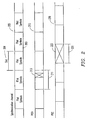
- Each slot 201 of a synchronization channel 205 includes a sequence of known pilot symbols 203 that convey timing and system configuration information to mobile terminals 105 in the cell served by the base station 120.
- System acquisition by the mobile terminal 105 begins by locating the synchronization channel 205, which permits the mobile terminal 105 to synchronize with the base station 120 through a process of path searching, carrier frequency correction, and channel estimation.
- path searching a process of path searching, carrier frequency correction, and channel estimation.
- Each mobile terminal 105 is assigned a specific, recurring time period 213 in which the mobile terminal 105 listens for paging indicator messages.
- the assigned time period 213 for the mobile terminal 105 can be identified based on information previously received by the mobile terminal 105 on a broadcast channel (not shown) associated with the base station 120.
- each such time period 213 is assigned to a group of mobile terminals 105, and thus more than one mobile terminal 105 is listening for a paging indicator message at the same time.
- a paging data channel (PDC) 220 includes slots 221 that transmit paging data messages 223. Generally, once a mobile terminal 105 detects a page based on a received paging indicator message, the mobile terminal 105 further receives an associated paging data message 223. The paging data message 223 allows the mobile terminal 105 to determine whether it actually has been paged or another mobile terminal from the paging group has been paged or, alternatively, whether there was an error in the detection of the paging indicator message. Assuming the mobile terminal 105 has been paged, the paging data message 223 contains control information for setting up a call connection. The synchronization channel 205, the paging indicator channel 215, and the paging data channel 220 share the same frequency bandwidth but are separated by different orthogonal codes.
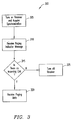
- step 305 the mobile terminal 105 powers up its receiver and uses the synchronization channel to acquire synchronization with a base station transmitter.
- step 310 the mobile terminal 105 receives a paging indicator message 213 on the paging indicator channel.
- the paging indicator channel transmits information indicating whether there is an incoming call for the mobile terminal 105.
- step 315 the mobile terminal 105 uses the paging indicator to determine if a call is intended for the mobile terminal 105.
- the mobile terminal 105 If it is determined that a call is intended for the mobile terminal 105, the mobile terminal 105 starts to receive, on the paging data channel, control data needed to set up a connection at step 320. However, if the paging indicator message indicates that there is not an incoming call for the mobile terminal 105, the receiver within the mobile terminal 105 is turned off at step 325, and the mobile terminal 105 waits for the next paging indicator.
- the conventional procedure for receiving paging data by a mobile terminal 105 while operating in the paging mode requires a path search along with other synchronization operations. The longer the path search, the better the synchronization. However, a longer path search causes the receiver of the mobile terminal 105 to be turned on for a longer time before the actual paging message is received, thereby degrading the stand-by performance of the mobile terminal 105.
- the stand-by time of a mobile terminal 105 can be improved by minimizing the time of reception while the mobile terminal 105 is communicating in a paging mode.
- the time actually required to perform the path search in connection with synchronizing with the base station 120 is heavily dependent on the current signal-to-noise ratio.
- SNR estimated signal-to-noise ratio
- the stand-by time of a mobile terminal 105 can be prolonged by adjusting the amount of time the receiver is turned on in accordance with the estimated SNR.
- the stand-by time of a mobile terminal 105 can be improved by utilizing information related to the path profile of the radio channel.
- radio channels are severely impacted by the presence of multipath propagation.
- multipath propagation the propagating signal is reflected from a number of objects in the physical environment, and the various multipath components from the different radio paths arrive at a receiving device at slightly different times due to the time delays associated with the multipath propagation.
- the difference between the shortest and longest time delays of the radio paths represents a delay spread. If the channel has a relatively small number of radio paths and a low delay spread associated therewith, the time interval needed to achieve synchronization between the mobile terminal 105 and the base station 120 is short.
- the time interval needed to achieve synchronization between the mobile terminal 105 and the base station 120 is longer.
- This information related to the number of radio paths and the size of the delay spread can be used to predict approximately how much time is required to achieve synchronization.
- the stand-by time of a mobile terminal 105 can be prolonged by adjusting the amount of time the receiver is turned on in accordance with the estimated path profiles.
- FIGURE 4 there is shown a diagram illustrating frame and slot structures of various communication channels in a WCDMA system along with the corresponding timing sequence for detection and synchronization of a paging signal in accordance with an embodiment of the present invention.
- the frame and slot structures of the synchronization channel 205, the paging indicator channel 215, and the paging data channel 220 are identical to those shown and described in connection with FIGURE 2.
- the timing of receiver activation and detection is adjusted relative to information transmitted on the synchronization channel 205, paging indicator channel 215, and paging data channel 220.
- a paging group time instant ⁇ pi at which the mobile terminal 105 should listen on the paging indicator channel 215, is known from information previously received on a broadcast channel. Accordingly, based on an internal clock signal, the mobile terminal 105 turns on its receiver prior to the beginning of the paging group time instant ⁇ pi .
- the amount of time ⁇ 1 prior to the beginning of the paging group time instant ⁇ pi and the amount of time ⁇ 2 subsequent to the paging group time instant ⁇ pi during which the receiver is powered up are derived from signal-to-noise ratio estimates from earlier paging messages or, at the very beginning of the paging procedure, are predetermined based on some worst case scenario regarding the signal-to-noise ratio.
- the amount of time ⁇ 1 prior and the amount of time ⁇ 2 subsequent to the paging group time instant ⁇ pi during which the receiver is powered up can also be derived from information related to the path profile estimates of the radio channel, such as the number of radio paths and the size of the delay spread.
- the receiver is turned on during a signal reception period 230 starting at ⁇ pi - ⁇ 1 and ending at ⁇ pi + ⁇ 2 .
- the mobile terminal 105 processes the signal received during the signal reception period 230 using the known pilot symbols to achieve synchronization during a first channel synchronization period 235.
- the received signal that includes the paging indicator is stored during a paging indicator interval 240 that begins at the known paging group time instant ⁇ pi .
- the stored signal is then decoded using the appropriate paging indicator code and in accordance with the identified path profile and synchronization information to detect the paging indicator (as indicated at 245).
- the mobile terminal 105 must again turn on its receiver to listen to a paging data message on the paging data channel.
- the paging data time instant ⁇ pd at which the mobile terminal should listen for the paging data message, is known either from system specifications or from the broadcast information in the particular cell.
- the amount of time ⁇ 3 prior to the beginning of the paging data time instant ⁇ pd at which the receiver is powered up is derived from the signal-to-noise ratio estimates, or from the path profile estimates, from earlier paging messages.
- the mobile terminal 105 refines the radio path profile identified during the first channel synchronization period 235.
- the value of ⁇ 3 can be zero, meaning that the path profile estimate obtained from the first channel synchronization period 235 is good enough that further path searching is not needed.
- the paging data is detected (as indicated at 255) beginning at the known paging data time instant ⁇ pd and continuing until the paging data message 223 is fully received.
- the mobile terminal 105 Upon entering a new cell or first powering up, the mobile terminal 105 receives broadcast channel data at step 502.
- the broadcast channel data can include information relating to paging, such as an indication of a recurring time instant ⁇ pi regarding when the mobile terminal 105 should listen on the paging indicator channel and an indication of a recurring time instant ⁇ pd regarding when to listen on the paging data channel.
- the receiver of the mobile terminal 105 is turned off at step 504 to conserve power.
- the receiver is turned on at step 506 to receive the paging indicator, which is sent at the paging indicator time instant ⁇ pi .
- the receiver generally needs to begin receiving signals some length of time ⁇ 1 prior to ⁇ pi .
- ⁇ 1 is set to some predetermined value based on a worst case scenario regarding the signal-to-noise ratio.
- the value of ⁇ 1 is derived from signal-to-noise ratio estimates from earlier paging messages.
- the mobile terminal can initiate a path search at step 508 to correct the carrier frequency and estimate the path profile of the radio channel using the pilot symbols on the synchronization channel.
- the path search generally continues until after the paging indicator is received.
- the received signal including the paging indicator message is stored at step 510.
- the receiver is turned off and the path search is discontinued in step 512 at some length of time ⁇ 2 after the paging indicator time instant ⁇ pi .
- the value of ⁇ 2 is initially predetermined based on some worst case scenario and is subsequently derived from signal-to-noise ratio or path profile estimates from earlier paging messages.
- the path profile estimate and the paging indicator channel de-spreading code are used to resolve, de-spread, and downsample to symbol rate the stored signal.
- step 516 it is determined from the downsampled signal whether the paging indicator is true (i.e., whether the mobile terminal 105 is being paged). If not, the signal-to-noise ratio (SNR) is updated at step 518 based on data from the path search and/or the process of resolving, de-spreading, and downsampling, and new values of ⁇ 1 , ⁇ 2 , and ⁇ 3 are computed at step 520. On the other hand, if the paging indicator is true, the receiver must again be turned on to receive additional information relating to the page on the paging data channel.
- SNR signal-to-noise ratio
- the receiver is turned on at step 522 a length of time ⁇ 3 prior to the known paging data time instant ⁇ pd to refine the radio path profile.
- the value of ⁇ 3 is derived from signal-to-noise ratio estimates from earlier paging messages.
- the paging data is actually intended for the mobile terminal 105 at step 524. If so, a call connection with the appropriate base station is initiated at step 526. If, on the other hand, the paging data indicates that paging data is not intended for the mobile terminal, the receiver is turned off at step 528, and the signal-to-noise ratio is updated at step 518. In this case, however, the indication that the paging indicator was true, followed by the indication that the paging data is not intended for the mobile terminal 105 implies that the detection of the paging indicator was erroneous.
- This error is used in place of and/or in addition to the updated signal-to-noise ratio estimates from the path search, the resolving, de-spreading, and downsampling process, and/or an estimate of channel characteristics to compute new values of ⁇ 1 , ⁇ 2 , and ⁇ 3 at step 520.
- the occurrence of such an error indicates that the time offsets ⁇ 1 , ⁇ 2 , and ⁇ 3 should be increased.
- FIGURE 6 there is illustrated an apparatus for minimizing the time of reception of a WCDMA receiver 600 in a mobile terminal 105 during paging mode in accordance with an embodiment of the present invention.
- the receiver 600 is turned off for a period of time when the mobile terminal 105 is not engaged in a call connection.
- the mobile terminal 105 has received information regarding the paging indicator time instant ⁇ pi and the paging data time instant ⁇ pd . These time instants ⁇ pi and ⁇ pd along with a clock signal clk are provided to a logic unit 605 (as indicated at 606).
- time offsets ⁇ 1 , ⁇ 2 , and ⁇ 3 that indicate when to start and stop receiving data for performing synchronization are stored in a control unit 620 and provided to the logic unit 605 (as indicated at 607).
- these time periods ⁇ 1 , ⁇ 2 , and ⁇ 3 are generally derived from signal-to-noise ratio estimates from earlier paging messages.
- the logic unit 605 uses the received value ⁇ 1 , together with ⁇ pi to enable (as indicated at 604) a front end receiver (FeRx) 610 to begin receiving data at time ⁇ pi - ⁇ 1 and to enable (as indicated at 612) a path searcher 640 to begin correcting the carrier frequency and estimating the path profile of the radio channel using a signal y l received by the front end receiver 610 via an antenna 602.
- the path searcher 640 may contain one or more correlators which continuously scans the time delay for a short period of time while looking for strong signals.
- the path searcher 640 provides the path profile estimate to a Rake receiver 625 and also generates an estimate (SNR) of the signal-to-noise ratio, which is provided to the control unit 620.
- SNR estimate of the signal-to-noise ratio
- the received signal y i including the paging indicator is stored in a memory in the Rake receiver 625.
- the logic unit 605 disables the front end receiver 610 (as indicated at 604) and disables the path searcher 640 (as indicated at 640).
- the Rake receiver 625 uses the estimated path profile received from the path searcher 640 to resolve, de-spread, and downsample the stored signal.
- the Rake receiver 625 remedies the effect of multipath propagation.
- the output x k from the receiver 625 is then provided to a paging indicator (PI) detector 630.
- the Rake receiver 625 provides a signal-to-noise ratio estimate to the control unit 620, and the control unit 620 computes new values of ⁇ 1 , ⁇ 2 , and ⁇ 3 based on the old values and the new signal-to-noise ratio estimates.
- the logic unit 605 disables the front end receiver 610 until the next synchronization period before the next paging indicator message (i.e., until the next occurrence of ⁇ pi - ⁇ 1 ).
- the logic unit 605 uses the time offset ⁇ 3 , along with the paging data time instant ⁇ pd to enable both the front end receiver 610 and the path searcher 640 for refining of the radio path profile.
- the time offset ⁇ 3 can be zero in cases where the estimated path profile from the synchronization for the paging indicator is of sufficient quality that further path searching is unnecessary.
- the path searcher 640 is disabled, and the Rake receiver 625 resolves, de-spreads, and downsamples the received signal y l to generate an output x k .
- a paging data detector 635 starts to detect the paging data from the signal x k . If the paging data confirms that the mobile terminal 105 is being paged, a call connection is established between the mobile terminal 105 and the base station 120.
- the front end receiver 610 is disabled, and the control unit 620 updates the values ⁇ 1 , ⁇ 2 , and ⁇ 3 using the estimated signal-to-noise ratio from the path searcher 640, the estimated signal-to-noise ratio from the Rake receiver 625, and/or information regarding the erroneous detection of a paging indicator.
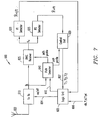
- FIGURE 7 there is illustrated an apparatus for minimizing the time of reception of a WCDMA receiver 600 in a mobile terminal 105 during paging mode in accordance with another embodiment of the present invention.
- the apparatus operates in a similar manner as discussed earlier with respect to FIGURE 6.
- the time offsets ⁇ 1 , ⁇ 2 , and ⁇ 3 that indicate when to start and stop receiving data for performing synchronization are generally derived from path profile estimates of the radio channel determined by the path searcher 640.
- the path searcher 640 provides an estimate of the path profile to a control unit 620.
- the control unit 620 then computes values of ⁇ 1 , ⁇ 2 , and ⁇ 3 based on characteristics of the estimated path profile, such as the number of detected paths, the delay spread among the various paths, and the like. These time offset values are fed to the logic unit 605, which activates and deactivates the receiver 610 based on the computed time offset values.
- the time offset values ⁇ 1 , ⁇ 2 , and ⁇ 3 can also be computed in the control unit 620 based on a combination of two or more of the estimated signal-to-noise ratio from the path searcher 640, the estimated signal-to-noise ratio from the Rake receiver 625, information regarding any erroneous detection of a paging indicator, and the characteristics of the estimated path profile.
Landscapes
- Engineering & Computer Science (AREA)
- Computer Networks & Wireless Communication (AREA)
- Signal Processing (AREA)
- Mobile Radio Communication Systems (AREA)
Claims (18)
- Verfahren zum Reduzieren der Empfangszeit während des Pagings in einem Kommunikationssystem, wobei das Verfahren die folgenden Verfahrensschritte aufweist:- Empfang von zumindest einer Paging-bezogenen Nachricht vor dem Empfang einer gegenwärtigen Paging-bezogenen Nachricht;- Bestimmen eines abgeschätzten Signal-Qualitätswertes basierend auf der zumindest einen Paging-bezogenen Nachricht;- Bestimmen einer Zeitperiode zum Empfang von Synchronisationsdaten basierend auf dem abgeschätzten Signalqualitätswert;- Aktivieren eines Empfängers während der Zeitperiode, um ein Signal zu empfangen, welches die Synchronisationsdaten enthält; und- Synchronisieren des Empfängers mit dem empfangenen Signal basierend auf den Synchronisationsdaten.
- Verfahren nach Anspruch 1, wobei die zumindest eine Paging-bezogene Nachricht eine Paging-Indikator-Nachricht enthält, die auf einem Paging-Indikator-Kanal übertragen wird.
- Verfahren nach Anspruch 1, wobei die zumindest eine Paging-Nachricht eine auf einem Paging-Daten-Kanal übertragene Paging-Daten-Nachricht enthält.
- Verfahren nach Anspruch 1, wobei der abgeschätzte Signal-Qualitätswert eine Abschätzung eines Signal-Zu-Rausch-Verhältnisses (SNR) aufweist.
- Verfahren nach Anspruch 1, wobei der abgeschätzte Signal-Qualitätswert einer Abschätzung eines Funk-Übertragungsweg-Profils entspricht.
- Verfahren nach Anspruch 1, wobei das während der Zeitperiode empfangene Signal ferner die gegenwärtige Paging-bezogene Nachricht aufweist.
- Verfahren nach Anspruch 6, wobei die Zeitperiode bei einem Startzeitpunkt vor der Paging-bezogenen Nachricht beginnt.
- Verfahren nach Anspruch 7, wobei der Verfahrensschritt des Bestimmens der Zeitperiode den Verfahrensschritt des Identifizierens des Startzeitpunktes basierend auf dem abgeschätzten Signal-Qualitätswert aufweist.
- Verfahren nach Anspruch 8, wobei die Zeitperiode bei einem Endzeitpunkt endet, welcher der Paging-bezogenen Nachricht nachfolgt, und wobei der Verfahrensschritt des Bestimmens der Zeitperiode den Verfahrensschritt des Identifizierens des End-Zeitpunktes basierend auf dem abgeschätzten Signal-Qualitätswert aufweist.
- Verfahren nach Anspruch 9, wobei die Paging-bezogene Nachricht eine Paging-Indikator-Nachricht aufweist.
- Verfahren nach Anspruch 1, welches ferner die folgenden Verfahrensschritte aufweist:- Aktualisieren des abgeschätzten Signal-Qualitätswertes basierend auf der gegenwärtigen Paging-bezogenen Nachricht; und- Abschätzen einer aktualisierten Zeitperiode zum Empfangen von Synchronisations-Daten basierend auf dem aktualisierten, abgeschätzten Signalwert.
- Vorrichtung zum Reduzieren der Empfangszeit während des Pagings in einem Kommunikationssystem, wobei die Vorrichtung folgendes aufweist:- einen Empfänger zum Empfangen einer Vielzahl von Paging-bezogenen Nachrichten;- eine Einrichtung zum Bestimmen eines abgeschätzten Signal-Qualitätswertes von zumindest einer der Vielzahl der Paging-Nachrichten, die vor dem Empfang einer gegenwärtigen Paging-Nachricht empfangen wurden; und- eine Steuerung zum Bestimmen einer Zeitperiode zum Empfangen von Synchronisationsdaten basierend auf dem abgeschätzten Signal-Qualitätswert und zum Aktivieren des Empfängers während der Zeitperiode, um die Synchronisationsdaten zu empfangen.
- Anordnung nach Anspruch 12, welche ferner einen Übertragungsweg-Sucher zum Erfassen der Synchronisationsdaten aufweist.
- Anordnung nach Anspruch 12, wobei der abgeschätzte Signal-Qualitätswert eine Abschätzung eines Signal-Zu-Rausch-Verhältnisses (SNR) aufweist.
- Anordnung nach Anspruch 12, wobei der abgeschätzte Signal-Qualitätswert einer Abschätzung des Funk-Übertragungs-Profils entspricht.
- Anordnung nach Anspruch 13, welche ferner einen RAKE-Empfänger zum Entspreizen der gegenwärtigen Paging-bezogenen Nachricht aufweist, wobei die Paging-bezogene Nachricht während der Zeitperiode empfangen wird.
- Anordnung nach Anspruch 16, wobei die Vorrichtung zumindest einen Übertragungsweg-Sucher (640) oder einen RAKE-Empfänger aufweist.
- Anordnung nach Anspruch 12, wobei das Kommunikationssystem ein WCDMA-System aufweist.
Applications Claiming Priority (3)
| Application Number | Priority Date | Filing Date | Title |
|---|---|---|---|
| US150037 | 2002-05-17 | ||
| US10/150,037 US7463599B2 (en) | 2002-05-17 | 2002-05-17 | Method and apparatus for minimizing time of reception during paging |
| PCT/EP2003/004987 WO2003098954A1 (en) | 2002-05-17 | 2003-05-13 | Method and apparatus for minimizing time of reception during paging |
Publications (2)
| Publication Number | Publication Date |
|---|---|
| EP1506685A1 EP1506685A1 (de) | 2005-02-16 |
| EP1506685B1 true EP1506685B1 (de) | 2006-07-19 |
Family
ID=29419162
Family Applications (1)
| Application Number | Title | Priority Date | Filing Date |
|---|---|---|---|
| EP03730019A Expired - Lifetime EP1506685B1 (de) | 2002-05-17 | 2003-05-13 | Verfahren und vorrichtung zur minimierung der empfangszeit während des paging |
Country Status (7)
| Country | Link |
|---|---|
| US (1) | US7463599B2 (de) |
| EP (1) | EP1506685B1 (de) |
| JP (1) | JP4398365B2 (de) |
| AT (1) | ATE333772T1 (de) |
| AU (1) | AU2003240630A1 (de) |
| DE (1) | DE60306922T2 (de) |
| WO (1) | WO2003098954A1 (de) |
Families Citing this family (29)
| Publication number | Priority date | Publication date | Assignee | Title |
|---|---|---|---|---|
| US6950684B2 (en) | 2002-05-01 | 2005-09-27 | Interdigital Technology Corporation | Method and system for optimizing power resources in wireless devices |
| CA2661727C (en) | 2002-05-06 | 2014-09-02 | Interdigital Technology Corporation | Synchronization for extending battery life |
| KR100827137B1 (ko) * | 2002-08-16 | 2008-05-02 | 삼성전자주식회사 | 이동통신시스템에서의 멀티캐스트 멀티미디어 방송 서비스 제공 방법 |
| US7385956B2 (en) | 2002-08-22 | 2008-06-10 | At&T Mobility Ii Llc | LAN based wireless communications system |
| US20050054375A1 (en) * | 2003-09-10 | 2005-03-10 | Patel Swetal A. | System and method for receiver management |
| US7292652B2 (en) * | 2003-10-21 | 2007-11-06 | Texas Instruments Incorporated | Symbol detecting with large frequency error |
| US7715855B2 (en) * | 2004-01-12 | 2010-05-11 | Qualcomm Incorporated | Method and apparatus optimizing receipt of call/broadcast paging messages by self-powered wireless communications devices |
| US8146078B2 (en) * | 2004-10-29 | 2012-03-27 | Intel Corporation | Timer offsetting mechanism in a virtual machine environment |
| KR20060056038A (ko) * | 2004-11-19 | 2006-05-24 | 엘지전자 주식회사 | 이동통신 시스템에서 피아이시에이치의 전송방법 |
| US7940710B2 (en) * | 2004-12-22 | 2011-05-10 | Qualcomm Incorporated | Methods and apparatus for efficient paging in a wireless communication system |
| US8073470B1 (en) | 2005-01-31 | 2011-12-06 | Jasper Wireless, Inc | Paging windows for power conservation in wireless networks |
| US8073469B2 (en) | 2005-01-31 | 2011-12-06 | Jasper Wireless, Inc. | Paging for non-real-time communications wireless networks |
| US8169982B2 (en) | 2005-08-10 | 2012-05-01 | Qualcomm Incorporated | Method and apparatus for creating a fingerprint for a wireless network |
| US20070087767A1 (en) | 2005-10-17 | 2007-04-19 | Sameer Pareek | Techniques to manage paging operations for idle mode mobile stations |
| JP4790484B2 (ja) * | 2006-05-01 | 2011-10-12 | 株式会社エヌ・ティ・ティ・ドコモ | 送信装置、受信装置およびページング情報受信方法 |
| JP4834471B2 (ja) * | 2006-06-19 | 2011-12-14 | 株式会社エヌ・ティ・ティ・ドコモ | 移動局装置および基地局装置並びにページング方法 |
| US20080063129A1 (en) * | 2006-09-11 | 2008-03-13 | Nokia Corporation | System and method for pre-defined wake-up of high speed serial link |
| US8301176B1 (en) * | 2007-05-07 | 2012-10-30 | Marvell International Ltd. | Increasing the stand-by time of wireless devices |
| US20090098885A1 (en) * | 2007-10-12 | 2009-04-16 | Qualcomm Incorporated | System and method for storing information to locate a femto cell |
| US9253653B2 (en) * | 2007-11-09 | 2016-02-02 | Qualcomm Incorporated | Access point configuration based on received access point signals |
| US8576757B2 (en) * | 2007-12-12 | 2013-11-05 | Qualcomm Incorporated | Dynamic adjustment of setup time based on paging performance |
| US8233428B2 (en) | 2008-08-13 | 2012-07-31 | Telefonaktiebolaget Lm Ericsson (Publ) | Using a synchronization channel to send quick paging signals |
| US8838096B2 (en) * | 2009-05-29 | 2014-09-16 | Qualcomm Incorporated | Non-macro cell search integrated with macro-cellular RF carrier monitoring |
| US20110134833A1 (en) * | 2009-12-08 | 2011-06-09 | Qualcomm Incorporated | Controlling access point functionality |
| US8923892B2 (en) | 2010-05-14 | 2014-12-30 | Qualcomm Incorporated | Method and apparatus for updating femtocell proximity information |
| US9003018B2 (en) * | 2011-09-15 | 2015-04-07 | Ca, Inc. | System and method for data set synchronization and replication |
| US9088942B2 (en) | 2013-02-08 | 2015-07-21 | Telefonaktiebolaget L M Ericsson (Publ) | Frequency offset estimation for early detection/decoding |
| WO2017048042A1 (ko) * | 2015-09-16 | 2017-03-23 | 엘지전자(주) | 무선 통신 시스템에서의 페이징 절차를 수행하는 방법 및 이를 위한 장치 |
| WO2018176375A1 (en) * | 2017-03-31 | 2018-10-04 | Zte Corporation | Method and apparatus for low power device synchronization |
Family Cites Families (11)
| Publication number | Priority date | Publication date | Assignee | Title |
|---|---|---|---|---|
| US6421540B1 (en) * | 1997-05-30 | 2002-07-16 | Qualcomm Incorporated | Method and apparatus for maximizing standby time using a quick paging channel |
| US6240288B1 (en) * | 1998-04-07 | 2001-05-29 | Conexant Systems, Inc. | Power management system for a mobile unit by intelligent page monitoring |
| US6606490B1 (en) * | 1999-08-10 | 2003-08-12 | Intel Corporation | Battery operated radio receivers having power save by reducing active reception time |
| US6697622B1 (en) | 1999-09-06 | 2004-02-24 | Nit Docomo, Inc. | Control method of searching neighboring cells, mobile station, and mobile communication system |
| FI109865B (fi) * | 1999-12-08 | 2002-10-15 | Nokia Corp | Menetelmä langattoman viestimen tehonkulutuksen pienentämiseksi |
| FI109568B (fi) * | 2000-01-13 | 2002-08-30 | Nokia Corp | Optimoitu lepotilan toiminta |
| US6728300B1 (en) * | 2000-02-11 | 2004-04-27 | Qualcomm Incorporated | Method and apparatus for maximizing standby time in remote stations configured to receive broadcast databurst messages |
| US7006468B1 (en) * | 2000-07-26 | 2006-02-28 | Qualcomm, Incorporated | Page monitoring method and apparatus |
| US6650912B2 (en) * | 2000-09-18 | 2003-11-18 | Qualcomm, Incorporated | Selecting paging channel mode |
| US6889055B1 (en) * | 2000-10-16 | 2005-05-03 | Qualcomm Inc. | Technique for reducing average power consumption in a wireless communications device |
| US6985453B2 (en) * | 2001-02-15 | 2006-01-10 | Qualcomm Incorporated | Method and apparatus for link quality feedback in a wireless communication system |
-
2002
- 2002-05-17 US US10/150,037 patent/US7463599B2/en not_active Expired - Lifetime
-
2003
- 2003-05-13 AU AU2003240630A patent/AU2003240630A1/en not_active Abandoned
- 2003-05-13 AT AT03730019T patent/ATE333772T1/de not_active IP Right Cessation
- 2003-05-13 EP EP03730019A patent/EP1506685B1/de not_active Expired - Lifetime
- 2003-05-13 WO PCT/EP2003/004987 patent/WO2003098954A1/en not_active Ceased
- 2003-05-13 JP JP2004506304A patent/JP4398365B2/ja not_active Expired - Fee Related
- 2003-05-13 DE DE60306922T patent/DE60306922T2/de not_active Expired - Lifetime
Also Published As
| Publication number | Publication date |
|---|---|
| US7463599B2 (en) | 2008-12-09 |
| JP2005526460A (ja) | 2005-09-02 |
| ATE333772T1 (de) | 2006-08-15 |
| US20030214937A1 (en) | 2003-11-20 |
| DE60306922D1 (de) | 2006-08-31 |
| JP4398365B2 (ja) | 2010-01-13 |
| AU2003240630A1 (en) | 2003-12-02 |
| WO2003098954A1 (en) | 2003-11-27 |
| EP1506685A1 (de) | 2005-02-16 |
| DE60306922T2 (de) | 2006-12-07 |
Similar Documents
| Publication | Publication Date | Title |
|---|---|---|
| US7463599B2 (en) | Method and apparatus for minimizing time of reception during paging | |
| KR100361252B1 (ko) | 통신 장치의 전력 소모를 줄이는 방법 | |
| JP4549603B2 (ja) | Cdmaセルラーシステムにおける移動局の位置測定を行うシステム及び方法 | |
| EP2485545B1 (de) | Kommunikationen in einem asynchronen drahtlosen Netzwerk | |
| EP1090521B1 (de) | Zellulares kommunikationssystem mit weichem weiterreichen des gemeinsamen kanals und dazugehöriges verfahren | |
| US7974647B2 (en) | Mobile apparatus and method of timing synchronization | |
| US8477722B2 (en) | Handoff control method and a mobile station employing the same | |
| US7903633B2 (en) | Method and apparatus for time-aligning transmissions from multiple base stations in a CDMA communication system | |
| US8059588B2 (en) | Systems and methods for shifting the position of a symbol to reduce transmission overhead | |
| WO1999023847A1 (en) | Method and apparatus for handoff within a communication system | |
| EP1410542A2 (de) | Verfahren zur synchronisierung einer mobilstation mit umts während des betriebs im gsm-dedicated-modus | |
| US8040866B2 (en) | CDMA-based mobile terminal, CDMA-based mobile communication method, and communication quality estimating method | |
| US7330447B2 (en) | Cell search method in CDMA capable of carrying out a cell search processing at a high speed | |
| EP1048094B1 (de) | Vorrichtung und Verfahren für einen gemeinsamen Kommunikationskanal mit Unterstützung verschiedener Datenraten in einem mobilen Kommunikationssystem | |
| US6718171B1 (en) | Robust and efficient reacquisition after call release | |
| US7990901B2 (en) | Cell search scheduling in a wireless cellular communication network | |
| WO2004021716A2 (en) | Method and apparatus for controlling the rate of path searching in a spread spectrum communications system | |
| US9398502B2 (en) | Method for measuring adjacent areas | |
| EP1053607B1 (de) | Synchronisierungsvorrichtung und verfahren in einem zellularen tdma-kommunikationssystem | |
| EP1784041A1 (de) | Zellulares Kommunikationssystem mit weichem Weiterreichen des gemeinsamen Kanals und dazugehöriges Verfahren | |
| HK1109007B (en) | Cellular communication system with common channel soft handoff and associated method |
Legal Events
| Date | Code | Title | Description |
|---|---|---|---|
| PUAI | Public reference made under article 153(3) epc to a published international application that has entered the european phase |
Free format text: ORIGINAL CODE: 0009012 |
|
| 17P | Request for examination filed |
Effective date: 20041007 |
|
| AK | Designated contracting states |
Kind code of ref document: A1 Designated state(s): AT BE BG CH CY CZ DE DK EE ES FI FR GB GR HU IE IT LI LU MC NL PT RO SE SI SK TR |
|
| AX | Request for extension of the european patent |
Extension state: AL LT LV MK |
|
| DAX | Request for extension of the european patent (deleted) | ||
| GRAP | Despatch of communication of intention to grant a patent |
Free format text: ORIGINAL CODE: EPIDOSNIGR1 |
|
| GRAS | Grant fee paid |
Free format text: ORIGINAL CODE: EPIDOSNIGR3 |
|
| GRAA | (expected) grant |
Free format text: ORIGINAL CODE: 0009210 |
|
| AK | Designated contracting states |
Kind code of ref document: B1 Designated state(s): AT BE BG CH CY CZ DE DK EE ES FI FR GB GR HU IE IT LI LU MC NL PT RO SE SI SK TR |
|
| PG25 | Lapsed in a contracting state [announced via postgrant information from national office to epo] |
Ref country code: IT Free format text: LAPSE BECAUSE OF FAILURE TO SUBMIT A TRANSLATION OF THE DESCRIPTION OR TO PAY THE FEE WITHIN THE PRESCRIBED TIME-LIMIT;WARNING: LAPSES OF ITALIAN PATENTS WITH EFFECTIVE DATE BEFORE 2007 MAY HAVE OCCURRED AT ANY TIME BEFORE 2007. THE CORRECT EFFECTIVE DATE MAY BE DIFFERENT FROM THE ONE RECORDED. Effective date: 20060719 Ref country code: CZ Free format text: LAPSE BECAUSE OF FAILURE TO SUBMIT A TRANSLATION OF THE DESCRIPTION OR TO PAY THE FEE WITHIN THE PRESCRIBED TIME-LIMIT Effective date: 20060719 Ref country code: LI Free format text: LAPSE BECAUSE OF FAILURE TO SUBMIT A TRANSLATION OF THE DESCRIPTION OR TO PAY THE FEE WITHIN THE PRESCRIBED TIME-LIMIT Effective date: 20060719 Ref country code: FI Free format text: LAPSE BECAUSE OF FAILURE TO SUBMIT A TRANSLATION OF THE DESCRIPTION OR TO PAY THE FEE WITHIN THE PRESCRIBED TIME-LIMIT Effective date: 20060719 Ref country code: CH Free format text: LAPSE BECAUSE OF FAILURE TO SUBMIT A TRANSLATION OF THE DESCRIPTION OR TO PAY THE FEE WITHIN THE PRESCRIBED TIME-LIMIT Effective date: 20060719 Ref country code: NL Free format text: LAPSE BECAUSE OF FAILURE TO SUBMIT A TRANSLATION OF THE DESCRIPTION OR TO PAY THE FEE WITHIN THE PRESCRIBED TIME-LIMIT Effective date: 20060719 Ref country code: BE Free format text: LAPSE BECAUSE OF FAILURE TO SUBMIT A TRANSLATION OF THE DESCRIPTION OR TO PAY THE FEE WITHIN THE PRESCRIBED TIME-LIMIT Effective date: 20060719 Ref country code: SK Free format text: LAPSE BECAUSE OF FAILURE TO SUBMIT A TRANSLATION OF THE DESCRIPTION OR TO PAY THE FEE WITHIN THE PRESCRIBED TIME-LIMIT Effective date: 20060719 Ref country code: RO Free format text: LAPSE BECAUSE OF FAILURE TO SUBMIT A TRANSLATION OF THE DESCRIPTION OR TO PAY THE FEE WITHIN THE PRESCRIBED TIME-LIMIT Effective date: 20060719 Ref country code: AT Free format text: LAPSE BECAUSE OF FAILURE TO SUBMIT A TRANSLATION OF THE DESCRIPTION OR TO PAY THE FEE WITHIN THE PRESCRIBED TIME-LIMIT Effective date: 20060719 Ref country code: SI Free format text: LAPSE BECAUSE OF FAILURE TO SUBMIT A TRANSLATION OF THE DESCRIPTION OR TO PAY THE FEE WITHIN THE PRESCRIBED TIME-LIMIT Effective date: 20060719 |
|
| REG | Reference to a national code |
Ref country code: GB Ref legal event code: FG4D |
|
| RIN1 | Information on inventor provided before grant (corrected) |
Inventor name: LINDOFF, BENGT Inventor name: ERIKSSON, HAKAN, BENGT |
|
| REG | Reference to a national code |
Ref country code: CH Ref legal event code: EP |
|
| REG | Reference to a national code |
Ref country code: IE Ref legal event code: FG4D |
|
| REF | Corresponds to: |
Ref document number: 60306922 Country of ref document: DE Date of ref document: 20060831 Kind code of ref document: P |
|
| PG25 | Lapsed in a contracting state [announced via postgrant information from national office to epo] |
Ref country code: SE Free format text: LAPSE BECAUSE OF FAILURE TO SUBMIT A TRANSLATION OF THE DESCRIPTION OR TO PAY THE FEE WITHIN THE PRESCRIBED TIME-LIMIT Effective date: 20061019 Ref country code: BG Free format text: LAPSE BECAUSE OF FAILURE TO SUBMIT A TRANSLATION OF THE DESCRIPTION OR TO PAY THE FEE WITHIN THE PRESCRIBED TIME-LIMIT Effective date: 20061019 Ref country code: DK Free format text: LAPSE BECAUSE OF FAILURE TO SUBMIT A TRANSLATION OF THE DESCRIPTION OR TO PAY THE FEE WITHIN THE PRESCRIBED TIME-LIMIT Effective date: 20061019 |
|
| PG25 | Lapsed in a contracting state [announced via postgrant information from national office to epo] |
Ref country code: ES Free format text: LAPSE BECAUSE OF FAILURE TO SUBMIT A TRANSLATION OF THE DESCRIPTION OR TO PAY THE FEE WITHIN THE PRESCRIBED TIME-LIMIT Effective date: 20061030 |
|
| PG25 | Lapsed in a contracting state [announced via postgrant information from national office to epo] |
Ref country code: PT Free format text: LAPSE BECAUSE OF FAILURE TO SUBMIT A TRANSLATION OF THE DESCRIPTION OR TO PAY THE FEE WITHIN THE PRESCRIBED TIME-LIMIT Effective date: 20061219 |
|
| NLV1 | Nl: lapsed or annulled due to failure to fulfill the requirements of art. 29p and 29m of the patents act | ||
| EN | Fr: translation not filed | ||
| PLBE | No opposition filed within time limit |
Free format text: ORIGINAL CODE: 0009261 |
|
| STAA | Information on the status of an ep patent application or granted ep patent |
Free format text: STATUS: NO OPPOSITION FILED WITHIN TIME LIMIT |
|
| 26N | No opposition filed |
Effective date: 20070420 |
|
| PG25 | Lapsed in a contracting state [announced via postgrant information from national office to epo] |
Ref country code: MC Free format text: LAPSE BECAUSE OF NON-PAYMENT OF DUE FEES Effective date: 20070531 |
|
| PG25 | Lapsed in a contracting state [announced via postgrant information from national office to epo] |
Ref country code: GR Free format text: LAPSE BECAUSE OF FAILURE TO SUBMIT A TRANSLATION OF THE DESCRIPTION OR TO PAY THE FEE WITHIN THE PRESCRIBED TIME-LIMIT Effective date: 20061020 Ref country code: FR Free format text: LAPSE BECAUSE OF FAILURE TO SUBMIT A TRANSLATION OF THE DESCRIPTION OR TO PAY THE FEE WITHIN THE PRESCRIBED TIME-LIMIT Effective date: 20070511 |
|
| PG25 | Lapsed in a contracting state [announced via postgrant information from national office to epo] |
Ref country code: IE Free format text: LAPSE BECAUSE OF NON-PAYMENT OF DUE FEES Effective date: 20070514 |
|
| PG25 | Lapsed in a contracting state [announced via postgrant information from national office to epo] |
Ref country code: EE Free format text: LAPSE BECAUSE OF FAILURE TO SUBMIT A TRANSLATION OF THE DESCRIPTION OR TO PAY THE FEE WITHIN THE PRESCRIBED TIME-LIMIT Effective date: 20060719 |
|
| PG25 | Lapsed in a contracting state [announced via postgrant information from national office to epo] |
Ref country code: FR Free format text: LAPSE BECAUSE OF FAILURE TO SUBMIT A TRANSLATION OF THE DESCRIPTION OR TO PAY THE FEE WITHIN THE PRESCRIBED TIME-LIMIT Effective date: 20060719 |
|
| PG25 | Lapsed in a contracting state [announced via postgrant information from national office to epo] |
Ref country code: LU Free format text: LAPSE BECAUSE OF NON-PAYMENT OF DUE FEES Effective date: 20070513 Ref country code: CY Free format text: LAPSE BECAUSE OF FAILURE TO SUBMIT A TRANSLATION OF THE DESCRIPTION OR TO PAY THE FEE WITHIN THE PRESCRIBED TIME-LIMIT Effective date: 20060719 |
|
| PG25 | Lapsed in a contracting state [announced via postgrant information from national office to epo] |
Ref country code: HU Free format text: LAPSE BECAUSE OF FAILURE TO SUBMIT A TRANSLATION OF THE DESCRIPTION OR TO PAY THE FEE WITHIN THE PRESCRIBED TIME-LIMIT Effective date: 20070120 Ref country code: TR Free format text: LAPSE BECAUSE OF FAILURE TO SUBMIT A TRANSLATION OF THE DESCRIPTION OR TO PAY THE FEE WITHIN THE PRESCRIBED TIME-LIMIT Effective date: 20060719 |
|
| PGFP | Annual fee paid to national office [announced via postgrant information from national office to epo] |
Ref country code: DE Payment date: 20180529 Year of fee payment: 16 |
|
| PGFP | Annual fee paid to national office [announced via postgrant information from national office to epo] |
Ref country code: GB Payment date: 20180529 Year of fee payment: 16 |
|
| REG | Reference to a national code |
Ref country code: DE Ref legal event code: R119 Ref document number: 60306922 Country of ref document: DE |
|
| GBPC | Gb: european patent ceased through non-payment of renewal fee |
Effective date: 20190513 |
|
| PG25 | Lapsed in a contracting state [announced via postgrant information from national office to epo] |
Ref country code: DE Free format text: LAPSE BECAUSE OF NON-PAYMENT OF DUE FEES Effective date: 20191203 Ref country code: GB Free format text: LAPSE BECAUSE OF NON-PAYMENT OF DUE FEES Effective date: 20190513 |