EP1507367A2 - Management of frame bursting - Google Patents
Management of frame bursting Download PDFInfo
- Publication number
- EP1507367A2 EP1507367A2 EP04254791A EP04254791A EP1507367A2 EP 1507367 A2 EP1507367 A2 EP 1507367A2 EP 04254791 A EP04254791 A EP 04254791A EP 04254791 A EP04254791 A EP 04254791A EP 1507367 A2 EP1507367 A2 EP 1507367A2
- Authority
- EP
- European Patent Office
- Prior art keywords
- vps
- data
- amount
- access category
- transmission
- Prior art date
- Legal status (The legal status is an assumption and is not a legal conclusion. Google has not performed a legal analysis and makes no representation as to the accuracy of the status listed.)
- Granted
Links
Images



Classifications
-
- H—ELECTRICITY
- H04—ELECTRIC COMMUNICATION TECHNIQUE
- H04W—WIRELESS COMMUNICATION NETWORKS
- H04W74/00—Wireless channel access
- H04W74/002—Transmission of channel access control information
-
- H—ELECTRICITY
- H04—ELECTRIC COMMUNICATION TECHNIQUE
- H04L—TRANSMISSION OF DIGITAL INFORMATION, e.g. TELEGRAPHIC COMMUNICATION
- H04L47/00—Traffic control in data switching networks
- H04L47/50—Queue scheduling
- H04L47/62—Queue scheduling characterised by scheduling criteria
- H04L47/6215—Individual queue per QOS, rate or priority
-
- H—ELECTRICITY
- H04—ELECTRIC COMMUNICATION TECHNIQUE
- H04W—WIRELESS COMMUNICATION NETWORKS
- H04W28/00—Network traffic management; Network resource management
- H04W28/02—Traffic management, e.g. flow control or congestion control
- H04W28/10—Flow control between communication endpoints
- H04W28/14—Flow control between communication endpoints using intermediate storage
-
- H—ELECTRICITY
- H04—ELECTRIC COMMUNICATION TECHNIQUE
- H04W—WIRELESS COMMUNICATION NETWORKS
- H04W84/00—Network topologies
- H04W84/02—Hierarchically pre-organised networks, e.g. paging networks, cellular networks, WLAN [Wireless Local Area Network] or WLL [Wireless Local Loop]
- H04W84/10—Small scale networks; Flat hierarchical networks
- H04W84/12—WLAN [Wireless Local Area Networks]
Definitions
- the present invention relates to communication equipment and, more specifically, to equipment for wireless local area networks (WLANs).
- WLANs wireless local area networks
- IEEE Standard 802.11 has emerged as a prevailing technology for broadband access in WLAN systems and is regarded by many as a wireless version of Ethernet.
- the 802.11 legacy medium access control (MAC) is based upon best-effort service, which does not support quality of service (QoS) for users or applications.
- QoS quality of service
- the upcoming 802.11e supplement standard will define enhancements to the legacy 802.11 MAC providing a QoS support facility.
- EDCF Enhanced Distributed Coordination Function
- the EDCF is based on eight priority values, designated 0 to 7, which are analogous to IEEE 802.1d priority tags.
- Each data frame to be transmitted is provided with a priority value, based on which the frame is sorted into one of the following four access categories (ACs): best effort, video probe, video, and voice.
- Each AC contends for access to the wireless medium based on the corresponding QoS parameter set (PS) including, for example, the values of (i) CWmin and CWmax specifying the contention window and (ii) arbitration inter-frame spacing (AIFS).
- PS QoS parameter set
- AIFS arbitration inter-frame spacing
- After winning a contention an AC is allowed to transmit one or more frames in addition to the first frame without having to re-contend for access to the wireless medium for the transmission of the additional frames.
- frame bursting Such transmission of multiple frames is referred to as frame bursting.
- frame bursting typically improves effective capacity of the communication channel, methods directed to efficient utilization of frame bursting by wireless stations are not sufficiently developed
- a variable parameter set, VPS[n] is provided to a channel access function in the process of obtaining a transmission opportunity (TXOP) for a corresponding access category, AC-n, at a wireless station of the WLAN system.
- the variation of one or more values in VPS[n] is based on the amount of buffered traffic and is preferably performed such that, when a TXOP is granted, AC-n has buffered an amount of traffic suitable for transmission using frame bursting in such a manner that the service and back-off overheads for AC-n are substantially reduced. Due to the overhead reduction, more channel time becomes available to traffic from other access categories and/or wireless stations. For example, bursting video traffic in accordance with the invention may significantly improve best-effort traffic. In addition, less channel time may be lost to collisions.
- the present invention is a method of data transmission at a node of a contention-based WLAN system, the method comprising: (A) determining a first amount of data in a transmission queue corresponding to a first access category; and (B) obtaining a first transmission opportunity for the first access category using a first variable parameter set (VPS), wherein at least one parameter value in the first VPS is determined based on the first amount.
- VPS variable parameter set
- the present invention is an apparatus for a node in a contention-based WLAN system, the apparatus comprising:(A) a first buffer configured to queue data corresponding to a first access category; and (B) a controller adapted to control data transmission at the node, wherein the controller is configured to: determine an amount of data in the first buffer; and obtain a first transmission opportunity for the first access category using a first variable parameter set (VPS), wherein at least one parameter value in the first VPS is determined based on the amount of data in the first buffer.
- VPS variable parameter set
- the present invention is a contention-based WLAN system, including a plurality of nodes configured to transmit data, wherein at least one node includes an apparatus comprising: (A) a buffer configured to queue data corresponding to a first access category; and (B) a controller adapted to control data transmission at the node, wherein the controller is configured to: determine an amount of data in the buffer; and obtain a first transmission opportunity for the first access category using a variable parameter set (VPS), wherein at least one parameter value in the VPS is determined based on the amount of data.
- VPS variable parameter set
- Fig. 1 shows a block diagram illustrating the 802.11 e MAC for a representative station (STA) of a WLAN.
- STA representative station
- AC-n is configured to behave as a separate EDCF contending entity having its own QoS parameter set (PS[n]) and maintaining its own back-off counter (BC[n]).
- PS[n] QoS parameter set
- BC[n] back-off counter
- AC-n contends for channel access based on the values of AIFS[n], CWmin[n], and CWmax[n] specified in QoS PS[n].
- the AP announces system-wide the values of TXOPLimit[n], each defining the maximum duration of a frame burst for the corresponding AC.
- TXOPLimit[n] each defining the maximum duration of a frame burst for the corresponding AC.
- the MAC of Fig. 1 is implemented using (i) one or more buffers configured to queue data corresponding to different access categories and (ii) a controller adapted to control data transmission at the STA. More specifically, the buffer corresponds to transmission queues 102-n of Fig. 1, and the controller is configured to (a) implement a channel access function based on QoS PS[n], BC[n], and TXOPLimit[n] as indicated in Fig. 1 and (b) perform functions of VCH 104.
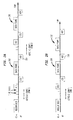
- Figs. 2A-B graphically illustrate frame transmission between a STA configured in accordance with Fig. 1 and the AP of a WLAN without and with frame bursting, respectively.
- transmission of two data frames from a particular queue 102-n corresponding to AC-n (Fig. 1) is shown in each figure.
- AC-n starts a back-off procedure after detecting that the wireless medium has been idle for an AIFS[n] interval.
- the value of BC[n] is set to a random number drawn from the interval of 1 to CW[n]+1, where CW[n] is a state variable for AC-n.
- CW[n] is typically initialized at the value of CWmin[n] but may be adjusted up to the value of CWmax[n] if a transmission fails.
- BC[n] is decremented in accordance with the rules of the channel access function, e.g., as specified in draft standard 802.11e.
- BC[n] may be granted a TXOP.
- the first TXOP of Fig. 2A is granted to AC-n after countdown 1, which is illustratively shown as consisting of two 9- ⁇ s time slots.
- AC-n After an exchange of request-to-send (RTS) and clear-to-send (CTS) frames between the STA and AP, AC-n transmits a first data frame 202 and receives an acknowledgment (ACK) frame 204 confirming successful receipt of that data frame at the AP. To transmit a second data frame 206, AC-n enters a new contention for the next TXOP, which is illustratively shown in Fig. 2A as granted after the AIFS[n] and countdown 2 following ACK frame 204. Transmission of frame 206 is accompanied by a similar exchange of RTS, CTS, and ACK frames between the STA and AP.
- Fig. 2B shows transmission of data frames 208 and 212, which are similar to frames 202 and 206 of Fig. 2A, when AC-n invokes frame bursting. Similar to Fig. 2A, AC-n is granted a TXOP following an AIFS[n] and countdown 1. However, in contrast to Fig. 2A, second data frame 212 is transmitted after an ACK frame 210 without a new contention and back-off procedure. As a result, the amount of time to transmit two data frames in Fig. 2B is reduced compared to that in Fig. 2A with the time savings coming mostly from the reduced service and back-off overheads, i.e., fewer service frames to transmit and no additional back-off procedures to perform. Consequently, more channel time becomes available to data traffic from other ACs of the same STA and/or from other STAs.
- an AC sending traffic of relatively high-priority e.g., video
- frame bursting is not invoked at all or, when frame bursting is invoked, the overhead reduction is not sufficiently large to improve data traffic of relatively low priority, e.g., best effort. It is therefore desirable to have a method of data transmission that makes efficient use of frame bursting.
- Fig. 3 shows a flowchart of a method 300 of data transmission in a WLAN system according to one embodiment of the present invention.
- Method 300 implements bursting management to improve data traffic and can be employed, for example, in a STA configured in accordance with Fig. 1.
- Step 302 of method 300 provides, for at least one AC-n at the STA, dynamic switching between two different configurations, each of which can be used to gain channel access.
- the first and second configurations are used in steps 304 and 306 , respectively.
- AC-n proceeds to step 308 to transmit data.
- AC-n may transmit a single data frame, as shown in Fig. 2A, or multiple data frames, as shown in Fig. 2B, taking up to TXOPLimit[n] of channel time.
- step 304 AC-n uses the first configuration, in which a regular parameter set, QoS PS[n], is used to obtain a TXOP, for example, as described above in reference to Fig. 2.
- QoS PS[n] a regular parameter set
- QoS PS[n] can be referred to as a fixed parameter set.
- AC-n uses the second configuration, in which one or more parameter values used to obtain a TXOP (e.g., CWmin[n], CWmax[n], and/or AIFS[n]) are allowed to vary based on the amount of data buffered by AC-n in queue 102-n.
- a parameter set including at least one variable parameter is hereafter referred to as a variable parameter set, VPS[n].
- VPS[n] is analogous to the regular QoS PS[n], in contrast to the latter, the former may supply a different set of values to the channel access function each time said function is invoked.
- VPS[n] instead of QoS PS[n] is to be able to adjust the probable wait time until a TXOP is granted to AC-n. This time adjustment is preferably carried out in such a manner that, AC-n can utilize frame bursting relatively efficiently. For example, when the amount of buffered data is relatively low, VPS[n] is modified to effectively delay channel access for AC-n. This delay is used to increase the amount of buffered data to a selected level, at which the service and back-off overheads can be significantly reduced through the use of frame bursting. On the other hand, when the amount of buffered data has reached the selected level, VPS[n] may be readjusted to facilitate faster channel access.
- step 306 lowers the overall collision probability. This may further improve data traffic, due to the fact that less channel time is lost to collisions.
- the choice of whether the processing of method 300 proceeds via step 304 or step 306 may be based on an "urgency flag" supplied with certain frames. For example, certain higher layer acknowledgement schemes in standard 802.11 require a prompt response from the STA before it can continue to stream regular traffic. Consequently, when a frame in the queue is flagged urgent, the processing of method 300 is directed via step 304 , while, when there are no flagged frames, the processing is directed via step 306 .
- Step 306 comprises steps 400 - 412 , a description of which follows.
- VPS[n] is initialized to have the same parameter values as QoS PS[n].
- AC-n determines the amount of data buffered in queue 102-n.
- the amount of data can be measured in the units of data frames.
- the amount of data can be measured in the units of time required for data transmission at the currently advised data rate.
- One possible unit of time that can be used for the measurement of step 402 is the value of TXOPLimit[n] with the amount of data indicated as the corresponding percentage of that value.
- step 404 based on the measurement of step 402, one or more parameter values in VPS[n] are modified to change the probable wait time until a TXOP is granted to AC-n.
- the adjustable parameters of VPS[n] may include but are not limited to CWmin[n], CWmax[n], and AIFS[n].
- the parameter adjustment is performed such that, at the moment of transmission, a relatively large amount of data has been buffered to obtain a substantial overhead reduction through the use of frame bursting.
- step 404 the processing of step 404 is as follows.
- VPS[n] is set to be equal QoS PS[j], where j ⁇ n, i.e., the QoS parameter set of AC-j which has lower priority than AC-n. For example, if AC-n is video, AC-j may be best effort.
- VPS[n] is reverted back to QoS PS[n].
- the threshold value may be set, for example, at N data frames or 50% of TXOPLimit[n].
- the processing of step 404 may be based on two or more threshold values or a mathematical relationship between the amount of data and each adjustable parameter value in VPS[n].
- One such mathematical relationship is, for example, a linear function.
- the number of adjustable parameters in VPS[n] may be varied as necessary.
- step 406 the STA monitors the state (i.e., busy or idle) of the wireless medium and provides this information to its ACs. If it is determined that the medium has become idle, the processing continues on to step 408 where AC-n has to wait for at least an AIFS[n] interval before it can perform a back-off procedure.
- the value of AIFS[n] is an adjustable parameter specified in VPS[n]. If the medium has become busy sooner than an AIFS[n] interval has elapsed, the processing is returned to step 402. However, if the medium has remained idle for an AIFS[n] interval, the processing is directed to step 410.
- step 410 a back-off procedure preferably analogous to that described in draft standard 802.11e is performed.
- the former uses parameter values from VPS[n] while the latter uses QoS PS[n].
- step 412 it is determined whether or not AC-n has won the contention for a TXOP. If a TXOP is granted to AC-n, the processing is then directed to step 308 (Fig. 3). However, if a TXOP has been granted to a different AC or a different STA and/or the medium has become busy, then the processing is returned to step 402 .
- the following two examples illustrate the operation of a WLAN system having one or more STAs configured to use method 300 .
- the WLAN system has one STA transmitting a video stream and several additional STAs transmitting best-effort traffic with the total amount of traffic in the system being moderate.
- the access function uses regular parameter values from QoS PS[n]
- the video STA has a relatively high probability of winning the contention for channel access.
- the use of VPS[n] instead of QoS PS[n] reduces the effective priority of the video STA when a relatively low amount of video traffic is buffered.
- channel access for the video STA is delayed and, during the delay, the video queue can buffer additional data, which permits efficient use of frame bursting.
- the ensuing reduced service and back-off overheads may improve channel availability to best-effort traffic.
- the WLAN system has multiple video streams, for the purpose of this particular example, coming from different STAs.
- a first STA which has just transmitted a frame burst, is likely to have a relatively small amount of buffered data when it begins the next contention for channel access.
- the first STA has a reduced effective priority compared to, for example, the effective priority of a second STA, which has more data in its queue due to a longer period of time since the last transmission.
- the second STA has a higher probability of winning the contention for channel access than the first STA.
- different video STAs will transmit data in a relatively orderly fashion, effectively taking turns for transmission. As already indicated above, this may reduce the number of collisions and therefore improve the effective channel capacity.
- frame bursting is managed locally and, as such, does not require an "over the air" protocol.
- a wireless station in which the invention can be practiced, may be a client terminal or an access point in a WLAN system.
- a particular station may be configured to use two or more variable parameter sets, each corresponding to a different access category at that station.
- the present invention may be implemented as circuit-based processes, including possible implementation on a single integrated circuit.
- various functions of circuit elements may also be implemented as processing steps in a software program.
- Such software may be employed in, for example, a digital signal processor, micro-controller, or general purpose computer.
- the present invention can be embodied in the form of methods and apparatuses for practicing those methods.
- the present invention can also be embodied in the form of program code embodied in tangible media, such as floppy diskettes, ROMs, hard drives, or any other machine-readable storage medium, wherein, when the program code is loaded into and executed by a machine, such as a computer, the machine becomes an apparatus for practicing the invention.
- the present invention can also be embodied in the form of program code, for example, whether stored in a storage medium, loaded into and/or executed by a machine, or transmitted over some transmission medium or carrier, such as over electrical wiring or cabling, through fiber optics, or via electromagnetic radiation, wherein, when the program code is loaded into and executed by a machine, such as a computer, the machine becomes an apparatus for practicing the invention.
- program code When implemented on a general-purpose processor, the program code segments combine with the processor to provide a unique device that operates analogously to specific logic circuits.
Landscapes
- Engineering & Computer Science (AREA)
- Computer Networks & Wireless Communication (AREA)
- Signal Processing (AREA)
- Mobile Radio Communication Systems (AREA)
- Small-Scale Networks (AREA)
- Data Exchanges In Wide-Area Networks (AREA)
Abstract
Description
Claims (10)
- A method of data transmission at a node of a contention-based WLAN system, the method comprising:(A) determining a first amount of data in a transmission queue corresponding to a first access category; and(B) obtaining a first transmission opportunity for the first access category using a first variable parameter set (VPS), wherein at least one parameter value in the first VPS is determined based on the first amount.
- The method of claim 1, further comprising transmitting data from the transmission queue using frame bursting, wherein the contention-based WLAN system conforms to an IEEE 802.11 standard and supports a quality of service (QoS) facility and the node is a client terminal of the WLAN system.
- The method of claim 1, further comprising:(C) obtaining a second transmission opportunity for the first access category using a fixed parameter set corresponding to said access category; and(D) selecting between the processing of step (B) and step (C) based on a presence of a flagged data frame in the transmission queue.
- The method of claim 1, wherein step (B) comprises:(B1) initializing the first VPS to have parameter values from a fixed parameter set corresponding to the first access category;(B2) comparing the first amount with a threshold value; and(B3) changing at least one parameter value in the first VPS based on the comparison.
- The method of claim 4, wherein:step (B3) comprises:the second access category has lower priority than the first access category.when the first amount is below the threshold value, setting the first VPS to have one or more parameter values from a fixed parameter set corresponding to a second access category; andwhen the first amount is above the threshold value, setting the first VPS to have parameter values from the fixed parameter set corresponding to the first access category; and
- The method of claim 1, wherein step (B) comprises:determining whether a transmission medium is busy or idle; andwhen the transmission medium is idle, waiting for an arbitration inter-frame spacing (AIFS) interval.
- The method of claim 6, wherein length of the AIFS interval is a variable parameter from the first VPS.
- The method of claim 1, further comprising:determining a second amount of data in a transmission queue corresponding to a second access category; andobtaining a transmission opportunity for the second access category using a second VPS, wherein at least one parameter value in the second VPS is determined based on the second amount.
- Apparatus for a node in a contention-based WLAN system, the apparatus comprising:(A) a first buffer configured to queue data corresponding to a first access category; and(B) a controller adapted to control data transmission at the node, wherein the controller is configured to:determine an amount of data in the first buffer; andobtain a first transmission opportunity for the first access category using a first variable parameter set (VPS), wherein at least one parameter value in the first VPS is determined based on the amount of data in the first buffer.
- A contention-based WLAN system, including a plurality of nodes configured to transmit data, wherein at least one node includes an apparatus comprising:(A) a buffer configured to queue data corresponding to a first access category; and(B) a controller adapted to control data transmission at the node, wherein the controller is configured to:determine an amount of data in the buffer; andobtain a first transmission opportunity for the first access category using a variable parameter set (VPS), wherein at least one parameter value in the VPS is determined based on the amount of data.
Applications Claiming Priority (2)
| Application Number | Priority Date | Filing Date | Title |
|---|---|---|---|
| US638663 | 2003-08-11 | ||
| US10/638,663 US7315528B2 (en) | 2003-08-11 | 2003-08-11 | Management of frame bursting |
Publications (3)
| Publication Number | Publication Date |
|---|---|
| EP1507367A2 true EP1507367A2 (en) | 2005-02-16 |
| EP1507367A3 EP1507367A3 (en) | 2006-07-12 |
| EP1507367B1 EP1507367B1 (en) | 2009-03-25 |
Family
ID=33565219
Family Applications (1)
| Application Number | Title | Priority Date | Filing Date |
|---|---|---|---|
| EP04254791A Expired - Lifetime EP1507367B1 (en) | 2003-08-11 | 2004-08-09 | Management of frame bursting |
Country Status (4)
| Country | Link |
|---|---|
| US (1) | US7315528B2 (en) |
| EP (1) | EP1507367B1 (en) |
| JP (1) | JP4473069B2 (en) |
| DE (1) | DE602004020156D1 (en) |
Cited By (2)
| Publication number | Priority date | Publication date | Assignee | Title |
|---|---|---|---|---|
| CN102176791A (en) * | 2006-01-04 | 2011-09-07 | 美商内数位科技公司 | Methods and systems for providing efficient operation of multiple modes in a wlan system |
| US8909286B2 (en) | 2006-01-04 | 2014-12-09 | Interdigital Technology Corporation | Methods and systems for providing efficient operation of multiple modes in a WLAN system |
Families Citing this family (35)
| Publication number | Priority date | Publication date | Assignee | Title |
|---|---|---|---|---|
| JP4108006B2 (en) * | 2003-06-23 | 2008-06-25 | 東京電力株式会社 | Wireless LAN communication system |
| US7899059B2 (en) * | 2003-11-12 | 2011-03-01 | Agere Systems Inc. | Media delivery using quality of service differentiation within a media stream |
| US20050152373A1 (en) * | 2004-01-08 | 2005-07-14 | Interdigital Technology Corporation | Packet scheduling in a wireless local area network |
| US7668128B1 (en) * | 2004-05-17 | 2010-02-23 | Avaya Inc. | Features of power save in 802.11e wireless local area networks (WLANs) |
| US7787366B2 (en) * | 2005-02-02 | 2010-08-31 | Interdigital Technology Corporation | Method and apparatus for controlling wireless medium congestion by adjusting contention window size and disassociating selected mobile stations |
| US7864701B2 (en) | 2005-03-31 | 2011-01-04 | Intel Corporation | Apparatus, system and method capable of decreasing management frame size in wireless networks |
| KR20080021764A (en) * | 2005-06-08 | 2008-03-07 | 아바야 테크놀러지 코퍼레이션 | Avoiding hidden terminals in wireless local area networks |
| JP2006345453A (en) * | 2005-06-10 | 2006-12-21 | Canon Inc | Wireless communication apparatus, control method thereof, and program thereof |
| US9521584B2 (en) * | 2005-10-17 | 2016-12-13 | Qualcomm Incorporated | Method and apparatus for managing data flow through a mesh network |
| US8483616B1 (en) | 2005-11-01 | 2013-07-09 | At&T Intellectual Property Ii, L.P. | Non-interference technique for spatially aware mobile ad hoc networking |
| US8355410B2 (en) | 2007-08-17 | 2013-01-15 | At&T Intellectual Property I, L.P. | Location-based mobile gaming application and method for implementing the same using a scalable tiered geocast protocol |
| US7519038B2 (en) * | 2006-03-06 | 2009-04-14 | Hitachi, Ltd. | Adaptive EDCA algorithm using traffic prediction in wireless local area networks |
| US20070258419A1 (en) * | 2006-05-04 | 2007-11-08 | Hitachi, Ltd. | Network adaptive priority management in wireless local area networks |
| US9479341B2 (en) | 2006-08-22 | 2016-10-25 | Centurylink Intellectual Property Llc | System and method for initiating diagnostics on a packet network node |
| US8576722B2 (en) * | 2006-08-22 | 2013-11-05 | Centurylink Intellectual Property Llc | System and method for modifying connectivity fault management packets |
| JP4840043B2 (en) * | 2006-09-21 | 2011-12-21 | ソニー株式会社 | Wireless communication system and wireless communication apparatus |
| KR101322509B1 (en) | 2006-12-20 | 2013-10-25 | 주식회사 케이티 | AN ADAPTIVE ADMISSION CONTROL FOR FRAME BASED MULTIMEDIA TRAFFIC IN IEEE 802.11 WLANs |
| KR100958191B1 (en) * | 2007-02-06 | 2010-05-17 | 엘지전자 주식회사 | A data transmission method considering the number of terminals participating in multicast, a base station and a terminal for wireless communication for the same, and a wireless communication system |
| US8385272B2 (en) * | 2007-10-24 | 2013-02-26 | Hitachi, Ltd. | System and method for burst channel access over wireless local area networks |
| JP5497741B2 (en) * | 2008-05-08 | 2014-05-21 | コーニンクレッカ フィリップス エヌ ヴェ | Wireless communication system for medical data |
| US9544922B2 (en) * | 2008-09-16 | 2017-01-10 | At&T Intellectual Property I, L.P. | Quality of service scheme for collision-based wireless networks |
| WO2011014036A2 (en) | 2009-07-31 | 2011-02-03 | 삼성전자 주식회사 | Method and device for sending packets on a wireless local area network |
| US9118428B2 (en) | 2009-11-04 | 2015-08-25 | At&T Intellectual Property I, L.P. | Geographic advertising using a scalable wireless geocast protocol |
| US10016684B2 (en) | 2010-10-28 | 2018-07-10 | At&T Intellectual Property I, L.P. | Secure geographic based gaming |
| CN102802171B (en) | 2011-05-25 | 2016-06-22 | 华为技术有限公司 | For the back-off method of wireless communication system with keep out of the way equipment |
| US9319842B2 (en) | 2011-06-27 | 2016-04-19 | At&T Intellectual Property I, L.P. | Mobile device configured point and shoot type weapon |
| US9161158B2 (en) | 2011-06-27 | 2015-10-13 | At&T Intellectual Property I, L.P. | Information acquisition using a scalable wireless geocast protocol |
| US9495870B2 (en) | 2011-10-20 | 2016-11-15 | At&T Intellectual Property I, L.P. | Vehicular communications using a scalable ad hoc geographic routing protocol |
| US8744419B2 (en) | 2011-12-15 | 2014-06-03 | At&T Intellectual Property, I, L.P. | Media distribution via a scalable ad hoc geographic protocol |
| US9071451B2 (en) | 2012-07-31 | 2015-06-30 | At&T Intellectual Property I, L.P. | Geocast-based situation awareness |
| US9210589B2 (en) | 2012-10-09 | 2015-12-08 | At&T Intellectual Property I, L.P. | Geocast protocol for wireless sensor network |
| US9660745B2 (en) | 2012-12-12 | 2017-05-23 | At&T Intellectual Property I, L.P. | Geocast-based file transfer |
| US9942793B2 (en) | 2014-03-24 | 2018-04-10 | Intel IP Corporation | Systems and methods for contention management and quality of service estimation in heterogeneous wireless networks |
| JPWO2016163015A1 (en) * | 2015-04-09 | 2017-11-30 | 三菱電機株式会社 | Communication relay device and air conditioning cooling / heating system |
| GB2560540B (en) * | 2017-03-14 | 2019-05-01 | Canon Kk | Queues management for multi-user and single user edca transmission mode in wireless networks |
Family Cites Families (7)
| Publication number | Priority date | Publication date | Assignee | Title |
|---|---|---|---|---|
| US6404772B1 (en) * | 2000-07-27 | 2002-06-11 | Symbol Technologies, Inc. | Voice and data wireless communications network and method |
| US7251232B1 (en) * | 2000-11-22 | 2007-07-31 | Cisco Technology, Inc. | Point-controlled contention arbitration in multiple access wireless LANs |
| US6836666B2 (en) * | 2001-05-08 | 2004-12-28 | Lucent Technologies Inc. | Method to control uplink transmissions in a wireless communication system |
| US7136392B2 (en) * | 2001-08-31 | 2006-11-14 | Conexant Systems, Inc. | System and method for ordering data messages having differing levels of priority for transmission over a shared communication channel |
| US20030135640A1 (en) * | 2002-01-14 | 2003-07-17 | Texas Instruments Incorporated | Method and system for group transmission and acknowledgment |
| US20030223365A1 (en) * | 2002-06-04 | 2003-12-04 | Sharp Laboratories Of America, Inc. | Class of dynamic programming schedulers |
| US20050030894A1 (en) * | 2003-08-04 | 2005-02-10 | Stephens Adrian P. | Techniques for channel access and transmit queue selection |
-
2003
- 2003-08-11 US US10/638,663 patent/US7315528B2/en not_active Expired - Lifetime
-
2004
- 2004-08-09 DE DE602004020156T patent/DE602004020156D1/en not_active Expired - Lifetime
- 2004-08-09 EP EP04254791A patent/EP1507367B1/en not_active Expired - Lifetime
- 2004-08-09 JP JP2004232209A patent/JP4473069B2/en not_active Expired - Fee Related
Cited By (3)
| Publication number | Priority date | Publication date | Assignee | Title |
|---|---|---|---|---|
| CN102176791A (en) * | 2006-01-04 | 2011-09-07 | 美商内数位科技公司 | Methods and systems for providing efficient operation of multiple modes in a wlan system |
| CN102176791B (en) * | 2006-01-04 | 2014-09-17 | 美商内数位科技公司 | Methods and systems for providing efficient operation of multiple modes in a wlan system |
| US8909286B2 (en) | 2006-01-04 | 2014-12-09 | Interdigital Technology Corporation | Methods and systems for providing efficient operation of multiple modes in a WLAN system |
Also Published As
| Publication number | Publication date |
|---|---|
| JP2005065275A (en) | 2005-03-10 |
| EP1507367B1 (en) | 2009-03-25 |
| US20050036448A1 (en) | 2005-02-17 |
| DE602004020156D1 (en) | 2009-05-07 |
| US7315528B2 (en) | 2008-01-01 |
| JP4473069B2 (en) | 2010-06-02 |
| EP1507367A3 (en) | 2006-07-12 |
Similar Documents
| Publication | Publication Date | Title |
|---|---|---|
| US7315528B2 (en) | Management of frame bursting | |
| JP5173275B2 (en) | Wireless communication system and wireless communication method | |
| US7058074B2 (en) | Unified channel access for supporting quality of service (QoS) in a local area network | |
| US7817675B2 (en) | Emergency call handling in contention-based wireless local-area networks | |
| US7477621B1 (en) | System and method for estimating bandwidth requirements of and allocating bandwidth to communication devices operating in a network | |
| KR101417937B1 (en) | Wireless communication system and its data transmission method | |
| CN100484064C (en) | Method for accessing medium through multi-channel device | |
| US20050025176A1 (en) | Medium access control in wireless local area network | |
| US7324491B1 (en) | Method and apparatus for over-the-air bandwidth reservations in wireless networks | |
| JP2008011509A (en) | Wireless communication method and wireless communication system | |
| CN116097900B (en) | Shared EDCA TXOP with RTA traffic | |
| JP3484390B2 (en) | Wireless packet priority control method | |
| JP2007189690A (en) | System and method for access control in a wireless network | |
| JP4726792B2 (en) | Wireless communication apparatus and wireless communication method | |
| CN108966360A (en) | Data transmission method when LTE system and WiFi system coexist in unauthorized frequency range | |
| EP4550877A1 (en) | Data transmission method and apparatus, storage medium, and program product | |
| JP4335219B2 (en) | Wireless LAN traffic priority control method and apparatus | |
| CN1332544C (en) | Method for transmitting multimedia data in wireless network | |
| US8509197B2 (en) | Media access control method of determining data transmission order in wireless network | |
| WO2024034051A1 (en) | Access point, wireless terminal device, and communication system | |
| Chao et al. | A reservation-based distributed MAC scheme for infrastructure wireless networks | |
| JP4027654B2 (en) | Unified channel access to support quality of service in local area networks | |
| EP1569385B1 (en) | Method and system for the improvement of the QoS support in the de-centrally organized wireless networks | |
| Pudasaini et al. | QoS provisioning in CSMA/iCA based medium access control protocol for WLAN | |
| CN121013202A (en) | Methods and apparatus for contention channels |
Legal Events
| Date | Code | Title | Description |
|---|---|---|---|
| PUAI | Public reference made under article 153(3) epc to a published international application that has entered the european phase |
Free format text: ORIGINAL CODE: 0009012 |
|
| AK | Designated contracting states |
Kind code of ref document: A2 Designated state(s): AT BE BG CH CY CZ DE DK EE ES FI FR GB GR HU IE IT LI LU MC NL PL PT RO SE SI SK TR |
|
| AX | Request for extension of the european patent |
Extension state: AL HR LT LV MK |
|
| PUAL | Search report despatched |
Free format text: ORIGINAL CODE: 0009013 |
|
| AK | Designated contracting states |
Kind code of ref document: A3 Designated state(s): AT BE BG CH CY CZ DE DK EE ES FI FR GB GR HU IE IT LI LU MC NL PL PT RO SE SI SK TR |
|
| AX | Request for extension of the european patent |
Extension state: AL HR LT LV MK |
|
| 17P | Request for examination filed |
Effective date: 20061206 |
|
| 17Q | First examination report despatched |
Effective date: 20070201 |
|
| AKX | Designation fees paid |
Designated state(s): DE FR GB |
|
| GRAP | Despatch of communication of intention to grant a patent |
Free format text: ORIGINAL CODE: EPIDOSNIGR1 |
|
| GRAS | Grant fee paid |
Free format text: ORIGINAL CODE: EPIDOSNIGR3 |
|
| GRAA | (expected) grant |
Free format text: ORIGINAL CODE: 0009210 |
|
| AK | Designated contracting states |
Kind code of ref document: B1 Designated state(s): DE FR GB |
|
| REG | Reference to a national code |
Ref country code: GB Ref legal event code: FG4D |
|
| REF | Corresponds to: |
Ref document number: 602004020156 Country of ref document: DE Date of ref document: 20090507 Kind code of ref document: P |
|
| PLBE | No opposition filed within time limit |
Free format text: ORIGINAL CODE: 0009261 |
|
| STAA | Information on the status of an ep patent application or granted ep patent |
Free format text: STATUS: NO OPPOSITION FILED WITHIN TIME LIMIT |
|
| 26N | No opposition filed |
Effective date: 20091229 |
|
| PGFP | Annual fee paid to national office [announced via postgrant information from national office to epo] |
Ref country code: FR Payment date: 20140808 Year of fee payment: 11 |
|
| PGFP | Annual fee paid to national office [announced via postgrant information from national office to epo] |
Ref country code: GB Payment date: 20150724 Year of fee payment: 12 |
|
| REG | Reference to a national code |
Ref country code: FR Ref legal event code: ST Effective date: 20160429 |
|
| REG | Reference to a national code |
Ref country code: DE Ref legal event code: R082 Ref document number: 602004020156 Country of ref document: DE Representative=s name: DILG HAEUSLER SCHINDELMANN PATENTANWALTSGESELL, DE Ref country code: DE Ref legal event code: R081 Ref document number: 602004020156 Country of ref document: DE Owner name: AVAGO TECHNOLOGIES GENERAL IP (SINGAPORE) PTE., SG Free format text: FORMER OWNER: AGERE SYSTEMS, INC., ALLENTOWN, PA., US Ref country code: DE Ref legal event code: R081 Ref document number: 602004020156 Country of ref document: DE Owner name: AVAGO TECHNOLOGIES INTERNATIONAL SALES PTE. LI, SG Free format text: FORMER OWNER: AGERE SYSTEMS, INC., ALLENTOWN, PA., US |
|
| REG | Reference to a national code |
Ref country code: DE Ref legal event code: R082 Ref document number: 602004020156 Country of ref document: DE Representative=s name: DILG HAEUSLER SCHINDELMANN PATENTANWALTSGESELL, DE Ref country code: DE Ref legal event code: R081 Ref document number: 602004020156 Country of ref document: DE Owner name: AVAGO TECHNOLOGIES GENERAL IP (SINGAPORE) PTE., SG Free format text: FORMER OWNER: AGERE SYSTEMS LLC (N.D.GES.D. STAATES DELAWARE), ALLENTOWN, PA., US Ref country code: DE Ref legal event code: R081 Ref document number: 602004020156 Country of ref document: DE Owner name: AVAGO TECHNOLOGIES INTERNATIONAL SALES PTE. LI, SG Free format text: FORMER OWNER: AGERE SYSTEMS LLC (N.D.GES.D. STAATES DELAWARE), ALLENTOWN, PA., US |
|
| PG25 | Lapsed in a contracting state [announced via postgrant information from national office to epo] |
Ref country code: FR Free format text: LAPSE BECAUSE OF NON-PAYMENT OF DUE FEES Effective date: 20150831 |
|
| GBPC | Gb: european patent ceased through non-payment of renewal fee |
Effective date: 20160809 |
|
| PG25 | Lapsed in a contracting state [announced via postgrant information from national office to epo] |
Ref country code: GB Free format text: LAPSE BECAUSE OF NON-PAYMENT OF DUE FEES Effective date: 20160809 |
|
| PGFP | Annual fee paid to national office [announced via postgrant information from national office to epo] |
Ref country code: DE Payment date: 20170719 Year of fee payment: 14 |
|
| REG | Reference to a national code |
Ref country code: DE Ref legal event code: R081 Ref document number: 602004020156 Country of ref document: DE Owner name: AVAGO TECHNOLOGIES INTERNATIONAL SALES PTE. LI, SG Free format text: FORMER OWNER: AVAGO TECHNOLOGIES GENERAL IP (SINGAPORE) PTE. LTD., SINGAPORE, SG Ref country code: DE Ref legal event code: R082 Ref document number: 602004020156 Country of ref document: DE Representative=s name: DILG HAEUSLER SCHINDELMANN PATENTANWALTSGESELL, DE |
|
| REG | Reference to a national code |
Ref country code: DE Ref legal event code: R119 Ref document number: 602004020156 Country of ref document: DE |
|
| PG25 | Lapsed in a contracting state [announced via postgrant information from national office to epo] |
Ref country code: DE Free format text: LAPSE BECAUSE OF NON-PAYMENT OF DUE FEES Effective date: 20190301 |