EP1507430A2 - Appareil, et procédé correspondant, pour appeler une station mobile dans un système de radiocommunication - Google Patents
Appareil, et procédé correspondant, pour appeler une station mobile dans un système de radiocommunication Download PDFInfo
- Publication number
- EP1507430A2 EP1507430A2 EP04016668A EP04016668A EP1507430A2 EP 1507430 A2 EP1507430 A2 EP 1507430A2 EP 04016668 A EP04016668 A EP 04016668A EP 04016668 A EP04016668 A EP 04016668A EP 1507430 A2 EP1507430 A2 EP 1507430A2
- Authority
- EP
- European Patent Office
- Prior art keywords
- mobile station
- page message
- communication system
- communication session
- initiate
- Prior art date
- Legal status (The legal status is an assumption and is not a legal conclusion. Google has not performed a legal analysis and makes no representation as to the accuracy of the status listed.)
- Withdrawn
Links
Images


Classifications
-
- H—ELECTRICITY
- H04—ELECTRIC COMMUNICATION TECHNIQUE
- H04W—WIRELESS COMMUNICATION NETWORKS
- H04W68/00—User notification, e.g. alerting and paging, for incoming communication, change of service or the like
-
- H—ELECTRICITY
- H04—ELECTRIC COMMUNICATION TECHNIQUE
- H04W—WIRELESS COMMUNICATION NETWORKS
- H04W52/00—Power management, e.g. Transmission Power Control [TPC] or power classes
- H04W52/02—Power saving arrangements
- H04W52/0209—Power saving arrangements in terminal devices
- H04W52/0212—Power saving arrangements in terminal devices managed by the network, e.g. network or access point is leader and terminal is follower
- H04W52/0216—Power saving arrangements in terminal devices managed by the network, e.g. network or access point is leader and terminal is follower using a pre-established activity schedule, e.g. traffic indication frame
-
- H—ELECTRICITY
- H04—ELECTRIC COMMUNICATION TECHNIQUE
- H04W—WIRELESS COMMUNICATION NETWORKS
- H04W64/00—Locating users or terminals or network equipment for network management purposes, e.g. mobility management
-
- H—ELECTRICITY
- H04—ELECTRIC COMMUNICATION TECHNIQUE
- H04W—WIRELESS COMMUNICATION NETWORKS
- H04W76/00—Connection management
- H04W76/10—Connection setup
-
- Y—GENERAL TAGGING OF NEW TECHNOLOGICAL DEVELOPMENTS; GENERAL TAGGING OF CROSS-SECTIONAL TECHNOLOGIES SPANNING OVER SEVERAL SECTIONS OF THE IPC; TECHNICAL SUBJECTS COVERED BY FORMER USPC CROSS-REFERENCE ART COLLECTIONS [XRACs] AND DIGESTS
- Y02—TECHNOLOGIES OR APPLICATIONS FOR MITIGATION OR ADAPTATION AGAINST CLIMATE CHANGE
- Y02D—CLIMATE CHANGE MITIGATION TECHNOLOGIES IN INFORMATION AND COMMUNICATION TECHNOLOGIES [ICT], I.E. INFORMATION AND COMMUNICATION TECHNOLOGIES AIMING AT THE REDUCTION OF THEIR OWN ENERGY USE
- Y02D30/00—Reducing energy consumption in communication networks
- Y02D30/70—Reducing energy consumption in communication networks in wireless communication networks
Definitions
- the present invention relates generally to a manner by which to page a mobile station to alert the mobile station of a SIP (Session Initiation Protocol), or other, call placed thereto. More particularly, the present invention relates to an apparatus, and an associated method, by which to identify an area within which to paged the mobile station and to page the mobile station in a manner to alert the mobile station of the call. A location index is created and maintained, identifying the location at which the mobile station is positioned. When the mobile station is page, the mobile station is able to detect the page when the mobile station is in a dormant, as well as active, mode.
- SIP Session Initiation Protocol
- a TIM Traffic Information Map
- a communication system includes, at least a set of communication stations and a communication channel that interconnects the communication stations. Data is originated at, or otherwise sourced, at a first of the communication stations, and the data is caused to be communicated upon the communication channel to another communication station of the set of communication stations.
- the communication station from which the data is sent is referred to as a sending station, and the communication station to which the data is communicated is referred to as a receiving station.
- Data is communicated to effectuate many varied types of communication services. And, different types of communication systems have been developed by which to provide for the effectuation of the different types of communication services.
- a radio communication system In a radio communication system, the communication channels upon which data is communicated between sending and receiving stations are defined upon a radio air interface extending therebetween. Wire line connections, conventionally required in a conventional wire line communication system to interconnect the sending and receiving stations is not required. Installation and use of a radio communication system provides various advantages over a wire line counterpart. Costs associated with the initial installation and deployment of a radio communication system are generally less than the corresponding costs required to install and deploy a wire line counterpart. Additionally, a radio communication system is amenable for implementation as a mobile communication system in which communication mobility is provided.
- a type of radio communication system that is widely deployed and popularly utilized is a cellular communication system.
- Network infrastructures of cellular communication systems have been installed to encompass many of the populated areas of the world.
- Usage of cellular communication systems to communicate therethrough is increasing, both in terms of increased numbers of users and increased amounts of usage.
- Successive generations of cellular communication systems have been developed, installed, and deployed. Successor generation systems generally utilize digital communication techniques and provide for packet switched communications in which packet formatted data is communicated pursuant to effectuation of communication services.
- WLANs Wireless Local Area Networks
- WLANs provide for radio communications with users of mobile stations.
- WLANs have been implemented both as private network systems and public network systems.
- WLANs generally provide for the effectuation of high data rate communication services, sometimes at costs substantially lower than the effectuation of corresponding communication services in a public access cellular communication system.
- WLANs are sometimes implemented to be operable in compliance with the operating protocol set forth in an IEEE 802.11, or variant, operating specification.
- WLANs of this type of implementation provides for high bandwidth communication services, e.g., between 11 and 54 Mbps within relatively small coverage areas.
- WLANs provide complementary communication services to those provided by wide area cellular communication systems. Communication sessions are formable between a mobile station operable in a WLAN and a communication station operable in an external network when the external network and the WLAN are appropriately connected theretogether.
- the external network forms, for instance, a UMTS/GPRS system.
- a mobile station operable in the UMTS/GPRS operates, for instance, to initiate to a mobile station operable in the WLAN.
- the call forms, for instance, an IMS call.
- the UMTS/GPRS mobile station sends an SIP (Session Initiation Protocol) INVITE to a SIP server of the UMTS network.
- SIP Session Initiation Protocol
- the radio portion of the UMTS network is sometimes referred to as an UTRAN (UMTS Terrestrial Radio Access Network).
- a call session control function (CSCF) is embodied at the server.
- the CSCF determines that the terminating station is beyond the domain of the UMTS and forwards the INVITE message to a SIP server in the WLAN. And, the SIP server of the WLAN forwards the message to the terminating mobile station.
- a problem occurs in the event that the terminating mobile station is not in an active mode when the INVITE message is broadcast thereto. Namely, if the mobile station is in a dormant mode when the message is broadcast, the mobile station does not detect the message, and a negative reply is returned to the UMTS.
- the present invention accordingly, advantageously provides an apparatus,' and an associated method, by which to page a mobile station to alert the mobile station of a call placed thereto.
- a location index is created and maintained.
- the location index identifies the location at where the mobile station is positioned.
- the location index is accessed prior to paging of the mobile station and used to select to where the page is broadcast.
- the location index mentioned here is not populated directly from the SIP location server.
- the SIP location server caches the SIP URIs, which are mapped to IP addresses, but the location server cache mentioned here keeps the paging related addresses, such as addresses of the Access Points (APs).
- APs Access Points
- a manner is provided by which to page the mobile station in a manner to alert the mobile station of the call.
- the mobile station is alerted of the call placed thereto even when the mobile station is in a dormant, as well as an active, state.
- the page is broadcast first only in an area in which the mobile station is identified to be positioned.
- a mobile station operable in the WLAN is tracked to obtain, and to maintain, positional indicia indicating the position of the mobile station.
- the mobile station is paged in an area in which the mobile station is indicated by the positional indicia associated therewith, to be located.
- a location server is embodied at the WLAN.
- a location index is created and maintained at the location server.
- the location server (different than SIP location server) is embodied, for instance, at a platform common to a SIP (Session Initiation Protocol) server (or to a SIP location server, which keeps the SIP addresses of the user agents) to which a call initiation request is routed when delivered from an external network.
- SIP Session Initiation Protocol
- the position at which the mobile station to which the call is placed is ascertained at the location index.
- a page is broadcast throughout the area at which the mobile station is indicated to be located. Rebroadcast of the page is also selectably performed in the event that the page does not appear to have been successfully delivered.
- the location index is created by a tracking procedure.
- mobile stations operable in the WLAN transmit ADD-notify packets.
- An access point to which the ADD-notify packet is delivered forwards on the message contents, together with an indication of the access point, and such information forms index entries at the location index.
- the entries of the location index are updated, as needed.
- a SIP INVITE is delivered to the WLAN and routed to the SIP server and location server embodied together therewith.
- the location index is accessed to determine the positioning of the mobile station to which the call is placed.
- a paging request is forwarded to the access point, or access points, associated with the location at which the mobile station is indicated to be positioned.
- the page request is broadcast by the access point throughout the area encompassed by the access point.
- the mobile station detects the paging request, the mobile station replies with a paging reply that is routed back to the SIP server. Formation of a call connection thereafter commences.
- the paging request first sent to the mobile station forms a layer 2 (L2) message, detectable by the mobile station, even when in the dormant state.
- L2 layer 2
- problems associated with failed detection of a paging request broadcast to the mobile station are less likely to occur.
- the radio communication system has a network part and a mobile station selectably operable to communicate with the network part by way of a radio air interface.
- the mobile station is operable in an active state and at least a dormant. Initiation of a communication session with the mobile station in which the mobile station forms a terminating node is facilitated.
- a page message generator is embodied at the network part. The page message generator generates a page message for broadcast upon the radio air interface to alert the mobile station of an invitation to initiate the communication session with the mobile station.
- the page message forms a wake-up indicator.
- the wake-up indicator is detectable by the mobile station when in the dormant state.
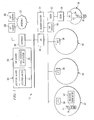
- a radio communication system shown generally at 10, provides for radio communications with mobile stations of which mobile stations 12 and 14 are representative.
- the mobile stations are alternately referred to as mobile nodes and user equipment, and such terminology shall be used interchangeably herein.
- the mobile station 12 is here representative of a mobile station operable in a UMTS/GPRS (Universal Mobile Telephone Service/General Packet Radio Service) system, or a variant thereof. And, the mobile station 12 is representative of a mobile station operable pursuant to an IEEE 802.11 operating specification or variant thereof.
- UMTS/GPRS Universal Mobile Telephone Service/General Packet Radio Service
- the communication system includes a network infrastructure capable of communicating with the mobile stations 12 and 14.
- the network infrastructure is formed of a first portion 16 forming the network infrastructure of a WLAN (Wireless Local Area Network) that operates pursuant to the IEEE 802.11 operating specification.
- the network infrastructure also includes a portion 18' operable pursuant to the operating specification of a UMTS/GPRS system.
- the separate network portions are connected to a packet data backbone, here the Internet 22. Packet switched communication connections are provided between the network portions 16 and 18 by way of the packet data network 22.
- the network portion 18 forms a radio access network (RAN).
- the radio access network includes a base station 24 that defines a coverage area forming a cell 26.
- the mobile station 12 is here shown to be positioned within the cell defined by the base station 24.
- the base station is coupled to a SGSN (Serving GPRS Service Node) 28 by way of, e.g., a radio network controller (not shown).
- the SGSN in turn, is coupled to a GGSN (Gateway GPRS Service Node) 32 that is coupled to a router, a border router 34, associated with the radio access network.
- the border router is coupled to the Internet 22.
- the border router is coupled to a SIP (Session Initiation Protocol) server 36 that operates, amongst other things, pursuant to call set up and routing of a SIP session initiated by a communication , station operable to communicate by way of the network portion 18.
- SIP Session Initiation Protocol
- the network portion 16 forms the network of a WLAN.
- the WLAN includes access points (APs) 38. Each of the access points defines a coverage area forming a cell, or paging area, 42.
- the mobile station 14 is here represented, initially, to be positioned within the cell defined by the first access point AP1.
- the access points are coupled to an access router 46 that operates in conventional manner to perform routing functions.
- the access router is connected to the internet by way of a gateway 48.
- the WLAN also includes a server 52.
- the server 52 forms a SIP server 52, and, in the exemplary implementation, embodied at the same platform, a location server 54 of an embodiment of the present invention.
- a location index shown at 56, is created and maintained at the location server.
- the location index is formed of entries that identify the mobile station and its location in terms of the access with which it communicates.
- the information that is obtained by the location server and that forms the entries of the location index thereof, is generated by a message generated by a message generator 62 embodied at the mobile stations, such as the mobile stations 14 that communicate with the WLAN.
- the signals are communicated over the radio air interface to the WLAN and routed through the WLAN to the location server 54.
- the communication system also includes other SIP servers, such as the SIP server 60 that forms an intermediary node, as shall be described below, during signaling operations.
- SIP server 60 that forms an intermediary node, as shall be described below, during signaling operations.
- the WLAN includes a page message generator 66 embodied at the SIP server or distributed at the access points 38.
- the page message generator 66 operates pursuant to an embodiment of the present invention by which to page a mobile station during a call session initiation procedure.
- operation of an embodiment of the present invention provides a manner by which to page a mobile station to alert the mobile station of a SIP call placed thereto.
- Layer 2 mobility of the mobile station 14 is tracked, and the tracked information is utilized during paging operations by which to page the mobile station.
- Paging is performed in a manner such that a mobile station in a power save, or other dormant, mode is capable of detecting the page.
- FIG 2 illustrates the portion 16 of the communication system 10 (shown in Figure 1). Elements previously shown and described are commonly referenced. Here, signaling by which to create the entries of the location index 56 is represented.
- the message generator of the mobile station 14 generates ADD-Notify or ADD-Modify messages that are sent over the radio air interface to an appropriate access point 38.
- the ADD-Notify message is represented at 72, and is routed through the WLAN to the SIP server and the location server embodied theretogether.
- the positional indicia associated with the mobile station here the identity of the access point that first receives the ADD-Notify or ADD-modify message, by the IP address of the associated access point, together with the IP address of the mobile station.
- the location index at the location server keeps track of which AP coverage area at which the mobile station has recently been positioned.
- Figure 3 illustrates the database 56 formed of the location index created and maintained at the location server.
- the location index is formed of rows 76 associated with individual ones of the mobile stations 14.
- Each mobile station includes a MAC (Medium Access Control) address indicated in the column 78 and an IP address, indicated in the column 82.
- a base station system IP address associated with the access point 38 through which the mobile station communicates is indicated in the column 84.
- the MAC address of the mobile station is contained in a data field of the ADD-notify packet message.
- the BSS IP is the source IP address in the ADD-Notify message.
- the IP address of the mobile station is initially empty as a (re) association request is a layer 2 message.
- the access router 46 of the WLAN sends an ADD-mobile packet to the SIP server 52.
- the message is a UDP packet and the data field thereof has a 64 bit MAC address, 128 bit IP address of the mobile station, a 128 bit prefix, an 8 bit prefix size in bits (maximum 128), and a 128 bit IP address of the access point (BSS-IP).
- FIG. 4 illustrates a paging database 88.
- the paging database is relatively static, i.e., hard state.
- the paging database maintains the identities of access points and their IP addresses until a subsequent ADD-Notify, or ADD-Modify, message provides a new access point or the SIP server 52 realizes a new access point to be associated with the mobile station during its paging procedure.
- the SIP server Subsequent to reception at the location server of each ADD-Mobile message routed to the location server by way of the access router, the SIP server maintains a list of all unique access points in the database 88.
- the list is organized, as illustrated in the Figure, such that the access points in a common sub network, such as the three access points shown in Figures 1 and 2 with the same prefix, and all of the distinct sub networks in the domain are thereby easily identifiable.
- the list 88 is used pursuant to paging operations. Because the entries on the list are generally not likely to change, the list 88 is static.
- FIG. 5 illustrates again the WLAN 16. Here, signaling generated during paging procedures is illustrated.
- Paging procedures at the WLAN commence when a SIP invite message is delivered, e.g., from the SIP server of the radio access network 18 (shown in Figure 1). A least recently used AP algorithm, or other appropriate algorithm, is utilized.
- the INVITE message is delivered to the SIP server 52.
- the location server searches the location index to obtain a corresponding entry in the paging database formed thereof for the location of the mobile station that forms the terminating node.
- a paging request is generated and routed to the identified access point.
- the routing of the paging request message is indicated by the arrows 94.
- the paging request message forms a UDP (User Datagram Protocol) message that contains MAC and IP addresses of the mobile station in the data field of the UDP message.
- UDP User Datagram Protocol
- layer 2 paging When delivered to the appropriate access point, layer 2 paging commences.
- the access point receives the layer 2 page request.
- the page message generator 66 operates to set a corresponding bit in the TIM (Transfer Information Management) packet to the association ID (AID) of the mobile station.
- the TIM is broadcast at TIM intervals.
- the paged mobile station responds to the paging request by a PS-poll control frame.
- the access point Upon detection of the PS-poll control frame, the access point sends a paging request data frame to the mobile station.
- the mobile station checks to see whether the address associated with the mobile station is contained in the field of the transmitted frame. If the address is detected to be therein, the mobile station enters into the active mode in logical layer 3, e.g., and the mobile station performs an MIP registration.
- the access point then sends a paging reply message back to the SIP server 52. If the reply is positive, the SIP server delivers the SIP invite message to the mobile station. Routing of the paging reply is indicated in the Figure by the arrows 96.
- the SIP server forwards on the paging request message to other access points 38 in the same sub network and, thereafter, to access points in other sub networks of the WLAN. If no positive reply is returned, the SIP server sends a "404 Not Found" response to the originating CSCF of the radio access network.
- the page is subsequently broadcast in additional domains in the event that the page is unsuccessfully delivered in the WLAN.
- the source SIP server 36 (shown in Figure 1) forms the INVITE message
- a record route header is included in the message.
- subsequent SIP servers such as the SIP server 60 (also shown in Figure 1) also have their' respective addresses inserted into the INVITE message.
- the INVITE message is delivered to the SIP server 52 of the WLAN, the identities of all SIP servers in the path between the initiating SIP server and the destination SIP server are known.
- the record route header contained in the INVITE message thereby enables the destination SIP server 52 to trigger other proxy servers to page the mobile station in the event that the page in the WLAN is unsuccessful. In this manner, the mobile station is paged in more than one domain, and a final "404 Not Found" response is returned only upon failure successfully to page the mobile station in all of the intermediary domains.
- Any intermediate proxy SIP server initiates paging as that just described with respect to paging in the WLAN 16. If a paging reply is returned, the INVITE message is delivered to the mobile station and the reply of the mobile station is relayed back to the source SIP server. If the reply is negative, then the associated SIP server sends a "404 Not Found" response to the previous proxy SIP server that itself starts its paging in the domain. The procedures continue until a response reaches the source SIP server or until the INVITE message is successfully delivered.
- Paging in other domains allows paging of the mobile stations that roam through heterogeneous networks, such as WLANS and a UMTS. If the mobile station is known initially to be in the WLAN, paging is first performed there. However, if the mobile station moves to another network, such as the UMTS, a proxy SIP server shall be in the domain of the UMTS, and, pursuant to operation of an embodiment of the present invention, the SIP server in the UMTS domain shall initiate a paging using UMTS paging protocols.
- the ADD-Mobile and ADD-Notify messages that include the IP addresses of the respective mobile stations are formable using IPv4 as well as Ipv6 identifiers.
- IPv4 IPv4
- Ipv6 identifiers
- a sub net mask length is used.
- the identifiers contained in the database 88 are appropriately, correspondingly identified.
- a manner is provided by which to page a mobile station to receive an SIP call.
- the page is broadcast to an area in which the mobile station is most likely to be located, and the page is broadcast in a manner that permits the mobile station to detect the page, whether in an active state or in a dormant state.
- Improved communications are thereby possible as the likelihood of successful delivery of the page is increased.
Landscapes
- Engineering & Computer Science (AREA)
- Computer Networks & Wireless Communication (AREA)
- Signal Processing (AREA)
- Mobile Radio Communication Systems (AREA)
Applications Claiming Priority (2)
| Application Number | Priority Date | Filing Date | Title |
|---|---|---|---|
| US639987 | 2003-08-13 | ||
| US10/639,987 US7043256B2 (en) | 2003-08-13 | 2003-08-13 | Apparatus, and an associated method, for paging a mobile station operable in a radio communication system |
Publications (2)
| Publication Number | Publication Date |
|---|---|
| EP1507430A2 true EP1507430A2 (fr) | 2005-02-16 |
| EP1507430A3 EP1507430A3 (fr) | 2006-11-08 |
Family
ID=33565247
Family Applications (1)
| Application Number | Title | Priority Date | Filing Date |
|---|---|---|---|
| EP04016668A Withdrawn EP1507430A3 (fr) | 2003-08-13 | 2004-07-15 | Appareil, et procédé correspondant, pour appeler une station mobile dans un système de radiocommunication |
Country Status (2)
| Country | Link |
|---|---|
| US (1) | US7043256B2 (fr) |
| EP (1) | EP1507430A3 (fr) |
Cited By (3)
| Publication number | Priority date | Publication date | Assignee | Title |
|---|---|---|---|---|
| WO2007142854A1 (fr) * | 2006-05-31 | 2007-12-13 | Lucent Technologies Inc. | Délivrance d'appel à un dispositif sans fil à double mode |
| EP1932386A4 (fr) * | 2005-10-04 | 2012-03-14 | Ericsson Telefon Ab L M | Radiomessagerie d'un reseau d'acces radio ayant des stations de base pico |
| EP2119054A4 (fr) * | 2007-03-05 | 2014-11-19 | Intel Corp | Wake-on-wlan pour stations sans fil stationnaires |
Families Citing this family (41)
| Publication number | Priority date | Publication date | Assignee | Title |
|---|---|---|---|---|
| US7020440B2 (en) * | 2002-12-13 | 2006-03-28 | Ntt Docomo, Inc. | Method and apparatus for an SIP based paging scheme |
| JP4210168B2 (ja) * | 2003-07-09 | 2009-01-14 | 株式会社エヌ・ティ・ティ・ドコモ | 移動端末、制御装置、ホームエージェント及びパケット通信方法 |
| WO2005025250A1 (fr) * | 2003-09-11 | 2005-03-17 | Sony Ericsson Mobile Communications Ab | Appel collectif de dispositifs portables avec identification du positionnement du correspondant |
| US20060083242A1 (en) * | 2004-10-20 | 2006-04-20 | Nokia Corporation | Address modification in application servers |
| WO2006078202A1 (fr) * | 2005-01-19 | 2006-07-27 | Telefonktiebolaget Lm Ericsson (Publ) | Procede et appareil pour la gestion d'appels d'urgence |
| US7353034B2 (en) | 2005-04-04 | 2008-04-01 | X One, Inc. | Location sharing and tracking using mobile phones or other wireless devices |
| DE102005038548B4 (de) * | 2005-08-12 | 2010-04-08 | Nec Europe Ltd. | Verfahren zur Steuerung der Kommunikation mit mobilen Stationen in einem Netzwerk |
| CN100461955C (zh) * | 2006-01-09 | 2009-02-11 | 华为技术有限公司 | 一种移动通信系统中寻呼优化的实现方法 |
| US8725062B2 (en) * | 2006-11-20 | 2014-05-13 | Broadcom Corporation | Media broadcasts from wireless access point |
| US9014765B2 (en) * | 2007-02-28 | 2015-04-21 | Intel Corporation | Mobile platform tracking in wireless networks |
| US7853274B2 (en) * | 2007-03-05 | 2010-12-14 | Intel Corporation | Wake-on-WLAN for stationary wireless stations |
| US8275352B2 (en) | 2007-06-28 | 2012-09-25 | Apple Inc. | Location-based emergency information |
| US9066199B2 (en) | 2007-06-28 | 2015-06-23 | Apple Inc. | Location-aware mobile device |
| US8774825B2 (en) | 2007-06-28 | 2014-07-08 | Apple Inc. | Integration of map services with user applications in a mobile device |
| US8385946B2 (en) | 2007-06-28 | 2013-02-26 | Apple Inc. | Disfavored route progressions or locations |
| US8204684B2 (en) | 2007-06-28 | 2012-06-19 | Apple Inc. | Adaptive mobile device navigation |
| US20090005964A1 (en) * | 2007-06-28 | 2009-01-01 | Apple Inc. | Intelligent Route Guidance |
| US8311526B2 (en) | 2007-06-28 | 2012-11-13 | Apple Inc. | Location-based categorical information services |
| US8108144B2 (en) | 2007-06-28 | 2012-01-31 | Apple Inc. | Location based tracking |
| US8175802B2 (en) | 2007-06-28 | 2012-05-08 | Apple Inc. | Adaptive route guidance based on preferences |
| US8332402B2 (en) * | 2007-06-28 | 2012-12-11 | Apple Inc. | Location based media items |
| US9109904B2 (en) | 2007-06-28 | 2015-08-18 | Apple Inc. | Integration of map services and user applications in a mobile device |
| US8290513B2 (en) | 2007-06-28 | 2012-10-16 | Apple Inc. | Location-based services |
| US8762056B2 (en) * | 2007-06-28 | 2014-06-24 | Apple Inc. | Route reference |
| US8977294B2 (en) * | 2007-10-10 | 2015-03-10 | Apple Inc. | Securely locating a device |
| US8355862B2 (en) | 2008-01-06 | 2013-01-15 | Apple Inc. | Graphical user interface for presenting location information |
| US20090326815A1 (en) * | 2008-05-02 | 2009-12-31 | Apple Inc. | Position Fix Indicator |
| US9250092B2 (en) | 2008-05-12 | 2016-02-02 | Apple Inc. | Map service with network-based query for search |
| US8644843B2 (en) | 2008-05-16 | 2014-02-04 | Apple Inc. | Location determination |
| US8369867B2 (en) | 2008-06-30 | 2013-02-05 | Apple Inc. | Location sharing |
| US8359643B2 (en) | 2008-09-18 | 2013-01-22 | Apple Inc. | Group formation using anonymous broadcast information |
| US8260320B2 (en) * | 2008-11-13 | 2012-09-04 | Apple Inc. | Location specific content |
| US8660530B2 (en) | 2009-05-01 | 2014-02-25 | Apple Inc. | Remotely receiving and communicating commands to a mobile device for execution by the mobile device |
| US8670748B2 (en) | 2009-05-01 | 2014-03-11 | Apple Inc. | Remotely locating and commanding a mobile device |
| US8666367B2 (en) | 2009-05-01 | 2014-03-04 | Apple Inc. | Remotely locating and commanding a mobile device |
| US8897134B2 (en) * | 2010-06-25 | 2014-11-25 | Telefonaktiebolaget L M Ericsson (Publ) | Notifying a controller of a change to a packet forwarding configuration of a network element over a communication channel |
| US9504032B2 (en) * | 2012-09-13 | 2016-11-22 | Interdigital Patent Holdings, Inc. | Method, wireless transmit/receive unit (WTRU) and base station for transferring small packets |
| US9544848B2 (en) | 2012-10-24 | 2017-01-10 | Qualcomm Incorporated | Methods and apparatus for communicating short paging messages in a wireless communication network |
| US9801157B2 (en) | 2012-10-31 | 2017-10-24 | Qualcomm, Incorporated | System and method of identifying a lower power paging mode |
| MY186828A (en) * | 2014-06-24 | 2021-08-24 | Intel Corp | Power optimization for network based internet protocol flow mobility |
| US11147042B1 (en) * | 2014-07-08 | 2021-10-12 | Sprint Communications Company L.P. | Wireless communication system to deliver pages to wireless communication devices based on wireless fidelity network identifiers |
Family Cites Families (14)
| Publication number | Priority date | Publication date | Assignee | Title |
|---|---|---|---|---|
| US5331580A (en) * | 1989-01-31 | 1994-07-19 | Norand Corporation | Data capture system with communicating and recharging docking apparatus, and modular printer and hand-held data terminal means cooperable therewith |
| US6446127B1 (en) | 1998-10-30 | 2002-09-03 | 3Com Corporation | System and method for providing user mobility services on a telephony network |
| JP2001253122A (ja) * | 2000-03-10 | 2001-09-18 | Fuji Photo Film Co Ltd | プリント方法、携帯通信端末及び携帯型プリンタ |
| US20020086703A1 (en) * | 2000-12-28 | 2002-07-04 | Brother International Corporation | Mobile computing device docking station |
| US7076270B2 (en) * | 2001-02-28 | 2006-07-11 | Dell Products L.P. | Docking station for wireless communication device |
| JP4574089B2 (ja) * | 2001-09-19 | 2010-11-04 | キヤノン株式会社 | 携帯端末用クレイドル、及びその制御方法、並びに記憶媒体 |
| KR100440182B1 (ko) * | 2001-09-29 | 2004-07-14 | 삼성전자주식회사 | 음영지역에서의 퀵페이징 방법 |
| US7283496B2 (en) * | 2001-10-17 | 2007-10-16 | Alcatel Lucent | Network paging system and method |
| KR100944569B1 (ko) * | 2001-12-05 | 2010-02-25 | 톰슨 라이센싱 | 무선 랜에서의 이동 단말기를 페이징하기 위한 방법 및 장치 |
| US7689225B2 (en) * | 2002-01-28 | 2010-03-30 | Ntt Docomo, Inc. | Method and apparatus for dormant mode support with paging |
| US20030225887A1 (en) * | 2002-05-28 | 2003-12-04 | Rene Purnadi | Establishing IP level connectivity by use of L-2 dormant mobile node activation |
| US7996021B2 (en) * | 2002-06-28 | 2011-08-09 | Hewlett-Packard Development Company, L.P. | Location determination in a wireless communication network |
| GB2391137B (en) * | 2002-07-19 | 2004-09-01 | Synad Technologies Ltd | Method of controlling access to a communications medium |
| US7020440B2 (en) * | 2002-12-13 | 2006-03-28 | Ntt Docomo, Inc. | Method and apparatus for an SIP based paging scheme |
-
2003
- 2003-08-13 US US10/639,987 patent/US7043256B2/en not_active Expired - Fee Related
-
2004
- 2004-07-15 EP EP04016668A patent/EP1507430A3/fr not_active Withdrawn
Cited By (6)
| Publication number | Priority date | Publication date | Assignee | Title |
|---|---|---|---|---|
| EP1932386A4 (fr) * | 2005-10-04 | 2012-03-14 | Ericsson Telefon Ab L M | Radiomessagerie d'un reseau d'acces radio ayant des stations de base pico |
| WO2007142854A1 (fr) * | 2006-05-31 | 2007-12-13 | Lucent Technologies Inc. | Délivrance d'appel à un dispositif sans fil à double mode |
| KR101050072B1 (ko) * | 2006-05-31 | 2011-07-19 | 알카텔-루센트 유에스에이 인코포레이티드 | 듀얼 모드 무선 디바이스로의 호출 전달 |
| US8340673B2 (en) | 2006-05-31 | 2012-12-25 | Alcatel Lucent | Call delivery to a dual mode wireless device |
| CN101455115B (zh) * | 2006-05-31 | 2013-08-07 | 卢森特技术有限公司 | 到双模无线设备的呼叫传递 |
| EP2119054A4 (fr) * | 2007-03-05 | 2014-11-19 | Intel Corp | Wake-on-wlan pour stations sans fil stationnaires |
Also Published As
| Publication number | Publication date |
|---|---|
| EP1507430A3 (fr) | 2006-11-08 |
| US7043256B2 (en) | 2006-05-09 |
| US20050037781A1 (en) | 2005-02-17 |
Similar Documents
| Publication | Publication Date | Title |
|---|---|---|
| US7043256B2 (en) | Apparatus, and an associated method, for paging a mobile station operable in a radio communication system | |
| JP4128739B2 (ja) | 移動端末へのパケット・データの送信を選択的に可能とする方法と関連装置 | |
| TW453070B (en) | Wireless network communication system and method with double packet filtering function | |
| EP1927228B1 (fr) | Noeud mobile a interfaces multiples et a connexion reseau domestique et etranger simultanee | |
| US7463605B2 (en) | Apparatus, and associated method, for facilitating local mobility management in a heterogeneous radio communication network | |
| CN102007752B (zh) | 当改变了移动性管理方案时的归属代理发现 | |
| JP5236477B2 (ja) | セルラー・ブロードキャストを利用した乗物の状態のモニタリング | |
| EP1645157B1 (fr) | Procedures rapides ameliorees de transfert | |
| US7948918B2 (en) | Network discovery utilizing cellular broadcasts/multicasts | |
| EP1758424B1 (fr) | Procédés et système de traitement de mise à jour de localisation dans un système de communication sans fil | |
| CN1518838A (zh) | 为无缝ip级别的切换确定最佳目标访问路由器的协议 | |
| CN100387074C (zh) | 移动节点、移动控制节点、分组通信系统及移动检出方法 | |
| CN101036321A (zh) | 用于多点传送分发树的主动建立的方法和系统 | |
| CN1985475A (zh) | 最小化的ip连接建立过程 | |
| US20090135783A1 (en) | FMIPv6 Intergration with Wimax | |
| US20070086460A1 (en) | Method and apparatus for supporting multicast/broadcast in wireless communication system | |
| US7623876B2 (en) | Apparatus, and an associated method, for performing link layer paging of a mobile station operable in a radio communication system | |
| US20120134346A1 (en) | Wireless communication system network equipment with broadcast-based backhaul network interface and next generation air interface | |
| US20060109827A1 (en) | Method for transmitting service data to wireless local area network users | |
| US8086210B2 (en) | Flow based layer 2 handover mechanism for mobile node with multi network interfaces | |
| US8213396B1 (en) | Methods and systems for disabling paging to a wireless communication device | |
| US20130034108A1 (en) | System and Method for Communications Network Configuration | |
| CN101742485B (zh) | 一种发送数据的方法和装置 | |
| Zhang et al. | A flexible and scalable IP paging protocol | |
| KR20020057292A (ko) | 통합 인터넷 프로토콜 망에서의 이동 인터넷 프로토콜관련 메시지 전달 방법 |
Legal Events
| Date | Code | Title | Description |
|---|---|---|---|
| PUAI | Public reference made under article 153(3) epc to a published international application that has entered the european phase |
Free format text: ORIGINAL CODE: 0009012 |
|
| AK | Designated contracting states |
Kind code of ref document: A2 Designated state(s): AT BE BG CH CY CZ DE DK EE ES FI FR GB GR HU IE IT LI LU MC NL PL PT RO SE SI SK TR |
|
| AX | Request for extension of the european patent |
Extension state: AL HR LT LV MK |
|
| PUAL | Search report despatched |
Free format text: ORIGINAL CODE: 0009013 |
|
| AK | Designated contracting states |
Kind code of ref document: A3 Designated state(s): AT BE BG CH CY CZ DE DK EE ES FI FR GB GR HU IE IT LI LU MC NL PL PT RO SE SI SK TR |
|
| AX | Request for extension of the european patent |
Extension state: AL HR LT LV MK |
|
| RAP1 | Party data changed (applicant data changed or rights of an application transferred) |
Owner name: ALCATEL LUCENT |
|
| AKX | Designation fees paid | ||
| STAA | Information on the status of an ep patent application or granted ep patent |
Free format text: STATUS: THE APPLICATION IS DEEMED TO BE WITHDRAWN |
|
| 18D | Application deemed to be withdrawn |
Effective date: 20070509 |
|
| REG | Reference to a national code |
Ref country code: DE Ref legal event code: 8566 |