EP1508850A2 - Speicher-Ablaufsteuerung eines stetigen Mediums mit Priorität - Google Patents
Speicher-Ablaufsteuerung eines stetigen Mediums mit Priorität Download PDFInfo
- Publication number
- EP1508850A2 EP1508850A2 EP04019208A EP04019208A EP1508850A2 EP 1508850 A2 EP1508850 A2 EP 1508850A2 EP 04019208 A EP04019208 A EP 04019208A EP 04019208 A EP04019208 A EP 04019208A EP 1508850 A2 EP1508850 A2 EP 1508850A2
- Authority
- EP
- European Patent Office
- Prior art keywords
- requests
- queue
- periodic
- disk
- latency
- Prior art date
- Legal status (The legal status is an assumption and is not a legal conclusion. Google has not performed a legal analysis and makes no representation as to the accuracy of the status listed.)
- Withdrawn
Links
Images
Classifications
-
- G—PHYSICS
- G06—COMPUTING OR CALCULATING; COUNTING
- G06F—ELECTRIC DIGITAL DATA PROCESSING
- G06F13/00—Interconnection of, or transfer of information or other signals between, memories, input/output devices or central processing units
- G06F13/14—Handling requests for interconnection or transfer
- G06F13/16—Handling requests for interconnection or transfer for access to memory bus
- G06F13/18—Handling requests for interconnection or transfer for access to memory bus based on priority control
-
- G—PHYSICS
- G06—COMPUTING OR CALCULATING; COUNTING
- G06F—ELECTRIC DIGITAL DATA PROCESSING
- G06F3/00—Input arrangements for transferring data to be processed into a form capable of being handled by the computer; Output arrangements for transferring data from processing unit to output unit, e.g. interface arrangements
- G06F3/06—Digital input from, or digital output to, record carriers, e.g. RAID, emulated record carriers or networked record carriers
- G06F3/0601—Interfaces specially adapted for storage systems
- G06F3/0628—Interfaces specially adapted for storage systems making use of a particular technique
- G06F3/0655—Vertical data movement, i.e. input-output transfer; data movement between one or more hosts and one or more storage devices
- G06F3/0659—Command handling arrangements, e.g. command buffers, queues, command scheduling
-
- G—PHYSICS
- G06—COMPUTING OR CALCULATING; COUNTING
- G06F—ELECTRIC DIGITAL DATA PROCESSING
- G06F3/00—Input arrangements for transferring data to be processed into a form capable of being handled by the computer; Output arrangements for transferring data from processing unit to output unit, e.g. interface arrangements
- G06F3/06—Digital input from, or digital output to, record carriers, e.g. RAID, emulated record carriers or networked record carriers
- G06F3/0601—Interfaces specially adapted for storage systems
- G06F3/0602—Interfaces specially adapted for storage systems specifically adapted to achieve a particular effect
- G06F3/061—Improving I/O performance
- G06F3/0613—Improving I/O performance in relation to throughput
-
- G—PHYSICS
- G06—COMPUTING OR CALCULATING; COUNTING
- G06F—ELECTRIC DIGITAL DATA PROCESSING
- G06F3/00—Input arrangements for transferring data to be processed into a form capable of being handled by the computer; Output arrangements for transferring data from processing unit to output unit, e.g. interface arrangements
- G06F3/06—Digital input from, or digital output to, record carriers, e.g. RAID, emulated record carriers or networked record carriers
- G06F3/0601—Interfaces specially adapted for storage systems
- G06F3/0668—Interfaces specially adapted for storage systems adopting a particular infrastructure
- G06F3/0671—In-line storage system
- G06F3/0673—Single storage device
- G06F3/0674—Disk device
- G06F3/0676—Magnetic disk device
-
- G—PHYSICS
- G06—COMPUTING OR CALCULATING; COUNTING
- G06F—ELECTRIC DIGITAL DATA PROCESSING
- G06F3/00—Input arrangements for transferring data to be processed into a form capable of being handled by the computer; Output arrangements for transferring data from processing unit to output unit, e.g. interface arrangements
- G06F3/06—Digital input from, or digital output to, record carriers, e.g. RAID, emulated record carriers or networked record carriers
- G06F3/0601—Interfaces specially adapted for storage systems
- G06F3/0628—Interfaces specially adapted for storage systems making use of a particular technique
- G06F3/0655—Vertical data movement, i.e. input-output transfer; data movement between one or more hosts and one or more storage devices
- G06F3/0656—Data buffering arrangements
Definitions
- the present invention relates generally to computer systems, and more particularly to a system and method that facilitates scheduling data requests to a disk in an efficient and bounded manner.
- FCFS first-come-first-serve
- EDF earliest-deadline-first
- FCFS and EDF algorithms suffer from poor I/O throughput.
- this poor utilization of the disk may not be a drawback, but on general purpose operating systems that also host multimedia applications, for example, significantly decreasing throughput to bound the latency to perform I/O requests is generally unacceptable.
- the present invention relates to systems and methods that facilitate dynamic scheduling of data requests to a storage media in an efficient, and timely manner.
- the data requests are processed as Input/Output (I/O) reads and writes to the storage media a such as a disk drive or other type media.
- Scheduling is achieved in an architecture that reorders a fixed number of requests per scan of the disk drive, thus providing a fixed upper bound on the latency of the request wherein each scan of the disk drive is referfed to as a round. Since the requests are reordered into an efficient pattern for the disk drive to execute, high throughput to the disk drive is also achieved.
- a disk scheduling system is provided that includes at least one scheduling component.
- the scheduling component employs a predetermined number of requests within a round to provide a particular latency guarantee for the requests while maintaining high throughput level in connection with disk updates.
- an admission controller categorizes I/O requests according to a determined category of I/O. For example, I/O associated with multi-media applications could be categorized as periodic I/O whereas other I/O could be characterized as aperiodic I/O. Aperiodic I/O is further characterized by priority where there are any fixed number of priorities. In one example implementation, the number of priorities may be limited to 32, however this can easily be changed to more or less values in other implementations.
- Periodic I/O requests can be queued to the periodic I/O queue and maintained in earliest-deadline-first (EDF) order, if desired.
- Aperiodic I/O requests can be queued to a separate aperiodic I/O queue based upon the priority of the request; wherein the aperiodic queues can be maintained in FCFS order, for example.
- FCFS order for example.
- a fixed number of requests from the periodic queue and the aperiodic queues are removed and placed on a sweep queue.
- the sweep queue is maintained in C-LOOK order.
- the requests are removed from the sweep queue in C-LOOK order and scheduled to the disk. Since the elements are scheduled to the physical drive in C-LOOK-order, high performance is maintained to the drive.
- the present invention relates to a system and methodology to facilitate I/O access to a computer storage medium in a predictable and efficient manner.
- a scheduling system and method is provided that mitigates the problem of providing differing levels of performance guarantees for disk I/O in view of varying levels of data access requirements.
- the scheduling system includes an algorithm or component that promotes high performance I/O updates for more time-critical applications while maintaining high throughput to the disk in a bounded or determined manner. This is achieved by dynamically balancing considerations of I/O access time and latency (e.g ., placing bounds on the limits of I/O access) with considerations of other data scheduling tasks (e.g ., classifying levels of I/O access data tasks in terms of importance).
- the system provides latency boundaries for multimedia applications (e.g. , time-critical applications having periodic data such as audio and visual streams) as well as managing data access for other applications (e.g ., lower priority I/O tasks associated with non-periodic data).
- multimedia applications e.g. , time-critical applications having periodic data such as audio and visual streams
- managing data access for other applications e.g ., lower priority I/O tasks associated with non-periodic data.
- a component may be, but is not limited to being, a process running on a processor, a processor, an object, an executable, a thread of execution, a program, and/or a computer.
- an application running on a server and the server can be a component.
- One or more components may reside within a process and/or thread of execution and a component may be localized on one computer and/or distributed between two or more computers.
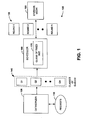
- a scheduling system 100 is illustrated in accordance with an aspect of the present invention.
- One or more Input/Output (I/O) data requests 110 destined to/from a storage media 120 are processed by a categorizer 130 that automatically processes the requests into one or more classes of queues 140.
- Such queues 140 can include periodic queues for periodic I/O data such as multimedia streams and one or more queues for other type data such as aperiodic data.
- Periodic I/O streams are those that are generated at regular intervals such as for multimedia type applications.
- Other I/O streams are considered aperiodic I/O streams.
- the arrival rate for aperiodic I/O can vary sharply over time.
- Aperiodic I/O can further be categorized into different I/O classes that also associated with the queues 140.
- the categorizer 130 transfers requests into the queues 140 that are processed by a scheduler 160, having a fixed or predetermined size queue 170.
- the scheduler 160 transfers data to/from the queue 170 in order to read and/or write data to the storage media 120 in the form of one or more rounds of data 180 that are directed to the media in accordance with determined slots of time that bound the overall latency and throughput of the system.
- rounds 180 of data requests having-predetermined size in terms of numbers of requests per round the present invention dynamically balances the overall latency to access the storage media 120 in view of a desired data throughput level to/from the media.
- the data requests 110 are processed as I/O reads/writes to the storage media 120 which can include disk drives (e.g. , hard disk, floppy disk) or other type media (e.g. , CD, any type of memory that is scheduled to be accsssed.from a computer).
- Scheduling is generally provided in a multi-tiered architecture that bounds the latency of I/O requests by servicing a predetermined number, subset, or set of requests per round of requests 150 while maintaining desired throughput to the storage media 120.
- a determined amount of I/O bandwidth can be dynamically reserved by the categorizer 130 and/or the scheduler 160 in order to allocate I/O scheduling for selected tasks.
- components illustrated in the system 100 can be isolated and communicate on local and/or remote computer systems, and/or can be combined in various forms to perform the functionality described herein (e.g. , pre-categorizer and scheduler combined to form a scheduling function).
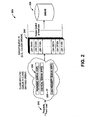
- a multi-tiered scheduling system 200 is illustrated in accordance with an aspect of the present invention.
- the system 200 can be described in terms of an algorithm, however, it is to be appreciated that the system may be implemented as a component, components, hardware, software, and/or combinations thereof.
- the system 200 processes a plurality of data requests 200 from a user or application. These requests 210 are processed into a periodic queue 220 (or queues) and one or more other queues 230.
- the requests from the queues 220 and 230 are then transferred into a sweep queue 240 having a fixed size before being written to or read from a disk 250.
- the present invention bounds the latency of a set of requests while maintaining acceptable throughput.
- the system 200 generally distinguishes between two separate types of I/O streams.
- Periodic I/O streams are those that come at regular intervals for multimedia type applications. Thus, periodic I/O streams are opened with specific performance parameters that may be checked against system resources. If an attempt is made to open a periodic I/O stream that exceeds the capabilities of the system, the request can be aborted, if desired. An admission control mechanism (not shown) enforces that respective parameters of the periodic I/O are not exceeded.
- Other I/O streams are considered aperiodic I/O streams. Unlike periodic I/O, the arrival rate for aperiodic I/O can vary sharply over time.
- Aperiodic I/O can further be categorized into different I/O priority classes. These different priorities represent different I/O needs of different components in the system such as a computer system. For example, when an operating system's memory manager runs out of paged memory, it is generally important that memory be freed as quickly as possible to ensure applications can continue to run. In this scenario, it is desirable that the memory manager's I/O requests not get blocked behind less important I/O requests from user applications. Conversely, background tasks often need to perform I/O to achieve their functions. If these background tasks generate large amounts of I/O, they can easily impact the performance of foreground tasks that generate less I/O.
- the system 200 supports the following seven priority classes (more or less than seven can be employed): critical, high, interactive, normal, background, low, and idle. It is generally desirable that I/O from a higher priority class be processed before I/O from a lower priority class.
- the system 200 generally applies four techniques (can be more or less) to achieve the goals outlined above.
- a two-level queuing mechanism can be provided that holds different types of requests in different request queues.
- the class specific requests queues 230 perform class-level scheduling for different request classes.
- eight class-specific queues can be provided, for example.
- Periodic requests are held in the periodic queue 220 and are generally maintained in EDF order, whereas aperiodic requests are generally maintained in FIFO order. These orderings mitigate periodic requests from backing up behind a large burst of aperiodic requests and also allows the scheduling of high priority requests before low priority requests.
- the sweep queue 240 is employed to queue requests that will be scheduled to the physical disk 250. Requests from the class-specific queues are moved to the sweep queue as it empties. The elements in the sweep queue are ordered in logical-block-address (LBA) ordering (other orderings possible), wherein the sweep queue performs a C-LOOK algorithm (or other similar type) when scheduling requests to the drive 250. Additionally, the system 200 fixes the size of the sweep queue 240, in order calculate a priori the length of time required to schedule the entire sweep queue. Moreover, the system 200 can reserve entries in the sweep queue 240 to facilitate availability of I/O bandwidth when necessary.
- LBA logical-block-address
- C-LOOK algorithm or other similar type
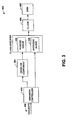
- Fig. 3 illustrates a system 400 that can be employed to perform an implementation of the components and process described above.
- One or more requests 404 for I/O disk access are received by an admission controller 410, wherein the request is generally received from a component or application executable on a computer system. If the request is a periodic request, a deadline component 420 associated with the admission controller 410 assigns a deadline or timeframe in which the request is to be completed. Other type requests such as non-periodic requests are passed from the admission controller 410 to an aperiodic queue 430 associated with class-specifier component. The periodic requests that were tagged with deadline specifications are processed within a periodic queue 440 within the class specifier-component.
- the class-specifier sorts requests based upon a desired policy associated with a selected class of requests.
- the periodic queue 440 can be arranged according to an EDF ordering, whereas the aperiodic queue 430 can be arranged according to a FIFO ordering.
- a sweep queue (not shown) is filled from the queues 430 and 440.
- the sweep queue is then scheduled to a disk 450 (or disks) in C-Look order via a C-Look component 460.
- Figs. 4 and 5 illustrate disk scheduling processes in accordance with an aspect of the present invention. While, for purposes of simplicity of explanation, the methodologies are shown and described as a series of acts, it is to be understood and appreciated that the present invention is not limited by the order of acts, as some acts may, in accordance with the present invention, occur in different orders or concurrently with other acts from that shown and described herein. For example, those skilled in the art will understand and appreciate that a methodology could alternatively be represented as a series of interrelated states or events, such as in a state diagram. Moreover, not all illustrated acts may be required to implement a methodology in accordance with the present invention.
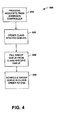
- Fig. 4 depicts a process 500 for one particular implementation of a disk scheduling process in accordance with the present invention.
- an admission controller receives/processes a request (or requests) from upper levels of a computer system. If the request is a periodic request, the admission controller provides a deadline for the I/O request; otherwise the request is passed from the admission-controller to a class-specific queue unmodified.
- requests from the admission controller are placed on the proper class-specific queue.
- the class-specific queue sorts requests based upon a desired or suitable policy for that class of requests, wherein periodic requests are sorted in an EDF ordering and aperiodic requests are sorted in a FIFO ordering.
- a sweep queue is filled from requests from the class-specific queues.
- the sweep queue is scheduled to the disk in a C-LOOK order, for example.
- the following is example Pseudo-code for an algorithm in accordance with the present invention that can be employed with the systems and method described herein.
- the maximum I/O service time is parameterized by the sweep-depth variable ( n ). Given sweep-depth and the parameters for a specific disk drive, one can compute the worst-case latency values for a given sweep-depth.
- C-LOOK by itself-generally treats all requests equally, without providing any latency guarantees.
- EDF algorithms can process requests with earliest deadlines first, but may incur large seek delays.
- EDF scan is generally a tradeoff between the two.
- the present invention and associated algorithms operate at a tradeoff of providing worst case latency guarantees, offering tighter admission controls, providing bounded latency guarantees and with locally optimal scheduling of disk and priority schemes for regular I/O.
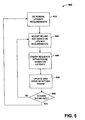
- Fig. 5 illustrates a process 600 for an alternative disk scheduling methodology in accordance with an aspect of the present invention.
- latency requirements for I/O requests are determined (e.g. , what are the worst case scheduling times for an application to work properly).
- round size is adjusted based on the latency requirement determined at 610.
- requests are ordered within a round based upon the determined latency requirements.
- a disk is updated according to a round having a fixed size based upon the determination at 610 and 620.
- a determination is made as to whether to alter or change the size of the round (eg., dynamic consideration based on changed system circumstances). If not, the process proceeds back to 620 to process a subsequent round of I/O requests. If the round size is to be adjusted at 660, the process proceeds back to 610, wherein latency requirements are determined and the round size is then readjusted at 620.
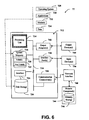
- an exemplary environment 710 for implementing various aspects of the invention includes a computer 712.
- the computer 712 includes a processing unit 714, a system memory 716, and a system bus 718.
- the system bus 718 couples system components including, but not limited to, the system memory 716 to the processing unit 714.
- the processing unit 714 can be any of various available processors. Dual microprocessors and other multiprocessor architectures also can be employed as the processing unit 714.
- the system bus 718 can be any of several types of bus structure(s) including the memory bus or memory controller, a peripheral bus or external bus, and/or a local bus using any variety of available bus architectures including, but not limited to, 16-bit bus, Industrial Standard Architecture (ISA), Micro-Channel Architecture (MSA), Extended ISA (EISA), Intelligent Drive Electronics (IDE), VESA Local Bus (VLB), Peripheral Component Interconnect (PCI), Universal Serial Bus (USB), Advanced Graphics Port (AGP), Personal Computer Memory Card International Association bus (PCMCIA), and Small Computer Systems Interface (SCSI).
- ISA Industrial Standard Architecture
- MSA Micro-Channel Architecture
- EISA Extended ISA
- IDE Intelligent Drive Electronics
- VLB VESA Local Bus
- PCI Peripheral Component Interconnect
- USB Universal Serial Bus
- AGP Advanced Graphics Port
- PCMCIA Personal Computer Memory Card International Association bus
- SCSI Small Computer Systems Interface
- the system memory 716 includes volatile memory 720 and nonvolatile memory 722.
- the basic input/output system (BIOS) containing the basic routines to transfer information between elements within the computer 712, such as during start-up, is stored in nonvolatile memory 722.
- nonvolatile memory 722 can include read only memory (ROM), programmable ROM (PROM), electrically programmable ROM (EPROM), electrically erasable ROM (EEPROM), or flash memory.
- Volatile memory 720 includes random access memory (RAM), which acts as external cache memory.
- RAM is available in many forms such as synchronous RAM (SRAM), dynamic RAM (DRAM), synchronous DRAM (SDRAM), double data rate SDRAM (DDR SDRAM),enhanced SDRAM (ESDRAM), Synchlink DRAM (SLDRAM), and direct Rambus RAM (DRRAM).
- SRAM synchronous RAM
- DRAM dynamic RAM
- SDRAM synchronous DRAM
- DDR SDRAM double data rate SDRAM
- ESDRAM encoded SDRAM
- SLDRAM Synchlink DRAM
- DRRAM direct Rambus RAM
- Disk storage 724 includes, but is not limited to, devices like a magnetic disk drive, floppy disk drive, tape drive, Jaz drive, Zip drive, LS-100 drive, flash memory card, or memory stick.
- disk storage 724 can include storage media separately or in combination with other storage media including, but not limited to, an optical disk drive such as a compact disk ROM device (CD-ROM), CD recordable drive (CD-R Drive), CD rewritable drive (CD-RW Drive) or a digital versatile disk ROM drive (DVD-ROM).
- CD-ROM compact disk ROM
- CD-R Drive CD recordable drive
- CD-RW Drive CD rewritable drive
- DVD-ROM digital versatile disk ROM drive
- Fig 6 describes software that acts as an intermediary between users and the basic computer resources described in-suitable operating environment 710.
- Such software includes an operating system 728.
- Operating system 728 which can be stored on disk storage 724, acts to control and allocate resources of the computer system 712.
- System applications 730 take advantage of the management of resources by operating system 728 through program modules 732 and program data 734 stored either in system memory 716 or on disk storage 724. It is to be appreciated that the present invention can be implemented with various operating systems or combinations of operating systems.
- Input devices 736 include, but are not limited to, a pointing device such as a mouse, trackball, stylus, touch pad, keyboard, microphone, joystick, game pad, satellite dish, scanner, TV tuner card, digital camera, digital video camera, web camera, and the like. These and other input devices connect to the processing unit 714 through the system bus 718 via interface port(s) 738.
- Interface port(s) 738 include, for example, a serial port, a parallel port, a game port, and a universal serial bus (USB).
- Output device(s) 740 use some of the same type of ports as input device(s) 736.
- a USB port may be used to provide input to computer 712, and to output information from computer 712 to an output device 740.
- Output adapter 742 is provided to illustrate that there are some output devices 740 like monitors, speakers, and printers, among other output devices 740, that require special adapters.
- the output adapters 742 include, by way of illustration and not limitation, video and sound cards that provide a means of connection between the output device 740 and the system bus 718. It should be noted that other devices and/or systems of devices provide both input and output capabilities such as remote computer(s) 744.
- Computer 712 can operate in a networked environment using logical connections to one or more remote computers, such as remote computer(s) 744.
- the remote computer(s) 744 can be a personal computer, a server, a router, a network PC, a workstation, a microprocessor based appliance, a peer device or other common network node and the like, and typically includes many or all of the elements described relative to computer 712. For purposes of brevity, only a memory storage device 746 is illustrated with remote computer(s) 744.
- Remote computer(s) 744 is logically connected to computer 712 through a network interface 748 and then physically connected via communication connection 750.
- Network interface 748 encompasses communication networks such as local-area networks (LAN) and wide-area networks (WAN).
- LAN technologies include Fiber Distributed Data Interface (FDDI), Copper Distributed Data Interface (CDDI), Ethernet/IEEE 1102.3, Token Ring/IEEE 1102.5 and the like.
- WAN technologies include, but are not limited to, point-to-point links, circuit switching networks like Integrated Services Digital Networks (ISDN) and variations thereon, packet switching networks, and Digital Subscriber Lines (DSL).
- ISDN Integrated Services Digital Networks
- DSL Digital Subscriber Lines
- Communication connections 750 refers to the hardware/software employed to connect the network interface 748 to the bus 718. While communication connection 750 is shown for illustrative clarity inside computer 712, it can also be external to computer 712.
- the hardware/software necessary for connection to the network interface 748 includes, for exemplary purposes only, internal and external technologies such as, modems including regular telephone grade modems, cable modems and DSL modems, ISDN adapters, and Ethernet cards.
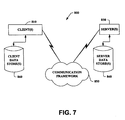
- Fig. 7 is a schematic block diagram of a sample-computing environment 800 with which the present invention can interact.
- the system 800 includes one or more client(s) 810.
- the client(s) 810 can be hardware and/or software (e.g. , threads, processes, computing devices).
- the system 800 also includes one or more server(s) 830.
- the server(s) 830 can also be hardware and/or software ( e.g ., threads, processes, computing devices).
- the servers 830 can house threads to perform transformations by-employing the present invention, for example.
- One possible communication between a client 810 and a server 830 may be in the form of a data packet adapted to be transmitted between two or more computer processes.
- the system 800 includes a communication framework 850 that can be employed to facilitate communications between the client(s) 810 and the server(s) 830.
- the client(s) 810 are operably connected to one or more client data store(s) 860 that can be employed to store information local to the client(s) 810.
- the server(s) 830 are operably connected to one or more server data store(s) 840 that can be employed to store information local to the servers 830.
Landscapes
- Engineering & Computer Science (AREA)
- Theoretical Computer Science (AREA)
- Physics & Mathematics (AREA)
- General Engineering & Computer Science (AREA)
- General Physics & Mathematics (AREA)
- Human Computer Interaction (AREA)
- Information Retrieval, Db Structures And Fs Structures Therefor (AREA)
Applications Claiming Priority (4)
| Application Number | Priority Date | Filing Date | Title |
|---|---|---|---|
| US729138 | 1991-07-12 | ||
| US49652903P | 2003-08-20 | 2003-08-20 | |
| US496529P | 2003-08-20 | ||
| US10/729,138 US7206866B2 (en) | 2003-08-20 | 2003-12-05 | Continuous media priority aware storage scheduler |
Publications (2)
| Publication Number | Publication Date |
|---|---|
| EP1508850A2 true EP1508850A2 (de) | 2005-02-23 |
| EP1508850A3 EP1508850A3 (de) | 2015-03-18 |
Family
ID=34068470
Family Applications (1)
| Application Number | Title | Priority Date | Filing Date |
|---|---|---|---|
| EP04019208.0A Withdrawn EP1508850A3 (de) | 2003-08-20 | 2004-08-12 | Speicher-Ablaufsteuerung eines stetigen Mediums mit Priorität |
Country Status (5)
| Country | Link |
|---|---|
| US (2) | US7206866B2 (de) |
| EP (1) | EP1508850A3 (de) |
| JP (1) | JP4597608B2 (de) |
| KR (1) | KR101086514B1 (de) |
| CN (1) | CN1617100A (de) |
Cited By (12)
| Publication number | Priority date | Publication date | Assignee | Title |
|---|---|---|---|---|
| WO2012096652A1 (en) | 2011-01-11 | 2012-07-19 | Hewlett-Packard Development Company, L.P. | Concurrent request scheduling |
| EP2301002A4 (de) * | 2008-05-30 | 2016-05-25 | Sony Comp Entertainment Us | Scheduler für dateieingabe/-ausgabe |
| US10705761B2 (en) | 2018-09-14 | 2020-07-07 | Yandex Europe Ag | Method of and system for scheduling transmission of I/O operations |
| US10908982B2 (en) | 2018-10-09 | 2021-02-02 | Yandex Europe Ag | Method and system for processing data |
| US10996986B2 (en) | 2018-12-13 | 2021-05-04 | Yandex Europe Ag | Method and system for scheduling i/o operations for execution |
| US11003600B2 (en) | 2018-12-21 | 2021-05-11 | Yandex Europe Ag | Method and system for scheduling I/O operations for processing |
| US11010090B2 (en) | 2018-12-29 | 2021-05-18 | Yandex Europe Ag | Method and distributed computer system for processing data |
| US11048547B2 (en) | 2018-10-09 | 2021-06-29 | Yandex Europe Ag | Method and system for routing and executing transactions |
| US11055160B2 (en) | 2018-09-14 | 2021-07-06 | Yandex Europe Ag | Method of determining potential anomaly of memory device |
| US11061720B2 (en) | 2018-09-14 | 2021-07-13 | Yandex Europe Ag | Processing system and method of detecting congestion in processing system |
| US11184745B2 (en) | 2019-02-06 | 2021-11-23 | Yandex Europe Ag | Actor system and method for transmitting a message from a first actor to a second actor |
| US11288254B2 (en) | 2018-10-15 | 2022-03-29 | Yandex Europe Ag | Method of and system for processing request in distributed database |
Families Citing this family (75)
| Publication number | Priority date | Publication date | Assignee | Title |
|---|---|---|---|---|
| US8656039B2 (en) * | 2003-12-10 | 2014-02-18 | Mcafee, Inc. | Rule parser |
| US7984175B2 (en) | 2003-12-10 | 2011-07-19 | Mcafee, Inc. | Method and apparatus for data capture and analysis system |
| US7774604B2 (en) * | 2003-12-10 | 2010-08-10 | Mcafee, Inc. | Verifying captured objects before presentation |
| US7899828B2 (en) * | 2003-12-10 | 2011-03-01 | Mcafee, Inc. | Tag data structure for maintaining relational data over captured objects |
| US8548170B2 (en) * | 2003-12-10 | 2013-10-01 | Mcafee, Inc. | Document de-registration |
| US8312145B2 (en) * | 2003-12-22 | 2012-11-13 | Rockstar Consortium US L.P. | Traffic engineering and bandwidth management of bundled links |
| US7930540B2 (en) * | 2004-01-22 | 2011-04-19 | Mcafee, Inc. | Cryptographic policy enforcement |
| US7962591B2 (en) * | 2004-06-23 | 2011-06-14 | Mcafee, Inc. | Object classification in a capture system |
| US7260703B1 (en) * | 2004-08-20 | 2007-08-21 | Sun Microsystems, Inc. | Method and apparatus for I/O scheduling |
| US7386692B1 (en) * | 2004-08-20 | 2008-06-10 | Sun Microsystems, Inc. | Method and apparatus for quantized deadline I/O scheduling |
| US8560534B2 (en) * | 2004-08-23 | 2013-10-15 | Mcafee, Inc. | Database for a capture system |
| US7949849B2 (en) * | 2004-08-24 | 2011-05-24 | Mcafee, Inc. | File system for a capture system |
| KR100585176B1 (ko) * | 2005-02-04 | 2006-05-30 | 삼성전자주식회사 | 입출력 서브시스템에서 입출력 명령의 부하 판단 방법 및장치 |
| US7305537B1 (en) | 2005-03-01 | 2007-12-04 | Sun Microsystems, Inc. | Method and system for I/O scheduler activations |
| US20060288184A1 (en) * | 2005-06-17 | 2006-12-21 | Seagate Technology Llc | Admission control in data storage devices |
| US20060294049A1 (en) * | 2005-06-27 | 2006-12-28 | Microsoft Corporation | Back-off mechanism for search |
| US7907608B2 (en) | 2005-08-12 | 2011-03-15 | Mcafee, Inc. | High speed packet capture |
| US7818326B2 (en) * | 2005-08-31 | 2010-10-19 | Mcafee, Inc. | System and method for word indexing in a capture system and querying thereof |
| US7730011B1 (en) | 2005-10-19 | 2010-06-01 | Mcafee, Inc. | Attributes of captured objects in a capture system |
| US7657671B2 (en) * | 2005-11-04 | 2010-02-02 | Sun Microsystems, Inc. | Adaptive resilvering I/O scheduling |
| US7478179B2 (en) * | 2005-11-04 | 2009-01-13 | Sun Microsystems, Inc. | Input/output priority inheritance wherein first I/O request is executed based on higher priority |
| US20070106849A1 (en) * | 2005-11-04 | 2007-05-10 | Sun Microsystems, Inc. | Method and system for adaptive intelligent prefetch |
| US7657104B2 (en) | 2005-11-21 | 2010-02-02 | Mcafee, Inc. | Identifying image type in a capture system |
| US8504537B2 (en) | 2006-03-24 | 2013-08-06 | Mcafee, Inc. | Signature distribution in a document registration system |
| US7689614B2 (en) | 2006-05-22 | 2010-03-30 | Mcafee, Inc. | Query generation for a capture system |
| US7958227B2 (en) | 2006-05-22 | 2011-06-07 | Mcafee, Inc. | Attributes of captured objects in a capture system |
| US7644206B2 (en) * | 2006-06-30 | 2010-01-05 | Seagate Technology Llc | Command queue ordering by positionally pushing access commands |
| US7779175B2 (en) * | 2007-05-04 | 2010-08-17 | Blackwave, Inc. | System and method for rendezvous in a communications network |
| KR100927190B1 (ko) * | 2007-10-12 | 2009-11-18 | 한국전자통신연구원 | 디스크 스케줄링 방법 및 장치 |
| US8521951B2 (en) * | 2008-01-16 | 2013-08-27 | S. Aqua Semiconductor Llc | Content addressable memory augmented memory |
| US20090182977A1 (en) * | 2008-01-16 | 2009-07-16 | S. Aqua Semiconductor Llc | Cascaded memory arrangement |
| US8090903B2 (en) * | 2008-01-18 | 2012-01-03 | Microsoft Corporation | Fair and dynamic disk input/output bandwidth distribution |
| US20100312815A1 (en) * | 2008-03-26 | 2010-12-09 | Masaki Uekubo | Date communication processing device and method |
| US8205242B2 (en) * | 2008-07-10 | 2012-06-19 | Mcafee, Inc. | System and method for data mining and security policy management |
| JP5147584B2 (ja) * | 2008-07-23 | 2013-02-20 | 株式会社日立製作所 | ストレージサブシステム及びコントローラによるコマンド実行方法 |
| JP2010033125A (ja) * | 2008-07-25 | 2010-02-12 | Hitachi Ltd | ストレージ装置及びデータ転送方法 |
| US9253154B2 (en) | 2008-08-12 | 2016-02-02 | Mcafee, Inc. | Configuration management for a capture/registration system |
| CN102165408B (zh) * | 2008-09-29 | 2014-08-06 | 国际商业机器公司 | 用于确定数据的再调用顺序的装置和方法 |
| KR100983048B1 (ko) * | 2008-11-27 | 2010-09-17 | 서울대학교산학협력단 | Ncq 제어 방법 및 컴퓨팅 장치 |
| US8850591B2 (en) | 2009-01-13 | 2014-09-30 | Mcafee, Inc. | System and method for concept building |
| US8706709B2 (en) | 2009-01-15 | 2014-04-22 | Mcafee, Inc. | System and method for intelligent term grouping |
| US8473442B1 (en) | 2009-02-25 | 2013-06-25 | Mcafee, Inc. | System and method for intelligent state management |
| US8667121B2 (en) | 2009-03-25 | 2014-03-04 | Mcafee, Inc. | System and method for managing data and policies |
| US8447722B1 (en) | 2009-03-25 | 2013-05-21 | Mcafee, Inc. | System and method for data mining and security policy management |
| US9842068B2 (en) | 2010-04-14 | 2017-12-12 | Qualcomm Incorporated | Methods of bus arbitration for low power memory access |
| US8539129B2 (en) * | 2010-04-14 | 2013-09-17 | Qualcomm Incorporated | Bus arbitration techniques to reduce access latency |
| US8330645B2 (en) | 2010-08-31 | 2012-12-11 | Raytheon Company | Radar activation multiple access system and method |
| US8806615B2 (en) | 2010-11-04 | 2014-08-12 | Mcafee, Inc. | System and method for protecting specified data combinations |
| US9043509B2 (en) * | 2011-01-14 | 2015-05-26 | Broadcom Corporation | Method and system for low-latency networking |
| KR101311305B1 (ko) * | 2011-08-26 | 2013-09-25 | 국방과학연구소 | 데드라인 기반 우선순위상속 시스템 및 그 방법 |
| CN102402401A (zh) * | 2011-12-13 | 2012-04-04 | 云海创想信息技术(无锡)有限公司 | 一种磁盘io请求队列调度的方法 |
| US8700561B2 (en) | 2011-12-27 | 2014-04-15 | Mcafee, Inc. | System and method for providing data protection workflows in a network environment |
| US8966173B1 (en) * | 2012-06-28 | 2015-02-24 | Emc Corporation | Managing accesses to storage objects |
| US11372672B2 (en) | 2013-02-15 | 2022-06-28 | Apple Inc. | Centralized task scheduling |
| US20150032961A1 (en) * | 2013-07-23 | 2015-01-29 | Lexmark International Technologies S.A. | System and Methods of Data Migration Between Storage Devices |
| CN104714753A (zh) * | 2013-12-12 | 2015-06-17 | 中兴通讯股份有限公司 | 一种数据访问存储方法及装置 |
| CN103761051B (zh) * | 2013-12-17 | 2016-05-18 | 北京同有飞骥科技股份有限公司 | 一种基于持续数据多输入输出流并发写入性能优化方法 |
| US9542107B2 (en) * | 2014-06-25 | 2017-01-10 | International Business Machines Corporation | Flash copy relationship management |
| CN105511806B (zh) | 2015-11-30 | 2018-09-07 | 华为技术有限公司 | 处理写请求的方法和移动终端 |
| US9792051B2 (en) * | 2016-02-24 | 2017-10-17 | Samsung Electronics Co., Ltd. | System and method of application aware efficient IO scheduler |
| WO2017171575A1 (en) * | 2016-03-30 | 2017-10-05 | Emc Corporation | Virtual machine storage management queue |
| US11579932B2 (en) * | 2016-08-29 | 2023-02-14 | Vmware, Inc. | Tiered backup archival in multi-tenant cloud computing system |
| US11886922B2 (en) | 2016-09-07 | 2024-01-30 | Pure Storage, Inc. | Scheduling input/output operations for a storage system |
| CN113411310B (zh) | 2017-01-09 | 2022-08-26 | 华为技术有限公司 | 一种媒体下行传输控制方法及相关设备 |
| US11066428B2 (en) | 2017-09-29 | 2021-07-20 | Dow Global Technologies Llc | Bis-phenyl-phenoxy polyolefin catalysts having a methylenetrialkylsilicon ligand on the metal for improved solubility |
| CN111133010B (zh) | 2017-09-29 | 2023-05-23 | 陶氏环球技术有限责任公司 | 用于改进溶解度的在金属上具有两个亚甲基三烷基硅配体的双-苯基-苯氧基聚烯烃催化剂 |
| KR102031853B1 (ko) * | 2018-07-18 | 2019-10-15 | 국방과학연구소 | 다중 중요도 시스템 위한 작업별 중요도 모드 전환 방법 |
| US20210309768A1 (en) | 2018-08-30 | 2021-10-07 | Dow Global Technologies Llc | Bis-phenyl-phenoxy polyolefin procatalysts having two anthracenyl ligands |
| US11307805B2 (en) | 2020-05-29 | 2022-04-19 | Seagate Technology Llc | Disk drive controller incorporating task manager for reducing performance spikes |
| US11647420B2 (en) * | 2021-02-18 | 2023-05-09 | Charter Communications Operating, Llc | Downlink and uplink data handling in a wireless device |
| KR20220145698A (ko) * | 2021-04-22 | 2022-10-31 | 에스케이하이닉스 주식회사 | PCIe 장치 및 그 동작 방법 |
| CN115480700A (zh) | 2022-09-08 | 2022-12-16 | 三星(中国)半导体有限公司 | 数据存储方法、存储设备以及主机 |
| CN117707988B (zh) * | 2023-08-08 | 2024-12-03 | 荣耀终端有限公司 | 回收内存的方法和装置 |
| US12373108B1 (en) | 2024-03-29 | 2025-07-29 | Amazon Technologies, Inc. | Optimized host-side storage queues |
| CN119484293B (zh) * | 2024-10-25 | 2025-09-09 | 西安交通大学 | 面向mpi聚合i/o的层次化聚合方法 |
Family Cites Families (20)
| Publication number | Priority date | Publication date | Assignee | Title |
|---|---|---|---|---|
| US5455934A (en) * | 1993-03-23 | 1995-10-03 | Eclipse Technologies, Inc. | Fault tolerant hard disk array controller |
| US5708796A (en) * | 1994-11-18 | 1998-01-13 | Lucent Technologies Inc. | Method of retrieving continuous and non-continuous media data from a file system |
| US5621898A (en) * | 1994-11-29 | 1997-04-15 | Compaq Computer Corporation | Arbiter organization for serial bus transfers |
| US5787482A (en) * | 1995-07-31 | 1998-07-28 | Hewlett-Packard Company | Deadline driven disk scheduler method and apparatus with thresholded most urgent request queue scan window |
| US5875481A (en) | 1997-01-30 | 1999-02-23 | International Business Machines Corporation | Dynamic reconfiguration of data storage devices to balance recycle throughput |
| US6078998A (en) * | 1997-02-11 | 2000-06-20 | Matsushita Electric Industrial Co., Ltd. | Real time scheduling of prioritized disk requests |
| US6079028A (en) * | 1997-04-23 | 2000-06-20 | Lucent Technologies Inc. | Fault tolerant architectures for continuous media servers |
| US6286045B1 (en) * | 1997-05-19 | 2001-09-04 | Matchlogic, Inc. | Information storage and delivery over a computer network using centralized intelligence to monitor and control the information being delivered |
| US5983227A (en) * | 1997-06-12 | 1999-11-09 | Yahoo, Inc. | Dynamic page generator |
| US5991825A (en) | 1997-07-11 | 1999-11-23 | International Business Machines Corporation | System for handling missed revolution in a disk drive by aborting the execution of primary command and executing secondary command if a missed revolution occurs |
| US6023720A (en) * | 1998-02-09 | 2000-02-08 | Matsushita Electric Industrial Co., Ltd. | Simultaneous processing of read and write requests using optimized storage partitions for read and write request deadlines |
| US6442648B1 (en) * | 1998-09-03 | 2002-08-27 | International Business Machines Corporation | Method of and system for the dynamic scheduling of requests to access a storage system |
| US6330646B1 (en) * | 1999-01-08 | 2001-12-11 | Intel Corporation | Arbitration mechanism for a computer system having a unified memory architecture |
| WO2000057308A1 (en) * | 1999-03-23 | 2000-09-28 | Frankel & Company | Control of server-originated dynamic digital signage at client site using automated data acquisition |
| US6378052B1 (en) * | 1999-08-11 | 2002-04-23 | International Business Machines Corporation | Data processing system and method for efficiently servicing pending requests to access a storage system |
| US6629220B1 (en) * | 1999-08-20 | 2003-09-30 | Intel Corporation | Method and apparatus for dynamic arbitration between a first queue and a second queue based on a high priority transaction type |
| US6535957B1 (en) | 1999-11-09 | 2003-03-18 | International Business Machines Corporation | System bus read data transfers with bus utilization based data ordering |
| US6654851B1 (en) | 2000-03-14 | 2003-11-25 | International Business Machine Corporation | System, apparatus, and method for using a disk drive for sequential data access |
| US6877049B1 (en) * | 2002-05-30 | 2005-04-05 | Finisar Corporation | Integrated FIFO memory management control system using a credit value |
| US7197577B2 (en) * | 2003-12-12 | 2007-03-27 | International Business Machines Corporation | Autonomic input/output scheduler selector |
-
2003
- 2003-12-05 US US10/729,138 patent/US7206866B2/en not_active Expired - Fee Related
-
2004
- 2004-08-12 EP EP04019208.0A patent/EP1508850A3/de not_active Withdrawn
- 2004-08-13 JP JP2004236041A patent/JP4597608B2/ja not_active Expired - Fee Related
- 2004-08-13 CN CNA2004100856507A patent/CN1617100A/zh active Pending
- 2004-08-13 KR KR1020040063845A patent/KR101086514B1/ko not_active Expired - Fee Related
-
2007
- 2007-01-05 US US11/620,266 patent/US7734837B2/en not_active Expired - Lifetime
Non-Patent Citations (1)
| Title |
|---|
| None * |
Cited By (14)
| Publication number | Priority date | Publication date | Assignee | Title |
|---|---|---|---|---|
| EP2301002A4 (de) * | 2008-05-30 | 2016-05-25 | Sony Comp Entertainment Us | Scheduler für dateieingabe/-ausgabe |
| WO2012096652A1 (en) | 2011-01-11 | 2012-07-19 | Hewlett-Packard Development Company, L.P. | Concurrent request scheduling |
| EP2663920A4 (de) * | 2011-01-11 | 2017-06-21 | Hewlett-Packard Development Company, L.P. | Koordination von gleichzeitigen anfragen |
| US11055160B2 (en) | 2018-09-14 | 2021-07-06 | Yandex Europe Ag | Method of determining potential anomaly of memory device |
| US10705761B2 (en) | 2018-09-14 | 2020-07-07 | Yandex Europe Ag | Method of and system for scheduling transmission of I/O operations |
| US11061720B2 (en) | 2018-09-14 | 2021-07-13 | Yandex Europe Ag | Processing system and method of detecting congestion in processing system |
| US11449376B2 (en) | 2018-09-14 | 2022-09-20 | Yandex Europe Ag | Method of determining potential anomaly of memory device |
| US10908982B2 (en) | 2018-10-09 | 2021-02-02 | Yandex Europe Ag | Method and system for processing data |
| US11048547B2 (en) | 2018-10-09 | 2021-06-29 | Yandex Europe Ag | Method and system for routing and executing transactions |
| US11288254B2 (en) | 2018-10-15 | 2022-03-29 | Yandex Europe Ag | Method of and system for processing request in distributed database |
| US10996986B2 (en) | 2018-12-13 | 2021-05-04 | Yandex Europe Ag | Method and system for scheduling i/o operations for execution |
| US11003600B2 (en) | 2018-12-21 | 2021-05-11 | Yandex Europe Ag | Method and system for scheduling I/O operations for processing |
| US11010090B2 (en) | 2018-12-29 | 2021-05-18 | Yandex Europe Ag | Method and distributed computer system for processing data |
| US11184745B2 (en) | 2019-02-06 | 2021-11-23 | Yandex Europe Ag | Actor system and method for transmitting a message from a first actor to a second actor |
Also Published As
| Publication number | Publication date |
|---|---|
| JP2005071353A (ja) | 2005-03-17 |
| CN1617100A (zh) | 2005-05-18 |
| US20070136496A1 (en) | 2007-06-14 |
| US20050044289A1 (en) | 2005-02-24 |
| EP1508850A3 (de) | 2015-03-18 |
| US7206866B2 (en) | 2007-04-17 |
| KR20050020942A (ko) | 2005-03-04 |
| JP4597608B2 (ja) | 2010-12-15 |
| KR101086514B1 (ko) | 2011-11-23 |
| US7734837B2 (en) | 2010-06-08 |
Similar Documents
| Publication | Publication Date | Title |
|---|---|---|
| US7206866B2 (en) | Continuous media priority aware storage scheduler | |
| US8312229B2 (en) | Method and apparatus for scheduling real-time and non-real-time access to a shared resource | |
| US9575664B2 (en) | Workload-aware I/O scheduler in software-defined hybrid storage system | |
| US9208116B2 (en) | Maintaining I/O priority and I/O sorting | |
| JP5752267B2 (ja) | 同時要求スケジューリング | |
| US8392633B2 (en) | Scheduling requesters of a shared storage resource | |
| JP4723260B2 (ja) | ソースデバイスに対するリクエストをスケジューリングする装置及び方法 | |
| US7293136B1 (en) | Management of two-queue request structure for quality of service in disk storage systems | |
| US20070156955A1 (en) | Method and apparatus for queuing disk drive access requests | |
| US20040230979A1 (en) | Command scheduling in computer networks | |
| US7089381B2 (en) | Multiple storage element command queues | |
| CN1018488B (zh) | 调节优先级仲裁的装置 | |
| US8019915B2 (en) | Method and device for controlling access to multiple applications | |
| US12236138B2 (en) | Creating isolation between multiple domains in a hierarchical multi-tenant storage device | |
| US6393505B1 (en) | Methods and apparatus for data bus arbitration | |
| US7478179B2 (en) | Input/output priority inheritance wherein first I/O request is executed based on higher priority | |
| US12153813B2 (en) | Maintaining predictable latency among tenants | |
| CN106155810A (zh) | 软件定义混合储存系统中工作负载感知的输入输出调度器 | |
| TWI509411B (zh) | 軟體定義混合儲存系統中之工作負載感知的輸入/輸出調度器 | |
| HK1231197A1 (en) | Workload-aware i/o scheduler in software-defined hybrid storage system | |
| HK1231197A (en) | Workload-aware i/o scheduler in software-defined hybrid storage system | |
| HK1231197B (zh) | 软件定义混合储存系统中工作负载感知的输入输出调度器 | |
| JP4878979B2 (ja) | マルチプレクサおよび情報処理装置 | |
| JP4979332B2 (ja) | マルチプレクサおよび情報処理装置 | |
| JP2007528032A (ja) | Osからのリクエストのリアルタイム・ファイルシステム制御キュー |
Legal Events
| Date | Code | Title | Description |
|---|---|---|---|
| PUAI | Public reference made under article 153(3) epc to a published international application that has entered the european phase |
Free format text: ORIGINAL CODE: 0009012 |
|
| AK | Designated contracting states |
Kind code of ref document: A2 Designated state(s): AT BE BG CH CY CZ DE DK EE ES FI FR GB GR HU IE IT LI LU MC NL PL PT RO SE SI SK TR |
|
| AX | Request for extension of the european patent |
Extension state: AL HR LT LV MK |
|
| PUAL | Search report despatched |
Free format text: ORIGINAL CODE: 0009013 |
|
| AK | Designated contracting states |
Kind code of ref document: A3 Designated state(s): AT BE BG CH CY CZ DE DK EE ES FI FR GB GR HU IE IT LI LU MC NL PL PT RO SE SI SK TR |
|
| AX | Request for extension of the european patent |
Extension state: AL HR LT LV MK |
|
| RAP1 | Party data changed (applicant data changed or rights of an application transferred) |
Owner name: MICROSOFT TECHNOLOGY LICENSING, LLC |
|
| RIC1 | Information provided on ipc code assigned before grant |
Ipc: G06F 3/06 20060101AFI20150209BHEP |
|
| 17P | Request for examination filed |
Effective date: 20150813 |
|
| AKX | Designation fees paid |
Designated state(s): AT BE BG CH CY CZ DE DK EE ES FI FR GB GR HU IE IT LI LU MC NL PL PT RO SE SI SK TR |
|
| AXX | Extension fees paid |
Extension state: MK Extension state: LV Extension state: AL Extension state: HR Extension state: LT |
|
| 17Q | First examination report despatched |
Effective date: 20180921 |
|
| STAA | Information on the status of an ep patent application or granted ep patent |
Free format text: STATUS: THE APPLICATION HAS BEEN WITHDRAWN |
|
| 18W | Application withdrawn |
Effective date: 20181107 |
|
| RIC1 | Information provided on ipc code assigned before grant |
Ipc: G06F 3/06 20060101AFI20150209BHEP |