EP1508864A2 - Verfahren und Gerät um Daten in einem strukturierten Dokument zu suchen - Google Patents
Verfahren und Gerät um Daten in einem strukturierten Dokument zu suchen Download PDFInfo
- Publication number
- EP1508864A2 EP1508864A2 EP04253257A EP04253257A EP1508864A2 EP 1508864 A2 EP1508864 A2 EP 1508864A2 EP 04253257 A EP04253257 A EP 04253257A EP 04253257 A EP04253257 A EP 04253257A EP 1508864 A2 EP1508864 A2 EP 1508864A2
- Authority
- EP
- European Patent Office
- Prior art keywords
- search
- tag
- keyword
- data
- document
- Prior art date
- Legal status (The legal status is an assumption and is not a legal conclusion. Google has not performed a legal analysis and makes no representation as to the accuracy of the status listed.)
- Ceased
Links
Images








Classifications
-
- G—PHYSICS
- G06—COMPUTING OR CALCULATING; COUNTING
- G06F—ELECTRIC DIGITAL DATA PROCESSING
- G06F16/00—Information retrieval; Database structures therefor; File system structures therefor
- G06F16/80—Information retrieval; Database structures therefor; File system structures therefor of semi-structured data, e.g. markup language structured data such as SGML, XML or HTML
- G06F16/81—Indexing, e.g. XML tags; Data structures therefor; Storage structures
-
- G—PHYSICS
- G06—COMPUTING OR CALCULATING; COUNTING
- G06F—ELECTRIC DIGITAL DATA PROCESSING
- G06F16/00—Information retrieval; Database structures therefor; File system structures therefor
- G06F16/80—Information retrieval; Database structures therefor; File system structures therefor of semi-structured data, e.g. markup language structured data such as SGML, XML or HTML
- G06F16/83—Querying
- G06F16/835—Query processing
-
- Y—GENERAL TAGGING OF NEW TECHNOLOGICAL DEVELOPMENTS; GENERAL TAGGING OF CROSS-SECTIONAL TECHNOLOGIES SPANNING OVER SEVERAL SECTIONS OF THE IPC; TECHNICAL SUBJECTS COVERED BY FORMER USPC CROSS-REFERENCE ART COLLECTIONS [XRACs] AND DIGESTS
- Y10—TECHNICAL SUBJECTS COVERED BY FORMER USPC
- Y10S—TECHNICAL SUBJECTS COVERED BY FORMER USPC CROSS-REFERENCE ART COLLECTIONS [XRACs] AND DIGESTS
- Y10S707/00—Data processing: database and file management or data structures
- Y10S707/99931—Database or file accessing
- Y10S707/99932—Access augmentation or optimizing
-
- Y—GENERAL TAGGING OF NEW TECHNOLOGICAL DEVELOPMENTS; GENERAL TAGGING OF CROSS-SECTIONAL TECHNOLOGIES SPANNING OVER SEVERAL SECTIONS OF THE IPC; TECHNICAL SUBJECTS COVERED BY FORMER USPC CROSS-REFERENCE ART COLLECTIONS [XRACs] AND DIGESTS
- Y10—TECHNICAL SUBJECTS COVERED BY FORMER USPC
- Y10S—TECHNICAL SUBJECTS COVERED BY FORMER USPC CROSS-REFERENCE ART COLLECTIONS [XRACs] AND DIGESTS
- Y10S707/00—Data processing: database and file management or data structures
- Y10S707/99931—Database or file accessing
- Y10S707/99933—Query processing, i.e. searching
Definitions
- the present invention relates to an apparatus and a method for searching data of a structured document such as an XML (extensible markup language) document, etc.
- a structured document such as an XML (extensible markup language) document, etc.
- An XML document is a document which is structured by describing each element of document data using a tag, and has a hierarchical structure.
- an XML document is represented by a tree structure, each element of the tree is called a node.
- There are two conventional methods of searching data of an XML document as follows.
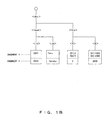
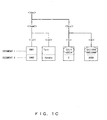
- the search expression represents the condition that the keyword 'X' is contained in the node specified by the path /doc/Grp/A, and the keyword '1000' is contained in the node specified by the path /doc/Grp/B. In this case, by tracing the node of the document data as shown in FIG. 1C, it is indicated that the document 1 satisfies the search request condition.
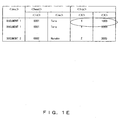
- the document data having the table structure as shown in FIG. 1D is generated.
- the data of the document 1 is stored in two rows in the table shown in FIG. 1D.
- a table is searched by the search expression (1), and the document 1 satisfies the search request condition.
- the XML definition information such as a DTD (document type definition), a schema, etc.
- the information relating to the relationship between the XML definition information and the XML document, and the information relating to each tag and node in the XML document are stored in addition to each XML document to expand in advance all documents to be searched.
- a hierarchical automaton is generated using a search condition as input, and search can be performed using a generated hierarchical automaton (for example, refer to the Patent Literature 1).
- Patent Literature 1 Japanese Patent Application Laid-open No. 2000-90091
- a document to be searched Before performing the searching process, a document to be searched is temporarily to be analyzed. Therefore, when a document to be searched is stored, a very long processing time is required to perform processes such as an analyzing process, an expanding process, etc.
- a group of XML documents to be searched are to be unified in a standardized format specified according to designated XML definition information based on the logic of a storage system. Furthermore, when a search is performed, a search expression according to a standardized format is to be used. Therefore, when a search is performed on a plurality of different-formatted XML documents, it is necessary to merge the obtained search results after searching XML documents in various formats.
- the present invention aims at providing a search apparatus and a method for reducing the processing time, the storage area, and the memory consumption required in storing and searching documents to be searched.
- the search apparatus includes a generation device, a read device, and a search device, and searches data of documents structured using tags based on a search condition.
- the generation device analyzes a search condition and generates tag registration information including a registered character string of a tag indicating each element contained in a search path specified by the search condition, keyword registration information including a registered character string of a keyword specified by the search condition, and state management information for management of the current search state using the search path.
- the read device sequentially reads document data of a structured document to be searched by a predetermined amount.
- the search device searches the document data of the structured document and outputs a search result while switching between a tag search of detecting a tag registered in the tag registration information from among the read data string and a keyword search of detecting a keyword registered in the keyword registration information from among the read data string using the state management information.
- FIG. 2 shows the principle of the search apparatus according to the present invention.
- the search apparatus shown in FIG. 2 comprises a generation device 101, a read device 102, and a search device 103, and searches data of a document structured using a tag based on a search condition.
- the generation device 101 analyzes a search condition, and generates tag registration information 104 including a registered character string of a tag indicating each element contained in a search path specified by the search condition, keyword registration information 105 including a registered character string of a keyword specified by the search condition; and state management information 106 for management of the current search state using the search path.
- the read device 102 sequentially reads document data of a structured document to be searched, in predetermined amounts.
- the search device 103 searches document data of a structured document and outputs a search result while switching between a tag search of detecting a tag registered in the tag registration information 104 from among the read data string and a keyword search of detecting a keyword registered in the keyword registration information 105 from among the read data string using the state management information 106.
- search is performed while sequentially reading a predetermined amount of document data. Therefore, it is not necessary to expand document data of all documents to be searched in advance. Furthermore, since search is performed while appropriately switching between the tag search of searching for the tag of the element specified by the search condition and the keyword search of searching for the keyword in the element, the contents of the element satisfying the search condition can be collated with the keyword even if the structure of a document to be searched is not known. Therefore, the document to be searched can be in a format not specified by specific XML definition information, etc.
- the generation device 101, the read device 102, the search device 103, the tag registration information 104, the keyword registration information 105, and the state management information 106 respectively correspond to, for example, a search expression analysis unit 213, a data read unit 215, an XML search unit 214, a tag automaton 222, a keyword automaton 224, and state management information 223, shown in FIG. 3.
- the document to be searched is not limited to a document in a standardized format, and can be stored as an XML document of a different layout schema. Therefore, the storage area of a document to be searched can be reduced, and the analyzing process is not required for the document to be searched, thereby increasing the storing speed.
- the consumption of memory resources is not based on the amount of data of the document to be searched, but depends on the amount of data of the search condition, a limited amount of memory resources can be sufficient for the search.
- the search can be performed regardless of each format, and the searching speed can be increased.
- FIG. 3 shows the configuration of the search apparatus according to an embodiment of the present invention.
- a search apparatus 201 shown in FIG. 3 comprises an operation analysis unit 211, a data search unit 212, a search expression analysis unit 213, an XML search unit 214, a data read unit 215, a search result storage unit 216, a data synchronization unit 217, a data write unit 218, and a data storage unit 219.
- the operation analysis unit 211 receives a process request from an application program 202 of data manipulation, analyzes it to check which the process request demands, the search, addition, update, deletion, or batch deletion of data. If the process request refers to a search request, the search request is transferred to the data search unit 212. If it refers to an addition request, an update request, a deletion request or a batch deletion request, then the process request is transferred to the data write unit 218.
- the data search unit 212 transfers the search expression contained in the received search request condition (hereinafter referred to as a search condition) to the search expression analysis unit 213.
- the search expression analysis unit 213 analyzes the received search expression, and extracts information such as a path specifying an element to be searched for, a tag of each element contained in the path, a keyword to be searched for, etc. Then, according to the extracted information, it generates a tag automaton 222, state management information 223, and a keyword automaton 224, and transfers them to the XML search unit 214.
- the state management information 223 is the information for management of the search state using the specified path.
- An automaton is represented by a set of a plurality of states including an initial state and a acceptance state, and two states are connected by an arrow indicating the direction of the transition.
- the automaton In the initial state, the automaton first determines the state of a transition destination based on the value of the input data, and makes a transition to the state. Then, it determines the state of the transition destination based on the value of the next input data, and makes a transition to the state.
- the acceptance state the information about the data string input from the initial state to the acceptance state is set. That is, the data string is registered in the automaton.
- the automaton collates the input data string with the registered data string by repeating the state transition based on the sequentially input data string.
- the acceptance state it determines that the input data string matches the registered data string corresponding to the state, and outputs the information about the registered data string.
- the XML search unit 214 has a logical expression table 221, and searches XML documents to be searched stored in the data storage unit 219 using the tag automaton 222, the state management information 223, and the keyword automaton 224 received from the search expression analysis unit 213.
- the data read unit 215 reads a predetermined amount of document data of all the documents from the data storage unit 219, and transfers it to the XML search unit 214.
- the value of the logical expression table 221 is set as "false".
- the XML search unit 214 inputs the data received from the data read unit 215 to the tag automaton 222, and accesses the state management information 223 according to the hit information output from the tag automaton 222 when the data hits. If the hierarchical level specified by the hit information matches the hierarchical level of the search condition registered in the state management information 223, then the subsequent data is input to the keyword automaton 224. When a keyword registered in the keyword automaton 224 is detected, the information about the corresponding document is stored in the search result storage unit 216.
- the tag automaton 222 is formed by the start tag and the end tag of an element.
- hit information is output.
- the XML search unit 214 traces the elements of the state management information 223, and starts inputting document data to the keyword automaton 224 when an element matching the search condition is reached.
- the keyword automaton 224 is formed by a keyword of a search condition, a start tag, and an end tag, and outputs hit information when the keyword of the search condition is detected from the input document data.
- the XML search unit 214 Upon receipt of the information, the XML search unit 214 changes the corresponding value in the logical expression table 221 to "true".
- the keyword automaton 224 When an end tag is detected from the input document data, the keyword automaton 224 outputs the hit information again.
- the XML search unit 214 determines that the searching process has reached a stage of passing through the elements of the search condition, evaluates the logical expression about the element, and initializes the corresponding value in the logical expression table 221. Then, the next element in the state management information 223 is accessed. When an element of a root node is passed through, the final logical expression evaluation is performed and it is determined whether or not the corresponding document is true.
- the search expression indicates the condition that the keyword 'ABC' is contained in the element specified by the path /root/comp/name.
- the symbol "/" is described as the header, and tags of different hierarchical levels are delimited by "/".
- a tag of an element contained in a path can be omitted in the method of describing a search expression.
- This representation includes the paths such as “/root/comp/name”, “/root/a/b/c/comp/name”, etc.
- This representation includes all paths up to "name” tag.
- This representation includes all paths up to a hierarchical level equal to or lower than "/root/comp”.
- This representation includes all paths up to a tag corresponding to the portion with "*”. Therefore, "root/comp/name” and “/root/comp/code” can be included in this representation.
- the expression (3) indicates the path designating the element to be searched for
- the expression (4) indicates the keyword to be searched for
- the search expression analysis unit 213 generates the tag automaton 222, the state management information 223, and the keyword automaton 224 from these logical expressions.
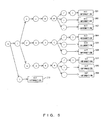
- FIG. 5 shows an example of a generated tag automaton 222.
- each state is expressed by a circle, and the character in the circle indicates the character data input when the state transition is made from the previous state to the state marked with the character.
- the state described as "in” indicates the initial state, and the state described with hit information indicates the acceptance state.
- the following character strings start tag, etc. are registered in the automaton. When an input character string matches a registered character string, corresponding hit information is output.
- each state and each piece of hit information is represented by one object.
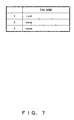
- FIG. 7 shows an example of a tag table generated before the state management information 223.
- the name and the number of each tag contained in the expression (3) are registered.
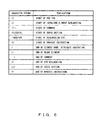
- the state management information as shown in FIG. 8 is generated.
- the state management information shown in FIG. 8 comprises four elements of "Initial”, “root”, “comp”, and "name”, and indicates the path specifying the element to be searched for.
- the element "Initial” indicates the initial state, and the other three elements respectively correspond to the three elements contained in the paths.
- the name and the number of a tag registered in the tag table shown in FIG. 7 are registered in each element, and the XML search unit 214 can access the next element according to the information.
- the "OUTPUT” is added to the element "name” belonging to the hierarchical level of the search condition.
- the "OUTPUT” includes that the information in the expression (5) is contained, and the expression (5) is evaluated when the element "name” is accessed.
- each element and each OUTPUT is represented by one object.
- FIG. 9 shows an example of the keyword automaton 224.
- the method of describing each state and state transition shown in FIG. 9 is basically the same as shown in FIG. 5.
- the state "in” indicates the initial state, and the state provided with hit information indicates the acceptance state.
- the following character strings (keyword, etc.) are registered in the automaton, and when a character string matching a registered character string is input, corresponding hit information is output.
- the XML search unit 214 receives the three logical expressions, the tag automaton 222, the state management information 223, and the keyword automaton 224 from the search expression analysis unit 213. As shown in FIG. 10, it registers the received logical expressions in the logical expression table. In the initial state, "false" is stored as a value of each logical expression of the logical expression table.
- the XML search unit 214 performs the searching process according to the flowchart shown in FIG. 11. In the example shown in FIG. 11, it is assumed that each XML document is stored as one record.
- the XML search unit 214 first checks whether or not the process of all records has been completed (step S1101), and a tag searching process is performed if there is any unprocessed record (step 1102).
- the document data is input character by character to the tag automaton 222, and when hit information is output from the tag automaton 222, it is checked whether or not the tag of the hit information corresponds to the end of a record (step 1103).
- the state management information 223 is referred to according to the information about the tag (step 1106), and it is checked whether or not the referenced element belongs to the hierarchical level of the search condition (step 1107). If the referenced element belongs to the hierarchical level of the search condition, then a keyword searching process is performed (step 1108).
- the subsequent document data is input character by character to the keyword automaton 224, and when hit information is output from the keyword automaton 224, it is checked whether or not a character string of hit information corresponds to the end of the tag (step 1109).
- step 1108 If the character string does not correspond to the end of the tag, then the keyword searching process in step 1108 is repeated. If the character string corresponds to the end of the tag, then the search expression relating to the tag is evaluated (step 1105). Then, according to the tag information, the processes in and after step 1106 are repeated.
- step 1107 If the referenced element does not belong to the hierarchical level of the search condition in step 1107, then the processes in and after step 1102 are repeated. Then, if the tag of the hit information corresponds to the end of the record in step 1103, then the final logical expression evaluation is performed, and it is determined whether or not the record satisfies the search condition (step 1104), and the processes in and after step 1101 are repeated. Then, if the process of all records has been completed in step 1101, the searching process terminates.
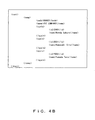
- step 1102 when a record in a document shown in FIG. 4A is searched, the ⁇ root> tag is first detected in step 1102, and hit information 505 is output from the tag automaton shown in FIG. 5.
- step 1106 the "Initial" element in the state management information shown in FIG. 8 is referred to, the tag name "root” points to the next "root” element, and the "root” element is accessed.
- step 1107 it is checked whether or not OUTPUT is added to the "root” element.
- the "name” element of the state management information is accessed. Since OUTPUT is added to the "name” element, the element is determined to belong to the hierarchical level of the search condition. Then, the value of /root/comp/name of the logical expression table shown in FIG. 10 is converted into "true”, and the keyword searching process in step 1108 is performed.
- the hit information 901 is output from the keyword automaton shown in FIG. 9. Then, the value of 'ABC' of the logical expression table is converted into "true". However, in step 1109, the character string does not correspond to the end of the tag. Therefore, the keyword searching process continues.
- the values of /root/comp/name and 'ABC' of the logical expression table are "true", it is determined that the logical expression is satisfied, and the corresponding value of the logical expression table is converted into "true”.
- the document shown in FIG. 4A is a candidate for a document satisfying the search condition.
- the values of /root/comp/name and 'ABC' are converted into the initial value of "false”.
- step 1106 the state management information is inversely traced in step 1106. In this operation, the element "comp” immediately before the element "name” of the state management information is accessed. However, since the element does not belong to the hierarchical level of the search condition, the tag searching process continues.
- step 1104 it is checked by referring to the logical expression table whether or not the search condition has been satisfied.
- the identification information about the document shown in FIG. 4A is stored in the search result storage unit 216 as the information about the document satisfying the search condition.
- the record of the document shown in FIG. 4B is similarly searched, but the element "name" of the record does not contain the keyword 'ABC'. Therefore, the search condition is not satisfied and the identification information about the document shown in FIG. 4B is not stored in the search result storage unit 216.
- the identification information about the document stored in the search result storage unit 216 is returned to the application program 202 as a search result.
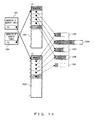
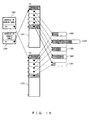
- the data synchronization unit 217 holds two data management tables 1201 and 1202 as shown in FIG. 12, and passes an available data management table to the data read unit 215 and the data write unit 218.
- the data management tables 1201 and 1202 hold the addresses of document data 1203, 1204, 1205, and 1206 stored in the data storage unit 219, and are used as index tables for access to the document data.
- each of the document data 1203, 1204, 1205, and 1206 is assumed to correspond to one XML document.
- the data synchronization unit 217 determines a data management table for use by the data read unit 215 and the data write unit 218 by setting the address of any data management table as an address 1207 of the search table and an address 1208 of the update table.
- the address P1 of the data management table 1201 is set as the address 1207
- the address P2 of the data management table 1202 is set as the address 1208.
- the data management table 1201 specified by the address 1207 is passed as a search table to the data read unit 215, and the data management table 1202 specified by the address 1208 is passed as an update table to the data write unit 218.
- the data read unit 215 reads document data from the data storage unit 219 using the received search table in the above-mentioned searching process.
- the data write unit 218 Upon receipt of an addition request, an update request, a deletion request, or a batch deletion request from the operation analysis unit 211, the data write unit 218 performs an adding process, an updating process, a deleting process, or a batch deletion processing on the document data of the data storage unit 219 using the received update table. After writing the information about the process to the update table, the notification of the end of the process is issued to the data synchronization unit 217.
- the data synchronization unit 217 switches between the stored addresses 1207 and 1208, and the data management table 1202 which has been used as the update table is passed to the data read unit 215 as a new search table. Then, the contents of the data management table 1202 are copied to the other data management table 1201.
- the data read unit 215 can read document data even during the adding process, the updating process, the deleting process, and the batch deletion processing by the data write unit 218.
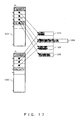
- FIGS. 13 through 15 show the procedure of the adding process of the new document data.
- the data write unit 218 stores document data 1301 to be added in the data storage unit 219, and its storage address is added to the data management table 1202.
- the data synchronization unit 217 switches the values between the address 1207 and the address 1208.
- the data management table 1201 functions as an update table
- the data management table 1202 functions as a search table.
- the contents of the data management table 1202 are copied to the data management table 1201, and the contents of the new update table are updated to the latest data.
- FIG. 16 shows the updating process of the existing document data 1205.
- the data write unit 218 stores the updated document data 1601 in the data storage unit 219, and changes the address of the document data 1205 registered in the data management table 1202 into the storage address of the document data 1601.
- the data synchronization unit 217 switches the values between the address 1207 and the address 1208, and the contents of the data management table 1202 are copied to the data management table 1201.
- FIG. 17 shows the deleting process of the existing document data 1206.
- the data write unit 218 deletes the address of the document data 1206 registered in the data management table 1202.
- the data synchronization unit 217 switches the values between the address 1207 and the address 1208, and the contents of the data management table 1202 are copied to the data management table 1201.
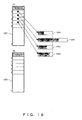
- FIG. 18 shows the batch deletion processing of all document data of the data storage unit 219.
- the data write unit 218 deletes the addresses of all document data registered in the data management table 1202.
- the data synchronization unit 217 switches the values between the addresses 1207 and 1208, and the contents of the data management table 1202 are copied to the data management table 1201.
- a searching process to be performed on XML documents is described, but the present invention can be applied not only to the searching of XML documents, but also can be applied to the searching process on any structured documents including SGML (standard generalized markup language) documents.
- SGML standard generalized markup language
- the tag automaton and the keyword automaton are used in detecting a tag and a keyword, but they can be replaced with other tag registration information and keyword registration information.
- the search apparatus shown in FIG. 3 can be configured by, for example, an information processing device (computer) as shown in FIG. 19.
- the information processing device shown in FIG. 19 comprises a CPU (central processing unit) 1901, memory 1902, an input device 1903, an output device 1904, an external storage device 1905, a medium drive device 1906, and a network connection device 1907. They are interconnected through a bus 1908.
- the memory 1902 includes, for example, ROM (read only memory), RAM (random access memory), etc., and stores a program and data used in data processing.
- the CPU 1901 performs necessary processes by executing a program using the memory 1902.
- the search result storage unit 216 shown in FIG. 3 corresponds to the memory 1902.
- the operation analysis unit 211, the data search unit 212, the search expression analysis unit 213, the XML search unit 214, the data read unit 215, the data synchronization unit 217, and the data write unit 218 shown in FIG. 3 correspond to the functions realized by executing a program stored in the memory 1902.
- the logical expression table 221, the tag automaton 222, the state management information 223, and the keyword automaton 224 shown in FIG. 3 are dynamically generated in the memory 1902.
- the input device 1903 can be, for example, a keyboard, a pointing device, a touch panel, etc., and is used by a user in inputting an instruction and information.
- the output device 1904 can be, for example, a display, a printer, a speaker, etc., and is used in outputting an inquiry and a process result, etc. to the user.
- the external storage device 1905 can be, for example, a magnetic disk device, an optical disk device, a magneto-optical disk device, a tape device, etc.
- the information processing device has the external storage device 1905 store the program and data so that they can be loaded into the memory 1902 as necessary.
- the external storage device 1905 can also be used as the data storage unit 219 shown in FIG. 3.
- the medium drive device 1906 drives a portable recording medium 1909 and accesses the recorded contents.
- the portable recording medium 1909 can be any computer-readable recording medium such as a memory card, a flexible disk, CD-ROM (compact disk read only memory), an optical disk, a magneto-optical disk, etc.
- a user can store the program and data on the portable recording medium 1909, and load them into the memory 1902 for use as necessary.
- the network connection device 1907 is connected to any communications network such as a LAN (local area network), etc. for data conversion in the communications.
- the information processing device receives the program and data from an external device through the network connection device 1907 as necessary, and uses them after loading them into the memory 1902.
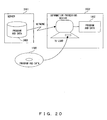
- FIG. 20 shows a computer-readable recording medium capable of providing a program and data for the information processing device shown in FIG. 19.
- the program and data stored in the portable recording medium 1909 and a database 2003 in a server 2001 are loaded into the memory 1902 of the information processing device 2002.
- the server 2001 generates a propagation signal for propagating the program and data, and transmits them to the information processing device 2002 through an arbitrary transmission medium in a network.
- the CPU 1901 executes the program using the data, and performs a necessary process.
Landscapes
- Engineering & Computer Science (AREA)
- Theoretical Computer Science (AREA)
- Data Mining & Analysis (AREA)
- Databases & Information Systems (AREA)
- Physics & Mathematics (AREA)
- General Engineering & Computer Science (AREA)
- General Physics & Mathematics (AREA)
- Software Systems (AREA)
- Information Retrieval, Db Structures And Fs Structures Therefor (AREA)
Applications Claiming Priority (2)
| Application Number | Priority Date | Filing Date | Title |
|---|---|---|---|
| JP2003296766 | 2003-08-20 | ||
| JP2003296766A JP4365162B2 (ja) | 2003-08-20 | 2003-08-20 | 構造化文書のデータを検索する装置および方法 |
Publications (2)
| Publication Number | Publication Date |
|---|---|
| EP1508864A2 true EP1508864A2 (de) | 2005-02-23 |
| EP1508864A3 EP1508864A3 (de) | 2006-06-14 |
Family
ID=34056235
Family Applications (1)
| Application Number | Title | Priority Date | Filing Date |
|---|---|---|---|
| EP04253257A Ceased EP1508864A3 (de) | 2003-08-20 | 2004-06-01 | Verfahren und Gerät um Daten in einem strukturierten Dokument zu suchen |
Country Status (5)
| Country | Link |
|---|---|
| US (1) | US7457799B2 (de) |
| EP (1) | EP1508864A3 (de) |
| JP (1) | JP4365162B2 (de) |
| KR (1) | KR100638695B1 (de) |
| CN (1) | CN1584884B (de) |
Families Citing this family (28)
| Publication number | Priority date | Publication date | Assignee | Title |
|---|---|---|---|---|
| US8521725B1 (en) | 2003-12-03 | 2013-08-27 | Google Inc. | Systems and methods for improved searching |
| JP2005309727A (ja) * | 2004-04-21 | 2005-11-04 | Hitachi Ltd | ファイルシステム |
| KR100716113B1 (ko) * | 2005-10-06 | 2007-05-09 | 엔에이치엔(주) | 웹 검색에서의 웹 데이터 태깅 방법 및 웹 데이터 태깅시스템 |
| US7912933B2 (en) * | 2005-11-29 | 2011-03-22 | Microsoft Corporation | Tags for management systems |
| US7617190B2 (en) * | 2005-11-29 | 2009-11-10 | Microsoft Corporation | Data feeds for management systems |
| US7835806B2 (en) * | 2007-01-29 | 2010-11-16 | Rockwell Automation Technologies, Inc. | Method for indirect access to controller data using name stored in string tag |
| JP5067420B2 (ja) | 2007-03-27 | 2012-11-07 | 富士通株式会社 | 情報検索プログラム、該プログラムを記録した記録媒体、情報検索装置、および情報検索方法 |
| KR100898475B1 (ko) * | 2007-04-10 | 2009-05-21 | 엔에이치엔(주) | 디렉터리 태깅 서비스를 제공하는 방법 및 상기 방법을수행하는 시스템 |
| KR100905494B1 (ko) * | 2007-09-07 | 2009-07-01 | 박수민 | 파일 관리 시스템 및 파일 관리를 실행하기 위한프로그램을 기록한 컴퓨터로 읽을 수 있는 기록매체 |
| JP5041003B2 (ja) | 2007-10-17 | 2012-10-03 | 富士通株式会社 | 検索装置および検索方法 |
| JP5071486B2 (ja) * | 2008-01-22 | 2012-11-14 | 富士通株式会社 | 検索装置および検索方法 |
| US8346791B1 (en) | 2008-05-16 | 2013-01-01 | Google Inc. | Search augmentation |
| JP5195149B2 (ja) * | 2008-08-11 | 2013-05-08 | 富士通株式会社 | 真偽判定方法 |
| JP5200762B2 (ja) * | 2008-08-25 | 2013-06-05 | 富士通株式会社 | 検索方法および検索プログラム |
| US8346792B1 (en) | 2010-11-09 | 2013-01-01 | Google Inc. | Query generation using structural similarity between documents |
| JP5782937B2 (ja) | 2011-09-08 | 2015-09-24 | 富士通株式会社 | タグ管理装置、タグ管理システムおよびタグ管理プログラム |
| JP6028393B2 (ja) * | 2012-05-24 | 2016-11-16 | 富士通株式会社 | 照合プログラム、照合方法および照合装置 |
| JP5958088B2 (ja) * | 2012-05-29 | 2016-07-27 | 富士通株式会社 | 更新プログラム、更新方法、および更新装置 |
| US9104730B2 (en) * | 2012-06-11 | 2015-08-11 | International Business Machines Corporation | Indexing and retrieval of structured documents |
| CN103488639B (zh) * | 2012-06-11 | 2016-12-07 | 北京大学 | 一种xml数据的查询方法 |
| JP5998942B2 (ja) * | 2013-01-08 | 2016-09-28 | 富士通株式会社 | 更新方法、更新プログラム、および照合処理装置 |
| CN104376008A (zh) * | 2013-08-14 | 2015-02-25 | 深圳市众鸿科技股份有限公司 | Xml绝对路径转换方法 |
| JP6737117B2 (ja) * | 2016-10-07 | 2020-08-05 | 富士通株式会社 | 符号化データ検索プログラム、符号化データ検索方法および符号化データ検索装置 |
| CN107291930A (zh) * | 2017-06-29 | 2017-10-24 | 环球智达科技(北京)有限公司 | 权重数的计算方法 |
| CN112306416B (zh) * | 2020-11-04 | 2022-09-27 | 福州汇思博信息技术有限公司 | 一种自动读写nv参数的方法及终端 |
| CN114676238A (zh) * | 2022-03-15 | 2022-06-28 | 来也科技(北京)有限公司 | 结合rpa及ai的关键信息获取方法、装置及存储介质 |
| CN116881251A (zh) * | 2023-06-30 | 2023-10-13 | 深圳图为技术有限公司 | 一种基于条文标签的采标方法、系统及电子设备 |
| CN117556790B (zh) * | 2024-01-02 | 2024-04-16 | 四川大学华西医院 | 医疗信息处理方法、装置、设备和存储介质 |
Family Cites Families (9)
| Publication number | Priority date | Publication date | Assignee | Title |
|---|---|---|---|---|
| JP3040945B2 (ja) * | 1995-11-29 | 2000-05-15 | 松下電器産業株式会社 | 文書検索装置 |
| JP3715444B2 (ja) * | 1998-06-30 | 2005-11-09 | 株式会社東芝 | 構造化文書保存方法及び構造化文書保存装置 |
| US6263332B1 (en) * | 1998-08-14 | 2001-07-17 | Vignette Corporation | System and method for query processing of structured documents |
| JP3965798B2 (ja) | 1998-09-08 | 2007-08-29 | 富士ゼロックス株式会社 | データ処理装置、文書処理装置、データ処理プログラムを記録したコンピュータ読み取り可能な記録媒体、文書処理プログラムを記録したコンピュータ読み取り可能な記録媒体、データ処理方法、および文書処理方法 |
| JP3651768B2 (ja) | 2000-05-18 | 2005-05-25 | 富士通株式会社 | 文書ファイル検索システム |
| KR100358348B1 (ko) | 2000-06-01 | 2002-10-25 | (주) 아이티캠프 | 엑스엠엘 데이터의 효과적인 검색을 위한 다중 경로인덱스 방법 |
| US20020004819A1 (en) * | 2000-07-10 | 2002-01-10 | David Agassy | Device and method for data interception and updating |
| US20030018668A1 (en) * | 2001-07-20 | 2003-01-23 | International Business Machines Corporation | Enhanced transcoding of structured documents through use of annotation techniques |
| US6999972B2 (en) * | 2001-09-08 | 2006-02-14 | Siemens Medical Systems Health Services Inc. | System for processing objects for storage in a document or other storage system |
-
2003
- 2003-08-20 JP JP2003296766A patent/JP4365162B2/ja not_active Expired - Fee Related
-
2004
- 2004-05-25 US US10/853,908 patent/US7457799B2/en not_active Expired - Fee Related
- 2004-06-01 EP EP04253257A patent/EP1508864A3/de not_active Ceased
- 2004-06-07 KR KR1020040041220A patent/KR100638695B1/ko not_active Expired - Fee Related
- 2004-06-25 CN CN2004100483380A patent/CN1584884B/zh not_active Expired - Fee Related
Non-Patent Citations (2)
| Title |
|---|
| GREEN; MIKLAU; ONIZUKA; SUCIU ET AL.: "Proceedings of the 9th International Conference on Database Theory, January 8-10, 2003, Siena, Italy, ICDT 2003", 8 January 2003, article "Processing XML Streams with Deterministic Automata", pages: 173 - 189 |
| PENG F; CHAWATHE S S: "XPath Queries on Streaming Data", SIGMOD 2003, [ONLINE], 9 June 2003 (2003-06-09), pages 1 - 12, XP002376243 |
Also Published As
| Publication number | Publication date |
|---|---|
| CN1584884A (zh) | 2005-02-23 |
| KR100638695B1 (ko) | 2006-10-30 |
| EP1508864A3 (de) | 2006-06-14 |
| US20050044070A1 (en) | 2005-02-24 |
| JP4365162B2 (ja) | 2009-11-18 |
| US7457799B2 (en) | 2008-11-25 |
| CN1584884B (zh) | 2010-07-21 |
| KR20050020927A (ko) | 2005-03-04 |
| JP2005070911A (ja) | 2005-03-17 |
Similar Documents
| Publication | Publication Date | Title |
|---|---|---|
| US7457799B2 (en) | Apparatus and method for searching data of structured document | |
| US6377946B1 (en) | Document search method and apparatus and portable medium used therefor | |
| JP4656868B2 (ja) | 構造化文書作成装置 | |
| US20070156622A1 (en) | Method and system to compose software applications by combining planning with semantic reasoning | |
| US20020087531A1 (en) | Database processing method and system | |
| US7831589B2 (en) | Method for retrieving constant values using regular expressions | |
| US20090177669A1 (en) | Processing structured electronic document streams using look-ahead automata | |
| CN112970011A (zh) | 记录查询优化中的谱系 | |
| CA2364886C (en) | Pattern retrieving method, pattern retrieval apparatus, computer-readable storage medium storing pattern retrieval program, pattern retrieval system, and pattern retrieval program | |
| US6470334B1 (en) | Document retrieval apparatus | |
| CN100495401C (zh) | 结构化文档处理装置和方法 | |
| JPWO2003034279A1 (ja) | 情報検索方法、情報検索プログラム、情報検索プログラムを記録したコンピュータ読み取り可能な記録媒体 | |
| US6571250B1 (en) | Method and system for processing queries in a data processing system using index | |
| JP2001331490A (ja) | 構造化文書格納装置、構造化文書検索装置、構造化文書格納検索装置及びプログラム並びにプログラム記録媒体 | |
| JP2000003366A (ja) | 文書登録方法と文書検索方法及びその実施装置並びにその処理プログラムを記録した媒体 | |
| US20050060314A1 (en) | System and methods involving a data structure searchable with O(logN) performance | |
| CN114896469A (zh) | 一种正则表达式引擎的构造方法、装置、存储介质及设备 | |
| JP5238105B2 (ja) | プログラム、及びデータ抽出方法 | |
| Thiombiano et al. | Discovery and enrichment of knowledges from a semantic wiki | |
| KR100659370B1 (ko) | 시소러스 매칭에 의한 문서 db 형성 방법 및 정보검색방법 | |
| CN119961447B (zh) | 基于图结构的长文本检索方法、装置和计算机设备 | |
| JP2011008811A (ja) | プログラム、及びデータ抽出方法 | |
| JPH1153400A (ja) | 構造化文書検索装置及びプログラムを記録した機械読み取り可能な記録媒体 | |
| JP3239845B2 (ja) | 全文検索装置および方法 | |
| Grohe et al. | The complexity of querying external memory and streaming data |
Legal Events
| Date | Code | Title | Description |
|---|---|---|---|
| PUAI | Public reference made under article 153(3) epc to a published international application that has entered the european phase |
Free format text: ORIGINAL CODE: 0009012 |
|
| AK | Designated contracting states |
Kind code of ref document: A2 Designated state(s): AT BE BG CH CY CZ DE DK EE ES FI FR GB GR HU IE IT LI LU MC NL PL PT RO SE SI SK TR |
|
| AX | Request for extension of the european patent |
Extension state: AL HR LT LV MK |
|
| PUAL | Search report despatched |
Free format text: ORIGINAL CODE: 0009013 |
|
| AK | Designated contracting states |
Kind code of ref document: A3 Designated state(s): AT BE BG CH CY CZ DE DK EE ES FI FR GB GR HU IE IT LI LU MC NL PL PT RO SE SI SK TR |
|
| AX | Request for extension of the european patent |
Extension state: AL HR LT LV MK |
|
| 17P | Request for examination filed |
Effective date: 20061211 |
|
| AKX | Designation fees paid |
Designated state(s): DE FR GB |
|
| 17Q | First examination report despatched |
Effective date: 20070720 |
|
| APBK | Appeal reference recorded |
Free format text: ORIGINAL CODE: EPIDOSNREFNE |
|
| APBN | Date of receipt of notice of appeal recorded |
Free format text: ORIGINAL CODE: EPIDOSNNOA2E |
|
| APBR | Date of receipt of statement of grounds of appeal recorded |
Free format text: ORIGINAL CODE: EPIDOSNNOA3E |
|
| APAF | Appeal reference modified |
Free format text: ORIGINAL CODE: EPIDOSCREFNE |
|
| APBT | Appeal procedure closed |
Free format text: ORIGINAL CODE: EPIDOSNNOA9E |
|
| STAA | Information on the status of an ep patent application or granted ep patent |
Free format text: STATUS: THE APPLICATION HAS BEEN REFUSED |
|
| 18R | Application refused |
Effective date: 20130315 |