EP1508929A1 - Bipolarplatte für Brennstoffzelle und Brenstoffzelle mit einer derartigen Bipolarplatte - Google Patents
Bipolarplatte für Brennstoffzelle und Brenstoffzelle mit einer derartigen Bipolarplatte Download PDFInfo
- Publication number
- EP1508929A1 EP1508929A1 EP04300253A EP04300253A EP1508929A1 EP 1508929 A1 EP1508929 A1 EP 1508929A1 EP 04300253 A EP04300253 A EP 04300253A EP 04300253 A EP04300253 A EP 04300253A EP 1508929 A1 EP1508929 A1 EP 1508929A1
- Authority
- EP
- European Patent Office
- Prior art keywords
- grooves
- face
- groove
- opening
- bipolar
- Prior art date
- Legal status (The legal status is an assumption and is not a legal conclusion. Google has not performed a legal analysis and makes no representation as to the accuracy of the status listed.)
- Withdrawn
Links
- 239000000446 fuel Substances 0.000 title claims abstract description 24
- 239000012530 fluid Substances 0.000 claims abstract description 28
- 239000012528 membrane Substances 0.000 claims description 39
- 239000003014 ion exchange membrane Substances 0.000 claims description 10
- 230000015572 biosynthetic process Effects 0.000 claims description 8
- 238000005342 ion exchange Methods 0.000 claims description 2
- 239000007788 liquid Substances 0.000 description 22
- 210000004027 cell Anatomy 0.000 description 17
- 239000007789 gas Substances 0.000 description 12
- XLYOFNOQVPJJNP-UHFFFAOYSA-N water Substances O XLYOFNOQVPJJNP-UHFFFAOYSA-N 0.000 description 12
- 150000002500 ions Chemical class 0.000 description 8
- 230000005484 gravity Effects 0.000 description 5
- 230000000694 effects Effects 0.000 description 3
- 230000003647 oxidation Effects 0.000 description 3
- 238000007254 oxidation reaction Methods 0.000 description 3
- 241000826860 Trapezium Species 0.000 description 2
- QVGXLLKOCUKJST-UHFFFAOYSA-N atomic oxygen Chemical compound [O] QVGXLLKOCUKJST-UHFFFAOYSA-N 0.000 description 2
- 238000006243 chemical reaction Methods 0.000 description 2
- 238000009792 diffusion process Methods 0.000 description 2
- 239000001257 hydrogen Substances 0.000 description 2
- 229910052739 hydrogen Inorganic materials 0.000 description 2
- 125000004435 hydrogen atom Chemical class [H]* 0.000 description 2
- 238000004519 manufacturing process Methods 0.000 description 2
- 239000001301 oxygen Substances 0.000 description 2
- 229910052760 oxygen Inorganic materials 0.000 description 2
- 230000001154 acute effect Effects 0.000 description 1
- 210000000170 cell membrane Anatomy 0.000 description 1
- 230000005465 channeling Effects 0.000 description 1
- 239000003792 electrolyte Substances 0.000 description 1
- 238000005370 electroosmosis Methods 0.000 description 1
- 230000002349 favourable effect Effects 0.000 description 1
- 239000007800 oxidant agent Substances 0.000 description 1
- 230000001590 oxidative effect Effects 0.000 description 1
- 238000006479 redox reaction Methods 0.000 description 1
- 238000006722 reduction reaction Methods 0.000 description 1
- 239000007787 solid Substances 0.000 description 1
- 239000007784 solid electrolyte Substances 0.000 description 1
Images

Classifications
-
- H—ELECTRICITY
- H01—ELECTRIC ELEMENTS
- H01M—PROCESSES OR MEANS, e.g. BATTERIES, FOR THE DIRECT CONVERSION OF CHEMICAL ENERGY INTO ELECTRICAL ENERGY
- H01M8/00—Fuel cells; Manufacture thereof
- H01M8/02—Details
- H01M8/0202—Collectors; Separators, e.g. bipolar separators; Interconnectors
- H01M8/0258—Collectors; Separators, e.g. bipolar separators; Interconnectors characterised by the configuration of channels, e.g. by the flow field of the reactant or coolant
- H01M8/026—Collectors; Separators, e.g. bipolar separators; Interconnectors characterised by the configuration of channels, e.g. by the flow field of the reactant or coolant characterised by grooves, e.g. their pitch or depth
-
- H—ELECTRICITY
- H01—ELECTRIC ELEMENTS
- H01M—PROCESSES OR MEANS, e.g. BATTERIES, FOR THE DIRECT CONVERSION OF CHEMICAL ENERGY INTO ELECTRICAL ENERGY
- H01M8/00—Fuel cells; Manufacture thereof
- H01M8/24—Grouping of fuel cells, e.g. stacking of fuel cells
- H01M8/2465—Details of groupings of fuel cells
- H01M8/2483—Details of groupings of fuel cells characterised by internal manifolds
-
- H—ELECTRICITY
- H01—ELECTRIC ELEMENTS
- H01M—PROCESSES OR MEANS, e.g. BATTERIES, FOR THE DIRECT CONVERSION OF CHEMICAL ENERGY INTO ELECTRICAL ENERGY
- H01M8/00—Fuel cells; Manufacture thereof
- H01M8/02—Details
- H01M8/0202—Collectors; Separators, e.g. bipolar separators; Interconnectors
- H01M8/0258—Collectors; Separators, e.g. bipolar separators; Interconnectors characterised by the configuration of channels, e.g. by the flow field of the reactant or coolant
- H01M8/0265—Collectors; Separators, e.g. bipolar separators; Interconnectors characterised by the configuration of channels, e.g. by the flow field of the reactant or coolant the reactant or coolant channels having varying cross sections
-
- H—ELECTRICITY
- H01—ELECTRIC ELEMENTS
- H01M—PROCESSES OR MEANS, e.g. BATTERIES, FOR THE DIRECT CONVERSION OF CHEMICAL ENERGY INTO ELECTRICAL ENERGY
- H01M8/00—Fuel cells; Manufacture thereof
- H01M8/04—Auxiliary arrangements, e.g. for control of pressure or for circulation of fluids
- H01M8/04082—Arrangements for control of reactant parameters, e.g. pressure or concentration
- H01M8/04089—Arrangements for control of reactant parameters, e.g. pressure or concentration of gaseous reactants
- H01M8/04119—Arrangements for control of reactant parameters, e.g. pressure or concentration of gaseous reactants with simultaneous supply or evacuation of electrolyte; Humidifying or dehumidifying
- H01M8/04156—Arrangements for control of reactant parameters, e.g. pressure or concentration of gaseous reactants with simultaneous supply or evacuation of electrolyte; Humidifying or dehumidifying with product water removal
-
- H—ELECTRICITY
- H01—ELECTRIC ELEMENTS
- H01M—PROCESSES OR MEANS, e.g. BATTERIES, FOR THE DIRECT CONVERSION OF CHEMICAL ENERGY INTO ELECTRICAL ENERGY
- H01M8/00—Fuel cells; Manufacture thereof
- H01M8/24—Grouping of fuel cells, e.g. stacking of fuel cells
- H01M8/241—Grouping of fuel cells, e.g. stacking of fuel cells with solid or matrix-supported electrolytes
-
- Y—GENERAL TAGGING OF NEW TECHNOLOGICAL DEVELOPMENTS; GENERAL TAGGING OF CROSS-SECTIONAL TECHNOLOGIES SPANNING OVER SEVERAL SECTIONS OF THE IPC; TECHNICAL SUBJECTS COVERED BY FORMER USPC CROSS-REFERENCE ART COLLECTIONS [XRACs] AND DIGESTS
- Y02—TECHNOLOGIES OR APPLICATIONS FOR MITIGATION OR ADAPTATION AGAINST CLIMATE CHANGE
- Y02E—REDUCTION OF GREENHOUSE GAS [GHG] EMISSIONS, RELATED TO ENERGY GENERATION, TRANSMISSION OR DISTRIBUTION
- Y02E60/00—Enabling technologies; Technologies with a potential or indirect contribution to GHG emissions mitigation
- Y02E60/30—Hydrogen technology
- Y02E60/50—Fuel cells
Definitions
- the present invention relates to a bipolar plate for a battery fuel cell and a fuel cell equipped with such plate.
- Fuel cells of the solid electrolyte type typically include a stack of bipolar plates and ion exchange type membranes formed by an electrolyte solid.
- the bipolar plates are provided with grooves forming gas circulation channels, one wall of which consists of a membrane.
- Anodic and cathodic gases circulate in the canals of circulation on each side of each membrane.
- Exchanges ions through the membranes lead from the anodic side to a oxidation, for example a hydrogen oxidation and the side cathodic to a reduction of an oxidant such as oxygen, with electron production.
- the oxidation-reduction reaction in the case in particular oxygen and hydrogen, leads to the production of water.
- the water thus produced spreads to the traffic channels through electro-osmosis or diffusion.
- anodic and cathodic anodic and cathodic gases as well as liquid such as water.
- the presence of water in the canals circulation can, by a partial overlap of the wall of the channels of circulation constituted by the membranes, limiting the efficiency of the battery fuel by hindering the exchange through the membranes.
- the document FR 2 786 027 describes bipolar plates for fuel cell comprising flutes capable of forming gas distribution channels planned so as to meander on the entire surface of the membrane to feed the membrane of the as uniformly as possible.
- This document proposes, to mitigate disadvantages related to the presence of liquid in the channels of provide for distribution channels with cross section a shape or geometry for moving a liquid circulating in said channels of the surface of the membranes. This is particularly realized by providing channels with isosceles trapezoidal profile whose small base is constituted by said membrane surface. Angles acute isosceles trapezoidal profile away from the membrane allow retain liquids away from the membrane by capillary action. It is also envisaged splines whose walls are equipped of throats to retain liquids remote from the membrane also by capillary effect.
- bipolar plates nevertheless do not allow to obtain channels allowing a satisfactory circulation of fluids and a completely satisfactory operation of a battery to combustible.
- the subject of the present invention is a bipolar plate for fuel cell to improve a flow of fluids in traffic channels for performance improved fuel cell.
- the subject of the invention is also a bipolar plate for fuel cell allowing a better use of the surface of a fuel cell membrane.
- Such a bipolar plate for a fuel cell comprises at least on one side a suitable groove to form a fluid circulation channel, the groove extending over its entire length in a straight line.
- the groove which has a longitudinal opening in the plane of the face and which is delimited by a first side wall, a bottom wall and a second wall lateral, presents in cross-section an asymmetrical profile relative to a mediating plane of its longitudinal opening.
- Prediction of an asymmetrical profile with respect to the plan mediator of the longitudinal opening allows to provide grooves with a profile adapted to recover liquids in a part lower circulation channels by moving liquids away from opening, i.e., moving liquids away from a closing membrane the opening, while also providing a profile adapted to form grooves close in a transverse direction. So, we can provide on the bipolar plate a greater density of grooves parallels, and make the best use of the total surface of a membrane and thus improving the performance of the fuel cell.
- the second side wall joins the opening in being substantially inclined relative to the plane of the face, and being oriented towards the bottom of the groove. This allows, when the liquid is collected by gravity on the second wall, to move the liquid away from the opening.
- the groove has in section a substantially trapezoidal profile rectangle, whose small base is formed by the opening, the large base by the bottom wall, and the first side wall is substantially perpendicular to the plane of the opening and to the bottom wall.
- At least a portion of the first side wall is inclined relative to the plane of the face and oriented towards the opening. Such an arrangement allows the prediction of closer grooves for better surface use total of a membrane associated with the bipolar plate.
- the lower side wall of a groove is provided with at least one longitudinal groove adapted to retain water by capillarity, in particular to ensure humidification of the fluids circulating in the traffic channels.
- the other side of the bipolar plate, or second face can be provided with rectilinear grooves parallel to the grooves of the first face-up and presenting in section similar or different profiles, or rectilinear grooves arranged in a different orientation to that grooves of the first face, and presenting in section profiles similar or different.
- the invention also relates to a fuel cell comprising at least one ion exchange membrane interposed between two plates according to one aspect of the invention for the formation of channels of anodic and cathodic gas circulation on both sides of the ion exchange membrane.
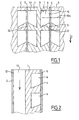
- bipolar plates in accordance with the invention 1, 2, 3, here three in number and partially represented, are arranged vertically and juxtaposed, exchange membranes of ions 4, 5, here two in number, being interposed between the plates bipolar 1, 2, 3.
- the central bipolar plate 1 has on each of its faces rectilinear grooves with identical profiles and provided for the flow of anodic or cathodic gas.
- a first face 11 of the bipolar plate 1 is provided with grooves 6, two grooves being visible in Figure 1.
- a groove 6 formed on a first face 11 is delimited by a first wall upper side 7, a bottom wall 8, and a second side wall lower 9.
- the groove 6 has in the plane of the first face 11 of the bipolar plate 1 a longitudinal opening 10, opposite to the bottom wall 8.
- the grooves 6 extend longitudinally in a direction perpendicular to the plane of Figure 1.
- the grooves present in cross section, that is to say in the plane of Figure 1, a asymmetrical profile relative to a mediating plane 10a of the longitudinal opening 10, that is to say a plane perpendicular to the longitudinal opening 10 and separating the opening into two parts of equal width.
- the grooves 6 more particularly have a profile to rectangular trapezoidal section.
- the opening 10 forms the small base of trapezium rectangle
- the bottom wall 8 parallel to the opening, forms the large base of the rectangle trapezium
- the top wall 7 is perpendicular to the bottom wall 8 and the plane of the face 11 which is the plane of the opening 10
- the bottom wall 9 is inclined relative to the bottom wall and the plane of the opening 10.
- the wall lower 9 is inclined by being oriented on the side of the bottom wall 8.
- Grooves 13 are formed on the second face 12 of the bipolar plate 1 opposite to the first face 11.
- the grooves 13 of the second face 12 are parallel to the grooves 6 of the first face 11, have an identical profile, and are located opposite the grooves 6 formed on the first face 11, so that the bipolar plate 1 presents a plan of symmetry.
- the bipolar plate 1 differs from the bipolar plate of Figure 1 in that the grooves 13 formed on the second face 12 are perpendicular to the grooves 6 formed on the first face 11.
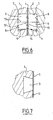
- a bipolar plate 1 having a parallelepipedal general shape is provided on a first face 11, visible in FIG. 1, of a plurality of grooves all rectilinear and parallel to each other, here at the number of five, and referenced 6.
- the grooves 6 extend from a rear edge 17 of the plate bipolar 1 to the opposite front edge 18, being parallel to the edges lateral 19, 20 of the bipolar slap 1.
- the plate bipolar 1 can be provided on its opposite side not visible, grooves extending parallel to visible grooves 6. Such grooves do not are not represented for ways of clarity.
- the bipolar plate 1 of FIG. can be provided on its opposite side with rectilinear grooves 13 oriented perpendicular to the grooves of the first face.
- the grooves of the second face open in this case at their ends at the side edges 20 and 19 of the bipolar plate 1 while being parallel to the front and rear edges 17, 18 of the bipolar plate 1.
- the plates bipolar are arranged vertically as shown in the figure. 1, so that the grooves 6 of a first face 11 extend horizontally.
- Anodic and cathodic fluids circulate in the circulation channels formed by the grooves 6 of the bipolar plates 1, 2, 3 in association with the membranes 4, 5.
- a cathodic fluid circulates in a "cathode” channel located on one side of a membrane 4, 5, an anode fluid circulating in an associated "anodic” channel circulating on the other side of the membrane, facing the said canal cathode.
- the grooves of one face are intended for the circulation of a cathodic fluid, and the grooves of the other side are provided for the circulation of an anode fluid.
- reaction oxidation leads to the formation of water that reaches the circulation channels by diffusion or osmosis within the membrane.
- grooves 6 extending rectilinearly on their entire length makes it possible to obtain circulation channels of fluids that are devoid of elbow.
- This arrangement of the grooves promotes, in the case of fluids containing gases and liquids, a stratified flow of fluid in the circulation channels, especially when the grooves extend substantially horizontally.
- liquids, denser than gases are driven to the lower part of canals, under the action of the force of gravity, acting vertically downwards, according to the direction indicated by the arrow G in Figure 1. As a result, the water will have tend to end up in the grooves.
- a two-phase fluid flows in a differentiated or stratified, gases 14 flowing in the upper the channel formed by a groove 6 of a plate 1, and the liquids 15 circulate in the lower part of the canal.
- the lower wall forecast 9 joining the opening. longitudinal 10 of the groove, that is to say, joining the surface exchange formed by the membrane 4, being inclined and oriented towards the bottom wall 8 of the groove makes it possible to remove the liquid 15 collected by gravity on the lower side wall 9. In fact, the liquid 15 tends to flow down along the sidewall lower 9 and down to the bottom of the channel formed between the wall lower side 9 and the bottom wall 8.
- the opening 10 is free of the liquid and the anodic gases and cathodic can come into direct contact with the surface exchange of the membrane 4, improving the performance of a battery combustible.
- the prediction of grooves 6 with in cross section a asymmetrical profile with respect to a mediating plane 10a of the opening 10 allows the formation of traffic channels with a profile allowing the channeling of liquids, while allowing training parallel grooves 6 closer.
- the grooves 6 with a lower wall 9 inclined to recover the liquids have a total width L ( Figure 4) larger than the width of the openings 10.
- the width total of the grooves is limited by providing an upper wall 7, which here is perpendicular to the face 11 of the bipolar plate.
- bipolar plates can be formed with one more high density of grooves, and a more favorable ratio or ratio between the surfaces of the longitudinal openings 10 of the grooves 6, and the total area of the bipolar plate 1.
- a membrane an effective total exchange surface, i.e. located opposite the openings 10 of the grooves 6, more important relative to the total area of the membrane.
- a groove 6 has a profile in section cross-section substantially identical to that of the groove of FIG. except that the upper side wall 7 of the groove 6 has a first portion 7a opening on the opening 10 perpendicular to the face 11 of the bipolar plate 1 and a second portion 7b joining the bottom wall 8 while being inclined and oriented towards the opening 10.
- This embodiment makes it possible to bring the grooves 6 so as to form a parallel network of grooves 6 plus dense, by limiting the width of the bottom portion of the grooves 6.
- the groove 6 has in section cross section a parallelogram profile with a side wall bottom inclined and oriented towards the bottom 8 and a side wall upper 7 inclined and oriented towards the opening 10.
- a groove 6 may be provided with a bottom wall 9 provided with a longitudinal groove 16 to retain the water by the effect of capillarity.
- the longitudinal groove 16 may have as an example limiting a profile rounded, V, rectangle or square.
- the throat longitudinal channel 16 makes it possible to retain the water in the circulation channel of fluids formed by the groove 6 to allow humidification of the gas flowing in the canal.
- the shape of the bipolar plates is in no way limited to the plate shown in Figure 3.
- distributors and collectors provided with nozzles opening respectively at the ends input and output of each channel.
- the possible cross-sectional profiles for Grooves are not limited to the examples provided. Any profile to collect liquids by gravity and to keep them away from longitudinal openings of the grooves, while limiting a width of the grooves may be suitable.
- bipolar provided grooves adapted to form fluid circulation channels anodic and cathodic for fuel cells allowing promote a stratified flow of fluids to recover derived products such as water formed as a result of the reaction Redox.
- the grooves also have a profile in section cross-section to move the water away from the membrane to release the active surface of the membrane and allow better operation of the fuel cell.
- the profiles of the grooves are further adapted to allow an improved arrangement of the grooves allowing the use of a larger part of the membranes as surface active, that is to say grooves to obtain a ratio more between the sum of the surfaces of the longitudinal openings grooves and the total area of the bipolar plates.
Landscapes
- Life Sciences & Earth Sciences (AREA)
- Engineering & Computer Science (AREA)
- Manufacturing & Machinery (AREA)
- Sustainable Development (AREA)
- Sustainable Energy (AREA)
- Chemical & Material Sciences (AREA)
- Chemical Kinetics & Catalysis (AREA)
- Electrochemistry (AREA)
- General Chemical & Material Sciences (AREA)
- Fuel Cell (AREA)
Applications Claiming Priority (2)
| Application Number | Priority Date | Filing Date | Title |
|---|---|---|---|
| FR0305365A FR2854499B1 (fr) | 2003-04-30 | 2003-04-30 | Plaque bipolaire pour pile a combustible et pile a combustible equipee d'une telle plaque |
| FR0305365 | 2003-04-30 |
Publications (1)
| Publication Number | Publication Date |
|---|---|
| EP1508929A1 true EP1508929A1 (de) | 2005-02-23 |
Family
ID=33155590
Family Applications (1)
| Application Number | Title | Priority Date | Filing Date |
|---|---|---|---|
| EP04300253A Withdrawn EP1508929A1 (de) | 2003-04-30 | 2004-04-30 | Bipolarplatte für Brennstoffzelle und Brenstoffzelle mit einer derartigen Bipolarplatte |
Country Status (2)
| Country | Link |
|---|---|
| EP (1) | EP1508929A1 (de) |
| FR (1) | FR2854499B1 (de) |
Cited By (1)
| Publication number | Priority date | Publication date | Assignee | Title |
|---|---|---|---|---|
| FR2900769A1 (fr) * | 2006-05-05 | 2007-11-09 | Renault Sas | Plaque bipolaire pour pile a combustible |
Families Citing this family (2)
| Publication number | Priority date | Publication date | Assignee | Title |
|---|---|---|---|---|
| US11302932B2 (en) | 2009-05-01 | 2022-04-12 | Xergy Inc. | Bipolar plate for low pressure feed electrode operation |
| GB2547967B (en) * | 2015-11-23 | 2022-02-23 | Ffi Ionix Ip Inc | Bipolar plate for low pressure feed electrode operation |
Citations (6)
| Publication number | Priority date | Publication date | Assignee | Title |
|---|---|---|---|---|
| JPH10172585A (ja) * | 1996-12-03 | 1998-06-26 | Honda Motor Co Ltd | 燃料電池 |
| FR2786027A1 (fr) * | 1998-11-12 | 2000-05-19 | Commissariat Energie Atomique | Plaques bipolaires pour pile a combustible et pile a combustible comprenant ces plaques |
| JP2001043869A (ja) * | 1999-07-29 | 2001-02-16 | Mitsubishi Materials Corp | 燃料電池用セパレータ |
| JP2001043870A (ja) * | 1999-07-29 | 2001-02-16 | Mitsubishi Materials Corp | 燃料電池用セパレータ |
| EP1282183A2 (de) * | 2001-07-27 | 2003-02-05 | Hewlett-Packard Company | Bipolare Platten und Endplatten für Brennstoffzellen und Verfahren zu ihrer Herstellung |
| JP2003036865A (ja) * | 2001-07-19 | 2003-02-07 | Toyota Motor Corp | 燃料電池 |
-
2003
- 2003-04-30 FR FR0305365A patent/FR2854499B1/fr not_active Expired - Fee Related
-
2004
- 2004-04-30 EP EP04300253A patent/EP1508929A1/de not_active Withdrawn
Patent Citations (6)
| Publication number | Priority date | Publication date | Assignee | Title |
|---|---|---|---|---|
| JPH10172585A (ja) * | 1996-12-03 | 1998-06-26 | Honda Motor Co Ltd | 燃料電池 |
| FR2786027A1 (fr) * | 1998-11-12 | 2000-05-19 | Commissariat Energie Atomique | Plaques bipolaires pour pile a combustible et pile a combustible comprenant ces plaques |
| JP2001043869A (ja) * | 1999-07-29 | 2001-02-16 | Mitsubishi Materials Corp | 燃料電池用セパレータ |
| JP2001043870A (ja) * | 1999-07-29 | 2001-02-16 | Mitsubishi Materials Corp | 燃料電池用セパレータ |
| JP2003036865A (ja) * | 2001-07-19 | 2003-02-07 | Toyota Motor Corp | 燃料電池 |
| EP1282183A2 (de) * | 2001-07-27 | 2003-02-05 | Hewlett-Packard Company | Bipolare Platten und Endplatten für Brennstoffzellen und Verfahren zu ihrer Herstellung |
Non-Patent Citations (3)
| Title |
|---|
| PATENT ABSTRACTS OF JAPAN vol. 1998, no. 11 30 September 1998 (1998-09-30) * |
| PATENT ABSTRACTS OF JAPAN vol. 2000, no. 19 5 June 2001 (2001-06-05) * |
| PATENT ABSTRACTS OF JAPAN vol. 2003, no. 06 3 June 2003 (2003-06-03) * |
Cited By (1)
| Publication number | Priority date | Publication date | Assignee | Title |
|---|---|---|---|---|
| FR2900769A1 (fr) * | 2006-05-05 | 2007-11-09 | Renault Sas | Plaque bipolaire pour pile a combustible |
Also Published As
| Publication number | Publication date |
|---|---|
| FR2854499A1 (fr) | 2004-11-05 |
| FR2854499B1 (fr) | 2006-12-01 |
Similar Documents
| Publication | Publication Date | Title |
|---|---|---|
| CA1038926A (fr) | Structure et nouveau systeme de pile a combustible notamment pour combustible carbone et air atmospherique | |
| WO2014067782A1 (fr) | Plaque bipolaire pour pile a combustible | |
| LU82769A1 (fr) | Appareil pour la fabrication d'hypochlorite de sodium | |
| JPH11250923A5 (de) | ||
| FR2579025A1 (fr) | Pile a combustible a separation amelioree | |
| FR2574596A1 (fr) | Batterie secondaire a empilage de cellules du type a circulation d'electrolyte metal-halogene | |
| EP0884794B1 (de) | Brennstoffzelle mit plattenförmigen Reaktantverteilerelementen | |
| EP3170220B1 (de) | Bipolare platte für elektrochemischen reaktor mit kompaktem homogenisierungsbereich und geringer druckdifferenz | |
| EP3092672B1 (de) | Flussleitende platte für eine brennstoffzelle | |
| EP1508929A1 (de) | Bipolarplatte für Brennstoffzelle und Brenstoffzelle mit einer derartigen Bipolarplatte | |
| EP2915208A1 (de) | Bipolare platte für eine brennstoffzelle | |
| EP3195392B1 (de) | Fluidverteilerplatte für elektrochemischen reaktor und anordnung enthaltend die selbige | |
| EP1929565B1 (de) | Platte für brennstoffzelle | |
| FR2891090A1 (fr) | Plaque bipolaire pour pile a combustible | |
| FR2931299A1 (fr) | Pile a combustible a empilement membrane/electrodes perpendiculaire au substrat de support et procede de realisation | |
| WO2015104491A1 (fr) | Plaque de guidage d'ecoulement pour pile a combustible | |
| FR2986108A1 (fr) | Plaque de pile a combustible, cellule et empilement de cellules correspondants | |
| EP4007019B1 (de) | Bipolarplatte für einen elektrochemischen reaktor | |
| EP3809504A1 (de) | Bipolare platte einer brennstoffzelle | |
| CA2829488A1 (fr) | Plaque de pile a combustible et empilement de cellules comprenant une telle plaque | |
| FR2864863A1 (fr) | Plaques bipolaires pour pile a combustible et pile a combustible equipee d'une plaque | |
| WO2003052847A2 (fr) | Collecteur bipolaire pour pile a combustible a membrane protonique | |
| FR3125647A3 (fr) | Plaque de pile à combustible | |
| FR2900769A1 (fr) | Plaque bipolaire pour pile a combustible | |
| WO2025061733A1 (fr) | Intercalaire pour une cellule électrolytique, cellule électrolytique et stack d'électrolyseur |
Legal Events
| Date | Code | Title | Description |
|---|---|---|---|
| PUAI | Public reference made under article 153(3) epc to a published international application that has entered the european phase |
Free format text: ORIGINAL CODE: 0009012 |
|
| AK | Designated contracting states |
Kind code of ref document: A1 Designated state(s): AT BE BG CH CY CZ DE DK EE ES FI FR GB GR HU IE IT LI LU MC NL PL PT RO SE SI SK TR |
|
| AX | Request for extension of the european patent |
Extension state: AL HR LT LV MK |
|
| 17P | Request for examination filed |
Effective date: 20050808 |
|
| AKX | Designation fees paid |
Designated state(s): BE DE ES FR GB IT |
|
| STAA | Information on the status of an ep patent application or granted ep patent |
Free format text: STATUS: THE APPLICATION HAS BEEN WITHDRAWN |
|
| 17Q | First examination report despatched |
Effective date: 20160621 |
|
| 18W | Application withdrawn |
Effective date: 20160711 |