EP1509033B1 - Verfahren und Vorrichtung zum Verbinden von IP-Anschlüssen und PSTN-Anschlüssen - Google Patents
Verfahren und Vorrichtung zum Verbinden von IP-Anschlüssen und PSTN-Anschlüssen Download PDFInfo
- Publication number
- EP1509033B1 EP1509033B1 EP03292049A EP03292049A EP1509033B1 EP 1509033 B1 EP1509033 B1 EP 1509033B1 EP 03292049 A EP03292049 A EP 03292049A EP 03292049 A EP03292049 A EP 03292049A EP 1509033 B1 EP1509033 B1 EP 1509033B1
- Authority
- EP
- European Patent Office
- Prior art keywords
- extend
- exchange
- gateway
- etgw
- call
- Prior art date
- Legal status (The legal status is an assumption and is not a legal conclusion. Google has not performed a legal analysis and makes no representation as to the accuracy of the status listed.)
- Expired - Lifetime
Links
- 238000000034 method Methods 0.000 title claims description 14
- 230000007246 mechanism Effects 0.000 claims description 36
- 238000012546 transfer Methods 0.000 claims description 5
- 102100032765 Chordin-like protein 1 Human genes 0.000 claims description 3
- 101000941971 Homo sapiens Chordin-like protein 1 Proteins 0.000 claims description 3
- 101100350635 Mycoplasma gallisepticum (strain R(low / passage 15 / clone 2)) mgc2 gene Proteins 0.000 claims description 2
- 230000011664 signaling Effects 0.000 description 14
- 238000003780 insertion Methods 0.000 description 7
- 230000037431 insertion Effects 0.000 description 7
- 101000618467 Hypocrea jecorina (strain ATCC 56765 / BCRC 32924 / NRRL 11460 / Rut C-30) Endo-1,4-beta-xylanase 2 Proteins 0.000 description 6
- 238000013459 approach Methods 0.000 description 4
- 230000009471 action Effects 0.000 description 3
- 238000004891 communication Methods 0.000 description 2
- 230000004044 response Effects 0.000 description 2
- 230000001960 triggered effect Effects 0.000 description 2
- 238000001514 detection method Methods 0.000 description 1
- 238000012423 maintenance Methods 0.000 description 1
- 238000005259 measurement Methods 0.000 description 1
- 238000013508 migration Methods 0.000 description 1
- 230000005012 migration Effects 0.000 description 1
- 238000012986 modification Methods 0.000 description 1
- 230000004048 modification Effects 0.000 description 1
- 230000007781 signaling event Effects 0.000 description 1
Images


Classifications
-
- H—ELECTRICITY
- H04—ELECTRIC COMMUNICATION TECHNIQUE
- H04M—TELEPHONIC COMMUNICATION
- H04M7/00—Arrangements for interconnection between switching centres
- H04M7/0024—Services and arrangements where telephone services are combined with data services
- H04M7/0057—Services where the data services network provides a telephone service in addition or as an alternative, e.g. for backup purposes, to the telephone service provided by the telephone services network
-
- H—ELECTRICITY
- H04—ELECTRIC COMMUNICATION TECHNIQUE
- H04M—TELEPHONIC COMMUNICATION
- H04M7/00—Arrangements for interconnection between switching centres
- H04M7/12—Arrangements for interconnection between switching centres for working between exchanges having different types of switching equipment, e.g. power-driven and step by step or decimal and non-decimal
- H04M7/1205—Arrangements for interconnection between switching centres for working between exchanges having different types of switching equipment, e.g. power-driven and step by step or decimal and non-decimal where the types of switching equipement comprises PSTN/ISDN equipment and switching equipment of networks other than PSTN/ISDN, e.g. Internet Protocol networks
- H04M7/125—Details of gateway equipment
- H04M7/1255—Details of gateway equipment where the switching fabric and the switching logic are decomposed such as in Media Gateway Control
-
- H—ELECTRICITY
- H04—ELECTRIC COMMUNICATION TECHNIQUE
- H04M—TELEPHONIC COMMUNICATION
- H04M7/00—Arrangements for interconnection between switching centres
- H04M7/12—Arrangements for interconnection between switching centres for working between exchanges having different types of switching equipment, e.g. power-driven and step by step or decimal and non-decimal
- H04M7/1205—Arrangements for interconnection between switching centres for working between exchanges having different types of switching equipment, e.g. power-driven and step by step or decimal and non-decimal where the types of switching equipement comprises PSTN/ISDN equipment and switching equipment of networks other than PSTN/ISDN, e.g. Internet Protocol networks
- H04M7/129—Details of providing call progress tones or announcements
Definitions
- the invention relates to a method and a devices for providing services among a Internet Protocol (IP) network and a telecommunications network, and more specifically, to a method and devices for providing advanced call services to subscriber of the IP network and subscriber of the telecommunication network.
- IP Internet Protocol
- the Internet Today beside the telecommunication networks the Internet has become the major network for providing communication services.
- the Internet was basically not designed for voice communication purposes, but there is a desire to connect both network.
- a connection approach has to solve several difficulties.
- a media gateway is in general a gateway converting media streams from a IP network to a telecommunication network, e.g. a public switched telephone network (PSTN) like a ISDN network or an analog telephone network, and vice versa. That means that audio data of the PSTN network are converted in packet data for transport via the Internet.
- PSTN public switched telephone network
- the media gateway is controlled by the media gateway controller using certain protocols like the media gateway control protocol (MGCP) or the Megaco / H.248 Standard protocol.
- MGCP media gateway control protocol
- a media gateway controller is in general a softswitch used for converting IP signalling to PSTN signalling.
- Advanced call services like call waiting, call-back on busy, three-party call or conference call, caller ID, charge information, call transfer and so on are available in telephone networks.
- the media gateway and the media gateway controllers have to be provided with appropriate components for executing these services to the IP world. That means, they have to be provided with hardware and software components which are with respects to its functions similar to the telephone exchange components, but adapted to the IP conditions, i.e. the services being already in place for the PSTN are rebuilt for the IP network.
- One example is described in the US 6,292,478 , which provides an architecture to permit the caller to set-up and carry out a telephone call over Internet with a special service.
- Such sophisticated media devices and media controllers are expensive and have to be provided as extra equipment. The building up of such a network structure is time consuming as well as cost extensive.
- NTN Next Generation Networks
- subscribers which are connected via IP-Gateways shall have at least a part of advanced call services and also with the same behaviour as the PSTN subscribers.
- Another object of the present invention is to provide a method and devices for linking the presently telecommunication network and the IP-network in an efficient and flexible way in view of providing advanced call services.
- the extend mechanism comprises a detecting of call conditions for applying the extend mechanism, an inserting of a gateway for providing advanced telecommunication services in a bearer connection of terminations involved in the call connection, a routing of the bearer to a digital switching device of the exchange via the inserted gateway and a providing of the advance call service.
- the detecting of call conditions comprises for example a request or a need for a advanced call service triggered by a subscriber or a component of the telecommunication system.
- the inserted gateway for providing advanced telecommunication services is connected with a predetermined port of the exchange.
- the bearer is routed to a digital switching device of the exchange via the inserted gateway.
- the inserted gateway is preferably controlled by a media gateway controller, which is associated to the exchange to which the gateway is bearer connected.
- a media gateway controller for executing the method according to the invention comprises means for executing the extend mechanism, wherein said means co-operate with corresponding means of a exchange for executing the extend mechanism, in particular for controlling the inserting and/or removing of said extend gateway and/or providing the advanced call service to the subscriber.
- An exchange for executing the method according to the invention comprises means for executing the extend mechanism, wherein said means co-operate with corresponding means of a media gateway controller for executing the extend mechanism, in particular for controlling the inserting and/or removing of said extend gateway and/or providing the advanced call service to the subscriber.
- the media gateway controller and the exchange are realised as one combined device, following called media gateway controller exchange.
- the gateway is inserted in an existing bearer connection and/or in a to be established bearer connection of the involved AGW and/or PSTN terminations. That means, that the insertion might occurs in the call set-up phase or in a stable phase. If bearer related advanced call features are invoked in a established call connection, the bearer is re-configured by insertion of the gateway in order to access the digital switching device of the exchange.
- the inserted gateway is in addition re-used for PSTN termination interworking call connection.
- the insertion of the gateway used for providing of advanced call features is furthermore used for the call connection between the AGW subscribers and PSTN subscribers or terminations respectively. This is in particular the case for subscribers which are assigned via their corresponding access gateways and exchanges to the same media gateway controller.
- the call connection is established by re-using the extend mechanism to provide a interworking connectivity.
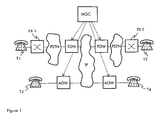
- Figure 1 shows in general a network architecture of the state of the art having a PSTN network and an IP network connected to each other by media gateways and media gateway controllers.
- PSTN public switched telephone network
- IP Internet Protocol
- Terminal T1 is connected with a PSTN network via a telephone exchange EX1 and terminal T2 via a telephone exchange EX1. Such subscribers are following called PSTN subscriber. Furthermore , terminals T3, T4 are connected with an IP network via access gateways (AGW). Such subscribers are following called AGW subscriber.
- AGW access gateways
- the terminals T1, T2, T3, T4 are in particular telephone devices, but can be for example computers too.
- the PSTN networks shown in Figure 1 are connected with the IP network by trunk gateway (TGW).
- TGW trunk gateway
- the AGW's and TGW's are controlled by a media gateway controller (MGC).
- MSC media gateway controller
- the AGW's and TGW's, when arranged in the network structure as shown in Figure 1 act as media gateways (MG).
- the telephone exchange (EX) is for example a local exchange (LEX).
- a media gateway is in general a gateway converting media streams from a IP network to a PSTN network, e.g. a ISDN network or an analog telephone network, and vice versa. That means that audio a data of the PSTN network are converted in packet data for transport via the Internet.
- the media gateway is controlled by the media gateway controller using certain protocols like the media gateway control protocol (MGCP) or the Megaco / H.248 Standard protocol.
- MGCP media gateway control protocol
- a media gateway controller is in general a softswitch used for converting IP signalling to PSTN signalling.
- call forwarding unconditional, if no answer, if busy
- call waiting call waiting
- call-back on busy three-party call or conference call
- caller ID caller ID
- charge information call transfer and so on.
- add-on telephone services are at least partly available for digital switched analog subscriber lines too.
- IP network subscriber i.e. AGW subcsriber
- PSTN subscriber calling AGW subscriber the media gateway and the media gateway controllers have to be provided with appropriate components for executing these services to the IP world.
- An example to this is a conference service, where special IP based conference devices could be used for the AGW subscribers, whereas for the PSTN subscribers the existing conference bridges are used.
- the media gateway controller must be able to convert and interwork the call handling for these services for both domains (AGW subscribers and PSTN subscribers), that means the signalling information but also the bearer related functions like switching, routing or reconfiguration.
- AGW subscribers and PSTN subscribers domains
- They have to be provided with hardware and software components which are with respects to its functions similar to the telephone exchange components, but adapted to the IP conditions.
- Such sophisticated media gateways and media gateway controllers are expensive and have to be provided on several border points between telephone world and IP world. The building up of such a network structure is time consuming as well as cost extensive.
- IP network gateways like access gateways (AGW) or trunk gateways (TGW) are able to provide simple call services like busy line signalling tone, dial-tone or call-waiting-tone.
- AGW access gateways
- TGW trunk gateways
- media gateways together with media gateway controllers are used for providing simple call connection between AGW subscriber and PSTN subscribers or AGW terminations and PSTN termination respectively.
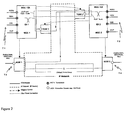
- call connections are exemplary shown in figure 2 with reference numbers 1 to 3 for a network structure of the state of the art.
- FIG. 2 shows with reference number 1 a call connection between the two AGW subscriber terminations T3 and T4, connected to first and second access gateways AGW 1, AGW 2.
- the AGW subscribers could be analog users, integrated service digital network (ISDN) users, private automatic branch exchange (PABX) users or remote subscriber unit (RSU) users.
- ISDN integrated service digital network
- PABX private automatic branch exchange
- RSU remote subscriber unit
- Reference number MGC/EX denotes a media gateway controller exchange device, i.e. a telephone exchange EX and a media gateway controller MGC realised as one device, called a media gateway controller exchange (MGC/EX).
- MGC/EX media gateway controller exchange
- EX, MGC both devices
- EX, MGC need not to be combined in one device and can also realised as physically separated devices (EX, MGC).
- the telephone exchange may be for example a local exchange (LEX) or a transit exchange (TEX).
- the call connection 1 is established with involvement of both media gateway controllers MGC1 and MGC2 of the media gateway controller exchange MGC/EX1, MGC/EX2.
- Advanced call services in particular involving bearer related features like three-party-call, conference, call waiting, music-on-hold, are not available for the subscriber of this scenario without external equipment.
- a call connection between two PSTN subscriber terminations T1, T2 is indicated by reference number 2.
- This call connection is set-up between two PSTN networks over the IP network, i.e. by making use of the trunk gateways TGW 1 and TGW 2.
- the PSTN subscribers could be plain old telephone subscriber (POTS), i.e. analog users, integrated service digital network (ISDN) subscriber or could be connected via existing PSTN trunks with channel associated signalling (CAS) or ISDN user part (ISUP).
- POTS plain old telephone subscriber
- ISDN integrated service digital network
- CAS channel associated signalling
- ISUP ISDN user part
- FIG. 2 shows further a call connection 3 between the AGW subscriber termination T3 and a PSTN subscriber termination T2.
- the AGW subscriber termination T3 is connected to the first access gateway AGW 1 and the PSTN subscriber termination T2 is connected to the exchange EX 2 of the media gateway controller exchange MGC/EX 2.
- the AGW 1 and the trunk gateway TGW 2 are controlled by the MGC 1 of the media gateway controller exchange MGC/EX 1.
- a first trunk gateway TGW 1 is connected the exchange EX 1 of the MGC/EX1, but not controlled by the MGC 1.
- the controlling of the second access gateway AGW2 and first trunk gateway TGW 1 is done by the MGC 2 of the MGC/EX 2.
- a bearer channel is to be established via TGW.
- the first exchanges EX 1 has via the MGC 1 a control connection to the AGW 1.
- the exchanges EX 1, EX 2 interact via signalling protocol information with each other, in particular to determine which channels (for example which one out of 30 PCM-channels) are used for the bearer.
- the first exchange EX 1 controls with the MGC 1 the TGW 2, which is bearer connected with the exchange EX 2, accordingly to set-up the agreed bearer channel in the TGW and to connect the bearer on the IP side towards the AGW.
- a bearer channel is established in a similar manner, wherein the TGW 1, connected with the exchange EX 1 and controlled by the MGC 2, is involved.
- Figure 3 shows schematically a system for executing a so called extend mechanism or extend scenario according to the invention.
- the extend scenario is used for providing advanced call service for call connections between AGW subscribers and PSTN subscribers as well as AGW subscribers among each other.
- the general architecture of the network structure is similar to the network structure shown in figure 2 .
- Equal components or parts of figure 3 are denoted with equal reference numbers as in figure 2 .
- a difference between figures 2 and 3 relates to the routing of the bearer.
- the bearer is directly routed via RTP/IP protocols between the involved gateways, as indicated by reference numbers 1, 2 and 3 in figure 2 for calls between AGW subscribers or AGW subscriber and PSTN subscriber.
- a basic idea of the present invention is to route the bearer to a digital switching device of the exchange EX in order to provide advanced call services like three-party call, conference call, call waiting with announcements, music-on-hold, (switched based) announcements etc.
- the digital switching device is for example the Digital Switching Network (DSN) of the exchange EX.
- DSN Digital Switching Network
- the advanced call service functionality of the exchange or the digital switching device, respectively is provided for the AGW subscriber and toward IP gateways too, e.g. the access gateways AGW and/or trunk gateways TGW.
- the extend scenario comprises the inserting of an additional gateway, for example a trunk gateway, which is connected to a port, e.g. a time division multiplex (TDM) port, of the exchange EX.
- a gateway for example a trunk gateway
- TDM time division multiplex
- the functionality of this gateway could be the same as a normal gateway, e.g. AGW, TGW, so physically the same gateway equipment as the one for the IP-Trunking can be used.
- an extend gateway for example extend trunk gateway (eTGW) or an extend access gateway (eAGW).
- the extend gateway is in particular connected to a predetermined port of the exchange and controlled by the media gateway controller MGC, associated to the exchange, for example EX1 and MGW1.
- a media gateway controller exchange MGW/EX it is controlled by its media gateway controller. Furthermore, the media gateway controller exchange MGC / EX, i.e. an exchange EX and a media gateway controller MGC, are provided with additional components, which enables the use of the exchange functionality, in particular of the advanced call services, for subscribers connected via the gateways (AGWs, TGWs).
- the media gateway controller exchange MGC/ EX is provided with an extend trigger mechanism handler (eTMH), an extend Digital Trunk Module (eDTM) and an extend Trunk Device Handler (eTDH), an extend resource manager (eXmgr) and an extend connection control (eCOCO).
- eTMH extend trigger mechanism handler
- eDTM extend Digital Trunk Module
- eTDH extend Trunk Device Handler
- eXmgr extend resource manager
- eCOCO extend connection control
- the extend mechanism or scenario is in particular used if bearer related features, for example announcements, three-arty (3PTY), intelligent networks and announcement (IN), explicit call transfer (ECT), call hold (HOLD), or conference (CONF) are invoked in calls between AGW subscribers among each other.
- bearer related features for example announcements, three-arty (3PTY), intelligent networks and announcement (IN), explicit call transfer (ECT), call hold (HOLD), or conference (CONF) are invoked in calls between AGW subscribers among each other.
- bearer related features for example announcements, three-arty (3PTY), intelligent networks and announcement (IN), explicit call transfer (ECT), call hold (HOLD), or conference (CONF) are invoked in calls between AGW subscribers among each other.
- ECT explicit call transfer
- HOLD call hold
- CONF conference
- an extend gateway eTGW in generally may occur in the call setup phase, (e.g. for interception) or in a stable phase (e.g. 3PTY, CONF, IN etc.).
- the inserted eTGW will be removed if required, for example an announcement is played to an AGW subscriber and then the call establishment to another AGW subscriber is continued.
- reference number 4 denotes a call connection between a first AGW Subscriber T4 and a second AGW subscriber T3.
- the bearer is routed via a digital switching device of the second exchange EX 2. This is realised by inserting the extend trunk gateway eTGW 2.
- the digital switching device is for example a digital switching network (DNS) of the exchange or a conference bridge.
- the digital switching device is indicated by reference number ACSF, which stands for advanced call service feature.
- the bearer could also be routed via the first eTGW 1 and a digital switching device ACSF of the first exchange EX 1.
- the aforementioned additional components of the exchange EX and the media gateway controller MGC for executing the extend mechanism according to the invention are not shown in figure 3 , but described in connection with figure 4 .
- a call connection 5 between an AGW subscriber T3 and a PSTN subscriber T1 is established using the extend mechanism.
- the extend trunk gateway eTGW 1 is inserted at the first media gateway controller exchange MGC/EX 1, wherein the eTGW 1 is connected with the exchange EX 1 and is controlled by the MGC 1.
- the digital switching device, to which the bearer is routed, is intimated by the connection to the advanced call service functions (ACSF) of the exchange EX.
- the insertion for the eTDW 1 is also used for the call connection between the AGW subscriber T3 and PSTN subscriber T1, i.e. subscribers which are assigned to the same media gateway controller MGC1 via the access gateway AGW 1 and exchange EX1.
- the call connection is established by re-using the extend mechanism to provide a interworking connectivity.
- FIG 4 shows in more detail components of a exchange media gateway controller MGC/EX for executing the extend mechanism according to the invention.
- the media gateway controller exchange MGC/EX comprises an exchange EX and a media gateway controller MGC.
- Exchange EX and media gateway controller MGC are shown in figure 4 as one device, but can also realised as two physical separated devices.
- the exchange might be a local exchange (LEX) or transit exchange (TEX).
- the media gateway controller exchange MGC/EX is provided with an extend trigger mechanism handler eTMH, an extend Digital Trunk Module eDTM and an extend Trunk Device Handler eTDH, an extend resource manager eXmgr and an extend connection control eCOCO.
- Components which could allocate to a (not shown) physically separated media gateway controller are indicated by a dashed rectangle. These are in particular the extend resource manager eXmgr and the extend connection control eCOCO. In addition, the extend trigger mechanism handler eTMH (shown in figure 4 as part of the exchange EX) could be complete or partly allocate to a MGC too.
- the exchange part of the MGC/EX comprises in comparison to a usual exchange at least one extend digital trunk module eDTM, the extend trunk device handler eTDH and the extend trigger mechanism handler eTMH for inserting the additional gateway.
- the extend digital trunk Module eDTM is a hardware module for physically connecting the eTGW with the exchange EX via several TDM channels. It is basically a gateway port which is controlled by extend trunk device handler eTDH software. All the TDM channels of all eDTMs represent a pool from which the extend resource manager eXmgr selects.
- the extend trunk device handler eTDH is a software module having a different and new functions in comparison to the device handler for normal used trunk gateways. It is a device handler for the eDTM modules which are used to connect the TDM trunks from the eTGWs. On the one hand it is les komplex as "normal" trunk device handler, because some functions (e.g. disabling of hunting; operation, administration and maintenance (OAM); measurements etc.) should not be provided on the other hand it is adapted to interface with the eTMH instead of the normal PSTN call handling software
- the extend trigger mechanism handler eTMH is a software and is provided for detecting certain call conditions for executing the extend mechanism. It determines if the extend devices, i.e. the eDTM and the eTGW, need to be inserted into the bearer path. It can be either on the incoming or on the outgoing side, but it is always on that side where the access to the megaco-connection-control is necessary in order to access the AGW or TGW, respectively. The removal of these extend-devices again will be in some cases also necessary and will be started from the same module which had the trigger point.
- the MGC part of the MGC/EX comprises in comparison to a usual MGC an extend resource manager (eXMgr) and an extend connection control (eCOCO).
- eXMgr extend resource manager
- eCOCO extend connection control
- Figure 4 shows further a gateway device handler (GWDH) and a connection control (COCO), which are part of a usual MGC.
- GWDH gateway device handler
- COCO connection control
- the extend resource manager eXMgr does the resource management for the eTGWs, e.g. seize/release the eTGW ports via the extend connection control eCoCo and resource management for the eDTMs and the TDM channels.
- the extend resource manager eXMgr selects either a channel from resources reserved for signalling capability or from resources reserved for bearer capability. Preferable, it keeps a dynamic table to know from which GWDH an extend resource was requested. This for advantageously for routing back the response messages of eXMgr and eCoCo.
- the dynamic tables of eXMgr might be used also to inform a failed GWDH after it is back again about the extend resources it has been used before (for example in response to a connection reset request).
- the extend resources could be determined and indicated to the GWDH, so that it can be released.
- the eXMgr comprises also device handler functionality for the eTGWs, like initialisation and service state handling, to off-load the GWDH from this task.
- connection control COCO controlling AGWs and TGWs
- COCO and the later described eCOCO might be realised as one connection control comprising the functions of the COCO and eCoCO.
- the extend connection control eCOCO is an adapted COCO such that it can handle eTGWs.
- the gateway device handler GWDH comprises several functions:
- the extend trigger mechanism handler eTMH supports the extend scenario on a device handling level:
- a first trigger event is a call set-up/call extension:
- the extend device handler eDH and extend trunk gateway eTGW are in particular required if one of the terminations is a PSTN termination. In case of a terminating call this can be detected by the extend trigger mechanism handler eTMH by checking the path set-up information. In case of an originating call the originating extend trigger mechanism handler eTMH includes the data of the physical device already in the set-up-request which is sent to the terminating side. Therefore a two-step approach is introduced here:
- the treatment at originating side for the call set-up/call extension is the following:
- DH device handler
- GWDH gateway device handler
- the GWDH remembers (by extend trigger mechanism handler eTMH ) whether extend devices are already included (e.g. re-routeing cases) or not.
- the treatment at terminating side for the call set-up/call extension is the following:
- the terminating signalling gets a setup-request it will pass the DSN path setup information which was received from originating side to the GWDH.
- the GWDH checks the remote device handler type, which is part of the received path set-up information:
- a second trigger event is a bearer reconfiguration:
- a third trigger event is an in-band information:
- media gateway controller exchange MGC/EX has to distinguish between the following cases for connecting in-band information towards the user:
- the GWDH has a configuration table to determine whether a requested in-band information shall be provided by the gateway (case 1) or whether it shall be provided by the MGC/EX and the extend scenario must be triggered (case 2a).
- the GWDH may keep the extend device when the tone/announcement has finished for further use (e.g. tones from eDTM during call setup).
Landscapes
- Engineering & Computer Science (AREA)
- Signal Processing (AREA)
- Computer Networks & Wireless Communication (AREA)
- General Engineering & Computer Science (AREA)
- Telephonic Communication Services (AREA)
- Data Exchanges In Wide-Area Networks (AREA)
Claims (8)
- Verfahren zum Anschließen eines Endgeräts (T3, T4), welches über ein Zugangs-Gateway (AGW) an ein IP-Netzwerk angeschlossen ist, an ein anderes Endgerät (T4, T3), welches über ein Zugangs-Gateway (AGW) an ein IP-Netzwerk angeschlossen ist, und/oder an ein Endgerät (T1, T2), welches unter Verwendung einer Vermittlungseinrichtung (EX1, EX2) und eines Media Gateway Controllers (MGC1, MGC2) und Gateways (AGW, TGW) an ein PSTN-Netzwerk angeschlossen ist,
dadurch gekennzeichnet, dass
für die Bereitstellung von weitergehenden Anrufdiensten ein Erweiterungsmechanismus ausgeführt wird, wobei das Ausführen die folgenden Schritte umfasst:- Erkennen von Anrufbedingungen, welche eine Anforderung für einen weitergehenden Anrufdienst anzeigen,- Einfügen eines Erweiterungs-Gateways (eTGW) in eine Trägerverbindung zwischen den beteiligten Abschlüssen (T1, T2, T3, T4) für die Bereitstellung von weitergehenden Anrufdiensten, wobei das Erweiterungs-Gateway (eTGW) an einen Port der Vermittlungseinrichtung (EX) angeschlossen ist,- Routen des Trägers an eine digitale Schaltvorrichtung (ACSF) der Vermittlungseinrichtung (EX) über das eingefügte Erweiterungs-Gateway (eTGW), und- Bereitstellen des weitergehenden Anrufdienstes durch die digitale Schaltvorrichtung der Vermittlungseinrichtung. - Verfahren nach Anspruch 1, dadurch gekennzeichnet, dass das Erweiterungs-Gateway (eTGW), welches an einen Port der Vermittlungseinrichtung (EX) angeschlossen ist, in eine bestehende Trägerverbindung und/oder in eine aufzubauende Trägerverbindung des beteiligten Endgeräts (T1, T2, T3, T4) eingefügt wird.
- Verfahren nach Anspruch 1 oder 2, dadurch gekennzeichnet, dass die besagten weitergehenden Anrufdienste mindestens einen der folgenden Dienste umfassen:- Ansage,- Dreierkonferenz (3 PTY),- Vermitteln im Amt (Explicit Call Transfer, ECT),- Konferenz (CONF),- Anklopfen (CW),- Halten (HOLD),- Ansagen im intelligenten Netzwerk,- Wählziffererfassung im intelligenten Netzwerk.
- Verfahren nach einem der Ansprüche 1 bis 3, dadurch gekennzeichnet, dass das eingefügte Erweiterungs-Gateway (eTGW) entfernt wird, wenn die trägerbezogenen erweiterten Anruffunktionen beendet sind.
- Verfahren nach einem der Ansprüche 1 bis 4, dadurch gekennzeichnet, dass es das Einfügen und/oder Entfernen des besagten Erweiterungs-Gateways (eTGW) steuert und/oder den weitergehenden Anrufdienst an den Teilnehmer bereitstellt.
- Media Gateway Controller (MGC), umfassend Mittel (eXMgr, eCOCO) zum Ausführen eines Erweiterungsmechanismus, umfassend:- Mittel zum Erkennen von Anrufbedingungen, welche eine Anforderung für einen weitergehenden Anrufdienst anzeigen,- Mittel zum Einfügen und/oder Entfernen eines Erweiterungs-Gateways (eTGW) in eine Trägerverbindung zwischen den beteiligten Abschlüssen (T1, T2, T3, T4) für die Bereitstellung von weitergehenden Anrufdiensten, wobei das Erweiterungs-Gateway (eTGW) an einen Port der Vermittlungseinrichtung (EX) angeschlossen ist,- Mittel zum Routen des Trägers an eine digitale Schaltvorrichtung (ACSF) der Vermittlungseinrichtung (EX) über das eingefügte Erweiterungs-Gateway (eTGW), und- Mittel zum Bereitstellen des weitergehenden Anrufdienstes durch die digitale Schaltvorrichtung (ACSF) der Vermittlungseinrichtung, wobei die besagten Mittel bereitgestellt werden, um, zusammen mit entsprechenden Mitteln der Vermittlungsvorrichtung, das Ausführen des besagten Erweiterungsmechanismus, insbesondere zur Steuerung des Einfügens und/oder Entfernens des besagten Erweiterungs-Gateways (eTGW) und/oder zur Bereitstellung des weitergehenden Anrufdienstes an den Teilnehmer zu steuern.
- Media Gateway Controller nach Anspruch 6, wobei der Media Gateway Controller und die Vermittlungseinrichtung (MGC/EX) in einer Vorrichtung angeordnet sind, umfassend Mittel (eXMgr, eCOCO, eTMH, eTDH, eDTM) zum Ausführen des Erweiterungsmechanismus, insbesondere zum Steuern des Einfügens und/oder Entfernens des besagten Erweiterungs-Gateways (eTGW) und/oder zum Bereitstellen des weitergehenden Anrufdienstes an den Teilnehmer.
- Vermittlungseinrichtung (EX), umfassend Mittel (eTMH, eTDH, eDTM) zum Ausführen eines Erweiterungsmechanismus, umfassend- Mittel zum Erkennen von Anrufbedingungen, welche eine Anforderung für einen weitergehenden Anrufdienst anzeigen,- Mittel zum Einfügen und/oder Entfernen eines Erweiterungs-Gateways (eTGW) in eine Trägerverbindung zwischen den beteiligten Abschlüsse (T1, T2, T3, T4) für die Bereitstellung von weitergehenden Anrufdienstes, wobei das Erweiterungs-Gateway (eTGW) an einen Port der Vermittlungseinrichtung (EX) angeschlossen ist,- Mittel zum Routen des Trägers an eine digitale Schaltvorrichtung (ACSF) der Vermittlungseinrichtung (EX) über das eingefügte Erweiterungs-Gateway (eTGW), und- Mittel zum Bereitstellen des weitergehenden Anrufdienstes durch die digitale Schaltvorrichtung (ACSF) der Vermittlungseinrichtung, wobei die besagten Mittel (eTMH, eTDH, eDTM) bereitgestellt werden, um, zusammen mit entsprechenden Mitteln des Media Gateway Controllers, das Ausführen des besagten Erweiterungsmechanismus, insbesondere zur Steuerung des Einfügens und/oder Entfernens des besagten Erweiterungs-Gateways (eTGW) und/oder zur Bereitstellung des weitergehenden Anrufdienstes an den Teilnehmer zu steuern.
Priority Applications (2)
| Application Number | Priority Date | Filing Date | Title |
|---|---|---|---|
| EP03292049A EP1509033B1 (de) | 2003-08-19 | 2003-08-19 | Verfahren und Vorrichtung zum Verbinden von IP-Anschlüssen und PSTN-Anschlüssen |
| US10/920,401 US20050041677A1 (en) | 2003-08-19 | 2004-08-18 | Method and devices for connecting IP terminations and PSTN terminations |
Applications Claiming Priority (1)
| Application Number | Priority Date | Filing Date | Title |
|---|---|---|---|
| EP03292049A EP1509033B1 (de) | 2003-08-19 | 2003-08-19 | Verfahren und Vorrichtung zum Verbinden von IP-Anschlüssen und PSTN-Anschlüssen |
Publications (2)
| Publication Number | Publication Date |
|---|---|
| EP1509033A1 EP1509033A1 (de) | 2005-02-23 |
| EP1509033B1 true EP1509033B1 (de) | 2012-10-17 |
Family
ID=34043001
Family Applications (1)
| Application Number | Title | Priority Date | Filing Date |
|---|---|---|---|
| EP03292049A Expired - Lifetime EP1509033B1 (de) | 2003-08-19 | 2003-08-19 | Verfahren und Vorrichtung zum Verbinden von IP-Anschlüssen und PSTN-Anschlüssen |
Country Status (2)
| Country | Link |
|---|---|
| US (1) | US20050041677A1 (de) |
| EP (1) | EP1509033B1 (de) |
Families Citing this family (6)
| Publication number | Priority date | Publication date | Assignee | Title |
|---|---|---|---|---|
| DE102004015157A1 (de) * | 2004-03-27 | 2005-10-20 | Siemens Ag | Verfahren zur Bereitstellung der Funktionalität einer Exchange Termination-Einheit und einer Line Termination-Einheit in einem Kommunikationsnetzwerk |
| KR100670876B1 (ko) * | 2005-05-09 | 2007-01-19 | 엘지노텔 주식회사 | 더블유씨디엠에이 시스템에서 에스알엔스 재배치/핸드오버방법 |
| US8751583B2 (en) | 2007-02-07 | 2014-06-10 | Acxess Inc. | System and method for providing business continuity through secure e-mail |
| WO2009006947A1 (en) * | 2007-07-06 | 2009-01-15 | Alcatel Lucent | A method of providing a message wait service to the users of an internet protocol based telecommunication network |
| CN101345703A (zh) * | 2007-08-06 | 2009-01-14 | 华为技术有限公司 | 一种承载资源预留方法、系统和装置 |
| CN115217470B (zh) * | 2022-07-19 | 2024-06-14 | 中国石油大学(华东) | 页岩中厘米-微米级尺度旋回划分及驱动因素识别方法 |
Family Cites Families (19)
| Publication number | Priority date | Publication date | Assignee | Title |
|---|---|---|---|---|
| US6546003B1 (en) * | 1996-11-21 | 2003-04-08 | Verizon Services Corp. | Telecommunications system |
| DE19745961A1 (de) * | 1997-10-17 | 1999-04-22 | Cit Alcatel | Vorrichtung und Verfahren zum Aufbau einer Gesprächsverbindung |
| GB2331197B (en) * | 1997-11-11 | 2002-10-02 | Ericsson Telefon Ab L M | Method of handling a telephone call |
| DE19840329A1 (de) * | 1998-09-04 | 2000-03-09 | Alcatel Sa | Telekommunikationssystem mit Vermittlungseinrichtung und Datenkonzentrator für den Zugang zum Internet |
| US6603760B1 (en) * | 1998-12-08 | 2003-08-05 | Telcordia Technologies, Inc. | System and method for gradual transition of local phone services from PSTN to next generation network |
| US6967957B2 (en) * | 1998-12-11 | 2005-11-22 | Telcordia Technologies, Inc. | Architecture for the rapid creation of telephony services in a next generation network |
| US6411704B1 (en) * | 1999-02-18 | 2002-06-25 | Ameritech Corporation | System and method for providing telephony services to remote subscribers |
| AU4006400A (en) * | 1999-03-06 | 2000-09-28 | Dti Networks, Inc. | System and method for administrating call and call feature set-up in a telecommunications network |
| DE19949316A1 (de) * | 1999-10-13 | 2001-04-19 | Alcatel Sa | Verfahren zur Übermittlung von Dienst-Signalisierungsnachrichten, Vermittlungsstelle, Konvertierungsknoten und Dienststeuerungsknoten |
| US6754180B1 (en) * | 1999-12-15 | 2004-06-22 | Nortel Networks Limited | System, method, and computer program product for support of bearer path services in a distributed control network |
| US7046778B2 (en) * | 2000-03-31 | 2006-05-16 | Coppercom, Inc. | Telecommunications portal capable of interpreting messages from an external device |
| US7254832B1 (en) * | 2000-08-28 | 2007-08-07 | Nortel Networks Limited | Firewall control for secure private networks with public VoIP access |
| US6792265B1 (en) * | 2000-10-02 | 2004-09-14 | Sbc Technology Resources, Inc. | Conference call setup utilizing a wireless access protocol capable telephone |
| WO2002091692A1 (en) * | 2001-04-13 | 2002-11-14 | Girard Gregory D | Ditributed edge switching system for voice-over-packet multiservice network |
| US6981263B1 (en) * | 2001-06-29 | 2005-12-27 | Bellsouth Intellectual Property Corp. | Methods and systems for converged service creation and execution environment applications |
| US7103644B1 (en) * | 2001-06-29 | 2006-09-05 | Bellsouth Intellectual Property Corp. | Systems for an integrated data network voice-oriented service and non-voice-oriented service converged creation and execution environment |
| SE519612C2 (sv) * | 2001-07-09 | 2003-03-18 | Ericsson Telefon Ab L M | Telekommunikationssystem med ATM-kärnnät och minst en Media Gateway som hanterar TDM-gränssnitt |
| NZ520231A (en) * | 2001-08-08 | 2003-11-28 | Tyk Corp | Water purifier with sintered activated carbon/ceramic filter block |
| DE10147494A1 (de) * | 2001-09-26 | 2003-04-30 | Siemens Ag | Dienststeuerung im Rahmen des Intelligentes Netzwerk Konzepts für Paketnetzverbindungen |
-
2003
- 2003-08-19 EP EP03292049A patent/EP1509033B1/de not_active Expired - Lifetime
-
2004
- 2004-08-18 US US10/920,401 patent/US20050041677A1/en not_active Abandoned
Also Published As
| Publication number | Publication date |
|---|---|
| US20050041677A1 (en) | 2005-02-24 |
| EP1509033A1 (de) | 2005-02-23 |
Similar Documents
| Publication | Publication Date | Title |
|---|---|---|
| US6754180B1 (en) | System, method, and computer program product for support of bearer path services in a distributed control network | |
| US7920690B2 (en) | Interworking of multimedia and telephony equipment | |
| US6665293B2 (en) | Application for a voice over IP (VoIP) telephony gateway and methods for use therein | |
| US6584094B2 (en) | Techniques for providing telephonic communications over the internet | |
| US7804820B2 (en) | System and method for processing packet domain signal | |
| US7092493B2 (en) | Methods and systems for providing lawful intercept of a media stream in a media gateway | |
| US20100220715A1 (en) | Technique for providing translation between the packet environment and the pstn environment | |
| WO2002078303A1 (en) | System and method for performing signaling-plan-specific call progress analysis | |
| US6603760B1 (en) | System and method for gradual transition of local phone services from PSTN to next generation network | |
| JP4901197B2 (ja) | ソフトスイッチ呼制御方法およびその方法を使用するソフトスイッチデバイス | |
| US7417982B2 (en) | Hybrid switching architecture having dynamically assigned switching models for converged services platform | |
| US9100467B2 (en) | Alternate routing of voice calls in a heavily loaded SIP network | |
| US20030156697A1 (en) | System and method to establish an on-demand expanded conference call for participants in an active two-party or three-way call | |
| NO860834L (no) | Digitalt telekommunikasjonssystem. | |
| US20060159251A1 (en) | Centralized call transfer method and system | |
| EP1509033B1 (de) | Verfahren und Vorrichtung zum Verbinden von IP-Anschlüssen und PSTN-Anschlüssen | |
| WO2007025950A1 (en) | Unified centrex services via access code | |
| EP1723770B1 (de) | Verfahren zur herstellung einer verbindung in einem telekommunikationsnetz, telekommunikationsnetz, und steuereinrichtung für paketnetze | |
| US7496192B1 (en) | Interworking of multimedia and telephony equipment | |
| US7539177B2 (en) | Call hold/terminal portability in H.323/ISUP-BICC-SIP networks | |
| US20040252706A1 (en) | Method and systems for non-call associated signaling in a multi-protocol telecommunications environment | |
| US7411938B2 (en) | Splitting up the handling of-voice channel-related functions in a telecommunications network, whereby only the least used functions are centrally provided | |
| US6771762B1 (en) | System and method for call merge to an AIN SSP from an intelligent peripheral | |
| EP0998109B1 (de) | Kommunikationsnetzwerk für einen Kommunikationssitzungs-Aufbau unter Gebrauch von autonomen Servern | |
| EP1821486B1 (de) | Verfahren zum Teilen von Betriebsmitteln über einem Netz |
Legal Events
| Date | Code | Title | Description |
|---|---|---|---|
| PUAI | Public reference made under article 153(3) epc to a published international application that has entered the european phase |
Free format text: ORIGINAL CODE: 0009012 |
|
| 17P | Request for examination filed |
Effective date: 20040216 |
|
| AK | Designated contracting states |
Kind code of ref document: A1 Designated state(s): AT BE BG CH CY CZ DE DK EE ES FI FR GB GR HU IE IT LI LU MC NL PT RO SE SI SK TR |
|
| AX | Request for extension of the european patent |
Extension state: AL LT LV MK |
|
| AKX | Designation fees paid |
Designated state(s): AT BE BG CH CY CZ DE DK EE ES FI FR GB GR HU IE IT LI LU MC NL PT RO SE SI SK TR |
|
| 17Q | First examination report despatched |
Effective date: 20050412 |
|
| RAP1 | Party data changed (applicant data changed or rights of an application transferred) |
Owner name: ALCATEL LUCENT |
|
| RAP1 | Party data changed (applicant data changed or rights of an application transferred) |
Owner name: ALCATEL LUCENT |
|
| GRAP | Despatch of communication of intention to grant a patent |
Free format text: ORIGINAL CODE: EPIDOSNIGR1 |
|
| RIC1 | Information provided on ipc code assigned before grant |
Ipc: H04M 7/00 20060101AFI20120307BHEP |
|
| RIN1 | Information on inventor provided before grant (corrected) |
Inventor name: PARGMANN, ECKART Inventor name: SCHWAB, ANDREAS Inventor name: KOENIG, GUENTHER Inventor name: WEBEL, THILO |
|
| GRAS | Grant fee paid |
Free format text: ORIGINAL CODE: EPIDOSNIGR3 |
|
| GRAA | (expected) grant |
Free format text: ORIGINAL CODE: 0009210 |
|
| AK | Designated contracting states |
Kind code of ref document: B1 Designated state(s): AT BE BG CH CY CZ DE DK EE ES FI FR GB GR HU IE IT LI LU MC NL PT RO SE SI SK TR |
|
| REG | Reference to a national code |
Ref country code: GB Ref legal event code: FG4D |
|
| REG | Reference to a national code |
Ref country code: CH Ref legal event code: EP |
|
| REG | Reference to a national code |
Ref country code: IE Ref legal event code: FG4D |
|
| REG | Reference to a national code |
Ref country code: AT Ref legal event code: REF Ref document number: 580344 Country of ref document: AT Kind code of ref document: T Effective date: 20121115 |
|
| REG | Reference to a national code |
Ref country code: DE Ref legal event code: R096 Ref document number: 60342351 Country of ref document: DE Effective date: 20121213 |
|
| REG | Reference to a national code |
Ref country code: AT Ref legal event code: MK05 Ref document number: 580344 Country of ref document: AT Kind code of ref document: T Effective date: 20121017 |
|
| REG | Reference to a national code |
Ref country code: NL Ref legal event code: VDEP Effective date: 20121017 |
|
| PG25 | Lapsed in a contracting state [announced via postgrant information from national office to epo] |
Ref country code: FI Free format text: LAPSE BECAUSE OF FAILURE TO SUBMIT A TRANSLATION OF THE DESCRIPTION OR TO PAY THE FEE WITHIN THE PRESCRIBED TIME-LIMIT Effective date: 20121017 Ref country code: ES Free format text: LAPSE BECAUSE OF FAILURE TO SUBMIT A TRANSLATION OF THE DESCRIPTION OR TO PAY THE FEE WITHIN THE PRESCRIBED TIME-LIMIT Effective date: 20130128 Ref country code: NL Free format text: LAPSE BECAUSE OF FAILURE TO SUBMIT A TRANSLATION OF THE DESCRIPTION OR TO PAY THE FEE WITHIN THE PRESCRIBED TIME-LIMIT Effective date: 20121017 Ref country code: SE Free format text: LAPSE BECAUSE OF FAILURE TO SUBMIT A TRANSLATION OF THE DESCRIPTION OR TO PAY THE FEE WITHIN THE PRESCRIBED TIME-LIMIT Effective date: 20121017 |
|
| PG25 | Lapsed in a contracting state [announced via postgrant information from national office to epo] |
Ref country code: SI Free format text: LAPSE BECAUSE OF FAILURE TO SUBMIT A TRANSLATION OF THE DESCRIPTION OR TO PAY THE FEE WITHIN THE PRESCRIBED TIME-LIMIT Effective date: 20121017 Ref country code: BE Free format text: LAPSE BECAUSE OF FAILURE TO SUBMIT A TRANSLATION OF THE DESCRIPTION OR TO PAY THE FEE WITHIN THE PRESCRIBED TIME-LIMIT Effective date: 20121017 Ref country code: CY Free format text: LAPSE BECAUSE OF FAILURE TO SUBMIT A TRANSLATION OF THE DESCRIPTION OR TO PAY THE FEE WITHIN THE PRESCRIBED TIME-LIMIT Effective date: 20121017 Ref country code: PT Free format text: LAPSE BECAUSE OF FAILURE TO SUBMIT A TRANSLATION OF THE DESCRIPTION OR TO PAY THE FEE WITHIN THE PRESCRIBED TIME-LIMIT Effective date: 20130218 Ref country code: GR Free format text: LAPSE BECAUSE OF FAILURE TO SUBMIT A TRANSLATION OF THE DESCRIPTION OR TO PAY THE FEE WITHIN THE PRESCRIBED TIME-LIMIT Effective date: 20130118 |
|
| PG25 | Lapsed in a contracting state [announced via postgrant information from national office to epo] |
Ref country code: AT Free format text: LAPSE BECAUSE OF FAILURE TO SUBMIT A TRANSLATION OF THE DESCRIPTION OR TO PAY THE FEE WITHIN THE PRESCRIBED TIME-LIMIT Effective date: 20121017 |
|
| PG25 | Lapsed in a contracting state [announced via postgrant information from national office to epo] |
Ref country code: DK Free format text: LAPSE BECAUSE OF FAILURE TO SUBMIT A TRANSLATION OF THE DESCRIPTION OR TO PAY THE FEE WITHIN THE PRESCRIBED TIME-LIMIT Effective date: 20121017 Ref country code: SK Free format text: LAPSE BECAUSE OF FAILURE TO SUBMIT A TRANSLATION OF THE DESCRIPTION OR TO PAY THE FEE WITHIN THE PRESCRIBED TIME-LIMIT Effective date: 20121017 Ref country code: EE Free format text: LAPSE BECAUSE OF FAILURE TO SUBMIT A TRANSLATION OF THE DESCRIPTION OR TO PAY THE FEE WITHIN THE PRESCRIBED TIME-LIMIT Effective date: 20121017 Ref country code: BG Free format text: LAPSE BECAUSE OF FAILURE TO SUBMIT A TRANSLATION OF THE DESCRIPTION OR TO PAY THE FEE WITHIN THE PRESCRIBED TIME-LIMIT Effective date: 20130117 Ref country code: CZ Free format text: LAPSE BECAUSE OF FAILURE TO SUBMIT A TRANSLATION OF THE DESCRIPTION OR TO PAY THE FEE WITHIN THE PRESCRIBED TIME-LIMIT Effective date: 20121017 |
|
| PLBE | No opposition filed within time limit |
Free format text: ORIGINAL CODE: 0009261 |
|
| STAA | Information on the status of an ep patent application or granted ep patent |
Free format text: STATUS: NO OPPOSITION FILED WITHIN TIME LIMIT |
|
| PG25 | Lapsed in a contracting state [announced via postgrant information from national office to epo] |
Ref country code: IT Free format text: LAPSE BECAUSE OF FAILURE TO SUBMIT A TRANSLATION OF THE DESCRIPTION OR TO PAY THE FEE WITHIN THE PRESCRIBED TIME-LIMIT Effective date: 20121017 Ref country code: RO Free format text: LAPSE BECAUSE OF FAILURE TO SUBMIT A TRANSLATION OF THE DESCRIPTION OR TO PAY THE FEE WITHIN THE PRESCRIBED TIME-LIMIT Effective date: 20121017 |
|
| 26N | No opposition filed |
Effective date: 20130718 |
|
| REG | Reference to a national code |
Ref country code: DE Ref legal event code: R097 Ref document number: 60342351 Country of ref document: DE Effective date: 20130718 |
|
| REG | Reference to a national code |
Ref country code: FR Ref legal event code: GC Effective date: 20131018 |
|
| REG | Reference to a national code |
Ref country code: CH Ref legal event code: PL |
|
| PG25 | Lapsed in a contracting state [announced via postgrant information from national office to epo] |
Ref country code: MC Free format text: LAPSE BECAUSE OF FAILURE TO SUBMIT A TRANSLATION OF THE DESCRIPTION OR TO PAY THE FEE WITHIN THE PRESCRIBED TIME-LIMIT Effective date: 20121017 Ref country code: CH Free format text: LAPSE BECAUSE OF NON-PAYMENT OF DUE FEES Effective date: 20130831 Ref country code: LI Free format text: LAPSE BECAUSE OF NON-PAYMENT OF DUE FEES Effective date: 20130831 |
|
| REG | Reference to a national code |
Ref country code: IE Ref legal event code: MM4A |
|
| PG25 | Lapsed in a contracting state [announced via postgrant information from national office to epo] |
Ref country code: IE Free format text: LAPSE BECAUSE OF NON-PAYMENT OF DUE FEES Effective date: 20130819 |
|
| REG | Reference to a national code |
Ref country code: FR Ref legal event code: RG Effective date: 20141016 |
|
| PG25 | Lapsed in a contracting state [announced via postgrant information from national office to epo] |
Ref country code: TR Free format text: LAPSE BECAUSE OF FAILURE TO SUBMIT A TRANSLATION OF THE DESCRIPTION OR TO PAY THE FEE WITHIN THE PRESCRIBED TIME-LIMIT Effective date: 20121017 |
|
| PG25 | Lapsed in a contracting state [announced via postgrant information from national office to epo] |
Ref country code: HU Free format text: LAPSE BECAUSE OF FAILURE TO SUBMIT A TRANSLATION OF THE DESCRIPTION OR TO PAY THE FEE WITHIN THE PRESCRIBED TIME-LIMIT; INVALID AB INITIO Effective date: 20030819 Ref country code: LU Free format text: LAPSE BECAUSE OF NON-PAYMENT OF DUE FEES Effective date: 20130819 |
|
| REG | Reference to a national code |
Ref country code: FR Ref legal event code: PLFP Year of fee payment: 13 |
|
| PGFP | Annual fee paid to national office [announced via postgrant information from national office to epo] |
Ref country code: DE Payment date: 20150821 Year of fee payment: 13 Ref country code: GB Payment date: 20150819 Year of fee payment: 13 |
|
| PGFP | Annual fee paid to national office [announced via postgrant information from national office to epo] |
Ref country code: FR Payment date: 20150820 Year of fee payment: 13 |
|
| REG | Reference to a national code |
Ref country code: DE Ref legal event code: R119 Ref document number: 60342351 Country of ref document: DE |
|
| GBPC | Gb: european patent ceased through non-payment of renewal fee |
Effective date: 20160819 |
|
| REG | Reference to a national code |
Ref country code: FR Ref legal event code: ST Effective date: 20170428 |
|
| PG25 | Lapsed in a contracting state [announced via postgrant information from national office to epo] |
Ref country code: FR Free format text: LAPSE BECAUSE OF NON-PAYMENT OF DUE FEES Effective date: 20160831 Ref country code: GB Free format text: LAPSE BECAUSE OF NON-PAYMENT OF DUE FEES Effective date: 20160819 Ref country code: DE Free format text: LAPSE BECAUSE OF NON-PAYMENT OF DUE FEES Effective date: 20170301 |