EP1510937A1 - Verfahren zur Bereitstellung eines Visualisierungsgraphen auf einem Computer und Computer zur Bereitstellung eines Visualisierungsgraphen - Google Patents
Verfahren zur Bereitstellung eines Visualisierungsgraphen auf einem Computer und Computer zur Bereitstellung eines Visualisierungsgraphen Download PDFInfo
- Publication number
- EP1510937A1 EP1510937A1 EP03077697A EP03077697A EP1510937A1 EP 1510937 A1 EP1510937 A1 EP 1510937A1 EP 03077697 A EP03077697 A EP 03077697A EP 03077697 A EP03077697 A EP 03077697A EP 1510937 A1 EP1510937 A1 EP 1510937A1
- Authority
- EP
- European Patent Office
- Prior art keywords
- entities
- graph
- visualisation
- query
- providing
- Prior art date
- Legal status (The legal status is an assumption and is not a legal conclusion. Google has not performed a legal analysis and makes no representation as to the accuracy of the status listed.)
- Ceased
Links
Images




Classifications
-
- G—PHYSICS
- G06—COMPUTING OR CALCULATING; COUNTING
- G06F—ELECTRIC DIGITAL DATA PROCESSING
- G06F16/00—Information retrieval; Database structures therefor; File system structures therefor
- G06F16/90—Details of database functions independent of the retrieved data types
- G06F16/903—Querying
- G06F16/9038—Presentation of query results
Definitions
- the invention relates to a method of providing a visualisation graph on a computer and a computer for providing a visualisation graph.
- Visualisation graphs are tools which allow data to be handled and displayed on a display device according to certain criteria, and are known for example from www.touchgraph.com .
- the primary objective of navigation graphs is to display systems of complex interrelationships between entities, e.g. in a database or the world wide web.
- Visualisation graphs can be based on an ontology including all entity types occurring, where the considered entities are linked to each other by various kinds of relations.
- a visualization graph represents entities as boxes, often referred to as "nodes" of the graph, and relations as lines between the boxes.
- a common way of solving the problem of graphical layout is applying a physical simulation where all entities are treated as masses repulsing each other and the relations are treated as elastic lines trying to pull connected entities together.
- a further problem with conventional visualisation graphs is that when the number of entities becomes large, the display becomes crowded. This leads to an inefficient use of the display. Also, it becomes more difficult for the user to access information easily.
- a further problem with conventional visualisation graphs is that when changes in the graphs are initiated, for example, when a node is double clicked on in order to include further entities related to that node into the graph, conventional repulsion based simulation approaches (which are indeterministic), a problem arises in making room for the entities of the group. In particular, if a node placed close to a second node is "exploded", the repulsion between the entities is so great that the system takes an unacceptable duration to converge. Thus, the user is faced with a graph that is slow to navigate with.
- a further problem with conventional visualisation graphs is that the user has access only to information concerning directly related entities. This is limiting in terms of the information the user can acquire from the system.
- a method of providing a visualisation graph on a computer comprising the steps of:
- a method of providing a visualisation graph on a computer comprising the steps of:
- said selecting step includes abstracting said relations to find said common relation. By abstracting said relations, characteristics are used to identify common relations in such a way that an even distribution of nodes in the graph is achieved.
- a method of providing a visualisation graph on a computer comprising the steps of:
- said node in response to said first predetermined stimulus, remains in said graph to represent said common relation.
- the "group node” is kept in the graph and represents the common relations, while the single group members (entities) have a link to the group node.
- said entities are linked to a further entity or node via a link which represents a relation which may not be common to all entities linked to said first node.
- a method of providing a visualisation graph on a computer comprising the steps of:
- a computer for providing a visualisation graph comprising:
- a computer for providing a visualisation graph comprising:
- a computer for providing a visualisation graph comprising:
- a computer for providing a visualisation graph comprising:
- a program storage device readable by a processing apparatus, said device embodying a program of instructions executable by the processor to perform the steps of the methods of any one of the first to fifth aspects of the present invention.
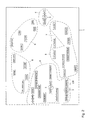
- Figures 1 and 2 show embodiments of the present invention according to a first aspect.
- Figure 1 shows the position of attractors for top-level entity types
- Figure 2 shows the approximate position of attractors for second-level entity types.
- Figure 1 shows details of a visualisation graph 1 wherein a plurality of entities 2 are displayed. Associated with each entity is an attractor 3. The attractors do not appear on the graph to a user, but are schematically depicted as dotted circles 3 .
- the entities 2 are typically modelled as a mass. There is a repulsive force between each pair of entities.
- the repulsive force may be inversely proportional to the distance or the square of the distance, or any other inverse relationship.
- the relations between entities (not shown in Figure 1) are modelled as springs, typically linear springs.
- the model provides damping to ensure that the system converges.
- energy is put into the system, for example, when entities 2 are introduced into the graph or moved, the system is modelled to adopt the lowest energy level.
- the distance and repulsive force is calculated from other entities and nodes. The forces are added to obtain a force vector.
- the reaction of the system in terms of acceleration and deceleration is dependent on the force vector.
- a 360°-approach is proposed.
- the present invention according to this first aspect may be carried out according to one of at least two embodiments.
- a first embodiment is based on a non-deterministic approach, using attractors and repulsive forces.
- a second, alternative embodiment is based on a deterministic approach using a dynamic, but deterministic, subdivision of the screen and screen areas into sectors. The first non-deterministic embodiment is now described:
- the 360° principle may also be used to arrange nodes (refer to Figure 2) in a navigation graph without the use of repulsive forces (which is the case in some conventional visualisation graphs).
- the display which is typically a computer screen, is divided into sectors 4 assigned to the respective top-level entity types 2.
- the size of each sector depends on the number of entities or nodes it contains, including all visible subtypes 6. For example, if a larger number of entities are to be placed in a particular sector, that sector will become larger. It is noted that this embodiment is carried out without repulsion and attractors.
- the sectors are recursively divided into subtype sectors 7 and again, their relative size depends on the number of entities they contain.
- the segmentation of the screen is repeated each time that entities are added to or removed from the graph 1.
- the distance of the entities or nodes to the center of the graph is an oscillating function of the angle in order to avoid collisions (which in the simulative approach are avoided by the repulsive force between entities).
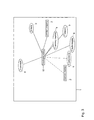
- Figure 3 shows a visualisation graph according to an embodiment of a second aspect of the present invention.
- Figure 3 shows a focus entity 10 with related entities 2 and those comprised in nodes 9, clustered by entity type.
- the dashed lines indicate indirectly related items, "competitors", "market”, selected due to user preferences.
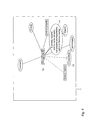
- Figure 4 shows further details of the visualisation graph shown in Figure 3.
- Figure 4 depicts a display of a group's common relations as indicated when a mouse, or other indicator adapted for use with a computer, is passed over the desired node (MouseOver).
- groups of entities 9 with common relations are bundled and displayed as group nodes 9 (Fig. 3). Of all possible groupings those are selected which result in the most even distribution of entities 2(also referred as elements) over the groups and which form groups of entities 2 (elements) which have at least two relations in common.
- the common relations may be explicitly assigned to each entity in a group, but they may also be abstractions of the individual relations.
- This embodiment is shown in Fig. 4, where the common relations of the group " sanitary napkins" are displayed: each of these products has got a relation "refers to German market” and a relation "has property biodegradability". These are direct relations. For example, two products in the group are sold by the company having access to the graph, the remaining products are sold by competing companies. Since the ontology contains the information that all those are companies, a common abstract relation "is sold by some company” is created, which also characterizes the elements of the group.
- the selection code is dynamic resulting in a dynamic grouping of the entities. That is, depending on certain criteria such as the context, the selection and abstraction, if applied, may at different times provide different groupings.
- facets are introduced.
- the user may define facets for each entity type. Facets are predefined groups which are characterized by the entity type of their elements or the kind of relation which connects their elements to the focus entity. In the example, the following facets have been defined for product properties:
- facets are defined, all entities related to the focus entity will be sorted into the corresponding facets (groups) and the dynamic grouping algorithm is used only to subdivide these facets into smaller groups (if possible).
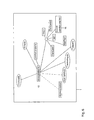
- Figures 5-8 show visualisation graphs according to embodiments of a third aspect of the present invention.
- Figure 5 depicts an exploding group 15, wherein association of members to group remains visible.
- Figure 6 depicts a display of entity type 16 as viewed with the MouseOver function.
- Figure 7 depicts an explosion of a group into subgroups 17.
- Figure 8 depicts the explosion of a subgroup 18.
- an aspect of the present invention allows the formation of groups in a 2D visualisation graph whilst keeping it clear. According to an embodiment of the present invention this is achieved by keeping the space required for the nodes minimal and the origin of the added nodes traceable. Further, the graph is rearranged in a smooth way to avoid confusion of the user. According to an embodiment of the invention, the following steps are taken:
- the resulting representation looks and behaves similar to a "tree view control".
- the main difference is that a tree view represents an existing hierarchical structure, whereas the group nodes in the graph dynamically create a hierarchy-like structure in order to get a clearer graph layout. Also the problem of finding a 2D graph layout does not exist for conventional tree view controls.
- the visualisation graph layout is such that the number of nodes is kept low without missing out potentially relevant information.
- d ⁇ d max the distance is the number of relations on the shortest path between a node and the focus node. Since the number of nodes usually increases exponentially with d max , a value of 1 or 2 is appropriate for most purposes.
- entities of certain types may be included in the graph even if they are far more distant to the focus, if they are considered to be of special interest in the current context either due to their entity type or due to the kind of relations linking them to the focus node.
- the context in this case can be made up, but is not limited, from the following components:
- Figure 9 shows a typical computer arrangement for carrying out the methods according to embodiments of the invention.
- Figure 5 shows a computer 20 including a central processing unit (CPU) 22.
- a display device such as a screen, for displaying a visualisation graph 1.
- the user may use a keyboard 40, mouse 42 or other operating device to communicate with the computer 20 and to instruct the computer to perform a query.
- the database 24 in which data for building the graph may store data locally at the computer 20.
- the database 60 or an additional database may be located remotely from the computer 20.
- the computer is provided with means to remotely access a remote database. For example, using a modem 26 connected via the internet 50 or other network or communications link to the remote database 60.
- the embodiment shown in Figure 9 is a typical internet configuration, other configurations may also be possible. As mentioned, a stand-alone configuration is also envisaged. Further, the database may be distributed over more than one computer. Whilst parts of the processing may be performed on the user's computer, other parts of the processing may be performed remotely at a remote computer.
- the visualisation graph is concerned with aspects of company dealing with personal hygiene products.
- the invention is not limited in this respect.
- the present invention finds application in any sphere where data is to be navigated. In particular, where complex interrelationships of data are to be navigated. Further applications are found where data in one or more databases is somehow related to one another. Further applications include internet applications, where metadata is accessed and used.
- the expression "visualisation graph” is intended to cover visual representations, such as navigation graphs and other such tools.
Landscapes
- Engineering & Computer Science (AREA)
- Databases & Information Systems (AREA)
- Theoretical Computer Science (AREA)
- Computational Linguistics (AREA)
- Data Mining & Analysis (AREA)
- Physics & Mathematics (AREA)
- General Engineering & Computer Science (AREA)
- General Physics & Mathematics (AREA)
- User Interface Of Digital Computer (AREA)
Priority Applications (13)
| Application Number | Priority Date | Filing Date | Title |
|---|---|---|---|
| EP03077697A EP1510937A1 (de) | 2003-08-29 | 2003-08-29 | Verfahren zur Bereitstellung eines Visualisierungsgraphen auf einem Computer und Computer zur Bereitstellung eines Visualisierungsgraphen |
| EP03078583.6A EP1510938B1 (de) | 2003-08-29 | 2003-11-14 | Verfahren zur Bereitstellung eines Visualisierungsgraphen auf einem Computer und Computer zur Bereitstellung eines Visualisierungsgraphen |
| EP03078584A EP1510939A1 (de) | 2003-08-29 | 2003-11-14 | Verfahren zur Bereitstellung eines Visualisierungsgraphen auf einem Computer und Computer zur Bereitstellung eines Visualisierungsgraphen |
| EP03078585A EP1510940A1 (de) | 2003-08-29 | 2003-11-14 | Verfahren zur Bereitstellung eines Visualisierungsgraphen auf einem Computer und Computer zur Bereitstellung eines Visualisierungsgraphen |
| EP03078586A EP1510941A1 (de) | 2003-08-29 | 2003-11-14 | Verfahren zur Bereitstellung eines Visualisierungsgraphen auf einem Computer und Computer zur Bereitstellung eines Visualisierungsgraphen |
| JP2004246056A JP4651329B2 (ja) | 2003-08-29 | 2004-08-26 | 表示画面上に視覚化グラフを提供する方法、それを提供するコンピュータ、そのコンピュータプログラム、及びその記憶媒体 |
| JP2004246055A JP2005100375A (ja) | 2003-08-29 | 2004-08-26 | コンピュータ上で視覚化グラフを提供する方法、および視覚化グラフを提供するコンピュータ |
| JP2004246058A JP4672310B2 (ja) | 2003-08-29 | 2004-08-26 | 表示画面上に視覚化グラフを提供する方法、それを提供するコンピュータ、そのコンピュータプログラム、及びその記憶媒体 |
| JP2004246057A JP4537152B2 (ja) | 2003-08-29 | 2004-08-26 | コンピュータ上で視覚化グラフを提供する方法、および視覚化グラフを提供するコンピュータ、ユーザ端末、コンピュータプログラム及び記憶媒体 |
| US10/927,316 US7720857B2 (en) | 2003-08-29 | 2004-08-27 | Method and system for providing an invisible attractor in a predetermined sector, which attracts a subset of entities depending on an entity type |
| US10/927,315 US7549309B2 (en) | 2003-08-29 | 2004-08-27 | Method and system for restructuring a visualization graph so that entities linked to a common node are replaced by the common node in response to a predetermined stimulus |
| US10/927,458 US7617185B2 (en) | 2003-08-29 | 2004-08-27 | Methods and systems for providing a visualization graph |
| US10/927,313 US7853552B2 (en) | 2003-08-29 | 2004-08-27 | Method and system for increasing a repulsive force between a first node and surrounding nodes in proportion to a number of entities and adding nodes to a visualization graph |
Applications Claiming Priority (1)
| Application Number | Priority Date | Filing Date | Title |
|---|---|---|---|
| EP03077697A EP1510937A1 (de) | 2003-08-29 | 2003-08-29 | Verfahren zur Bereitstellung eines Visualisierungsgraphen auf einem Computer und Computer zur Bereitstellung eines Visualisierungsgraphen |
Publications (1)
| Publication Number | Publication Date |
|---|---|
| EP1510937A1 true EP1510937A1 (de) | 2005-03-02 |
Family
ID=34089670
Family Applications (1)
| Application Number | Title | Priority Date | Filing Date |
|---|---|---|---|
| EP03077697A Ceased EP1510937A1 (de) | 2003-08-29 | 2003-08-29 | Verfahren zur Bereitstellung eines Visualisierungsgraphen auf einem Computer und Computer zur Bereitstellung eines Visualisierungsgraphen |
Country Status (1)
| Country | Link |
|---|---|
| EP (1) | EP1510937A1 (de) |
Cited By (8)
| Publication number | Priority date | Publication date | Assignee | Title |
|---|---|---|---|---|
| US7499928B2 (en) | 2004-10-15 | 2009-03-03 | Microsoft Corporation | Obtaining and displaying information related to a selection within a hierarchical data structure |
| CN102239468A (zh) * | 2008-12-02 | 2011-11-09 | 起元技术有限责任公司 | 可视化数据元素之间的关系以及数据元数据属性的图形表示 |
| US9116603B2 (en) | 2012-12-26 | 2015-08-25 | Ab Initio Technology Llc | Managing interactions with data having membership in multiple groupings |
| US9852153B2 (en) | 2012-09-28 | 2017-12-26 | Ab Initio Technology Llc | Graphically representing programming attributes |
| CN110019540A (zh) * | 2017-07-20 | 2019-07-16 | 阿里巴巴集团控股有限公司 | 企业图谱的实现方法、展示方法及装置、设备 |
| US10402069B2 (en) * | 2007-12-18 | 2019-09-03 | International Business Machines Corporation | Logical zooming of a directed graph |
| CN110647574A (zh) * | 2019-09-24 | 2020-01-03 | 厦门市美亚柏科信息股份有限公司 | 一种社交网络数据展示方法、终端设备及存储介质 |
| US11741091B2 (en) | 2016-12-01 | 2023-08-29 | Ab Initio Technology Llc | Generating, accessing, and displaying lineage metadata |
Citations (1)
| Publication number | Priority date | Publication date | Assignee | Title |
|---|---|---|---|---|
| WO2003069506A2 (en) * | 2002-02-12 | 2003-08-21 | Accenture Global Services Gmbh | Display of data element indicia based on data types |
-
2003
- 2003-08-29 EP EP03077697A patent/EP1510937A1/de not_active Ceased
Patent Citations (1)
| Publication number | Priority date | Publication date | Assignee | Title |
|---|---|---|---|---|
| WO2003069506A2 (en) * | 2002-02-12 | 2003-08-21 | Accenture Global Services Gmbh | Display of data element indicia based on data types |
Non-Patent Citations (9)
| Title |
|---|
| BROCKENAUER R ET AL: "Drawing Clusters and Hierarchies", LECTURE NOTES IN COMPUTER SCIENCE/COMPUTATIONAL SCIENCE (CPAIOR 2011), SPRINGER, DE, vol. 2025 / 2001, 1 June 2003 (2003-06-01), pages 193 - 227, XP002283485, ISBN: 978-3-540-24128-7 * |
| EADES P ET AL: "Navigating Clustered Graphs using Force-Directed Methods", JOURNAL OF GRAPH ALGORITHMS AND APPLICATIONS AND APPLICATIONS, BROWN UNIVERSITY, DEPT. OF COMPUTER SCIENCE, PROVIDENCE, RI, US, vol. 4, no. 3, 1 January 2000 (2000-01-01), pages 157 - 181, XP002284042, ISSN: 1526-1719 * |
| FLUIT C, SABOU M, VAN HARMELEN F: "Ontology-based Information Visualisation", FIFTH INTERNATIONAL CONFERENCE ON INFORMATION VISUALISATION (IV'01), 25 July 2001 (2001-07-25) - 27 July 2001 (2001-07-27), London, England, pages 546 - 559, XP002281069 * |
| GRAHAM J. WILLS: "NicheWorks - Interactive Visualization of Very Large Graphs", 1999, pages 190 - 212, XP007906624, Retrieved from the Internet <URL:http://www.amstat.org/PUBLICATIONS/jcgs/pdf99/wills.pdf> * |
| HERMAN I, MELANÇON G, SCOTT MARSHALL M: "Graph visualization and Navigation in Information Visualization: a Survey", IEEE TRANSACTIONS ON VISUALIZATION AND COMPUTER GRAPHICS, vol. 6, no. 1, 2000, pages 24 - 43, XP002281070 * |
| MUTTON P ET AL: "Visualization of semantic metadata and ontologies", SEVENTH INTERNATIONAL CONFERENCE ON INFORMATION VISUALISATION, 16 July 2003 (2003-07-16), pages 300 - 305, XP010648515 * |
| QUANG VINH NGUYEN; MAO LIN HUANG: "A space-optimized tree visualization", INFORMATION VISUALIZATION, 2002. INFOVIS 2002. IEEE SYMPOSIUM, 28 October 2002 (2002-10-28) - 29 October 2002 (2002-10-29), XP010625077 * |
| ROTH A: "Modellierung und Anwendung von Ontologien am Beispiel "Operations Research & Management Science"", 12 July 2002, UNIVERSITÄT PADERBORN, PADERBORN, GERMANY, XP002281071 * |
| XIAOBO WANG ET AL: "Generating customized layouts", 20 September 1995, GRAPH DRAWING. SYMPOSIUM ON GRAPH DRAWING, (PROCEEDINGS OF GRAPH DRAWING '95 - 20-22 SEPT. 1995 - PASSAU, GERMANY), SPRINGER BERLIN HEIDELBERG, BERLIN, HEIDELBERG, PAGE(S) 504 - 515, ISBN: 978-3-540-60723-6, XP019189981 * |
Cited By (18)
| Publication number | Priority date | Publication date | Assignee | Title |
|---|---|---|---|---|
| US7499928B2 (en) | 2004-10-15 | 2009-03-03 | Microsoft Corporation | Obtaining and displaying information related to a selection within a hierarchical data structure |
| US11175810B2 (en) * | 2007-12-18 | 2021-11-16 | International Business Machines Corporation | Logical zooming of a directed graph |
| US10402069B2 (en) * | 2007-12-18 | 2019-09-03 | International Business Machines Corporation | Logical zooming of a directed graph |
| US20190384486A1 (en) * | 2007-12-18 | 2019-12-19 | International Business Machine Corporation | Logical zooming of a directed graph |
| US11354346B2 (en) | 2008-12-02 | 2022-06-07 | Ab Initio Technology Llc | Visualizing relationships between data elements and graphical representations of data element attributes |
| US10860635B2 (en) | 2008-12-02 | 2020-12-08 | Ab Initio Technology Llc | Visualizing relationships between data elements |
| US10191904B2 (en) | 2008-12-02 | 2019-01-29 | Ab Initio Technology Llc | Visualizing relationships between data elements and graphical representations of data element attributes |
| US9875241B2 (en) | 2008-12-02 | 2018-01-23 | Ab Initio Technology Llc | Visualizing relationships between data elements and graphical representations of data element attributes |
| CN102239468A (zh) * | 2008-12-02 | 2011-11-09 | 起元技术有限责任公司 | 可视化数据元素之间的关系以及数据元数据属性的图形表示 |
| US9767100B2 (en) | 2008-12-02 | 2017-09-19 | Ab Initio Technology Llc | Visualizing relationships between data elements |
| US9852153B2 (en) | 2012-09-28 | 2017-12-26 | Ab Initio Technology Llc | Graphically representing programming attributes |
| US9116603B2 (en) | 2012-12-26 | 2015-08-25 | Ab Initio Technology Llc | Managing interactions with data having membership in multiple groupings |
| US11741091B2 (en) | 2016-12-01 | 2023-08-29 | Ab Initio Technology Llc | Generating, accessing, and displaying lineage metadata |
| US12405949B2 (en) | 2016-12-01 | 2025-09-02 | Ab Initio Technology Llc | Generating, accessing, and displaying lineage metadata |
| CN110019540A (zh) * | 2017-07-20 | 2019-07-16 | 阿里巴巴集团控股有限公司 | 企业图谱的实现方法、展示方法及装置、设备 |
| CN110019540B (zh) * | 2017-07-20 | 2023-09-29 | 阿里巴巴集团控股有限公司 | 企业图谱的实现方法、展示方法及装置、设备 |
| CN110647574A (zh) * | 2019-09-24 | 2020-01-03 | 厦门市美亚柏科信息股份有限公司 | 一种社交网络数据展示方法、终端设备及存储介质 |
| CN110647574B (zh) * | 2019-09-24 | 2022-05-03 | 厦门市美亚柏科信息股份有限公司 | 一种社交网络数据展示方法、终端设备及存储介质 |
Similar Documents
| Publication | Publication Date | Title |
|---|---|---|
| US7853552B2 (en) | Method and system for increasing a repulsive force between a first node and surrounding nodes in proportion to a number of entities and adding nodes to a visualization graph | |
| US7720857B2 (en) | Method and system for providing an invisible attractor in a predetermined sector, which attracts a subset of entities depending on an entity type | |
| US7549309B2 (en) | Method and system for restructuring a visualization graph so that entities linked to a common node are replaced by the common node in response to a predetermined stimulus | |
| EP1510941A1 (de) | Verfahren zur Bereitstellung eines Visualisierungsgraphen auf einem Computer und Computer zur Bereitstellung eines Visualisierungsgraphen | |
| JP4355050B2 (ja) | 関連する一連のグラフ間の変形を視覚化する方法、装置並びに媒体 | |
| Carr | Guidelines for designing information visualization applications | |
| JP4223133B2 (ja) | タイムチューブおよび円形木を用いたインタラクティブな活性化拡散視覚化方法、装置並びに媒体 | |
| JP4355049B2 (ja) | 一般化されたグラフ構造の使用度ベースの巡回および表示方法、装置並びに媒体 | |
| CA2596068C (en) | Providing a dynamic user interface for a dense three-dimensional scene | |
| WO2011142720A1 (en) | A self-organizing and contextual graphical user interface | |
| CA2357286A1 (en) | Graphical user interface graphics-based interpolated animation performance | |
| JP2016167303A (ja) | 誘引に基づくデータ可視化 | |
| Andrienko et al. | Intelligent support for geographic data analysis and decision making in the Web | |
| EP1510937A1 (de) | Verfahren zur Bereitstellung eines Visualisierungsgraphen auf einem Computer und Computer zur Bereitstellung eines Visualisierungsgraphen | |
| Vande Moere et al. | Visualizing abstract information using motion properties of data-driven infoticles | |
| JP2009211406A (ja) | Web閲覧履歴表示装置及び方法及びプログラム及びコンピュータ読取可能な記録媒体 | |
| Freire et al. | A graph-based interface to complex hypermedia structure visualization | |
| Musial et al. | Application of focus+ context to UML | |
| Wilkins et al. | EvolutionWorks: Towards improved visualization of citation networks | |
| Greffard et al. | Immersive dynamic visualization of interactions in a social network | |
| Roep | Implementing Layout Algorithms Using Cytoscape in ExplorViz | |
| Noppens et al. | Interactive visualization of large OWL instance sets | |
| Noppens et al. | Understanding Large Volumes of Interconnected Individuals by Visual Exploration: (System Description) | |
| Stedile | JMFGraph: a modular framework for drawing graphs in JAVA | |
| Bichler | Visualization framework for information graphs: an incremental approach |
Legal Events
| Date | Code | Title | Description |
|---|---|---|---|
| PUAI | Public reference made under article 153(3) epc to a published international application that has entered the european phase |
Free format text: ORIGINAL CODE: 0009012 |
|
| AK | Designated contracting states |
Kind code of ref document: A1 Designated state(s): AT BE BG CH CY CZ DE DK EE ES FI FR GB GR HU IE IT LI LU MC NL PT RO SE SI SK TR |
|
| AX | Request for extension of the european patent |
Extension state: AL LT LV MK |
|
| 17P | Request for examination filed |
Effective date: 20050623 |
|
| AKX | Designation fees paid |
Designated state(s): AT BE BG CH CY CZ DE DK EE ES FI FR GB GR HU IE IT LI LU MC NL PT RO SE SI SK TR |
|
| RAP1 | Party data changed (applicant data changed or rights of an application transferred) |
Owner name: SAP AG |
|
| 17Q | First examination report despatched |
Effective date: 20061026 |
|
| STAA | Information on the status of an ep patent application or granted ep patent |
Free format text: STATUS: THE APPLICATION HAS BEEN REFUSED |
|
| 18R | Application refused |
Effective date: 20130526 |