EP1510998A2 - Dispositif émetteur d'électrons, source lumineuse et dispositif d'affichage d'images - Google Patents
Dispositif émetteur d'électrons, source lumineuse et dispositif d'affichage d'images Download PDFInfo
- Publication number
- EP1510998A2 EP1510998A2 EP20040255005 EP04255005A EP1510998A2 EP 1510998 A2 EP1510998 A2 EP 1510998A2 EP 20040255005 EP20040255005 EP 20040255005 EP 04255005 A EP04255005 A EP 04255005A EP 1510998 A2 EP1510998 A2 EP 1510998A2
- Authority
- EP
- European Patent Office
- Prior art keywords
- emitter
- electrons
- electrode
- light source
- electron
- Prior art date
- Legal status (The legal status is an assumption and is not a legal conclusion. Google has not performed a legal analysis and makes no representation as to the accuracy of the status listed.)
- Withdrawn
Links
- 239000000463 material Substances 0.000 claims description 51
- 230000010287 polarization Effects 0.000 claims description 43
- 239000003989 dielectric material Substances 0.000 claims description 34
- 230000002093 peripheral effect Effects 0.000 claims description 30
- 239000000126 substance Substances 0.000 claims description 4
- 230000002441 reversible effect Effects 0.000 abstract description 11
- 239000003990 capacitor Substances 0.000 description 106
- 230000004048 modification Effects 0.000 description 73
- 238000012986 modification Methods 0.000 description 73
- 238000000034 method Methods 0.000 description 70
- 230000008569 process Effects 0.000 description 64
- 230000005684 electric field Effects 0.000 description 46
- 238000010586 diagram Methods 0.000 description 43
- BASFCYQUMIYNBI-UHFFFAOYSA-N platinum Chemical compound [Pt] BASFCYQUMIYNBI-UHFFFAOYSA-N 0.000 description 43
- 239000000758 substrate Substances 0.000 description 40
- OAICVXFJPJFONN-UHFFFAOYSA-N Phosphorus Chemical compound [P] OAICVXFJPJFONN-UHFFFAOYSA-N 0.000 description 39
- 230000001965 increasing effect Effects 0.000 description 32
- 239000000919 ceramic Substances 0.000 description 30
- KDLHZDBZIXYQEI-UHFFFAOYSA-N Palladium Chemical compound [Pd] KDLHZDBZIXYQEI-UHFFFAOYSA-N 0.000 description 21
- 239000010408 film Substances 0.000 description 20
- 238000009825 accumulation Methods 0.000 description 19
- 239000000203 mixture Substances 0.000 description 19
- 230000008859 change Effects 0.000 description 18
- 229910052697 platinum Inorganic materials 0.000 description 18
- 239000011575 calcium Substances 0.000 description 15
- RVTZCBVAJQQJTK-UHFFFAOYSA-N oxygen(2-);zirconium(4+) Chemical compound [O-2].[O-2].[Zr+4] RVTZCBVAJQQJTK-UHFFFAOYSA-N 0.000 description 14
- 229910001928 zirconium oxide Inorganic materials 0.000 description 14
- 150000002500 ions Chemical class 0.000 description 13
- 229910052751 metal Inorganic materials 0.000 description 13
- 239000002184 metal Substances 0.000 description 13
- 238000009826 distribution Methods 0.000 description 11
- 238000005229 chemical vapour deposition Methods 0.000 description 10
- 230000006870 function Effects 0.000 description 10
- -1 electrophoresis Substances 0.000 description 9
- 239000011521 glass Substances 0.000 description 9
- 239000002245 particle Substances 0.000 description 9
- 230000008901 benefit Effects 0.000 description 8
- 150000001875 compounds Chemical class 0.000 description 8
- 229920006395 saturated elastomer Polymers 0.000 description 8
- 238000005245 sintering Methods 0.000 description 8
- 239000010409 thin film Substances 0.000 description 8
- 238000001704 evaporation Methods 0.000 description 7
- 230000008020 evaporation Effects 0.000 description 7
- 238000007667 floating Methods 0.000 description 7
- 230000008018 melting Effects 0.000 description 7
- 238000002844 melting Methods 0.000 description 7
- 230000009467 reduction Effects 0.000 description 7
- 238000004544 sputter deposition Methods 0.000 description 7
- ZOKXTWBITQBERF-UHFFFAOYSA-N Molybdenum Chemical compound [Mo] ZOKXTWBITQBERF-UHFFFAOYSA-N 0.000 description 6
- VYPSYNLAJGMNEJ-UHFFFAOYSA-N Silicium dioxide Chemical compound O=[Si]=O VYPSYNLAJGMNEJ-UHFFFAOYSA-N 0.000 description 6
- 229910045601 alloy Inorganic materials 0.000 description 6
- 239000000956 alloy Substances 0.000 description 6
- RKTYLMNFRDHKIL-UHFFFAOYSA-N copper;5,10,15,20-tetraphenylporphyrin-22,24-diide Chemical compound [Cu+2].C1=CC(C(=C2C=CC([N-]2)=C(C=2C=CC=CC=2)C=2C=CC(N=2)=C(C=2C=CC=CC=2)C2=CC=C3[N-]2)C=2C=CC=CC=2)=NC1=C3C1=CC=CC=C1 RKTYLMNFRDHKIL-UHFFFAOYSA-N 0.000 description 6
- NKZSPGSOXYXWQA-UHFFFAOYSA-N dioxido(oxo)titanium;lead(2+) Chemical compound [Pb+2].[O-][Ti]([O-])=O NKZSPGSOXYXWQA-UHFFFAOYSA-N 0.000 description 6
- 229910052750 molybdenum Inorganic materials 0.000 description 6
- 239000011733 molybdenum Substances 0.000 description 6
- TWNQGVIAIRXVLR-UHFFFAOYSA-N oxo(oxoalumanyloxy)alumane Chemical compound O=[Al]O[Al]=O TWNQGVIAIRXVLR-UHFFFAOYSA-N 0.000 description 6
- OKTJSMMVPCPJKN-UHFFFAOYSA-N Carbon Chemical compound [C] OKTJSMMVPCPJKN-UHFFFAOYSA-N 0.000 description 5
- 239000011248 coating agent Substances 0.000 description 5
- 238000000576 coating method Methods 0.000 description 5
- 238000007598 dipping method Methods 0.000 description 5
- 238000001962 electrophoresis Methods 0.000 description 5
- 238000010304 firing Methods 0.000 description 5
- 238000010438 heat treatment Methods 0.000 description 5
- 238000007733 ion plating Methods 0.000 description 5
- 238000010884 ion-beam technique Methods 0.000 description 5
- ZBSCCQXBYNSKPV-UHFFFAOYSA-N oxolead;oxomagnesium;2,4,5-trioxa-1$l^{5},3$l^{5}-diniobabicyclo[1.1.1]pentane 1,3-dioxide Chemical compound [Mg]=O.[Pb]=O.[Pb]=O.[Pb]=O.O1[Nb]2(=O)O[Nb]1(=O)O2 ZBSCCQXBYNSKPV-UHFFFAOYSA-N 0.000 description 5
- 238000007747 plating Methods 0.000 description 5
- 230000004044 response Effects 0.000 description 5
- 238000007650 screen-printing Methods 0.000 description 5
- 229910052712 strontium Inorganic materials 0.000 description 5
- CIOAGBVUUVVLOB-UHFFFAOYSA-N strontium atom Chemical compound [Sr] CIOAGBVUUVVLOB-UHFFFAOYSA-N 0.000 description 5
- 238000007738 vacuum evaporation Methods 0.000 description 5
- PXHVJJICTQNCMI-UHFFFAOYSA-N Nickel Chemical compound [Ni] PXHVJJICTQNCMI-UHFFFAOYSA-N 0.000 description 4
- 239000000654 additive Substances 0.000 description 4
- 230000000996 additive effect Effects 0.000 description 4
- 229910002113 barium titanate Inorganic materials 0.000 description 4
- 239000004020 conductor Substances 0.000 description 4
- 238000002474 experimental method Methods 0.000 description 4
- 230000001976 improved effect Effects 0.000 description 4
- HEPLMSKRHVKCAQ-UHFFFAOYSA-N lead nickel Chemical compound [Ni].[Pb] HEPLMSKRHVKCAQ-UHFFFAOYSA-N 0.000 description 4
- 239000011572 manganese Substances 0.000 description 4
- QSHDDOUJBYECFT-UHFFFAOYSA-N mercury Chemical compound [Hg] QSHDDOUJBYECFT-UHFFFAOYSA-N 0.000 description 4
- 229910052753 mercury Inorganic materials 0.000 description 4
- SIWVEOZUMHYXCS-UHFFFAOYSA-N oxo(oxoyttriooxy)yttrium Chemical compound O=[Y]O[Y]=O SIWVEOZUMHYXCS-UHFFFAOYSA-N 0.000 description 4
- 229910052763 palladium Inorganic materials 0.000 description 4
- 125000006850 spacer group Chemical group 0.000 description 4
- WFKWXMTUELFFGS-UHFFFAOYSA-N tungsten Chemical compound [W] WFKWXMTUELFFGS-UHFFFAOYSA-N 0.000 description 4
- 229910052721 tungsten Inorganic materials 0.000 description 4
- 239000010937 tungsten Substances 0.000 description 4
- 239000000443 aerosol Substances 0.000 description 3
- 230000002238 attenuated effect Effects 0.000 description 3
- JRPBQTZRNDNNOP-UHFFFAOYSA-N barium titanate Chemical compound [Ba+2].[Ba+2].[O-][Ti]([O-])([O-])[O-] JRPBQTZRNDNNOP-UHFFFAOYSA-N 0.000 description 3
- 229910052791 calcium Inorganic materials 0.000 description 3
- 229910052799 carbon Inorganic materials 0.000 description 3
- 239000013078 crystal Substances 0.000 description 3
- 230000007423 decrease Effects 0.000 description 3
- 238000000151 deposition Methods 0.000 description 3
- 230000008021 deposition Effects 0.000 description 3
- 229910052746 lanthanum Inorganic materials 0.000 description 3
- FZLIPJUXYLNCLC-UHFFFAOYSA-N lanthanum atom Chemical compound [La] FZLIPJUXYLNCLC-UHFFFAOYSA-N 0.000 description 3
- CPLXHLVBOLITMK-UHFFFAOYSA-N magnesium oxide Inorganic materials [Mg]=O CPLXHLVBOLITMK-UHFFFAOYSA-N 0.000 description 3
- 239000000395 magnesium oxide Substances 0.000 description 3
- AXZKOIWUVFPNLO-UHFFFAOYSA-N magnesium;oxygen(2-) Chemical compound [O-2].[Mg+2] AXZKOIWUVFPNLO-UHFFFAOYSA-N 0.000 description 3
- 238000004519 manufacturing process Methods 0.000 description 3
- 239000010955 niobium Substances 0.000 description 3
- 230000008054 signal transmission Effects 0.000 description 3
- 230000007704 transition Effects 0.000 description 3
- 239000004925 Acrylic resin Substances 0.000 description 2
- 229920000178 Acrylic resin Polymers 0.000 description 2
- 229910001316 Ag alloy Inorganic materials 0.000 description 2
- OYPRJOBELJOOCE-UHFFFAOYSA-N Calcium Chemical compound [Ca] OYPRJOBELJOOCE-UHFFFAOYSA-N 0.000 description 2
- 229910002269 La1–xCaxMnO3 Inorganic materials 0.000 description 2
- 229910002273 La1–xSrxCoO3 Inorganic materials 0.000 description 2
- FYYHWMGAXLPEAU-UHFFFAOYSA-N Magnesium Chemical compound [Mg] FYYHWMGAXLPEAU-UHFFFAOYSA-N 0.000 description 2
- PWHULOQIROXLJO-UHFFFAOYSA-N Manganese Chemical compound [Mn] PWHULOQIROXLJO-UHFFFAOYSA-N 0.000 description 2
- 229910001252 Pd alloy Inorganic materials 0.000 description 2
- 229910052581 Si3N4 Inorganic materials 0.000 description 2
- BQCADISMDOOEFD-UHFFFAOYSA-N Silver Chemical compound [Ag] BQCADISMDOOEFD-UHFFFAOYSA-N 0.000 description 2
- GWEVSGVZZGPLCZ-UHFFFAOYSA-N Titan oxide Chemical compound O=[Ti]=O GWEVSGVZZGPLCZ-UHFFFAOYSA-N 0.000 description 2
- HCHKCACWOHOZIP-UHFFFAOYSA-N Zinc Chemical compound [Zn] HCHKCACWOHOZIP-UHFFFAOYSA-N 0.000 description 2
- 229910052787 antimony Inorganic materials 0.000 description 2
- WATWJIUSRGPENY-UHFFFAOYSA-N antimony atom Chemical compound [Sb] WATWJIUSRGPENY-UHFFFAOYSA-N 0.000 description 2
- 229910052788 barium Inorganic materials 0.000 description 2
- DSAJWYNOEDNPEQ-UHFFFAOYSA-N barium atom Chemical compound [Ba] DSAJWYNOEDNPEQ-UHFFFAOYSA-N 0.000 description 2
- 238000004364 calculation method Methods 0.000 description 2
- 230000015556 catabolic process Effects 0.000 description 2
- CETPSERCERDGAM-UHFFFAOYSA-N ceric oxide Chemical compound O=[Ce]=O CETPSERCERDGAM-UHFFFAOYSA-N 0.000 description 2
- 229910000422 cerium(IV) oxide Inorganic materials 0.000 description 2
- 239000011195 cermet Substances 0.000 description 2
- 238000006243 chemical reaction Methods 0.000 description 2
- 229910017052 cobalt Inorganic materials 0.000 description 2
- 239000010941 cobalt Substances 0.000 description 2
- GUTLYIVDDKVIGB-UHFFFAOYSA-N cobalt atom Chemical compound [Co] GUTLYIVDDKVIGB-UHFFFAOYSA-N 0.000 description 2
- 229910052681 coesite Inorganic materials 0.000 description 2
- 239000012141 concentrate Substances 0.000 description 2
- PMHQVHHXPFUNSP-UHFFFAOYSA-M copper(1+);methylsulfanylmethane;bromide Chemical compound Br[Cu].CSC PMHQVHHXPFUNSP-UHFFFAOYSA-M 0.000 description 2
- 229910052906 cristobalite Inorganic materials 0.000 description 2
- CJXLIMFTIKVMQN-UHFFFAOYSA-N dimagnesium;oxygen(2-);tantalum(5+) Chemical compound [O-2].[O-2].[O-2].[O-2].[O-2].[O-2].[O-2].[Mg+2].[Mg+2].[Ta+5].[Ta+5] CJXLIMFTIKVMQN-UHFFFAOYSA-N 0.000 description 2
- HTXDPTMKBJXEOW-UHFFFAOYSA-N dioxoiridium Chemical compound O=[Ir]=O HTXDPTMKBJXEOW-UHFFFAOYSA-N 0.000 description 2
- KZHJGOXRZJKJNY-UHFFFAOYSA-N dioxosilane;oxo(oxoalumanyloxy)alumane Chemical compound O=[Si]=O.O=[Si]=O.O=[Al]O[Al]=O.O=[Al]O[Al]=O.O=[Al]O[Al]=O KZHJGOXRZJKJNY-UHFFFAOYSA-N 0.000 description 2
- 238000001312 dry etching Methods 0.000 description 2
- 239000007772 electrode material Substances 0.000 description 2
- 238000005516 engineering process Methods 0.000 description 2
- 238000005530 etching Methods 0.000 description 2
- 239000003779 heat-resistant material Substances 0.000 description 2
- 229910052741 iridium Inorganic materials 0.000 description 2
- GKOZUEZYRPOHIO-UHFFFAOYSA-N iridium atom Chemical compound [Ir] GKOZUEZYRPOHIO-UHFFFAOYSA-N 0.000 description 2
- MRELNEQAGSRDBK-UHFFFAOYSA-N lanthanum(3+);oxygen(2-) Chemical compound [O-2].[O-2].[O-2].[La+3].[La+3] MRELNEQAGSRDBK-UHFFFAOYSA-N 0.000 description 2
- LQBJWKCYZGMFEV-UHFFFAOYSA-N lead tin Chemical compound [Sn].[Pb] LQBJWKCYZGMFEV-UHFFFAOYSA-N 0.000 description 2
- JQJCSZOEVBFDKO-UHFFFAOYSA-N lead zinc Chemical compound [Zn].[Pb] JQJCSZOEVBFDKO-UHFFFAOYSA-N 0.000 description 2
- 239000004973 liquid crystal related substance Substances 0.000 description 2
- 229910052749 magnesium Inorganic materials 0.000 description 2
- 239000011777 magnesium Substances 0.000 description 2
- 229910052748 manganese Inorganic materials 0.000 description 2
- WPBNNNQJVZRUHP-UHFFFAOYSA-L manganese(2+);methyl n-[[2-(methoxycarbonylcarbamothioylamino)phenyl]carbamothioyl]carbamate;n-[2-(sulfidocarbothioylamino)ethyl]carbamodithioate Chemical compound [Mn+2].[S-]C(=S)NCCNC([S-])=S.COC(=O)NC(=S)NC1=CC=CC=C1NC(=S)NC(=O)OC WPBNNNQJVZRUHP-UHFFFAOYSA-L 0.000 description 2
- 239000011159 matrix material Substances 0.000 description 2
- 230000003446 memory effect Effects 0.000 description 2
- 229910052863 mullite Inorganic materials 0.000 description 2
- 230000007935 neutral effect Effects 0.000 description 2
- 229910052759 nickel Inorganic materials 0.000 description 2
- 229910052758 niobium Inorganic materials 0.000 description 2
- GUCVJGMIXFAOAE-UHFFFAOYSA-N niobium atom Chemical compound [Nb] GUCVJGMIXFAOAE-UHFFFAOYSA-N 0.000 description 2
- 230000001590 oxidative effect Effects 0.000 description 2
- 229920003217 poly(methylsilsesquioxane) Polymers 0.000 description 2
- 239000010970 precious metal Substances 0.000 description 2
- 229910052703 rhodium Inorganic materials 0.000 description 2
- 239000010948 rhodium Substances 0.000 description 2
- MHOVAHRLVXNVSD-UHFFFAOYSA-N rhodium atom Chemical compound [Rh] MHOVAHRLVXNVSD-UHFFFAOYSA-N 0.000 description 2
- WOCIAKWEIIZHES-UHFFFAOYSA-N ruthenium(iv) oxide Chemical compound O=[Ru]=O WOCIAKWEIIZHES-UHFFFAOYSA-N 0.000 description 2
- 238000004904 shortening Methods 0.000 description 2
- 239000000377 silicon dioxide Substances 0.000 description 2
- HQVNEWCFYHHQES-UHFFFAOYSA-N silicon nitride Chemical compound N12[Si]34N5[Si]62N3[Si]51N64 HQVNEWCFYHHQES-UHFFFAOYSA-N 0.000 description 2
- 229910052814 silicon oxide Inorganic materials 0.000 description 2
- 229910052709 silver Inorganic materials 0.000 description 2
- 239000004332 silver Substances 0.000 description 2
- 239000007787 solid Substances 0.000 description 2
- 229910052596 spinel Inorganic materials 0.000 description 2
- 239000011029 spinel Substances 0.000 description 2
- 238000005507 spraying Methods 0.000 description 2
- 239000003381 stabilizer Substances 0.000 description 2
- 229910052682 stishovite Inorganic materials 0.000 description 2
- OGIDPMRJRNCKJF-UHFFFAOYSA-N titanium oxide Inorganic materials [Ti]=O OGIDPMRJRNCKJF-UHFFFAOYSA-N 0.000 description 2
- 229910052905 tridymite Inorganic materials 0.000 description 2
- 238000001039 wet etching Methods 0.000 description 2
- 229910052725 zinc Inorganic materials 0.000 description 2
- 239000011701 zinc Substances 0.000 description 2
- BHPQYMZQTOCNFJ-UHFFFAOYSA-N Calcium cation Chemical compound [Ca+2] BHPQYMZQTOCNFJ-UHFFFAOYSA-N 0.000 description 1
- 229910002353 SrRuO3 Inorganic materials 0.000 description 1
- 239000000853 adhesive Substances 0.000 description 1
- 230000001070 adhesive effect Effects 0.000 description 1
- 238000013459 approach Methods 0.000 description 1
- XDFCIPNJCBUZJN-UHFFFAOYSA-N barium(2+) Chemical compound [Ba+2] XDFCIPNJCBUZJN-UHFFFAOYSA-N 0.000 description 1
- 229910000416 bismuth oxide Inorganic materials 0.000 description 1
- 230000004397 blinking Effects 0.000 description 1
- 229910052810 boron oxide Inorganic materials 0.000 description 1
- 239000005388 borosilicate glass Substances 0.000 description 1
- BRPQOXSCLDDYGP-UHFFFAOYSA-N calcium oxide Chemical compound [O-2].[Ca+2] BRPQOXSCLDDYGP-UHFFFAOYSA-N 0.000 description 1
- ODINCKMPIJJUCX-UHFFFAOYSA-N calcium oxide Inorganic materials [Ca]=O ODINCKMPIJJUCX-UHFFFAOYSA-N 0.000 description 1
- 239000000292 calcium oxide Substances 0.000 description 1
- 229910021393 carbon nanotube Inorganic materials 0.000 description 1
- 239000002041 carbon nanotube Substances 0.000 description 1
- 229910010293 ceramic material Inorganic materials 0.000 description 1
- 229910000420 cerium oxide Inorganic materials 0.000 description 1
- 239000004927 clay Substances 0.000 description 1
- 238000004891 communication Methods 0.000 description 1
- 239000000470 constituent Substances 0.000 description 1
- 230000003247 decreasing effect Effects 0.000 description 1
- 230000007547 defect Effects 0.000 description 1
- 230000002950 deficient Effects 0.000 description 1
- 238000000280 densification Methods 0.000 description 1
- 230000001419 dependent effect Effects 0.000 description 1
- 229910003460 diamond Inorganic materials 0.000 description 1
- 239000010432 diamond Substances 0.000 description 1
- TYIXMATWDRGMPF-UHFFFAOYSA-N dibismuth;oxygen(2-) Chemical compound [O-2].[O-2].[O-2].[Bi+3].[Bi+3] TYIXMATWDRGMPF-UHFFFAOYSA-N 0.000 description 1
- JKWMSGQKBLHBQQ-UHFFFAOYSA-N diboron trioxide Chemical compound O=BOB=O JKWMSGQKBLHBQQ-UHFFFAOYSA-N 0.000 description 1
- IVUXZQJWTQMSQN-UHFFFAOYSA-N distrontium;oxygen(2-);tantalum(5+) Chemical compound [O-2].[O-2].[O-2].[O-2].[O-2].[O-2].[O-2].[Sr+2].[Sr+2].[Ta+5].[Ta+5] IVUXZQJWTQMSQN-UHFFFAOYSA-N 0.000 description 1
- 239000012777 electrically insulating material Substances 0.000 description 1
- 238000010894 electron beam technology Methods 0.000 description 1
- 229910002804 graphite Inorganic materials 0.000 description 1
- 239000010439 graphite Substances 0.000 description 1
- 230000001939 inductive effect Effects 0.000 description 1
- 229910000457 iridium oxide Inorganic materials 0.000 description 1
- 230000001788 irregular Effects 0.000 description 1
- 238000005304 joining Methods 0.000 description 1
- HFGPZNIAWCZYJU-UHFFFAOYSA-N lead zirconate titanate Chemical compound [O-2].[O-2].[O-2].[O-2].[O-2].[Ti+4].[Zr+4].[Pb+2] HFGPZNIAWCZYJU-UHFFFAOYSA-N 0.000 description 1
- RVPVRDXYQKGNMQ-UHFFFAOYSA-N lead(2+) Chemical compound [Pb+2] RVPVRDXYQKGNMQ-UHFFFAOYSA-N 0.000 description 1
- 230000007246 mechanism Effects 0.000 description 1
- 238000005459 micromachining Methods 0.000 description 1
- BMMGVYCKOGBVEV-UHFFFAOYSA-N oxo(oxoceriooxy)cerium Chemical compound [Ce]=O.O=[Ce]=O BMMGVYCKOGBVEV-UHFFFAOYSA-N 0.000 description 1
- UZLYXNNZYFBAQO-UHFFFAOYSA-N oxygen(2-);ytterbium(3+) Chemical compound [O-2].[O-2].[O-2].[Yb+3].[Yb+3] UZLYXNNZYFBAQO-UHFFFAOYSA-N 0.000 description 1
- 230000001737 promoting effect Effects 0.000 description 1
- 229910052761 rare earth metal Inorganic materials 0.000 description 1
- 150000002910 rare earth metals Chemical class 0.000 description 1
- 229910001925 ruthenium oxide Inorganic materials 0.000 description 1
- HYXGAEYDKFCVMU-UHFFFAOYSA-N scandium oxide Chemical compound O=[Sc]O[Sc]=O HYXGAEYDKFCVMU-UHFFFAOYSA-N 0.000 description 1
- 239000004065 semiconductor Substances 0.000 description 1
- 238000004088 simulation Methods 0.000 description 1
- PWYYWQHXAPXYMF-UHFFFAOYSA-N strontium(2+) Chemical compound [Sr+2] PWYYWQHXAPXYMF-UHFFFAOYSA-N 0.000 description 1
- 230000008093 supporting effect Effects 0.000 description 1
- 230000002459 sustained effect Effects 0.000 description 1
- 239000010936 titanium Substances 0.000 description 1
- 238000010792 warming Methods 0.000 description 1
- 229910003454 ytterbium oxide Inorganic materials 0.000 description 1
- 229940075624 ytterbium oxide Drugs 0.000 description 1
Images

























Classifications
-
- H—ELECTRICITY
- H01—ELECTRIC ELEMENTS
- H01J—ELECTRIC DISCHARGE TUBES OR DISCHARGE LAMPS
- H01J1/00—Details of electrodes, of magnetic control means, of screens, or of the mounting or spacing thereof, common to two or more basic types of discharge tubes or lamps
- H01J1/02—Main electrodes
- H01J1/30—Cold cathodes, e.g. field-emissive cathode
- H01J1/312—Cold cathodes, e.g. field-emissive cathode having an electric field perpendicular to the surface, e.g. tunnel-effect cathodes of metal-insulator-metal [MIM] type
-
- B—PERFORMING OPERATIONS; TRANSPORTING
- B82—NANOTECHNOLOGY
- B82Y—SPECIFIC USES OR APPLICATIONS OF NANOSTRUCTURES; MEASUREMENT OR ANALYSIS OF NANOSTRUCTURES; MANUFACTURE OR TREATMENT OF NANOSTRUCTURES
- B82Y10/00—Nanotechnology for information processing, storage or transmission, e.g. quantum computing or single electron logic
-
- G—PHYSICS
- G09—EDUCATION; CRYPTOGRAPHY; DISPLAY; ADVERTISING; SEALS
- G09G—ARRANGEMENTS OR CIRCUITS FOR CONTROL OF INDICATING DEVICES USING STATIC MEANS TO PRESENT VARIABLE INFORMATION
- G09G3/00—Control arrangements or circuits, of interest only in connection with visual indicators other than cathode-ray tubes
- G09G3/20—Control arrangements or circuits, of interest only in connection with visual indicators other than cathode-ray tubes for presentation of an assembly of a number of characters, e.g. a page, by composing the assembly by combination of individual elements arranged in a matrix no fixed position being assigned to or needed to be assigned to the individual characters or partial characters
- G09G3/22—Control arrangements or circuits, of interest only in connection with visual indicators other than cathode-ray tubes for presentation of an assembly of a number of characters, e.g. a page, by composing the assembly by combination of individual elements arranged in a matrix no fixed position being assigned to or needed to be assigned to the individual characters or partial characters using controlled light sources
-
- H—ELECTRICITY
- H01—ELECTRIC ELEMENTS
- H01J—ELECTRIC DISCHARGE TUBES OR DISCHARGE LAMPS
- H01J1/00—Details of electrodes, of magnetic control means, of screens, or of the mounting or spacing thereof, common to two or more basic types of discharge tubes or lamps
- H01J1/02—Main electrodes
- H01J1/32—Secondary-electron-emitting electrodes
-
- H—ELECTRICITY
- H01—ELECTRIC ELEMENTS
- H01J—ELECTRIC DISCHARGE TUBES OR DISCHARGE LAMPS
- H01J31/00—Cathode ray tubes; Electron beam tubes
- H01J31/08—Cathode ray tubes; Electron beam tubes having a screen on or from which an image or pattern is formed, picked up, converted, or stored
- H01J31/10—Image or pattern display tubes, i.e. having electrical input and optical output; Flying-spot tubes for scanning purposes
- H01J31/12—Image or pattern display tubes, i.e. having electrical input and optical output; Flying-spot tubes for scanning purposes with luminescent screen
- H01J31/123—Flat display tubes
- H01J31/125—Flat display tubes provided with control means permitting the electron beam to reach selected parts of the screen, e.g. digital selection
- H01J31/127—Flat display tubes provided with control means permitting the electron beam to reach selected parts of the screen, e.g. digital selection using large area or array sources, i.e. essentially a source for each pixel group
-
- H—ELECTRICITY
- H01—ELECTRIC ELEMENTS
- H01J—ELECTRIC DISCHARGE TUBES OR DISCHARGE LAMPS
- H01J2201/00—Electrodes common to discharge tubes
- H01J2201/30—Cold cathodes
- H01J2201/312—Cold cathodes having an electric field perpendicular to the surface thereof
- H01J2201/3125—Metal-insulator-Metal [MIM] emission type cathodes
Definitions
- the present invention relates to a light source (including a planar light source) comprising electron emitters each having an upper electrode and a lower electrode that are disposed in an emitter.
- FEDs field emission displays
- a plurality of electron emitters are arranged in a two-dimensional array, and a plurality of phosphors are positioned in association with the respective electron emitters with a predetermined gap left therebetween.
- the conventional electron emitters are problematic in that the electron emission is not stable and can be performed at most several tens of thousands times, and the electron emitters are not practical when used as light sources, for example.
- Another object of the present invention is to provide a light source which is capable of easily producing a high electric field concentration and providing many electron emission spots for emitting electrons with a high output power and a high efficiency.
- a light source for emitting light from an electron source by impingement of electrons upon a substance
- the electron source comprises an electron emitter
- the electron emitter comprises an emitter of a dielectric material and a first electrode and a second electrode which are disposed on the emitter, and wherein when a drive voltage is applied between the first electrode and the second electrode, at least a portion of the emitter has its polarization inverted or changed to emit electrons.
- the emitter may be made of a piezoelectric material, an anti-ferrodielectric layer, or an electrostrictive layer.
- the electron emitter When the drive voltage is applied between the first electrode and the second electrode, at least a portion of the emitter has its polarization inverted or changed, emitting electrons from an area near the first electrode whose potential is lower than the second electrode. Specifically, as the polarization is inverted or changed, a local electric field concentration occurs on the first electrode and positive poles of dipoles near the first electrode, drawing primary electrons from the first electrode. The primary electrons drawn from the first electrode impinge upon the emitter to cause the emitter to emit secondary electrons.
- the primary electrons are drawn from a portion of the first electrode near the triple point, and the primary electrons drawn from the first electrode impinge upon the emitter to cause the emitter to emit secondary electrons.
- the secondary electrons referred to above include all of electrons in solid state which gain energy by coulomb-attracted impingement of primary electrons and are expelled out of the emitter, auger electrons, and primary electrons (reflected electrons) scattered near the surface of the emitter. If the thickness of the first electrode is very small (up to 10 nm), then electrons are emitted from the interface between the first electrode and the emitter.
- the light source according to the present invention emits electrons stably in 2 billion times or more, and is highly practical. Furthermore, because the amount of emitted electrons increases substantially in proportion to the level of the drive voltage applied between the first electrode and the second electrode, the amount of emitted electrons can easily be controlled.
- the electrons attracted to the second electrode ionize a gas that is present primarily near the second electrode or atoms of the second electrode into positive ions and electrons. Atoms of the second electrode that are present near the second electrode are produced when a portion of the second electrode is evaporated, and are floating near the second electrode. Since the electrons produced by the above ionization further ionize the gas and the atoms, the number of electrons is exponentially increased. When such a process goes on, electrons and positive ions are present in a neutral fashion, developing a local plasma.
- the positive ions produced by the ionization may impinge upon the first electrode, thus damaging the first electrode.
- the electrons emitted from the first electrode are attracted to positive poles of dipoles of the emitter that is present as a local anode, negatively charging the first surface of the emitter in the vicinity of the first electrode.
- the factor for accelerating electrons local potential difference
- no potential is present for the emission of secondary electrons
- the first surface of the emitter is further negatively charged.
- the positive polarity of the local anode provided by the dipoles is reduced, and the intensity of the electric field between a local anode and a local cathode is reduced, stopping the emission of electrons.
- the electron emitter is prevented from emitting excessive electrons to prevent the first electrode from being damaged by the emission of electrons, thus allowing the light source with the electron emitter to have a long service life and increased reliability.
- a light source for emitting light from an electron source by impingement of electrons upon a substance
- electron source comprises an electron emitter
- the electron emitter comprises an emitter of a dielectric material and a first electrode and a second electrode which are disposed on the emitter, the first electrode being disposed on a first surface of the emitter, the second electrode being disposed on a second surface of the emitter, at least the first electrode having a plurality of through regions through which the emitter is exposed, each of the through regions has a peripheral portion having a surface facing the emitter and spaced from the emitter.
- the first electrode may emit electrons toward the emitter to charge the emitter in a first stage, and the emitter may emit electrons in a second stage.
- the drive voltage is applied between the first electrode and the second electrode.
- the drive voltage is defined as a voltage, such as a pulse voltage or an alternating-current voltage, which abruptly changes with time from a voltage level that is higher or lower than a reference voltage (e.g., 0 V) to a voltage level that is lower or higher than the reference voltage.
- a reference voltage e.g. 0 V
- a triple junction is formed in a region of contact between the first surface of the emitter, the first electrode, and a medium (e.g., vacuum) around the electron emitter.
- the triple junction is defined as an electric field concentration region formed by a contact between the first electrode, the emitter, and the vacuum.
- the triple junction includes a triple point where the first electrode, the emitter, and the vacuum exist as one point.
- the triple junction is formed in peripheral portions of a plurality of through regions and the peripheral portion of the first electrode. Therefore, when the drive voltage is applied between the first electrode and the second electrode, an electric field concentration occurs at the triple junction.
- the voltage higher or lower than the reference voltage is applied between the first electrode and the second electrode, producing an electric field concentration in one direction, for example, at the triple junction. Electrons are emitted from the first electrode toward the emitter, and accumulated in the portions of the emitter which correspond to the through regions of the first electrode and the portion of the emitter near the peripheral portion of the first electrode. That is, the emitter is charged. At this time, the first electrode functions as an electron supply source.
- the voltage level of the drive voltage abruptly changes, i.e., the voltage lower or higher than the reference voltage is applied between the first electrode and the second electrode.
- the electrons that have been accumulated in the portions corresponding to the through regions of the first electrode and the regions near the peripheral portion of the first electrode are expelled from the emitter by dipoles (whose negative poles appear on the surface of the emitter) in the emitter whose polarization has been inverted in the opposite direction.
- the electrons are emitted from the portions of the emitter where the electrons have been accumulated, through the through regions.
- the electrons are also emitted from the regions near the outer peripheral portion of the first electrode.
- electrons depending on the amount of charges in the emitter in the first stage are emitted from the emitter in the second stage.
- the amount of charges in the emitter in the first stage is maintained until electrons are emitted in the second stage.
- the first electrode since the first electrode has the plural through regions, electrons are uniformly emitted from each of the through regions and the regions near the outer peripheral portions of the first electrode. Thus, any variations in the overall electron emission characteristics are reduced, making it possible to facilitate the control of the electron emission and increase the electron emission efficiency.
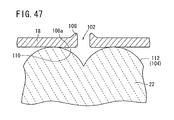
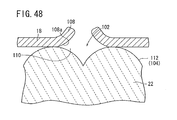
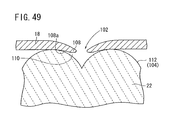
- the second aspect of the present invention because a gap is formed between the surface of the first electrode which faces the emitter around the through regions and the emitter, when the drive voltage is applied, an electric field concentration tends to be produced in the region of the gap. This leads to a larger efficiency of the electron emission, making the drive voltage lower (emitting electrons at a lower voltage level).
- the first electrode since the first electrode has an overhanging portion (flange) on the peripheral portion of each through region, together with the increased electric field concentration in the region of the gap, electrons are easily emitted from the overhanging portion (around the through region). This leads to a larger output and larger efficiency of the electron emission, making the drive voltage lower.
- the periphery of the through region functions as a gate electrode (a control electrode, a focusing electronic lens, or the like), the straightness of emitted electrons can be increased. This is effective in reducing crosstalk if a number of electron emitters are arrayed for use as an electron source of displays.
- the light source is capable of easily developing a high electric field concentration, provides many electron emission regions, has a larger output and larger efficiency of the electron emission, and can be driven at a lower voltage (lower power consumption).
- the light sources according to the first and second aspects of the present invention may have means for applying AC pulses between the first electrode and the second electrode to cause at least a portion of the emitter to have its polarization inverted or changed, wherein electrons are intermittently emitted from the emitter. Before light emitted by a first emission of electrons is extinguished, next electrons may be emitted to emit light continuously.
- the light sources according to the first and second aspects of the present invention may have a third electrode at a position corresponding to the first electrode above the emitter, and the third electrode may be coated with a phosphor. Some of the emitted electrons are attracted to the third electrode and excite the phosphor, which emits fluorescent light.
- the light sources according to the first and second aspects of the present invention may have a phosphor disposed around the electron emitter, and mercury particles, for example, may be sealed in the atmosphere between the electron emitter and the phosphor. Some of the emitted electrons impinge upon the mercury particles, which are excited to emit ultraviolet rays. The ultraviolet rays hit the phosphor, which is excited to emit fluorescent light.
- a plurality of electron emitters may be arranged in a two-dimensional array, realizing a planar light source comprising electron emitters and having a longer service life and increased reliability.
- planar light sources may emit light from its entire surface at all times, and hence does not need to be driven under complex control such as row scanning control, etc., but may be driven altogether statically. Since the diameter of a light emission spot produced by an electron emission does not need to be controlled, it is not necessary to install a control electrode, etc. functioning as a focusing lens, for example, between the electron emitters and the phosphors. This leads to a simplified mechanical arrangement and a simplified circuit arrangement.
- the drive voltage is of a complex waveform ⁇ that is modulated depending on the gradation.
- the drive voltage may be of a simple waveform, i.e., a waveform having a constant pulse period or pulse width.
- the electron emitters may be divided into two groups, and when the electron emitters in one of the groups emit light, the electron emitters in the other group may retrieve electric power of the electron emitters in the one group, and when the electron emitters in the other group emit light, the electron emitters in the one group may retrieve electric power of the electron emitters in the other group.
- the electron emitters in the group other than the group which is emitting light double as a buffer capacitor for retrieving electric power. Therefore, no separate buffer capacitor is required, and hence the light source may be mounted in a reduced area and may consume reduced electric power.
- the drive voltage may be modulated based on a control signal to control an amount of electrons emitted from the electron emitter for controlling emitted light.
- the light sources according to the first and second aspects of the present invention may have at least two planar light source sections, and each of the planar light source sections may have a plurality of the electron emitters which are arranged in a two-dimensional array.
- each of the planar light source sections can be controlled for energization/de-energization to perform stepwise light control (digital light control).
- stepwise light control digital light control
- the light source has means for modulating the drive voltage applied to each of the electron emitters in each of the planar light source sections based on a corresponding control signal to control the amount of electrons emitted from the electron emitter for performing light control of each of the planar light source sections, then the light emission distributions of the planar light source sections can independently be controlled. That is, the light source can perform analog light control as well as digital light control for fine light control applications.
- the electron emitters of each of the planar light source sections may be divided into two groups, and when the electron emitters in one of the groups emit light, the electron emitters in the other group may retrieve electric power of the electron emitters in the one group, and when the electron emitters in the other group emit light, the electron emitters in the one group may retrieve electric power of the electron emitters in the other group.
- the at least two planar light source sections may be divided into two groups, and when the electron emitters in one of the groups emit light, the electron emitters in the other group may retrieve electric power of the electron emitters in the one group, and when the electron emitters in the other group emit light, the electron emitters in the one group may retrieve electric power of the electron emitters in the other group.
- the electron emitter having the emitter made of a dielectric material is prevented from emitting excessive electrons to prevent the electrode from being damaged by the emission of electrons, thus allowing the light source to have a long service life and increased reliability.
- the light sources are capable of easily developing a high electric field concentration, provide many electron emission regions, have a larger output and larger efficiency of the electron emission, and can be driven at a lower voltage.
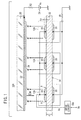
- a light source 10A has a light emitting section 14A comprising a two-dimensional array of electron emitters 12A, and a drive circuit 16A for applying a drive voltage Va to each of the electron emitters 12A of the light emitting section 14A.
- the drive circuit 16A applies a drive voltage Va between a first electrode (e.g., an upper electrode) 18 and a second electrode (e.g., a lower electrode) 20 of each of the electron emitters 12A to control each of the electron emitters 12A based on a control signal Sc representative of turn-on/turn-off from an external source (a turn-on/turn-off switch or the like). Preferred examples of the drive circuit 16A will be described later on.
- each of the electron emitters 12A has a plate-like emitter 22, the upper electrode 18 disposed on a face side of the emitter 22, and the lower electrode 20 disposed on a reverse side of the emitter 22. Since the electron emitter 12A is of a structure in which the emitter 22 is sandwiched between the upper electrode 18 and the lower electrode 20, it provides a capacitive load. Therefore, the electron emitter 12A may be regarded as a capacitor C (see FIG. 12).
- a drive voltage Va from the drive circuit 16A is applied between the upper electrode 18 and the lower electrode 20.
- the lower electrode 20 is connected to GND (ground) through a resistor R1, and hence is kept at the zero potential.
- the lower electrode 20 may be held at a potential other than the zero potential.
- the drive voltage Va is applied between the upper electrode 18 and the lower electrode 20 through a lead electrode 24 connected to the upper electrode 18 and a lead electrode 26 connected to the lower electrode 20.
- a transparent panel 30 of glass or acrylic resin is placed over the upper electrodes 18, and a collector electrode 32 comprising a transparent electrode, for example, is mounted on the reverse side of the transparent panel 30, i.e., the surface of the transparent panel 30 which faces the upper electrodes 18.
- the collector electrode 32 is coated with a phosphor 34.
- a bias power supply 36 having a bias voltage Vc is connected to the collector electrode 32 through a resistor R2.
- the electron emitters 12A are placed in a vacuum. As shown in FIG. 1, electric field concentration points A are present in each of the electron emitters 12. Each of the electric field concentration points A may be defined as a point including a triple point where the upper electrode, the emitter 22, and the vacuum exist.
- the vacuum level in the atmosphere should preferably in the range from 10 2 to 10 -6 Pa and more preferably in the range from 10 -3 to 10 -5 Pa.
- the emitter 22 is made of a dielectric material.
- the dielectric material may preferably be a dielectric material having a relatively high dielectric constant, e.g., a dielectric constant of 1000 or larger.
- Dielectric materials of such a nature may be ceramics including barium titanate, lead zirconate, lead magnesium niobate, lead nickel niobate, lead zinc niobate, lead manganese niobate, lead magnesium tantalate, lead nickel tantalate, lead antimony tinate, lead titanate, lead magnesium tungstenate, lead cobalt niobate, etc.
- any of these materials a material which chiefly contains 50 weight % or more of any of these materials, or such ceramics to which there is added an oxide of such as lanthanum, calcium, strontium, molybdenum, tungsten, barium, niobium, zinc, nickel, manganese, or the like, or a combination of these materials, or any of other compounds.
- nPMN-mPT nPMN-mPT
- PT lead titanate
- MPB morphotropic phase boundary
- a dielectric material may be mixed with 20 weight % of platinum.
- the emitter 22 may be in the form of a piezoelectric/electrostrictive layer or an anti-ferrodielectric layer. If the emitter 22 comprises a piezoelectric/electrostrictive layer, then it may be made of ceramics such as lead zirconate, lead magnesium niobate, lead nickel niobate, lead zinc niobate, lead manganese niobate, lead magnesium tantalate, lead nickel tantalate, lead antimony tinate, lead titanate, barium titanate, lead magnesium tungstenate, lead cobalt niobate, or the like. or a combination of any of these materials.
- ceramics such as lead zirconate, lead magnesium niobate, lead nickel niobate, lead zinc niobate, lead manganese niobate, lead magnesium tantalate, lead nickel tantalate, lead antimony tinate, lead titanate, barium titanate, lead magnesium tungstenate, lead co
- the emitter 22 may be made of chief components including 50 wt % or more of any of the above compounds.
- the ceramics including lead zirconate is mostly frequently used as a constituent of the piezoelectric/electrostrictive layer of the emitter 22.
- the piezoelectric/electrostrictive layer is made of ceramics, then lanthanum, calcium, strontium, molybdenum, tungsten, barium, niobium, zinc, nickel, manganese, or the like, or a combination of these materials, or any of other compounds may be added to the ceramics.
- ceramics produced by adding SiO 2 , CeO 2 , Pb 5 Ge 3 O 11 , or a combination of any of these compounds to the above ceramics may be used.
- a material produced by adding 0.2 wt % of SiO 2 , 0.1 wt % of CeO 2 , or 1 to 2 wt % of Pb 5 Ge 3 O 11 to a PT-PZ-PMN piezoelectric material is preferable.
- the piezoelectric/electrostrictive layer should preferably be made of ceramics including as chief components lead magnesium niobate, lead zirconate, and lead titanate, and also including lanthanum and strontium.
- the piezoelectric/electrostrictive layer may be dense or porous. If the piezoelectric/electrostrictive layer is porous, then it should preferably have a porosity of 40 % or less.
- the anti-ferrodielectric layer may be made of lead zirconate as a chief component, lead zirconate and lead tin as chief components, lead zirconate with lanthanum oxide added thereto, or lead zirconate and lead tin as components with lead zirconate and lead niobate added thereto.
- the anti-ferrodielectric layer may be porous. If the anti-ferrodielectric layer is porous, then it should preferably have a porosity of 30 % or less.
- the emitter 22 is made of strontium tantalate bismuthate (SrBi 2 Ta 2 O 9 ), then its polarization inversion (polarization reversal) fatigue is small.
- Materials whose polarization inversion fatigue is small are laminar ferrodielectric compounds and expressed by the general formula of (BiO 2 ) 2+ (A m-1 B m O 3m+1 ) 2- .
- Ions of the metal A are Ca 2+ , Sr 2+ , Ba 2+ , Pb 2+ , Bi 3+ , La 3+ , etc.
- ions of the metal B are Ti 4+ , Ta 5+ , Nb 5+ , etc.
- An additive may be added to piezoelectric ceramics of barium titanate, lead zirconate, and PZT to convert them into a semiconductor.
- the baking temperature can be lowered by adding glass such as lead borosilicate glass or the like or other compounds of low melting point (e.g., bismuth oxide or the like) to the piezoelectric/electrostrictive/anti-ferrodielectric ceramics.
- glass such as lead borosilicate glass or the like or other compounds of low melting point (e.g., bismuth oxide or the like) to the piezoelectric/electrostrictive/anti-ferrodielectric ceramics.
- the emitter 22 is made of piezoelectric/electrostrictive/anti-ferrodielectric ceramics, then it may be a sheet-like molded body, a sheet-like laminated body, or either one of such bodies stacked or bonded to another support substrate.
- the emitter 22 is made of a non-lead-based material, then it may be a material having a high melting point or a high evaporation temperature so as to be less liable to be damaged by the impingement of electrons or ions.
- the emitter 22 may be made by any of various thick-film forming processes including screen printing, dipping, coating, electrophoresis, aerosol deposition, etc., or any of various thin-film forming processes including an ion beam process, sputtering, vacuum evaporation, ion plating, chemical vapor deposition (CVD), plating, etc. Particularly, it is preferable to form a powdery piezoelectric/electrostrictive material as the emitter 22 and impregnate the emitter 22 thus formed with glass of a low melting point or sol particles. According to this process, it is possible to form a film at a low temperature of 700°C or lower or 600°C or lower.
- a polarization inversion or a polarization change can occur at a lower voltage, enabling the electron emitter 12A to emit electrons when driven by a lower voltage, e.g., less than 100 V.
- the upper electrode 18 should preferably be made of a conductor having a small sputtering yield and a high evaporation temperature in vacuum.
- materials having a sputtering yield of 2.0 or less at 600 V in Ar + and an evaporation pressure of 1.3 ⁇ 10 -3 Pa at a temperature of 1800 K or higher are preferable. Such materials include platinum, molybdenum, tungsten, etc.
- the upper electrode 18 may be made of a conductor which is resistant to a high-temperature oxidizing atmosphere, e.g., a metal, an alloy, a mixture of insulative ceramics and a metal, or a mixture of insulative ceramics and an alloy.
- the upper electrode 18 should be chiefly composed of a precious metal having a high melting point, e.g., platinum, iridium, palladium, rhodium, molybdenum, or the like, or an alloy of silver and palladium, silver and platinum, platinum and palladium, or the like, or a cermet of platinum and ceramics.
- the upper electrode 18 should be made of platinum only or a material chiefly composed of a platinum-base alloy.
- the electrodes should preferably be made of carbon or a graphite-base material, e.g., diamond thin film, diamond-like carbon, or carbon nanotube. Ceramics to be added to the electrode material should preferably have a proportion ranging from 5 to 30 volume %.
- the upper electrode 18 should preferably be made of an organic metal paste which can produce a thin film after being baked.
- a platinum resinate paste or the like should preferably be used.
- the upper electrode 18 may be made of any of the above materials by any of thick-film forming processes including screen printing, spray coating, coating, dipping, electrophoresis, etc., or any of various thin-film forming processes including sputtering, an ion beam process, vacuum evaporation, ion plating, chemical vapor deposition (CVD), plating, etc.
- the upper electrode 18 is made by any of the above thick-film forming processes.
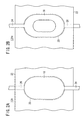
- the shape in plan of the upper electrode 18 may be an elliptical shape as shown in FIG. 2A, or a ring shape as with an electron emitter 12Aa according to a first modification shown in FIG. 2B.
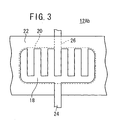
- the shape in plan of the upper electrode 18 may be a comb-toothed shape as with an electron emitter 12Ab according to a second modification shown in FIG. 3.
- the ring-shaped or comb-toothed upper electrode 18 is effective to increase the number of triple points of the upper electrode 18, the emitter 22, and the vacuum as electric field concentration points A for increased electron emission efficiency.
- the upper electrode 18 should preferably have a thickness tc (see FIG. 1) of 20 ⁇ m or less or preferably of 5 pm or less. Therefore, the thickness tc of the upper electrode 18 may be 100 nm or less. If the thickness tc of the upper electrode 18 is extremely small (10 nm or less), then electrons are emitted from the interface between the upper electrode 18 and the emitter 22 for further increased electron emission efficiency.
- the lower electrode 20 is made of the same material according to the same process as the upper electrode 18.
- the lower electrode 20 is made according to one of the above thick-film forming processes.
- the lower electrode 20 should preferably have a thickness of 20 ⁇ m or less or preferably of 5 ⁇ m or less.
- the assembly is heated (fired) into an integral structure.
- the heating (firing) process for producing an integral structure may not be required.
- the firing process for integrally combining the emitter 22, the upper electrode 18, and the lower electrode 20 may be carried out at a temperature ranging from 500 to 1400°c, preferably from 1000 to 1400°C.
- the emitter 22 should preferably be fired together with its evaporation source while their atmosphere is being controlled, so that the composition of the emitter 22 will not become unstable at high temperatures.
- the emitter 22 may be covered with a suitable member, and then fired such that the surface of the emitter 22 will not be exposed directly to the firing atmosphere.
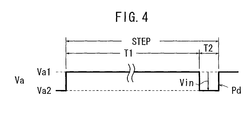
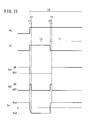
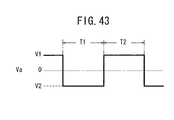
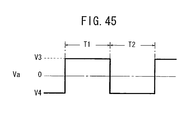
- a drive voltage Va output from the drive circuit 16A has repeated steps each including a period T1 in which a voltage Va1 making the potential of the upper electrode 18 higher than the potential of the lower electrode 20 is output and a period T2 in which a voltage Va2 making the potential of the upper electrode 18 lower than the potential of the lower electrode 20 is output.
- the voltage Va2 which is output in the period T2 is referred to as a drive pulse Pd.
- the period T1 is a period in which the voltage Va1 is applied between the upper electrode 18 and the lower electrode 20 to polarize the emitter 22, as shown in FIG. 5.
- the voltage Va1 may be a DC voltage, as shown in FIG. 4, but may be a single pulse voltage or a succession of pulse voltages.
- the period T1 should preferably be longer than the period T2 for sufficient polarization.
- the period T1 should preferably be of 100 ⁇ sec. or longer. This is because the absolute value of the voltage Va1 for polarization is set so as to be smaller than the absolute value of the voltage Va2 for the purpose of lowering the power consumption at the time the voltage Va1 is applied and preventing damage to the upper electrode 18.
- the voltages Va1, Va2 should preferably be of such voltage levels as to be able to polarize the emitter 22 reliably into positive and negative poles.
- the absolute values of the voltages Va1, Va2 should preferably be equal to or higher than the coercive voltage.
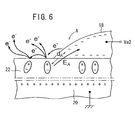
- the polarization is inverted or changed in at least a portion of the emitter 22, as shown in FIG. 6.
- the portion of the emitter 22 where the polarization is inverted or changed includes a portion directly below the upper electrode 18 and a portion whose surface is exposed in the vicinity of the upper electrode 18, because the polarization seeps in the portion of the emitter 22 whose surface is exposed in the vicinity of the upper electrode 18.
- a local electric field concentration occurs at the upper electrode 18 and the positive poles of the dipoles near the upper electrode 18, drawing primary electrons from the upper electrode 18.
- the primary electrons from the upper electrode 18 impinge upon the emitter 22, causing the emitter 22 to emit secondary electrons.
- the electron emitter 12A has a triple point A of the upper electrode 18, the emitter 22, and the vacuum in the present embodiment, primary electrons are drawn from the portion of the upper electrode 18 near the triple point A, and the primary electrons drawn from the triple point A impinge upon the emitter 22, which emits secondary electrons. If the thickness of the upper electrode 18 is very small (up to 10 nm), then electrons are emitted from the interface between the upper electrode 18 and the emitter 22.
- those dipoles which are charged in the emitter 22 in the vicinity of the upper electrode 18, have their positive poles serving as a local anode, drawing electrons from the upper electrode 18.
- Some of the drawn electrons are attracted to the collector electrode 32 (see FIG. 1) and excite the phosphor 34, which emits fluorescent light.
- Some of the drawn electrons impinge upon the emitter 22, which emit secondary electrons that are attracted to the collector electrode 32 and excite the phosphor 34.
- a distribution of the emitted secondary electrons will be described below with reference to FIG. 8.
- most of the secondary electrons have an energy level which is nearly zero.
- the secondary electrons are accelerated from an initial velocity of almost 0 (m/sec.) according to the surrounding electric field distribution. Therefore, as shown in FIG. 1, if an electric field Ea occurs between the emitter 22 and the collector electrode 32, then the secondary electrons have their trajectory determined along the electric field Ea. That is, the straightness of electrons emitted from the emitter as an electron source is improved.
- the secondary electrons with the low initial velocity are electrons in solid state which gain energy by coulomb-attracted impingement of primary electrons and are expelled out of the emitter 22.
- secondary electrons having an energy level corresponding to the energy E 0 of primary electrons are emitted. These secondary electrons are primary electrons emitted from the upper electrode 18 and scattered in the vicinity of the surface of the emitter 22 (reflected electrons).
- the secondary electrons referred to in the present specification are defined as including such reflected electrons and Auger electrons.
- the thickness of the upper electrode 18 is very small (up to 10 nm), then primary electrons emitted from the upper electrode 18 are reflected by the interface between the upper electrode 18 and the emitter 22 and directed toward the collector electrode 32.
- the dielectric breakdown voltage of the emitter 22 should preferably be at least 10 kV/mm. In the present embodiment, if the thickness d of the emitter 22 is of 20 ⁇ m, for example, the emitter 22 will not suffer dielectric breakdown even when a drive voltage of - 100 V is applied between the upper electrode 18 and the lower electrode 20.
- the emitter 22 When electrons emitted from the emitter 22 impinge again upon the emitter 22 or atoms are ionized in the vicinity of the surface of the emitter 22, the emitter 22 may possibly be damaged, inducing crystal defects and resulting in a fragile structure.
- the emitter 22 should preferably be made of a dielectric material having a high evaporation temperature in vacuum, e.g., BaTiO 3 containing no Pb or the like.
- the atoms of the emitter 22 thus formed are less likely to evaporate due to the Joule heat, and are prevented from being ionized by electrons. This approach is effective in protecting the surface of the emitter 22.
- the pattern shape and potential of the collector electrode 32 may appropriately be changed and control electrodes or the like may be disposed between the emitter 22 and the collector electrode 32 to establish a desired electric field distribution between the emitter 22 and the collector electrode 32, thereby controlling the trajectory of emitted secondary electrons and converging, enlarging, and modifying the electron beam diameter with ease.
- the electron emitters 12A output secondary electrons emitted from the emitter 22, the service life and reliability thereof for electron emission can be increased. Furthermore, as the electron emitters 12A are arranged in a two-dimensional array in the first embodiment, there is realized a planar light source which can be of a longer service life and of increased reliability.
- planar light sources may emit light from its entire surface at all times, and hence does not need to be driven under complex control such as row scanning control, etc., but may be driven altogether statically. Since the diameter of a light emission spot produced by an electron emission does not need to be controlled, it is not necessary to install a control electrode, etc. functioning as a focusing lens, for example, between the electron emitters and the phosphors. This leads to a simplified mechanical arrangement and a simplified circuit arrangement.
- the drive voltage is of a complex waveform ⁇ that is modulated depending on the gradation.
- the drive voltage may be of a simple waveform, i.e., a waveform having a constant pulse period or pulse width.
- the collector electrode 32 is disposed on the reverse side of the transparent panel 30, and the phosphor 34 is disposed on the surface of the collector electrode 32 which faces the upper electrode 18.
- phosphors 34 are disposed on the reverse side of the transparent panel 30, and the collector electrode 32 is disposed in covering relation to the phosphors 34.
- the collector electrode 32 functions as a metal back. Secondary electrons emitted from the emitter 22 pass through the collector electrode 32 into the phosphors 34, exciting the phosphors 34. Therefore, the collector electrode 32 is of a thickness which allows electrons to pass therethrough, preferably be 100 nm or less thick. As the kinetic energy of the secondary electrons is larger, the thickness of the collector electrode 32 may be increased.
- FIG. 11 shows a light source 10Ab according to a second modification.
- the phosphor 34 is formed on the transparent panel 30, and mercury particles 40, for example, are sealed in the atmosphere between the light emitting section 14A having the electron emitters 12A and the phosphor 34.
- some of secondary electrons emitted from the electron emitters 12A impinge upon the mercury particles 40, which are excited to emit ultraviolet rays 42.
- the ultraviolet rays 42 hit the phosphor 34, which is excited to emit fluorescent light.
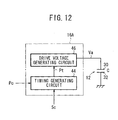
- the drive circuit 16A comprises a timing generating circuit 44 and a drive voltage generating circuit 46.
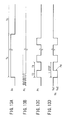
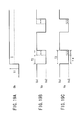
- the timing generating circuit 44 generates and outputs a timing pulse Pt for determining the output timing of the drive pulse Pd based on the control signal Sc representative of turn-on/turn-off and a clock signal Pc. Specifically, as shown in FIG. 13A, the timing generating circuit 44 starts counting the clock signal Pc (see FIG. 13B) from the time when the control signal Sc goes high (a level representative of turn-on). As shown in FIG. 13C, the timing generating circuit 44 repeatedly generates and outputs a high-level timing pulse Pt during a period T2 corresponding to m clock pulses and a low-level timing pulse Pt during a period T2 corresponding to n clock pulses.
- the timing pulses Pt are successively output only during a period (turn-on period Ts) in which the control signal Sc represents turn-on.
- the control signal Sc is of a low level (a level representative of turn-off), i.e., during a turn-off period Tn, the timing generating circuit 44 outputs only a low-level signal.
- the drive voltage generating circuit 46 generates and outputs a drive voltage Va to be applied between the upper electrode 18 and the lower electrode 20 of each of the electron emitters 12A based on the timing pulses Pt from the timing generating circuit 44. Specifically, as shown in FIG. 13D, the drive voltage generating circuit 46 outputs a voltage Va1 during the period T1 in which the output level of the timing generating circuit 44 is low, and outputs a voltage Va2 during the period T2 in which the output level of the timing generating circuit 44 is high. Therefore, the drive voltage Va output from the drive voltage generating circuit 46 has a waveform representing a succession of drive pulses Pd in synchronism with the timing pulses Pt from the timing generating circuit 44.
- each of the electron emitters 12A continuously emits electrons to excite the phosphor 34 in response to the application of drive pulses Pd between the upper electrode 18 and the lower electrode 20 of the electron emitter 12A.
- the fluorescent light emission is sustained during the turn-on period Ts.
- the turn-off period Tn since no drive pulses Pd are applied between the upper electrode 18 and the lower electrode 20 of each of the electron emitters 12A, the emission of electrons from the electron emitter 12A are stopped, keeping the light source turned off until a next turn-on instruction.
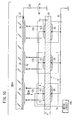
- the drive circuit 16A has, as shown in FIG. 14, comprises the timing generating circuit 44 and the drive voltage generating circuit 46 as described above, and an electric power retrieval circuit 50.
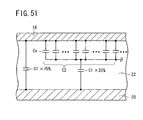
- all the electron emitters 12A in the light emitting section 14A are represented as a single capacitor C.
- One of the electrodes of the capacitor C represents the upper electrodes 18 of all the electron emitters 12A, and the other of the electrodes of the capacitor C represents the lower electrodes 20 of all the electron emitters 12A.
- a buffer capacitor Cf and a first series-connected circuit 52 are connected parallel to each other between both electrodes (the upper electrode 18 and the lower electrode 20) of the capacitor C.
- a second series-connected circuit 54 is also connected between the capacitor C and the buffer capacitor Cf.
- one buffer capacitor Cf is connected to one capacitor C.
- two or more buffer capacitors Cf may be connected to one capacitor C, and the number of buffer capacitors Cf is arbitrary.
- the first series-connected circuit 52 comprises a first switching circuit SW1, a current-suppressing first resistor r, and a positive power supply 56 (voltage Va1) which are connected in series to each other.
- the second series-connected circuit 54 comprises a second switching circuit SW2 and an inductor 58 (inductance L) which are connected in series to each other.
- the drive voltage generating circuit 46 generates and outputs control signals Sc1, Sc2 for controlling the first switching circuit SW1 and the second switching circuit SW2 based on timing pulses Pt from the timing generating circuit 44.
- the first switching circuit SW1 Prior to the start of the turn-on period Ts, the first switching circuit SW1 is turned on and the second switching circuit SW2 is turned off.
- the voltage across the capacitor C is substantially the same as the voltage Va1 of the positive power supply 56.
- the first switching circuit SW1 is turned off and the second switching circuit SW2 is turned on by the drive voltage generating circuit 46.
- the inductor 58 and the capacitor C start oscillating sinusoidally, whereupon the voltage across the capacitor C starts being attenuated resonantly. At this time, electric charges stored in the capacitor C are retrieved by the buffer capacitor Cf.
- the second switching circuit SW2 is turned off by the drive voltage generating circuit 46, placing the system of the capacitor C and the buffer capacitor Cf in a high impedance state. From time t2 on, the voltage Va2 is maintained until time t3 when the period T2 ends. As described above, when the voltage Va1 drops to the voltage Va2, the emitters 22 of the electron emitters 12A emit secondary electrons to emit light through the entire surface of the transparent panel 30.
- the second switching circuit SW2 is turned on by the drive voltage generating circuit 46.
- the inductor 62 and the capacitor C start oscillating sinusoidally, whereupon the voltage across the capacitor C starts being amplified resonantly.
- electric charges stored in the buffer capacitor Cf are charged in the capacitor C.
- the second switching circuit SW2 is turned off and the first switching circuit SW1 is turned on by the drive voltage generating circuit 46. From time t4 on, the voltage Va1 is maintained until time t2 when the next period T2 starts.
- one step of successive periods T2, T1 is repeated during the turn-on period Ts.
- the electron emitter 12A self-inactivates the emission of electrons
- the emission of light is apparently maintained through the entire surface of the transparent panel 30 throughout the period Ts. Specifically, before the light emitted by a single emission of electrons is extinguished, a next emission of electrons occurs, causing the light source to emit light continuously.
- the electric power retrieval circuit 50 connected to the drive circuit 16A makes it possible to retrieve almost 100 % of the drive voltage Va, resulting in an advantage for the reduction of electric power consumption.
- the first series-connected circuit 52 is included to forcibly change the voltage across the capacitor C to the voltage Va1 at a predetermining time. Therefore, an attenuation of the drive voltage due to the electric power consumption by the inductor 58 can be avoided.
- the voltage across the capacitor C may be set to the voltage Va1, and thereafter the capacitor C and the buffer capacitor Cf may alternately be charged and discharged only by turning on and off the second switching circuit SW2.
- the drive voltage Va is applied to the upper and lower electrodes 18, 20 of all the electron emitters 12A to cause the light emitting section 14A to emit light through the entire surface of the transparent panel 30.
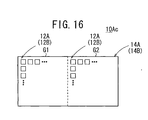
- the light emitting section 14A is divided into two groups (first and second groups G1, G2).
- the electron emitters 12A in the group G1 emit light
- the electron emitters 12A in the group G2 retrieve electric power of the electron emitters 12A in the group G1
- the electron emitters 12A in the group G1 retrieve electric power of the electron emitters 12A in the group G2.
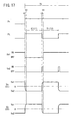
- the drive circuit 16A may include the capacitor C1 instead of the capacitor C and the capacitor C2 instead of the buffer capacitor Cf as indicated by the parentheses in FIG. 14.
- the first switching circuit SW1 is turned off and the second switching circuit SW2 is turned on by the drive voltage generating circuit 46.
- the inductor 58 and the capacitor C1 start oscillating sinusoidally, whereupon the voltage across the capacitor C1 starts being attenuated resonantly. At this time, electric charges stored in the capacitor C1 are retrieved by the buffer capacitor Cf.
- the inductor 58 and the capacitor C1 start oscillating sinusoidally at time t1, and the voltage across the capacitor C2 starts being amplified resonantly. At this time, electric charges stored in the capacitor C1 are retrieved by the capacitor C2.
- the second switching circuit SW2 is turned off by the drive voltage generating circuit 46, placing the system of the capacitor C1 and the capacitor C2 in a high impedance state. From time t2 on, the capacitor C1 maintains the voltage Va2 and the capacitor C2 maintains the voltage Va1 until time t3 when the period T2 ends.
- the emitters 22 of the electron emitters 12A in the group G1 as shown in FIG. 16 emit secondary electrons. Because of the emission of the secondary electrons, the light source 10Ac emits light through the region of the transparent panel 30 which corresponds to the first group G1.
- the period T2 is a period for emitting electrons from the capacitor C1, and is also a preparatory period T1 until the emission of electrons as viewed from the capacitor C2. Therefore, the period T1 should preferably be equal to the period T2.
- the second switching circuit SW2 is turned on by the drive voltage generating circuit 46.
- the inductor 62 and the capacitor C1 start oscillating sinusoidally, whereupon the voltage across the capacitor C starts being amplified resonantly.
- electric charges stored in the capacitor C2 are charged in the capacitor C1.
- the inductor 58 and the capacitor C2 start oscillating sinusoidally at time t3, and the voltage across the capacitor C2 starts being attenuated resonantly. At this time, electric charges stored in the capacitor C2 are retrieved by the capacitor C1.
- the second switching circuit SW2 is turned off and the first switching circuit SW1 is turned on by the drive voltage generating circuit 46.
- the capacitor C1 maintains the voltage Va1 and the capacitor C2 maintains the voltage Va2 until time t2 when the next period T2 starts.
- the emitters 22 of the electron emitters 12A in the group G2 as shown in FIG. 16 emit secondary electrons. Because of the emission of the secondary electrons, the light source 10Ac emits light through the region of the transparent panel 30 which corresponds to the second group G2.
- the period T1 starts from time t3.
- the period T1 is a period for emitting electrons from the capacitor C1, and is also the period T2 for emitting electrons as viewed from the capacitor C2.
- a succession of periods T2, T1 (one step) is repeated during the turn-on period Ts to emit electrons alternately from the electron emitters 12A in the group G1 and the electron emitters 12A in the group G2. Therefore, by appropriately setting the period T1 or T2, the light source 10Ac apparently maintains light emission through the entire surface of the transparent panel 30 throughout the turn-on period Ts. It is also possible to intentionally increase the period T1 or the period T2 to allow human eyes to distinguish the emission of light from the first group G1 from the emission of light from the second group G2.
- the electron emitters 12A in the group other than the group which is emitting light double as a buffer capacitor Cf for retrieving electric power Therefore, no separate buffer capacitor Cf is required, and hence the light source 10Ac may be mounted in a reduced area and may consume reduced electric power.
- the electron emitter 12A in the fist group G1 and the electron emitter 12A in the second group G2 may be positioned in scattered units for achieving apparent uniform planar light emission at all times.
- each of the electron emitters 12A emits a constant quantity of electrons.
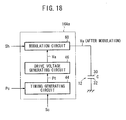
- FIG. 18 shows a drive circuit 16Aa according to a modification, which comprises the timing generating circuit 44, the drive voltage generating circuit 46, and a modulation circuit 60.
- the modulation circuit 60 is a circuit for controlling the quantity of electrons emitted from each of the electron emitters 12A depending on a light control signal Sh from a light control volume (not shown) disposed outside of the drive circuit 16Aa.
- the modulation circuit 60 may operate according to four modulation processes.
- the first modulation process modulates the pulse width of the voltage Va2, as shown in FIG. 19B or 19C, based on the level (voltage level or the like) of the light control signal Sh, as shown in FIG. 19A.
- the period T2 itself may be modulated, or as shown in FIG. 19C, the period T2 may be constant, and the period ⁇ in which to apply the voltage Va2 may be modulated.
- the modulation process shown in FIG. 19C is based on the fact that the pulse width of the voltage Va2 and luminance are linearly related to each other as shown in FIG. 20.
- the luminance can be changed from 0 to about 1020 (cd/m 2 ) by varying the pulse width from 0 to about 600 ⁇ sec. Since the pulse width of the voltage Va2 may be controlled, highly fine gradation representations can be achieved by performing an inexpensive digital control process.
- the second modulation process is a process of controlling the collector voltage Vc, and is based on the fact that the collector voltage Vc and luminance are linearly related to each other as shown in FIG. 21. For example, if the collector voltage Vc is varied from 4 kV to 7 kV, then the luminance can be changed from 0 to 600 (cd/m 2 ).
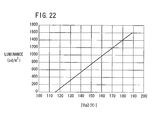
- the third modulation process is a process of controlling the voltage Va2 (voltage level) of the drive voltage V1, and is based on the fact that the voltage Va2 and luminance are linearly related to each other as shown in FIG. 22.
- the luminance can be changed from 0 to 1600 (cd/m 2 ) by varying the voltage Va2 from about 118 V to 188 V.
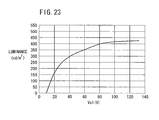
- the fourth modulation process is a process of controlling the voltage Va1 of the drive voltage Va. Since the voltage Va1 and luminance are nonlinearly related to each other as shown in FIG. 23. Therefore, it is difficult to control the voltage Va1, and some circuit refinement is needed as analog voltage control over the voltage Va1 is necessary.
- the light source 10A As shown in FIG. 1, the light source 10A according to the first embodiment has one collector electrode 32 associated with a plurality of electron emitters 12A, and a bias voltage Vc is applied to the collector electrode 32 through the resistor R2.
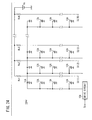
- a light source 10Ad according to a fourth modification shown in FIG. 24 has as many collector electrodes 32(1), 32(2), ..., 32(N) as the number of columns of the light source 10Ad, and resistors Rc1, Rc2, ..., RcN connected respectively to the collector electrodes 32(1), 32(2), ..., 32(N).
- variations introduced in the manufacturing process e.g., luminance variations of the electron emitters 12A
- variations introduced in the manufacturing process may be adjusted by the resistors Rc1, Rc2, ..., RcN connected respectively to the collector electrodes 32(1), 32(2), ..., 32(N).
- the conventional process is based on the relationship between the current flowing through the emitter and the gate voltage, and requires a number of simulations to be performed until optimum resistances for lowering luminance variations are obtained.
- the present embodiment there is employed a process of adjusting the electric field between the collector electrode 32 that is actually reached by emitted electrons and the upper electrode 18, for directly adjusting luminance variations to lower the luminance variations quickly with accuracy.
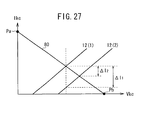
- a resistor Rk connected between the upper electrode 18 and a negative power supply 70 which applies a negative voltage Vk (e.g., a voltage which is the same as the voltage Va2 described above) between the upper electrode 18 and the lower electrode 20, and a resistor Rc connected between the collector electrode 32 and a bias power supply 36 (bias voltage Vc) are adjusted.
- Vkc represents a resistor across the gap between the upper electrode 18 and the collector electrode 32
- Vkc a voltage across the gap
- C a capacitance between the upper electrode 18 and the lower electrode 20
- Vak a voltage between the upper electrode 18 and the lower electrode 20.
- the current change ⁇ I 1 can be reduced to a current change ⁇ I 2 on a load line 80 by connecting the resistors Rk, Rc.
- the load line 80 can be drawn as follows: Based on the structure shown in FIG. 25, an equivalent circuit primarily in terms of a current Ikc flowing between the upper electrode 18 and the lower electrode 20 is plotted as shown in FIG. 26.
- FIG. 28 An equivalent circuit primarily in terms of a collector current Ic flowing through the collector electrode 32 and a control current Ig flowing through the control electrode is plotted as shown in FIG. 28.
- a resistor Rg is connected between the control electrode and a negative power supply 72 which applies a negative voltage Vg between the control electrode and the lower electrode 20.
- Rkg represents a resistor across the gap between the upper electrode 18 and the control electrode.
- the collector current Ic is 60 % of a cathode current Ik
- the control current Ig is 40 % of the cathode current Ik.
- a load line is drawn, and the voltage Vg and the resistor Rg for minimizing luminance variations are determined. With the voltage Vg and the resistor Rg determined, the control current Ig and the cathode current Ik are determined, and so is the collector current Ic of necessity.
- the light source 10A As shown in FIG. 1, the light source 10A according to the first embodiment has a single light emitting section 14A including all the electron emitters 12A, and a single drive circuit 16A connected to the light emitting section 14A.
- a light source 10Ae according to a fifth modification shown in FIG. 29 has two or more planar light source sections Z1 through Z6. In the fifth modification shown in FIG. 29, the light source 10Ae has six planar light source sections Z1 through Z6. Each of the planar light source sections Z1 through Z6 has a two-dimensional array of electron emitters 12A, and drive circuits 16A are independently connected to the respective planar light source sections Z1 through Z6.
- Each of the planar light source sections Z1 through Z6 can be controlled for energization/de-energization. Particularly, if the drive circuits 16A independently connected respectively to the planar light source sections Z1 through Z6 have modulation circuits 60 (see FIG. 18), then the light emission distributions of the planar light source sections Z1 through Z6 can independently be controlled. That is, the light source 10Ae can perform analog light control as well as digital light control for fine light control applications.
- FIG. 30 shows a light source 10Af according to a sixth modification which includes first and sixth planar light source sections Z1, Z6 which are of a horizontally long rectangular shape with long sides, second and fifth planar light source sections Z2, Z5 which are of a vertically long rectangular shape with long sides shorter than the long sides of the first and sixth planar light source sections Z1, Z6, and third and fourth planar light source sections Z3, Z4 which are of a horizontally long rectangular shape with long sides shorter than the long sides of the first and sixth planar light source sections Z1, Z6.
- FIG. 31 shows a light source 10Ag according to a seventh modification.
- the light source 10Ag has first through sixth light source sections Z1 through Z6.
- the electron emitters 12A in each of the first through sixth light source sections Z1 through Z6 are divided into two groups (first and second groups G1, G2).
- first and second groups G1, G2 In each of the first through sixth light source sections Z1 through Z6, when the electron emitters 12A in the group G1 emit light, the electron emitters 12A in the group G2 retrieve electric power of the electron emitters 12A in the group G1, and when the electron emitters 12A in the group G2 emit light, the electron emitters 12A in the group G1 retrieve electric power of the electron emitters 12A in the group G2.
- FIG. 32 shows a light source 10Ah according to an eighth modification.
- the light source 10Ah has first through sixth light source sections Z1 through Z6.
- the first through sixth light source sections Z1 through Z6 are divided into two groups (first and second groups G1, G2).
- first and second groups G1, G2 When the electron emitters 12A in the planar light source sections Z1 through Z3 in the group G1 emit light, the electron emitters 12A in the planar light source sections Z4 through Z6 in the group G2 retrieve electric power of the electron emitters 12A in the group G1, and when the electron emitters 12A in the planar light source sections Z4 through Z6 in the group G2 emit light, the electron emitters 12A in the planar light source sections Z1 through Z3 in the group G1 retrieve electric power of the electron emitters 12A in the group G2.
- the light emitting section 14A is divided into the six planar light source sections Z1 through Z6.
- the number of planar light source sections is optional.
- the light source 10A has a plurality of independent upper electrodes 18 disposed on the face side of one emitter 22, and a plurality of lower electrodes 20 disposed independently on the reverse side of the emitter 22, thus providing a plurality of electron emitters 12A.
- Other embodiments will be described below with reference to FIGS. 33 trough 37.
- FIGS. 33 trough 34 the collector 32 and the phosphors 34 are omitted from illustration.
- FIG. 33 shows a display 10B according to a ninth modification.
- the light source 10B has a plurality of independent upper electrodes 18 (common upper electrodes) disposed on the face side of one emitter 22, and a single lower electrode 20 (common lower electrode) disposed on the reverse side of the emitter 22, thus providing a plurality of electron emitters 12A.
- FIG. 34 shows a light source 10Aj according to a tenth modification.
- the light source 10Aj has a single very thin upper electrode 18 (common upper electrode) having a thickness up to 10 nm, disposed on the face side of one emitter 22, and a plurality of independent lower electrodes 20 disposed on the reverse side of the emitter 22, thus providing a plurality of electron emitters 12A.
- FIG. 35 shows a light source 10Ak according to an eleventh modification.
- the light source 10Ak has a plurality of lower electrodes 20 disposed independently on a substrate 90, a single emitter 22 disposed in covering relation to the lower electrodes 20, and a plurality of independent upper electrodes 18 disposed on the emitter 22, thus providing a plurality of electron emitters 12A.
- the upper electrodes 18 are positioned above the corresponding lower electrodes 20 with the emitter 22 sandwiched therebetween.
- FIG. 36 shows a light source 10A1 according to a twelfth modification.
- the light source 10A1 has a single lower electrode 20 disposed on a substrate 90, a single emitter 22 disposed in covering relation to the lower electrode 20, and a plurality of independent upper electrodes 18 disposed on the emitter 22, thus providing a plurality of electron emitters 12A.
- FIG. 37 shows a light source 10Am according to a thirteenth modification.
- the light source 10Am has a plurality of lower electrodes 20 disposed independently on a substrate 90, a single emitter 22 disposed in covering relation to the lower electrodes 20, and a single very thin upper electrode 18 disposed on the emitter 22, thus providing a plurality of electron emitters 12A.
- a light source 10B according to a second embodiment of the present invention will be described below with reference to FIGS. 38 through 77.
- Those parts of the light source 10B according to the second embodiment which are identical or correspond to those of the light source 10A according to the first embodiment are denoted by identical or corresponding reference characters, and will not be described in detail below.
- each of electron emitters 12B of the light source 10B comprises an emitter 22, an upper electrode 18, a lower electrode 20, and a pulse generating source 100 for applying a drive voltage Va between the upper electrode 18 and the lower electrode 20.
- the upper electrode 18 has a plurality of through regions 102 where the emitter 22 is exposed.
- the emitter 22 has surface irregularities 104 due to the grain boundary of a dielectric material that the emitter 22 is made of.
- the through regions 102 of the upper electrode 18 are formed in areas corresponding to concavities 106 due to the grain boundary of the dielectric material. In the embodiment shown in FIG. 38, one through region 102 is formed in association with one concavity 106. However, one through region 102 may be formed in association with a plurality of concavities 106.
- the particle diameter of the dielectric material of the emitter 22 should preferably be in the range from 0.1 ⁇ m to 10 ⁇ m, and more preferably be in the range from 2 ⁇ m to 7 ⁇ m. In the embodiment shown in FIG. 38, the particle diameter of the dielectric material is of 3 ⁇ m.
- each of the through regions 102 of the upper electrode 18 has a peripheral portion 108 having a surface 108a facing the emitter 22, the surface 108a being spaced from the emitter 22.
- a gap 110 is formed between the surface 108a, facing the emitter 22, of the peripheral portion 108 of the through region 102 and the emitter 22, and the peripheral portion 108 of the through region 102 of the upper electrode 18 is formed as an overhanging portion (flange).
- the peripheral portion 108 of the through region 102 of the upper electrode 18 is referred to as "the overhanging portion 108 of the upper electrode 18".
- convexities 112 of the surface irregularities 104 of the grain boundary of the dielectric material are shown as having a semicircular cross-sectional shape.
- the convexities 112 are not limited to the semicircular cross-sectional shape.
- the upper electrode 18 has a thickness t in the range of 0.01 ⁇ m ⁇ t ⁇ 10 ⁇ m, and the maximum angle ⁇ between the upper surface of the emitter 22, i.e., the surface of the convexity 112 (which is also the inner wall surface of the concavity 106) of the grain boundary of the dielectric material, and the lower surface 108a of the overhanging portion 108 of the upper electrode 18 is in the range of 1° ⁇ ⁇ ⁇ 60°.
- the shape of the through region 102 is the shape of a hole 114, which may be a circular shape, an elliptical shape, a track shape, a shape including a curve, or a polygonal shape such as a quadrangular shape or a triangular shape.
- the shape of the hole 114 is a circular shape.
- the hole 114 has an average diameter ranging from 0.1 ⁇ m to 10 ⁇ m.
- the average diameter represents the average of the lengths of a plurality of different line segments passing through the center of the hole 114.
- the materials of the emitter 22 are the same as those according to the first embodiment, and will not be described below.
- the emitter 22 may be made by any of various thick-film forming processes including screen printing, dipping, coating, electrophoresis, aerosol deposition, etc., or any of various thin-film forming processes including an ion beam process, sputtering, vacuum evaporation, ion plating, chemical vapor deposition (CVD), plating, etc. Particularly, it is preferable to form a powdery piezoelectric/electrostrictive material as the emitter 22 and impregnate the emitter 22 thus formed with glass of a low melting point or sol particles. According to this process, it is possible to form a film at a low temperature of 700°C or lower or 600°C or lower.
- the upper electrode 18 is made of an organic metal paste which can produce a thin film after being baked.
- a platinum resinate paste or the like should preferably be used.
- x 0.2
- a mixture of any one of these compounds and a platinum resinate paste, for example, is preferable.
- the upper electrode 18 may preferably be in the form of a cluster 118 of a plurality of scale-like members 116 (e.g., of graphite).
- the upper electrode 18 may preferably be in the form of a cluster 122 of electrically conductive members 120 including scale-like members 116.
- the cluster 118 or 122 does not fully cover the surface of the emitter 22, but a plurality of through regions 102 are provided through which the emitter 22 is partly exposed, and those portions of the emitter 22 which face the through regions 102 serve as electron emission regions.
- the upper electrode 18 may be made of any of the above materials by any of thick-film forming processes including screen printing, spray coating, coating, dipping, electrophoresis, etc., or any of various thin-film forming processes including sputtering, an ion beam process, vacuum evaporation, ion plating, chemical vapor deposition (CVD), plating, etc.
- the upper electrode 18 is made by any of the above thick-film forming processes.
- the lower electrode 20 is made of an electrically conductive material, e.g., a metal such as platinum, molybdenum, tungsten, or the like.
- the lower electrode 20 is made of an electric conductor which is resistant to a high-temperature oxidizing atmosphere, e.g., a metal, an alloy, a mixture of insulative ceramics and a metal, a mixture of insulative ceramics and an alloy, or the like.
- the lower electrode 20 should be made of a precious metal having a high melting point such as platinum, iridium, palladium, rhodium, molybdenum, or the like, or a material chiefly composed of an alloy of silver and palladium, silver and platinum, platinum and palladium, or the like, or a cermet of platinum and ceramics. Further preferably, the lower electrode 20 should be made of platinum only or a material chiefly composed of a platinum-base alloy.
- the lower electrode 20 may be made of carbon or a graphite-base material. Ceramics to be added to the electrode material should preferably have a proportion ranging from 5 to 30 volume %.
- the lower electrode 20 may be made of the same material as the upper electrode 18, as described above.
- the lower electrode 20 should preferably be formed by any of various thick-film forming processes.
- the lower electrode 20 has a thickness of 20 ⁇ m or less or preferably a thickness of 5 ⁇ m or less.
- the assembly is heated (sintered) into an integral structure.
- the sintering process for integrally combining the emitter 22, the upper electrode 18, and the lower electrode 20 may be carried out at a temperature ranging from 500 to 1400°c, preferably from 1000 to 1400°C.
- the emitter 22 should be sintered together with its evaporation source while their atmosphere is being controlled, so that the composition of the emitter 22 will not become unstable at high temperatures.
- the film which will serve as the upper electrode 18 is shrunk from the thickness of 10 ⁇ m to the thickness of 0.1 ⁇ m, and simultaneously a plurality of holes are formed therein.
- a plurality of through regions 102 are formed in the upper electrode 18, and the peripheral portions 108 of the through regions 102 are turned into overhanging portions.
- the film which will serve as the upper electrode 18 may be patterned by etching (wet etching or dry etching) or lift-off, and then may be sintered. In this case, recesses or slits may easily be formed as the through regions 102.
- the emitter 22 may be covered with a suitable member, and then sintered such that the surface of the emitter 22 will not be exposed directly to the sintering atmosphere.
- a drive voltage Va is applied between the upper electrode 18 and the lower electrode 20.
- the drive voltage Va is defined as a voltage, such as a pulse voltage or an alternating-current voltage, which abruptly changes with time from a voltage level that is higher or lower than a reference voltage (e.g., 0 V) to a voltage level that is lower or higher than the reference voltage.
- a reference voltage e.g., 0 V
- a triple junction is formed in a region of contact between the upper surface of the emitter 22, the upper electrode 18, and a medium (e.g., a vacuum) around the electron emitter 12B.
- the triple junction is defined as an electric field concentration region formed by a contact between the upper electrode 18, the emitter 22, and the vacuum.
- the triple junction includes a triple point where the upper electrode 18, the emitter 22, and the vacuum exist as one point.
- the vacuum level in the atmosphere should preferably in the range from 10 2 to 10 -6 Pa and more preferably in the range from 10 -3 to 10 -5 Pa.
- the triple junction is formed on the overhanging portion 108 of the upper electrode 18 and the peripheral area of the upper electrode 18. Therefore, when the above drive voltage Va is applied between the upper electrode 18 and the lower electrode 20, an electric field concentration occurs at the triple junction.
- a first electron emission process for the electron emitter 12B will be described below with reference to FIGS. 43 and 44.
- a voltage V2 lower than a reference voltage e.g., 0 V
- a voltage V1 higher than the reference voltage is applied to the lower electrode 20.
- an electric field concentration occurs at the triple junction referred to above, causing the upper electrode 18 to emit primary electrons toward the emitter 22.
- the emitted electrons are accumulated in the portions of the emitter 22 which are exposed through the through region 102 of the upper electrode 18 and regions near the outer peripheral portion of the upper electrode 18, thus charging the emitter 22.
- the upper electrode 18 functions as an electron supply source.
- the voltage level of the drive voltage Va abruptly changes, i.e., the voltage V1 higher than the reference voltage is applied to the upper electrode 18, and the voltage V2 lower than the reference voltage to the lower electrode 20.
- the electrons that have been accumulated in the portions of the emitter 22 which are exposed through the through region 102 of the upper electrode 18 and the regions near the outer peripheral portion of the upper electrode 18 are expelled from the emitter 22 by dipoles (whose negative poles appear on the surface of the emitter 22) in the emitter 22 whose polarization has been inverted in the opposite direction.
- the electrons are emitted from the portions of the emitter 22 where the electrons have been accumulated, through the through regions 102.
- the electrons are also emitted from the regions near the outer peripheral portion of the upper electrode 18.
- a second electron emission process will be described below with reference to FIGS. 45 and 46.
- a first output period T1 first stage shown in FIG. 45
- a voltage V3 higher than the reference voltage is applied to the upper electrode 18, and a voltage V4 lower than the reference voltage is applied to the lower electrode 20.
- the electron emitter 12B is prepared for electron emission.
- the voltage level of the drive voltage Va abruptly changes, i.e., the voltage V4 lower than the reference voltage is applied to the upper electrode 18, and the voltage V3 higher than the reference voltage to the lower electrode 20.
- the electron emitter 12B offers the following advantages: Since the upper electrode 18 has the plural through regions 102, electrons are uniformly emitted from each of the through regions 102 and the outer peripheral portions of the upper electrode 18. Thus, any variations in the overall electron emission characteristics of the electron emitter 12B are reduced, making it possible to facilitate the control of the electron emission and increase the electron emission efficiency.
- the gap 110 is formed between the overhanging portion of the upper electrode 18 and the emitter 22, when the drive voltage Va is applied, an electric field concentration tends to be produced in the region of the gap 110. This leads to a larger efficiency of the electron emission, making the drive voltage lower (emitting electrons at a lower voltage level).
- the upper electrode 18 has the overhanging portion 108 on the peripheral portion of the through region 102, together with the increased electric field concentration in the region of the gap 110, electrons are easily emitted from the overhanging portion 108 of the upper electrode 18. This leads to a larger output and larger efficiency of the electron emission, making the drive voltage Va lower.
- the light source 10B according to the second embodiment which has a number of arrayed electron emitters 12B, has a higher level of luminance.
- the straightness of emitted electrons can be increased. This is effective in reducing crosstalk if a number of electron emitters 12B are arrayed for use as an electron source of displays.
- the light source 10B according to the second embodiment is capable of easily developing a high electric field concentration, provides many electron emission regions, has a larger output and larger efficiency of the electron emission, and can be driven at a lower voltage (lower power consumption).
- the upper surface of the emitter 22 has the surface irregularities 104 due to the grain boundary of the dielectric material.
- the upper electrode 18 has the through regions 102 in portions corresponding to the concavities 106 of the grain boundary of the dielectric material, the overhanging portions 108 of the upper electrode 18 can easily be realized.
- the maximum angle ⁇ between the upper surface of the emitter 22, i.e., the surface of the convexity 112 (which is also the inner wall surface of the concavity 106) of the grain boundary of the dielectric material, and the lower surface 108a of the overhanging portion 108 of the upper electrode 18 is in the range of 1° ⁇ ⁇ ⁇ 60°.
- the through region 102 is in the shape of the hole 114.
- the portions of the emitter 22 where the polarization is inverted or changed depending on the drive voltage Va applied between the upper electrode 18 and the lower electrode 20 include a portion (first portion) 124 directly below the upper electrode 18 and a portion (second portion) 126 corresponding to a region extending from the inner peripheral edge of the through region 102 inwardly of the through region 102.
- the second portion 126 changes depending on the level of the drive voltage and the degree of the electric field concentration.
- the average diameter of the hole 114 is in the range from 0.1 ⁇ m to 10 ⁇ m. Insofar as the average diameter of the hole 114 is in this range, the distribution of electrons emitted through the through region 102 is almost free of any variations, allowing electrons to be emitted efficiently.
- the average diameter of the hole 114 is less than 0.1 ⁇ m, then the region where electrons are accumulated is made narrower, reducing the amount of emitted electrons. While one solution would be to form many holes 114, it would be difficult and highly costly to form many holes 114. If the average diameter of the hole 114 is in excess of 10 ⁇ m, then the proportion (share) of the portion (second portion) 126 which contributes to the emission of electrons in the portion of the emitter 22 that is exposed through the through region 102 is reduced, resulting in a reduction in the electron emission efficiency.
- the overhanging portion 108 of the upper electrode 18 may have upper and lower surfaces extending horizontally as shown in FIG. 39.
- the overhanging portion 108 may have a lower surface 108a extending substantially horizontally and an upper end raised upwardly.
- the overhanging portion 108 may have a lower surface 108a inclined progressively upwardly toward the center of the through region 102.
- the overhanging portion 108 may have a lower surface 108a inclined progressively downwardly toward the center of the through region 102.
- the arrangement shown in FIG. 47 is capable of increasing the function as a gate electrode.
- the arrangement shown in FIG. 49 makes it easier to produce a higher electric field concentration for a larger output and larger efficiency of the electron emission because the gap 110 is narrower.
- the electron emitter 12B has in its electrical operation a capacitor C1 due to the emitter 22 and a cluster of capacitors Ca due to respective gaps 110, disposed between the upper electrode 18 and the lower electrode 20.
- the capacitors Ca due to the respective gaps 110 are connected parallel to each other into a single capacitor C2.
- the capacitor C1 due to the emitter 22 is connected in series to the capacitor C2 which comprises the cluster of capacitors Ca.
- the capacitor C1 due to the emitter 22 is not directly connected in series to the capacitor C2 which comprises the cluster of capacitors Ca, but the capacitive component that is connected in series varies depending on the number of the through regions 102 formed in the upper electrode 18 and the overall area of the through regions 102.
- the capacitor C2 which comprises the cluster of capacitors Ca has a capacitance of 0.885 pF, and the capacitor C1 due to the emitter 22 has a capacitance of 35.4 pF. If the portion of the capacitor C1 due to the emitter 22 which is connected in series to the capacitor C2 which comprises the cluster of capacitors Ca is 25 % of the entire capacitor C1, then that series-connected portion has a capacitance (including the capacitance of capacitor C2 which comprises the cluster of capacitors Ca) of 0.805 pF, and the remaining portion has a capacitance of 26.6 pF.
- the overall capacitance is 27.5 pF. This capacitance is 78 % of the capacitance 35.4 pF of the capacitor C1 due to the emitter 22. Therefore, the overall capacitance is smaller than the capacitance of the capacitor C1 due to the emitter 22.
- the capacitance of the cluster of capacitors Ca due to the gaps 110 is relatively small. Because of the voltage division between the cluster of capacitors Ca and the capacitor C1 due to the emitter 22, almost the entire applied voltage Va is applied across the gaps 110, which are effective to produce a larger output of the electron emission.
- the capacitor C2 which comprises the cluster of capacitors Ca is connected in series to the capacitor C1 due to the emitter 22, the overall capacitance is smaller than the capacitance of the capacitor C1 due to the emitter 22. This is effective to provide such preferred characteristics that the electron emission is performed for a larger output and the overall power consumption is lower.
- an electron emitter 12Ba according to a first modification differs from the above electron emitter 12B in that the through region 102 has a shape, particularly a shape viewed from above, in the form of a recess 128.
- the recess 128 should preferably be shaped such that a number of recesses 128 are successively formed into a saw-toothed recess 130.
- the saw-toothed recess 130 is effective to reduce variations in the distribution of electrons emitted through the through region 102 for efficient electron emission.
- the average width represents the average of the lengths of a plurality of different line segments extending perpendicularly across the central line of the recess 128.
- an electron emitter 12Bb according to a second modification differs from the above electron emitter 12B in that the through region 102 has a shape, particularly a shape viewed from above, in the form of a slit 132.
- the slit 132 is defined as something having a major axis (extending in a longitudinal direction) whose length is 10 times or more the length of the minor axis (extending in a transverse direction) thereof. Those having a major axis (extending in a longitudinal direction) whose length is less than 10 times the length of the minor axis (extending in a transverse direction) thereof are defined as holes 114 (see FIG. 40).
- the slit 132 includes a succession of holes 114 in communication with each other.
- the slit 132 should preferably have an average width ranging from 0.1 ⁇ m to 10 ⁇ m for reducing variations in the distribution of electrons emitted through the through region 102 for efficient electron emission.
- the average width represents the average of the lengths of a plurality of different line segments extending perpendicularly across the central line of the slit 132.
- an electron emitter 12Bc according to a third modification differs from the above electron emitter 12B in that a floating electrode 134 exists on the portion of the upper surface of the emitter 22 which corresponds to the through region 102, e.g., in the concavity 106 due to the grain boundary of the dielectric material.
- the electron emitter 12Bc can emit many electrons through the through region 102 in an electron emission stage (the second output period T2 (see FIG. 43) according to the first electron emission process described above).
- the electron emission from the floating electrode 134 may be attributed to an electric field concentration at the triple junction of the floating electrode 134, the dielectric material, and the vacuum.
- the characteristics of the electron emitter 12B of the light source 10B according to the second embodiment particularly, the voltage vs. charge quantity characteristics (the voltage vs. polarization quantity characteristics) thereof will be described below.
- the voltage vs. charge quantity characteristics will be described below. If a region from which electrons are emitted is defined as an electron emission region, then at a point p1 (initial state) where the reference voltage is applied, almost no electrons are stored in the electron emission region. Thereafter, when a negative voltage is applied, the amount of positive charges of dipoles whose polarization is inverted in the emitter 22 in the electron emission region increases, and electrons are emitted from the upper electrode 18 toward the electron emission region in the first stage, so that electrons are stored.
- the amount of negative charges is the sum of the amount of electrons remaining to be stored and the amount of negative charges of the dipoles whose polarization is inverted in the emitter 22.
- the voltage vs. charge quantity characteristics have the following features:
- FIG. 55 The characteristics shown in FIG. 55 will be described below in terms of the voltage vs. polarization quantity characteristics. It is assumed that the emitter 22 is polarized in one direction, with dipoles having negative poles facing toward the upper surface of the emitter 22 (see FIG. 56A).
- the polarization starts being inverted substantially at the time the negative voltage exceeds a negative coercive voltage (see the point p2 in FIG. 55). All the polarization is inverted at the point p3 shown in FIG. 55 (see FIG. 56B). Because of the polarization inversion, an electric field concentration occurs at the triple junction, and the upper electrode 18 emits electrons toward the emitter 22 in the first stage, causing electrons to be accumulated in the portion of the emitter 22 which is exposed through the through region 102 of the upper electrode 18 and the portion of the emitter 22 which is near the peripheral portion of the upper electrode 18 (see FIG. 56C). In particular, electrons are emitted (emitted inwardly) from the upper electrode 18 toward the portion of the emitter 22 which is exposed through the through region 102 of the upper electrode 18. At the point p3 shown in FIG. 55, the accumulation of electrons is saturated.
- the upper surface of the emitter 22 is kept charged up to a certain voltage level (see FIG. 57A).
- the level of the positive voltage is increased, there is produced a region where the negative poles of dipoles start facing the upper surface of the emitter 22 (see FIG. 57B) immediately prior to the point p4 in FIG. 55.
- the level is further increased, electrons start being emitted due to coulomb repulsive forces posed by the negative poles of the dipoles after the point p4 in FIG. 55 (see FIG. 57C).
- the positive voltage is increased in the positive direction, the amount of emitted electrons is increased.
- the characteristics of the electron emitter 12B has have the following features:
- the electron emitter 12B Since the electron emitter 12B has the above characteristics, it can easily be applied to the light source 10B according to the second embodiment which has a plurality of electron emitters 12B arrayed in association with a plurality of pixels, for emitting light due to the emission of electrons from the electron emitters 12B.
- the light source 10B which employs the electron emitters 12B will be described below.
- the light source 10B is a light source in conformity with a display for displaying an image such as a liquid crystal display backlight or the like. As shown in FIG. 58, the light source 10B has a light emission section 14B comprising a matrix or staggered pattern of electron emitters 10B corresponding to respective light-emitting devices such as pixels, and a drive circuit 16B for driving the light emission section 14B.
- One electron emitter 12B may be assigned to each pixel, or a plurality of electron emitters 12B may be assigned to each pixel. In the present embodiment, it is assumed for the sake of brevity that one electron emitter 12B is assigned to each pixel.
- the drive circuit 16B has a plurality of row selection lines 144 for selecting rows in the light emission section 14B and a plurality of signal lines 146 for supplying data signals Sd to the light emission section 14B.
- the drive circuit 16B also has a row selecting circuit 148 for supplying a selection signal Ss selectively to the row selection lines 144 to successively select a row of electron emitters 12B, a signal supplying circuit 150 for supplying parallel data signals Sd to the signal lines 146 to supply the data signals Sd to a row (selected row) selected by the row selecting circuit 148, and a signal control circuit 152 for controlling the row selecting circuit 148 and the signal supplying circuit 150 based on a control signal (video signal or the like) Sv and a synchronizing signal Sc that are input to the signal control circuit 152.
- a row selecting circuit 148 for supplying a selection signal Ss selectively to the row selection lines 144 to successively select a row of electron emitters 12B
- a signal supplying circuit 150 for supplying parallel data signals Sd to the signal lines 146 to supply the data signals Sd to a row (selected row) selected by the row selecting circuit 148
- a signal control circuit 152 for controlling the row selecting circuit 148
- a power supply circuit 154 (which supplies 50 V and 0 V, for example) is connected to the row selecting circuit 148 and the signal supplying circuit 150.
- a pulse power supply 156 is connected between a negative line between the row selecting circuit 148 and the power supply circuit 154, and GND (ground).
- the pulse power supply 156 outputs a pulsed voltage waveform having a reference voltage (e.g., 0 V) during a charge accumulation period Td, to be described later, and a certain voltage (e.g., - 400 V) during a light emission period Th.
- the row selecting circuit 148 outputs the selection signal Ss to the selected row and outputs a non-selection signal Sn to the unselected rows.
- the row selecting circuit 148 outputs a constant voltage (e.g., - 350 V) which is the sum of a power supply voltage (e.g., 50 V) from the power supply circuit 154 and a voltage (e.g., - 400 V) from the pulse power supply 156.
- the signal supplying circuit 150 has a pulse generating circuit 158 and an amplitude modulating circuit 160.
- the pulse generating circuit 158 generates and outputs a pulse signal Sp having a constant pulse period and a constant amplitude (e.g., 50 V) during the charge accumulation period Td, and outputs a reference voltage (e.g., 0 V) during the light emission period Th.
- the amplitude modulating circuit 160 amplitude-modulates the pulse signal Sp from the pulse generating circuit 158 depending on the luminance levels of the light-emitting devices of the selected row, and outputs the amplitude-modulated pulse signal Sp as the data signal Sd for the light-emitting devices of the selected row.
- the amplitude modulating circuit 160 outputs the reference voltage from the pulse generating circuit 158 as it is.
- the timing control in the amplitude modulating circuit 160 and the supply of the luminance levels of the selected light-emitting devices to the amplitude modulating circuit 160 are performed through the signal supplying circuit 150.
- the amplitude of the pulse signal Sp is set to a low level Vsl (see FIG. 59A)
- the amplitude of the pulse signal Sp is set to a medium level Vsm (see FIG. 59B)
- the amplitude of the pulse signal Sp is set to a high level Vsh (see FIG. 59C).
- the amplitude of the pulse signal Sp is modulated into three levels in the above examples, if the amplitude modulation is applied to the light source 10B, then the pulse signal Sp is amplitude-modulated to 128 levels or 256 levels depending on the luminance levels of the light-emitting devices.
- a modified signal supplying circuit 150a has a pulse generating circuit 162 and a pulse width modulating circuit 164.
- the pulse generating circuit 162 generates and outputs a pulse signal Spa (indicated by the broken lines in FIGS. 61A through 61C) where the positive-going edge of a voltage waveform (indicated by the solid lines in FIGS. 61A through 61C) applied to the electron emitter 12B is continuously changed in level, during the charge accumulation period Td.
- the pulse generating circuit 162 outputs a reference voltage during the light emission period Th.
- the pulse width modulating circuit 164 modulates the pulse width Wp (see FIGS.
- the pulse width modulating circuit 164 outputs the reference voltage from the pulse generating circuit 162 as it is.
- the timing control in the pulse width modulating circuit 164 and the supply of the luminance levels of the selected pixels to the pulse with modulating circuit 164 are also performed through the signal supplying circuit 150a.
- the pulse width p of the pulse signal Spa is set to a short width, setting the substantial amplitude to a low level Vsl (see FIG. 61A), if the luminance level is medium, then the pulse width Wp of the pulse signal Spa is set to a medium width, setting the substantial amplitude to a medium level Vsm (see FIG. 61B), and if the luminance level is high, then the pulse width Wp of the pulse signal Spa is set to a long width, setting the substantial amplitude to a high level Vsh (see FIG. 61C).
- the pulse width Wp of the pulse signal Spa is modulated into three levels in the above examples, if the amplitude modulation is applied to the light source 10B, then the pulse signal Spa is pulse-width-modulated to 128 levels or 256 levels depending on the luminance levels of the light-emitting devices.
- the voltage level at the point p4 where electrons start being emitted is substantially the same. That is, even if the applied voltage changes to the voltage level indicated at the point p4 after electrons are accumulated, the amount of accumulated electrons does not change essentially. It can thus be seen that a memory effect has been caused.
- a transparent panel 166 made of glass or acrylic resin is placed above the upper electrode 18, and a collector electrode 168 in the form of a transparent electrode, for example, is placed on the reverse side of the transparent panel 166 (which faces the upper electrode 18), the collector electrode 168 being coated with a phosphor 170.
- a bias voltage source 172 (collector voltage Vc) is connected to the collector electrode 168 through a resistor.
- the electron emitter 12B is naturally placed in a vacuum.
- the vacuum level in the atmosphere should preferably in the range from 10 2 to 10 -6 Pa and more preferably in the range from 10 -3 to 10 -5 Pa.
- the collector electrode 168 is formed on the reverse side of the transparent panel 166, and the phosphor 170 is formed on the surface of the collector electrode 168 (which faces the upper electrode 18).
- the phosphor 170 may be formed on the reverse side of the transparent panel 166, and the collector electrode 168 may be formed in covering relation to the phosphor 170.
- Such another arrangement is for use in a CRT or the like where the collector electrode 168 functions as a metal back. Electrons emitted from the emitter 22 pass through the collector electrode 168 into the phosphor 170, exciting the phosphor 170. Therefore, the collector electrode 168 is of a thickness which allows electrons to pass therethrough, preferably be 100 nm or less thick. As the kinetic energy of the emitted electrons is larger, the thickness of the collector electrode 168 may be increased.
- the emission of electrons from the electron emitter 12B was observed. Specifically, as shown in FIG. 65A, a write pulse Pw having a voltage of - 70 V was applied to the electron emitter 12B to cause the electron emitter 12B to accumulate electrons, and thereafter a turn-on pulse Ph having a voltage of 280 V was applied to cause the electron emitter 12B to emit electrons.
- the emission of electrons was measured by detecting the light emission from the phosphor 170 with a light-detecting device (photodiode). The detected waveform is shown in FIG. 65B.
- the write pulse Pw and the turn-on pulse Ph had a duty cycle of 50 %.
- the solid-line curve A represents the characteristics at the time the turn-on pulse Ph had an amplitude of 200 V and the write pulse Pw had an amplitude changing from - 10 V to - 80 V
- the solid-line curve B represents the characteristics at the time the turn-on pulse Ph had an amplitude of 350 V and the write pulse Pw had an amplitude changing from - 10 V to - 80 V.
- the solid-line curve C represents the characteristics at the time the write pulse Pw had an amplitude of - 40 V and the turn-on pulse Ph had an amplitude changing from 50 V to 400 V
- the solid-line curve D represents the characteristics at the time the write pulse Pw had an amplitude of - 70 V and the turn-on pulse Ph had an amplitude changing from 50 V to 400 V.
- the turn-on pulse Ph when the turn-on pulse Ph is changed from 100 V to 300 V, it can be understood that the light emission luminance changes substantially linearly.
- a comparison between the amplitudes -40 V and - 70 V of the write pulse Pw in particular indicates that a change in the light emission luminance in response to the turn-on pulse Ph at the time the amplitude of the write pulse Pw is - 70 V has a wider dynamic range, which is advantageous for increased luminance and also increased contrast if the light source 10B is applied to a display.
- This tendency appears to be more advantageous as the amplitude (in this case, the absolute value) of the write pulse Pw increases in a range until the light emission luminance is saturated with respect to the setting of the amplitude of the write pulse Pw. It is preferable also in this case to set the amplitude (absolute value) of the write pulse Pw to an optimum value in relation to the withstand voltage and power consumption of the signal transmission system.
- the solid-line curve E represents the characteristics at the time the level of the collector voltage Vc was 3 kV and the amplitude of the turn-on pulse Ph was changed from 80 V to 500 V
- the solid-line curve F represents the characteristics at the time the level of the collector voltage Vc was 7 kV and the amplitude of the turn-on pulse Ph was changed from 80 V to 500 V.
- a change in the light emission luminance in response to the turn-on pulse Ph has a wider dynamic range when the collector voltage Vc is 7 kV than when the collector voltage Vc is 3 kV, which is advantageous for increased luminance and also increased contrast if the light source 10B is applied to a display.
- This tendency appears to be more advantageous as the level of the collector voltage Vc increases. It is preferable also in this case to set the level of the collector voltage Vc to an optimum value in relation to the withstand voltage and power consumption of the signal transmission system.
- FIG. 70 shows operation of pixels in the first row and the first column, the second row and the first column, and the nth row and the first column.
- An electron emitter 12A used in the drive method has such characteristics that the coercive voltage v1 at the point p2 shown in FIG. 55 is - 20 V, for example, the coercive voltage v2 at the point p5 is + 70 V, the voltage v3 at the point p3 is - 50 V, and the voltage v4 at the point p4 is + 50 V.
- each selection period Ts becomes a selection period Ts for a corresponding row, it becomes a non-selection period Tn for non-corresponding n-1 rows.
- all the electron emitters 12B are scanned in the charge accumulation period Td, and voltages depending on the luminance levels of corresponding pixels to be turned on (to emit light) are applied to a plurality of electron emitters 12B which correspond to light-emitting devices to be turned on, thereby accumulating charges (electrons) in amounts depending on the luminance levels of the corresponding light-emitting devices in the electron emitters 12B which correspond to the light-emitting devices to be turned on.
- a constant voltage is applied to all the electron emitters 12B to cause the electron emitters 12B which correspond to the light-emitting devices to be turned on to emit electrons in amounts depending on the luminance levels of the corresponding light-emitting devices, thereby emitting light from the light-emitting devices to be turned on.
- a selection signal Ss of 50 V for example, is supplied to the row selection line 144 of the first row, and a non-selection signal Sn of 0 V, for example, is applied to the row selection lines 144 of the other rows.
- a data signal Sd supplied to the signal lines 146 of the light-emitting devices to be turned on (to emit light) of all the pixels of the first row has a voltage in the range from 0 V to 30 V, depending on the luminance levels of the corresponding light-emitting devices. If the luminance level is maximum, then the voltage of the data signal Sd is 0 V.
- the data signal Sd is modulated depending on the luminance level by the amplitude modulating circuit 160 shown in FIG. 58 or the pulse width modulating circuit 164 shown in FIG. 60.
- a voltage ranging from - 50 V to - 20 V depending on the luminance level is applied between the upper and lower electrodes 18, 20 of the electron emitter 12B which corresponds to each of the light-emitting devices to be turned on in the first row.
- each electron emitter 12B accumulates electrons depending on the applied voltage.
- the electron emitter 12B corresponding to the light-emitting device in the first row and the first column is in a state at the point p3 shown in FIG. 55 as the luminance level of the pixel is maximum, and the portion of the emitter 22 which is exposed through the through region 102 of the upper electrode 18 accumulates a maximum amount of electrons.
- a data signal Sd supplied to the electron emitters 12B which correspond to light-emitting devices to be turned off (to extinguish light) has a voltage of 50 V, for example. Therefore, a voltage of 0 V is applied to the electron emitters 12B which correspond to light-emitting devices to be turned off, bringing those electron emitters 12B into a state at the point p1 shown in FIG. 55, so that no electrons are accumulated in those electron emitters 12B.
- a selection signal Ss of 50 V is supplied to the row selection line 144 of the second row, and a non-selection signal Sn of 0 V is applied to the row selection lines 144 of the other rows.
- a voltage ranging from - 50 V to - 20 V depending on the luminance level is also applied between the upper and lower electrodes 18, 20 of the electron emitter 12B which corresponds to each of the light-emitting devices to be turned on.
- a voltage ranging from 0 V to 50 V is applied between the upper and lower electrodes 18, 20 of the electron emitter 12B which corresponds to each of unselected light-emitting devices in the first row, for example. Since this voltage is of a level not reaching the point 4 in FIG. 55, no electrons are emitted from the electron emitters 12B which correspond to the light-emitting devices to be turned on in the first row. That is, the unselected light-emitting devices in the first row are not affected by the data signal Sd that is supplied to the selected light-emitting devices in the second row.
- a selection signal Ss of 50 V is supplied to the row selection line 144 of the nth row, and a non-selection signal Sn of 0 V is applied to the row selection lines 144 of the other rows.
- a voltage ranging from - 50 V to - 20 V depending on the luminance level is also applied between the upper and lower electrodes 18, 20 of the electron emitter 12B which corresponds to each of the light-emitting devices to be turned on.
- a voltage ranging from 0 V to 50 V is applied between the upper and lower electrodes 18, 20 of the electron emitter 12B which corresponds to each of unselected light-emitting devices in the first through (n-1)th rows.
- no electrons are emitted from the electron emitters 12B which correspond to the light-emitting devices to be turned on, of those unselected light-emitting devices.
- a reference voltage (e.g., 0 V) is applied from the signal supplying circuit 150 to the upper electrodes 18 of all the electron emitters 12B, and a voltage of - 350 V (the sum of the voltage of - 400 V from the pulse power supply 156 and the power supply voltage 50 V from the row selecting circuit 148) is applied to the lower electrodes 20 of all the electron emitters 12B.
- a high voltage (+ 350 V) is applied between the upper and lower electrodes 18, 20 of all the electron emitters 12B.
- All the electron emitters 12B are now brought into a state at the point p6 shown in FIG. 55.
- FIG. 57C electrons are emitted from the portion of the emitter 22 where the electrons have been accumulated, through the through region 102. Electrons are also emitted from near the outer peripheral portion of the upper electrode 18.
- Electrons are thus emitted from the electron emitters 12B which correspond to the light-emitting devices to be turned on, and the emitted electrons are led to the collector electrodes 168 which correspond to those electron emitters 12B, exciting the corresponding phosphors 170 which emit light.
- the emitted light is radiated out through the surface of the transparent panel 166.
- all the electron emitters 12B are scanned in the charge accumulation period Td in one frame, and voltages depending on the luminance levels of corresponding light-emitting devices are applied to electron emitters 12B corresponding to the light-emitting devices to be turned on, thereby accumulating amounts of charges depending on the luminance levels of corresponding light-emitting devices in the electron emitters 12B corresponding to the light-emitting devices to be turned on.
- a constant voltage is applied to all the electron emitters 12B to cause a plurality of electron emitters 12B which correspond to the light-emitting devices to be turned on to emit electrons in amounts depending on the luminance levels of the corresponding light-emitting devices, thereby emitting light from the light-emitting devices to be turned on.
- the voltage V3 at which the accumulation of electrons is saturated and the voltage V4 at which electrons start being emitted satisfy the following relationship: 1 ⁇
- the electron emitters 12B are arranged in a matrix, and when a row of electron emitters 12B is selected at a time in synchronism with a horizontal scanning period and the selected electron emitters 12B are supplied with a data signal Sd depending on the luminance levels of the light-emitting devices, the data signal Sd is also supplied to the unselected light-emitting devices.
- the unselected light-emitting devices emit electrons, for example, in response to the supplied data signal Sd, then the luminance of the light source 10B tends to suffer irregularities.
- the electron emitter 12B Since the electron emitter 12B has the above characteristics, however, even if a simple voltage relationship is employed such that the voltage level of the data signal Sd supplied to the selected electron emitters 12B is set to an arbitrary level from the reference voltage to the voltage V3, and a signal which is opposite in polarity to the data signal Sd, for example, is supplied to the unselected electron emitters 12B, the unselected light-emitting devices are not affected by the data signal Sd supplied to the selected light-emitting devices. That is, the amount of electrons accumulated by each electron emitter 12B (the amount of charges in the emitter 22 of each electron emitter 12B) in the selection period Ts is maintained until electrons are emitted in the next light emission period Th. As a result, each electron emitter 12B realizes a memory effect for higher luminance and higher contrast.
- a voltage is applied to all the electron emitters 12B to emit light from light-emitting devices corresponding to those electron emitters 12B which are to be turned on.
- the period Th for applying the voltage (emission voltage) for electron emission to all the electron emitters 12B is naturally shorter than one frame. Furthermore, since the period for applying the emission voltage can be shortened as can be seen from the first experimental example shown in FIGS. 65A and 65B, the electric power consumption can be much smaller than if charges are accumulated and light is emitted when the light-emitting devices are scanned.
- the circuit for applying voltages depending on luminance levels to the electron emitters 12B can be driven at a lower voltage.
- the data signal Sd and the selection signal Ss/ non-selection signal Sn in the charge accumulation period Td need to be applied to each row or column. Since the drive voltage may be of several tens volts as can be seen in the above embodiments, an inexpensive multi-output driver for use with fluorescent display tubes or the like can be used. In the light emission period Th, the voltage for emitting sufficient electrons is possibly higher than the drive voltage. However, because all light-emitting devices to be turned on may be driven altogether, multi-output circuit components are not necessary. For example, a drive circuit having one output and constructed of discrete components of a high withstand voltage is sufficient, the light source may be inexpensive and may be of a small circuit scale. The drive voltage and discharge voltage may be lowered by reducing the film thickness of the emitter 22. The drive voltage may be set to several volts by setting the film thickness of the emitter 22.
- the present drive method furthermore, electrons are emitted in the second stage from all the light-emitting devices, independent of the row scanning, separately from the first stage based on the row scanning. Consequently, the light emission time can easily be maintained for increased luminance irrespective of the resolution and the screen size.
- an electron emitter 12Ba has essentially the same structure as the electron emitter 12B described above, and resides in that the upper electrode 18 is made of the same material as the lower electrode 20, the upper electrode 18 has a thickness t greater than 10 ⁇ m, and the through region 102 is artificially formed by etching (wet etching or dry etching), lift-off, and a laser beam.
- the through region 102 may be shaped as the hole 114, the recess 128, or the slit 132, as with the electron emitter 12B described above.
- the peripheral portion 108 of the upper electrode 18 has a lower surface 108a slanted gradually upwardly toward the center of the peripheral portion 108.
- the shape of the peripheral portion 108 can easily be formed by lift-off, for example.
- the light source 10B which employs the electron emitter 12Ba according to the first modification, as with the electron emitter 12B described above, is capable of easily developing a high electric field concentration, provides many electron emission regions, has a larger output and larger efficiency of the electron emission, and can be driven at a lower voltage (lower power consumption).
- FIG. 73 shows an electron emitter 12Bb according to a second modification.
- the electron emitter 12Bb has floating electrodes 174 which are present on the portion of the upper surface of the emitter 22 which corresponds to the through region 102.
- FIG. 74 shows an electron emitter 12Bc according to a third modification.
- the electron emitter 12Bc has upper electrodes 18 each having a substantially T-shaped cross section.
- FIG. 75 shows an electron emitter 12Bd according to a fourth modification.
- the electron emitter 12Bd has an upper electrode 18 including a lifted peripheral portion 108 of a through region 102.
- the film material of the upper electrode 18 contains a material which will be gasified in the baking process. In the process, the material is gasified, forming a number of through regions 102 in the upper electrode 18 and lifting the peripheral portions 108 of the through regions 102.
- the electron emitter 12Be according to the fifth modification has essentially the same structure as the electron emitter 12B described above, but differs therefrom in that it has a single substrate 176 of ceramics, a lower electrode 20 formed on the substrate 176, an emitter 22 formed on the substrate 176 in covering relation to the lower electrode 20, and an upper electrode 18 formed on the emitter 22.
- the substrate 176 has a cavity 178 defined therein at a position aligned with the emitter 22 to form a thinned portion to be described below.
- the cavity 178 communicates with the exterior through a through hole 180 having a small diameter which is defined in the other end of the substrate 176 remote from the emitter 22.
- the portion of the substrate 176 below which the cavity 178 is defined is thinned (hereinafter referred to as "thinned portion 182").
- the other portion of the substrate 176 is thicker and functions as a stationary block 184 for supporting the thinned portion 182.
- the substrate 176 comprises a laminated assembly of a substrate layer 176A as a lowermost layer, a spacer layer 176B as an intermediate layer, and a thin layer 176C as an uppermost layer.
- the laminated assembly may be regarded as an integral structure with the cavity 178 defined in the portion of the spacer layer 176B which is aligned with the emitter 22.
- the substrate layer 176A functions as a stiffening substrate and also as a wiring substrate.
- the substrate 176 may be formed by integrally baking the substrate layer 176A, the spacer layer 176B, and the thin layer 176C, or may be formed by bonding the substrate layer 176A, the spacer layer 176B, and the thin layer 176C together.
- the thinned portion 182 should preferably be made of a highly heat-resistant material. The reason for this is that if the thinned portion 182 is directly supported by the stationary block 184 without using a heat-resistant material such as an organic adhesive or the like, the thin layer 176C is not be modified at least when the emitter 22 is formed.
- the thinned portion 182 should preferably be made of an electrically insulating material in order to electrically isolate interconnects connected to the upper electrode 18 formed on the substrate 176 and interconnects connected to the lower electrode 20 formed on the substrate 176.
- the thinned portion 182 may thus be made of a material such as an enameled material where a highly heat-resistant metal or its surface is covered with a ceramic material such as glass or the like. However, ceramics is optimum as the material of the thinned portion 182.
- the ceramics of the thinned portion 182 may be stabilized zirconium oxide, aluminum oxide, magnesium oxide, titanium oxide, spinel, mullite, aluminum nitride, silicon nitride, glass, or a mixture thereof.
- aluminum oxide and stabilized zirconium oxide are particularly preferable because they provide high mechanical strength and high rigidity.
- Stabilized zirconium oxide is particularly suitable because it has relatively high mechanical strength, relatively high tenacity, and causes a relatively small chemical reaction with the upper electrode 18 and the lower electrode 20.
- Stabilized zirconium oxide includes both stabilized zirconium oxide and partially stabilized zirconium oxide. Stabilized zirconium oxide does not cause a phase transition because it has a crystalline structure such as a cubic structure or the like.
- Zirconium oxide causes a phase transition between a monoclinic structure and a tetragonal structure at about 1000°C, and may crack upon such a phase transition.
- Stabilized zirconium oxide contains 1 - 30 mol % of calcium oxide, magnesium oxide, yttrium oxide, scandium oxide, ytterbium oxide, cerium oxide, or an oxide of a rare earth metal.
- the stabilizer should preferably contain yttrium oxide for increasing the mechanical strength of the substrate 176.
- the stabilizer should preferably contain 1.5 to 6 mol % of yttrium oxide, or more preferably 2 to 4 mol % of yttrium oxide, and furthermore should preferably contain 0.1 to 5 mol % of aluminum oxide.
- the crystalline phase of stabilized zirconium oxide may be a mixture of cubic and monoclinic systems, a mixture of tetragonal and monoclinic systems, or a mixture of cubic, tetragonal and monoclinic systems. Particularly, a mixture of cubic and monoclinic systems or a mixture of tetragonal and monoclinic systems is most preferable from the standpoint of strength, tenacity, and durability.
- the substrate 176 is made of ceramics, then it is constructed of relatively many crystal grains.
- the average diameter of the crystal grains should preferably be in the range from 0.05 to 2 pm and more preferably in the range from 0.1 to 1 ⁇ m.
- the stationary block 184 should preferably be made of ceramics.
- the stationary block 184 may be made of ceramics which is the same as or different from the ceramics of the thinned portion 182.
- the ceramics of the stationary block 184 may be stabilized zirconium oxide, aluminum oxide, magnesium oxide, titanium oxide, spinel, mullite, aluminum nitride, silicon nitride, glass, or a mixture thereof.
- the substrate 176 used in the electron emitter 12Be is made of a material containing zirconium oxide as a chief component, a material containing aluminum oxide as a chief component, or a material containing a mixture of zirconium oxide and aluminum oxide as a chief component. Particularly preferable is a material chiefly containing zirconium oxide.
- Clay or the like may be added as a sintering additive.
- Components of such a sintering additive need to be adjusted so that the sintering additive does not contain excessive amounts of materials which can easily be vitrified, e.g., silicon oxide, boron oxide, etc. This is because while these easily vitrifiable materials are advantageous in joining the substrate 176 to the emitter 22, they promote a reaction between the substrate 176 and the emitter 22, making it difficult to keep the desired composition of the emitter 22 and resulting in a reduction in the device characteristics.
- the easily vitrifiable materials such as silicon oxide in the substrate 176 should preferably be limited to 3 % by weight or less or more preferably to 1 % by weight or less.
- the chief component referred to above is a component which occurs at 50 % by weight or more.
- the thickness of the thinned portion 182 and the thickness of the emitter 22 should preferably be of substantially the same level. If the thickness of the thinned portion 182 were extremely larger than the thickness of the emitter 22 by at least ten times, then since the thinned portion 182 would work to prevent the emitter 22 from shrinking when it is baked, large stresses would be developed in the interface between the emitter 22 and the substrate 176, making the emitter 22 easy to peel off the substrate 176. If the thickness of the thinned portion 182 is substantially the same as the thickness of the emitter 22, the substrate 176 (the thinned portion 182) is easy to follow the emitter 22 as it shrinks when it is baked, allowing the substrate 176 and the emitter 22 to be appropriately combined with each other.
- the thickness of the thinned portion 182 should preferably be in the range from 1 to 100 ⁇ m, more particularly in the range from 3 to 50 ⁇ m, and even more particularly in the range from 5 to 20 ⁇ m.
- the thickness of the emitter 22 should preferably be in the range from 5 to 100 ⁇ m, more particularly in the range from 5 to 50 ⁇ m, and even more particularly in the range from 5 to 30 ⁇ m.
- the emitter 22 may be formed on the substrate 176 by any of various thick-film forming processes including screen printing, dipping, coating, electrophoresis, aerosol deposition, etc., or any of various thin-film forming processes including an ion beam process, sputtering, vacuum evaporation, ion plating, chemical vapor deposition (CVD), plating, etc. Particularly, it is preferable to form a powdery piezoelectric/electrostrictive material as the emitter 22 and impregnate the emitter 22 thus formed with glass of a low melting point or sol particles. According to this process, it is possible to form a film at a low temperature of 700°C or lower or 600°C or lower.
- the material of the lower electrode 20, the material of the emitter 22, and the material of the upper electrode 18 may be successively be stacked on the substrate 176, and then baked into an integral structure as the electron emitter 12Be.
- the assembly may be heated (fired) into an integral structure.
- the heating (firing) process for producing an integral structure may not be required.
- the firing process for integrally combining the substrate 176 the emitter 22, the upper electrode 18, and the lower electrode 20 may be carried out at a temperature ranging from 500 to 1400°c, preferably from 1000 to 1400°C.
- the emitter 22 should preferably be sintered together with its evaporation source while their atmosphere is being controlled, so that the composition of the emitter 22 will not become unstable at high temperatures.
- the emitter 22 may be covered with a suitable member, and then sintered such that the surface of the emitter 22 will not be exposed directly to the sintering atmosphere.
- the covering member should preferably be of the same material as the substrate 176.
- the emitter 22 shrinks when baked. However, stresses produced when the emitter 22 shrinks are released when the cavity 178 is deformed, the emitter 22 can sufficiently be densified. The densification of the emitter 22 increases the withstand voltage and allows the emitter 22 to carry out the polarization inversion and the polarization change efficiently, resulting in improved characteristics of the electron emitter 12Be.
- the substrate 176 comprises a three-layer substrate.
- FIG. 77 shows an electron emitter 12Bf according to a sixth modification which has a two-layer substrate 176a which is free of the lowermost substrate layer 176A.
- the light source 10B according to the second embodiment may have its light emission section 14B divided into two groups (first and second groups G1, G2).
- first and second groups G1, G2 When the electron emitters 12B in the group G1 emit light, the electron emitters 12B in the group G2 may retrieve electric power of the electron emitters 12B in the group G1, and when the electron emitters 12B in the group G2 emit light, the electron emitters 12B in the group G1 may retrieve electric power of the electron emitters 12A in the group G2.
- the light source 10B according to the second embodiment may have two or more planar light source sections Z1 through Z6.
- the light source 10Ae has six planar light source sections Z1 through Z6.
- Each of the planar light source sections Z1 through Z6 has a two-dimensional array of electron emitters 12B, and drive circuits 16B are independently connected to the respective planar light source sections Z1 through Z6.
- Each of the planar light source sections Z1 through Z6 can be controlled for energization/de-energization to perform stepwise light control (digital light control). Particularly, if the drive circuits 16B independently connected respectively to the planar light source sections Z1 through Z6 have modulation circuits 60 (see FIG. 18), then the light emission distributions of the planar light source sections Z1 through Z6 can independently be controlled. That is, the light source 10B can perform analog light control as well as digital light control for fine light control applications.
- the light source 10B according to the second embodiment may include first and sixth planar light source sections Z1, Z6 which are of a horizontally long rectangular shape with long sides, second and fifth planar light source sections Z2, Z5 which are of a vertically long rectangular shape with long sides shorter than the long sides of the first and sixth planar light source sections Z1, Z6, and third and fourth planar light source sections Z3, Z4 which are of a horizontally long rectangular shape with long sides shorter than the long sides of the first and sixth planar light source sections Z1, Z6.
- the light source 10B according to the second embodiment may have first through sixth light source sections Z1 through Z6, and the electron emitters 12A in each of the first through sixth light source sections Z1 through Z6 may be divided into two groups (first and second groups G1, G2).
- first and second groups G1, G2 In each of the first through sixth light source sections Z1 through Z6, when the electron emitters 12A in the group G1 emit light, the electron emitters 12A in the group G2 may retrieve electric power of the electron emitters 12A in the group G1, and when the electron emitters 12A in the group G2 emit light, the electron emitters 12A in the group G1 may retrieve electric power of the electron emitters 12A in the group G2.
- the light source 10B according to the second embodiment may have first through sixth light source sections Z1 through Z6, and the first through sixth light source sections Z1 through Z6 may be divided into two groups (first and second groups G1, G2).
- the electron emitters 12A in the planar light source sections Z1 through Z3 in the group G1 may retrieve electric power of the electron emitters 12A in the group G1
- the electron emitters 12A in the planar light source sections Z4 through Z6 in the group G2 may retrieve electric power of the electron emitters 12A in the group G2.
- the light source 10B according to the second embodiment may have the structure of any of the light sources Ai through Am according to the ninth through thirteenth modifications shown in FIGS. 33 through 37.
- the light source 10A according to the first embodiment (including various modifications) and the light source 10B according to the second embodiment (including various modifications) offer the following advantages:
Landscapes
- Engineering & Computer Science (AREA)
- Physics & Mathematics (AREA)
- Theoretical Computer Science (AREA)
- Chemical & Material Sciences (AREA)
- Nanotechnology (AREA)
- Computer Hardware Design (AREA)
- General Physics & Mathematics (AREA)
- Mathematical Physics (AREA)
- Crystallography & Structural Chemistry (AREA)
- Cathode-Ray Tubes And Fluorescent Screens For Display (AREA)
- Cold Cathode And The Manufacture (AREA)
- Discharge Lamps And Accessories Thereof (AREA)
Applications Claiming Priority (8)
| Application Number | Priority Date | Filing Date | Title |
|---|---|---|---|
| JP2003298523 | 2003-08-22 | ||
| JP2003298523 | 2003-08-22 | ||
| JP2003345992 | 2003-10-03 | ||
| JP2003345992 | 2003-10-03 | ||
| US730754 | 2003-12-08 | ||
| US10/730,754 US7176609B2 (en) | 2003-10-03 | 2003-12-08 | High emission low voltage electron emitter |
| JP2004188597A JP2005129486A (ja) | 2003-08-22 | 2004-06-25 | 光源 |
| JP2004188597 | 2004-06-25 |
Publications (1)
| Publication Number | Publication Date |
|---|---|
| EP1510998A2 true EP1510998A2 (fr) | 2005-03-02 |
Family
ID=34109012
Family Applications (1)
| Application Number | Title | Priority Date | Filing Date |
|---|---|---|---|
| EP20040255005 Withdrawn EP1510998A2 (fr) | 2003-08-22 | 2004-08-19 | Dispositif émetteur d'électrons, source lumineuse et dispositif d'affichage d'images |
Country Status (2)
| Country | Link |
|---|---|
| EP (1) | EP1510998A2 (fr) |
| JP (1) | JP2005129486A (fr) |
Families Citing this family (1)
| Publication number | Priority date | Publication date | Assignee | Title |
|---|---|---|---|---|
| KR100708716B1 (ko) * | 2005-10-11 | 2007-04-17 | 삼성에스디아이 주식회사 | 전자 방출 발광 소자, 이를 이용한 평판 디스플레이 장치및 그 제조 방법 |
-
2004
- 2004-06-25 JP JP2004188597A patent/JP2005129486A/ja active Pending
- 2004-08-19 EP EP20040255005 patent/EP1510998A2/fr not_active Withdrawn
Also Published As
| Publication number | Publication date |
|---|---|
| JP2005129486A (ja) | 2005-05-19 |
Similar Documents
| Publication | Publication Date | Title |
|---|---|---|
| US7230371B2 (en) | Light source | |
| EP1523026B1 (fr) | Emetteur d'électrons | |
| US20040104684A1 (en) | Electron emitter | |
| US7379037B2 (en) | Display apparatus, method of driving display apparatus, electron emitter, method of driving electron emitter, apparatus for driving electron emitter, electron emission apparatus, and method of driving electron emission apparatus | |
| EP1521231A2 (fr) | Emetteur électronique, dispositif d'affichage à émetteur d'électrons et dispositif émetteur de lumière | |
| US20040256995A1 (en) | Display and method for driving display | |
| US7129642B2 (en) | Electron emitting method of electron emitter | |
| JP4273026B2 (ja) | 表示装置、表示装置の駆動方法、電子放出素子、電子放出素子の駆動方法、電子放出素子の駆動装置、電子放出装置、電子放出装置の駆動方法 | |
| US7474060B2 (en) | Light source | |
| US7336026B2 (en) | High efficiency dielectric electron emitter | |
| US6897620B1 (en) | Electron emitter, drive circuit of electron emitter and method of driving electron emitter | |
| US20050073234A1 (en) | Electron emitter | |
| JP3867078B2 (ja) | 電子放出素子 | |
| US20050116603A1 (en) | Electron emitter | |
| EP1607929A2 (fr) | Dispositif d'affichage à émission de champ | |
| US20060214557A1 (en) | Light source | |
| EP1510998A2 (fr) | Dispositif émetteur d'électrons, source lumineuse et dispositif d'affichage d'images | |
| EP1376641A2 (fr) | Emetteur electronique, circuit de commande pour un emetteur electronique et procede pour commander un emetteur electronique | |
| EP1521232A2 (fr) | Emetteur électronique, dispositif d'affichage à émetteur d'électrons. | |
| US20060214556A1 (en) | Light source | |
| JP4097230B2 (ja) | 電子放出素子 | |
| US20050057175A1 (en) | Display and method of driving display | |
| EP1424715A1 (fr) | Emetteur électronique | |
| EP1705689A2 (fr) | Source lumineuse | |
| WO2006070446A1 (fr) | Element emetteur d’electrons, dispositif emetteur d’electrons, affichage et source de lumiere |
Legal Events
| Date | Code | Title | Description |
|---|---|---|---|
| PUAI | Public reference made under article 153(3) epc to a published international application that has entered the european phase |
Free format text: ORIGINAL CODE: 0009012 |
|
| AK | Designated contracting states |
Kind code of ref document: A2 Designated state(s): AT BE BG CH CY CZ DE DK EE ES FI FR GB GR HU IE IT LI LU MC NL PL PT RO SE SI SK TR |
|
| AX | Request for extension of the european patent |
Extension state: AL HR LT LV MK |
|
| STAA | Information on the status of an ep patent application or granted ep patent |
Free format text: STATUS: THE APPLICATION HAS BEEN WITHDRAWN |
|
| 18W | Application withdrawn |
Effective date: 20070315 |