EP1511194A2 - Einrichtung und Verfahren zur Nachführung optischer Wellenlängen in einem WDM passiven optischen Netz unter Verwendung von Rückschleifen-Lichtquellen - Google Patents
Einrichtung und Verfahren zur Nachführung optischer Wellenlängen in einem WDM passiven optischen Netz unter Verwendung von Rückschleifen-Lichtquellen Download PDFInfo
- Publication number
- EP1511194A2 EP1511194A2 EP04011315A EP04011315A EP1511194A2 EP 1511194 A2 EP1511194 A2 EP 1511194A2 EP 04011315 A EP04011315 A EP 04011315A EP 04011315 A EP04011315 A EP 04011315A EP 1511194 A2 EP1511194 A2 EP 1511194A2
- Authority
- EP
- European Patent Office
- Prior art keywords
- wavelength division
- optical
- light source
- demultiplexer
- frequency light
- Prior art date
- Legal status (The legal status is an assumption and is not a legal conclusion. Google has not performed a legal analysis and makes no representation as to the accuracy of the status listed.)
- Withdrawn
Links
Images



Classifications
-
- H—ELECTRICITY
- H04—ELECTRIC COMMUNICATION TECHNIQUE
- H04J—MULTIPLEX COMMUNICATION
- H04J14/00—Optical multiplex systems
- H04J14/02—Wavelength-division multiplex systems
- H04J14/0221—Power control, e.g. to keep the total optical power constant
-
- H—ELECTRICITY
- H04—ELECTRIC COMMUNICATION TECHNIQUE
- H04J—MULTIPLEX COMMUNICATION
- H04J14/00—Optical multiplex systems
- H04J14/02—Wavelength-division multiplex systems
- H04J14/0278—WDM optical network architectures
- H04J14/0282—WDM tree architectures
-
- G—PHYSICS
- G02—OPTICS
- G02B—OPTICAL ELEMENTS, SYSTEMS OR APPARATUS
- G02B6/00—Light guides; Structural details of arrangements comprising light guides and other optical elements, e.g. couplings
- G02B6/10—Light guides; Structural details of arrangements comprising light guides and other optical elements, e.g. couplings of the optical waveguide type
- G02B6/12—Light guides; Structural details of arrangements comprising light guides and other optical elements, e.g. couplings of the optical waveguide type of the integrated circuit kind
- G02B6/12007—Light guides; Structural details of arrangements comprising light guides and other optical elements, e.g. couplings of the optical waveguide type of the integrated circuit kind forming wavelength selective elements, e.g. multiplexer, demultiplexer
- G02B6/12009—Light guides; Structural details of arrangements comprising light guides and other optical elements, e.g. couplings of the optical waveguide type of the integrated circuit kind forming wavelength selective elements, e.g. multiplexer, demultiplexer comprising arrayed waveguide grating [AWG] devices, i.e. with a phased array of waveguides
-
- H—ELECTRICITY
- H04—ELECTRIC COMMUNICATION TECHNIQUE
- H04B—TRANSMISSION
- H04B10/00—Transmission systems employing electromagnetic waves other than radio-waves, e.g. infrared, visible or ultraviolet light, or employing corpuscular radiation, e.g. quantum communication
- H04B10/07—Arrangements for monitoring or testing transmission systems; Arrangements for fault measurement of transmission systems
- H04B10/075—Arrangements for monitoring or testing transmission systems; Arrangements for fault measurement of transmission systems using an in-service signal
- H04B10/079—Arrangements for monitoring or testing transmission systems; Arrangements for fault measurement of transmission systems using an in-service signal using measurements of the data signal
- H04B10/0795—Performance monitoring; Measurement of transmission parameters
- H04B10/07955—Monitoring or measuring power
-
- H—ELECTRICITY
- H04—ELECTRIC COMMUNICATION TECHNIQUE
- H04B—TRANSMISSION
- H04B10/00—Transmission systems employing electromagnetic waves other than radio-waves, e.g. infrared, visible or ultraviolet light, or employing corpuscular radiation, e.g. quantum communication
- H04B10/25—Arrangements specific to fibre transmission
- H04B10/2587—Arrangements specific to fibre transmission using a single light source for multiple stations
-
- H—ELECTRICITY
- H04—ELECTRIC COMMUNICATION TECHNIQUE
- H04B—TRANSMISSION
- H04B10/00—Transmission systems employing electromagnetic waves other than radio-waves, e.g. infrared, visible or ultraviolet light, or employing corpuscular radiation, e.g. quantum communication
- H04B10/50—Transmitters
- H04B10/501—Structural aspects
- H04B10/506—Multiwavelength transmitters
-
- H—ELECTRICITY
- H04—ELECTRIC COMMUNICATION TECHNIQUE
- H04B—TRANSMISSION
- H04B10/00—Transmission systems employing electromagnetic waves other than radio-waves, e.g. infrared, visible or ultraviolet light, or employing corpuscular radiation, e.g. quantum communication
- H04B10/50—Transmitters
- H04B10/572—Wavelength control
-
- H—ELECTRICITY
- H04—ELECTRIC COMMUNICATION TECHNIQUE
- H04J—MULTIPLEX COMMUNICATION
- H04J14/00—Optical multiplex systems
- H04J14/02—Wavelength-division multiplex systems
- H04J14/0226—Fixed carrier allocation, e.g. according to service
-
- H—ELECTRICITY
- H04—ELECTRIC COMMUNICATION TECHNIQUE
- H04J—MULTIPLEX COMMUNICATION
- H04J14/00—Optical multiplex systems
- H04J14/02—Wavelength-division multiplex systems
- H04J14/0227—Operation, administration, maintenance or provisioning [OAMP] of WDM networks, e.g. media access, routing or wavelength allocation
- H04J14/0241—Wavelength allocation for communications one-to-one, e.g. unicasting wavelengths
- H04J14/0242—Wavelength allocation for communications one-to-one, e.g. unicasting wavelengths in WDM-PON
- H04J14/0245—Wavelength allocation for communications one-to-one, e.g. unicasting wavelengths in WDM-PON for downstream transmission, e.g. optical line terminal [OLT] to ONU
- H04J14/0246—Wavelength allocation for communications one-to-one, e.g. unicasting wavelengths in WDM-PON for downstream transmission, e.g. optical line terminal [OLT] to ONU using one wavelength per ONU
-
- H—ELECTRICITY
- H04—ELECTRIC COMMUNICATION TECHNIQUE
- H04J—MULTIPLEX COMMUNICATION
- H04J14/00—Optical multiplex systems
- H04J14/02—Wavelength-division multiplex systems
- H04J14/0227—Operation, administration, maintenance or provisioning [OAMP] of WDM networks, e.g. media access, routing or wavelength allocation
- H04J14/0241—Wavelength allocation for communications one-to-one, e.g. unicasting wavelengths
- H04J14/0242—Wavelength allocation for communications one-to-one, e.g. unicasting wavelengths in WDM-PON
- H04J14/0249—Wavelength allocation for communications one-to-one, e.g. unicasting wavelengths in WDM-PON for upstream transmission, e.g. ONU-to-OLT or ONU-to-ONU
- H04J14/025—Wavelength allocation for communications one-to-one, e.g. unicasting wavelengths in WDM-PON for upstream transmission, e.g. ONU-to-OLT or ONU-to-ONU using one wavelength per ONU, e.g. for transmissions from-ONU-to-OLT or from-ONU-to-ONU
-
- H—ELECTRICITY
- H04—ELECTRIC COMMUNICATION TECHNIQUE
- H04J—MULTIPLEX COMMUNICATION
- H04J14/00—Optical multiplex systems
- H04J14/02—Wavelength-division multiplex systems
- H04J14/03—WDM arrangements
- H04J14/0305—WDM arrangements in end terminals
-
- H—ELECTRICITY
- H04—ELECTRIC COMMUNICATION TECHNIQUE
- H04J—MULTIPLEX COMMUNICATION
- H04J14/00—Optical multiplex systems
- H04J14/02—Wavelength-division multiplex systems
- H04J14/03—WDM arrangements
- H04J14/0307—Multiplexers; Demultiplexers
-
- H—ELECTRICITY
- H04—ELECTRIC COMMUNICATION TECHNIQUE
- H04Q—SELECTING
- H04Q11/00—Selecting arrangements for multiplex systems
- H04Q11/0001—Selecting arrangements for multiplex systems using optical switching
- H04Q11/0062—Network aspects
- H04Q11/0067—Provisions for optical access or distribution networks, e.g. Gigabit Ethernet Passive Optical Network (GE-PON), ATM-based Passive Optical Network (A-PON), PON-Ring
-
- H—ELECTRICITY
- H04—ELECTRIC COMMUNICATION TECHNIQUE
- H04J—MULTIPLEX COMMUNICATION
- H04J14/00—Optical multiplex systems
- H04J14/02—Wavelength-division multiplex systems
- H04J14/0227—Operation, administration, maintenance or provisioning [OAMP] of WDM networks, e.g. media access, routing or wavelength allocation
- H04J14/0241—Wavelength allocation for communications one-to-one, e.g. unicasting wavelengths
- H04J14/0242—Wavelength allocation for communications one-to-one, e.g. unicasting wavelengths in WDM-PON
- H04J2014/0253—Allocation of downstream wavelengths for upstream transmission
Definitions
- the present invention relates generally to a WDM (Wavelength Division Multiplexed) PON (Passive Optical Network) using loop-back light sources. More particularly, the present invention relates to an optical wavelength tracking apparatus and method for rendering the WDM wavelengths of a multi-frequency light source in a central office (CO) identical to those of a WDM multiplexer/demultiplexer (MUX/DEMUX) in a remote node (RN).
- CO central office
- MUX/DEMUX WDM multiplexer/demultiplexer
- RN remote node
- a WDM PON provides very high-speed, wide-band communication service to subscribers by optical signals having different subscriber-specific wavelengths.
- the WDM PON helps to ensure the privacy of communications, and easily satisfies individual users' demands for additional communication services or a larger communication capacity. This service accommodates more and more subscribers simply by adding specific wavelengths for new subscribers.
- the WDM PON has serious drawbacks that have delayed deployment because of the requirement of an additional wavelength stabilizing circuit for stabilizing the oscillation frequency of a light source that generates an optical signal in both a CO and each subscriber device. Therefore, the development of an economical WDM light source is essential to implementation of the WDM PON.
- Loop-back light sources such as a Fabry-Perot laser injection-locked to the wavelength of an external optical signal or a reflective semiconductor optical amplifier (RSOA) have been proposed as economical WDM light sources for upstream data transmission from an optical network unit (ONU) as a subscriber device to a CO.
- ONU optical network unit
- a loop-back light source used for upstream data transmission in the ONU receives an optical signal from the CO and outputs an optical signal having the same wavelength as that of the received optical signal that is modulated according to the upstream transmission data.
- the loop-back light source does not need frequency selection and wavelength stabilization.
- the Fabry-Perot laser is a low-price light source that is popular because the laser outputs an optical signal injection-locked to an input optical signal and the injection-locked signal is a high-power signal with a narrow linewidth. Therefore, the Fabry-Perot laser can transmit modulated data at high speed.
- the RSOA amplifies an input optical signal to a high power level even though it is at a very low power level, and modulates the amplified signal according to an upstream transmission data signal.
- the ROSA is used as a Loop-back light source in the ONU, a low price multi-frequency light source, which generates a WDM optical signal destined for loop-back light source in the ONU, is usable in the CO.
- the physical configuration of the PON is that of a double star topology, thereby minimizing the length of the optical lines used.
- the CO is connected to an RN close-by to subscribers by a single optical fiber, and the RN is in turn connected to the individual subscribers by independent optical fibers. Therefore, the CO and the RN are provided with a WDM MUX for WDM-multiplexing optical signals having different wavelengths and a WDM DEMUX for WDM-demultiplexing the WDM optical signal.
- Arrayed waveguide gratings (AWGs) are usually used as the WDM MUX/DEMUX.
- the RN close-by to the subscribers does not require a device to maintain an internal temperature constant.
- the RN is affected by temperature changes between seasons, or between day and night.
- the WDM wavelengths of the AWG WDM MUX/DEMUX in the RN are subsequently changed by the temperature variations.
- the wavelength variation of the AWG with temperature is determined according to the material of the AWG If the AWG is formed of an III-IV group compound, a typical semiconductor material, its wavelength variation with temperature is about 0.1nm/°C. If the AWG is formed of silica (SiO 2 ), the wavelength variation with temperature is about 0.01nm/°C.
- the WDM wavelengths of the WDM MUX/DEMUX in the RN change with corresponding temperature changes, the WDM wavelengths of the multi-frequency light source in the CO are not exactly the same as compared with those of the WDM MUX/DEMUX in the RN.
- the WDM wavelengths of the WDM DEMUX in the CO are at variance from those of the WDM MUX/DEMUX in the RN. The resulting increase in the output loss of upstream and downstream channels and crosstalk from adjacent channels degrades system transmission performance.
- the discrete wavelengths are tracked by removing one of ONUs connected to a multi-frequency router corresponding to the WDM MUX/DEMUX in the RN and reflecting back a wavelength corresponding to the removed ONU in the upstream direction.
- the CO then changes the temperature of a multi-frequency laser (MFL) (which is a multi-frequency light source) in accordancewith the change of the received power level, to thereby enable the frequencies of the MFL in the CO to track the channels of the WGR in the RN.
- MFL multi-frequency laser
- optical wavelength tracking techniques are inefficient because one of WDM wavelengths is only used for tracking, and these techniques require an additional device by which the RN measures the power level of one channel and transmits the power level to the CO, thereby increasing cost.
- an optical wavelength tracking apparatus in a WDM PON in which a CO having a multi-frequency light source is connected to a plurality of ONUs having loop-back light sources through a WDM MUX/DEMUX in an RN.
- a first optical power measurer measures the power level of a downstream WDM optical signal for the ONUs directed from the multi-frequency light source to the WDM MUX/DEMUX
- a second optical power measurer measures the power level of an upstream WDM optical signal received from the loop-back light sources through the WDM MUX/DEMUX
- a control unit controls the WDM wavelengths of the multi-frequency light source and the WDM MUX/DEMUX to be nearly identical in order to minimize the difference of the power levels of the measured downstream and upstream WDM optical signals.
- a section of a downstream WDM optical signal for the ONUs directed from the multi-frequency light source to the WDM MUX/DEMUX is branched off, the power level of the branched optical signal is measured as a reference voltage, a section of an upstream WDM optical signal received from the loop-back light sources through the WDM MUX/DEMUX is branched off, and the power level of the branched optical signal is measured as a monitoring voltage.
- the WDM wavelengths of the multi-frequency light source and the WDM MUX/DEMUX are controlled to be nearly identical by adjusting the temperature of the multi-frequency light source in order to minimize the difference between the reference voltage and the monitoring voltage.
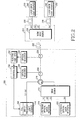
- FIG 1 illustrates the configuration of a WDM PON using loop-back light sources.
- a CO 100 is connected to an RN 104 adjacent to subscribers by a single optical fiber 102, and the RN 104 is connected to ONUs 110, 130 by independent optical fibers 106 to 108.
- An upstream data transmission structure in which the ONUs 110 to 130 transmit data to the CO 100 via a WDM MUX/DEMUX 124 in the RN 104.
- a multi-frequency light source 114 generates a WDM optical signal containing optical signals at n wavelengths ⁇ 1 to ⁇ n. It is to be noted here that only components needed for understanding the subject matter of the present invention are shown between the CO 100 and the RN 104 and the RN 104 and the ONUs 110 to 130, with the other components omitted.
- the CO 100 is comprised of the multi-frequency light source 114, an optical circulator 116, a WDM DEMUX 118, and upstream optical data receivers 120 to 122.
- the multi-frequency light source 114 generates a WDM optical signal destined for loop-back light sources 126 to 128 used for upstream data transmission in the ONUs 110 to 130.
- the optical circulator 116 connects the multi-frequency light source 114 and the WDN DEMUX 118.
- the circulator 116 is also connected to the optical fiber 102 which connects the CO to the WDM MUX/DEMUX 124 of the RN 104, for outputting the WDM optical signal received from the multi-frequency light source 114 to the optical fiber 102 and outputting a WDM optical signal received from the optical fiber 102 to the WDM DEMUX 118.
- the WDM DEMUX 118 is a 1xN WDM DEMUX that WDM-demultiplexes the WDM optical signal received from the optical circulator 116 into optical signals having the n wavelengths ⁇ 1 to ⁇ n and feeds the optical signals to the upstream optical data receivers 120 to 122.
- the WDM DEMUX 118 is usually an AWG
- the upstream optical data receivers 120 to 122 generate electrical signals corresponding to the respective received optical signals.
- the RN 104 includes the 1xN WDM MUX/DEMUX, 124.
- the WDM MUX/DEMUX 124 WDM-demultiplexes the WDM optical signal from the multi-frequency light source 114 into optical signals having the n wavelengths ⁇ 1 to ⁇ n and feeding the optical signals to the optical fibers 106 to 108. It also WDM-multiplexes optical signals having the n wavelengths ⁇ 1 to ⁇ n received from the optical fibers 106 to 108 and feeds the multiplexed optical signal to the optical fiber 102.
- the ONUs 110 to 122 have their respective loop-back light sources 126 to 128 that generate optical signals at specific wavelengths for upstream data transmission. As described before, injection-locked Fabry-Perot lasers or RSOAs are used as the loop-back light sources 126 to 128.
- the WDM optical signal output from the multi-frequency light source 114 in the CO 100 reaches the RN 104 via the optical circulator 116 and the optical fiber 102.
- the WDM optical signal is then WDM-demultiplexed in the WDM MUX/DEMUX 124 in the RN 104.
- the respective demultiplexed optical signals are applied to the input of the upstream light sources, the loop-back light sources 126 to 128 in the ONUs 110 to 130 via the optical fibers 106 to 108.
- the loop-back light sources 126 to 128 output optical signals having the same wavelengths as those of the received optical signals and modulated according to upstream data signals.
- the signals from the loop-back light sources 126 to 128 are WDM-multiplexed in the WDM MUX/DEMUX 124 of the RN 104 and then transmitted to the CO 100.
- the WDM optical signal is applied to the input of the WDM DEMUX 118 via the optical circulator 116.
- the optical signal is WDM-demultiplexed in the WDM DEMUX 118 and the demultiplexed optical signals are fed to the respective upstream optical data receivers 120 to 122.
- FIG 2 illustrates the configuration of a WDM PON using loop-back light sources according to a first aspect of the present invention.
- the WDM PON further includes an optical wavelength tracking apparatus in a CO 200 in addition to the components of the WDM PON illustrated in FIG 1.
- the optical wavelength tracking apparatus including a first optical power measurer with an optical divider 224 and an optical receiver 228, a second optical power measurer with an optical divider 226, an optical receiver 230, and an electric amplifier 232, and a control unit including a controller 234 and a temperature control unit (TCU) 236.
- TCU temperature control unit
- the CO 200 is connected to an RN 204 adjacent to subscribers by a single optical fiber 202, and the RN 204 is connected to ONUs 210 to 250 by independent optical fibers 206 to 208.
- An upstream data transmission structure in which the ONUs 210 to 250 transmit data to the CO 200 via a WDM MUX/DEMUX 238 in the RN 204 is illustrated in FIG 2.
- a multi-frequency light source 214 generates a WDM optical signal containing optical signals at n wavelengths ⁇ 1 to ⁇ n. It is to be noted here that only components needed for understanding the subject matter of the present invention are shown between the CO 200 and the RN 204 and the RN 204 and the ONUs 210 to 250, with the other components omitted.
- the optical dividers 224 and 226 are disposed in the optical signal path between the optical fiber 202 connected to the WDM MUX/DEMUX 238 of the RN 204 and an optical circulator 216.
- a WDM optical signal output from the multi-frequency light source 214 reaches the RN 204 via the optical circulator 216, the optical dividers 224 and 226, and the optical fiber 202.
- the WDM optical signal is then WDM-demultiplexed in the WDM MUX/DEMUX 238 in the RN 204.
- the respective demultiplexed optical signals are applied to the input of loop-back light sources 240 to 242 in the ONUs 210 to 250 via the optical fibers 206 to 208.
- the loop-back light sources 240 to 242 output optical signals having the same wavelengths as those of the received optical signals and modulated according to upstream data signals.
- the signals from the loop-back light sources 240 to 242 are WDM-multiplexed in the WDM MUX/DEMUX 238 of the RN 204 and then transmitted to the CO 200.
- the WDM optical signal is applied to the input of the WDM DEMUX 218 via the optical dividers 224 and 226 and the optical circulator 216. It is WDM-demultiplexed in the WDM DEMUX 218 and the demultiplexed optical signals are fed to respective upstream optical data receivers 220 to 222.
- the first optical power measurer measures the power level of a downstream WDM optical signal directed from the multi-frequency light source 214 to the WDM MUX/DEMUX 238.
- the optical divider 224 in the first optical power measurer branches off a section of the downstream WDM optical signal to the optical receiver 228.
- the optical receiver 228 applies a voltage at the power level of the received optical signal as a reference voltage to the controller 234.
- the second optical power measurer measures the power level of an upstream WDM optical signal received from the loop-back light sources 240 to 242 via the WDM MUX/DEMUX 238.
- the optical divider 226 in the second optical power measurer branches off a section of the upstream WDM optical signal to the optical receiver 230.
- the optical receiver 230 applies a voltage at the power level of the received optical signal as a monitoring voltage to the electric amplifier 232.
- the electric amplifier 232 amplifies the monitoring voltage with an amplification gain that renders the monitoring voltage equal to the reference voltage when the WDM wavelengths of the multi-frequency light source 214 and the WDM MUX/DEMUX 238 are identical, and feeds the amplified voltage to the controller 234.
- the control unit controls the WDM wavelengths of the multi-frequency light source 214 and the WDM MUX/DEMUX 238 to be nearly identical in order to minimize the difference between the power levels of the downstream and upstream optical signals measured in the first and second optical power measurers.
- the TCU 236 of the control unit is appended to the multi-frequency light source 214 and changes temperature under the control of the controller 234.
- a thermoelectric cooler (TEC) can be used as the TCU 236.
- the controller 234 controls the temperature of the multi-frequency light source 214 through the TCU 236 such that the difference between the reference voltage received from the optical receiver 228 and the monitoring voltage received from the optical receiver 230 through the electric amplifier 232 is minimized. Accordingly the optical wavelength tracking for the WDM wavelengths of the multi-frequency light source 214 and the WDM MUX/DEMUX 238 to be identical is possible.
- a microprocessor can be adopted as the controller 234, for control by an optical wavelength tracking algorithm.
- the output of the multi-frequency light source 214 in the CO 200 is maintained constant. Therefore, the reference voltage detected at the optical receiver 228 that receives a section of the output of the multi-frequency light source 214 is also maintained constant.
- the power of the upstream WDM optical signal is maximal when the WDM wavelengths of the multi-frequency light source 214 are identical to those of the WDM MUX/DEMUX 238.
- the upstream WDM optical signal is an optical signal that is generated in the downstream direction in the multi-frequency light source 214 of the CO 200, WDM-demultiplexed in the RN 204, modulated in the loop-back light sources 240 to 242 in the ONUs 210 to 250, WDM-multiplexed in the RN 204, and then transmitted to the CO 200.
- optical links connecting the CO 200 to the ONUs 210 to 212 undergo constant loss and the power of optical signals from the loop-back light sources 240 to 242 in the ONUs 210 to 250 is proportional to that of received optical signals.
- the maximum power of the upstream WDM optical signal transmitted to the CO 200 is dependent on that of the downstream WDM optical signal from the multi-frequency light source 214. If the multi-frequency light source 214 and the WDM MUX/DEMUX 238 are identical in WDM wavelength, the difference between the reference voltage and the monitoring voltage is minimized. On the other hand, as the WDM wavelength difference between the multi-frequency light source 214 and the WDM MUX/DEMUX 238 gets broad, the difference between the reference voltage and the monitoring voltage also becomes large.
- the controller 234 monitors the voltage difference and minimizes the difference between the reference voltage and the monitoring voltage by control of the WDM wavelengths of the multi-frequency light source 214 through the TCU 236. As a result, the controller 234 enables the WDM wavelengths of the multi-frequency light source 214 to track those of the WDM MUX/DEMUX 238 varying with temperature in the RN 204 so that they are identical all the time.
- the multi-frequency light source 214 may include an AWG that is used for determining its wavelength band.
- a multi-frequency light source may include an Erbium-doped lasing light source, a spectrum-division multi-frequency light source using an Erbium-doped optical fiber, or a multi-frequency light source using a semiconductor optical amplifier.
- the multi-frequency light source 214 may adopt a resonator structure including a gain medium for oscillating an optical signal, by which its wavelength band is determined.
- a TEC used as the TCU 236 is mounted to the AWG of the multi-frequency light source 214.
- the controller 234 adjusts the strength and direction of a current flowing in the TEC, the AWG's temperature is controlled and thus the AWG's WDM wavelengths are changed.
- the controller 234 can control the WDM wavelengths of the multi-frequency light source 214.
- the TEC is mounted to a light source in the multi-frequency light source 214. In this case, the controller 234 can control the WDM wavelengths of the multi-frequency light source 214 by adjusting the strength and direction of a current flowing in the TEC and thus controlling the temperature of the gain medium.
- the power of the upstream WDM optical signal transmitted to the CO 200 can be maximized by enabling the WDM wavelengths of the multi-frequency light source 214 in the CO 200 to track those of the WDM MUX/DEMUX 238 in the RN 204.
- one of the WDM wavelengths is neither confined to tracking, nor is an additional device for measuring the power level of one channel and notifying the CO 200 of the power level used in the RN 204.
- the optical wavelength tracking is carried out using a section of a transmitted WDM optical signal and a simple control circuit.
- the present invention is more cost-effective than previously known in the art.
- the reference voltage can be rendered equal to the monitoring voltage when the WDM wavelengths of the multi-frequency light source 214 and the WDM MUX/DEMUX 238 are identical.
- One way is by setting the dividing ratios of the optical dividers 224 and 226 to the same value, the electric amplifier 232 is positioned between the controller 234 and the optical receiver 230, and the amplification gain of the electric amplifier 232 is set in the manner that makes the monitoring voltage equal to the reference voltage when the WDM wavelengths of the multi-frequency light source 214 and the WDM MUX/DEMUX 238 are identical.
- step 300 An implementation of an algorithm for optical wavelength tracking by control of the temperature of the multi-frequency light source 214 in the CO in the controller 234 is shown in steps 300 to 320 of FIG 3.
- the controller 234 measures the reference voltage and the monitoring voltage in step 300.
- the reference voltage is denoted by V1 and the monitoring voltage, by V2 in FIG 3.
- the controller 234 stores the absolute difference between V1 and V2,
- the controller 234 increases the temperature of the multi-frequency light source 214 by a predetermined temperature variation ⁇ T in step 304.
- the controller 234 measures V1 and V2 again in step 308 and stores the difference between V1 and V2,
- step 312 the controller 234 compares the present voltage difference with a threshold Vr. If the voltage difference is equal to or less than Vr, the controller 234 returns to step 306, taking into consideration that the WDM wavelengths of the multi-frequency light source 214 and the WDM MUX/DEMUX 238 are identical. In this case, the temperature of the multi-frequency light source 214 is maintained unchanged. Since the amplification gain of the electric amplifier 232 is set to render the monitoring voltage equal to the reference voltage when the WDM wavelengths of the multi-frequency light source 214 and the WDM MUX/DEMUX 238 are identical, the present voltage different is 0. Even if the present voltage difference is not truly 0 because of errors, Vr is preset to a value that can make the WDM wavelengths of the multi-frequency light source 214 and the WDM MUX/DEMUX 238 almost identical to each other.
- the controller 234 compares the present voltage difference with the previous voltage difference in step 314. If the present voltage difference is equal to or greater than the present voltage difference, this difference implies that the WDM wavelengths of the multi-frequency light source 214 are more discrepant from those of the WDM MUX/DEMUX 238. Therefore, the controller 234 increases or decreases the temperature of the multi-frequency light source 214 by ⁇ T, by a value that is contrary to the present temperature change, in step 316. That is, if the temperature of the multi-frequency light source 214 was increased by ⁇ T, it is decreased by ⁇ T at this time, and vice versa.
- the controller 234 increases or decreases the temperature of the multi-frequency light source 214 by ⁇ T, in the same manner as the previous temperature change, in step 318. That is, if the temperature of the multi-frequency light source 214 was increased by ⁇ T, it is also increased by ⁇ T at this time. If the temperature of the multi-frequency light source 214 was decreased by ⁇ T, it is also decreased by ⁇ T at this time.
- step 316 or 318 the controller 234 stores the present voltage difference as the previous voltage difference in step 320 and returns to step 306.
- the controller 234 periodically measures
- the WDM wavelengths of the multi-frequency light source 214 become identical to those of the WDM MUX/DEMUX 238.
- the controller 234 dynamically sets ⁇ T according to
- the WDM wavelengths of the WDM DEMUX 218 in the CO 200 become varied from those of the WDM MUX/DEMUX 238 in the RN 204. Therefore, the WDM wavelengths of the WDM DEMUX 218 as well as those of the multi-frequency light source 214 in the CO 200 can be enabled to track those of the WDM MUX/DEMUX 238 in the RN 204.
- FIG. 4 illustrates the configuration of a WDM PON using loop-back light sources according to another aspect of the present invention, which allows the WDM wavelengths of a WDM DEMUX 418 as well as those of a multi-frequency light source 414 in a CO 400 to track those of a WDM MUX/DEMUX 442 in an RN 404.
- Another embodiment of the optical wavelength tracking apparatus for the CO 400 according to the present invention is also comprised of first and second optical power measurers and a control unit.
- the first power measurer includes an optical divider 424 and an optical receiver 428
- the second optical power measurer includes an optical divider 426, an optical receiver 430, and an electric amplifier 432.
- the control unit further has an electric amplifier 438 and a TCU 440 in addition to a controller 434 and a TCU 436.
- the CO 400 is connected to the RN 404 adjacent to subscribers by a single optical fiber 402, and the RN 404 is connected to ONUs 410 to 460 by independent optical fibers 406 to 408.
- An upstream data transmission structure in which the ONUs 410 to 460 transmit data to the CO 400 via a WDM MUX/DEMUX 442 in the RN 404 is illustrated in FIG 4.
- the multi-frequency light source 414 generates a WDM optical signal containing optical signals at n wavelengths ⁇ 1 to ⁇ n.
- the optical dividers 424 and 426 are disposed in the optical signal path between the optical fiber 402 connected to the WDM MUX/DEMUX 442 of the RN 404 and an optical circulator 416.
- the control unit controls the WDM wavelengths of the multi-frequency light source 414 and the WDM DEMUX 418 so as to be nearly identical to those of the WDM MUX/DEMUX 442 in order to minimize the difference between the power levels of the downstream and upstream optical signals measured in the first and second optical power measurers.
- the TCU 436 of the control unit is appended to the multi-frequency light source 414 and changes its temperature under the control of the controller 434
- the other TCU 440 is mounted to the WDM DEMUX 418 and changes its temperature through the electric amplifier 438 under the control of the controller 434.
- a TEC can also be used as the TCU 440.
- the WDM DEMUX 418 is an AWG
- a TEC used as the TCU 440 is mounted to the AWG
- the controller 434 adjusts the strength and direction of a current flowing in the TEC, the AWG's temperature is controlled and thus the AWG's WDM wavelengths are changed.
- the controller 434 can control the WDM wavelengths of the WDM DEMUX 418.
- the electric amplifier 438 is used for the controller 434 to control simultaneously the TCUs 436 and 438 through one output port because the multi-frequency light source 414 and the WDM DEMUX 418 exhibit different wavelength characteristics with respect to temperature. Accordingly, the amplification gain of the electric amplifier 438 is set in correspondence with the wavelength characteristics of the multi-frequency light source 414 and the WDM DEMUX 418 with respect to temperature. However, if the controller 434 is configured to control the TCUs 436 and 440 separately through different output ports, there is no need for the electric amplifier 438.
- the controller 434 controls the temperature of the multi-frequency light source 414 to thereby minimize the difference between a reference voltage received from the optical receiver 428 and a monitoring voltage received from the optical receiver 430 through the electric amplifier 432. At the same time, it controls the temperature of the WDM DEMUX 418 by means of the TCU 440. Thus, optical wavelength tracking is carried out so that the WDM wavelengths of the multi-frequency light source 414 and the WDM DEMUX 418 are nearly identical to those of the WDM MUX/DEMUX 442.
- the WDM wavelengths of the WDM DEMUX 418 which demultiplexes an upstream WDM optical signal and provides the demultiplexed signals to optical receivers 420 to 422, as well as those of the multi-frequency light source 414, also tracks output of the WDM MUX/DEMUX 442.
- the power of the upstream WDM optical signal transmitted to the CO 400 is, therefore, maximized and degradation from adjacent channels is minimized in the upstream WDM optical signal WDM-demultiplexed in the WDM DEMUX 418.
- none of the WDM wavelengths are confined to tracking, or are any additional devices required for measuring the power level of one channel and notifying the CO 400 of the power level used in the RN 404.
- the optical wavelength tracking is carried out using a section of a transmitted WDM optical signal and a simple control circuit.
- the present invention is more cost-effective than known heretofore in the art
- optical wavelength tracking is carried out so efficiently, economically that the WDM wavelengths of a multi-frequency light source and/or a WDM DEMUX in a CO can track those of a WDM MUX/DEMUX in an RN.
Landscapes
- Engineering & Computer Science (AREA)
- Computer Networks & Wireless Communication (AREA)
- Signal Processing (AREA)
- Physics & Mathematics (AREA)
- Electromagnetism (AREA)
- Microelectronics & Electronic Packaging (AREA)
- General Physics & Mathematics (AREA)
- Optics & Photonics (AREA)
- Optical Communication System (AREA)
Applications Claiming Priority (2)
| Application Number | Priority Date | Filing Date | Title |
|---|---|---|---|
| KR10-2003-0059536A KR100498954B1 (ko) | 2003-08-27 | 2003-08-27 | 루프-백 광원을 이용한 파장분할다중방식 수동형 광가입자망의 광 파장 트래킹 장치 및 방법 |
| KR2003059536 | 2003-08-27 |
Publications (2)
| Publication Number | Publication Date |
|---|---|
| EP1511194A2 true EP1511194A2 (de) | 2005-03-02 |
| EP1511194A3 EP1511194A3 (de) | 2006-05-03 |
Family
ID=34101853
Family Applications (1)
| Application Number | Title | Priority Date | Filing Date |
|---|---|---|---|
| EP04011315A Withdrawn EP1511194A3 (de) | 2003-08-27 | 2004-05-12 | Einrichtung und Verfahren zur Nachführung optischer Wellenlängen in einem WDM passiven optischen Netz unter Verwendung von Rückschleifen-Lichtquellen |
Country Status (5)
| Country | Link |
|---|---|
| US (1) | US7254340B2 (de) |
| EP (1) | EP1511194A3 (de) |
| JP (1) | JP4202981B2 (de) |
| KR (1) | KR100498954B1 (de) |
| CN (1) | CN100553182C (de) |
Cited By (5)
| Publication number | Priority date | Publication date | Assignee | Title |
|---|---|---|---|---|
| CN100488207C (zh) * | 2005-09-23 | 2009-05-13 | 华为技术有限公司 | 无源光网络用户终端的运行方法 |
| WO2010046714A3 (en) * | 2008-10-25 | 2010-06-24 | The Centre For Integrated Photonics Limited | Wavelength division multiplexing transmission equipment |
| EP2025080A4 (de) * | 2006-05-30 | 2012-11-07 | Luxpert Technologies Co Ltd | Injektionsgekoppelte lichtquelle, deren rauschen minimiert werden kann |
| EP1886422A4 (de) * | 2005-06-03 | 2015-01-21 | Kt Corp | Passives optisches netzwerksystem mit wellenlängenmultiplex |
| FR3045844A1 (fr) * | 2015-12-22 | 2017-06-23 | Inst Mines Telecom | Systeme de liaison optique sans fil pour la transmission de donnees a tres haut debit de maniere asservie en itinerance |
Families Citing this family (23)
| Publication number | Priority date | Publication date | Assignee | Title |
|---|---|---|---|---|
| KR100608946B1 (ko) * | 2004-10-20 | 2006-08-03 | 광주과학기술원 | 자체잠김된 페브리-페롯 레이저 다이오드를 이용한 파장분할다중 방식의 수동형 광통신망과, 이에 사용되는 지역 기지국 및 그 제어 방법 |
| KR100689503B1 (ko) * | 2004-12-30 | 2007-03-02 | 삼성전자주식회사 | 파장 분할 다중 방식 수동형 광 가입자망 |
| FR2884086A1 (fr) * | 2005-04-05 | 2006-10-06 | France Telecom | Transmission optique entre une premiere unite et une pluralite de secondes unites connectees entre elles au moyen d'un reseau d'acces optique passif |
| KR100809400B1 (ko) | 2005-12-07 | 2008-03-06 | 한국전자통신연구원 | 반사형 반도체 광증폭기를 이용한 광송수신 모듈, 그모듈을 포함한 수동형 광가입자망 및 그 모듈의 입력광파워 검출방법 |
| US7787771B2 (en) * | 2005-12-08 | 2010-08-31 | Electronics And Telecommunications Research Institute | Extendable loop-back type passive optical network and scheduling method and apparatus for the same |
| US20070183793A1 (en) * | 2006-02-09 | 2007-08-09 | Huawei Technologies Co., Ltd. | Device and method for detecting received optical power in optical communication network |
| CN101018090B (zh) * | 2006-02-09 | 2012-05-23 | 华为技术有限公司 | 在光通信网络中检测光接收功率的装置和方法 |
| KR100819034B1 (ko) * | 2006-05-11 | 2008-04-03 | 한국전자통신연구원 | 반사형 반도체 광증폭기 기반 수동형 광가입자망 |
| CN101154996B (zh) * | 2006-09-30 | 2012-07-11 | 华为技术有限公司 | 光网络单元及其接入方法、光线路终端及无源光网络系统 |
| KR100870897B1 (ko) * | 2007-02-06 | 2008-11-28 | 한국과학기술원 | 전송품질이 개선된 반사형 반도체 광증폭기 기반광가입자망 시스템 |
| KR100910940B1 (ko) * | 2007-09-03 | 2009-08-05 | (주)켐옵틱스 | 파장 조절이 가능한 수동 광 가입자망 및 그 파장 조절방법 |
| JP4820791B2 (ja) * | 2007-09-21 | 2011-11-24 | 株式会社日立製作所 | パッシブ光ネットワークシステムおよびレンジング方法 |
| WO2009056365A1 (en) * | 2007-10-29 | 2009-05-07 | Telefonaktiebolaget Lm Ericsson (Publ) | Improvements in or relating to optical networks |
| CN101499853B (zh) * | 2008-01-30 | 2012-08-15 | 华为技术有限公司 | 一种光路状态的测量方法、光网络和网络设备 |
| KR100964240B1 (ko) * | 2008-07-09 | 2010-06-16 | 주식회사 나노트로닉스 | 수동광통신망의 광출력 측정장치 및 방법 |
| US8126332B2 (en) * | 2008-08-20 | 2012-02-28 | Lg-Ericsson Co., Ltd. | Method of wavelength alignment for a wavelength division multiplexed passive optical network |
| TW201023536A (en) * | 2008-12-03 | 2010-06-16 | Univ Nat Taiwan Science Tech | Optical network monitoring system and method |
| EP2372936A1 (de) * | 2010-03-29 | 2011-10-05 | Alcatel Lucent | Integrierter Photonensender |
| US9178610B1 (en) | 2013-03-14 | 2015-11-03 | Google Inc. | Optical loopback in a wavelength division multiplexing system |
| US9344195B2 (en) * | 2013-04-30 | 2016-05-17 | Broadcom Corporation | Multiple level signaling for passive optical networks |
| EP3091678B1 (de) * | 2015-05-06 | 2019-07-10 | ADVA Optical Networking SE | Optisches wdm-übertragungsnetzwerk |
| US10630413B2 (en) * | 2016-05-25 | 2020-04-21 | Huawei Technologies Co., Ltd. | Optical communications system with centralized wavelength source |
| US11140633B2 (en) * | 2020-02-10 | 2021-10-05 | Samsung Electronics Co., Ltd. | Method and apparatus for loopback gain step calibration on RF chain with phase shifter |
Family Cites Families (10)
| Publication number | Priority date | Publication date | Assignee | Title |
|---|---|---|---|---|
| US5729369A (en) | 1996-05-31 | 1998-03-17 | Lucent Technologies Inc. | Method of tracking a plurality of discrete wavelengths of a multifrequency optical signal for use in a passive optical network telecommunications system |
| US6043915A (en) | 1997-03-31 | 2000-03-28 | Lucent Technologies Inc. | Stabilization of a multi-channel optical signal transmitter through correlation feedback |
| US6304350B1 (en) | 1997-05-27 | 2001-10-16 | Lucent Technologies Inc | Temperature compensated multi-channel, wavelength-division-multiplexed passive optical network |
| DE19828615A1 (de) * | 1998-06-26 | 1999-12-30 | Ams Optotech Vertrieb Gmbh | Verfahren zur Erfassung und/oder Regelung der Sendewellenlängen von Sendeelementen einer optischen Wellenlängenmultiplex--Sendeeinheit und entsprechende Wellenlängenmultiplex-Sendeeinheit |
| ATE280456T1 (de) * | 1998-08-14 | 2004-11-15 | Ericsson Telefon Ab L M | Regelung der wellenlänge für wdm optische übertragungssysteme |
| JP3844902B2 (ja) * | 1999-03-02 | 2006-11-15 | 富士通株式会社 | 波長多重用光増幅器及び光通信システム |
| KR100342757B1 (ko) * | 1999-10-05 | 2002-07-04 | 이계철 | 파장 분할 다중화 시스템에서의 다채널 광신호 감시 장치 |
| US7027743B1 (en) * | 2000-10-05 | 2006-04-11 | Agilent Technologies, Inc. | System and method for optical heterodyne detection of an optical signal including optical pre-selection that is adjusted to accurately track a local oscillator signal |
| KR100419608B1 (ko) * | 2001-09-24 | 2004-02-25 | 한국전자통신연구원 | 파장분할다중화방식 광통신 시스템의 채널 등화장치 및 방법 |
| KR100480246B1 (ko) * | 2002-11-07 | 2005-04-07 | 삼성전자주식회사 | 중앙 기지국에서 생성된 다파장 광의 루프백을 이용하는수동형 광통신망 |
-
2003
- 2003-08-27 KR KR10-2003-0059536A patent/KR100498954B1/ko not_active Expired - Fee Related
-
2004
- 2004-02-17 US US10/780,132 patent/US7254340B2/en not_active Expired - Fee Related
- 2004-04-15 CN CNB2004100353033A patent/CN100553182C/zh not_active Expired - Fee Related
- 2004-05-12 EP EP04011315A patent/EP1511194A3/de not_active Withdrawn
- 2004-08-23 JP JP2004241854A patent/JP4202981B2/ja not_active Expired - Fee Related
Cited By (7)
| Publication number | Priority date | Publication date | Assignee | Title |
|---|---|---|---|---|
| EP1886422A4 (de) * | 2005-06-03 | 2015-01-21 | Kt Corp | Passives optisches netzwerksystem mit wellenlängenmultiplex |
| CN100488207C (zh) * | 2005-09-23 | 2009-05-13 | 华为技术有限公司 | 无源光网络用户终端的运行方法 |
| EP2025080A4 (de) * | 2006-05-30 | 2012-11-07 | Luxpert Technologies Co Ltd | Injektionsgekoppelte lichtquelle, deren rauschen minimiert werden kann |
| WO2010046714A3 (en) * | 2008-10-25 | 2010-06-24 | The Centre For Integrated Photonics Limited | Wavelength division multiplexing transmission equipment |
| US9020358B2 (en) | 2008-10-25 | 2015-04-28 | The Centre For Integrated Photonics Limited | Wavelength division multiplexing transmission equipment |
| FR3045844A1 (fr) * | 2015-12-22 | 2017-06-23 | Inst Mines Telecom | Systeme de liaison optique sans fil pour la transmission de donnees a tres haut debit de maniere asservie en itinerance |
| WO2017108583A1 (fr) * | 2015-12-22 | 2017-06-29 | Institut Mines Telecom | Système de liaison optique sans fil pour la transmission de données à très haut débit de manière asservie en itinérance |
Also Published As
| Publication number | Publication date |
|---|---|
| JP4202981B2 (ja) | 2008-12-24 |
| US7254340B2 (en) | 2007-08-07 |
| JP2005073263A (ja) | 2005-03-17 |
| CN1592184A (zh) | 2005-03-09 |
| US20050047784A1 (en) | 2005-03-03 |
| CN100553182C (zh) | 2009-10-21 |
| EP1511194A3 (de) | 2006-05-03 |
| KR20050022917A (ko) | 2005-03-09 |
| KR100498954B1 (ko) | 2005-07-04 |
Similar Documents
| Publication | Publication Date | Title |
|---|---|---|
| US7254340B2 (en) | Apparatus and method for tracking optical wavelength in WDM passive optical network using loop-back light source | |
| JP4584584B2 (ja) | 波長分割多重パッシーブ光ネットワークを含むシステムおよびそのための方法 | |
| US8126332B2 (en) | Method of wavelength alignment for a wavelength division multiplexed passive optical network | |
| KR100480246B1 (ko) | 중앙 기지국에서 생성된 다파장 광의 루프백을 이용하는수동형 광통신망 | |
| KR101471688B1 (ko) | 주기적으로 필터된 광대역 광원 | |
| US20060083515A1 (en) | WDM-PON having optical source of self-injection locked fabry-perot laser diode | |
| US7593647B2 (en) | Apparatuses and methods for automatic wavelength locking of an optical transmitter to the wavelength of an injected incoherent light signal | |
| US6701222B1 (en) | Transmission systems and components utilizing thermo-stabilization and method of use therein | |
| US20040001718A1 (en) | Course wavelength division multiplexed optical network | |
| WO2008045141A1 (en) | Mutual wavelength locking in wdm-pons | |
| KR100711201B1 (ko) | 광대역 비간섭성 광원의 위치 조정을 이용한 장거리 전송파장분할 다중방식 수동형 광 가입자망 | |
| KR20050040149A (ko) | 반사형 이득고정 반도체 광증폭기를 포함하는 광신호전송장치 및 이를 이용한 광통신 시스템 | |
| WO2020045185A1 (ja) | 光通信システム及び光通信方法 | |
| US7400835B2 (en) | WDM system having chromatic dispersion precompensation | |
| US20050074240A1 (en) | Wavelength-division-multiplexed passive optical network system using wavelength-seeded light source | |
| JP2014079013A (ja) | チューニング可能なレーザーを備える通信システム | |
| KR100609698B1 (ko) | 파장분할다중방식 수동형 광가입자망 시스템 및광원생성방법 | |
| US7486890B2 (en) | Optical transmission apparatus and method | |
| US20060233550A1 (en) | Wavelength division multiplexed light source and passive optical network using the same | |
| KR100547834B1 (ko) | 파장추적장치를 구비한 파장분할다중방식 수동형광가입자망 및 이의 파장추적방법 | |
| KR100895482B1 (ko) | 저가격 파장분할다중방식 수동형 광가입자망 | |
| KR100514383B1 (ko) | 상하향 채널이 동일파장을 가지는 파장분할 다중방식수동형 광가입자망 시스템 | |
| US9368941B1 (en) | Temperature compensation in an optical transmitter | |
| KR100594961B1 (ko) | 부반송파다중접속 방식을 이용한 광통신 장치 및 그 방법 | |
| KR100539922B1 (ko) | 파장분할다중방식 수동형 광 가입자망에서의 파장 추적 장치 |
Legal Events
| Date | Code | Title | Description |
|---|---|---|---|
| PUAI | Public reference made under article 153(3) epc to a published international application that has entered the european phase |
Free format text: ORIGINAL CODE: 0009012 |
|
| 17P | Request for examination filed |
Effective date: 20040512 |
|
| AK | Designated contracting states |
Kind code of ref document: A2 Designated state(s): AT BE BG CH CY CZ DE DK EE ES FI FR GB GR HU IE IT LI LU MC NL PL PT RO SE SI SK TR |
|
| AX | Request for extension of the european patent |
Extension state: AL HR LT LV MK |
|
| PUAL | Search report despatched |
Free format text: ORIGINAL CODE: 0009013 |
|
| RIC1 | Information provided on ipc code assigned before grant |
Ipc: H04B 10/155 20060101ALI20060214BHEP Ipc: H04B 10/26 20060101ALI20060214BHEP Ipc: H04B 10/12 20060101AFI20050103BHEP |
|
| AK | Designated contracting states |
Kind code of ref document: A3 Designated state(s): AT BE BG CH CY CZ DE DK EE ES FI FR GB GR HU IE IT LI LU MC NL PL PT RO SE SI SK TR |
|
| AX | Request for extension of the european patent |
Extension state: AL HR LT LV MK |
|
| AKX | Designation fees paid |
Designated state(s): DE FR GB |
|
| 17Q | First examination report despatched |
Effective date: 20070212 |
|
| STAA | Information on the status of an ep patent application or granted ep patent |
Free format text: STATUS: THE APPLICATION IS DEEMED TO BE WITHDRAWN |
|
| 18D | Application deemed to be withdrawn |
Effective date: 20100120 |