EP1512242B1 - Pointillage identique pour donnees d'identification d'equipement utilisateur et pour donnees utiles de canal hs-scch - Google Patents
Pointillage identique pour donnees d'identification d'equipement utilisateur et pour donnees utiles de canal hs-scch Download PDFInfo
- Publication number
- EP1512242B1 EP1512242B1 EP03759831A EP03759831A EP1512242B1 EP 1512242 B1 EP1512242 B1 EP 1512242B1 EP 03759831 A EP03759831 A EP 03759831A EP 03759831 A EP03759831 A EP 03759831A EP 1512242 B1 EP1512242 B1 EP 1512242B1
- Authority
- EP
- European Patent Office
- Prior art keywords
- data
- bits
- rate matching
- rate
- coding
- Prior art date
- Legal status (The legal status is an assumption and is not a legal conclusion. Google has not performed a legal analysis and makes no representation as to the accuracy of the status listed.)
- Expired - Lifetime
Links
- 238000000034 method Methods 0.000 claims abstract description 27
- 238000004891 communication Methods 0.000 claims abstract description 6
- 230000005540 biological transmission Effects 0.000 abstract description 13
- 230000008569 process Effects 0.000 abstract description 13
- 230000006978 adaptation Effects 0.000 description 31
- 230000000873 masking effect Effects 0.000 description 16
- 238000001514 detection method Methods 0.000 description 9
- 230000008901 benefit Effects 0.000 description 6
- 238000013459 approach Methods 0.000 description 3
- 230000001419 dependent effect Effects 0.000 description 2
- 238000013461 design Methods 0.000 description 2
- 238000005457 optimization Methods 0.000 description 2
- 238000012937 correction Methods 0.000 description 1
- 238000011161 development Methods 0.000 description 1
- 230000018109 developmental process Effects 0.000 description 1
- 230000006870 function Effects 0.000 description 1
- 230000010363 phase shift Effects 0.000 description 1
- 238000012545 processing Methods 0.000 description 1
- 238000011084 recovery Methods 0.000 description 1
- 230000009467 reduction Effects 0.000 description 1
- 230000011664 signaling Effects 0.000 description 1
Images

Classifications
-
- H—ELECTRICITY
- H04—ELECTRIC COMMUNICATION TECHNIQUE
- H04L—TRANSMISSION OF DIGITAL INFORMATION, e.g. TELEGRAPHIC COMMUNICATION
- H04L1/00—Arrangements for detecting or preventing errors in the information received
- H04L1/004—Arrangements for detecting or preventing errors in the information received by using forward error control
- H04L1/0056—Systems characterized by the type of code used
- H04L1/0057—Block codes
-
- H—ELECTRICITY
- H03—ELECTRONIC CIRCUITRY
- H03M—CODING; DECODING; CODE CONVERSION IN GENERAL
- H03M13/00—Coding, decoding or code conversion, for error detection or error correction; Coding theory basic assumptions; Coding bounds; Error probability evaluation methods; Channel models; Simulation or testing of codes
- H03M13/63—Joint error correction and other techniques
- H03M13/635—Error control coding in combination with rate matching
- H03M13/6362—Error control coding in combination with rate matching by puncturing
-
- H—ELECTRICITY
- H04—ELECTRIC COMMUNICATION TECHNIQUE
- H04L—TRANSMISSION OF DIGITAL INFORMATION, e.g. TELEGRAPHIC COMMUNICATION
- H04L1/00—Arrangements for detecting or preventing errors in the information received
- H04L1/004—Arrangements for detecting or preventing errors in the information received by using forward error control
- H04L1/0041—Arrangements at the transmitter end
-
- H—ELECTRICITY
- H04—ELECTRIC COMMUNICATION TECHNIQUE
- H04L—TRANSMISSION OF DIGITAL INFORMATION, e.g. TELEGRAPHIC COMMUNICATION
- H04L1/00—Arrangements for detecting or preventing errors in the information received
- H04L1/004—Arrangements for detecting or preventing errors in the information received by using forward error control
- H04L1/0045—Arrangements at the receiver end
-
- H—ELECTRICITY
- H04—ELECTRIC COMMUNICATION TECHNIQUE
- H04L—TRANSMISSION OF DIGITAL INFORMATION, e.g. TELEGRAPHIC COMMUNICATION
- H04L1/00—Arrangements for detecting or preventing errors in the information received
- H04L1/004—Arrangements for detecting or preventing errors in the information received by using forward error control
- H04L1/0056—Systems characterized by the type of code used
- H04L1/0059—Convolutional codes
-
- H—ELECTRICITY
- H04—ELECTRIC COMMUNICATION TECHNIQUE
- H04L—TRANSMISSION OF DIGITAL INFORMATION, e.g. TELEGRAPHIC COMMUNICATION
- H04L1/00—Arrangements for detecting or preventing errors in the information received
- H04L1/004—Arrangements for detecting or preventing errors in the information received by using forward error control
- H04L1/0056—Systems characterized by the type of code used
- H04L1/0067—Rate matching
- H04L1/0068—Rate matching by puncturing
- H04L1/0069—Puncturing patterns
-
- H—ELECTRICITY
- H04—ELECTRIC COMMUNICATION TECHNIQUE
- H04L—TRANSMISSION OF DIGITAL INFORMATION, e.g. TELEGRAPHIC COMMUNICATION
- H04L1/00—Arrangements for detecting or preventing errors in the information received
- H04L1/004—Arrangements for detecting or preventing errors in the information received by using forward error control
- H04L1/0072—Error control for data other than payload data, e.g. control data
-
- H—ELECTRICITY
- H04—ELECTRIC COMMUNICATION TECHNIQUE
- H04L—TRANSMISSION OF DIGITAL INFORMATION, e.g. TELEGRAPHIC COMMUNICATION
- H04L1/00—Arrangements for detecting or preventing errors in the information received
- H04L1/08—Arrangements for detecting or preventing errors in the information received by repeating transmission, e.g. Verdan system
-
- H—ELECTRICITY
- H04—ELECTRIC COMMUNICATION TECHNIQUE
- H04L—TRANSMISSION OF DIGITAL INFORMATION, e.g. TELEGRAPHIC COMMUNICATION
- H04L1/00—Arrangements for detecting or preventing errors in the information received
- H04L1/12—Arrangements for detecting or preventing errors in the information received by using return channel
- H04L1/16—Arrangements for detecting or preventing errors in the information received by using return channel in which the return channel carries supervisory signals, e.g. repetition request signals
- H04L1/18—Automatic repetition systems, e.g. Van Duuren systems
- H04L1/1812—Hybrid protocols; Hybrid automatic repeat request [HARQ]
- H04L1/1819—Hybrid protocols; Hybrid automatic repeat request [HARQ] with retransmission of additional or different redundancy
Definitions
- the present invention relates to a method of data transmission in which the bit rate of transmission over the physical channel is fixed.
- transmission channels in mobile radio systems offer only fixed data or raw data transmission rates, while the data rates of different signals or applications deviate therefrom. Therefore, it is generally necessary to match the data rates at an interface.
- UMTS Universal Mobile Telecommunication System
- data packets are sent to a mobile station (UE) via the "High-Speed Downlink Shared Channel” (HS-DSCH).
- the associated control information is transmitted via the "High-Speed Shared Control Channel” (HS-SCCH), such as the channelization codes and the modulation scheme used for the HS-DSCH, for example QPSK (Quadrature Phase Shift Keying) or 16QAM (16 Quadrature Amplitude modulation).
- HS-SCCH High-Speed Shared Control Channel
- this control information or this user data is linked to identification information.
- identification information One speaks in this connection also of a masking of the data. Before the Link experience both user and identification data encoding and each subsequent rate adjustment.
- the core of the invention is, in the overall coding in a channel used by a plurality of communication users, the rate adaptation for user data and identification data, which is used to indicate who is responsible for the data, according to a common scheme.
- This has the advantage that the complexity of the decoding is lower, in particular on the receiver side.
- Another aspect of the invention is directed to the design of a rate matching pattern that allows rate matching according to a common scheme while preserving the original information as well as possible.
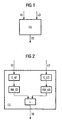
- FIG. 1 A first figure.
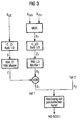
- FIG. 1 schematically shows an overall coding for user data (LD: load data) and identification data (ID: identification data), which are transmitted via a shared channel in a communication system.
- transferred data TD: Transferred Data
- LD user data
- ID identification data
- the combination of user data LD and identification data ID occurs as part of an overall coding (CC: Channel Coding), usually a channel coding.
- Channel coding is the adaptation of digital values to the physical transmission medium, that is, for example, a coding with subsequent rate adaptation.
- overall coding is understood to be the coding, rate adaptation and linking of the user and identification data. However, it is not absolutely necessary that all listed steps take place, the overall coding can for example also consist of coding alone without rate adaptation.
- the user data LD are first subjected to a coding C_LD.
- C_LD coding
- redundancy is added to the useful data LD, which enables a more reliable recovery of the transmitted data TD on the receiver side.
- a problem associated with encoding is that the data rate is reduced by a factor of R.
- a rate adaptation (Ratematching) RM_LD is performed in the transmitter, wherein after a certain pattern either bits are removed from the data stream or repeated in the data stream.
- the removal of bits is referred to as "puncturing” and the repetition of bits as “repeating”.
- the identification data ID is first subjected to a coding C_ID and then to a rate matching RM_ID. Subsequently, identification data and user data are linked together in a linking operation L, whereby the data to be transmitted TD are formed.
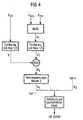
- FIG. 3 shows the implementation of the overall coding of the HS-SCCH part 1 according to the current specification UMTS standard (FDD, Release 5).
- the payload data LD are formed by the channel information bits x ccs, 1 , x ccs, 2 ,..., X ccs, 7 .
- the channel information bits are referred to in the art as "Channelization Code Set Bits”.
- the modulation scheme bit x ms, 1 which is also referred to as “modulation scheme bit” flows into the user data.
- These payloads are encoded using a rate 1/3 convolutional encoder according to the 1999 standard (Release 99).
- the multiplexer MUX allows for alternately polling channel information bits X ccs and the modulation scheme bit X ms .
- the entirety of the data present after the multiplexer is referred to as X 1 .
- X 1 The entirety of the data present after the multiplexer.
- This coded bit block should be referred to as Z 1 .
- the index 1 means that it is a size which concerns Part 1 (Part 1) of HS-SCCH.
- Rate matching is done according to the following rate matching pattern (Pattern 1): From the bit block or the sequence Z 1 resulting from Encoding C_LD, the Bits at positions 1, 2, 4, 8, 42, 45, 47, 48 dotted. If a notation with a second index j is used which characterizes the bit position and runs in the case shown and 1 to 48, then the bits to be punctured can be specified as Z 1,1 , Z 1,2, Z 1,4, Z 1 , 8, Z 1.42, Z 1.45, Z 1.47, Z 1.48 .
- the first index indicates, as before, that it is part 1 of HS-SCCH. In this notation, the sequence R 1.1 R 1.2, ... R 1.40 then exists in FIG. 3 after the rate adaptation process.
- the control channel HS-SCCH is intercepted by several mobile stations or mobile terminals (UE: User Equipment).
- UE User Equipment
- the payload data consisting of channel information data and the modulation scheme by the identification data or one of the identification number the mobile station dependent specific mask.
- UE ID 16-bit identification number of the mobile station
- rate 1 ⁇ 2-coding a so-called scrambling code (mask) specific to the identification number of the mobile station.
- the identification number of the mobile station UE ID is assigned to the mobile station in the respective cell by the respective base station.
- Scrambling is a "personalization" of information. This is done via so-called “scrambling codes” with which the signal is modified to separate signals for individual terminals or base stations from each other or separate.
- C_ID rate 1 ⁇ 2 convolutional encoder
- (16 + 8) x2 48 bits of a sequence B at the output of the convolutional coder.
- the rate matching algorithm from the standard 1999 (Release 99) is used for puncturing for the rate adaptation RM_ID (RM_ID), in which of the sequence B consisting of the bits b 1 , b 2 , ...
- the aim of the invention is, as I said, to make the overall coding, in particular the rate matching less complex than at present, that is, the specification according to the release 5 of the case.
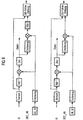
- FIG. 4 now shows a method sequence designed according to approach ii), likewise for the example of the control channel HS-SCCH.
- the identification data ID here referred to as identification bit sequence X ue
- the channel information data here X ccs and X ms already linked to each other after the respective coding C_LD or C_ID and then subjected to a common rate adaptation.
- the linkage is done, for example, by an XOR function, if you define the two values that each bit can assume with 0 and 1. If the values - 1 and 1 are accepted, the link can be made by multiplication. However, other bitwise links can also be used.
- the data resulting from the coding process is designated Z 1 .
- the bit block or the bit sequence or the sequence R 1 denotes the data before the common rate adaptation, but after the combination.
- the decoding in the receiver is correspondingly easier.
- a lower complexity is already achieved if the rate adaptation for identification data ID and useful data LD is carried out separately according to the same pattern (approach i).
- the proposed simplification of the rate adaptation in particular on the receiver side, that is to say for example in a mobile station, represents a great advantage due to the lower complexity of the decoding. Differences in the decoding as it currently occurs and how it can be done according to the invention are set forth below.
- FIG. 5 shows an example implementation in the receiver device as required by the current specification (Release 99).
- the transmitted data TD is received via the air interface AI (Air Interface). These transmitted data TD are demodulated in the demodulator Demod. After demodulation, these data are fed directly on the one hand to a bit error count unit. On the other hand, these data are with linked to the masking data, for example by an XOR connection or a multiplication.
- the masking data is generated in the mobile station from the identification number of the mobile station UE ID, which is coded and then subjected to rate matching (RM2). Subsequently, the linkage with the demodulated, transmitted data TD occurs.
- the rate matching RM2 of the masking data is required to match the bit lengths of the masking data to the bit length of the received data TD.
- decoding of the rate adaptation RM1 -1 takes place before decoding Dec.
- These data are decoded and re-encoded to check whether the information was intended for the respective receiving mobile station and subjected to another rate adaptation RM1 before being recombined with the masking data.
- the result of this new link also flows into the bit error count.
- the detection of the errors is based here on a processing of 40 bits, that is, as many bits as are transmitted via the air interface AI per HS-SCCH frame (HS-SCCH subframe), which consists of three so-called slots or time slots.
- FIG. 6 shows two exemplary implementations which can be used with a rate adaptation carried out according to the invention.
- the bit error detection in the Bit Error Counting Bit Error Count is also based on 40 bits. Due to the same rate matching pattern used in the transmitter for identification data ID and user data LD, the rate adaptation first takes place together with the transmitted data TD received via the air interface, immediately before the bit error counting unit Bit Error Count.
- the transmitted data TD are received via the air interface AI.
- a demodulation process Demod the data is split and flows on the one hand in a first branch directly into a Bit Sharingffected Strukturiere Bit Error Count, in the other branch is a cancellation or cancellation of the rate adjustment RM -1 and a subsequent link with the masking data, which by encoding Coding the mobile station identification number are generated.
- no rate matching of the masking data is required because the rate adaptation of the transmitted data has already been undone prior to the linkage.
- the linked data undergoes decoding in a Dec decoding process.
- the required data Data are then present, on the other hand, these data are subjected to coding in a further coding process and recombined with the masking data. This is done for the purpose of error detection in the bit error counting unit Bit Error Count, in which these data flow after the reconnection and a rate adaptation process RM.
- a rate adaptation is thus saved in comparison to the implementation shown in FIG. This is made possible by the use of a common rate matching pattern for payload data LD and masking data ID in the transmitter; For example, if different rate matching patterns were used, the common rate matching in the rate matching unit RM in FIG. 6 before the bit error counting unit would not result in the original signal.
- the transmitted data TD are received via the air interface AI. This is followed by a cancellation of the rate adaptation RM -1 , which is necessary because the data is routed, on the one hand, directly to the bit error count bit error count in which the bit error detection takes place on the basis of 48 bits.
- this data is linked to the masking data generated in the mobile station from the mobile station identification number UE ID. After the link and a subsequent decoding Dec, the required data is then available. Analogously to the above example, the data for the subsequent error detection is again subjected to a coding Cod and then linked to the masking data.
- a rate adaptation after the link is not required in contrast to the upper example in FIG. 6, since there are 48 bits, on the basis of which the error detection also takes place. Thus, no rate adaptation is required in this implementation.
- rate matching patterns has been explained, but not limited to, HS-SCCH in particular. Even with other control channels a masking of the user data is used, whereby the invention is usable. Other applications arise in principle for all channels in which different data streams are linked together for transmission and rate adaptation is required.
Landscapes
- Engineering & Computer Science (AREA)
- Computer Networks & Wireless Communication (AREA)
- Signal Processing (AREA)
- Physics & Mathematics (AREA)
- Probability & Statistics with Applications (AREA)
- Theoretical Computer Science (AREA)
- Mobile Radio Communication Systems (AREA)
- Error Detection And Correction (AREA)
- Time-Division Multiplex Systems (AREA)
- Ultra Sonic Daignosis Equipment (AREA)
- Measuring Pulse, Heart Rate, Blood Pressure Or Blood Flow (AREA)
Claims (8)
- Procédé de transmission de données avec un nombre déterminé de bits sur un canal physique utilisé par au moins une première unité émettrice et réceptrice et une deuxième unité émettrice et réceptrice dans un système de communication, dans lequel- les données à transmettre (TD) se composent de données utiles (LD) et de données d'identification (ID) pour caractériser le deuxième appareil de communication,- les données utiles (LD) et les données d'identification (ID) sont codées séparément les unes des autres au moyen de respectivement un codage convolutif et- le codage convolutif (C_LD, C_ID) est opéré respectivement de manière telle que, après l'opération de codage, on obtient le même nombre de bits pour les données utiles (LD) et les données d'identification (ID),- les données utiles (LD) codées et les données d'identification (ID) codées sont combinées entre elles par une combinaison XOR, caractérisé en ce que- une adaptation de débit des données combinées entre elles au nombre de bits déterminé pour le canal physique se fait moyennant l'utilisation d'un modèle d'adaptation de débit directement avant ou directement après la combinaison XOR, le modèle d'adaptation de débit établissant quels bits sont poinçonnés hors du flux de données ou sont répétés,- le modèle d'adaptation de débit étant le même pour les données utiles (LD) et les données d'identification (ID).
- Procédé selon la revendication 1, dans lequel l'opération de codage fournit une séquence de bits 1 à n dans une fenêtre de temps déterminée, ceci déterminant le débit,- et l'adaptation de débit étant opérée par un modèle d'adaptation de débit par lequel des bits individuels sont poinçonnés hors de cette séquence.
- Procédé selon l'une des revendications précédentes, dans lequel pour le canal physique il s'agit du High Speed Shared Control Channel (HS-SCCH).
- Procédé selon l'une des revendications précédentes, dans lequel pour les données d'identification il s'agit du numéro d'identification d'une unité émettrice / réceptrice.
- Procédé selon la revendication 3 et 4, dans lequel l'adaptation de débit se fait avec un modèle d'adaptation de débit par lequel les bits sont poinçonnés aux positions 1, 2, 4, 8, 42, 45, 47, 48 dans la séquence de bits composée de n = 48 bits.
- Procédé selon la revendication 3 et 4, dans lequel les bits sont poinçonnés aux positions 1, 7, 13, 19, 25, 31, 37, 43 dans la séquence de bits composées de n = 48 bits.
- Procédé selon la revendication 6, dans lequel la position des bits à poinçonner est décalée d'un nombre entier k avec 0 < k <= 5.
- Procédé selon l'une des revendications précédentes, dans lequel la combinaison est une combinaison bit par bit.
Priority Applications (1)
| Application Number | Priority Date | Filing Date | Title |
|---|---|---|---|
| EP06003610A EP1667352A1 (fr) | 2002-06-13 | 2003-06-03 | Pointillage identique pour données d'identification d'équipement utilisateur et pour données utiles de canal HS-SCCH |
Applications Claiming Priority (3)
| Application Number | Priority Date | Filing Date | Title |
|---|---|---|---|
| DE10226394 | 2002-06-13 | ||
| DE10226394A DE10226394B4 (de) | 2002-06-13 | 2002-06-13 | Verfahren zur Datenübertragung |
| PCT/DE2003/001872 WO2003107580A1 (fr) | 2002-06-13 | 2003-06-03 | Pointillage identique pour donnees d'identification d'equipement utilisateur et pour donnees utiles de canal hs-scch |
Related Child Applications (1)
| Application Number | Title | Priority Date | Filing Date |
|---|---|---|---|
| EP06003610A Division EP1667352A1 (fr) | 2002-06-13 | 2003-06-03 | Pointillage identique pour données d'identification d'équipement utilisateur et pour données utiles de canal HS-SCCH |
Publications (2)
| Publication Number | Publication Date |
|---|---|
| EP1512242A1 EP1512242A1 (fr) | 2005-03-09 |
| EP1512242B1 true EP1512242B1 (fr) | 2006-04-19 |
Family
ID=29719040
Family Applications (2)
| Application Number | Title | Priority Date | Filing Date |
|---|---|---|---|
| EP06003610A Withdrawn EP1667352A1 (fr) | 2002-06-13 | 2003-06-03 | Pointillage identique pour données d'identification d'équipement utilisateur et pour données utiles de canal HS-SCCH |
| EP03759831A Expired - Lifetime EP1512242B1 (fr) | 2002-06-13 | 2003-06-03 | Pointillage identique pour donnees d'identification d'equipement utilisateur et pour donnees utiles de canal hs-scch |
Family Applications Before (1)
| Application Number | Title | Priority Date | Filing Date |
|---|---|---|---|
| EP06003610A Withdrawn EP1667352A1 (fr) | 2002-06-13 | 2003-06-03 | Pointillage identique pour données d'identification d'équipement utilisateur et pour données utiles de canal HS-SCCH |
Country Status (7)
| Country | Link |
|---|---|
| US (2) | US7471660B2 (fr) |
| EP (2) | EP1667352A1 (fr) |
| AT (1) | ATE323987T1 (fr) |
| AU (1) | AU2003246522A1 (fr) |
| DE (2) | DE10226394B4 (fr) |
| ES (1) | ES2260653T3 (fr) |
| WO (1) | WO2003107580A1 (fr) |
Families Citing this family (7)
| Publication number | Priority date | Publication date | Assignee | Title |
|---|---|---|---|---|
| US6973579B2 (en) | 2002-05-07 | 2005-12-06 | Interdigital Technology Corporation | Generation of user equipment identification specific scrambling code for the high speed shared control channel |
| DE10226394B4 (de) * | 2002-06-13 | 2006-10-19 | Siemens Ag | Verfahren zur Datenübertragung |
| CN100455093C (zh) * | 2005-12-29 | 2009-01-21 | 华为技术有限公司 | Hs-scch的检测方法和装置 |
| US8514818B2 (en) * | 2008-04-25 | 2013-08-20 | Nokia Corporation | System and methods for generating masking sequences |
| US8995998B2 (en) * | 2008-11-07 | 2015-03-31 | Qualcomm Incorporated | Optimized signaling of primary scrambling codes and frequency lists in wireless communications |
| DE102011077390B4 (de) * | 2011-06-10 | 2022-01-27 | Rohde & Schwarz GmbH & Co. Kommanditgesellschaft | Messgerät und Verfahren zur Vermessung eines Signals mit mehreren Teilsignalen |
| DK2893642T3 (en) * | 2012-09-10 | 2017-10-16 | ERICSSON TELEFON AB L M (publ) | Symmetric puncture for CQI / PCI reporting on HS-DPCCH |
Family Cites Families (14)
| Publication number | Priority date | Publication date | Assignee | Title |
|---|---|---|---|---|
| KR100383607B1 (ko) * | 1998-09-14 | 2003-07-10 | 삼성전자주식회사 | 이동통신시스템에서다양한전송율을지원하는공통채널통신장치및방법 |
| CA2266283C (fr) * | 1999-03-19 | 2006-07-11 | Wen Tong | Entrelaceur de donnees et methode d'entrelacement de donnees |
| CA2742096C (fr) * | 1999-04-13 | 2015-01-06 | Ericsson Ab | Adaptation de debit et entrelacement de canaux pour un systeme de communications |
| DE10038229B4 (de) * | 1999-08-24 | 2011-06-09 | LG Electronics Inc., Kangnam-gu | Verfahren und Vorrichtung zur Ratenanpassung in einem Mobilkommunikationssystem |
| EP1091517A1 (fr) | 1999-10-07 | 2001-04-11 | Siemens Aktiengesellschaft | Méthode et système de communication avec poinçonnage ou répétition des données |
| DE19956492A1 (de) * | 1999-11-24 | 2001-05-31 | Siemens Ag | Verfahren zum Abbilden von Formatkennungs-Bits auf einen in einem Komprimiermodus zu sendenden Rahmen |
| JP3399904B2 (ja) * | 2000-03-17 | 2003-04-28 | 松下電器産業株式会社 | インタリーブアドレス生成装置 |
| DE10129777A1 (de) * | 2001-06-20 | 2003-01-02 | Siemens Ag | Verfahren und Vorrichtung zur Datenübertragung gemäß einem ARQ-Verfahren |
| US7162675B2 (en) * | 2002-04-05 | 2007-01-09 | Lucent Technologies Inc. | Error detection methods in wireless communication systems |
| US6973579B2 (en) * | 2002-05-07 | 2005-12-06 | Interdigital Technology Corporation | Generation of user equipment identification specific scrambling code for the high speed shared control channel |
| DE10226394B4 (de) * | 2002-06-13 | 2006-10-19 | Siemens Ag | Verfahren zur Datenübertragung |
| US7680216B2 (en) * | 2002-07-01 | 2010-03-16 | Texas Instruments Incorporated | Adaptive thresholds for high speed downlink shared control channel (HS-SCCH) (part I) detection schemes |
| US7301929B2 (en) * | 2002-08-09 | 2007-11-27 | Spyder Navigations, L.L.C. | Method and system for transport block size signaling based on modulation type for HSDPA |
| US7406070B2 (en) * | 2003-10-09 | 2008-07-29 | Telefonaktiebolaget L M Ericsson (Publ) | Adaptive threshold for HS-SCCH part 1 decoding |
-
2002
- 2002-06-13 DE DE10226394A patent/DE10226394B4/de not_active Expired - Lifetime
-
2003
- 2003-06-03 US US10/517,851 patent/US7471660B2/en not_active Expired - Lifetime
- 2003-06-03 WO PCT/DE2003/001872 patent/WO2003107580A1/fr not_active Ceased
- 2003-06-03 EP EP06003610A patent/EP1667352A1/fr not_active Withdrawn
- 2003-06-03 AT AT03759831T patent/ATE323987T1/de not_active IP Right Cessation
- 2003-06-03 AU AU2003246522A patent/AU2003246522A1/en not_active Abandoned
- 2003-06-03 EP EP03759831A patent/EP1512242B1/fr not_active Expired - Lifetime
- 2003-06-03 ES ES03759831T patent/ES2260653T3/es not_active Expired - Lifetime
- 2003-06-03 DE DE50303042T patent/DE50303042D1/de not_active Expired - Lifetime
-
2008
- 2008-12-29 US US12/345,416 patent/US7821999B2/en not_active Expired - Lifetime
Also Published As
| Publication number | Publication date |
|---|---|
| ATE323987T1 (de) | 2006-05-15 |
| US7821999B2 (en) | 2010-10-26 |
| EP1667352A1 (fr) | 2006-06-07 |
| AU2003246522A1 (en) | 2003-12-31 |
| ES2260653T3 (es) | 2006-11-01 |
| US20090109934A1 (en) | 2009-04-30 |
| DE10226394A1 (de) | 2004-01-08 |
| US7471660B2 (en) | 2008-12-30 |
| EP1512242A1 (fr) | 2005-03-09 |
| WO2003107580A1 (fr) | 2003-12-24 |
| DE50303042D1 (de) | 2006-05-24 |
| US20050232214A1 (en) | 2005-10-20 |
| DE10226394B4 (de) | 2006-10-19 |
Similar Documents
| Publication | Publication Date | Title |
|---|---|---|
| EP1397881B1 (fr) | Procede et dispositif pour la transmission de donnees selon un procede arq | |
| DE10008064B4 (de) | Verfahren zum Anpassen der einem Turbo-Codierer zuzuführenden Datenblöcke und entsprechende Kommunikationsvorrichtung | |
| EP1121762B1 (fr) | Procede et dispositif de codage ou de decodage | |
| DE60307165T2 (de) | Verfahren zur Kodierung eines Benutzeridentifikator in einem Kommunikationssystem | |
| DE60037688T2 (de) | Methode und Telekommunikationssystem zum Ausgleichen des Eb/I Verhältnisses in einem Dienstemultiplex CDMA System | |
| EP1461888B1 (fr) | Procédé et dispositif de transmission de données, dont un modèle d'adaptation de débit binaire est signalé entre émetteur et récepteur | |
| DE60121373T2 (de) | Verfahren und system zum transfer von amr-zeichengaberahmen auf halbratenkanälen | |
| DE69926906T2 (de) | System und verfahren für drahtlose kommunikation mit verbindungsanpassung und inkrementaler redundanz | |
| DE60202115T2 (de) | Verfahren zur blinden Erkennung von Transport-Format | |
| DE10226394B4 (de) | Verfahren zur Datenübertragung | |
| DE60308509T2 (de) | Blinde transportformatdetektion für übertragungsverbindung | |
| EP1497943B1 (fr) | Procede et dispositif de communication pour adapter le debit de donnees dans un dispositif de communication | |
| DE60205037T2 (de) | Signalisierung durch transport format combination indicator | |
| EP1511215B1 (fr) | Procédé et dispositif de transmission de données selon un procédé ARQ hybride | |
| EP1142185B1 (fr) | Procede et systeme pour le codage de canaux ou le decodage d'informations a structure de trame | |
| DE69832877T2 (de) | Datenkommunikationsverfahren und Vorrichtung | |
| EP0762699B1 (fr) | Procédé pour lever l'ambiguité de phase dans un système de modulation codée en treillis | |
| DE10339832A1 (de) | Verfahren zum verbesserten Erkennen der Gültigkeit von IEEE 802.11a Signalen sowie Schaltungsanordnung zur Durchführung des Verfahrens | |
| WO2004021632A1 (fr) | Procede de transmission de donnees | |
| DE10201846A1 (de) | Automatisches Synchronisationsschema zur Härtung von ATM-Zellen | |
| DE10229640A1 (de) | Verfahren zur Ratenanpassung | |
| EP1708403B1 (fr) | Procédé ARQ hybride de transmission de données, émetteur et récepteur correspondants | |
| DE602004007897T2 (de) | Datenstromwiederherstellung | |
| DE19953894B4 (de) | Datenübertragungsverfahren und -vorrichtung | |
| DE10345713B4 (de) | ARQ-Verfahren |
Legal Events
| Date | Code | Title | Description |
|---|---|---|---|
| PUAI | Public reference made under article 153(3) epc to a published international application that has entered the european phase |
Free format text: ORIGINAL CODE: 0009012 |
|
| 17P | Request for examination filed |
Effective date: 20041011 |
|
| AK | Designated contracting states |
Kind code of ref document: A1 Designated state(s): AT BE BG CH CY CZ DE DK EE ES FI FR GB GR HU IE IT LI LU MC NL PT RO SE SI SK TR |
|
| AX | Request for extension of the european patent |
Extension state: AL LT LV MK |
|
| RIN1 | Information on inventor provided before grant (corrected) |
Inventor name: WIEDMANN, RALF Inventor name: DOETTLING, MARTIN Inventor name: RAAF, BERNHARD Inventor name: MICHEL, JUERGEN |
|
| DAX | Request for extension of the european patent (deleted) | ||
| GRAP | Despatch of communication of intention to grant a patent |
Free format text: ORIGINAL CODE: EPIDOSNIGR1 |
|
| GRAS | Grant fee paid |
Free format text: ORIGINAL CODE: EPIDOSNIGR3 |
|
| GRAA | (expected) grant |
Free format text: ORIGINAL CODE: 0009210 |
|
| AK | Designated contracting states |
Kind code of ref document: B1 Designated state(s): AT BE BG CH CY CZ DE DK EE ES FI FR GB GR HU IE IT LI LU MC NL PT RO SE SI SK TR |
|
| PG25 | Lapsed in a contracting state [announced via postgrant information from national office to epo] |
Ref country code: IE Free format text: LAPSE BECAUSE OF FAILURE TO SUBMIT A TRANSLATION OF THE DESCRIPTION OR TO PAY THE FEE WITHIN THE PRESCRIBED TIME-LIMIT Effective date: 20060419 Ref country code: SK Free format text: LAPSE BECAUSE OF FAILURE TO SUBMIT A TRANSLATION OF THE DESCRIPTION OR TO PAY THE FEE WITHIN THE PRESCRIBED TIME-LIMIT Effective date: 20060419 Ref country code: FI Free format text: LAPSE BECAUSE OF FAILURE TO SUBMIT A TRANSLATION OF THE DESCRIPTION OR TO PAY THE FEE WITHIN THE PRESCRIBED TIME-LIMIT Effective date: 20060419 Ref country code: SI Free format text: LAPSE BECAUSE OF FAILURE TO SUBMIT A TRANSLATION OF THE DESCRIPTION OR TO PAY THE FEE WITHIN THE PRESCRIBED TIME-LIMIT Effective date: 20060419 Ref country code: RO Free format text: LAPSE BECAUSE OF FAILURE TO SUBMIT A TRANSLATION OF THE DESCRIPTION OR TO PAY THE FEE WITHIN THE PRESCRIBED TIME-LIMIT Effective date: 20060419 |
|
| REG | Reference to a national code |
Ref country code: GB Ref legal event code: FG4D Free format text: NOT ENGLISH |
|
| REF | Corresponds to: |
Ref document number: 50303042 Country of ref document: DE Date of ref document: 20060524 Kind code of ref document: P |
|
| REG | Reference to a national code |
Ref country code: IE Ref legal event code: FG4D Free format text: LANGUAGE OF EP DOCUMENT: GERMAN |
|
| GBT | Gb: translation of ep patent filed (gb section 77(6)(a)/1977) |
Effective date: 20060605 |
|
| PG25 | Lapsed in a contracting state [announced via postgrant information from national office to epo] |
Ref country code: BE Free format text: LAPSE BECAUSE OF NON-PAYMENT OF DUE FEES Effective date: 20060630 Ref country code: MC Free format text: LAPSE BECAUSE OF NON-PAYMENT OF DUE FEES Effective date: 20060630 |
|
| PG25 | Lapsed in a contracting state [announced via postgrant information from national office to epo] |
Ref country code: DK Free format text: LAPSE BECAUSE OF FAILURE TO SUBMIT A TRANSLATION OF THE DESCRIPTION OR TO PAY THE FEE WITHIN THE PRESCRIBED TIME-LIMIT Effective date: 20060719 Ref country code: SE Free format text: LAPSE BECAUSE OF FAILURE TO SUBMIT A TRANSLATION OF THE DESCRIPTION OR TO PAY THE FEE WITHIN THE PRESCRIBED TIME-LIMIT Effective date: 20060719 |
|
| PG25 | Lapsed in a contracting state [announced via postgrant information from national office to epo] |
Ref country code: PT Free format text: LAPSE BECAUSE OF FAILURE TO SUBMIT A TRANSLATION OF THE DESCRIPTION OR TO PAY THE FEE WITHIN THE PRESCRIBED TIME-LIMIT Effective date: 20060919 |
|
| REG | Reference to a national code |
Ref country code: HU Ref legal event code: AG4A Ref document number: E000541 Country of ref document: HU |
|
| ET | Fr: translation filed | ||
| REG | Reference to a national code |
Ref country code: ES Ref legal event code: FG2A Ref document number: 2260653 Country of ref document: ES Kind code of ref document: T3 |
|
| REG | Reference to a national code |
Ref country code: IE Ref legal event code: FD4D |
|
| PLBE | No opposition filed within time limit |
Free format text: ORIGINAL CODE: 0009261 |
|
| STAA | Information on the status of an ep patent application or granted ep patent |
Free format text: STATUS: NO OPPOSITION FILED WITHIN TIME LIMIT |
|
| 26N | No opposition filed |
Effective date: 20070122 |
|
| PG25 | Lapsed in a contracting state [announced via postgrant information from national office to epo] |
Ref country code: AT Free format text: LAPSE BECAUSE OF NON-PAYMENT OF DUE FEES Effective date: 20060603 |
|
| BERE | Be: lapsed |
Owner name: SIEMENS A.G. Effective date: 20060630 |
|
| REG | Reference to a national code |
Ref country code: CH Ref legal event code: PL |
|
| PG25 | Lapsed in a contracting state [announced via postgrant information from national office to epo] |
Ref country code: LI Free format text: LAPSE BECAUSE OF NON-PAYMENT OF DUE FEES Effective date: 20070630 Ref country code: GR Free format text: LAPSE BECAUSE OF FAILURE TO SUBMIT A TRANSLATION OF THE DESCRIPTION OR TO PAY THE FEE WITHIN THE PRESCRIBED TIME-LIMIT Effective date: 20060720 Ref country code: CH Free format text: LAPSE BECAUSE OF NON-PAYMENT OF DUE FEES Effective date: 20070630 |
|
| PG25 | Lapsed in a contracting state [announced via postgrant information from national office to epo] |
Ref country code: BG Free format text: LAPSE BECAUSE OF FAILURE TO SUBMIT A TRANSLATION OF THE DESCRIPTION OR TO PAY THE FEE WITHIN THE PRESCRIBED TIME-LIMIT Effective date: 20060719 Ref country code: EE Free format text: LAPSE BECAUSE OF FAILURE TO SUBMIT A TRANSLATION OF THE DESCRIPTION OR TO PAY THE FEE WITHIN THE PRESCRIBED TIME-LIMIT Effective date: 20060419 |
|
| PG25 | Lapsed in a contracting state [announced via postgrant information from national office to epo] |
Ref country code: LU Free format text: LAPSE BECAUSE OF NON-PAYMENT OF DUE FEES Effective date: 20060603 |
|
| PG25 | Lapsed in a contracting state [announced via postgrant information from national office to epo] |
Ref country code: CY Free format text: LAPSE BECAUSE OF FAILURE TO SUBMIT A TRANSLATION OF THE DESCRIPTION OR TO PAY THE FEE WITHIN THE PRESCRIBED TIME-LIMIT Effective date: 20060419 |
|
| PG25 | Lapsed in a contracting state [announced via postgrant information from national office to epo] |
Ref country code: IT Free format text: LAPSE BECAUSE OF NON-PAYMENT OF DUE FEES Effective date: 20130603 |
|
| PGFP | Annual fee paid to national office [announced via postgrant information from national office to epo] |
Ref country code: IT Payment date: 20140627 Year of fee payment: 11 |
|
| PGRI | Patent reinstated in contracting state [announced from national office to epo] |
Ref country code: IT Effective date: 20140701 |
|
| PGRI | Patent reinstated in contracting state [announced from national office to epo] |
Ref country code: IT Effective date: 20140701 |
|
| REG | Reference to a national code |
Ref country code: FR Ref legal event code: PLFP Year of fee payment: 14 |
|
| REG | Reference to a national code |
Ref country code: FR Ref legal event code: PLFP Year of fee payment: 15 |
|
| REG | Reference to a national code |
Ref country code: FR Ref legal event code: PLFP Year of fee payment: 16 |
|
| PGFP | Annual fee paid to national office [announced via postgrant information from national office to epo] |
Ref country code: NL Payment date: 20220620 Year of fee payment: 20 Ref country code: DE Payment date: 20220620 Year of fee payment: 20 Ref country code: CZ Payment date: 20220601 Year of fee payment: 20 |
|
| PGFP | Annual fee paid to national office [announced via postgrant information from national office to epo] |
Ref country code: TR Payment date: 20220602 Year of fee payment: 20 |
|
| PGFP | Annual fee paid to national office [announced via postgrant information from national office to epo] |
Ref country code: FR Payment date: 20220621 Year of fee payment: 20 |
|
| PGFP | Annual fee paid to national office [announced via postgrant information from national office to epo] |
Ref country code: GB Payment date: 20220714 Year of fee payment: 20 Ref country code: ES Payment date: 20220928 Year of fee payment: 20 |
|
| PGFP | Annual fee paid to national office [announced via postgrant information from national office to epo] |
Ref country code: HU Payment date: 20220819 Year of fee payment: 20 |
|
| REG | Reference to a national code |
Ref country code: DE Ref legal event code: R071 Ref document number: 50303042 Country of ref document: DE |
|
| REG | Reference to a national code |
Ref country code: NL Ref legal event code: MK Effective date: 20230602 |
|
| P01 | Opt-out of the competence of the unified patent court (upc) registered |
Effective date: 20230504 |
|
| REG | Reference to a national code |
Ref country code: GB Ref legal event code: PE20 Expiry date: 20230602 |
|
| REG | Reference to a national code |
Ref country code: ES Ref legal event code: FD2A Effective date: 20230626 |
|
| PG25 | Lapsed in a contracting state [announced via postgrant information from national office to epo] |
Ref country code: ES Free format text: LAPSE BECAUSE OF EXPIRATION OF PROTECTION Effective date: 20230604 Ref country code: CZ Free format text: LAPSE BECAUSE OF EXPIRATION OF PROTECTION Effective date: 20230603 |
|
| PG25 | Lapsed in a contracting state [announced via postgrant information from national office to epo] |
Ref country code: GB Free format text: LAPSE BECAUSE OF EXPIRATION OF PROTECTION Effective date: 20230602 |