EP1512942A1 - Spracherkennungsvorrichtung - Google Patents
Spracherkennungsvorrichtung Download PDFInfo
- Publication number
- EP1512942A1 EP1512942A1 EP04018969A EP04018969A EP1512942A1 EP 1512942 A1 EP1512942 A1 EP 1512942A1 EP 04018969 A EP04018969 A EP 04018969A EP 04018969 A EP04018969 A EP 04018969A EP 1512942 A1 EP1512942 A1 EP 1512942A1
- Authority
- EP
- European Patent Office
- Prior art keywords
- language data
- unit
- voice signal
- voice
- information
- Prior art date
- Legal status (The legal status is an assumption and is not a legal conclusion. Google has not performed a legal analysis and makes no representation as to the accuracy of the status listed.)
- Granted
Links
- 238000000034 method Methods 0.000 claims description 14
- 230000006870 function Effects 0.000 claims description 7
- 238000004590 computer program Methods 0.000 claims 3
- 239000000284 extract Substances 0.000 claims 1
- 238000012545 processing Methods 0.000 description 43
- 238000012549 training Methods 0.000 description 9
- 238000010586 diagram Methods 0.000 description 6
- 238000013459 approach Methods 0.000 description 2
- 238000005516 engineering process Methods 0.000 description 2
- 230000002349 favourable effect Effects 0.000 description 2
- 230000001133 acceleration Effects 0.000 description 1
- 230000003213 activating effect Effects 0.000 description 1
- 230000015572 biosynthetic process Effects 0.000 description 1
- 238000004891 communication Methods 0.000 description 1
- 230000000295 complement effect Effects 0.000 description 1
- 238000012937 correction Methods 0.000 description 1
- 230000007423 decrease Effects 0.000 description 1
- 238000012217 deletion Methods 0.000 description 1
- 230000037430 deletion Effects 0.000 description 1
- 238000001514 detection method Methods 0.000 description 1
- 238000011161 development Methods 0.000 description 1
- 230000005674 electromagnetic induction Effects 0.000 description 1
- 230000014509 gene expression Effects 0.000 description 1
- 239000004973 liquid crystal related substance Substances 0.000 description 1
- 230000005389 magnetism Effects 0.000 description 1
- 230000003287 optical effect Effects 0.000 description 1
- 238000003786 synthesis reaction Methods 0.000 description 1
Images

Classifications
-
- H—ELECTRICITY
- H04—ELECTRIC COMMUNICATION TECHNIQUE
- H04H—BROADCAST COMMUNICATION
- H04H60/00—Arrangements for broadcast applications with a direct linking to broadcast information or broadcast space-time; Broadcast-related systems
- H04H60/09—Arrangements for device control with a direct linkage to broadcast information or to broadcast space-time; Arrangements for control of broadcast-related services
- H04H60/13—Arrangements for device control affected by the broadcast information
-
- G—PHYSICS
- G01—MEASURING; TESTING
- G01C—MEASURING DISTANCES, LEVELS OR BEARINGS; SURVEYING; NAVIGATION; GYROSCOPIC INSTRUMENTS; PHOTOGRAMMETRY OR VIDEOGRAMMETRY
- G01C21/00—Navigation; Navigational instruments not provided for in groups G01C1/00 - G01C19/00
- G01C21/26—Navigation; Navigational instruments not provided for in groups G01C1/00 - G01C19/00 specially adapted for navigation in a road network
-
- G—PHYSICS
- G08—SIGNALLING
- G08G—TRAFFIC CONTROL SYSTEMS
- G08G1/00—Traffic control systems for road vehicles
- G08G1/09—Arrangements for giving variable traffic instructions
- G08G1/0962—Arrangements for giving variable traffic instructions having an indicator mounted inside the vehicle, e.g. giving voice messages
Definitions
- the present invention relates to a voice (or speech) recognition device that recognizes a voice broadcasted from a broadcast station.
- VICS Vehicle Information Communication System
- the VICS is a service being still under development, so that a region of the service is limited to some cities or areas along arterial roads. Traffic information by a radio broadcast dedicated for traffic information that Public Roads Administration or the like broadcasts and traffic information by a private radio broadcast (traffic information being broadcasted between radio programs) are thereby still widely utilized.
- a driver needs to intentionally tune a reception frequency of a radio receiver to a broadcast frequency of the radio broadcast dedicated for traffic information, so that availability is not so acceptable. Further, even unrelated information (for example, information for an opposite direction in a highway) is broadcasted, so that the driver needs to listen to select necessary information from among traffic information broadcasted.
- unrelated information for example, information for an opposite direction in a highway
- a primary program is the news program or entertainment program, so that the driver needs to listen to select traffic information from among the programs broadcasted. Furthermore, the driver needs to determine whether the selected information is traffic information necessary for the driver.
- a road traffic information notice device described in Patent Document 1 is thereby known.
- the road traffic information notice device receives a radio broadcast to convert the voice of the radio broadcast received to language data by voice (or speech) recognition, then extracting necessary information for the own vehicle from the language data converted to notify the driver of the necessary information by voice (or speech) synthesis.
- a voice recognition device provided with the following.
- a voice signal broadcasted is retrieved from a broadcast station.
- the voice signal retrieved is recognized and converted into language data.
- the language data converted is then stored.
- language data according with a given condition is extracted from among the language data stored; then, in a notifying process, information indicated by the language data extracted is notified so that validity or invalidity of the language data is determined based on a command by a user.
- language data means data, based on a voice signal, being quasi language that a person understands such as text data.
- a given condition means a condition set for extracting necessary language data such as a condition for extracting information relating to traffic information, or a condition for extracting information relating to weather information.
- to determine validity or invalidity means, in detail, to attach a flag indicating validity to valid language data or to attach a flag indicating being invalid to invalid language data; otherwise, to delete the invalid language data.
- a voice recognition device of the present invention as the first stage, necessary language data is extracted based on the above-described given condition; then, as the second stage, a user is notified of information indicated by the language data extracted, and to judge its validity or invalidity. The validity or invalidity of the language data is thereby determined according to a judgment result by the user. Thus, in the second stage, the validity or invalidity of the language data is judged by the user, so that whether the language data is really necessary for the user is accurately determined. Further, the validity determination is applied not for the entire language data, but for the language data that are screened in the first stage and assumed to be relatively necessary. This decreases a user's load in comparison with the case where the user judges the entire language data.
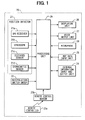
- FIG. 1 is a block diagram for explaining a schematic structure of a navigation device 20 of an embodiment.
- the navigation device 20 is mounted on a vehicle and includes: a position detector 21 for detecting a current position of the vehicle; a manipulation switch (SW) group 22 for inputting various commands from a user; a remote controller 23a that is for inputting various commands similarly with the manipulation switch group 22 and is separated from the navigation device 20; an external information input and output unit 24 capable of inputting information obtained from devices other than the navigation device 20 and of outputting information to the other devices; a map data input unit 25 for inputting map data or the like obtained from an external storage medium that stores map data or various information; a displaying unit 26 for displaying a map or various information; a voice output unit 27 for outputting various guiding voices or the like; and a processing unit 29.
- SW manipulation switch
- remote controller 23a that is for inputting various commands similarly with the manipulation switch group 22 and is separated from the navigation device 20
- an external information input and output unit 24 capable of inputting information obtained from
- the processing unit 29 is for executing various processing according to inputs from the above-described position detector 21, the manipulation switch group 22, the remote control sensor 23b, the external information input and output unit 24, and the map data input unit 25, and for controlling the external input and output unit 24, the displaying unit 26, and the voice output unit 27.
- the position detector 21 includes: a GPS (Global Positioning System) receiver 21a for receiving transmitted radio waves from satellites for GPS via a GPS antenna to detect a current position, orientation, speed, etc. of the vehicle; a gyroscope 21b for detecting a magnitude of rotation movement applied on the vehicle; a distance sensor 21c for detecting a traveling distance from back and forth acceleration or the like of the vehicle; and a geomagnetic sensor 21d for detecting an advancing orientation from earth magnetism.
- GPS Global Positioning System
- the manipulation switch group 22 is constructed of a touch panel integrated with the displaying unit 26 and disposed on a screen as a unit built in the displaying unit 26, a mechanical switch in the periphery of the displaying unit 26, and the like.
- the touch panel and displaying unit 26 are integrated by being laminated.
- the touch panel can be any one of various types such as a pressure-sensitive type, an electromagnetic induction type, an electric capacitance type, or a combination of the foregoing.
- the external information input and output unit 25 is connected with other external devices or the like to take a role of a function to input and output information with the external devices.
- the external information input an output unit 25 is connected with an audio device (not shown) as one of the external devices and capable of receiving a voice signal of a radio, further outputting signals for controlling the audio device such as selecting channels, and turning on or off the power.
- the map data input unit 25 is a device for receiving various data stored in the storage medium (not shown).
- the storage medium stores map data (road data, landform data, mark data, intersection data, entity data, etc.), voice data for guidance, voice recognition data, etc.
- the storage medium typically includes a CD-ROM and a DVD-ROM from the viewpoint of their data volumes; however, a magnetic storage unit such as a hard disk, or a medium such as a memory card can be included.
- the displaying unit 26 is a color display device of any one of a liquid crystal display, organic electro luminescent (EL) display, a CRT, and the like.
- the screen of the displaying unit 26 shows a map with additional data of a mark of current position, a guiding route to a destination, names, landmarks, marks for various entities, using the current position of the vehicle detected by the position detector 21 and the map data inputted by the map data input unit 25. Further, guidance for the entities can be also shown.
- the voice output unit 27 can output voice of the guidance for the entities and other guidance, which are inputted from the map data input unit 25.
- the microphone 28 outputs electric signals based on the voice inputted when the user utters the voice. The user can operate the navigation device 20 by inputting the various voices to the microphone 28.
- the processing unit 29 is constructed mainly of a known microcomputer containing a CPU, a ROM, a RAM, an I/O, and a bus line connecting these components.
- the processing unit 29 executes various processing based on the program stored in the ROM or RAM. For example, in a displaying processing, a current position of the vehicle is computed as a set of coordinates and advancing orientation, based on detection signals from the position detector 21; and then a map or the like around the current position computed is read through the map data input unit 25 to be displayed. In a route guiding processing, an appropriate route to a destination is computed based on: the position data stored in the map data input unit 25; and destination being set according to manipulation of the manipulation switch group 22 or remote controller 23a.
- the processing unit 29 includes a controlling unit 29a, a voice signal temporary storing unit 29b, a language data generating unit 29c, a language data analyzing unit 29d, a language data storing unit 29e, and a voice signal storing unit 29f.
- the controlling unit 29a is inputted signals or the like from the position detector 21, the manipulation switch group 22, the remote control sensor 23b, the external information input and output unit 24, the map data input unit 25, or the like; further, the controlling unit 29a outputs signals or the like for controlling the external information input and output unit 24, the displaying unit 26, and the voice output unit 27.
- the controlling unit 29a controls, as a whole, the parts of the processing unit 29.
- the voice signal temporary storing unit 29b can store the voice signals inputted for a given period (e.g., one minute).
- a given period e.g., one minute.
- the newest voice signal is constantly stored, while the oldest voice signal is deleted.
- the language data generating unit 29c has a function of generating language data based on the voice signals inputted.
- the language data generated is sent one by one to the language data analyzing unit 29d.
- the language data analyzing unit 29d analyzes the language data sent from the language data generating unit 29c, sending, to the language data storing unit 29e, only necessary language data from among the analyzed language data.
- the language data storing unit 29e stores the necessary language data sent from the language data analyzing unit 29d.
- the voice signal storing unit 29f stores the language data designated from among the voice signals stored in the voice signal temporary storing unit 29b.
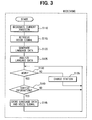
- the receiving processing is started when the navigation device 20 is supplied with power.
- the controlling unit 29a designates a current position based on a signal from the position detector 21 (S110).
- Retrieving a voice signal of the radio broadcast is then started, from the audio device via the external information input and output unit 24 (S115).
- the retrieved voice signal is stored in the voice signal temporary storing unit 29b.
- the voice signal is also sent to the language data generating unit 29c; the language data generating unit 29c executes voice (or speech) recognition to generate the language data (S120).
- "language data” means data being quasi language understood by a person such as text data; the audio device has a choice of causing a user to listen to the radio broadcast or not causing.
- the language data generated by the language data generating unit 29c is sent to the language data analyzing unit 29d; thereby, the language data analyzing unit 29d analyzes the language data (S125).
- "analyzing" means to determine a context from words or a word order. This analyzing is executed on every sentence, also being executed using the preceding and following sentences. Thus, each processing from S115 to S125 is started and executed one by one.
- the language data analyzing unit 29d determines whether or not the voice signal broadcasted from the broadcast station relates to the news, based on the analyzing result of the language data; further, the unit 29d determines whether broadcasted information not relating to the news continues for a given period (e.g., 3 minutes) (S130).
- the determination of whether the broadcasted information does not relate to the news is executed by whether person's colloquial expressions are included (information relating to music is thereby removed), by whether more than the given number of terms used in the news are included, or the like.
- the processing advances to S135; otherwise, to S140.
- the controlling unit 29a outputs, to the audio device via the external information input and output unit 24, a command for changing a broadcast station to be received.
- the broadcast to be received is thereby changed; then, the voice signal from another broadcast station is newly received via the external input and output unit 24, which returns the processing to S130.
- whether broadcasted information not relating to the news continues for the given period is determined again.
- the language data analyzing unit 29d determines whether the language data relates to traffic information. In detail, it is determined by whether terms relating to a traffic or terms relating to a place are included in the language data. When the language data does not relate to the traffic information, the processing returns to S130, where whether broadcasted information not relating to the news continues for the given period is determined again.
- the language data relates to the traffic information (S140:YES)
- the language data is stored along with an ID for identifying in the language data storing unit 29e.
- the voice signal corresponding to the language data is retrieved from the voice signal temporary storing unit 29b by the voice signal storing unit 29f; thereby, the voice signal storing unit 29f stores the voice signal while attaching the same ID as that used when the language data storing unit 29e stores the language data (S145). Accordingly, the language data stored in the language data storing unit 29e and voice signal stored in the voice signal storing unit 29f are managed by the same ID.
- a broadcast station constantly broadcast a voice signal including desired contents; however, such a private radio broadcast does not always broadcast desired contents since the private radio broadcast includes various programs. Therefore, it is favorable that the broadcast station be changed when no language data extracted in the receiving process appears for a given period.
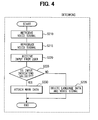
- the determining processing executed by the processing unit 29 will be explained using the flow chart in FIG. 4.
- the determining processing is started at some kind of timing before the language data stored in the language data storing unit 29e is to be utilized.
- This some kind of timing means a timing when the user executes given manipulation, when the language data storing unit 29e stores the language data, when the navigation device 20 approaches a position corresponding to the information include in the language data, or the like.
- the controlling unit 29a retrieves the voice signal corresponding to the ID from the voice signal storing unit 29f (S210).
- the ID designated is used for retrieving; at the timing when the language data storing unit 29e stores the language data, an ID that is attached at the described timing is used for retrieving.
- the voice output unit 27 is caused to reproduce the voice signal retrieved (S215).
- the user can listen to what a radio broadcasted.
- the user determines whether the information reproduced can be used for route guidance, and intentionally inputs the determination that is to be received by the manipulation switch group 22 or remote control sensor 23b (S220).
- the input received means "this information is to be used for route guidance," namely "information is valid," mark data (e.g., flag) indicating validity is attached to the language data, which is stored in the language data storing unit 29e and of which ID is the same as ID attached to the reproduced voice signal (S230).
- mark data e.g., flag
- the reproduced voice signal is deleted from the voice signal storing unit 29. Further, the language data of which ID is the same as ID attached to the reproduced voice signal is deleted from the language data storing unit 29e (S235). The determining processing is then terminated.
- the language data storing unit 29e stores the language data of "Tomeikousokudouro (Tomei Expressway)- nagoyainta (Nagoya interchange)- noborishasenno (lane directing to Tokyo)- tokyogawa (towards Tokyo)- gokirochitende (a spot of five kilometers)- jikoga (accident)-okitatosouteishita (assuming occurrence)- kyujyokunrenga (rescue training)-jissisaremashita (took place)." It is further supposed that a vehicle having the navigation device 20 approaches Nagoya interchange in Tomei Expressway.
- a notice is shown in the displaying unit 26, the notice that information is unconfirmed by a user, based on the language data (having no mark data indicating validity).
- the user thereby manipulates to confirm the unconfirmed information, so that the above-described determining processing is started.
- radio-broadcasted "A rescue training took place, the training that assumes that an accident occurs at a five kilometer spot towards Tokyo from Nagoya interchange in Tomei (Tokyo-Nagoya) Expressway" is reproduced; thereafter, the user inputs so as to determine whether the information is valid or not.
- the navigation device 20 Based on the input by the user, the navigation device 20 either attaches the mark data indicating validity to the language data, or deletes the language data and voice signal.
- the language data determined to be valid in this determining processing is used for route change, warning, or the like.
- the rescue training is assumed to take place without preventing the traffic, so that the relevant language data is determined to be invalid in the determining processing. This deletes the relevant language data and voice signal, so that they are not to be used for the route changing or warning.
- information only relating to traffic information is extracted from among information broadcasted from a broadcast station, then being confirmed by a user. Further, the information which is determined, by the user, to be necessary is to be used for other processing such as route guidance. Accordingly, accuracy of the information is enhanced; thereby, accuracy of other processing such as route guidance is naturally enhanced.
Landscapes
- Engineering & Computer Science (AREA)
- Radar, Positioning & Navigation (AREA)
- Remote Sensing (AREA)
- Physics & Mathematics (AREA)
- General Physics & Mathematics (AREA)
- Automation & Control Theory (AREA)
- Signal Processing (AREA)
- Navigation (AREA)
- Circuits Of Receivers In General (AREA)
Applications Claiming Priority (2)
| Application Number | Priority Date | Filing Date | Title |
|---|---|---|---|
| JP2003311633 | 2003-09-03 | ||
| JP2003311633A JP2005077372A (ja) | 2003-09-03 | 2003-09-03 | 音声認識装置、ナビゲーション装置及びプログラム |
Publications (2)
| Publication Number | Publication Date |
|---|---|
| EP1512942A1 true EP1512942A1 (de) | 2005-03-09 |
| EP1512942B1 EP1512942B1 (de) | 2011-05-18 |
Family
ID=34131844
Family Applications (1)
| Application Number | Title | Priority Date | Filing Date |
|---|---|---|---|
| EP04018969A Expired - Lifetime EP1512942B1 (de) | 2003-09-03 | 2004-08-10 | Spracherkennungsvorrichtung |
Country Status (5)
| Country | Link |
|---|---|
| US (1) | US20050049878A1 (de) |
| EP (1) | EP1512942B1 (de) |
| JP (1) | JP2005077372A (de) |
| KR (1) | KR100713229B1 (de) |
| ES (1) | ES2366540T3 (de) |
Families Citing this family (2)
| Publication number | Priority date | Publication date | Assignee | Title |
|---|---|---|---|---|
| US8315868B2 (en) * | 2006-12-28 | 2012-11-20 | Mitsubishi Electric Corporation | Vehicle-mounted voice recognition and guidance apparatus |
| CN115762520A (zh) * | 2022-09-29 | 2023-03-07 | 广东粤港澳大湾区国家纳米科技创新研究院 | 语音备忘录检测方法、装置、存储介质及计算机设备 |
Citations (4)
| Publication number | Priority date | Publication date | Assignee | Title |
|---|---|---|---|---|
| EP0827126A2 (de) * | 1996-08-30 | 1998-03-04 | Aisin Aw Co., Ltd. | Landfahrzeugsnavigationsgerät mit lokaler Routenführungsselektivität und Speichermedium dafür |
| EP0893308A2 (de) | 1997-07-22 | 1999-01-27 | Kabushiki Kaisha Equos Research | Im Kraftfahrzeug eingebautes Gerät |
| EP1001627A1 (de) | 1998-05-28 | 2000-05-17 | Kabushiki Kaisha Toshiba | Digitales rundfunksystem und entsprechender terminal |
| EP1137210A2 (de) * | 2000-03-20 | 2001-09-26 | Matsushita Electric Industrial Co., Ltd. | Vorrichtung zur Bereitstellung von Musik bzw. Informationen an Fahrgästen in einem Kraftfahrzeug |
Family Cites Families (3)
| Publication number | Priority date | Publication date | Assignee | Title |
|---|---|---|---|---|
| US6208932B1 (en) * | 1996-09-30 | 2001-03-27 | Mazda Motor Corporation | Navigation apparatus |
| JP3893647B2 (ja) * | 1996-09-30 | 2007-03-14 | マツダ株式会社 | ナビゲーション装置 |
| US6011854A (en) * | 1997-09-18 | 2000-01-04 | Sony Corporation | Automatic recognition of audio information in a broadcast program |
-
2003
- 2003-09-03 JP JP2003311633A patent/JP2005077372A/ja active Pending
-
2004
- 2004-08-10 ES ES04018969T patent/ES2366540T3/es not_active Expired - Lifetime
- 2004-08-10 US US10/914,212 patent/US20050049878A1/en not_active Abandoned
- 2004-08-10 EP EP04018969A patent/EP1512942B1/de not_active Expired - Lifetime
- 2004-09-02 KR KR1020040069969A patent/KR100713229B1/ko not_active Expired - Fee Related
Patent Citations (4)
| Publication number | Priority date | Publication date | Assignee | Title |
|---|---|---|---|---|
| EP0827126A2 (de) * | 1996-08-30 | 1998-03-04 | Aisin Aw Co., Ltd. | Landfahrzeugsnavigationsgerät mit lokaler Routenführungsselektivität und Speichermedium dafür |
| EP0893308A2 (de) | 1997-07-22 | 1999-01-27 | Kabushiki Kaisha Equos Research | Im Kraftfahrzeug eingebautes Gerät |
| EP1001627A1 (de) | 1998-05-28 | 2000-05-17 | Kabushiki Kaisha Toshiba | Digitales rundfunksystem und entsprechender terminal |
| EP1137210A2 (de) * | 2000-03-20 | 2001-09-26 | Matsushita Electric Industrial Co., Ltd. | Vorrichtung zur Bereitstellung von Musik bzw. Informationen an Fahrgästen in einem Kraftfahrzeug |
Also Published As
| Publication number | Publication date |
|---|---|
| KR20050024269A (ko) | 2005-03-10 |
| JP2005077372A (ja) | 2005-03-24 |
| KR100713229B1 (ko) | 2007-05-02 |
| US20050049878A1 (en) | 2005-03-03 |
| EP1512942B1 (de) | 2011-05-18 |
| ES2366540T3 (es) | 2011-10-21 |
Similar Documents
| Publication | Publication Date | Title |
|---|---|---|
| JP4551961B2 (ja) | 音声入力支援装置、その方法、そのプログラム、そのプログラムを記録した記録媒体、および、ナビゲーション装置 | |
| EP0798539B1 (de) | Navigationsvorrichtung | |
| JP3994365B2 (ja) | ナビゲーション装置及び記憶媒体 | |
| US7386437B2 (en) | System for providing translated information to a driver of a vehicle | |
| JPH1151684A (ja) | 車両用ナビゲーション装置及び記憶媒体 | |
| US8548737B2 (en) | Navigation apparatus | |
| JPH1151674A (ja) | 車両用ナビゲーション装置及び記憶媒体 | |
| JP4013630B2 (ja) | 事故多発位置報知装置、事故多発位置報知システム及び事故多発位置報知方法 | |
| US7683805B2 (en) | Traffic situation display device, method and program thereof and recording medium with the program recorded therein | |
| JP2005326209A (ja) | 報知制御装置、その方法、そのプログラム、および、そのプログラムを記録した記録媒体 | |
| JP2006017537A (ja) | 出力制御装置、その方法、そのプログラム、および、そのプログラムを記録した記録媒体 | |
| JP2009085750A (ja) | 施設特定システム及び施設特定装置 | |
| US20080243368A1 (en) | Navigation apparatus | |
| JP3409657B2 (ja) | 車両用ナビゲーション装置及び記憶媒体 | |
| JPH1089997A (ja) | 車両用ナビゲーション装置 | |
| EP1512942B1 (de) | Spracherkennungsvorrichtung | |
| US20090105936A1 (en) | Route guidance apparatus, route guidance method, route guidance program and computer-readable recording medium | |
| JP4077376B2 (ja) | 経路提案装置及び経路提案プログラム | |
| JP2010152418A (ja) | 車両情報通信システム、及び、車両情報通信方法 | |
| JP2000111356A (ja) | 車両用ナビゲーション装置及び記憶媒体 | |
| JP3393443B2 (ja) | 車両用ナビゲーション装置及び記憶媒体 | |
| US7643787B2 (en) | Receiver system and method for receiving broadcasting | |
| JP3407344B2 (ja) | 車両用簡易地図表示装置 | |
| JP2006350089A (ja) | 交通情報処理データベース、交通情報処理装置、そのシステム、その方法、そのプログラム、そのプログラムを記録した記録媒体、および、案内誘導装置 | |
| JP5296593B2 (ja) | Poi情報を受信可能な施設情報表示装置およびコンピュータプログラム。 |
Legal Events
| Date | Code | Title | Description |
|---|---|---|---|
| PUAI | Public reference made under article 153(3) epc to a published international application that has entered the european phase |
Free format text: ORIGINAL CODE: 0009012 |
|
| AK | Designated contracting states |
Kind code of ref document: A1 Designated state(s): AT BE BG CH CY CZ DE DK EE ES FI FR GB GR HU IE IT LI LU MC NL PL PT RO SE SI SK TR |
|
| AX | Request for extension of the european patent |
Extension state: AL HR LT LV MK |
|
| 17P | Request for examination filed |
Effective date: 20050223 |
|
| AKX | Designation fees paid |
Designated state(s): DE ES FR GB IT |
|
| 17Q | First examination report despatched |
Effective date: 20100504 |
|
| GRAP | Despatch of communication of intention to grant a patent |
Free format text: ORIGINAL CODE: EPIDOSNIGR1 |
|
| GRAS | Grant fee paid |
Free format text: ORIGINAL CODE: EPIDOSNIGR3 |
|
| GRAA | (expected) grant |
Free format text: ORIGINAL CODE: 0009210 |
|
| AK | Designated contracting states |
Kind code of ref document: B1 Designated state(s): DE ES FR GB IT |
|
| REG | Reference to a national code |
Ref country code: GB Ref legal event code: FG4D |
|
| REG | Reference to a national code |
Ref country code: DE Ref legal event code: R096 Ref document number: 602004032706 Country of ref document: DE Effective date: 20110630 |
|
| REG | Reference to a national code |
Ref country code: ES Ref legal event code: FG2A Ref document number: 2366540 Country of ref document: ES Kind code of ref document: T3 Effective date: 20111021 |
|
| PLBE | No opposition filed within time limit |
Free format text: ORIGINAL CODE: 0009261 |
|
| STAA | Information on the status of an ep patent application or granted ep patent |
Free format text: STATUS: NO OPPOSITION FILED WITHIN TIME LIMIT |
|
| 26N | No opposition filed |
Effective date: 20120221 |
|
| REG | Reference to a national code |
Ref country code: DE Ref legal event code: R097 Ref document number: 602004032706 Country of ref document: DE Effective date: 20120221 |
|
| PGFP | Annual fee paid to national office [announced via postgrant information from national office to epo] |
Ref country code: ES Payment date: 20130829 Year of fee payment: 10 Ref country code: DE Payment date: 20130821 Year of fee payment: 10 |
|
| PGFP | Annual fee paid to national office [announced via postgrant information from national office to epo] |
Ref country code: FR Payment date: 20130823 Year of fee payment: 10 Ref country code: GB Payment date: 20130821 Year of fee payment: 10 |
|
| PGFP | Annual fee paid to national office [announced via postgrant information from national office to epo] |
Ref country code: IT Payment date: 20130830 Year of fee payment: 10 |
|
| REG | Reference to a national code |
Ref country code: DE Ref legal event code: R119 Ref document number: 602004032706 Country of ref document: DE |
|
| GBPC | Gb: european patent ceased through non-payment of renewal fee |
Effective date: 20140810 |
|
| PG25 | Lapsed in a contracting state [announced via postgrant information from national office to epo] |
Ref country code: IT Free format text: LAPSE BECAUSE OF NON-PAYMENT OF DUE FEES Effective date: 20140810 |
|
| REG | Reference to a national code |
Ref country code: FR Ref legal event code: ST Effective date: 20150430 |
|
| PG25 | Lapsed in a contracting state [announced via postgrant information from national office to epo] |
Ref country code: DE Free format text: LAPSE BECAUSE OF NON-PAYMENT OF DUE FEES Effective date: 20150303 Ref country code: GB Free format text: LAPSE BECAUSE OF NON-PAYMENT OF DUE FEES Effective date: 20140810 |
|
| PG25 | Lapsed in a contracting state [announced via postgrant information from national office to epo] |
Ref country code: FR Free format text: LAPSE BECAUSE OF NON-PAYMENT OF DUE FEES Effective date: 20140901 |
|
| REG | Reference to a national code |
Ref country code: ES Ref legal event code: FD2A Effective date: 20160105 |
|
| PG25 | Lapsed in a contracting state [announced via postgrant information from national office to epo] |
Ref country code: ES Free format text: LAPSE BECAUSE OF NON-PAYMENT OF DUE FEES Effective date: 20140811 |