EP1513363B1 - Verfahren und Mobilendgerät zur Bereitstellung von Zustandsinformation des Mobilendgerätes in einem Mobilkommunikationssystem - Google Patents
Verfahren und Mobilendgerät zur Bereitstellung von Zustandsinformation des Mobilendgerätes in einem Mobilkommunikationssystem Download PDFInfo
- Publication number
- EP1513363B1 EP1513363B1 EP04020868A EP04020868A EP1513363B1 EP 1513363 B1 EP1513363 B1 EP 1513363B1 EP 04020868 A EP04020868 A EP 04020868A EP 04020868 A EP04020868 A EP 04020868A EP 1513363 B1 EP1513363 B1 EP 1513363B1
- Authority
- EP
- European Patent Office
- Prior art keywords
- mobile station
- information
- buffer
- limit value
- amount
- Prior art date
- Legal status (The legal status is an assumption and is not a legal conclusion. Google has not performed a legal analysis and makes no representation as to the accuracy of the status listed.)
- Expired - Lifetime
Links
Images
Classifications
-
- H—ELECTRICITY
- H04—ELECTRIC COMMUNICATION TECHNIQUE
- H04W—WIRELESS COMMUNICATION NETWORKS
- H04W74/00—Wireless channel access
- H04W74/08—Non-scheduled access, e.g. ALOHA
-
- H—ELECTRICITY
- H04—ELECTRIC COMMUNICATION TECHNIQUE
- H04W—WIRELESS COMMUNICATION NETWORKS
- H04W52/00—Power management, e.g. Transmission Power Control [TPC] or power classes
- H04W52/04—Transmission power control [TPC]
- H04W52/30—Transmission power control [TPC] using constraints in the total amount of available transmission power
- H04W52/32—TPC of broadcast or control channels
-
- H—ELECTRICITY
- H04—ELECTRIC COMMUNICATION TECHNIQUE
- H04L—TRANSMISSION OF DIGITAL INFORMATION, e.g. TELEGRAPHIC COMMUNICATION
- H04L47/00—Traffic control in data switching networks
- H04L47/10—Flow control; Congestion control
- H04L47/26—Flow control; Congestion control using explicit feedback to the source, e.g. choke packets
- H04L47/263—Rate modification at the source after receiving feedback
-
- H—ELECTRICITY
- H04—ELECTRIC COMMUNICATION TECHNIQUE
- H04L—TRANSMISSION OF DIGITAL INFORMATION, e.g. TELEGRAPHIC COMMUNICATION
- H04L47/00—Traffic control in data switching networks
- H04L47/10—Flow control; Congestion control
- H04L47/30—Flow control; Congestion control in combination with information about buffer occupancy at either end or at transit nodes
-
- H—ELECTRICITY
- H04—ELECTRIC COMMUNICATION TECHNIQUE
- H04W—WIRELESS COMMUNICATION NETWORKS
- H04W28/00—Network traffic management; Network resource management
- H04W28/02—Traffic management, e.g. flow control or congestion control
- H04W28/0205—Traffic management, e.g. flow control or congestion control at the air interface
-
- H—ELECTRICITY
- H04—ELECTRIC COMMUNICATION TECHNIQUE
- H04W—WIRELESS COMMUNICATION NETWORKS
- H04W28/00—Network traffic management; Network resource management
- H04W28/02—Traffic management, e.g. flow control or congestion control
- H04W28/0278—Traffic management, e.g. flow control or congestion control using buffer status reports
-
- H—ELECTRICITY
- H04—ELECTRIC COMMUNICATION TECHNIQUE
- H04W—WIRELESS COMMUNICATION NETWORKS
- H04W28/00—Network traffic management; Network resource management
- H04W28/02—Traffic management, e.g. flow control or congestion control
- H04W28/10—Flow control between communication endpoints
- H04W28/14—Flow control between communication endpoints using intermediate storage
-
- H—ELECTRICITY
- H04—ELECTRIC COMMUNICATION TECHNIQUE
- H04W—WIRELESS COMMUNICATION NETWORKS
- H04W8/00—Network data management
- H04W8/02—Processing of mobility data, e.g. registration information at HLR [Home Location Register] or VLR [Visitor Location Register]; Transfer of mobility data, e.g. between HLR, VLR or external networks
- H04W8/04—Registration at HLR or HSS [Home Subscriber Server]
-
- H—ELECTRICITY
- H04—ELECTRIC COMMUNICATION TECHNIQUE
- H04W—WIRELESS COMMUNICATION NETWORKS
- H04W74/00—Wireless channel access
- H04W74/08—Non-scheduled access, e.g. ALOHA
- H04W74/0866—Non-scheduled access, e.g. ALOHA using a dedicated channel for access
Definitions
- the present invention relates generally to a method for providing state information of a mobile station in a mobile communication system, and in particular, to a method for providing reverse state information of a mobile station.
- data transmission is divided into forward data transmission and reverse data transmission.
- Forward data transmission is data transmission from a base station (BTS) to a mobile station
- reverse data transmission is data transmission from a mobile station to a base station.
- data transmission methods can be classified into a method supporting only a voice service, a method supporting the voice service together with a simple data service, a method supporting only a high-speed data service, and a method supporting the high-speed data service together with the voice service.
- a mobile communication system supporting the data service has been developed to provide an increased amount of data to users at higher speed.
- a mobile communication system supporting both the high-speed data service and the voice service provides a multimedia service using the same frequency band.
- a plurality of users can simultaneously transmit data using Code Division Multiple Access (CDMA) technology.
- CDMA technology users are identified by unique numbers, which are assigned to the users.
- reverse data is transmitted over a packet data channel by the physical layer packet (PLP), and a length of the packet is fixed according to a data rate, The data rate is variable every packet, and a data rate of each packet is controlled according to a power of a mobile station, an mount of transmission data, and a power control bit.
- the power control bit is forward control information transmitted from a base station over a rate control channel (RCCH).
- RCCH rate control channel
- the mobile communication system enables retransmission in a physical layer.
- a base station demodulates a received reverse data packet and transmits an ACK/NACK for a physical channel according to whether there is a packet error (for example, a cyclic redundancy check (CRC) error). If an ACK is received from the base station, a mobile station transmits a new packet, determining that the base station has successfully received the transmitted packet. However, if a NACK is received from the base station, the mobile station retransmits the previous packet, determining that the base station has failed to receive the transmitted packet.
- a packet error for example, a cyclic redundancy check (CRC) error
- a function of determining a data rate of a mobile station in a base station is called "scheduling."
- a base station schedules the data rate of a mobile station.
- the base station performs scheduling using Rise-over-Thermal (RoT), which represents a ratio of thermal noises to the total reception power, and a load acquired from a received signal-to-noise ratio of a mobile station belonging to a current base transceiver system (BTS).
- RoT Rise-over-Thermal
- the base station performs scheduling considering a measured RoT, an assigned load, and an available residual capacity.
- the base station measures a load and performs scheduling considering the measured load and the available residual capacity. That is, a scheduler of the base station determines whether to increase, decrease, or hold a data rate of a corresponding mobile station, considering RoT, a buffer state of each mobile station, and a power state or a channel state of each mobile station.
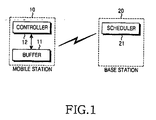
- a common mobile communication system employing the scheduling technique includes a mobile station (MS) 10 and a base station (BS) 20.
- the mobile station 10 generates information necessary for the scheduling and periodically feeds back the information to the base station 20 under the control of its controller 12.
- a scheduler 21 of the base station 20 determines a data rate for the mobile station 10, i.e., performs scheduling, using the feedback information necessary for the scheduling.
- a channel for transmitting the feedback information necessary for the scheduling is commonly called a "reverse request channel (R-REQCH)."
- R-REQCH can be replaced with an equivalent channel in other mobile communication systems.
- the R-REQCH is transmitted to the base station 20 by the mobile station 10 that desires to transmit a reverse packet.
- the mobile station 10 transmits the R-REQCH to the base station 20 if one of the following two conditions is satisfied. Accordingly, in addition to the following two conditions, there are other possible conditions according to mobile communication systems.
- the mobile station 10 transmits the R-REQCH to the base station 20, if new data is input to its buffer 11 and the amount of data stored in the buffer 11 is larger than a predetermined level (BUF_DEPTH).
- the mobile station 10 can transmit data without transmission of the R-REQCH, if a very small amount of data that can be transmitted without separate scheduling by the base station 20 is stored in the buffer 11. Therefore, the mobile station 10 transmits the R-REQCH to the base station 20 only when the amount of data stored its buffer 11 is larger than the BUF_DEPTH.
- the "BUF_DEPTH" represents the minimum data amount which becomes a criterion based on which the mobile station 10 determines whether to send the R-REQCH, or a scheduling request for reverse transmission, to the base station 20.
- the mobile station 10 transmits the R-REQCH to the base station 20, if the amount of data stored in its buffer 11 is larger than BUF_DEPTH and a time of REQCH_PRD has elapsed.
- the "REQCH_PRD” represents a transmission period of the R-REQCH. For example, if REQCH_PRD is 80 ms, it means that after current transmission of buffer information to the base station 20 over the R-REQCH, the mobile station 10 retransmits the R-REQCH after a lapse of 80 ms.
- the transmission period of the R-REQCH is predefined between the mobile station 10 and the base station 20.
- the mobile station 10 periodically transmits the R-REQCH to the base station 20. If the mobile station 10 continuously transmits the R-REQCH to the base station 20, a reverse load increases. In order to prevent the increase in the reverse load, the mobile station 10 periodically transmits the R-REQCH to the base station 20.
- the base station 20 can acquire state information, such as channel state information and buffer state information, of the mobile station 10 by periodically receiving the R-REQCH.
- the base station 20 can trace an expected change in the residual capacity of the buffer 11 in the mobile station 10 until the next period. That is, the base station 20 determines if the amount of data stored in the buffer 11 is tending downward or upward, based on the buffer information reported from the mobile station 10.
- the R-REQCH is periodically transmitted because channel information of the mobile station 10 changes constantly, but the base station 20 has less information with which it can estimate the change in channel information. Therefore, an excessive increase in transmission period of the R-REQCH causes an increase in error of channel information and buffer information of the mobile station 10 that the base station 20 has. However, an excessive decrease in transmission period of the R-REQCH causes an increase in reverse load. Therefore, the base station 20 can send information on an appropriate transmission period of the R-REQCH to the mobile station 10 using a signaling message.
- Table 1 illustrates an example of types of information transmitted over the R-REQCH and the number of bits assigned to each type of the information.
- the types of the information transmitted over the R-REQCH and the number of bits assigned to each type of the information are subject to change according to communication systems.
- Table 1 Information Field Number of Bits Maximum Possible Data Rate of MS 4 Amount of Data Stored in Buffer of MS 4
- a "Maximum Possible Data Rate of MS” represents information on a channel state of the mobile station 10.
- the mobile station 10 is power-controlled by the base station 20. If the mobile station 10 has a poor reverse channel state, the base station 20 allows the mobile station 10 to increase power of a pilot channel. However, if the mobile station 10 has a good reverse channel state, the base station 20 allows the mobile station 10 to decrease power of a pilot channel. Therefore, a level of pilot transmission power of the power-controlled mobile station 10 at a particular time represents a channel state of the corresponding mobile station 10.
- the mobile station 10 informs the base station 20 of absolute power of its pilot channel, or calculates a maximum packet data rate based on an absolute power level of a currently transmitted pilot channel and a margin of maximum possible transmission power of the mobile station 10.
- the mobile station 10 can feed back information on the calculated maximum packet data rate to the base station 20.
- the mobile station 10 feeds back its reverse channel information to the base station 20 over the R-REQCH.
- the "Amount of Data Stored in Buffer of MS” represents the amount of data stored in the buffer 11 of the mobile station 10, i.e., represents the amount of reverse data that the mobile station 10 desires to transmit.
- the number of bits assigned to each type of the information transmitted over the R-REQCH is limited to a particular number.
- the maximum possible data rate of the mobile station 10 is represented with 4 bits
- the amount of data stored in the buffer 11 of the mobile station 10 is represented with 4 bits. 16 possible expressions arc provided with 4 bits.
- Table 2 illustrates an example of 16 possible buffer states that can be expressed with 4 bits.
- Table 2 Indication Queue Size [bytes] 0000 0 ⁇ 1241 0001 1242 ⁇ 2387 0010 2888 ⁇ 3533 0011 3534 ⁇ 4679 0100 4680 ⁇ 5825 0101 5826 ⁇ 6971 0110 6972 ⁇ 8117 0111 8118 ⁇ 9265 1000 9266 ⁇ 10409 1001 10410 ⁇ 11555 1010 11556 ⁇ 12701 1011 12702 ⁇ 13847 1100 13848 ⁇ 14994 1101 14995 ⁇ 16139 1110 16140 ⁇ 17285 1111 17286 ⁇ infinity
- the minimum amount of data stored in the buffer 11 is set to 0 bytes, and the maximum amount of data stored in the buffer 11 is set to 17286 bytes.
- the amount of data stored in the buffer 11, being larger than 17286 bytes, is expressed with '1111'.
- a uniform quantization method is used to divide the maximum limit of 17286 bytes by 15 and express each limit with one bit steam.
- the mobile station 10 transmits buffer state information of '1111' to the base station 20 over the R-REQCH if the amount of data stored in its buffer 11 is 13000 bytes.
- the base station 20 receiving the buffer state information determines that the amount of data stored in the buffer 11 of the mobile station 10 falls within a range between 12702 and 13847 bytes, and the scheduler 21 in the base station 20 performs scheduling using the received buffer state information.
- the mobile station 10 provides its buffer information to the base station 20 using the limited number of bits.
- the mobile station 10 always transmits its buffer state information in the same method without considering its channel state and a transmission period of the R-REQCH. Consequently, this constant method causes a reduction in transmission efficiency of the buffer state information. Accordingly, there have been demands for a method capable of efficiently transmitting buffer state information of the mobile station 10 to the base station 20 using the limited number of bits, with a minimized quantization error.
- US 2003/125037 discloses a method of controlling reverse data transmission in a mobile communication system, wherein the information fields of the RSCRM include at least information about the buffer size of the MS so that the BS determines a data rate and a transmission duration.
- the buffer size indicates the amount of current data stored in a transmission buffer of the MS.
- EP-A-1 257 140 discloses a method to control uplink transmissions in a wireless communication system using centralized control of data communications, such as packet switched services, over the uplink channel.
- a method for providing state information of a mobile station in a mobile communication system which provides a data service between the mobile station and a base station and transmits information on a maximum data rate available for the mobile station and information on the amount of data stored in a buffer of the mobile station in a reverse direction, such that the base station determines a reverse data rate of the mobile station based on channel state information transmitted in the reverse direction from the mobile station to the base station.
- the method includes the steps of determining information on an amount of data stored in a buffer of the mobile station based on information transmitted from the base station, including transmission period information of the information on the amount of data stored in the buffer, the information on the maximum data rate available for the mobile station, and information agreed between the base station and the mobile station; and quantizing the determined information on the amount of data stored in the buffer, and transmitting the quantized information to the base station.
- a mobile communication system uses an encoder packet (EP) having data rates with corresponding EP sizes as illustrated in Table 3, in order to describe a reverse data transmission method.
- EP size refers to the amount of data transmitted by one packet.
- the EP size represents an encoder packet size.
- the EP size is classified into a PHY EP size and an RLP EP size.
- the PHY EP size represents an encoder packet size of a physical (PHY) layer
- the RLP EP size represents an encoder packet size of a radio link protocol (RLP) layer.
- RLP radio link protocol
- all packets are transmitted over 10 ms. For example, if a data rate is 38.4 Kbps, the number of bits constituting one packet is 348.
- the RLP EP size represents a size of pure data determined by subtracting an overhead of the physical layer, i.e., CRC bits and encoder tail bits, from the PHY EP size. Commonly, an overhead of the physical layer is 24 bits.
- the RLP EP size becomes 45 bytes by subtracting the 24-bit overhead of the physical layer from the 384-bit PHY EP size.
- the RLP EP size becomes 93 bytes by subtracting the 24-bit overhead of the physical layer from the 768-bit PHY EP size.
- EP size refers to the "RLP EP size.”
- Table 3 Index Data Rate PHY EP size RLP EP size 0 19.2 192 21 1 38.4 384 45 2 76.8 768 93 3 153.6 1536 189 4 307.2 3072 381 5 460.8 4608 573 6 614.4 6144 765 7 921.6 9216 1149 8 1228.8 12288 1533 9 1536.0 15360 1917 10 1843.2 18432 2301
- a method for providing state information of a mobile station indicates buffer information of the mobile station in a uniform quantization method, using i) channel information of the mobile station, ii) a transmission period of the buffer information, iii) a maximum data rate available for the mobile station, and iv) other information agreed between the mobile station and a base station. That is, in order to provide state information of a mobile station, the present invention indicates buffer state information of the mobile station with the limited number of bits.
- a parameter one or more types of information among the channel information of the mobile station, the transmission period of the buffer information, the maximum data rate available for the mobile station, and the other information agreed between the mobile station and the base station.
- the present invention dynamically determines a maximum limit value using i) channel information of the mobile station, ii) a transmission period of the buffer information, iii) a maximum data rate available for the mobile station, and iv) other information agreed between the mobile station and a base station.
- a minimum limit value BUF min and a maximum limit value BUF max are defined by Equation (1) and Equation (2), respectively.
- BUF min BUF_DEPTH
- BUF max EPsize MIN R max ⁇ R max_ Limit ⁇ REQCH_PRD ⁇
- Equation (2) can be rewritten as shown in Equation (3).
- BUF max round EPsize MIN R max ⁇ R max_ Limit ⁇ REQCH_PRD ⁇
- the minimum limit value BUF min is set to BUF_DEPTH as illustrated in Equation (1) in the quantization process because when the amount of data stored in a buffer of a mobile station is larger than BLTF_DEPTH, the mobile station feeds back corresponding information to a base station, such that the mobile station is not required to a distinguish a value smaller than the BUF_DEPTH.
- Equation (2) MIN(a,b) represents a smaller one of values 'a' and 'b', i.e., represents a smaller one of R max and R max_Limit .
- EPsize(R) denotes an EP size corresponding to a data rate R. The EPsize(R) is determined by a data rate determined by an agreement between a mobile station and a base station as illustrated in Table 3.
- R max denotes a maximum possible data rate determined on the basis of a channel of the mobile station. Therefore, the R max varies on a time basis according to a channel state of the mobile station. That is, if the mobile station has a good channel state, the R max is increased, and if the mobile station has a poor channel state, the R max is decreased.
- the R max corresponds to information on a maximum possible data rate for the mobile station, the information transmitted over R-REQCH as illustrated in connection with Table 1. As described above, the R max can be transmitted over the R-REQCH.
- a base station can calculate the Rmax, when the R-REQCH transmits information on a transmission power level of a pilot channel of the mobile station instead of the maximum possible data rate information of the mobile station.
- R max_Limit denotes a maximum data rate available for the mobile station.
- the R max_Limit represents a maximum data rate that a base station granted to a mobile station based on feedback information on the maximum data rate that the mobile station can physically support. Therefore, the R max_Limit is determined in an initial setup process between the mobile station and the base station, or determined through a signaling message after the initial setup process.
- REQCH_PRD denotes a transmission period of R-REQCH of the mobile station
- ⁇ denotes a value that the base station provides to the mobile station.
- a value of a is determined in the initial setup process between the mobile station and the base station, or determined through a signaling message after the initial setup process. That is, ⁇ corresponds to other information agreed between the mobile station and the base station, proposed by the present invention, ⁇ can be determined by the base station considering a reverse load of the system and the average number of retransmissions of the mobile station, ⁇ determined by the base station can be transmitted to the mobile station through a signaling message.
- R max_Limit 1.2288 Mbps means that a maximum data rate limit of the mobile station is 1.2288 Mbps. Therefore, the base station does not schedule a data rate higher than 1.2288 Mbps.
- Equation (2) the maximum limit value is represented as shown in Equation (2).
- Equation (2) A description will now be made of a process of expressing the actual amount of data stored in a buffer of the mobile station with the limited number of bits after setting the maximum limit value BUF max and the minimum limit value BUF min defined in the quantization process for indicating a buffer state of the mobile station using i) channel information of the mobile station, ii) a transmission period of the buffer information, iii) a maximum data rate available for the mobile station, and iv) other information agreed between the mobile station and a base station, illustrated in Equation (1) and Equation (2).
- buffer state information of a mobile station is indicated using 4 bits.
- the present invention can be applied in the same way even when the number of bits used for expressing the butter state information is different than 4 bits.
- the minimum value '0000' means that the amount of data stored in a buffer of the mobile station is smaller than BUF min .
- the maximum value '1111' means that the amount of data stored in a buffer of the mobile station is larger than BUF max .
- a quantization level is defined by Equation (4).
- a non-uniform quantization method can also be applied to the present invention.
- a difference between the maximum limit value and the minimum limit value is uniformly divided by 14 (determined by subtracting two values '0000' and '1111' from 16 possible values capable of expressing buffer state information with 4 bits), and ranges of multiples of the result are expressed with '0010' to '1110'.
- Equation (5) the amount of data stored in the buffer of the mobile station is expressed as shown in Equation (5).
- the amount of data stored in the buffer of the mobile station is expressed as '0001' between 768 and 1590 bits. If a value corresponding to the amount of data stored in the buffer of the mobile station is not an integer, the corresponding value is rounded off.
- the amount of data stored in the buffer of the mobile station is expressed as shown in Equation (6).
- the amount of data stored in the buffer of the mobile station is expressed as '0010' between 1591 and 2413 bits. If a value corresponding to the amount of data stored in the buffer of the mobile station is not an integer, the corresponding value is rounded off.
- the amount of data stored in the buffer of the mobile station is expressed as shown in Equation (7).
- the amount of data stored in the buffer of the mobile station is expressed as '0011' between 2413 and 3236 bits. If a value corresponding to the amount of data stored in the buffer of the mobile station is not an integer, the corresponding value is rounded off.
- the amount of data stored in the buffer of the mobile station is expressed as in Equation (8).
- the amount of data stored in the buffer of the mobile station is expressed as '1110' between 11465 and 12287 bits. If a value corresponding to the amount of data stored in the buffer of the mobile station is not an integer, the corresponding value is rounded off.
- the mobile station determines a bit stream corresponding to one of above three values according to the actual amount of data stored in its buffer.
- BUF_DEPTH 84 bits
- R max 153.6 Kbps
- R max_Limit 1.2288 Mbps
- REQCH_PRD 8
- ⁇ 2
- BUF max 756 in accordance with Equation (2). Therefore, the amount of data stored in the buffer of the mobile station can be expressed as shown in Table 4.
- Table 4 corresponds to the embodiment in which the uniform quantization method is used. Therefore, the method for providing state information of a mobile station, proposed by the present invention, expresses the actual amount of data stored in a buffer of a mobile station with the limited number of bits, using i) channel information of the mobile station, ii) a transmission period of the buffer information, iii) a maximum data rate available for the mobile station, and iv) other information agreed between the mobile station and a base station. Accordingly, the maximum limit value BUF max and the minimum limit value BUF min are set. Thereafter, a difference between the maximum limit value and the minimum limit value is uniformly divided by 14, and ranges of multiples of the result are expressed with '0010' to '1110'.
- BUF_DEPTH 84 bits
- R max 153.6 Kbps
- R max_Limit 1.2288 Mbps
- REQCH_PRD 80 ms
- ⁇ 2.
- BUF min 84
- BUF max round EPsize MIN
- R max ⁇ R max_ Limit ⁇ REQCH_PRD ⁇ 756
- '0000' and '1111' are defined as follows.
- 0000 indicates that the amount of data stored in a buffer of a mobile station is smaller than BUF min .
- 1111 indicates that the amount of data stored in a buffer of a mobile station is larger than or equal to BUF max .
- Equation (11) 'round( )' denotes a rounding function for rounding off a non-integer value in the parenthesis.
- Equation (11) a value in the parenthesis is non-uniformly quantized in a log scale within a range between the determined BUF min and BUF max .
- Table 5 Buffer Size Field Amount of Data 0001 84 ⁇ 97 0010 98 ⁇ 114 0011 115 ⁇ 134 0100 135 ⁇ 156 0101 157 ⁇ 183 0110 184 ⁇ 214 0111 215 ⁇ 251 1000 252 ⁇ 294 1001 295 ⁇ 344 1010 345 ⁇ 403 1011 404 ⁇ 471 1100 472 ⁇ 551 1101 552 ⁇ 643 1110 644 ⁇ 755 1111 756 ⁇ infinity
- the maximum limit value BUF max and the minimum limit value BUF min are set in accordance with Equation (1) and Equation (2), using i) channel information of the mobile station, ii) a transmission period of the buffer information, iii) a maximum data rate available for the mobile station, and iv) other information agreed between the mobile station and the base station. Thereafter, a value in the parenthesis of 'round( )' is non-uniformly quantized in a log scale within a range between the determined BUF min and BUF max .
- buffer state information of the mobile station is expressed after performing the non-uniform quantization in the manner described above, buffer state information of the mobile station is finely expressed in a region where the amount of data stored in the buffer of the mobile station is smaller, and buffer state information of the mobile station is roughly expressed in a region where the amount of data stored in the buffer of the mobile station is larger. Accordingly, it is possible to efficiently transmit buffer state information to the base station.
- the difference between the maximum limit value and the minimum limit value is non-uniformly quantized using a square within a range between the maximum limit value and the minimum limit value.
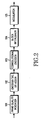
- FIG 2 is a block diagram illustrating a mobile station according to an embodiment of the present invention.
- the mobile station includes a transmitter for transmitting 8-bit information including information on the maximum data rate and the amount of data stored in its buffer through a reverse request channel (R-REQCH).
- R-REQCH reverse request channel
- the mobile station is identical in structure to a transmitter using a convolutional encoder.
- the transmitter includes a frame quality indicator 101, an encoder tail bit adder 102, a convolutional encoder 103, a block interleaver 104, and a modulator 105.
- 8-bit information is applied to the frame quality indicator 101.
- the frame quality indicator 101 adds an error detection code, for example, CRC code to the 8-bit information, and outputs CRC-added information to the encoder tail bit adder 102.
- the encoder tail bit adder 102 adds encoder tail bits to the CRC-added information, for convergence to a particular state, and outputs the encoder tail bit-added information to the convolutional encoder 103.
- the convolutional encoder 103 convolutional-encodes the encoder tail bit-added information, and the block interleaver 104 block-interleaves the convolutional-encoded information. Thereafter, the modulator 105 modulates the block-interleaved information and then transmits the modulated information to a base station over a reverse channel.
Landscapes
- Engineering & Computer Science (AREA)
- Computer Networks & Wireless Communication (AREA)
- Signal Processing (AREA)
- Databases & Information Systems (AREA)
- Mobile Radio Communication Systems (AREA)
Claims (20)
- Verfahren zum Bereitstellen von Statusinformationen einer Mobilstation (10) in einem Mobilkommunikationssystem, das einen Datendienst zwischen der Mobilstation und einer Basisstation (20) bereitstellt und eine Information über eine für die Mobilstation verfügbare maximale Datenrate sowie eine Information über eine in einem Puffer (11) der Mobilstation gespeicherte Menge an Daten in einer Rückwärtsrichtung sendet, so dass die Basisstation eine Rückwärts-Datenrate der Mobilstation auf Basis von Kanalstatusinformationen bestimmt, die in der Rückwärtsrichtung von der Mobilstation zu der Basisstation gesendet werden, und wobei das Verfahren die folgenden Schritte umfasst:Bestimmen von Informationen über die in dem Puffer (11) der Mobilstation gespeicherte Menge an Daten auf Basis von der Basisstation gesendeter Informationen, die Sendeperioden-Informationen der Information über die in dem Puffer gespeicherte Menge an Daten, die Information über die für die Mobilstation verfügbare maximale Datenrate sowie zwischen der Basisstation und der Mobilstation vereinbarte Informationen umfassen, wobei die zwischen der Basisstation und der Mobilstation vereinbarte Information durch die Basisstation unter Berücksichtigung einer Rückwärtslast (reverse load) des Systems und einer durchschnittlichen Anzahl von Sendewiederholungen der Mobilstation bestimmt werden;Quantisieren der bestimmten Informationen über die in dem Puffer gespeicherte Menge an Daten; undSenden der quantisierten Informationen zu der Basisstation.
- Verfahren nach Anspruch 1, wobei der Schritt des Bestimmens von Informationen über die in dem Puffer (11) der Mobilstation (10) gespeicherte Menge an Daten den Schritt des Bestimmens eines maximalen Grenzwertes BUFmax und eines minimalen Grenzwertes BUFmin des Puffers auf Basis der von der Basisstation (20) gesendeten Informationen umfasst.
- Verfahren nach Anspruch 2, wobei der maximale Grenzwert definiert ist als:

wobei BUFmax einen maximalen Grenzwert bezeichnet, EPsize eine für ein Paket gesendete Menge an Daten bezeichnet, MIN(Rmax, Rmax_Limit) den kleineren Wert von Rmax und Rmax_Limit bezeichnet, REQCH_PRD eine Sendeperiode von Pufferinformationen bezeichnet, Rmax eine maximale verfügbare Datenrate bezeichnet, Rmax_Limit eine für die Mobilstation verfügbare maximale Datenrate bezeichnet, und α andere, zwischen der Basisstation und der Mobilstation vereinbarte Informationen bezeichnet, wobei α durch die Basisstation unter Berücksichtigung einer Rückwärtslast des Systems und der durchschnittlichen Anzahl von Sendewiederholungen der Mobilstation bestimmt wird. - Verfahren nach Anspruch 2, wobei der minimale Grenzwert definiert ist als:

wobei BUFmin einen minimalen Grenzwert bezeichnet und BUF_DEPTH die minimale in dem Puffer (11) der Mobilstation (10) gespeicherte Menge an Daten bezeichnet. - Verfahren nach Anspruch 1, wobei der Schritt des Quantisierens der bestimmten Informationen über die in dem Puffer (11) gespeicherte Menge an Daten die folgenden Schritte umfasst:einheitliches Quantisieren einer Differenz zwischen dem maximalen Grenzwert und dem minimalen Grenzwert; undZuordnen der in dem Puffer gespeicherten Menge an Daten zu einem beliebigen der quantisierten Werte, um Informationen über die Menge an Daten anzuzeigen.
- Verfahren nach Anspruch 1, wobei der Schritt des Quantisierens der bestimmten Informationen über die in dem Puffer gespeicherte Menge an Daten die folgenden Schritte umfasst:uneinheitliches Quantisieren einer Differenz zwischen dem maximalen Grenzwert und dem minimalen Grenzwert; undZuordnen der in dem Puffer (11) gespeicherten Menge an Daten zu einem beliebigen der quantisierten Werte, um Informationen über die Menge an Daten anzuzeigen.
- Verfahren nach Anspruch 6, wobei die Informationen über die in dem Puffer (11) gespeicherte Menge an Daten in einem Bereich fein ausgedrückt werden, in dem die in dem Puffer der Mobilstation tatsächlich gespeicherte Menge an Daten unter einem vorgegebenen Schwellenwert liegt.
- Verfahren nach Anspruch 6, wobei die Informationen über die in dem Puffer (11) gespeicherte Menge an Daten in einem Bereich grob ausgedrückt werden, in dem die in dem Puffer der Mobilstation (10) tatsächlich gespeicherte Menge an Daten über einem vorgegebenen Schwellenwert liegt.
- Verfahren nach Anspruch 6, wobei die Differenz zwischen dem maximalen Grenzwert und dem minimalen Grenzwert unter Verwendung einer logarithmischen Skala innerhalb eines Bereiches zwischen dem maximalen Grenzwert und dem minimalen Grenzwert uneinheitlich quantisiert wird.
- Verfahren nach Anspruch 6, wobei die Differenz zwischen dem maximalen Grenzwert und dem minimalen Grenzwert unter Verwendung eines Quadrats innerhalb eines Bereiches zwischen dem maximalen Grenzwert und dem minimalen Grenzwert uneinheitlich quantisiert wird.
- Mobilstation (10), die zum Bereitstellen von Statusinformationen der Mobilstation eingerichtet ist, wobei die Mobilstation zum Einsatz in einem Mobilkommunikationssystem dient, das einen Datendienst zwischen der Mobilstation und einer Basisstation (20) bereitstellt, und eine Information über eine für die Mobilstation verfügbare maximale Datenrate sowie eine Information über eine in einem Puffer (11) der Mobilstation gespeicherte Menge an Daten in einer Rückwärtsrichtung sendet, so dass die Basisstation eine Rückwärts-Datenrate der Mobilstation auf Basis von Kanalstatusinformationen bestimmen kann, die in der Rückwärtsrichtung von der Mobilstation zu der Basisstation gesendet werden,eine Steuereinrichtung (12) zum Bestimmen von Informationen über die in dem Puffer (11) der Mobilstation gespeicherte Menge an Daten auf Basis von der Basisstation gesendeter Informationen, die eine Sendeperioden-Information über die Information über die Menge an Daten, die Information über die für die Mobilstation verfügbare maximale Datenrate sowie eine zwischen der Basisstation und der Mobilstation vereinbarte Information umfassen, wobei die zwischen der Basisstation und der Mobilstation vereinbarte Information durch die Basisstation unter Berücksichtigung einer Rückwärtslast des Systems und einer durchschnittlichen Anzahl von Sendewiederholungen der Mobilstation bestimmt werden, und zum Quantisieren der bestimmten Informationen über die in dem Puffer gespeicherte Menge an Daten; undeine Sendeeinrichtung zum Senden der quantisierten Informationen zu der Basisstation.
- Mobilstation nach Anspruch 11, wobei die Steuereinrichtung (12) einen maximalen Grenzwert BUFmax und einen minimalen Grenzwert BUFmin des Puffers auf Basis der von der Basisstation (20) gesendeten Informationen bestimmt.
- Mobilstation nach Anspruch 12, wobei der maximale Grenzwert definiert ist als:

wobei BUFmax einen maximalen Grenzwert bezeichnet, EPsize eine für ein Paket gesendete Menge an Daten bezeichnet, MIN(Rmax, Rmax_Limit) einen kleineren Wert von Rmax und Rmax_Limit bezeichnet, REQCH_PRD die Sendeperiode von Pufferinformationen bezeichnet, Rmax_Limit eine für die Mobilstation verfügbare maximale Datenrate bezeichnet, und α andere, zwischen der Basisstation und der Mobilstation vereinbarte Informationen bezeichnet, wobei α durch die Basisstation unter Berücksichtigung einer Rückwärtslast des Systems und der durchschnittlichen Anzahl von Sendewiederholungen der Mobilstation bestimmt wird. - Mobilstation nach Anspruch 12, wobei der minimale Grenzwert definiert ist als:

wobei BUFmin einen minimalen Grenzwert bezeichnet und BUF_DEPTH die minimale in dem Puffer (11) der Mobilstation (10) gespeicherte Menge an Daten bezeichnet. - Mobilstation nach Anspruch 11, wobei die Steuereinrichtung (12) eine Differenz zwischen dem maximalen Grenzwert und dem minimalen Grenzwert einheitlich quantisiert und die in dem Puffer gespeicherte Menge an Daten einem beliebigen der quantisierten Werte zuordnet, um Informationen über die Menge an Daten anzuzeigen.
- Mobilstation nach Anspruch 11, wobei die Steuereinrichtung (12) eine Differenz zwischen dem maximalen Grenzwert und dem minimalen Grenzwert einheitlich quantisiert und die in dem Puffer gespeicherte Menge an Daten einem beliebigen der quantisierten Werte zuordnet, um Informationen über die Menge an Daten anzuzeigen.
- Mobilstation nach Anspruch 16, wobei die Informationen über die in dem Puffer gespeicherte Menge an Daten in einem Bereich fein ausgedrückt werden, in dem die in dem Puffer der Mobilstation tatsächlich gespeicherte Menge an Daten unter einem vorgegebenen Schwellenwert liegt.
- Mobilstation nach Anspruch 16, wobei die Informationen über die in dem Puffer gespeicherte Menge an Daten in einem Bereich grob ausgedrückt werden, in dem die in dem Puffer der Mobilstation tatsächlich gespeicherte Menge an Daten über einem vorgegebenen Schwellenwert liegt.
- Mobilstation nach Anspruch 16, wobei die Differenz zwischen dem maximalen Grenzwert und dem minimalen Grenzwert unter Verwendung einer logarithmischen Skala innerhalb eines Bereiches zwischen dem maximalen Grenzwert und dem minimalen Grenzwert uneinheitlich quantisiert wird.
- Mobilstation nach Anspruch 16, wobei die Differenz zwischen dem maximalen Grenzwert und dem minimalen Grenzwert unter Verwendung eines Quadrats innerhalb eines Bereiches zwischen dem maximalen Grenzwert und dem minimalen Grenzwert uneinheitlich quantisiert wird.
Priority Applications (1)
| Application Number | Priority Date | Filing Date | Title |
|---|---|---|---|
| EP07024302A EP1924116A3 (de) | 2003-09-02 | 2004-09-02 | Verfahren zur Bereitstellung von Zustandsinformation einer Mobilstation in einem Mobilkommunikationssystem |
Applications Claiming Priority (2)
| Application Number | Priority Date | Filing Date | Title |
|---|---|---|---|
| KR1020030061251A KR100689354B1 (ko) | 2003-09-02 | 2003-09-02 | 이동통신 시스템에서 이동국의 상태 정보 제공 방법 |
| KR2003061251 | 2003-09-02 |
Related Child Applications (1)
| Application Number | Title | Priority Date | Filing Date |
|---|---|---|---|
| EP07024302A Division EP1924116A3 (de) | 2003-09-02 | 2004-09-02 | Verfahren zur Bereitstellung von Zustandsinformation einer Mobilstation in einem Mobilkommunikationssystem |
Publications (2)
| Publication Number | Publication Date |
|---|---|
| EP1513363A1 EP1513363A1 (de) | 2005-03-09 |
| EP1513363B1 true EP1513363B1 (de) | 2008-07-23 |
Family
ID=36714566
Family Applications (2)
| Application Number | Title | Priority Date | Filing Date |
|---|---|---|---|
| EP04020868A Expired - Lifetime EP1513363B1 (de) | 2003-09-02 | 2004-09-02 | Verfahren und Mobilendgerät zur Bereitstellung von Zustandsinformation des Mobilendgerätes in einem Mobilkommunikationssystem |
| EP07024302A Withdrawn EP1924116A3 (de) | 2003-09-02 | 2004-09-02 | Verfahren zur Bereitstellung von Zustandsinformation einer Mobilstation in einem Mobilkommunikationssystem |
Family Applications After (1)
| Application Number | Title | Priority Date | Filing Date |
|---|---|---|---|
| EP07024302A Withdrawn EP1924116A3 (de) | 2003-09-02 | 2004-09-02 | Verfahren zur Bereitstellung von Zustandsinformation einer Mobilstation in einem Mobilkommunikationssystem |
Country Status (11)
| Country | Link |
|---|---|
| US (2) | US20050047375A1 (de) |
| EP (2) | EP1513363B1 (de) |
| KR (1) | KR100689354B1 (de) |
| CN (1) | CN1816974B (de) |
| AT (1) | ATE402578T1 (de) |
| AU (1) | AU2004302747B2 (de) |
| BR (1) | BRPI0412204A (de) |
| CA (1) | CA2530624A1 (de) |
| DE (1) | DE602004015212D1 (de) |
| RU (1) | RU2314641C2 (de) |
| WO (1) | WO2005022773A1 (de) |
Families Citing this family (18)
| Publication number | Priority date | Publication date | Assignee | Title |
|---|---|---|---|---|
| US7983708B2 (en) * | 2004-04-28 | 2011-07-19 | Airvana Network Solutions, Inc. | Reverse link power control |
| US7843892B2 (en) * | 2004-04-28 | 2010-11-30 | Airvana Network Solutions, Inc. | Reverse link power control |
| US7693529B2 (en) * | 2004-07-09 | 2010-04-06 | Alcatel-Lucent Usa Inc. | Method of scheduling for mobile stations in wireless communication networks |
| US7729243B2 (en) * | 2005-01-18 | 2010-06-01 | Airvana, Inc. | Reverse link rate and stability control |
| US7831257B2 (en) * | 2005-04-26 | 2010-11-09 | Airvana, Inc. | Measuring interference in radio networks |
| US8111253B2 (en) * | 2005-07-28 | 2012-02-07 | Airvana Network Solutions, Inc. | Controlling usage capacity in a radio access network |
| WO2007088465A2 (en) | 2006-02-03 | 2007-08-09 | Nokia Corporation | Apparatus, method and computer program product providing threshold-based buffer state reports from user equipment to a wireless network |
| KR100996704B1 (ko) * | 2006-11-06 | 2010-11-25 | 삼성전자주식회사 | 버퍼 크기 정보의 전송 방법 |
| US8515466B2 (en) | 2007-02-16 | 2013-08-20 | Qualcomm Incorporated | Scheduling based on rise-over-thermal in a wireless communication system |
| RU2439842C2 (ru) * | 2007-02-16 | 2012-01-10 | Квэлкомм Инкорпорейтед | Планирование на основе превышения над тепловым шумом в системе беспроводной связи |
| US8254279B2 (en) | 2007-04-24 | 2012-08-28 | Qualcomm Incorporated | Estimation of thermal noise and rise-over-thermal in a wireless communication system |
| US8165528B2 (en) * | 2007-12-27 | 2012-04-24 | Airvana, Corp. | Interference mitigation in wireless networks |
| CN101488954A (zh) * | 2009-01-09 | 2009-07-22 | 中兴通讯股份有限公司 | 语音监听方法以及接入网关 |
| US8547941B2 (en) * | 2009-04-16 | 2013-10-01 | Qualcomm Incorporated | Apparatus and method for improving WLAN spectrum efficiency and reducing interference by flow control |
| KR101623977B1 (ko) * | 2009-10-09 | 2016-05-24 | 삼성전자주식회사 | 이동통신 시스템에서 스케줄링 요청 신호를 전송하는 방법 및 장치 |
| US9258088B2 (en) | 2010-06-18 | 2016-02-09 | Acer Incorporated | Method of performing buffer status reporting and communication device thereof |
| EP2398273B1 (de) * | 2010-06-18 | 2018-02-14 | Acer Incorporated | Verfahren zur handhabung von pufferstatusberichten und kommunikationsvorrichtung damit |
| US20170332385A1 (en) * | 2016-05-11 | 2017-11-16 | Qualcomm Incorporated | Buffer status reporting in a wireless local area network (wlan) |
Family Cites Families (18)
| Publication number | Priority date | Publication date | Assignee | Title |
|---|---|---|---|---|
| JP3303469B2 (ja) * | 1993-06-08 | 2002-07-22 | 古河電気工業株式会社 | 多重伝送システム |
| FI100567B (fi) * | 1996-01-08 | 1997-12-31 | Nokia Telecommunications Oy | Verkkosovitin ja datansiirtomenetelmä matkaviestinverkossa |
| US6111870A (en) * | 1996-11-07 | 2000-08-29 | Interdigital Technology Corporation | Method and apparatus for compressing and transmitting high speed data |
| US5905720A (en) * | 1996-11-13 | 1999-05-18 | Motorola, Inc. | Method and apparatus for traffic management of inbound communications in a radio communication system |
| US6137789A (en) * | 1997-06-26 | 2000-10-24 | Nokia Mobile Phones Limited | Mobile station employing selective discontinuous transmission for high speed data services in CDMA multi-channel reverse link configuration |
| KR100587255B1 (ko) * | 1998-08-17 | 2006-07-25 | 엘지전자 주식회사 | 무선패킷데이터통신시스템의어시메트릭다이나믹무선베어러제어방법 |
| RU2209526C2 (ru) * | 1999-01-14 | 2003-07-27 | Корпорация "Самсунг Электроникс" | Способ и устройство когерентного приема в обратном канале cdma по is-95 |
| DE10102362A1 (de) * | 2001-01-19 | 2002-07-25 | Siemens Ag | Verfahren zum Steuern der Strahlformung eines Nachrichtensig-nals in einem Funk-Kommunikationssystem, Teilnehmerstation und Basisstation dafür |
| US6836666B2 (en) * | 2001-05-08 | 2004-12-28 | Lucent Technologies Inc. | Method to control uplink transmissions in a wireless communication system |
| KR100547793B1 (ko) * | 2001-12-29 | 2006-02-01 | 삼성전자주식회사 | 이동통신시스템에서 역방향 데이터 전송 제어 방법 |
| EP1357694B1 (de) * | 2002-04-23 | 2006-06-21 | Lucent Technologies Inc. | Anforderung zur automatischen Sendungswiederholung |
| US6768715B2 (en) * | 2002-06-07 | 2004-07-27 | Nokia Corporation | Apparatus, and associated method, for performing reverse-link traffic measurements in a radio communication system |
| AU2003284014A1 (en) * | 2002-10-03 | 2004-04-23 | Flarion Technologies, Inc. | Method to convey uplink traffic information |
| CN1220399C (zh) * | 2003-01-27 | 2005-09-21 | 西安电子科技大学 | 基于通信质量量化的浮动费率计费方法 |
| US7551588B2 (en) * | 2003-03-06 | 2009-06-23 | Nortel Networks Limited | Autonomous mode transmission from a mobile station |
| US7142548B2 (en) * | 2003-03-06 | 2006-11-28 | Nortel Networks Limited | Communicating in a reverse wireless link information relating to buffer status and data rate of a mobile station |
| US7380028B2 (en) * | 2003-06-13 | 2008-05-27 | Microsoft Corporation | Robust delivery of video data |
| US7599394B2 (en) * | 2003-06-16 | 2009-10-06 | Telefonaktiebolaget Lm Ericsson (Publ) | Common rate control method for reverse link channels in CDMA networks |
-
2003
- 2003-09-02 KR KR1020030061251A patent/KR100689354B1/ko not_active Expired - Fee Related
-
2004
- 2004-09-01 CN CN2004800188142A patent/CN1816974B/zh not_active Expired - Fee Related
- 2004-09-01 CA CA002530624A patent/CA2530624A1/en not_active Abandoned
- 2004-09-01 AU AU2004302747A patent/AU2004302747B2/en not_active Ceased
- 2004-09-01 RU RU2005141761/09A patent/RU2314641C2/ru not_active IP Right Cessation
- 2004-09-01 BR BRPI0412204-6A patent/BRPI0412204A/pt not_active IP Right Cessation
- 2004-09-01 WO PCT/KR2004/002203 patent/WO2005022773A1/en not_active Ceased
- 2004-09-02 AT AT04020868T patent/ATE402578T1/de not_active IP Right Cessation
- 2004-09-02 EP EP04020868A patent/EP1513363B1/de not_active Expired - Lifetime
- 2004-09-02 DE DE602004015212T patent/DE602004015212D1/de not_active Expired - Lifetime
- 2004-09-02 US US10/933,158 patent/US20050047375A1/en not_active Abandoned
- 2004-09-02 EP EP07024302A patent/EP1924116A3/de not_active Withdrawn
-
2007
- 2007-11-08 US US11/937,241 patent/US20080064410A1/en not_active Abandoned
Also Published As
| Publication number | Publication date |
|---|---|
| DE602004015212D1 (de) | 2008-09-04 |
| ATE402578T1 (de) | 2008-08-15 |
| CN1816974B (zh) | 2010-12-15 |
| RU2314641C2 (ru) | 2008-01-10 |
| US20080064410A1 (en) | 2008-03-13 |
| AU2004302747B2 (en) | 2008-04-03 |
| BRPI0412204A (pt) | 2006-08-22 |
| WO2005022773A1 (en) | 2005-03-10 |
| EP1513363A1 (de) | 2005-03-09 |
| KR100689354B1 (ko) | 2007-03-02 |
| CA2530624A1 (en) | 2005-03-10 |
| RU2005141761A (ru) | 2006-06-27 |
| EP1924116A3 (de) | 2011-02-23 |
| KR20050022837A (ko) | 2005-03-08 |
| CN1816974A (zh) | 2006-08-09 |
| US20050047375A1 (en) | 2005-03-03 |
| EP1924116A2 (de) | 2008-05-21 |
| AU2004302747A1 (en) | 2005-03-10 |
Similar Documents
| Publication | Publication Date | Title |
|---|---|---|
| US20080064410A1 (en) | Method for providing state information of a mobile station in a mobile communication system | |
| AU2004273532B8 (en) | Method of controlling reverse link in a mobile communication system | |
| KR100925126B1 (ko) | 고속 레이트 패킷 데이터 전송에서 고속 폐쇄 루프 레이트적응을 위한 방법 및 장치 | |
| EP1775982B1 (de) | Verfahren und Vorrichtung zur Übermittlung / Empfang von Benutzer-Endgerätsteuerinformation für Datenübertragung in der Aufwärtsrichtung | |
| US7512153B2 (en) | Apparatus and method for controlling a reverse traffic rate in a mobile communication system | |
| EP1521408B1 (de) | Verfahren und Vorrichtung zur adaptiven Planung von Aufwärtsdatenraten mit schneller progressiver Erhöhung der Raten in einem Paketübertragungssystem | |
| EP1617607A1 (de) | Verfharen und Vorrichtung zur durchführung einer eigenständigen Sendung in einem mobilen Kommunikationsystem für E-DCH Unterstützung | |
| EP1708536A2 (de) | Verfahren zur Verwaltung von Betriebsmitteln und Node B Apparat dafür | |
| JP4542356B2 (ja) | 無線ネットワークにおける逆方向リンク・チャネルの能力を向上させる方法 | |
| KR20060080836A (ko) | 상향링크 패킷 데이터 서비스 시스템을 위한 이득인자설정 방법 | |
| KR20060009793A (ko) | 역방향 패킷 전송에 있어서 소프트 핸드오버 단말들의스케쥴링 방법 및 장치 | |
| KR100996079B1 (ko) | 이동통신 시스템의 역방향 트래픽 대 파일럿 전력비 제어방법 및 장치 | |
| KR20060127835A (ko) | 이동통신 시스템에서 이동국의 상태 정보 제공 방법과 그시스템 | |
| KR20040071554A (ko) | 복합 자동 재전송 방식을 지원하는 이동통신 시스템에서역방향 전력 제어 장치 및 방법 |
Legal Events
| Date | Code | Title | Description |
|---|---|---|---|
| PUAI | Public reference made under article 153(3) epc to a published international application that has entered the european phase |
Free format text: ORIGINAL CODE: 0009012 |
|
| 17P | Request for examination filed |
Effective date: 20040902 |
|
| AK | Designated contracting states |
Kind code of ref document: A1 Designated state(s): AT BE BG CH CY CZ DE DK EE ES FI FR GB GR HU IE IT LI LU MC NL PL PT RO SE SI SK TR |
|
| AX | Request for extension of the european patent |
Extension state: AL HR LT LV MK |
|
| AKX | Designation fees paid |
Designated state(s): AT BE BG CH CY CZ DE DK EE ES FI FR GB GR HU IE IT LI LU MC NL PL PT RO SE SI SK TR |
|
| GRAP | Despatch of communication of intention to grant a patent |
Free format text: ORIGINAL CODE: EPIDOSNIGR1 |
|
| RTI1 | Title (correction) |
Free format text: METHOD AND MOBILE STATION FOR PROVIDING STATE INFORMATION OF THE MOBILE STATION IN A MOBILE COMMUNICATION SYSTEM |
|
| GRAS | Grant fee paid |
Free format text: ORIGINAL CODE: EPIDOSNIGR3 |
|
| GRAA | (expected) grant |
Free format text: ORIGINAL CODE: 0009210 |
|
| AK | Designated contracting states |
Kind code of ref document: B1 Designated state(s): AT BE BG CH CY CZ DE DK EE ES FI FR GB GR HU IE IT LI LU MC NL PL PT RO SE SI SK TR |
|
| REG | Reference to a national code |
Ref country code: GB Ref legal event code: FG4D |
|
| REG | Reference to a national code |
Ref country code: CH Ref legal event code: EP |
|
| REG | Reference to a national code |
Ref country code: IE Ref legal event code: FG4D |
|
| REF | Corresponds to: |
Ref document number: 602004015212 Country of ref document: DE Date of ref document: 20080904 Kind code of ref document: P |
|
| NLV1 | Nl: lapsed or annulled due to failure to fulfill the requirements of art. 29p and 29m of the patents act | ||
| PG25 | Lapsed in a contracting state [announced via postgrant information from national office to epo] |
Ref country code: PT Free format text: LAPSE BECAUSE OF FAILURE TO SUBMIT A TRANSLATION OF THE DESCRIPTION OR TO PAY THE FEE WITHIN THE PRESCRIBED TIME-LIMIT Effective date: 20081223 Ref country code: ES Free format text: LAPSE BECAUSE OF FAILURE TO SUBMIT A TRANSLATION OF THE DESCRIPTION OR TO PAY THE FEE WITHIN THE PRESCRIBED TIME-LIMIT Effective date: 20081103 Ref country code: NL Free format text: LAPSE BECAUSE OF FAILURE TO SUBMIT A TRANSLATION OF THE DESCRIPTION OR TO PAY THE FEE WITHIN THE PRESCRIBED TIME-LIMIT Effective date: 20080723 |
|
| PG25 | Lapsed in a contracting state [announced via postgrant information from national office to epo] |
Ref country code: AT Free format text: LAPSE BECAUSE OF FAILURE TO SUBMIT A TRANSLATION OF THE DESCRIPTION OR TO PAY THE FEE WITHIN THE PRESCRIBED TIME-LIMIT Effective date: 20080723 Ref country code: SI Free format text: LAPSE BECAUSE OF FAILURE TO SUBMIT A TRANSLATION OF THE DESCRIPTION OR TO PAY THE FEE WITHIN THE PRESCRIBED TIME-LIMIT Effective date: 20080723 Ref country code: FI Free format text: LAPSE BECAUSE OF FAILURE TO SUBMIT A TRANSLATION OF THE DESCRIPTION OR TO PAY THE FEE WITHIN THE PRESCRIBED TIME-LIMIT Effective date: 20080723 Ref country code: BG Free format text: LAPSE BECAUSE OF FAILURE TO SUBMIT A TRANSLATION OF THE DESCRIPTION OR TO PAY THE FEE WITHIN THE PRESCRIBED TIME-LIMIT Effective date: 20081023 |
|
| PG25 | Lapsed in a contracting state [announced via postgrant information from national office to epo] |
Ref country code: BE Free format text: LAPSE BECAUSE OF FAILURE TO SUBMIT A TRANSLATION OF THE DESCRIPTION OR TO PAY THE FEE WITHIN THE PRESCRIBED TIME-LIMIT Effective date: 20080723 |
|
| PG25 | Lapsed in a contracting state [announced via postgrant information from national office to epo] |
Ref country code: MC Free format text: LAPSE BECAUSE OF NON-PAYMENT OF DUE FEES Effective date: 20080930 Ref country code: EE Free format text: LAPSE BECAUSE OF FAILURE TO SUBMIT A TRANSLATION OF THE DESCRIPTION OR TO PAY THE FEE WITHIN THE PRESCRIBED TIME-LIMIT Effective date: 20080723 Ref country code: DK Free format text: LAPSE BECAUSE OF FAILURE TO SUBMIT A TRANSLATION OF THE DESCRIPTION OR TO PAY THE FEE WITHIN THE PRESCRIBED TIME-LIMIT Effective date: 20080723 |
|
| REG | Reference to a national code |
Ref country code: CH Ref legal event code: PL |
|
| PG25 | Lapsed in a contracting state [announced via postgrant information from national office to epo] |
Ref country code: CZ Free format text: LAPSE BECAUSE OF FAILURE TO SUBMIT A TRANSLATION OF THE DESCRIPTION OR TO PAY THE FEE WITHIN THE PRESCRIBED TIME-LIMIT Effective date: 20080723 Ref country code: SK Free format text: LAPSE BECAUSE OF FAILURE TO SUBMIT A TRANSLATION OF THE DESCRIPTION OR TO PAY THE FEE WITHIN THE PRESCRIBED TIME-LIMIT Effective date: 20080723 Ref country code: RO Free format text: LAPSE BECAUSE OF FAILURE TO SUBMIT A TRANSLATION OF THE DESCRIPTION OR TO PAY THE FEE WITHIN THE PRESCRIBED TIME-LIMIT Effective date: 20080723 |
|
| PLBE | No opposition filed within time limit |
Free format text: ORIGINAL CODE: 0009261 |
|
| STAA | Information on the status of an ep patent application or granted ep patent |
Free format text: STATUS: NO OPPOSITION FILED WITHIN TIME LIMIT |
|
| GBPC | Gb: european patent ceased through non-payment of renewal fee |
Effective date: 20081023 |
|
| 26N | No opposition filed |
Effective date: 20090424 |
|
| REG | Reference to a national code |
Ref country code: FR Ref legal event code: ST Effective date: 20090529 |
|
| PG25 | Lapsed in a contracting state [announced via postgrant information from national office to epo] |
Ref country code: IE Free format text: LAPSE BECAUSE OF NON-PAYMENT OF DUE FEES Effective date: 20080902 |
|
| PG25 | Lapsed in a contracting state [announced via postgrant information from national office to epo] |
Ref country code: IT Free format text: LAPSE BECAUSE OF FAILURE TO SUBMIT A TRANSLATION OF THE DESCRIPTION OR TO PAY THE FEE WITHIN THE PRESCRIBED TIME-LIMIT Effective date: 20080723 |
|
| PG25 | Lapsed in a contracting state [announced via postgrant information from national office to epo] |
Ref country code: LI Free format text: LAPSE BECAUSE OF NON-PAYMENT OF DUE FEES Effective date: 20080930 Ref country code: CH Free format text: LAPSE BECAUSE OF NON-PAYMENT OF DUE FEES Effective date: 20080930 Ref country code: FR Free format text: LAPSE BECAUSE OF NON-PAYMENT OF DUE FEES Effective date: 20080930 |
|
| PG25 | Lapsed in a contracting state [announced via postgrant information from national office to epo] |
Ref country code: GB Free format text: LAPSE BECAUSE OF NON-PAYMENT OF DUE FEES Effective date: 20081023 |
|
| PG25 | Lapsed in a contracting state [announced via postgrant information from national office to epo] |
Ref country code: SE Free format text: LAPSE BECAUSE OF FAILURE TO SUBMIT A TRANSLATION OF THE DESCRIPTION OR TO PAY THE FEE WITHIN THE PRESCRIBED TIME-LIMIT Effective date: 20081023 |
|
| PG25 | Lapsed in a contracting state [announced via postgrant information from national office to epo] |
Ref country code: PL Free format text: LAPSE BECAUSE OF FAILURE TO SUBMIT A TRANSLATION OF THE DESCRIPTION OR TO PAY THE FEE WITHIN THE PRESCRIBED TIME-LIMIT Effective date: 20080723 |
|
| PG25 | Lapsed in a contracting state [announced via postgrant information from national office to epo] |
Ref country code: LU Free format text: LAPSE BECAUSE OF NON-PAYMENT OF DUE FEES Effective date: 20080902 Ref country code: CY Free format text: LAPSE BECAUSE OF FAILURE TO SUBMIT A TRANSLATION OF THE DESCRIPTION OR TO PAY THE FEE WITHIN THE PRESCRIBED TIME-LIMIT Effective date: 20080723 Ref country code: HU Free format text: LAPSE BECAUSE OF FAILURE TO SUBMIT A TRANSLATION OF THE DESCRIPTION OR TO PAY THE FEE WITHIN THE PRESCRIBED TIME-LIMIT Effective date: 20090124 |
|
| PG25 | Lapsed in a contracting state [announced via postgrant information from national office to epo] |
Ref country code: TR Free format text: LAPSE BECAUSE OF FAILURE TO SUBMIT A TRANSLATION OF THE DESCRIPTION OR TO PAY THE FEE WITHIN THE PRESCRIBED TIME-LIMIT Effective date: 20080723 |
|
| PG25 | Lapsed in a contracting state [announced via postgrant information from national office to epo] |
Ref country code: GR Free format text: LAPSE BECAUSE OF FAILURE TO SUBMIT A TRANSLATION OF THE DESCRIPTION OR TO PAY THE FEE WITHIN THE PRESCRIBED TIME-LIMIT Effective date: 20081024 |
|
| PGFP | Annual fee paid to national office [announced via postgrant information from national office to epo] |
Ref country code: DE Payment date: 20130828 Year of fee payment: 10 |
|
| REG | Reference to a national code |
Ref country code: DE Ref legal event code: R119 Ref document number: 602004015212 Country of ref document: DE |
|
| PG25 | Lapsed in a contracting state [announced via postgrant information from national office to epo] |
Ref country code: DE Free format text: LAPSE BECAUSE OF NON-PAYMENT OF DUE FEES Effective date: 20150401 |