EP1514262B1 - Codierung von audiosignalen - Google Patents
Codierung von audiosignalen Download PDFInfo
- Publication number
- EP1514262B1 EP1514262B1 EP03722975A EP03722975A EP1514262B1 EP 1514262 B1 EP1514262 B1 EP 1514262B1 EP 03722975 A EP03722975 A EP 03722975A EP 03722975 A EP03722975 A EP 03722975A EP 1514262 B1 EP1514262 B1 EP 1514262B1
- Authority
- EP
- European Patent Office
- Prior art keywords
- order
- audio signal
- impulse response
- audio
- filter type
- Prior art date
- Legal status (The legal status is an assumption and is not a legal conclusion. Google has not performed a legal analysis and makes no representation as to the accuracy of the status listed.)
- Expired - Lifetime
Links
- 238000000034 method Methods 0.000 claims abstract description 20
- 230000001235 sensitizing effect Effects 0.000 claims abstract description 20
- 230000005236 sound signal Effects 0.000 claims abstract description 19
- 230000004044 response Effects 0.000 claims abstract description 16
- 230000009466 transformation Effects 0.000 claims description 13
- 238000012546 transfer Methods 0.000 claims description 10
- 230000001131 transforming effect Effects 0.000 claims description 6
- 230000002194 synthesizing effect Effects 0.000 claims description 3
- 239000011159 matrix material Substances 0.000 claims description 2
- 230000006870 function Effects 0.000 description 10
- 238000010606 normalization Methods 0.000 description 4
- 230000003595 spectral effect Effects 0.000 description 4
- 238000004891 communication Methods 0.000 description 3
- 238000013139 quantization Methods 0.000 description 3
- 230000008569 process Effects 0.000 description 2
- 230000035945 sensitivity Effects 0.000 description 2
- 230000008901 benefit Effects 0.000 description 1
- 238000004364 calculation method Methods 0.000 description 1
- 230000001364 causal effect Effects 0.000 description 1
- 230000008859 change Effects 0.000 description 1
- 230000001419 dependent effect Effects 0.000 description 1
- 238000013461 design Methods 0.000 description 1
- 238000009499 grossing Methods 0.000 description 1
- 230000007246 mechanism Effects 0.000 description 1
- 239000007787 solid Substances 0.000 description 1
- 238000010561 standard procedure Methods 0.000 description 1
- 238000003786 synthesis reaction Methods 0.000 description 1
Images

Classifications
-
- G—PHYSICS
- G10—MUSICAL INSTRUMENTS; ACOUSTICS
- G10L—SPEECH ANALYSIS TECHNIQUES OR SPEECH SYNTHESIS; SPEECH RECOGNITION; SPEECH OR VOICE PROCESSING TECHNIQUES; SPEECH OR AUDIO CODING OR DECODING
- G10L19/00—Speech or audio signals analysis-synthesis techniques for redundancy reduction, e.g. in vocoders; Coding or decoding of speech or audio signals, using source filter models or psychoacoustic analysis
- G10L19/04—Speech or audio signals analysis-synthesis techniques for redundancy reduction, e.g. in vocoders; Coding or decoding of speech or audio signals, using source filter models or psychoacoustic analysis using predictive techniques
-
- G—PHYSICS
- G10—MUSICAL INSTRUMENTS; ACOUSTICS
- G10L—SPEECH ANALYSIS TECHNIQUES OR SPEECH SYNTHESIS; SPEECH RECOGNITION; SPEECH OR VOICE PROCESSING TECHNIQUES; SPEECH OR AUDIO CODING OR DECODING
- G10L25/00—Speech or voice analysis techniques not restricted to a single one of groups G10L15/00 - G10L21/00
- G10L25/03—Speech or voice analysis techniques not restricted to a single one of groups G10L15/00 - G10L21/00 characterised by the type of extracted parameters
- G10L25/12—Speech or voice analysis techniques not restricted to a single one of groups G10L15/00 - G10L21/00 characterised by the type of extracted parameters the extracted parameters being prediction coefficients
Definitions
- the present invention relates to coding and decoding audio signals.
- Linear predictive coding is often employed in audio and speech coding.
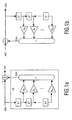
- Figure 1(a) shows a finite impulse response (FIR) type predictive filter 10 component of order K for a conventional LPC based encoder.
- the filter provides an estimate x ⁇ ( n ) for a given signal x(n) generated from a linear combination of K previous samples of the signal.
- the prediction coefficients ⁇ k are calculated based on some criterion, typically a weighted mean-squared error.
- the estimate x ⁇ ( n ) is in turn subtracted from the signal x(n) to provide a residual signal r ( n ).
- This residual signal and the information for the prediction filter i.e. the prediction coefficients ⁇ are generally transmitted or stored in a more efficient form.
- the prediction coefficients ⁇ k can be mapped onto a set of reflection coefficients, and these in turn can be mapped onto log area ratios (LAR).
- the prediction coefficients ⁇ k can be mapped directly to line spectral frequencies (LSF) prior to being encoded along with the residual signal in a bitstream representing the signal x(n) .
- LSF line spectral frequencies
- Alternative representations such as arcsine reflection coefficients (ASRCs) and Line Spectral Pairs (LSPs) may also be employed.
- an FIR type filter of the type described above does not enable an encoder to be tuned taking into account a psycho acoustic model of the auditory process.
- H k ( z ) 1 ⁇ ⁇ 2 1 ⁇ z ⁇ 1 ⁇ ⁇ z ⁇ 1 ⁇ ⁇ 1 ⁇ z ⁇ 1 ⁇ ⁇ k
- ⁇ ⁇ (-1, 1) the total transfer F may be a minimum-phase IIR filter.
- the preferred embodiments of the invention provide an extension of a conventional LPC scheme allowing Laguerre type prediction coefficients to be mapped to those of an FIR system. Therefore, conventional linear predictive coding techniques can be used to quantise and transmit or store the Laguerre prediction coefficients.
- the total transfer function F ( z ) can be represented as a combination of equations 2 and 3:
- the transfer function F(z) can be a minimum-phase system if the coefficients are optimised using, for example, a data-input windowing method as disclosed by Voitishchuk et al and den Brinker.
- the above filter is mapped onto a minimum-phase FIR filter of order K, so that these Laguerre type prediction coefficients can be quantised and transmitted by standard techniques.
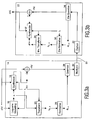
- the encoder 14 includes a Laguerre filter component 16 of the type disclosed by by Voitishchuk et al and den Brinker.
- the component 16 is provided with a value of ⁇ which determines the frequency sensitivity of the filter. This value may either be encoded in a bitstream 50 produced by the encoder for later use by a decoder 22, Figure 3(b), or the value of ⁇ may otherwise be known by the decoder 22.
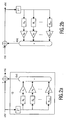
- the component For the signal x(n), the component provides a set of prediction coefficients ⁇ . These along with the ⁇ value are supplied to a synthesizer component 18, which produces an estimate of signal x ⁇ (n) in the manner shown in Figure 2(a).
- the prediction coefficients ⁇ are transformed in a transformation component 20.
- the coefficients c 0 ...c k are passed to a normalising component 26.
- the normalising component 26 passes the coefficients d 1 ...d k to a component 28 where the coefficients are transformed preferably into LAR or LSF parameters and quantized in a corresponding manner to the quantization of the ⁇ coefficients of Figure 1(a) except that indexing is different and the signs have been reversed.
- the component 28 also receives the residual signal r ( n ), quantizes this as appropriate and passes the values to a multiplexing unit 30 which generates a bitstream 50 representing the signal x(n). It will therefore be seen that this bitstream can be transmitted in the same form as with a bitstream containing conventional FIR filter parameters. Alternatively, the bitstream may be slightly modified to include at some point the value of ⁇ , but otherwise, its format need not be changed.
- bitstream 50 is decoded by a de-multiplexing unit 32.
- the extracted parameters are provided to a de-quantizing component which produces the residual signal r(n) and the normalized FIR type filter parameters d l ...d k in a conventional manner.
- an adapted encoder 14' provides peak broadening or bandwidth extension/expansion/widening as disclosed in "Spectral smoothing technique in PARCOR speech analysis-synthesis", Y. Tohkura and F. Itakura and S. Hashimoto, IEEE Trans. Acoust. Speech Signal Process. vol. 26, pp. 587-596, 1978.
- Spectral peak broadening in linear prediction coding is done by multiplying the impulse response (prediction coefficients) by an exponentially-decreasing sequence.
- peak broadening is implemented by interposing a peak broadening component 38 between the transform component 20 and an adapted normalizing component 26' of the first embodiment.
- the normalising component 26' can then normalise the coefficients c ⁇ 1 ...c ⁇ k to provide the normalised type FIR coefficients d 1...k as before.
- the peak broadening affects the signal which will eventually be synthesized within a decoder reading the peak broadened signal, and as such a different residual signal r(n) should be calculated within the encoder 14' if peak broadening has been applied.
- a de-quantizer component 34 as in Figure 2(b) is provided with the quantized signal produced by the component 28 to provide the coefficients d 1 ... k exactly as they would be generated within the decoder. These are in turn de-normalised and inversely transformed by components 36 and 24 respectively, again corresponding to the components of Figure 2(b), to produce a set of prediction coefficients ⁇ as would be generated within the decoder for the peak broadened signal.
- the synthesizer 18 then either uses the prediction coefficients ⁇ or ⁇ according to whether peak broadening has been applied or not and subtracts this from the signal x(n) to generate the residual signal r(n).
- the resulting prediction coefficients ⁇ are the coefficients of a spectrally peak broadened Laguerre prediction filter, where peak broadening has been carried out in a frequency warped domain.
- the encoder is in fact performing peak broadening on a psycho-acoustically relevant scale and also allow the peak broadening function, for example, w k , to be chosen on the basis of its pyscho-acoustical function.
- peak broadening could be applied to the coefficients d 1 ... k , rather than the coefficients c 0...k with the appropriate changes required for the generation of the residual signal.
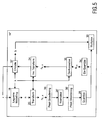
- Figure 5 shows a more general form of encoder 14" encompassing the encoders of the first and second embodiments.
- the steps of transforming, normalising, quantizing and optionally peak broadening are performed as before by components 20, 26', 28 and 38/38' respectively.
- the components 38/38' indicate that peak broadening may occur either before 38 or after 38' normalizing
- the quantized signal is fed through de-quantizing, de-normalizing and inverse transform components 34, 36 and 24 respectively as in the second embodiment to ensure that the prediction coefficients employed by the encoder to generate the residual signal will be exactly the same as those employed in the decoder.
- the invention is not limited to the generation of a residual signal r(n) by synthesizing the signal x ⁇ (n) and subtracting this from the signal x(n) as in the first two embodiments.
- This aspect of the invention can be thought of more generally as including an encoder 18" which ideally uses the prediction coefficients which will be employed in the decoder and the frequency sensitizing parameter ⁇ to generate an indication b of the difference between the modelled aspect of the signal x(n) and the signal itself x(n) .
- a corresponding component combines this indication b with the prediction coefficients and the frequency sensitizing parameter ⁇ to generate the final estimate of the original audio signal.
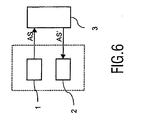
- Figure 6 shows an audio system according to the invention comprising an audio coder 1 including the encoder 14,14' as shown in Fig. 3(a) or 4 and an audio player 2 including the decoder 22 as shown in Figure 3(b).
- the encoded audio stream 50 is furnished from the audio coder to the audio player over a communication channel 3, which may be a 3 wireless connection, a data bus or a storage medium.
- the communication channel 3 is a storage medium, the storage medium may be fixed in the system or may also be a removable disc, solid state storage device such as a Memory StickTM from Sony Corporation etc.
- the communication channel 3 may be part of the audio system, but will however often be outside the audio system.
Landscapes
- Engineering & Computer Science (AREA)
- Physics & Mathematics (AREA)
- Signal Processing (AREA)
- Health & Medical Sciences (AREA)
- Audiology, Speech & Language Pathology (AREA)
- Human Computer Interaction (AREA)
- Computational Linguistics (AREA)
- Acoustics & Sound (AREA)
- Multimedia (AREA)
- Compression, Expansion, Code Conversion, And Decoders (AREA)
- Reduction Or Emphasis Of Bandwidth Of Signals (AREA)
- Complex Calculations (AREA)
- Cereal-Derived Products (AREA)
Claims (14)
- Verfahren zum Codieren eines Audiosignals, wobei das Verfahren folgende Schritte umfasst:Modellieren des Audiosignals entsprechend einem Frequenzsensibilisierungsparameter, um einen ersten Satz Eigenschaften einer Ordnung K vom Typ eines infiniten Impulsreaktions-Filters zu erzeugen, die linear mit dem Sensibilisierungsparameter kombiniert werden können, um eine Schätzung für das Audiosignal zu erhalten,Transformieren des ersten oder eines dritten Satzes Eigenschaften als eine Funktion des Sensibilisierungsparameters, um einen zweiten Satz Eigenschaften zu erhalten, die mit Eigenschaften vom Typ eines finiten Impulsreaktions-Filters kompatibel sind,Normalisieren des zweiten bzw. des ersten Satzes Eigenschaften, um den dritten Satz Eigenschaften zu erhalten, undErzeugen eines codierten Audiostromes, der Darstellungen eines transformierten und normalisierten Satzes Eigenschaften der Ordnung K enthält.
- Verfahren nach Anspruch 1, wobei die Filtereigenschaften vom Typ eines IIR-Filters die Anforderungen eines Minimumphasenfilters erfüllen und die Eigenschaften vom Typ eines FIR-Filters die Anforderungen eines Minimumphasenfilters erfüllen.
- Verfahren nach Anspruch 1, das des Weiteren folgenden Schritt umfasst:Subtrahieren der Schätzung von dem Audiosignal, um ein Restsignal zu erhalten, und wobei der Schritt des Erzeugens das Aufnehmen des Restsignals in den codierten Audiostrom enthält.
- Verfahren nach Anspruch 1, wobei der Schritt des Modellierens das Modellieren des Audiosignals mit einem Filter vom Laguerre-Typ umfasst, der folgende Übertragungsfunktion hat:

- Verfahren nach Anspruch 4, wobei der Schritt des Transformierens das Transformieren der Laguerre-Filter-Koeffizienten gemäß folgender Matrixtransformation umfasst:
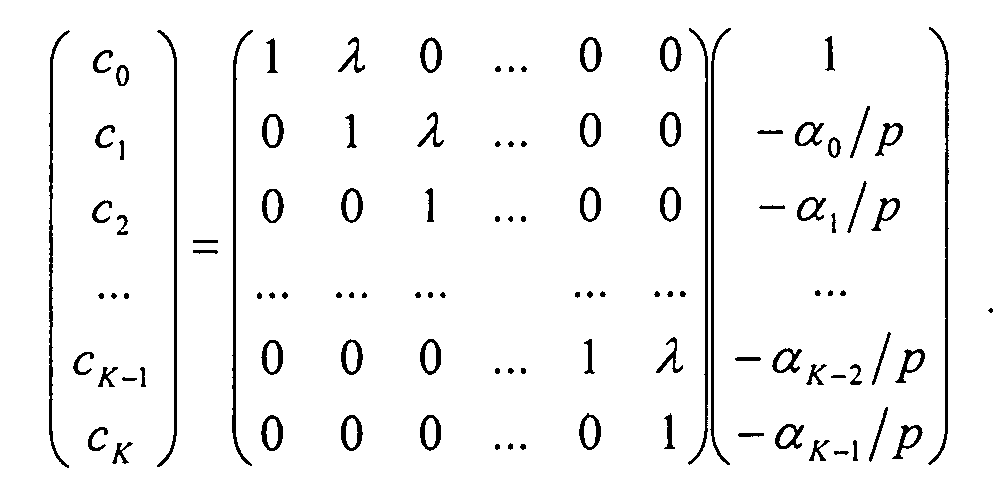
wobei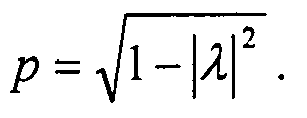
- Verfahren nach Anspruch 5, wobei der Schritt des Normalisierens umfasst, den zweiten Satz Eigenschaften der Ordnung K+1 durch eine des zweiten Satzes Eigenschaften zu teilen und den übrigen Teil des geteilten Satzes Eigenschaften als den dritten Satz Eigenschaften der Ordnung K bereitzustellen.
- Verfahren nach Anspruch 1, wobei der Schritt des Erzeugens den Frequenzsensibilisierungsparameter in dem Bitstrom enthält.
- Verfahren nach Anspruch 1, das des Weiteren den Schritt der Spitzenwertverbreiterung des Satzes Eigenschaften der Ordnung K+1 umfasst.
- Verfahren zum Decodieren eines Audiostroms, wobei das Verfahren folgende Schritte umfasst:Lesen eines codierten Audiostroms, der Darstellungen eines Audiosignals enthält, um einen ersten Satz Eigenschaften einer Ordnung K bereitzustellen, die mit Eigenschaften vom Typ eines finiten Impulsreaktions-Filters kompatibel sind,Kombinieren des ersten Satzes Eigenschaften der Ordnung K mit einem Frequenzsensibilisierungsparameter, um eine Entnormalisierungseigenschaft zu erhalten,Entnormalisieren des ersten oder eines dritten Satzes Eigenschaften vom Typ eines infiniten Impulsreaktions-Filters als eine Funktion der Entnormalisierungseigenschaft, um einen zweiten Satz Eigenschaften zu erhalten,Transformieren des zweiten bzw. des ersten Satzes Eigenschaften als eine Funktion des Sensibilisierungsparameters, um den dritten Satz Eigenschaften zu erhalten, undSynthetisieren des Audiosignals als eine lineare Kombination des Frequenzsensibilisierungsparameters und eines Satzes entnormalisierter und transformierter Eigenschaften der Ordnung K.
- Audiocodierer, umfassend:Mittel zum Modellieren eines Audiosignals entsprechend einem Frequenzsensibilisierungsparameter, um einen ersten Satz Eigenschaften einer Ordnung K vom Typ eines infiniten Impulsreaktions-Filters zu erhalten, die linear mit dem Sensibilisierungsparameter kombiniert werden können, um eine Schätzung für das Audiosignal zu erhalten,Mittel zum Transformieren des ersten oder eines dritten Satzes Eigenschaften als eine Funktion des Sensibilisierungsparameters, um einen zweiten Satz Eigenschaften zu erhalten, die mit Eigenschaften vom Typ eines finiten Impulsreaktions-Filters kompatibel sind,Mittel zum Normalisieren des zweiten bzw. des ersten Satzes Eigenschaften, um den dritten Satz Eigenschaften zu erhalten, undMittel zum Erzeugen eines codierten Audiostroms, der Darstellungen eines transformierten und normalisierten Satzes Eigenschaften der Ordnung K enthält.
- Audiowiedergabevorrichtung, umfassend:Mittel zum Lesen eines codierten Audiostroms, der Darstellungen eines Audiosignals enthält, um einen ersten Satz Eigenschaften einer Ordnung K zu erhalten, die mit Eigenschaften vom Typ eines finiten Impulsreaktions-Filters kompatibel sind,Mittel zum Kombinieren des ersten Satzes Eigenschaften der Ordnung K mit einem Frequenzsensibilisierungsparameter, um eine Entnormalisierungseigenschaft zu erhalten,Mittel zum Entnormalisieren des ersten oder eines dritten Satzes Eigenschaften vom Typ eines infiniten Impulsreaktions-Filters als eine Funktion der Entnormalisierungseigenschaft, um einen zweiten Satz Eigenschaften zu erhalten,Mittel zum Transformieren des zweiten bzw. des ersten Satzes Eigenschaften als eine Funktion des Sensibilisierungsparameters, um den dritten Satz Eigenschaften zu erhalten, undMittel zum Synthetisieren des Audiosignals als eine lineare Kombination des Frequenzsensibilisierungsparameters und eines Satzes entnormalisierter und transformierter Eigenschaften der Ordnung K.
- Audiosystem, das einen Audiocodierer nach Anspruch 10 und eine Audiowiedergabevorrichtung nach Anspruch 11 umfasst.
- Audiostrom, der Darstellungen eines Audiosignals umfasst, das einem Satz Eigenschaften einer Ordnung K entspricht, wobei der Satz Eigenschaften der Ordnung K mit einem Frequenzsensibilisierungsparameter zu einem Satz Eigenschaften der Ordnung K+1 kombiniert werden kann, die mit Eigenschaften vom Typ eines finiten Impulsreaktions-Filters kompatibel sind, wobei der Satz Eigenschaften der Ordnung K+1 als eine Funktion des Sensibilisierungsparameters transformiert werden kann, um einen Satz Eigenschaften der Ordnung K vom Typ eines infiniten Impulsreaktions-Filters zu erhalten.
- Speichermedium, auf dem ein Audiostrom nach Anspruch 13 gespeichert ist.
Priority Applications (1)
| Application Number | Priority Date | Filing Date | Title |
|---|---|---|---|
| EP03722975A EP1514262B1 (de) | 2002-05-30 | 2003-05-16 | Codierung von audiosignalen |
Applications Claiming Priority (4)
| Application Number | Priority Date | Filing Date | Title |
|---|---|---|---|
| EP02077128 | 2002-05-30 | ||
| EP02077128 | 2002-05-30 | ||
| PCT/IB2003/002044 WO2003102922A1 (en) | 2002-05-30 | 2003-05-16 | Audio coding |
| EP03722975A EP1514262B1 (de) | 2002-05-30 | 2003-05-16 | Codierung von audiosignalen |
Publications (2)
| Publication Number | Publication Date |
|---|---|
| EP1514262A1 EP1514262A1 (de) | 2005-03-16 |
| EP1514262B1 true EP1514262B1 (de) | 2006-08-16 |
Family
ID=29595018
Family Applications (1)
| Application Number | Title | Priority Date | Filing Date |
|---|---|---|---|
| EP03722975A Expired - Lifetime EP1514262B1 (de) | 2002-05-30 | 2003-05-16 | Codierung von audiosignalen |
Country Status (9)
| Country | Link |
|---|---|
| US (1) | US20050228656A1 (de) |
| EP (1) | EP1514262B1 (de) |
| JP (1) | JP4446883B2 (de) |
| KR (1) | KR101038446B1 (de) |
| CN (1) | CN100343895C (de) |
| AT (1) | ATE336781T1 (de) |
| AU (1) | AU2003230132A1 (de) |
| DE (1) | DE60307634T2 (de) |
| WO (1) | WO2003102922A1 (de) |
Families Citing this family (9)
| Publication number | Priority date | Publication date | Assignee | Title |
|---|---|---|---|---|
| RU2007143418A (ru) * | 2005-05-25 | 2009-05-27 | Конинклейке Филипс Электроникс Н.В. (Nl) | Кодирование с предсказанием многоканального сигнала |
| DE102006022346B4 (de) * | 2006-05-12 | 2008-02-28 | Fraunhofer-Gesellschaft zur Förderung der angewandten Forschung e.V. | Informationssignalcodierung |
| US8532985B2 (en) * | 2010-12-03 | 2013-09-10 | Microsoft Coporation | Warped spectral and fine estimate audio encoding |
| TWI538000B (zh) | 2012-05-10 | 2016-06-11 | 杜比實驗室特許公司 | 多階段過濾器,音頻編碼器,音頻解碼器,施行多階段過濾的方法,用以編碼音頻資料的方法,用以將編碼音頻資料解碼的方法,及用以處理編碼位元流的方法和裝置 |
| WO2013191597A1 (en) * | 2012-06-18 | 2013-12-27 | Telefonaktiebolaget L M Ericsson (Publ) | Prefiltering in mimo receiver |
| WO2014096236A2 (en) * | 2012-12-19 | 2014-06-26 | Dolby International Ab | Signal adaptive fir/iir predictors for minimizing entropy |
| PL3462449T3 (pl) * | 2014-01-24 | 2021-06-28 | Nippon Telegraph And Telephone Corporation | Urządzenie, sposób i program do analizy liniowo-predykcyjnej oraz nośnik zapisu |
| CN109188069B (zh) * | 2018-08-29 | 2020-08-28 | 广东石油化工学院 | 一种用于负载开关事件检测的脉冲噪声滤除方法 |
| CN118136042B (zh) * | 2024-05-10 | 2024-07-23 | 四川湖山电器股份有限公司 | 基于iir频谱拟合的频谱优化方法、系统、终端及介质 |
Family Cites Families (4)
| Publication number | Priority date | Publication date | Assignee | Title |
|---|---|---|---|---|
| US4493048A (en) * | 1982-02-26 | 1985-01-08 | Carnegie-Mellon University | Systolic array apparatuses for matrix computations |
| US7423983B1 (en) * | 1999-09-20 | 2008-09-09 | Broadcom Corporation | Voice and data exchange over a packet based network |
| JP2001134295A (ja) * | 1999-08-23 | 2001-05-18 | Sony Corp | 符号化装置および符号化方法、記録装置および記録方法、送信装置および送信方法、復号化装置および符号化方法、再生装置および再生方法、並びに記録媒体 |
| US6931373B1 (en) * | 2001-02-13 | 2005-08-16 | Hughes Electronics Corporation | Prototype waveform phase modeling for a frequency domain interpolative speech codec system |
-
2003
- 2003-05-16 WO PCT/IB2003/002044 patent/WO2003102922A1/en not_active Ceased
- 2003-05-16 AU AU2003230132A patent/AU2003230132A1/en not_active Abandoned
- 2003-05-16 CN CNB038122014A patent/CN100343895C/zh not_active Expired - Fee Related
- 2003-05-16 EP EP03722975A patent/EP1514262B1/de not_active Expired - Lifetime
- 2003-05-16 US US10/515,746 patent/US20050228656A1/en not_active Abandoned
- 2003-05-16 DE DE60307634T patent/DE60307634T2/de not_active Expired - Lifetime
- 2003-05-16 AT AT03722975T patent/ATE336781T1/de not_active IP Right Cessation
- 2003-05-16 KR KR1020047019512A patent/KR101038446B1/ko not_active Expired - Fee Related
- 2003-05-16 JP JP2004509924A patent/JP4446883B2/ja not_active Expired - Fee Related
Also Published As
| Publication number | Publication date |
|---|---|
| WO2003102922A1 (en) | 2003-12-11 |
| DE60307634T2 (de) | 2007-08-09 |
| JP4446883B2 (ja) | 2010-04-07 |
| ATE336781T1 (de) | 2006-09-15 |
| KR101038446B1 (ko) | 2011-06-01 |
| JP2005528646A (ja) | 2005-09-22 |
| DE60307634D1 (de) | 2006-09-28 |
| CN1656537A (zh) | 2005-08-17 |
| KR20050007574A (ko) | 2005-01-19 |
| US20050228656A1 (en) | 2005-10-13 |
| CN100343895C (zh) | 2007-10-17 |
| AU2003230132A1 (en) | 2003-12-19 |
| EP1514262A1 (de) | 2005-03-16 |
Similar Documents
| Publication | Publication Date | Title |
|---|---|---|
| Gersho | Advances in speech and audio compression | |
| EP1527441B1 (de) | Audiokodierung | |
| US6732070B1 (en) | Wideband speech codec using a higher sampling rate in analysis and synthesis filtering than in excitation searching | |
| CA2140329C (en) | Decomposition in noise and periodic signal waveforms in waveform interpolation | |
| RU2389085C2 (ru) | Способы и устройства для введения низкочастотных предыскажений в ходе сжатия звука на основе acelp/tcx | |
| EP3244407B1 (de) | Apparat und methode zur modifizierung einer paramterisierten darstellung | |
| EP0747882A2 (de) | Veränderte Grundfrequenzverzögerung bei Verlust von Datenrahmen | |
| US20090192792A1 (en) | Methods and apparatuses for encoding and decoding audio signal | |
| Spanias et al. | Analysis of the MPEG-1 Layer III (MP3) algorithm using MATLAB | |
| JP3541680B2 (ja) | 音声音楽信号の符号化装置および復号装置 | |
| EP1514262B1 (de) | Codierung von audiosignalen | |
| CN117940994A (zh) | 基于长期预测和/或谐波后置滤波生成预测频谱的处理器 | |
| EP1385150B1 (de) | Verfahren und System zur Charakterisierung von transienten Audiosignalen | |
| EP1160769A2 (de) | Verfahren und Vorrichtung zur Darstellung der Verdeckungsschwelle in perzeptuellen Audiokodierern | |
| EP1756807B1 (de) | Audiokodierung | |
| JPH10124089A (ja) | 音声信号処理装置及び方法、並びに、音声帯域幅拡張装置及び方法 | |
| JP4281131B2 (ja) | 信号符号化装置及び方法、並びに信号復号装置及び方法 | |
| JP2000132194A (ja) | 信号符号化装置及び方法、並びに信号復号装置及び方法 | |
| CN100585700C (zh) | 语音编码装置及其方法 | |
| JP3264679B2 (ja) | コード励振線形予測符号化装置及び復号化装置 | |
| JP4618823B2 (ja) | 信号符号化装置及び方法 | |
| Yuan | The weighted sum of the line spectrum pair for noisy speech | |
| Kao | Low Complexity CELP Speech Coding at 4.8 kbps | |
| Shum | Optimisation techniques for low bit rate speech coding | |
| Ning | Analysis and coding of high quality audio signals |
Legal Events
| Date | Code | Title | Description |
|---|---|---|---|
| PUAI | Public reference made under article 153(3) epc to a published international application that has entered the european phase |
Free format text: ORIGINAL CODE: 0009012 |
|
| 17P | Request for examination filed |
Effective date: 20041230 |
|
| AK | Designated contracting states |
Kind code of ref document: A1 Designated state(s): AT BE BG CH CY CZ DE DK EE ES FI FR GB GR HU IE IT LI LU MC NL PT RO SE SI SK TR |
|
| AX | Request for extension of the european patent |
Extension state: AL LT LV MK |
|
| GRAP | Despatch of communication of intention to grant a patent |
Free format text: ORIGINAL CODE: EPIDOSNIGR1 |
|
| DAX | Request for extension of the european patent (deleted) | ||
| GRAS | Grant fee paid |
Free format text: ORIGINAL CODE: EPIDOSNIGR3 |
|
| GRAA | (expected) grant |
Free format text: ORIGINAL CODE: 0009210 |
|
| AK | Designated contracting states |
Kind code of ref document: B1 Designated state(s): AT BE BG CH CY CZ DE DK EE ES FI FR GB GR HU IE IT LI LU MC NL PT RO SE SI SK TR |
|
| PG25 | Lapsed in a contracting state [announced via postgrant information from national office to epo] |
Ref country code: IT Free format text: LAPSE BECAUSE OF FAILURE TO SUBMIT A TRANSLATION OF THE DESCRIPTION OR TO PAY THE FEE WITHIN THE PRESCRIBED TIME-LIMIT;WARNING: LAPSES OF ITALIAN PATENTS WITH EFFECTIVE DATE BEFORE 2007 MAY HAVE OCCURRED AT ANY TIME BEFORE 2007. THE CORRECT EFFECTIVE DATE MAY BE DIFFERENT FROM THE ONE RECORDED. Effective date: 20060816 Ref country code: BE Free format text: LAPSE BECAUSE OF FAILURE TO SUBMIT A TRANSLATION OF THE DESCRIPTION OR TO PAY THE FEE WITHIN THE PRESCRIBED TIME-LIMIT Effective date: 20060816 Ref country code: NL Free format text: LAPSE BECAUSE OF FAILURE TO SUBMIT A TRANSLATION OF THE DESCRIPTION OR TO PAY THE FEE WITHIN THE PRESCRIBED TIME-LIMIT Effective date: 20060816 Ref country code: LI Free format text: LAPSE BECAUSE OF FAILURE TO SUBMIT A TRANSLATION OF THE DESCRIPTION OR TO PAY THE FEE WITHIN THE PRESCRIBED TIME-LIMIT Effective date: 20060816 Ref country code: CZ Free format text: LAPSE BECAUSE OF FAILURE TO SUBMIT A TRANSLATION OF THE DESCRIPTION OR TO PAY THE FEE WITHIN THE PRESCRIBED TIME-LIMIT Effective date: 20060816 Ref country code: FI Free format text: LAPSE BECAUSE OF FAILURE TO SUBMIT A TRANSLATION OF THE DESCRIPTION OR TO PAY THE FEE WITHIN THE PRESCRIBED TIME-LIMIT Effective date: 20060816 Ref country code: SK Free format text: LAPSE BECAUSE OF FAILURE TO SUBMIT A TRANSLATION OF THE DESCRIPTION OR TO PAY THE FEE WITHIN THE PRESCRIBED TIME-LIMIT Effective date: 20060816 Ref country code: RO Free format text: LAPSE BECAUSE OF FAILURE TO SUBMIT A TRANSLATION OF THE DESCRIPTION OR TO PAY THE FEE WITHIN THE PRESCRIBED TIME-LIMIT Effective date: 20060816 Ref country code: AT Free format text: LAPSE BECAUSE OF FAILURE TO SUBMIT A TRANSLATION OF THE DESCRIPTION OR TO PAY THE FEE WITHIN THE PRESCRIBED TIME-LIMIT Effective date: 20060816 Ref country code: CH Free format text: LAPSE BECAUSE OF FAILURE TO SUBMIT A TRANSLATION OF THE DESCRIPTION OR TO PAY THE FEE WITHIN THE PRESCRIBED TIME-LIMIT Effective date: 20060816 Ref country code: SI Free format text: LAPSE BECAUSE OF FAILURE TO SUBMIT A TRANSLATION OF THE DESCRIPTION OR TO PAY THE FEE WITHIN THE PRESCRIBED TIME-LIMIT Effective date: 20060816 |
|
| REG | Reference to a national code |
Ref country code: GB Ref legal event code: FG4D |
|
| REG | Reference to a national code |
Ref country code: CH Ref legal event code: EP |
|
| REG | Reference to a national code |
Ref country code: IE Ref legal event code: FG4D |
|
| REF | Corresponds to: |
Ref document number: 60307634 Country of ref document: DE Date of ref document: 20060928 Kind code of ref document: P |
|
| PG25 | Lapsed in a contracting state [announced via postgrant information from national office to epo] |
Ref country code: SE Free format text: LAPSE BECAUSE OF FAILURE TO SUBMIT A TRANSLATION OF THE DESCRIPTION OR TO PAY THE FEE WITHIN THE PRESCRIBED TIME-LIMIT Effective date: 20061116 Ref country code: BG Free format text: LAPSE BECAUSE OF FAILURE TO SUBMIT A TRANSLATION OF THE DESCRIPTION OR TO PAY THE FEE WITHIN THE PRESCRIBED TIME-LIMIT Effective date: 20061116 Ref country code: DK Free format text: LAPSE BECAUSE OF FAILURE TO SUBMIT A TRANSLATION OF THE DESCRIPTION OR TO PAY THE FEE WITHIN THE PRESCRIBED TIME-LIMIT Effective date: 20061116 |
|
| PG25 | Lapsed in a contracting state [announced via postgrant information from national office to epo] |
Ref country code: ES Free format text: LAPSE BECAUSE OF FAILURE TO SUBMIT A TRANSLATION OF THE DESCRIPTION OR TO PAY THE FEE WITHIN THE PRESCRIBED TIME-LIMIT Effective date: 20061127 |
|
| PG25 | Lapsed in a contracting state [announced via postgrant information from national office to epo] |
Ref country code: PT Free format text: LAPSE BECAUSE OF FAILURE TO SUBMIT A TRANSLATION OF THE DESCRIPTION OR TO PAY THE FEE WITHIN THE PRESCRIBED TIME-LIMIT Effective date: 20070116 |
|
| NLV1 | Nl: lapsed or annulled due to failure to fulfill the requirements of art. 29p and 29m of the patents act | ||
| REG | Reference to a national code |
Ref country code: CH Ref legal event code: PL |
|
| ET | Fr: translation filed | ||
| PLBE | No opposition filed within time limit |
Free format text: ORIGINAL CODE: 0009261 |
|
| STAA | Information on the status of an ep patent application or granted ep patent |
Free format text: STATUS: NO OPPOSITION FILED WITHIN TIME LIMIT |
|
| 26N | No opposition filed |
Effective date: 20070518 |
|
| PG25 | Lapsed in a contracting state [announced via postgrant information from national office to epo] |
Ref country code: MC Free format text: LAPSE BECAUSE OF NON-PAYMENT OF DUE FEES Effective date: 20070531 |
|
| PG25 | Lapsed in a contracting state [announced via postgrant information from national office to epo] |
Ref country code: GR Free format text: LAPSE BECAUSE OF FAILURE TO SUBMIT A TRANSLATION OF THE DESCRIPTION OR TO PAY THE FEE WITHIN THE PRESCRIBED TIME-LIMIT Effective date: 20061117 |
|
| PG25 | Lapsed in a contracting state [announced via postgrant information from national office to epo] |
Ref country code: IE Free format text: LAPSE BECAUSE OF NON-PAYMENT OF DUE FEES Effective date: 20070516 |
|
| PG25 | Lapsed in a contracting state [announced via postgrant information from national office to epo] |
Ref country code: EE Free format text: LAPSE BECAUSE OF FAILURE TO SUBMIT A TRANSLATION OF THE DESCRIPTION OR TO PAY THE FEE WITHIN THE PRESCRIBED TIME-LIMIT Effective date: 20060816 |
|
| PG25 | Lapsed in a contracting state [announced via postgrant information from national office to epo] |
Ref country code: LU Free format text: LAPSE BECAUSE OF NON-PAYMENT OF DUE FEES Effective date: 20070516 Ref country code: CY Free format text: LAPSE BECAUSE OF FAILURE TO SUBMIT A TRANSLATION OF THE DESCRIPTION OR TO PAY THE FEE WITHIN THE PRESCRIBED TIME-LIMIT Effective date: 20060816 |
|
| PG25 | Lapsed in a contracting state [announced via postgrant information from national office to epo] |
Ref country code: TR Free format text: LAPSE BECAUSE OF FAILURE TO SUBMIT A TRANSLATION OF THE DESCRIPTION OR TO PAY THE FEE WITHIN THE PRESCRIBED TIME-LIMIT Effective date: 20060816 Ref country code: HU Free format text: LAPSE BECAUSE OF FAILURE TO SUBMIT A TRANSLATION OF THE DESCRIPTION OR TO PAY THE FEE WITHIN THE PRESCRIBED TIME-LIMIT Effective date: 20070217 |
|
| REG | Reference to a national code |
Ref country code: DE Ref legal event code: R082 Ref document number: 60307634 Country of ref document: DE Representative=s name: VOLMER, GEORG, DIPL.-ING., DE |
|
| REG | Reference to a national code |
Ref country code: DE Ref legal event code: R082 Ref document number: 60307634 Country of ref document: DE Representative=s name: MEISSNER, BOLTE & PARTNER GBR, DE Effective date: 20140328 Ref country code: DE Ref legal event code: R082 Ref document number: 60307634 Country of ref document: DE Representative=s name: MEISSNER BOLTE PATENTANWAELTE RECHTSANWAELTE P, DE Effective date: 20140328 Ref country code: DE Ref legal event code: R082 Ref document number: 60307634 Country of ref document: DE Representative=s name: VOLMER, GEORG, DIPL.-ING., DE Effective date: 20140328 Ref country code: DE Ref legal event code: R081 Ref document number: 60307634 Country of ref document: DE Owner name: KONINKLIJKE PHILIPS N.V., NL Free format text: FORMER OWNER: KONINKLIJKE PHILIPS ELECTRONICS N.V., EINDHOVEN, NL Effective date: 20140328 |
|
| REG | Reference to a national code |
Ref country code: FR Ref legal event code: CD Owner name: KONINKLIJKE PHILIPS N.V., NL Effective date: 20141126 Ref country code: FR Ref legal event code: CA Effective date: 20141126 |
|
| REG | Reference to a national code |
Ref country code: DE Ref legal event code: R082 Ref document number: 60307634 Country of ref document: DE Representative=s name: MEISSNER, BOLTE & PARTNER GBR, DE Ref country code: DE Ref legal event code: R082 Ref document number: 60307634 Country of ref document: DE Representative=s name: MEISSNER BOLTE PATENTANWAELTE RECHTSANWAELTE P, DE |
|
| REG | Reference to a national code |
Ref country code: FR Ref legal event code: PLFP Year of fee payment: 14 |
|
| REG | Reference to a national code |
Ref country code: FR Ref legal event code: PLFP Year of fee payment: 15 |
|
| REG | Reference to a national code |
Ref country code: FR Ref legal event code: PLFP Year of fee payment: 16 |
|
| PGFP | Annual fee paid to national office [announced via postgrant information from national office to epo] |
Ref country code: FR Payment date: 20190527 Year of fee payment: 17 |
|
| PGFP | Annual fee paid to national office [announced via postgrant information from national office to epo] |
Ref country code: DE Payment date: 20190731 Year of fee payment: 17 Ref country code: GB Payment date: 20190529 Year of fee payment: 17 |
|
| REG | Reference to a national code |
Ref country code: DE Ref legal event code: R119 Ref document number: 60307634 Country of ref document: DE |
|
| GBPC | Gb: european patent ceased through non-payment of renewal fee |
Effective date: 20200516 |
|
| PG25 | Lapsed in a contracting state [announced via postgrant information from national office to epo] |
Ref country code: FR Free format text: LAPSE BECAUSE OF NON-PAYMENT OF DUE FEES Effective date: 20200531 Ref country code: GB Free format text: LAPSE BECAUSE OF NON-PAYMENT OF DUE FEES Effective date: 20200516 |
|
| PG25 | Lapsed in a contracting state [announced via postgrant information from national office to epo] |
Ref country code: DE Free format text: LAPSE BECAUSE OF NON-PAYMENT OF DUE FEES Effective date: 20201201 |