EP1515516B1 - Authentifizierung des Zugriffs auf ein drahtloses Local Area Network basierend auf Sicherheitswerte(n), die einem zellularen Mobilfunksystem zugeordnet sind - Google Patents
Authentifizierung des Zugriffs auf ein drahtloses Local Area Network basierend auf Sicherheitswerte(n), die einem zellularen Mobilfunksystem zugeordnet sind Download PDFInfo
- Publication number
- EP1515516B1 EP1515516B1 EP04255196A EP04255196A EP1515516B1 EP 1515516 B1 EP1515516 B1 EP 1515516B1 EP 04255196 A EP04255196 A EP 04255196A EP 04255196 A EP04255196 A EP 04255196A EP 1515516 B1 EP1515516 B1 EP 1515516B1
- Authority
- EP
- European Patent Office
- Prior art keywords
- network
- key
- private key
- mobile terminal
- determining
- Prior art date
- Legal status (The legal status is an assumption and is not a legal conclusion. Google has not performed a legal analysis and makes no representation as to the accuracy of the status listed.)
- Expired - Lifetime
Links
- 230000001413 cellular effect Effects 0.000 title claims description 38
- 238000000034 method Methods 0.000 claims description 34
- 230000004044 response Effects 0.000 claims description 24
- 238000004891 communication Methods 0.000 description 15
- 230000015654 memory Effects 0.000 description 7
- 238000010586 diagram Methods 0.000 description 5
- 230000005540 biological transmission Effects 0.000 description 4
- 238000005516 engineering process Methods 0.000 description 4
- 230000008569 process Effects 0.000 description 4
- 230000011664 signaling Effects 0.000 description 4
- 108091006146 Channels Proteins 0.000 description 3
- 230000008901 benefit Effects 0.000 description 3
- 230000010267 cellular communication Effects 0.000 description 3
- 238000012986 modification Methods 0.000 description 3
- 230000004048 modification Effects 0.000 description 3
- 238000011161 development Methods 0.000 description 2
- 230000006870 function Effects 0.000 description 2
- 238000012545 processing Methods 0.000 description 2
- 238000001228 spectrum Methods 0.000 description 2
- 230000009471 action Effects 0.000 description 1
- 238000013475 authorization Methods 0.000 description 1
- 238000010276 construction Methods 0.000 description 1
- 238000013461 design Methods 0.000 description 1
- 230000000977 initiatory effect Effects 0.000 description 1
- 230000010354 integration Effects 0.000 description 1
- 230000007774 longterm Effects 0.000 description 1
- 238000012423 maintenance Methods 0.000 description 1
- 230000003287 optical effect Effects 0.000 description 1
- 239000004065 semiconductor Substances 0.000 description 1
- 230000003068 static effect Effects 0.000 description 1
Images

Classifications
-
- H—ELECTRICITY
- H04—ELECTRIC COMMUNICATION TECHNIQUE
- H04L—TRANSMISSION OF DIGITAL INFORMATION, e.g. TELEGRAPHIC COMMUNICATION
- H04L63/00—Network architectures or network communication protocols for network security
- H04L63/06—Network architectures or network communication protocols for network security for supporting key management in a packet data network
- H04L63/062—Network architectures or network communication protocols for network security for supporting key management in a packet data network for key distribution, e.g. centrally by trusted party
-
- H—ELECTRICITY
- H04—ELECTRIC COMMUNICATION TECHNIQUE
- H04L—TRANSMISSION OF DIGITAL INFORMATION, e.g. TELEGRAPHIC COMMUNICATION
- H04L63/00—Network architectures or network communication protocols for network security
- H04L63/04—Network architectures or network communication protocols for network security for providing a confidential data exchange among entities communicating through data packet networks
- H04L63/0428—Network architectures or network communication protocols for network security for providing a confidential data exchange among entities communicating through data packet networks wherein the data content is protected, e.g. by encrypting or encapsulating the payload
- H04L63/0442—Network architectures or network communication protocols for network security for providing a confidential data exchange among entities communicating through data packet networks wherein the data content is protected, e.g. by encrypting or encapsulating the payload wherein the sending and receiving network entities apply asymmetric encryption, i.e. different keys for encryption and decryption
-
- H—ELECTRICITY
- H04—ELECTRIC COMMUNICATION TECHNIQUE
- H04W—WIRELESS COMMUNICATION NETWORKS
- H04W12/00—Security arrangements; Authentication; Protecting privacy or anonymity
- H04W12/04—Key management, e.g. using generic bootstrapping architecture [GBA]
- H04W12/041—Key generation or derivation
-
- H—ELECTRICITY
- H04—ELECTRIC COMMUNICATION TECHNIQUE
- H04W—WIRELESS COMMUNICATION NETWORKS
- H04W12/00—Security arrangements; Authentication; Protecting privacy or anonymity
- H04W12/04—Key management, e.g. using generic bootstrapping architecture [GBA]
- H04W12/043—Key management, e.g. using generic bootstrapping architecture [GBA] using a trusted network node as an anchor
- H04W12/0431—Key distribution or pre-distribution; Key agreement
-
- H—ELECTRICITY
- H04—ELECTRIC COMMUNICATION TECHNIQUE
- H04W—WIRELESS COMMUNICATION NETWORKS
- H04W12/00—Security arrangements; Authentication; Protecting privacy or anonymity
- H04W12/04—Key management, e.g. using generic bootstrapping architecture [GBA]
- H04W12/043—Key management, e.g. using generic bootstrapping architecture [GBA] using a trusted network node as an anchor
- H04W12/0433—Key management protocols
-
- H—ELECTRICITY
- H04—ELECTRIC COMMUNICATION TECHNIQUE
- H04W—WIRELESS COMMUNICATION NETWORKS
- H04W12/00—Security arrangements; Authentication; Protecting privacy or anonymity
- H04W12/06—Authentication
-
- H—ELECTRICITY
- H04—ELECTRIC COMMUNICATION TECHNIQUE
- H04W—WIRELESS COMMUNICATION NETWORKS
- H04W84/00—Network topologies
- H04W84/02—Hierarchically pre-organised networks, e.g. paging networks, cellular networks, WLAN [Wireless Local Area Network] or WLL [Wireless Local Loop]
- H04W84/10—Small scale networks; Flat hierarchical networks
- H04W84/12—WLAN [Wireless Local Area Networks]
-
- H—ELECTRICITY
- H04—ELECTRIC COMMUNICATION TECHNIQUE
- H04W—WIRELESS COMMUNICATION NETWORKS
- H04W12/00—Security arrangements; Authentication; Protecting privacy or anonymity
- H04W12/06—Authentication
- H04W12/065—Continuous authentication
-
- H—ELECTRICITY
- H04—ELECTRIC COMMUNICATION TECHNIQUE
- H04W—WIRELESS COMMUNICATION NETWORKS
- H04W12/00—Security arrangements; Authentication; Protecting privacy or anonymity
- H04W12/06—Authentication
- H04W12/068—Authentication using credential vaults, e.g. password manager applications or one time password [OTP] applications
-
- H—ELECTRICITY
- H04—ELECTRIC COMMUNICATION TECHNIQUE
- H04W—WIRELESS COMMUNICATION NETWORKS
- H04W88/00—Devices specially adapted for wireless communication networks, e.g. terminals, base stations or access point devices
- H04W88/02—Terminal devices
Definitions
- This invention relates generally to telecommunications, and, more particularly, to wireless communications.
- WLAN wireless local area networks
- IEEE Institute of Electrical and Electronics Engineering
- 802.11x standards include 802.11, 802.11a, 802.11b (also known as Wi-Fi), and 802.11g.
- An integrated mobile terminal can thus communicate with both the existing cellular network infrastructure (for voice and/or data), and WLAN networks for high-speed data applications. While an integrated mobile terminal may be used to access both the cellular network and the WLAN network, these two networks largely remain independent, and thus are typically accessed independently of one another.
- Ala-Laurila provides billing in a packet data network, and further describes multiple networks (such as GSM A and B) in a system.
- WO Reference No. 02/052784 (hereinafter Haverinen II) provides authenticating mobile stations and network servers that communicate with each other through a network, such as the Internet.
- the present invention is directed to addressing one or more of the problems set forth above.
- the present invention is characterized over the disclosure of Haverinen I and II and Ala-Laurila in that it calls for determining at a server associated with a first network a private key for a first network based on at least one security value provided by another server associated with a second network and establishing a plurality of sessions between a mobile terminal and the first network using the private key.
- a method for authenticating access to a first network based on security value(s) of a second system comprises determining at a server associated with a first network a private key for a first network based on at least one security value provided by another server associated with a second network. The method further comprises establishing a plurality of sessions between a mobile terminal and the first network based on the private key.
- a method for authenticating access to a wireless local area network based on security value(s) of a cellular system comprises receiving at a server at least one security value associated with a cellular network, determining at a server a private key for a wireless local area network based on the security value provided by another server associated with the cellular network, and allowing establishment of a plurality of sessions between a mobile terminal and the wireless local area network based on the private key.
- a method for authenticating access to a wireless local area network based on security value(s) of a cellular system.
- the method comprises receiving, at a server, at least one security value provided by another server associated with a cellular network; determining, using the server, a private key based on the at least one security value; determining, at a mobile terminal, a private key based on the at least one security value associated with the cellular network; and allowing establishment of a plurality of sessions between the mobile terminal and the wireless local area network based on the private key determined by the mobile terminal.
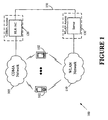
- the communications system 100 of Figure 1 allows the users of mobile terminals 102 to access a cellular system 105 and/or a wireless local area network (WLAN) system 110.
- the cellular system 105 is a Code Division Multiple Access (CDMA) system.
- CDMA is a "spread spectrum" technology, allowing many users to occupy the same time and frequency allocations in a given band/space. As its name implies, CDMA assigns unique codes to each communication to differentiate it from others in the same spectrum.
- CDMA includes second generation (2G) and third generation (3G) services.
- CDMA2000 represents a family of technologies that includes CDMA2000-1X and CDMA2000-1xEV).
- CDMA2000 network 105 of Figure 1 is a CDMA2000 network, although one or more embodiments of the present invention may be applied to other cellular schemes, including, but not limited to, OFDMA, TDMA, GSM, and ASM.
- the communications system 100 includes a home location register/authentication center (HLR/AC) 120 that controls access to the CDMA network 105 and further includes a server 130 that controls access to the WLAN network 110.
- HLR/AC 120 authenticates the identity of the remote terminals 102 desiring access to the CDMA network 105
- server 130 authenticates the identity of the remote terminals 102 desiring access to the WLAN network 110.
- the mobile terminals 102 seeking to access the WLAN network 110 are authenticated based on security value(s) provided by the HLR/AC 120, which, as noted, is associated with the CDMA network 105.
- the security provision(s) or value(s) available in a cellular network may be employed to authenticate users desiring access to the WLAN network 110.
- the security values (or some form of these parameters), that are utilized to authenticate access to the CDMA network 105 may also be utilized to authenticate the users desiring access to the WLAN network 110. This capability allows the service provider to readily administer or manage the key distribution for both its CDMA and WLAN subscribers.
- CDMA network security protocols typically rely on a 64-bit authentication key (A-key) and the Electronic Serial Number (ESN) of the mobile terminal 102.
- a random binary number called RANDSSD which is generated in the HLR/AC 120, also plays a role in the authentication procedures.
- the A-key is programmed into the mobile terminal 102 and is stored in the HLR/AC 120 associated with the CDMA network 105.
- CDMA uses the standardized Cellular Authentication and Voice Encryption (CAVE) algorithm to generate a 128-bit sub-key called the "Shared Secret Data" (SSD).
- CAVE Cellular Authentication and Voice Encryption
- the A-key, the ESN, and the network-supplied RANDSSD are inputs to the CAVE algorithm that generates the SSD key.
- the SDD key can be shared with roaming service providers to allow location authentication.
- a fresh SSD key can be generated when a mobile terminal 102 returns to the home network or roams to a different system.
- the mobile terminal 102 desiring access to the WLAN network 110 is authenticated via an Extensible Authentication Protocol (EAP) using a common long-term secret key (referred to as the "WKEY") that is established between the mobile terminal 102 and the server 130.
- EAP Extensible Authentication Protocol
- WKEY common long-term secret key
- a private key, WKEY is established based on the security value(s) generated by the HLR/AC 120 of the CDMA network 105.
- the private WKEY key once calculated, is typically not shared with other, remote devices ( i . e ., not transmitted over the air).
- the server 130 shown in Figure 1 is an EAP server.
- the EAP protocol is described in Request for Comments (RFC) 2284. Some modifications to the EAP protocol may be desired in order to authenticate access to the WLAN network 110 using the security value(s) of the CDMA network 105. It is noted that the present invention is described in the context of the EAP protocol for illustrative purposes only, and that in alternative embodiments any other suitable authentication protocols may also be employed without deviating from the spirit and scope of the invention.
- the EAP server 130 may be communicatively coupled to the HLR/AC 120 over a connection 150 that supports the Signaling System 7 (SS7) protocol.
- SS7 Signaling System 7
- Signaling System 7 which was developed by ComInstituttatif International Telecommunicationphonique et Telecommunication Union, is a common channel signaling system and is used for communicating signaling information.
- a "network” may refer to one or more communication networks, channels, links, or paths, and systems or devices (such as routers) used to route data over such networks, channels, links, or paths.
- the configuration of the communications system 100 of Figure 1 is exemplary in nature, and that fewer, additional, or different components may be employed in other embodiments of the communications system 100.
- the communications system 100 may include a mobile services switching center and one or more base stations.
- the system 100 may include an authentication, authorization, and accounting (AAA) server (not shown) and a network management system (not shown) that provides operation, administration, maintenance, and provisioning functions.
- AAA authentication, authorization, and accounting
- terms such as “processing” or “computing” or “calculating” or “determining” or “displaying” or the like refer to the action and processes of a computer system, or similar electronic computing device, that manipulates and transforms data represented as physical, electronic quantities within the computer system's registers and memories into other data similarly represented as physical quantities within the computer system's memories or registers or other such information storage, transmission or display devices.
- the mobile terminal 102 may take the form of one of a variety of devices, including cellular phones, personal digital assistants (PDAs), laptops, digital pagers, wireless cards, and any other device capable of communicating with a cellular network (CDMA network 105 in the illustrated example) and WLAN network 110.
- the mobile terminal 102 includes two modules, a cellular module 205 and a WLAN module 210.
- the term "module,” as utilized herein, may be implemented in software, hardware, or a combination thereof.
- the mobile terminal 102 is shown to include two separate modules 205, 210, although in an alternative embodiment, the mobile terminal 102 may include one module that integrates the functionality of these two modules 205, 210.
- the cellular module 205 is generally responsible for performing the requisite acts to communicate over the CDMA network 105, including performing the call processing functions once a session has been established.
- the cellular module 205 includes a CDMA authentication (CA) application 230 for authenticating the mobile terminal user to the CDMA network 105.
- the CA application 230 may include the CAVE algorithm (discussed above) to generate the SSD key ( i . e ., the secondary authentication key used to calculate CDMA session keys).
- the cellular module 205 may include a control unit 232 that is communicatively coupled to a storage unit 235.
- the CA application 230 if implemented in software, is storable in the storage unit 235 and executable by the control unit 232.
- the CA application 230 may be implemented in hardware or using a combination of hardware and software.
- the WLAN module 210 of the mobile terminal 102 is generally responsible for allowing a user to communicate with the WLAN network 110 using any suitable protocol, such as one of the IEEE 802.11 x protocols.
- One example of the WLAN module 210 may be a network interface card (NIC).
- the WLAN module 210 includes a WLAN authentication (WA) application 250 for authenticating the mobile terminal user to the CDMA network 105.
- the WLAN module 210 may include a control unit 252 that is communicatively coupled to a storage unit 255.
- the WA authentication application 250 if implemented in software, may be storable in the storage unit 255 and executable by the control unit 252.
- the WA authentication application 250 may be implemented in hardware or using a combination of hardware and software.
- the mobile terminal 102 in the illustrated embodiment includes transmission/reception logic 260 and an antenna 265 for transmitting and receiving data over a wireless link.
- various portions of the transmission/reception logic 260 may be implemented in the modules 205, 210.
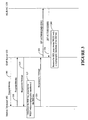
- Figure 3 illustrates one embodiment of the present invention in which the SSD key that is established during the CDMA authentication process is also employed to authenticate the mobile terminal 102 to the WLAN network 110.
- the cellular module 205 (see Figure 2) of the mobile terminal 102 generates the "Shared Secret Data" (SSD) key in the process of authenticating the user to the CDMA network 105.
- SSD Shared Secret Data
- the authentication procedure commences with the EAP server 130 providing an identity request (at 305) to the mobile terminal 102.
- the mobile terminal 102 responds (at 310) with an identifier that uniquely identifies the mobile terminal 102.
- the mobile terminal 102 may provide an identifier that includes the International Mobile Subscriber Identity (IMSI) or a temporary identity (pseudonym).
- IMSI International Mobile Subscriber Identity
- Pseudonym temporary identity
- the mobile terminal 102 receives a start request (at 315) (i . e ., "Request/AUTH/Start” message) from the EAP server 130.
- a start request i . e ., "Request/AUTH/Start” message
- the term “AUTH” in the phrase “Request/AUTH/Start” indicates that a new transaction sub-identifier may be appended to the existing EAP protocol to support the desired functionality.
- the WLAN module 210 of the mobile terminal 102 obtains (at 317) the SSD key by initiating a local request to the cellular module 205, which, as noted above, has access to the SSD key because it was previously generated in association with the CDMA authentication process.
- the SSD key may then be used by the WLAN module 210 as, for example, its root key (WKEY) for authentication purposes, and, if desired, to generate session keys.
- the WLAN module 210 may, at block 317 of Figure 3, populate the WKEY with a cryptographic transform of the SSD key before using it for its intended purpose.
- the WKEY may be used by the mobile terminal 102 to establish a call session with the WLAN 110 (see Figure 1).
- the WKEY may be repeatedly used to establish different call sessions. That is, a new WKEY is not required each time a different call session is established.
- the WLAN module 210 may use the WKEY to determine a first session key to use in association with a first (call or data) session, and then, for another session, determine a second session key (based on the WKEY).
- the session keys may be utilized to encrypt the transmitted data and decrypt the received data.
- the WKEY may be updated or revised as desired, for example, either after an occurrence of a selected event or after the expiration of a preselected amount of time.
- the mobile terminal 102 provides a Response/AUTH/Start message (at 320) to the EAP server 130.
- the EAP server 130 Upon receiving the start response from the mobile terminal 102, the EAP server 130 initiates a query request (at 340) to the HLR/AC 120 via an SS7 AUTHREQ message.
- the EAP server 130 may provide a mobile station identifier in the form of a mobile identification number (MIN) and/or electronic serial number (ESN).
- MIN mobile identification number
- ESN electronic serial number
- the HLR/AC 120 responds (at 350) to the EAP server 130 by providing the SSD key (associated with the mobile terminal 102 desiring authentication to the WLAN network 110) in an AUTHREQ message.
- the EAP server 130 receives (at 360) the SSD key transmitted by the HLR/AC 120.
- the EAP server 130 determines the WKEY by populating it with the cryptographic transform of the SSD key, much in the same manner as done by the mobile terminal 102 earlier.
- the EAP server 130 and the mobile terminal 102 each have access to the WKEY, which, in this embodiment, is based on the SSD key associated with the CDMA network 105.
- the WLAN module 210 of the mobile terminal 102 can thereafter use the WKEY to authenticate the user to the WLAN network 110 and/or also use the WKEY to generate session keys, if desired.
- the act of authenticating may include transmitting one or more random challenges and receiving one or more responses associated with the random challenges, where the response(s) may be determined based on applying the WKEY to the random challenge(s).
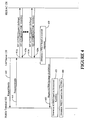
- Figure 4 a procedure to determine a WKEY that may be employed to authenticate the user to the WLAN network 110 of Figure 1 is illustrated, in accordance with an alternative embodiment of the present invention.
- Figure 4 illustrates one embodiment of the present invention in which random challenges provided by the HLR/AC 120 are used to generate the key, WKEY, which can then be used to authenticate the mobile terminal 102 to the WLAN network 110 and/or generate session keys, if desired.
- the SSD key need not be shared with the EAP server 130.
- the authentication procedure commences with the EAP server 130 providing an identity request (at 405) to the mobile terminal 102.
- the mobile terminal 102 responds (at 410) with an identifier that uniquely identifies the mobile terminal 102.
- the mobile terminal 102 may provide an identifier that includes the International Mobile Subscriber Identity (IMSI) or a temporary identity (pseudonym).
- IMSI International Mobile Subscriber Identity
- Pseudonym temporary identity
- the EAP server 130 initiates a challenge request (at 415a) to the HRL/AC 120 via an SS7 AUTHREQ message, and the HRL/AC 120 responds to that request (at 420a) with an AUTHREQ message that includes an challenge, RANDU, and a response, AUTHU.
- Each RANDU challenge is typically a 24-bit value
- each AUTHU response is an 18-bit value.
- the EAP server 130 requests a plurality of challenges (see 415a and 415x) from the HLR/AC 120.
- the HLV/AC 120 provides a pair of RANDU and AUTHU values (see 420a and 420x) for each request.
- the EAP server 130 determines (at 430) a WKEY.
- the EAP server 130 combines the received AUTHU responses according to a preselected algorithm to determine the WKEY.
- the number of requests for challenges presented (at 415) by the EAP server 130 to the HLR/AC 120 may depend on a variety of factors, including the length of the WKEY, the length of the AUTHU response, and/or the preselected algorithm employed to generate the WKEY.
- the EAP server 130 provides (at 450) the plurality of received RANDU challenges to the mobile terminal 102.
- the RANDU challenges may be transmitted separately to the mobile terminal 102.
- the RANDU challenges may be combined ( e.g ., by concatenation or some other desirable method) before transmission to the mobile terminal 102.
- the mobile terminal 102 may, if desired, parse the received string to recover the plurality of RANDU challenges.
- the mobile terminal 102 determines the respective AUTHU responses (at 455) using the SSD key.
- the SSD key as described above, is calculable by the CA application 230 (see Figure 2) of the mobile terminal 102, and thus is available to the WA application 250.
- the WLAN module 210 of the mobile terminal 102 determines (at 460) the WKEY using the same algorithm as employed by the EAP server 130.
- the AUTHU responses once they are generated by the mobile terminal 102, are not transmitted to an authentication system, such as the EAP server 130, as they may otherwise be in a conventional Unique Challenge procedure. Rather, in the illustrated embodiment, the generated AUTHU responses are used internally by the mobile terminal 102 for the purposes of, for example, determining (at 460) the WKEY.
- both the EAP server 130 and the mobile terminal 102 have access to the WKEY.
- the WLAN module 210 of the mobile terminal 102 can thereafter use the WKEY, for example, as a root key to authenticate the user to the WLAN network 110 and/or also use the WKEY to generate session keys, if desired.
- a procedure is provided for determining the WKEY based on one or more of the security values or values generated by the HLV/AC 120 of the CDMA network 105.
- the mobile terminal 102 may authenticate itself to the WLAN network 110, and, if desired, generate one or more session keys. Because the WKEY is generated based on the security value(s) that are readily available in the cellular system 105, the administration task for the network operator or the service provider is simplified, as it may not be necessary for the operator or the provider to manage different keys for different networks.
- one or more embodiments of the present invention are described in the context of a wireless communications system. However, it should be appreciated that in alternative embodiments the present invention may also be implemented in wired networks. Additionally, the present invention may also be applicable to a system supporting voice-only communications or voice and data communications.
- security value refers to one or more secure values that have some level, although not necessarily absolute level, of protection.
- examples of “security value” may include the SSD key, a signed response associated with a random challenge, a cryptographic value calculated using a key that is not shared (e.g ., root key) or a key that is shared for a limited purpose (e.g ., SSD key).
- the SSD key may be a cryptographic value that is calculated using the root key (A-key), and as another example, RANDU/AUTHU (in the context of CDMA) may be cryptographic values that are calculated using the SSD key.
- private key refers to a key that, once calculated, is generally not shared with another device.
- a “private key” may be the WKEY.
- the private key may be utilized to authenticate a mobile terminal 102 to a network (the WLAN 110); it may be utilized to provide session security through encryption/decryption.
- the "private key” may be utilized as a root key, if desired.
- control units 232 and 252 may be executable control units (such as the control units 232 and 252 (see Figure 2)).
- the control units 232, 252 may include a microprocessor, a microcontroller, a digital signal processor, a processor card (including one or more microprocessors or controllers), or other control or computing devices.
- the storage devices 235, 255 referred to in this discussion may include one or more machine-readable storage media for storing data and instructions.
- the storage media may include different forms of memory including semiconductor memory devices such as dynamic or static random access memories (DRAMs or SRAMs), erasable and programmable read-only memories (EPROMs), electrically erasable and programmable read-only memories (EEPROMs) and flash memories; magnetic disks such as fixed, floppy, removable disks; other magnetic media including tape; and optical media such as compact disks (CDs) or digital video disks (DVDs).
- DRAMs or SRAMs dynamic or static random access memories
- EPROMs erasable and programmable read-only memories
- EEPROMs electrically erasable and programmable read-only memories
- flash memories such as fixed, floppy, removable disks
- CDs compact disks
- DVDs digital video disks
Landscapes
- Engineering & Computer Science (AREA)
- Computer Networks & Wireless Communication (AREA)
- Signal Processing (AREA)
- Computer Security & Cryptography (AREA)
- Computer Hardware Design (AREA)
- Computing Systems (AREA)
- General Engineering & Computer Science (AREA)
- Mobile Radio Communication Systems (AREA)
- Small-Scale Networks (AREA)
Claims (9)
- Verfahren, dadurch gekennzeichnet, dass es Folgendes umfasst:Bestimmen an einem Server (130), der einem ersten Netzwerk (110) zugeordnet ist, eines privaten Schlüssels für das erste Netzwerk (110) basierend auf mindestens einem Sicherheitswert, der durch einen anderen Server (120) bereitgestellt wird, welcher einem zweiten Netzwerk (105) zugeordnet ist; undEinrichten einer Vielzahl von Sitzungen zwischen einem mobilen Endgerät (102) und dem ersten Netzwerk (110) unter Verwendung des privaten Schlüssels.
- Verfahren nach Anspruch 1, wobei das erste Netzwerk (110) ein drahtloses lokales Gebietsnetzwerk und das zweite Netzwerk ein zelluläres Netzwerk ist, und wobei das Bestimmen des privaten Schlüssels das Bestimmen des privaten Schlüssels auf der Basis eines gemeinsam benutzten Geheim-Daten-(SSD)-Schlüssels, der dem zellulären Netzwerk zugeordnet ist, umfasst.
- Verfahren nach Anspruch 2, wobei das Bestimmen des privaten Schlüssels auf der Basis des gemeinsam benutzten Geheim-Daten-Schlüssels das Anwenden eines Wurzelschlüssels, einer dem mobilen Endgerät (102) zugeordneten elektronischen Seriennummer und eines von dem Netzwerk bereitgestellten Zufallswert auf einen Zellulären-Authentifizierungs- und Sprachverschlüsselungs-(CAVE)-Algorithmus umfasst, um den privaten Schlüssel zu erzeugen.
- Verfahren nach Anspruch 1, wobei das zweite Netzwerk ein zelluläres Netzwerk (105) mit einem zugeordneten Authentifizierungszentrum und das erste Netzwerk (110) ein drahtloses lokales Gebietsnetzwerk (110) ist, und wobei das Bestimmen des privaten Schlüssels das Bestimmen des privaten Schlüssels auf der Basis einer oder mehrerer Zufallsherausforderungen, die von dem dem zellulären Netzwerk (105) zugeordneten Authentifizerungszentrum erzeugt werden.
- Verfahren nach Anspruch 4, wobei das zelluläre Netzwerk (105) ein Code-Division-Multiple-Access-(CDMA)-Netzwerk ist, wobei das Bestimmen des privaten Schlüssels das Bestimmen einer oder mehrerer Antworten, die einer oder mehreren Herausforderungen auf der Basis des dem CDMA-Netzwerk zugeordneten gemeinsam benutzen Geheim-Daten-Schlüssels zugeordnet sind, und das Kombinieren der bestimmten einen oder mehreren Antworten zum Bilden des privaten Schlüssels umfasst.
- Verfahren nach Anspruch 1, ferner umfassend das Bestimmen mindestens eines Sitzungsschlüssels basierend auf dem bestimmten privaten Schlüssel.
- Verfahren nach Anspruch 1, wobei das Einrichten der Vielzahl von Sitzungen das Authentifizieren des mobilen Endgeräts (102) für das erste Netzwerk (110) für jede der Vielzahl von Sitzungen umfasst.
- Verfahren nach Anspruch 7, wobei das Authentifizieren des mobilen Endgeräts (102) für das erste Netzwerk (110) Folgendes umfasst:Empfangen einer Herausforderung von dem ersten Netzwerk (110); undSenden einer der empfangenen Herausforderung zugeordneten Antwort, wobei die Antwort basierend auf dem privaten Schlüssel berechnet wird.
- Verfahren nach Anspruch 1, wobei das Einrichten der Vielzahl von Sitzungen das Bestimmen eines Sitzungsschlüssels für jede der Vielzahl von Sitzungen basierend auf dem privaten Schlüssel umfasst.
Applications Claiming Priority (2)
| Application Number | Priority Date | Filing Date | Title |
|---|---|---|---|
| US661715 | 2003-09-12 | ||
| US10/661,715 US7593717B2 (en) | 2003-09-12 | 2003-09-12 | Authenticating access to a wireless local area network based on security value(s) associated with a cellular system |
Publications (2)
| Publication Number | Publication Date |
|---|---|
| EP1515516A1 EP1515516A1 (de) | 2005-03-16 |
| EP1515516B1 true EP1515516B1 (de) | 2007-02-21 |
Family
ID=34136797
Family Applications (1)
| Application Number | Title | Priority Date | Filing Date |
|---|---|---|---|
| EP04255196A Expired - Lifetime EP1515516B1 (de) | 2003-09-12 | 2004-08-27 | Authentifizierung des Zugriffs auf ein drahtloses Local Area Network basierend auf Sicherheitswerte(n), die einem zellularen Mobilfunksystem zugeordnet sind |
Country Status (6)
| Country | Link |
|---|---|
| US (1) | US7593717B2 (de) |
| EP (1) | EP1515516B1 (de) |
| JP (1) | JP4652754B2 (de) |
| KR (1) | KR101097709B1 (de) |
| CN (1) | CN1596028A (de) |
| DE (1) | DE602004004844T2 (de) |
Families Citing this family (34)
| Publication number | Priority date | Publication date | Assignee | Title |
|---|---|---|---|---|
| US8140845B2 (en) * | 2001-09-13 | 2012-03-20 | Alcatel Lucent | Scheme for authentication and dynamic key exchange |
| US20030236980A1 (en) * | 2002-06-20 | 2003-12-25 | Hsu Raymond T. | Authentication in a communication system |
| US8630414B2 (en) | 2002-06-20 | 2014-01-14 | Qualcomm Incorporated | Inter-working function for a communication system |
| US20050096048A1 (en) * | 2003-10-30 | 2005-05-05 | Cellco Partnership | Optimized network employing seamless and single sign on capabilities for users accessing data applications on different networks |
| US7801093B2 (en) * | 2003-11-20 | 2010-09-21 | Tekelec | Signal transfer point with wireless signaling link interface |
| US20050138355A1 (en) * | 2003-12-19 | 2005-06-23 | Lidong Chen | System, method and devices for authentication in a wireless local area network (WLAN) |
| US20050149740A1 (en) * | 2003-12-31 | 2005-07-07 | Kotzin Michael D. | Method and apparatus for device authentication |
| US7546459B2 (en) * | 2004-03-10 | 2009-06-09 | Telefonaktiebolaget L M Ericsson (Publ) | GSM-like and UMTS-like authentication in a CDMA2000 network environment |
| US20060019635A1 (en) * | 2004-06-29 | 2006-01-26 | Nokia Corporation | Enhanced use of a network access identifier in wlan |
| US7706343B2 (en) * | 2004-09-10 | 2010-04-27 | Tekelec | Methods and systems for wireless local area network (WLAN)-based signaling network monitoring |
| US20060143132A1 (en) | 2004-11-30 | 2006-06-29 | Valenti William L | Method and apparatus to enable a market in used digital content |
| CN101151920A (zh) * | 2005-03-31 | 2008-03-26 | 诺基亚公司 | 用于非授权移动接入的认证机制 |
| US20070043947A1 (en) * | 2005-08-19 | 2007-02-22 | Mizikovsky Semyon B | Providing multimedia system security to removable user identity modules |
| KR100750153B1 (ko) * | 2006-01-03 | 2007-08-21 | 삼성전자주식회사 | Wusb 보안을 위한 세션 키를 제공하는 방법 및 장치,이 세션 키를 획득하는 방법 및 장치 |
| US8189544B2 (en) * | 2006-06-26 | 2012-05-29 | Alcatel Lucent | Method of creating security associations in mobile IP networks |
| EP1965595B1 (de) * | 2007-02-27 | 2009-10-28 | Lucent Technologies Inc. | Drahtloses Kommunikationsverfahren zur Steuerung eines mittels Sicherheitsvorrichtung gewährten Zugangs |
| KR100936530B1 (ko) * | 2007-11-13 | 2010-01-13 | 주식회사 케이티 | 네트워크 장치 및 네트워크 장치의 인증 정보 공유 방법 |
| JP4694586B2 (ja) * | 2008-02-28 | 2011-06-08 | 京セラ株式会社 | 携帯端末装置および通信システム |
| KR101069442B1 (ko) * | 2009-08-14 | 2011-09-30 | 주식회사 케이티 | 이종 통신 네트워크에 통신 서비스를 제공하는 방법 및 장치, 통신 서비스 제공에 따른 과금 방법. |
| US8280351B1 (en) | 2010-02-04 | 2012-10-02 | Cellco Partnership | Automatic device authentication and account identification without user input when application is started on mobile station |
| US20110228752A1 (en) * | 2010-03-22 | 2011-09-22 | Shiquan Wu | System and method to pack cellular systems and WiFi within a TV channel |
| US8677451B1 (en) | 2010-06-22 | 2014-03-18 | Cellco Partnership | Enabling seamless access to a domain of an enterprise |
| US8955154B2 (en) * | 2011-07-08 | 2015-02-10 | Credibility Corp. | Single system for authenticating entities across different third party platforms |
| CN103139768B (zh) * | 2011-11-28 | 2017-03-01 | 上海贝尔股份有限公司 | 融合无线网络中的认证方法以及认证装置 |
| CN103428690B (zh) * | 2012-05-23 | 2016-09-07 | 华为技术有限公司 | 无线局域网络的安全建立方法及系统、设备 |
| US9258704B2 (en) * | 2012-06-27 | 2016-02-09 | Advanced Messaging Technologies, Inc. | Facilitating network login |
| GB2512082A (en) * | 2013-03-19 | 2014-09-24 | Vodafone Ip Licensing Ltd | WLAN application access control |
| US10034168B1 (en) * | 2013-04-25 | 2018-07-24 | Sprint Spectrum L.P. | Authentication over a first communication link to authorize communications over a second communication link |
| US9913137B2 (en) | 2015-09-02 | 2018-03-06 | Huawei Technologies Co., Ltd. | System and method for channel security |
| US10620855B2 (en) * | 2016-09-06 | 2020-04-14 | Samsung Electronics Co., Ltd. | System and method for authenticating critical operations on solid-state drives |
| US10433163B2 (en) * | 2016-09-19 | 2019-10-01 | Qualcomm Incorporated | Techniques for deriving security keys for a cellular network based on performance of an extensible authentication protocol (EAP) procedure |
| JP6889263B2 (ja) * | 2017-01-27 | 2021-06-18 | テレフオンアクチーボラゲット エルエム エリクソン(パブル) | ユーザ機器の二次認証 |
| KR102515902B1 (ko) * | 2020-10-30 | 2023-03-31 | 이화여자대학교 산학협력단 | 물리적 복제 방지 기술을 이용한 인증 장치 |
| US11825389B2 (en) | 2021-07-02 | 2023-11-21 | Cisco Technology, Inc. | Mechanism to deliver SMS meant for user's public or private 5G identity over WLAN network |
Family Cites Families (11)
| Publication number | Priority date | Publication date | Assignee | Title |
|---|---|---|---|---|
| FI20000761A0 (fi) * | 2000-03-31 | 2000-03-31 | Nokia Mobile Phones Ltd | Laskutus pakettidataverkossa |
| FI20000760A0 (fi) * | 2000-03-31 | 2000-03-31 | Nokia Corp | Autentikointi pakettidataverkossa |
| US7200750B1 (en) | 2000-09-15 | 2007-04-03 | Lucent Technologies Inc. | Method for distributing encryption keys for an overlay data network |
| US7804961B2 (en) * | 2000-12-19 | 2010-09-28 | Qualcomm Incorporated | Method and apparatus for fast crytographic key generation |
| FI115098B (fi) | 2000-12-27 | 2005-02-28 | Nokia Corp | Todentaminen dataviestinnässä |
| US7039027B2 (en) * | 2000-12-28 | 2006-05-02 | Symbol Technologies, Inc. | Automatic and seamless vertical roaming between wireless local area network (WLAN) and wireless wide area network (WWAN) while maintaining an active voice or streaming data connection: systems, methods and program products |
| US20020174335A1 (en) * | 2001-03-30 | 2002-11-21 | Junbiao Zhang | IP-based AAA scheme for wireless LAN virtual operators |
| US7426393B2 (en) * | 2001-11-19 | 2008-09-16 | Nokia Corporation | Method and system of identifying network services |
| US7721106B2 (en) * | 2002-04-26 | 2010-05-18 | Thomson Licensing | Transitive authentication authorization accounting in the interworking between access networks |
| CN1215386C (zh) * | 2002-04-26 | 2005-08-17 | St微电子公司 | 根据量子软计算控制过程或处理数据的方法和硬件体系结构 |
| US20040203800A1 (en) * | 2002-10-24 | 2004-10-14 | John Myhre | System and method for content delivery using alternate data paths in a wireless network |
-
2003
- 2003-09-12 US US10/661,715 patent/US7593717B2/en not_active Expired - Fee Related
-
2004
- 2004-08-27 DE DE602004004844T patent/DE602004004844T2/de not_active Expired - Lifetime
- 2004-08-27 EP EP04255196A patent/EP1515516B1/de not_active Expired - Lifetime
- 2004-09-03 KR KR1020040070417A patent/KR101097709B1/ko not_active Expired - Fee Related
- 2004-09-09 CN CNA2004100770027A patent/CN1596028A/zh active Pending
- 2004-09-10 JP JP2004263155A patent/JP4652754B2/ja not_active Expired - Fee Related
Also Published As
| Publication number | Publication date |
|---|---|
| JP2005094758A (ja) | 2005-04-07 |
| CN1596028A (zh) | 2005-03-16 |
| DE602004004844T2 (de) | 2007-10-25 |
| EP1515516A1 (de) | 2005-03-16 |
| KR20050027015A (ko) | 2005-03-17 |
| DE602004004844D1 (de) | 2007-04-05 |
| JP4652754B2 (ja) | 2011-03-16 |
| US20050113067A1 (en) | 2005-05-26 |
| US7593717B2 (en) | 2009-09-22 |
| KR101097709B1 (ko) | 2011-12-23 |
Similar Documents
| Publication | Publication Date | Title |
|---|---|---|
| EP1515516B1 (de) | Authentifizierung des Zugriffs auf ein drahtloses Local Area Network basierend auf Sicherheitswerte(n), die einem zellularen Mobilfunksystem zugeordnet sind | |
| US7565135B2 (en) | Performing authentication in a communications system | |
| RU2372734C2 (ru) | Способ и устройство для повторной аутентификации в системе сотовой связи | |
| US8959598B2 (en) | Wireless device authentication between different networks | |
| US7546459B2 (en) | GSM-like and UMTS-like authentication in a CDMA2000 network environment | |
| US8397071B2 (en) | Generation method and update method of authorization key for mobile communication | |
| EP2257095B1 (de) | Interworking-funktion zur authentifizierung eines Endgerätes in einem drahtlosen lokalen Netzwerk | |
| US20060019635A1 (en) | Enhanced use of a network access identifier in wlan | |
| US20050135624A1 (en) | System and method for pre-authentication across wireless local area networks (WLANS) | |
| WO2007102702A2 (en) | Fast re-authentication method in umts | |
| US20060154645A1 (en) | Controlling network access | |
| US7904715B2 (en) | Method for authenticating dual-mode access terminals | |
| Kuroda et al. | A radio-independent authentication protocol (EAP-CRP) for networks of cognitive radios | |
| Lin et al. | Authentication schemes based on the EAP-SIM mechanism in GSM-WLAN heterogeneous mobile networks |
Legal Events
| Date | Code | Title | Description |
|---|---|---|---|
| PUAI | Public reference made under article 153(3) epc to a published international application that has entered the european phase |
Free format text: ORIGINAL CODE: 0009012 |
|
| 17P | Request for examination filed |
Effective date: 20040911 |
|
| AK | Designated contracting states |
Kind code of ref document: A1 Designated state(s): AT BE BG CH CY CZ DE DK EE ES FI FR GB GR HU IE IT LI LU MC NL PL PT RO SE SI SK TR |
|
| AX | Request for extension of the european patent |
Extension state: AL HR LT LV MK |
|
| 17Q | First examination report despatched |
Effective date: 20050429 |
|
| AKX | Designation fees paid |
Designated state(s): DE FR GB |
|
| GRAP | Despatch of communication of intention to grant a patent |
Free format text: ORIGINAL CODE: EPIDOSNIGR1 |
|
| GRAS | Grant fee paid |
Free format text: ORIGINAL CODE: EPIDOSNIGR3 |
|
| GRAA | (expected) grant |
Free format text: ORIGINAL CODE: 0009210 |
|
| AK | Designated contracting states |
Kind code of ref document: B1 Designated state(s): DE FR GB |
|
| REG | Reference to a national code |
Ref country code: GB Ref legal event code: FG4D |
|
| REF | Corresponds to: |
Ref document number: 602004004844 Country of ref document: DE Date of ref document: 20070405 Kind code of ref document: P |
|
| ET | Fr: translation filed | ||
| PLBE | No opposition filed within time limit |
Free format text: ORIGINAL CODE: 0009261 |
|
| STAA | Information on the status of an ep patent application or granted ep patent |
Free format text: STATUS: NO OPPOSITION FILED WITHIN TIME LIMIT |
|
| 26N | No opposition filed |
Effective date: 20071122 |
|
| REG | Reference to a national code |
Ref country code: GB Ref legal event code: 732E Free format text: REGISTERED BETWEEN 20131107 AND 20131113 |
|
| REG | Reference to a national code |
Ref country code: FR Ref legal event code: CD Owner name: ALCATEL-LUCENT USA INC. Effective date: 20131122 |
|
| REG | Reference to a national code |
Ref country code: FR Ref legal event code: GC Effective date: 20140410 |
|
| REG | Reference to a national code |
Ref country code: FR Ref legal event code: RG Effective date: 20141015 |
|
| REG | Reference to a national code |
Ref country code: FR Ref legal event code: PLFP Year of fee payment: 12 |
|
| REG | Reference to a national code |
Ref country code: FR Ref legal event code: PLFP Year of fee payment: 13 |
|
| REG | Reference to a national code |
Ref country code: FR Ref legal event code: PLFP Year of fee payment: 14 |
|
| REG | Reference to a national code |
Ref country code: FR Ref legal event code: PLFP Year of fee payment: 15 |
|
| PGFP | Annual fee paid to national office [announced via postgrant information from national office to epo] |
Ref country code: DE Payment date: 20200812 Year of fee payment: 17 Ref country code: FR Payment date: 20200715 Year of fee payment: 17 Ref country code: GB Payment date: 20200819 Year of fee payment: 17 |
|
| REG | Reference to a national code |
Ref country code: DE Ref legal event code: R079 Ref document number: 602004004844 Country of ref document: DE Free format text: PREVIOUS MAIN CLASS: H04L0029060000 Ipc: H04L0065000000 |
|
| REG | Reference to a national code |
Ref country code: DE Ref legal event code: R119 Ref document number: 602004004844 Country of ref document: DE |
|
| GBPC | Gb: european patent ceased through non-payment of renewal fee |
Effective date: 20210827 |
|
| PG25 | Lapsed in a contracting state [announced via postgrant information from national office to epo] |
Ref country code: GB Free format text: LAPSE BECAUSE OF NON-PAYMENT OF DUE FEES Effective date: 20210827 Ref country code: FR Free format text: LAPSE BECAUSE OF NON-PAYMENT OF DUE FEES Effective date: 20210831 Ref country code: DE Free format text: LAPSE BECAUSE OF NON-PAYMENT OF DUE FEES Effective date: 20220301 |