EP1515864B1 - Procede et dispositif de limitation de la vitesse d'un vehicule automobile - Google Patents
Procede et dispositif de limitation de la vitesse d'un vehicule automobile Download PDFInfo
- Publication number
- EP1515864B1 EP1515864B1 EP02790261A EP02790261A EP1515864B1 EP 1515864 B1 EP1515864 B1 EP 1515864B1 EP 02790261 A EP02790261 A EP 02790261A EP 02790261 A EP02790261 A EP 02790261A EP 1515864 B1 EP1515864 B1 EP 1515864B1
- Authority
- EP
- European Patent Office
- Prior art keywords
- speed
- vehicle
- fuel consumption
- driving speed
- maximum
- Prior art date
- Legal status (The legal status is an assumption and is not a legal conclusion. Google has not performed a legal analysis and makes no representation as to the accuracy of the status listed.)
- Expired - Lifetime
Links
Images

Classifications
-
- B—PERFORMING OPERATIONS; TRANSPORTING
- B60—VEHICLES IN GENERAL
- B60K—ARRANGEMENT OR MOUNTING OF PROPULSION UNITS OR OF TRANSMISSIONS IN VEHICLES; ARRANGEMENT OR MOUNTING OF PLURAL DIVERSE PRIME-MOVERS IN VEHICLES; AUXILIARY DRIVES FOR VEHICLES; INSTRUMENTATION OR DASHBOARDS FOR VEHICLES; ARRANGEMENTS IN CONNECTION WITH COOLING, AIR INTAKE, GAS EXHAUST OR FUEL SUPPLY OF PROPULSION UNITS IN VEHICLES
- B60K31/00—Vehicle fittings, acting on a single sub-unit only, for automatically controlling vehicle speed, i.e. preventing speed from exceeding an arbitrarily established velocity or maintaining speed at a particular velocity, as selected by the vehicle operator
- B60K31/02—Vehicle fittings, acting on a single sub-unit only, for automatically controlling vehicle speed, i.e. preventing speed from exceeding an arbitrarily established velocity or maintaining speed at a particular velocity, as selected by the vehicle operator including electrically actuated servomechanism
- B60K31/04—Vehicle fittings, acting on a single sub-unit only, for automatically controlling vehicle speed, i.e. preventing speed from exceeding an arbitrarily established velocity or maintaining speed at a particular velocity, as selected by the vehicle operator including electrically actuated servomechanism and means for comparing one electrical quantity, e.g. voltage, pulse, waveform, flux, or the like, with another quantity of a like kind, which comparison means is involved in the development of an electrical signal which is fed into the controlling means
-
- B—PERFORMING OPERATIONS; TRANSPORTING
- B60—VEHICLES IN GENERAL
- B60W—CONJOINT CONTROL OF VEHICLE SUB-UNITS OF DIFFERENT TYPE OR DIFFERENT FUNCTION; CONTROL SYSTEMS SPECIALLY ADAPTED FOR HYBRID VEHICLES; ROAD VEHICLE DRIVE CONTROL SYSTEMS FOR PURPOSES NOT RELATED TO THE CONTROL OF A PARTICULAR SUB-UNIT
- B60W30/00—Purposes of road vehicle drive control systems not related to the control of a particular sub-unit, e.g. of systems using conjoint control of vehicle sub-units
- B60W30/14—Adaptive cruise control
- B60W30/143—Speed control
- B60W30/146—Speed limiting
-
- B—PERFORMING OPERATIONS; TRANSPORTING
- B60—VEHICLES IN GENERAL
- B60L—PROPULSION OF ELECTRICALLY-PROPELLED VEHICLES; SUPPLYING ELECTRIC POWER FOR AUXILIARY EQUIPMENT OF ELECTRICALLY-PROPELLED VEHICLES; ELECTRODYNAMIC BRAKE SYSTEMS FOR VEHICLES IN GENERAL; MAGNETIC SUSPENSION OR LEVITATION FOR VEHICLES; MONITORING OPERATING VARIABLES OF ELECTRICALLY-PROPELLED VEHICLES; ELECTRIC SAFETY DEVICES FOR ELECTRICALLY-PROPELLED VEHICLES
- B60L2240/00—Control parameters of input or output; Target parameters
- B60L2240/40—Drive Train control parameters
- B60L2240/44—Drive Train control parameters related to combustion engines
- B60L2240/441—Speed
-
- B—PERFORMING OPERATIONS; TRANSPORTING
- B60—VEHICLES IN GENERAL
- B60L—PROPULSION OF ELECTRICALLY-PROPELLED VEHICLES; SUPPLYING ELECTRIC POWER FOR AUXILIARY EQUIPMENT OF ELECTRICALLY-PROPELLED VEHICLES; ELECTRODYNAMIC BRAKE SYSTEMS FOR VEHICLES IN GENERAL; MAGNETIC SUSPENSION OR LEVITATION FOR VEHICLES; MONITORING OPERATING VARIABLES OF ELECTRICALLY-PROPELLED VEHICLES; ELECTRIC SAFETY DEVICES FOR ELECTRICALLY-PROPELLED VEHICLES
- B60L2240/00—Control parameters of input or output; Target parameters
- B60L2240/40—Drive Train control parameters
- B60L2240/44—Drive Train control parameters related to combustion engines
- B60L2240/443—Torque
-
- B—PERFORMING OPERATIONS; TRANSPORTING
- B60—VEHICLES IN GENERAL
- B60L—PROPULSION OF ELECTRICALLY-PROPELLED VEHICLES; SUPPLYING ELECTRIC POWER FOR AUXILIARY EQUIPMENT OF ELECTRICALLY-PROPELLED VEHICLES; ELECTRODYNAMIC BRAKE SYSTEMS FOR VEHICLES IN GENERAL; MAGNETIC SUSPENSION OR LEVITATION FOR VEHICLES; MONITORING OPERATING VARIABLES OF ELECTRICALLY-PROPELLED VEHICLES; ELECTRIC SAFETY DEVICES FOR ELECTRICALLY-PROPELLED VEHICLES
- B60L2240/00—Control parameters of input or output; Target parameters
- B60L2240/40—Drive Train control parameters
- B60L2240/48—Drive Train control parameters related to transmissions
- B60L2240/486—Operating parameters
-
- B—PERFORMING OPERATIONS; TRANSPORTING
- B60—VEHICLES IN GENERAL
- B60W—CONJOINT CONTROL OF VEHICLE SUB-UNITS OF DIFFERENT TYPE OR DIFFERENT FUNCTION; CONTROL SYSTEMS SPECIALLY ADAPTED FOR HYBRID VEHICLES; ROAD VEHICLE DRIVE CONTROL SYSTEMS FOR PURPOSES NOT RELATED TO THE CONTROL OF A PARTICULAR SUB-UNIT
- B60W50/00—Details of control systems for road vehicle drive control not related to the control of a particular sub-unit, e.g. process diagnostic or vehicle driver interfaces
- B60W2050/0001—Details of the control system
- B60W2050/0043—Signal treatments, identification of variables or parameters, parameter estimation or state estimation
- B60W2050/0052—Filtering, filters
-
- B—PERFORMING OPERATIONS; TRANSPORTING
- B60—VEHICLES IN GENERAL
- B60W—CONJOINT CONTROL OF VEHICLE SUB-UNITS OF DIFFERENT TYPE OR DIFFERENT FUNCTION; CONTROL SYSTEMS SPECIALLY ADAPTED FOR HYBRID VEHICLES; ROAD VEHICLE DRIVE CONTROL SYSTEMS FOR PURPOSES NOT RELATED TO THE CONTROL OF A PARTICULAR SUB-UNIT
- B60W2510/00—Input parameters relating to a particular sub-units
- B60W2510/06—Combustion engines, Gas turbines
- B60W2510/0638—Engine speed
-
- B—PERFORMING OPERATIONS; TRANSPORTING
- B60—VEHICLES IN GENERAL
- B60W—CONJOINT CONTROL OF VEHICLE SUB-UNITS OF DIFFERENT TYPE OR DIFFERENT FUNCTION; CONTROL SYSTEMS SPECIALLY ADAPTED FOR HYBRID VEHICLES; ROAD VEHICLE DRIVE CONTROL SYSTEMS FOR PURPOSES NOT RELATED TO THE CONTROL OF A PARTICULAR SUB-UNIT
- B60W2510/00—Input parameters relating to a particular sub-units
- B60W2510/06—Combustion engines, Gas turbines
- B60W2510/0657—Engine torque
-
- B—PERFORMING OPERATIONS; TRANSPORTING
- B60—VEHICLES IN GENERAL
- B60W—CONJOINT CONTROL OF VEHICLE SUB-UNITS OF DIFFERENT TYPE OR DIFFERENT FUNCTION; CONTROL SYSTEMS SPECIALLY ADAPTED FOR HYBRID VEHICLES; ROAD VEHICLE DRIVE CONTROL SYSTEMS FOR PURPOSES NOT RELATED TO THE CONTROL OF A PARTICULAR SUB-UNIT
- B60W2530/00—Input parameters relating to vehicle conditions or values, not covered by groups B60W2510/00 or B60W2520/00
- B60W2530/10—Weight
-
- B—PERFORMING OPERATIONS; TRANSPORTING
- B60—VEHICLES IN GENERAL
- B60W—CONJOINT CONTROL OF VEHICLE SUB-UNITS OF DIFFERENT TYPE OR DIFFERENT FUNCTION; CONTROL SYSTEMS SPECIALLY ADAPTED FOR HYBRID VEHICLES; ROAD VEHICLE DRIVE CONTROL SYSTEMS FOR PURPOSES NOT RELATED TO THE CONTROL OF A PARTICULAR SUB-UNIT
- B60W2530/00—Input parameters relating to vehicle conditions or values, not covered by groups B60W2510/00 or B60W2520/00
- B60W2530/16—Driving resistance
-
- B—PERFORMING OPERATIONS; TRANSPORTING
- B60—VEHICLES IN GENERAL
- B60W—CONJOINT CONTROL OF VEHICLE SUB-UNITS OF DIFFERENT TYPE OR DIFFERENT FUNCTION; CONTROL SYSTEMS SPECIALLY ADAPTED FOR HYBRID VEHICLES; ROAD VEHICLE DRIVE CONTROL SYSTEMS FOR PURPOSES NOT RELATED TO THE CONTROL OF A PARTICULAR SUB-UNIT
- B60W2540/00—Input parameters relating to occupants
- B60W2540/10—Accelerator pedal position
- B60W2540/106—Rate of change
-
- B—PERFORMING OPERATIONS; TRANSPORTING
- B60—VEHICLES IN GENERAL
- B60W—CONJOINT CONTROL OF VEHICLE SUB-UNITS OF DIFFERENT TYPE OR DIFFERENT FUNCTION; CONTROL SYSTEMS SPECIALLY ADAPTED FOR HYBRID VEHICLES; ROAD VEHICLE DRIVE CONTROL SYSTEMS FOR PURPOSES NOT RELATED TO THE CONTROL OF A PARTICULAR SUB-UNIT
- B60W2710/00—Output or target parameters relating to a particular sub-units
- B60W2710/10—Change speed gearings
- B60W2710/1061—Output power
-
- Y—GENERAL TAGGING OF NEW TECHNOLOGICAL DEVELOPMENTS; GENERAL TAGGING OF CROSS-SECTIONAL TECHNOLOGIES SPANNING OVER SEVERAL SECTIONS OF THE IPC; TECHNICAL SUBJECTS COVERED BY FORMER USPC CROSS-REFERENCE ART COLLECTIONS [XRACs] AND DIGESTS
- Y02—TECHNOLOGIES OR APPLICATIONS FOR MITIGATION OR ADAPTATION AGAINST CLIMATE CHANGE
- Y02T—CLIMATE CHANGE MITIGATION TECHNOLOGIES RELATED TO TRANSPORTATION
- Y02T10/00—Road transport of goods or passengers
- Y02T10/10—Internal combustion engine [ICE] based vehicles
- Y02T10/40—Engine management systems
-
- Y—GENERAL TAGGING OF NEW TECHNOLOGICAL DEVELOPMENTS; GENERAL TAGGING OF CROSS-SECTIONAL TECHNOLOGIES SPANNING OVER SEVERAL SECTIONS OF THE IPC; TECHNICAL SUBJECTS COVERED BY FORMER USPC CROSS-REFERENCE ART COLLECTIONS [XRACs] AND DIGESTS
- Y02—TECHNOLOGIES OR APPLICATIONS FOR MITIGATION OR ADAPTATION AGAINST CLIMATE CHANGE
- Y02T—CLIMATE CHANGE MITIGATION TECHNOLOGIES RELATED TO TRANSPORTATION
- Y02T10/00—Road transport of goods or passengers
- Y02T10/80—Technologies aiming to reduce greenhouse gasses emissions common to all road transportation technologies
- Y02T10/84—Data processing systems or methods, management, administration
-
- Y—GENERAL TAGGING OF NEW TECHNOLOGICAL DEVELOPMENTS; GENERAL TAGGING OF CROSS-SECTIONAL TECHNOLOGIES SPANNING OVER SEVERAL SECTIONS OF THE IPC; TECHNICAL SUBJECTS COVERED BY FORMER USPC CROSS-REFERENCE ART COLLECTIONS [XRACs] AND DIGESTS
- Y10—TECHNICAL SUBJECTS COVERED BY FORMER USPC
- Y10S—TECHNICAL SUBJECTS COVERED BY FORMER USPC CROSS-REFERENCE ART COLLECTIONS [XRACs] AND DIGESTS
- Y10S477/00—Interrelated power delivery controls, including engine control
- Y10S477/902—Control signal is engine parameter other than manifold pressure or fuel control
Definitions
- the invention is based on a method and a device for limiting the travel speed of a motor vehicle.
- Another method is from the DE-A-10024231 known.
- the inventive method and the device according to the invention for limiting the travel speed of a motor vehicle with the features of the independent claims have the advantage that the vehicle speed is limited to a maximum value at which a predetermined for stationary driving speed maximum fuel consumption is not exceeded. In this way, an adjustable stationary fuel consumption can be maintained without limiting short-term accelerations. Thus, an economical driving can be automated according to the driver of the vehicle.
- the maximum value for the driving speed is determined from a maximum driving force of the vehicle, which results from the ratio between the predetermined maximum fuel consumption and a specific fuel consumption of the engine at the current operating point, by means of an inverse characteristic curve for a speed-dependent component of the driving resistance becomes.
- the maximum value for the driving speed can be determined particularly simple and inexpensive.
- the maximum driving force is corrected by a speed-independent component of the driving resistance. In this way, the accuracy of determining the maximum value for the driving speed is increased.
- a further advantage is that the speed-independent component of the driving resistance is filtered, in particular with a first-order low-pass filter. In this way, noise effects in the calculation of the speed-independent component of the driving resistance can be largely smoothed.
- the limitation of the driving speed in dependence on the predetermined maximum fuel consumption is only performed when the gradient of an accelerator pedal position falls below a predetermined value or a kick-down function is deactivated. In this way, it is ensured that in driving situations in which the driver primarily depends on achieving the highest possible driving speed, the fuel consumption-dependent limitation of the driving speed is overridden. Thus, the driving safety, for example in overtaking, guaranteed.
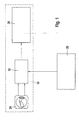
- FIG. 1 shows an arrangement for limiting the speed in a motor vehicle in the form of a block diagram.
- a device 10 for limiting the driving speed of the motor vehicle is provided.
- the device 10 comprises an input / operating unit 20, which is connected to means 15 for determining a maximum value vmaxbe, to which the driving speed is to be limited.
- the maximum value vmaxbe for the driving speed is given by the means 15 to means 30, which realize the actual speed limiting function.
- the means 30 ensure that the current driving speed of the motor vehicle does not exceed the maximum value vmaxbe for the driving speed. about the input / operating unit 20, the driver of the motor vehicle can specify a maximum fuel consumption Besoll for a stationary driving speed.
- the driver at the input / operating unit 20 can activate the means 15 in such a way that they determine the maximum value vmaxbe for the driving speed as a function of the maximum fuel consumption Besoll predetermined for the stationary driving speed.
- the input / operating unit 20 generates an activation signal "ON”.
- the driver at the input / operating unit 20 can deactivate the means 15 such that the maximum value vmaxbe for the driving speed is not determined as a function of the maximum fuel consumption Besoll predetermined for the stationary driving speed.
- the means 15 for input / output generates a deactivation signal "OFF".
- an engine control 25 which includes values for a transmission ratio factor, an engine speed nmot, an engine actual moment Miist, an actual acceleration aist of the vehicle, an actual speed vist of the vehicle, and a bit B_kdown, the device 10 and the means 15 indicates whether a kick-down of the vehicle has been operated using an automatic transmission.
- the determination of the values for the transmission ratio factor üist, the engine speed nmot, the actual engine torque Miist, the actual acceleration aist and the actual speed vist is carried out in a manner known from the prior art.
- the kick-down B_kdown bit is set upon actuation of the kick-down and is otherwise reset.
- an engine consumption map 35 is provided, the engine speed nmot and the Motoristmoment Miist are supplied as input variables.
- the output quantity is a specific fuel consumption BEENG of the engine of the vehicle in the current operating point, which is characterized by the engine speed nmot and the Motoristmoment Miist.
- the engine consumption map 35 is determined by default for each engine by its manufacturer and is therefore known from the prior art.
- the specific fuel consumption BEENG of the engine is multiplied by the transmission ratio factor ⁇ .
- the multiplication result is multiplied in a second connection point 45 with a wheel radius r Rad of the wheels of the vehicle, wherein the wheel radius r wheel in the means 15 known and stored there or known in the engine control 25 and can be transferred from there to the means 15.
- the multiplication result is identified in FIG. 2 by bePT and is fed to a third node 50.
- the quotient is formed from the maximum fuel consumption Besoll predetermined for stationary vehicle speed and the multiplication result bePT, so that a maximum drive force F BEsetpoint of the vehicle results as follows:
- F Besoll Besoll / bePT
- the actual engine torque Miist is also supplied to a fourth node 55 where it is multiplied by the transmission ratio factor ⁇ .
- the multiplication result is fed to a fifth node 60 where it is multiplied by the wheel radius r Rad .
- the multiplication result is the current driving force FAN of the vehicle.
- a sixth connection point 65 the actual acceleration aist of the vehicle with the vehicle mass MFzg multiplied.
- the multiplication result is the inertia force T of the vehicle.
- the vehicle mass MFzg can be known in the means 15 and stored there. Alternatively, the vehicle mass MFzg may be known in the engine control 25 and transmitted from there to the means 15.
- the actual speed vist of the vehicle is fed to a first characteristic 85 as an input variable.
- the first characteristic 85 delivers from the actual speed vist a speed-dependent component fv of the driving resistance of the vehicle.
- the inertial force T and the speed-dependent component fv of the driving resistance are added together.
- the addition result is subtracted from the current driving force FAN of the vehicle at an eighth node 75.
- the subtraction result is fed to a filter 5 in order to smooth noise influences on the measured value for the actual acceleration a and to prevent rapid changes of the maximum value vmaxbe for the driving speed.
- the filter 5 may be, for example, a first order low pass filter.
- the smoothed output signal of the filter 5 is fed as a speed-independent component F ⁇ of the driving resistance to a ninth connection point 80 and there subtracted from the maximum driving force F BEsoll .
- the subtraction result is fed as input to a second characteristic curve 90, which is inverse to the first characteristic curve 85 and supplies a speed value fv -1 , which is supplied to a first input 105 of a controlled switch 100.
- a second input 110 of the controlled switch 100 is supplied with a predetermined absolute maximum speed VMAX, which is either permanently preset or can likewise be preset by the user at the input / operating unit 20.
- the controlled switch 100 is controlled via an OR gate 95, to which the deactivation signal "OFF" and the bit B_kdown for the kick-down are supplied as input variables.
- B_kdown OR gate 95 is set, that is, the kick-down is pressed or the driver has disabled at the input / operating unit 20, the specification of the maximum value vmaxbe for the vehicle speed in function of the preset for stationary vehicle speed maximum fuel consumption Besoll
- the output of the OR gate is set and causes the controlled switch 100 to connect the second input 110 to the output 115 of the controlled switch 100.
- the predetermined absolute maximum speed VMAX the means 30th fed.
- the output of the OR gate 95 is reset, ie neither the kick-down is actuated nor deactivated by the driver at the input / operating unit 20, the determination of the maximum value vmaxbe for the driving speed as a function of the maximum fuel consumption Besoll given for stationary driving speed
- the reset output of the OR gate 95 causes the controlled switch 100 to connect the first input 105 to the output 115, so that the output fv -1 of the second characteristic 90 is supplied to the means 30 as the maximum value vmaxbe for the vehicle speed becomes.
- the speed limit function implemented by the means 30 is a function of the vehicle longitudinal movement, which allows the driver to specify a maximum value vmaxbe for the driving speed which is not to be exceeded by the actual speed vist of the vehicle. This uses both the driving safety, as well as the fuel consumption. If the driver wants to use the speed limiting function to limit himself to a desired fuel consumption, this is not possible by the specification of the maximum value vmaxbe for the driving speed alone, since the fuel consumption also depends on speed-independent parameters, such as the slope, the engine operating point or the headwind.
- the fuel consumption in this embodiment is a fuel line consumption, ie a fuel consumption per traveled distance, so for example, the fuel consumption per 100 km traveled distance.
- the maximum value vmaxbe for the driving speed is calculated as the output fv- 1 of the second characteristic curve 90 such that the maximum fuel consumption Besoll specified for stationary driving speed is not exceeded.
- the goal is to solve equation (2) according to the actual speed vist.
- the maximum value vmaxbe for the driving speed valid for the given maximum fuel consumption Besoll is obtained.
- the vehicle acceleration below the maximum value vmaxbe for the driving speed should not be limited as a function of the specified maximum fuel consumption Besoll, in order not to endanger the agility of the vehicle. Therefore, only the maximum value vmaxbe is calculated for the vehicle speed that results in the stationary drive case, ie, in which the actual acceleration aist of the vehicle is zero and the braking force Fbr of the vehicle in equation (2) is also equal to zero.
- the driving resistance of the vehicle consists of the speed-dependent component fv, resulting from the Rolling resistance Froll and the drag Fair in equation (2) composed, as well as from the velocity independent portion F ⁇ , which consists of the pitch resistance and the force by headwind.
- the right side of equation (4) corresponds to the mean force produced by the rolling resistance Froll and the drag Fair.
- the quotient on the left side of the equation may be interpreted as a driving force F Be of the vehicle multiplied by the transmission ratio factor ⁇ t and the wheel radius r Rad from the actual value Be of the fuel consumption per distance covered relative to the specific fuel consumption BeENG of the engine in the current one Operating point results.
- the right-hand side of equation (4) can be determined in a vehicle experiment as the first characteristic curve fv (vist) over the actual speed vist. The determination can be made as follows:
- the vehicle is operated in calm weather, on a level road, at stationary actual speed vist.
- the current driving force FAN of the vehicle is then determined from the motor instantaneous moment Miist, as shown in FIG. 2 with the aid of the fourth linking point 55 and the fifth linking point 60.
- the described vehicle experiment is carried out for several actual speeds vist of the vehicle, which is the entire spectrum of the possible actual speeds Cover the vehicle with sufficient density. In this way, the first characteristic curve 85 is formed.
- the actual speeds vist of the vehicle then represent the interpolation points of the first characteristic curve 85.
- the driving resistances as a function of the actual speed vist of the vehicle are increasing monotonously. Therefore, the first characteristic 85 corresponding to the function fv (vist) can be inverted. The inversion of the first characteristic curve 85 then corresponds to the function fv -1 (vist) and corresponds to the second characteristic curve 90.
- the engine consumption map 35 is described in Equation (7) as BeENG (nmot, Miist) and is determined by default for each engine by its manufacturer as described, and is thus set in the means 15 in a manner known in the art.
- BeENG nomot, Miist
- the current driving force FAN of the vehicle may be formed from the actual motor torque Miist, the gear ratio factor ⁇ and the wheel radius R Rad in the manner described according to FIG.
- the speed-independent component F ⁇ of the driving resistance according to FIG. 2 is filtered, for example by a first-order low-pass filter.
- the limitation of the driving speed in dependence on the predetermined maximum fuel consumption Besoll is only carried out if a kick-down function is deactivated, ie the bit B_kdown is reset.
- the limitation of the driving speed depending on the predetermined maximum fuel consumption Besoll may be provided to carry out the limitation of the driving speed depending on the predetermined maximum fuel consumption Besoll only when the gradient of an accelerator pedal position falls below a predetermined value. Exceeds the gradient of the accelerator pedal position the predetermined value, it is recognized that the driver wants to accelerate as fast as possible, similar to the kick-down function, so that in this case, the limitation of Driving speed depending on the given maximum fuel consumption Besoll to be abandoned and instead the driving speed should be limited by the predetermined maximum speed VMAX. Furthermore, as described with reference to FIG. 2, it can be provided that the limitation of the driving speed in dependence on the predetermined maximum fuel consumption Besoll is only carried out when the driver at the input / operating unit 20 selects the means 15 while setting the activation signal "ON". also activated.
- the deactivation signal "OFF" is reset.
- the limitation of the vehicle speed should not be performed in response to the predetermined maximum fuel consumption Besoll, but Instead, the limitation of the vehicle speed by the predetermined maximum speed VMAX be realized.
Landscapes
- Engineering & Computer Science (AREA)
- Transportation (AREA)
- Mechanical Engineering (AREA)
- Chemical & Material Sciences (AREA)
- Combustion & Propulsion (AREA)
- Automation & Control Theory (AREA)
- Control Of Vehicle Engines Or Engines For Specific Uses (AREA)
- Control Of Transmission Device (AREA)
- Electric Propulsion And Braking For Vehicles (AREA)
- Controls For Constant Speed Travelling (AREA)
- Combined Controls Of Internal Combustion Engines (AREA)
- Control Of Driving Devices And Active Controlling Of Vehicle (AREA)
Claims (9)
- Procédé de limitation de la vitesse d'un véhicule automobile, selon lequel p, limite la vitesse de conduite à une valeur maximale (vmaxbe) permettant de ne pas dépasser une consommation de carburant maximale (Besoll) prédéterminée pour une vitesse de conduite stationnaire alors que pour une vitesse de conduite inférieure à la valeur maximale (vmaxbe), on ne limite pas l'accélération du véhicule en fonction de la consommation de carburant maximale prédéterminée (Besoll).
- Procédé selon la revendication 1,
caractérisé en ce qu'
on détermine la valeur maximale (vmaxbe) de la vitesse de conduite à partir d'une force motrice maximale (FBEsol) du véhicule, qui résulte du rapport entre la consommation de carburant maximale prédéterminée (Besoll) et une consommation de carburant spécifique (beENG) du moteur au point de fonctionnement actuel, au moyen d'une courbe caractéristique inverse (fv-1) pour une partie (fv) dépendante de la vitesse de la résistance au roulage. - Procédé selon la revendication 2,
caractérisé en ce que
la force d'entraînement maximale (FBEsol) du véhicule est corrigée par une partie (Fα) indépendante de la vitesse de la résistance au roulage. - Procédé selon la revendication 3,
caractérisé en ce que
la partie indépendante de la vitesse (Fα) de la résistance au roulage est déterminée à partir d'une force d'entraînement actuelle (FAN) du véhicule moins la partie dépendante de la vitesse (fv) de la résistance au roulage et la force d'inertie du véhicule. - Procédé selon la revendication 3 ou 4,
caractérisé en ce que
la partie indépendante de la vitesse (Fα) de la résistance au roulage est filtrée, en particulier à l'aide d'un filtre passe-bas (5) de premier ordre. - Procédé selon la revendication 4 ou 5,
caractérisé en ce que
la force d'entraînement actuelle (FAN) est déterminée à partir d'un couple moteur réel (Miist), d'un rayon de roue (rRad) et d'un facteur de démultiplication de la boite de vitesses (üist). - Procédé selon l'une des revendications 2 à 6,
caractérisé en ce que
la consommation de carburant spécifique (beENG) est déterminée à partir d'un champ de caractéristiques en fonction d'un régime moteur (nmot) et d'un couple moteur réel (Miist). - Procédé selon l'une des revendications précédentes,
caractérisé en ce que
la limitation de la vitesse de conduite est réalisée en fonction de la consommation de carburant maximale prédéterminée (Besoll) uniquement lorsque le gradient d'une position de la pédale d'accélérateur est inférieure à une valeur prédéterminée ou qu'une fonction de rétrogradation forcée (B_kdown) est désactivée. - Dispositif (10) de limitation de la vitesse de conduite d'un véhicule automobile, comportant des moyens (15, 30) de limitation de la vitesse de conduite à une valeur maximale (vmaxbe), à laquelle une consommation de carburant maximale prédéterminée (Besoll) pour une vitesse de conduite stationnaire n'est pas dépassée, et qui pour une vitesse de conduite inférieure à la valeur maximale (vmaxbe), n'effectuent aucune limitation de l'accélération du véhicule en fonction de la consommation de carburant maximale prédéterminée (Besoll).
Applications Claiming Priority (3)
| Application Number | Priority Date | Filing Date | Title |
|---|---|---|---|
| DE10226678A DE10226678A1 (de) | 2002-06-15 | 2002-06-15 | Verfahren und Vorrichtung zur Begrenzung der Fahrgeschwindigkeit eines Kraftfahrzeugs |
| DE10226678 | 2002-06-15 | ||
| PCT/DE2002/004331 WO2003106208A1 (fr) | 2002-06-15 | 2002-11-26 | Procede et dispositif de limitation de la vitesse d'un vehicule automobile |
Publications (2)
| Publication Number | Publication Date |
|---|---|
| EP1515864A1 EP1515864A1 (fr) | 2005-03-23 |
| EP1515864B1 true EP1515864B1 (fr) | 2007-08-08 |
Family
ID=29594538
Family Applications (1)
| Application Number | Title | Priority Date | Filing Date |
|---|---|---|---|
| EP02790261A Expired - Lifetime EP1515864B1 (fr) | 2002-06-15 | 2002-11-26 | Procede et dispositif de limitation de la vitesse d'un vehicule automobile |
Country Status (5)
| Country | Link |
|---|---|
| US (1) | US7509193B2 (fr) |
| EP (1) | EP1515864B1 (fr) |
| JP (1) | JP2005536384A (fr) |
| DE (2) | DE10226678A1 (fr) |
| WO (1) | WO2003106208A1 (fr) |
Families Citing this family (61)
| Publication number | Priority date | Publication date | Assignee | Title |
|---|---|---|---|---|
| US9233696B2 (en) | 2006-03-20 | 2016-01-12 | General Electric Company | Trip optimizer method, system and computer software code for operating a railroad train to minimize wheel and track wear |
| US10569792B2 (en) | 2006-03-20 | 2020-02-25 | General Electric Company | Vehicle control system and method |
| US9733625B2 (en) * | 2006-03-20 | 2017-08-15 | General Electric Company | Trip optimization system and method for a train |
| US10308265B2 (en) | 2006-03-20 | 2019-06-04 | Ge Global Sourcing Llc | Vehicle control system and method |
| US20070225878A1 (en) * | 2006-03-20 | 2007-09-27 | Kumar Ajith K | Trip optimization system and method for a train |
| US8924049B2 (en) | 2003-01-06 | 2014-12-30 | General Electric Company | System and method for controlling movement of vehicles |
| DE10333962A1 (de) | 2003-07-25 | 2005-02-10 | Robert Bosch Gmbh | Verfahren zum Betreiben eines Fahrzeugs |
| FR2870911B1 (fr) * | 2004-05-28 | 2007-08-31 | Renault Sas | Procede de commande d'une transmission automatisee pour un vehicule automobile, en fonction des modes de conduite automatique ou manuel avec commande impulsionnelle et dispositif correspondant |
| DE102005017965A1 (de) * | 2005-04-19 | 2006-10-26 | Cristobal Guzman | Über den Kraftstoffverbrauch gesteuertes Kraftfahrzeug |
| DE102005035306A1 (de) * | 2005-07-28 | 2007-02-01 | Bayerische Motoren Werke Ag | Verbrauchsregelung eines Kraftfahrzeugs |
| US11225144B2 (en) | 2005-11-17 | 2022-01-18 | Invently Automotive Inc. | Vehicle power management system |
| US11186173B2 (en) | 2005-11-17 | 2021-11-30 | Invently Automotive Inc. | Electric vehicle power management system |
| US11345236B2 (en) | 2005-11-17 | 2022-05-31 | Invently Automotive Inc. | Electric vehicle power management system |
| US11207981B2 (en) | 2005-11-17 | 2021-12-28 | Invently Automotive Inc. | Vehicle power management system |
| US11285810B2 (en) | 2005-11-17 | 2022-03-29 | Invently Automotive Inc. | Vehicle power management system |
| US11186175B2 (en) | 2005-11-17 | 2021-11-30 | Invently Automotive Inc. | Vehicle power management system |
| US11390165B2 (en) | 2005-11-17 | 2022-07-19 | Invently Automotive Inc. | Electric vehicle power management system |
| US11247564B2 (en) | 2005-11-17 | 2022-02-15 | Invently Automotive Inc. | Electric vehicle power management system |
| US8712650B2 (en) | 2005-11-17 | 2014-04-29 | Invent.Ly, Llc | Power management systems and designs |
| US11370302B2 (en) | 2005-11-17 | 2022-06-28 | Invently Automotive Inc. | Electric vehicle power management system |
| US11267339B2 (en) | 2005-11-17 | 2022-03-08 | Invently Automotive Inc. | Vehicle power management system |
| US11180025B2 (en) | 2005-11-17 | 2021-11-23 | Invently Automotive Inc. | Electric vehicle power management system |
| US11279234B2 (en) | 2005-11-17 | 2022-03-22 | Invently Automotive Inc. | Vehicle power management system |
| US11207980B2 (en) | 2005-11-17 | 2021-12-28 | Invently Automotive Inc. | Vehicle power management system responsive to traffic conditions |
| US11267338B2 (en) | 2005-11-17 | 2022-03-08 | Invently Automotive Inc. | Electric vehicle power management system |
| US11084377B2 (en) | 2005-11-17 | 2021-08-10 | Invently Automotive Inc. | Vehicle power management system responsive to voice commands from a Gps enabled device |
| US11220179B2 (en) | 2005-11-17 | 2022-01-11 | Invently Automotive Inc. | Vehicle power management system determining route segment length |
| US11230190B2 (en) | 2005-11-17 | 2022-01-25 | Invently Automotive Inc. | Electric vehicle power management system |
| US11186174B2 (en) | 2005-11-17 | 2021-11-30 | Invently Automotive Inc. | Vehicle power management system |
| US11351863B2 (en) | 2005-11-17 | 2022-06-07 | Invently Automotive Inc. | Vehicle power management system |
| US11325468B2 (en) | 2005-11-17 | 2022-05-10 | Invently Automotive Inc. | Vehicle power management system |
| US11254211B2 (en) | 2005-11-17 | 2022-02-22 | Invently Automotive Inc. | Electric vehicle power management system |
| US11279233B2 (en) | 2005-11-17 | 2022-03-22 | Invently Automotive Inc. | Electric vehicle power management system |
| US11214144B2 (en) | 2005-11-17 | 2022-01-04 | Invently Automotive Inc. | Electric vehicle power management system |
| US10882399B2 (en) | 2005-11-17 | 2021-01-05 | Invently Automotive Inc. | Electric vehicle power management system |
| US8788135B2 (en) * | 2006-03-20 | 2014-07-22 | General Electric Company | System, method, and computer software code for providing real time optimization of a mission plan for a powered system |
| US8370007B2 (en) * | 2006-03-20 | 2013-02-05 | General Electric Company | Method and computer software code for determining when to permit a speed control system to control a powered system |
| US8370006B2 (en) * | 2006-03-20 | 2013-02-05 | General Electric Company | Method and apparatus for optimizing a train trip using signal information |
| US8126601B2 (en) | 2006-03-20 | 2012-02-28 | General Electric Company | System and method for predicting a vehicle route using a route network database |
| US9527518B2 (en) | 2006-03-20 | 2016-12-27 | General Electric Company | System, method and computer software code for controlling a powered system and operational information used in a mission by the powered system |
| US9266542B2 (en) * | 2006-03-20 | 2016-02-23 | General Electric Company | System and method for optimized fuel efficiency and emission output of a diesel powered system |
| US8473127B2 (en) * | 2006-03-20 | 2013-06-25 | General Electric Company | System, method and computer software code for optimizing train operations considering rail car parameters |
| US20080167766A1 (en) * | 2006-03-20 | 2008-07-10 | Saravanan Thiyagarajan | Method and Computer Software Code for Optimizing a Range When an Operating Mode of a Powered System is Encountered During a Mission |
| US9156477B2 (en) | 2006-03-20 | 2015-10-13 | General Electric Company | Control system and method for remotely isolating powered units in a vehicle system |
| US8401720B2 (en) * | 2006-03-20 | 2013-03-19 | General Electric Company | System, method, and computer software code for detecting a physical defect along a mission route |
| US8290645B2 (en) | 2006-03-20 | 2012-10-16 | General Electric Company | Method and computer software code for determining a mission plan for a powered system when a desired mission parameter appears unobtainable |
| US9201409B2 (en) | 2006-03-20 | 2015-12-01 | General Electric Company | Fuel management system and method |
| US8768543B2 (en) * | 2006-03-20 | 2014-07-01 | General Electric Company | Method, system and computer software code for trip optimization with train/track database augmentation |
| DE102006025851A1 (de) * | 2006-06-02 | 2007-12-06 | GM Global Technology Operations, Inc., Detroit | Kraftfahrzeug mit einem Steuersystem zur Geschwindigkeitsregulierung |
| FR2935441B1 (fr) * | 2008-08-26 | 2010-09-17 | Peugeot Citroen Automobiles Sa | Dispositif de limitation de consommation de carburant. |
| FR2940639B1 (fr) * | 2008-12-30 | 2011-09-30 | Mathieu Pierre Marie Gillard | Regulateur de vitesse a vitesse variable. |
| US9834237B2 (en) | 2012-11-21 | 2017-12-05 | General Electric Company | Route examining system and method |
| US8234023B2 (en) * | 2009-06-12 | 2012-07-31 | General Electric Company | System and method for regulating speed, power or position of a powered vehicle |
| FR2946924B1 (fr) * | 2009-06-22 | 2012-10-26 | Peugeot Citroen Automobiles Sa | Procede de regulation de vitesse d'un vehicule a moteur optimisant la consommation de carburant et dispositif correspondant. |
| DE102010027862B4 (de) * | 2010-04-16 | 2023-12-21 | Bayerische Motoren Werke Aktiengesellschaft | Verfahren und Vorrichtung zum Ermitteln eines Kraftstoffverbrauchs eines Kraftfahrzeugs |
| KR101316017B1 (ko) * | 2011-11-14 | 2013-10-10 | 현대자동차주식회사 | 차량의 에코 운전 안내 방법 및 장치 |
| US9669851B2 (en) | 2012-11-21 | 2017-06-06 | General Electric Company | Route examination system and method |
| WO2016186565A1 (fr) * | 2015-05-20 | 2016-11-24 | Lean Marine Sweden Ab | Dispositif et procédé de contrôle d'un effet de propulsion d'un navire |
| SE543261C2 (en) | 2019-07-03 | 2020-11-03 | Lean Marine Sweden Ab | Method and System for Controlling Propulsive Power Output of Ship |
| DE102021128803B4 (de) | 2021-11-05 | 2024-09-12 | Dr. Ing. H.C. F. Porsche Aktiengesellschaft | Verfahren zum Betreiben eines elektrisch oder teilelektrisch angetriebenen Fahrzeugs sowie elektrisch oder teilelektrisch angetriebenes Fahrzeug |
| TR2022020782A1 (tr) * | 2022-12-27 | 2024-07-22 | Oyak Renault Otomobil Fabrikalari Anonim Sirketi | Otomoti̇vde seyi̇r kontrol si̇stemleri̇nde anlik yakit tüketi̇m seçi̇m ve taki̇p si̇stemi̇ |
Family Cites Families (9)
| Publication number | Priority date | Publication date | Assignee | Title |
|---|---|---|---|---|
| JPS555431A (en) | 1978-06-26 | 1980-01-16 | Yasuo Shimazu | Automobile fuel consumption controller |
| US4463427A (en) | 1979-07-18 | 1984-07-31 | Renault Vehicules Industriels | Road transportation vehicle drive assist process and apparatus |
| DE3236990A1 (de) | 1982-10-06 | 1984-04-12 | Audi Nsu Auto Union Ag, 7107 Neckarsulm | Vorrichtung zum betreiben eines kraftfahrzeugs mit einem gewuenschten streckenbezogenen energieverbrauch |
| DE4344369C2 (de) * | 1993-12-24 | 1997-12-11 | Daimler Benz Ag | Verbrauchsorientierte Fahrleistungsbegrenzung eines Fahrzeugantriebs |
| DE19616620A1 (de) * | 1996-04-25 | 1997-10-30 | Agentur Droege Gmbh | Regeleinrichtung für den ökonomischen Betrieb energieverbrauchender Fahrzeuge |
| DE19632337C2 (de) | 1996-08-10 | 2000-12-14 | Daimler Chrysler Ag | Verfahren und Einrichtung zur Regelung der Längsdynamik eines Kraftfahrzeuges |
| DE10024231A1 (de) * | 2000-05-17 | 2001-11-22 | Volkswagen Ag | Vorrichtung zur Reduzierung des Kraftstoffverbrauchs eines Fahrzeugmotors |
| FR2813050B1 (fr) | 2000-08-17 | 2002-11-22 | Renault | Procede et systeme de regulation de la vitesse d'un vehicule automobile |
| DE10201160A1 (de) | 2002-01-15 | 2003-07-24 | Bosch Gmbh Robert | Verfahren und Vorrichtung zur Steuerung der Fahrgeschwindigkeit eines Fahrzeugs |
-
2002
- 2002-06-15 DE DE10226678A patent/DE10226678A1/de not_active Withdrawn
- 2002-11-26 DE DE50210667T patent/DE50210667D1/de not_active Expired - Lifetime
- 2002-11-26 JP JP2004513067A patent/JP2005536384A/ja active Pending
- 2002-11-26 WO PCT/DE2002/004331 patent/WO2003106208A1/fr not_active Ceased
- 2002-11-26 EP EP02790261A patent/EP1515864B1/fr not_active Expired - Lifetime
- 2002-11-26 US US10/517,159 patent/US7509193B2/en not_active Expired - Fee Related
Also Published As
| Publication number | Publication date |
|---|---|
| US20060100755A1 (en) | 2006-05-11 |
| DE10226678A1 (de) | 2003-12-24 |
| WO2003106208A1 (fr) | 2003-12-24 |
| US7509193B2 (en) | 2009-03-24 |
| JP2005536384A (ja) | 2005-12-02 |
| EP1515864A1 (fr) | 2005-03-23 |
| DE50210667D1 (de) | 2007-09-20 |
Similar Documents
| Publication | Publication Date | Title |
|---|---|---|
| EP1515864A1 (fr) | Procede et dispositif de limitation de la vitesse d'un vehicule automobile | |
| EP0599982B1 (fr) | Procede de modification de la vitesse d'un vehicule et vehicule permettant de mettre en oeuvre ce procedure | |
| EP1105702B1 (fr) | Procedes et dispositif pour determiner la masse d'un vehicule | |
| DE102008003063B4 (de) | Automatisches Bremssystem | |
| EP1985576B1 (fr) | Procédé et dispositif destinés à empêcher le basculement d'un dispositif d'empilage à contrepoids | |
| DE19517567B4 (de) | Antriebssteuersystem und Verfahren zum Steuern eines Akkumulatorenfahrzeugs | |
| EP0589916B1 (fr) | Procede pour la commande d'une transmission a variation continue d'un vehicule automobile | |
| EP1058628B1 (fr) | Procede d'acheminement de messages dans au moins un reseau de telecommunication selon la norme gsm | |
| DE19720131B4 (de) | Fahrsituationsabhängige Standabkopplung | |
| DE112008002789T5 (de) | Fahrbetriebssteuerungsvorrichtung und Fahrzeug | |
| EP0584457B1 (fr) | Procédé et dispositif pour régler l'engagement et le disengagement d'un embrayage dans la transmission d'un véhicule | |
| DE102013001666A1 (de) | Verfahren und Vorrichtung zur Anpassung des Fahrverhaltens eines Fahrzeugs | |
| EP1047889A1 (fr) | Procede de commande d'un changement de vitesses dans des boites de vitesses automatiques | |
| DE102005049710A1 (de) | Verfahren zur Beeinflussung eines automatisierten Schaltgetriebes unter Berücksichtigung des Fahrwiderstandes | |
| DE102008030358A1 (de) | Fahrzeuggeschwindigkeitsregelungssystem | |
| EP1537312B1 (fr) | Procede et dispositif pour commander une unite d'entrainement dans un vehicule | |
| EP0657668B1 (fr) | Procédé de commande de groupe propulseur d'automobiles | |
| DE10344705B4 (de) | Verfahren und Vorrichtung zur Verhinderung unbeabsichtigter Beschleunigungen eines Fahrzeugs | |
| EP0890482A2 (fr) | Procédé pour reconnaítre une demande dynamique spontanée d'un conducteur d'automobile | |
| WO2005065980A1 (fr) | Procede et dispositif pour influencer un couple moteur reel | |
| DE69907075T2 (de) | Verfahren und Vorrichtung zur Anpassung der Steuerung eines Getriebes während einer Kurvenfahrt | |
| DE102011121719A1 (de) | Vorrichtung und Verfahren zum Steuern eines Kraftfahrzeug-Subsystems | |
| EP1334862A2 (fr) | Procédé pour déterminer la demande de freinage ou de charge d'un conducteur d'un véhicule | |
| EP1619067B1 (fr) | Méthode de régulation de la vitesse d'un véhicule et système de commande pour un moteur et/ou une transmission d'un véhicule | |
| DE102004013512A1 (de) | Verfahren und Vorrichtung zur Beeinflussung eines Motoristmoments |
Legal Events
| Date | Code | Title | Description |
|---|---|---|---|
| PUAI | Public reference made under article 153(3) epc to a published international application that has entered the european phase |
Free format text: ORIGINAL CODE: 0009012 |
|
| 17P | Request for examination filed |
Effective date: 20050117 |
|
| AK | Designated contracting states |
Kind code of ref document: A1 Designated state(s): AT BE BG CH CY CZ DE DK EE ES FI FR GB GR IE IT LI LU MC NL PT SE SK TR |
|
| 17Q | First examination report despatched |
Effective date: 20050520 |
|
| RBV | Designated contracting states (corrected) |
Designated state(s): DE FR IT |
|
| GRAP | Despatch of communication of intention to grant a patent |
Free format text: ORIGINAL CODE: EPIDOSNIGR1 |
|
| GRAS | Grant fee paid |
Free format text: ORIGINAL CODE: EPIDOSNIGR3 |
|
| GRAA | (expected) grant |
Free format text: ORIGINAL CODE: 0009210 |
|
| AK | Designated contracting states |
Kind code of ref document: B1 Designated state(s): DE FR IT |
|
| REF | Corresponds to: |
Ref document number: 50210667 Country of ref document: DE Date of ref document: 20070920 Kind code of ref document: P |
|
| ET | Fr: translation filed | ||
| PLBE | No opposition filed within time limit |
Free format text: ORIGINAL CODE: 0009261 |
|
| STAA | Information on the status of an ep patent application or granted ep patent |
Free format text: STATUS: NO OPPOSITION FILED WITHIN TIME LIMIT |
|
| 26N | No opposition filed |
Effective date: 20080509 |
|
| PGFP | Annual fee paid to national office [announced via postgrant information from national office to epo] |
Ref country code: IT Payment date: 20081125 Year of fee payment: 7 |
|
| PGFP | Annual fee paid to national office [announced via postgrant information from national office to epo] |
Ref country code: FR Payment date: 20081118 Year of fee payment: 7 |
|
| REG | Reference to a national code |
Ref country code: FR Ref legal event code: ST Effective date: 20100730 |
|
| PG25 | Lapsed in a contracting state [announced via postgrant information from national office to epo] |
Ref country code: FR Free format text: LAPSE BECAUSE OF NON-PAYMENT OF DUE FEES Effective date: 20091130 |
|
| PG25 | Lapsed in a contracting state [announced via postgrant information from national office to epo] |
Ref country code: IT Free format text: LAPSE BECAUSE OF NON-PAYMENT OF DUE FEES Effective date: 20091126 |
|
| PGFP | Annual fee paid to national office [announced via postgrant information from national office to epo] |
Ref country code: DE Payment date: 20170126 Year of fee payment: 15 |
|
| REG | Reference to a national code |
Ref country code: DE Ref legal event code: R119 Ref document number: 50210667 Country of ref document: DE |
|
| PG25 | Lapsed in a contracting state [announced via postgrant information from national office to epo] |
Ref country code: DE Free format text: LAPSE BECAUSE OF NON-PAYMENT OF DUE FEES Effective date: 20180602 |