EP1519424A1 - Piezoelektrischer Aktor - Google Patents
Piezoelektrischer Aktor Download PDFInfo
- Publication number
- EP1519424A1 EP1519424A1 EP03256046A EP03256046A EP1519424A1 EP 1519424 A1 EP1519424 A1 EP 1519424A1 EP 03256046 A EP03256046 A EP 03256046A EP 03256046 A EP03256046 A EP 03256046A EP 1519424 A1 EP1519424 A1 EP 1519424A1
- Authority
- EP
- European Patent Office
- Prior art keywords
- piezoelectric
- stack
- electrodes
- apertures
- elements
- Prior art date
- Legal status (The legal status is an assumption and is not a legal conclusion. Google has not performed a legal analysis and makes no representation as to the accuracy of the status listed.)
- Withdrawn
Links
- 239000004020 conductor Substances 0.000 claims abstract description 67
- 239000000446 fuel Substances 0.000 claims description 11
- 239000000463 material Substances 0.000 claims description 9
- 238000004519 manufacturing process Methods 0.000 claims description 8
- 238000000034 method Methods 0.000 claims description 8
- 238000005553 drilling Methods 0.000 claims description 4
- 239000007787 solid Substances 0.000 claims description 3
- 230000005684 electric field Effects 0.000 description 9
- 239000000919 ceramic Substances 0.000 description 5
- 230000000694 effects Effects 0.000 description 4
- 239000000203 mixture Substances 0.000 description 4
- 230000008901 benefit Effects 0.000 description 3
- 238000005336 cracking Methods 0.000 description 3
- 239000007788 liquid Substances 0.000 description 3
- PXHVJJICTQNCMI-UHFFFAOYSA-N Nickel Chemical compound [Ni] PXHVJJICTQNCMI-UHFFFAOYSA-N 0.000 description 2
- KDLHZDBZIXYQEI-UHFFFAOYSA-N Palladium Chemical compound [Pd] KDLHZDBZIXYQEI-UHFFFAOYSA-N 0.000 description 2
- 229910045601 alloy Inorganic materials 0.000 description 2
- 239000000956 alloy Substances 0.000 description 2
- 239000004411 aluminium Substances 0.000 description 2
- 229910052782 aluminium Inorganic materials 0.000 description 2
- XAGFODPZIPBFFR-UHFFFAOYSA-N aluminium Chemical compound [Al] XAGFODPZIPBFFR-UHFFFAOYSA-N 0.000 description 2
- 238000005452 bending Methods 0.000 description 2
- 230000008602 contraction Effects 0.000 description 2
- 238000002347 injection Methods 0.000 description 2
- 239000007924 injection Substances 0.000 description 2
- 238000009413 insulation Methods 0.000 description 2
- 229910052451 lead zirconate titanate Inorganic materials 0.000 description 2
- BASFCYQUMIYNBI-UHFFFAOYSA-N platinum Chemical compound [Pt] BASFCYQUMIYNBI-UHFFFAOYSA-N 0.000 description 2
- 238000007639 printing Methods 0.000 description 2
- 229910001316 Ag alloy Inorganic materials 0.000 description 1
- RYGMFSIKBFXOCR-UHFFFAOYSA-N Copper Chemical compound [Cu] RYGMFSIKBFXOCR-UHFFFAOYSA-N 0.000 description 1
- GYHNNYVSQQEPJS-UHFFFAOYSA-N Gallium Chemical compound [Ga] GYHNNYVSQQEPJS-UHFFFAOYSA-N 0.000 description 1
- 229910001374 Invar Inorganic materials 0.000 description 1
- 229910001252 Pd alloy Inorganic materials 0.000 description 1
- RTAQQCXQSZGOHL-UHFFFAOYSA-N Titanium Chemical compound [Ti] RTAQQCXQSZGOHL-UHFFFAOYSA-N 0.000 description 1
- 238000005275 alloying Methods 0.000 description 1
- 230000015572 biosynthetic process Effects 0.000 description 1
- 229910052797 bismuth Inorganic materials 0.000 description 1
- JCXGWMGPZLAOME-UHFFFAOYSA-N bismuth atom Chemical compound [Bi] JCXGWMGPZLAOME-UHFFFAOYSA-N 0.000 description 1
- 238000002485 combustion reaction Methods 0.000 description 1
- 229910052802 copper Inorganic materials 0.000 description 1
- 239000010949 copper Substances 0.000 description 1
- 238000005260 corrosion Methods 0.000 description 1
- 230000007797 corrosion Effects 0.000 description 1
- 230000008878 coupling Effects 0.000 description 1
- 238000010168 coupling process Methods 0.000 description 1
- 238000005859 coupling reaction Methods 0.000 description 1
- 238000010292 electrical insulation Methods 0.000 description 1
- 229910052733 gallium Inorganic materials 0.000 description 1
- 238000003780 insertion Methods 0.000 description 1
- 230000037431 insertion Effects 0.000 description 1
- 239000011810 insulating material Substances 0.000 description 1
- 238000002955 isolation Methods 0.000 description 1
- HFGPZNIAWCZYJU-UHFFFAOYSA-N lead zirconate titanate Chemical compound [O-2].[O-2].[O-2].[O-2].[O-2].[Ti+4].[Zr+4].[Pb+2] HFGPZNIAWCZYJU-UHFFFAOYSA-N 0.000 description 1
- 238000002844 melting Methods 0.000 description 1
- 230000008018 melting Effects 0.000 description 1
- QSHDDOUJBYECFT-UHFFFAOYSA-N mercury Chemical compound [Hg] QSHDDOUJBYECFT-UHFFFAOYSA-N 0.000 description 1
- 229910052753 mercury Inorganic materials 0.000 description 1
- 229910052751 metal Inorganic materials 0.000 description 1
- 239000002184 metal Substances 0.000 description 1
- 238000012986 modification Methods 0.000 description 1
- 230000004048 modification Effects 0.000 description 1
- 229910052759 nickel Inorganic materials 0.000 description 1
- 229910052697 platinum Inorganic materials 0.000 description 1
- 239000000843 powder Substances 0.000 description 1
- 230000001902 propagating effect Effects 0.000 description 1
- 238000007789 sealing Methods 0.000 description 1
- 238000005245 sintering Methods 0.000 description 1
- 239000000126 substance Substances 0.000 description 1
- 239000010936 titanium Substances 0.000 description 1
- 229910052719 titanium Inorganic materials 0.000 description 1
Images




Classifications
-
- H—ELECTRICITY
- H10—SEMICONDUCTOR DEVICES; ELECTRIC SOLID-STATE DEVICES NOT OTHERWISE PROVIDED FOR
- H10N—ELECTRIC SOLID-STATE DEVICES NOT OTHERWISE PROVIDED FOR
- H10N30/00—Piezoelectric or electrostrictive devices
- H10N30/80—Constructional details
- H10N30/87—Electrodes or interconnections, e.g. leads or terminals
- H10N30/872—Interconnections, e.g. connection electrodes of multilayer piezoelectric or electrostrictive devices
- H10N30/874—Interconnections, e.g. connection electrodes of multilayer piezoelectric or electrostrictive devices embedded within piezoelectric or electrostrictive material, e.g. via connections
-
- H—ELECTRICITY
- H10—SEMICONDUCTOR DEVICES; ELECTRIC SOLID-STATE DEVICES NOT OTHERWISE PROVIDED FOR
- H10N—ELECTRIC SOLID-STATE DEVICES NOT OTHERWISE PROVIDED FOR
- H10N30/00—Piezoelectric or electrostrictive devices
- H10N30/01—Manufacture or treatment
- H10N30/06—Forming electrodes or interconnections, e.g. leads or terminals
- H10N30/063—Forming interconnections, e.g. connection electrodes of multilayered piezoelectric or electrostrictive parts
Definitions
- the invention relates to a piezoelectric actuator device, more particularly but not exclusively a piezoelectric device suitable for use in fuel injectors of internal combustion engines.
- piezoelectric fuel injectors typically employ piezoelectric actuators having a stack of piezoelectric elements arranged mechanically in series for opening and closing an injection valve to meter fuel injected into the engine. It is known to locate the piezoelectric actuator in a chamber containing fuel at injection pressures to control movement of a valve needle either by mechanical or hydraulic coupling.
- An example of a piezoelectric fuel injector is disclosed in U.S. Patent No. 6520423.
- known piezoelectric actuator devices have several limitations.
- a voltage is applied across the two external conductors 18, 20 whereby an adjacent pair of internal electrodes 24 sandwiching a piezoelectric element 22 become mutual conductors of opposite polarity and apply an electric field to said element 22. Since each element has a typical thickness of around 100 ⁇ m, a sufficient electric field strength of, for example 2kV/mm, can be attained between the electrodes 24 by way of an applied voltage of 200V. Due to the alternating polarity of the electric fields generated between the internal electrodes 24, the poling direction of the elements 22 also alternates throughout the structure of the actuator.
- each piezoelectric element 22 is coated with an electrode 24 over at least a part of its surface leaving a margin 26 where the element 22 is uncoated.
- the margins 26 of adjacent elements 22 are located on opposing sides of the stack 12 and create "in-active zones" 28 in the multi-layered stack 12 that will not be exposed to an electric field during operation.
- Cracks may also propagate inwardly from the point of contact between the internal electrodes 24 and the external current conducting elements 28, 20. This arises as the material is weakened by micro-cracking caused by the alloying effects of the compositions of the internal electrodes and the external conducting elements 18, 20 during manufacture.
- actuators of the type described are the need to connect the side-mounted conductors 18, 20 to a power supply and difficulties arise in achieving adequate electrical connection whilst maintaining sufficient insulation of the entire stack 12.
- some form of electrical connector must be accommodated by the injector assembly reducing both the space available for the actuator itself and increasing the complexity and hence cost of the assembly as a whole.
- the positive and negative conductor members are received by the first and second channels respectively, so as to make contact with the opposing electrode pair.
- the term - internal to the stack - refers to a location inwardly of the outer edges of the stack i.e. within or inside the stack boundary.
- the stack comprises a plurality of piezoelectric elements wherein adjacent elements share a common electrode and the first and second channels are defined by apertures in the piezoelectric elements and corresponding electrodes.
- the piezoelectric actuator device has particular benefit when employed in a fuel injector. Since the conductor members are located inside the stack, they are not subject to a high pressure environment together with high moisture content so avoiding corrosion and undue stress of the conductor members. In addition, the difficulties associated with insulating a stack having external conductors can be avoided.
- the apertures of a first group of alternate ones of the electrodes are shaped so as to be in electrical contact with the positive conductor member and the apertures of a second group of remaining alternate ones of the electrodes are shaped so as to be in electrical contact with the negative conductor member. Therefore, an electric field is generated in each piezoelectric element, the polarity of which alternates between successive elements.
- the electrodes of each pair are planar and mutually parallel, and the conductor members intersect the electrodes substantially perpendicular to the plane of the electrodes.
- Arranging the conductor members internal to the stack in this manner avoids inactive zones being located on opposing faces of the stack as is common in the prior art. Consequently, the effects of the inactive zones "clamping" the active zones, for instance, cracking in the elements and bending of the stack, can be largely prevented.
- the apertures may be substantially circular, they may alternatively be polygonal (e.g. square or rectangular).
- the apertures are preferably disposed on an axis of symmetry of an electrode, they may also be disposed offset from said axis. This allows design freedom in the design of a piezoelectric device in accordance with the invention.
- the positive and negative conductors may comprise one or more segments having a side wall and first and second end faces.
- at least one of the end faces of a segment may be domed.
- the positive and negative conductors may comprise a material that is substantially a liquid, or at least non-solid, at some operating conditions, so as largely to avoid problems due to metal fatigue occurring at the electrical and mechanical interface between the electrodes and conductor members.
- the invention lies in a method for constructing a piezoelectric actuator device comprising: providing a stack of one or more piezoelectric elements, providing an opposing pair of electrodes for each element to permit application of a voltage across the one or more piezoelectric elements to cause energisation thereof and receiving positive and negative conductor members into first and second channels disposed internal to the stack.
- the step of arranging the stack so as to receive the positive and negative conductor members internal to the stack may further comprise: providing two or more apertures in the or each of the one or more elements and in each of the electrodes; arranging the piezoelectric elements in a stack so that a first set of the apertures align to define the first channel and a second set of the apertures align to define the second channel; inserting the positive conductor member through the first channel so as to make contact with alternate ones of the electrodes; and inserting the negative conductor member through the second channel so as to make contact with remaining alternate ones of the electrodes.
- the steps of providing the two or more apertures in the elements and the electrodes may be carried out prior to arranging the elements in a stack.
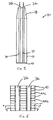
- a piezoelectric actuator device 30 having a stack 31 of piezoelectric elements being provided with first and second longitudinal channels or passages 32, 34 for receiving conductor means.
- the conductor means include rod-like conducting members 36a, 36b each of which extends through a respective one of the channels 32, 34.
- the stack 31 comprises a first end piece 38 and a second end piece 40 and a plurality of piezoelectric elements or layers 42, adjacent elements 42 being spaced apart by internal electrodes 44a, 44b, which are arranged to be substantially parallel to the first and second end pieces 38, 40 of the device 30.
- the first end piece 38 is in the form of a cap and the second end piece 40 is in the form of a plate or tile.
- Alternate ones of the electrodes 44a, 44b form a first group of electrodes and the remaining alternate ones of the electrodes form a second group of electrodes, whereby the electrodes 44a of the first group are in electrical connection with the first conductor member 36a and the electrodes 44b of the second electrode group are in electrical connection with the second internal conductor member 36b.
- the first and second end pieces 38, 40 are disposed at the ends of the stack 31 and enclose the conductor members 36a, 36b inside the stack 31, and so seal the stack 31, against high pressure fuel for example.
- the conductor members 36a, 36b extend along the length of the stack 31 and protrude through the first end piece 38 wherein the ends of the conductors 36a, 36b are adapted for attachment to a suitable electrical connector (not shown).
- the first and second pieces 38, 40 are formed from the same material as the piezoelectric elements 42 and become an integral part of the stack 31 following manufacture. The pieces 38, 40 thus provide support to the stack so that the stack may withstand high pressures.
- another ceramic composition or indeed any other material appropriate to effect sealing of the stack may alternatively be used, for example, aluminium.
- the internal electrode layers 44a, 44b extend to the edges of the element 42 and are provided with a first generally circular aperture 48 of relatively large diameter and a second generally circular aperture 46 of smaller diameter.
- Each piezoelectric element 42 is also provided with first and second apertures or openings 33.
- the piezoelectric element 42 and its associated electrodes 44a, 44b are arranged so that the first, larger aperture 48 in the electrode 44a, 44b aligns with one of the openings 33 in the element 42 and the second, smaller aperture 46 aligns with the other opening 33 in the element 42, so when formed into a stack 31 of elements 42, the aligned openings 33 and apertures 46, 48 define respective first and second channels 32, 34 which are substantially disposed on a symmetrical axis of the elements 42.
- the small aperture 46 has a diameter substantially equal to the opening 33 and so an electrical connection is formed between the electrode 44a, 44b and the conductor (not shown).
- the second conductor (not shown) is isolated from the electrode layer 44a since the aperture 48 has a larger diameter (and therefore larger area) than the opening 33.
- successive electrode layers in the stack are oriented at 180 degrees to one another (e.g. referring to Figures 7a and 7b which show successive layers).
- a voltage is applied across the conductors 36a, 36b so that they are of positive and negative polarity and therefore, an inactive zone 50 (also shown in Figure 6) surrounds each internal conductor 36a, 36b.
- prior art multi-layer devices as exemplified in Figures 1 to 3, have an electrode layer 24 printed over a portion of the adjacent piezoelectric element 22 whilst leaving an inactive zone 26 at an edge of the piezoelectric element 22.
- the size of the inactive region is significantly reduced, as compared to known prior art devices, whilst the main advantage of low applied voltages associated with existing multi-layered stacks is maintained.
- relatively small inactive zones 50 are formed internal to the stack and located around either one of the conductor members 36a, 36b. This reduces the likelihood of cracking between the terminated ends of the internal electrodes.
- the piezoelectric device 30 of the present invention avoids the need for components such as conductors to be attached to the external surface of the stack 31, thus eliminating the manufacturing step required to affix the conductors.
- a further advantage with the above arrangement is that the shape of the piezoelectric device is not constrained by the necessity to apply external conductors to faces of the device, so the shape of the device may be designed to suit a specific application.
- the stack 31 may be circular or even polygonal in cross section to make efficient use of space within an injector chamber of a fuel injector.
- the external conductors i.e. 18, 20 in Figure 1
- the insulating material may be forced into any cracks or pits on the surface of the stack by high pressure fuel. This may lead to internal shorting as the cracks are driven across the active region.
- the apertures are disposed in alignment on a lateral axis of the element 42 within the stack 31, the apertures may also be disposed offset from the axis to provide further design freedom for a specific application.
- the piezoelectric elements or layers 42 in the device of the present invention may be fabricated by the so called "green sheet” method, as is well known in the art.
- the composition of the layers may be constituted by a ferroelectric ceramic of the lead zirconate titanate (PZT) group although it will be appreciated that piezoelectric ceramics of other compositions may also be used.
- a ceramic sheet (green sheet) is fabricated comprising a plurality of ceramic layers and internal electrode sheets are then screen printed, using a printing mask to form the apertures 46, 48 onto its surface.
- the internal electrodes 44a, 44b are preferably an alloy of silver and palladium, although any other conductive material such as copper or nickel or any alloy thereof may be used as an alternative.
- the channel formation and conductor member insertion steps may be more readily performed on a monolithic block, they could alternatively be performed on individual samples following dicing of the monolith. Still alternatively, the apertures 33 may be formed in the piezoelectric elements 42 before or after the electrodes are screen printed.
- FIG. 8 An alternative embodiment is shown in Figure 8 and is similar to that as described with reference to Figures 5 to 7, except that the conductors 36a, 36b are formed of a plurality of segments 54 disposed end to end (each segment associated with a piezoelectric element 42).
- the conductor segments 54 will effectively create a single conductor member, equivalent to 36a, 36b in Figures 5 and 6.
- a segment 54 can be accommodated by an opening 33 in the piezoelectric element 42 prior to assembly of the stack 31, which may be a more convenient means of manufacture as opposed to inserting a conductor member into a drilled channel of a stack 31.
- each element 42 due to the applied electric field does not cause relative movement between the conductor segments 54, so that electrical contact between the segments is broken.
- thermal expansion of the segments 54 at operating temperatures may ensure electrical contact between the segments 54 is maintained at all times.
- Electrical disconnection of the segments 54 can also be avoided by a further embodiment, as shown in Figure 9, in which the conductor segments 56 include domed or convex end faces 58 to compensate for the relative movement between segments 56 and so maintain electrical connection during extension and contraction of the stack.
- the segments 54, 56 in the above embodiments made be composed of invar (RTM), platinum or titanium for example.
- the conductors 36a, 36b may comprise a non-cohesive solid conducting material such as a paste or a powder or still alternatively, a low melting point alloy such as gallium or bismuth for example. Such a material may substantially liquefy when the piezoelectric actuator device reaches its operating temperature (typically 100°C to 150°C). Still alternatively, the conducting material may be a liquid at operating temperature, for example mercury.
- the conducting means includes conductor pins (not shown) formed in the first end piece 38 and which extend into the channels 32, 34 to effect electrical connection from the power supply (not shown) to the liquid conductor material. It will be appreciated that stresses at the electrical interface between the conductors 36a, 36b and the electrode layers 44a, 44b will be reduced in this embodiment.
- the conductors 36a, 36b may alternatively be tubular more readily to comply with thermal expansion and irregularities of the channels 32, 34.
- the first and second end pieces 38, 40 may alternatively be formed of aluminium, for example, to impart additional strength to the stack.
Landscapes
- Engineering & Computer Science (AREA)
- Manufacturing & Machinery (AREA)
- General Electrical Machinery Utilizing Piezoelectricity, Electrostriction Or Magnetostriction (AREA)
- Fuel-Injection Apparatus (AREA)
- Electrically Driven Valve-Operating Means (AREA)
Priority Applications (4)
| Application Number | Priority Date | Filing Date | Title |
|---|---|---|---|
| EP03256046A EP1519424A1 (de) | 2003-09-25 | 2003-09-25 | Piezoelektrischer Aktor |
| EP04255835A EP1519425B1 (de) | 2003-09-25 | 2004-09-24 | Piezoelektrischer Aktor |
| AT04255835T ATE331300T1 (de) | 2003-09-25 | 2004-09-24 | Piezoelektrischer aktor |
| DE602004001307T DE602004001307T2 (de) | 2003-09-25 | 2004-09-24 | Piezoelektrischer Aktor |
Applications Claiming Priority (1)
| Application Number | Priority Date | Filing Date | Title |
|---|---|---|---|
| EP03256046A EP1519424A1 (de) | 2003-09-25 | 2003-09-25 | Piezoelektrischer Aktor |
Publications (1)
| Publication Number | Publication Date |
|---|---|
| EP1519424A1 true EP1519424A1 (de) | 2005-03-30 |
Family
ID=34178625
Family Applications (1)
| Application Number | Title | Priority Date | Filing Date |
|---|---|---|---|
| EP03256046A Withdrawn EP1519424A1 (de) | 2003-09-25 | 2003-09-25 | Piezoelektrischer Aktor |
Country Status (3)
| Country | Link |
|---|---|
| EP (1) | EP1519424A1 (de) |
| AT (1) | ATE331300T1 (de) |
| DE (1) | DE602004001307T2 (de) |
Cited By (1)
| Publication number | Priority date | Publication date | Assignee | Title |
|---|---|---|---|---|
| EP2755247A1 (de) * | 2013-01-10 | 2014-07-16 | Robert Bosch Gmbh | Piezoelektrisches Bauteil und Verfahren zur Herstellung eines piezoelektrischen Bauteils |
Citations (7)
| Publication number | Priority date | Publication date | Assignee | Title |
|---|---|---|---|---|
| US4471256A (en) * | 1982-06-14 | 1984-09-11 | Nippon Soken, Inc. | Piezoelectric actuator, and valve apparatus having actuator |
| JPH02192186A (ja) * | 1989-01-19 | 1990-07-27 | Toto Ltd | 圧電素子 |
| JPH09223828A (ja) * | 1996-02-16 | 1997-08-26 | Nippon Cement Co Ltd | 圧電トランス用積層素子 |
| US6291932B1 (en) * | 1998-02-17 | 2001-09-18 | Canon Kabushiki Kaisha | Stacked piezoelectric element and producing method therefor |
| WO2002019441A1 (de) * | 2000-08-31 | 2002-03-07 | Siemens Aktiengesellschaft | Piezoaktor und verfahren zur herstellung eines piezoaktors |
| US6603240B1 (en) * | 1999-09-27 | 2003-08-05 | Murata Manufacturing Co., Ltd. | Sensor array, method for manufacturing sensor array, and ultrasonic diagnostic apparatus using the same |
| WO2003094252A2 (de) * | 2002-05-06 | 2003-11-13 | Epcos Ag | Piezoaktor und verfahren zu dessen herstellung |
-
2003
- 2003-09-25 EP EP03256046A patent/EP1519424A1/de not_active Withdrawn
-
2004
- 2004-09-24 DE DE602004001307T patent/DE602004001307T2/de not_active Expired - Lifetime
- 2004-09-24 AT AT04255835T patent/ATE331300T1/de not_active IP Right Cessation
Patent Citations (7)
| Publication number | Priority date | Publication date | Assignee | Title |
|---|---|---|---|---|
| US4471256A (en) * | 1982-06-14 | 1984-09-11 | Nippon Soken, Inc. | Piezoelectric actuator, and valve apparatus having actuator |
| JPH02192186A (ja) * | 1989-01-19 | 1990-07-27 | Toto Ltd | 圧電素子 |
| JPH09223828A (ja) * | 1996-02-16 | 1997-08-26 | Nippon Cement Co Ltd | 圧電トランス用積層素子 |
| US6291932B1 (en) * | 1998-02-17 | 2001-09-18 | Canon Kabushiki Kaisha | Stacked piezoelectric element and producing method therefor |
| US6603240B1 (en) * | 1999-09-27 | 2003-08-05 | Murata Manufacturing Co., Ltd. | Sensor array, method for manufacturing sensor array, and ultrasonic diagnostic apparatus using the same |
| WO2002019441A1 (de) * | 2000-08-31 | 2002-03-07 | Siemens Aktiengesellschaft | Piezoaktor und verfahren zur herstellung eines piezoaktors |
| WO2003094252A2 (de) * | 2002-05-06 | 2003-11-13 | Epcos Ag | Piezoaktor und verfahren zu dessen herstellung |
Non-Patent Citations (2)
| Title |
|---|
| PATENT ABSTRACTS OF JAPAN vol. 014, no. 467 (E - 0989) 11 October 1990 (1990-10-11) * |
| PATENT ABSTRACTS OF JAPAN vol. 1997, no. 12 25 December 1997 (1997-12-25) * |
Cited By (1)
| Publication number | Priority date | Publication date | Assignee | Title |
|---|---|---|---|---|
| EP2755247A1 (de) * | 2013-01-10 | 2014-07-16 | Robert Bosch Gmbh | Piezoelektrisches Bauteil und Verfahren zur Herstellung eines piezoelektrischen Bauteils |
Also Published As
| Publication number | Publication date |
|---|---|
| DE602004001307D1 (de) | 2006-08-03 |
| ATE331300T1 (de) | 2006-07-15 |
| DE602004001307T2 (de) | 2007-04-26 |
Similar Documents
| Publication | Publication Date | Title |
|---|---|---|
| US6316863B1 (en) | Piezo actuator with novel contacting and production method | |
| EP1162671B1 (de) | Piezoelektrisches Bauelement für eine Einspritzvorrichtung | |
| US6874475B2 (en) | Structure of fuel injector using piezoelectric actuator | |
| US6731048B2 (en) | Piezoelectric actuator with insulating member separate from piezoelectric device | |
| US20100156250A1 (en) | Multi-Layer Piezoelectric Element and Method for Manufacturing the Same | |
| US6765337B1 (en) | Piezoelectric actuator | |
| CN101563795B (zh) | 压电致动器装置及其制造方法 | |
| US8339017B2 (en) | Multi-layer piezoelectric element and injection apparatus using the same | |
| EP0961329B1 (de) | Piezoelektrischer Antrieb des aufgestapelten Typs | |
| EP1519425B1 (de) | Piezoelektrischer Aktor | |
| US10707404B2 (en) | Piezoelectric element | |
| US6922005B2 (en) | Multilayer actuator with contact surfaces of internal electrodes of the same polarity arranged offset for their external electrodes | |
| JP3598057B2 (ja) | 積層型圧電素子および噴射装置 | |
| JP4737799B2 (ja) | 積層型圧電アクチュエータおよび噴射装置 | |
| CN116210370B (zh) | 压电致动器 | |
| US7170217B2 (en) | Stack-type piezoelectric device | |
| US20100308693A1 (en) | Piezoelectric Stack Actuator Assembly | |
| JP2002111088A (ja) | 積層型圧電アクチュエータ | |
| EP1650816A1 (de) | Piezoelektrischer Aktor | |
| JP7528240B2 (ja) | 圧電アクチュエータ | |
| JP2000261055A (ja) | 圧電アクチュエータ | |
| JP4373904B2 (ja) | 積層型圧電素子 | |
| JP2505024Y2 (ja) | 積層セラミック電歪素子 | |
| KR100612800B1 (ko) | 전계에 의한 응력발생을 감소시킬 수 있도록 구성된 압전적층 액추에이터 | |
| DE602004001307T2 (de) | Piezoelektrischer Aktor |
Legal Events
| Date | Code | Title | Description |
|---|---|---|---|
| PUAI | Public reference made under article 153(3) epc to a published international application that has entered the european phase |
Free format text: ORIGINAL CODE: 0009012 |
|
| AK | Designated contracting states |
Kind code of ref document: A1 Designated state(s): AT BE BG CH CY CZ DE DK EE ES FI FR GB GR HU IE IT LI LU MC NL PT RO SE SI SK TR |
|
| AX | Request for extension of the european patent |
Extension state: AL LT LV MK |
|
| AKX | Designation fees paid | ||
| REG | Reference to a national code |
Ref country code: DE Ref legal event code: 8566 |
|
| STAA | Information on the status of an ep patent application or granted ep patent |
Free format text: STATUS: THE APPLICATION IS DEEMED TO BE WITHDRAWN |
|
| 18D | Application deemed to be withdrawn |
Effective date: 20051001 |