EP1519980B1 - Polypropylene a ramification en chaines longues - Google Patents
Polypropylene a ramification en chaines longues Download PDFInfo
- Publication number
- EP1519980B1 EP1519980B1 EP03762589A EP03762589A EP1519980B1 EP 1519980 B1 EP1519980 B1 EP 1519980B1 EP 03762589 A EP03762589 A EP 03762589A EP 03762589 A EP03762589 A EP 03762589A EP 1519980 B1 EP1519980 B1 EP 1519980B1
- Authority
- EP
- European Patent Office
- Prior art keywords
- polypropylene
- electron beam
- irradiation
- pellets
- under
- Prior art date
- Legal status (The legal status is an assumption and is not a legal conclusion. Google has not performed a legal analysis and makes no representation as to the accuracy of the status listed.)
- Expired - Lifetime
Links
- -1 polypropylene Polymers 0.000 title claims abstract description 74
- 229920001155 polypropylene Polymers 0.000 title claims abstract description 73
- 239000004743 Polypropylene Substances 0.000 title claims abstract description 71
- 239000008188 pellet Substances 0.000 claims abstract description 40
- 238000000034 method Methods 0.000 claims abstract description 28
- 238000010894 electron beam technology Methods 0.000 claims abstract description 25
- 230000001678 irradiating effect Effects 0.000 claims abstract description 8
- 230000005855 radiation Effects 0.000 claims abstract description 8
- IJGRMHOSHXDMSA-UHFFFAOYSA-N Atomic nitrogen Chemical compound N#N IJGRMHOSHXDMSA-UHFFFAOYSA-N 0.000 claims description 38
- 238000001125 extrusion Methods 0.000 claims description 24
- 229910052757 nitrogen Inorganic materials 0.000 claims description 19
- 239000003963 antioxidant agent Substances 0.000 claims description 16
- 229920000642 polymer Polymers 0.000 claims description 14
- 230000003078 antioxidant effect Effects 0.000 claims description 10
- 239000000463 material Substances 0.000 claims description 8
- 238000004519 manufacturing process Methods 0.000 claims description 6
- 238000004806 packaging method and process Methods 0.000 claims description 4
- 239000011265 semifinished product Substances 0.000 claims description 3
- 238000002844 melting Methods 0.000 claims description 2
- 230000008018 melting Effects 0.000 claims description 2
- 229920005989 resin Polymers 0.000 description 41
- 239000011347 resin Substances 0.000 description 41
- 230000000052 comparative effect Effects 0.000 description 21
- 239000000155 melt Substances 0.000 description 16
- 239000000654 additive Substances 0.000 description 9
- 235000006708 antioxidants Nutrition 0.000 description 9
- QVGXLLKOCUKJST-UHFFFAOYSA-N atomic oxygen Chemical compound [O] QVGXLLKOCUKJST-UHFFFAOYSA-N 0.000 description 8
- 238000006243 chemical reaction Methods 0.000 description 8
- 239000000203 mixture Substances 0.000 description 8
- 239000001301 oxygen Substances 0.000 description 8
- 229910052760 oxygen Inorganic materials 0.000 description 8
- 238000006731 degradation reaction Methods 0.000 description 7
- 239000012299 nitrogen atmosphere Substances 0.000 description 7
- 238000003860 storage Methods 0.000 description 7
- 230000015556 catabolic process Effects 0.000 description 6
- 238000007254 oxidation reaction Methods 0.000 description 6
- 230000006641 stabilisation Effects 0.000 description 6
- 238000011105 stabilization Methods 0.000 description 6
- 230000015572 biosynthetic process Effects 0.000 description 5
- CJZGTCYPCWQAJB-UHFFFAOYSA-L calcium stearate Chemical compound [Ca+2].CCCCCCCCCCCCCCCCCC([O-])=O.CCCCCCCCCCCCCCCCCC([O-])=O CJZGTCYPCWQAJB-UHFFFAOYSA-L 0.000 description 5
- 239000008116 calcium stearate Substances 0.000 description 5
- 235000013539 calcium stearate Nutrition 0.000 description 5
- 238000012668 chain scission Methods 0.000 description 5
- 238000012667 polymer degradation Methods 0.000 description 5
- 230000007423 decrease Effects 0.000 description 4
- 238000009826 distribution Methods 0.000 description 4
- 239000000843 powder Substances 0.000 description 4
- 238000012360 testing method Methods 0.000 description 4
- 239000004698 Polyethylene Substances 0.000 description 3
- 239000012298 atmosphere Substances 0.000 description 3
- 230000004888 barrier function Effects 0.000 description 3
- 150000001993 dienes Chemical class 0.000 description 3
- 238000006073 displacement reaction Methods 0.000 description 3
- 238000009472 formulation Methods 0.000 description 3
- 239000007789 gas Substances 0.000 description 3
- 238000005227 gel permeation chromatography Methods 0.000 description 3
- 230000007246 mechanism Effects 0.000 description 3
- 230000003647 oxidation Effects 0.000 description 3
- 239000002245 particle Substances 0.000 description 3
- 229920000573 polyethylene Polymers 0.000 description 3
- QQONPFPTGQHPMA-UHFFFAOYSA-N propylene Natural products CC=C QQONPFPTGQHPMA-UHFFFAOYSA-N 0.000 description 3
- 125000004805 propylene group Chemical group [H]C([H])([H])C([H])([*:1])C([H])([H])[*:2] 0.000 description 3
- 229920002943 EPDM rubber Polymers 0.000 description 2
- 229920000181 Ethylene propylene rubber Polymers 0.000 description 2
- 230000001133 acceleration Effects 0.000 description 2
- 238000010504 bond cleavage reaction Methods 0.000 description 2
- 230000003247 decreasing effect Effects 0.000 description 2
- 230000001627 detrimental effect Effects 0.000 description 2
- 230000000694 effects Effects 0.000 description 2
- 238000002474 experimental method Methods 0.000 description 2
- 239000000835 fiber Substances 0.000 description 2
- MHAJPDPJQMAIIY-UHFFFAOYSA-M hydroperoxide group Chemical group [O-]O MHAJPDPJQMAIIY-UHFFFAOYSA-M 0.000 description 2
- 230000001590 oxidative effect Effects 0.000 description 2
- 150000002989 phenols Chemical class 0.000 description 2
- 239000000047 product Substances 0.000 description 2
- 230000007017 scission Effects 0.000 description 2
- FGUUSXIOTUKUDN-IBGZPJMESA-N C1(=CC=CC=C1)N1C2=C(NC([C@H](C1)NC=1OC(=NN=1)C1=CC=CC=C1)=O)C=CC=C2 Chemical compound C1(=CC=CC=C1)N1C2=C(NC([C@H](C1)NC=1OC(=NN=1)C1=CC=CC=C1)=O)C=CC=C2 FGUUSXIOTUKUDN-IBGZPJMESA-N 0.000 description 1
- OKTJSMMVPCPJKN-UHFFFAOYSA-N Carbon Chemical compound [C] OKTJSMMVPCPJKN-UHFFFAOYSA-N 0.000 description 1
- VGGSQFUCUMXWEO-UHFFFAOYSA-N Ethene Chemical compound C=C VGGSQFUCUMXWEO-UHFFFAOYSA-N 0.000 description 1
- 239000005977 Ethylene Substances 0.000 description 1
- 239000004594 Masterbatch (MB) Substances 0.000 description 1
- PJANXHGTPQOBST-VAWYXSNFSA-N Stilbene Natural products C=1C=CC=CC=1/C=C/C1=CC=CC=C1 PJANXHGTPQOBST-VAWYXSNFSA-N 0.000 description 1
- 239000011954 Ziegler–Natta catalyst Substances 0.000 description 1
- 150000001336 alkenes Chemical class 0.000 description 1
- 238000004458 analytical method Methods 0.000 description 1
- 239000011324 bead Substances 0.000 description 1
- 229920001400 block copolymer Polymers 0.000 description 1
- 239000002041 carbon nanotube Substances 0.000 description 1
- 229910021393 carbon nanotube Inorganic materials 0.000 description 1
- 239000003054 catalyst Substances 0.000 description 1
- 238000000576 coating method Methods 0.000 description 1
- 150000001875 compounds Chemical class 0.000 description 1
- 230000008094 contradictory effect Effects 0.000 description 1
- 229920001577 copolymer Polymers 0.000 description 1
- 238000002425 crystallisation Methods 0.000 description 1
- 238000000354 decomposition reaction Methods 0.000 description 1
- 238000002845 discoloration Methods 0.000 description 1
- 229920001971 elastomer Polymers 0.000 description 1
- 239000000945 filler Substances 0.000 description 1
- 239000006260 foam Substances 0.000 description 1
- 238000001879 gelation Methods 0.000 description 1
- 239000003365 glass fiber Substances 0.000 description 1
- 229920001519 homopolymer Polymers 0.000 description 1
- 239000011261 inert gas Substances 0.000 description 1
- 239000012968 metallocene catalyst Substances 0.000 description 1
- SJYNFBVQFBRSIB-UHFFFAOYSA-N norbornadiene Chemical compound C1=CC2C=CC1C2 SJYNFBVQFBRSIB-UHFFFAOYSA-N 0.000 description 1
- 230000003287 optical effect Effects 0.000 description 1
- 238000010525 oxidative degradation reaction Methods 0.000 description 1
- 229940097156 peroxyl Drugs 0.000 description 1
- 239000002861 polymer material Substances 0.000 description 1
- 239000002952 polymeric resin Substances 0.000 description 1
- 229920000098 polyolefin Polymers 0.000 description 1
- 229920005629 polypropylene homopolymer Polymers 0.000 description 1
- 238000002360 preparation method Methods 0.000 description 1
- 238000012545 processing Methods 0.000 description 1
- 150000004053 quinones Chemical class 0.000 description 1
- 239000002516 radical scavenger Substances 0.000 description 1
- 229920005604 random copolymer Polymers 0.000 description 1
- 238000000518 rheometry Methods 0.000 description 1
- 239000007787 solid Substances 0.000 description 1
- PJANXHGTPQOBST-UHFFFAOYSA-N stilbene Chemical compound C=1C=CC=CC=1C=CC1=CC=CC=C1 PJANXHGTPQOBST-UHFFFAOYSA-N 0.000 description 1
- 235000021286 stilbenes Nutrition 0.000 description 1
- 229920003002 synthetic resin Polymers 0.000 description 1
- 239000000454 talc Substances 0.000 description 1
- 229910052623 talc Inorganic materials 0.000 description 1
- 229920001897 terpolymer Polymers 0.000 description 1
Images
Classifications
-
- C—CHEMISTRY; METALLURGY
- C08—ORGANIC MACROMOLECULAR COMPOUNDS; THEIR PREPARATION OR CHEMICAL WORKING-UP; COMPOSITIONS BASED THEREON
- C08J—WORKING-UP; GENERAL PROCESSES OF COMPOUNDING; AFTER-TREATMENT NOT COVERED BY SUBCLASSES C08B, C08C, C08F, C08G or C08H
- C08J3/00—Processes of treating or compounding macromolecular substances
- C08J3/28—Treatment by wave energy or particle radiation
-
- C—CHEMISTRY; METALLURGY
- C08—ORGANIC MACROMOLECULAR COMPOUNDS; THEIR PREPARATION OR CHEMICAL WORKING-UP; COMPOSITIONS BASED THEREON
- C08J—WORKING-UP; GENERAL PROCESSES OF COMPOUNDING; AFTER-TREATMENT NOT COVERED BY SUBCLASSES C08B, C08C, C08F, C08G or C08H
- C08J2323/00—Characterised by the use of homopolymers or copolymers of unsaturated aliphatic hydrocarbons having only one carbon-to-carbon double bond; Derivatives of such polymers
- C08J2323/02—Characterised by the use of homopolymers or copolymers of unsaturated aliphatic hydrocarbons having only one carbon-to-carbon double bond; Derivatives of such polymers not modified by chemical after treatment
- C08J2323/10—Homopolymers or copolymers of propene
Definitions
- the present invention relates to a method for the production of polypropylene having improved properties, in particular high melt strength.
- the present invention relates to a process for the production of polypropylene having improved properties by irradiating polypropylene with a high energy electron beam.
- Polypropylene resin is used in a variety of different applications.
- linear polypropylene resin suffers from the problem of having a low melt strength, which restricts the use of polypropylene in a number of applications because the polypropylene is difficult to process.
- EP-A-190,889 or US-A-5,541,236 disclose a process for irradiating polypropylene to increase the melt strength thereof. It is disclosed that a linear propylene polymer material is irradiated under nitrogen with high energy ionising radiation, preferably an electron beam, at a dose rate in the range of from about 1 to 1 x10 4 Mrads per minute for a period of time sufficient for the appearance of long chain branching concomitantly with chain scission, but insufficient to cause gelation of the material. Thereafter, the material is maintained under the same inert environment, for a period of time sufficient for a significant amount of long chain branches to form.
- high energy ionising radiation preferably an electron beam
- the material is treated to deactivate substantially all free radicals present in the irradiated material.
- the electrons are beamed from an electron generator having an accelerating potential of from 500 to 4000 kV.
- the finely divided linear polypropylene material to be irradiated is conveyed on a conveyor belt beneath an electron beam generator which continuously irradiates the polypropylene particles as they are translated there-under by the conveyor belt.
- finely divided it is meant in the present application that the typical average particle size is of the order of 0.25 mm.
- the resultant polypropylene has improved melt strength as a result of the creation of long chain branches.
- a characteristic of the process disclosed in EP-A-190,889 is that the production of the irradiated polypropylene has to be performed under stringent conditions of inert atmosphere.
- the present invention discloses a process for producing polypropylene having increased melt strength by irradiating polypropylene in pellet form with an electron beam having an energy of from 0.5 to 25 MeV, delivered by an accelerator having a power of from 50 to 1000 kW and with a radiation dose of from 10 to 120 kGray, characterised in that the irradiation is carried out in the presence of air.
- the process can be carried out for other types of irradiation sources such as for example y Rays.
- the energy of the electron beam is preferably of from 5 to 10 MeV.
- the power of the accelerator is preferably of from 120 to 600 kW, and more preferably, it is about 200 kW.
- the total radiation dose is preferably of from 40 to 100 kGy.
- the total irradiation dose can be delivered to the polypropylene product either in one pass or in several passes under the electron beam. For example, four passes each delivering a dose of 20 kGy can replace a unique higher irradiation dose.
- the polypropylene may be a homopolymer of propylene or a random or block copolymer of propylene and one or more olefins and/or dienes selected from ethylene and C4 to C10 1-olefins or dienes, which may be linear or branched.
- the polypropylene homopolymer may be reinforced by rubber particles such as for example ethylene propylene rubber (EPR) or ethylene propylene diene monomer (EPDM), typically in an amount of up to 30 wt%.
- EPR ethylene propylene rubber
- EPDM ethylene propylene diene monomer
- the polypropylene may be a terpolymer optionally with a diene, for example norbornadiene, as a comonomer.
- the polypropylene can be prepared with any catalyst system known in the field of propylene polymerisation, preferably a metallocene catalyst system is used.
- the polymer may contain any filler such as for example glass fibres, carbon nanotubes, nanoclays, chalk or talc, typically used to reinforce the polymer's properties.
- the improved long chain branching can be measured through the determination of the branching index.
- the branching index as mentioned in the present patent application is obtained by the ratio of weight average molecular weight Mw values inferred from rheological measurement at zero shear viscosity and at crossover points as fully described by Michel, J. C. in SPE ANTEC, Conf. Proceedings, paper 359,2002 .
- the present invention also discloses a method for producing polypropylene with improved melt strength, said process comprising the steps of:
- the polypropylene pellets produced in step a) are defined as solid, non-porous beads having a weight comprised between 1 and 1000 mg.
- the semi-finished products of step a) can be for example chopped strands or staple fibres or other.
- the non-irradiated material optionally added in step f) can be any polymer such as for example polyethylene, polypropylene or a copolymer.
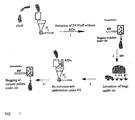
- the configuration is represented in Figure 1 , that describes the various steps of the present invention.
- the conveyor speed is adjusted in order to achieve the desired dose. Typically, it is of from 0.5 to 20 m/min, preferably it is of from 1 to 10 m/min.
- the polypropylene is bagged in conventional industrial bags or it is uniformly spread unbagged on the conveyor belt.
- the optimal thickness of the bags or of the polypropylene layer is determined by the energy of the electron beam: it increases with increasing energy of the electron beam. The irradiation is carried out under air.
- the degradation by oxidation is much lower for pellets than for powders because the pellets have a much smaller specific surface area than the powders, thereby limiting the effect of atmospheric oxygen.
- the antioxidant additives are then added to the pellets either in powder form or under the form of a master batch and the pellets are extruded and granulated under nitrogen atmosphere at temperatures that are typical for polypropylene.
- the time elapsed between the irradiation and the second extrusion processes can be of from a few minutes to several weeks, at a temperature of the order of 25 °C (room temperature).
- the polypropylene (PP) irradiated according to the present invention has improved melt strength.
- This high melt strength provides an outstanding processing behaviour that allows the long chain branching polypropylene produced in accordance with the present invention, to be suitable particularly for producing films, sheets, fibres, pipes, foams, hollow articles, panels and coatings.
- the melt strength is measured using a CEAST rheometer (Rheoscope 1000) equipped with a capillary die and a rotating wheel as a take-up device.
- Molten polymer is extruded through the capillary die by application of a pressure resulting from the displacement of a piston.
- the molten extrudate is uniaxially stretched before crystallisation by wrapping the fibre around the rotating wheel.
- the piston displacement rate is fixed and the speed of the rotating take-up wheel is linearly changed at constant acceleration until the fibre, becoming very thin, breaks.
- the tensile force is recorded during the test.
- the test was run with a cylindrical die having a length/diameter ratio of 5mm/1mm.
- the diameter of the rotating wheel is 120 mm and the displacement rate of the piston is 2 mm/min giving an extrudate throughput of 2.36 mm 3 /min.
- the acceleration of the rotating wheel is constant at 10 rpm1100 seconds, or 0.000628 m/s 2 .
- the extrusion temperature is 230°C. During the melt strength experiments, the recorded force rapidly reaches a constant value that remains independent from wheel rpm up to rupture.
- the melt strength is defined as the maximum tensile force recorded during the experiment.
- melt strength of a polypropylene resin ionised under air is equivalent to that of a polypropylene resin ionised under nitrogen atmosphere.
- MFI represents the melt flow index measured according to the method of standard test ASTM D 1238 under a load of 2.16 kg and at a temperature of 230 °C.
- Mn, Mw and Mz represent respectively the number average molecular weight, the weight average molecular weight and the z average molecular weight, measured by gel permeation chromatography (GPC).
- D represents the polydispersity index that is the ratio Mw/Mn of the weight average molecular weight to the number average molecular weight.
- the pellets were then bagged under air in standard 25 kg bags, prepared from polyethylene film, without gas barrier layer.
- the filled bags had a thickness of about 15 cm.
- the bags of polypropylene in pellet form were ionised under air using an electron beam having an energy of about 10MeV, and generated by an electrons accelerator having power of about 190 kW.
- the dose was about 60 kGy.
- 3000 ppm of anti-oxidant sold by CIBA as formulation B215 and 500 ppm of calcium stearate were added to the ionised pellets and the mixture was re-extruded under nitrogen on the extruder that was used for the first extrusion.
- the melt flow index MFI, the melt strength MS, the number, weight and z average molecular weights and the molecular weight distribution represented by the polydispersity index D and the branching index of the irradiated pellets from example 1 and comparative example 1 are displayed in Table 2.
- the branching index is a measure of the amount of long chain branching: a branching index of one represents a linear polypropylene and it decreases with increasing branching.
- melt flow index MFI of irradiated resins increases. Nevertheless, when compared to the MFI of 4.9 g/10 min of the non-irradiated resin, the MFI of the resin irradiated in pellet form and under air increases much less than that of the resin irradiated in fluff form under nitrogen atmosphere.
- the molecular weight distribution (MWD) curve of the irradiated resin is broader than that of the non-irradiated resin.
- the resin irradiated in pellet form of example 1 is characterised by a broader molecular weight distribution curve than that of the resin irradiated in fluff form of comparative example 1.
- the branched molecules increase the melt strength of resin.
- the melt strength of the resin of example 1 is much higher than that of the resin of comparative example 1. This can be observed in Table II.
- the pellets were then bagged under air in standard 25 kg bags, prepared from polyethylene film, without gas barrier layer.
- the filled bags had a thickness of about 15 cm.
- the bags of polypropylene in pellet form were ionised under air using an electron beam having an energy of about 10MeV, and generated by an electrons accelerator having power of about 190 kW.
- the dose was about 60 kGy.
- 3000 ppm of anti-oxidant sold by CIBA as formulation B215 and 500 ppm of calcium stearate were added to the ionised pellets and the mixture was re-extruded under nitrogen on the extruder that was used for the first extrusion.
- melt flow index MFI The melt flow index MFI, the melt strength MS, the number, weight and z average molecular weights and the molecular weight distribution represented by the polydispersity index D of the irradiated pellets of example 2 and comparative example 2 are displayed in Table III. TABLE III.
- N2 N2 MFI (g/10 min) 8.6 127 Mn (kDa) 46.6 61.7 Mw (kDa) 272.3 156-1 Mz (kDa) 1040.4 632.3 D 5.8 4.9 MS at 230 °C (mN) 11.7 3
- the amount of chain scission produced during irradiation was higher for the Ziegler-Natta-produced resin than for the metallocene-produced resin. Consequently the amount of high molecular weight branched molecules formed was lower for the Ziegler-Nafta-produced resin than for the metallocene-produced resin.
- the polydispersity of the irradiated resins of example 2 and comparative example 2 respectively did not increase with respect to the non-irradiated resin, but it was higher for the resin of example 2 irradiated in pellet form than for the resin of comparative example 2 irradiated in fluff form. Resulting from the formation of long chain branches and from low MFI, the melt strength of the resin of example 2 irradiated in pellet form was much higher than that of the resin of comparative example 2 irradiated in fluff form.
- example 3 the resin and the operating conditions used for storage, bagging, extrusion, ionisation and re-extrusion were the same as those of example 1.
- the presence of additives during ionisation has a negative influence on the branching and consequently decreases the melt strength of the ionised resin as can be seen in Table IV.
- the additives also strongly increase the coloration of the ionised pellets as represented in Table IV by the yellow index YI.
- the yellow index is defined here as the chromatic deviation with respect to a white standard in the wave length range of from 570 to 580 nm. It is measured on the colorimeter HUNTERLAB D25M optical sensor linked to a Toshiba T1000 PC. The apparatus is calibrated respectively with a black plate, a white plate and a reference plate. The 95x95x49 mm measuring vessel is then filled with the sample (the pellets) and the yellow index is evaluated directly by the PC and displayed on the computer screen.
- example 4 the resin and the operating conditions used for storage, bagging, extrusion, ionisation and re-extrusion of the resin were the same as those of example 2.
- Example 4 the polypropylene fluff of example 2 (ZNPP), kept under a nitrogen atmosphere during its storage, was extruded under nitrogen at 220°c on a single screw extruder.
- the polypropylene pellets were packed under nitrogen in industrial bags with a gas barrier layer, and then ionised with the same irradiation source as that used in Example 4, also under nitrogen atmosphere.
- the pellets have a much lower specific surface area than the fluff thereby decreasing the maximum concentration of adsorbed oxygen on the resin.
- the presence of air during the ionisation of the pellets is therefore less detrimental to the properties of ionised polypropylene than it is for a fluff.
Landscapes
- Chemical & Material Sciences (AREA)
- Health & Medical Sciences (AREA)
- Chemical Kinetics & Catalysis (AREA)
- Medicinal Chemistry (AREA)
- Polymers & Plastics (AREA)
- Organic Chemistry (AREA)
- Processes Of Treating Macromolecular Substances (AREA)
- Treatments Of Macromolecular Shaped Articles (AREA)
- Graft Or Block Polymers (AREA)
- Compositions Of Macromolecular Compounds (AREA)
- Materials For Medical Uses (AREA)
Claims (11)
- Procédé de production de polypropylène faisant preuve d'une résistance accrue à l'état fondu en irradiant le polypropylène sous forme de boulettes avec un faisceau d'électrons ayant une énergie de 0,5 à 25 MeV, provenant d'un accélérateur d'une puissance de 50 à 1000 kW et avec une dose de radiation de 10 à 120 kGray, caractérisé en ce que l'irradiation est effectuée en la présence d'air.
- Procédé selon la revendication 1, dans lequel le faisceau d'électrons a une énergie de 5 à 10 MeV.
- Procédé selon la revendication 1 ou la revendication 2, dans lequel l'accélérateur a une puissance de 120 à 600 kW.
- Procédé selon l'une quelconque des revendications précédentes, dans lequel la dose totale de radiation est de 40 à 100 kGray.
- Méthode de production de polypropylène bénéficiant d'une meilleure résistance à l'état fondu, comprenant les étapes qui consistent :a) à extruder le fluff de polypropylène sous azote et avec peu ou pas d'additifs antioxydants pour produire des boulettes de polypropylène ou des produits semi-finis ;b) optionnellement, à conditionner les boulettes sous air dans des sacs industriels conventionnels ;c) à placer les sacs ou les boulettes en vrac disposé(e)s en une couche uniforme et sous air sur une bande transporteuse en mouvement continu qui passe sous le faisceau d'électrons ;d) à irradier le polypropylène sous air au moyen du faisceau d'électrons de l'étape c), ledit faisceau d'électrons ayant une énergie de 0,5 à 25 MeV et avec une dose de 10 à 120 kGy ;e) optionnellement, à traiter thermiquement les boulettes irradiées sous des températures inférieures au point de fusion en vue de tuer les radicaux libres avant d'extruder de nouveau le polymère ;f) à extruder de nouveau le polypropylène avec les additifs anti-oxydants et, optionnellement, avec la matière non irradiée, sous azote, ledit antioxydant étant ajouté dans l'extrudeur soit simultanément avec le propylène, soit à un stade ultérieur sur la longueur de l'extrudeur ;g) à granuler et à conditionner sous air.
- Méthode selon la revendication 5, dans laquelle le faisceau d'électrons a une énergie de 5 à 10 MeV.
- Méthode selon la revendication 5 ou la revendication 6, dans laquelle la dose totale d'irradiation est comprise entre 40 et 100 kGray.
- Méthode selon l'une quelconque des revendications 5 à 7, dans laquelle la dose d'irradiation peut être fournie en plusieurs passages sous le faisceau d'électrons.
- Méthode selon l'une quelconque des revendications 5 à 8, dans laquelle, durant l'irradiation, le polypropylène est transporté au-delâ du faisceau d'électrons à une vitesse de 0,5 à 20 m/minute.
- Méthode selon l'une quelconque des revendications 5 à 9, dans laquelle aucun additif antioxydant n'est ajouté avant l'ionisation.
- Méthode selon l'une quelconque des revendications 5 à 10, dans laquelle le délai écoulé entre l'irradiation et la seconde extrusion est de quelques minutes à plusieurs semaines, à une température de l'ordre de 25 °C.
Priority Applications (1)
| Application Number | Priority Date | Filing Date | Title |
|---|---|---|---|
| EP03762589A EP1519980B1 (fr) | 2002-07-09 | 2003-07-01 | Polypropylene a ramification en chaines longues |
Applications Claiming Priority (4)
| Application Number | Priority Date | Filing Date | Title |
|---|---|---|---|
| EP02077723A EP1380613A1 (fr) | 2002-07-09 | 2002-07-09 | Polypropylène ayant des ramifications à longues chaínes |
| EP02077723 | 2002-07-09 | ||
| EP03762589A EP1519980B1 (fr) | 2002-07-09 | 2003-07-01 | Polypropylene a ramification en chaines longues |
| PCT/EP2003/007061 WO2004005378A1 (fr) | 2002-07-09 | 2003-07-01 | Polypropylene a ramification en chaines longues |
Publications (2)
| Publication Number | Publication Date |
|---|---|
| EP1519980A1 EP1519980A1 (fr) | 2005-04-06 |
| EP1519980B1 true EP1519980B1 (fr) | 2008-03-05 |
Family
ID=29724521
Family Applications (2)
| Application Number | Title | Priority Date | Filing Date |
|---|---|---|---|
| EP02077723A Withdrawn EP1380613A1 (fr) | 2002-07-09 | 2002-07-09 | Polypropylène ayant des ramifications à longues chaínes |
| EP03762589A Expired - Lifetime EP1519980B1 (fr) | 2002-07-09 | 2003-07-01 | Polypropylene a ramification en chaines longues |
Family Applications Before (1)
| Application Number | Title | Priority Date | Filing Date |
|---|---|---|---|
| EP02077723A Withdrawn EP1380613A1 (fr) | 2002-07-09 | 2002-07-09 | Polypropylène ayant des ramifications à longues chaínes |
Country Status (8)
| Country | Link |
|---|---|
| US (1) | US20060167128A1 (fr) |
| EP (2) | EP1380613A1 (fr) |
| JP (1) | JP2005532443A (fr) |
| CN (1) | CN1314733C (fr) |
| AT (1) | ATE388190T1 (fr) |
| AU (1) | AU2003242781A1 (fr) |
| DE (1) | DE60319536T2 (fr) |
| WO (1) | WO2004005378A1 (fr) |
Families Citing this family (11)
| Publication number | Priority date | Publication date | Assignee | Title |
|---|---|---|---|---|
| EP1825036A1 (fr) * | 2004-12-13 | 2007-08-29 | Basell Poliolefine Italia S.r.l. | Composition de polyolefines, fibres et tissus non-tisses |
| ATE502080T1 (de) * | 2005-02-03 | 2011-04-15 | Basell Polyolefine Gmbh | Verfahren zur herstellung von warmgeformten artikeln |
| US7855241B2 (en) * | 2005-10-18 | 2010-12-21 | Sabic Innovative Plastics Ip B.V. | Method of improving abrasion resistance of plastic article using nanoparticles and article produced thereby |
| WO2007045603A1 (fr) * | 2005-10-21 | 2007-04-26 | Basell Polyolefine Gmbh | Polymeres de propylene |
| CN101291986B (zh) * | 2005-10-21 | 2011-12-14 | 巴塞尔聚烯烃股份有限公司 | 用于注射模塑的聚丙烯 |
| EP2172498A1 (fr) | 2008-10-03 | 2010-04-07 | Total Petrochemicals Research Feluy | Modification de polyoléfines préparées avec des catalyseurs à site unique |
| US7935740B2 (en) | 2008-12-30 | 2011-05-03 | Basell Poliolefine Italia S.R.L. | Process for producing high melt strength polypropylene |
| US8921466B2 (en) | 2010-01-15 | 2014-12-30 | Reliance Industries Limited | Concurrent solid and melt state grafting of coagents for making long chain branched polypropylene via direct reactive extrusion process |
| BR112013008999A2 (pt) | 2010-10-14 | 2016-07-05 | Reliance Ind Ltd | um processo para a preparação do polipropileno com alta resistência do fundido. |
| US11117995B2 (en) | 2018-08-23 | 2021-09-14 | Formosa Plastics Corporation, U.S.A. | Process for preparing high melt strength polypropylene |
| CN111571855A (zh) * | 2020-06-02 | 2020-08-25 | 中广核中科海维科技发展有限公司 | 一种通过辐照提升聚丙烯塑料粒子熔体指数的方法 |
Family Cites Families (10)
| Publication number | Priority date | Publication date | Assignee | Title |
|---|---|---|---|---|
| NO167039C (no) * | 1985-01-31 | 1991-09-25 | Himont Inc | Fremgangsmaate for fremstilling av polypropylen med langkjedede forgreninger og anvendelse av dette |
| IN166935B (fr) * | 1985-01-31 | 1990-08-11 | Himont Inc | |
| US5266607A (en) * | 1989-11-30 | 1993-11-30 | Rexene Products Company | Crystallization enhancement of polyolefins |
| US5439949A (en) * | 1991-08-21 | 1995-08-08 | Rexene Corporation | Propylene compositions with improved resistance to thermoforming sag |
| US5414027A (en) * | 1993-07-15 | 1995-05-09 | Himont Incorporated | High melt strength, propylene polymer, process for making it, and use thereof |
| JP3171422B2 (ja) * | 1994-04-20 | 2001-05-28 | 日本原子力研究所 | 改質ポリプロピレンを製造する方法および成形品 |
| JP3697322B2 (ja) * | 1996-06-28 | 2005-09-21 | 日本原子力研究所 | 改質プロピレン(共)重合体組成物およびその製造方法 |
| EP1038893A1 (fr) * | 1999-03-19 | 2000-09-27 | Fina Research S.A. | Procédé de préparation de polypropylène à propriétés améliorées |
| JP2000309670A (ja) * | 1999-04-26 | 2000-11-07 | Nippon Polyolefin Kk | ポリプロピレン系樹脂組成物 |
| EP1170306A1 (fr) * | 2000-07-05 | 2002-01-09 | ATOFINA Research | Production de polypropylène ayant de meilleures propriétés |
-
2002
- 2002-07-09 EP EP02077723A patent/EP1380613A1/fr not_active Withdrawn
-
2003
- 2003-07-01 DE DE60319536T patent/DE60319536T2/de not_active Expired - Fee Related
- 2003-07-01 JP JP2004518668A patent/JP2005532443A/ja active Pending
- 2003-07-01 US US10/520,475 patent/US20060167128A1/en not_active Abandoned
- 2003-07-01 CN CNB038161338A patent/CN1314733C/zh not_active Expired - Fee Related
- 2003-07-01 WO PCT/EP2003/007061 patent/WO2004005378A1/fr not_active Ceased
- 2003-07-01 AT AT03762589T patent/ATE388190T1/de not_active IP Right Cessation
- 2003-07-01 EP EP03762589A patent/EP1519980B1/fr not_active Expired - Lifetime
- 2003-07-01 AU AU2003242781A patent/AU2003242781A1/en not_active Abandoned
Also Published As
| Publication number | Publication date |
|---|---|
| DE60319536D1 (de) | 2008-04-17 |
| EP1519980A1 (fr) | 2005-04-06 |
| AU2003242781A1 (en) | 2004-01-23 |
| EP1380613A1 (fr) | 2004-01-14 |
| CN1665864A (zh) | 2005-09-07 |
| US20060167128A1 (en) | 2006-07-27 |
| CN1314733C (zh) | 2007-05-09 |
| JP2005532443A (ja) | 2005-10-27 |
| ATE388190T1 (de) | 2008-03-15 |
| WO2004005378A1 (fr) | 2004-01-15 |
| DE60319536T2 (de) | 2009-04-02 |
Similar Documents
| Publication | Publication Date | Title |
|---|---|---|
| EP0190889B1 (fr) | Polypropylène à branchement de longue chaîne libre, son procédé de fabrication et son application | |
| DE69503422T2 (de) | Verfahren zur Herstellung von modifiziertem Polypropylen und Formkörper | |
| US5508319A (en) | High melt strength, ethylene polymer, process for making it, and use thereof | |
| US4916198A (en) | High melt strength, propylene polymer, process for making it, and use thereof | |
| EP1187860B2 (fr) | Polypropylene presentant une meilleure ramification de chaines longues | |
| EP1519980B1 (fr) | Polypropylene a ramification en chaines longues | |
| EP1311564B1 (fr) | Production de polypropylene a proprietes ameliorees | |
| EP0063654A1 (fr) | Méthode pour le craquage de chaînes du polypropylène | |
| EP1297031B1 (fr) | Production de polyol fines propri t s am lior es | |
| CA2071779C (fr) | Polymere d'ethylene tres resistant a la fusion, procede pour son obtention, et applications | |
| CN103415564B (zh) | 用于聚烯烃树脂的抗氧化剂化合物 | |
| EP0519386B1 (fr) | Polymère d'éthylène irradié à haute résistance à l'état fondu | |
| EP1170309A1 (fr) | Production de copolymères de propylène ayant de meilleures propriétés | |
| KR20050017003A (ko) | 장쇄 분지화 폴리프로필렌 | |
| EP4499728B1 (fr) | Compositions de résine de poly(méso-lactide) hyperramifié | |
| CN120265702A (zh) | 熔体强度优异的聚丙烯树脂组合物及其制备方法 | |
| JPH0117487B2 (fr) |
Legal Events
| Date | Code | Title | Description |
|---|---|---|---|
| PUAI | Public reference made under article 153(3) epc to a published international application that has entered the european phase |
Free format text: ORIGINAL CODE: 0009012 |
|
| 17P | Request for examination filed |
Effective date: 20041222 |
|
| AK | Designated contracting states |
Kind code of ref document: A1 Designated state(s): AT BE BG CH CY CZ DE DK EE ES FI FR GB GR HU IE IT LI LU MC NL PT RO SE SI SK TR |
|
| AX | Request for extension of the european patent |
Extension state: AL LT LV MK |
|
| DAX | Request for extension of the european patent (deleted) | ||
| RIN1 | Information on inventor provided before grant (corrected) |
Inventor name: DUPIRE, MARC Inventor name: MICHEL, JACQUES Inventor name: OLIVIER, DOMINIQUE |
|
| 17Q | First examination report despatched |
Effective date: 20061218 |
|
| GRAP | Despatch of communication of intention to grant a patent |
Free format text: ORIGINAL CODE: EPIDOSNIGR1 |
|
| RAP1 | Party data changed (applicant data changed or rights of an application transferred) |
Owner name: BASELL POLIOLEFINE ITALIA S.R.L. |
|
| GRAS | Grant fee paid |
Free format text: ORIGINAL CODE: EPIDOSNIGR3 |
|
| GRAA | (expected) grant |
Free format text: ORIGINAL CODE: 0009210 |
|
| AK | Designated contracting states |
Kind code of ref document: B1 Designated state(s): AT BE BG CH CY CZ DE DK EE ES FI FR GB GR HU IE IT LI LU MC NL PT RO SE SI SK TR |
|
| REG | Reference to a national code |
Ref country code: GB Ref legal event code: FG4D |
|
| REG | Reference to a national code |
Ref country code: CH Ref legal event code: EP |
|
| REG | Reference to a national code |
Ref country code: IE Ref legal event code: FG4D |
|
| REF | Corresponds to: |
Ref document number: 60319536 Country of ref document: DE Date of ref document: 20080417 Kind code of ref document: P |
|
| PG25 | Lapsed in a contracting state [announced via postgrant information from national office to epo] |
Ref country code: FI Free format text: LAPSE BECAUSE OF FAILURE TO SUBMIT A TRANSLATION OF THE DESCRIPTION OR TO PAY THE FEE WITHIN THE PRESCRIBED TIME-LIMIT Effective date: 20080305 Ref country code: ES Free format text: LAPSE BECAUSE OF FAILURE TO SUBMIT A TRANSLATION OF THE DESCRIPTION OR TO PAY THE FEE WITHIN THE PRESCRIBED TIME-LIMIT Effective date: 20080616 |
|
| PG25 | Lapsed in a contracting state [announced via postgrant information from national office to epo] |
Ref country code: AT Free format text: LAPSE BECAUSE OF FAILURE TO SUBMIT A TRANSLATION OF THE DESCRIPTION OR TO PAY THE FEE WITHIN THE PRESCRIBED TIME-LIMIT Effective date: 20080305 |
|
| NLV1 | Nl: lapsed or annulled due to failure to fulfill the requirements of art. 29p and 29m of the patents act | ||
| PG25 | Lapsed in a contracting state [announced via postgrant information from national office to epo] |
Ref country code: BE Free format text: LAPSE BECAUSE OF FAILURE TO SUBMIT A TRANSLATION OF THE DESCRIPTION OR TO PAY THE FEE WITHIN THE PRESCRIBED TIME-LIMIT Effective date: 20080305 Ref country code: SI Free format text: LAPSE BECAUSE OF FAILURE TO SUBMIT A TRANSLATION OF THE DESCRIPTION OR TO PAY THE FEE WITHIN THE PRESCRIBED TIME-LIMIT Effective date: 20080305 |
|
| PG25 | Lapsed in a contracting state [announced via postgrant information from national office to epo] |
Ref country code: PT Free format text: LAPSE BECAUSE OF FAILURE TO SUBMIT A TRANSLATION OF THE DESCRIPTION OR TO PAY THE FEE WITHIN THE PRESCRIBED TIME-LIMIT Effective date: 20080805 Ref country code: CZ Free format text: LAPSE BECAUSE OF FAILURE TO SUBMIT A TRANSLATION OF THE DESCRIPTION OR TO PAY THE FEE WITHIN THE PRESCRIBED TIME-LIMIT Effective date: 20080305 Ref country code: SE Free format text: LAPSE BECAUSE OF FAILURE TO SUBMIT A TRANSLATION OF THE DESCRIPTION OR TO PAY THE FEE WITHIN THE PRESCRIBED TIME-LIMIT Effective date: 20080605 Ref country code: SK Free format text: LAPSE BECAUSE OF FAILURE TO SUBMIT A TRANSLATION OF THE DESCRIPTION OR TO PAY THE FEE WITHIN THE PRESCRIBED TIME-LIMIT Effective date: 20080305 Ref country code: NL Free format text: LAPSE BECAUSE OF FAILURE TO SUBMIT A TRANSLATION OF THE DESCRIPTION OR TO PAY THE FEE WITHIN THE PRESCRIBED TIME-LIMIT Effective date: 20080305 |
|
| PGFP | Annual fee paid to national office [announced via postgrant information from national office to epo] |
Ref country code: DE Payment date: 20080806 Year of fee payment: 6 |
|
| PG25 | Lapsed in a contracting state [announced via postgrant information from national office to epo] |
Ref country code: RO Free format text: LAPSE BECAUSE OF FAILURE TO SUBMIT A TRANSLATION OF THE DESCRIPTION OR TO PAY THE FEE WITHIN THE PRESCRIBED TIME-LIMIT Effective date: 20080305 |
|
| ET | Fr: translation filed | ||
| PLBE | No opposition filed within time limit |
Free format text: ORIGINAL CODE: 0009261 |
|
| STAA | Information on the status of an ep patent application or granted ep patent |
Free format text: STATUS: NO OPPOSITION FILED WITHIN TIME LIMIT |
|
| PG25 | Lapsed in a contracting state [announced via postgrant information from national office to epo] |
Ref country code: DK Free format text: LAPSE BECAUSE OF FAILURE TO SUBMIT A TRANSLATION OF THE DESCRIPTION OR TO PAY THE FEE WITHIN THE PRESCRIBED TIME-LIMIT Effective date: 20080305 |
|
| 26N | No opposition filed |
Effective date: 20081208 |
|
| REG | Reference to a national code |
Ref country code: CH Ref legal event code: PL |
|
| GBPC | Gb: european patent ceased through non-payment of renewal fee |
Effective date: 20080701 |
|
| PG25 | Lapsed in a contracting state [announced via postgrant information from national office to epo] |
Ref country code: MC Free format text: LAPSE BECAUSE OF NON-PAYMENT OF DUE FEES Effective date: 20080731 |
|
| PGFP | Annual fee paid to national office [announced via postgrant information from national office to epo] |
Ref country code: IT Payment date: 20081030 Year of fee payment: 6 |
|
| PG25 | Lapsed in a contracting state [announced via postgrant information from national office to epo] |
Ref country code: EE Free format text: LAPSE BECAUSE OF FAILURE TO SUBMIT A TRANSLATION OF THE DESCRIPTION OR TO PAY THE FEE WITHIN THE PRESCRIBED TIME-LIMIT Effective date: 20080305 Ref country code: BG Free format text: LAPSE BECAUSE OF FAILURE TO SUBMIT A TRANSLATION OF THE DESCRIPTION OR TO PAY THE FEE WITHIN THE PRESCRIBED TIME-LIMIT Effective date: 20080605 |
|
| PGFP | Annual fee paid to national office [announced via postgrant information from national office to epo] |
Ref country code: FR Payment date: 20081018 Year of fee payment: 6 |
|
| PG25 | Lapsed in a contracting state [announced via postgrant information from national office to epo] |
Ref country code: CH Free format text: LAPSE BECAUSE OF NON-PAYMENT OF DUE FEES Effective date: 20080731 Ref country code: LI Free format text: LAPSE BECAUSE OF NON-PAYMENT OF DUE FEES Effective date: 20080731 Ref country code: GB Free format text: LAPSE BECAUSE OF NON-PAYMENT OF DUE FEES Effective date: 20080701 |
|
| PG25 | Lapsed in a contracting state [announced via postgrant information from national office to epo] |
Ref country code: IE Free format text: LAPSE BECAUSE OF NON-PAYMENT OF DUE FEES Effective date: 20080701 |
|
| PG25 | Lapsed in a contracting state [announced via postgrant information from national office to epo] |
Ref country code: CY Free format text: LAPSE BECAUSE OF FAILURE TO SUBMIT A TRANSLATION OF THE DESCRIPTION OR TO PAY THE FEE WITHIN THE PRESCRIBED TIME-LIMIT Effective date: 20080305 |
|
| REG | Reference to a national code |
Ref country code: FR Ref legal event code: ST Effective date: 20100331 |
|
| PG25 | Lapsed in a contracting state [announced via postgrant information from national office to epo] |
Ref country code: FR Free format text: LAPSE BECAUSE OF NON-PAYMENT OF DUE FEES Effective date: 20090731 |
|
| PG25 | Lapsed in a contracting state [announced via postgrant information from national office to epo] |
Ref country code: DE Free format text: LAPSE BECAUSE OF NON-PAYMENT OF DUE FEES Effective date: 20100202 |
|
| PG25 | Lapsed in a contracting state [announced via postgrant information from national office to epo] |
Ref country code: HU Free format text: LAPSE BECAUSE OF FAILURE TO SUBMIT A TRANSLATION OF THE DESCRIPTION OR TO PAY THE FEE WITHIN THE PRESCRIBED TIME-LIMIT Effective date: 20080906 Ref country code: LU Free format text: LAPSE BECAUSE OF NON-PAYMENT OF DUE FEES Effective date: 20080701 |
|
| PG25 | Lapsed in a contracting state [announced via postgrant information from national office to epo] |
Ref country code: TR Free format text: LAPSE BECAUSE OF FAILURE TO SUBMIT A TRANSLATION OF THE DESCRIPTION OR TO PAY THE FEE WITHIN THE PRESCRIBED TIME-LIMIT Effective date: 20080305 |
|
| PG25 | Lapsed in a contracting state [announced via postgrant information from national office to epo] |
Ref country code: GR Free format text: LAPSE BECAUSE OF FAILURE TO SUBMIT A TRANSLATION OF THE DESCRIPTION OR TO PAY THE FEE WITHIN THE PRESCRIBED TIME-LIMIT Effective date: 20080606 |
|
| PG25 | Lapsed in a contracting state [announced via postgrant information from national office to epo] |
Ref country code: IT Free format text: LAPSE BECAUSE OF NON-PAYMENT OF DUE FEES Effective date: 20090701 |