EP1521410A1 - Verfahren zur Zuteiliung von Ressourcen in einem Telekommunikationsnetz mit multi Auflösungen - Google Patents
Verfahren zur Zuteiliung von Ressourcen in einem Telekommunikationsnetz mit multi Auflösungen Download PDFInfo
- Publication number
- EP1521410A1 EP1521410A1 EP04292311A EP04292311A EP1521410A1 EP 1521410 A1 EP1521410 A1 EP 1521410A1 EP 04292311 A EP04292311 A EP 04292311A EP 04292311 A EP04292311 A EP 04292311A EP 1521410 A1 EP1521410 A1 EP 1521410A1
- Authority
- EP
- European Patent Office
- Prior art keywords
- traffic
- sub
- resource
- path
- node
- Prior art date
- Legal status (The legal status is an assumption and is not a legal conclusion. Google has not performed a legal analysis and makes no representation as to the accuracy of the status listed.)
- Withdrawn
Links
- 238000000034 method Methods 0.000 title claims abstract description 36
- 230000006870 function Effects 0.000 claims description 24
- 239000011159 matrix material Substances 0.000 claims description 12
- 230000003068 static effect Effects 0.000 claims description 6
- 238000011144 upstream manufacturing Methods 0.000 claims description 5
- 230000001629 suppression Effects 0.000 claims description 3
- 235000008694 Humulus lupulus Nutrition 0.000 claims 1
- 230000015572 biosynthetic process Effects 0.000 claims 1
- 238000013468 resource allocation Methods 0.000 abstract description 3
- 235000019580 granularity Nutrition 0.000 description 17
- 230000005540 biological transmission Effects 0.000 description 10
- 230000003287 optical effect Effects 0.000 description 8
- 235000021183 entrée Nutrition 0.000 description 5
- 238000007726 management method Methods 0.000 description 5
- 230000008901 benefit Effects 0.000 description 4
- 239000000835 fiber Substances 0.000 description 4
- 238000012550 audit Methods 0.000 description 2
- 238000010276 construction Methods 0.000 description 2
- 238000005538 encapsulation Methods 0.000 description 2
- 238000000605 extraction Methods 0.000 description 2
- 239000000463 material Substances 0.000 description 2
- 238000005259 measurement Methods 0.000 description 2
- 238000005457 optimization Methods 0.000 description 2
- 241000251468 Actinopterygii Species 0.000 description 1
- 238000006424 Flood reaction Methods 0.000 description 1
- 241000287107 Passer Species 0.000 description 1
- 240000008042 Zea mays Species 0.000 description 1
- 238000004458 analytical method Methods 0.000 description 1
- 238000004364 calculation method Methods 0.000 description 1
- 238000004891 communication Methods 0.000 description 1
- 238000011161 development Methods 0.000 description 1
- 230000000694 effects Effects 0.000 description 1
- 239000013307 optical fiber Substances 0.000 description 1
- 238000012545 processing Methods 0.000 description 1
- 230000004044 response Effects 0.000 description 1
- 238000005070 sampling Methods 0.000 description 1
- 230000035945 sensitivity Effects 0.000 description 1
- 230000011664 signaling Effects 0.000 description 1
- 238000004513 sizing Methods 0.000 description 1
- 238000012549 training Methods 0.000 description 1
Images
Classifications
-
- H—ELECTRICITY
- H04—ELECTRIC COMMUNICATION TECHNIQUE
- H04J—MULTIPLEX COMMUNICATION
- H04J14/00—Optical multiplex systems
- H04J14/02—Wavelength-division multiplex systems
- H04J14/0227—Operation, administration, maintenance or provisioning [OAMP] of WDM networks, e.g. media access, routing or wavelength allocation
-
- H—ELECTRICITY
- H04—ELECTRIC COMMUNICATION TECHNIQUE
- H04J—MULTIPLEX COMMUNICATION
- H04J14/00—Optical multiplex systems
- H04J14/02—Wavelength-division multiplex systems
- H04J14/0227—Operation, administration, maintenance or provisioning [OAMP] of WDM networks, e.g. media access, routing or wavelength allocation
- H04J14/0241—Wavelength allocation for communications one-to-one, e.g. unicasting wavelengths
-
- H—ELECTRICITY
- H04—ELECTRIC COMMUNICATION TECHNIQUE
- H04L—TRANSMISSION OF DIGITAL INFORMATION, e.g. TELEGRAPHIC COMMUNICATION
- H04L45/00—Routing or path finding of packets in data switching networks
-
- H—ELECTRICITY
- H04—ELECTRIC COMMUNICATION TECHNIQUE
- H04Q—SELECTING
- H04Q11/00—Selecting arrangements for multiplex systems
- H04Q11/0001—Selecting arrangements for multiplex systems using optical switching
- H04Q11/0062—Network aspects
- H04Q2011/0075—Wavelength grouping or hierarchical aspects
-
- H—ELECTRICITY
- H04—ELECTRIC COMMUNICATION TECHNIQUE
- H04Q—SELECTING
- H04Q11/00—Selecting arrangements for multiplex systems
- H04Q11/0001—Selecting arrangements for multiplex systems using optical switching
- H04Q11/0062—Network aspects
- H04Q2011/0086—Network resource allocation, dimensioning or optimisation
Definitions
- the present invention relates to the field of telecommunications and more specifically relates to a method allocating at least one resource in a network of multigranular architecture telecommunications.
- This order of granularity levels actually corresponds to a encapsulation hierarchy that can be implemented in networks current.
- the dimensioning of a hierarchical network is usually based on combinatorial optimization methods (linear programming in numbers integer, heuristic or meta heuristic method) using as input a traffic matrix for example static, representative of traffic demands at a given moment and most often representative of the peak demands traffic.
- the present invention aims to overcome these problems by providing an intelligent method of allocating resources for a better dimensioning of the network under construction, as for a dynamic reconfiguration in response to a request.
- the invention proposes a method that involves multigranular network elements that should be well understand.
- the topology can be the physical topology, or a logical topology corresponding to a higher level of granularity.
- the link can be a physical link point point, so between two physically adjacent nodes; or a logical link between a first and a last node not physically adjacent.
- a "road” in the network and for a level of granularity considered will be a route from a starting node to a node arrival.
- a road will therefore consist of a single link or a succession consecutive links separated by nodes.
- sub-paths each constituted of a section of this road delimited by any two nodes of this route, including the departure and arrival nodes delimiting the route.
- a sub-path of a given route will then be identified by the two nodes placed at its ends: an input node and a termination node.
- a traffic request is defined between a source node and a node recipient and, if it is followed by effect, will correspond to a volume of between these two nodes.
- a volume of traffic on a sub-path will then be the total volume of traffic carried from end to end by this sub-path, that is to say from its input node to its termination node.
- a first advantage of this method is to be easy to implement. Because it is iterative and each iteration consists of operations relatively simple. Another important benefit is to always ensure convergence to a suitable configuration.
- the knowledge of traffic requests can be obtained by a intra-domain routing protocol such as the IGP ("Interior Gateway Protocol "which is defined by the IETF, or by traffic analyzes local and / or global statistics.
- IGP Interior Gateway Protocol
- triggering resource allocation (s) can be related to several types of events.
- One or more resources may be provisionally allocated or permanently.
- the logical nature of the links considered according to the levels of granularity, for example has the consequence that when a connection wavelength band is already established or expected between two non-nodes physically adjacent, the routing provided for in step 1, will, for wavelengths and from the first iteration of the method, consider this multi-link link between these two nodes as a single link.
- TE-links TE for "Traffic Engineering" used for routing in the Open Shortest Path First-Traffic Engineering (OSPF-TE) protocol English) of a Generalized Multi-Protocol Label Switching (GMPLS) network in English).
- This link is of type 'FA' (Forwarding Adjacencies ") which comes from a 'Label Switched Path' (LSP) of granularity given.
- LSP Label Switched Path'
- the method can take into account the variability of the traffic by statistical estimation on appropriate time samples and possibly using approximation methods or predictive estimation of the evolution of traffic, for example by the establishment of gradients.
- the choice of the number of matrices and / or the sampling is function of scales of traffic variations in time and space.
- the routing is carried out at from a Dijkstra routing algorithm and each sub-path corresponds to a shorter path.
- any sub-path between two points of a shorter path is itself a shorter way.
- This kind of Simple routing does not depend on time or context. All sub-paths of the graph not being taken into account, the number of data to storing is reduced.
- the routing integrates predictive way a maximum gain in relation to the cost function.
- This smart routing takes into account how is the traffic processing. Thus, taking into account the constraints of routing, the expected maximum gain will be increased.
- the cost function can take into account one or more of the following parameters: lengths sub-paths, physical constraints and administrative costs
- the physical constraints are for example linked to geographical features.
- the administrative cost is for example linked to a network rental.
- the cost function takes into account these parameters in addition to the traffic volume.
- the cost function uses the number of wavelengths to enter the bandwidth.
- the cost function can not use the average traffic volume but rather a value to be estimated between the average volume and the peak of the traffic.
- the cost function will take into account an estimated bandwidth equivalent.
- the equivalent bandwidth is for example explained in the document titled Equivalent Capacity and Its Application to Bandwidth Allocation in High-Speed Networks ", Guerin R., IEE Journal on Selected Area of Communication, Vol 9, No. 7, September 1991.
- step n ° 4 can comprise training in the topology of a new link between the input node and the termination node of said best sub-path.
- This new link is likely to be used as a link for routing during a new allocation of a resource.
- step 4 may comprise the management of a memory associated with the allocated higher resources, said memory comprising one or more of the following: number of jumps for each better sub-path, the length of each best sub-path, the input and termination nodes of each better sub-way.
- Step 1 can include determining the distribution of requests for traffic in time and space, by software means or materials. This determination can be achieved by means distributed in said network, and more specifically by its control plane.
- the control plan delivers information from a routing protocol dedicated to inferior resources.
- the protocol information is given by the OSPF-TE protocol which floods the entire network with the state of links (links state en English) with, in particular, attributes of "TE" declaring inter alia the bandwidth used.
- the determination can also be made by means of management external and centralized ("management 'off line"').
- the determination of traffic requests can also be obtained from information delivered by measuring means, distributed in the network. These measuring means are controlled automatically or manually by a centralized operator.
- steps 2 and 3 can conduct in the same iteration, at the election of at least two better separate sub-paths and the allocation of at least two resources higher.
- the lower resources can be chosen among the packets, circuits, wavelengths, wavelength bands, fibers optics and the higher resource (s) can be selected from circuits, wavelengths, wavelength bands, fibers optical and fiber optic cables.
- the upper resource and the lower resources can be adjacent or not in terms of granularity levels.
- the method according to the invention can be used for a dimensioning or dynamic reconfiguration of the network or for a sizing of two superimposed networks in terms of encapsulation hierarchy.
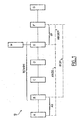
- FIG. 1 is a simplified representation of a network of telecommunications 10 to size.
- This network 10 has a topology comprising eight nodes A to H linked by point-to-point physical links, for example, monodirectional.
- This network 10 is designed to be of multigranular architecture and can use at least a first so-called superior resource such as minus one band of wavelengths WB1 and second resources say, below, for example, at least a plurality of wavelengths.
- the wavelength band WB1 is of variable size and example contains twenty usable wavelengths.
- this network 10 is to be hierarchical into regions as defined in the IETF GMPLS protocol suite, a region corresponding to the set of resources that switch the same granularity.
- step 1 of this method we first determine traffic requests between source nodes and destination nodes in terms of number of wavelengths from a traffic matrix static.
- ABCDEF roads BCDEF, ABCDE identified by their input and termination nodes: AB, AC, AD, AE, AF, BC, BD, BE, BF, CD, CE, CF, DE, DF, EF.
- a cost function is then applied to each of the fifteen subpaths to evaluate their sensitivities, that is, their vocations respective to be associated with the wavelength band WB1.
- the cost function is the product of the traffic volume (total number of wavelengths) by the number of jump (s) minus one.
- This product could be, if appropriate, weighted by a factor representative of an administrative cost and / or physical constraints, by example of regenerator (s) to add if the sub-path is too long.
- the cost function must make it possible to evaluate a gain plans to realize if we use the superior granularity. It corresponds therefore to a difference between the cost of the means to implement to support traffic with the lower granularity and the cost of the means to put in to support this traffic with superior granularity.
- Table 1 below presents the results of Step 2.
- Cost function AB 3 ⁇ + 7 ⁇ 1 - AC 3 ⁇ + 7 ⁇ 2 10 AD 3 ⁇ + 7 ⁇ 3 20 AE 3 ⁇ + 7 ⁇ 4 30 AF 3 ⁇ 5 12 BC 3 ⁇ + 5 ⁇ + 7 ⁇ 1 - BD 5 ⁇ 3 ⁇ + 7 + ⁇ 2 15 BE 3 ⁇ + 5 ⁇ + 7 ⁇ 3 30 BF 3 ⁇ + 5 ⁇ 4 24 CD 3 ⁇ + 5 ⁇ + 7 ⁇ 1 - THIS 3 ⁇ + 5 ⁇ + 7 ⁇ 2 15 CF 3 ⁇ + 5 ⁇ 3 16 OF 3 ⁇ + 5 ⁇ + 7 ⁇ 1 - DF 3 ⁇ + 5 ⁇ 2 8 EF 3 ⁇ + 5 ⁇ 1 -
- step 3 we elect the best sub-way from the determination of the sub-path having a maximum gain according to the selected cost function.
- BE a better under path is BE because it carries the maximum traffic on a longest possible length. Also, WB1 wavelength band actually able to carry fifteen wavelengths; is allocated for the transport of data on BE.
- this band contained, for example, only 8 wavelengths, we would then use a second 8-length band wave.
- the WB1 band should take charge only a portion of the wavelengths, the wavelength (s) remaining (s) being switched individually.
- the traffic requests are updated relating to wavelengths by suppressing traffic demands at the level of the best BE sub-path and the introduction of traffic requests adjacent to the best sub-path BE, that is between A and B and between E and F.
- the allocation information of the WB1 band is stored in a memory and modifies the topology of the network 10 by forming a new link between the input node and the termination node of the best subpath BE.
- This logical link integrated in the network topology is likely to be used during routing, if the wavelength band WB1 is not satisfied and if traffic can go through this link.
- BE introduces a jump number equal to 1.
- step 5 the method plans to repeat the steps # 2 to # 4 until a new length band allowance no more gain.
- At least one Wavelength band switching matrix in C-nodes and D for the dimensioning of the network 10, at least one Wavelength band switching matrix in C-nodes and D, a wavelength switching matrix in the B nodes and E, and optionally a wavelength switching matrix or insertion-extraction ports in node A.
- the allocation method presented in this first mode of realization is transposed as well for the dynamic reconfiguration of a network.
- the wavelength band WB1 can be allocated temporarily or permanently to the best sub-path BE.
- the network 10 can understand another node said X upstream of the node A on the opposite side to node B.
- two new requests traffic between F and G and X and B can be detected dynamically, after the first iteration of the method, for example via means of measurement (not shown) distributed in the network.
- information on the need for this news connections at the wavelength level is the result of traffic measurements in routers distributed in the network.
- this information is known via the signaling in the network control plane.
- steps # 2 and # 3 can lead in the second iteration of the method to the election of two best sub-paths and the allocation of two bands of wavelengths.
- the method according to the invention can also be applied when the lower resources are packages and the higher resources are for example circuits or wavelengths.
- the method according to the invention also proposes a determination the distribution of traffic demands in time and space by software or material means, either by means distributed in the network and from information of a routing protocol dedicated to resources, either through external management means and centralized.
- the method according to the invention also proposes the use of several traffic matrices for example static so as to give a dimension statistical. For example, variable traffic demands are taken into account. different hours of the day. In this case, the choice of the best sub-path will be decided against an optimum at the day level and who does not necessarily represent the optimum for each hour.
- the invention also proposes intelligent routing that integrates predictive way the gain of the cost function. For example, instead of choose a metric equal to one as with a Dijkstra algorithm, one assigns to the links a variable metric and chosen even lower than the link carries traffic. Thus, we aggregate the maximum traffic.
Landscapes
- Engineering & Computer Science (AREA)
- Computer Networks & Wireless Communication (AREA)
- Signal Processing (AREA)
- Data Exchanges In Wide-Area Networks (AREA)
Applications Claiming Priority (2)
| Application Number | Priority Date | Filing Date | Title |
|---|---|---|---|
| FR0311411 | 2003-09-30 | ||
| FR0311411A FR2860311B1 (fr) | 2003-09-30 | 2003-09-30 | Methode d'allocation d'au moins une ressource dans un reseau de telecommunications multigranulaire |
Publications (1)
| Publication Number | Publication Date |
|---|---|
| EP1521410A1 true EP1521410A1 (de) | 2005-04-06 |
Family
ID=34307259
Family Applications (1)
| Application Number | Title | Priority Date | Filing Date |
|---|---|---|---|
| EP04292311A Withdrawn EP1521410A1 (de) | 2003-09-30 | 2004-09-27 | Verfahren zur Zuteiliung von Ressourcen in einem Telekommunikationsnetz mit multi Auflösungen |
Country Status (3)
| Country | Link |
|---|---|
| US (1) | US20050084265A1 (de) |
| EP (1) | EP1521410A1 (de) |
| FR (1) | FR2860311B1 (de) |
Families Citing this family (3)
| Publication number | Priority date | Publication date | Assignee | Title |
|---|---|---|---|---|
| WO2016155974A1 (en) * | 2015-03-31 | 2016-10-06 | Nec Europe Ltd. | Stability- and capacity-aware time-dependent routing in transport networks |
| CN104935462B (zh) * | 2015-06-02 | 2018-10-19 | 清华大学 | 一种端服务器部署方法及装置 |
| CN108897610B (zh) * | 2018-06-15 | 2024-04-12 | 北京兴盛公科技有限公司 | 任务调度方法、装置、计算机设备和存储介质 |
Citations (1)
| Publication number | Priority date | Publication date | Assignee | Title |
|---|---|---|---|---|
| US20020039216A1 (en) * | 2000-10-02 | 2002-04-04 | Alcatel | Method of detecting switching subnodes for switching wavelength division multiplexes |
Family Cites Families (4)
| Publication number | Priority date | Publication date | Assignee | Title |
|---|---|---|---|---|
| US6188756B1 (en) * | 1994-10-11 | 2001-02-13 | Alexander Mashinsky | Efficient communication through networks |
| US6580721B1 (en) * | 1998-08-11 | 2003-06-17 | Nortel Networks Limited | Routing and rate control in a universal transfer mode network |
| US7298704B2 (en) * | 2000-07-06 | 2007-11-20 | Lucent Technologies Inc. | Dynamic path routing with service level guarantees in optical networks |
| US7187652B2 (en) * | 2001-12-26 | 2007-03-06 | Tropic Networks Inc. | Multi-constraint routing system and method |
-
2003
- 2003-09-30 FR FR0311411A patent/FR2860311B1/fr not_active Expired - Fee Related
-
2004
- 2004-09-27 EP EP04292311A patent/EP1521410A1/de not_active Withdrawn
- 2004-09-29 US US10/951,787 patent/US20050084265A1/en not_active Abandoned
Patent Citations (1)
| Publication number | Priority date | Publication date | Assignee | Title |
|---|---|---|---|---|
| US20020039216A1 (en) * | 2000-10-02 | 2002-04-04 | Alcatel | Method of detecting switching subnodes for switching wavelength division multiplexes |
Non-Patent Citations (4)
| Title |
|---|
| DOTARO ET ALL: "Optical Multi granularity architectural framework", IETF IPO WORKING GROUP, November 2001 (2001-11-01), XP002282258 * |
| HO, T.MOUFTHA: "Routing and wavelength assignment with multigranularity traffic in optical networks", IEEE JOURNAL OF LIGHTWAVE TECHNOLOGY, vol. 8, August 2002 (2002-08-01), XP002282256 * |
| PIN-HAN HO ET AL: "A novel design of optical cross-connects with multi-granularity provisioning support for the next-generation internet", ICC 2003. 2003 IEEE INTERNATIONAL CONFERENCE ON COMMUNICATIONS. ANCHORAGE, AK, MAY 11 - 15, 2003, IEEE INTERNATIONAL CONFERENCE ON COMMUNICATIONS, NEW YORK, NY: IEEE, US, vol. 1 OF 5, 11 May 2003 (2003-05-11), pages 582 - 587, XP010642816, ISBN: 0-7803-7802-4 * |
| ZHU ET ALL: "Cost effective WDM backbone network design with OXCs of different Bandwidth granularities", OFC 2003, 28 March 2003 (2003-03-28), XP002282257 * |
Also Published As
| Publication number | Publication date |
|---|---|
| US20050084265A1 (en) | 2005-04-21 |
| FR2860311A1 (fr) | 2005-04-01 |
| FR2860311B1 (fr) | 2006-06-23 |
Similar Documents
| Publication | Publication Date | Title |
|---|---|---|
| Ou et al. | Survivable optical WDM networks | |
| EP2471274B1 (de) | Darstellung von physikalischen degradierungen in einem optischen kommunikationsnetz | |
| EP0616477A1 (de) | Mindestkosten Weglendungsvorrichtung in einem Telekommunikationsnetz | |
| Giroire et al. | Increasing the robustness of IP backbones in the absence of optical level protection | |
| EP1252744B1 (de) | Verfahren zur dynamischen optimisierung der dienstqualität in einem datenübertragungsnetzwerk | |
| EP2345210B1 (de) | Verwaltung der routing-topologie in einem netzwerk | |
| FR2848757A1 (fr) | Dispositif de determination de chemins de communication dans un reseau de communications a commutation d'etiquettes, en presence d'attributs de selection | |
| EP1521410A1 (de) | Verfahren zur Zuteiliung von Ressourcen in einem Telekommunikationsnetz mit multi Auflösungen | |
| EP1499054A2 (de) | Verfahren zur Bestimmung des spektralen Weges in einem optischen Telekommunikationsnetzwerk | |
| Maurya et al. | Dynamic routing and wavelength assignment using cost based heuristics in WDM optical networks | |
| Mahalati et al. | Reconfiguration of traffic grooming optical networks | |
| EP1545079B1 (de) | Verfahren zur Errichtung einer logischen Verbindung zwischen einem Startknoten und einem Endknoten, die nicht angrenzen innerhalb eines Telekommunikationsnetzwerkes | |
| FR2963999A1 (fr) | Procede de commutation d'un flot de donnees optiques, produit programme d'ordinateur, moyen de stockage et nœud correspondants. | |
| EP1958393B1 (de) | Verfahren und vorrichtung zur fernsteuerung der überlast bei vermaschten strömen in einem paketvermittelten telekommunikationsnetz | |
| Köhn | Comparison of SDH/SONET-WDM multi-layer networks with static and dynamic optical plane | |
| Tomic et al. | Policy-based lightpath provisioning over federated WDM network domains | |
| Casellas | Partage de Charge et Ingénierie de Trafic dans les Réseaux MPLS | |
| Elsayed | Dynamic routing, wavelength, and fibre selection algorithms for multifibre WDM grooming networks | |
| EP2207313A1 (de) | Routing Verfahren für ein Telekommunikationsnetz und assoziertes Routing Management System | |
| EP1878172B1 (de) | Steuerung der buchung gemeinsam benutzter ressourcen von verbindungswegen in einem nicht-paket-label-switching-kommunikationsnetz | |
| Sumathi et al. | Dynamic reconfiguration of lightpath with priority based deletion | |
| Lumetta et al. | Robust dimensioning and routing for dynamic WDM networks | |
| EP1453237A1 (de) | Verfahren zur Trägerfrequenzzuordnung in einem optischen Übertragungsnetzwerk | |
| Suryanarayana et al. | DYNAMIC ROUTING SCHEME IN ALL-OPTICAL NETWORK USING RESOURCE ADAPTIVE ROUTING SCHEME | |
| Zhang | Resource management for dynamic optical networks |
Legal Events
| Date | Code | Title | Description |
|---|---|---|---|
| PUAI | Public reference made under article 153(3) epc to a published international application that has entered the european phase |
Free format text: ORIGINAL CODE: 0009012 |
|
| AK | Designated contracting states |
Kind code of ref document: A1 Designated state(s): AT BE BG CH CY CZ DE DK EE ES FI FR GB GR HU IE IT LI LU MC NL PL PT RO SE SI SK TR |
|
| AX | Request for extension of the european patent |
Extension state: AL HR LT LV MK |
|
| 17P | Request for examination filed |
Effective date: 20051006 |
|
| AKX | Designation fees paid |
Designated state(s): AT BE BG CH CY CZ DE DK EE ES FI FR GB GR HU IE IT LI LU MC NL PL PT RO SE SI SK TR |
|
| RAP1 | Party data changed (applicant data changed or rights of an application transferred) |
Owner name: ALCATEL LUCENT |
|
| GRAP | Despatch of communication of intention to grant a patent |
Free format text: ORIGINAL CODE: EPIDOSNIGR1 |
|
| STAA | Information on the status of an ep patent application or granted ep patent |
Free format text: STATUS: THE APPLICATION IS DEEMED TO BE WITHDRAWN |
|
| 18D | Application deemed to be withdrawn |
Effective date: 20081112 |