EP1521815B1 - Zusammensetzung zur herstelllung einer wärmeisolationsbeschichtung - Google Patents
Zusammensetzung zur herstelllung einer wärmeisolationsbeschichtung Download PDFInfo
- Publication number
- EP1521815B1 EP1521815B1 EP03762634A EP03762634A EP1521815B1 EP 1521815 B1 EP1521815 B1 EP 1521815B1 EP 03762634 A EP03762634 A EP 03762634A EP 03762634 A EP03762634 A EP 03762634A EP 1521815 B1 EP1521815 B1 EP 1521815B1
- Authority
- EP
- European Patent Office
- Prior art keywords
- group
- alkyl
- und
- oder
- cholesteric
- Prior art date
- Legal status (The legal status is an assumption and is not a legal conclusion. Google has not performed a legal analysis and makes no representation as to the accuracy of the status listed.)
- Expired - Lifetime
Links
- 239000000203 mixture Substances 0.000 title claims abstract description 43
- 238000000576 coating method Methods 0.000 title claims abstract description 36
- 239000011248 coating agent Substances 0.000 title claims abstract description 33
- 238000009413 insulation Methods 0.000 title description 24
- 150000001875 compounds Chemical class 0.000 claims abstract description 32
- 238000000034 method Methods 0.000 claims abstract description 12
- -1 N-substituted naphthalene-1,8-dicarboxylic monoimides Chemical class 0.000 claims description 263
- 239000000178 monomer Substances 0.000 claims description 34
- 230000003098 cholesteric effect Effects 0.000 claims description 31
- 229910052757 nitrogen Inorganic materials 0.000 claims description 31
- 229920000642 polymer Polymers 0.000 claims description 28
- 125000003118 aryl group Chemical group 0.000 claims description 19
- OKTJSMMVPCPJKN-UHFFFAOYSA-N Carbon Chemical group [C] OKTJSMMVPCPJKN-UHFFFAOYSA-N 0.000 claims description 17
- 239000003085 diluting agent Substances 0.000 claims description 16
- 230000003595 spectral effect Effects 0.000 claims description 16
- 239000011295 pitch Substances 0.000 claims description 14
- 229910052739 hydrogen Inorganic materials 0.000 claims description 12
- WKBOTKDWSSQWDR-UHFFFAOYSA-N Bromine atom Chemical compound [Br] WKBOTKDWSSQWDR-UHFFFAOYSA-N 0.000 claims description 10
- ZAMOUSCENKQFHK-UHFFFAOYSA-N Chlorine atom Chemical compound [Cl] ZAMOUSCENKQFHK-UHFFFAOYSA-N 0.000 claims description 10
- GDTBXPJZTBHREO-UHFFFAOYSA-N bromine Substances BrBr GDTBXPJZTBHREO-UHFFFAOYSA-N 0.000 claims description 9
- 229910052794 bromium Inorganic materials 0.000 claims description 9
- 239000000460 chlorine Substances 0.000 claims description 9
- 229910052801 chlorine Inorganic materials 0.000 claims description 9
- 239000001257 hydrogen Substances 0.000 claims description 9
- 239000002904 solvent Substances 0.000 claims description 9
- 229940126062 Compound A Drugs 0.000 claims description 7
- NLDMNSXOCDLTTB-UHFFFAOYSA-N Heterophylliin A Natural products O1C2COC(=O)C3=CC(O)=C(O)C(O)=C3C3=C(O)C(O)=C(O)C=C3C(=O)OC2C(OC(=O)C=2C=C(O)C(O)=C(O)C=2)C(O)C1OC(=O)C1=CC(O)=C(O)C(O)=C1 NLDMNSXOCDLTTB-UHFFFAOYSA-N 0.000 claims description 7
- 229910052751 metal Inorganic materials 0.000 claims description 7
- 239000002184 metal Substances 0.000 claims description 7
- 125000004433 nitrogen atom Chemical group N* 0.000 claims description 7
- 229910052799 carbon Inorganic materials 0.000 claims description 6
- 239000000758 substrate Substances 0.000 claims description 6
- 125000004169 (C1-C6) alkyl group Chemical group 0.000 claims description 5
- 239000003795 chemical substances by application Substances 0.000 claims description 5
- 125000004191 (C1-C6) alkoxy group Chemical group 0.000 claims description 4
- 125000003178 carboxy group Chemical group [H]OC(*)=O 0.000 claims description 4
- 150000005125 dioxazines Chemical class 0.000 claims description 4
- 125000005842 heteroatom Chemical group 0.000 claims description 4
- 235000019239 indanthrene blue RS Nutrition 0.000 claims description 4
- 150000002790 naphthalenes Chemical class 0.000 claims description 4
- 125000003367 polycyclic group Chemical class 0.000 claims description 4
- 239000011230 binding agent Substances 0.000 claims description 3
- 238000004132 cross linking Methods 0.000 claims description 3
- JYAKNSNAABYQBU-UHFFFAOYSA-N 2h-dibenzofuran-1-one Chemical class O1C2=CC=CC=C2C2=C1C=CCC2=O JYAKNSNAABYQBU-UHFFFAOYSA-N 0.000 claims description 2
- 235000000177 Indigofera tinctoria Nutrition 0.000 claims description 2
- 150000001251 acridines Chemical class 0.000 claims description 2
- 150000001454 anthracenes Chemical class 0.000 claims description 2
- 150000004056 anthraquinones Chemical class 0.000 claims description 2
- 150000008641 benzimidazolones Chemical class 0.000 claims description 2
- IOJUPLGTWVMSFF-UHFFFAOYSA-N benzothiazole Chemical class C1=CC=C2SC=NC2=C1 IOJUPLGTWVMSFF-UHFFFAOYSA-N 0.000 claims description 2
- 125000000609 carbazolyl group Chemical class C1(=CC=CC=2C3=CC=CC=C3NC12)* 0.000 claims description 2
- 150000004826 dibenzofurans Chemical class 0.000 claims description 2
- 229940097275 indigo Drugs 0.000 claims description 2
- COHYTHOBJLSHDF-UHFFFAOYSA-N indigo powder Chemical class N1C2=CC=CC=C2C(=O)C1=C1C(=O)C2=CC=CC=C2N1 COHYTHOBJLSHDF-UHFFFAOYSA-N 0.000 claims description 2
- 239000012038 nucleophile Substances 0.000 claims description 2
- 150000002979 perylenes Chemical class 0.000 claims description 2
- 150000002987 phenanthrenes Chemical class 0.000 claims description 2
- 150000002988 phenazines Chemical class 0.000 claims description 2
- 239000003381 stabilizer Substances 0.000 claims description 2
- 150000003518 tetracenes Chemical class 0.000 claims description 2
- JOUDBUYBGJYFFP-FOCLMDBBSA-N thioindigo Chemical class S\1C2=CC=CC=C2C(=O)C/1=C1/C(=O)C2=CC=CC=C2S1 JOUDBUYBGJYFFP-FOCLMDBBSA-N 0.000 claims description 2
- 125000004209 (C1-C8) alkyl group Chemical group 0.000 claims 1
- 150000001556 benzimidazoles Chemical class 0.000 claims 1
- 125000004435 hydrogen atom Chemical group [H]* 0.000 claims 1
- 230000000379 polymerizing effect Effects 0.000 claims 1
- 150000004032 porphyrins Chemical class 0.000 claims 1
- 150000003254 radicals Chemical class 0.000 description 47
- 125000000217 alkyl group Chemical group 0.000 description 35
- 229910052736 halogen Inorganic materials 0.000 description 19
- 150000002367 halogens Chemical class 0.000 description 18
- 229910052760 oxygen Inorganic materials 0.000 description 18
- 125000001997 phenyl group Chemical group [H]C1=C([H])C([H])=C(*)C([H])=C1[H] 0.000 description 18
- 150000002148 esters Chemical class 0.000 description 15
- 229910052717 sulfur Inorganic materials 0.000 description 15
- IJGRMHOSHXDMSA-UHFFFAOYSA-N Atomic nitrogen Chemical compound N#N IJGRMHOSHXDMSA-UHFFFAOYSA-N 0.000 description 13
- UFHFLCQGNIYNRP-UHFFFAOYSA-N Hydrogen Chemical compound [H][H] UFHFLCQGNIYNRP-UHFFFAOYSA-N 0.000 description 13
- 125000005843 halogen group Chemical group 0.000 description 13
- 125000002496 methyl group Chemical group [H]C([H])([H])* 0.000 description 13
- SNOOUWRIMMFWNE-UHFFFAOYSA-M sodium;6-[(3,4,5-trimethoxybenzoyl)amino]hexanoate Chemical class [Na+].COC1=CC(C(=O)NCCCCCC([O-])=O)=CC(OC)=C1OC SNOOUWRIMMFWNE-UHFFFAOYSA-M 0.000 description 13
- WYURNTSHIVDZCO-UHFFFAOYSA-N Tetrahydrofuran Chemical compound C1CCOC1 WYURNTSHIVDZCO-UHFFFAOYSA-N 0.000 description 12
- 125000001495 ethyl group Chemical group [H]C([H])([H])C([H])([H])* 0.000 description 12
- 230000005855 radiation Effects 0.000 description 12
- 125000001424 substituent group Chemical group 0.000 description 12
- 125000003545 alkoxy group Chemical group 0.000 description 11
- 229920002678 cellulose Polymers 0.000 description 9
- 150000002009 diols Chemical group 0.000 description 9
- 229920000515 polycarbonate Polymers 0.000 description 9
- 239000004417 polycarbonate Substances 0.000 description 9
- 150000004820 halides Chemical class 0.000 description 8
- 229920000728 polyester Polymers 0.000 description 8
- 125000004178 (C1-C4) alkyl group Chemical group 0.000 description 7
- PXGOKWXKJXAPGV-UHFFFAOYSA-N Fluorine Chemical compound FF PXGOKWXKJXAPGV-UHFFFAOYSA-N 0.000 description 7
- 239000002585 base Substances 0.000 description 7
- 239000001913 cellulose Substances 0.000 description 7
- ZWEHNKRNPOVVGH-UHFFFAOYSA-N 2-Butanone Chemical compound CCC(C)=O ZWEHNKRNPOVVGH-UHFFFAOYSA-N 0.000 description 6
- NINIDFKCEFEMDL-UHFFFAOYSA-N Sulfur Chemical compound [S] NINIDFKCEFEMDL-UHFFFAOYSA-N 0.000 description 6
- CODNYICXDISAEA-UHFFFAOYSA-N bromine monochloride Chemical compound BrCl CODNYICXDISAEA-UHFFFAOYSA-N 0.000 description 6
- 150000001991 dicarboxylic acids Chemical class 0.000 description 6
- 239000001301 oxygen Substances 0.000 description 6
- 238000006116 polymerization reaction Methods 0.000 description 6
- 125000000999 tert-butyl group Chemical group [H]C([H])([H])C(*)(C([H])([H])[H])C([H])([H])[H] 0.000 description 6
- YLQBMQCUIZJEEH-UHFFFAOYSA-N tetrahydrofuran Natural products C=1C=COC=1 YLQBMQCUIZJEEH-UHFFFAOYSA-N 0.000 description 6
- 125000003860 C1-C20 alkoxy group Chemical group 0.000 description 5
- 230000005540 biological transmission Effects 0.000 description 5
- 238000006243 chemical reaction Methods 0.000 description 5
- 150000005690 diesters Chemical class 0.000 description 5
- 229910052731 fluorine Inorganic materials 0.000 description 5
- 239000011737 fluorine Substances 0.000 description 5
- 125000002887 hydroxy group Chemical group [H]O* 0.000 description 5
- 150000002576 ketones Chemical class 0.000 description 5
- 239000000126 substance Substances 0.000 description 5
- 125000001494 2-propynyl group Chemical group [H]C#CC([H])([H])* 0.000 description 4
- FERIUCNNQQJTOY-UHFFFAOYSA-N Butyric acid Chemical compound CCCC(O)=O FERIUCNNQQJTOY-UHFFFAOYSA-N 0.000 description 4
- 0 CCC1OC(c2ccccc2)OC2*(CC)*C(c3ccccc3)OC12 Chemical compound CCC1OC(c2ccccc2)OC2*(CC)*C(c3ccccc3)OC12 0.000 description 4
- CERQOIWHTDAKMF-UHFFFAOYSA-N Methacrylic acid Chemical compound CC(=C)C(O)=O CERQOIWHTDAKMF-UHFFFAOYSA-N 0.000 description 4
- UFWIBTONFRDIAS-UHFFFAOYSA-N Naphthalene Chemical compound C1=CC=CC2=CC=CC=C21 UFWIBTONFRDIAS-UHFFFAOYSA-N 0.000 description 4
- JUJWROOIHBZHMG-UHFFFAOYSA-N Pyridine Chemical compound C1=CC=NC=C1 JUJWROOIHBZHMG-UHFFFAOYSA-N 0.000 description 4
- SMWDFEZZVXVKRB-UHFFFAOYSA-N Quinoline Chemical compound N1=CC=CC2=CC=CC=C21 SMWDFEZZVXVKRB-UHFFFAOYSA-N 0.000 description 4
- PPBRXRYQALVLMV-UHFFFAOYSA-N Styrene Chemical compound C=CC1=CC=CC=C1 PPBRXRYQALVLMV-UHFFFAOYSA-N 0.000 description 4
- 125000001931 aliphatic group Chemical group 0.000 description 4
- 125000002947 alkylene group Chemical group 0.000 description 4
- 150000001412 amines Chemical group 0.000 description 4
- 239000012965 benzophenone Substances 0.000 description 4
- 125000000484 butyl group Chemical group [H]C([*])([H])C([H])([H])C([H])([H])C([H])([H])[H] 0.000 description 4
- 238000005266 casting Methods 0.000 description 4
- XBDQKXXYIPTUBI-UHFFFAOYSA-N dimethylselenoniopropionate Natural products CCC(O)=O XBDQKXXYIPTUBI-UHFFFAOYSA-N 0.000 description 4
- 125000002485 formyl group Chemical group [H]C(*)=O 0.000 description 4
- 125000001072 heteroaryl group Chemical group 0.000 description 4
- KQNPFQTWMSNSAP-UHFFFAOYSA-N isobutyric acid Chemical compound CC(C)C(O)=O KQNPFQTWMSNSAP-UHFFFAOYSA-N 0.000 description 4
- 125000001449 isopropyl group Chemical group [H]C([H])([H])C([H])(*)C([H])([H])[H] 0.000 description 4
- AWJUIBRHMBBTKR-UHFFFAOYSA-N isoquinoline Chemical compound C1=NC=CC2=CC=CC=C21 AWJUIBRHMBBTKR-UHFFFAOYSA-N 0.000 description 4
- 125000001624 naphthyl group Chemical group 0.000 description 4
- 125000000449 nitro group Chemical class [O-][N+](*)=O 0.000 description 4
- SMUQFGGVLNAIOZ-UHFFFAOYSA-N quinaldine Chemical compound C1=CC=CC2=NC(C)=CC=C21 SMUQFGGVLNAIOZ-UHFFFAOYSA-N 0.000 description 4
- 125000003837 (C1-C20) alkyl group Chemical group 0.000 description 3
- 125000000923 (C1-C30) alkyl group Chemical group 0.000 description 3
- MYRTYDVEIRVNKP-UHFFFAOYSA-N 1,2-Divinylbenzene Chemical compound C=CC1=CC=CC=C1C=C MYRTYDVEIRVNKP-UHFFFAOYSA-N 0.000 description 3
- RFFLAFLAYFXFSW-UHFFFAOYSA-N 1,2-dichlorobenzene Chemical compound ClC1=CC=CC=C1Cl RFFLAFLAYFXFSW-UHFFFAOYSA-N 0.000 description 3
- RYHBNJHYFVUHQT-UHFFFAOYSA-N 1,4-Dioxane Chemical compound C1COCCO1 RYHBNJHYFVUHQT-UHFFFAOYSA-N 0.000 description 3
- SMZOUWXMTYCWNB-UHFFFAOYSA-N 2-(2-methoxy-5-methylphenyl)ethanamine Chemical compound COC1=CC=C(C)C=C1CCN SMZOUWXMTYCWNB-UHFFFAOYSA-N 0.000 description 3
- FWWXYLGCHHIKNY-UHFFFAOYSA-N 2-ethoxyethyl prop-2-enoate Chemical compound CCOCCOC(=O)C=C FWWXYLGCHHIKNY-UHFFFAOYSA-N 0.000 description 3
- QTBSBXVTEAMEQO-UHFFFAOYSA-N Acetic acid Chemical compound CC(O)=O QTBSBXVTEAMEQO-UHFFFAOYSA-N 0.000 description 3
- YMWUJEATGCHHMB-UHFFFAOYSA-N Dichloromethane Chemical compound ClCCl YMWUJEATGCHHMB-UHFFFAOYSA-N 0.000 description 3
- MYMOFIZGZYHOMD-UHFFFAOYSA-N Dioxygen Chemical compound O=O MYMOFIZGZYHOMD-UHFFFAOYSA-N 0.000 description 3
- SNRUBQQJIBEYMU-UHFFFAOYSA-N Dodecane Natural products CCCCCCCCCCCC SNRUBQQJIBEYMU-UHFFFAOYSA-N 0.000 description 3
- CERQOIWHTDAKMF-UHFFFAOYSA-M Methacrylate Chemical compound CC(=C)C([O-])=O CERQOIWHTDAKMF-UHFFFAOYSA-M 0.000 description 3
- ZMXDDKWLCZADIW-UHFFFAOYSA-N N,N-Dimethylformamide Chemical compound CN(C)C=O ZMXDDKWLCZADIW-UHFFFAOYSA-N 0.000 description 3
- ISWSIDIOOBJBQZ-UHFFFAOYSA-N Phenol Chemical compound OC1=CC=CC=C1 ISWSIDIOOBJBQZ-UHFFFAOYSA-N 0.000 description 3
- RWRDLPDLKQPQOW-UHFFFAOYSA-N Pyrrolidine Chemical compound C1CCNC1 RWRDLPDLKQPQOW-UHFFFAOYSA-N 0.000 description 3
- HEMHJVSKTPXQMS-UHFFFAOYSA-M Sodium hydroxide Chemical compound [OH-].[Na+] HEMHJVSKTPXQMS-UHFFFAOYSA-M 0.000 description 3
- YXFVVABEGXRONW-UHFFFAOYSA-N Toluene Chemical compound CC1=CC=CC=C1 YXFVVABEGXRONW-UHFFFAOYSA-N 0.000 description 3
- 150000001252 acrylic acid derivatives Chemical class 0.000 description 3
- 150000001298 alcohols Chemical class 0.000 description 3
- 125000001204 arachidyl group Chemical group [H]C([*])([H])C([H])([H])C([H])([H])C([H])([H])C([H])([H])C([H])([H])C([H])([H])C([H])([H])C([H])([H])C([H])([H])C([H])([H])C([H])([H])C([H])([H])C([H])([H])C([H])([H])C([H])([H])C([H])([H])C([H])([H])C([H])([H])C([H])([H])[H] 0.000 description 3
- QVGXLLKOCUKJST-UHFFFAOYSA-N atomic oxygen Chemical compound [O] QVGXLLKOCUKJST-UHFFFAOYSA-N 0.000 description 3
- RWCCWEUUXYIKHB-UHFFFAOYSA-N benzophenone Chemical compound C=1C=CC=CC=1C(=O)C1=CC=CC=C1 RWCCWEUUXYIKHB-UHFFFAOYSA-N 0.000 description 3
- 150000001732 carboxylic acid derivatives Chemical class 0.000 description 3
- 150000001735 carboxylic acids Chemical class 0.000 description 3
- 239000003086 colorant Substances 0.000 description 3
- 125000004093 cyano group Chemical group *C#N 0.000 description 3
- 125000002704 decyl group Chemical group [H]C([H])([H])C([H])([H])C([H])([H])C([H])([H])C([H])([H])C([H])([H])C([H])([H])C([H])([H])C([H])([H])C([H])([H])* 0.000 description 3
- 125000001142 dicarboxylic acid group Chemical group 0.000 description 3
- 125000003438 dodecyl group Chemical group [H]C([H])([H])C([H])([H])C([H])([H])C([H])([H])C([H])([H])C([H])([H])C([H])([H])C([H])([H])C([H])([H])C([H])([H])C([H])([H])C([H])([H])* 0.000 description 3
- 239000000194 fatty acid Substances 0.000 description 3
- 125000001153 fluoro group Chemical group F* 0.000 description 3
- 239000011521 glass Substances 0.000 description 3
- 150000002431 hydrogen Chemical class 0.000 description 3
- RAXXELZNTBOGNW-UHFFFAOYSA-N imidazole Natural products C1=CNC=N1 RAXXELZNTBOGNW-UHFFFAOYSA-N 0.000 description 3
- 125000000959 isobutyl group Chemical group [H]C([H])([H])C([H])(C([H])([H])[H])C([H])([H])* 0.000 description 3
- 238000004519 manufacturing process Methods 0.000 description 3
- 125000002960 margaryl group Chemical group [H]C([*])([H])C([H])([H])C([H])([H])C([H])([H])C([H])([H])C([H])([H])C([H])([H])C([H])([H])C([H])([H])C([H])([H])C([H])([H])C([H])([H])C([H])([H])C([H])([H])C([H])([H])C([H])([H])C([H])([H])[H] 0.000 description 3
- 125000001421 myristyl group Chemical group [H]C([*])([H])C([H])([H])C([H])([H])C([H])([H])C([H])([H])C([H])([H])C([H])([H])C([H])([H])C([H])([H])C([H])([H])C([H])([H])C([H])([H])C([H])([H])C([H])([H])[H] 0.000 description 3
- 125000001196 nonadecyl group Chemical group [H]C([*])([H])C([H])([H])C([H])([H])C([H])([H])C([H])([H])C([H])([H])C([H])([H])C([H])([H])C([H])([H])C([H])([H])C([H])([H])C([H])([H])C([H])([H])C([H])([H])C([H])([H])C([H])([H])C([H])([H])C([H])([H])C([H])([H])[H] 0.000 description 3
- 125000001400 nonyl group Chemical group [H]C([*])([H])C([H])([H])C([H])([H])C([H])([H])C([H])([H])C([H])([H])C([H])([H])C([H])([H])C([H])([H])[H] 0.000 description 3
- 125000004430 oxygen atom Chemical group O* 0.000 description 3
- 125000000913 palmityl group Chemical group [H]C([*])([H])C([H])([H])C([H])([H])C([H])([H])C([H])([H])C([H])([H])C([H])([H])C([H])([H])C([H])([H])C([H])([H])C([H])([H])C([H])([H])C([H])([H])C([H])([H])C([H])([H])C([H])([H])[H] 0.000 description 3
- 125000002958 pentadecyl group Chemical group [H]C([*])([H])C([H])([H])C([H])([H])C([H])([H])C([H])([H])C([H])([H])C([H])([H])C([H])([H])C([H])([H])C([H])([H])C([H])([H])C([H])([H])C([H])([H])C([H])([H])C([H])([H])[H] 0.000 description 3
- 125000002914 sec-butyl group Chemical group [H]C([H])([H])C([H])([H])C([H])(*)C([H])([H])[H] 0.000 description 3
- 125000004079 stearyl group Chemical group [H]C([*])([H])C([H])([H])C([H])([H])C([H])([H])C([H])([H])C([H])([H])C([H])([H])C([H])([H])C([H])([H])C([H])([H])C([H])([H])C([H])([H])C([H])([H])C([H])([H])C([H])([H])C([H])([H])C([H])([H])C([H])([H])[H] 0.000 description 3
- 239000011593 sulfur Substances 0.000 description 3
- 125000002889 tridecyl group Chemical group [H]C([*])([H])C([H])([H])C([H])([H])C([H])([H])C([H])([H])C([H])([H])C([H])([H])C([H])([H])C([H])([H])C([H])([H])C([H])([H])C([H])([H])C([H])([H])[H] 0.000 description 3
- 125000002948 undecyl group Chemical group [H]C([*])([H])C([H])([H])C([H])([H])C([H])([H])C([H])([H])C([H])([H])C([H])([H])C([H])([H])C([H])([H])C([H])([H])C([H])([H])[H] 0.000 description 3
- 230000000007 visual effect Effects 0.000 description 3
- KLDXJTOLSGUMSJ-UNTFVMJOSA-N (3s,3ar,6s,6ar)-2,3,3a,5,6,6a-hexahydrofuro[3,2-b]furan-3,6-diol Chemical compound O[C@H]1CO[C@@H]2[C@@H](O)CO[C@@H]21 KLDXJTOLSGUMSJ-UNTFVMJOSA-N 0.000 description 2
- QPFMBZIOSGYJDE-UHFFFAOYSA-N 1,1,2,2-tetrachloroethane Chemical compound ClC(Cl)C(Cl)Cl QPFMBZIOSGYJDE-UHFFFAOYSA-N 0.000 description 2
- RBACIKXCRWGCBB-UHFFFAOYSA-N 1,2-Epoxybutane Chemical compound CCC1CO1 RBACIKXCRWGCBB-UHFFFAOYSA-N 0.000 description 2
- AZQWKYJCGOJGHM-UHFFFAOYSA-N 1,4-benzoquinone Chemical class O=C1C=CC(=O)C=C1 AZQWKYJCGOJGHM-UHFFFAOYSA-N 0.000 description 2
- XXCVIFJHBFNFBO-UHFFFAOYSA-N 1-ethenoxyoctane Chemical compound CCCCCCCCOC=C XXCVIFJHBFNFBO-UHFFFAOYSA-N 0.000 description 2
- JWYVGKFDLWWQJX-UHFFFAOYSA-N 1-ethenylazepan-2-one Chemical compound C=CN1CCCCCC1=O JWYVGKFDLWWQJX-UHFFFAOYSA-N 0.000 description 2
- 239000012956 1-hydroxycyclohexylphenyl-ketone Substances 0.000 description 2
- 125000005808 2,4,6-trimethoxyphenyl group Chemical group [H][#6]-1=[#6](-[#8]C([H])([H])[H])-[#6](-*)=[#6](-[#8]C([H])([H])[H])-[#6]([H])=[#6]-1-[#8]C([H])([H])[H] 0.000 description 2
- KLIDCXVFHGNTTM-UHFFFAOYSA-N 2,6-dimethoxyphenol Chemical group COC1=CC=CC(OC)=C1O KLIDCXVFHGNTTM-UHFFFAOYSA-N 0.000 description 2
- LEJBBGNFPAFPKQ-UHFFFAOYSA-N 2-(2-prop-2-enoyloxyethoxy)ethyl prop-2-enoate Chemical compound C=CC(=O)OCCOCCOC(=O)C=C LEJBBGNFPAFPKQ-UHFFFAOYSA-N 0.000 description 2
- NIXOWILDQLNWCW-UHFFFAOYSA-N 2-Propenoic acid Natural products OC(=O)C=C NIXOWILDQLNWCW-UHFFFAOYSA-N 0.000 description 2
- XFCMNSHQOZQILR-UHFFFAOYSA-N 2-[2-(2-methylprop-2-enoyloxy)ethoxy]ethyl 2-methylprop-2-enoate Chemical compound CC(=C)C(=O)OCCOCCOC(=O)C(C)=C XFCMNSHQOZQILR-UHFFFAOYSA-N 0.000 description 2
- SBYMUDUGTIKLCR-UHFFFAOYSA-N 2-chloroethenylbenzene Chemical compound ClC=CC1=CC=CC=C1 SBYMUDUGTIKLCR-UHFFFAOYSA-N 0.000 description 2
- QZPSOSOOLFHYRR-UHFFFAOYSA-N 3-hydroxypropyl prop-2-enoate Chemical compound OCCCOC(=O)C=C QZPSOSOOLFHYRR-UHFFFAOYSA-N 0.000 description 2
- 125000004801 4-cyanophenyl group Chemical group [H]C1=C([H])C(C#N)=C([H])C([H])=C1* 0.000 description 2
- 125000004860 4-ethylphenyl group Chemical group [H]C1=C([H])C(=C([H])C([H])=C1*)C([H])([H])C([H])([H])[H] 0.000 description 2
- 125000004861 4-isopropyl phenyl group Chemical group [H]C1=C([H])C(=C([H])C([H])=C1*)C([H])(C([H])([H])[H])C([H])([H])[H] 0.000 description 2
- 125000004172 4-methoxyphenyl group Chemical group [H]C1=C([H])C(OC([H])([H])[H])=C([H])C([H])=C1* 0.000 description 2
- 125000000590 4-methylphenyl group Chemical group [H]C1=C([H])C(=C([H])C([H])=C1*)C([H])([H])[H] 0.000 description 2
- CSCPPACGZOOCGX-UHFFFAOYSA-N Acetone Chemical compound CC(C)=O CSCPPACGZOOCGX-UHFFFAOYSA-N 0.000 description 2
- XKRFYHLGVUSROY-UHFFFAOYSA-N Argon Chemical compound [Ar] XKRFYHLGVUSROY-UHFFFAOYSA-N 0.000 description 2
- SOGAXMICEFXMKE-UHFFFAOYSA-N Butylmethacrylate Chemical compound CCCCOC(=O)C(C)=C SOGAXMICEFXMKE-UHFFFAOYSA-N 0.000 description 2
- GPVZRIRLCYZNLG-UHFFFAOYSA-N CCC1OCOC2C1OCOC2CC Chemical compound CCC1OCOC2C1OCOC2CC GPVZRIRLCYZNLG-UHFFFAOYSA-N 0.000 description 2
- RDSRQJIEOGMXCR-UHFFFAOYSA-N C[NH+]([O-])OOOC Chemical compound C[NH+]([O-])OOOC RDSRQJIEOGMXCR-UHFFFAOYSA-N 0.000 description 2
- JIGUQPWFLRLWPJ-UHFFFAOYSA-N Ethyl acrylate Chemical compound CCOC(=O)C=C JIGUQPWFLRLWPJ-UHFFFAOYSA-N 0.000 description 2
- VZCYOOQTPOCHFL-OWOJBTEDSA-N Fumaric acid Chemical compound OC(=O)\C=C\C(O)=O VZCYOOQTPOCHFL-OWOJBTEDSA-N 0.000 description 2
- SIKJAQJRHWYJAI-UHFFFAOYSA-N Indole Chemical compound C1=CC=C2NC=CC2=C1 SIKJAQJRHWYJAI-UHFFFAOYSA-N 0.000 description 2
- OFOBLEOULBTSOW-UHFFFAOYSA-N Malonic acid Chemical compound OC(=O)CC(O)=O OFOBLEOULBTSOW-UHFFFAOYSA-N 0.000 description 2
- BAPJBEWLBFYGME-UHFFFAOYSA-N Methyl acrylate Chemical compound COC(=O)C=C BAPJBEWLBFYGME-UHFFFAOYSA-N 0.000 description 2
- SECXISVLQFMRJM-UHFFFAOYSA-N N-Methylpyrrolidone Chemical compound CN1CCCC1=O SECXISVLQFMRJM-UHFFFAOYSA-N 0.000 description 2
- WHNWPMSKXPGLAX-UHFFFAOYSA-N N-Vinyl-2-pyrrolidone Chemical compound C=CN1CCCC1=O WHNWPMSKXPGLAX-UHFFFAOYSA-N 0.000 description 2
- GLUUGHFHXGJENI-UHFFFAOYSA-N Piperazine Chemical compound C1CNCCN1 GLUUGHFHXGJENI-UHFFFAOYSA-N 0.000 description 2
- NQRYJNQNLNOLGT-UHFFFAOYSA-N Piperidine Chemical compound C1CCNCC1 NQRYJNQNLNOLGT-UHFFFAOYSA-N 0.000 description 2
- ZLMJMSJWJFRBEC-UHFFFAOYSA-N Potassium Chemical compound [K] ZLMJMSJWJFRBEC-UHFFFAOYSA-N 0.000 description 2
- KYQCOXFCLRTKLS-UHFFFAOYSA-N Pyrazine Chemical compound C1=CN=CC=N1 KYQCOXFCLRTKLS-UHFFFAOYSA-N 0.000 description 2
- CZPWVGJYEJSRLH-UHFFFAOYSA-N Pyrimidine Chemical compound C1=CN=CN=C1 CZPWVGJYEJSRLH-UHFFFAOYSA-N 0.000 description 2
- KAESVJOAVNADME-UHFFFAOYSA-N Pyrrole Chemical compound C=1C=CNC=1 KAESVJOAVNADME-UHFFFAOYSA-N 0.000 description 2
- CDBYLPFSWZWCQE-UHFFFAOYSA-L Sodium Carbonate Chemical compound [Na+].[Na+].[O-]C([O-])=O CDBYLPFSWZWCQE-UHFFFAOYSA-L 0.000 description 2
- XTXRWKRVRITETP-UHFFFAOYSA-N Vinyl acetate Chemical compound CC(=O)OC=C XTXRWKRVRITETP-UHFFFAOYSA-N 0.000 description 2
- 238000010521 absorption reaction Methods 0.000 description 2
- 125000000738 acetamido group Chemical group [H]C([H])([H])C(=O)N([H])[*] 0.000 description 2
- 238000007754 air knife coating Methods 0.000 description 2
- 125000004183 alkoxy alkyl group Chemical group 0.000 description 2
- XYLMUPLGERFSHI-UHFFFAOYSA-N alpha-Methylstyrene Chemical compound CC(=C)C1=CC=CC=C1 XYLMUPLGERFSHI-UHFFFAOYSA-N 0.000 description 2
- WPYMKLBDIGXBTP-UHFFFAOYSA-N benzoic acid Chemical group OC(=O)C1=CC=CC=C1 WPYMKLBDIGXBTP-UHFFFAOYSA-N 0.000 description 2
- MQDJYUACMFCOFT-UHFFFAOYSA-N bis[2-(1-hydroxycyclohexyl)phenyl]methanone Chemical compound C=1C=CC=C(C(=O)C=2C(=CC=CC=2)C2(O)CCCCC2)C=1C1(O)CCCCC1 MQDJYUACMFCOFT-UHFFFAOYSA-N 0.000 description 2
- 125000003917 carbamoyl group Chemical group [H]N([H])C(*)=O 0.000 description 2
- BVKZGUZCCUSVTD-UHFFFAOYSA-N carbonic acid Chemical group OC(O)=O BVKZGUZCCUSVTD-UHFFFAOYSA-N 0.000 description 2
- MVPPADPHJFYWMZ-UHFFFAOYSA-N chlorobenzene Chemical compound ClC1=CC=CC=C1 MVPPADPHJFYWMZ-UHFFFAOYSA-N 0.000 description 2
- HVYWMOMLDIMFJA-DPAQBDIFSA-N cholesterol Chemical compound C1C=C2C[C@@H](O)CC[C@]2(C)[C@@H]2[C@@H]1[C@@H]1CC[C@H]([C@H](C)CCCC(C)C)[C@@]1(C)CC2 HVYWMOMLDIMFJA-DPAQBDIFSA-N 0.000 description 2
- 229920001577 copolymer Chemical group 0.000 description 2
- 150000004292 cyclic ethers Chemical class 0.000 description 2
- 125000000582 cycloheptyl group Chemical group [H]C1([H])C([H])([H])C([H])([H])C([H])([H])C([H])(*)C([H])([H])C1([H])[H] 0.000 description 2
- 125000000113 cyclohexyl group Chemical group [H]C1([H])C([H])([H])C([H])([H])C([H])(*)C([H])([H])C1([H])[H] 0.000 description 2
- 125000001511 cyclopentyl group Chemical group [H]C1([H])C([H])([H])C([H])([H])C([H])(*)C1([H])[H] 0.000 description 2
- USIUVYZYUHIAEV-UHFFFAOYSA-N diphenyl ether Chemical compound C=1C=CC=CC=1OC1=CC=CC=C1 USIUVYZYUHIAEV-UHFFFAOYSA-N 0.000 description 2
- 239000002019 doping agent Substances 0.000 description 2
- 238000010894 electron beam technology Methods 0.000 description 2
- UIWXSTHGICQLQT-UHFFFAOYSA-N ethenyl propanoate Chemical compound CCC(=O)OC=C UIWXSTHGICQLQT-UHFFFAOYSA-N 0.000 description 2
- 150000002170 ethers Chemical class 0.000 description 2
- SUPCQIBBMFXVTL-UHFFFAOYSA-N ethyl 2-methylprop-2-enoate Chemical compound CCOC(=O)C(C)=C SUPCQIBBMFXVTL-UHFFFAOYSA-N 0.000 description 2
- 125000006260 ethylaminocarbonyl group Chemical group [H]N(C(*)=O)C([H])([H])C([H])([H])[H] 0.000 description 2
- 239000011888 foil Substances 0.000 description 2
- 150000002334 glycols Chemical class 0.000 description 2
- 125000003187 heptyl group Chemical group [H]C([*])([H])C([H])([H])C([H])([H])C([H])([H])C([H])([H])C([H])([H])C([H])([H])[H] 0.000 description 2
- 125000004051 hexyl group Chemical group [H]C([H])([H])C([H])([H])C([H])([H])C([H])([H])C([H])([H])C([H])([H])* 0.000 description 2
- 229910052740 iodine Inorganic materials 0.000 description 2
- 239000005340 laminated glass Substances 0.000 description 2
- 239000000463 material Substances 0.000 description 2
- 229920003240 metallophthalocyanine polymer Polymers 0.000 description 2
- 125000004458 methylaminocarbonyl group Chemical group [H]N(C(*)=O)C([H])([H])[H] 0.000 description 2
- 150000002763 monocarboxylic acids Chemical class 0.000 description 2
- ZQXSMRAEXCEDJD-UHFFFAOYSA-N n-ethenylformamide Chemical compound C=CNC=O ZQXSMRAEXCEDJD-UHFFFAOYSA-N 0.000 description 2
- 125000004123 n-propyl group Chemical group [H]C([H])([H])C([H])([H])C([H])([H])* 0.000 description 2
- 125000002347 octyl group Chemical group [H]C([*])([H])C([H])([H])C([H])([H])C([H])([H])C([H])([H])C([H])([H])C([H])([H])C([H])([H])[H] 0.000 description 2
- 230000003287 optical effect Effects 0.000 description 2
- 125000001147 pentyl group Chemical group C(CCCC)* 0.000 description 2
- PNJWIWWMYCMZRO-UHFFFAOYSA-N pent‐4‐en‐2‐one Natural products CC(=O)CC=C PNJWIWWMYCMZRO-UHFFFAOYSA-N 0.000 description 2
- WLJVXDMOQOGPHL-UHFFFAOYSA-N phenylacetic acid Chemical compound OC(=O)CC1=CC=CC=C1 WLJVXDMOQOGPHL-UHFFFAOYSA-N 0.000 description 2
- 229920000058 polyacrylate Polymers 0.000 description 2
- 229920001296 polysiloxane Polymers 0.000 description 2
- KWYUFKZDYYNOTN-UHFFFAOYSA-M potassium hydroxide Inorganic materials [OH-].[K+] KWYUFKZDYYNOTN-UHFFFAOYSA-M 0.000 description 2
- 235000019260 propionic acid Nutrition 0.000 description 2
- 125000001436 propyl group Chemical group [H]C([*])([H])C([H])([H])C([H])([H])[H] 0.000 description 2
- UMJSCPRVCHMLSP-UHFFFAOYSA-N pyridine Natural products COC1=CC=CN=C1 UMJSCPRVCHMLSP-UHFFFAOYSA-N 0.000 description 2
- 125000000714 pyrimidinyl group Chemical group 0.000 description 2
- IUVKMZGDUIUOCP-BTNSXGMBSA-N quinbolone Chemical compound O([C@H]1CC[C@H]2[C@H]3[C@@H]([C@]4(C=CC(=O)C=C4CC3)C)CC[C@@]21C)C1=CCCC1 IUVKMZGDUIUOCP-BTNSXGMBSA-N 0.000 description 2
- 125000006850 spacer group Chemical group 0.000 description 2
- 238000006467 substitution reaction Methods 0.000 description 2
- 235000000346 sugar Nutrition 0.000 description 2
- 150000008163 sugars Chemical class 0.000 description 2
- 125000004434 sulfur atom Chemical group 0.000 description 2
- VZGDMQKNWNREIO-UHFFFAOYSA-N tetrachloromethane Chemical compound ClC(Cl)(Cl)Cl VZGDMQKNWNREIO-UHFFFAOYSA-N 0.000 description 2
- VOVUARRWDCVURC-UHFFFAOYSA-N thiirane Chemical compound C1CS1 VOVUARRWDCVURC-UHFFFAOYSA-N 0.000 description 2
- VZCYOOQTPOCHFL-UHFFFAOYSA-N trans-butenedioic acid Natural products OC(=O)C=CC(O)=O VZCYOOQTPOCHFL-UHFFFAOYSA-N 0.000 description 2
- NQPDZGIKBAWPEJ-UHFFFAOYSA-N valeric acid Chemical compound CCCCC(O)=O NQPDZGIKBAWPEJ-UHFFFAOYSA-N 0.000 description 2
- 229920001567 vinyl ester resin Polymers 0.000 description 2
- 125000000391 vinyl group Chemical group [H]C([*])=C([H])[H] 0.000 description 2
- 229920002554 vinyl polymer Polymers 0.000 description 2
- QNODIIQQMGDSEF-UHFFFAOYSA-N (1-hydroxycyclohexyl)-phenylmethanone Chemical compound C=1C=CC=CC=1C(=O)C1(O)CCCCC1 QNODIIQQMGDSEF-UHFFFAOYSA-N 0.000 description 1
- WXPWZZHELZEVPO-UHFFFAOYSA-N (4-methylphenyl)-phenylmethanone Chemical compound C1=CC(C)=CC=C1C(=O)C1=CC=CC=C1 WXPWZZHELZEVPO-UHFFFAOYSA-N 0.000 description 1
- LAIJAUHBAWLPCO-UHFFFAOYSA-N (4-tert-butylcyclohexyl) prop-2-enoate Chemical compound CC(C)(C)C1CCC(OC(=O)C=C)CC1 LAIJAUHBAWLPCO-UHFFFAOYSA-N 0.000 description 1
- 125000000008 (C1-C10) alkyl group Chemical group 0.000 description 1
- 125000006702 (C1-C18) alkyl group Chemical group 0.000 description 1
- 125000000229 (C1-C4)alkoxy group Chemical group 0.000 description 1
- 125000006755 (C2-C20) alkyl group Chemical group 0.000 description 1
- SCYULBFZEHDVBN-UHFFFAOYSA-N 1,1-Dichloroethane Chemical compound CC(Cl)Cl SCYULBFZEHDVBN-UHFFFAOYSA-N 0.000 description 1
- JYEUMXHLPRZUAT-UHFFFAOYSA-N 1,2,3-triazine Chemical compound C1=CN=NN=C1 JYEUMXHLPRZUAT-UHFFFAOYSA-N 0.000 description 1
- ZDQNWDNMNKSMHI-UHFFFAOYSA-N 1-[2-(2-prop-2-enoyloxypropoxy)propoxy]propan-2-yl prop-2-enoate Chemical compound C=CC(=O)OC(C)COC(C)COCC(C)OC(=O)C=C ZDQNWDNMNKSMHI-UHFFFAOYSA-N 0.000 description 1
- JTPNRXUCIXHOKM-UHFFFAOYSA-N 1-chloronaphthalene Chemical compound C1=CC=C2C(Cl)=CC=CC2=C1 JTPNRXUCIXHOKM-UHFFFAOYSA-N 0.000 description 1
- 125000006219 1-ethylpentyl group Chemical group [H]C([H])([H])C([H])([H])C([H])([H])C([H])([H])C([H])(*)C([H])([H])C([H])([H])[H] 0.000 description 1
- PPMXQNULSMCAFF-UHFFFAOYSA-N 1-isocyanato-2,6-dimethylheptane Chemical compound CC(C)CCCC(C)CN=C=O PPMXQNULSMCAFF-UHFFFAOYSA-N 0.000 description 1
- RFXBSYPBSRSQDU-UHFFFAOYSA-N 1-isocyanatoheptane Chemical compound CCCCCCCN=C=O RFXBSYPBSRSQDU-UHFFFAOYSA-N 0.000 description 1
- DYQFCTCUULUMTQ-UHFFFAOYSA-N 1-isocyanatooctane Chemical compound CCCCCCCCN=C=O DYQFCTCUULUMTQ-UHFFFAOYSA-N 0.000 description 1
- VOBUAPTXJKMNCT-UHFFFAOYSA-N 1-prop-2-enoyloxyhexyl prop-2-enoate Chemical compound CCCCCC(OC(=O)C=C)OC(=O)C=C VOBUAPTXJKMNCT-UHFFFAOYSA-N 0.000 description 1
- 125000004214 1-pyrrolidinyl group Chemical group [H]C1([H])N(*)C([H])([H])C([H])([H])C1([H])[H] 0.000 description 1
- FRPZMMHWLSIFAZ-UHFFFAOYSA-N 10-undecenoic acid Chemical compound OC(=O)CCCCCCCCC=C FRPZMMHWLSIFAZ-UHFFFAOYSA-N 0.000 description 1
- PIZHFBODNLEQBL-UHFFFAOYSA-N 2,2-diethoxy-1-phenylethanone Chemical compound CCOC(OCC)C(=O)C1=CC=CC=C1 PIZHFBODNLEQBL-UHFFFAOYSA-N 0.000 description 1
- KWVGIHKZDCUPEU-UHFFFAOYSA-N 2,2-dimethoxy-2-phenylacetophenone Chemical compound C=1C=CC=CC=1C(OC)(OC)C(=O)C1=CC=CC=C1 KWVGIHKZDCUPEU-UHFFFAOYSA-N 0.000 description 1
- HADUXHUADNQJRI-UHFFFAOYSA-N 2,3-diphenylpyrrolo[3,2-b]pyrrole-5,6-dione Chemical compound N1=C2C(=O)C(=O)N=C2C(C=2C=CC=CC=2)=C1C1=CC=CC=C1 HADUXHUADNQJRI-UHFFFAOYSA-N 0.000 description 1
- ZXDDPOHVAMWLBH-UHFFFAOYSA-N 2,4-Dihydroxybenzophenone Chemical class OC1=CC(O)=CC=C1C(=O)C1=CC=CC=C1 ZXDDPOHVAMWLBH-UHFFFAOYSA-N 0.000 description 1
- HZMXJTJBSWOCQB-UHFFFAOYSA-N 2-(2-methoxyethoxy)ethyl prop-2-enoate Chemical compound COCCOCCOC(=O)C=C HZMXJTJBSWOCQB-UHFFFAOYSA-N 0.000 description 1
- JECYNCQXXKQDJN-UHFFFAOYSA-N 2-(2-methylhexan-2-yloxymethyl)oxirane Chemical compound CCCCC(C)(C)OCC1CO1 JECYNCQXXKQDJN-UHFFFAOYSA-N 0.000 description 1
- HIXDQWDOVZUNNA-UHFFFAOYSA-N 2-(3,4-dimethoxyphenyl)-5-hydroxy-7-methoxychromen-4-one Chemical compound C=1C(OC)=CC(O)=C(C(C=2)=O)C=1OC=2C1=CC=C(OC)C(OC)=C1 HIXDQWDOVZUNNA-UHFFFAOYSA-N 0.000 description 1
- KJSGODDTWRXQRH-UHFFFAOYSA-N 2-(dimethylamino)ethyl benzoate Chemical compound CN(C)CCOC(=O)C1=CC=CC=C1 KJSGODDTWRXQRH-UHFFFAOYSA-N 0.000 description 1
- GOXQRTZXKQZDDN-UHFFFAOYSA-N 2-Ethylhexyl acrylate Chemical compound CCCCC(CC)COC(=O)C=C GOXQRTZXKQZDDN-UHFFFAOYSA-N 0.000 description 1
- GJKGAPPUXSSCFI-UHFFFAOYSA-N 2-Hydroxy-4'-(2-hydroxyethoxy)-2-methylpropiophenone Chemical compound CC(C)(O)C(=O)C1=CC=C(OCCO)C=C1 GJKGAPPUXSSCFI-UHFFFAOYSA-N 0.000 description 1
- HWSSEYVMGDIFMH-UHFFFAOYSA-N 2-[2-[2-(2-methylprop-2-enoyloxy)ethoxy]ethoxy]ethyl 2-methylprop-2-enoate Chemical compound CC(=C)C(=O)OCCOCCOCCOC(=O)C(C)=C HWSSEYVMGDIFMH-UHFFFAOYSA-N 0.000 description 1
- LTHJXDSHSVNJKG-UHFFFAOYSA-N 2-[2-[2-[2-(2-methylprop-2-enoyloxy)ethoxy]ethoxy]ethoxy]ethyl 2-methylprop-2-enoate Chemical compound CC(=C)C(=O)OCCOCCOCCOCCOC(=O)C(C)=C LTHJXDSHSVNJKG-UHFFFAOYSA-N 0.000 description 1
- 125000003006 2-dimethylaminoethyl group Chemical group [H]C([H])([H])N(C([H])([H])[H])C([H])([H])C([H])([H])* 0.000 description 1
- WDQMWEYDKDCEHT-UHFFFAOYSA-N 2-ethylhexyl 2-methylprop-2-enoate Chemical compound CCCCC(CC)COC(=O)C(C)=C WDQMWEYDKDCEHT-UHFFFAOYSA-N 0.000 description 1
- XMLYCEVDHLAQEL-UHFFFAOYSA-N 2-hydroxy-2-methyl-1-phenylpropan-1-one Chemical compound CC(C)(O)C(=O)C1=CC=CC=C1 XMLYCEVDHLAQEL-UHFFFAOYSA-N 0.000 description 1
- 125000004200 2-methoxyethyl group Chemical group [H]C([H])([H])OC([H])([H])C([H])([H])* 0.000 description 1
- 125000004204 2-methoxyphenyl group Chemical group [H]C1=C([H])C(*)=C(OC([H])([H])[H])C([H])=C1[H] 0.000 description 1
- LWRBVKNFOYUCNP-UHFFFAOYSA-N 2-methyl-1-(4-methylsulfanylphenyl)-2-morpholin-4-ylpropan-1-one Chemical compound C1=CC(SC)=CC=C1C(=O)C(C)(C)N1CCOCC1 LWRBVKNFOYUCNP-UHFFFAOYSA-N 0.000 description 1
- 125000005916 2-methylpentyl group Chemical group 0.000 description 1
- RUMACXVDVNRZJZ-UHFFFAOYSA-N 2-methylpropyl 2-methylprop-2-enoate Chemical compound CC(C)COC(=O)C(C)=C RUMACXVDVNRZJZ-UHFFFAOYSA-N 0.000 description 1
- CFVWNXQPGQOHRJ-UHFFFAOYSA-N 2-methylpropyl prop-2-enoate Chemical compound CC(C)COC(=O)C=C CFVWNXQPGQOHRJ-UHFFFAOYSA-N 0.000 description 1
- RZVINYQDSSQUKO-UHFFFAOYSA-N 2-phenoxyethyl prop-2-enoate Chemical compound C=CC(=O)OCCOC1=CC=CC=C1 RZVINYQDSSQUKO-UHFFFAOYSA-N 0.000 description 1
- 125000000094 2-phenylethyl group Chemical group [H]C1=C([H])C([H])=C(C([H])=C1[H])C([H])([H])C([H])([H])* 0.000 description 1
- KTALPKYXQZGAEG-UHFFFAOYSA-N 2-propan-2-ylthioxanthen-9-one Chemical compound C1=CC=C2C(=O)C3=CC(C(C)C)=CC=C3SC2=C1 KTALPKYXQZGAEG-UHFFFAOYSA-N 0.000 description 1
- 125000004105 2-pyridyl group Chemical group N1=C([*])C([H])=C([H])C([H])=C1[H] 0.000 description 1
- 125000004485 2-pyrrolidinyl group Chemical group [H]N1C([H])([H])C([H])([H])C([H])([H])C1([H])* 0.000 description 1
- QEYMMOKECZBKAC-UHFFFAOYSA-N 3-chloropropanoic acid Chemical compound OC(=O)CCCl QEYMMOKECZBKAC-UHFFFAOYSA-N 0.000 description 1
- 125000003349 3-pyridyl group Chemical group N1=C([H])C([*])=C([H])C([H])=C1[H] 0.000 description 1
- 125000004575 3-pyrrolidinyl group Chemical group [H]N1C([H])([H])C([H])([H])C([H])(*)C1([H])[H] 0.000 description 1
- DBCAQXHNJOFNGC-UHFFFAOYSA-N 4-bromo-1,1,1-trifluorobutane Chemical compound FC(F)(F)CCCBr DBCAQXHNJOFNGC-UHFFFAOYSA-N 0.000 description 1
- IKVYHNPVKUNCJM-UHFFFAOYSA-N 4-propan-2-ylthioxanthen-9-one Chemical compound S1C2=CC=CC=C2C(=O)C2=C1C(C(C)C)=CC=C2 IKVYHNPVKUNCJM-UHFFFAOYSA-N 0.000 description 1
- 125000000339 4-pyridyl group Chemical group N1=C([H])C([H])=C([*])C([H])=C1[H] 0.000 description 1
- NIXOWILDQLNWCW-UHFFFAOYSA-M Acrylate Chemical compound [O-]C(=O)C=C NIXOWILDQLNWCW-UHFFFAOYSA-M 0.000 description 1
- NOWKCMXCCJGMRR-UHFFFAOYSA-N Aziridine Chemical compound C1CN1 NOWKCMXCCJGMRR-UHFFFAOYSA-N 0.000 description 1
- 239000005711 Benzoic acid Substances 0.000 description 1
- 229920002799 BoPET Polymers 0.000 description 1
- LCRDYQLDFQLXMG-UHFFFAOYSA-N CC1C2OCC(C)C2OC1 Chemical compound CC1C2OCC(C)C2OC1 LCRDYQLDFQLXMG-UHFFFAOYSA-N 0.000 description 1
- JWACQEDIJHCIPU-UHFFFAOYSA-N CCC(C12)OC=CC1[O]2C1OC(CC)C(C)C(C)C1C Chemical compound CCC(C12)OC=CC1[O]2C1OC(CC)C(C)C(C)C1C JWACQEDIJHCIPU-UHFFFAOYSA-N 0.000 description 1
- YWEMDHGJRGBMNO-UHFFFAOYSA-N CCC1OC(c2ccccc2)OC2C1OC(c1ccccc1)OC2CC Chemical compound CCC1OC(c2ccccc2)OC2C1OC(c1ccccc1)OC2CC YWEMDHGJRGBMNO-UHFFFAOYSA-N 0.000 description 1
- RQFRKRXHDVYABS-UHFFFAOYSA-N COC(CC1)Cc(cc2)c1cc2OC Chemical compound COC(CC1)Cc(cc2)c1cc2OC RQFRKRXHDVYABS-UHFFFAOYSA-N 0.000 description 1
- OHBQPCCCRFSCAX-UHFFFAOYSA-N COc(cc1)ccc1OC Chemical compound COc(cc1)ccc1OC OHBQPCCCRFSCAX-UHFFFAOYSA-N 0.000 description 1
- LCRDYQLDFQLXMG-NIYQRSRNSA-N C[C@H]1C2OCC(C)C2OC1 Chemical compound C[C@H]1C2OCC(C)C2OC1 LCRDYQLDFQLXMG-NIYQRSRNSA-N 0.000 description 1
- GAWIXWVDTYZWAW-UHFFFAOYSA-N C[CH]O Chemical group C[CH]O GAWIXWVDTYZWAW-UHFFFAOYSA-N 0.000 description 1
- YZVPGQFVQLZLSZ-UHFFFAOYSA-N C[NH+]([O-])ONOC Chemical compound C[NH+]([O-])ONOC YZVPGQFVQLZLSZ-UHFFFAOYSA-N 0.000 description 1
- 241000819038 Chichester Species 0.000 description 1
- HEDRZPFGACZZDS-UHFFFAOYSA-N Chloroform Chemical compound ClC(Cl)Cl HEDRZPFGACZZDS-UHFFFAOYSA-N 0.000 description 1
- 239000004986 Cholesteric liquid crystals (ChLC) Substances 0.000 description 1
- XDTMQSROBMDMFD-UHFFFAOYSA-N Cyclohexane Chemical compound C1CCCCC1 XDTMQSROBMDMFD-UHFFFAOYSA-N 0.000 description 1
- 241000031711 Cytophagaceae Species 0.000 description 1
- IAYPIBMASNFSPL-UHFFFAOYSA-N Ethylene oxide Chemical compound C1CO1 IAYPIBMASNFSPL-UHFFFAOYSA-N 0.000 description 1
- DGAQECJNVWCQMB-PUAWFVPOSA-M Ilexoside XXIX Chemical compound C[C@@H]1CC[C@@]2(CC[C@@]3(C(=CC[C@H]4[C@]3(CC[C@@H]5[C@@]4(CC[C@@H](C5(C)C)OS(=O)(=O)[O-])C)C)[C@@H]2[C@]1(C)O)C)C(=O)O[C@H]6[C@@H]([C@H]([C@@H]([C@H](O6)CO)O)O)O.[Na+] DGAQECJNVWCQMB-PUAWFVPOSA-M 0.000 description 1
- WRYCSMQKUKOKBP-UHFFFAOYSA-N Imidazolidine Chemical compound C1CNCN1 WRYCSMQKUKOKBP-UHFFFAOYSA-N 0.000 description 1
- OWIKHYCFFJSOEH-UHFFFAOYSA-N Isocyanic acid Chemical compound N=C=O OWIKHYCFFJSOEH-UHFFFAOYSA-N 0.000 description 1
- KLDXJTOLSGUMSJ-JGWLITMVSA-N Isosorbide Chemical compound O[C@@H]1CO[C@@H]2[C@@H](O)CO[C@@H]21 KLDXJTOLSGUMSJ-JGWLITMVSA-N 0.000 description 1
- 229920000106 Liquid crystal polymer Polymers 0.000 description 1
- WHXSMMKQMYFTQS-UHFFFAOYSA-N Lithium Chemical compound [Li] WHXSMMKQMYFTQS-UHFFFAOYSA-N 0.000 description 1
- VVQNEPGJFQJSBK-UHFFFAOYSA-N Methyl methacrylate Chemical compound COC(=O)C(C)=C VVQNEPGJFQJSBK-UHFFFAOYSA-N 0.000 description 1
- FXHOOIRPVKKKFG-UHFFFAOYSA-N N,N-Dimethylacetamide Chemical compound CN(C)C(C)=O FXHOOIRPVKKKFG-UHFFFAOYSA-N 0.000 description 1
- CTQNGGLPUBDAKN-UHFFFAOYSA-N O-Xylene Chemical compound CC1=CC=CC=C1C CTQNGGLPUBDAKN-UHFFFAOYSA-N 0.000 description 1
- ZCQWOFVYLHDMMC-UHFFFAOYSA-N Oxazole Chemical compound C1=COC=N1 ZCQWOFVYLHDMMC-UHFFFAOYSA-N 0.000 description 1
- PCNDJXKNXGMECE-UHFFFAOYSA-N Phenazine Natural products C1=CC=CC2=NC3=CC=CC=C3N=C21 PCNDJXKNXGMECE-UHFFFAOYSA-N 0.000 description 1
- WTKZEGDFNFYCGP-UHFFFAOYSA-N Pyrazole Chemical compound C=1C=NNC=1 WTKZEGDFNFYCGP-UHFFFAOYSA-N 0.000 description 1
- AWMVMTVKBNGEAK-UHFFFAOYSA-N Styrene oxide Chemical compound C1OC1C1=CC=CC=C1 AWMVMTVKBNGEAK-UHFFFAOYSA-N 0.000 description 1
- FZWLAAWBMGSTSO-UHFFFAOYSA-N Thiazole Chemical compound C1=CSC=N1 FZWLAAWBMGSTSO-UHFFFAOYSA-N 0.000 description 1
- ZMZDMBWJUHKJPS-UHFFFAOYSA-M Thiocyanate anion Chemical compound [S-]C#N ZMZDMBWJUHKJPS-UHFFFAOYSA-M 0.000 description 1
- DAKWPKUUDNSNPN-UHFFFAOYSA-N Trimethylolpropane triacrylate Chemical compound C=CC(=O)OCC(CC)(COC(=O)C=C)COC(=O)C=C DAKWPKUUDNSNPN-UHFFFAOYSA-N 0.000 description 1
- 239000007983 Tris buffer Substances 0.000 description 1
- FZNCGRZWXLXZSZ-CIQUZCHMSA-N Voglibose Chemical compound OCC(CO)N[C@H]1C[C@](O)(CO)[C@@H](O)[C@H](O)[C@H]1O FZNCGRZWXLXZSZ-CIQUZCHMSA-N 0.000 description 1
- DBHQYYNDKZDVTN-UHFFFAOYSA-N [4-(4-methylphenyl)sulfanylphenyl]-phenylmethanone Chemical compound C1=CC(C)=CC=C1SC1=CC=C(C(=O)C=2C=CC=CC=2)C=C1 DBHQYYNDKZDVTN-UHFFFAOYSA-N 0.000 description 1
- CIUQDSCDWFSTQR-UHFFFAOYSA-N [C]1=CC=CC=C1 Chemical group [C]1=CC=CC=C1 CIUQDSCDWFSTQR-UHFFFAOYSA-N 0.000 description 1
- 150000007933 aliphatic carboxylic acids Chemical class 0.000 description 1
- 150000001338 aliphatic hydrocarbons Chemical class 0.000 description 1
- 229910052783 alkali metal Inorganic materials 0.000 description 1
- 229910000288 alkali metal carbonate Inorganic materials 0.000 description 1
- 150000008041 alkali metal carbonates Chemical class 0.000 description 1
- 150000008044 alkali metal hydroxides Chemical class 0.000 description 1
- 150000001340 alkali metals Chemical class 0.000 description 1
- 150000005215 alkyl ethers Chemical class 0.000 description 1
- 125000005037 alkyl phenyl group Chemical group 0.000 description 1
- 125000006350 alkyl thio alkyl group Chemical group 0.000 description 1
- 125000004414 alkyl thio group Chemical group 0.000 description 1
- 150000001408 amides Chemical class 0.000 description 1
- 150000001413 amino acids Chemical class 0.000 description 1
- 125000003277 amino group Chemical group 0.000 description 1
- 125000002178 anthracenyl group Chemical group C1(=CC=CC2=CC3=CC=CC=C3C=C12)* 0.000 description 1
- 229910052786 argon Inorganic materials 0.000 description 1
- 150000004945 aromatic hydrocarbons Chemical class 0.000 description 1
- 150000005840 aryl radicals Chemical class 0.000 description 1
- 150000001555 benzenes Chemical group 0.000 description 1
- 125000003785 benzimidazolyl group Chemical class N1=C(NC2=C1C=CC=C2)* 0.000 description 1
- ZYGHJZDHTFUPRJ-UHFFFAOYSA-N benzo-alpha-pyrone Natural products C1=CC=C2OC(=O)C=CC2=C1 ZYGHJZDHTFUPRJ-UHFFFAOYSA-N 0.000 description 1
- XJHABGPPCLHLLV-UHFFFAOYSA-N benzo[de]isoquinoline-1,3-dione Chemical class C1=CC(C(=O)NC2=O)=C3C2=CC=CC3=C1 XJHABGPPCLHLLV-UHFFFAOYSA-N 0.000 description 1
- 235000010233 benzoic acid Nutrition 0.000 description 1
- 125000001797 benzyl group Chemical group [H]C1=C([H])C([H])=C(C([H])=C1[H])C([H])([H])* 0.000 description 1
- 239000004305 biphenyl Substances 0.000 description 1
- 125000006267 biphenyl group Chemical group 0.000 description 1
- WXNRYSGJLQFHBR-UHFFFAOYSA-N bis(2,4-dihydroxyphenyl)methanone Chemical class OC1=CC(O)=CC=C1C(=O)C1=CC=C(O)C=C1O WXNRYSGJLQFHBR-UHFFFAOYSA-N 0.000 description 1
- 238000009835 boiling Methods 0.000 description 1
- 239000011449 brick Substances 0.000 description 1
- 239000004566 building material Substances 0.000 description 1
- PVEOYINWKBTPIZ-UHFFFAOYSA-N but-3-enoic acid Chemical compound OC(=O)CC=C PVEOYINWKBTPIZ-UHFFFAOYSA-N 0.000 description 1
- CQEYYJKEWSMYFG-UHFFFAOYSA-N butyl acrylate Chemical compound CCCCOC(=O)C=C CQEYYJKEWSMYFG-UHFFFAOYSA-N 0.000 description 1
- 150000008280 chlorinated hydrocarbons Chemical class 0.000 description 1
- 229960001701 chloroform Drugs 0.000 description 1
- 235000012000 cholesterol Nutrition 0.000 description 1
- 150000001841 cholesterols Chemical class 0.000 description 1
- 238000002983 circular dichroism Methods 0.000 description 1
- 238000007796 conventional method Methods 0.000 description 1
- 235000001671 coumarin Nutrition 0.000 description 1
- 125000000332 coumarinyl group Chemical class O1C(=O)C(=CC2=CC=CC=C12)* 0.000 description 1
- LDHQCZJRKDOVOX-NSCUHMNNSA-N crotonic acid Chemical compound C\C=C\C(O)=O LDHQCZJRKDOVOX-NSCUHMNNSA-N 0.000 description 1
- XLJMAIOERFSOGZ-UHFFFAOYSA-M cyanate Chemical compound [O-]C#N XLJMAIOERFSOGZ-UHFFFAOYSA-M 0.000 description 1
- 125000000753 cycloalkyl group Chemical group 0.000 description 1
- 125000000640 cyclooctyl group Chemical group [H]C1([H])C([H])([H])C([H])([H])C([H])([H])C([H])(*)C([H])([H])C([H])([H])C1([H])[H] 0.000 description 1
- RIQVSVGXJVQRNM-UHFFFAOYSA-N cyclopenta-2,4-dien-1-ylbenzene titanium(2+) Chemical class [Ti++].c1cc[c-](c1)-c1ccccc1.c1cc[c-](c1)-c1ccccc1 RIQVSVGXJVQRNM-UHFFFAOYSA-N 0.000 description 1
- 230000007423 decrease Effects 0.000 description 1
- 125000004386 diacrylate group Chemical group 0.000 description 1
- RAABOESOVLLHRU-UHFFFAOYSA-N diazene Chemical compound N=N RAABOESOVLLHRU-UHFFFAOYSA-N 0.000 description 1
- 229910000071 diazene Inorganic materials 0.000 description 1
- 235000014113 dietary fatty acids Nutrition 0.000 description 1
- VFHVQBAGLAREND-UHFFFAOYSA-N diphenylphosphoryl-(2,4,6-trimethylphenyl)methanone Chemical compound CC1=CC(C)=CC(C)=C1C(=O)P(=O)(C=1C=CC=CC=1)C1=CC=CC=C1 VFHVQBAGLAREND-UHFFFAOYSA-N 0.000 description 1
- 239000006185 dispersion Substances 0.000 description 1
- GLVVKKSPKXTQRB-UHFFFAOYSA-N ethenyl dodecanoate Chemical compound CCCCCCCCCCCC(=O)OC=C GLVVKKSPKXTQRB-UHFFFAOYSA-N 0.000 description 1
- RTZKZFJDLAIYFH-UHFFFAOYSA-N ether Substances CCOCC RTZKZFJDLAIYFH-UHFFFAOYSA-N 0.000 description 1
- 125000001033 ether group Chemical group 0.000 description 1
- 235000019439 ethyl acetate Nutrition 0.000 description 1
- STVZJERGLQHEKB-UHFFFAOYSA-N ethylene glycol dimethacrylate Substances CC(=C)C(=O)OCCOC(=O)C(C)=C STVZJERGLQHEKB-UHFFFAOYSA-N 0.000 description 1
- 238000011156 evaluation Methods 0.000 description 1
- 238000001704 evaporation Methods 0.000 description 1
- 230000008020 evaporation Effects 0.000 description 1
- 238000001125 extrusion Methods 0.000 description 1
- 229930195729 fatty acid Natural products 0.000 description 1
- 150000004665 fatty acids Chemical group 0.000 description 1
- 239000001530 fumaric acid Substances 0.000 description 1
- 238000007756 gravure coating Methods 0.000 description 1
- 150000003977 halocarboxylic acids Chemical class 0.000 description 1
- 230000002140 halogenating effect Effects 0.000 description 1
- 238000010438 heat treatment Methods 0.000 description 1
- 150000002402 hexoses Chemical class 0.000 description 1
- ANJPRQPHZGHVQB-UHFFFAOYSA-N hexyl isocyanate Chemical compound CCCCCCN=C=O ANJPRQPHZGHVQB-UHFFFAOYSA-N 0.000 description 1
- 125000003707 hexyloxy group Chemical group [H]C([H])([H])C([H])([H])C([H])([H])C([H])([H])C([H])([H])C([H])([H])O* 0.000 description 1
- ZMZDMBWJUHKJPS-UHFFFAOYSA-N hydrogen thiocyanate Natural products SC#N ZMZDMBWJUHKJPS-UHFFFAOYSA-N 0.000 description 1
- 125000004356 hydroxy functional group Chemical group O* 0.000 description 1
- 125000002768 hydroxyalkyl group Chemical group 0.000 description 1
- 239000001866 hydroxypropyl methyl cellulose Substances 0.000 description 1
- UFVKGYZPFZQRLF-UHFFFAOYSA-N hydroxypropyl methyl cellulose Chemical compound OC1C(O)C(OC)OC(CO)C1OC1C(O)C(O)C(OC2C(C(O)C(OC3C(C(O)C(O)C(CO)O3)O)C(CO)O2)O)C(CO)O1 UFVKGYZPFZQRLF-UHFFFAOYSA-N 0.000 description 1
- 229920003088 hydroxypropyl methyl cellulose Polymers 0.000 description 1
- 235000010979 hydroxypropyl methyl cellulose Nutrition 0.000 description 1
- MTNDZQHUAFNZQY-UHFFFAOYSA-N imidazoline Chemical compound C1CN=CN1 MTNDZQHUAFNZQY-UHFFFAOYSA-N 0.000 description 1
- 125000002883 imidazolyl group Chemical group 0.000 description 1
- 238000005470 impregnation Methods 0.000 description 1
- UHOKSCJSTAHBSO-UHFFFAOYSA-N indanthrone blue Chemical compound C1=CC=C2C(=O)C3=CC=C4NC5=C6C(=O)C7=CC=CC=C7C(=O)C6=CC=C5NC4=C3C(=O)C2=C1 UHOKSCJSTAHBSO-UHFFFAOYSA-N 0.000 description 1
- PZOUSPYUWWUPPK-UHFFFAOYSA-N indole Natural products CC1=CC=CC2=C1C=CN2 PZOUSPYUWWUPPK-UHFFFAOYSA-N 0.000 description 1
- RKJUIXBNRJVNHR-UHFFFAOYSA-N indolenine Natural products C1=CC=C2CC=NC2=C1 RKJUIXBNRJVNHR-UHFFFAOYSA-N 0.000 description 1
- 125000001041 indolyl group Chemical group 0.000 description 1
- 230000001939 inductive effect Effects 0.000 description 1
- 239000011261 inert gas Substances 0.000 description 1
- 239000011872 intimate mixture Substances 0.000 description 1
- 239000012948 isocyanate Substances 0.000 description 1
- 150000002513 isocyanates Chemical class 0.000 description 1
- 238000002955 isolation Methods 0.000 description 1
- 125000001972 isopentyl group Chemical group [H]C([H])([H])C([H])(C([H])([H])[H])C([H])([H])C([H])([H])* 0.000 description 1
- 125000002183 isoquinolinyl group Chemical group C1(=NC=CC2=CC=CC=C12)* 0.000 description 1
- 229960002479 isosorbide Drugs 0.000 description 1
- ZLTPDFXIESTBQG-UHFFFAOYSA-N isothiazole Chemical compound C=1C=NSC=1 ZLTPDFXIESTBQG-UHFFFAOYSA-N 0.000 description 1
- CTAPFRYPJLPFDF-UHFFFAOYSA-N isoxazole Chemical compound C=1C=NOC=1 CTAPFRYPJLPFDF-UHFFFAOYSA-N 0.000 description 1
- 238000007759 kiss coating Methods 0.000 description 1
- 150000002596 lactones Chemical class 0.000 description 1
- TWNIBLMWSKIRAT-VFUOTHLCSA-N levoglucosan Chemical group O[C@@H]1[C@@H](O)[C@H](O)[C@H]2CO[C@@H]1O2 TWNIBLMWSKIRAT-VFUOTHLCSA-N 0.000 description 1
- 125000005647 linker group Chemical group 0.000 description 1
- 239000007788 liquid Substances 0.000 description 1
- 239000004973 liquid crystal related substance Substances 0.000 description 1
- 229910052744 lithium Inorganic materials 0.000 description 1
- 125000000040 m-tolyl group Chemical group [H]C1=C([H])C(*)=C([H])C(=C1[H])C([H])([H])[H] 0.000 description 1
- VZCYOOQTPOCHFL-UPHRSURJSA-N maleic acid Chemical compound OC(=O)\C=C/C(O)=O VZCYOOQTPOCHFL-UPHRSURJSA-N 0.000 description 1
- 239000011976 maleic acid Substances 0.000 description 1
- 238000005259 measurement Methods 0.000 description 1
- 150000002734 metacrylic acid derivatives Chemical class 0.000 description 1
- JIQNWFBLYKVZFY-UHFFFAOYSA-N methoxycyclohexatriene Chemical compound COC1=C[C]=CC=C1 JIQNWFBLYKVZFY-UHFFFAOYSA-N 0.000 description 1
- 125000004373 methylthiopropyl group Chemical group [H]C([H])([H])SC([H])([H])C([H])([H])C([H])([H])* 0.000 description 1
- 125000004573 morpholin-4-yl group Chemical group N1(CCOCC1)* 0.000 description 1
- 125000002757 morpholinyl group Chemical group 0.000 description 1
- 125000004108 n-butyl group Chemical group [H]C([H])([H])C([H])([H])C([H])([H])C([H])([H])* 0.000 description 1
- 125000001971 neopentyl group Chemical group [H]C([*])([H])C(C([H])([H])[H])(C([H])([H])[H])C([H])([H])[H] 0.000 description 1
- 230000000269 nucleophilic effect Effects 0.000 description 1
- 125000003261 o-tolyl group Chemical group [H]C1=C([H])C(*)=C(C([H])=C1[H])C([H])([H])[H] 0.000 description 1
- 238000007645 offset printing Methods 0.000 description 1
- 239000003960 organic solvent Substances 0.000 description 1
- 125000002971 oxazolyl group Chemical group 0.000 description 1
- 150000002924 oxiranes Chemical class 0.000 description 1
- FZUGPQWGEGAKET-UHFFFAOYSA-N parbenate Chemical compound CCOC(=O)C1=CC=C(N(C)C)C=C1 FZUGPQWGEGAKET-UHFFFAOYSA-N 0.000 description 1
- 150000002972 pentoses Chemical class 0.000 description 1
- 125000002080 perylenyl group Chemical group C1(=CC=C2C=CC=C3C4=CC=CC5=CC=CC(C1=C23)=C45)* 0.000 description 1
- 229960003424 phenylacetic acid Drugs 0.000 description 1
- 239000003279 phenylacetic acid Substances 0.000 description 1
- FSDNTQSJGHSJBG-UHFFFAOYSA-N piperidine-4-carbonitrile Chemical compound N#CC1CCNCC1 FSDNTQSJGHSJBG-UHFFFAOYSA-N 0.000 description 1
- 239000004033 plastic Substances 0.000 description 1
- 239000002798 polar solvent Substances 0.000 description 1
- 229920001223 polyethylene glycol Polymers 0.000 description 1
- 229920002635 polyurethane Polymers 0.000 description 1
- 239000004814 polyurethane Substances 0.000 description 1
- BWHMMNNQKKPAPP-UHFFFAOYSA-L potassium carbonate Substances [K+].[K+].[O-]C([O-])=O BWHMMNNQKKPAPP-UHFFFAOYSA-L 0.000 description 1
- 229910000027 potassium carbonate Inorganic materials 0.000 description 1
- LPNYRYFBWFDTMA-UHFFFAOYSA-N potassium tert-butoxide Chemical compound [K+].CC(C)(C)[O-] LPNYRYFBWFDTMA-UHFFFAOYSA-N 0.000 description 1
- 238000002360 preparation method Methods 0.000 description 1
- 238000007639 printing Methods 0.000 description 1
- NHARPDSAXCBDDR-UHFFFAOYSA-N propyl 2-methylprop-2-enoate Chemical compound CCCOC(=O)C(C)=C NHARPDSAXCBDDR-UHFFFAOYSA-N 0.000 description 1
- PNXMTCDJUBJHQJ-UHFFFAOYSA-N propyl prop-2-enoate Chemical compound CCCOC(=O)C=C PNXMTCDJUBJHQJ-UHFFFAOYSA-N 0.000 description 1
- 125000003373 pyrazinyl group Chemical group 0.000 description 1
- USPWKWBDZOARPV-UHFFFAOYSA-N pyrazolidine Chemical compound C1CNNC1 USPWKWBDZOARPV-UHFFFAOYSA-N 0.000 description 1
- DNXIASIHZYFFRO-UHFFFAOYSA-N pyrazoline Chemical compound C1CN=NC1 DNXIASIHZYFFRO-UHFFFAOYSA-N 0.000 description 1
- 125000003226 pyrazolyl group Chemical group 0.000 description 1
- PBMFSQRYOILNGV-UHFFFAOYSA-N pyridazine Chemical compound C1=CC=NN=C1 PBMFSQRYOILNGV-UHFFFAOYSA-N 0.000 description 1
- 125000002098 pyridazinyl group Chemical group 0.000 description 1
- 125000004076 pyridyl group Chemical group 0.000 description 1
- 125000000168 pyrrolyl group Chemical group 0.000 description 1
- GGVMPKQSTZIOIU-UHFFFAOYSA-N quaterrylene Chemical group C12=C3C4=CC=C2C(C2=C56)=CC=C5C(C=57)=CC=CC7=CC=CC=5C6=CC=C2C1=CC=C3C1=CC=CC2=CC=CC4=C21 GGVMPKQSTZIOIU-UHFFFAOYSA-N 0.000 description 1
- 125000002943 quinolinyl group Chemical group N1=C(C=CC2=CC=CC=C12)* 0.000 description 1
- 230000035484 reaction time Effects 0.000 description 1
- 230000009257 reactivity Effects 0.000 description 1
- 238000007763 reverse roll coating Methods 0.000 description 1
- 150000003902 salicylic acid esters Chemical class 0.000 description 1
- 229920006395 saturated elastomer Polymers 0.000 description 1
- 238000007650 screen-printing Methods 0.000 description 1
- 229920002545 silicone oil Polymers 0.000 description 1
- 229910052708 sodium Inorganic materials 0.000 description 1
- 239000011734 sodium Substances 0.000 description 1
- 229910000029 sodium carbonate Inorganic materials 0.000 description 1
- 239000000243 solution Substances 0.000 description 1
- 238000004528 spin coating Methods 0.000 description 1
- 238000005507 spraying Methods 0.000 description 1
- 239000007858 starting material Substances 0.000 description 1
- 125000003011 styrenyl group Chemical group [H]\C(*)=C(/[H])C1=C([H])C([H])=C([H])C([H])=C1[H] 0.000 description 1
- 238000010345 tape casting Methods 0.000 description 1
- 125000001973 tert-pentyl group Chemical group [H]C([H])([H])C([H])([H])C(*)(C([H])([H])[H])C([H])([H])[H] 0.000 description 1
- 150000003509 tertiary alcohols Chemical class 0.000 description 1
- 238000012360 testing method Methods 0.000 description 1
- 125000000335 thiazolyl group Chemical group 0.000 description 1
- LDHQCZJRKDOVOX-UHFFFAOYSA-N trans-crotonic acid Natural products CC=CC(O)=O LDHQCZJRKDOVOX-UHFFFAOYSA-N 0.000 description 1
- 238000012546 transfer Methods 0.000 description 1
- 150000003852 triazoles Chemical class 0.000 description 1
- WLOQLWBIJZDHET-UHFFFAOYSA-N triphenylsulfonium Chemical class C1=CC=CC=C1[S+](C=1C=CC=CC=1)C1=CC=CC=C1 WLOQLWBIJZDHET-UHFFFAOYSA-N 0.000 description 1
- 239000011882 ultra-fine particle Substances 0.000 description 1
- 239000008096 xylene Substances 0.000 description 1
Classifications
-
- C—CHEMISTRY; METALLURGY
- C03—GLASS; MINERAL OR SLAG WOOL
- C03C—CHEMICAL COMPOSITION OF GLASSES, GLAZES OR VITREOUS ENAMELS; SURFACE TREATMENT OF GLASS; SURFACE TREATMENT OF FIBRES OR FILAMENTS MADE FROM GLASS, MINERALS OR SLAGS; JOINING GLASS TO GLASS OR OTHER MATERIALS
- C03C17/00—Surface treatment of glass, not in the form of fibres or filaments, by coating
- C03C17/28—Surface treatment of glass, not in the form of fibres or filaments, by coating with organic material
- C03C17/32—Surface treatment of glass, not in the form of fibres or filaments, by coating with organic material with synthetic or natural resins
-
- G—PHYSICS
- G02—OPTICS
- G02B—OPTICAL ELEMENTS, SYSTEMS OR APPARATUS
- G02B5/00—Optical elements other than lenses
- G02B5/20—Filters
- G02B5/208—Filters for use with infrared or ultraviolet radiation, e.g. for separating visible light from infrared and/or ultraviolet radiation
-
- C—CHEMISTRY; METALLURGY
- C09—DYES; PAINTS; POLISHES; NATURAL RESINS; ADHESIVES; COMPOSITIONS NOT OTHERWISE PROVIDED FOR; APPLICATIONS OF MATERIALS NOT OTHERWISE PROVIDED FOR
- C09K—MATERIALS FOR MISCELLANEOUS APPLICATIONS, NOT PROVIDED FOR ELSEWHERE
- C09K2323/00—Functional layers of liquid crystal optical display excluding electroactive liquid crystal layer characterised by chemical composition
-
- C—CHEMISTRY; METALLURGY
- C09—DYES; PAINTS; POLISHES; NATURAL RESINS; ADHESIVES; COMPOSITIONS NOT OTHERWISE PROVIDED FOR; APPLICATIONS OF MATERIALS NOT OTHERWISE PROVIDED FOR
- C09K—MATERIALS FOR MISCELLANEOUS APPLICATIONS, NOT PROVIDED FOR ELSEWHERE
- C09K2323/00—Functional layers of liquid crystal optical display excluding electroactive liquid crystal layer characterised by chemical composition
- C09K2323/03—Viewing layer characterised by chemical composition
-
- C—CHEMISTRY; METALLURGY
- C09—DYES; PAINTS; POLISHES; NATURAL RESINS; ADHESIVES; COMPOSITIONS NOT OTHERWISE PROVIDED FOR; APPLICATIONS OF MATERIALS NOT OTHERWISE PROVIDED FOR
- C09K—MATERIALS FOR MISCELLANEOUS APPLICATIONS, NOT PROVIDED FOR ELSEWHERE
- C09K2323/00—Functional layers of liquid crystal optical display excluding electroactive liquid crystal layer characterised by chemical composition
- C09K2323/05—Bonding or intermediate layer characterised by chemical composition, e.g. sealant or spacer
-
- Y—GENERAL TAGGING OF NEW TECHNOLOGICAL DEVELOPMENTS; GENERAL TAGGING OF CROSS-SECTIONAL TECHNOLOGIES SPANNING OVER SEVERAL SECTIONS OF THE IPC; TECHNICAL SUBJECTS COVERED BY FORMER USPC CROSS-REFERENCE ART COLLECTIONS [XRACs] AND DIGESTS
- Y10—TECHNICAL SUBJECTS COVERED BY FORMER USPC
- Y10S—TECHNICAL SUBJECTS COVERED BY FORMER USPC CROSS-REFERENCE ART COLLECTIONS [XRACs] AND DIGESTS
- Y10S428/00—Stock material or miscellaneous articles
- Y10S428/91—Product with molecular orientation
-
- Y—GENERAL TAGGING OF NEW TECHNOLOGICAL DEVELOPMENTS; GENERAL TAGGING OF CROSS-SECTIONAL TECHNOLOGIES SPANNING OVER SEVERAL SECTIONS OF THE IPC; TECHNICAL SUBJECTS COVERED BY FORMER USPC CROSS-REFERENCE ART COLLECTIONS [XRACs] AND DIGESTS
- Y10—TECHNICAL SUBJECTS COVERED BY FORMER USPC
- Y10T—TECHNICAL SUBJECTS COVERED BY FORMER US CLASSIFICATION
- Y10T428/00—Stock material or miscellaneous articles
- Y10T428/31504—Composite [nonstructural laminate]
Definitions
- the present invention relates to a composition for producing a thermal insulation coating comprising at least one radiation-absorbing compound and at least one IR reflector component, a thermal insulation coating comprising this oriented, cured composition, and a method for the production thereof.
- heat insulation in particular for shielding heat radiation in the wavelength range between 800 nm and 2000 nm, materials that reflect heat radiation largely.
- materials may be, for example, cholesteric IR-reflecting layers.
- liquid-crystalline phases When heating formanisotropic substances, liquid-crystalline phases, so-called mesophases, can occur.
- the individual phases are distinguished by the spatial arrangement of the molecular centers on the one hand and by the molecular arrangement with respect to the longitudinal axes on the other hand (G.W. Gray, P.A Winsor, Liquid Crystals and Plastic Crystals, Ellis Horwood Limited, Chichester, 1974).
- the nematic liquid-crystalline phase is characterized by parallel orientation of the molecular longitudinal axes (one-dimensional order state).
- a so-called chiral nematic (cholesteric) phase results, in which the longitudinal axis of the molecules forms a helical superstructure perpendicular to it (H. Baessler, Fest redesigne XI, 1971).
- the pitch is the distance between two imaginary layers with the same orientation of the molecular axes.
- the chiral moiety may be present in the liquid crystalline molecule itself as well as added as a dopant to the nematic phase, thereby inducing the chiral nematic phase.
- This phenomenon was first studied on cholesterol derivatives (e.g. BH Baessler, MM Labes, J. Chem. Phys. 52, 631 (1970 )).
- concentration of a chiral dopant By changing the concentration of a chiral dopant, the pitch and thus the wavelength range of selectively reflected radiation of a chiral nematic layer can be varied.
- the chiral nematic phase has special optical properties: a high optical rotation and a pronounced circular dichroism, which results from selective reflection of circularly polarized light within the chiral nematic layer.
- Such chiral nematic systems offer interesting possibilities for practical application.
- Transparent thermal insulation coatings are known. That's how it describes EP-A-727 306 a laminated glass consisting of two glass plates and an intermediate layer in which ultrafine particles are dispersed. The intermediate layer is used for thermal insulation and UV absorption.
- the JP-A-281403/92 describes a laminate consisting of a transparent plate and a coating which reflects IR radiation over a wide range of wavelengths and a cholesteric liquid crystal wavelength filter which selectively reflects near IR wavelengths and has high visible light transmission.
- IR absorbing components is not mentioned.
- the DE-A-19817069 describes IR radiation-reflecting colorants composed of an IR radiation-reflecting cholesteric liquid-crystalline polymers and light-absorbing colorants.
- colorants are meant compounds whose absorption maximum is in the range of 350 to 750 nm. The use of components that absorb IR radiation is not mentioned.
- the WO-A-99/19267 describes thermal insulation coatings comprising one or more cholesteric IR reflective layers.
- the coating is transparent and colorless. However, effective heat insulation is only obtained with multiple cholesteric layers.
- the object of the present invention was to provide a very thin, effective, tinted thermal insulation coating.
- the IR reflector property of component B is due to the fact that, after orientation and curing of component B, at least a portion of the oriented cholesteric polymers obtainable by polymerization of the monomers a) or b) or at least a portion of the oriented polymers c) or d) have a pitch of the helical superstructure which corresponds to a wavelength in the IR spectral range.
- Hardening means in the context of the present invention both the polymerization of monomers and the crosslinking of polymers.
- Radiation-absorbing compounds A are to be understood as meaning those which in the spectral range of the infrared (IR radiation), ie. H. in the spectral range with a wavelength of> 750 nm to about 1 mm, preferably from 751 nm to about 2000 nm, and / or in the visible spectral range, d. H. in the spectral range with a wavelength of 350 to 750 nm, preferably from 550 to 750 nm, and / or in the spectral range of ultraviolet (UV) radiation, d. H. in the spectral range with a wavelength of 10 nm to ⁇ 350 nm, preferably from 100 nm to 349 nm.
- IR radiation infrared
- the compounds A preferably absorb in the spectral range of the infrared, in particular from 751 to 2000 nm, and / or in the visible spectral range, in particular from 550 to 750 nm. More preferably, the compounds A absorb in the spectral range of the infrared, in particular from 751 to 2000 nm, and in the visible spectral range, in particular from 550 to 750 nm.
- the compounds A can be used as pure substances or as mixtures of position isomers or as mixtures of substances.
- the compounds A of the formula I are, for example, in the PCT application PCT / EP 02/03279 ( WO 02/076988 A ) and are based on a stable, conjugated polycyclic radical P in the reaction conditions with respect to bases and nucleophiles.
- the radical P has no groupings from the group -CO-NH-CO-, -COOH and -CO-O-CO-.
- the residue P can carry aryl substituents that are not fundamentally vulnerable, e.g. unsubstituted, alkyl- and / or alkoxy-substituted aryl, in particular phenyl, or hetaryl, such as 2-, 3- and 4-pyridyl and pyrimidyl.
- aryl substituents can either be bonded directly to the ring skeleton or, in the case of the polycyclic imides listed below, also to the imide nitrogen atoms.
- tert-alkylphenoxy radical (s) in such aryl-substituted radicals P may also be bonded via the aryl substituents to the radical P, e.g. for diphenyldiketopyrrolopyrrole or N, N'-diphenylperylene-3,4: 9,10-tetracarboxylic diimide via the 4- or 3,5-positions of the phenyl radical.
- P is preferably a base-stable radical from the group of naphthalenes, anthracenes, phenanthrenes, tetracenes, perylenes, terrylenes, quaterrylenes, pentaarylenes and hexarylenes, anthraquinones, indanthrones, N-substituted naphthalene-1,8-dicarboxylic acid monoimides (referred to below as "naphthalene monoimides”) ), N, N'-disubstituted naphthalene-1,8: 4,5-tetracarboxylic diimides ("naphthalimides” for short), N-substituted perylene-3,4-dicarboxylic acid monoimides ("perylmonoimides” for short), N, N'-disubstituted perylene -3,4: 9,10-tetracarboxylic diimides ("perylimides” for short), N, N
- radicals P from the group of naphthalenes, quinacridones, diketopyrrolopyrroles, dioxazines, indanthrones, metallophthalocyanines, metalnaphthalocyanines, naphthalmonoimides, perylmonoimides, perylimides, terrylimides and quaterrylimides, where the metallophthalocyanines, metalnaphthalocyanines, metalloporphyrins, terrylimides and quaterrylimides are very particular are preferred. Of these, in particular the quaterrylimides are preferred.
- the tert-alkylphenoxy radicals characterizing the compounds I and optionally additionally present halogen atoms can be bonded directly or, as already described above, via optionally present aryl substituents to the ring skeleton of the radicals P. Of course, both forms of bonding can occur in a compound I.
- Larger radicals P such as perylmonoimides, perylimides, terrylimides and quaterrylimides, preferably carry the tert-alkylphenoxy radicals directly on the ring skeleton or have at least directly bonded tert-alkylphenoxy radicals in addition to arylene-bonded tert-alkylphenoxy radicals.
- the compounds I contain at least 1 and up to 16 (n: 1 to 16), in particular 2 to 8, tert-alkylphenoxy radicals.
- radicals P are the generally suitable ones and the preferred ranges for the sum m + n: naphthalenes: 1 to 4, in particular 1 to 2; Quinacridones: 1 to 8, especially 2 to 4; Diketopyrrolopyrroles: 1 to 6, especially 2 to 4; Dioxazines: 1 to 8, especially 2 to 4; Indanthrone: 1 to 6, especially 2 to 4; Metal phthalocyanines: 1 to 16, especially 4 to 8; Metal naphthalocyanines: 1 to 16, especially 8 to 16; Naphthalene monoimides: 1 to 4, especially 1 to 2; Peryl monoimides: 1 to 6, especially 1 to 3; Perylimides: 1 to 8, especially 2 to 6; Terrylimides: 1 to 12, especially 2 to 8; Quaterrylimides: 1 to 14, especially 2 to 8.
- radicals P have additional aryl substituents which do not serve to bind the tert-alkylphenoxy radicals, of course the maximum possible sum m + n correspondingly decreases.
- tert-alkylphenoxy radicals and the optionally present Hal substituents are preferably randomly distributed over the radical P.
- C 1 -C 6 -alkyl is, for example, methyl, ethyl, propyl, isopropyl, butyl, isobutyl, sec-butyl, tert-butyl, pentyl, isopentyl, neopentyl, tert-pentyl, hexyl and 2-methylpentyl.
- C 1 -C 8 alkyl In addition to these radicals, for example, heptyl, 1-ethylpentyl, octyl, 2-ethylhexyl and isooctyl.
- C 1 -C 8 -alkyl whose carbon chain may be interrupted by one or more groups -O- is, for example, 2-methoxyethyl, 2-ethoxyethyl, 2-propoxyethyl, 2-isopropoxyethyl, 2-butoxyethyl, 2- and 3- Methoxypropyl, 2- and 3-ethoxypropyl, 2- and 3-propoxypropyl, 2- and 3-butoxypropyl, 2- and 4-methoxybutyl, 2- and 4-ethoxybutyl, 2- and 4-propoxybutyl, 3,6-dioxaheptyl, 3, 6-dioxaoctyl, 4,8-dioxanonyl, 3,7-dioxaoctyl, 3,7-dioxanonyl, 4,7-dioxaoctyl, 4,7-dioxanonyl, 2- and 4-butoxybutyl, 4,8-dioxadecyl
- C 1 -C 9 -alkyl whose carbon chain may be interrupted by one or more groupings -S- represents, for example, 2-methylthioethyl, 2-ethylthioethyl, 2-propylthioethyl, 2-isopropylthioethyl, 2-butylthioethyl, 2- and 3-alkyl.
- C 1 -C 8 -alkyl whose carbon chain may be interrupted by one or more groupings -NR 1 - represents, for example, 2-monomethyl- and 2-monoethylaminoethyl, 2-dimethylaminoethyl, 2- and 3-dimethylaminopropyl, 3-monoisopropylaminopropyl, 2- and 4-monopropylaminobutyl, 2- and 4-monomethylaminobutyl, 6-methyl-3,6-diazaheptyl, 3,6-dimethyl-3,6-diazahexylptone, 3,6-diazaoctyl, 3,6-dimethyl-3, 6-diazaoctyl, 9-methyl-3,6,9-triazadecyl, 3,6,9-trimethyl-3,6,9-triazadecyl, 3,6,9-triazaundecyl and 3,6,9-trimethyl-3, 6.9-triazaundecyl.
- C 1 -C 8 -alkyl whose carbon chain may be interrupted by one or more groupings -CO- is, for example, propan-2-one-1-yl, butan-3-one-1-yl, butane-3 on-2-yl and 2-ethyl-pentan-3-one-1-yl.
- C 1 -C 8 -alkyl whose carbon chain may be interrupted by one or more groups -SO 2 - represents, for example, 2-methylsulfonylethyl, 2-ethylsulfonylethyl, 2-propylsulfonylethyl, 2-isopropylsulfonylethyl, 2-butylsulfonylethyl, 2- and 3 Methylsulfonylpropyl, 2- and 3-ethylsulfonylpropyl, 2- and 3-propylsulfonylpropyl, 2- and 3-butylsulfonylpropyl, 2- and 3-ethylsulfonylpropyl; 4-methylsulfonylbutyl, 2- and 4-ethylsulfonylbutyl, 2- and 4-propylsulfonylbutyl and 4-butylsulfonylbutyl.
- C 1 -C 6 alkoxy is, for.
- the 5- to 7-membered heterocyclic radical attached via a nitrogen atom, which optionally contains further heteroatoms and / or may be aromatic, is, for example, pyrrole, pyrazole, imidazole, triazole, pyrrolidine, pyrazoline, pyrazolidine, imidazoline, imidazolidine, pyridine, pyridazine , Pyrimidine, pyrazine, triazine, piperidine, piperazine, oxazole, isooxazole, thiazole, isothiazole, indole, quinoline, isoquinoline or quinaldine.
- C 5 -C 8 -cycloalkyl whose carbon skeleton may be interrupted by one or more groups selected from -O-, -S-, NR 1 -, -CO- and -SO 2 -, wherein the carbon skeleton one or more times may be substituted by C 1 -C 6 -alkyl, is, for example, cyclopentyl, 2- and 3-methylcyclopentyl, 2- and 3-ethylcyclopentyl, cyclohexyl, 2-, 3- and 4-methylcyclohexyl, 2-, 3- and 4 -Ethylcyclohexyl, 3- and 4-propylcyclohexyl, 3- and 4-isopropylcyclohexyl, 3- and 4-butylcyclohexyl, 3- and 4-sec-butylcyclohexyl, 3- and 4-tert-butylcyclohexyl, cycloheptyl, 2-, 3- and 4-methylcycloheptyl, 2-,
- tert-alkylphenoxy radicals are p- (1,1-dimethylpropyl) phenoxy, p- (1,1-dimethylbutyl) phenoxy, p- (1,1-dimethylpentyl) phenoxy, p- (1,1,3, 3-tetramethylbutyl) phenoxy, p- (2-cyclopentyl-1,1-dimethylethyl) phenoxy, p- (2-cyclohexyl-1,1-dimethylethyl) phenoxy, p- (2-cycloheptyl-1,1-dimethylethyl) phenoxy and p- (1,1-dimethyl-2- (4-morpholinyl) ethyl) phenoxy. Particularly preferred is p- (1,1,3,3-tetramethylbutyl) phenoxy.
- Aryl or hetaryl such as phenyl, naphthyl, anthracenyl, phenantrenyl, pyrrolyl, pyrazolyl, imidazolyl, oxazolyl, thiazolyl, pyridinyl, pyridazinyl, pyrimidinyl, pyrazinyl, indolyl, quinolinyl, isoquinolinyl or quinaldinyl, which are each mono- or polysubstituted by C 1 -C 18 alkyl, C 1 -C 6 alkoxy, cyano, -CONH-R 1 and / or -NH-COR 1 may be substituted.
- Particularly preferred compounds A are those in which P represents N, N'-disubstituted quaterrylene-3,4: 13,14-tetracarboxylic diimides of the formula II wherein R 2 corresponds to the abovementioned, base-stable imido nitrogen atom substituents.
- R is preferably H, methyl, ethyl, propyl, isopropyl, butyl, tert-butyl, cyclopentyl, cyclohexyl, cycloheptyl or morpholinyl, particularly preferably H, methyl, ethyl, butyl or tert-butyl and especially tert-butyl;
- R 2 preferably represents substituted phenyl, particularly preferably mono- to trisubstituted with C 1 -C 4 -alkyl-substituted phenyl and in particular 2,6-diisopropylphenyl;
- n is preferably 2 to 10, more preferably 4 to 8 and especially 6; and
- m is preferably 0 to 4, more preferably 0 to 2 and especially 0.
- n-tert-alkylphenoxy substituents and the m substituents Hal are preferably randomly distributed via the quaterryl system. Particularly preferably, in each case the same number of substituents are located on the two sides of an imaginary axis between the two imide nitrogen atoms.
- the compounds of the formula I can be obtained by a process in which a halide of the general formula III in an inert nitrogen-based solvent in the presence of a base with a tert-alkylphenol of the general formula IV implements.
- Polar solvents especially nitrogen heterocycles, such as pyridine, pyrimidine, quinoline, isoquinoline, quinaldine and preferably N-methylpyrrolidone, as well as carboxylic acid amides, such as N, N-dimethylformamide and N, N-dimethylacetamide, are particularly suitable as the inert nitrogen-based solvent.
- nitrogen heterocycles such as pyridine, pyrimidine, quinoline, isoquinoline, quinaldine and preferably N-methylpyrrolidone
- carboxylic acid amides such as N, N-dimethylformamide and N, N-dimethylacetamide
- the amount of solvent is usually from 2 to 40 g, preferably from 4 to 25 g, of solvent per g of halide III.
- the base in particular, only weakly nucleophilic compounds are not suitable.
- examples of such bases are alkali metal hydroxides, such as potassium and sodium hydroxide, alkali metal carbonates, such as potassium and sodium carbonate, and alkali metal alcoholates of tertiary alcohols, such as lithium, sodium and potassium tert-butoxide, which are used in anhydrous form.
- 0.8 to 1.5, preferably 1.0 to 1.2, molar equivalents of base are used per mole of halogen atom to be substituted.
- halides III used as starting materials are generally known or obtainable by known methods by reacting the non-halogenated conjugated polycyclic compounds with halogenating agents, in particular the elemental halogens.
- Halides III which contain the halogen atoms bound to aryl substituents, are known to be generally accessible via the introduction of the halogenated aryl radicals into the polycyclic system.
- the molar ratio of halide III to phenol IV depends on the number of halogen atoms to be substituted. In general, 1 to 2, preferably 1 to 1.3, mol of phenol IV are used per mole of halogen atom to be exchanged in the halide III.
- the reaction temperature is usually in the range of 50 to 200 ° C, preferably 60 to 140 ° C.
- reaction be carried out under inert gas, e.g. Nitrogen or argon.
- inert gas e.g. Nitrogen or argon.
- the reaction time is 2 to 48 hours, depending on the reactivity of the halide III.
- the mesogenic group contains a substituted 1,4-dioxybenzene building block, in particular a methyl-substituted 1,4-dioxybenzene building block.
- R 4 is chlorine, bromine or C 1 -C 4 alkyl, and in particular methyl and n is 0 to 2, in particular 0 or 1, especially 1.
- chiral radicals X of the compounds of the general formula IX inter alia, owing to their easier availability, preference is given in particular to those derived from sugars, dinaphthyl or diphenyl derivatives and also optically active glycols, alcohols or amino acids.
- the sugars include, in particular, pentoses and hexoses and derivatives derived therefrom.
- chiral groups are also suitable which have the following structures:
- C 1 -C 20 -alkyl is in particular methyl, ethyl, n-propyl, isopropyl, n Butyl, sec-butyl, isobutyl, tert-butyl, pentyl, hexyl, heptyl, octyl, nonyl, decyl, undecyl, dodecyl, tridecyl, tetradecyl, pentadecyl, hexadecyl, heptadecyl, octadecyl, nonadecyl and eicosyl;
- C 1 -C 4 -alkyl is in particular methyl, ethyl, n-propyl, isopropyl, n-butyl, sec-butyl
- the nematic achiral polymerizable monomer has the following structural formula X.
- the chiral polymerizable monomer has the following structural formula XI or XII and or
- the ratio of achiral nematic monomer to chiral monomer is chosen so that the polymer resulting from these monomers after orientation has a pitch of the helical superstructure, which corresponds to a wavelength in the IR spectral range.
- the ratio depends on the type of nematic and chiral monomers and must be determined from case to case.
- component B at least one cholesteric polymerizable monomer of group b) can be used.
- Preferred monomers of group b) are in the DE-A 19602848 to which reference is hereby incorporated by reference.
- the monomers b) comprise at least one cholesteric polymerizable monomer of the formula XIII (Z 1 -Y 1 -A 1 -Y 2 -M 1 -Y 3 ) n X (XIII)
- At least one cholesteric crosslinkable polymer of group c) can be used as component B.
- mixed esters in which the hydroxyalkyl radicals of component (1) bonded via ether functions comprise straight-chain or branched C 2 -C 10 -hydroxyalkyl radicals, in particular hydroxypropyl and / or hydroxyethyl radicals.
- Component (1) of the employable mixed esters preferably has a molecular weight of about 500 to about 1 million.
- the anhydroglucose units of the cellulose are etherified with an average molar degree of substitution of 2 to 4 with hydroxyalkyl radicals.
- the hydroxyalkyl groups in the cellulose may be the same or different. Up to 50% of these can also be replaced by alkyl groups (in particular C 1 -C 10 -alkyl groups). An example of this is the hydroxypropylmethylcellulose.
- component (2) of the usable mixed esters are straight-chain aliphatic C 1 -C 10 carboxylic acids, in particular C 2 -C 6 carboxylic acids, branched aliphatic C 4 -C 10 carboxylic acids, in particular C 4 -C 6 carboxylic acids or straight-chain or branched Halocarboxylic acids useful.
- Component (2) may also be benzoic acid or aromatic substituted aliphatic carboxylic acids, especially phenylacetic acid.
- the component (2) is particularly preferably selected from acetic acid, propionic acid, n-butyric acid, isobutyric acid or n-valeric acid, in particular from Propionic acid, 3-Cl-propionic acid, n-butyric acid or isobutyric acid.
- Component (3) is preferably selected from unsaturated C 3 -C 12 -mono- or dicarboxylic acids or half-esters of such a dicarboxylic acid, in particular ⁇ , ⁇ -ethylenically unsaturated C 3 -C 6 -mono- or dicarboxylic acids or half-esters of dicarboxylic acids.
- the component (3) of the usable mixed esters is particularly preferably selected from acrylic acid, methacrylic acid, crotonic acid, vinylacetic acid, maleic acid, fumaric acid or undecenoic acid, in particular under acrylic acid or methacrylic acid.
- component (1) is esterified with an average molar degree of substitution of from 1.5 to 3, in particular from 1.6 to 2.7, more preferably from 2.3 to 2.6 with component (2) and (3) , Preferably, about 1 to 30%, in particular 1 to 20% or 1 to 10%, particularly preferably about 5 to 7% of the OH groups of component (1) are esterified with component (3).
- the ratio of component (2) to component (3) determines the reflection wavelength of the polymer.
- suitable polymers of group c) are those in the DE-A-197 17 371 described, propargyltermin faced, cholesteric polyester or polycarbonates.
- polyesters or polycarbonates having at least one propargyl end group of the formula R 6 C ⁇ C-CH 2 -, in which R 6 is H, C 1 -C 4 -alkyl, aryl or ar-C 1 -C 4 -alkyl (for example, benzyl or phenethyl) bonded to the polyesters or polycarbonates directly or via a linker.
- the link is preferably selected from -O-, -S-, -NR 7 -, (the propargyl group is attached to Z), wherein R 7 is H, C 1 -C 4 alkyl or phenyl, Z is O, S or NR 8 , and R 8 is H, C 1 -C 4 alkyl or phenyl.
- the propargyl end group is over -O-, bound.
- Preferred hydroxycarboxylic acid units are those of the formula and wherein each phenyl group or the naphthyl group may have 1, 2 or 3 substituents independently selected from C 1 -C 4 alkyl, C 1 -C 4 alkoxy, halogen or phenyl.
- polyesters which contain at least one dicarboxylic acid unit of the formula or and at least one diol unit of the formula wherein R 10 is H, halogen, C 1 -C 4 alkyl, in particular CH 3 or C (CH 3 ) 3 , or phenyl.
- P is a propargyl end group of the formula defined above
- B stands, where each phenyl group or the naphthyl group may have 1, 2 or 3 substituents independently selected from C 1 -C 4 alkyl, C 2 -C 4 alkoxy, halogen or phenyl, and A (together with the adjacent oxygen atoms) one of the above diol units is available.
- polycarbonates which contain at least one diol unit of the abovementioned formulas, in particular of the formulas or included included.
- Preferred polycarbonates are those which contain, as diol units, at least one mesogenic unit of the formula and at least one chiral unit of the formula and optionally a non-chiral moiety of the formula wherein R 10 has the meanings given above and in particular represents H or CH 3 .
- Particularly preferred polycarbonates are those with Propargylend phenomenon of the formula HC ⁇ CCH 2 OR 13 -CO, wherein R 13 is stands.
- Suitable polymers of group c) are cholesteric polycarbonates which also contain photoreactive groups at non-terminal position. Such polycarbonates are used in the DE-A-196 31 658 described. They preferably correspond to the formula XIV wherein the molar ratio w / x / y / z is about 1 to 20 / about 1 to 5 / about 0 to 10 / about 0 to 10. Particularly preferred is a molar ratio w / x / y / z of about 1 to 5 / about 1 to 2 / about 0 to 5 / about 0 to 5.
- R 14 is alkyl, halo and A is a single bond, or when R 14 is H or alkyl and A is -O (CH 2 ) n -, -S (CH 2 ) n or -NR 15 (CH 2 ) n stands, these are solubility-improving groups. Examples for this are or Isosorbide, isomannide and / or isoidide is the preferred chiral component.
- the proportion of the chiral diol structural units is preferably in the range from 1 to 80 mol% of the total content of diol structural units, particularly preferably 2 to 20 mol%, depending on the desired reflection behavior.
- a cholesteric polymer may be used in a polymerizable diluent (group d)).
- alkyl (also in terms such as alkoxy, dialkyl, alkylthio, etc.) is a branched and unbranched C 1 -C 12 alkyl, preferably C 3 -C 12 -, more preferably C 4 -C 10 -, in particular C 6 -C 10 alkyl to understand.
- R 16 is preferably selected from (chiral) branched or unbranched alkyl, alkoxyalkyl, alkylthioalkyl, cycloalkyl, alkylphenyl or C 3 -C 9 -epoxyalkyl radicals or radicals of esters of C 1 -C 6 -fatty acids with C 1 - C 6 alkanols or C 3 -C 9 dialkyl ketones.
- the ester residue can be converted via the fatty acid moiety as well be bound to the N-atom, the alkanol radical.
- the radical R 16 may have 1, 2 or 3 substituents which are identical or different and are selected from alkoxy groups, di-C 1 -C 4 -alkylamino groups, CN, halogen atoms or C 1 -C 4 -alkylthio groups.
- R 16 is selected from alkyl, alkoxyalkyl, residues of esters of C 1 -C 6 fatty acids with C 1 -C 6 -alkanols, C 3 -C 9 dialkyl ketones and epoxidized C 3 -C 9 -epoxyalkyl radicals, wherein R 16 may be substituted by 1 or 2 radicals which are identical or different and are selected from alkoxy, halogen, CN or CF 3 .
- Preferred substituents for branched or unbranched alkyl or alkoxy radicals are selected from alkoxy groups, halogen atoms or CN; for esters of C 1 -C 6 -fatty acids with C 1 -C 6 -alkanols under alkoxy groups, halogen atoms, CN or CF 3 and for C 3 -C 9 -dialkyl ketones among alkoxy groups, halogen atoms or CN.
- the main chain of the radical R 16 has a length of 3 to 12, in particular 6 to 10, preferably 6 to 8 members (C, O and / or S atoms).
- Particularly preferred are radicals R 16 , which are selected from 2,6-dimethylheptyl and Most preferably, component XV of the usable copolyisocyanates is derived from 2,6-dimethylheptyl isocyanate.
- the radical is selected from methyl acrylate, ethyl acrylate, propyl acrylate, n-butyl acrylate, isobutyl acrylate, 2-ethylhexyl acrylate, methyl methacrylate, ethyl methacrylate, propyl methacrylate, n-butyl methacrylate, isobutyl methacrylate, 2-ethylhexyl methacrylate, especially under ethyl acrylate or ethyl methacrylate.
- the radical R 18 preferably has the same meanings as the radical R 16 . But it is achiral, ie it has no center of chirality or exists as a racemic mixture.
- the main chain of the radical R 18 has a length of 4 to 12, in particular 6 to 10, preferably 6 to 8 members (C, O and / or S atoms).
- component XVII of the copolyisocyanates of the invention is derived from n-hexyl isocyanate, n-heptyl isocyanate or n-octyl isocyanate.
- the components XV, XVI and XVII are preferably in the molar ratio XV: XVI: XVII of about 1 to 20: 1 to 20: 50 to 98, in particular about 5 to 15: 5 to 15: 65 to 90, particularly preferably about 15:10 : 75 available.
- the units XV, XVI and XVII may be randomly distributed in the usable copolyisocyanates.
- component B of the composition according to the invention is a mixture of at least one achiral nematic polymerizable monomer and a chiral polymerizable monomer, i. H. Group a) used.
- the compound or the sum of the compounds A is preferably in an amount of 0.01 to 20 wt .-%, particularly preferably from 0.01 to 15 wt .-%, most preferably 0.01 to 10 wt .-% , in particular from 0.01 to 7 wt .-% and especially 0.01 to 5 wt .-%, based on the total weight of component B, before.
- the composition is preferably either an intimate mixture of components A and B or a solution or dispersion of components A and B in a suitable diluent.
- the proportion of diluent is preferably 5 to 95 wt .-%, particularly preferably 30 to 80 wt .-%, in particular 40 to 70 wt .-%, based on the total weight of the composition.
- Suitable diluents for the compounds of groups a) or b) are linear or branched esters, especially acetic esters, cyclic ethers and esters, alcohols, lactones, aliphatic and aromatic hydrocarbons, such as toluene, xylene and cyclohexane, and also ketones, amides, N-alkylpyrrolidones , especially N-methylpyrrolidone, and especially tetrahydrofuran (THF), dioxane and methyl ethyl ketone (MEK).
- esters especially acetic esters, cyclic ethers and esters, alcohols, lactones, aliphatic and aromatic hydrocarbons, such as toluene, xylene and cyclohexane, and also ketones, amides, N-alkylpyrrolidones , especially N-methylpyrrolidone, and especially tetrahydrofuran (THF
- polymerizable diluents examples include 2-ethoxyethyl acrylate, diethylene glycol diacrylate, ethylene glycol dimethacrylate, diethylene glycol dimethacrylate, triethylene glycol dimethacrylate, diethylene glycol monomethyl ether acrylate, phenoxyethyl acrylate and tetraethylene glycol dimethacrylate.
- a particularly preferred polymerizable diluent is styrene.
- the mixtures of groups a), b) or c) may contain polymerizable diluents in small amounts.
- polymerizable solvents are acrylates, in particular higher-functional acrylates such as bis, tris or tetraacrylates, particularly preferably high-boiling oligoacrylates.
- the preferred amount added is about 5 wt .-%, based on the total weight of the mixture.
- composition of the invention can be mixed with additional components to adjust the viscosity and the flow behavior.
- polymeric binders and / or monomeric compounds which can be converted into a polymeric binder by polymerization.
- agents are z. B. in organic solvents soluble polyesters, cellulose esters, polyurethanes, silicones, polyether- or polyester-modified silicones. Particular preference is given to using cellulose esters, such as cellulose acetobutyrate.
- Suitable leveling agents may be advantageous. Can be used about 0.005 to 1 wt .-%, in particular 0.01 to 0.5 wt .-%, based on the amount of cholesterol used.
- Suitable flow control agents are, for example, glycols, silicone oils and, in particular, acrylate polymers, such as the acrylate copolymers obtainable by Byk 361 or Byk 358 from Byk-Chemie and the modified silicone-free acrylate polymers available under the name Tego flow ZFS 460 from Tego.
- the composition also contains stabilizers against UV and weathering.
- stabilizers against UV and weathering for example, derivatives of 2,4-dihydroxybenzophenone, derivatives of 2-cyano-3,3-diphenyl acrylates, derivatives of 2,2 ', 4,4'-tetrahydroxybenzophenone, derivatives of orthohydroxyphenylbenzotriazole, salicylic acid esters, orthohydroxyphenyl-s-triazines or sterically hindered amines.
- stabilizers against UV and weathering for this purpose, for example, derivatives of 2,4-dihydroxybenzophenone, derivatives of 2-cyano-3,3-diphenyl acrylates, derivatives of 2,2 ', 4,4'-tetrahydroxybenzophenone, derivatives of orthohydroxyphenylbenzotriazole, salicylic acid esters, orthohydroxyphenyl-s-triazines or sterically hindered amines. These substances can be used alone or preferably in the form of mixtures.
- composition according to the invention if it is to be photochemically polymerized, contain commercially available photoinitiators.
- photoinitiators are, for example, isobutylbenzoic ether, 2,4,6-trimethylbenzoyldiphenylphosphine oxide, 1-hydroxycyclohexyl phenylketone, 2-benzyl-2-dimethylamino-1- (4-morpholinophenyl) -furan-1-one, mixtures of benzophenone and 1- Hydroxycyclohexyl phenyl ketone, 2,2-dimethoxy-2-phenylacetophenone, perfluorinated diphenyltitanocenes, 2-methyl-1- (4- [methylthio] phenyl) -2- (4-morpholinyl) -1-propanone, 2-hydroxy-2- methyl-1-phenylpropan-1-one, 4- (2-hydroxyethoxy) phenyl-2-
- the embodiment is defined by claim 5.
- the present invention also relates to the use of a composition for producing a thermal insulation coating as described above.
- a further subject of the present invention is a heat-insulating coating comprising at least one oriented, hardened layer of the composition according to the invention.
- the thermal insulation coating according to the invention preferably comprises at least one IR radiation-reflecting, hardened cholesteric polymer which has a pitch of the helical superstructure which corresponds to a wavelength in the IR spectral range.
- the cholesteric polymer is obtainable, for example, by orientation and curing of a component B of group a), b), c) or d) as described above.
- the thermal insulation coating comprises at least two layers
- the polymers which reflect the IR radiation in the different layers preferably each have different pitches of the helical superstructure corresponding to wavelengths in the IR spectral range and / or opposite chirality (handedness). It is likewise preferred if, in the case of an at least 2-layered heat-insulating coating, the pitch of the helical superstructures of in each case 2, preferably adjacent, layers is the same, but their chirality is opposite.
- the thermal insulation coating comprises 1 to 10 layers, more preferably 1 to 4 layers and especially 2 layers.
- the two layers differ either in the pitch of the helical superstructure or in the chirality.
- the two layers have the same pitch of the helical superstructure but opposite chirality.
- Another object of the present invention is a process for the preparation of the thermal insulation coating according to the invention, wherein a composition of the invention is applied to a substrate, optionally oriented and cured.
- the curing is preferably carried out by polymerization of the monomers of groups a) or b) or of the solvent of group d) or by crosslinking of the polymer of group c).
- the process of application, orientation and curing is repeated, wherein preferably a different composition of the invention from the first composition is used, so that the oriented, by polymerization of the monomers of group a) or b) available cholesteric polymers or the oriented cholesteric polymers of group c) or d) in different layers have a different pitch of the helical superstructure and / or an opposite chirality than those of the first layer.
- a medium can be installed, which reverses the direction of rotation of the transmitted circularly polarized light, in particular a so-called ⁇ / 2-foil or - plate.
- the substrate is preferably transparent.
- the transparent substrate can be, for example, a glass brick, a window pane, an automobile window or a film to be glued to glass for insulation purposes.
- the application of the cholesteric IR-reflecting layer to the substrate can be carried out by conventional methods, for example by means of air knife coating, knife coating, air knife coating, squeeze coating, impregnation coating, reverse roll coating, transfer roll coating, gravure coating, kiss-coating casting coating, Spray coating, spin coating or printing processes, such as gravure, gravure, flexo, offset or screen printing.
- composition of the invention may be diluted with any suitable diluent prior to application to the substrate.
- suitable diluents are those mentioned above.
- the hardening of the applied IR-reflecting layer (s) can be effected thermally, photochemically or by electron beam.
- the curing must be in the cholesteric phase and to obtain the cholesteric phase.
- these can each be applied individually, optionally oriented, optionally dried and cured. However, it is also possible to apply several or all layers to be applied wet-on-wet in the application process on the object to be coated, if necessary to dry together and then cure together.
- the prerequisite for the simultaneous application of the cholesteric layers, however, is that there is no interdiffusion between different layers with different reflection behavior.
- composition of the invention is particularly suitable for the production of colored tinted insulating windows or thermally insulating transparent building materials or for the insulation of residential, office or industrial buildings against heat radiation.
- composition according to the invention is also particularly suitable for use in the automotive sector, in particular for the production of heat-insulating colored-tinted laminated glass panes.
- the objects provided with the thermal insulation coating according to the invention are therefore a further subject of the present invention.
- the thermal insulation coating according to the invention has a color tint, preferably a bluish or greenish hue on.
- compound A advantageously absorbs IR radiation, so that the thermal insulation properties of the coating are improved because non-reflected IR radiation is absorbed and not transmitted.
- the thermal insulation coating according to the invention has a transmission of light in the wavelength range of 350 to 750 nm, determined according to ISO 9050, of at least 70%, preferably at least 72%.
- the invention relates to objects provided with a heat insulation coating according to the invention.
- the nematic achiral polymerizable monomer used was a compound of the formula X.
- the chiral polymerizable monomer used was a compound of the formula XI.
- This compound will be referred to as Ia below.
- the solvent used was tetrahydrofuran (THF).
Landscapes
- Physics & Mathematics (AREA)
- Chemical & Material Sciences (AREA)
- Health & Medical Sciences (AREA)
- General Physics & Mathematics (AREA)
- General Chemical & Material Sciences (AREA)
- Geochemistry & Mineralogy (AREA)
- Materials Engineering (AREA)
- Organic Chemistry (AREA)
- Life Sciences & Earth Sciences (AREA)
- Toxicology (AREA)
- Engineering & Computer Science (AREA)
- Chemical Kinetics & Catalysis (AREA)
- Optics & Photonics (AREA)
- Paints Or Removers (AREA)
- Organic Low-Molecular-Weight Compounds And Preparation Thereof (AREA)
- Addition Polymer Or Copolymer, Post-Treatments, Or Chemical Modifications (AREA)
- Polymerisation Methods In General (AREA)
- Macromonomer-Based Addition Polymer (AREA)
- Polymers With Sulfur, Phosphorus Or Metals In The Main Chain (AREA)
Description
- Die vorliegende Erfindung betrifft eine Zusammensetzung zur Herstellung einer Wärmeisolationsbeschichtung, die wenigstens eine Strahlung absorbierende Verbindung und wenigstens eine IR-Reflektor-Komponente umfasst, eine Wärmeisolationsbeschichtung, die diese orientierte, gehärtete Zusammensetzung umfasst, und ein Verfahren zu deren Herstellung.
- Das Problem der Abschirmung von Wärmestrahlung stellt sich insbesondere bei der Isolation von Wohn-, Büro- oder Industriebauten, insbesondere bei solchen mit großzügigen Fensterflächen, aber auch bei Transportmitteln, wie Autos und öffentlichen Verkehrsmitteln.
- Es ist bekannt, zur Wärmeisolation, insbesondere zur Abschirmung von Wärmestrahlung im Wellenlängenbereich zwischen 800 nm und 2000 nm, Materialien einzusetzen, die Wärmestrahlung weitgehend reflektieren. Derartige Materialien können beispielsweise cholesterische IR-reflektierende Schichten sein.
- Beim Erwärmen formanisotroper Stoffe können flüssigkristalline Phasen, sogenannte Mesophasen, auftreten. Die einzelnen Phasen unterscheiden sich durch die räumliche Anordnung der Molekülschwerpunkte einerseits sowie durch die Molekülanordnung hinsichtlich der Längsachsen andererseits (G.W. Gray, P.A Winsor, Liquid Crystals and Plastic Crystals, Ellis Horwood Limited, Chichester, 1974).
- Die nematisch flüssigkristalline Phase zeichnet sich durch Parallelorientierung der Molekül-Längsachsen aus (eindimensionaler Ordnungszustand). Unter der Voraussetzung, dass die die nematische Phase aufbauenden Moleküle chiral sind, entsteht eine sogenannte chirale nematische (cholesterische) Phase, bei der die Längsachse der Moleküle eine zu ihr senkrechte, helixartige Überstruktur ausbilden (H. Baessler, Festkörperprobleme XI, 1971). Als Ganghöhe bezeichnet man den Abstand zwischen zwei gedachten Schichten mit identischer Ausrichtung der Moleküllängsachsen.
- Der chirale Molekülteil kann sowohl im flüssigkristallinen Molekül selbst vorhanden sein als auch als Dotierstoff zur nematischen Phase gegeben werden, wodurch die chiral nematische Phase induziert wird. Dieses Phänomen wurde zuerst an Cholesterolderivaten untersucht (z.B. H. Baessler, M. M. Labes, J. Chem. Phys. 52, 631 (1970)). Durch Änderung der Konzentration eines chiralen Dotierstoffes kann die Ganghöhe und damit der Wellenlängenbereich selektiv reflektierter Strahlung einer chiralen nematischen Schicht variiert werden.
- Die chiral nematische Phase hat besondere optische Eigenschaften: eine hohe optische Rotation sowie einen ausgeprägten Zirkulardichroismus, der durch Selektivreflektion von zirkular polarisiertem Licht innerhalb der chiral nematischen Schicht entsteht. Solche chiral nematischen Systeme bieten für eine praktische Anwendung interessante Möglichkeiten.
- Transparente Wärmeisolationsbeschichtungen sind bekannt. So beschreibt die
EP-A-727306 - Die
JP-A-281403/92 - Die
DE-A-19817069 beschreibt IR-Strahlung reflektierende Farbmittel, die sich aus einem IR-Strahlung reflektierenden cholesterischen flüssigkristallinen Polymeren und lichtabsorbierenden Farbmitteln zusammensetzen. Unter Farbmittel werden Verbindungen verstanden, deren Absorptionsmaximum im Bereich von 350 bis 750 nm liegt. Die Verwendung von Komponenten, die IR-Strahlung absorbieren, wird nicht erwähnt. - Die
WO-A-99/19267 - Aufgabe der vorliegenden Erfindung war es, eine möglichst dünne, wirksame, getönte Wärmeisolationsbeschichtung bereitzustellen.
- Die Aufgabe wurde durch eine Zusammensetzung zur Herstellung einer Wärmeisolationsbeschichtung gelöst, umfassend
- i) wenigstens eine Strahlung absorbierende tert-Alkylphenoxysubstituierte polycyclische Verbindung A der allgemeinen Formel I
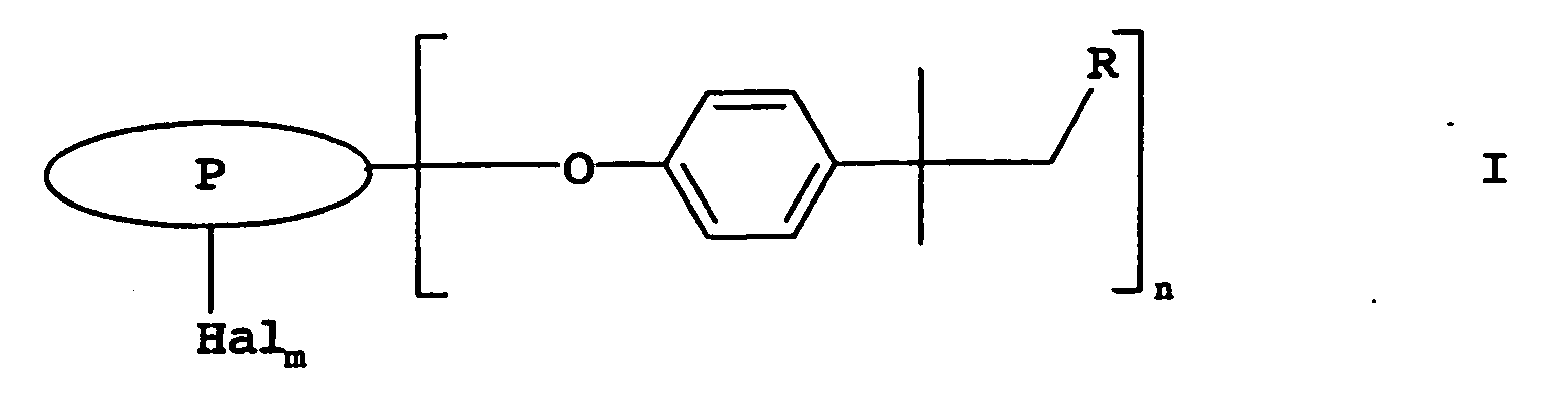
- P
- für einen gegenüber Basen und Nukleophilen stabilen, gegebenenfalls Arylsubstituenten tragenden, konjugierten polycylischen Rest steht, der keine Gruppierungen aus der Gruppe -CO-NH-CO-, -COOH und -CO-O-CO- enthält;
- R
- für einen C1-C8-Alkyl-Rest steht, dessen Kohlenstoffkette durch eine oder mehrere Gruppierungen, ausgewählt unter -O-, -S-, -NR1-, -CO- und -SO2-, unterbrochen sein kann, wobei die Kohlenstoffkette gegebenenfalls ein- oder mehrfach substituiert ist mit gleichen oder verschiedenen Resten, ausgewählt unter C1-C6-Alkoxy oder einen über ein Stickstoffatom gebundenen, 5- bis 7-gliedrigen heterocyclischen Rest, der gegebenenfalls weitere Heteroatome enthält und/oder aromatisch ist, oder für einen C5-C8-Cycloalkyl-Rest steht, dessen Kohlenstoffgerüst durch eine oder mehrere Gruppierungen, ausgewählt unter -O-, -S-, -NR1-, -CO- und -SO2- unterbrochen sein kann, wobei das Kohlenstoffgerüst gegebenenfalls ein- oder mehrfach durch C1-C6-Alkyl substituiert ist;
- R1
- für Wasserstoff oder C1-C6-Alkyl steht;
- Hal
- für Chlor und/oder Brom steht;
- m
- eine Zahl von 0 bis 15 bedeutet;und
- n
- eine Zahl von 1 bis 16 bedeutet, wobei die Summe m + n ≤ 16 ist
- ii) wenigstens eine härtbare Infrarot (IR)-Reflektor-Komponente B, die
- a) wenigstens ein achirales nematisches polymerisierbares Monomer und wenigstens ein chirales polymerisierbares Monomer;
- b) wenigstens ein cholesterisches polymerisierbares Monomer;
- c) wenigstens ein cholesterisches vernetzbares Polymer; oder
- d) wenigstens ein cholesterisches Polymer in einem polymerisierbaren Verdünnungsmittel
- Die IR-Reflektor-Eigenschaft der Komponente B ist darauf zurückzuführen, dass nach dem Orientieren und Härten der Komponente B wenigstens ein Teil der orientierten, durch Polymerisation der Monomere a) oder b) erhältlichen cholesterische Polymere bzw. wenigstens ein Teil der orientierten Polymere c) oder d) eine Ganghöhe der helikalen Überstruktur aufweisen, die einer Wellenlänge im IR-Spektralbereich entspricht.
- Unter Härten versteht man im Rahmen der vorliegenden Erfindung sowohl die Polymerisation von Monomeren als auch das Vernetzen von Polymeren.
- Unter Strahlung absorbierenden Verbindungen A sollen solche verstanden werden, die im Spektralbereich des Infrarot (IR-Strahlung), d. h. im Spektralbereich mit einer Wellenlänge von > 750 nm bis etwa 1 mm, vorzugsweise von 751 nm bis etwa 2000 nm, und/ oder im sichtbaren Spektralbereich, d. h. im Spektralbereich mit einer Wellenlänge von 350 bis 750 nm, vorzugsweise von 550 bis 750 nm, und/oder im Spektralbereich des Ultraviolett (UV-Strahlung), d. h. im Spektralbereich mit einer Wellenlänge von 10 nm bis <350 nm, vorzugsweise von 100 nm bis 349 nm, absorbieren. Vorzugsweise absorbieren die Verbindungen A im Spektralbereich des Infrarot, insbesondere von 751 bis 2000 nm, und/oder im sichtbaren Spektralbereich, insbesondere von 550 bis 750 nm. Besonders bevorzugt absorbieren die Verbindungen A im Spektralbereich des Infrarot, insbesondere von 751 bis 2000 nm, und im sichtbaren Spektralbereich, insbesondere von 550 bis 750 nm.
- Die Verbindungen A können als Reinsubstanzen oder als Gemische von Stellungsisomeren oder als Stoffgemische eingesetzt werden.
- Die Verbindungen A der Formel I sind beispielsweise in der PCT-Anmeldung
PCT/EP 02/03279 (WO 02/076988 A - Der Rest P kann Arylsubstituenten tragen, die basisch nicht angreifbar sind, z.B. unsubstituiertes, alkyl- und/oder alkoxysubstituiertes Aryl, insbesondere Phenyl, oder Hetaryl, wie 2-, 3- und 4-Pyridyl und Pyrimidyl. Diese Arylsubstituenten können entweder direkt an das Ringgerüst oder bei den weiter unten aufgeführten polycyclischen Imiden auch an die Imidstickstoffatome gebunden sein.
- Der bzw. die tert-Alkylphenoxyreste können bei solchen arylsubstituierten Resten P auch über die Arylsubstituenten an den Rest P gebunden sein, also z.B. bei Diphenyldiketopyrrolopyrrol oder N,N'-Diphenylperylen-3,4:9,10-tetracarbonsäurediimid über die 4- oder 3,5-Positionen des Phenylrestes.
- Vorzugsweise bedeutet P einen basenstabilen Rest aus der Gruppe der Naphthaline, Anthracene, Phenanthrene, Tetracene, Perylene, Terrylene, Quaterrylene, Pentarylene und Hexarylene, Anthrachinone, Indanthrone, N-substituierten Naphthalin-1,8-dicarbonsäuremonoimide (im folgenden kurz "Naphthalmonoimide" genannt), N,N'-disubstituierten Naphthalin-1,8:4,5-tetracarbonsäurediimide (kurz "Naphthalimide"), N-substituierten Perylen-3,4-dicarbonsäuremonoimide (kurz "Perylmonoimide"), N,N'-disubstituierten Perylen-3,4:9,10-tetracarbonsäurediimide (kurz "Perylimide"), N,N'-disubstituierten Terrylen-3,4:11,12-tetracarbonsäurediimide (kurz "Terrylimide"), N,N'-disubstituierten Quaterrylen-3,4:13,14-tetracarbonsäurediimide (kurz "Quaterrylimide"), Acridine, Carbazole, Dibenzofurane, Dinaphthofurane, Benzimidazole, Benzthiazole, Phenazine, Dioxazine, Chinacridone, Metallphthalocyanine, Metallnaphthalocyanine, Metallporphyrine, Cumarine, Dibenzofuranone, Dinaphthofuranone, Benzimidazolone, Indigoverbindungen, Thioindigoverbindungen, Chinophthalone, Naphthochinophthalone und Diketopyrrolopyrrole.
- Besonders bevorzugt sind dabei Reste P aus der Gruppe der Naphthaline, Chinacridone, Diketopyrrolopyrrole, Dioxazine, Indanthrone, Metallphthalocyanine, Metallnaphthalocyanine, Naphthalmonoimide, Perylmonoimide, Perylimide, Terrylimide und Quaterrylimide, wobei die Metallphthalocyanine, Metallnaphthalocyanine, Metallporphyrine, Terrylimide und Quaterrylimide ganz besonders bevorzugt sind. Davon sind insbesondere die Quaterrylimide bevorzugt.
- Die die Verbindungen I charakterisierenden tert-Alkylphenoxyreste sowie die gegebenenfalls zusätzlich vorhandenen Halogenatome können direkt oder, wie oben bereits beschrieben, über gegebenenfalls vorhandene Arylsubstituenten an das Ringgerüst der Reste P gebunden sein. Selbstverständlich können auch beide Bindungsformen in einer Verbindung I auftreten. Größere Reste P, wie Perylmonoimide, Perylimide, Terrylimide und Quaterrylimide, tragen die tert-Alkylphenoxyreste bevorzugt direkt am Ringgerüst oder weisen zumindest direkt gebundene tert-Alkylphenoxyreste zusätzlich zu arylengebundenen tert-Alkylphenoxyresten auf.
- Je nach Größe des konjugierten Ringgerüsts enthalten die Verbindungen I mindestens 1 und bis zu 16 (n: 1 bis 16), insbesondere 2 bis 8, tert-Alkylphenoxyreste.
- Beispielhaft seien für die besonders bevorzugten Reste P die generell geeigneten und die bevorzugten Bereiche für die Summe m+n genannt: Naphthaline: 1 bis 4, insbesondere 1 bis 2; Chinacridone: 1 bis 8, insbesondere 2 bis 4; Diketopyrrolopyrrole: 1 bis 6, insbesondere 2 bis 4; Dioxazine: 1 bis 8, insbesondere 2 bis 4; Indanthrone: 1 bis 6, insbesondere 2 bis 4; Metallphthalocyanine: 1 bis 16, insbesondere 4 bis 8; Metallnaphthalocyanine: 1 bis 16, insbesondere 8 bis 16; Naphthalmonoimide: 1 bis 4, insbesondere 1 bis 2; Perylmonoimide: 1 bis 6, insbesondere 1 bis 3; Perylimide: 1 bis 8, insbesondere 2 bis 6; Terrylimide: 1 bis 12, insbesondere 2 bis 8; Quaterrylimide: 1 bis 14, insbesondere 2 bis 8.
- Weisen die Reste P zusätzliche Arylsubstituenten auf, die nicht zur Bindung der tert-Alkylphenoxyreste dienen, erniedrigt sich natürlich die maximal mögliche Summe m+n entsprechend.
- Die tert-Alkylphenoxyreste sowie die gegebenenfalls vorhandenen Hal-Substituenten sind über den Rest P vorzugsweise statistisch verteilt.
- Im folgenden sind geeignete Beispiele für die in Formel I auftretenden Reste R und R1 sowie für deren Substituenten aufgeführt.
- C1-C6-Alkyl steht beispielsweise für Methyl, Ethyl, Propyl, Isopropyl, Butyl, Isobutyl, sec-Butyl, tert-Butyl, Pentyl, Isopentyl, Neopentyl, tert-Pentyl, Hexyl und 2-Methylpentyl. C1-C8-Alkyl steht neben diesen Resten weiterhin beispielsweise für Heptyl, 1-Ethylpentyl, Octyl, 2-Ethylhexyl und Isooctyl.
- C1-C8-Alkyl, dessen Kohlenstoffkette durch eine oder mehrere Gruppierungen -O- unterbrochen sein kann, steht beispielsweise für 2-Methoxyethyl, 2-Ethoxyethyl, 2-Propoxyethyl, 2-Isopropoxyethyl, 2-Butoxyethyl, 2- und 3-Methoxypropyl, 2- und 3-Ethoxypropyl, 2-und 3-Propoxypropyl, 2- und 3- Butoxypropyl, 2- und 4-Methoxybutyl, 2- und 4-Ethoxybutyl, 2- und 4-Propoxybutyl, 3,6-Dioxaheptyl, 3,6-Dioxaoctyl, 4,8-Dioxanonyl, 3,7-Dioxaoctyl, 3,7-Dioxanonyl, 4,7-Dioxaoctyl, 4,7-Dioxanonyl, 2- und 4-Butoxybutyl, 4,8-Dioxadecyl, 3,6,9-Trioxadecyl und 3,6,9-Trioxaundecyl.
- C1-C9-Alkyl, dessen Kohlenstoffkette durch eine oder mehrere Gruppierungen -S- unterbrochen sein kann, steht beispielsweise für 2-Methylthioethyl, 2-Ethylthioethyl, 2-Propylthioethyl, 2-Isopropylthioethyl, 2-Butylthioethyl, 2- und 3-Methylthiopropyl, 2- und 3-Ethylthiopropyl, 2- und 3-Propylthiopropyl, 2- und 3- Butylthiopropyl, 2- und 4-Methylthiobutyl, 2- und 4-Ethylthiobutyl, 2-und 4-Propylthiobutyl, 3,6-Dithiaheptyl, 3,6-Dithiaoctyl, 4,8-Dithianonyl, 3,7-Dithiaoctyl, 3,7-Dithianonyl, 4,7-Dithiaoctyl, 4,7-Dithianonyl, 2- und 4-Butylthiobutyl, 4,8-Dithiadecyl, 3,6,9-Trithiadecyl und 3,6,9-Trithiaundecyl.
- C1-C8-Alkyl, dessen Kohlenstoffkette durch eine oder mehrere Gruppierungen -NR1- unterbrochen sein kann, steht beispielsweise für 2-Monomethyl- und 2-Monoethylaminoethyl, 2-Dimethylaminoethyl, 2-und 3-Dimethylaminopropyl, 3-Monoisopropylaminopropyl, 2- und 4-Monopropylaminobutyl, 2- und 4-Monomethylaminobutyl, 6-Methyl-3,6-diazaheptyl, 3,6-Dimethyl-3,6-diazaheyptyl, 3,6-Diazaoctyl, 3,6-Dimethyl-3,6-diazaoctyl, 9-Methyl-3,6,9-triazadecyl, 3,6,9-Trimethyl-3,6,9-triazadecyl, 3,6,9-Triazaundecyl und 3,6,9-Trimethyl-3,6,9-triazaundecyl.
- C1-C8-Alkyl, dessen Kohlenstoffkette durch eine oder mehrere Gruppierungen -CO- unterbrochen sein kann, steht beispielsweise für-Propan-2-on-1-yl, Butan-3-on-1-yl, Butan-3-on-2-yl und 2-Ethylpentan-3-on-1-yl.
- C1-C8-Alkyl, dessen Kohlenstoffkette durch eine oder mehrere Gruppierungen -SO2- unterbrochen sein kann, steht beispielsweise für 2-Methylsulfonylethyl, 2-Ethylsulfonylethyl, 2-Propylsulfonylethyl, 2-Isopropylsulfonylethyl, 2-Buthylsulfonylethyl, 2- und 3-Methylsulfonylpropyl, 2- und 3-Ethylsulfonylpropyl, 2- und 3-Propylsulfonylpropyl, 2- und 3-Butylsulfonylpropyl, 2- und 4-Methylsulfonylbutyl, 2- und 4-Ethylsulfonylbutyl, 2- und 4-Propylsulfonylbutyl und 4-Butylsulfonylbutyl.
- C1-C6-Alkoxy steht z. B. für Methoxy, Ethoxy, Propoxy, Isopropoxy, Butoxy, Isobutoxy, sec-Butoxy, tert-Butoxy, Pentoxy, Isopentoxy, Neopentoxy, tert-Pentoxy und Hexoxy.
- Der über ein Stickstoffatom gebundene 5- bis 7-gliedrige heterocyclischer Rest, der gegebenenfalls weitere Heteroatome enthält und/oder aromatisch sein kann, steht beispielsweise für Pyrrol, Pyrazol, Imidazol, Triazol, Pyrrolidin, Pyrazolin, Pyrazolidin, Imidazolin, Imidazolidin, Pyridin, Pyridazin, Pyrimidin, Pyrazin, Triazin, Piperidin, Piperazin, Oxazol, Isooxazol, Thiazol, Isothiazol, Indol, Chinolin, Isochinolin oder Chinaldin.
- C5-C8-Cycloalkyl, dessen Kohlenstoffgerüst durch eine oder mehrere Gruppierungen, ausgewählt unter -O-, -S-, NR1-, -CO- und -SO2-, unterbrochen sein kann, wobei das Kohlenstoffgerüst ein- oder mehrfach durch C1-C6-Alkyl substituiert sein kann, steht beispielsweise für Cyclopentyl, 2- und 3-Methylcyclopentyl, 2- und 3-Ethylcyclopentyl, Cyclohexyl, 2-, 3- und 4-Methylcyclohexyl, 2-, 3- und 4-Ethylcyclohexyl, 3- und 4-Propylcyclohexyl, 3- und 4-Isopropylcyclohexyl, 3- und 4-Butylcyclohexyl, 3- und 4-sec-Butylcyclohexyl, 3- und 4-tert-Butylcyclohexyl, Cycloheptyl, 2-, 3- und 4-Methylcycloheptyl, 2-, 3- und 4-Ethylcycloheptyl, 3- und 4-Propylcycloheptyl, 3- und 4-Isopropylcycloheptyl, 3- und 4-Butylcycloheptyl, 3- und 4-sec-Butylcycloheptyl, 3- und 4-tert-Butylcycloheptyl, Cyclooctyl, 2-, 3-, 4- und 5-Methylcyclooctyl, 2-, 3-, 4- und 5-Ethylcyclooctyl, 3-, 4- und 5-Propylcyclooctyl, 2-Dioxanyl, 4-Morpholinyl, 2- und 3-Tetrahydrofuryl, 1-, 2- und 3-Pyrrolidinyl und 1-, 2-, 3- und 4-Piperidyl.
- Als Beispiele für bevorzugte tert-Alkylphenoxyreste seien p-(1,1-Dimethylpropyl)phenoxy, p-(1,1-Dimethylbutyl)phenoxy, p-(1,1-Dimethylpentyl)phenoxy, p-(1,1,3,3-Tetramethylbutyl)phenoxy, p-(2-Cyclopentyl-1,1-dimethylethyl)phenoxy, p-(2-Cyclohexyl-1,1-dimethylethyl)phenoxy, p-(2-Cycloheptyl-1,1-dimethylethyl)phenoxy und p-(1,1-Dimethyl-2-(4-morpholinyl)ethyl)phenoxy genannt. Besonders bevorzugt ist p-(1,1,3,3-Tetramethylbutyl)phenoxy.
- Die besonders bevorzugten Naphthalmonoimide, Perylmonoimide, Perylimide, Terrylimide und Quaterrylimide tragen insbesondere folgende basenstabile Substituenten R2 an den Imidstickstoffatomen:
- C1-C30-Alkyl, dessen Kohlenstoffkette durch eine oder mehrere Gruppierungen, ausgewählt unter -O-, -S-, -NR1-, -CO- und -SO2-, unterbrochen sein kann, wobei die Kohlenstoffkette gegebenenfalls ein- oder mehrfach substituiert ist mit gleichen oder verschidenen Resten, ausgewählt unter C1-C6-Alkoxy und einen über ein Stickstoffatom gebundenen, 5- bis 7-gliedrigen heterocyclischen Rest, der gegebenenfalls weitere Heteroatome enthält und/oder aromatisch ist;
- C5-C8-Cycloalkyl, dessen Kohlenstoffgerüst durch eine oder mehrere Gruppierungen, ausgewählt unter -O-, -S-, -NR1-, -CO- und -SO2-, unterbrochen sein kann, wobei das Kohlenstoffgerüst gegebenenfalls ein- oder mehrfach durch C1-C6-Alkyl substituiert ist;
- Aryl oder Hetaryl, wie Phenyl, Naphthyl, Anthracenyl, Phenantrenyl, Pyrrolyl, Pyrazolyl, Imidazolyl, Oxazolyl, Thiazolyl, Pyridinyl, Pyridazinyl, Pyrimidinyl, Pyrazinyl, Indolyl, Chinolinyl, Isochinolinyl oder Chinaldinyl, das jeweils ein- oder mehrfach durch C1-C18-Alkyl, C1-C6-Alkoxy, Cyano, -CONH-R1 und/oder -NH-COR1 substituiert sein kann.
- Im einzelnen seien für diese Substituenten ergänzend zu den bereits genannten Resten folgende Reste beispielhaft aufgeführt:
- C1-C30-Alkyl steht neben den zuvor genannten Alkylresten weiterhin beispielsweise für Nonyl, Isononyl, Decyl, Isodecyl, Undecyl, Dodecyl, Tridecyl, Isotridecyl, Tetradecyl, Pentadecyl, Hexadecyl, Heptadecyl, Octadecyl, Nonadecyl und Eicosyl (die Bezeichnungen Isononyl, Isodecyl und Isotridecyl sowie die weiter oben angeführte Bezeichnung Isooctyl sind Trivialbezeichnungen und stammen von den nach der Oxosynthese erhaltenen Alkoholen);
- Durch die Gruppierung -O- oder -S- unterbrochenes C1-C30-Alkyl steht beispielsweise für 3,6,9-Trioxadodecyl, 3,6,9,12-Tetraoxatridecyl und 3,6,9,12-Tetraoxatetradecyl; 3,6,9-Trithiadodecyl, 3,6,9,12-Tetrathiatridecyl und 3,6,9,12-Tetrathiatetradecyl;
- Die Substituenten -CO-NHR1 und -NH-COR1 stehen beispielsweise für Carbamoyl, Methylaminocarbonyl, Ethylaminocarbonyl, Propylaminocarbonyl, Butylaminocarbonyl, Pentylaminocarbonyl, Hexylaminocarbonyl, Heptylaminocarbonyl, Octylaminocarbonyl, Nonylaminocarbonyl und Decylaminocarbonyl; Formylamino, Acetylamino und Propionylamino;
- Aryl oder Hetaryl, das jeweils ein- oder mehrfach durch C1-C18-Alkyl, C1-C6-Alkoxy, Cyano, -CONH-R1 und/oder -NH-COR1 substituiert sein kann, steht beispielsweise für 2-, 3- und 4-Methylphenyl, 2,4-, 2,5-, 3,5- und 2,6-Dimethylphenyl, 2,4,6-Trimethylphenyl, 2-, 3- und 4-Ethylphenyl, 2,4-, 2,5-, 3,5- und 2,6-Diethylphenyl, 2,4,6-Triethylphenyl, 2-, 3- und 4-Propylphenyl, 2,4-, 2,5-, 3,5-und 2,6- Dipropylphenyl, 2,4,6-Tripropylphenyl, 2-, 3- und 4-Isopropylphenyl, 2,4-, 2,5-, 3,5- und 2,6-Diisopropylphenyl, 2,4,6-Triisopropylphenyl, 2-, 3- und 4-Butylphenyl, 2,4-, 2,5-, 3,5- und 2,6-Dibutylphenyl, 2,4,6-Tributylphenyl, 2-, 3- und 4-Isobutylphenyl, 2,4-, 2,5-, 3,5- und 2,6-Diisobutylphenyl, 2,4,6-Triisobutylphenyl, 2-, 3- und 4-sec-Butylphenyl, 2,4-, 2,5-, 3,5- und 2,6-Di-sec-butylphenyl, 2,4,6-Tri-sec-butylphenyl, 2-, 3- und 4-tert-Butylphenyl, 2,4-, 2,5-, 3,5- und 2,6-Di-tert-butylphenyl und 2,4,6-Tri-tert-Butylphenyl; 2-, 3- und 4-Methoxyphenyl, 2,4-, 2,5-, 3,5- und 2,6-Dimethoxyphenyl, 2,4,6-Trimethoxyphenyl, 2-, 3- und 4-Ethoxyphenyl, 2,4-, 2,5-, 3,5- und 2,6-Diethoxyphenyl, 2,4,6-Triethoxyphenyl, 2-, 3- und 4-Propoxyphenyl, 2,4-, 2,5-, 3,5- und 2,6-Dipropoxyphenyl, 2-, 3- und 4-Isopropoxyphenyl, 2,4-, 2,5-, 3,5- und 2,6-Diisopropoxyphenyl und 2-, 3- und 4-Butoxyphenyl; 2-, 3- und 4-Cyanophenyl; 3- und 4-Carboxamidophenyl, 3- und 4-N-(Methyl)carboxamidophenyl und 3- und 4-N-(Ethyl)carboxamidophenyl; 3- und 4-Acetylaminophenyl, 3- und 4-Propionylaminophenyl und 3- und 4-Butyrylaminophenyl.
- Besonders bevorzugte Verbindungen A sind solche, in denen P für N,N'-disubstituierte Quaterrylen-3,4:13,14-tetracarbonsäurediimide der Formel II steht

- In besonders bevorzugten Verbindungen A der Formel I, in denen P für ein Quaterrylimid II steht, stehen
R vorzugsweise für H, Methyl, Ethyl, Propyl, Isopropyl, Butyl, tert-Butyl, Cyclopentyl, Cyclohexyl, Cycloheptyl, oder Morpholinyl, besonders bevorzugt für H, Methyl, Ethyl, Butyl oder tert-Butyl und insbesondere für tert-Butyl;
R2 vorzugsweise für substituiertes Phenyl, besonders bevorzugt für ein- bis dreifach mit C1-C4-Alkyl substituiertes Phenyl und insbesondere für 2,6-Diisopropylphenyl;
n vorzugsweise für 2 bis 10, besonders bevorzugt für 4 bis 8 und insbesondere für 6; und
m vorzugsweise für 0 bis 4, besonders bevorzugt für 0 bis 2 und insbesondere für 0. - Die n tert-Alkylphenoxysubstituenten sowie die m Substituenten Hal sind über das Quaterrylensystem vorzugsweise statistische verteilt. Besonders bevorzugt befinden sich auf den beiden Seiten einer gedachten Achse zwischen den beiden Imid-Stickstoffatomen jeweils gleich viele Substituenten.
- Die Verbindungen der Formel I können mittels eines Verfahrens erhalten werden, bei dem man ein Halogenid der allgemeinen Formel III


- Als inertes stickstoffbasisches Lösungsmittel eignen sich hierfür insbesondere polare Lösungsmittel, vor allem Stickstoffheterocyclen, wie Pyridin, Pyrimidin, Chinolin, Isochinolin, Chinaldin und vorzugsweise N-Methylpyrrolidon, sowie Carbonsäureamide, wie N,N-Dimethylformamid und N,N-Dimethylacetamid.
- Die Lösungsmittelmenge beträgt abhängig von der Löslichkeit des Halogenids III üblicherweise 2 bis 40 g, vorzugsweise 4 bis 25 g, Lösungsmittel je g Halogenid III.
- Als Base sind insbesondere nicht oder nur schwach nukleophile Verbindungen geeignet. Beispiele für solche Basen sind Alkalimetallhydroxide, wie Kalium- und Natriumhydroxid, Alkalimetallcarbonate, wie Kalium- und Natriumcarbonat, sowie Alkalimetallalkoholate tertiärer Alkohole, wie Lithium-, Natrium- und Kaliumtert-butylat, die in wasserfreier Form zum Einsatz kommen.
- In der Regel werden 0,8 bis 1,5, vorzugsweise 1,0 bis 1,2, Moläquivalente Base je mol zu substituierendes Halogenatom eingesetzt.
- Die als Ausgangsstoffe eingesetzten Halogenide III sind allgemein bekannt oder nach bekannten Methoden durch Umsetzung der nichthalogenierten konjugierten polycyclischen Verbindungen mit Halogenierungsmitteln, insbesondere den elementaren Halogenen, erhältlich. Halogenide III, die die Halogenatome an Arylsubstituenten gebunden enthalten, sind bekanntermaßen in der Regel über die Einführung der halogenierten Arylreste in das polycyclische System zugänglich.
- Das Molverhältnis Halogenid III zu Phenol IV hängt von der Anzahl der zu substituierenden Halogenatome ab. Im allgemeinen verwendet man 1 bis 2, bevorzugt 1 bis 1,3, mol Phenol IV je mol auszutauschendes Halogenatom im Halogenid III.
- Die Reaktionstemperatur liegt üblicherweise im Bereich von 50 bis 200°C, vorzugsweise bei 60 bis 140°C.
- Es empfiehlt sich, die Umsetzung unter Schutzgas, z.B. Stickstoff oder Argon, durchzuführen.
- Die Reaktionszeit beträgt in Abhängigkeit von der Reaktivität des Halogenids III 2 bis 48 h.
- Durch Auswahl der Reaktionsbedingungen - Menge an Phenol IV und Base sowie der Reaktionstemperatur - kann der Halogenaustausch vorteilhaft gesteuert werden, so daß sowohl Produkte I, in denen alle Halogenatome ausgetauscht sind (m=0), als auch Produkte I, die noch Halogen enthalten, problemlos hergestellt werden können. Gewünschtenfalls kann das Halogen anschließend noch aus dem Produkt I entfernt werden. Aus einem Ausgangsprodukt III können also verschiedene Produkte I nach Wunsch hergestellt werden.
- Bei der Komponente B sind bevorzugte Monomere der Gruppe a) in der
WO 99/19267 P 10203938.0 (DE 10203938 ) beschrieben, auf die hiermit in vollem Umfang Bezug genommen wird. Bevorzugt ist das achirale nematische polymerisierbare Monomer der Gruppe a) difunktionell polymerisierbar und entspricht vorzugsweise der allgemeinen Formel V
Z1-(Y1-A1)V-Y2-M-Y3-(A2-Y4)w-Z2 (V)
worin - Z1, Z2
- für gleiche oder verschiedene reaktive Gruppen stehen, über die eine Polymerisation erfolgen kann, bzw. Reste, die solche reaktiven Gruppen enthalten, wobei es sich bei den reaktiven Gruppen um C=C-Doppelbindungen, C≡C-Dreifachbindungen, Oxiran-, Thiiran-, Aziran-, Cyanat-, Thiocyanat-, Isocyanat-, Carbonsäure-, Hydroxy- oder Aminogruppen handelt, wobei C=C-Doppelbindungen besonders bevorzugt sind;
- Y1, Y2, Y3, Y4
- unabhängig voneinander für eine chemische Bindung, O, S, -CO-O-, -O-CO-, -O-CO-O-, -CO-S-, -S-CO-, -CO-N(R3)-, -N(R3)-CO-, -N(R3)-CO-O-, -O-CO-N(R3)-, -N(R3)-CO-N(R3)-, -CH2-O-, -O-CH2-, vorzugsweise -CO-O-, -O-CO- oder -O-CO-O- stehen,
- A1, A2
- für gleiche oder verschiedene Spacer stehen, beispielsweise lineare C2-C30-Alkylengruppen, vorzugsweise C2-C12-Alkylengruppen, die durch Sauerstoff, Schwefel, gegebenenfalls einfach substituiertem Stickstoff unterbrochen sein können, wobei diese unterbrechenden Gruppen nicht benachbart sein dürfen; wobei geeignete Aminsubstituenten C1-C4-Alkylgruppen umfassen, wobei die Alkylenketten durch Fluor, Chlor, Brom, Cyan, Methyl oder Ethyl substituiert sein können; und wobei besonders bevorzugt A1 und A2 für -(CH2)-n mit n = 2 bis 6 stehen;
- v, w
- für 0 oder 1 steht;
- M
- eine mesogene Gruppe bedeutet, die vorzugsweise die allgemeine Formel VI besitzt:
(T-Y5)m-T (VI)
- T
- für gleiche oder verschiedene zweiwertige isocycloaliphatische, heterocycloaliphatische, isoaromatische oder heteroaromatische Reste, vorzugsweise 1,4-gebundene unsubstituierte oder 1- bis mehrfach, z.B. 1- bis 4-fach, substituierte Benzolringe steht,

- R4
- für Fluor, Chlor, Brom, C1-C20-Alkyl, C1-C20-Alkoxy, C1-C20-Alkylcarbonyl, C1-C20-Alkylcarbonyloxy, Hydroxy, Nitro, CHO oder CN, vorzugsweise für Chlor, Brom oder C1-C4-Alkyl und insbesondere für Methyl steht; und
- n
- für eine ganze Zahl von 0 bis 4, vorzugsweise 0 bis 2 und insbesondere für 0 oder 1 steht;
- Y5
- für gleiche oder verschiedene Brückenglieder -CO-O-, -O-CO-, -CH2-O-, -O-CH2-, -CO-S-, -S-CO-, -CH2-S-, -S-CH2, -CH=N- oder -N=CH- oder eine direkte Bindung, vorzugsweise -CO-O- oder -O-CO- steht, und
- m
- eine ganze Zahl von 0 bis 3, vorzugsweise 0, 1 oder 2, bedeutet.
- Vorzugsweise enthält die mesogene Gruppe einen substituierten 1,4-Dioxybenzol-Baustein, insbesondere einen Methyl-substituierten 1,4-Dioxybenzol-Baustein.
- Besonders bevorzugte mesogene Gruppen weisen die folgenden Strukturen VII auf:

- R4
- für Fluor, Chlor, Brom, C1-C20-Alkyl, C1-C20-Alkoxy, C1-C20-Alkylcarbonyl, C1-C20-Alkylcarbonyloxy, Hydroxy, Nitro, CHO oder CN steht und
- n
- für eine ganze Zahl von 0 bis 4 steht.
- Besonders bevorzugt steht in der mesogenen Gruppe VII R4 für Chlor, Brom oder C1-C4-Alkyl, und insbesondere für Methyl und n für 0 bis 2, insbesondere für 0 oder 1, speziell für 1.
- Ganz besonders bevorzugte mesogene Gruppen weisen folgende Struktur VIII auf:

- Das chirale polymerisierbare Monomer der Gruppe a) entspricht vorzugsweise der Formel IX
[(Z1-Y1)o-A3-Y2-M-Y3]nX[Y3-M-Y2-A4-(Y1-Z1)p]m (IX)
wobei
Z1, Y1, Y2, Y3 und M wie oben definiert sind,
o, p für 0 oder 1 stehen, wobei o und p nicht gleichzeitig für 0 stehen dürfen, - A3 und A4
- gleich oder verschieden sind und
- A3
- wie A1 definiert ist, wenn o=1 ist oder
für eine lineare C2-C30-Alkylengruppe, vorzugsweise C2-C12-Alkylengruppe steht, die durch Sauerstoff, Schwefel, gegebenenfalls einfach substituiertem Stickstoff unterbrochen sein kann, wobei diese unterbrechenden Gruppen nicht benachbart sein dürfen; wobei geeignete Aminsubstituenten C1-C4-Alkylgruppen umfassen, wobei die Alkylgruppen durch Fluor, Chlor, Brom, Cyan, Methyl oder Ethyl substituiert sein können und wobei A3 besonders bevorzugt für CH3-(-CH2)1-Gruppen mit 1 = 1 bis 7 steht, wenn o=0 ist; - A4
- wie A1 definiert ist, wenn p=1 ist bzw.
für eine lineare C2-C30-Alkylgruppe, vorzugsweise C2-C12-Alkylgruppe, die durch Sauerstoff, Schwefel, gegebenenfalls einfach substituiertem Stickstoff unterbrochen sein kann, wobei diese unterbrechenden Gruppen nicht benachbart sein dürfen; wobei geeignete Aminsubstituenten C1-C4-Alkylgruppen umfassen, wobei die Alkylgruppen durch Fluor, Chlor, Brom, Cyan, Methyl oder Ethyl substituiert sein können und wobei A3 besonders bevorzugt für CH3(̵CH2)1-Gruppen mit 1 = 1 bis 7 steht, wenn p=0 ist; - n, m
- für 0, 1 oder 2 stehen, wobei die Summe n+m gleich 1 oder 2, vorzugsweise 2, ist; und
- X
- für einen chiralen Rest steht.
- Von den chiralen Resten X der Verbindungen der allgemeinen Formel IX sind unter anderem aufgrund der leichteren Verfügbarkeit insbesondere solche bevorzugt, die sich von Zuckern, Dinaphthyl- oder Diphenylderivaten sowie optisch aktiven Glykolen, Alkoholen oder Aminosäuren ableiten. Bei den Zuckern sind insbesondere Pentosen und Hexosen und davon abgeleitete Derivate zu nennen.
- Beispiele für Reste X sind die folgenden Strukturen, wobei die endständigen Striche jeweils die freien Valenzen bedeuten.


- L1
- C1-C4-Alkyl, C1-C4-Alkoxy, Halogen, COOR5, OCOR5, NHCOR5 ist und R5 für C1-C4-Alkyl oder Wasserstoff steht.
- Besonders bevorzugt sind

- Weiterhin sind auch chirale Gruppen geeignet, die folgende Strukturen aufweisen:


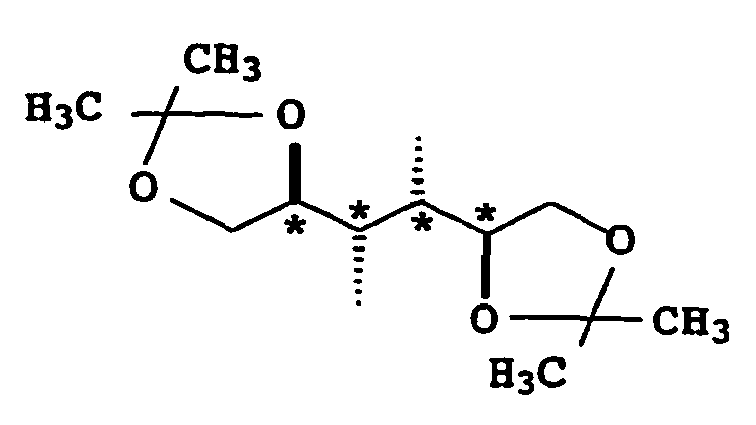
- In obiger Definition für die Gruppen A1, A2, A3, A4, R3, R4, R5 und L1 stehen C1-C20-Alkyl insbesondere für Methyl, Ethyl, n-Propyl, Isopropyl, n-Butyl, sec-Butyl, Isobutyl, tert.-Butyl, Pentyl, Hexyl, Heptyl, Octyl, Nonyl, Decyl, Undecyl, Dodecyl, Tridecyl, Tetradecyl, Pentadecyl, Hexadecyl, Heptadecyl, Octadecyl, Nonadecyl und Eicosyl;
C1-C4-Alkyl steht insbesondere für Methyl, Ethyl, n-Propyl, Isopropyl, n-Butyl, sec-Butyl, Isobutyl oder tert-Butyl;
C1-C20-Alkoxy steht insbesondere für Alkoxygruppen, deren Alkylrest den oben genannten C1-C20-Alkylgruppen entspricht; und C2-C30-Alkylen steht insbesondere für Alkylengruppen, die dem zweiwertigen Rest der oben genannten C2-C20-Alkylgruppen entsprechen, sowie für die linearen C21-C30-Homologe. - In einer besonderen Ausführungsform weist das nematische achirale polymerisierbare Monomer folgende Strukturformel X auf

- In einer weiteren besonderen Ausführungsform weist das chirale polymerisierbare Monomer folgende Strukturformel XI oder XII auf


- Das Mengenverhältnis von achiralem nematischem Monomer zu chiralem Monomer wird so gewählt, dass das aus diesen Monomeren entstehende Polymerisat nach der Orientierung eine Ganghöhe der helikalen Überstruktur aufweist, die einer Wellenlänge im IR-Spektralbereich entspricht. Dabei hängt das Mengenverhältnis von der Art der nematischen und chiralen Monomeren ab und muss von Einzelfall zu Einzelfall bestimmt werden.
- Alternativ kann als Komponente B wenigstens ein cholesterisches polymerisierbares Monomer der Gruppe b) verwendet werden.
- Bevorzugte Monomere der Gruppe b) sind in der
DE-A 19602848 beschrieben, auf die hiermit in vollem Umfang Bezug genommen wird. Insbesondere umfassen die Monomere b) mindestens ein cholesterisches polymerisierbares Monomer der Formel XIII
(Z1-Y1-A1-Y2-M1-Y3)nX (XIII)
- Die Variablen sind dabei wie bei den Monomeren der Gruppe a) definiert. Die bevorzugten Ausgestaltungen gelten entsprechend.
- Alternativ kann als Komponente B wenigstens ein cholesterisches vernetzbares Polymer der Gruppe c) verwendet werden.
- Bevorzugte Polymere der Gruppe c) sind cholesterische Cellulosederivate, wie sie in der
DE-A-197 136 38 beschrieben werden, insbesondere cholesterische Mischester von - (1) Hydroxyalkylethern der Cellulose mit
- (2) gesättigten, aliphatischen oder aromatischen Carbonsäuren und
- (3) ungesättigten Mono- oder Dicarbonsäuren.
- Besonders bevorzugt sind Mischester, bei denen die über Etherfunktionen gebundenen Hydroxyalkylreste der Komponente (1) geradkettige oder verzweigte C2-C10-Hydroxyalkylreste, insbesondere Hydroxypropyl- und/oder Hydroxyethylreste umfassen. Die Komponente (1) der einsetzbaren Mischester weist vorzugsweise ein Molekulargewicht von etwa 500 bis etwa 1 Million auf. Bevorzugtermaßen sind die Anhydroglukose-Einheiten der Cellulose mit einem durchschnittlichen molaren Substitutionsgrad von 2 bis 4 mit Hydroxyalkylresten verethert. Die Hydroxyalkylgruppen in der Cellulose können gleich oder verschieden sein. Bis zu 50 % davon können auch durch Alkylgruppen (insbesondere C1-C10-Alkylgruppen) ersetzt werden. Ein Beispiel hierfür ist die Hydroxypropylmethylcellulose.
- Als Komponente (2) der einsetzbaren Mischester sind geradkettige aliphatische C1-C10-Carbonsäuren, insbesondere C2-C6-Carbonsäuren, verzweigte aliphatische C4-C10-Carbonsäuren, insbesondere C4-C6-Carbonsäuren oder geradkettige oder verzweigte Halogencarbonsäuren brauchbar. Die Komponente (2) kann auch Benzoesäure oder aromatisch substituierte aliphatische Carbonsäuren, insbesondere Phenylessigsäure sein. Besonders bevorzugt ist die Komponente (2) ausgewählt unter Essigsäure, Propionsäure, n-Buttersäure, Isobuttersäure oder n-Valeriansäure, insbesondere unter Propionsäure, 3-Cl-Propionsäure, n-Buttersäure oder Isobuttersäure.
- Vorzugsweise ist die Komponente (3) ausgewählt unter ungesättigten C3-C12-Mono- oder Dicarbonsäuren oder Halbestern einer derartigen Dicarbonsäure, insbesondere α,β-ethylenisch ungesättigten C3-C6-Mono- oder Dicarbonsäuren oder Halbestern der Dicarbonsäuren.
- Die Komponente (3) der einsetzbaren Mischester ist besonders bevorzugt ausgewählt unter Acrylsäure, Methacrylsäure, Crotonsäure, Vinylessigsäure, Maleinsäure, Fumarsäure oder Undecensäure, insbesondere unter Acrylsäure oder Methacrylsäure.
- Vorzugsweise ist die Komponente (1) mit einem durchschnittlichen molaren Substitutionsgrad von 1,5 bis 3, insbesondere von 1,6 bis 2,7, besonders bevorzugt von 2,3 bis 2,6 mit der Komponente (2) und (3) verestert. Vorzugsweise sind etwa 1 bis 30 %, insbesondere 1 bis 20 % oder 1 bis 10 %, besonders bevorzugt etwa 5 bis 7 % der OH-Gruppen der Komponente (1) mit der Komponente (3) verestert.
- Das Mengenverhältnis der Komponente (2) zu Komponente (3) bestimmt die Reflexionswellenlänge des Polymers.
- Gut geeignete Polymere der Gruppe c) sind außerdem die in der
DE-A-197 17 371 beschriebenen, propargylterminierten, cholesterischen Polyester oder Polycarbonate. - Bevorzugt unter diesen Verbindungen sind Polyester oder Polycarbonate mit wenigstens einer Propargylendgruppe der Formel R6C≡C-CH2-, worin R6 für H, C1-C4-Alkyl, Aryl oder Ar-C1-C4-alkyl (z. B. Benzyl oder Phenethyl) steht, die direkt oder über ein Bindeglied an die Polyester oder Polycarbonate gebunden ist. Das Bindeglied ist vorzugsweise ausgewählt unter
-O-, -S-, -NR7-,

worin R7 für H, C1-C4-Alkyl oder Phenyl steht, Z für O, S oder NR8 steht, und R8 für H, C1-C4-Alkyl oder Phenyl steht. - Vorzugsweise ist in den Polyestern die Propargylendgruppe über
-O-,
- Die Polyester enthalten vorzugsweise
- (4) mindestens eine aromatische oder araliphatische Dicarbonsäureeinheit und/oder mindestens eine aromatische oder araliphatische Hydroxycarbonsäureeinheit und
- (5) mindestens eine Dioleinheit.
- Bevorzugte Dicarbonsäureeinheiten sind solche der Formel
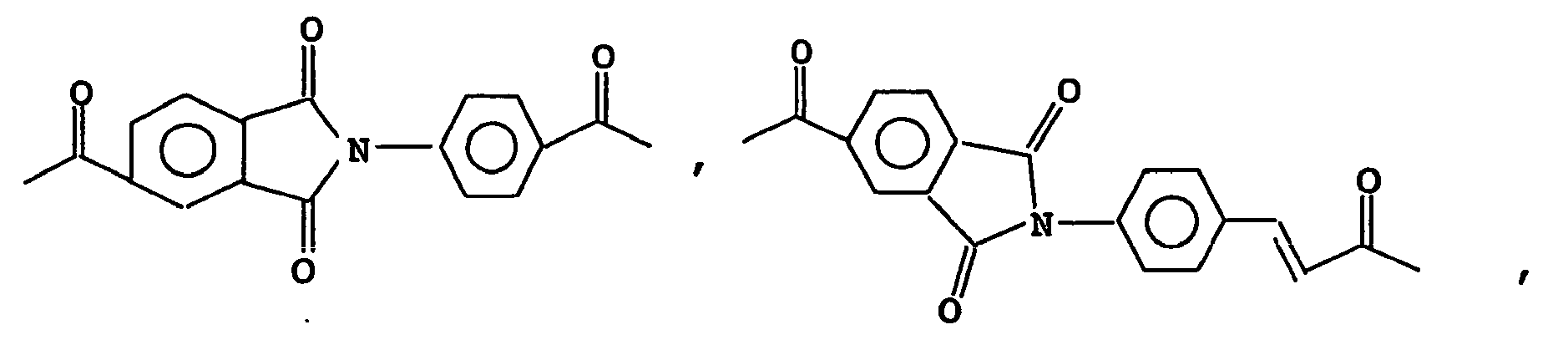



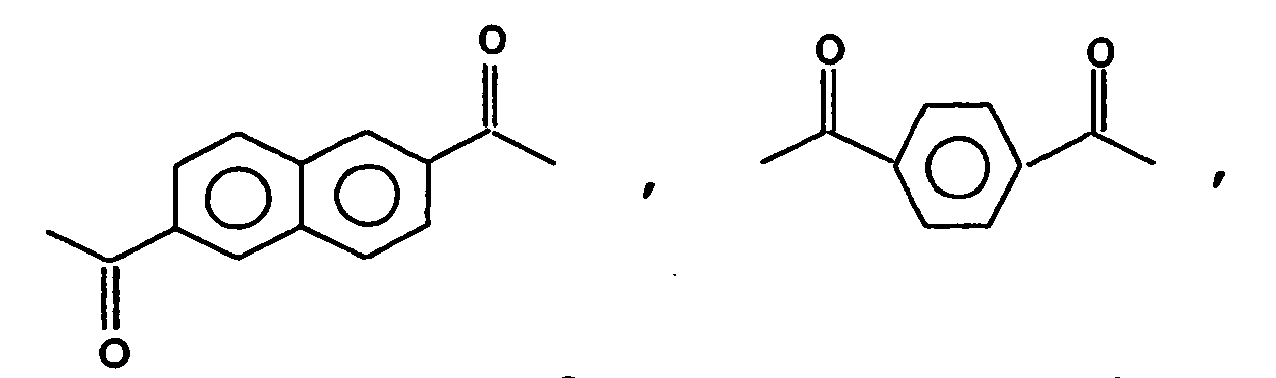

- W
- für NR9, S, O, (CH2)rO(CH2)q, (CH2)s oder eine Einfachbindung steht,
- R9
- Alkyl oder Wasserstoff bedeutet,
- s
- eine ganze Zahl von 1 bis 15 bedeutet, und
- r und q
- unabhängig voneinander für ganze Zahlen von 0 bis 10 stehen.
- Bevorzugte Hydroxycarbonsäureeinheiten sind solche der Formel

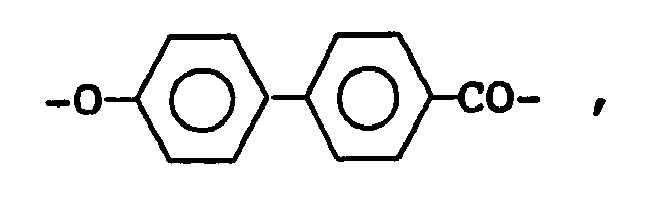
- Bevorzugte Dioleinheiten sind solche der Formel

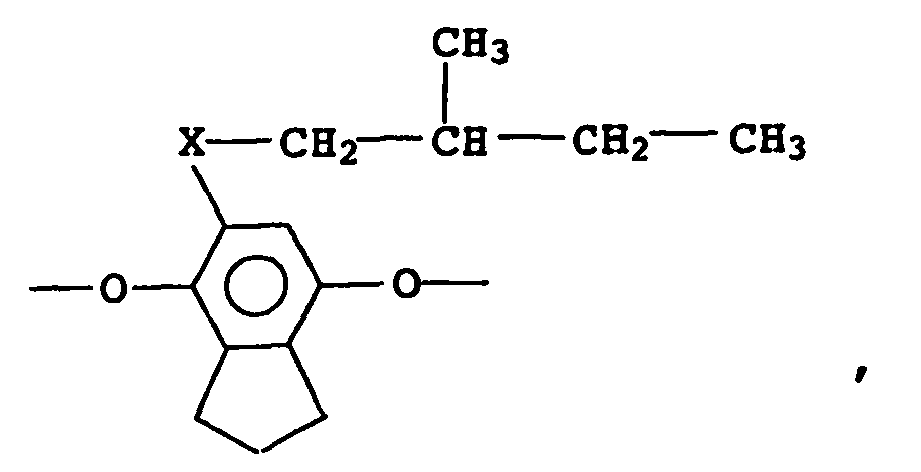



insbesondere solche der Formel


- L
- für Alkyl, Alkoxy, Halogen, COOR11, OCOR11, CONHR11 oder NHCOR11 steht,
- X
- für S, O, N, CH2 oder eine Einfachbindung steht,
- A
- eine Einfachbindung, (CH2)n, O(CH2)n, S(CH2)n, NR11(CH2)n,
- R11
- Alkyl oder Wasserstoff bedeutet,
- R10
- Wasserstoff, Halogen, Alkyl oder Phenyl bedeutet und
- n
- eine ganze Zahl von 1 bis 15 bedeutet.
- Bevorzugt sind Polyester, die mindestens eine Dicarbonsäureeinheit der Formel


- Weitere bevorzugte Verbindungen sind Diester der Formel P-Y-B-CO-O-A-O-CO-B-Y-P, worin P für eine Propargylendgruppe der oben definierten Formel steht, Y für O, S oder NR12 (R12 = C1-C4-Alkyl) steht, B für

jede Phenylgruppe oder die Naphthylgruppe 1, 2 oder 3 Substituenten aufweisen kann, die unabhängig voneinander ausgewählt sind unter C1-C4-Alkyl, C2-C4-Alkoxy, Halogen oder Phenyl, und A (zusammen mit den benachbarten Sauerstoffatomen) für eine der oben genannten Dioleinheiten steht. - Besonders bevorzugte Diester sind solche der oben genannten Formel, in der B für

insbesondere Diester der Formel
HC≡CCH2O-B-CO-O-A-O-CO-B-OCH2-C≡CH, worin - (6) B für

A für

- (7) B für

A die unter (6) genannten Bedeutungen besitzt. - Weitere bevorzugte Verbindungen sind Polycarbonate, die mindestens eine Dioleinheit der oben genannten Formeln, insbesondere der Formeln


- Bevorzugte Polycarbonate sind dabei solche, die als Dioleinheiten mindestens eine mesogene Einheit der Formel

mindestens eine chiralen Einheit der Formel

- Besonders bevorzugte Polycarbonate sind solche mit Propargylendgruppen der Formel HC≡CCH2O-R13-CO, worin R13 für
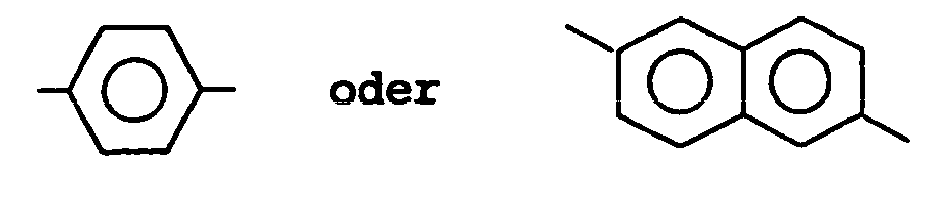
- Als Polymere der Gruppe c) sind außerdem cholesterische Polycarbonate, die auch an nicht-terminaler Position photoreaktive Gruppen enthalten, geeignet. Solche Polycarbonate werden in der
DE-A-196 31 658 beschrieben. Sie entsprechen vorzugsweise der Formel XIV
- In der Formel XIV steht
- A
- für eine mesogene Gruppe der Formel

- B
- für eine chirale Gruppe der Formel
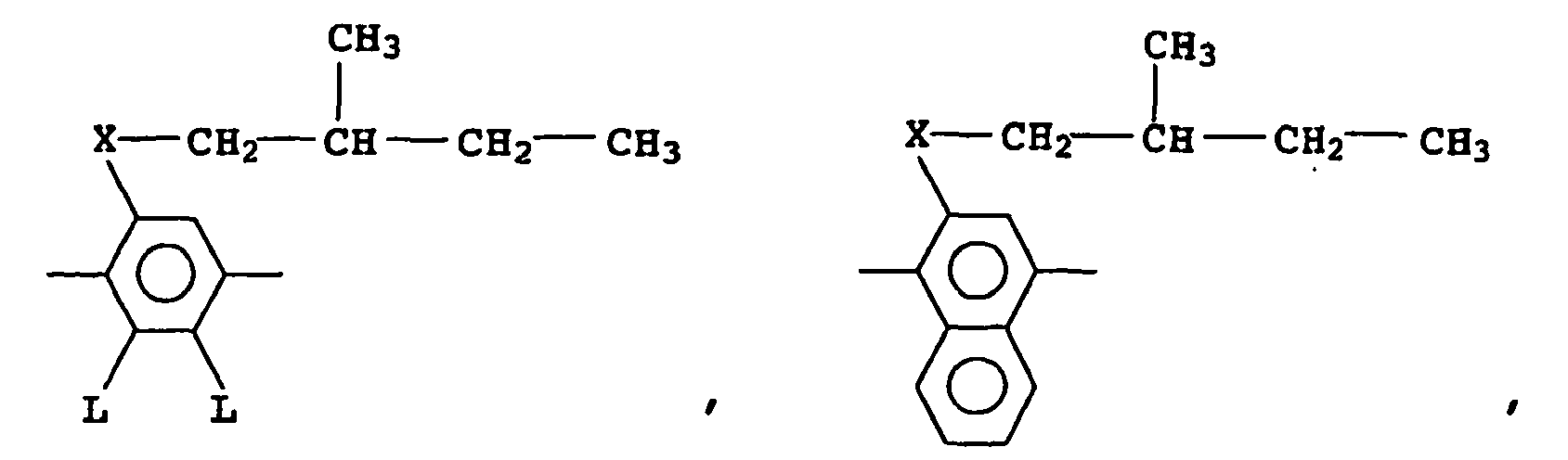


- D
- für eine photoreaktive Gruppe der Formel


- E
- für eine weitere, nicht-chirale Gruppe der Formel

- L
- für Alkyl, Alkoxy, Halogen, COOR15, OCOR15, CONHR15 oder NHCOR15 steht,
- X
- für S, O, N, CH2 oder eine Einfachbindung steht,
- R15
- für Alkyl oder Wasserstoff steht,
- A
- eine Einfachbindung, (CH2)n, O(CH2)n, S(CH2)n, NR(CH2)n,


- R14
- Wasserstoff, Halogen, Alkyl oder Phenyl bedeutet und
- n
- eine ganze Zahl von 1 bis 15 bedeutet.
- Wenn R14 für Alkyl, Halogen und A für eine Einfachbindung stehen oder wenn R14 für H oder Alkyl und A für
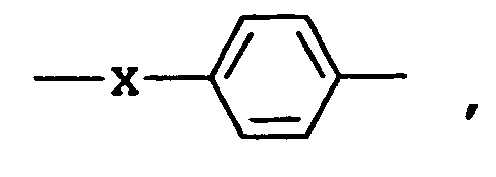
steht, handelt es sich um löslichkeitsverbessernde Gruppen. Beispiele hierfür sind

- Der Anteil der chiralen Diolstruktureinheiten liegt bevorzugt im Bereich von 1 bis 80 mol-% des Gesamtgehaltes an Diolstruktureinheiten, besonders bevorzugt 2 bis 20 mol-%, je nach gewünschtem Reflexionsverhalten.
- Alternativ kann als Komponente B ein cholesterisches Polymer in einem polymerisierbaren Verdünnungsmittel (Gruppe d)) verwendet werden.
- Bevorzugte Polymere der Gruppe d) sind beispielsweise vernetzbare, cholesterische Copolyisocyanate, wie sie in der
US-A-08 834 745 beschrieben werden, auf die hiermit in vollem Umfang Bezug genommen wird. Solche Copolyisocyanate weisen wiederkehrende Einheiten der Formeln


- R16
- für einen chiralen aliphatischen oder aromatischen Rest steht,
- R17
- für einen vernetzbaren Rest steht und
- R18
- für einen achiralen Rest steht.
- Soweit nicht anders angegeben, ist hier unter "Alkyl" (auch in Bedeutungen wie Alkoxy, Dialkyl, Alkylthio etc.) ein verzweigtes und unverzweigtes C1-C12-Alkyl, vorzugsweise C3-C12-, besonders bevorzugt C4-C10-, insbesondere C6-C10-Alkyl zu verstehen.
- Vorzugsweise ist R16 ausgewählt unter (chiralen) verzweigten oder unverzweigten Alkyl-, Alkoxyalkyl-, Alkylthioalkyl-, Cycloalkyl-, Alkylphenyl- oder C3-C9-Epoxyalkylresten oder Resten von Estern von C1-C6-Fettsäuren mit C1-C6-Alkanolen oder C3-C9-Dialkylketonen. Der Esterrest kann sowohl über den Fettsäureanteil als auch über den Alkanolrest an das N-Atom gebunden sein. Der Rest R16 kann 1, 2 oder 3 Substituenten aufweisen, die gleich oder verschieden und ausgewählt sind unter Alkoxygruppen, Di-C1-C4-alkylaminogruppen, CN, Halogenatomen oder C1-C4-Alkylthiogruppen.
- Vorzugsweise ist R16 ausgewählt unter Alkyl, Alkoxyalkyl, Resten von Estern von C1-C6-Fettsäuren mit C1-C6-Alkanolen, C3-C9-Dialkylketonen und epoxidierten C3-C9-Epoxyalkylresten, wobei R16 durch 1 oder 2 Reste substituiert sein kann, die gleich oder verschieden und ausgewählt sind unter Alkoxy, Halogen, CN oder CF3. Bevorzugte Substituenten für verzweigte oder unverzweigte Alkyl- oder Alkoxyreste sind ausgewählt unter Alkoxygruppen, Halogenatomen oder CN; für Ester von C1-C6-Fettsäuren mit C1-C6-Alkanolen unter Alkoxygruppen, Halogenatomen, CN oder CF3 und für C3-C9-Dialkylketone unter Alkoxygruppen, Halogenatomen oder CN.
- Insbesondere weist die Hauptkette des Restes R16 eine Länge von 3 bis 12, insbesondere 6 bis 10, vorzugsweise 6 bis 8 Gliedern (C-, O- und/oder S-Atome) auf. Besonders bevorzugt sind Reste R16, die ausgewählt sind unter








- Der Rest R17 der einsetzbaren Copolyisocyanate ist vorzugsweise ausgewählt unter C3-C11-Alkenylresten, C4-C11-Vinyletherresten (= Vinyl-C2-C9-Alkylethern), ethylenisch ungesättigten C3-C11-Carbonsäureresten und Estern von ethylenisch ungesättigten C3-C6-Monocarbonsäuren mit C2-C6-Alkanolen, wobei die Bindung an das N-Atom über den Alkanolrest des Esters erfolgt. Besonders bevorzugt ist der Rest ausgewählt unter Methylacrylat, Ethylacrylat, Propylacrylat, n-Butylacrylat, Isobutylacrylat, 2-Ethylhexylacrylat, Methylmethacrylat, Ethylmethacrylat, Propylmethacrylat, n-Butylmethacrylat, Isobutylmethacrylat, 2-Ethylhexylmethacrylat, insbesondere unter Ethylacrylat oder Ethylmethacrylat.
- Der Rest R18 besitzt vorzugsweise die gleichen Bedeutungen wie der Rest R16. Er ist aber achiral, d. h. er weist kein Chiralitätszentrum auf oder liegt als racemisches Gemisch vor.
- Besonders bevorzugt weist die Hauptkette des Restes R18 eine Länge von 4 bis 12, insbesondere 6 bis 10, vorzugsweise 6 bis 8 Gliedern (C-, O- und/oder S-Atome) auf. Ganz besonders bevorzugt ist die Komponente XVII der erfindungsgemäßen Copolyisocyanate von n-Hexylisocyanat, n-Heptylisocyanat oder n-Octylisocyanat abgeleitet.
- Die Komponenten XV, XVI und XVII sind vorzugsweise im Molmengenverhältnis XV:XVI:XVII von etwa 1 bis 20 : 1 bis 20 : 50 bis 98, insbesondere etwa 5 bis 15 : 5 bis 15 : 65 bis 90, besonders bevorzugtermaßen etwa 15:10:75 vorhanden.
- Die Einheiten XV, XVI und XVII können in den einsetzbaren Copolyisocyanaten statistisch verteilt sein.
- Bevorzugt wird als Komponente B der erfindungsgemäßen Zusammensetzung ein Gemisch aus wenigstens einem achiralen nematischen polymerisierbaren Monomer und einem chiralen polymerisierbaren Monomer, d. h. Gruppe a), verwendet.
- Die Verbindung bzw. die Summe der Verbindungen A liegt vorzugsweise in einer Menge von 0,01 bis 20 Gew.-%, besonders bevorzugt von 0,01 bis 15 Gew.-%, ganz besonders bevorzugt 0,01 bis 10 Gew.-%, insbesondere von 0,01 bis 7 Gew.-% und speziell 0,01 bis 5 Gew.-%, bezogen auf das Gesamtgewicht der Komponente B, vor.
- Die Zusammensetzung ist vorzugsweise entweder ein inniges Gemisch der Komponenten A und B oder eine Lösung oder Dispersion der Komponenten A und B in einem geeigneten Verdünnungsmittel. Dabei beträgt der Anteil an Verdünnungsmittel vorzugsweise 5 bis 95 Gew.-%, besonders bevorzugt 30 bis 80 Gew.-%, insbesondere 40 bis 70 Gew.-%, bezogen auf das Gesamtgewicht der Zusammensetzung.
- Geeignete Verdünnungsmittel sind für die Verbindungen der Gruppen a) oder b) lineare oder verzweigte Ester, besonders Essigsäurester, cyclische Ether und Ester, Alkohole, Lactone, aliphatische und aromatische Kohlenwasserstoffe, wie Toluol, Xylol und Cyclohexan, sowie Ketone, Amide, N-Alkylpyrrolidone, besonders N-Methylpyrrolidon, und insbesondere Tetrahydrofuran (THF), Dioxan und Methylethylketon (MEK).
- Geeignete Verdünnungsmittel für die Polymere der Gruppe c) sind beispielsweise Ether und cyclische Ether wie Tetrahydrofuran oder Dioxan, chlorierte Kohlenwasserstoffe, wie Dichlormethan, Trichlormethan, Tetrachlorkohlenstoff, Dichlorethan, 1,1,2,2-Tetrachlorethan, 1-Chlornaphthalin, Chlorbenzol oder 1,2-Dichlorbenzol. Diese Verdünnungsmittel sind besonders für Polyester und Polycarbonate geeignet. Geeignete Verdünnungsmittel für Cellulosederivate sind beispielsweise Ether, wie Dioxan, oder Ketone, wie Aceton. Werden Copolyisocyanate als Polymere der Gruppe d) eingesetzt, ist es sinnvoll, polymerisierbare Verdünnungsmittel, wie in der
US-A-08 834 745 beschrieben, zu verwenden. Solche polymerisierbaren Verdünnungsmittel sind beispielsweise - Ester α,β-ungesättigter Mono- oder Dicarbonsäuren, insbesondere C3-C6-Mono- oder Dicarbonsäuren, mit C1-C12-Alkanolen, C2-C12-Alkandiolen oder deren C1-C6-Alkylether und Phenylether, beispielsweise Acrylate und Methacrylate, Hydroxyethyl- oder Hydroxypropylacrylat oder -methacrylat sowie 2-Ethoxyethylacrylat oder -methacrylat;
- Vinyl-C1-C12-alkylether, wie Vinylethyl-, Vinylhexyl- oder Vinyloctylether;
- Vinylester von C1-C12-Carbonsäuren, wie Vinylacetat, Vinylpropionat, Vinyllaurat;
- C3-C9-Epoxide, wie 1,2-Butylenoxid, Styroloxid;
- N-Vinylpyrrolidon, N-Vinylcaprolactam, N-Vinylformamid;
- vinylaromatische Verbindungen, wie Styrol, α-Methylstyrol, Chlorstyrol, und
- Verbindungen mit zwei oder mehreren vernetzbaren Gruppen, wie Diester von Diolen (einschließlich Polyethylenglykole) mit Acryl- oder Methacrylsäure oder Divinylbenzol.
- Beispiele für bevorzugte polymerisierbare Verdünnungsmittel sind 2-Ethoxyethylacrylat, Diethylenglykoldiacrylat, Ethylenglykoldimethacrylat, Diethylenglykoldimethacrylat, Triethylenglykoldimethacrylat, Diethylenglykolmonomethyletheracrylat, Phenoxyethylacrylat und Tetraethylenglykoldimethacrylat. Ein besonders bevorzugtes polymerisierbares Verdünnungsmittel ist Styrol.
- Auch die Gemische der Gruppen a), b) oder c) können in kleinen Mengen polymerisierbare Verdünnungsmittel enthalten. Bevorzugte, a), b) oder c) zusetzbare, polymerisierbare Lösungsmittel sind Acrylate, insbesondere höherfunktionelle Acrylate wie Bis, Tris- oder Tetraacrylate, besonders bevorzugt hochsiedende Oligoacrylate. Die bevorzugte Zusatmenge liegt bei etwa 5 Gew.-%, bezogen auf das Gesamtgewicht des Gemischs.
- Die erfindungsgemäße Zusammensetzung kann zur Einstellung der Viskosität und des Verlaufverhaltens mit zusätzlichen Komponenten vermischt werden.
- Einsetzbar sind beispielsweise polymere Bindemittel und/oder monomere Verbindungen, die durch Polymerisation in ein polymeres Bindemittel überführt werden können. Als solche Mittel eignen sich z. B. in organischen Lösungsmitteln lösliche Polyester, Celluloseester, Polyurethane, Silikone, polyether- oder polyestermodifizierte Silikone. Besonders bevorzugt werden Celluloseester wie Celluloseacetobutyrat eingesetzt.
- Auch die Zugabe geringer Mengen geeigneter Verlaufsmittel kann vorteilhaft sein. Einsetzbar sind etwa 0,005 bis 1 Gew.-%, insbesondere 0,01 bis 0,5 Gew.-%, bezogen auf die Menge an eingesetztem Cholester. Geeignete Verlaufsmittel sind beispielsweise Glykole, Siliconöle und insbesondere Acrylatpolymere, wie die unter der Bezeichnung Byk 361 bzw. Byk 358 der Firma Byk-Chemie erhältlichen Acrylatcopolymere und die unter der Bezeichnung Tego flow ZFS 460 der Fa. Tego erhältlichen modifizierten silikonfreien Acrylatpolymere.
- Gegebenenfalls enthält die Zusammensetzung auch Stabilisatoren gegen UV- und Witterungseinflüsse. Hierfür eignen sich zum Beispiel Derivate des 2,4-Dihydroxybenzophenons, Derivate des 2-Cyan-3,3-diphenylacrylates, Derivate des 2,2',4,4'-Tetrahydroxybenzophenons, Derivate des Orthohydroxyphenylbenztriazols, Salicylsäureester, Orthohydroxyphenyl-s-triazine oder sterisch gehinderte Amine. Diese Stoffe können allein oder vorzugsweise in Form von Gemischen eingesetzt werden.
- Weiterhin kann die erfindungsgemäße Zusammensetzung, wenn sie photochemisch polymerisiert werden soll, handelsübliche Photoinitiatoren enthalten. Für eine Härtung durch Elektronenstrahlen sind solche nicht notwendig. Geeignete Photoinitiatoren sind beispielsweise Isobutyl-benzoinether, 2,4,6-Trimethylbenzoyldiphenylphosphinoxid, 1-Hydroxycyclohexyl-phenylketon, 2-Benzyl-2-dimethylamino-1-(4-morpholinophenyl)-furan-1-on, Mischungen von Benzophenon und 1-Hydroxycyclohexyl-phenylketon, 2,2-Dimethoxy-2-phenylacetophenon, perfluorierte Diphenyltitanocene, 2-Methyl-1-(4-[methylthio]phenyl)-2-(4-morpholinyl)-1-propanon, 2-Hydroxy-2-methyl-1-phenylpropan-1-on, 4-(2-Hydroxyethoxy)phenyl-2-hydroxy-2-propylketon, 2,2-Diethoxyacetophenon, 4-Benzoyl-4'-methyldiphenyl-sulfid, Ethyl-4-(dimethylamino)benzoat, Mischungen von 2-Isopropylthioxanthon und 4-Isopropyl-thioxanthon, 2-(Dimethylamino)ethylbenzoat, d,1-Campherchinon, Ethyl-d,l-campherchinon, Mischungen von Benzophenon und 4-Methylbenzophenon, Benzophenon, 4,4'-Bisdimethylamin-benzophenon, (η5-Cyclopentadienyl) (η6-isopropylphenyl)-eisen(II)-hexafluorophosphat, Triphenylsulfonium-hexafluorophosphat oder Mischungen von Triphenylsulfoniumsalzen, sowie Butandioldiacrylat, Dipropylenglykoldiacrylat, Hexandioldiacrylat, 4-(1,1-Dimethylethyl)cyclohexylacrylat, Trimethylolpropantriacrylat und Tripropylenglykoldiacrylat.
- Die Ausführungsform ist durch Anspruch 5 definiert.
- Gegenstand der vorliegenden Erfindung ist auch die Verwendung einer wie zuvor beschriebenen Zusammensetzung zur Herstellung einer Wärmeisolationsbeschichtung.
- Ein weiterer Gegenstand der vorliegenden Erfindung ist eine Wärmeisolationsbeschichtung, umfassend wenigstens eine orientierte, gehärtete Schicht der erfindungsgemäßen Zusammensetzung.
- Vorzugsweise umfasst die erfindungsgemäße Wärmeisolationsbeschichtung wenigstens ein IR-Strahlung reflektierendes, gehärtetes cholesterisches Polymer, das eine Ganghöhe der helikalen Überstruktur aufweist, die einer Wellenlänge im IR-Spektralbereich entspricht.
- Das cholesterische Polymer ist beispielsweise durch Orientierung und Härtung einer wie zuvor beschriebenen Komponente B der Gruppe a), b), c) oder d) erhältlich.
- Umfasst die Wärmeisolationsbeschichtung wenigstens zwei Schichten, so weisen die die IR-Strahlung reflektierenden Polymere in den unterschiedlichen Schichten vorzugsweise jeweils unterschiedliche Ganghöhen der helikalen Überstruktur, die Wellenlängen im IR-Spektralbereich entsprechen, und/oder entgegengesetzte Chiralitäten (Händigkeit) auf. Ebenfalls bevorzugt ist es, wenn bei einer wenigstens 2-schichtigen Wärmeisolationsbeschichtung die Ganghöhe der helikalen Überstrukturen von jeweils 2, vorzugsweise benachbarten, Schichten gleich, ihre Chiralität jedoch entgegengesetzt ist. Gleichfalls bevorzugt ist es, wenn bei einer wenigstens 2-schichtigen Wärmeisolationsbeschichtung zwischen zwei Schichten mit helikaler Überstruktur gleicher Ganghöhe und gleicher Chiralität ein Medium vorliegt, das die Drehrichtung des transmittierten zirkular polarisierten Lichtes umkehrt, insbesondere eine sog. λ/2-Folie oder - Platte.
- Vorzugsweise umfasst die Wärmeisolationsbeschichtung 1 bis 10 Schichten, besonders bevorzugt 1 bis 4 Schichten und speziell 2 Schichten. Vorzugsweise unterscheiden sich die beiden Schichten entweder in der Ganghöhe der helikalen Überstruktur oder in der Chiralität. Besonders bevorzugt weisen die beiden Schichten die gleiche Ganghöhe der helikalen Überstruktur, jedoch entgegengesetzte Chiralitäten auf.
- Ein weiterer Gegenstand der vorliegenden Erfindung ist ein Verfahren zur Herstellung der erfindungsgemäßen Wärmeisolationsbeschichtung, bei dem man eine erfindungsgemäße Zusammensetzung auf ein Substrat aufträgt, gegebenenfalls orientiert und härtet. Die Härtung erfolgt vorzugsweise durch Polymerisation der Monomere der Gruppen a) oder b) oder des Lösungsmittels der Gruppe d) bzw. durch Vernetzung des Polymers der Gruppe c).
- Zur Herstellung weiterer Schichten wird den Vorgang des Aufbringens, Orientierens und Härtens wiederholt, wobei dabei vorzugsweise eine von der ersten Zusammensetzung verschiedene erfindungsgemäße Zusammensetzung verwendet wird, so dass die orientierten, durch Polymerisation der Monomere der Gruppe a) oder b) erhältlichen cholesterischen Polymere bzw. die orientierten cholesterischen Polymere der Gruppe c) oder d) in unterschiedlichen Schichten eine andere Ganghöhe der helikalen Überstruktur und/ oder eine entgegengesetzte Chiralität aufweisen als diejenigen der ersten Schicht. Alternativ oder ergänzend kann zwischen zwei Schichten mit helikaler Überstruktur gleicher Ganghöhe und gleicher Chiralität ein Medium eingebaut werden, das die Drehrichtung des transmittierten zirkular polarisierten Lichtes umkehrt, insbesondere eine sog. λ/2-Folie oder - Platte.
- Die zuvor gemachten Ausführungen zu den bevorzugten Zusammensetzungen und wärmeisolationsbeschichtungen gelten hier entsprechend.
- Das Substrat ist vorzugsweise transparent. Das transparente Substrat kann beispielsweise ein Glasbaustein, eine Fensterscheibe, Autoscheibe oder eine zu Isolationszwecken auf Glas zu klebende Folie sein.
- Das Aufbringen der cholesterischen IR-reflektierenden Schicht auf das Substrat kann mittels üblicher Verfahren erfolgen, beispielsweise mittels Verfahren, die ausgewählt sind unter Luft-Rakelbeschichtung, Rakelbeschichtung, Luftmesserbeschichtung, Quetschbeschichtung, Imprägnierbeschichtung, Umkehrwalzenbeschichtung, Transferwalzenbeschichtung, Gravurbeschichtung, "kiss-coating" Gießbeschichtung, Spraybeschichtung, Spinnbeschichtung oder Druckverfahren, wie Hoch-, Tief-, Flexo-, Offset- oder Siebdruck.
- Die erfindungsgemäße Zusammensetzung kann mit jedem geeigneten Verdünnungsmittel vor dem Aufbringen auf das Substrat verdünnt werden. Geeignete Verdünnungsmittel sind die vorstehend genannten.
- Die Härtung der aufgebrachten IR-reflektierende(n) Schicht(en) kann thermisch, photochemisch oder durch Elektronenstrahl erfolgen.
- Selbstverständlich muss die Härtung in der cholesterischen Phase und unter Erhalt der cholesterischen Phase erfolgen.
- Werden mehrere Schichten aufgebracht, können diese jeweils einzeln aufgetragen, gegebenenfalls orientiert, gegebenenfalls getrocknet und gehärtet werden. Es ist jedoch ebenso möglich, mehrere oder auch alle aufzubringende Schichten in einem Auftragungsvorgang nass-in-nass auf den zu beschichtenden Gegenstand aufzubringen, gegebenenfalls gemeinsam zu trocknen und danach gemeinsam zu härten. Voraussetzung für das gleichzeitige Auftragen der cholesterischen Schichten ist jedoch, dass es nicht zu einer Interdiffusion zwischen verschiedenen Schichten mit unterschiedlichem Reflexionsverhalten kommt.
- Für das gleichzeitige Auftragen der cholesterischen Schichten sind Gießverfahren besonders geeignet, insbesondere Messer- bzw. Rakelgießverfahren, Extrusions- bzw. Abstreifgießverfahren sowie das Kaskadengießverfahren. Die genannten Gießverfahren sind beispielsweise in der
DE-A-19 504 930 , derEP-A-431 630 DE-A-3 733 031 sowie derEP-A-452 959 - Die erfindungsgemäße Zusammensetzung ist insbesondere zur Herstellung von farbig getönten Isolierfenstern oder wärmeisolierenden transparenten Baustoffen oder zur Isolierung von Wohn-, Büro- oder Industriebauten gegen Wärmestrahlung geeignet. Außerdem ist die erfindungsgemäße Zusammensetzung auch zur Verwendung im Automobilsektor, insbesondere zur Herstellung von wärmeisolierenden farbig getönten Verbundglasscheiben, besonders geeignet. Die mit der erfindungsgemäßen Wärmeisolationsbeschichtung versehenen Gegenstände sind daher ein weiterer Gegenstand der vorliegenden Erfindung.
- Aufgrund der Gegenwart der Verbindung A weist die erfindungsgemäße Wärmeisolationsbeschichtung eine Farbtönung, vorzugsweise eine bläuliche oder grünliche Farbtönung, auf. Zudem absorbiert Verbindung A vorteilhafterweise IR-Strahlung, so dass die Wärmeisolationseigenschaften der Beschichtung verbessert werden, da nicht reflektierte IR-Strahlung absorbiert und nicht transmittiert wird.
- Die erfindungsgemäße Wärmeisolationsbeschichtung weist eine nach ISO 9050 bestimmte Transmission von Licht im Wellenlängenbereich von 350 bis 750 nm von wenigstens 70 %, vorzugsweise wenigstens 72 % auf.
- Gegenstand der Erfindung sind mit einer erfindungsgemäßen Wärmeisolations beschichtung versehene Gegenstände.
- Die nachfolgenden Beispiele sollen die Erfindung veranschaulichen, ohne sie jedoch einzuschränken.
- Als nematisches achirales polymerisierbares Monomer verwendete man eine Verbindung der Formel X.
- Als chirales polymerisierbares Monomer verwendete man eine Verbindung der Formel XI.
- Als Verbindung A verwendete man eine Verbindung der Formel I, worin P für ein Quaterrylimid der Formel II steht, das am Quaterrylengerüst mit 6 tert-Alkylphenoxy-Resten symmetrisch substituiert ist (n = 6) und keine Halogen-Substituenten trägt (m = 0) und worin R2 für Alkyl-substituiertes Phenyl steht. Diese Verbindung wird nachfolgend als Ia bezeichnet.
- Als Lösungsmittel verwendete man Tetrahydrofuran (THF).
- Ein Gemisch der Verbindungen X, XI und Ia, des Verlaufsmittels Byk 361 (10%ig; Fa. Byk Chemie) und des Photoinitiators Irgacure 184 der Fa. Ciba in den in Tabelle 1 aufgeführten Konzentrationen in 10 g THF wurde mit einem Rakel in der in Tabelle 1 jeweils aufgeführten Nassschichtdicke auf eine PET-Folie aufgetragen. Nach Abdampfen des Lösungsmittels bei ca. 85 °C bildete sich eine homogene, transparente, grüngetönte Schicht. Diese wurde mittels einer UV-Lampe gehärtet.
Tabelle 1 Versuch Menge (X) Menge Menge Menge Menge [g] (XI) [g] (Ia) [g] (Byk 361) (Irgacure) [g] [g] A 1,5 - 0,15 0,5 0,2 B 4,5 - 0,45 0,5 0,2 C 4,5 0,245 0,45 0,5 0,2 - Die visuelle Beurteilung ergab die in Tabelle 2 dargestellten Ergebnisse.
Tabelle 2 Versuch Schichtdicke [µm] Visuelle Beurteilung A 4,0 transparent 5,5 transparent 7,0 beginnende Trübung B 3,8 trüb 5,8 zunehmende Trübung 7,1 zunehmende Trübung C 3,5 transparent 5,3 transparent 6,6 transparent - Die Messung der Transmission bei den Versuchen B und C nach ISO 9050 bestätigte die visuelle Beurteilung. Die Ergebnisse sind in nachfolgender Tabelle 3 zusammengestellt.
Tabelle 3 Versuch Schichtdicke [µm] Tvis [%] Tsol [%] B 3,8 59,2 51,6 C 3,5 72,8 38,8 Tvis = Transmission im Wellenlängenbereich von 350 bis 750 nm
Tsol = Transmission im Wellenlängenbereich von 350 bis 2500 nm - Soll-Werte nach ISO 9050:
- Tvis > 70 %
- Tsol < 40 %


Claims (12)
- Zusammensetzung, umfassendi) wenigstens eine Strahlung absorbierende tert-Alkylphenoxysubstituierte polycyclische Verbindung A der allgemeinen Formel I
 P für einen gegenüber Basen und Nukleophilen stabilen, gegebenenfalls Arylsubstituenten tragenden, konjugierten polycylischen Rest steht, der keine Gruppierungen aus der Gruppe -CO-NH-CO-, -COOH und -CO-O-CO- enthält;R für einen C1-C8-Alkyl-Rest steht, dessen Kohlenstoffkette durch eine oder mehrere Gruppierungen, ausgewählt unter -O-, -S-, -NR1-, -CO- und -SO2-, unterbrochen sein kann, wobei die Kohlenstoffkette gegebenenfalls ein- oder mehrfach substituiert ist mit gleichen oder verschiedenen Resten, ausgewählt unter C1-C6-Alkoxy oder einen über ein Stickstoffatom gebundenen, 5- bis 7-gliedrigen heterocyclischen Rest, der gegebenenfalls weitere Heteroatome enthält und/oder aromatisch ist, oder für einen C5-C8-Cycloalkyl-Rest steht, dessen Kohlenstoffgerüst durch eine oder mehrere Gruppierungen, ausgewählt unter -O-, -S-, -NR1-, -CO- und -SO2- unterbrochen sein kann, wobei das Kohlenstoffgerüst gegebenenfalls ein- oder mehrfach durch C1-C6-Alkyl substituiert ist;R1 für Wasserstoff oder C1-C6-Alkyl steht;Hal für Chlor und/oder Brom steht;m eine Zahl von 0 bis 15 bedeutet;undn eine Zahl von 1 bis 16 bedeutet, wobei die Summe m + n ≤ 16 istundii) wenigstens eine härtbare IR-Reflektor-Komponente B, dieenthält.a) wenigstens ein achirales nematisches polymerisierbares Monomer und wenigstens ein chirales polymerisierbares Monomer;b) wenigstens ein cholesterisches polymerisierbares Monomer;c) wenigstens ein cholesterisches vernetzbares Polymer; oderd) wenigstens ein cholesterisches Polymer in einem polymerisierbaren Verdünnungsmittel
 - Zusammensetzung nach Anspruch 1, wobei in der Verbindung A der allgemeinen Formel I die Gruppierung P einen basenstabilen Rest aus der Gruppe der Naphthaline, Anthracene, Phenanthrene, Tetracene, Perylene, Terrylene, Quaterrylene, Pentarylene, Hexarylene, Anthrachinone, Indanthrone, N-substituierten Naphthalin-1,8-dicarbonsäuremonoimide, N,N'-disubstituierten Naphthalin-1,8:4,5-tetracarbonsäurediimide, N-substituierten Perylen-3,4-dicarbonsäuremonoimide, N,N'-disubstituierten Perylen-3,4:9,10-tetracarbonsäurediimide, N,N'-disubstituierten Terrylen-3,4:11,12-tetracarbonsäurediimide, N,N'-disubstituierten Quaterrylen-3,4:13,14-tetracarbonsäurediimide, Acridine, Carbazole, Dibenzofurane, Dinaphthofurane, Benzimidazole, Benzthiazole, Phenazine, Dioxazine, Chinacridone, Metallphthalocyanine, Metallnaphthalocyanine, Metallporphyrine, Cumarine, Dibenzofuranone, Dinaphthofuranone, Benzimidazolone, Indigoverbindungen, Thioindigoverbindungen, Chinophthalone, Naphthochinophthalone und Diketopyrrolopyrrole bedeutet.
- Zusammensetzung nach einem der vorhergehenden Ansprüche, umfassend 0,01 bis 20 Gew.-% Verbindung A, bezogen auf das Gesamtgewicht der Komponente B.
- Zusammensetzung nach einem der vorhergehenden Ansprüche, wobei Komponente B wenigstens ein achirales nematisches polymerisierbares Monomer und wenigstens ein chirales polymerisierbares Monomer enthält.
- Zusammensetzung nach einem der vorhergehenden Ansprüche, umfassend weiterhin wenigstens einen Hilfstoff, der ausgewählt ist unter Photoinitiatoren, Bindemitteln, Verlaufsmitteln und Stabilisatoren gegen UV- und Witterungseinflüsse.
- Verwendung einer Zusammensetzung nach einem der vorhergehenden Ansprüche zur Herstellung einer Wärmeisolationsbeschichtung.
- Wärmeisolationsbeschichtung, umfassend wenigstens eine orientierte, gehärtete Schicht einer Zusamensetzung nach einem der Ansprüche 1 bis 5.
- Wärmeisolationsbeschichtung nach Anspruch 7, umfassend wenigstens ein orientiertes, IR-Strahlung reflektierendes, gehärtetes cholesterisches Polymer, das eine Ganghöhe der helikalen Überstruktur aufweist, die einer Wellenlänge im IR-Spektralbereich entspricht.
- Wärmeisolationsbeschichtung nach Anspruch 8, umfassend wenigstens 2 Schichten, wobei die die IR-Strahlung reflektierenden Polymere in den unterschiedlichen Schichten jeweils unterschiedliche Ganghöhen der helikalen Überstruktur, die Wellenlängen im IR-Spektralbereich entsprechen, und/oder entgegengesetzte Chiralitäten aufweisen.
- Verfahren zur Herstellung einer Wärmeisolationsbeschichtung nach einem der Ansprüche 7 oder 8, bei dem man eine Zusammensetzung nach einem der Ansprüche 1 bis 5 auf ein Substrat aufträgt, gegebenenfalls orientiert und härtet.
- Verfahren nach Anspruch 10, wobei die Härtung durch Polymerisation der Monomere der Gruppen a) oder b) oder des Lösungsmittels der Gruppe d) bzw. Vernetzung des Polymers der Gruppe c) erfolgt.
- Mit einer Wärmeisolationsbeschichtung nach einem der Ansprüche 7 bis 9 versehene Gegenstände.
Priority Applications (1)
| Application Number | Priority Date | Filing Date | Title |
|---|---|---|---|
| SI200331303T SI1521815T1 (sl) | 2002-07-05 | 2003-07-04 | Sestavek za proizvodnjo toplotno izolirajoäśe obloge |
Applications Claiming Priority (3)
| Application Number | Priority Date | Filing Date | Title |
|---|---|---|---|
| DE2002130388 DE10230388A1 (de) | 2002-07-05 | 2002-07-05 | Zusammensetzung zur Herstellung einer Wärmeisolationsbeschichtung |
| DE10230388 | 2002-07-05 | ||
| PCT/EP2003/007201 WO2004005427A2 (de) | 2002-07-05 | 2003-07-04 | Zusammensetzung zur herstelllung einer wärmeisolationsbeschichtung |
Publications (2)
| Publication Number | Publication Date |
|---|---|
| EP1521815A2 EP1521815A2 (de) | 2005-04-13 |
| EP1521815B1 true EP1521815B1 (de) | 2008-07-16 |
Family
ID=29723730
Family Applications (1)
| Application Number | Title | Priority Date | Filing Date |
|---|---|---|---|
| EP03762634A Expired - Lifetime EP1521815B1 (de) | 2002-07-05 | 2003-07-04 | Zusammensetzung zur herstelllung einer wärmeisolationsbeschichtung |
Country Status (9)
| Country | Link |
|---|---|
| US (1) | US7252785B2 (de) |
| EP (1) | EP1521815B1 (de) |
| JP (1) | JP4197318B2 (de) |
| CN (1) | CN1331793C (de) |
| AT (1) | ATE401382T1 (de) |
| AU (1) | AU2003253028A1 (de) |
| DE (2) | DE10230388A1 (de) |
| SI (1) | SI1521815T1 (de) |
| WO (1) | WO2004005427A2 (de) |
Families Citing this family (14)
| Publication number | Priority date | Publication date | Assignee | Title |
|---|---|---|---|---|
| DE102007030076A1 (de) | 2007-06-29 | 2007-11-15 | Heidelberger Druckmaschinen Ag | Verfahren zum Trocknen von Druckfarbe auf einem Bedruckstoff |
| JP2009215425A (ja) * | 2008-03-10 | 2009-09-24 | Tokyo Univ Of Agriculture & Technology | ジナフトフラン単位を有するπ共役電子系ポリアリーレンエチニレン及びその製造方法 |
| EP2300559B1 (de) * | 2008-06-17 | 2013-08-14 | Basf Se | Wärmeisolierende folien und laminate |
| JP2012013965A (ja) * | 2010-06-30 | 2012-01-19 | Dainippon Printing Co Ltd | 選択波長反射フィルム |
| JP2012013964A (ja) * | 2010-06-30 | 2012-01-19 | Dainippon Printing Co Ltd | 選択波長反射フィルム及びその製造方法 |
| CN102344549B (zh) * | 2010-07-30 | 2013-07-10 | 海洋王照明科技股份有限公司 | 含咔唑卟啉-吡咯并吡咯共聚物及其制备方法和应用 |
| ES2734705T3 (es) * | 2013-03-25 | 2019-12-11 | Isoclima Spa | Estructura de cristal |
| US11441036B2 (en) | 2016-10-06 | 2022-09-13 | Basf Se | 2-phenylphenoxy-substituted perylene bisimide compounds and their use |
| KR102483363B1 (ko) | 2016-12-23 | 2022-12-29 | 사빅 글로벌 테크놀러지스 비.브이. | 적외선 차단층을 포함하는 물품 및 그 제조 방법 |
| EP3858946A1 (de) | 2020-01-29 | 2021-08-04 | Basf Se | Neue rylendicarboximide |
| WO2023025694A1 (en) | 2021-08-24 | 2023-03-02 | Basf Se | Novel perylene-based nir emitters |
| EP4444700A1 (de) | 2021-12-09 | 2024-10-16 | Basf Se | Terrylendiimid- und quaterrylendiimidfarbstoffe |
| EP4638605A1 (de) | 2022-12-21 | 2025-10-29 | Basf Se | Xanthenverbindungen mit einer wellenlänge im bereich von 400 bis 200 nm |
| EP4638606A1 (de) | 2022-12-22 | 2025-10-29 | Basf Se | Fluoreszierende phenylxanthenfarbstoffe |
Family Cites Families (6)
| Publication number | Priority date | Publication date | Assignee | Title |
|---|---|---|---|---|
| JPH04281403A (ja) | 1991-03-08 | 1992-10-07 | Nippon Sheet Glass Co Ltd | 高可視熱線反射積層体 |
| JP3154645B2 (ja) | 1995-01-23 | 2001-04-09 | セントラル硝子株式会社 | 自動車用合せガラス |
| DE19602848A1 (de) * | 1996-01-26 | 1997-07-31 | Basf Ag | Verfahren zur Herstellung von Pigmenten |
| DE19745647A1 (de) | 1997-10-15 | 1999-04-22 | Basf Ag | Wärmeisolationsbeschichtung |
| DE19817069A1 (de) * | 1998-04-17 | 1999-10-21 | Clariant Gmbh | Infrarotstrahlung reflektierende Farbmittel |
| DK1373272T3 (da) | 2001-03-23 | 2005-09-05 | Basf Ag | Ter-alkylphenoxysubstituerede polycykliske forbindelser |
-
2002
- 2002-07-05 DE DE2002130388 patent/DE10230388A1/de not_active Withdrawn
-
2003
- 2003-07-04 AU AU2003253028A patent/AU2003253028A1/en not_active Abandoned
- 2003-07-04 JP JP2004518721A patent/JP4197318B2/ja not_active Expired - Fee Related
- 2003-07-04 AT AT03762634T patent/ATE401382T1/de not_active IP Right Cessation
- 2003-07-04 SI SI200331303T patent/SI1521815T1/sl unknown
- 2003-07-04 US US10/518,711 patent/US7252785B2/en not_active Expired - Lifetime
- 2003-07-04 CN CNB038159953A patent/CN1331793C/zh not_active Expired - Fee Related
- 2003-07-04 DE DE50310164T patent/DE50310164D1/de not_active Expired - Lifetime
- 2003-07-04 WO PCT/EP2003/007201 patent/WO2004005427A2/de not_active Ceased
- 2003-07-04 EP EP03762634A patent/EP1521815B1/de not_active Expired - Lifetime
Also Published As
| Publication number | Publication date |
|---|---|
| CN1331793C (zh) | 2007-08-15 |
| ATE401382T1 (de) | 2008-08-15 |
| DE50310164D1 (de) | 2008-08-28 |
| US7252785B2 (en) | 2007-08-07 |
| AU2003253028A1 (en) | 2004-01-23 |
| DE10230388A1 (de) | 2004-01-15 |
| WO2004005427A3 (de) | 2004-10-14 |
| CN1665905A (zh) | 2005-09-07 |
| EP1521815A2 (de) | 2005-04-13 |
| JP2006505632A (ja) | 2006-02-16 |
| WO2004005427A2 (de) | 2004-01-15 |
| SI1521815T1 (sl) | 2008-10-31 |
| US20050221091A1 (en) | 2005-10-06 |
| JP4197318B2 (ja) | 2008-12-17 |
Similar Documents
| Publication | Publication Date | Title |
|---|---|---|
| EP1904497B1 (de) | Substituierte rylenderivate | |
| EP1373272B1 (de) | Tert.-alkylphenoxysubstituierte polycyclische verbindungen | |
| EP1879847B1 (de) | Terrylen- und quaterrylenderivate | |
| EP1513841B1 (de) | 1,6,9,14-tetrasubstituierte terrylentetracarbons urediimide | |
| EP1206456B1 (de) | Thermochrome rylenfarbstoffe | |
| EP1373214B1 (de) | Rylenderivate und deren verwendung als farbstoffe | |
| DE10230388A1 (de) | Zusammensetzung zur Herstellung einer Wärmeisolationsbeschichtung | |
| EP1370612B1 (de) | Thermochrome rylenfarbstoffe | |
| EP1802622B1 (de) | Halogenierung von rylencarbonsäureureimiden mit elementarem halogen in einem zweiphasengemisch bestehend aus organischem lösungsmittel und wasser, wobei der sich bildende halogenwasserstoff dem organischen lösungsmittel kontinuierlich entzogen wird | |
| EP2089390A1 (de) | Heptarylen-und octarylentetracarbonsäurediimide und deren herstellung | |
| DE102005037115A1 (de) | Mehrfachchromophore | |
| EP1711469B1 (de) | Verfahren zur herstellung von terrylen-3,4:11,12-tetracarbonsäurediimiden durch direktsynthese | |
| KR100993559B1 (ko) | 단열 코팅을 제조하기 위한 조성물 | |
| US20090124732A1 (en) | Rylene Tetracarboxylic Acid Diimides Substituted By Cyclic Amino Groups |
Legal Events
| Date | Code | Title | Description |
|---|---|---|---|
| PUAI | Public reference made under article 153(3) epc to a published international application that has entered the european phase |
Free format text: ORIGINAL CODE: 0009012 |
|
| AK | Designated contracting states |
Kind code of ref document: A2 Designated state(s): AT BE BG CH CY CZ DE DK EE ES FI FR GB GR HU IE IT LI LU MC NL PT RO SE SI SK TR |
|
| AX | Request for extension of the european patent |
Extension state: AL LT LV MK |
|
| 17P | Request for examination filed |
Effective date: 20050414 |
|
| DAX | Request for extension of the european patent (deleted) | ||
| GRAP | Despatch of communication of intention to grant a patent |
Free format text: ORIGINAL CODE: EPIDOSNIGR1 |
|
| GRAS | Grant fee paid |
Free format text: ORIGINAL CODE: EPIDOSNIGR3 |
|
| RAP1 | Party data changed (applicant data changed or rights of an application transferred) |
Owner name: BASF SE |
|
| GRAA | (expected) grant |
Free format text: ORIGINAL CODE: 0009210 |
|
| AK | Designated contracting states |
Kind code of ref document: B1 Designated state(s): AT BE BG CH CY CZ DE DK EE ES FI FR GB GR HU IE IT LI LU MC NL PT RO SE SI SK TR |
|
| REG | Reference to a national code |
Ref country code: GB Ref legal event code: FG4D Free format text: NOT ENGLISH |
|
| REG | Reference to a national code |
Ref country code: CH Ref legal event code: EP |
|
| REF | Corresponds to: |
Ref document number: 50310164 Country of ref document: DE Date of ref document: 20080828 Kind code of ref document: P |
|
| REG | Reference to a national code |
Ref country code: IE Ref legal event code: FG4D Free format text: LANGUAGE OF EP DOCUMENT: GERMAN |
|
| REG | Reference to a national code |
Ref country code: RO Ref legal event code: EPE |
|
| PG25 | Lapsed in a contracting state [announced via postgrant information from national office to epo] |
Ref country code: ES Free format text: LAPSE BECAUSE OF FAILURE TO SUBMIT A TRANSLATION OF THE DESCRIPTION OR TO PAY THE FEE WITHIN THE PRESCRIBED TIME-LIMIT Effective date: 20081027 Ref country code: PT Free format text: LAPSE BECAUSE OF FAILURE TO SUBMIT A TRANSLATION OF THE DESCRIPTION OR TO PAY THE FEE WITHIN THE PRESCRIBED TIME-LIMIT Effective date: 20081216 |
|
| PG25 | Lapsed in a contracting state [announced via postgrant information from national office to epo] |
Ref country code: BG Free format text: LAPSE BECAUSE OF FAILURE TO SUBMIT A TRANSLATION OF THE DESCRIPTION OR TO PAY THE FEE WITHIN THE PRESCRIBED TIME-LIMIT Effective date: 20081016 Ref country code: FI Free format text: LAPSE BECAUSE OF FAILURE TO SUBMIT A TRANSLATION OF THE DESCRIPTION OR TO PAY THE FEE WITHIN THE PRESCRIBED TIME-LIMIT Effective date: 20080716 |
|
| REG | Reference to a national code |
Ref country code: IE Ref legal event code: FD4D |
|
| PG25 | Lapsed in a contracting state [announced via postgrant information from national office to epo] |
Ref country code: EE Free format text: LAPSE BECAUSE OF FAILURE TO SUBMIT A TRANSLATION OF THE DESCRIPTION OR TO PAY THE FEE WITHIN THE PRESCRIBED TIME-LIMIT Effective date: 20080716 Ref country code: IE Free format text: LAPSE BECAUSE OF FAILURE TO SUBMIT A TRANSLATION OF THE DESCRIPTION OR TO PAY THE FEE WITHIN THE PRESCRIBED TIME-LIMIT Effective date: 20080716 Ref country code: DK Free format text: LAPSE BECAUSE OF FAILURE TO SUBMIT A TRANSLATION OF THE DESCRIPTION OR TO PAY THE FEE WITHIN THE PRESCRIBED TIME-LIMIT Effective date: 20080716 |
|
| PLBE | No opposition filed within time limit |
Free format text: ORIGINAL CODE: 0009261 |
|
| STAA | Information on the status of an ep patent application or granted ep patent |
Free format text: STATUS: NO OPPOSITION FILED WITHIN TIME LIMIT |
|
| PG25 | Lapsed in a contracting state [announced via postgrant information from national office to epo] |
Ref country code: SK Free format text: LAPSE BECAUSE OF FAILURE TO SUBMIT A TRANSLATION OF THE DESCRIPTION OR TO PAY THE FEE WITHIN THE PRESCRIBED TIME-LIMIT Effective date: 20080716 Ref country code: CZ Free format text: LAPSE BECAUSE OF FAILURE TO SUBMIT A TRANSLATION OF THE DESCRIPTION OR TO PAY THE FEE WITHIN THE PRESCRIBED TIME-LIMIT Effective date: 20080716 |
|
| 26N | No opposition filed |
Effective date: 20090417 |
|
| PG25 | Lapsed in a contracting state [announced via postgrant information from national office to epo] |
Ref country code: SE Free format text: LAPSE BECAUSE OF FAILURE TO SUBMIT A TRANSLATION OF THE DESCRIPTION OR TO PAY THE FEE WITHIN THE PRESCRIBED TIME-LIMIT Effective date: 20081016 |
|
| BERE | Be: lapsed |
Owner name: BASF SE Effective date: 20090731 |
|
| PG25 | Lapsed in a contracting state [announced via postgrant information from national office to epo] |
Ref country code: MC Free format text: LAPSE BECAUSE OF NON-PAYMENT OF DUE FEES Effective date: 20090731 |
|
| PG25 | Lapsed in a contracting state [announced via postgrant information from national office to epo] |
Ref country code: BE Free format text: LAPSE BECAUSE OF NON-PAYMENT OF DUE FEES Effective date: 20090731 |
|
| PG25 | Lapsed in a contracting state [announced via postgrant information from national office to epo] |
Ref country code: GR Free format text: LAPSE BECAUSE OF FAILURE TO SUBMIT A TRANSLATION OF THE DESCRIPTION OR TO PAY THE FEE WITHIN THE PRESCRIBED TIME-LIMIT Effective date: 20081017 |
|
| PG25 | Lapsed in a contracting state [announced via postgrant information from national office to epo] |
Ref country code: AT Free format text: LAPSE BECAUSE OF NON-PAYMENT OF DUE FEES Effective date: 20090704 |
|
| PG25 | Lapsed in a contracting state [announced via postgrant information from national office to epo] |
Ref country code: LU Free format text: LAPSE BECAUSE OF NON-PAYMENT OF DUE FEES Effective date: 20090704 |
|
| PG25 | Lapsed in a contracting state [announced via postgrant information from national office to epo] |
Ref country code: HU Free format text: LAPSE BECAUSE OF FAILURE TO SUBMIT A TRANSLATION OF THE DESCRIPTION OR TO PAY THE FEE WITHIN THE PRESCRIBED TIME-LIMIT Effective date: 20090117 |
|
| PG25 | Lapsed in a contracting state [announced via postgrant information from national office to epo] |
Ref country code: TR Free format text: LAPSE BECAUSE OF FAILURE TO SUBMIT A TRANSLATION OF THE DESCRIPTION OR TO PAY THE FEE WITHIN THE PRESCRIBED TIME-LIMIT Effective date: 20080716 |
|
| PG25 | Lapsed in a contracting state [announced via postgrant information from national office to epo] |
Ref country code: CY Free format text: LAPSE BECAUSE OF FAILURE TO SUBMIT A TRANSLATION OF THE DESCRIPTION OR TO PAY THE FEE WITHIN THE PRESCRIBED TIME-LIMIT Effective date: 20080716 |
|
| REG | Reference to a national code |
Ref country code: FR Ref legal event code: PLFP Year of fee payment: 14 |
|
| PGFP | Annual fee paid to national office [announced via postgrant information from national office to epo] |
Ref country code: RO Payment date: 20160627 Year of fee payment: 14 |
|
| PGFP | Annual fee paid to national office [announced via postgrant information from national office to epo] |
Ref country code: NL Payment date: 20160725 Year of fee payment: 14 |
|
| PGFP | Annual fee paid to national office [announced via postgrant information from national office to epo] |
Ref country code: SI Payment date: 20160620 Year of fee payment: 14 |
|
| REG | Reference to a national code |
Ref country code: FR Ref legal event code: PLFP Year of fee payment: 15 |
|
| REG | Reference to a national code |
Ref country code: NL Ref legal event code: MM Effective date: 20170801 |
|
| PG25 | Lapsed in a contracting state [announced via postgrant information from national office to epo] |
Ref country code: NL Free format text: LAPSE BECAUSE OF NON-PAYMENT OF DUE FEES Effective date: 20170801 Ref country code: RO Free format text: LAPSE BECAUSE OF NON-PAYMENT OF DUE FEES Effective date: 20170704 |
|
| REG | Reference to a national code |
Ref country code: SI Ref legal event code: KO00 Effective date: 20180320 |
|
| PG25 | Lapsed in a contracting state [announced via postgrant information from national office to epo] |
Ref country code: SI Free format text: LAPSE BECAUSE OF NON-PAYMENT OF DUE FEES Effective date: 20170705 |
|
| REG | Reference to a national code |
Ref country code: FR Ref legal event code: PLFP Year of fee payment: 16 |
|
| PGFP | Annual fee paid to national office [announced via postgrant information from national office to epo] |
Ref country code: IT Payment date: 20180725 Year of fee payment: 16 Ref country code: FR Payment date: 20180726 Year of fee payment: 16 |
|
| PGFP | Annual fee paid to national office [announced via postgrant information from national office to epo] |
Ref country code: GB Payment date: 20180731 Year of fee payment: 16 Ref country code: CH Payment date: 20180726 Year of fee payment: 16 |
|
| PGFP | Annual fee paid to national office [announced via postgrant information from national office to epo] |
Ref country code: DE Payment date: 20180928 Year of fee payment: 16 |
|
| REG | Reference to a national code |
Ref country code: DE Ref legal event code: R119 Ref document number: 50310164 Country of ref document: DE |
|
| REG | Reference to a national code |
Ref country code: CH Ref legal event code: PL |
|
| GBPC | Gb: european patent ceased through non-payment of renewal fee |
Effective date: 20190704 |
|
| PG25 | Lapsed in a contracting state [announced via postgrant information from national office to epo] |
Ref country code: DE Free format text: LAPSE BECAUSE OF NON-PAYMENT OF DUE FEES Effective date: 20200201 Ref country code: GB Free format text: LAPSE BECAUSE OF NON-PAYMENT OF DUE FEES Effective date: 20190704 |
|
| PG25 | Lapsed in a contracting state [announced via postgrant information from national office to epo] |
Ref country code: LI Free format text: LAPSE BECAUSE OF NON-PAYMENT OF DUE FEES Effective date: 20190731 Ref country code: CH Free format text: LAPSE BECAUSE OF NON-PAYMENT OF DUE FEES Effective date: 20190731 |
|
| PG25 | Lapsed in a contracting state [announced via postgrant information from national office to epo] |
Ref country code: FR Free format text: LAPSE BECAUSE OF NON-PAYMENT OF DUE FEES Effective date: 20190731 |
|
| PG25 | Lapsed in a contracting state [announced via postgrant information from national office to epo] |
Ref country code: IT Free format text: LAPSE BECAUSE OF NON-PAYMENT OF DUE FEES Effective date: 20190704 |