EP1522064B1 - Audioidentifikationssystem - Google Patents
Audioidentifikationssystem Download PDFInfo
- Publication number
- EP1522064B1 EP1522064B1 EP02747014A EP02747014A EP1522064B1 EP 1522064 B1 EP1522064 B1 EP 1522064B1 EP 02747014 A EP02747014 A EP 02747014A EP 02747014 A EP02747014 A EP 02747014A EP 1522064 B1 EP1522064 B1 EP 1522064B1
- Authority
- EP
- European Patent Office
- Prior art keywords
- audio
- recognition
- feature
- pattern
- features
- Prior art date
- Legal status (The legal status is an assumption and is not a legal conclusion. Google has not performed a legal analysis and makes no representation as to the accuracy of the status listed.)
- Expired - Lifetime
Links
Images




Classifications
-
- G—PHYSICS
- G10—MUSICAL INSTRUMENTS; ACOUSTICS
- G10L—SPEECH ANALYSIS TECHNIQUES OR SPEECH SYNTHESIS; SPEECH RECOGNITION; SPEECH OR VOICE PROCESSING TECHNIQUES; SPEECH OR AUDIO CODING OR DECODING
- G10L25/00—Speech or voice analysis techniques not restricted to a single one of groups G10L15/00 - G10L21/00
- G10L25/48—Speech or voice analysis techniques not restricted to a single one of groups G10L15/00 - G10L21/00 specially adapted for particular use
-
- G—PHYSICS
- G06—COMPUTING OR CALCULATING; COUNTING
- G06Q—INFORMATION AND COMMUNICATION TECHNOLOGY [ICT] SPECIALLY ADAPTED FOR ADMINISTRATIVE, COMMERCIAL, FINANCIAL, MANAGERIAL OR SUPERVISORY PURPOSES; SYSTEMS OR METHODS SPECIALLY ADAPTED FOR ADMINISTRATIVE, COMMERCIAL, FINANCIAL, MANAGERIAL OR SUPERVISORY PURPOSES, NOT OTHERWISE PROVIDED FOR
- G06Q30/00—Commerce
- G06Q30/02—Marketing; Price estimation or determination; Fundraising
-
- G—PHYSICS
- G06—COMPUTING OR CALCULATING; COUNTING
- G06Q—INFORMATION AND COMMUNICATION TECHNOLOGY [ICT] SPECIALLY ADAPTED FOR ADMINISTRATIVE, COMMERCIAL, FINANCIAL, MANAGERIAL OR SUPERVISORY PURPOSES; SYSTEMS OR METHODS SPECIALLY ADAPTED FOR ADMINISTRATIVE, COMMERCIAL, FINANCIAL, MANAGERIAL OR SUPERVISORY PURPOSES, NOT OTHERWISE PROVIDED FOR
- G06Q30/00—Commerce
- G06Q30/06—Buying, selling or leasing transactions
- G06Q30/0601—Electronic shopping [e-shopping]
- G06Q30/0633—Managing shopping lists, e.g. compiling or processing purchase lists
-
- G—PHYSICS
- G10—MUSICAL INSTRUMENTS; ACOUSTICS
- G10L—SPEECH ANALYSIS TECHNIQUES OR SPEECH SYNTHESIS; SPEECH RECOGNITION; SPEECH OR VOICE PROCESSING TECHNIQUES; SPEECH OR AUDIO CODING OR DECODING
- G10L15/00—Speech recognition
- G10L15/28—Constructional details of speech recognition systems
- G10L15/30—Distributed recognition, e.g. in client-server systems, for mobile phones or network applications
-
- G—PHYSICS
- G11—INFORMATION STORAGE
- G11C—STATIC STORES
- G11C2207/00—Indexing scheme relating to arrangements for writing information into, or reading information out from, a digital store
- G11C2207/16—Solid state audio
Definitions
- the present invention relates to a system for selectively capturing free-field audio samples and automatically recognizing these signals.
- the audio signals may be transmitted, for example, via cable or wireless broadcast, computer networks (e.g., the Internet), or satellite transmission.
- audio recordings that are played locally e.g., in a room, theater, or studio
- the automatic pattern recognition process employed allows users to select music or other audio recordings for purchase even though they do not know the names of the recordings.
- the user uses a hand-held audio capture device to capture a portion of a broadcast song, and then uses the captured portion to access a site over the Internet to order the song.
- Automatic program identification techniques fall into the two general categories of active and passive.
- the active technologies involve the insertion of coded identification signals into the program material or other modification of the audio signal.
- Active techniques are faced with two difficult problems.
- the inserted codes must not cause noticeable distortion or be perceptible to listeners.
- the identification codes must be sufficiently robust to survive transmission system signal processing. Active systems that have been developed to date have experienced difficulty in one or both of these areas. An additional problem is that almost all existing program material has not been coded.
- An audio signal recognition system is described by Kenyon et al. in U.S. Patent 4,843,562 that specifically addresses speed errors in the transmitted signal by re-sampling the input signal to create several time-distorted versions of the signal segments. This allows a high resolution fast correlation function to be applied to each of the time warped signal segments without degrading the correlation values.
- a low resolution spectrogram matching process is also used as a queuing mechanism to select candidate reference patterns for high resolution pattern recognition. This method achieves high accuracy with a large number of candidate patterns.
- Audio spectra are computed at a 50 Hz rate and are quantized to one bit of resolution by comparing each frequency to a threshold derived from the corresponding spectrum. Forty-eight spectral components are retained representing semi-tones of four octaves of the musical scale. The semi-tones are determined to be active or inactive according to their previous activity status and comparison with two thresholds. The first threshold is used to determine if an inactive semitone should be set to an active state. The second threshold is set to a lower value and is used to select active semi-tones that should be set to an inactive state.
- the purpose of this hysteresis is to prevent newly occurring semi-tones from dominating the power spectrum and forcing other tones to an inactive state.
- the set of 48 semitone states forms an activity vector for the current sample interval. Sequential vectors are grouped to form an activity matrix that represents the time-frequency structure of the audio. These activity matrices are compared with similarly constructed reference patterns using a procedure that sums bit matches over sub-intervals of the activity matrix. Sub-intervals are evaluated with several different time alignments to compensate for speed errors that may be introduced by broadcasters. To narrow the search space in comparing the input with many templates, gross features of the input activity matrix are computed. The distances from the macro features of the input and each template are computed to determine a subset of patterns to be further evaluated.
- WO-A-02/11123 discloses a mobile device that sends a set of features corresponding to a captured audio signal directly to a server, which performs recognition.
- EP-A-1093109 discloses that a user sings a section of a piece of music, a tone sequence is obtained which is compared to information stored in a data basis.
- AudioID Towards content-based identification of audio material
- Allamanche E et al, Audio Engineering Society Convention Paper, 12-05-2001 discloses a hand-held device that records music signatures for music sales purposes.
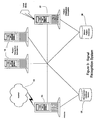
- Figure 1 illustrates a system model of the operation of the audio capture and identification system.
- a brief free-field sound sample from an audio source such as a radio, television receiver, a CD player, a personal computer, a phonograph player, etc. is captured by a small hand-held device and is stored in a digital memory. Captured samples of the audio or audio features are later loaded into a personal computer that is connected to a host site containing reference patterns derived from music offered for sale.
- An audio identification system located at the host site then identifies the samples and transmits the names of the corresponding recordings and returns these names and a brief sound clip to the user for confirmation. The user is then offered the opportunity to purchase the recording.
- Figure 2 shows the components of an audio capture device used to acquire samples of audio for transmission to the host site.
- Figure 3 illustrates the components of the remote sites that are used to perform audio signal identifications. These may include the website host, pattern recognition subsystems, a pattern initialization system for generating reference patterns from recordings, and the necessary databases.
- Figure 4 is a diagram of the audio interface and signal processor that is used in the pattern initialization system according to a preferred embodiment to acquire audio at the host site and extract features for use in reference pattern generation.
- Figure 5 depicts the preferred processes for extracting features from audio waveforms. These processes include computing sequences of power spectra, integrating spectral power over several frequency bands, and decimating the integrated spectral power sequences to form a set of low bandwidth feature time series.
- Figure 6 illustrates a typical audio power spectrum and the partitioning of this spectrum into several frequency bands. Lower frequency bands are preferably narrower than the higher frequency bands to balance the total power in each band and to match the human auditory characteristics.
- Figure 7 illustrates several feature time series waveforms.
- Figure 8 illustrates the partitioning of a single feature waveform into overlapped segments. These segments are then normalized, processed, and stored in the pattern database for later recognition.
- Figure 9 shows the signal processing steps that are preferably used to generate a reference pattern data structure from the feature time series waveforms.
- the features from the entire work are grouped into a sequence of overlapping time segments.
- Each feature from each segment is then block-scaled to a fixed total power.
- the scaled feature is then processed by a Fast Fourier Transform (FFT) to produce the complex spectrum.
- FFT Fast Fourier Transform
- the sliding standard deviation of the scaled feature is also computed over an interval equal to half of the segment length.
- the individual data structures representing each feature of each segment are then constructed. When all features of all segments have been processed, the features within each segment are rank-ordered according to their information content.
- the top level of the pattern data structure is then constructed.
- Figure 10 illustrates the preferred structure of a database reference pattern entry.
- a reference pattern identification code may be used for both the reference pattern data structures and a data structure that describes the work.
- the reference pattern data structure includes a list of pointers to segment descriptors. Each segment descriptor contains pattern and segment identification codes and a list of pointers to feature structures.
- Each feature structure comprises pattern, segment, and feature identification codes and the pattern data itself. Included in the pattern data are the scale factor used to normalize the data, the standard deviation of random correlations, a detection probability threshold, and a rejection probability threshold. After these parameters are the complex spectrum of feature time series and the sliding standard deviation (RMS) of the feature time series.
- RMS sliding standard deviation
- Each component of the overall data structure may also contain a checksum to validate data integrity.
- Figure 11 illustrates the preferred preprocessing of features that may occur prior to real-time pattern recognition.
- a new block of feature data is acquired and the mean is removed from each feature.
- Each feature is then normalized to fixed total power.
- the normalized feature blocks are then padded to double their length by appending zeros.
- the Fast Fourier Transform of each feature block is then computed to produce the complex spectrum.
- Figure 12 shows the preferred strategy and procedure used to identify a work using a subset of available features.
- the unknown input feature block is compared with each segment of a particular work.
- features are evaluated sequentially according to their information content.
- the probability of false alarm is estimated each time new information is added. Detection/rejection decisions are made on the basis of two sets of probability thresholds.
- Figure 13 illustrates the preferred feature correlation process between an unknown feature complex spectrum and a candidate reference pattern complex spectrum.
- the cross-power spectrum is first computed prior to computing the inverse FFT, yielding a cross-correlation function. The first half of this is normalized by the sliding standard deviation. The second half of the correlation functions contains circularly wrapped values and is discarded.
- Figure 14 is an example of a feature correlation function containing a detection event.
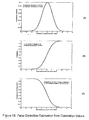
- Figure 15 illustrates how false detection probabilities are derived from a distribution of random correlation values.
- the probability density function of mismatched correlation values is estimated for a large group ofbackground patterns during initialization.
- the cumulative distribution function (B) is then estimated by integrating (A).
- the probability of false alarm is estimated by subtracting the cumulative distribution function from one as shown in (C).
- the preferred embodiment is directed to a technology and system for audio sample capture and the automatic identification of signals using a method known as passive pattern recognition.
- passive pattern recognition which injects identification codes into the recorded material
- the passive approach uses characteristics or features of the recording itself to distinguish it from other possible audio inputs. While both methods have their advantages, passive approaches are most appropriate for audio sample identification. There are several reasons for this. First, coded identification signals that are added to the audio material in active systems are frequently detectable by a discerning ear. When the code injection level is reduced to the point that it is inaudible, the reliability of the code recovery suffers. Further, the injected codes are often destroyed by broadcast processing or signal processing necessary to distribute audio on computer networks.
- the templates stored in the database are derived from a single time interval of a recording that may range from several seconds to a minute in duration.
- the system then monitors each input channel continuously, searching for a match with one of the templates in the database.
- the system has only learned a small piece of each recording that it must recognize.
- the system searches for audio pattern matches from its input channels, it must repeatedly acquire signal segments and compare them with database entries.
- the system must continuously monitor each of its input channels. Otherwise, a time segment that matches one of the database templates could occur when the system is not monitoring a particular channel.
- this approach is not suitable for an application where a consumer wishes to capture only a short sample of a recording for subsequent automatic identification.
- the preferred embodiment according to the present invention is designed differently. Instead of learning a single time segment from each audio recording, all of the time segments comprising each work are learned and stored in a pattern database. While this increases the size of the pattern database, the size is not unreasonable. Signal recognition is accomplished from a single input signal sample block. Once an audio sample block has been captured and stored, it is compared with all stored templates from all recordings in the database.
- the recognition system architecture is a distributed network of specially equipped computers. This network can grow in a uniform way to expand the number of input ports or the number of audio recordings in the database. Audio samples or features are delivered to the recognition system via the Internet or other similar means. These audio samples are captured from free-field audio from virtually any source. These sources include Internet transmission of audio recordings, broadcast, or locally played recordings. Regardless of the signal source, the pattern recognition processes involved are the same.
- the present invention utilizes an initialization or registration process to produce templates of recordings that are later to be identified.
- audio signals are digitized and processed to extract sequences of important features. These features generally represent measurements of energy present in different portions of the audio spectrum. Sequences of these measurements comprise time series data streams that indicate the dynamic structure of the signal.
- the multiple feature streams are then broken into overlapping time intervals or segments of several seconds each that cover the entire recording.
- the audio features from each segment are analyzed to determine which features carry the most descriptive information about the segment.
- Features are then rank-ordered according to their information content, and the best features are selected to construct a template of a particular segment. Note that each segment may use a different subset of available features, and they may be ordered differently within each segment.
- the features are then normalized and fast Fourier transformed to produce complex spectra that facilitate fast feature correlation.
- each feature is correlated with a large number of similar features stored in the pattern library. This allows us to estimate the standard deviation of correlation values when the segment is not present in the input stream. From this we can predict the probability that a particular peak correlation value occurred randomly.
- the rank-ordered features, normalization factors, and feature standard deviations are stored as structured records within a database entry representing the entire work.
- the signal recognition process operates on unknown audio signals by extracting features in the same manner as was done in the initialization process. However, instead of capturing the entire work, it is only necessary to acquire a single snapshot or time sample equal in duration to that of a template segment; in the present embodiment, about 6 seconds. All available features are computed from the unknown audio sample. Note that the feature extraction can be performed in the portable sampling device or at the central site. For each time segment of each pattern in the database the most descriptive feature is correlated with the corresponding feature measurement from the unknown input signal. Based on the peak value of the correlation function and the standard deviation of background correlations computed during initialization, an estimate is made of the probability that the correlation occurred randomly. If the probability is low enough, the pattern is placed on a candidate list.
- Patterns on the candidate list are then further evaluated by correlating the next most valuable feature of each pattern segment on the candidate list with the corresponding features of the unknown input.
- the probability of random (false) correlation is then estimated for this feature as well. Assuming statistical independence of the two feature correlations, the probability that the two events happened randomly is the product of the individual probabilities. This process is repeated using additional features until the probability that a detection event occurred at random is low enough that there is confidence that the detection is legitimate. Patterns on the candidate list that exceed the probability of false detection threshold are deleted.
- N c 4*N p correlations would have been required.
- the savings in computation is substantial, and increases as more features are used. This allows the system to operate with a larger database searching for more patterns, or to process more identification requests using the same computational resources.
- the preferred pattern recognition algorithm is based on computing cross correlation functions between feature time series data extracted from the unknown audio samples and reference patterns or templates derived from the signal to be identified.
- the performance of the correlation function is determined by the amount of information contained in the pattern. If there is too little information in the pattern, it will have a high false alarm rate due to random correlations exceeding the detection threshold. If there is too much information in the pattern, small variations or distortions of the input signal will degrade the value of the correlation peak causing detections to be missed.
- the information content of a pattern is equal to its time-bandwidth product. It has been found that a time-bandwidth product of 80-100 provides low false alarm rates while still being tolerant of distortion typical in a broadcast environment or environmental background noise.
- a pattern duration of 10 seconds would therefore need a bandwidth of 8-10 Hz to produce the desired performance.
- This bandwidth can be from a single information stream or from several separate streams with less bandwidth, provided that the individual streams are statistically independent. Similarly, several time segments of low bandwidth may be used to produce the needed time bandwidth product.
- the correlation function or matched filter response can be implemented in the time domain by integrating the products of time series samples of the template and a corresponding number of samples of the unknown input series and then properly normalizing the result. However, the process should be repeated for each time delay value to be evaluated. The computational load, however, may not be acceptable.
- a better technique known as fast convolution is preferred that is based on the Fast Fourier Transform algorithm. Instead of directly computing each correlation value, an entire block of correlation values is computed as the inverse Fourier transform of the cross-power spectrum of the template time series and a block of input data samples. The result may be normalized by the product of the standard deviations of the input and the template.
- the template or reference pattern can be padded with zeros to double its length and the input data may be blocked into double length buffers. This process is repeated using overlapped segments of the input data and evaluating the values of the first half of the resulting correlation function buffers. In this method, the input stream is monitored continuously. Any occurrence of the reference pattern in the input stream will be detected in real time.
- the method used in the preferred embodiment uses a fast correlation approach where the roles of template and input data are reversed.
- a sequence of overlapped data buffers are acquired from the entire audio time series to be recognized during the initialization process.
- a set of templates is then created as the fast Fourier transform of the normalized data buffers.
- a post correlation normalization may be used to adjust for the signal power present in the portion of the template where the input block occurs.
- a set of RMS amplitude values is computed for each of the possible time delays. These values are computed and stored in the pattern data structure during initialization.
- a block of feature data from the unknown audio sample is acquired from the input stream and normalized to a fixed total power. It is then zero-filled to double its length and Fourier transformed to produce a complex spectrum.
- the input spectrum is then vector-multiplied by each of the template spectra.
- the resulting cross power spectra are then inverse Fourier transformed to produce a set of correlation functions.
- These raw correlation functions are then normalized by dividing each value in the correlation by the corresponding RMS value stored in the pattern data structure.
- the correlation values range from 1.0 for a perfect match to 0.0 for no match to -1.0 for an exact opposite. Further, the mean value of these correlations will always be 0.0.
- the method of the present invention uses multiple feature streams extracted from the audio. This allows the template generation and the recognition process to be tailored to the most distinctive aspects of each recording. In addition, the pattern recognition process is staged to conserve processing capacity. In this approach, an initial classification is performed using only one or two features. For each feature correlation that is evaluated within a particular time segment, the system estimates the probability that such an event could occur randomly. Candidate patterns with a low probability of random occurrence are examined further by computing the correlation with an additional feature. Correlation peaks are matched within a time window and the probability that the new feature correlation occurred randomly is estimated. The system then computes the probability of simultaneous random correlation as the product of the individual probabilities (assuming statistical independence).
- this joint probability is below a predetermined detection threshold, it is determined that the event represents a valid recognition and the detection is reported. If the joint probability is above a separate predetermined rejection threshold, the event is deemed to be a false alarm and the pattern is no longer considered a candidate for recognition. Otherwise, an additional feature correlation is computed and the joint probability is updated to include the new feature information.
- the basis for relating correlation values to probabilities is the standard deviation of feature correlations between pattern templates and a large database of similar features extracted from different recordings stored in the pattern database. This is performed during initialization of each recording. Since these correlations have approximately a normal distribution, the cumulative distribution function can be used to estimate the probability that a particular correlation value occurred randomly.
- the pattern recognition system is driven to a large degree by the structure of the pattern database.
- a pattern data structure has been devised that is hierarchical and self-descriptive. Since the system must be capable of identifying randomly selected audio samples, a generalized representation of feature streams has been devised that allows the most effective features to be used for each segment. Other segments of the same recording may use completely different feature sets.
- One aspect that is common to all features is that they are preferably represented as a time series of measurements of certain characteristics of the audio.
- a reference pattern is preferably structured as a three-layer hierarchy. At the top level the pattern identification code and pattern type are indicated in the first two words. The third word indicates the number of time segments in the pattern. Next is a list of pointers to segment descriptor blocks followed by a checksum to assure block integrity.
- Each segment descriptor block carries forward the pattern identification code and the pattern type as the first two words in the block header. Next is the segment number indicating which time interval is represented. The fourth word indicates the number of features in the current segment block. Next is a list of pointers to feature data blocks followed by a checksum.
- the third level in the hierarchy is the feature data block level. In addition to header information, these blocks actually contain pattern feature data.
- the first three words carry the pattern identification code, pattern type and the segment number as was the case in the segment descriptor block.
- the fourth word in the feature data block indicates the feature type.
- the feature type word is used to select which feature stream from the input is to be compared with this block.
- Next is a scale factor that is used to adjust the relative gain among features to maintain precision. This is used since the feature time series data are preferably normalized to preserve dynamic range.
- the standard deviation of background (false alarm) correlations is stored along with detection and rejection probability thresholds.
- Next in the feature data block is a frequency domain matched filter derived from the normalized feature data.
- templates are stored as complex spectra representing the amplitude and phase response.
- the maximum output value occurs when the spectrum of the unknown input is the complex conjugate of the template at every frequency.
- the feature normalization array is stored next in compressed form. At the end of the block is a checksum, again to assure data structure integrity.
- the reference pattern database In addition to the signal feature data structures that are stored in the reference pattern database are a set of structures that provide information about the work itself such as the name, type, author, and publisher of each work. Various industry standard identification codes such as ISWC (International Standard Musical Work Code), ISRC (International Standard Recording Code), and ISCI (International Standard Coding Identification) are stored in the pattern database. Also included in this structure may be the media source type, work duration, and the date and time of pattern initialization. These structures are indexed by the same Pattern ID code used to reference the signal feature data structures. The work description data are used to report information that is useful to users.
- ISWC International Standard Music Work Code
- ISRC International Standard Recording Code
- ISCI International Standard Coding Identification
- the preferred embodiment of the invention comprises a signal collection and identification system that is capable of capturing samples of a local audio environment 1 containing musical recordings or other audio sources. These sources may include conventional broadcast, satellite distribution feeds, internet and data distribution networks, and various subscription services. Users of the system carry a small digital recording device 2 that allows audio samples to be digitized and stored in a local memory. Optionally, recognition features are extracted, compressed, and stored in the digital recording device 2 instead of the audio waveform, to conserve memory. Later, the user transfers these audio samples or audio features using a personal computer 3 or other electronic means to a recognition facility 4 where they are identified.
- the corresponding recording is played for the user so that the user can confirm that the recording is, in fact, the one that the user has sampled. If the user confirms the identification, the system offers the opportunity to purchase the recording in an on-line or interactive manner.
- a purchased recording may be provided from local retail stock, shipped from a central warehouse, or transferred electronically.
- a typical audio capture device is shown in Figure 2 .
- This device may be separate or may be embedded in other electronic devices such as cellular telephones, PDA's (personal digital assistants like Palm Pilots TM , or any type of portable radio receiver.
- the preferred embodiment of the audio capture device includes a small microphone 6 to acquire the audio signal and an analog to digital converter 7 that includes necessary signal conditioning such as pre-amplifiers and anti-aliasing filters.
- the output of the analog to digital converter 7 comprises a digital time series representing the voltage waveform of the captured audio signal.
- a start button 8 is depressed to begin capture of the audio sample.
- a fixed duration sample block from the analog to digital converter 7 is then transferred to digital signal processor 9.
- the digital signal processor 9 may then format and label the captured audio block for storage in a non-volatile memory such as flash memory 10. Alternatively, the digital signal processor 9 may perform feature extraction and store only the highly compressed recognition features in flash memory 10. Since the audio capture device is only active during the signal acquisition and storage processes, it can be powered by a small battery 11 with long battery life expectations. The captured audio samples or audio feature samples are later transferred to a personal computer using data link 12. This data link may be any of the common standards such as RS-232, IEEE-1394, USB, or IrDA.
- the audio samples or audio feature samples are transferred to a host site as illustrated in Figure 3 , preferably using the Internet 13.
- the preferred exemplary embodiment of the host site is configured as a distributed network of computer subsystems where each subsystem has specific functions. Users communicate via the Internet 13 with a website 14 and transmit their audio samples for identification. These samples are in turn transferred from the website 14 to one or more pattern recognition subsystems 16.
- the pattern recognition subsystems 16 compare the features of the user-supplied audio samples with similar feature data stored in a master pattern database 18.
- one or more pattern initialization subsystems 17 process audio signals from physical media or electronic sources to create templates of audio feature vectors. These are formatted and stored in the master pattern database 18.
- the detection results are indexed with corresponding data in the management database system 15 such as the name of the song and the artist. This information is transmitted through the website 14 to the user using the Internet 13.
- the pattern initialization subsystems 17 accept complete audio works that are to be entered into the master pattern database 18. These subsystems perform feature extraction in the same manner as in the audio sample capture processing. However, instead of constructing brief packets of features for identification, the initialization subsystems 17 extract continuous feature waveforms from the entire work. The feature waveforms are then broken into overlapping time-series segments and processed to determine which features should be used for signal recognition and in what order. The resulting reference pattern data structures are stored in the master pattern database 18. These patterns are subsequently transferred to the pattern recognition subsystems 16 for comparison with the unknown input feature packets.
- the website computer(s) 14 interacts with users who may transmit audio samples or audio feature blocks for identification. If feature extraction has been performed in the audio capture device, the feature blocks may be transferred directly to pattern recognition subsystems 16 for identification. Otherwise, the feature extraction process is performed using an audio interface and signal processor board as illustrated in Figure 4 . Note that this type of signal processor is also used in the pattern initialization subsystem 17 to extract features for generation of reference patterns for storage in the master pattern database.
- the pattern initialization subsystem comprises a host computer and one or more specialized signal processor circuit boards that perform the actual feature extraction.
- the audio interface and signal processor according to the preferred embodiment is illustrated in Figure 4 .
- up to eight audio sources can be simultaneously processed. In this way, multiple workstations can be supported for adding entries to the database.
- Analog audio inputs are connected to analog anti-alias lowpass filters 19 to restrict the maximum audio frequency (to 3.2 kHz in this example).
- the outputs of these filters are connected to a channel multiplexer 20 that rapidly scans the filter outputs. In this example with eight channels sampled at 8 kHz each, the channel multiplexer 20 switches at a 64 kHz rate.
- the channel multiplexer output is connected to an analog to digital converter 21 that operates at the aggregate sample rate producing a multiplexed time series of the selected sources.
- the output of the analog to digital converter 21 is transmitted to a programmable digital signal processor 22 that performs the digital processing of the audio time series waveforms to extract features and construct the feature packets that are to be recognized.
- Digital signal processor 22 may comprise a special purpose microprocessor that is optimized for signal processing applications. It is connected to a program memory 24 (where programs and constants are stored) and a data memory 23 for storage of variables and data arrays.
- the digital signal processor 22 also connects to the host computer bus 26 using an interface such as the PCI bus interface 25 for exchange of data between the digital signal processor and the host computer. Note that in cases where digitized audio is available for feature extraction, these data are transferred directly from the host computer bus 26 via the PCI bus interface 25 to the digital signal processor 22, bypassing anti-alias lowpass filters 19, channel multiplexer 20, and analog to digital converter 21.
- the audio signal processing necessary to perform the feature extraction is preferably performed in software or firmware installed on digital signal processor 22, as depicted in Figure 5 .
- Digitized audio samples from one of the signal sources are grouped into a sample set 27 and merged with one or more previous sample sets 28 to form a window into the audio time series for periodic spectral analysis. The size of this window determines the spectral resolution while the size of the new sample set 27 determines the interval between updates.
- a function such as a Hanning window 29 to reduce the spectral leakage due to so-called end-effects caused by finite block size.
- the resultant time series is then processed by a Fast Fourier Transform (FFT) 30 to produce the complex spectrum.
- the power spectrum 31 is then calculated from the complex spectrum by summing the squares of the real and imaginary components of each frequency bin.
- FFT Fast Fourier Transform
- FIG. 6 An example of the resulting audio power spectrum 31 is shown in Figure 6 .
- This figure also indicates the partitioning of the spectrum into several frequency bands. The total power in each of the frequency bands is found by integrating the power contained in all of the frequency bins in the respective bands as shown in 32.
- a new set of feature measurements is generated. In most cases the update rate will still be much higher than desired from the point of view of feature bandwidth and the resulting data rate. For this reason, the sample rate is reduced by processing each frequency band feature sequence by a polyphase decimating lowpass filter 33. In the preferred embodiment of the invention, this results in an audio feature sample rate of approximately 10 Hz.
- Figure 7 is an example of a set of feature waveforms extracted from an audio signal.
- a set of 64 consecutive samples is collected from each feature waveform to construct recognition feature packets.
- each feature waveform is broken into segments that are 128 samples long and are overlapped by 64 samples. This ensures that an unknown input sample feature packet will be completely contained in at least one of the feature reference segments.
- the overlapping segmentation of a single feature is illustrated in Figure 8 . This segmentation is applied to all available features.
- the procedure for generating reference patterns is illustrated in Figure 9 .
- the feature waveform is first block-scaled to a fixed total power. This assures that the precision and dynamic range of the signal processing is preserved. The scale factor used in this scaling is saved.
- the Fast Fourier Transform (FFT) of the feature waveform is computed, yielding the complex spectrum that is used in the fast correlation algorithm.
- a sliding standard deviation (RMS) of the feature waveform is also computed for use in properly normalizing the correlation functions.
- the standard deviation is calculated for each of 64 positions within a 128 sample segment using a window that is 64 samples long.
- the measure of information content used in the preferred embodiment is the degree of spectral dispersion of energy in the power spectrum of each feature. This can be statistically estimated from the second moment of the power spectrum. Features with widely dispersed energy have more complex structure and are therefore more distinctive in their ability to discriminate among different patterns.
- the features within each segment are then rank-ordered by their information content so that the most useful features will be used first in the pattern recognition process. Features with too little information to be useful are deleted from the reference pattern data structure.
- the detection parameters are computed. Each feature is correlated with a large number of pattern samples that do not match the pattern under consideration. The statistical distribution that results characterizes the false alarm behavior of the feature. Acceptable detection and rejection probabilities are then computed from the joint probability of false alarm. These are stored as detection and rejection thresholds to be used in the pattern recognition process.
- the reference pattern database structure of the preferred embodiment is illustrated in Figure 10 .
- This structure contains two types of information, both of which are indexed by a unique Pattern Identification Code 43.
- the first is a descriptive data record 45 that contains administrative information such as the name, type, author, and publisher of the work. Also included are various industry standard identification codes and data that describe the source media and initialization time and date.
- the pattern identification code is also included in this record to allow cross-checking of the database.
- the second part of the preferred database is a hierarchical set of data structures that contain the reference pattern data itself plus the information needed to process the data.
- the Pattern Descriptor Block 44 This block contains the pattern identification code to allow integrity checking of the database and the pattern type.
- a number that indicates the number of segments in the pattern and a set of pointers to Segment Descriptor Blocks 46.
- a checksum may also be included to verify the integrity of the block.
- the Segment Descriptor Blocks contain the pattern identification code, pattern type, and segment number to verify the integrity of the data structures.
- Each Feature Block 47 contains the pattern identification code, pattern type (audio, video, mixed, etc.), segment number, and feature type (audio, video, etc.).
- Next is the scale factor that was used to block scale the feature waveform during initialization followed by the standard deviation of background (false) correlations that was computed from the false alarm correlation distribution.
- the detection and rejection probability thresholds are included next. These are used to determine whether a detection can be confirmed, a false alarm can be confirmed, or if another feature must be evaluated in order to decide.
- the complex spectrum of the feature data is included next, followed by the sliding standard deviation (RMS) of the feature waveforms that is used to normalize the raw correlation functions.
- RMS sliding standard deviation
- a checksum may also be included.
- Figure 11 identifies the steps that are used to prepare a new input feature block for pattern recognition.
- the raw input feature set comprises a set of time series waveforms representing captured samples.
- each feature in the input block is normalized by dividing each feature data value by the standard deviation calculated over the entire block.
- Each normalized feature time series is then padded with zeros to double its duration. This is a preferred step in the fast correlation process to prevent circular time wrapping of data values from distorting correlation values.
- the fast Fourier transform (FFT) of each feature is then computed, producing a complex spectrum.
- FFT fast Fourier transform
- the pattern recognition processes employed in the preferred embodiment of the invention are illustrated in Figure 12 .
- a new input feature block is acquired, it is compared with candidate patterns on one or more of the reference pattern lists. After initializing this list to access the next pattern to be evaluated, the first feature is selected from both the unknown input and the reference pattern.
- the cross-correlation function is then computed.
- the correlation function has a value of one for a perfect match, zero for no correlation, and negative one for a perfect anti-correlation.
- the maximum value of the correlation function is then found.
- the correlation peak value is divided by the standard deviation ofbackground (false) correlations that was found in the initialization process to yield the number of standard deviations from the mean value of zero.
- an estimate the probability that this event occurred randomly can be determined.
- the process is repeated for subsequent features at the same instant of time.
- the resulting probabilities of false alarm for the individual features are multiplied to produce a composite false alarm probability.
- the composite probability of false alarm (PFA) is then compared with an upper limit. If the composite PFA exceeds this limit, the candidate detection is deemed to be a false alarm and the pattern is rejected. Otherwise, the composite PFA is compared with a lower limit.
- the composite PFA is less than the lower limit, the probability that the event is due to random events is deemed to be sufficiently low that the event must be a legitimate pattern recognition.
- the detection event is then logged along with the time and date of its occurrence and the channel number or source. Additional information regarding the remaining time in the recording is passed to the scheduler to allow it to make more efficient scheduling plans. If the composite PFA is above the lower limit and is below the upper limit, the cause of the event is still uncertain and requires the use of additional information from other features. This process of correlating, estimating individual feature PFA's, updating the composite PFA, and evaluating the composite PFA is repeated until a decision can be made. Note that a new pair of PFA limits is used each time that a new feature is added.
- the upper and lower PFA limits for the last available feature are set to be equal to force a decision to be made.
- the above processes are repeated for all time segments of all patterns on the candidate pattern list. This could result in simultaneous detections of two or more patterns. If such simultaneous detections occur, this could indicate that one work or recording is a composite of other initialized works.
- Figure 13 illustrates the steps in performing the fast correlation algorithm using the complex spectra of the feature waveforms from the unknown input and an initialized reference pattern from the database. These spectra are first multiplied to produce the complex cross-power spectrum. The Inverse Fast Fourier Transform is then applied to the cross-spectrum to obtain a raw correlation function. The first half of this correlation function is then normalized by the sliding standard deviation (RMS) previously computed during initialization and stored in the feature structure of the pattern database. The second half of the correlation function represents circularly time-wrapped values that are discarded.
- RMS sliding standard deviation
- Figure 15 illustrates how false detection probabilities can be estimated from the feature correlation values and the standard deviation of background (false) correlations calculated during initialization. It has been found that the distribution of random correlations is approximately normal resulting in a probability density function resembling Figure 15A . In the preferred embodiment of the invention, the correlation values are divided by the standard deviation of background correlations. This yields the number of standard deviations from the expected value. The cumulative distribution function shown in Figure 15B indicates the probability that a correlation value expressed in standard deviations will encompass all legitimate detections. For example, if the standard deviation of background correlations was found to be 0.3 during initialization and we compute a correlation value of 0.6 during pattern recognition, the correlation value is 2 standard deviations above the expected (mean) value for all correlations.
- FREE-FIELD AUDIO CAPTURE AND STORAGE A method and portable apparatus for the selective capture and digital storage of samples of the local audio environment. Either the audio waveform or compressed features of the audio waveform may be stored.
- the audio capture device contains a microphone, signal conditioning electronics, analog-to-digital converter, digital signal processor, and a memory for storage of captured audio samples.
- AUDIO DATA TRANSFER A method and apparatus for electronically transferring stored audio waveforms or compressed features of audio waveforms from the portable capture device to a central site for identification. This method may utilize the Internet or other data network. Alternatively, a direct connection to a host computer site may be used to transfer audio samples for identification.
- FEATURE EXTRACTION A process for the extraction of recognition features of the audio samples. This process includes measuring the energy in a plurality of frequency bands of the audio signal. Sequences of these measurements represent time series features that are used to construct reference patterns for the pattern database. Similarly processed features from unknown audio samples are used for signal identification.
- PATTERN INITIALIZATION A process for constructing reference patterns from audio features of works to be identified. This process accepts as its input feature time series waveforms from an entire work to be identified. Each feature is then broken into overlapping time segments. The segmented feature time series are normalized to fixed power in each segment of each feature. A sliding standard deviation is calculated for each segment of each feature for use in post-processing feature correlation functions during the recognition process. These data are then formatted into reference pattern data structures for storage in a pattern database.
- PATTERN RECOGNITION A process for comparing the unknown captured audio samples transferred from users with reference patterns stored in the pattern database.
- the recognition process involves the calculation of correlation functions between features of the unknown audio blocks and corresponding features of works stored in the pattern database. For each correlation function, the probability that it occurred randomly is estimated. Additional features are computed as needed and are iteratively evaluated to determine the joint probability of random false detection. This process is repeated until a detection can be conclusively confirmed or until it can be conclusively rejected.
- a captured audio feature block is identified, the name of the work and the artist are reported to the user. Otherwise it will be declared to be unknown.
- TRANSACTION MODEL A method has been devised to allow users to carry a small audio collection device to capture unknown samples ofmusic that are heard on radio, television, or any other source of audio recordings.
- the unknown audio samples are subsequently electronically transferred to a host computer site.
- the host computer compares the samples transmitted by the user with patterns stored in a reference pattern library stored on the host.
- the host computer informs the user of the identity of the unknown work if the identification was successful.
- a brief audio sample may be sent to the user for confirmation of the identity.
- the user is then given the opportunity to purchase the recording on-line, through the recognition server or another commercial server on the Internet or in the same network.
- the user may be directed to a local retailer where the recording can be purchased.
- the feature signal extraction function can be performed by either the hand-held device or the personal computer.
- the feature extraction and communication functions may be embodied in software which is uploaded to the hand-held device and/or the personal computer.
- the feature signal extraction and pattern recognition functions may be incorporated into software running on the recognition server.
Landscapes
- Business, Economics & Management (AREA)
- Engineering & Computer Science (AREA)
- Accounting & Taxation (AREA)
- Finance (AREA)
- Development Economics (AREA)
- Strategic Management (AREA)
- Physics & Mathematics (AREA)
- Economics (AREA)
- Marketing (AREA)
- General Business, Economics & Management (AREA)
- General Physics & Mathematics (AREA)
- Theoretical Computer Science (AREA)
- Entrepreneurship & Innovation (AREA)
- Game Theory and Decision Science (AREA)
- Computational Linguistics (AREA)
- Signal Processing (AREA)
- Health & Medical Sciences (AREA)
- Audiology, Speech & Language Pathology (AREA)
- Human Computer Interaction (AREA)
- Acoustics & Sound (AREA)
- Multimedia (AREA)
- Information Retrieval, Db Structures And Fs Structures Therefor (AREA)
- Traffic Control Systems (AREA)
- Stereo-Broadcasting Methods (AREA)
- Management, Administration, Business Operations System, And Electronic Commerce (AREA)
- Automatic Analysis And Handling Materials Therefor (AREA)
Claims (9)
- System zur Erkennung von Freifeldaudiosignalen, umfassend:eine tragbare Vorrichtung (2) mit einem Mikrofon (6) zur Erfassung von Freifeldaudiosignalen, wobei die erfassten Freifeldaudiosignale einem Teil eines aufgezeichneten Audiowerks entsprechen, der kleiner ist als ein gesamtes aufgezeichnetes Audiowerk;eine lokale Verarbeitungseinheit (3), die mit der tragbaren Vorrichtung (2) verbunden werden kann, um Audiosignalmerkmale, die den erfassten Freifeldaudiosignalen entsprechen, an eine Erkennungsstelle zu übertragen;wobei die tragbare Vorrichtung (2) oder die lokale Verarbeitungseinheit (3) einen Schaltungsautbau beinhaltet, der eine Zeitreihe spektral charakteristischer Audiosignalmerkmale aus irgendeinem Teil der erfassten Freifeldaudiosignale extrahiert, wobei die Zeitreihe der spektral charakteristischen Audiosignalmerkmale dem Teil eines aufgezeichneten Audiowerks entspricht, der kleiner ist als das gesamte aufgezeichnete Audiowerk; und
eine Erkennungsverarbeitungseinheit (16) und einen Erkennungsspeicher (18) an der Erkennungsstelle, wobei der Erkennungsspeicher (18) Daten speichert, die mehreren Audiovorlagen entsprechen, die Erkennungsverarbeitungseinheit (16) die von der lokalen Verarbeitungseinheit (3) übertragenen Audiosignalmerkmale mit wenigstens einer der in dem Erkennungsspeicher (18) gespeicherten Audiovorlagen korreliert und die Erkennungsverarbeitungseinheit (16) ein Erkennungssignal basierend auf der Korrelation bereitstellt. - System gemäß Anspruch 1, worin die tragbare Vorrichtung (2) beinhaltet: einen Analog-Digital-Wandler (7), der die erfassten Freifeldaudiosignale digitalisiert; und einen Prozessor, der die Zeitreihe der spektral charakteristischen Audiosignalmerkmale aus den erfassten Freifeldaudiosignalen extrahiert.
- System gemäß Anspruch 1, worin die lokale Verarbeitungseinheit (3) die Zeitreihe der spektral charakteristischen Audiosignalmerkmale aus den erfassten Freifeldaudiosignalen extrahiert.
- System gemäß Anspruch 1, worin die lokale Verarbeitungseinheit (3) einen Personalcomputer umfasst, der mit dem Internet (13) verbunden ist.
- System gemäß Anspruch 1, worin der Erkennungsverarbeitungsspeicher (18) mehrere Audiovorlagen speichert, wobei jede Vorlage im Wesentlichen einem gesamten Audiowerk entspricht.
- System gemäß Anspruch 5, worin die tragbare Vorrichtung (2) einen Speicher aufweist, der Freifeldaudiosignale speichert, die weniger als einem gesamten Audiowerk entsprechen.
- System gemäß Anspruch 6, worin das Audiowerk ein Lied umfasst.
- System gemäß Anspruch 1, worin die Erkennungsverarbeitungseinheit (16) in Reaktion auf das Erkennungssignal wenigstens einen Teil der wenigstens einen in dem Erkennungsverarbeitungsspeicher (18) gespeicherten Vorlage zur Überprüfung an die lokale Verarbeitungseinheit (3) überträgt.
- System gemäß Anspruch 1, worin die Erkennungsverarbeitungseinheit (16) die von der lokalen Verarbeitungseinheit (3) übertragenen Audiosignalmerkmale mathematisch mit wenigstens einer der in dem Erkennungsverarbeitungsspeicher (18) gespeicherten Audiovorlagen korreliert.
Applications Claiming Priority (3)
| Application Number | Priority Date | Filing Date | Title |
|---|---|---|---|
| US09/903,627 US7174293B2 (en) | 1999-09-21 | 2001-07-13 | Audio identification system and method |
| US903627 | 2001-07-13 | ||
| PCT/US2002/022334 WO2003007128A2 (en) | 2001-07-13 | 2002-07-15 | Audio identification system and method |
Publications (3)
| Publication Number | Publication Date |
|---|---|
| EP1522064A2 EP1522064A2 (de) | 2005-04-13 |
| EP1522064A4 EP1522064A4 (de) | 2005-08-31 |
| EP1522064B1 true EP1522064B1 (de) | 2008-07-09 |
Family
ID=25417816
Family Applications (1)
| Application Number | Title | Priority Date | Filing Date |
|---|---|---|---|
| EP02747014A Expired - Lifetime EP1522064B1 (de) | 2001-07-13 | 2002-07-15 | Audioidentifikationssystem |
Country Status (7)
| Country | Link |
|---|---|
| US (2) | US7174293B2 (de) |
| EP (1) | EP1522064B1 (de) |
| AT (1) | ATE400869T1 (de) |
| AU (1) | AU2002316689A1 (de) |
| DE (1) | DE60227568D1 (de) |
| ES (1) | ES2312589T3 (de) |
| WO (1) | WO2003007128A2 (de) |
Families Citing this family (296)
| Publication number | Priority date | Publication date | Assignee | Title |
|---|---|---|---|---|
| US7313251B2 (en) * | 1993-11-18 | 2007-12-25 | Digimarc Corporation | Method and system for managing and controlling electronic media |
| US5841978A (en) | 1993-11-18 | 1998-11-24 | Digimarc Corporation | Network linking method using steganographically embedded data objects |
| US6882738B2 (en) * | 1994-03-17 | 2005-04-19 | Digimarc Corporation | Methods and tangible objects employing textured machine readable data |
| US6560349B1 (en) * | 1994-10-21 | 2003-05-06 | Digimarc Corporation | Audio monitoring using steganographic information |
| US8094949B1 (en) | 1994-10-21 | 2012-01-10 | Digimarc Corporation | Music methods and systems |
| US20030133592A1 (en) * | 1996-05-07 | 2003-07-17 | Rhoads Geoffrey B. | Content objects with computer instructions steganographically encoded therein, and associated methods |
| US6738495B2 (en) * | 1995-05-08 | 2004-05-18 | Digimarc Corporation | Watermarking enhanced to withstand anticipated corruptions |
| US7805500B2 (en) * | 1995-05-08 | 2010-09-28 | Digimarc Corporation | Network linking methods and apparatus |
| US6760463B2 (en) | 1995-05-08 | 2004-07-06 | Digimarc Corporation | Watermarking methods and media |
| US6411725B1 (en) * | 1995-07-27 | 2002-06-25 | Digimarc Corporation | Watermark enabled video objects |
| US7711564B2 (en) * | 1995-07-27 | 2010-05-04 | Digimarc Corporation | Connected audio and other media objects |
| US6829368B2 (en) * | 2000-01-26 | 2004-12-07 | Digimarc Corporation | Establishing and interacting with on-line media collections using identifiers in media signals |
| US6577746B1 (en) * | 1999-12-28 | 2003-06-10 | Digimarc Corporation | Watermark-based object linking and embedding |
| US6505160B1 (en) * | 1995-07-27 | 2003-01-07 | Digimarc Corporation | Connected audio and other media objects |
| US7562392B1 (en) * | 1999-05-19 | 2009-07-14 | Digimarc Corporation | Methods of interacting with audio and ambient music |
| US8180844B1 (en) | 2000-03-18 | 2012-05-15 | Digimarc Corporation | System for linking from objects to remote resources |
| US7930546B2 (en) * | 1996-05-16 | 2011-04-19 | Digimarc Corporation | Methods, systems, and sub-combinations useful in media identification |
| JPH1155201A (ja) | 1997-07-29 | 1999-02-26 | Sony Corp | 情報処理装置および方法、情報処理システム、並びに伝送媒体 |
| US6782115B2 (en) | 1998-04-16 | 2004-08-24 | Digimarc Corporation | Watermark holograms |
| US7689532B1 (en) | 2000-07-20 | 2010-03-30 | Digimarc Corporation | Using embedded data with file sharing |
| US6608911B2 (en) * | 2000-12-21 | 2003-08-19 | Digimarc Corporation | Digitally watermaking holograms for use with smart cards |
| US6965873B1 (en) | 1998-04-16 | 2005-11-15 | Digimarc Corporation | Electronic commerce using optical input device |
| US7602940B2 (en) * | 1998-04-16 | 2009-10-13 | Digimarc Corporation | Steganographic data hiding using a device clock |
| US7164413B2 (en) * | 1999-05-19 | 2007-01-16 | Digimarc Corporation | Enhanced input peripheral |
| US7406214B2 (en) | 1999-05-19 | 2008-07-29 | Digimarc Corporation | Methods and devices employing optical sensors and/or steganography |
| US7760905B2 (en) * | 1999-06-29 | 2010-07-20 | Digimarc Corporation | Wireless mobile phone with content processing |
| US8874244B2 (en) * | 1999-05-19 | 2014-10-28 | Digimarc Corporation | Methods and systems employing digital content |
| US20020032734A1 (en) | 2000-07-26 | 2002-03-14 | Rhoads Geoffrey B. | Collateral data combined with user characteristics to select web site |
| US7185201B2 (en) | 1999-05-19 | 2007-02-27 | Digimarc Corporation | Content identifiers triggering corresponding responses |
| US8095796B2 (en) * | 1999-05-19 | 2012-01-10 | Digimarc Corporation | Content identifiers |
| US7302574B2 (en) * | 1999-05-19 | 2007-11-27 | Digimarc Corporation | Content identifiers triggering corresponding responses through collaborative processing |
| US6519564B1 (en) * | 1999-07-01 | 2003-02-11 | Koninklijke Philips Electronics N.V. | Content-driven speech-or audio-browser |
| US7174293B2 (en) * | 1999-09-21 | 2007-02-06 | Iceberg Industries Llc | Audio identification system and method |
| US7194752B1 (en) | 1999-10-19 | 2007-03-20 | Iceberg Industries, Llc | Method and apparatus for automatically recognizing input audio and/or video streams |
| US6941275B1 (en) * | 1999-10-07 | 2005-09-06 | Remi Swierczek | Music identification system |
| AU2001229402A1 (en) * | 2000-01-13 | 2001-07-24 | Digimarc Corporation | Authenticating metadata and embedding metadata in watermarks of media signals |
| US7444353B1 (en) | 2000-01-31 | 2008-10-28 | Chen Alexander C | Apparatus for delivering music and information |
| US6834308B1 (en) * | 2000-02-17 | 2004-12-21 | Audible Magic Corporation | Method and apparatus for identifying media content presented on a media playing device |
| US6646195B1 (en) * | 2000-04-12 | 2003-11-11 | Microsoft Corporation | Kernel-mode audio processing modules |
| US6961631B1 (en) * | 2000-04-12 | 2005-11-01 | Microsoft Corporation | Extensible kernel-mode audio processing architecture |
| US8121843B2 (en) * | 2000-05-02 | 2012-02-21 | Digimarc Corporation | Fingerprint methods and systems for media signals |
| US7853664B1 (en) * | 2000-07-31 | 2010-12-14 | Landmark Digital Services Llc | Method and system for purchasing pre-recorded music |
| US6990453B2 (en) | 2000-07-31 | 2006-01-24 | Landmark Digital Services Llc | System and methods for recognizing sound and music signals in high noise and distortion |
| ES2414650T3 (es) | 2000-08-23 | 2013-07-22 | Gracenote, Inc. | Procedimiento y sistema para la obtención de información |
| US8205237B2 (en) | 2000-09-14 | 2012-06-19 | Cox Ingemar J | Identifying works, using a sub-linear time search, such as an approximate nearest neighbor search, for initiating a work-based action, such as an action on the internet |
| US8010988B2 (en) * | 2000-09-14 | 2011-08-30 | Cox Ingemar J | Using features extracted from an audio and/or video work to obtain information about the work |
| US7277766B1 (en) * | 2000-10-24 | 2007-10-02 | Moodlogic, Inc. | Method and system for analyzing digital audio files |
| US20020072982A1 (en) * | 2000-12-12 | 2002-06-13 | Shazam Entertainment Ltd. | Method and system for interacting with a user in an experiential environment |
| US8055899B2 (en) * | 2000-12-18 | 2011-11-08 | Digimarc Corporation | Systems and methods using digital watermarking and identifier extraction to provide promotional opportunities |
| US7266704B2 (en) | 2000-12-18 | 2007-09-04 | Digimarc Corporation | User-friendly rights management systems and methods |
| KR100375822B1 (ko) * | 2000-12-18 | 2003-03-15 | 한국전자통신연구원 | 디지털 오디오의 워터마크 삽입/추출 장치 및 방법 |
| WO2002051063A1 (en) * | 2000-12-21 | 2002-06-27 | Digimarc Corporation | Methods, apparatus and programs for generating and utilizing content signatures |
| US6965683B2 (en) | 2000-12-21 | 2005-11-15 | Digimarc Corporation | Routing networks for use with watermark systems |
| JP4723171B2 (ja) | 2001-02-12 | 2011-07-13 | グレースノート インク | マルチメディア・コンテンツのハッシュの生成および突合せ |
| US7359889B2 (en) * | 2001-03-02 | 2008-04-15 | Landmark Digital Services Llc | Method and apparatus for automatically creating database for use in automated media recognition system |
| US7248715B2 (en) * | 2001-04-06 | 2007-07-24 | Digimarc Corporation | Digitally watermarking physical media |
| US7424747B2 (en) * | 2001-04-24 | 2008-09-09 | Microsoft Corporation | Method and system for detecting pirated content |
| US7046819B2 (en) * | 2001-04-25 | 2006-05-16 | Digimarc Corporation | Encoded reference signal for digital watermarks |
| WO2003009277A2 (en) * | 2001-07-20 | 2003-01-30 | Gracenote, Inc. | Automatic identification of sound recordings |
| KR100961461B1 (ko) * | 2001-07-31 | 2010-06-08 | 그레이스노트 아이엔씨 | 기록의 다단계 식별 |
| US6724914B2 (en) * | 2001-10-16 | 2004-04-20 | Digimarc Corporation | Progressive watermark decoding on a distributed computing platform |
| US6961467B2 (en) * | 2001-10-17 | 2005-11-01 | Intel Corporation | Identifying image content |
| US6915176B2 (en) * | 2002-01-31 | 2005-07-05 | Sony Corporation | Music marking system |
| AU2003244416A1 (en) | 2002-02-05 | 2003-09-02 | Koninklijke Philips Electronics N.V. | Efficient storage of fingerprints |
| US8239197B2 (en) | 2002-03-28 | 2012-08-07 | Intellisist, Inc. | Efficient conversion of voice messages into text |
| WO2003084196A1 (en) | 2002-03-28 | 2003-10-09 | Martin Dunsmuir | Closed-loop command and response system for automatic communications between interacting computer systems over an audio communications channel |
| US7369685B2 (en) * | 2002-04-05 | 2008-05-06 | Identix Corporation | Vision-based operating method and system |
| US20040052418A1 (en) * | 2002-04-05 | 2004-03-18 | Bruno Delean | Method and apparatus for probabilistic image analysis |
| AU2003230993A1 (en) * | 2002-04-25 | 2003-11-10 | Shazam Entertainment, Ltd. | Robust and invariant audio pattern matching |
| US7824029B2 (en) | 2002-05-10 | 2010-11-02 | L-1 Secure Credentialing, Inc. | Identification card printer-assembler for over the counter card issuing |
| US20040091111A1 (en) * | 2002-07-16 | 2004-05-13 | Levy Kenneth L. | Digital watermarking and fingerprinting applications |
| US7239981B2 (en) * | 2002-07-26 | 2007-07-03 | Arbitron Inc. | Systems and methods for gathering audience measurement data |
| US7653544B2 (en) * | 2003-08-08 | 2010-01-26 | Audioeye, Inc. | Method and apparatus for website navigation by the visually impaired |
| US9711153B2 (en) | 2002-09-27 | 2017-07-18 | The Nielsen Company (Us), Llc | Activating functions in processing devices using encoded audio and detecting audio signatures |
| US8959016B2 (en) | 2002-09-27 | 2015-02-17 | The Nielsen Company (Us), Llc | Activating functions in processing devices using start codes embedded in audio |
| WO2004030341A1 (en) * | 2002-09-30 | 2004-04-08 | Koninklijke Philips Electronics N.V. | Fingerprint extraction |
| US7539086B2 (en) * | 2002-10-23 | 2009-05-26 | J2 Global Communications, Inc. | System and method for the secure, real-time, high accuracy conversion of general-quality speech into text |
| WO2004044820A1 (en) * | 2002-11-12 | 2004-05-27 | Koninklijke Philips Electronics N.V. | Fingerprinting multimedia contents |
| EP1586045A1 (de) | 2002-12-27 | 2005-10-19 | Nielsen Media Research, Inc. | Verfahren und vorrichtung zur transkodierung von metadaten |
| US7512807B2 (en) * | 2003-02-25 | 2009-03-31 | Activcard Ireland, Limited | Method and apparatus for biometric verification with data packet transmission prioritization |
| US7114646B2 (en) | 2003-02-25 | 2006-10-03 | Hillhouse Robert D | Method and apparatus for biometric verification with data packet transmission prioritization |
| US7492928B2 (en) * | 2003-02-25 | 2009-02-17 | Activcard Ireland Limited | Method and apparatus for biometric verification with data packet transmission prioritization |
| EP1602019A2 (de) * | 2003-02-25 | 2005-12-07 | Snocap, Inc. | Inhaltsregulierung |
| US7606790B2 (en) * | 2003-03-03 | 2009-10-20 | Digimarc Corporation | Integrating and enhancing searching of media content and biometric databases |
| US20060235864A1 (en) * | 2005-04-14 | 2006-10-19 | Apple Computer, Inc. | Audio sampling and acquisition system |
| US20060229878A1 (en) * | 2003-05-27 | 2006-10-12 | Eric Scheirer | Waveform recognition method and apparatus |
| US20080162300A1 (en) * | 2003-09-26 | 2008-07-03 | Ewald Stephen A | System and Method for Purchasing Linked with Broadcast Media |
| WO2005041109A2 (en) * | 2003-10-17 | 2005-05-06 | Nielsen Media Research, Inc. | Methods and apparatus for identifiying audio/video content using temporal signal characteristics |
| US7986913B2 (en) | 2004-02-19 | 2011-07-26 | Landmark Digital Services, Llc | Method and apparatus for identificaton of broadcast source |
| US20050215239A1 (en) * | 2004-03-26 | 2005-09-29 | Nokia Corporation | Feature extraction in a networked portable device |
| US7221902B2 (en) | 2004-04-07 | 2007-05-22 | Nokia Corporation | Mobile station and interface adapted for feature extraction from an input media sample |
| KR100967125B1 (ko) * | 2004-03-26 | 2010-07-05 | 노키아 코포레이션 | 네트워크 휴대용 장치에서의 특징 추출 |
| WO2005093622A1 (en) * | 2004-03-26 | 2005-10-06 | Nokia Corporation | Mobile station and interface adapted for feature extraction from an imput media sample |
| US8688248B2 (en) * | 2004-04-19 | 2014-04-01 | Shazam Investments Limited | Method and system for content sampling and identification |
| US20050265396A1 (en) * | 2004-05-14 | 2005-12-01 | Ryan Steelberg | System for broadcast play verification and method for same |
| US20050283795A1 (en) * | 2004-05-14 | 2005-12-22 | Ryan Steelberg | Broadcast monitoring system and method |
| US7672337B2 (en) * | 2004-05-14 | 2010-03-02 | Google Inc. | System and method for providing a digital watermark |
| US20050266834A1 (en) * | 2004-05-14 | 2005-12-01 | Ryan Steelberg | System and method for broadcast play verification |
| US8495089B2 (en) * | 2004-05-14 | 2013-07-23 | Google Inc. | System and method for optimizing media play transactions |
| US7711313B2 (en) * | 2004-05-14 | 2010-05-04 | Google Inc. | Broadcast monitoring system and method for intelligent optimization |
| EP2602630A3 (de) * | 2004-06-24 | 2015-02-11 | Shazam Investments Limited | Verfahren zur Charakterisierung der Überlappung zweier Mediensegmente |
| US7751804B2 (en) * | 2004-07-23 | 2010-07-06 | Wideorbit, Inc. | Dynamic creation, selection, and scheduling of radio frequency communications |
| DE102004036154B3 (de) * | 2004-07-26 | 2005-12-22 | Fraunhofer-Gesellschaft zur Förderung der angewandten Forschung e.V. | Vorrichtung und Verfahren zur robusten Klassifizierung von Audiosignalen sowie Verfahren zu Einrichtung und Betrieb einer Audiosignal-Datenbank sowie Computer-Programm |
| WO2006017532A2 (en) * | 2004-08-03 | 2006-02-16 | Ziegler Frederick S | Broadcast channel identification system |
| US7574451B2 (en) * | 2004-11-02 | 2009-08-11 | Microsoft Corporation | System and method for speeding up database lookups for multiple synchronized data streams |
| US7567899B2 (en) * | 2004-12-30 | 2009-07-28 | All Media Guide, Llc | Methods and apparatus for audio recognition |
| US7451078B2 (en) * | 2004-12-30 | 2008-11-11 | All Media Guide, Llc | Methods and apparatus for identifying media objects |
| CN101189658A (zh) * | 2005-02-08 | 2008-05-28 | 兰德马克数字服务有限责任公司 | 音频信号中重复素材的自动识别 |
| US20060212409A1 (en) * | 2005-03-17 | 2006-09-21 | Ryan Steelberg | Method for placing advertisements in a broadcast system |
| US20060212899A1 (en) * | 2005-03-17 | 2006-09-21 | Ryan Steelberg | System and method for broadcast tagging |
| US8570586B2 (en) | 2005-05-02 | 2013-10-29 | Digimarc Corporation | Active images through digital watermarking |
| US20070106405A1 (en) * | 2005-08-19 | 2007-05-10 | Gracenote, Inc. | Method and system to provide reference data for identification of digital content |
| US7516074B2 (en) * | 2005-09-01 | 2009-04-07 | Auditude, Inc. | Extraction and matching of characteristic fingerprints from audio signals |
| US7447865B2 (en) * | 2005-09-13 | 2008-11-04 | Yahoo ! Inc. | System and method for compression in a distributed column chunk data store |
| JP4432877B2 (ja) * | 2005-11-08 | 2010-03-17 | ソニー株式会社 | 情報処理システム、および、情報処理方法、情報処理装置、プログラム、並びに、記録媒体 |
| KR101082121B1 (ko) * | 2005-11-10 | 2011-11-10 | 멜로디스 코포레이션 | 비문자기반 정보를 저장하고 검색하는 시스템과 방법 |
| US20070118455A1 (en) * | 2005-11-18 | 2007-05-24 | Albert William J | System and method for directed request for quote |
| BRPI0619388A2 (pt) * | 2005-11-29 | 2011-10-04 | Google Inc | aplicações sociais e interativas para mìdia de massa |
| CN101517550B (zh) * | 2005-11-29 | 2013-01-02 | 谷歌公司 | 大众传媒的社会性和交互式应用 |
| JP2009520411A (ja) * | 2005-12-15 | 2009-05-21 | グーグル・インコーポレーテッド | コンテンツデポット |
| US20070157261A1 (en) * | 2005-12-15 | 2007-07-05 | Ryan Steelberg | Digital media management system and method |
| US7921131B2 (en) * | 2005-12-19 | 2011-04-05 | Yahoo! Inc. | Method using a hierarchy of servers for query processing of column chunks in a distributed column chunk data store |
| US7921132B2 (en) * | 2005-12-19 | 2011-04-05 | Yahoo! Inc. | System for query processing of column chunks in a distributed column chunk data store |
| US7921087B2 (en) * | 2005-12-19 | 2011-04-05 | Yahoo! Inc. | Method for query processing of column chunks in a distributed column chunk data store |
| US7860865B2 (en) * | 2005-12-19 | 2010-12-28 | Yahoo! Inc. | System of a hierarchy of servers for query processing of column chunks in a distributed column chunk data store |
| US8214388B2 (en) * | 2005-12-19 | 2012-07-03 | Yahoo! Inc | System and method for adding a storage server in a distributed column chunk data store |
| US20070162761A1 (en) | 2005-12-23 | 2007-07-12 | Davis Bruce L | Methods and Systems to Help Detect Identity Fraud |
| JP2007219178A (ja) * | 2006-02-16 | 2007-08-30 | Sony Corp | 楽曲抽出プログラム、楽曲抽出装置及び楽曲抽出方法 |
| US7958051B2 (en) * | 2006-02-28 | 2011-06-07 | The Invention Science Fund I, Llc | Using payment mode rankings responsive to item attributes |
| US8200579B2 (en) * | 2006-02-28 | 2012-06-12 | The Invention Science Fund I, Llc | Using payment mode rankings responsive to item attributes |
| US8290543B2 (en) * | 2006-03-20 | 2012-10-16 | Research In Motion Limited | System and methods for adaptively switching a mobile device's mode of operation |
| WO2007126992A2 (en) | 2006-03-27 | 2007-11-08 | Nielsen Media Research, Inc. | Methods and systems to meter media content presented on a wireless communication device |
| US8549022B1 (en) | 2007-07-02 | 2013-10-01 | Datascout, Inc. | Fingerprint generation of multimedia content based on a trigger point with the multimedia content |
| US8463000B1 (en) | 2007-07-02 | 2013-06-11 | Pinehill Technology, Llc | Content identification based on a search of a fingerprint database |
| US9020964B1 (en) | 2006-04-20 | 2015-04-28 | Pinehill Technology, Llc | Generation of fingerprints for multimedia content based on vectors and histograms |
| US7840540B2 (en) | 2006-04-20 | 2010-11-23 | Datascout, Inc. | Surrogate hashing |
| US8156132B1 (en) | 2007-07-02 | 2012-04-10 | Pinehill Technology, Llc | Systems for comparing image fingerprints |
| KR100684457B1 (ko) * | 2006-05-04 | 2007-02-22 | 주식회사 모빌리언스 | 이동통신단말의 외부 음원 인식을 이용하여 사용자에게고유정보를 제공하는 고유정보 제공 시스템, 고유정보 제공방법 및 그 이동통신단말 |
| US7831531B1 (en) | 2006-06-22 | 2010-11-09 | Google Inc. | Approximate hashing functions for finding similar content |
| DE102006032543A1 (de) * | 2006-07-13 | 2008-01-17 | Nokia Siemens Networks Gmbh & Co.Kg | Verfahren und System zur Reduzierung des Empfangs unerwünschter Nachrichten |
| GB0614543D0 (en) * | 2006-07-21 | 2006-08-30 | Vodafone Plc | RF Distribution |
| US8468561B2 (en) * | 2006-08-09 | 2013-06-18 | Google Inc. | Preemptible station inventory |
| US20080051029A1 (en) * | 2006-08-25 | 2008-02-28 | Bradley James Witteman | Phone-based broadcast audio identification |
| US9654447B2 (en) | 2006-08-29 | 2017-05-16 | Digimarc Corporation | Customized handling of copied content based on owner-specified similarity thresholds |
| US8738749B2 (en) | 2006-08-29 | 2014-05-27 | Digimarc Corporation | Content monitoring and host compliance evaluation |
| US8411977B1 (en) | 2006-08-29 | 2013-04-02 | Google Inc. | Audio identification using wavelet-based signatures |
| US8707459B2 (en) | 2007-01-19 | 2014-04-22 | Digimarc Corporation | Determination of originality of content |
| US8311823B2 (en) * | 2006-08-31 | 2012-11-13 | Sony Mobile Communications Ab | System and method for searching based on audio search criteria |
| US8229754B1 (en) * | 2006-10-23 | 2012-07-24 | Adobe Systems Incorporated | Selecting features of displayed audio data across time |
| US8296315B2 (en) * | 2006-11-03 | 2012-10-23 | Microsoft Corporation | Earmarking media documents |
| US9179200B2 (en) | 2007-03-14 | 2015-11-03 | Digimarc Corporation | Method and system for determining content treatment |
| US10242415B2 (en) | 2006-12-20 | 2019-03-26 | Digimarc Corporation | Method and system for determining content treatment |
| US9135797B2 (en) | 2006-12-28 | 2015-09-15 | International Business Machines Corporation | Audio detection using distributed mobile computing |
| US7949300B2 (en) * | 2007-01-22 | 2011-05-24 | Jook, Inc. | Wireless sharing of audio files and related information |
| US8923747B2 (en) * | 2007-01-22 | 2014-12-30 | Jook, Inc. | Wireless sharing of audio files and information for streamlined purchasing |
| US8751475B2 (en) * | 2007-02-14 | 2014-06-10 | Microsoft Corporation | Providing additional information related to earmarks |
| US8453170B2 (en) * | 2007-02-27 | 2013-05-28 | Landmark Digital Services Llc | System and method for monitoring and recognizing broadcast data |
| US20080255686A1 (en) * | 2007-04-13 | 2008-10-16 | Google Inc. | Delivering Podcast Content |
| US7925201B2 (en) * | 2007-04-13 | 2011-04-12 | Wideorbit, Inc. | Sharing media content among families of broadcast stations |
| US7889724B2 (en) * | 2007-04-13 | 2011-02-15 | Wideorbit, Inc. | Multi-station media controller |
| US7826444B2 (en) | 2007-04-13 | 2010-11-02 | Wideorbit, Inc. | Leader and follower broadcast stations |
| US20080274687A1 (en) | 2007-05-02 | 2008-11-06 | Roberts Dale T | Dynamic mixed media package |
| US7912894B2 (en) | 2007-05-15 | 2011-03-22 | Adams Phillip M | Computerized, copy-detection and discrimination apparatus and method |
| US7840177B2 (en) * | 2007-05-23 | 2010-11-23 | Landmark Digital Services, Llc | Device for monitoring multiple broadcast signals |
| US8295363B2 (en) * | 2007-09-14 | 2012-10-23 | Yahoo! Inc. | Restoring program information for clips of broadcast programs shared online |
| KR20090035989A (ko) * | 2007-10-08 | 2009-04-13 | 삼성전자주식회사 | 컨텐츠 획득 시스템 및 그 방법 |
| US20090215416A1 (en) * | 2008-02-25 | 2009-08-27 | Harry Lee Devore | System and Method for Providing Information About Broadcasted Content |
| US8503991B2 (en) * | 2008-04-03 | 2013-08-06 | The Nielsen Company (Us), Llc | Methods and apparatus to monitor mobile devices |
| US20090281901A1 (en) * | 2008-05-01 | 2009-11-12 | Accton Technology Corporation | Transmission system and method thereof |
| US20110225026A1 (en) * | 2008-06-13 | 2011-09-15 | Google Inc. | Map-Based Interface for Booking Broadcast Advertisements |
| US20100023328A1 (en) * | 2008-07-28 | 2010-01-28 | Griffin Jr Paul P | Audio Recognition System |
| US8805110B2 (en) | 2008-08-19 | 2014-08-12 | Digimarc Corporation | Methods and systems for content processing |
| US20100099461A1 (en) * | 2008-10-22 | 2010-04-22 | X-Tel Communications, Inc. | Cellular Phone Data Streaming for Surveillance and Personal Security |
| US8359205B2 (en) * | 2008-10-24 | 2013-01-22 | The Nielsen Company (Us), Llc | Methods and apparatus to perform audio watermarking and watermark detection and extraction |
| US9667365B2 (en) | 2008-10-24 | 2017-05-30 | The Nielsen Company (Us), Llc | Methods and apparatus to perform audio watermarking and watermark detection and extraction |
| US8121830B2 (en) * | 2008-10-24 | 2012-02-21 | The Nielsen Company (Us), Llc | Methods and apparatus to extract data encoded in media content |
| US8108887B2 (en) | 2008-10-30 | 2012-01-31 | The Nielsen Company (Us), Llc | Methods and apparatus for identifying media content using temporal signal characteristics |
| US20100205628A1 (en) | 2009-02-12 | 2010-08-12 | Davis Bruce L | Media processing methods and arrangements |
| US8508357B2 (en) * | 2008-11-26 | 2013-08-13 | The Nielsen Company (Us), Llc | Methods and apparatus to encode and decode audio for shopper location and advertisement presentation tracking |
| US9390167B2 (en) | 2010-07-29 | 2016-07-12 | Soundhound, Inc. | System and methods for continuous audio matching |
| US8934545B2 (en) * | 2009-02-13 | 2015-01-13 | Yahoo! Inc. | Extraction of video fingerprints and identification of multimedia using video fingerprinting |
| US8823714B1 (en) * | 2009-02-23 | 2014-09-02 | Livespark LLC | Music-reactive fire display |
| WO2010114862A1 (en) * | 2009-03-31 | 2010-10-07 | Promptu Systems Corporation | Mechanism for providing user guidance and latency concealment for automatic speech recognition systems |
| AU2010242814B2 (en) | 2009-05-01 | 2014-07-31 | The Nielsen Company (Us), Llc | Methods, apparatus and articles of manufacture to provide secondary content in association with primary broadcast media content |
| EP2433391A4 (de) | 2009-05-21 | 2013-01-23 | Digimarc Corp | Kombination aus wasserzeichen und fingerabdruck |
| US8687839B2 (en) * | 2009-05-21 | 2014-04-01 | Digimarc Corporation | Robust signatures derived from local nonlinear filters |
| US8713068B2 (en) * | 2009-06-11 | 2014-04-29 | Yahoo! Inc. | Media identification system with fingerprint database balanced according to search loads |
| US8620967B2 (en) * | 2009-06-11 | 2013-12-31 | Rovi Technologies Corporation | Managing metadata for occurrences of a recording |
| US20110041154A1 (en) * | 2009-08-14 | 2011-02-17 | All Media Guide, Llc | Content Recognition and Synchronization on a Television or Consumer Electronics Device |
| US20110069937A1 (en) * | 2009-09-18 | 2011-03-24 | Laura Toerner | Apparatus, system and method for identifying advertisements from a broadcast source and providing functionality relating to the same |
| US8161071B2 (en) | 2009-09-30 | 2012-04-17 | United Video Properties, Inc. | Systems and methods for audio asset storage and management |
| US20110078020A1 (en) * | 2009-09-30 | 2011-03-31 | Lajoie Dan | Systems and methods for identifying popular audio assets |
| US8677400B2 (en) * | 2009-09-30 | 2014-03-18 | United Video Properties, Inc. | Systems and methods for identifying audio content using an interactive media guidance application |
| US8706276B2 (en) | 2009-10-09 | 2014-04-22 | The Trustees Of Columbia University In The City Of New York | Systems, methods, and media for identifying matching audio |
| US8990142B2 (en) | 2009-10-30 | 2015-03-24 | The Nielsen Company (Us), Llc | Distributed audience measurement systems and methods |
| US8594392B2 (en) | 2009-11-18 | 2013-11-26 | Yahoo! Inc. | Media identification system for efficient matching of media items having common content |
| US20110173185A1 (en) * | 2010-01-13 | 2011-07-14 | Rovi Technologies Corporation | Multi-stage lookup for rolling audio recognition |
| US8886531B2 (en) | 2010-01-13 | 2014-11-11 | Rovi Technologies Corporation | Apparatus and method for generating an audio fingerprint and using a two-stage query |
| US8625033B1 (en) | 2010-02-01 | 2014-01-07 | Google Inc. | Large-scale matching of audio and video |
| US8713593B2 (en) * | 2010-03-01 | 2014-04-29 | Zazum, Inc. | Detection system and method for mobile device application |
| US8989883B2 (en) | 2010-03-25 | 2015-03-24 | Verisign, Inc. | Systems and methods for providing access to resources through enhanced audio signals |
| WO2011132150A2 (en) * | 2010-04-19 | 2011-10-27 | Toy Toy Toy Ltd. | A method, circuit, device, system, and corresponding computer readable code for facilitating communication with and among interactive devices |
| WO2011140269A1 (en) | 2010-05-04 | 2011-11-10 | Shazam Entertainment Ltd. | Methods and systems for processing a sample of a media stream |
| EP2567331B1 (de) | 2010-05-04 | 2018-07-18 | Shazam Entertainment Ltd. | Verfahren und systeme zur synchronisierung von medien |
| US20120191231A1 (en) * | 2010-05-04 | 2012-07-26 | Shazam Entertainment Ltd. | Methods and Systems for Identifying Content in Data Stream by a Client Device |
| US9047371B2 (en) | 2010-07-29 | 2015-06-02 | Soundhound, Inc. | System and method for matching a query against a broadcast stream |
| US20120136466A1 (en) * | 2010-11-28 | 2012-05-31 | Aron Weiss | System and method for identifying a broadcast source of ambient audio |
| US9384512B2 (en) * | 2010-12-10 | 2016-07-05 | Quib, Inc. | Media content clip identification and combination architecture |
| US9093120B2 (en) | 2011-02-10 | 2015-07-28 | Yahoo! Inc. | Audio fingerprint extraction by scaling in time and resampling |
| KR20140038374A (ko) | 2011-02-18 | 2014-03-28 | 샤잠 엔터테인먼트 리미티드 | 클라이언트 장치에 의해 데이터 스트림 내 콘텐트를 식별하는 방법 및 시스템 |
| CA2824627C (en) | 2011-02-23 | 2014-09-30 | Bottlenose, Inc. | System and method for analyzing messages in a network or across networks |
| US9380356B2 (en) | 2011-04-12 | 2016-06-28 | The Nielsen Company (Us), Llc | Methods and apparatus to generate a tag for media content |
| US9035163B1 (en) | 2011-05-10 | 2015-05-19 | Soundbound, Inc. | System and method for targeting content based on identified audio and multimedia |
| US20120296458A1 (en) * | 2011-05-18 | 2012-11-22 | Microsoft Corporation | Background Audio Listening for Content Recognition |
| JP6060155B2 (ja) * | 2011-06-08 | 2017-01-11 | シャザム エンターテインメント リミテッドShazam Entertainment Limited | 受信データの比較を実行しその比較に基づいて後続サービスを提供する方法及びシステム |
| CA2837725C (en) | 2011-06-10 | 2017-07-11 | Shazam Entertainment Ltd. | Methods and systems for identifying content in a data stream |
| US9210208B2 (en) | 2011-06-21 | 2015-12-08 | The Nielsen Company (Us), Llc | Monitoring streaming media content |
| US9209978B2 (en) | 2012-05-15 | 2015-12-08 | The Nielsen Company (Us), Llc | Methods and apparatus to measure exposure to streaming media |
| US9374183B2 (en) | 2011-08-30 | 2016-06-21 | Iheartmedia Management Services, Inc. | Broadcast source identification based on matching via bit count |
| US9461759B2 (en) | 2011-08-30 | 2016-10-04 | Iheartmedia Management Services, Inc. | Identification of changed broadcast media items |
| US8639178B2 (en) | 2011-08-30 | 2014-01-28 | Clear Channel Management Sevices, Inc. | Broadcast source identification based on matching broadcast signal fingerprints |
| US20130066633A1 (en) * | 2011-09-09 | 2013-03-14 | Verisign, Inc. | Providing Audio-Activated Resource Access for User Devices |
| US9384272B2 (en) | 2011-10-05 | 2016-07-05 | The Trustees Of Columbia University In The City Of New York | Methods, systems, and media for identifying similar songs using jumpcodes |
| US9098576B1 (en) | 2011-10-17 | 2015-08-04 | Google Inc. | Ensemble interest point detection for audio matching |
| US8831763B1 (en) | 2011-10-18 | 2014-09-09 | Google Inc. | Intelligent interest point pruning for audio matching |
| US8805560B1 (en) | 2011-10-18 | 2014-08-12 | Google Inc. | Noise based interest point density pruning |
| US9299110B2 (en) * | 2011-10-19 | 2016-03-29 | Facebook, Inc. | Periodic ambient waveform analysis for dynamic device configuration |
| US9043435B2 (en) | 2011-10-24 | 2015-05-26 | International Business Machines Corporation | Distributing licensed content across multiple devices |
| US8886543B1 (en) | 2011-11-15 | 2014-11-11 | Google Inc. | Frequency ratio fingerprint characterization for audio matching |
| US8612442B2 (en) | 2011-11-16 | 2013-12-17 | Google Inc. | Displaying auto-generated facts about a music library |
| US8893168B2 (en) | 2012-02-07 | 2014-11-18 | Turner Broadcasting System, Inc. | Method and system for synchronization of dial testing and audience response utilizing automatic content recognition |
| US8832092B2 (en) | 2012-02-17 | 2014-09-09 | Bottlenose, Inc. | Natural language processing optimized for micro content |
| US9268845B1 (en) | 2012-03-08 | 2016-02-23 | Google Inc. | Audio matching using time alignment, frequency alignment, and interest point overlap to filter false positives |
| US9471673B1 (en) | 2012-03-12 | 2016-10-18 | Google Inc. | Audio matching using time-frequency onsets |
| US9224118B2 (en) * | 2012-03-12 | 2015-12-29 | Google Inc. | Dynamic display of content consumption by geographic location |
| US9292894B2 (en) | 2012-03-14 | 2016-03-22 | Digimarc Corporation | Content recognition and synchronization using local caching |
| US9087124B1 (en) | 2012-03-26 | 2015-07-21 | Google Inc. | Adaptive weighting of popular reference content in audio matching |
| US9148738B1 (en) | 2012-03-30 | 2015-09-29 | Google Inc. | Using local gradients for pitch resistant audio matching |
| US10957310B1 (en) | 2012-07-23 | 2021-03-23 | Soundhound, Inc. | Integrated programming framework for speech and text understanding with meaning parsing |
| US9009126B2 (en) | 2012-07-31 | 2015-04-14 | Bottlenose, Inc. | Discovering and ranking trending links about topics |
| US9282366B2 (en) | 2012-08-13 | 2016-03-08 | The Nielsen Company (Us), Llc | Methods and apparatus to communicate audience measurement information |
| US9081778B2 (en) | 2012-09-25 | 2015-07-14 | Audible Magic Corporation | Using digital fingerprints to associate data with a work |
| US9195649B2 (en) | 2012-12-21 | 2015-11-24 | The Nielsen Company (Us), Llc | Audio processing techniques for semantic audio recognition and report generation |
| US9158760B2 (en) | 2012-12-21 | 2015-10-13 | The Nielsen Company (Us), Llc | Audio decoding with supplemental semantic audio recognition and report generation |
| US9183849B2 (en) | 2012-12-21 | 2015-11-10 | The Nielsen Company (Us), Llc | Audio matching with semantic audio recognition and report generation |
| US9282346B2 (en) | 2012-12-28 | 2016-03-08 | Turner Broadcasting System, Inc. | Method and system for automatic content recognition (ACR) integration for smartTVs and mobile communication devices |
| US9313544B2 (en) | 2013-02-14 | 2016-04-12 | The Nielsen Company (Us), Llc | Methods and apparatus to measure exposure to streaming media |
| US8762302B1 (en) * | 2013-02-22 | 2014-06-24 | Bottlenose, Inc. | System and method for revealing correlations between data streams |
| US9451048B2 (en) | 2013-03-12 | 2016-09-20 | Shazam Investments Ltd. | Methods and systems for identifying information of a broadcast station and information of broadcasted content |
| US9773058B2 (en) | 2013-03-15 | 2017-09-26 | Shazam Investments Ltd. | Methods and systems for arranging and searching a database of media content recordings |
| US8990638B1 (en) * | 2013-03-15 | 2015-03-24 | Digimarc Corporation | Self-stabilizing network nodes in mobile discovery system |
| US9390170B2 (en) | 2013-03-15 | 2016-07-12 | Shazam Investments Ltd. | Methods and systems for arranging and searching a database of media content recordings |
| US9391692B2 (en) * | 2013-07-05 | 2016-07-12 | Gilat Satellite Networks Ltd. | System for dual frequency range mobile two-way satellite communications |
| US9711152B2 (en) | 2013-07-31 | 2017-07-18 | The Nielsen Company (Us), Llc | Systems apparatus and methods for encoding/decoding persistent universal media codes to encoded audio |
| US20150039321A1 (en) | 2013-07-31 | 2015-02-05 | Arbitron Inc. | Apparatus, System and Method for Reading Codes From Digital Audio on a Processing Device |
| US9507849B2 (en) | 2013-11-28 | 2016-11-29 | Soundhound, Inc. | Method for combining a query and a communication command in a natural language computer system |
| US9292488B2 (en) | 2014-02-01 | 2016-03-22 | Soundhound, Inc. | Method for embedding voice mail in a spoken utterance using a natural language processing computer system |
| US10198697B2 (en) | 2014-02-06 | 2019-02-05 | Otosense Inc. | Employing user input to facilitate inferential sound recognition based on patterns of sound primitives |
| US9749762B2 (en) | 2014-02-06 | 2017-08-29 | OtoSense, Inc. | Facilitating inferential sound recognition based on patterns of sound primitives |
| US9466316B2 (en) * | 2014-02-06 | 2016-10-11 | Otosense Inc. | Device, method and system for instant real time neuro-compatible imaging of a signal |
| US11295730B1 (en) | 2014-02-27 | 2022-04-05 | Soundhound, Inc. | Using phonetic variants in a local context to improve natural language understanding |
| US20150302458A1 (en) * | 2014-04-16 | 2015-10-22 | Ebay Inc. | Identifying advertisements based on audio data and performing associated tasks |
| US9699499B2 (en) | 2014-04-30 | 2017-07-04 | The Nielsen Company (Us), Llc | Methods and apparatus to measure exposure to streaming media |
| US9564123B1 (en) | 2014-05-12 | 2017-02-07 | Soundhound, Inc. | Method and system for building an integrated user profile |
| CN104023250B (zh) * | 2014-06-13 | 2015-10-21 | 腾讯科技(深圳)有限公司 | 基于流媒体的实时互动方法和系统 |
| US9905233B1 (en) | 2014-08-07 | 2018-02-27 | Digimarc Corporation | Methods and apparatus for facilitating ambient content recognition using digital watermarks, and related arrangements |
| US9363562B1 (en) | 2014-12-01 | 2016-06-07 | Stingray Digital Group Inc. | Method and system for authorizing a user device |
| US9392324B1 (en) | 2015-03-30 | 2016-07-12 | Rovi Guides, Inc. | Systems and methods for identifying and storing a portion of a media asset |
| CN106294331B (zh) * | 2015-05-11 | 2020-01-21 | 阿里巴巴集团控股有限公司 | 音频信息检索方法及装置 |
| US9762965B2 (en) | 2015-05-29 | 2017-09-12 | The Nielsen Company (Us), Llc | Methods and apparatus to measure exposure to streaming media |
| CN104868915B (zh) * | 2015-05-30 | 2017-12-01 | 宁波摩米创新工场电子科技有限公司 | 一种基于模数转换电路的线性驱动式语音识别系统 |
| US20180012227A1 (en) * | 2016-07-05 | 2018-01-11 | NXT-ID, Inc. | Biometric, Behavioral-Metric, Knowledge-Metric, and Electronic-Metric Directed Authentication and Transaction Method and System |
| US9548046B1 (en) * | 2015-10-01 | 2017-01-17 | VersaMe, Inc. | Continuous analysis word counter |
| US10468053B2 (en) | 2015-12-04 | 2019-11-05 | Chromera, Inc. | Verifying messages projected from an intelligent audible device |
| KR20170080018A (ko) * | 2015-12-31 | 2017-07-10 | 한국전자통신연구원 | 컨텐츠 식별 방법 및 장치 및 컨텐츠 식별을 위한 오디오 신호 처리 장치 및 방법 |
| US10423709B1 (en) | 2018-08-16 | 2019-09-24 | Audioeye, Inc. | Systems, devices, and methods for automated and programmatic creation and deployment of remediations to non-compliant web pages or user interfaces |
| US11727195B2 (en) | 2016-03-18 | 2023-08-15 | Audioeye, Inc. | Modular systems and methods for selectively enabling cloud-based assistive technologies |
| US10896286B2 (en) | 2016-03-18 | 2021-01-19 | Audioeye, Inc. | Modular systems and methods for selectively enabling cloud-based assistive technologies |
| US10867120B1 (en) | 2016-03-18 | 2020-12-15 | Audioeye, Inc. | Modular systems and methods for selectively enabling cloud-based assistive technologies |
| US10444934B2 (en) | 2016-03-18 | 2019-10-15 | Audioeye, Inc. | Modular systems and methods for selectively enabling cloud-based assistive technologies |
| WO2018027066A1 (en) * | 2016-08-03 | 2018-02-08 | Chromera, Inc. | Verifying messages projected from an intelligent audible device |
| EP3309777A1 (de) * | 2016-10-13 | 2018-04-18 | Thomson Licensing | Vorrichtung und verfahren zur audiorahmenverarbeitung |
| US10701438B2 (en) | 2016-12-31 | 2020-06-30 | Turner Broadcasting System, Inc. | Automatic content recognition and verification in a broadcast chain |
| TWI616819B (zh) * | 2017-02-06 | 2018-03-01 | 晨星半導體股份有限公司 | 用於電視的軟體更新方法及相關的電路 |
| US10762347B1 (en) | 2017-05-25 | 2020-09-01 | David Andrew Caulkins | Waveform generation and recognition system |
| US20190206102A1 (en) * | 2017-12-29 | 2019-07-04 | Facebook, Inc. | Systems and methods for enhancing content |
| US10885336B1 (en) | 2018-01-13 | 2021-01-05 | Digimarc Corporation | Object identification and device communication through image and audio signals |
| GB201810202D0 (en) * | 2018-06-21 | 2018-08-08 | Magus Communications Ltd | Answer machine detection method & apparatus |
| CN109389970A (zh) * | 2018-12-28 | 2019-02-26 | 合肥凯捷技术有限公司 | 一种语音分析识别方法 |
| TWI740206B (zh) * | 2019-09-16 | 2021-09-21 | 宏碁股份有限公司 | 訊號量測的校正系統及其校正方法 |
| CN111081228A (zh) * | 2019-11-28 | 2020-04-28 | 安普德(天津)科技股份有限公司 | 语音识别算法及芯片 |
| US11935520B1 (en) * | 2019-12-17 | 2024-03-19 | Auddia Inc. | Identifying shifts in audio content via machine learning |
| EP3896625A1 (de) * | 2020-04-17 | 2021-10-20 | Tata Consultancy Services Limited | Adaptives filterbasiertes lernmodell für die klassifizierung von zeitseriensensorsignalen auf randvorrichtungen |
| US12443671B2 (en) | 2020-10-19 | 2025-10-14 | Audioeye, Inc. | Distributed systems and methods for facilitating website remediation and promoting assistive technologies and detecting compliance issues |
| CN113609692B (zh) * | 2021-08-11 | 2023-10-03 | 上海新动力汽车科技股份有限公司 | 基于wav文件的柴油机齿轮异响识别方法 |
| WO2024005482A1 (ko) | 2022-06-30 | 2024-01-04 | 삼성전자 주식회사 | 동영상에 포함된 객체별로 음원을 매칭시키는 방법 및 이를 수행하기 위한 컴퓨팅 장치 |
Family Cites Families (43)
| Publication number | Priority date | Publication date | Assignee | Title |
|---|---|---|---|---|
| US3919479A (en) * | 1972-09-21 | 1975-11-11 | First National Bank Of Boston | Broadcast signal identification system |
| US4450531A (en) * | 1982-09-10 | 1984-05-22 | Ensco, Inc. | Broadcast signal recognition system and method |
| DE3236000A1 (de) * | 1982-09-29 | 1984-03-29 | Blaupunkt-Werke Gmbh, 3200 Hildesheim | Verfahren zum klassifizieren von audiosignalen |
| US4697209A (en) | 1984-04-26 | 1987-09-29 | A. C. Nielsen Company | Methods and apparatus for automatically identifying programs viewed or recorded |
| US4739398A (en) * | 1986-05-02 | 1988-04-19 | Control Data Corporation | Method, apparatus and system for recognizing broadcast segments |
| US4959850A (en) * | 1987-05-29 | 1990-09-25 | Kabushiki Kaisha Toshiba | Radio telephone apparatus |
| DE3720882A1 (de) * | 1987-06-24 | 1989-01-05 | Media Control Musik Medien | Verfahren und schaltungsanordnung zum automatischen wiedererkennen von signalfolgen |
| US4843562A (en) * | 1987-06-24 | 1989-06-27 | Broadcast Data Systems Limited Partnership | Broadcast information classification system and method |
| US5019899A (en) * | 1988-11-01 | 1991-05-28 | Control Data Corporation | Electronic data encoding and recognition system |
| US5164915A (en) * | 1990-09-26 | 1992-11-17 | Information Storage Devices, Inc. | Cascading analog record/playback devices |
| US5436653A (en) * | 1992-04-30 | 1995-07-25 | The Arbitron Company | Method and system for recognition of broadcast segments |
| US5437050A (en) * | 1992-11-09 | 1995-07-25 | Lamb; Robert G. | Method and apparatus for recognizing broadcast information using multi-frequency magnitude detection |
| US5511000A (en) * | 1993-11-18 | 1996-04-23 | Kaloi; Dennis M. | Electronic solid-state record/playback device and system |
| US5708477A (en) * | 1994-12-01 | 1998-01-13 | Forbes; Scott Jared | Video signal identifier for controlling a VCR and television based on the occurrence of commercials |
| US5687279A (en) * | 1994-12-23 | 1997-11-11 | Intel Corporation | Retro-storing analog information in a digital storage circuit |
| DE4446543A1 (de) * | 1994-12-24 | 1996-06-27 | Abb Management Ag | Kraftwerksanlage |
| US6510031B1 (en) * | 1995-03-31 | 2003-01-21 | International Business Machines Corporation | Magnetoresistive sensor with magnetostatic coupling to obtain opposite alignment of magnetic regions |
| US5907815A (en) * | 1995-12-07 | 1999-05-25 | Texas Instruments Incorporated | Portable computer stored removable mobile telephone |
| US6510325B1 (en) * | 1996-04-19 | 2003-01-21 | Mack, Ii Gawins A. | Convertible portable telephone |
| US5918223A (en) * | 1996-07-22 | 1999-06-29 | Muscle Fish | Method and article of manufacture for content-based analysis, storage, retrieval, and segmentation of audio information |
| US6816577B2 (en) * | 2001-06-01 | 2004-11-09 | James D. Logan | Cellular telephone with audio recording subsystem |
| US6188985B1 (en) * | 1997-01-06 | 2001-02-13 | Texas Instruments Incorporated | Wireless voice-activated device for control of a processor-based host system |
| GB2323693B (en) * | 1997-03-27 | 2001-09-26 | Forum Technology Ltd | Speech to text conversion |
| US5963957A (en) * | 1997-04-28 | 1999-10-05 | Philips Electronics North America Corporation | Bibliographic music data base with normalized musical themes |
| US6049710A (en) * | 1997-06-19 | 2000-04-11 | Kimberley Nanette Engen | Wireless prepaid telephone system with dispensable instruments |
| US6092039A (en) * | 1997-10-31 | 2000-07-18 | International Business Machines Corporation | Symbiotic automatic speech recognition and vocoder |
| US6385434B1 (en) * | 1998-09-16 | 2002-05-07 | Motorola, Inc. | Wireless access unit utilizing adaptive spectrum exploitation |
| US6434520B1 (en) * | 1999-04-16 | 2002-08-13 | International Business Machines Corporation | System and method for indexing and querying audio archives |
| US7284255B1 (en) * | 1999-06-18 | 2007-10-16 | Steven G. Apel | Audience survey system, and system and methods for compressing and correlating audio signals |
| US6519564B1 (en) * | 1999-07-01 | 2003-02-11 | Koninklijke Philips Electronics N.V. | Content-driven speech-or audio-browser |
| US7174293B2 (en) * | 1999-09-21 | 2007-02-06 | Iceberg Industries Llc | Audio identification system and method |
| US7194752B1 (en) * | 1999-10-19 | 2007-03-20 | Iceberg Industries, Llc | Method and apparatus for automatically recognizing input audio and/or video streams |
| US6941275B1 (en) | 1999-10-07 | 2005-09-06 | Remi Swierczek | Music identification system |
| DE19948974A1 (de) * | 1999-10-11 | 2001-04-12 | Nokia Mobile Phones Ltd | Verfahren zum Erkennen und Auswählen einer Tonfolge, insbesondere eines Musikstücks |
| US6453252B1 (en) * | 2000-05-15 | 2002-09-17 | Creative Technology Ltd. | Process for identifying audio content |
| WO2002006578A1 (en) | 2000-07-14 | 2002-01-24 | Nextec Applications, Inc. | Fabric seam sealing using sealant |
| US7246058B2 (en) * | 2001-05-30 | 2007-07-17 | Aliph, Inc. | Detecting voiced and unvoiced speech using both acoustic and nonacoustic sensors |
| US6990453B2 (en) * | 2000-07-31 | 2006-01-24 | Landmark Digital Services Llc | System and methods for recognizing sound and music signals in high noise and distortion |
| US6507727B1 (en) * | 2000-10-13 | 2003-01-14 | Robert F. Henrick | Purchase and delivery of digital content using multiple devices and data networks |
| JP4723171B2 (ja) | 2001-02-12 | 2011-07-13 | グレースノート インク | マルチメディア・コンテンツのハッシュの生成および突合せ |
| US20020174431A1 (en) * | 2001-05-15 | 2002-11-21 | John Bowman | Method and system for receiving music related information via an internet connection |
| US20020198789A1 (en) * | 2001-06-22 | 2002-12-26 | Sony Corp. And Sony Music Entertainment, Inc. | Apparatus and method for identifying and purchasing music |
| US7103541B2 (en) * | 2002-06-27 | 2006-09-05 | Microsoft Corporation | Microphone array signal enhancement using mixture models |
-
2001
- 2001-07-13 US US09/903,627 patent/US7174293B2/en not_active Expired - Fee Related
-
2002
- 2002-07-15 DE DE60227568T patent/DE60227568D1/de not_active Expired - Lifetime
- 2002-07-15 WO PCT/US2002/022334 patent/WO2003007128A2/en not_active Ceased
- 2002-07-15 AU AU2002316689A patent/AU2002316689A1/en not_active Abandoned
- 2002-07-15 ES ES02747014T patent/ES2312589T3/es not_active Expired - Lifetime
- 2002-07-15 EP EP02747014A patent/EP1522064B1/de not_active Expired - Lifetime
- 2002-07-15 AT AT02747014T patent/ATE400869T1/de not_active IP Right Cessation
-
2007
- 2007-01-19 US US11/624,973 patent/US7783489B2/en not_active Expired - Fee Related
Also Published As
| Publication number | Publication date |
|---|---|
| US20020023020A1 (en) | 2002-02-21 |
| US20070118375A1 (en) | 2007-05-24 |
| ATE400869T1 (de) | 2008-07-15 |
| ES2312589T3 (es) | 2009-03-01 |
| EP1522064A4 (de) | 2005-08-31 |
| WO2003007128A2 (en) | 2003-01-23 |
| EP1522064A2 (de) | 2005-04-13 |
| DE60227568D1 (de) | 2008-08-21 |
| US7783489B2 (en) | 2010-08-24 |
| AU2002316689A1 (en) | 2003-01-29 |
| US7174293B2 (en) | 2007-02-06 |
| WO2003007128A3 (en) | 2005-02-17 |
Similar Documents
| Publication | Publication Date | Title |
|---|---|---|
| US7783489B2 (en) | Audio identification system and method | |
| US7870574B2 (en) | Method and apparatus for automatically recognizing input audio and/or video streams | |
| US6574594B2 (en) | System for monitoring broadcast audio content | |
| US10672407B2 (en) | Distributed audience measurement systems and methods | |
| EP1774348B1 (de) | Verfahren zur charakterisierung der überlappung zweier mediensegmente | |
| US8688248B2 (en) | Method and system for content sampling and identification | |
| US20140214190A1 (en) | Method and System for Content Sampling and Identification | |
| EP1307833B1 (de) | Verfahren zur suche in einer audiodatenbank | |
| US7881931B2 (en) | Automatic identification of sound recordings | |
| US20040122679A1 (en) | AD detection using ID code and extracted signature | |
| US20060229878A1 (en) | Waveform recognition method and apparatus | |
| JP2005518594A (ja) | オーディオ・コンテンツの識別を使用して製品を販売するシステム | |
| CN1998168A (zh) | 用于广播源辨识的方法与装置 | |
| Neuschmied et al. | Content-based identification of audio titles on the internet | |
| CA2451720A1 (en) | Monitoring usage of media data with non-program data elimination | |
| KR100754294B1 (ko) | 오디오 컨텐츠 식별 방법 및 식별 특징 형성 방법 및 컴퓨터 판독가능한 기록 매체 및 시스템 | |
| Batlle et al. | Recognition and analysis of audio for copyright protection: the raa project | |
| HK1169898A (en) | Method and system for content sampling and identification | |
| HK1051248B (en) | Method for search in an audio database |
Legal Events
| Date | Code | Title | Description |
|---|---|---|---|
| PUAI | Public reference made under article 153(3) epc to a published international application that has entered the european phase |
Free format text: ORIGINAL CODE: 0009012 |
|
| 17P | Request for examination filed |
Effective date: 20040213 |
|
| AK | Designated contracting states |
Kind code of ref document: A2 Designated state(s): AT BE BG CH CY CZ DE DK EE ES FI FR GB GR IE IT LI LU MC NL PT SE SK TR |
|
| RIC1 | Information provided on ipc code assigned before grant |
Ipc: 7G 06F 17/30 B Ipc: 7G 10L 11/00 A |
|
| A4 | Supplementary search report drawn up and despatched |
Effective date: 20050713 |
|
| GRAP | Despatch of communication of intention to grant a patent |
Free format text: ORIGINAL CODE: EPIDOSNIGR1 |
|
| RTI1 | Title (correction) |
Free format text: AUDIO IDENTIFICATION SYSTEM |
|
| GRAS | Grant fee paid |
Free format text: ORIGINAL CODE: EPIDOSNIGR3 |
|
| GRAA | (expected) grant |
Free format text: ORIGINAL CODE: 0009210 |
|
| AK | Designated contracting states |
Kind code of ref document: B1 Designated state(s): AT BE BG CH CY CZ DE DK EE ES FI FR GB GR IE IT LI LU MC NL PT SE SK TR |
|
| REG | Reference to a national code |
Ref country code: GB Ref legal event code: FG4D |
|
| REG | Reference to a national code |
Ref country code: CH Ref legal event code: EP |
|
| REF | Corresponds to: |
Ref document number: 60227568 Country of ref document: DE Date of ref document: 20080821 Kind code of ref document: P |
|
| REG | Reference to a national code |
Ref country code: IE Ref legal event code: FG4D |
|
| NLV1 | Nl: lapsed or annulled due to failure to fulfill the requirements of art. 29p and 29m of the patents act | ||
| PG25 | Lapsed in a contracting state [announced via postgrant information from national office to epo] |
Ref country code: NL Free format text: LAPSE BECAUSE OF FAILURE TO SUBMIT A TRANSLATION OF THE DESCRIPTION OR TO PAY THE FEE WITHIN THE PRESCRIBED TIME-LIMIT Effective date: 20080709 Ref country code: PT Free format text: LAPSE BECAUSE OF FAILURE TO SUBMIT A TRANSLATION OF THE DESCRIPTION OR TO PAY THE FEE WITHIN THE PRESCRIBED TIME-LIMIT Effective date: 20081209 |
|
| PG25 | Lapsed in a contracting state [announced via postgrant information from national office to epo] |
Ref country code: BG Free format text: LAPSE BECAUSE OF FAILURE TO SUBMIT A TRANSLATION OF THE DESCRIPTION OR TO PAY THE FEE WITHIN THE PRESCRIBED TIME-LIMIT Effective date: 20081009 Ref country code: FI Free format text: LAPSE BECAUSE OF FAILURE TO SUBMIT A TRANSLATION OF THE DESCRIPTION OR TO PAY THE FEE WITHIN THE PRESCRIBED TIME-LIMIT Effective date: 20080709 Ref country code: AT Free format text: LAPSE BECAUSE OF FAILURE TO SUBMIT A TRANSLATION OF THE DESCRIPTION OR TO PAY THE FEE WITHIN THE PRESCRIBED TIME-LIMIT Effective date: 20080709 |
|
| REG | Reference to a national code |
Ref country code: CH Ref legal event code: PL |
|
| REG | Reference to a national code |
Ref country code: ES Ref legal event code: FG2A Ref document number: 2312589 Country of ref document: ES Kind code of ref document: T3 |
|
| PG25 | Lapsed in a contracting state [announced via postgrant information from national office to epo] |
Ref country code: BE Free format text: LAPSE BECAUSE OF FAILURE TO SUBMIT A TRANSLATION OF THE DESCRIPTION OR TO PAY THE FEE WITHIN THE PRESCRIBED TIME-LIMIT Effective date: 20080709 Ref country code: MC Free format text: LAPSE BECAUSE OF NON-PAYMENT OF DUE FEES Effective date: 20080731 |
|
| PG25 | Lapsed in a contracting state [announced via postgrant information from national office to epo] |
Ref country code: DK Free format text: LAPSE BECAUSE OF FAILURE TO SUBMIT A TRANSLATION OF THE DESCRIPTION OR TO PAY THE FEE WITHIN THE PRESCRIBED TIME-LIMIT Effective date: 20080709 Ref country code: EE Free format text: LAPSE BECAUSE OF FAILURE TO SUBMIT A TRANSLATION OF THE DESCRIPTION OR TO PAY THE FEE WITHIN THE PRESCRIBED TIME-LIMIT Effective date: 20080709 |
|
| PLBE | No opposition filed within time limit |
Free format text: ORIGINAL CODE: 0009261 |
|
| STAA | Information on the status of an ep patent application or granted ep patent |
Free format text: STATUS: NO OPPOSITION FILED WITHIN TIME LIMIT |
|
| PG25 | Lapsed in a contracting state [announced via postgrant information from national office to epo] |
Ref country code: SK Free format text: LAPSE BECAUSE OF FAILURE TO SUBMIT A TRANSLATION OF THE DESCRIPTION OR TO PAY THE FEE WITHIN THE PRESCRIBED TIME-LIMIT Effective date: 20080709 Ref country code: CZ Free format text: LAPSE BECAUSE OF FAILURE TO SUBMIT A TRANSLATION OF THE DESCRIPTION OR TO PAY THE FEE WITHIN THE PRESCRIBED TIME-LIMIT Effective date: 20080709 |
|
| 26N | No opposition filed |
Effective date: 20090414 |
|
| PG25 | Lapsed in a contracting state [announced via postgrant information from national office to epo] |
Ref country code: LI Free format text: LAPSE BECAUSE OF NON-PAYMENT OF DUE FEES Effective date: 20080731 Ref country code: CH Free format text: LAPSE BECAUSE OF NON-PAYMENT OF DUE FEES Effective date: 20080731 |
|
| PG25 | Lapsed in a contracting state [announced via postgrant information from national office to epo] |
Ref country code: IE Free format text: LAPSE BECAUSE OF NON-PAYMENT OF DUE FEES Effective date: 20080715 |
|
| PG25 | Lapsed in a contracting state [announced via postgrant information from national office to epo] |
Ref country code: IT Free format text: LAPSE BECAUSE OF FAILURE TO SUBMIT A TRANSLATION OF THE DESCRIPTION OR TO PAY THE FEE WITHIN THE PRESCRIBED TIME-LIMIT Effective date: 20080709 |
|
| PG25 | Lapsed in a contracting state [announced via postgrant information from national office to epo] |
Ref country code: SE Free format text: LAPSE BECAUSE OF FAILURE TO SUBMIT A TRANSLATION OF THE DESCRIPTION OR TO PAY THE FEE WITHIN THE PRESCRIBED TIME-LIMIT Effective date: 20081009 |
|
| PG25 | Lapsed in a contracting state [announced via postgrant information from national office to epo] |
Ref country code: LU Free format text: LAPSE BECAUSE OF NON-PAYMENT OF DUE FEES Effective date: 20080715 Ref country code: CY Free format text: LAPSE BECAUSE OF FAILURE TO SUBMIT A TRANSLATION OF THE DESCRIPTION OR TO PAY THE FEE WITHIN THE PRESCRIBED TIME-LIMIT Effective date: 20080709 |
|
| PG25 | Lapsed in a contracting state [announced via postgrant information from national office to epo] |
Ref country code: TR Free format text: LAPSE BECAUSE OF FAILURE TO SUBMIT A TRANSLATION OF THE DESCRIPTION OR TO PAY THE FEE WITHIN THE PRESCRIBED TIME-LIMIT Effective date: 20080709 |
|
| PG25 | Lapsed in a contracting state [announced via postgrant information from national office to epo] |
Ref country code: GR Free format text: LAPSE BECAUSE OF FAILURE TO SUBMIT A TRANSLATION OF THE DESCRIPTION OR TO PAY THE FEE WITHIN THE PRESCRIBED TIME-LIMIT Effective date: 20081010 |
|
| REG | Reference to a national code |
Ref country code: FR Ref legal event code: PLFP Year of fee payment: 15 |
|
| PGFP | Annual fee paid to national office [announced via postgrant information from national office to epo] |
Ref country code: ES Payment date: 20160613 Year of fee payment: 15 |
|
| PGFP | Annual fee paid to national office [announced via postgrant information from national office to epo] |
Ref country code: FR Payment date: 20160613 Year of fee payment: 15 |
|
| PGFP | Annual fee paid to national office [announced via postgrant information from national office to epo] |
Ref country code: GB Payment date: 20160713 Year of fee payment: 15 Ref country code: DE Payment date: 20160712 Year of fee payment: 15 |
|
| REG | Reference to a national code |
Ref country code: DE Ref legal event code: R119 Ref document number: 60227568 Country of ref document: DE |
|
| GBPC | Gb: european patent ceased through non-payment of renewal fee |
Effective date: 20170715 |
|
| REG | Reference to a national code |
Ref country code: FR Ref legal event code: ST Effective date: 20180330 |
|
| PG25 | Lapsed in a contracting state [announced via postgrant information from national office to epo] |
Ref country code: GB Free format text: LAPSE BECAUSE OF NON-PAYMENT OF DUE FEES Effective date: 20170715 Ref country code: DE Free format text: LAPSE BECAUSE OF NON-PAYMENT OF DUE FEES Effective date: 20180201 |
|
| PG25 | Lapsed in a contracting state [announced via postgrant information from national office to epo] |
Ref country code: FR Free format text: LAPSE BECAUSE OF NON-PAYMENT OF DUE FEES Effective date: 20170731 |
|
| REG | Reference to a national code |
Ref country code: ES Ref legal event code: FD2A Effective date: 20181030 |
|
| PG25 | Lapsed in a contracting state [announced via postgrant information from national office to epo] |
Ref country code: ES Free format text: LAPSE BECAUSE OF NON-PAYMENT OF DUE FEES Effective date: 20170716 |