EP1526122A2 - Verfahren zur Reduktion von Binaphtylderivaten - Google Patents
Verfahren zur Reduktion von Binaphtylderivaten Download PDFInfo
- Publication number
- EP1526122A2 EP1526122A2 EP04024475A EP04024475A EP1526122A2 EP 1526122 A2 EP1526122 A2 EP 1526122A2 EP 04024475 A EP04024475 A EP 04024475A EP 04024475 A EP04024475 A EP 04024475A EP 1526122 A2 EP1526122 A2 EP 1526122A2
- Authority
- EP
- European Patent Office
- Prior art keywords
- alkyl
- aryl
- reduction
- hydrogen
- radicals
- Prior art date
- Legal status (The legal status is an assumption and is not a legal conclusion. Google has not performed a legal analysis and makes no representation as to the accuracy of the status listed.)
- Withdrawn
Links
Classifications
-
- C—CHEMISTRY; METALLURGY
- C07—ORGANIC CHEMISTRY
- C07C—ACYCLIC OR CARBOCYCLIC COMPOUNDS
- C07C37/00—Preparation of compounds having hydroxy or O-metal groups bound to a carbon atom of a six-membered aromatic ring
-
- C—CHEMISTRY; METALLURGY
- C07—ORGANIC CHEMISTRY
- C07C—ACYCLIC OR CARBOCYCLIC COMPOUNDS
- C07C209/00—Preparation of compounds containing amino groups bound to a carbon skeleton
- C07C209/68—Preparation of compounds containing amino groups bound to a carbon skeleton from amines, by reactions not involving amino groups, e.g. reduction of unsaturated amines, aromatisation, or substitution of the carbon skeleton
- C07C209/70—Preparation of compounds containing amino groups bound to a carbon skeleton from amines, by reactions not involving amino groups, e.g. reduction of unsaturated amines, aromatisation, or substitution of the carbon skeleton by reduction of unsaturated amines
- C07C209/72—Preparation of compounds containing amino groups bound to a carbon skeleton from amines, by reactions not involving amino groups, e.g. reduction of unsaturated amines, aromatisation, or substitution of the carbon skeleton by reduction of unsaturated amines by reduction of six-membered aromatic rings
-
- C—CHEMISTRY; METALLURGY
- C07—ORGANIC CHEMISTRY
- C07C—ACYCLIC OR CARBOCYCLIC COMPOUNDS
- C07C37/00—Preparation of compounds having hydroxy or O-metal groups bound to a carbon atom of a six-membered aromatic ring
- C07C37/01—Preparation of compounds having hydroxy or O-metal groups bound to a carbon atom of a six-membered aromatic ring by replacing functional groups bound to a six-membered aromatic ring by hydroxy groups, e.g. by hydrolysis
- C07C37/055—Preparation of compounds having hydroxy or O-metal groups bound to a carbon atom of a six-membered aromatic ring by replacing functional groups bound to a six-membered aromatic ring by hydroxy groups, e.g. by hydrolysis the substituted group being bound to oxygen, e.g. ether group
-
- C—CHEMISTRY; METALLURGY
- C07—ORGANIC CHEMISTRY
- C07C—ACYCLIC OR CARBOCYCLIC COMPOUNDS
- C07C41/00—Preparation of ethers; Preparation of compounds having groups, groups or groups
- C07C41/01—Preparation of ethers
- C07C41/18—Preparation of ethers by reactions not forming ether-oxygen bonds
- C07C41/20—Preparation of ethers by reactions not forming ether-oxygen bonds by hydrogenation of carbon-to-carbon double or triple bonds
-
- C—CHEMISTRY; METALLURGY
- C07—ORGANIC CHEMISTRY
- C07C—ACYCLIC OR CARBOCYCLIC COMPOUNDS
- C07C2601/00—Systems containing only non-condensed rings
- C07C2601/12—Systems containing only non-condensed rings with a six-membered ring
- C07C2601/14—The ring being saturated
-
- C—CHEMISTRY; METALLURGY
- C07—ORGANIC CHEMISTRY
- C07C—ACYCLIC OR CARBOCYCLIC COMPOUNDS
- C07C2602/00—Systems containing two condensed rings
- C07C2602/02—Systems containing two condensed rings the rings having only two atoms in common
- C07C2602/04—One of the condensed rings being a six-membered aromatic ring
- C07C2602/10—One of the condensed rings being a six-membered aromatic ring the other ring being six-membered, e.g. tetraline
Definitions
- the invention relates to a novel process for the selective reduction of Binaphthylderivaten with hydrogen.
- 2,2'-functionalized 1,1'-bi-2-naphthyl derivatives such as. BINOL (1,1'-bi-2-naphthol) or BINAM (1,1'-bi-2-naphthylamine) are proven chiral ligands in asymmetric catalysis.
- derived ligands based on an H 8 -binaphthyl skeleton have come into the field of further development, since these ligands often show a higher asymmetric induction in comparison. Consequently, z. B.
- H 8 -1,1'-bi-2-naphthyl derivatives are obtainable by reduction of the corresponding 2,2'-functionalized 1,1'-bi-2-naphthyl derivatives.
- Cram et al. Angew Chem. 2001, 113, No. 8, 1500-1504 developed process in which the reduction is carried out using a PtO 2 catalyst in the presence of acetic acid, reclaimed. To carry out the process, relatively large amounts of catalyst are needed. Furthermore, the reaction can be carried out enantioselectively only at low temperatures, resulting in long reduction periods.
- the object of the present invention was to provide a process for the preparation of H 8 -1,1'-bi-2-naphthyl derivatives with high selectivity, wherein the desired products can be obtained in good yields.
- the object is achieved by a catalytic reduction of binaphthylene with Hydrogen using a catalyst containing at least one a solid carrier applied metal from the eighth subgroup, solved.
- Metals of the eighth subgroup which have been found to be useful on a porous carrier, e.g. B. may be in powder or granular form and preferably a specific surface area between 0.1 m 2 / g and 5000 m 2 / g, preferably between 1 m 2 / g and 2500 m 2 / g may have been applied.
- catalysts comprising palladium, rhodium and / or ruthenium in carrying out the reduction.
- Preferred porous carriers are in particular carbon carriers, such as. As activated carbon, or alumina carrier, such as. B.
- the activated carbon supports a preferred bulk density between 100 and 450 g / l, more preferably between 200 and 400 g / l and / or a specific surface area between 700 and 2000 m 2 / g, more preferably between 900 and 1800 m 2 / g and the Al 2 O 3 carriers a preferred bulk density between 200 and 800 g / l, more preferably between 250 and 750 g / l and / or a specific surface area between 2 and 300 m 2 / g, particularly preferred between 5 and 250 m 2 / g.
- particularly preferred catalysts are Pd / C, Ru / C, Pd / Al 2 O 3 or Ru / Al 2 O 3 whose supports correspond to the specifications just described.
- the catalyst is used in an amount in which the Metal in a range of 0.01 mol% to 15 mol%, more preferably in one Amount of 0.1 mol% to 10 mol%, especially between 0.5 mol% and 5 mol% present to the amount of substrate.
- the desired products of formula (II) are obtained in high yield, the high yields even at relatively mild reduction conditions, such as. B. at temperatures below 120 ° C and an initial hydrogen pressure of less than 80 bar. This also seems to be the reason for the very good selectivity of the reaction to the H 8 -1,1'-bi-2-naphthylderivaten of formula (II), a racemization of the products during the production can be largely or even completely avoided.
- Another advantage of the method described is the good recyclability of the catalyst. So z. B. the catalysts used in the embodiments recovered several times and reused without detectable loss of activity. Consequently, the process described is of particular interest for the industrial preparation of compounds of the formula (II).
- the recoverability of the catalyst without loss of activity could be due to the reaction conditions such.
- the metal / support construction the mild reaction conditions or the elimination of catalyst-damaging reaction additives such. As acids are. Due to the clean reaction, the processing of the products obtained is very simple.
- the claimed reduction process is preferred at temperatures of 30 ° C to 100 ° C, more preferably carried out from 40 ° C to 70 ° C.
- the initial applied hydrogen pressure is preferably between 1 bar and 70 bar, especially preferably between 10 bar and 50 bar.
- Preferred starting materials for the claimed reduction are binaphthyl derivatives of the formula (I) whose radicals X and Y are independently selected from the group OH, OR ', OCH 2 OCH 3 , OCH 2 OCH 2 CH 3 , OCH 2 OCH 2 OCH 3 , SH , SR ', NH 2 , NHR' and NR'R ", wherein R 'and R" independently represent a (C 1 -C 12 ) -alkyl or C 6 -aryl.
- Preferred radicals R 1 to R 12 are independently selected from the group consisting of hydrogen, (C 1 -C 12 ) -alkyl, (C 3 -C 6 ) -cycloalkyl and C 6 -aryl.
- Preferred radicals R 1 , R 2 , R 7 and R 8 are substituents other than hydrogen.
- Particularly preferred starting compounds are binaphthyl derivatives of the formula (I) whose radicals R 1 to R 12 are hydrogen
- the individual radicals R ', R "and R 1 to R 12 may each independently bear further substituents, which are preferably selected from the group H, OH, OR', O - ((C n H 2n ) -O-) m R ''', NH 2 , NHR ''',NR''' R ''', SH, SR '', (C 1 -C 24 ) -alkyl, (C 3 -C 12 ) -cycloalkyl, (C 2 -C 24 ) -alkenyl, (C 3 -C 24 ) -cycloalkenyl, (C 5 -C 20 ) -aryl, Si ((C 1 -C 24 ) -alkyl) 3 , Si (C 1 -C 24 ) -Alkyl) 2 (C 6 -aryl), Si (C 1 -C 24 ) -alkyl) (C 6 -aryl) 2 , Si (C 1
- Products of formula (II) can be obtained, are preferred are the desired Products with an enantioselectivity (ee) of more than 80%, more preferably of over 90%, in particular of over 95%. In many cases, you can even practically enantiomerically pure compounds are obtained which have a Enantiomeric purity of over 99%.
- the compounds of the formula (II) obtained by the claimed process can z. B. as ligands in catalytic asymmetric reactions or Polymerizations, especially in asymmetric hydrogenation, the asymmetric alkylation of aldehydes or in hetero-Diels-Alder reactions be used.
- you can use as a starting material for more Derivatizations serve to optimize ligands for such asymmetric ligands To provide catalysis reactions.
- 3,3'-disubstituted chiral H 8 -BINOLs 2a, 2b, 2c can also be obtained by hydrogenation of the corresponding bis-methylated compounds 3a, 3b, 3c with subsequent demethylation.
- the hydrogenation of the 2,2-Dimethoxybinaphthylderivate 3a, 3b, 3c is carried out according to the procedure under Example 1 b).
- the 2,2'-dimethoxy-1,1'-binaphthyl derivatives 4a, 4b, 4c obtained in the reduction are then deprotected with the addition of BBr 3 .
- the catalyst used is a 5% palladium catalyst on activated carbon (Degussa AG, type E 10 R).
- the reaction and recovery of the catalyst is carried out analogously to the procedure of Example 1 b).
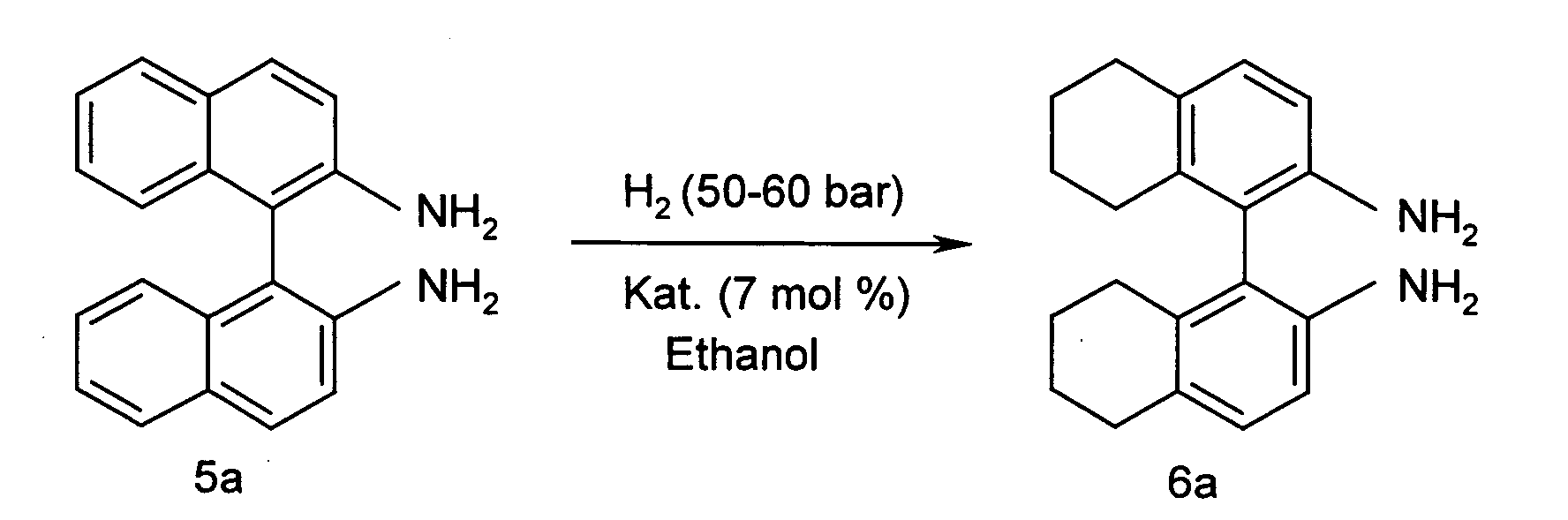
- the following table summarizes the results of the implementation. implementation reaction time Yield (%) ee (%) 1 60 99 > 99 2 80 98 > 99 3 70 100 > 99 4 60 98 > 99 5 60 99 > 99
Landscapes
- Chemical & Material Sciences (AREA)
- Organic Chemistry (AREA)
- Chemical Kinetics & Catalysis (AREA)
- Organic Low-Molecular-Weight Compounds And Preparation Thereof (AREA)
- Catalysts (AREA)
- Low-Molecular Organic Synthesis Reactions Using Catalysts (AREA)
Abstract
Description
zur Reduktion von Binaphthylderivaten der Formel (I),
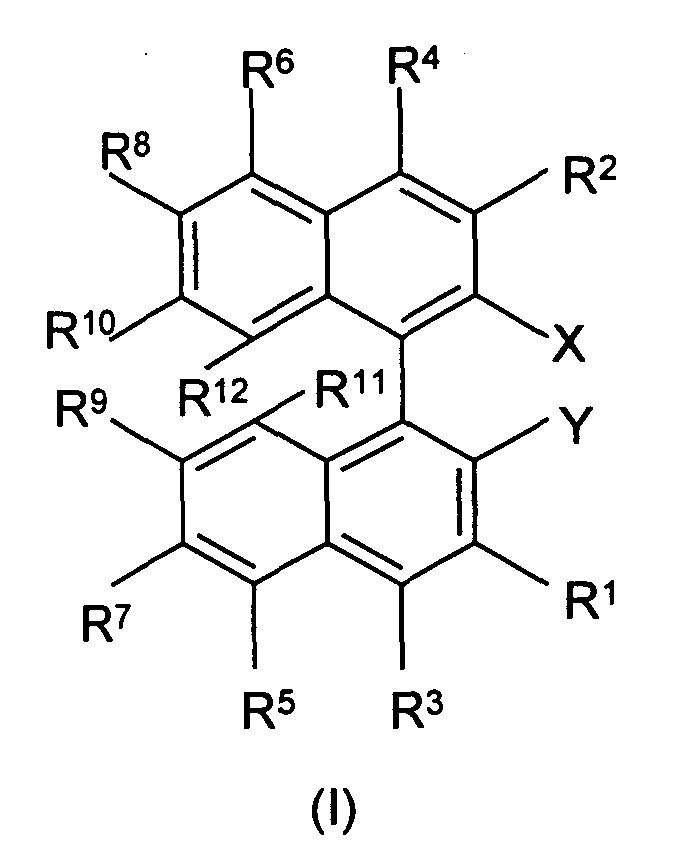

in Gegenwart eines Katalysators enthaltend mindestens ein Metall ausgewählt aus der Gruppe Pt, Ir, Os, Pd, Rh, Ru, Ni, Co und Fe, wobei das oder die Metalle auf einem festen Träger aufgebracht sind,
wobei
- X und Y
- unabhängig voneinander für einen Rest ausgewählt aus der Gruppe
OH, OR', O-((CnH2n)-O-)mR', NH2, NHR', NR'R", SH und SR', worin
R' und R" unabhängig voneinander für einen Wasserstoff-,
(C1-C24)-Alkyl-, (C3-C12)-Cycloalkyl-, (C2-C24)-Alkenyl-,
(C3-C24)-Cycloalkenyl- oder (C5-C20)-Aryl- Rest stehen,
wobei die Reste R' und R" auch weitere Substituenten tragen können und worin n für eine ganze Zahl von 1 bis 24, bevorzugt von 1 bis 6 und m für eine ganze Zahl von 1 bis 12, bevorzugt von 1 bis 3 steht,
R1, R2, R3, R4, R5, R6, R7, R8, R9, R10, R11 und R12 unabhängig voneinander für einen Rest ausgewählt aus der Gruppe Wasserstoff, (C1-C24)-Alkyl, (C3-C12)-Cycloalkyl, (C2-C24)-Alkenyl, (C3-C24)-Cycloalkenyl, (C5-C20)-Aryl, Si((C1-C24)-Alkyl)3, Si(C1-C24)-Alkyl)2(C6-Aryl), Si(C1-C24)-Alkyl)(C6-Aryl)2, Si(C6-Aryl)3, S((C1-C24)-Alkyl), S((C5-C20)-Aryl), F, Cl, Br oder I stehen,
wobei die Reste R2 und R4 und R1 und R3 unabhängig voneinander auch miteinander verknüpft sein können und
wobei die genannten Reste R1 bis R12 auch weitere Substituenten tragen können.
Die zur Charakterisierung der Produkte aufgenommenen NMR-Spektren wurden bei 400.13 (1H) MHz und 100.63 (13C) MHz mit TMS als Standrad aufgenommen. Die angegebenen Werte J sind Hz, δ in ppm angegeben.
Die chirale HPLC wird mit einer Chiralcel Säule, Hexan/EtOH = 90/10 (Octahydrobinaphthole) bzw. einer Chiralcel Säule, Hexan/EtOH = 99.5/0.5 (3,3'dimethyl-octahydrobinaphthole) oder einer (R,R)-Whelk-01 Säule; Hexan/EtOH = 99.95/0.05 (3,3'-dicyclohexyl-octahydrobinaphthole) durchgeführt.
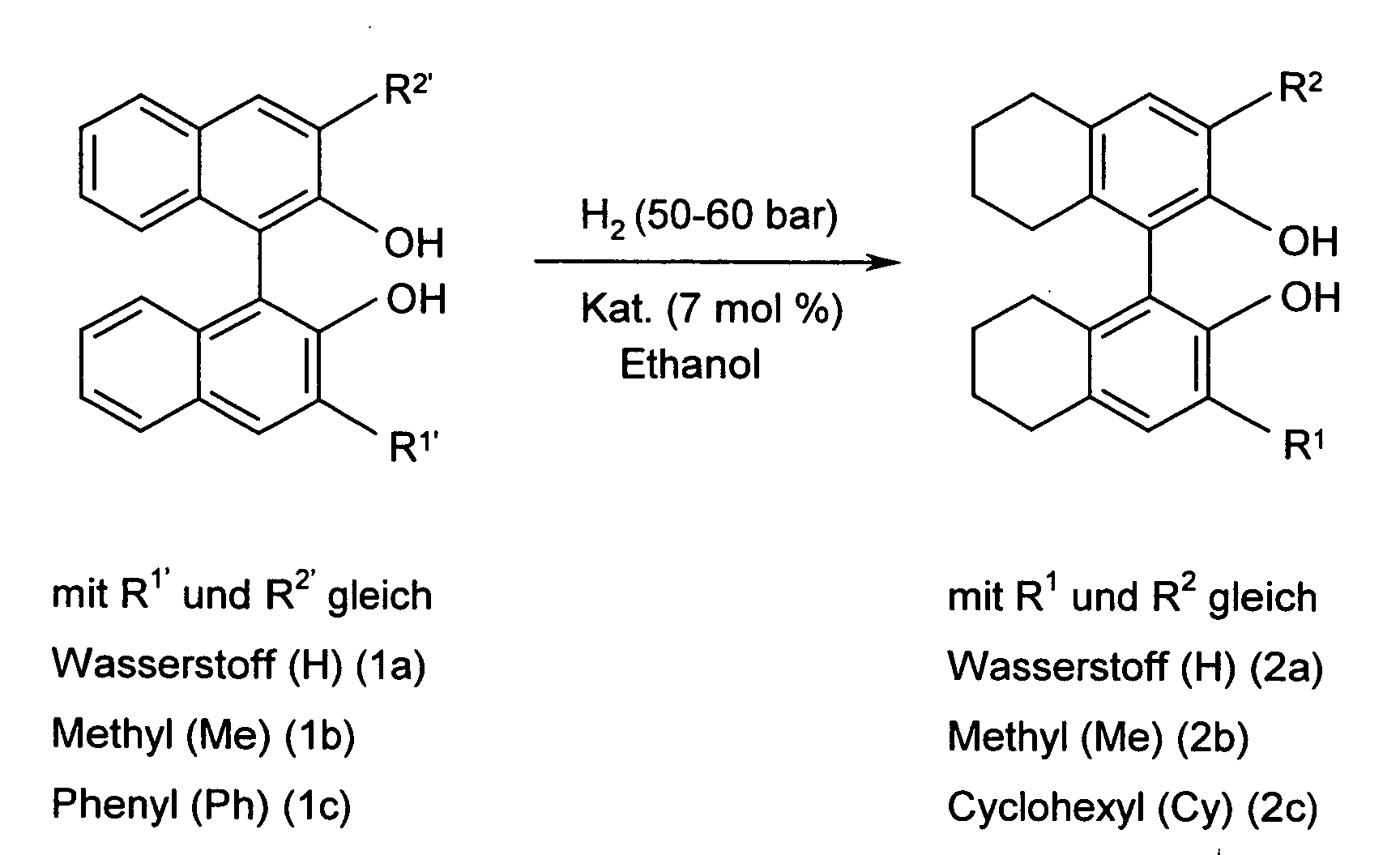
| Ergebnisse der katalytischen Hydrogenierung der Substrate 1 a, 1 b, 1 c. | ||||||
| Bsp. Nr. | Substrat | Katalysator | T (in °C) | Reaktionszeit (in Stunden) | Ausbeute (in %) | ee (in %) |
| 1 | 1a | Ru/Al2O3 | 100 | 3 | 100 | 97.2 |
| 2 | 1a | Ru/C | 50 | 1.5 | 98 | >99 |
| 3 | 1a | Ru/C | 70 | 0.5 | 98 | >99 |
| 4 | 1a | Pd/C | 50 | 2.5 | 99 | >99 |
| 5 | 1a | Pd/C | 70 | 0.5 | 99 | >99 |
| 6 | 1b | Ru/Al2O3 | 100 | 2 | 100 | 99.0 |
| 7 | 1b | Ru/C | 50 | 7 | 99 | >99 |
| 8 | 1b | Ru/C | 70 | 0.5 | 97 | >99 |
| 9 | 1b | Pd/C | 70 | 0.5 | 98 | >99 |
| 10 | 1c | Ru/C | 70 | 7 | 96 | 98.5 |
| 11 | 1c | Pd/C | 70 | 7 | 100 | >99 |
| 12 | 1c | Pd/C | 100 | 0.75 | 100 | 99.0 |

| Katalytische Reduktion der 2,2'-Dimethoxy-binaphthylen 2a, 2b, 2c. | ||||||
| Bsp. Nr. | Substrat | Katalysator | T (in °C) | Reaktionszeit (in Stunden) | Ausbeute (in %) | ee (in %) |
| 13 | 3a | Ru/C | 100 | 0.5 | 74 | 95.4 |
| 14 | 3a | Pd/C | 50 | 3 | 80 | 97.0 |
| 15 | 3a | Pd/C | 70 | 1.5 | 77 | 97.2 |
| 16 | 3b | Ru/C | 100 | 1.5 | 71 | 93.3 |
| 17 | 3b | Pd/C | 100 | 1 | 75 | 90.2 |
| 18 | 3c | Ru/C | 100 | 0.5 | 69 | 98.8 |
| 19 | 3c | Pd/C | 100 | 1 | 74 | 98.5 |

| Umsetzung | Reaktionszeit | Ausbeute (%) | ee (%) |
| 1 | 60 | 99 | >99 |
| 2 | 80 | 98 | >99 |
| 3 | 70 | 100 | >99 |
| 4 | 60 | 98 | >99 |
| 5 | 60 | 99 | >99 |
Claims (13)
- Verfahren zur Reduktion von Binaphthylderivaten der Formel (I),zu H8-1,1'-bi-2-naphthylderivaten der Formel (II)
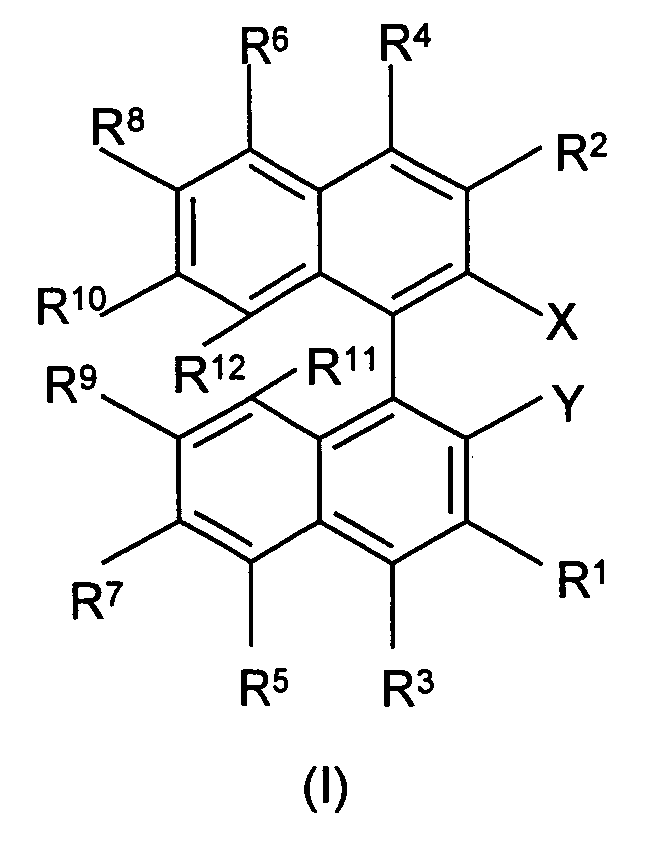 mit Wasserstoff
in Gegenwart eines Katalysators enthaltend mindestens ein Metall ausgewählt aus der Gruppe Pt, Ir, Os, Pd, Rh, Ru, Ni, Co und Fe, wobei das oder die Metalle auf einem festen Träger aufgebracht sind,
wobei- X und Y
- unabhängig voneinander für einen Rest ausgewählt aus der Gruppe
OH, OR', O-((CnH2n)-O-)mR', NH2, NHR', NR'R", SH und SR', worin
R' und R" unabhängig voneinander für einen Wasserstoff-,
(C1-C24)-Alkyl, (C3-C12)-Cycloalkyl, (C2-C24)-Alkenyl,
(C3-C24)-Cycloalkenyl oder (C5-C20)-Aryl -Rest stehen,
wobei die Reste R' und R" auch weitere Substituenten tragen können und worin n für eine ganze Zahl von 1 bis 24, bevorzugt von 1 bis 6 und m für eine ganze Zahl von 1 bis 12, bevorzugt von 1 bis 3 steht,
R1, R2, R3, R4, R5, R6, R7, R8, R9, R10, R11 und R12 unabhängig voneinander für einen Rest ausgewählt aus der Gruppe Wasserstoff, (C1-C24)-Alkyl, (C3-C12)-Cycloalkyl, (C2-C24)-Alkenyl, (C3-C24)-Cycloalkenyl, (C5-C20)-Aryl Si((C1-C24)-Alkyl)3, Si(C1-C24)-Alkyl)2(C6-Aryl), Si(C1-C24)-Alkyl)(C6-Aryl)2, Si(C6-Aryl)3, S((C5-C24)-Alkyl), S((C5-C10)-Aryl), F, Cl, Br oder I stehen,
wobei die Reste R2 und R4 und R1 und R3 unabhängig voneinander auch miteinander verknüpft sein können und
wobei die genannten Reste R1 bis R12 auch weitere Substituenten tragen können. - Verfahren nach Anspruch 1, dadurch gekennzeichnet, dass das oder die Metalle auf einem porösen Träger mit einer spezifischen Oberfläche zwischen 0,1 m2/g und 5000 m2/g aufgebracht sind.
- Verfahren nach Anspruch 1 oder 2, dadurch gekennzeichnet, dass das oder die Metalle auf einem Aktivkohle- oder Aluminiumoxid-Träger aufgebracht sind.
- Verfahren nach einem der Ansprüche 1 bis 3, dadurch gekennzeichnet, dass die Reduktion bei einer Temperatur von unter 120 °C durchgeführt wird.
- Verfahren nach Anspruch 4, dadurch gekennzeichnet, dass die Reduktion bei einer Temperatur von 30 °C bis 100 °C durchgeführt wird.
- Verfahren nach einem der Ansprüche 1 bis 5, dadurch gekennzeichnet, dass die Reduktion bei einem anfänglichen Wasserstoffdruck von unter 80 bar durchgeführt wird.
- Verfahren nach Anspruch 6, dadurch gekennzeichnet, dass die Reduktion bei einem anfänglichen Wasserstoffdruck von unter 60 bar durchgeführt wird.
- Verfahren nach einem der Ansprüche 1 bis 7, dadurch gekennzeichnet, dass als Edukt Binaphthylderivate der Formel (I) eingesetzt werden deren Reste X und Y unabhängig voneinander ausgewählt sind aus der Gruppe OH, OR', OCH2OCH3, OCH2OCH2CH3, OCH2OCH2OCH3, SH, SR', NH2, NHR' und NR'R", wobei R' und R" unabhängig voneinander für einen (C1-C12)-Alkyl-, (C3-C6)-Cycloalkyl- oder C6-Arylrest stehen.
- Verfahren nach einem der Ansprüche 1 bis 8, dadurch gekennzeichnet, dass als Edukt Binaphthylderivate der Formel (I) eingesetzt werden worin mindestens einer der Reste R1 bis R12 unabhängig voneinander ausgewählt ist aus der Gruppe Wasserstoff, (C1-C12)-Alkyl, (C3-C6)-Cycloalkyl und C6-Aryl.
- Verfahren nach Anspruch 9, dadurch gekennzeichnet, dass als Edukt Binaphthylderivate der Formel (I) eingesetzt werden deren Reste R1 bis R12 Wasserstoff sind.
- Verwendung von Katalysatoren enthaltend mindestens ein Metall aus der Gruppe Pt, Ir, Os, Pd, Rh, Ru, Ni, Co und Fe, wobei das oder die Metalle auf einem festen Träger aufgebracht sind zur Reduktion von Binaphthylderivaten mit Wasserstoff.
- Verwendung von Katalysatoren gemäß Anspruch 11 enthaltend mindestens ein Metall aus der Gruppe Pd, Rh und Ru, wobei das oder die Metalle auf einem festen Träger aufgebracht sind zur Reduktion von Binaphthylderivaten mit Wasserstoff.
- Verwendung von Katalysatoren gemäß Anspruch 11 oder 12 enthaltend als festen Träger einen Aktivkohleträger oder einen Aluminiumoxidträger.
Applications Claiming Priority (2)
| Application Number | Priority Date | Filing Date | Title |
|---|---|---|---|
| DE10349399 | 2003-10-21 | ||
| DE10349399A DE10349399A1 (de) | 2003-10-21 | 2003-10-21 | Verfahren zur Reduktion von Binaphthylderivaten |
Publications (2)
| Publication Number | Publication Date |
|---|---|
| EP1526122A2 true EP1526122A2 (de) | 2005-04-27 |
| EP1526122A3 EP1526122A3 (de) | 2005-05-04 |
Family
ID=34384426
Family Applications (1)
| Application Number | Title | Priority Date | Filing Date |
|---|---|---|---|
| EP04024475A Withdrawn EP1526122A3 (de) | 2003-10-21 | 2004-10-14 | Verfahren zur Reduktion von Binaphtylderivaten |
Country Status (4)
| Country | Link |
|---|---|
| US (1) | US20050171371A1 (de) |
| EP (1) | EP1526122A3 (de) |
| JP (1) | JP2005126433A (de) |
| DE (1) | DE10349399A1 (de) |
Families Citing this family (16)
| Publication number | Priority date | Publication date | Assignee | Title |
|---|---|---|---|---|
| DE10058383A1 (de) | 2000-11-24 | 2002-05-29 | Oxeno Olefinchemie Gmbh | Neue Phosphininverbindungen und deren Metallkomplexe |
| DE10210918B4 (de) | 2002-03-13 | 2004-06-03 | Oxeno Olefinchemie Gmbh | Verfahren zur Herstellung von Bisphosphiten |
| DE10223593A1 (de) * | 2002-05-27 | 2003-12-11 | Degussa | Hydroxydiphosphine und deren Verwendung in der Katalyse |
| RU2337090C2 (ru) | 2002-08-31 | 2008-10-27 | Оксено Олефинхеми Гмбх | Способ гидроформилирования олефиновых соединений в присутствии циклических эфиров угольной кислоты |
| CN1290814C (zh) | 2002-08-31 | 2006-12-20 | 奥克森诺奥勒芬化学股份有限公司 | 通过烯属不饱和化合物的加氢甲酰基化制备醛的方法,该方法在环状碳酸酯存在的条件下由未改性的金属配合物催化 |
| DE10360771A1 (de) * | 2003-12-23 | 2005-07-28 | Oxeno Olefinchemie Gmbh | Verfahren zur Herstellung von dreiwertigen Organophosphor-Verbindungen |
| DE10360772A1 (de) * | 2003-12-23 | 2005-07-28 | Oxeno Olefinchemie Gmbh | Verfahren zur Herstellung von Organoacylphosphiten |
| DE102004013514A1 (de) * | 2004-03-19 | 2005-10-06 | Oxeno Olefinchemie Gmbh | Verfahren zur Hydroformylierung von Olefinen in Anwesenheit von neuen phosphororganischen Verbindungen |
| DE102005014055A1 (de) * | 2005-03-23 | 2006-09-28 | Degussa Ag | Unsymmetrisch substituierte Phospholankatalysatoren |
| DE102005042464A1 (de) * | 2005-09-07 | 2007-03-08 | Oxeno Olefinchemie Gmbh | Carbonylierungsverfahren unter Zusatz von sterisch gehinderten sekundären Aminen |
| DE102007017230A1 (de) | 2007-04-12 | 2008-10-16 | Glinberg, Valeriy, Dipl.-Ing. | Mobilen Schutzwandkomplex |
| JP5087344B2 (ja) * | 2007-08-20 | 2012-12-05 | 国立大学法人九州大学 | ビナフチル化合物の還元によるh8−ビナフチル誘導体の合成法 |
| JP6109604B2 (ja) * | 2013-03-05 | 2017-04-05 | 嶋田 豊司 | オクタヒドロビナフチル誘導体 |
| CN103962152B (zh) * | 2014-04-28 | 2016-07-06 | 上海师范大学 | 一种Ru-Pd双金属负载型手性催化剂及其制备工艺 |
| CN106478716B (zh) * | 2016-09-18 | 2018-09-28 | 江苏欣诺科催化剂有限公司 | 一种有机磷化合物的合成方法 |
| JP7014962B2 (ja) * | 2018-03-15 | 2022-02-15 | 新日本理化株式会社 | 新規な環式ジオール化合物 |
Family Cites Families (3)
| Publication number | Priority date | Publication date | Assignee | Title |
|---|---|---|---|---|
| DE605519C (de) * | 1932-07-01 | 1934-11-27 | I G Farbenindustrie Akt Ges | Verfahren zur Darstellung eines Hydrierungsproduktes des 2íñ2'-Dioxy-1íñ1'-dinaphthyls |
| JP2681057B2 (ja) * | 1990-10-01 | 1997-11-19 | 高砂香料工業株式会社 | 2,2’―ビス(ジフェニルホスフィノ)―5,5’,6,6’,7,7’,8,8’―オクタヒドロ―1,1’―ビナフチル及びこれを配位子とする遷移金属錯体 |
| JP3445451B2 (ja) * | 1996-10-24 | 2003-09-08 | 高砂香料工業株式会社 | 光学活性ジホスフィン配位子の製造方法 |
-
2003
- 2003-10-21 DE DE10349399A patent/DE10349399A1/de not_active Withdrawn
-
2004
- 2004-10-14 EP EP04024475A patent/EP1526122A3/de not_active Withdrawn
- 2004-10-18 JP JP2004303519A patent/JP2005126433A/ja active Pending
- 2004-10-20 US US10/968,458 patent/US20050171371A1/en not_active Abandoned
Also Published As
| Publication number | Publication date |
|---|---|
| US20050171371A1 (en) | 2005-08-04 |
| DE10349399A1 (de) | 2005-06-02 |
| JP2005126433A (ja) | 2005-05-19 |
| EP1526122A3 (de) | 2005-05-04 |
Similar Documents
| Publication | Publication Date | Title |
|---|---|---|
| EP1526122A2 (de) | Verfahren zur Reduktion von Binaphtylderivaten | |
| EP1802561B1 (de) | Verfahren zur herstellung optisch aktiver carbonylverbindungen | |
| EP3489213B1 (de) | Zusammensetzung zur verwendung in einem verfahren zur herstellung optisch aktiver carbonylverbindungen | |
| EP2139835A1 (de) | Verfahren zur herstellung optisch aktiver carbonylverbindungen | |
| EP1202952B2 (de) | Verfahren zur herstellung von aminen durch homogen katalysierte reduktive aminierung von carbonylverbindungen | |
| EP1819654B1 (de) | Verfahren zur herstellung von menthol | |
| DE4435390C2 (de) | Verfahren zur Herstellung von Aminopropylalkoxysilanen in Gegenwart von geformten polymeren Rhodiumkomplex-Katalysatoren und deren Verwendung | |
| DE2161200A1 (de) | Neue zweibindige Liganden, ihre Herstellung und Verwendung | |
| EP1858903B1 (de) | Diarylphenoxy-aluminium-verbindungen | |
| DE69114986T2 (de) | Eine Phosphino-Binapthyl-Verbindung und Übergangsmetall-Komplexe davon. | |
| WO2005058786A1 (de) | Verfahren zur herstellung von tricyclodecandialdehyd | |
| EP0238961B1 (de) | Verfahren zur Herstellung von Hydroxyaminen | |
| DE102004007498A1 (de) | Hydrierverfahren zur Herstellung optisch aktiver Alkohole oder Carbonsäuren | |
| DE3935910A1 (de) | Verfahren zur herstellung von optisch reinen 1,2,3,4-tetrahydro-3-carboxyisochinolinen | |
| EP4482828A1 (de) | Verfahren zur herstellung von cis-4-aminotetrahydrofuran-2-carbonsäureestern | |
| DE102005044355A1 (de) | Chirale Phosphoramidite | |
| DE69405705T2 (de) | Verfahren zur Herstellung von einem optisch aktiven Diaminohexanonderivat | |
| DE10352757A1 (de) | Chirale Di- und Triphosphite | |
| DE69931966T2 (de) | Herstellung von optisch aktiven alphahydroxyacetalen | |
| EP0089417A1 (de) | Verfahren zur Herstellung von Phthalid | |
| EP1819647B1 (de) | Verfahren zur hydrierung von , -ungesättigten carbonylverbindungen | |
| DE102008033165A1 (de) | Verfahren zum Herstellen eines optisch aktiven ß-Hydroxycarbonsäurederivats | |
| DE60313317T2 (de) | Kontinuierliches verfahren zur cyanierung von hydrierten beta-ketoestern | |
| EP0512415B1 (de) | Verfahren zur enantioselektiven Synthese von 2(R)-Benzylbernsteinsäuremonoamid-Derivaten | |
| DE102005040752A1 (de) | Eisen-katalysierte allylische Alkylierung |
Legal Events
| Date | Code | Title | Description |
|---|---|---|---|
| PUAI | Public reference made under article 153(3) epc to a published international application that has entered the european phase |
Free format text: ORIGINAL CODE: 0009012 |
|
| PUAL | Search report despatched |
Free format text: ORIGINAL CODE: 0009013 |
|
| 17P | Request for examination filed |
Effective date: 20041014 |
|
| AK | Designated contracting states |
Kind code of ref document: A2 Designated state(s): AT BE BG CH CY CZ DE DK EE ES FI FR GB GR HU IE IT LI LU MC NL PL PT RO SE SI SK TR |
|
| AX | Request for extension of the european patent |
Extension state: AL HR LT LV MK |
|
| AK | Designated contracting states |
Kind code of ref document: A3 Designated state(s): AT BE BG CH CY CZ DE DK EE ES FI FR GB GR HU IE IT LI LU MC NL PL PT RO SE SI SK TR |
|
| AX | Request for extension of the european patent |
Extension state: AL HR LT LV MK |
|
| AKX | Designation fees paid |
Designated state(s): AT BE BG CH CY CZ DE DK EE ES FI FR GB GR HU IE IT LI LU MC NL PL PT RO SE SI SK TR |
|
| RAP1 | Party data changed (applicant data changed or rights of an application transferred) |
Owner name: DEGUSSA GMBH |
|
| RAP1 | Party data changed (applicant data changed or rights of an application transferred) |
Owner name: EVONIK DEGUSSA GMBH |
|
| RAP1 | Party data changed (applicant data changed or rights of an application transferred) |
Owner name: EVONIK DEGUSSA GMBH |
|
| STAA | Information on the status of an ep patent application or granted ep patent |
Free format text: STATUS: THE APPLICATION IS DEEMED TO BE WITHDRAWN |
|
| 18D | Application deemed to be withdrawn |
Effective date: 20080502 |