EP1526647A1 - Verfahren zur erzeugung einer prüfmatrix und erzeugung einer prüfmatrix - Google Patents
Verfahren zur erzeugung einer prüfmatrix und erzeugung einer prüfmatrix Download PDFInfo
- Publication number
- EP1526647A1 EP1526647A1 EP03736176A EP03736176A EP1526647A1 EP 1526647 A1 EP1526647 A1 EP 1526647A1 EP 03736176 A EP03736176 A EP 03736176A EP 03736176 A EP03736176 A EP 03736176A EP 1526647 A1 EP1526647 A1 EP 1526647A1
- Authority
- EP
- European Patent Office
- Prior art keywords
- weights
- row
- column
- ensemble
- weight
- Prior art date
- Legal status (The legal status is an assumption and is not a legal conclusion. Google has not performed a legal analysis and makes no representation as to the accuracy of the status listed.)
- Granted
Links
Images







Classifications
-
- H—ELECTRICITY
- H03—ELECTRONIC CIRCUITRY
- H03M—CODING; DECODING; CODE CONVERSION IN GENERAL
- H03M13/00—Coding, decoding or code conversion, for error detection or error correction; Coding theory basic assumptions; Coding bounds; Error probability evaluation methods; Channel models; Simulation or testing of codes
- H03M13/03—Error detection or forward error correction by redundancy in data representation, i.e. code words containing more digits than the source words
- H03M13/033—Theoretical methods to calculate these checking codes
-
- H—ELECTRICITY
- H03—ELECTRONIC CIRCUITRY
- H03M—CODING; DECODING; CODE CONVERSION IN GENERAL
- H03M13/00—Coding, decoding or code conversion, for error detection or error correction; Coding theory basic assumptions; Coding bounds; Error probability evaluation methods; Channel models; Simulation or testing of codes
- H03M13/03—Error detection or forward error correction by redundancy in data representation, i.e. code words containing more digits than the source words
- H03M13/05—Error detection or forward error correction by redundancy in data representation, i.e. code words containing more digits than the source words using block codes, i.e. a predetermined number of check bits joined to a predetermined number of information bits
- H03M13/11—Error detection or forward error correction by redundancy in data representation, i.e. code words containing more digits than the source words using block codes, i.e. a predetermined number of check bits joined to a predetermined number of information bits using multiple parity bits
- H03M13/1102—Codes on graphs and decoding on graphs, e.g. low-density parity check [LDPC] codes
- H03M13/1148—Structural properties of the code parity-check or generator matrix
- H03M13/1151—Algebraically constructed LDPC codes, e.g. LDPC codes derived from Euclidean geometries [EG-LDPC codes]
Definitions
- the present invention relates to a method and an apparatus for generating a check matrix for a low density parity check (LDPC) code that is employed as an error correcting code, and more particularly, to a method and an apparatus for generating a check matrix capable of searching a definite and characteristic stabilized check matrix for the LDPC code.
- LDPC low density parity check
- FIG. 13 illustrates an LDPC encoding/decoding system.
- Reference numeral 101 denotes an encoder
- 102 denotes a modulator
- 103 denotes a channel
- 104 denotes a demodulator
- 105 denotes a decoder.
- the encoder 101 then receives a message (m 1 m 2 ... m k ) of an information-length k, and generates a code-word C using the generator matrix G as follows:
- the modulator 102 subjects the generated code-word C to digital modulation such as BPSK, QPSK or multi-valued QAM and transmits the resultant modulated signal.
- the demodulator 104 receives the modulated signal via the channel 103, and subjects it to a digital demodulation such as BPSK, QPSK or multi-valued QAM.
- the decoder 105 then subjects the LDPC-coded, demodulated result to an iterative decoding by "Sum-Product Algorithm” and provides an estimated result (corresponding to the original m 1 m 2 ... m k ).
- check matrixes for the LDPC codes are generated as explained below.
- the check matrix the LDPC code for example, following matrix is proposed by Gallager (see Non-patent Literature 1, Fig. 14).
- This matrix is a binary matrix of "1" and "0". Parts of "1” are hatched and parts of "0" are white. There are four “1”s in one row (hereinafter, “row weight”), and there are three “1”s in one column (hereinafter, “column weight”). All columns and rows have respective uniform weights. Thus, it is generally called “Regular-LDPC Code”. In the Gallager's codes, as shown in Fig. 14, the matrix is divided into three blocks, for example, and the second and third blocks are subjected to random permutation.
- Euclidean geometry codes are such LDPC codes that exhibit a relatively stable and nice characteristic and can definitely generate a matrix without the use of the computer search.
- Y. Kou et al. have proposed a method using such Euclidean geometry codes. This method explains "Regular-LDPC Codes" consisting of regular ensembles (see Non-patent Literature 2).
- a method of generating a check matrix for LDPC codes is herein proposed using Euclidean geometry codes EG(2, 2 6 ) or a kind of finite geometric codes. This method achieves a characteristic that is located closely but 1.45 decibels away from the Shannon limit at an error rate of 10-4.
- Fig. 15 illustrates a configuration of Euclidean geometry codes EG(2, 2 2 ), which has a structure of "Regular-LDPC Codes" with row and column weights of 4, 4.
- Euclidean geometry codes EG(m, 2 s ) have a characteristic defined as follows
- Euclidean geometry codes have a structure with a cyclically sifted location of "1" in each row from an adjacent row. This structure can characteristically configure codes easily and definitely.
- the check matrix generating method by Y. Kou et al. further includes changing row and column weights based on the Euclidean geometry codes to extend rows and columns, if required. For example, when a column weight in EG(2, 2 2 ) is separated into halves, in the paper by Y. Kou et al., every other one of four weights located in one column is separated into two groups. Fig. 16 illustrates an exemplary regular separation of the column weight from 4 into 2.
- the present invention has been achieved in consideration of the above problems, and accordingly has an object to provide a method and an apparatus for generating a check matrix of a satisfactory performance for the an LDPC code capable of easily searching a definite and characteristic stabilized check matrix for the LDPC code corresponding to an optional ensemble.
- a method of generating a check matrix for a low-density parity-check code in which at least one of weights of a column and a row are not uniform, using a Euclidean geometry code includes determining a code length and a coding rate; selecting the Euclidean geometry code that becomes a base; rearranging the Euclidean geometry code selected, based on a specific relational equation to create a basic matrix; selecting a maximum value of the weight of the column that satisfies a condition of "2 ⁇ maximum value of the weight of the column ⁇ number of 1s within columns in the Euclidean geometry code"; searching provisionally an ensemble of the weights of the row and the column weights of the low-density parity-check code via optimization based on Gaussian approximation in a state that number of the weights of the row are limited to continuous two kinds to determine an optimum set of the weights of the row; deleting the rows sequentially from a bottom of the basic
- the specific relational equation used at the rearranging is generated such that the weights within the matrix are arranged at a higher position within columns.
- a method of generating a check matrix for a low-density parity-check code in which at least one of weights of a column and a row are not uniform, using a Caylay graph includes determining a code length and a coding rate; determining the weights of the row and the column in the Caylay graph, which becomes a base, to create a basic matrix; selecting a maximum value of the weight of the column that satisfies a condition of "2 ⁇ maximum value of the weight of the column ⁇ number of 1s within columns in the Caylay graph"; searching provisionally an ensemble of the weights of the row and the column weights of the low-density parity-check code via optimization based on Gaussian approximation in a state that number of the weights of the row are limited to continuous two kinds to determine an optimum set of the weights of the row; deleting the rows sequentially from a bottom of the basic matrix considering number of rows after a division; searching provisionally an ensemble
- the optimal ensemble of the weights of the row and the column, which minimizes a threshold is searched in a single linear programming such that a Gaussian noise becomes maximum in a state that the coding rate is fixed.
- a weight distribution in the ensemble is adjusted such that a total number of the weights in weight unit is equal to an integer and a sum of the total number of the weights in the weight unit is equal to a total number of 1s in the Euclidean geometry code.
- the dividing is performed based on the ensemble after an adjustment.
- a Latin square of basic random sequence is generated, and a weight of 1 is extracted from each of the rows and each of the columns in the basic matrix after deleting the row, thereby dividing each of the rows and each of the columns at random based on the Latin square.
- An apparatus for generating a check matrix for a low-density parity-check code in which at least one of weights of a column and a row are not uniform, using a Euclidean geometry code includes a code-length/coding-rate determining unit that determines a code length and a coding rate; a Euclidean geometry code selecting unit that selects the Euclidean geometry code that becomes a base; a rearranging unit that rearranges the Euclidean geometry code selected, based on a specific relational equation to create a basic matrix; a maximum-weight selecting unit that selects a maximum value of the weight of the column that satisfies a condition of "2 ⁇ maximum value of the weight of the column ⁇ number of 1s within columns in the Euclidean geometry code"; a first weight searching unit that searches provisionally an ensemble of the weights of the row and the column weights of the low-density parity-check code via optimization based on Gaussian app
- An apparatus for generating a check matrix for a low-density parity-check code in which at least one of weights of a column and a row are not uniform, using a Caylay graph includes a code-length/coding-rate determining unit that determines a code length and a coding rate; a Caylay-graph determining unit that determines the weights of the row and the column in the Caylay graph, which becomes a base, to create a basic matrix; a maximum-weight selecting unit that selects a maximum value of the weight of the column that satisfies a condition of "2 ⁇ maximum value of the weight of the column ⁇ number of 1s within columns in the Caylay graph"; a first weight searching unit that searches provisionally an ensemble of the weights of the row and the column weights of the low-density parity-check code via optimization based on Gaussian approximation in a state that number of the weights of the row are limited to continuous two kinds to
- Fig. 1 is a flowchart of a method of generating check matrixes for LDPC codes according to the present invention
- Fig. 2 is a diagram of a matrix of selected Euclidean geometry codes EG(2, 2 2 )
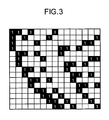
- Fig. 3 is a diagram of a matrix after a rearrangement (i.e., basic matrix)
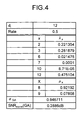
- Fig. 4 is a diagram of an ensemble (provisional) of a generator function ⁇ (x) and a generator function ⁇ (x) after weights are distributed
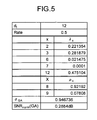
- Fig. 5 is a diagram of an ensemble (provisional) of a generator function ⁇ (x) and a generator function ⁇ (x) after weights are distributed
- Fig. 1 is a flowchart of a method of generating check matrixes for LDPC codes according to the present invention
- Fig. 2 is a diagram of a matrix of selected Euclidean geometry codes EG(2, 2 2 )
- Fig. 3 is a diagram of a matrix after
- FIG. 6 is a diagram of an ensemble (provisional) of a generator function ⁇ (x) and a generator function ⁇ (x) after weights are distributed;
- Fig. 7 is a diagram of one example of a weight distribution adjusting table;
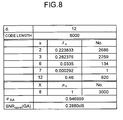
- Fig. 8 is a diagram of an ensemble of a final generator function ⁇ (x) and a final generator function ⁇ (x) after the ensemble shown in Fig. 6 is adjusted;
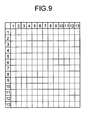
- Fig. 9 is a diagram of a conventional dividing procedure according to a research paper;
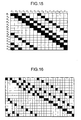
- Fig. 10 is a diagram of a basic random sequence C (i) and a permutation pattern LB j (i) of the basic random sequence;
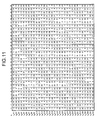
- Fig. 11 is a diagram of a Latin square matrix L jq (i); Fig.
- Fig. 12 is a diagram of a relation between Eb/No (a ratio of signal power to noise power per one information bit) and bit error rate (BER);
- Fig. 13 is a diagram of an LDPC encoding/decoding system;
- Fig. 14 is a diagram of a conventional check matrix for LDPC codes;
- Fig. 15 is a diagram of a configuration of Euclidean geometry codes EG(2, 2 2 ); and
- Fig. 16 is an exemplary row weight regularly separated from 4 into 2.
- Fig. 1 is a flowchart of a method of generating check matrixes for LDPC codes according to the present invention.
- the method of generating check matrixes for LDPC codes according to the present embodiment can be executed within a communication apparatus according to a set parameter, or can be executed by other control unit at the outside of the communication apparatus (such as a computer).
- the method of generating check matrixes for LDPC codes according to the present embodiment is executed at the outside of the communication apparatus, generated check matrixes for LDPC codes are stored into the communication apparatus.
- the above method is executed within the communication apparatus for the convenience of explanation.
- the encoder 101 then receives a message (m 1 m 2 ... m k ) of an information-length k, and generates a code-word C using the generator matrix G.
- the modulator 102 subjects the generated code-word C to digital modulation such as BPSK, QPSK or multi-valued QAM and transmits the resultant modulated signal.
- the demodulator 104 receives the modulated signal via the channel 103, and subjects it to a digital demodulation such as BPSK, QPSK or multi-valued QAM.
- the decoder 105 then subjects the LDPC-coded, demodulated result to an iterative decoding by "Sum-Product Algorithm” and provides an estimated result (corresponding to the original m1 m2 ... mk).
- the method of generating check matrixes for LDPC Codes described in the paper, or Gaussian Approximation has a premise that defines a point of "1" on a row as a variable node and a point of "1" on a column as a check node in the check matrix.
- LLR message propagation from a check node to a variable node is analyzed first.
- the following equation (2) is defined on condition that 0 ⁇ s ⁇ ⁇ and 0 ⁇ t ⁇ .
- u0 a Log Likelihood Ratio (LLR) associated with a signal received via a channel containing a Gaussian noise of distributed value ⁇ n2
- LLR Log Likelihood Ratio
- ⁇ (x) and ⁇ (x) respectively denote generator functions of degree distribution associated with variable nodes and check nodes, and can be represented by the equations (3) and (4).
- a degree is expressed as the number of "1"s in each row and each column of variable nodes and check nodes).
- ⁇ i and ⁇ i respectively denote ratios of edges belonging to variable nodes and check nodes at a degree of i.
- dl denotes a degree of maximum variable nodes, and d r a degree of maximum check nodes.
- ⁇ (x) is defined as the following equation (5)
- a condition required for deriving an SNR limit (threshold) that provides an error with a value of 0 includes t 1 (s) ⁇ (expressed as R+) when 1 ⁇ . In order to satisfy this condition, it is required to satisfy the following conditional expression (7): t ⁇ f(s, t), all t ⁇ R+
- a condition required for deriving an SNR limit (threshold) that provides an error with a value of 0 includes r I (s) ⁇ 0. In order to satisfy this condition, it is required to satisfy the following conditional expression (10) r ⁇ h(s, r), all r ⁇ (0, ⁇ (s))
- a problem is found in the paper of Chung et al. because a check matrix derived from the maximum of the "rate (coding rate)" is flux. Such the check matrix is not suitable for practical design because the rate fixed in design as a spec varies.
- a problem is found in the paper of Chung et al. that it takes time to carry out a search processing because the derivation of the degree distribution associated with variable nodes and the derivation of the degree distribution associated with check nodes are executed over certain times. Further, it is difficult to easily cope with an optional ensemble, an optional code length, and an optional coding rate.
- a method of easily searching in a short time a definite and characteristic-stabilized check matrix for "Irregular-LDPC Codes" corresponding to an optional ensemble, an optional code length, and an optional coding rate according to the present embodiment will be explained (see Fig. 1).
- a check matrix for "Irregular-LDPC Codes” is generated by dividing or deleting the arrangement of "1s" in one row or one column in Euclidean geometry codes.
- Fig. 1 is a flowchart of the method of generating check matrixes for LDPC codes according to a first embodiment of the present invention.
- a code length N and a coding rate are determined (step S1).
- the size of the check matrix is determined as N ⁇ M.
- Euclidean geometry codes EG(2, 2 s ) that become a base of the check matrix for "Irregular-LDPC Codes" are selected (step S2).
- a row weight and a column weight become 2 s respectively.
- the selected Euclidean geometry codes EG(2, 2 s ) are rearranged such that 1 within a column is at a higher position of the column as far as possible (step S3).
- the polynomial within ( ⁇ ) of the equation (12) denotes a first row of the Euclidean geometry codes EG(2, 2 s ).
- a row delete processing described later is carried out by this rearrangement, a column having a largest weight possible can be left, and a variation of weight within the column can be minimized.
- Fig. 2 is a diagram (where blank designates 0) of the matrix of Euclidean geometry codes EG(2, 2 s ) selected at step S2, and Fig. 3 is a diagram of the matrix (basic matrix) after the rearrangement.
- a largest weight of a column ⁇ 1 (2 ⁇ 1 ⁇ 2 s ) is selected (step S4).
- LDPC codes having a construction of restricting the occurrence of a small number of "cycle 4" and "cycle 6" is preferable.
- Euclidean geometry codes do not have "cycle 4". Therefore, decoding characteristics are improved by deleting "cycle 6". For example, in the case of Euclidean geometry codes EG(2, 2 5 ), it is generally known that the number of "cycle 6" decreases when the weight is about 12, and satisfactory characteristics are obtained.
- step S5 an ensemble of "Irregular-LDPC codes" based on a requested coding rate is provisionally obtained using optimization according to Gaussian Approximation.
- a parameter set ⁇ 1 , ⁇ 2 ⁇ that satisfies the following equation (13) is selected (step S5), where 2 ⁇ i ⁇ 2 s , and i ⁇ 1, 2 ⁇ .
- ⁇ 1 + b 2 ⁇ 2 2 s arg ⁇ min
- ⁇ '_ ⁇ i ⁇ i ⁇ b i 2 s
- bi and i are nonnegative integers
- ⁇ i denotes a row weight
- ⁇ _ ⁇ i ' denotes an edge ratio belonging to the weight ⁇ i that is matched with "Irregular-LDPC codes”.
- ⁇ GA denotes a noise distribution value on the "threshold” derived by Gaussian Approximation
- SNR norm (GA) denotes a difference between an SNR on the "threshold” derived by Gaussian Approximation and an SNR on Shannon limit.
- Steps of executing Gaussian Approximation according to the present embodiment for searching an ensemble of a generator function ⁇ (x) of a degree distribution of variable nodes and a generator function ⁇ (x) of a degree distribution of check nodes will be explained.
- the linear programming is employed once to find such generator functions ⁇ (x) and ⁇ (x) that satisfy the equations (9) and (10). Therefore, it is possible to search a definite and characteristic-stabilized check matrix for LDPC codes more easily in a shorter time than the method described in the above paper (Chung, et. al.) that iteratively executes derivation of the generator functions ⁇ (x) and ⁇ (x) to derive both optimal values.
- step S8 When a number of rows is M' after a row division processing (step S8) explained later is executed following b 1 , b 2 , ⁇ 1 , and ⁇ 2 obtained at steps S5, the rows of the number shown in the following equation (14) are deleted in order from the bottom of the basic matrix shown in Fig. 3 (step S6). As a result, the weight set of columns of the matrix after the deletion becomes ⁇ d 1 , d 2 , ..., d ⁇ ⁇ . M' - M b 1 + b 2
- a set ⁇ 1 , ⁇ 2 , ..., ⁇ 1 ⁇ of column weight candidates that satisfies the above weight distribution and satisfies the following equation (15) is selected (step S7), where ⁇ 1 ⁇ 2 s .
- this column weight is deleted from the candidates.
- Fig. 7 is a diagram of one example of a weight distribution adjusting table.
- the above adjusting procedure can be generally expressed as shown in the following equations (16), (17), and (18).
- a number of columns n_ ⁇ i belonging to the weight ⁇ i and a number of rows n_ ⁇ i belonging to the weight ⁇ i are obtained from the following equation (16), where w t denotes a total weight of matrixes after deleting rows.
- ⁇ _ ⁇ i ' represents a ratio of columns belonging to the weight ⁇ i ' adjusted by matching the matrix after deleting rows
- ⁇ _ ⁇ i ' represents a ratio of rows belonging to the weight ⁇ i ' adjusted by matching the matrix after deleting rows.
- Fig. 8 is a diagram of an ensemble of a final generator function ⁇ (x) and a final generator function ⁇ (x) at step S7 after the ensemble shown in Fig. 6 is adjusted in the following procedure.
- a procedure of dividing one row or one column in Euclidean geometry codes (step S8) is explained.
- the paper of Y. Kou et al. proposes to perform the dividing based on certain rules.
- Fig. 9 illustrates the dividing procedure proposed in the paper of Kou et al. As shown in Fig. 9, a matrix is numbered with column numbers 1, 2, 3 ... in sequence from the left end and row numbers 1, 2, 3 ... in sequence from the top.
- 32 points ⁇ 1 row can be divided into 8 points ⁇ 4 rows regularly in accordance with the following equation (12)
- B I (x) denotes a position of "1" on the I-th column in EG(2, 2 5 )
- Sm(n) a position of "1" on the m-th column in the divided matrix.
- a row number indicative of a position of "1" on a row in EG(2, 2 5 ) is represented by
- B 1 (x) ⁇ 1 32 114 136 149 223 260 382 402 438 467 507 574 579 588 622 634 637 638 676 717 728 790 851 861 879 947 954 971 977 979 998 ⁇
- B I (x) ⁇ 1 32 114 136 149 223 260 382 402 438 467 507 574 579 588 622 634 637 638 676 717 728 790 851 861 879 947 954 971 977 979 998 ⁇
- Euclidean geometry codes are not divided regularly as described above. Rather, a number indicative of "1" is extracted from B I (x) at random. Any extracting process may be applied so long as it can retain randomness.
- Fig. 11 is a diagram of a Latin square matrix L jq (i).
- This Latin square matrix L jq (i) is used to determine a j ⁇ 32+q-th division pattern of a matrix to be expanded.
- Fig. 12 is a diagram of a relation between Eb/No (a ratio of signal power to noise power per one information bit) and bit error rate (BER).
- the decoding method is a "Sum-Product Algorithm".
- the characteristics use the ensemble shown in Fig. 8.
- Fig. 12 is a comparison of characteristics between a result of a regular division as described in a research paper by Y. Kou et al. and a result of executing a divide processing according to a Latin square in random sequence.
- a code length and a coding rate are determined.
- Euclidean geometry codes that become a base are determined.
- the selected Euclidean geometry codes are rearranged based on a specific relational equation to create a basic matrix.
- a maximum value of a column weight that satisfies the condition "2 ⁇ 1 ⁇ 2 s " is selected.
- an ensemble of Irregular-LDPC codes is searched by Gaussian approximation.
- An optimum set of row weights is determined. Rows are deleted in order from the bottom of the basic matrix by considering the number of rows after a division.
- An ensemble of Irregular-LDPC codes is provisionally searched by Gaussian approximation using a set of row weights. An optimum set of column weights is determined. An optimal ensemble of Irregular-LDPC codes is searched by Gaussian approximation using the set of row weights and the set of column weights as fixed parameters. Finally, weights of the rows and columns of the basic matrix after deleting the rows are divided at random in a predetermined procedure based on this ensemble. As a result, a definite and characteristic-stabilized check matrix for "Irregular-LDPC Codes" corresponding to an optional ensemble, an optional code length, and an optional coding rate can be easily generated in a short time.
- Euclidean geometry codes are used to generate check matrix for "Irregular-LDPC Codes" according to the present embodiment
- firm “Irregular-LDPC codes” can be constructed using a Cayley graph, for example.
- “processing of determining weights of rows and columns of the Cayley graph as a base, thereby creating a basic matrix” is executed in place of the above-explained “processing of selecting Euclidean geometry codes EG that become a base (step S2)” and “processing of rearranging the selected Euclidean geometry codes based on the equation (12), thereby creating a basic matrix (step S3)”.
- Other processing are similar to the processing shown in Fig. 1.
- Euclidean geometry codes or the Cayley graph are used for the basic matrix in the above explanation, other matrixes than Euclidean geometry codes such as projective geometric codes can be used so long as the matrixes satisfy conditions that "weights of rows and columns are constant" and "number of cycles is equal to or more than 6".
- a code length and a coding rate are determined.
- Euclidean geometry codes that become a base are determined.
- the selected Euclidean geometry codes are rearranged based on a specific relational equation to create a basic matrix.
- a maximum value of a column weight is selected.
- an ensemble of Irregular-LDPC codes is searched by Gaussian approximation.
- An optimum set of row weights is determined. Rows are deleted in order from the bottom of the basic matrix by considering the number of rows after a division.
- An ensemble of Irregular-LDPC codes is provisionally searched by Gaussian approximation using a set of row weights.
- An optimum set of column weights is determined.
- An optimal ensemble of Irregular-LDPC codes is searched by Gaussian approximation using the set of row weights and the set of column weights as fixed parameters. Finally, weights of the rows and columns of the basic matrix after deleting the rows are divided at random in a predetermined procedure based on this ensemble.
- the weights in the matrix are rearranged to be disposed at a higher position in columns.
- first a code length and a coding rate are determined.
- weights of rows and columns of a Caylay graph that become a base are determined.
- a maximum value of a column weight is selected.
- an ensemble of Irregular-LDPC codes is searched by Gaussian approximation.
- An optimum set of row weights is determined. Rows are deleted in order from the bottom of the basic matrix by considering the number of rows after a division.
- An ensemble of Irregular-LDPC codes is provisionally searched by Gaussian approximation using a set of row weights.
- An optimum set of column weights is determined.
- the generator function ⁇ (x) and the generator function ⁇ (x) are calculated in one linear programming. Therefore, it is possible to search a definite and characteristic-stabilized check matrix for LDPC codes more easily and speedily than the method described in the research paper that iteratively executes derivation of the generator functions ⁇ (x) and ⁇ (x) to derive both optimal values.
- a weight distribution is adjusted such that the total weight number of weight units is equal to an integer, and a sum of the total weight numbers of weight units is equal to the total number of "1"s in Euclidean geometry codes.
- a condition associated with code characteristics can be defined correctly through creation of a Latin square of random sequences.
- first a code length and a coding rate are determined.
- Euclidean geometry codes that become a base are determined.
- the selected Euclidean geometry codes are rearranged based on a specific relational equation to create a basic matrix.
- a maximum value of a column weight is selected.
- an ensemble of Irregular-LDPC codes is searched by Gaussian approximation.
- An optimum set of row weights is determined. Rows are deleted in order from the bottom of the basic matrix by considering the number of rows after a division.
- An ensemble of Irregular-LDPC codes is provisionally searched by Gaussian approximation using a set of row weights.
- An optimum set of column weights is determined.
- An optimal ensemble of Irregular-LDPC codes is searched by Gaussian approximation using the set of row weights and the set of column weights as fixed parameters. Finally, weights of the rows and columns of the basic matrix after deleting the rows are divided at random in a predetermined procedure based on this ensemble.
- first a code length and a coding rate are determined.
- weights of rows and columns of a Caylay graph that become a base are determined.
- a maximum value of a column weight is selected.
- an ensemble of Irregular-LDPC codes is searched by Gaussian approximation.
- An optimum set of row weights is determined. Rows are deleted in order from the bottom of the basic matrix by considering the number of rows after a division.
- An ensemble of Irregular-LDPC codes is provisionally searched by Gaussian approximation using a set of row weights.
- An optimum set of column weights is determined.
- the method of generating check matrixes for LDPC codes and the check matrix generating apparatus according to the present invention are useful for a communication apparatus that employs LDPC codes as error correcting codes, and are particularly useful for an apparatus that generates a definite and characteristic stabilized "Irregular-LDPC codes".
Landscapes
- Physics & Mathematics (AREA)
- Probability & Statistics with Applications (AREA)
- Engineering & Computer Science (AREA)
- Theoretical Computer Science (AREA)
- Mathematical Physics (AREA)
- Discrete Mathematics (AREA)
- General Physics & Mathematics (AREA)
- Error Detection And Correction (AREA)
- Detection And Correction Of Errors (AREA)
Applications Claiming Priority (3)
| Application Number | Priority Date | Filing Date | Title |
|---|---|---|---|
| JP2002193767 | 2002-07-02 | ||
| JP2002193767 | 2002-07-02 | ||
| PCT/JP2003/007476 WO2004006444A1 (ja) | 2002-07-02 | 2003-06-12 | 検査行列生成方法および検査行列生成装置 |
Publications (3)
| Publication Number | Publication Date |
|---|---|
| EP1526647A1 true EP1526647A1 (de) | 2005-04-27 |
| EP1526647A4 EP1526647A4 (de) | 2007-03-14 |
| EP1526647B1 EP1526647B1 (de) | 2008-10-01 |
Family
ID=30112288
Family Applications (1)
| Application Number | Title | Priority Date | Filing Date |
|---|---|---|---|
| EP03736176A Expired - Lifetime EP1526647B1 (de) | 2002-07-02 | 2003-06-12 | Erzeugung einer Prüfmatrix für irregulare Low-Density Parity-Check (LDPC) Codes |
Country Status (5)
| Country | Link |
|---|---|
| US (1) | US7395484B2 (de) |
| EP (1) | EP1526647B1 (de) |
| JP (1) | JP4005084B2 (de) |
| CN (1) | CN100448170C (de) |
| WO (1) | WO2004006444A1 (de) |
Cited By (3)
| Publication number | Priority date | Publication date | Assignee | Title |
|---|---|---|---|---|
| EP1460766A4 (de) * | 2001-12-27 | 2007-03-14 | Mitsubishi Electric Corp | Erzeugungsverfahren für eine ldpc-codeinspektionsmatrix |
| EP1598942A4 (de) * | 2003-02-28 | 2007-04-04 | Mitsubishi Electric Corp | Pr fmatrixerzeugungsverfahren und pr fmatrixerzeugungseinrichtung |
| EP1746732A4 (de) * | 2004-04-28 | 2008-02-27 | Mitsubishi Electric Corp | Neuübertragungssteuerverfahren und kommunikationseinrichtung |
Families Citing this family (21)
| Publication number | Priority date | Publication date | Assignee | Title |
|---|---|---|---|---|
| JP4339313B2 (ja) | 2003-05-15 | 2009-10-07 | 三菱電機株式会社 | 通信方法、無線端末および基地局 |
| DE202005021953U1 (de) * | 2004-01-20 | 2012-06-28 | Nec Corporation | Vorrichtung zum Generieren einer Paritätsprüfmatrix, Datenübertragungssystem, Codiervorrichtung, Decodiervorrichtung |
| US7831883B2 (en) * | 2004-04-02 | 2010-11-09 | Nortel Networks Limited | LDPC encoders, decoders, systems and methods |
| JP4138700B2 (ja) * | 2004-05-31 | 2008-08-27 | 株式会社東芝 | 復号装置および復号回路 |
| KR101065693B1 (ko) * | 2004-09-17 | 2011-09-19 | 엘지전자 주식회사 | Ldpc 코드를 이용한 부호화, 복호화 방법 및 부호화또는 복호화를 위한 ldpc 코드 생성 방법 |
| EP1800408A1 (de) * | 2004-10-01 | 2007-06-27 | Thomson Licensing | Niederdichte-paritätsprüfungs-(ldpc-)decoder |
| US8122324B2 (en) * | 2005-03-31 | 2012-02-21 | Mitsubishi Electric Corporation | Error correction coding apparatus |
| JP4563454B2 (ja) * | 2005-08-10 | 2010-10-13 | 三菱電機株式会社 | 検査行列生成方法、符号化方法、復号方法、通信装置、通信システム、符号化器および復号器 |
| CN101005333B (zh) * | 2006-01-17 | 2010-05-12 | 华为技术有限公司 | 低密度奇偶校验码编码方法 |
| CN101162907B (zh) * | 2006-10-10 | 2010-11-03 | 华为技术有限公司 | 一种利用低密度奇偶校验码实现编码的方法及装置 |
| KR100996030B1 (ko) * | 2007-03-06 | 2010-11-22 | 삼성전자주식회사 | 통신 시스템에서 신호 송수신 장치 및 방법 |
| US20090034661A1 (en) * | 2007-07-31 | 2009-02-05 | Pascal Olivier Vontobel | Coordinate-ascent method for linear programming decoding |
| CN101272150B (zh) * | 2008-05-14 | 2010-09-29 | 中兴通讯股份有限公司 | 一种低密度生成矩阵码的译码方法及装置 |
| JP5489552B2 (ja) * | 2009-06-19 | 2014-05-14 | 三菱電機株式会社 | 復号方法及び復号装置 |
| JP5582088B2 (ja) * | 2011-04-28 | 2014-09-03 | 株式会社Jvcケンウッド | 符号化装置、復号装置、符号化方法、復号方法、送信装置、送信方法 |
| JP5875713B2 (ja) * | 2013-02-08 | 2016-03-02 | 三菱電機株式会社 | 送信機および受信機、並びに符号化率可変方法 |
| US8924823B2 (en) * | 2013-03-15 | 2014-12-30 | Tyco Electronics Subsea Communications Llc | System and method for cycle slip correction |
| JP2018098774A (ja) * | 2016-12-14 | 2018-06-21 | 日本放送協会 | 送信装置、受信装置及びチップ |
| CN108809509B (zh) * | 2017-05-05 | 2021-01-22 | 电信科学技术研究院 | 低密度奇偶校验码的基础图选择方法及装置 |
| CN115801191B (zh) * | 2017-06-26 | 2024-09-13 | 中兴通讯股份有限公司 | 准循环低密度奇偶校验编码设计方法及装置 |
| US10944429B1 (en) * | 2020-01-02 | 2021-03-09 | Silicon Motion, Inc. | Data accessing method using data protection with aid of parity check matrix having partial sequential information, and associated apparatus |
Family Cites Families (11)
| Publication number | Priority date | Publication date | Assignee | Title |
|---|---|---|---|---|
| US4862463A (en) * | 1987-07-20 | 1989-08-29 | International Business Machines Corp. | Error correcting code for 8-bit-per-chip memory with reduced redundancy |
| ZA907017B (en) * | 1989-10-18 | 1991-09-25 | Himont Inc | Polymetallic catalysts,method of preparing and polymers produced thereby |
| JP3740175B2 (ja) * | 1993-01-22 | 2006-02-01 | キヤノン株式会社 | 多項式系導出装置 |
| JPH06223095A (ja) * | 1993-01-22 | 1994-08-12 | Canon Inc | 多項式系導出装置及びその方法 |
| EP0611054B1 (de) | 1993-01-22 | 1998-04-08 | Canon Kabushiki Kaisha | Vorrichtung und Verfahren zur Ableitung von Polynomialmengen |
| US7170954B2 (en) * | 1999-07-16 | 2007-01-30 | Lucent Technologies Inc. | Cayley-encodation of unitary matrices for differential communication |
| FR2799592B1 (fr) | 1999-10-12 | 2003-09-26 | Thomson Csf | Procede de construction et de codage simple et systematique de codes ldpc |
| WO2002099976A2 (en) * | 2001-06-06 | 2002-12-12 | Seagate Technology Llc | A method and coding apparatus using low density parity check codes for data storage or data transmission |
| US6789227B2 (en) * | 2001-07-05 | 2004-09-07 | International Business Machines Corporation | System and method for generating low density parity check codes using bit-filling |
| US6968491B1 (en) * | 2002-04-08 | 2005-11-22 | Sanera Systems Inc. | Generating a check matrix for error correction |
| US6961888B2 (en) * | 2002-08-20 | 2005-11-01 | Flarion Technologies, Inc. | Methods and apparatus for encoding LDPC codes |
-
2003
- 2003-06-12 CN CNB038156210A patent/CN100448170C/zh not_active Expired - Fee Related
- 2003-06-12 US US10/518,444 patent/US7395484B2/en not_active Expired - Fee Related
- 2003-06-12 JP JP2004519205A patent/JP4005084B2/ja not_active Expired - Fee Related
- 2003-06-12 EP EP03736176A patent/EP1526647B1/de not_active Expired - Lifetime
- 2003-06-12 WO PCT/JP2003/007476 patent/WO2004006444A1/ja not_active Ceased
Non-Patent Citations (11)
| Title |
|---|
| CHIANI M ET AL: "Design and performance evalution of some high-rate irregular low-density parity-check codes" PROC., IEEE GLOBAL TELECOMMUNICATIONS CONFERENCE, GLOBECOM 2001, SAN ANTONIO, TX, vol. VOL. 2 OF 6, 25 November 2001 (2001-11-25), - 29 November 2001 (2001-11-29) pages 990-994, XP001099253 ISBN: 0-7803-7206-9 * |
| CHUNG S.-Y. ET AL: "Analysis of Sum-Product Decoding of Low-Density Parity-Check Codes Using a Gaussian Approximation" IEEE TRANSACTIONS ON INFORMATION THEORY, vol. 47, no. 2, February 2001 (2001-02), pages 657-670, XP011027864 ISSN: 0018-9448 * |
| LUBY M. ET AL: "Improved Low-Density Parity-Check Codes Using Irregular Graphs" IEEE TRANSACTIONS ON INFORMATION THEORY, vol. 47, no. 2, February 2001 (2001-02), XP011027875 ISSN: 0018-9448 * |
| LUBY M. G. ET AL: "Analysis of low density codes and imrpoved designs using irregular graphs" PROC., 30TH ANNUAL ACM SYMPOSIUM ON THEORY OF COMPUTING. DALLAS, TX,, 23 May 1998 (1998-05-23), pages 249-258, XP000970907 ISBN: 0-89791-962-9 * |
| MATSUMOTO W ET AL: "Deterministic irregular low-density parity-check codes design scheme" PROC., KISO KYOKAI SOCIETY MEETING, vol. A-6-12, 10 September 2002 (2002-09-10), page 126, XP002903378 * |
| MATSUMOTO W ET AL: "Irregular extended Euclidean geometry low-density parity-check codes" PROC., INTERNATIONAL SYMPOSIUM ON COMMUNICATION SYSTEMS NETWORKS AND DIGITAL SIGNAL PROCESSING, CSNDSP 2002, STAFFORD, UK, 15 July 2002 (2002-07-15), pages 148-151, XP002370884 * |
| ROSENTHAL J ET AL: "Constructions of regular and irregular LDPC codes using Ramanujan graphs and ideas from margulis" PROC., IEEE INTERNATIONAL SYMPOSIUM ON INFORMATION THEORY, ISIT 2001, WASHINGTON, WA, US, 24 June 2001 (2001-06-24), - 29 June 2001 (2001-06-29) page 4, XP010552621 ISBN: 0-7803-7123-2 * |
| ROSENTHAL J. AND VONTOBEL P.O.: "Constructions of LDPC codes using Ramanujan graphs and ideas from Margulis" PROC., 38TH ALLERTON CONFERENCE ON COMMUNICATION, CONTROL AND COMPUTING, ALLERTON HOUSE, MONTICELLO, ILLINOIS, 4 October 2000 (2000-10-04), - 6 October 2000 (2000-10-06) pages 1-10, XP002416895 Retrieved from the Internet: URL:http://www.hpl.hp.com/personal/Pascal_Vontobel/publications/papers/pvto-00-3.pdf > [retrieved on 2007-01-25] * |
| See also references of WO2004006444A1 * |
| VONTOBEL P. O. ET AL: "Irregular codes from regular graphs" PROC., IEEE INTERNATIONAL SYMPOSIUM ON INFORMATION THEORY, ISIT 02, LAUSANNE, SWITZERLAND, 30 June 2002 (2002-06-30), - 5 July 2002 (2002-07-05) page 284, XP010601995 ISBN: 0-7803-7501-7 * |
| YU KOU ET AL: "Low-Density Parity-Check Codes Based on Finite Geometries: A Rediscovery and New Results" IEEE TRANSACTIONS ON INFORMATION THEORY, IEEE SERVICE CENTER, PISCATAWAY, NJ, US, vol. 47, no. 7, November 2001 (2001-11), XP011028087 ISSN: 0018-9448 * |
Cited By (4)
| Publication number | Priority date | Publication date | Assignee | Title |
|---|---|---|---|---|
| EP1460766A4 (de) * | 2001-12-27 | 2007-03-14 | Mitsubishi Electric Corp | Erzeugungsverfahren für eine ldpc-codeinspektionsmatrix |
| US7516388B2 (en) | 2001-12-27 | 2009-04-07 | Mitsubishi Electric Corporation | LDPC code inspection matrix generation method |
| EP1598942A4 (de) * | 2003-02-28 | 2007-04-04 | Mitsubishi Electric Corp | Pr fmatrixerzeugungsverfahren und pr fmatrixerzeugungseinrichtung |
| EP1746732A4 (de) * | 2004-04-28 | 2008-02-27 | Mitsubishi Electric Corp | Neuübertragungssteuerverfahren und kommunikationseinrichtung |
Also Published As
| Publication number | Publication date |
|---|---|
| WO2004006444A1 (ja) | 2004-01-15 |
| JPWO2004006444A1 (ja) | 2005-11-10 |
| EP1526647B1 (de) | 2008-10-01 |
| CN100448170C (zh) | 2008-12-31 |
| CN1666420A (zh) | 2005-09-07 |
| US7395484B2 (en) | 2008-07-01 |
| US20050246615A1 (en) | 2005-11-03 |
| EP1526647A4 (de) | 2007-03-14 |
| JP4005084B2 (ja) | 2007-11-07 |
Similar Documents
| Publication | Publication Date | Title |
|---|---|---|
| EP1460766A1 (de) | Erzeugungsverfahren für eine ldpc-codeinspektionsmatrix | |
| EP1526647B1 (de) | Erzeugung einer Prüfmatrix für irregulare Low-Density Parity-Check (LDPC) Codes | |
| EP1598942B1 (de) | Prüfmatrixerzeugung für irreguläre LDPC Codes bestimmter Coderate | |
| US7089479B2 (en) | LDPC code inspection matrix generation method and inspection matrix generation device | |
| US7222284B2 (en) | Low-density parity-check codes for multiple code rates | |
| Caire et al. | Noiseless data compression with low-density parity-check codes | |
| EP1901433A1 (de) | Familie von LDPC-Codes für Videorundfunkanwendungen | |
| JP2008035524A (ja) | 反復確率伝搬を使用して記号ブロックを復号化する装置および方法 | |
| Kumar et al. | On unequal error protection LDPC codes based on Plotkin-type constructions | |
| US20070101243A1 (en) | Method for puncturing a low density parity check code | |
| US8806289B1 (en) | Decoder and decoding method for a communication system | |
| JP4772689B2 (ja) | 検査行列生成方法及び通信方法 | |
| Price et al. | A survey on trapping sets and stopping sets | |
| Ciliberti et al. | Lossy data compression with random gates | |
| US7406648B2 (en) | Methods for coding and decoding LDPC codes, and method for forming LDPC parity check matrix | |
| Urman et al. | Efficient maximum likelihood decoding of polar codes over the binary erasure channel | |
| Mitzenmacher | A note on low density parity check codes for erasures and errors | |
| Wang et al. | Channel code analysis and design using multiple variable-length codes in parallel without feedback | |
| Wu et al. | Joint source-channel polar-coded modulation | |
| Chen et al. | Semi-random Construction of Rate-Compatible Low-Density Parity-Check Codes | |
| KR20070085244A (ko) | 검사 행렬 생성 방법 및 통신 방법 | |
| Dolecek | Chapter Overview |
Legal Events
| Date | Code | Title | Description |
|---|---|---|---|
| PUAI | Public reference made under article 153(3) epc to a published international application that has entered the european phase |
Free format text: ORIGINAL CODE: 0009012 |
|
| 17P | Request for examination filed |
Effective date: 20050103 |
|
| AK | Designated contracting states |
Kind code of ref document: A1 Designated state(s): AT BE BG CH CY CZ DE DK EE ES FI FR GB GR HU IE IT LI LU MC NL PT RO SE SI SK TR |
|
| AX | Request for extension of the european patent |
Extension state: AL LT LV MK |
|
| DAX | Request for extension of the european patent (deleted) | ||
| RBV | Designated contracting states (corrected) |
Designated state(s): ES FR GB |
|
| REG | Reference to a national code |
Ref country code: DE Ref legal event code: 8566 |
|
| RAP1 | Party data changed (applicant data changed or rights of an application transferred) |
Owner name: MITSUBISHI DENKI KABUSHIKI KAISHA |
|
| A4 | Supplementary search report drawn up and despatched |
Effective date: 20070214 |
|
| RIC1 | Information provided on ipc code assigned before grant |
Ipc: H03M 13/11 20060101AFI20070202BHEP |
|
| RAP1 | Party data changed (applicant data changed or rights of an application transferred) |
Owner name: MITSUBISHI ELECTRIC CORPORATION |
|
| 17Q | First examination report despatched |
Effective date: 20070605 |
|
| GRAP | Despatch of communication of intention to grant a patent |
Free format text: ORIGINAL CODE: EPIDOSNIGR1 |
|
| RTI1 | Title (correction) |
Free format text: GENERATION OF A CHECK MATRIX FOR IRREGULAR LOW-DENSITY PARITY-CHECK (LDPC) CODES |
|
| GRAS | Grant fee paid |
Free format text: ORIGINAL CODE: EPIDOSNIGR3 |
|
| GRAA | (expected) grant |
Free format text: ORIGINAL CODE: 0009210 |
|
| AK | Designated contracting states |
Kind code of ref document: B1 Designated state(s): ES FR GB |
|
| REG | Reference to a national code |
Ref country code: GB Ref legal event code: FG4D |
|
| PG25 | Lapsed in a contracting state [announced via postgrant information from national office to epo] |
Ref country code: ES Free format text: LAPSE BECAUSE OF FAILURE TO SUBMIT A TRANSLATION OF THE DESCRIPTION OR TO PAY THE FEE WITHIN THE PRESCRIBED TIME-LIMIT Effective date: 20090112 |
|
| PLBE | No opposition filed within time limit |
Free format text: ORIGINAL CODE: 0009261 |
|
| STAA | Information on the status of an ep patent application or granted ep patent |
Free format text: STATUS: NO OPPOSITION FILED WITHIN TIME LIMIT |
|
| 26N | No opposition filed |
Effective date: 20090702 |
|
| REG | Reference to a national code |
Ref country code: GB Ref legal event code: 746 Effective date: 20110516 |
|
| PGFP | Annual fee paid to national office [announced via postgrant information from national office to epo] |
Ref country code: GB Payment date: 20130612 Year of fee payment: 11 |
|
| PGFP | Annual fee paid to national office [announced via postgrant information from national office to epo] |
Ref country code: FR Payment date: 20130624 Year of fee payment: 11 |
|
| GBPC | Gb: european patent ceased through non-payment of renewal fee |
Effective date: 20140612 |
|
| REG | Reference to a national code |
Ref country code: FR Ref legal event code: ST Effective date: 20150227 |
|
| PG25 | Lapsed in a contracting state [announced via postgrant information from national office to epo] |
Ref country code: GB Free format text: LAPSE BECAUSE OF NON-PAYMENT OF DUE FEES Effective date: 20140612 Ref country code: FR Free format text: LAPSE BECAUSE OF NON-PAYMENT OF DUE FEES Effective date: 20140630 |