EP1527367B1 - Lentille de contact a translation comportant une arete inclinee - Google Patents
Lentille de contact a translation comportant une arete inclinee Download PDFInfo
- Publication number
- EP1527367B1 EP1527367B1 EP03771075.3A EP03771075A EP1527367B1 EP 1527367 B1 EP1527367 B1 EP 1527367B1 EP 03771075 A EP03771075 A EP 03771075A EP 1527367 B1 EP1527367 B1 EP 1527367B1
- Authority
- EP
- European Patent Office
- Prior art keywords
- zone
- ridge
- contact lens
- ramped
- optical
- Prior art date
- Legal status (The legal status is an assumption and is not a legal conclusion. Google has not performed a legal analysis and makes no representation as to the accuracy of the status listed.)
- Expired - Lifetime
Links
- 230000004438 eyesight Effects 0.000 claims description 110
- 230000003287 optical effect Effects 0.000 claims description 87
- 208000001491 myopia Diseases 0.000 claims description 61
- 238000012937 correction Methods 0.000 claims description 31
- 210000001747 pupil Anatomy 0.000 claims description 31
- 210000000744 eyelid Anatomy 0.000 claims description 27
- 230000007704 transition Effects 0.000 claims description 22
- 238000000034 method Methods 0.000 claims description 12
- 238000004519 manufacturing process Methods 0.000 claims description 11
- 238000007620 mathematical function Methods 0.000 claims description 10
- 230000003993 interaction Effects 0.000 claims description 7
- 230000000750 progressive effect Effects 0.000 claims description 5
- 210000004087 cornea Anatomy 0.000 claims description 4
- 201000009310 astigmatism Diseases 0.000 claims description 3
- 230000000694 effects Effects 0.000 claims description 3
- 238000007493 shaping process Methods 0.000 claims description 3
- 238000013461 design Methods 0.000 description 14
- 238000013519 translation Methods 0.000 description 13
- 239000000463 material Substances 0.000 description 5
- 230000008901 benefit Effects 0.000 description 3
- 230000007547 defect Effects 0.000 description 3
- 238000002156 mixing Methods 0.000 description 3
- 230000035882 stress Effects 0.000 description 3
- 239000000919 ceramic Substances 0.000 description 2
- 201000006318 hyperopia Diseases 0.000 description 2
- 230000004305 hyperopia Effects 0.000 description 2
- 238000012986 modification Methods 0.000 description 2
- 230000004048 modification Effects 0.000 description 2
- 238000000465 moulding Methods 0.000 description 2
- 230000004379 myopia Effects 0.000 description 2
- 238000009304 pastoral farming Methods 0.000 description 2
- 201000010041 presbyopia Diseases 0.000 description 2
- 230000000007 visual effect Effects 0.000 description 2
- 102100026735 Coagulation factor VIII Human genes 0.000 description 1
- 101000911390 Homo sapiens Coagulation factor VIII Proteins 0.000 description 1
- WOBHKFSMXKNTIM-UHFFFAOYSA-N Hydroxyethyl methacrylate Chemical compound CC(=C)C(=O)OCCO WOBHKFSMXKNTIM-UHFFFAOYSA-N 0.000 description 1
- 206010020675 Hypermetropia Diseases 0.000 description 1
- XUIMIQQOPSSXEZ-UHFFFAOYSA-N Silicon Chemical compound [Si] XUIMIQQOPSSXEZ-UHFFFAOYSA-N 0.000 description 1
- 230000032683 aging Effects 0.000 description 1
- 238000004364 calculation method Methods 0.000 description 1
- 238000006243 chemical reaction Methods 0.000 description 1
- 230000006835 compression Effects 0.000 description 1
- 238000007906 compression Methods 0.000 description 1
- 238000007796 conventional method Methods 0.000 description 1
- 230000007812 deficiency Effects 0.000 description 1
- 239000000017 hydrogel Substances 0.000 description 1
- 239000007788 liquid Substances 0.000 description 1
- 239000000203 mixture Substances 0.000 description 1
- 230000010355 oscillation Effects 0.000 description 1
- 230000035807 sensation Effects 0.000 description 1
- 229910052710 silicon Inorganic materials 0.000 description 1
- 239000010703 silicon Substances 0.000 description 1
Images



Classifications
-
- G—PHYSICS
- G02—OPTICS
- G02C—SPECTACLES; SUNGLASSES OR GOGGLES INSOFAR AS THEY HAVE THE SAME FEATURES AS SPECTACLES; CONTACT LENSES
- G02C7/00—Optical parts
- G02C7/02—Lenses; Lens systems ; Methods of designing lenses
- G02C7/04—Contact lenses for the eyes
- G02C7/041—Contact lenses for the eyes bifocal; multifocal
- G02C7/043—Translating type
-
- G—PHYSICS
- G02—OPTICS
- G02C—SPECTACLES; SUNGLASSES OR GOGGLES INSOFAR AS THEY HAVE THE SAME FEATURES AS SPECTACLES; CONTACT LENSES
- G02C7/00—Optical parts
- G02C7/02—Lenses; Lens systems ; Methods of designing lenses
- G02C7/04—Contact lenses for the eyes
- G02C7/048—Means for stabilising the orientation of lenses in the eye
Definitions
- This invention is related to contact lenses.
- the present invention is related to translating contact lenses each having a ramped ridge zone on the lower portion of the anterior surface that is able to control lens position on the eye in primary gaze and/or translation amount across the surface of the eye when the eye changes from gazing at an object at a distance to gazing at a nearby object.
- Contact lenses are widely used for correcting many different types of vision deficiencies. These include defects such as near-sightedness and far-sightedness (myopia and hypermetropia, respectively), and defects in near range vision usually associated with aging (presbyopia). Presbyopia occurs as a person ages when the lens of eye begins to crystalize and lose its elasticity, eventually resulting in the eye losing the ability to focus at near distances, such as the normal reading distance, and in some cases at intermediate distances. Some presbyopic persons have both near vision and far vision defects, requiring bifocal or multifocal lenses, instead of single vision lenses, to properly correct their vision.
- a typical single vision contact lens has a focus, which is the point on which parallel rays of light focus when the lens is placed perpendicular to the parallel rays, and an optical axis, which is an imaginary line drawn from the focus to the center of the lens.
- a posterior surface fits against the cornea and an opposite anterior surface has a vision surface that focuses light to correct the eye's vision.
- the vision surface has a single radius of curvature that is the distance from any point on the vision surface to a point on the optical axis referred to as the center of curvature.
- a bifocal lens has at least two vision surfaces on the anterior surface of the lens: a distance vision surface, for gazing at far off objects, and a near vision surface, for gazing at close objects (e.g ., while reading).
- bifocal contact lenses are concentric or segmented in configuration.
- a first, centrally located, circular correction zone constitutes either distant or near vision correction
- a second annular correction zone surrounding the first zone provides the corresponding near or distance vision correction, respectively.
- the lens is divided into two optical zones. Usually the upper zone is for distance vision correction, whereas the lower zone is for near vision correction. With such a translating lens, the distance portion (upper zone) of the lens is in front of the pupil of the eye in straight-ahead gaze, while in downward gaze, the add power or near portion (lower zone) of the lens is over the pupil.
- Effective use of bifocal contact lens requires translation of the eye between vision surfaces when the eye changes from grazing at an object at a distance to grazing a nearby object. In such a situation, the pupil must move from being subtended by the distance vision surface to being subtended by the near vision surface.
- a translating contact lens could have one or more intermediate vision surfaces in addition to the near and distant vision surfaces.
- Such a translating contact lens may have to have an ability to control the translation amount of the eye in a manner that the pupil can be subtended by one of near vision surface, intermediate vision surfaces, and distant vision surface.
- a soft translating multi-focal contact lens that is capable of translating across the surface of the eye when the eye changes position from distance vision to near vision and providing wearer's comfort.
- a soft translating multi-focal contact lens that can control the amount of translation across the surface of the eye when the eye changes position from distance vision to an intermediate vision or to near vision.
- a translating contact lens having a central axis, an anterior surface and an opposite posterior surface.
- the posterior surface has an optical zone.
- the anterior surface includes an optical zone and a ramped ridge zone capable of controlling contact lens position on an eye in primary gaze and/or translating amount across the eye when the eye changes from gazing at an object at a distance to gazing at an object at an intermediate distance or at a nearby object.
- the ramped ridge zone is disposed below the optical zone and includes an upper edge, a lower ramped edge, a latitudinal ridge that extends outwardly from the anterior surface, and a ramp that extends dowardly from the lower ramped edge and has a curvature or slope that provides a varying degree of interaction between the ramped ridge zone and the lower eyelid depending on where the lower eyelid strikes the ramped ridge zone.
- the lower eyelid of the eye is engaged with at least some portion of the ramped ridge zone at all times.
- At least one of the optical zones of the anterior and posterior surfaces includes a first portion to provide distant vision correction for the eye and a second portion disposed beneath the first portion to provide near vision correction for the eye.
- At least one of the optical zones of the anterior and posterior surfaces has a top edge, a lower edge, a distance vision zone and a near vision zone.
- the distance vision zone provides distance vision correction and has a first area that is sufficient to overlay a substantial portion of a pupil of an eye and is disposed in a first position within the optical zone so that the pupil is substantially subtended by the distance vision zone when the eye is gazing at a substantially horizontal point.
- the near vision zone is substantially concentric with the central axis and extends radially outward from the distance vision zone.
- the near vision zone provides near vision correction and has a second area that is sufficient to overlay a substantial portion of a pupil of an eye.
- the near vision zone is disposed in a second position within the optical zone so that the pupil is substantially subtended by the near vision zone when the eye is gazing at a near vision point below the substantially horizontal point.
- At least one of the optical zones of the anterior and posterior surfaces has a top edge, a lower edge, a distant vision zone, an intermediate vision zone, and a near vision zone.
- An optical zone including three vision zones can provide distance vision correction (e.g., driving), intermediate vision correction (e.g., working on computer), and near vision correction (e.g., reading books or newspapers).
- the intermediate vision zone is located between the distant vision zone and the near vision zone.
- the intermediate vision zone provides intermediate vision correction and has an area that is sufficient to overlay a substantial portion of the pupil and disposed in a position within the optical zone so that the pupil is substantially subtended by the intermediate vision zone when gazing at an intermediate vision point below the substantially horizontal point.
- the intermediate vision zone is a progressive power zone having an optical power that continuously changes from distant vision to near vision.
- At least one of the optical zones of the anterior and posterior surfaces has a top edge, a lower edge, and a cylindrical optical surface, or power, to correct for a wearer's astigmatism.
- the anterior surface further comprises a ridge-off zone extending outwardly from the top edge of the optical zone of the anterior surface, a transition zone, and a lenticular zone.
- the ridge-off zone extends outwardly from the top edge of the optical zone.
- the transition zone extends from the lower edge of the optical zone to the upper edge of the ramped ridge zone and provides a smooth transition from the ramped ridge zone to the optical zone.
- the lenticular zone extends radially outward from the ridge-off zone and the lower ramped edge of the ramped ridge zone, that tapers to a narrow end (edge) where the posterior and anterior surfaces meet each other.
- the entire ramped ridge zone is continuous in first derivative and/or in second derivative.
- the latitudinal ridge in the ramped ridge zone is defined by one or more mathematical functions, preferably a conic or spline-based mathematical function, or is made of several different surface patches.
- the latitudinal ridge has a non-uniformly varying elevation profile, such that the elevation heights at both ends of the latitudinal ridge are higher than the elevation heights in the middle of the latitudinal ridge. More preferably, the latitudinal ridge has a mirror symmetry with respect to a plan which cut the latitudinal ridge in the middle into two equal parts and contains the central axis of the contact lens.
- Such latitudinal ridge may provide increased wearer's comfort since the stress on the lower eyelid may be more uniformly distributed to the lens-interacting portion of the eyelid during lens translation.
- Another example relates to a method for producing a translating contact lens.
- the method comprises the steps of shaping a contact lens by a manufacturing means to have a central axis, an anterior surface and an opposite posterior surface, wherein the posterior surface has an optical zone, wherein the anterior surface includes an optical zone and a ramped ridge zone capable of controlling contact lens position on an eye in primary gaze and/or translating amount across the eye when the eye changes from gazing at an object at a distance to gazing at an object at an intermediate distance or at a nearby object.
- the ramped ridge zone is disposed below the optical zone and includes an upper edge, a lower ramped edge, a latitudinal ridge that extends outwardly from the anterior surface, and a ramp that extends dowardly from the lower ramped edge and has a curvature or slope that provides a varying degree of interaction between the ramped ridge zone and the lower eyelid depending on where the lower eyelid strikes the ramped ridge zone.
- the lower eyelid of the eye is engaged with at least some portion of the ramped ridge zone at all times.
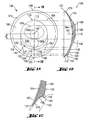
- a preferred embodiment of the invention is a contact lens 100 having a top 108 , a bottom 109, a central axis 102 , a posterior surface 104 and an opposite anterior surface 106.
- the anterior surface 106 includes an optical zone 110 , a transition zone 140 , a ramped ridge zone 150 , a ridge-off zone 160 and a lenticular zone 170 .
- the optical zone 110 has a lower edge 114 and includes a distance vision zone 120 and a near vision zone 130 .
- the distance vision zone 120 provides distance vision correction for the user.
- the area of the distance vision zone 120 is sufficient to overlay a substantial portion of a pupil 106a of a user.
- the distance vision zone 120 is disposed so that the user's pupil 106a is substantially subtended by the distance vision zone 120 when the user is gazing at a substantially horizontal point.
- the distance vision zone 120 will be offset from the central axis 102 . But its curvature center is on or very close to the central axis 102 .
- the prism effect caused by the decentralization of the curvature center from the central axis is less or equal to 1 prism diopter.
- the distance a from the center 102 to the bottom of the distance vision zone 120 should be the minimum distance that allows the pupil 106a to be substantially subtended by the distance vision zone 120 when gazing at the horizon. This may result in the distance vision zone 120 having an oval shape.
- the near vision zone 130 is substantially concentric with the central axis 102 and extends radially outward from the distance vision zone 120 .
- the near vision zone 130 provides near vision correction for the user.
- the area of the near vision zone 130 is sufficient to overlay a substantial portion of the pupil 106b .
- the near vision zone 130 is disposed so that the user's pupil 106b is substantially subtended by the near vision zone 130 when the user is gazing at a near vision point below the substantially horizontal point ( e.g ., while reading). Both the distance vision zone 120 and near vision zone 130 could be place either on the posterior surface 104 or the anterior surface 106 of the lens 100.
- the transition zone 140 provides a smooth transition from the ramped ridge zone 150 to the optical zone 110.
- the transition zone 140 extends from the lower edge 114 of the optical zone 110 to the upper edge of the ramped ridge zone 156 .
- the lens 100 can also include a ridge-off zone 160 , which extends outwardly from the top edge 112 of the optical zone 110 , the first side edge 152 of the ramped ridge zone 150 and the second side edge 154 of the ramped ridge zone 150 .
- the ridge-off zone 160 adds lens rotational stability and improves the comfort of the lens 100 .
- the lens 100 may also include a lenticular zone 170 , extending radially outward from the ridge-off zone 160 and the lower ramped edge 158 of the ramped ridge zone 150, that tapers to a narrow end 172.
- the ramped ridge zone 150 provides vertical translation support for the lens 100 .
- the ramped ridge zone 150 is disposed below the optical zone 110 .
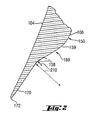
- the ramped ridge zone 150 has an upper edge 156 , a lower ramped edge 158 , a first side edge 152, a second side edge 154 , a latitudinal ridge 159 extends outwardly from the anterior surface 106 , and a ramp 180 that extends downwardly from the lower ramped edge to the lenticular zone 170.
- the user's lower eyelid 105 can engage gradually first with the ramp 180 , then the lower ramp edge 158 and finally the latitudinal ridge 159 , thereby allowing translation of the lens 100 across the surface of the eye 107 .
- the transition from the lenticular zone 170 to the ramped ridge zone 150 is continuous in first derivative (tangent to each other), preferably continuous in second derivative.
- the ramp 180 has a curvature or slope that provides a varying degree of interaction between the ramped ridge zone and the lower eyelid depending on where the lower eyelid strikes the ramped ridge zone. With such ramp, the lower eyelid of the eye is engaged with at least some portion of the ramped ridge zone at all times and thereby effect the lens position on the eye in primary gaze (horizontal gaze) and/or lens translating amount across the surface of an eye when the eye changes from the horizontal (primary) gaze (distant vision) to a down gaze (intermediate or near vision).
- One advantage of incorporating a ramp in the ramped ridge zone is that it can provide a smooth transition zone for the eyelid to "ramp up" the ridge. This gradual engagement will benefit the wearer by increasing comfort and reducing lens sensation in the eye because the ridge will always be engaged.
- ramp slope can determine lens position on an eye in primary gaze (horizontal)
- a lens design for a desired visual performance can be reliably implemented in the production of translating contact lenses.
- the ramp can be composed of one or more curved surfaces that ensure a continuous transition (continuous in first or second derivative) from the lenticular zone to the ramp and to the latitudinal ridge.
- a ramp is composed of a simple curvature as shown in FIG. 2 .
- the slope of a ramp depends on the radius of the curvature. Where a blending curvature has a large radius, ramp is longer and steep. Where a blending curvature has a small radius, the ramp is shorter and flat.
- the curvature of a ramp can have a radius of between 0.1 to 1.0 mm, preferably a radius of between 0.2 to 0.6 mm, to provide a desired lens position on the eye in the primary gaze.
- the entire ramped ridge zone of a translating contact lens of the invention has a continuity in first derivative and/or in second derivative.
- Such ramped ridge zone can be a continuous surface defined by one or more mathematical functions, preferably by a conic or spline-based mathematical function, or is made of several different surface patches.
- “Surface patches” refer to combinations of curvatures and lines that are continuous in first derivative, preferably in second derivative, from each other.
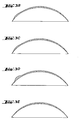
- the lower ramp edge and the latitudinal ridge is morphed into a shape that will both help translation and improve comfort, for example, as shown in FIGS. 3A-3E and FiGs. 3F-3J .
- FIGs. 3A-3E illustrate schematically a translating contact lens having preferred ramped ridge zone including a flattened lower ramp edge and a latitudinal ridge of a preferred ramped ridge zone.
- This preferred ramped ridge zone may accommodate better to the lower eyelid of the eye, and may distribute more uniformly translating stress over the entire lens-interacting portion of the lower eyelid. Therefore, with such ramped ridge, a translating contact lens may improve wearer's comfort.
- FIGS. 3F-3J show schematically a translating contact lens 300 according to the invention having a top 308 , a bottom 309 , a central axis 302 , a posterior surface 304 and an opposite anterior surface 306.
- the anterior surface 306 includes an optical zone 310, a transition zone 340, a ramped ridge zone 350 , a ridge-off zone 360 and a lenticular zone 370.
- the ramped ridge zone 350 has an upper edge, a lower ramp edge, a latitudinal ridge extends outwardly from the anterior surface 306 , and a ramp.
- the elevation height of the latitudinal ridge are higher at the both ends than in the middle ( FIG. 3F-3J ).
- Two bumps ( 391, 392 ) forms at the two ends of the latitudinal ridge.
- the latitudinal ridge has a mirror symmetry with respect to a plan, which cuts the latitudinal ridge in the middle into two equal part and contains the central axis.
- Such latitudinal ridge can improve wearer's comfort, since translating stress may be uniformly distributed over the entire lens-interacting portion of the lower eyelid.
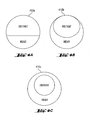
- Such a preferred feature of a ramped ridge zone can be achieved by using a continuous surface defined by a conic or spline-based mathematical function or made of several different surface patches.
- FIGS. 4A-4C Three illustrative examples of such shapes are shown in FIGS. 4A-4C .
- multi-focal translating contact lens refers to a translating contact lens that comprises bifocal, trifocal or multi-focal optics.
- the optical zone of at least one of the anterior and posterior surfaces of a multi-focal translating contact lens can include a distant vision zone, an intermediate vision zone, and a near vision zone, from the top to the bottom of the contact lens.
- the multi-focal translating contact lens of the invention has a ramped ridge zone of the invention on the lower portion of the anterior surface of the contact lens. The ramped ridge zone interacts with the lower eyelid to influence lens motion relative to the cornea and thereby the translating amount across the surface of the eye.
- the multi-focal translating contact lens can provide distant vision correction at a primary gaze (e.g. driving), intermediate vision correction at a half-down-gaze (e.g. work on computer) and near vision correction at full-down-gaze (e.g. read books and newspaper).
- a preferred embodiment of the optical zone of at least one of the anterior and posterior surfaces of a multi-focal translating contact lens of the invention has a distant vision zone, an intermediate vision zone extending radially outward from the distance vision zone, and a near vision zone extending radially outward from the intermediate vision zone.
- the distance vision zone provides distance vision correction and having a first area that is sufficient to overlay a substantial portion of the pupil of the eye and disposed in a first position within the optical zone so that the pupil is substantially subtended by the distance vision zone when gazing at a substantially horizontal point.
- the intermediate vision zone provides intermediate vision correction and having a second area that is sufficient to overlay a substantial portion of the pupil and disposed in a second position within the optical zone so that the pupil is substantially subtended by the intermediate vision zone when gazing at an intermediate vision point below the substantially horizontal point.
- the near vision zone provides near vision correction and having a third area that is sufficient to overlay a substantial portion of the pupil and disposed in a third position within the optical zone so that the pupil is substantially subtended by the near vision zone when gazing at a near vision point below the intermediate vision point.
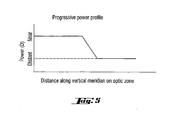
- a preferred embodiment of the intermediate vision zone in a multi-focal translating lens of the invention is a progressive power zone, which has an optical power that continuously changes from the distant vision to the near vision ( FIG. 5 ).
- Effective use of a trifocal contact lens or a multi-focal translating contact lens having a progressive power zone requires varying amounts of translation across the surface of the eye when the eye changes from gazing at an object at a distance (primary gaze) to gazing at an object at an intermediate distance (partially-down or half down gaze) or to gazing at a nearby object (fully-down gaze).
- Such requirement related to varying amounts of translation can be achieved by varying the curvature or slope of the ramp in the ramped ridge zone, since degrees of eyelid interaction depend upon the curvature or slope of the ramp and upon the looseness of the lower eyelid of an eye.
- a correlation between amounts of translation and the curvature or slope of the ramp for a give individual can be established empirically by a person skilled in the art.
- a correlation between amounts of translation and the curvature or slope of the ramp is derived from population studies.
- a ramped ridge zone of the invention can be incorporated in a toric soft contact lens that has a cylindrical optical surface, or power, to correct for the wearer's astigmatism.
- a toric contact lens requires features that provide a predetermined orientation on the eye.
- a toric soft contact lens comprises a posterior surface and an opposite anterior surface.
- the anterior surface includes an optical zone and a ramped ridge zone on the lower portion of the anterior surface, wherein the first derivative of the anterior surface is continuous from the center to the edge.
- the second derivative of the anterior surface is continous from the center to the edge.
- a translating contact lens of the invention typically would be made from a soft contact lens material, such as a silicon hydro-gel or HEMA. It will be understood that lenses according to the invention may comprise any soft contact lens material.
- a translating contact lenses of the invention may be produced by any convenient means, for example, such as lathing and molding.
- contact lenses are molded from contact lens molds including molding surfaces that replicate the contact lens surfaces when a lens is cast in the molds.
- an optical cutting tool with a numerically controlled lathe may be used to form a metallic optical tool incorporating the features of the anterior surface of a translating contact lens of the invention. The tool is then used to make anterior surface molds that are then used, in conjunction with posterior surface molds, to form the lens of the invention using a suitable liquid lens-forming material placed between the molds followed by compression and curing of the lens-forming material.
- a contact lens having complicated surface feature or the optical tool to be used for making the same is fabricated by using a numerically controlled lathe, for example, such as Optoform ultra-precision lathes (models 30, 40, 50 and 80) having Variform piezo-ceramic fast tool servo attachment from Precitech, Inc, according to a method described in co-pending U.S. Patent Application published as US 2006/0055876 , entitled Method for Manufacturing a contact lens.
- a numerically controlled lathe for example, such as Optoform ultra-precision lathes (models 30, 40, 50 and 80) having Variform piezo-ceramic fast tool servo attachment from Precitech, Inc, according to a method described in co-pending U.S. Patent Application published as US 2006/0055876 , entitled Method for Manufacturing a contact lens.
- an user defines a set of parameters, such as a surface tolerance, a concentricity tolerance, orientation of the lens design, the number of spokes to be generated for each of the anterior and posterior surfaces, creating zero point at 0,0, orientation of Z-axis, and type of lens surface (concave or convex surface) to be converted into a geometry.
- parameters such as a surface tolerance, a concentricity tolerance, orientation of the lens design, the number of spokes to be generated for each of the anterior and posterior surfaces, creating zero point at 0,0, orientation of Z-axis, and type of lens surface (concave or convex surface) to be converted into a geometry.
- a “surface tolerance” refers to the allowed position-deviation of a projected point from an ideal position on a surface of a lens design. The deviation can be in the direction either parallel or perpendicular to the central axis of a lens design.
- a “concentricity tolerance” refers to the allowed deviation of a point from a given arc.
- a "spoke” refers to a ray radiating outwardly from the central axis and is perpendicular to the central axis.
- a “semi-diameter spoke” refers to a line segment from the central axis to the edge of a lens design.
- Electrode-spaced semi-diameter spokes means that all semi-diameter spokes radiate outwardly from the central axis and separate from each other by one equal angle.
- a "point spacing” refers to a distance between two points along the semi-diameter spoke.
- an user determines the number of points to be projected onto the a surface of the lens design (for example, the anterior surface) along each of the number of evenly-spaced semi-diameter spokes in a direction parallel to the central axis.
- Evenly-spaced points are projected along the semi-diameter probing spoke, in which each pairs of points are separating by a point spacing of 10 microns. Then, all of the projected points are divided into a series of groups, each group composed of three consecutive points, a first point, a middle point and a third point.
- Each of the points can belong to either one group or two groups.
- the point spacing between the first and additional points is equal to point spacing between the additional and middle points.
- the above-determined number of points are projected onto the anterior surface of the lens design shown in FIG. 3F along each of 96 semi-diameter spokes.
- a semi-meridian which is continuous in first derivative is generated.
- the semi-meridian includes a series of arcs and optionally straight lines, wherein each arc is defined by fitting at least three consecutive points into a spherical mathematical function within a desired concentricity tolerance.
- Each of the straight lines is obtained by connecting at least three consecutive points.
- arc fitting routine is started from the central axis to the edge.
- a mini-file containing both the information for the header and the information about the geometry of the lens is generated.
- This mini-file also contains a zero semi-meridian that is based on the average height of each of the other meridians at each of radial locations and that gives the Variform a zero position on which it can base its oscillation calculations.
- all semi-meridians have the same number of zones. This is accomplished by copying the last zone of a semi-meridian for a number of time to equalize the numbers of zones for all meridians.
- the mini-file is complete, it is loaded into an Optoform ultra-precision lathe (models 30, 40, 50 or 80) having Variform piezo-ceramic fast tool servo attachment and run to produce a translating contact lens.
- Another example provides a method for producing a translating contact lens.
- the method comprises the steps of shaping a contact lens by a manufacturing means to have a central axis, an anterior surface and an opposite posterior surface, wherein the posterior surface has an optical zone, wherein the anterior surface includes an optical zone and a ramped ridge zone capable of controlling contact lens position on an eye in primary gaze and/or translating amount across the eye when the eye changes from gazing at an object at a distance to gazing at an object at an intermediate distance or at a nearby object, wherein the ramped ridge zone is disposed below the optical zone and includes an upper edge, a lower ramped edge, a latitudinal ridge that extends outwardly from the anterior surface, and a ramp that extends dowardly from the lower ramped edge and has a curvature or slope that provides a varying degree of interaction between the ramped ridge zone and the lower eyelid depending on where the lower eyelid strikes the ramped ridge zone.
- the lower eyelid of the eye is
Landscapes
- Health & Medical Sciences (AREA)
- Ophthalmology & Optometry (AREA)
- Physics & Mathematics (AREA)
- General Health & Medical Sciences (AREA)
- General Physics & Mathematics (AREA)
- Optics & Photonics (AREA)
- Eyeglasses (AREA)
- Prostheses (AREA)
Claims (44)
- Lentille de contact à translation (100 , 300) ayant un axe central (102 ; 302), une surface antérieure (106 ; 306) et une surface postérieure opposée (104 ; 304) ayant une première zone optique, la surface antérieure (106 ; 306) comprenant :- une deuxième zone optique (110 ; 310) ayant un bord supérieur et un bord inférieur, au moins l'une des première et deuxième zones optiques comportant une zone de vision de loin (120) pour la correction de la vision de loin, la zone de vision de loin (120) ayant une première superficie qui est suffisante pour recouvrir une grande partie de la pupille de l'oeil et qui est disposée à une première position à l'intérieur de la zone optique (110), de telle sorte que la pupille (106a) soit essentiellement sous-tendue par la zone de vision de loin (120) lorsqu'elle fixe un point essentiellement horizontal ; et
une zone de vision de près (130) pour la correction de la vision de près, la zone de vision de près (130) s'étendant radialement vers l'extérieur à partir de la zone de vision de loin (120) et ayant une deuxième superficie qui est suffisante pour recouvrir une grande partie de la pupille et qui est disposée à une deuxième position à l'intérieur de la zone optique (110), de telle sorte que la pupille soit essentiellement sous-tendue par la zone de vision de près lorsqu'elle fixe un point en vision de près en dessous du point essentiellement horizontal ;- une zone de saillie en forme de rampe (150 ; 350) capable de commander la position de la lentille de contact sur un oeil en fixation primaire et/ou la quantité de translation sur l'oeil lorsque l'oeil passe de la fixation d'un objet éloigné à la fixation d'un objet à une distance intermédiaire ou la fixation d'un objet proche,
la zone de saillie en forme de rampe (150 ; 350) étant disposée en dessous de la deuxième zone optique (110 ; 130) et comportant un bord supérieur (156), un bord en forme de rampe inférieur (158), une saillie latitudinale (159) qui s'étend vers l'extérieur à partir de la surface antérieure (106 ; 306), et une rampe (180) qui s'étend vers le bas de la saillie latitudinale (159) vers le bord en forme de rampe inférieur (158) et qui a une courbure ou pente qui offre un degré variable d'interaction entre la zone de saillie en forme de rampe (150 ; 350) et la paupière inférieure dépendant de l'endroit où la paupière inférieure de l'oeil touche la zone de saillie en forme de rampe (150 ; 350), et
la paupière inférieure de l'oeil étant à tout instant en contact avec au moins une certaine partie de la zone de saillie en forme de rampe (150 ; 350),
caractérisée en ce que la saillie latitudinale (159) a un profil en élévation variant de façon non uniforme, les hauteurs d'élévation aux deux extrémités de la saillie latitudinale étant plus élevées que la hauteur en élévation au milieu de la saillie latitudinale. - Lentille de contact en translation selon la revendication 1, dans laquelle la surface antérieure (106 ; 306) comprend en outre :une zone sans saillie (160 ; 360) s'étendant vers l'extérieur à partir du bord supérieur de la deuxième zone optique (110 ; 310) ;une zone de transition (140 ; 340) s'étendant du bord inférieur (114) de la deuxième zone optique (110 ; 310) au bord supérieur de la zone de saillie en forme de rampe (150 ; 350), la zone de transition (140 ; 340) offrant une transition douce de la zone de saillie en forme de rampe (150 ; 350) à la deuxième zone optique (110 ; 310) ; etune zone lenticulaire (170 ; 370), s'étendant radialement vers l'extérieur à partir de la zone sans saillie (160 ; 360) et du bord en forme de rampe inférieur (158) de la zone de saillie en forme de rampe (150 ; 350), qui s'effile vers une extrémité étroite au niveau de laquelle se rencontrent les surfaces postérieure (104 ; 304) et antérieure (106 ; 306).
- Lentille de contact à translation selon la revendication 2, dans laquelle le centre de courbure de la zone de vision de loin (120) se trouve sur ou très près de l'axe central (102 ; 302).
- Lentille de contact à translation selon la revendication 3, dans laquelle l'effet de prisme provoqué par la déviation du centre de courbure de la zone de vision de loin (120) par rapport à l'axe central est inférieur ou égal à 1 dioptrie prismatique.
- Lentille de contact à translation selon la revendication 2, dans laquelle la zone de vision de loin (120) a une forme ovale.
- Lentille de contact à translation selon la revendication 2, dans laquelle la zone de saillie en forme de rampe (150 ; 350) comprend un premier bord latéral (152) et un deuxième bord latéral (154), la zone sans saillie (160; 360) s'étendant vers l'extérieur à partir du bord supérieur (112) de la deuxième zone optique (110; 310), du premier bord latéral (152) de la zone de saillie en forme de rampe (150; 350) et du deuxième bord latéral (154) de la zone de saillie en forme de rampe (150 ; 350), et la zone sans saillie (160 ; 360) ayant une superficie suffisante pour que la zone sans saillie (160 ; 360), la deuxième zone optique (110 ; 310), la zone de saillie en forme de rampe (150 ; 350) et la zone de transition (140 ; 340) recouvrent essentiellement la totalité de la cornée de l'oeil.
- Lentille de contact à translation selon la revendication 6, dans laquelle la rampe (180) est constituée d'une surface courbe ayant un rayon compris entre 0.1 et 1.0 mm.
- Lentille de contact à translation selon la revendication 7, dans laquelle le rayon est compris entre 0.2 et 0.4 mm.
- Lentille de contact à translation selon la revendication 1, dans laquelle la zone de saillie en forme de rampe (150 ; 350) complète est continue en dérivée première et/ou en dérivée seconde.
- Lentille de contact à translation selon la revendication 9, dans laquelle la zone de saillie en forme de rampe (150 ; 350) est définie par une fonction mathématique à base de splines ou constituée de plusieurs morceaux de surface différents.
- Lentille de contact à translation selon la revendication 1, dans laquelle la surface antérieure (106 ; 306) est continue en dérivée première et/ou en dérivée seconde du centre vers le bord.
- Lentille de contact à translation selon la revendication 1, dans laquelle la saillie latitudinale (159) a une symétrie miroir par rapport à un plan qui coupe la saillie latitudinale (159) en son milieu, en deux parties égales, et qui contient l'axe central (102 ; 302).
- Lentille de contact à translation selon la revendication 1, dans laquelle la lentille de contact est une lentille de contact souple.
- Lentille de contact à translation selon la revendication 1, dans laquelle au moins l'une des première et deuxième zones optiques comporte en outre :une zone de vision intermédiaire pour la correction de la vision intermédiaire, la zone de vision intermédiaire s'étendant radialement vers l'extérieur à partir de la zone de vision de loin et ayant une troisième superficie qui est suffisante pour recouvrir une grande partie de la pupille et qui est disposée à une troisième position à l'intérieur de la zone optique, de telle sorte que la pupille soit essentiellement sous-tendue par la zone de vision de intermédiaire lorsqu'elle fixe un point en vision intermédiaire en dessous du point essentiellement horizontal.
- Lentille de contact à translation selon la revendication 14, dans laquelle la surface antérieure comprend en outre :une zone sans saillie s'étendant vers l'extérieur à partir du bord supérieur de la deuxième zone optique ;une zone de transition s'étendant du bord inférieur de la deuxième zone optique au bord supérieur de la zone de saillie en forme de rampe, qui offre une transition douce de la zone de saillie à la deuxième zone optique ; etune zone lenticulaire, s'étendant radialement vers l'extérieur à partir de la zone sans saillie et du bord inférieur de la zone de saillie, qui s'effile vers une extrémité étroite au niveau de laquelle se rencontrent les surfaces postérieure et antérieure.
- Lentille de contact à translation selon la revendication 15, dans laquelle la zone de saillie en forme de rampe comprend un premier bord latéral et un deuxième bord latéral, la zone sans saillie s'étendant vers l'extérieur à partir du bord supérieur de la deuxième zone optique, du premier bord latéral de la zone de saillie en forme de rampe et du deuxième bord latéral de la zone de saillie en forme de rampe, et la zone sans saillie ayant une superficie suffisante pour que la zone sans saillie, la deuxième zone optique, la zone de saillie en forme de rampe et la zone de transition recouvrent essentiellement la totalité de la cornée de l'oeil.
- Lentille de contact à translation selon la revendication 14, dans laquelle la zone de saillie en forme de rampe complète est continue en dérivée première et/ou en dérivée seconde.
- Lentille de contact à translation selon la revendication 17, dans laquelle la zone de saillie en forme de rampe est définie par une fonction mathématique à base de splines ou constituée de plusieurs morceaux de surface différents.
- Lentille de contact à translation selon la revendication 14, dans laquelle la surface antérieure est continue en dérivée première et/ou en dérivée seconde du centre vers le bord.
- Lentille de contact à translation selon la revendication 14, dans laquelle la saillie latitudinale a une symétrie miroir par rapport à un plan qui coupe la saillie latitudinale en son milieu, en deux parties égales, et qui contient l'axe central.
- Lentille de contact à translation selon la revendication 14, dans laquelle la lentille de contact est une lentille de contact souple.
- Lentille de contact à translation selon la revendication 14, dans laquelle la zone de vision intermédiaire est une zone à puissance progressive ayant une puissance optique qui change de manière continue d'une vision de loin à une vision de près.
- Lentille de contact à translation selon la revendication 1, dans laquelle au moins l'une des première et deuxième zones optiques comporte une surface optique cylindrique pour corriger l'astigmatisme.
- Lentille de contact à translation selon la revendication 23, dans laquelle la surface antérieure comprend en outre :une zone sans saillie s'étendant vers l'extérieur à partir du bord supérieur de la deuxième zone optique ;une zone de transition s'étendant du bord inférieur de la deuxième zone optique au bord supérieur de la zone de saillie en forme de rampe, qui offre une transition douce de la zone de saillie à la deuxième zone optique ; etune zone lenticulaire, s'étendant radialement vers l'extérieur à partir de la zone sans saillie et du bord en forme de rampe inférieur de la zone de saillie en forme de rampe, qui s'effile vers une extrémité étroite au niveau de laquelle se rencontrent les surfaces postérieure et antérieure.
- Lentille de contact à translation selon la revendication 24, dans laquelle la rampe est constituée d'une surface courbe ayant un rayon compris entre 0.1 et 1.0 mm.
- Lentille de contact à translation selon la revendication 24, dans laquelle la zone de saillie en forme de rampe complète est continue en dérivée première et/ou en dérivée seconde.
- Lentille de contact à translation selon la revendication 26, dans laquelle la zone de saillie en forme de rampe est définie par une fonction mathématique à base de splines ou constituée de plusieurs morceaux de surface différents.
- Lentille de contact à translation selon la revendication 24, dans laquelle la surface antérieure est continue en dérivée première et/ou en dérivée seconde du centre vers le bord.
- Lentille de contact à translation selon la revendication 24, dans laquelle la saillie latitudinale a une symétrie miroir par rapport à un plan qui coupe la saillie latitudinale en son milieu, en deux parties égales, et qui contient l'axe central.
- Lentille de contact à translation selon la revendication 24, dans laquelle la lentille de contact est une lentille de contact souple.
- Lentille de contact à translation selon la revendication 1, dans laquelle la zone de vision de près pour la correction de la vision de près de l'au moins une des première et deuxième zones optiques est disposée en dessous de la zone de vision de loin pour une correction de la vision de loin de l'au moins une des première et deuxième zones optiques.
- Lentille de contact à translation selon la revendication 31, dans laquelle la zone de vision de près pour la correction de la vision de près est disposée en dessous de l'axe central.
- Lentille de contact à translation selon la revendication 31, dans laquelle la surface antérieure comprend en outre :une zone sans saillie s'étendant vers l'extérieur à partir du bord supérieur de la deuxième zone optique ;une zone de transition s'étendant du bord inférieur de la deuxième zone optique au bord supérieur de la zone de saillie en forme de rampe, qui offre une transition douce de la zone de saillie à la deuxième zone optique ; etune zone lenticulaire, s'étendant radialement vers l'extérieur à partir de la zone sans saillie et du bord en forme de rampe inférieur de la zone de saillie en forme de rampe, qui s'effile vers une extrémité étroite au niveau de laquelle se rencontrent les surfaces postérieure et antérieure.
- Lentille de contact à translation selon la revendication 33, dans laquelle la zone de saillie en forme de rampe complète est continue en dérivée première et/ou en dérivée seconde.
- Lentille de contact à translation selon la revendication 34, dans laquelle la zone de saillie en forme de rampe est définie par une fonction mathématique à base de splines ou constituée de plusieurs morceaux de surface différents.
- Lentille de contact à translation selon la revendication 33, dans laquelle la surface antérieure est continue en dérivée première et/ou en dérivée seconde du centre vers le bord.
- Lentille de contact à translation selon la revendication 33, dans laquelle la saillie latitudinale a une symétrie miroir par rapport à un plan qui coupe la saillie latitudinale en son milieu, en deux parties égales, et qui contient l'axe central.
- Lentille de contact à translation selon la revendication 33, dans laquelle la lentille de contact est une lentille de contact souple.
- Lentille de contact à translation selon la revendication 31, dans laquelle au moins l'une des première et deuxième zones optiques comporte en outre une zone de vision intermédiaire pour la correction de la vision intermédiaire, la zone de vision intermédiaire étant disposée en dessous de la zone de vision de loin et la zone de vision de près étant disposée en dessous de la zone de vision intermédiaire.
- Lentille de contact à translation selon la revendication 39, dans laquelle la zone de vision intermédiaire a une puissance optique qui change de manière continue d'une vision de loin à une vision de près.
- Procédé de production d'une lentille de contact à translation, comprenant les étapes consistant à façonner une lentille de contact (100; 300) par des moyens de fabrication, de telle sorte qu'elle ait un axe central (102 ; 302), une surface antérieure (106 ; 306) et une surface postérieure opposée (104 ; 304), la surface postérieure ayant une première zone optique, la surface antérieure comportant une deuxième zone optique (110 ; 310) et une zone de saillie en forme de rampe (150 ; 350) capable de commander la position de la lentille de contact sur un oeil en fixation primaire et/ou la quantité de translation sur l'oeil lorsque l'oeil passe de la fixation d'un objet éloigné à la fixation d'un objet à une distance intermédiaire ou la fixation d'un objet proche, au moins l'une des première et deuxième zones optiques comportant une zone de vision de loin (120) pour la correction de la vision de loin, la zone de vision de loin (120) ayant une première superficie qui est suffisante pour recouvrir une grande partie de la pupille de l'oeil et qui est disposée à une première position à l'intérieur de la zone optique, de telle sorte que la pupille soit essentiellement sous-tendue par la zone de vision de loin (120) lorsqu'elle fixe un point essentiellement horizontal, et une zone de vision de près (130) pour la correction de la vision de près, la zone de vision de près (130) s'étendant radialement vers l'extérieur à partir de la zone de vision de loin (120) et ayant une deuxième superficie qui est suffisante pour recouvrir une grande partie de la pupille et qui est disposée à une deuxième position à l'intérieur de la zone optique, de telle sorte que la pupille soit essentiellement sous-tendue par la zone de vision de près (130) lorsqu'elle fixe un point en vision de près en dessous du point essentiellement horizontal, la zone de saillie en forme de rampe (150 ; 350) étant disposée en dessous de la zone optique et comportant un bord supérieur (156), un bord en forme de rampe inférieur (158), une saillie latitudinale (159) qui s'étend vers l'extérieur à partir de la surface antérieure (106 ; 306), et qui a un profil en élévation variant de façon non uniforme, les hauteurs d'élévation aux deux extrémités de la saillie latitudinale étant plus élevées que la hauteur en élévation au milieu de la saillie latitudinale, et une rampe (180) qui s'étend vers le bas de la saillie latitudinale (159) vers le bord en forme de rampe inférieur (158) et qui a une courbure ou pente qui offre un degré variable d'interaction entre la zone de saillie en forme de rampe (150 ; 350) et la paupière inférieure dépendant de l'endroit où la paupière inférieure de l'oeil touche la zone de saillie en forme de rampe (150 ; 350).
- Procédé selon la revendication 41, dans lequel la surface antérieure (106; 306) est continue en dérivée première et/ou en dérivée seconde du centre vers le bord.
- Procédé selon la revendication 42, dans lequel la saillie latitudinale (159) a une symétrie miroir par rapport à un plan qui coupe la saillie latitudinale (159) en son milieu, en deux parties égales, et qui contient l'axe central (102 ; 302).
- Procédé selon la revendication 41, dans lequel lesdits moyens de fabrication sont un tour à commande numérique ou des moules.
Applications Claiming Priority (3)
| Application Number | Priority Date | Filing Date | Title |
|---|---|---|---|
| US39848502P | 2002-07-24 | 2002-07-24 | |
| US398485P | 2002-07-24 | ||
| PCT/EP2003/008058 WO2004011989A1 (fr) | 2002-07-24 | 2003-07-23 | Lentille de contact a translation comportant une arete inclinee |
Publications (2)
| Publication Number | Publication Date |
|---|---|
| EP1527367A1 EP1527367A1 (fr) | 2005-05-04 |
| EP1527367B1 true EP1527367B1 (fr) | 2013-04-10 |
Family
ID=31188407
Family Applications (1)
| Application Number | Title | Priority Date | Filing Date |
|---|---|---|---|
| EP03771075.3A Expired - Lifetime EP1527367B1 (fr) | 2002-07-24 | 2003-07-23 | Lentille de contact a translation comportant une arete inclinee |
Country Status (6)
| Country | Link |
|---|---|
| US (1) | US6921168B2 (fr) |
| EP (1) | EP1527367B1 (fr) |
| JP (1) | JP4987229B2 (fr) |
| AU (1) | AU2003263184A1 (fr) |
| CA (1) | CA2491460C (fr) |
| WO (1) | WO2004011989A1 (fr) |
Families Citing this family (41)
| Publication number | Priority date | Publication date | Assignee | Title |
|---|---|---|---|---|
| US7052132B2 (en) * | 1999-12-16 | 2006-05-30 | Iolco Pty Ltd. | Soft multifocal contact lens |
| US6773107B2 (en) * | 2000-08-17 | 2004-08-10 | Novartis Ag | Soft translating contact lens for presbyopia |
| EP2388640A3 (fr) | 2003-05-21 | 2012-09-19 | Novartis AG | Lentilles de contact |
| US20050041203A1 (en) * | 2003-08-20 | 2005-02-24 | Lindacher Joseph Michael | Ophthalmic lens with optimal power profile |
| US7044597B2 (en) * | 2003-12-16 | 2006-05-16 | Bausch & Lomb Incorporated | Multifocal contact lens and method of manufacture thereof |
| MX2007007571A (es) * | 2004-12-22 | 2007-07-24 | Novartis Ag | Diseno de lente de contacto para translacion de gran amplitud. |
| TWI410696B (zh) * | 2005-02-15 | 2013-10-01 | Univ Queensland | 控制近視的方法與裝置 |
| AR052382A1 (es) | 2005-02-23 | 2007-03-14 | Novartis Ag | Un diseno de lente torica |
| EP1901108B1 (fr) * | 2005-06-03 | 2020-09-09 | Hoya Corporation | Verre oculaire |
| US7503652B2 (en) * | 2006-06-29 | 2009-03-17 | Johnson & Johnson Vision Care, Inc. | Translating multifocal ophthalmic lenses |
| EP1879064A1 (fr) * | 2006-07-11 | 2008-01-16 | Procornea Nederland B.V. | Lentille de contact |
| WO2008007955A1 (fr) * | 2006-07-11 | 2008-01-17 | Procornea Nederland B.V. | Lentille de contact |
| FR2908898B1 (fr) * | 2006-11-17 | 2009-02-06 | Essilor Int | Lentilles ophtalmiques colorees pour dyslexiques. |
| US20080297721A1 (en) * | 2007-05-29 | 2008-12-04 | Amitava Gupta | Lens designs for treating asthenopia caused by visual defects |
| FR2921163B1 (fr) * | 2007-09-19 | 2009-12-25 | Precilens Lab | Lentille de contact stabilisee. |
| US9417464B2 (en) | 2008-08-20 | 2016-08-16 | Johnson & Johnson Vision Care, Inc. | Method and apparatus of forming a translating multifocal contact lens having a lower-lid contact surface |
| EP2503380B1 (fr) * | 2009-11-17 | 2014-04-23 | Menicon Co., Ltd. | Lentille de contact |
| DE102010004379A1 (de) * | 2009-12-16 | 2011-06-22 | Continental Automotive GmbH, 30165 | Kraftstoffpumpe |
| JP5448789B2 (ja) * | 2009-12-22 | 2014-03-19 | Hoya株式会社 | トーリックコンタクトレンズ及びその製造方法 |
| US9158129B2 (en) * | 2010-09-27 | 2015-10-13 | Johnson & Johnson Vision Care, Inc. | Translating presbyopic contact lens |
| WO2012044532A1 (fr) * | 2010-09-27 | 2012-04-05 | Johnson & Johnson Vision Care, Inc. | Lentille de contact presbytique à translation asymétrique |
| KR101848224B1 (ko) * | 2010-09-27 | 2018-04-12 | 존슨 앤드 존슨 비젼 케어, 인코포레이티드 | 교대보기 노안용 콘택트 렌즈 |
| US9028063B2 (en) * | 2011-08-26 | 2015-05-12 | Johnson & Johnson Vision Care, Inc. | Translating presbyopic contact lens pair |
| US9046698B2 (en) * | 2012-02-28 | 2015-06-02 | Johnson & Johnson Vision Care, Inc. | Multi-axis lens design for astigmatism |
| AU2015203881B2 (en) * | 2012-03-30 | 2018-02-15 | Johnson & Johnson Vision Care, Inc. | Method and apparatus for providing variations of a lower-lid contact surface and under-lid support structures of a translating multifocal contact lens |
| US20140063444A1 (en) * | 2012-03-30 | 2014-03-06 | Johnson & Johnson Vision Care, Inc. | Methods and apparatus for forming a translating multifocal contact lens |
| SG193767A1 (en) * | 2012-03-30 | 2013-10-30 | Johnson & Johnson Vision Care | Method and apparatus for providing variations of a lower-lid contact surface and under-lid support structures of a translating multifocal contact lens |
| SG193768A1 (en) * | 2012-03-30 | 2013-10-30 | Johnson & Johnson Vision Care | Methods and apparatus for forming a translating multifocal contact lens |
| US9823493B2 (en) * | 2012-08-30 | 2017-11-21 | Johnson & Johnson Vision Care, Inc. | Compliant dynamic translation zones for contact lenses |
| JP5536265B2 (ja) * | 2013-07-30 | 2014-07-02 | 株式会社メニコン | コンタクトレンズ |
| WO2015132889A1 (fr) * | 2014-03-04 | 2015-09-11 | 株式会社メニコン | Lentille de contact de type décentré et jeu de lentilles de contact de type décentré |
| US10191302B2 (en) * | 2015-09-23 | 2019-01-29 | Ohio State Innovation Foundation | Contact lens comprising lenticular-like curve |
| ES2969255T3 (es) | 2015-09-23 | 2024-05-17 | Ohio State Innovation Foundation | Lente de contacto que comprende una lenticular en una porción superior de la lente de contacto |
| US9880399B2 (en) | 2015-11-16 | 2018-01-30 | Johnson & Johnson Vision Care, Inc. | Truncated translating contact lens with optimized performance and method of design |
| US9885882B2 (en) | 2016-02-03 | 2018-02-06 | Diversified Ophthalmics, Inc. | Progressive contact lens |
| US9933633B1 (en) | 2016-11-08 | 2018-04-03 | Paul Douglas Becherer | Bifocal contact lenses providing reduced glare and blurriness in dim lighting |
| WO2019046714A1 (fr) * | 2017-09-01 | 2019-03-07 | Ohio State Innovation Foundation | Lentille de contact souple comprenant un lenticulaire dans une partie supérieure de la lentille de contact avec échange lacrymal amélioré |
| AR115981A1 (es) | 2019-03-19 | 2021-03-17 | Ohio State Innovation Foundation | Lente de contacto |
| US11327341B2 (en) | 2019-06-14 | 2022-05-10 | Johnson & Johnson Vision Care, Inc | Toric contact lens stabilization design based on thickness gradients orthogonal to eyelid margin |
| USD1075870S1 (en) | 2020-03-26 | 2025-05-20 | Ohio State Innovation Foundation | Contact lens |
| EP4619820A1 (fr) * | 2022-11-15 | 2025-09-24 | Ohio State Innovation Foundation | Lentille de contact comprenant une lentille lenticulaire et ayant une zone optique de forme négative |
Family Cites Families (11)
| Publication number | Priority date | Publication date | Assignee | Title |
|---|---|---|---|---|
| US4573775A (en) * | 1982-08-19 | 1986-03-04 | Vistakon, Inc. | Bifocal contact lens |
| US4618229A (en) * | 1983-07-22 | 1986-10-21 | Bausch & Lomb Incorporated | Bifocal contact lens |
| US4618227A (en) * | 1983-10-07 | 1986-10-21 | Vistakon, Inc. | Soft contact lens |
| CS246212B1 (en) * | 1984-06-18 | 1986-10-16 | Otto Wichterle | Toric contact lens with centre of gravity shifted towards its border,mould for its production and method of moulds production |
| DE4012478A1 (de) * | 1990-04-19 | 1991-10-24 | Heinrich Woehlk Inst Fuer Cont | Kontaktlinse mit lagestabilisierung |
| US5071244A (en) * | 1990-10-03 | 1991-12-10 | Ross Richard M | Soft bifocal contact lens |
| US5764339A (en) * | 1996-10-03 | 1998-06-09 | Medical University Of South Carolina | Compressive force-activated variable focus lens and method of making the same |
| DE19726918A1 (de) * | 1997-06-25 | 1999-01-07 | Woehlk Contact Linsen Gmbh | Multifokale Kontaktlinse |
| US6109749A (en) * | 1997-11-04 | 2000-08-29 | Bernstein; Paul R. | Soft bifocal contact lenses |
| US6467903B1 (en) * | 2000-03-31 | 2002-10-22 | Ocular Sciences, Inc. | Contact lens having a uniform horizontal thickness profile |
| US6773107B2 (en) * | 2000-08-17 | 2004-08-10 | Novartis Ag | Soft translating contact lens for presbyopia |
-
2003
- 2003-07-09 US US10/616,476 patent/US6921168B2/en not_active Expired - Lifetime
- 2003-07-23 EP EP03771075.3A patent/EP1527367B1/fr not_active Expired - Lifetime
- 2003-07-23 CA CA2491460A patent/CA2491460C/fr not_active Expired - Fee Related
- 2003-07-23 AU AU2003263184A patent/AU2003263184A1/en not_active Abandoned
- 2003-07-23 WO PCT/EP2003/008058 patent/WO2004011989A1/fr not_active Ceased
- 2003-07-23 JP JP2004523768A patent/JP4987229B2/ja not_active Expired - Fee Related
Also Published As
| Publication number | Publication date |
|---|---|
| AU2003263184A1 (en) | 2004-02-16 |
| WO2004011989A8 (fr) | 2005-02-17 |
| US6921168B2 (en) | 2005-07-26 |
| JP2005534064A (ja) | 2005-11-10 |
| CA2491460A1 (fr) | 2004-02-05 |
| EP1527367A1 (fr) | 2005-05-04 |
| WO2004011989A1 (fr) | 2004-02-05 |
| CA2491460C (fr) | 2012-01-17 |
| US20040017542A1 (en) | 2004-01-29 |
| JP4987229B2 (ja) | 2012-07-25 |
Similar Documents
| Publication | Publication Date | Title |
|---|---|---|
| EP1527367B1 (fr) | Lentille de contact a translation comportant une arete inclinee | |
| EP2508936B1 (fr) | Lentilles de contact | |
| US6923540B2 (en) | Toric multifocal contact lenses | |
| US7080906B2 (en) | Translating bifocal wear modality | |
| CA2457573C (fr) | Verres ophtalmiques munis d'une zone optique de transition | |
| EP1629318B1 (fr) | Lentille ophtalmique multifocale | |
| JP2005534985A5 (fr) | ||
| EP1552336B1 (fr) | Procede de fabrication de lentilles de contact | |
| MXPA06005361A (en) | Translating bifocal wear modality |
Legal Events
| Date | Code | Title | Description |
|---|---|---|---|
| PUAI | Public reference made under article 153(3) epc to a published international application that has entered the european phase |
Free format text: ORIGINAL CODE: 0009012 |
|
| 17P | Request for examination filed |
Effective date: 20050224 |
|
| AK | Designated contracting states |
Kind code of ref document: A1 Designated state(s): AT BE BG CH CY CZ DE DK EE ES FI FR GB GR HU IE IT LI LU MC NL PT RO SE SI SK TR |
|
| AX | Request for extension of the european patent |
Extension state: AL LT LV MK |
|
| DAX | Request for extension of the european patent (deleted) | ||
| RAP1 | Party data changed (applicant data changed or rights of an application transferred) |
Owner name: NOVARTIS PHARMA GMBH Owner name: NOVARTIS AG |
|
| RAP1 | Party data changed (applicant data changed or rights of an application transferred) |
Owner name: NOVARTIS AG |
|
| 17Q | First examination report despatched |
Effective date: 20100510 |
|
| GRAP | Despatch of communication of intention to grant a patent |
Free format text: ORIGINAL CODE: EPIDOSNIGR1 |
|
| GRAS | Grant fee paid |
Free format text: ORIGINAL CODE: EPIDOSNIGR3 |
|
| GRAA | (expected) grant |
Free format text: ORIGINAL CODE: 0009210 |
|
| AK | Designated contracting states |
Kind code of ref document: B1 Designated state(s): AT BE BG CH CY CZ DE DK EE ES FI FR GB GR HU IE IT LI LU MC NL PT RO SE SI SK TR |
|
| REG | Reference to a national code |
Ref country code: GB Ref legal event code: FG4D |
|
| REG | Reference to a national code |
Ref country code: CH Ref legal event code: EP Ref country code: AT Ref legal event code: REF Ref document number: 606309 Country of ref document: AT Kind code of ref document: T Effective date: 20130415 |
|
| REG | Reference to a national code |
Ref country code: IE Ref legal event code: FG4D |
|
| REG | Reference to a national code |
Ref country code: DE Ref legal event code: R096 Ref document number: 60343752 Country of ref document: DE Effective date: 20130606 |
|
| PG25 | Lapsed in a contracting state [announced via postgrant information from national office to epo] |
Ref country code: SI Free format text: LAPSE BECAUSE OF FAILURE TO SUBMIT A TRANSLATION OF THE DESCRIPTION OR TO PAY THE FEE WITHIN THE PRESCRIBED TIME-LIMIT Effective date: 20130410 |
|
| REG | Reference to a national code |
Ref country code: AT Ref legal event code: MK05 Ref document number: 606309 Country of ref document: AT Kind code of ref document: T Effective date: 20130410 |
|
| REG | Reference to a national code |
Ref country code: NL Ref legal event code: VDEP Effective date: 20130410 |
|
| PG25 | Lapsed in a contracting state [announced via postgrant information from national office to epo] |
Ref country code: GR Free format text: LAPSE BECAUSE OF FAILURE TO SUBMIT A TRANSLATION OF THE DESCRIPTION OR TO PAY THE FEE WITHIN THE PRESCRIBED TIME-LIMIT Effective date: 20130711 Ref country code: AT Free format text: LAPSE BECAUSE OF FAILURE TO SUBMIT A TRANSLATION OF THE DESCRIPTION OR TO PAY THE FEE WITHIN THE PRESCRIBED TIME-LIMIT Effective date: 20130410 Ref country code: SE Free format text: LAPSE BECAUSE OF FAILURE TO SUBMIT A TRANSLATION OF THE DESCRIPTION OR TO PAY THE FEE WITHIN THE PRESCRIBED TIME-LIMIT Effective date: 20130410 Ref country code: ES Free format text: LAPSE BECAUSE OF FAILURE TO SUBMIT A TRANSLATION OF THE DESCRIPTION OR TO PAY THE FEE WITHIN THE PRESCRIBED TIME-LIMIT Effective date: 20130721 Ref country code: BE Free format text: LAPSE BECAUSE OF FAILURE TO SUBMIT A TRANSLATION OF THE DESCRIPTION OR TO PAY THE FEE WITHIN THE PRESCRIBED TIME-LIMIT Effective date: 20130410 Ref country code: NL Free format text: LAPSE BECAUSE OF FAILURE TO SUBMIT A TRANSLATION OF THE DESCRIPTION OR TO PAY THE FEE WITHIN THE PRESCRIBED TIME-LIMIT Effective date: 20130410 Ref country code: PT Free format text: LAPSE BECAUSE OF FAILURE TO SUBMIT A TRANSLATION OF THE DESCRIPTION OR TO PAY THE FEE WITHIN THE PRESCRIBED TIME-LIMIT Effective date: 20130812 Ref country code: FI Free format text: LAPSE BECAUSE OF FAILURE TO SUBMIT A TRANSLATION OF THE DESCRIPTION OR TO PAY THE FEE WITHIN THE PRESCRIBED TIME-LIMIT Effective date: 20130410 |
|
| PG25 | Lapsed in a contracting state [announced via postgrant information from national office to epo] |
Ref country code: BG Free format text: LAPSE BECAUSE OF FAILURE TO SUBMIT A TRANSLATION OF THE DESCRIPTION OR TO PAY THE FEE WITHIN THE PRESCRIBED TIME-LIMIT Effective date: 20130710 Ref country code: CY Free format text: LAPSE BECAUSE OF FAILURE TO SUBMIT A TRANSLATION OF THE DESCRIPTION OR TO PAY THE FEE WITHIN THE PRESCRIBED TIME-LIMIT Effective date: 20130410 |
|
| PG25 | Lapsed in a contracting state [announced via postgrant information from national office to epo] |
Ref country code: DK Free format text: LAPSE BECAUSE OF FAILURE TO SUBMIT A TRANSLATION OF THE DESCRIPTION OR TO PAY THE FEE WITHIN THE PRESCRIBED TIME-LIMIT Effective date: 20130410 Ref country code: CZ Free format text: LAPSE BECAUSE OF FAILURE TO SUBMIT A TRANSLATION OF THE DESCRIPTION OR TO PAY THE FEE WITHIN THE PRESCRIBED TIME-LIMIT Effective date: 20130410 Ref country code: SK Free format text: LAPSE BECAUSE OF FAILURE TO SUBMIT A TRANSLATION OF THE DESCRIPTION OR TO PAY THE FEE WITHIN THE PRESCRIBED TIME-LIMIT Effective date: 20130410 Ref country code: EE Free format text: LAPSE BECAUSE OF FAILURE TO SUBMIT A TRANSLATION OF THE DESCRIPTION OR TO PAY THE FEE WITHIN THE PRESCRIBED TIME-LIMIT Effective date: 20130410 |
|
| PLBE | No opposition filed within time limit |
Free format text: ORIGINAL CODE: 0009261 |
|
| STAA | Information on the status of an ep patent application or granted ep patent |
Free format text: STATUS: NO OPPOSITION FILED WITHIN TIME LIMIT |
|
| PG25 | Lapsed in a contracting state [announced via postgrant information from national office to epo] |
Ref country code: MC Free format text: LAPSE BECAUSE OF FAILURE TO SUBMIT A TRANSLATION OF THE DESCRIPTION OR TO PAY THE FEE WITHIN THE PRESCRIBED TIME-LIMIT Effective date: 20130410 Ref country code: RO Free format text: LAPSE BECAUSE OF FAILURE TO SUBMIT A TRANSLATION OF THE DESCRIPTION OR TO PAY THE FEE WITHIN THE PRESCRIBED TIME-LIMIT Effective date: 20130410 |
|
| REG | Reference to a national code |
Ref country code: CH Ref legal event code: PL |
|
| 26N | No opposition filed |
Effective date: 20140113 |
|
| REG | Reference to a national code |
Ref country code: DE Ref legal event code: R097 Ref document number: 60343752 Country of ref document: DE Effective date: 20140113 |
|
| PG25 | Lapsed in a contracting state [announced via postgrant information from national office to epo] |
Ref country code: CH Free format text: LAPSE BECAUSE OF NON-PAYMENT OF DUE FEES Effective date: 20130731 Ref country code: LI Free format text: LAPSE BECAUSE OF NON-PAYMENT OF DUE FEES Effective date: 20130731 |
|
| PG25 | Lapsed in a contracting state [announced via postgrant information from national office to epo] |
Ref country code: TR Free format text: LAPSE BECAUSE OF FAILURE TO SUBMIT A TRANSLATION OF THE DESCRIPTION OR TO PAY THE FEE WITHIN THE PRESCRIBED TIME-LIMIT Effective date: 20130410 |
|
| PG25 | Lapsed in a contracting state [announced via postgrant information from national office to epo] |
Ref country code: LU Free format text: LAPSE BECAUSE OF NON-PAYMENT OF DUE FEES Effective date: 20130723 Ref country code: HU Free format text: LAPSE BECAUSE OF FAILURE TO SUBMIT A TRANSLATION OF THE DESCRIPTION OR TO PAY THE FEE WITHIN THE PRESCRIBED TIME-LIMIT; INVALID AB INITIO Effective date: 20030723 |
|
| REG | Reference to a national code |
Ref country code: FR Ref legal event code: PLFP Year of fee payment: 14 |
|
| PGFP | Annual fee paid to national office [announced via postgrant information from national office to epo] |
Ref country code: FR Payment date: 20160613 Year of fee payment: 14 |
|
| PGFP | Annual fee paid to national office [announced via postgrant information from national office to epo] |
Ref country code: IT Payment date: 20160720 Year of fee payment: 14 |
|
| REG | Reference to a national code |
Ref country code: FR Ref legal event code: ST Effective date: 20180330 |
|
| PG25 | Lapsed in a contracting state [announced via postgrant information from national office to epo] |
Ref country code: FR Free format text: LAPSE BECAUSE OF NON-PAYMENT OF DUE FEES Effective date: 20170731 |
|
| PG25 | Lapsed in a contracting state [announced via postgrant information from national office to epo] |
Ref country code: IT Free format text: LAPSE BECAUSE OF NON-PAYMENT OF DUE FEES Effective date: 20170723 |
|
| PGFP | Annual fee paid to national office [announced via postgrant information from national office to epo] |
Ref country code: DE Payment date: 20190710 Year of fee payment: 17 Ref country code: IE Payment date: 20190710 Year of fee payment: 17 |
|
| PGFP | Annual fee paid to national office [announced via postgrant information from national office to epo] |
Ref country code: GB Payment date: 20190717 Year of fee payment: 17 |
|
| REG | Reference to a national code |
Ref country code: DE Ref legal event code: R082 Ref document number: 60343752 Country of ref document: DE Representative=s name: WEICKMANN & WEICKMANN PATENT- UND RECHTSANWAEL, DE Ref country code: DE Ref legal event code: R081 Ref document number: 60343752 Country of ref document: DE Owner name: ALCON INC., CH Free format text: FORMER OWNER: NOVARTIS AG, 4056 BASEL, CH |
|
| REG | Reference to a national code |
Ref country code: GB Ref legal event code: 732E Free format text: REGISTERED BETWEEN 20200123 AND 20200129 |
|
| REG | Reference to a national code |
Ref country code: DE Ref legal event code: R119 Ref document number: 60343752 Country of ref document: DE |
|
| GBPC | Gb: european patent ceased through non-payment of renewal fee |
Effective date: 20200723 |
|
| PG25 | Lapsed in a contracting state [announced via postgrant information from national office to epo] |
Ref country code: GB Free format text: LAPSE BECAUSE OF NON-PAYMENT OF DUE FEES Effective date: 20200723 |
|
| PG25 | Lapsed in a contracting state [announced via postgrant information from national office to epo] |
Ref country code: DE Free format text: LAPSE BECAUSE OF NON-PAYMENT OF DUE FEES Effective date: 20210202 |
|
| PG25 | Lapsed in a contracting state [announced via postgrant information from national office to epo] |
Ref country code: IE Free format text: LAPSE BECAUSE OF NON-PAYMENT OF DUE FEES Effective date: 20200723 |