EP1528049A1 - Procédé de fabrication d'un matériau composite en céramique - Google Patents
Procédé de fabrication d'un matériau composite en céramique Download PDFInfo
- Publication number
- EP1528049A1 EP1528049A1 EP04025471A EP04025471A EP1528049A1 EP 1528049 A1 EP1528049 A1 EP 1528049A1 EP 04025471 A EP04025471 A EP 04025471A EP 04025471 A EP04025471 A EP 04025471A EP 1528049 A1 EP1528049 A1 EP 1528049A1
- Authority
- EP
- European Patent Office
- Prior art keywords
- silicon
- silicon carbide
- production
- pyrolysis
- ceramic
- Prior art date
- Legal status (The legal status is an assumption and is not a legal conclusion. Google has not performed a legal analysis and makes no representation as to the accuracy of the status listed.)
- Withdrawn
Links
- 238000000034 method Methods 0.000 title claims abstract description 45
- 239000000919 ceramic Substances 0.000 title claims abstract description 40
- 238000004519 manufacturing process Methods 0.000 title claims abstract description 34
- 239000002131 composite material Substances 0.000 title claims abstract description 17
- HBMJWWWQQXIZIP-UHFFFAOYSA-N silicon carbide Chemical compound [Si+]#[C-] HBMJWWWQQXIZIP-UHFFFAOYSA-N 0.000 claims abstract description 45
- 229910010271 silicon carbide Inorganic materials 0.000 claims abstract description 44
- 229910052799 carbon Inorganic materials 0.000 claims abstract description 22
- OKTJSMMVPCPJKN-UHFFFAOYSA-N Carbon Chemical compound [C] OKTJSMMVPCPJKN-UHFFFAOYSA-N 0.000 claims abstract description 21
- 238000000197 pyrolysis Methods 0.000 claims abstract description 18
- 239000007858 starting material Substances 0.000 claims abstract description 6
- 239000011111 cardboard Substances 0.000 claims description 26
- 229910052710 silicon Inorganic materials 0.000 claims description 11
- XUIMIQQOPSSXEZ-UHFFFAOYSA-N Silicon Chemical compound [Si] XUIMIQQOPSSXEZ-UHFFFAOYSA-N 0.000 claims description 10
- 238000010438 heat treatment Methods 0.000 claims description 9
- 239000010703 silicon Substances 0.000 claims description 9
- 230000008595 infiltration Effects 0.000 claims description 6
- 238000001764 infiltration Methods 0.000 claims description 6
- 239000000843 powder Substances 0.000 claims description 5
- 239000002210 silicon-based material Substances 0.000 claims description 5
- 229910004298 SiO 2 Inorganic materials 0.000 claims description 4
- 230000015572 biosynthetic process Effects 0.000 claims description 3
- -1 polysiloxane Polymers 0.000 claims description 3
- 229920001296 polysiloxane Polymers 0.000 claims description 3
- 239000002243 precursor Substances 0.000 claims description 3
- 239000000126 substance Substances 0.000 claims description 3
- BOTDANWDWHJENH-UHFFFAOYSA-N Tetraethyl orthosilicate Chemical compound CCO[Si](OCC)(OCC)OCC BOTDANWDWHJENH-UHFFFAOYSA-N 0.000 claims description 2
- 150000001875 compounds Chemical class 0.000 claims description 2
- 230000007717 exclusion Effects 0.000 claims description 2
- 239000011261 inert gas Substances 0.000 claims description 2
- 229920005610 lignin Polymers 0.000 claims description 2
- 229920003257 polycarbosilane Polymers 0.000 claims description 2
- 229920001709 polysilazane Polymers 0.000 claims description 2
- 239000011347 resin Substances 0.000 claims description 2
- 229920005989 resin Polymers 0.000 claims description 2
- 238000007493 shaping process Methods 0.000 claims description 2
- 239000002344 surface layer Substances 0.000 claims description 2
- 238000000137 annealing Methods 0.000 claims 1
- 238000004939 coking Methods 0.000 claims 1
- 239000000835 fiber Substances 0.000 abstract description 11
- 239000003575 carbonaceous material Substances 0.000 abstract description 3
- 239000011226 reinforced ceramic Substances 0.000 abstract 1
- 239000000123 paper Substances 0.000 description 15
- 239000000463 material Substances 0.000 description 13
- 210000004027 cell Anatomy 0.000 description 9
- 210000002421 cell wall Anatomy 0.000 description 8
- 238000000465 moulding Methods 0.000 description 8
- 239000011148 porous material Substances 0.000 description 8
- 239000000047 product Substances 0.000 description 7
- 238000002360 preparation method Methods 0.000 description 6
- 239000002023 wood Substances 0.000 description 6
- 239000007789 gas Substances 0.000 description 5
- 239000012298 atmosphere Substances 0.000 description 4
- 229910010293 ceramic material Inorganic materials 0.000 description 4
- 238000006243 chemical reaction Methods 0.000 description 4
- 239000007788 liquid Substances 0.000 description 4
- 229910003465 moissanite Inorganic materials 0.000 description 4
- 238000000354 decomposition reaction Methods 0.000 description 3
- 239000000203 mixture Substances 0.000 description 3
- 239000002994 raw material Substances 0.000 description 3
- 239000000758 substrate Substances 0.000 description 3
- 229920003043 Cellulose fiber Polymers 0.000 description 2
- 239000011230 binding agent Substances 0.000 description 2
- 230000000035 biogenic effect Effects 0.000 description 2
- 244000309464 bull Species 0.000 description 2
- 239000003054 catalyst Substances 0.000 description 2
- 238000009826 distribution Methods 0.000 description 2
- 238000005516 engineering process Methods 0.000 description 2
- 239000012774 insulation material Substances 0.000 description 2
- 239000010410 layer Substances 0.000 description 2
- 150000001247 metal acetylides Chemical class 0.000 description 2
- 229910052760 oxygen Inorganic materials 0.000 description 2
- 239000001301 oxygen Substances 0.000 description 2
- 229920000642 polymer Polymers 0.000 description 2
- 238000005496 tempering Methods 0.000 description 2
- 229910052684 Cerium Inorganic materials 0.000 description 1
- 241001251054 Formica truncorum Species 0.000 description 1
- 229920001131 Pulp (paper) Polymers 0.000 description 1
- QVGXLLKOCUKJST-UHFFFAOYSA-N atomic oxygen Chemical compound [O] QVGXLLKOCUKJST-UHFFFAOYSA-N 0.000 description 1
- 239000000969 carrier Substances 0.000 description 1
- 229920002678 cellulose Polymers 0.000 description 1
- 239000001913 cellulose Substances 0.000 description 1
- ZMIGMASIKSOYAM-UHFFFAOYSA-N cerium Chemical compound [Ce][Ce][Ce][Ce][Ce][Ce][Ce][Ce][Ce][Ce][Ce][Ce][Ce][Ce][Ce][Ce][Ce][Ce][Ce][Ce][Ce][Ce][Ce][Ce][Ce][Ce][Ce][Ce][Ce][Ce][Ce][Ce][Ce][Ce][Ce][Ce][Ce][Ce] ZMIGMASIKSOYAM-UHFFFAOYSA-N 0.000 description 1
- 239000011248 coating agent Substances 0.000 description 1
- 238000000576 coating method Methods 0.000 description 1
- 239000000571 coke Substances 0.000 description 1
- 238000010276 construction Methods 0.000 description 1
- 230000007797 corrosion Effects 0.000 description 1
- 238000005260 corrosion Methods 0.000 description 1
- 239000011096 corrugated fiberboard Substances 0.000 description 1
- 230000006378 damage Effects 0.000 description 1
- 230000007613 environmental effect Effects 0.000 description 1
- 239000004744 fabric Substances 0.000 description 1
- 239000011888 foil Substances 0.000 description 1
- 239000007849 furan resin Substances 0.000 description 1
- 239000003292 glue Substances 0.000 description 1
- 239000000155 melt Substances 0.000 description 1
- 239000012299 nitrogen atmosphere Substances 0.000 description 1
- 239000004745 nonwoven fabric Substances 0.000 description 1
- 229910052574 oxide ceramic Inorganic materials 0.000 description 1
- 239000011224 oxide ceramic Substances 0.000 description 1
- 239000010893 paper waste Substances 0.000 description 1
- 239000011087 paperboard Substances 0.000 description 1
- 239000002245 particle Substances 0.000 description 1
- 239000011120 plywood Substances 0.000 description 1
- 238000000746 purification Methods 0.000 description 1
- 239000004065 semiconductor Substances 0.000 description 1
- 239000011265 semifinished product Substances 0.000 description 1
- 239000011863 silicon-based powder Substances 0.000 description 1
- 238000005245 sintering Methods 0.000 description 1
- 239000007787 solid Substances 0.000 description 1
- 230000002269 spontaneous effect Effects 0.000 description 1
- 238000005979 thermal decomposition reaction Methods 0.000 description 1
- 235000013311 vegetables Nutrition 0.000 description 1
- 230000004580 weight loss Effects 0.000 description 1
Images



Classifications
-
- C—CHEMISTRY; METALLURGY
- C04—CEMENTS; CONCRETE; ARTIFICIAL STONE; CERAMICS; REFRACTORIES
- C04B—LIME, MAGNESIA; SLAG; CEMENTS; COMPOSITIONS THEREOF, e.g. MORTARS, CONCRETE OR LIKE BUILDING MATERIALS; ARTIFICIAL STONE; CERAMICS; REFRACTORIES; TREATMENT OF NATURAL STONE
- C04B35/00—Shaped ceramic products characterised by their composition; Ceramics compositions; Processing powders of inorganic compounds preparatory to the manufacturing of ceramic products
- C04B35/515—Shaped ceramic products characterised by their composition; Ceramics compositions; Processing powders of inorganic compounds preparatory to the manufacturing of ceramic products based on non-oxide ceramics
- C04B35/56—Shaped ceramic products characterised by their composition; Ceramics compositions; Processing powders of inorganic compounds preparatory to the manufacturing of ceramic products based on non-oxide ceramics based on carbides or oxycarbides
- C04B35/565—Shaped ceramic products characterised by their composition; Ceramics compositions; Processing powders of inorganic compounds preparatory to the manufacturing of ceramic products based on non-oxide ceramics based on carbides or oxycarbides based on silicon carbide
- C04B35/573—Shaped ceramic products characterised by their composition; Ceramics compositions; Processing powders of inorganic compounds preparatory to the manufacturing of ceramic products based on non-oxide ceramics based on carbides or oxycarbides based on silicon carbide obtained by reaction sintering or recrystallisation
-
- C—CHEMISTRY; METALLURGY
- C04—CEMENTS; CONCRETE; ARTIFICIAL STONE; CERAMICS; REFRACTORIES
- C04B—LIME, MAGNESIA; SLAG; CEMENTS; COMPOSITIONS THEREOF, e.g. MORTARS, CONCRETE OR LIKE BUILDING MATERIALS; ARTIFICIAL STONE; CERAMICS; REFRACTORIES; TREATMENT OF NATURAL STONE
- C04B35/00—Shaped ceramic products characterised by their composition; Ceramics compositions; Processing powders of inorganic compounds preparatory to the manufacturing of ceramic products
- C04B35/515—Shaped ceramic products characterised by their composition; Ceramics compositions; Processing powders of inorganic compounds preparatory to the manufacturing of ceramic products based on non-oxide ceramics
- C04B35/56—Shaped ceramic products characterised by their composition; Ceramics compositions; Processing powders of inorganic compounds preparatory to the manufacturing of ceramic products based on non-oxide ceramics based on carbides or oxycarbides
- C04B35/565—Shaped ceramic products characterised by their composition; Ceramics compositions; Processing powders of inorganic compounds preparatory to the manufacturing of ceramic products based on non-oxide ceramics based on carbides or oxycarbides based on silicon carbide
-
- C—CHEMISTRY; METALLURGY
- C04—CEMENTS; CONCRETE; ARTIFICIAL STONE; CERAMICS; REFRACTORIES
- C04B—LIME, MAGNESIA; SLAG; CEMENTS; COMPOSITIONS THEREOF, e.g. MORTARS, CONCRETE OR LIKE BUILDING MATERIALS; ARTIFICIAL STONE; CERAMICS; REFRACTORIES; TREATMENT OF NATURAL STONE
- C04B35/00—Shaped ceramic products characterised by their composition; Ceramics compositions; Processing powders of inorganic compounds preparatory to the manufacturing of ceramic products
- C04B35/622—Forming processes; Processing powders of inorganic compounds preparatory to the manufacturing of ceramic products
- C04B35/626—Preparing or treating the powders individually or as batches ; preparing or treating macroscopic reinforcing agents for ceramic products, e.g. fibres; mechanical aspects section B
- C04B35/62605—Treating the starting powders individually or as mixtures
- C04B35/62645—Thermal treatment of powders or mixtures thereof other than sintering
- C04B35/6267—Pyrolysis, carbonisation or auto-combustion reactions
-
- C—CHEMISTRY; METALLURGY
- C04—CEMENTS; CONCRETE; ARTIFICIAL STONE; CERAMICS; REFRACTORIES
- C04B—LIME, MAGNESIA; SLAG; CEMENTS; COMPOSITIONS THEREOF, e.g. MORTARS, CONCRETE OR LIKE BUILDING MATERIALS; ARTIFICIAL STONE; CERAMICS; REFRACTORIES; TREATMENT OF NATURAL STONE
- C04B38/00—Porous mortars, concrete, artificial stone or ceramic ware; Preparation thereof
- C04B38/0022—Porous mortars, concrete, artificial stone or ceramic ware; Preparation thereof obtained by a chemical conversion or reaction other than those relating to the setting or hardening of cement-like material or to the formation of a sol or a gel, e.g. by carbonising or pyrolysing preformed cellular materials based on polymers, organo-metallic or organo-silicon precursors
-
- C—CHEMISTRY; METALLURGY
- C04—CEMENTS; CONCRETE; ARTIFICIAL STONE; CERAMICS; REFRACTORIES
- C04B—LIME, MAGNESIA; SLAG; CEMENTS; COMPOSITIONS THEREOF, e.g. MORTARS, CONCRETE OR LIKE BUILDING MATERIALS; ARTIFICIAL STONE; CERAMICS; REFRACTORIES; TREATMENT OF NATURAL STONE
- C04B2235/00—Aspects relating to ceramic starting mixtures or sintered ceramic products
- C04B2235/02—Composition of constituents of the starting material or of secondary phases of the final product
- C04B2235/30—Constituents and secondary phases not being of a fibrous nature
- C04B2235/34—Non-metal oxides, non-metal mixed oxides, or salts thereof that form the non-metal oxides upon heating, e.g. carbonates, nitrates, (oxy)hydroxides, chlorides
- C04B2235/3418—Silicon oxide, silicic acids or oxide forming salts thereof, e.g. silica sol, fused silica, silica fume, cristobalite, quartz or flint
-
- C—CHEMISTRY; METALLURGY
- C04—CEMENTS; CONCRETE; ARTIFICIAL STONE; CERAMICS; REFRACTORIES
- C04B—LIME, MAGNESIA; SLAG; CEMENTS; COMPOSITIONS THEREOF, e.g. MORTARS, CONCRETE OR LIKE BUILDING MATERIALS; ARTIFICIAL STONE; CERAMICS; REFRACTORIES; TREATMENT OF NATURAL STONE
- C04B2235/00—Aspects relating to ceramic starting mixtures or sintered ceramic products
- C04B2235/02—Composition of constituents of the starting material or of secondary phases of the final product
- C04B2235/30—Constituents and secondary phases not being of a fibrous nature
- C04B2235/42—Non metallic elements added as constituents or additives, e.g. sulfur, phosphor, selenium or tellurium
- C04B2235/428—Silicon
-
- C—CHEMISTRY; METALLURGY
- C04—CEMENTS; CONCRETE; ARTIFICIAL STONE; CERAMICS; REFRACTORIES
- C04B—LIME, MAGNESIA; SLAG; CEMENTS; COMPOSITIONS THEREOF, e.g. MORTARS, CONCRETE OR LIKE BUILDING MATERIALS; ARTIFICIAL STONE; CERAMICS; REFRACTORIES; TREATMENT OF NATURAL STONE
- C04B2235/00—Aspects relating to ceramic starting mixtures or sintered ceramic products
- C04B2235/02—Composition of constituents of the starting material or of secondary phases of the final product
- C04B2235/30—Constituents and secondary phases not being of a fibrous nature
- C04B2235/46—Gases other than oxygen used as reactant, e.g. nitrogen used to make a nitride phase
- C04B2235/465—Ammonia
-
- C—CHEMISTRY; METALLURGY
- C04—CEMENTS; CONCRETE; ARTIFICIAL STONE; CERAMICS; REFRACTORIES
- C04B—LIME, MAGNESIA; SLAG; CEMENTS; COMPOSITIONS THEREOF, e.g. MORTARS, CONCRETE OR LIKE BUILDING MATERIALS; ARTIFICIAL STONE; CERAMICS; REFRACTORIES; TREATMENT OF NATURAL STONE
- C04B2235/00—Aspects relating to ceramic starting mixtures or sintered ceramic products
- C04B2235/02—Composition of constituents of the starting material or of secondary phases of the final product
- C04B2235/30—Constituents and secondary phases not being of a fibrous nature
- C04B2235/48—Organic compounds becoming part of a ceramic after heat treatment, e.g. carbonising phenol resins
- C04B2235/483—Si-containing organic compounds, e.g. silicone resins, (poly)silanes, (poly)siloxanes or (poly)silazanes
-
- C—CHEMISTRY; METALLURGY
- C04—CEMENTS; CONCRETE; ARTIFICIAL STONE; CERAMICS; REFRACTORIES
- C04B—LIME, MAGNESIA; SLAG; CEMENTS; COMPOSITIONS THEREOF, e.g. MORTARS, CONCRETE OR LIKE BUILDING MATERIALS; ARTIFICIAL STONE; CERAMICS; REFRACTORIES; TREATMENT OF NATURAL STONE
- C04B2235/00—Aspects relating to ceramic starting mixtures or sintered ceramic products
- C04B2235/70—Aspects relating to sintered or melt-casted ceramic products
- C04B2235/74—Physical characteristics
- C04B2235/77—Density
-
- C—CHEMISTRY; METALLURGY
- C04—CEMENTS; CONCRETE; ARTIFICIAL STONE; CERAMICS; REFRACTORIES
- C04B—LIME, MAGNESIA; SLAG; CEMENTS; COMPOSITIONS THEREOF, e.g. MORTARS, CONCRETE OR LIKE BUILDING MATERIALS; ARTIFICIAL STONE; CERAMICS; REFRACTORIES; TREATMENT OF NATURAL STONE
- C04B2235/00—Aspects relating to ceramic starting mixtures or sintered ceramic products
- C04B2235/70—Aspects relating to sintered or melt-casted ceramic products
- C04B2235/80—Phases present in the sintered or melt-cast ceramic products other than the main phase
Definitions
- the invention relates to a method for producing a Composite body of ceramic, in which a carbonaceous and cavities having shaped body formed, then subjected to pyrolysis and a siliconization and up to Training of silicon carbide is fired.
- the invention relates Further, a silicon carbide-containing composite body.
- SiC-based materials are used for a variety of different Applications, especially where high strength at high temperatures or high corrosion resistance be required.
- SiC-based ceramics increasingly as high temperature resistant materials for catalyst carriers, as kiln furniture, insulation materials, as substrate materials or for gas heating in pore burners or for solar systems as well as for exhaust gas purification high temperatures required as filter materials.
- biogenic raw materials are fiber composites in the form of nonwovens, mats or fabrics, ie Long fiber composites made of natural fibers, as well as large-area thin-walled Sheets proposed.
- DE 101 61 108 A1 and WO 03/050058 A1 describe a method that using a fiber, span and / or strand Georgian cellulose-containing semi-finished homogeneous density distribution and Homogeneous structure produces a carbon or ceramic component.
- semi-finished moldings are used in particular plate-shaped Moldings with homogeneous density distribution of celluloseund / or lignocellulose-containing particles prepared from Wood or vegetable fibers.
- Homogeneous large-area carbon or ceramic components produced as mass products be that largely non-directional mechanical and have thermal properties.
- DE 199 47 731 A1 (component made of SiC ceramic and method for Production of a component made of SiC ceramic) describes a Method for producing a component made of SiC ceramic under Use of a starting body made of cellulosic material and binder, characterized in that the Starting body consists of a technical semi-finished, the In the form of chips and / or one or more Layers of cellulosic material bonded with pyrolyzable material Binder is produced.
- Ceramic material describes a ceramic Material and a method for its production in which a charred material coked and then with Si is infiltrated.
- Wood and plants and woody products e.g. described.
- the shaping can be described in the Process after pyrolysis or after silicization respectively.
- EP 1 219 578 A2 (silicone / silicon carbide composite and process for manufacturing the same) describes a method of production of moldings of SiSiC ceramic with 45-75 wt .-% Si and 25-55 wt% SiC from an array of cellulosic fibers with a thickness of 150 mm and a length of 0.8 - 3.5 mm.
- the process describes the preparation of particular dense, high purity SiSiC materials for semiconductor temperature treatment without going into the shape of the same.
- EP 0 151 213 A1 describes a process for the production a reaction sintered silicon carbide body with porous Structure.
- This is a still deformable, strong carbonaceous Pre-body brought into the desired final shape and by a per se known method with exclusion of air coked so that the carbon skeleton remains behind (pyrolysis).
- the carbonized parts are associated with silicon (Silication).
- silicon is deposited by decomposition and in another thermal process for reaction C + Si -> SiC brought.
- the object of the invention is therefore a process for the preparation of silicon carbide composites to provide the cheaper and easier to perform.
- the invention is based on the surprising finding that for the production of silicon carbide-containing composites is not required, a special precursor high-carbon raw materials, but that already commercially available corrugated board, despite their significantly lower carbon content are suitable, silicon carbide - Ceramics with sufficiently good for practice To produce properties.
- corrugated board here is any commercial paper product understood, in which one or more sheets of paper or Cardboard joined together to form a voided body is.
- the invention makes it possible to use in the paper industry developed various possibilities of paper processing and molding for the production of ceramics exploit. Especially can single-layered, as well as single and multi-wave Corrugated cardboard are used. Ceiling and wave papers of Corrugated board can be made from virgin fiber (wood pulp) as well be made from waste paper. Depending on the fiber composition a distinction is made between the corrugated base papers kraftliner and testliner or Schrenz as cover papers and half-pulp paper or corrugated medium as wave papers, each for different Purpose also in the ceramic production can be used.
- An overview of commercially produced Corrugated cardboard, their manufacture and properties can be found in the DIN 55468 as well as on the Internet side of the federation of the German corrugated cardboard industry (http: ⁇ www.wellpappen-industrie.de).
- An inventive, SiC-containing composite body is thus characterized by the following manufacturing steps: the manufacture of a preform made of corrugated cardboard this is under Anhydrous or a low-oxygen inert gas coked and subsequently with silicon or silicon-containing compounds brought into contact.
- the silicon or the silicon-containing Compounds can be solid, liquid or gaseous Form are brought to the coked preform.
- the in this way brought into contact with silicon preform be in a further or simultaneous step subjected to a heat treatment, which makes it to the implementation of C and Si come in SiC.
- the heat treatment can also additional steps, such as frying or sintering, to the properties of the composite in the desired manner influence.
- the implementation in ceramic SiC-based components is about a simple, 1- or 2-stage tempering treatment in inert Atmosphere possible.
- the converted ceramic components have the advantages of ceramic materials, e.g. High temperature resistance, and can be used in aggressive environmental conditions be used. With the method can also porous components made of SiC-based ceramic with closed pore structures are produced.
- the pyrolysis of corrugated cardboard which if necessary to increase the Carbon density with dilute or undiluted solutions from cokemable substances (e.g., resins, lignin, sugar solutions) infiltrated takes place at a temperature between about 600 - 1800 ° C in inert, oxygen-free atmosphere instead.
- cokemable substances e.g., resins, lignin, sugar solutions
- the cellulose fibers, or the cokokstoffen in To prevent carbon arising gases should be up to a temperature of about 400-500 ° C, a slow heating rate selected (eg 1-2 ° C / min). From about 500 ° C can be a higher Heating rate (eg 5 ° C / min) can be used.
- the pyrolysis temperature should be kept for about 1h.
- the silicization of the pyrolyzed components preferably in the form a melt phase silicidation found under oxygen free Atmosphere or in vacuo (about 100 Pa) instead.
- Well suited a Wicksilizierung in which the pyrolyzed component on a porous carbon or SiC body is provided and the liquid Si flows into the component via the porous wick. Due to the porous structure of carbon is a spontaneous infiltration of the component with the liquid Si and a conversion of the carbon to SiC. After silicating at temperatures between about 1420 - 1600 ° C, the component relatively easy and without destroying it again separated from the wick become.
- other types of silicidation are also suitable, z. B. in which the component directly into a powder bed is made of Si.
- the silicization can be another treatment step follow, in which the silicon at least is partially removed, creating a ceramic with elevated SiC content is produced.
- the two-stage process of pyrolysis and silicization may be summarized in a one-step process become.
- the one-step litigation will also be characterized favors that unlike the pyrolysis of woody Starting materials in the use of paper products a much lower burden of decomposition products occurs during pyrolysis, since a much lower Amount of cellulosic starting materials in the ratio to the component size is available.
- the corrugated fiberboards may also be subjected to infiltration with an Si-containing preceramic compound, such as TEOS tetraethyl orthofosilicate, polysiloxane, polycarbosilane or polysilazane, and / or Si / SiO 2 powder, followed by pyrolysis, wherein the reactive reaction is in SiC ceramic inert atmosphere at temperatures above about 600 ° C is performed.
- an Si-containing preceramic compound such as TEOS tetraethyl orthofosilicate, polysiloxane, polycarbosilane or polysilazane, and / or Si / SiO 2 powder
- the composite body After formation of silicon carbide, the composite body can also be coated by a tempering treatment in air at temperatures above about 600 ° C with a surface layer of SiO 2 .
- the pictures show an example of some concrete applications for the invention described, but the invention is not limited thereon.
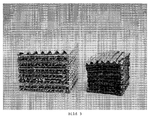
- One picture is shown in the pictures Corrugated cardboard molded preform and the resulting - after processing according to the inventive method - resulting ceramic composites.
- Example 1 Figure 1 - SiSiC component with uniaxially oriented cell structure
- Single-sided corrugated board with different wave height and wave width are rolled up and glued to cylindrical components (picture 1, left).
- the result is components made of corrugated cardboard with directed pore structures with cell diameters between 1 to 8 mm and cell wall thicknesses corresponding to the selected paper thickness (about 200 ⁇ m).
- To increase the mechanical strength of the rolled corrugated cardboard can be fitted in a likewise made of cardboard ring.
- the corrugated components were pyrolyzed at 800 ° C in N 2 atmosphere. In this case, a slow heating rate of 1 ° C / min was used up to a temperature of 500 ° C. At this temperature, the thermal decomposition of the cellulose fibers to carbon is largely complete.
- the mixture was then heated at a heating rate of 5 ° C / min to 800 ° C. After pyrolysis, a weight loss of 78% by weight was determined and a shrinkage of about 20% in the axial and radial directions.
- the resulting carbon shapes retain the inner and outer shape of the corrugated board member and were reacted by subsequent infiltration with liquid Si at a temperature of 1500 ° C (holding time 1h) in SiSiC ceramics. After siliconization, a porous SiSiC ceramic (porosity approx. 60%) was created, which reflects the original form of the rolled corrugated cardboard component (Fig. 1, right).
- SiSiC ceramics with uniaxial directed porosity can e.g. as catalyst carrier structures, for the transport of hot gases, for the heating of gases in solar systems, as kiln furniture or as pore burner substrates be used.
- One-sided corrugated board with different wave height and Shaft width were rolled up and become cylindrical components glued (picture 2, left). It creates components made of corrugated cardboard with directed pore structures with cell diameters between 1 to 8 mm and cell wall thicknesses according to the selected paper thickness (about 200 microns). To strengthen the mechanical strength The rolled corrugated cardboard components became one too made of cardboard boxes existing ring. Before the pyrolysis The corrugated cardboard components were made with a coke Polymer (furan resin, undiluted) for increasing the carbon density the cell walls infiltrated at room temperature. The polymer infiltration led to an increase in weight of the corrugated cardboard component of about 50% by weight. The pyrolysis was analogous to Example 1 performed.
- Single-sided or double-sided corrugated board with different Wave height and wave width are cut square each glued to each other with 90 °, (picture 3, Left). It creates components made of corrugated cardboard with crosswise directed Pore structures with cell diameters between 1 to 8 mm and cell wall thicknesses according to the selected paper thickness (about 200 microns).
- the pyrolysis and silicization became analog Example 1 performed. After silicization are highly porous SiSiC ceramics were created, which are the original form of the reflect crosswise bonded corrugated board (Fig. 3, right).
- Such, easy to produce SiSiC or SiC (after additional Treatment for the removal of Si) ceramics with Crosswise uniaxially directed cell structures may e.g. as heat exchanger structures at high temperatures or as Kiln furniture can be used.
- Two-sided corrugated board with different wave height and Wavelength are cut into flat components (Fig. 4, Left).
- the result is components made of corrugated cardboard with directional Pore structures with cell diameters between 1 and 8 mm and Cell wall thicknesses according to the selected paper thickness (approx. 200 ⁇ m).
- the pyrolysis and silicization was carried out analogously to Example 1. After the silicization are planar, lightweight SiSiC ceramics, which are the reflect the original shape of the corrugated cardboard structures (Picture 4, right).
- Such easy-to-produce and lightweight SiSiC ceramics can e.g. as high temperature stable substrates for z.
Landscapes
- Chemical & Material Sciences (AREA)
- Engineering & Computer Science (AREA)
- Ceramic Engineering (AREA)
- Organic Chemistry (AREA)
- Structural Engineering (AREA)
- Materials Engineering (AREA)
- Manufacturing & Machinery (AREA)
- Chemical Kinetics & Catalysis (AREA)
- Combustion & Propulsion (AREA)
- Inorganic Chemistry (AREA)
- Thermal Sciences (AREA)
- Physics & Mathematics (AREA)
- Dispersion Chemistry (AREA)
- Ceramic Products (AREA)
Applications Claiming Priority (2)
| Application Number | Priority Date | Filing Date | Title |
|---|---|---|---|
| DE10351057 | 2003-10-31 | ||
| DE10351057 | 2003-10-31 |
Publications (1)
| Publication Number | Publication Date |
|---|---|
| EP1528049A1 true EP1528049A1 (fr) | 2005-05-04 |
Family
ID=34399638
Family Applications (1)
| Application Number | Title | Priority Date | Filing Date |
|---|---|---|---|
| EP04025471A Withdrawn EP1528049A1 (fr) | 2003-10-31 | 2004-10-27 | Procédé de fabrication d'un matériau composite en céramique |
Country Status (1)
| Country | Link |
|---|---|
| EP (1) | EP1528049A1 (fr) |
Cited By (3)
| Publication number | Priority date | Publication date | Assignee | Title |
|---|---|---|---|---|
| WO2011000967A1 (fr) * | 2009-07-03 | 2011-01-06 | Schunk Kohlenstofftechnik Gmbh | Procédé de préparation dun corps céramique, dun catalyseur de gaz déchappement, ainsi que support pour celui-ci |
| WO2011015571A1 (fr) * | 2009-08-04 | 2011-02-10 | Schunk Kohlenstofftechnik Gmbh | Procédé de fabrication d'un échangeur thermique et échangeur thermique |
| CN107010973A (zh) * | 2017-05-10 | 2017-08-04 | 济南大学 | 一种轻质复相多孔隔热耐火材料和莫来石质耐火材料及其制备方法 |
Citations (3)
| Publication number | Priority date | Publication date | Assignee | Title |
|---|---|---|---|---|
| GB1368169A (en) * | 1972-11-20 | 1974-09-25 | Nippon Oil Seal Ind Co Ltd | Production of silicon carbide articles |
| US4617072A (en) * | 1983-07-30 | 1986-10-14 | Mtu Motoren-Und Turbinen-Union Muenchen Gmbh | Method for producing a composite ceramic body |
| EP1284251A1 (fr) * | 2001-08-17 | 2003-02-19 | Eiji Tani | Matériau structural poreux, leger et resistant à chaleur à base de carbure de silicium, et son procédé de fabrication |
-
2004
- 2004-10-27 EP EP04025471A patent/EP1528049A1/fr not_active Withdrawn
Patent Citations (3)
| Publication number | Priority date | Publication date | Assignee | Title |
|---|---|---|---|---|
| GB1368169A (en) * | 1972-11-20 | 1974-09-25 | Nippon Oil Seal Ind Co Ltd | Production of silicon carbide articles |
| US4617072A (en) * | 1983-07-30 | 1986-10-14 | Mtu Motoren-Und Turbinen-Union Muenchen Gmbh | Method for producing a composite ceramic body |
| EP1284251A1 (fr) * | 2001-08-17 | 2003-02-19 | Eiji Tani | Matériau structural poreux, leger et resistant à chaleur à base de carbure de silicium, et son procédé de fabrication |
Cited By (3)
| Publication number | Priority date | Publication date | Assignee | Title |
|---|---|---|---|---|
| WO2011000967A1 (fr) * | 2009-07-03 | 2011-01-06 | Schunk Kohlenstofftechnik Gmbh | Procédé de préparation dun corps céramique, dun catalyseur de gaz déchappement, ainsi que support pour celui-ci |
| WO2011015571A1 (fr) * | 2009-08-04 | 2011-02-10 | Schunk Kohlenstofftechnik Gmbh | Procédé de fabrication d'un échangeur thermique et échangeur thermique |
| CN107010973A (zh) * | 2017-05-10 | 2017-08-04 | 济南大学 | 一种轻质复相多孔隔热耐火材料和莫来石质耐火材料及其制备方法 |
Similar Documents
| Publication | Publication Date | Title |
|---|---|---|
| EP1741685B1 (fr) | Corps formé céramique poreux contenant beta-SiC et son procédé de préparation. | |
| DE10008686B4 (de) | Verfahren zur Herstellung eines faserverstärkten Siliziumcarbid-Verbundstoffes | |
| Greil et al. | Biomorphic cellular silicon carbide ceramics from wood: I. Processing and microstructure | |
| Sieber | Biomimetic synthesis of ceramics and ceramic composites | |
| DE10048012A1 (de) | Reib- oder Gleitkörper aus mit Faserbündeln verstärkten Verbundwerkstoffen mit keramischer Matrix | |
| DE69802748T2 (de) | Silicium-Siliciumcarbidwerkstoff und siliciumcarbidfaserverstärkter Silicium-Siliciumcarbidverbundwerkstoff | |
| Yu et al. | Wood-derived ultra-high temperature carbides and their composites: A review | |
| DE19856721A1 (de) | Verfahren zur Herstellung eines mittels Kohlenstoffkurzfasern verstärkten Siliciumcarbid-Verbundwerkstoffes | |
| DE102009048424A1 (de) | Werkstoff, Verfahren zur Herstellung eines Werkstoffs und seine Verwendung | |
| US5618767A (en) | Process for producing ceramic components of silicon carbide | |
| DE102006022598B4 (de) | Verfahren zur Herstellung einer Keramik aus präkeramischen Papier- oder Pappstrukturen | |
| EP1741687B1 (fr) | Corps formé céramique poreux contenant ß-SiC et son procédé de préparation. | |
| EP1089952B1 (fr) | Procede de production de corps moules a base de carbone, de carbures et/ou de carbonitrures | |
| DE102015201119B4 (de) | Herstellungsverfahren von Keramikmatrix-Halbzeugen | |
| EP2192096A2 (fr) | Procédé de fabrication d'un composant en céramique | |
| Locs et al. | Optimized vacuum/pressure sol impregnation processing of wood for the synthesis of porous, biomorphic SiC ceramics | |
| EP1453773B1 (fr) | Procede pour fabriquer un element en carbone ou en ceramique | |
| EP1528049A1 (fr) | Procédé de fabrication d'un matériau composite en céramique | |
| US20070132129A1 (en) | Process for producing silicon carbide ceramic | |
| DE19823521A1 (de) | Verfahren zur Herstellung von Kohlenstoff-Verbundwerkstoffen und/oder kohlenstoffhaltigen Werkstoffen, carbidischen und/oder carbonitridischen Werkstoffen | |
| Bhattacharya et al. | Cellular SiC ceramic from stems of corn—processing and microstructure | |
| DE10020655A1 (de) | Keramischer Werkstoff | |
| Hyie et al. | Fabrication of biomorphic silicon carbide from agriculture waste powders | |
| EP1017648B1 (fr) | Procede pour produire des materiaux composites a base de carbone et/ou des materiaux contenant du carbone, des materiaux a base de carbure et/ou de carbonitrure | |
| Qiao et al. | Biomorphic SiC ceramics prepared by organic template method |
Legal Events
| Date | Code | Title | Description |
|---|---|---|---|
| PUAI | Public reference made under article 153(3) epc to a published international application that has entered the european phase |
Free format text: ORIGINAL CODE: 0009012 |
|
| AK | Designated contracting states |
Kind code of ref document: A1 Designated state(s): AT BE BG CH CY CZ DE DK EE ES FI FR GB GR HU IE IT LI LU MC NL PL PT RO SE SI SK TR |
|
| AX | Request for extension of the european patent |
Extension state: AL HR LT LV MK |
|
| AKX | Designation fees paid | ||
| STAA | Information on the status of an ep patent application or granted ep patent |
Free format text: STATUS: THE APPLICATION IS DEEMED TO BE WITHDRAWN |
|
| 18D | Application deemed to be withdrawn |
Effective date: 20051105 |
|
| REG | Reference to a national code |
Ref country code: DE Ref legal event code: 8566 |