EP1528221B1 - Expandierbarer excentrischer Räumer und Verfahren zum bohren - Google Patents
Expandierbarer excentrischer Räumer und Verfahren zum bohren Download PDFInfo
- Publication number
- EP1528221B1 EP1528221B1 EP04025098A EP04025098A EP1528221B1 EP 1528221 B1 EP1528221 B1 EP 1528221B1 EP 04025098 A EP04025098 A EP 04025098A EP 04025098 A EP04025098 A EP 04025098A EP 1528221 B1 EP1528221 B1 EP 1528221B1
- Authority
- EP
- European Patent Office
- Prior art keywords
- blade
- tool
- drill
- cavity
- diameter
- Prior art date
- Legal status (The legal status is an assumption and is not a legal conclusion. Google has not performed a legal analysis and makes no representation as to the accuracy of the status listed.)
- Expired - Lifetime
Links
- 238000005553 drilling Methods 0.000 title claims description 33
- 238000000034 method Methods 0.000 title claims description 18
- 239000012530 fluid Substances 0.000 claims description 31
- 239000003381 stabilizer Substances 0.000 claims description 18
- 230000015572 biosynthetic process Effects 0.000 claims description 4
- 238000005461 lubrication Methods 0.000 claims description 3
- 239000000314 lubricant Substances 0.000 claims description 2
- 230000008878 coupling Effects 0.000 description 6
- 238000010168 coupling process Methods 0.000 description 6
- 238000005859 coupling reaction Methods 0.000 description 6
- 239000004519 grease Substances 0.000 description 3
- 230000002028 premature Effects 0.000 description 3
- 229910003460 diamond Inorganic materials 0.000 description 2
- 239000010432 diamond Substances 0.000 description 2
- 230000014759 maintenance of location Effects 0.000 description 2
- 238000012986 modification Methods 0.000 description 2
- 230000004048 modification Effects 0.000 description 2
- 229910000831 Steel Inorganic materials 0.000 description 1
- 238000010276 construction Methods 0.000 description 1
- 238000005552 hardfacing Methods 0.000 description 1
- 238000009434 installation Methods 0.000 description 1
- 230000013011 mating Effects 0.000 description 1
- 230000000087 stabilizing effect Effects 0.000 description 1
- 239000010959 steel Substances 0.000 description 1
- XLYOFNOQVPJJNP-UHFFFAOYSA-N water Substances O XLYOFNOQVPJJNP-UHFFFAOYSA-N 0.000 description 1
Images





Classifications
-
- E—FIXED CONSTRUCTIONS
- E21—EARTH OR ROCK DRILLING; MINING
- E21B—EARTH OR ROCK DRILLING; OBTAINING OIL, GAS, WATER, SOLUBLE OR MELTABLE MATERIALS OR A SLURRY OF MINERALS FROM WELLS
- E21B10/00—Drill bits
- E21B10/26—Drill bits with leading portion, i.e. drill bits with a pilot cutter; Drill bits for enlarging the borehole, e.g. reamers
- E21B10/265—Bi-center drill bits, i.e. an integral bit and eccentric reamer used to simultaneously drill and underream the hole
-
- E—FIXED CONSTRUCTIONS
- E21—EARTH OR ROCK DRILLING; MINING
- E21B—EARTH OR ROCK DRILLING; OBTAINING OIL, GAS, WATER, SOLUBLE OR MELTABLE MATERIALS OR A SLURRY OF MINERALS FROM WELLS
- E21B10/00—Drill bits
- E21B10/26—Drill bits with leading portion, i.e. drill bits with a pilot cutter; Drill bits for enlarging the borehole, e.g. reamers
- E21B10/32—Drill bits with leading portion, i.e. drill bits with a pilot cutter; Drill bits for enlarging the borehole, e.g. reamers with expansible cutting tools
- E21B10/322—Drill bits with leading portion, i.e. drill bits with a pilot cutter; Drill bits for enlarging the borehole, e.g. reamers with expansible cutting tools cutter shifted by fluid pressure
Definitions
- THE PRESENT INVENTION generally relates to downhole tools useful for drilling oil, gas and water wells. More specifically, the present invention relates to a downhole drilling tool used to pass through a smaller hole and drill a larger hole.
- Under-reamers usually have hinged arms with attached cutters.
- the tool typically has pocket recesses formed in the body where the arms are retracted when the tool is in a closed state.
- Most of the prior art under-reamers utilize swing out cutter arms that are pivoted at an end opposite the cutting end of the reamer and are actuated by mechanical or hydraulic forces acting on the arms to extend or retract them.
- Bi-center bits have been used as an alternative to under-reamers as a downhole drilling tool.
- the bi-center bit is a combination reamer and pilot bit.
- the reamer section is disposed up-hole of the pilot bit.
- the pilot bit drills a pilot borehole and the eccentric reamer section follows the pilot bit reaming the pilot borehole to the desired diameter for the new borehole.
- a desirable aspect to the bi-center bit is its ability to pass through a small hole and then drill a hole of a larger diameter.
- the drill out diameter of a hi-center bit is limited by the pass-through diameter and the maximum tool diameter.
- US 2003/079913 Al discloses a drilling assembly incorporating an eccentric adjustable diameter reamer.
- the reamer includes cutter elements mounted on at least one fixed blade for reaming a previously-formed borehole, or for forming a borehole of increased diameter beneath an existing cased borehole.
- Retainer means such as shear pins, are provided to prevent premature extension of the reamer's moveable members which include blades and pistons.
- US-A-5,547,031 also discloses a tool with extendable reamer blades.
- a downhole tool comprising:
- the blade moves relative to the cavity in the manner of a piston in a cylinder.
- the blade is not pivotally mounted.
- the blade carries at least one cutting element to drill a formation.
- the blade carries a stabiliser pad.
- the cavity in the body housing the blade opens on an outer surface of the body opposite the eccentricity.
- the cavity in the body housing the blade opens substantially in alignment with the eccentricity.
- the cavity and blade are aligned so that the blade extends substantially radially upon actuation under fluid pressure.
- the cavity and blade are disposed at an angle with respect to the longitudinal axis, the blade being extendible at said angle upon actuation by fluid pressure.
- the shaft carries a stop limit member positioned to be engaged by the collar when the collar has slid along the shaft.
- a seal is provided between the blade and an interior wall of the cavity.
- two parallel seals are provided between the blade and the interior wall of the cavity and a lubrication reservoir is provided to supply lubricant to the space between the two seals.
- the reservoir may be in the blade.
- the blade has an outer end of surface configuration of a predetermined thickness, non cutting elements being disposed at each side of said outer end and a cutting element being disposed between the non cutting elements at a position on the outer end of surface of the blade.
- a frangible element is provided to retain the blade in the first retracted position.
- the elongate body is provided with a second attachment to attach the body to a drill string at a second end opposed to said first end.
- the blade has a bevelled upper edge surface configuration.
- a method of drilling a well bore hole comprising the steps of establishing a drill string incorporating at least one tool as described in the preceding paragraphs, introducing the drill string to a bore hole with the blade of the or each tool in the initial retracted position and subsequently applying drilling fluid to the or each blade to deploy the or each blade by moving the or each blade at least partly out of the cavity accommodating the blade.
- the drill string incorporates a bi-center bit drill.
- the method may further comprise the step of aligning an area of eccentricity on the eccentrically shaped body of the tool with reamer blades of the bi-center bit.
- the drill string incorporates two tools of the type described above.
- one said tool is provided with a blade carrying cutters, and the blade of the first tool is deployed to a first drill out diameter, and a second tool is provided with a blade carrying cutters and the blade of the second tool is deployed to a second drill out diameter, the first drill out diameter being smaller than the second drill out diameter.
- the preferred embodiment of the present invention provides a downhole tool to be disposed in a drill string up-hole of a conventional drill bit.
- the downhole tool provides a drilling tool for drill out diameter for the borehole that is significantly larger than a pass-through diameter.
- the downhole tool provides a stabilizer tool.
- an elongated body defining a longitudinal axis has first and second ends for attachment to a drill string.
- An internal space of the body is supplied with a drilling fluid under pressure.
- a reamer blade having a plurality of cutter elements is housed within the elongated body and actuated by the pressure of the drilling fluid to radially extend for deployment to a drill out diameter larger than a pass-through diameter.
- the blade moves in the manner of a piston within a cylinder.
- the reamer blade has a curved outer edge configuration that positions the cutters thereon to prevent them from engaging a casing of a well borehole upon deployment.
- the body has an eccentrically shaped outer surface configuration to house the reamer blade.
- the downhole tool can be characterized as an "expandable eccentric reamer" and is distinguishable from "concentric" reamers, which have a body with a tubular shaped outer surface configuration.
- a drill bit is affixed to a drill string and an expandable eccentric reamer is provided in the drill string up-hole from the drill bit.
- the drill bit can be a bi- center bit having reamer blades. If so, an area of eccentricity on the eccentric reamer is aligned with the reamer blades of the bi-center bit.
- a second expanded eccentric reamer can be provided in the drill string up-hole from the first eccentric reamer.
- the first eccentric reamer deploys its cutters to a first drill out diameter and the second eccentric reamer deploys its cutters to a second drill out diameter.
- the first and second drill out diameters may be the same or different.
- the second drill out diameter is larger than the first drill out diameter.
- An area of eccentricity on the first expandable eccentric reamer is evenly spaced radially from an area of eccentricity on the second expandable eccentric reamer.
- Tool 10 in accordance with the present invention is shown.
- Tool 10 is generally of a type known as a "reamer.”
- Tool 100 has a body 1.2 adapted for coupling along the length of a drill string (not shown) by attachment at the proximal end 14 and the distal end 16. Ends 14 and 16 preferably have threaded couplings to mate with the threaded ends of drill pipe.
- Tool 10 would be placed in the drill string up-hole of conventional drill bit.
- the elongated body 12 defines a longitudinal axis and in relation thereto has an eccentric outer surface configuration due to a hump area 18 between ends 14 and 16.
- the eccentric shape of body 12 closely matches the shape of conventional bi-center bits and allows the tool 10 to be aligned with and run behind a conventional bi-center bit.
- a bi-center bit is that shown in U.S. Patent No. 5,678,644, which is hereby incorporated by reference in its entirety.
- the hump area 18 is aligned with the reamer blades of the bi-center bit.
- Tool 10 can also be used with a standard drill bit and without necessity of alignment of the eccentric shape with the drill bit.
- the spacing between the tool 10 and the drill bit may vary.
- the tool 10 may, for example, be "stacked" directly above the drill bit by providing suitable mating threaded connections on the drill bit body and the tool 10 body.
- a piston Housed within a cavity 20 of body 12 is a piston, which forms a reamer blade 22.
- the cavity 20 is in the form of an elongated, radial slot.
- the length of the slot extends parallel to the longitudinal axis of tool 10 and the depth of the slot extends radially of the longitudinal axis of the tool 10.
- blade 22 carries a plurality of cutter elements 24 of conventional design, for example, polycrystalline diamond compact (“PDC”) cutters.
- PDC polycrystalline diamond compact
- blade 22 travels axially along retention shaft 28.
- An end 30 of shaft 28 is anchored in the hump area 18 of body 12.
- Blade 22 is coupled to shaft 28 by a collar that slides along shaft 28 until the stop limit member 32 at the opposite end 34 of shaft 28 is reached as shown in Fig. 2.
- the length of travel permitted by shaft 28 and limit stop member 32 determine the drill out diameter of tool 10.
- the blade 22 is extended by exposure to the drilling fluid pressure in the internal space 26.
- a retaining shear pin 3 6 is provided in order to assure that blade 22 is maintained in the retracted position until time of deployment.
- blade 22 remains within body 12.
- the force necessary to break pin 36 can, of course, be varied as desired.
- the internal space 26 must be sealed from the external fluid pressure of the well bore.
- Two O-rings 38 and 40 are provided to isolate the internal space 26 from the external fluid pressure of the well bore.
- a reservoir 42 of grease is provided within the body of blade 22.
- the reservoir is closed-off by cap 44.
- the cap is in direct contact with the drilling fluid pressure, which pushes down on cap 44 and forces grease from the reservoir 42 into the region between the O-rings 38 and 40.
- the grease provides lubrication of the steel surfaces to permit easier movement of the piston arm.
- the region between the O-rings is pressurized to assist in maintaining the seal between the internal space 26 and the external space of the well bore.
- Retraction of blade 22 can be accomplished by reducing fluid pressure within internal space 26 and pulling the tool 10 into the casing.
- the edge 46 of blade 22 has a tapered portion 50. The angle of the tapered edge provides a cam action that causes the blade to be retracted into slot 20.
- FIGs. 3A and 3B there is illustrated the manner in which damage to a casing is avoided in the event of premature deployment of the blade 22 in the extended position. Shown in these views is the blade 22 in the non-retracted position. Each view is from above and looking down upon a cross section of the tool 10.
- FIG. 3A blade 22 is shown prematurely deployed while still in the casing.
- the cutting element 24 and non-cutting elements 48 are shown mounted on blade 22. As seen, while the tool is in the casing, there is a gap distance "d" between the radius of curvature of the pass through diameter and the cutting element 24. Thus, while the non-cutting elements 48 can contact the casing, the cutting element 24 cannot.
- the radius of curvature of the larger drill out diameter provides for the cutting element 24 and the non-cutting elements 48 to be in contact with the formation.
- the thickness "t" of the blade 22 and the radius of curvature "r" of the outer end surface of the blade 22 are selected to match the intended drill out diameter.
- the blade has contact points at its edges where non-cutting elements 48 are located. The non-cutting elements 48 contact the casing and prevent cutting element 24 from contacting the casing.
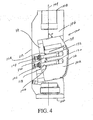
- tool 100 has a blade 102 that is angled or canted with respect to longitudinal axis 104 at an angle " ⁇ ".
- the angle " ⁇ " is preferably about 10°.
- Tool 100 has a body 106 that is adapted for coupling along the length of a drill string by attachment at the proximal end 108 and the distal end 110. Ends 108 and 110 preferably have threaded couplings to mate with the threaded ends of drill pipe. Tool 100 would be placed in the drill string up-hole of conventional drill bit.
- the elongated body 106 defines the longitudinal axis 104 and in relation thereto has an eccentric outer surface configuration due to a hump area 112 between ends 108 and 110.
- the eccentric shape of body 106 closely matches the shape of conventional bi-center bits and allows the tool 100 to be aligned with and run behind a conventional bi-center bit.
- Blade 102 is housed within a cavity 114 formed in body 106.
- the cavity 114 is in the form of an elongated, radial slot.
- the length of the slot extends parallel to the longitudinal axis of tool 100 and the depth of the slot extends radially of the longitudinal axis of the tool 100.
- blade 102 carries a plurality of cutter elements 116 of conventional design, for example, polycrystalline diamond compact ("PDC”) cutters.
- the blade 102 is radially extended from cavity 114 as shown in Fig. 4 under the influence of the fluid pressure of drilling fluid or mud that is pumped into the interior space behind blade 102. It is in this manner that the backside surface of blade 102 acts as a piston.
- blade 102 travels axially along a pair of retention shafts 118 and 120.
- An end 122 of shaft 118 is anchored in the hump area 112 of body 106; and an end 124 of shaft 120 is anchored in the hump area 112.
- Blade 102 is coupled to shafts 118 and 120 by collars 126 and 128 that slide along shafts 118 and 120, respectively, until the stop limit members 130 and 132 at the opposite ends of shafts 118 and 120 are reached.
- the length of travel permitted by shafts 118 and 120 together with limit stop members 130 and 132 determine the drill out diameter of tool 100.
- Retraction of blade 102 can be accomplished by reducing fluid pressure within the internal space of body 106 and pulling the tool 100 into the casing.
- the edge 134 of blade 102 is tapered. The angle of the tapered edge provides a cam action that causes the blade to be retracted into the slot.
- tool 10 or tool 100 can be provided up-hole of a drill bit.
- its reamer blades can produce a large cutting force.
- the blade of the tool extends from the opposite side and serves to offset the bi-center reamer blades cutting force.
- the opposing forces assist in stabilizing the bi-center reamer and makes for a more accurate well borehole size.
- a pair of tools 10 or 100 can be coupled into the drill string up-hole from a drill bit. When used behind a bi-center bit, a first of the tools 10 or 100 is aligned with the bi-center bit as described.
- the second tool 10 or 100 will have the eccentricity of the body extending in the opposite direction.
- the tools 10 or 100 would drill to the same drill out diameter and serve to act as a two-bladed stabilizer.
- the stacked tools 10 or 100 could be sized to drill to a different diameter. In that situation, the distal tool nearer the drill bit would have a smaller drill out diameter than the proximal tool, which would extend to the final drill out diameter.
- a standard drill bit rather than a bi-center bit would be employed.
- the hump area on each would be evenly spaced radially from one another. That is, if two tools were used, the hump areas on them would be spaced apart 180°. If three tools were used, the hump areas on them would be spaced apart 120°.
- FIG. 5 there is illustrated an eccentric stabilizer 200 coupled to a bi-center bit 202.
- a stabilizer pad 204 which is a non-cutting surface, is shown in the extended position.
- Pad 204 may be a smooth surface comprising carbide blocks with hard-facing to permit it to slide along the formation wall.
- the body 206 of stabilizer 200 has an eccentric outer configuration provided by a hump area 208.
- the proximal end 210 is adapted to be connected to a drill string.
- the bi-center bit is coupled to the distal end 212.
- Fig. 6 shows a cross-section of stabilizer 200. As seen, the stabilizer 200 is similar to tool 100 of Fig. 4. However, rather than having cutting elements, blade 206 has pad 204.
- Fig. 7 shows a stacked arrangement of downhole tools 300 and 400.
- Tool 300 is in accordance with either tool 10 (Figs. 1 and 2) or tool 100 (Fig. 4).
- Tool 400 is of a different configuration.
- the body of tool 400 has an eccentric-shaped outer surface configuration. But, the blade 402 with cutting elements 404 extends from the hump area 406 of body 408.
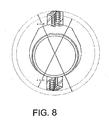
- Fig. 8 is a top view of the stacked arrangement of tools 300 and 400 with the blades of the tools in the extended position for drilling.
- Fig. 9 shows tool 400 in cross-section.
- Tool 400 has a similar internal mechanical construction to tool 100.
- Tool 400 has blade 402 angled or canted with respect to the longitudinal axis of the tool body.
- the body 408 is adapted for coupling along the length of a drill string by attachment at the proximal end 410.
- the distal end 412 is configured for coupling to tool 300 either directly or indirectly through a short section of drill pipe.
- Blade 402 is moved by hydraulic pressure to extend from hump area 406 of body 408.
- the beveled surface 414 engages the casing to urge blade 402 into the retracted position when the tool is being retrieved.
- Shafts 416 and 418 are anchored at one end within body 408. Blade 402 slides along shafts 416 and 418 as it is being extended and retracted.
- a stacked arrangement of tools can comprise a combination of a stabilizer in accordance with tool 200 and a reamer tool in accordance with tool 10.
- a method of drilling a wellbore may be implemented using a combination of a stabilizer, a reamer tool, and a drill bit.
- the humps must be aligned in order for the assembly to be able to trip into the hole.
- the stabilizer and the reamer tool will necessarily have opposing eccentric shaped bodies.
- the invention relates generally to a method of drilling a well borehole, comprising the steps of:
- the drill bit is preferably a bi-center bit having reamer blades, the eccentricity of the eccentricity body of the downhole tool being aligned with the reamer blades.
- the invention can be considered to relate to a downhole drilling system for attachment to a drill string comprising:
- one embodiment of the invention provides a method of drilling a well borehole, comprising the steps of:
Landscapes
- Engineering & Computer Science (AREA)
- Life Sciences & Earth Sciences (AREA)
- Geology (AREA)
- Mining & Mineral Resources (AREA)
- Mechanical Engineering (AREA)
- Physics & Mathematics (AREA)
- Environmental & Geological Engineering (AREA)
- Fluid Mechanics (AREA)
- General Life Sciences & Earth Sciences (AREA)
- Geochemistry & Mineralogy (AREA)
- Earth Drilling (AREA)
Claims (19)
- In einem Bohrloch einzusetzendes Werkzeug (10), mit:einem länglichen Grundkörper (12), wobei der Grundkörper mit einer Befestigung (14) an einem ersten Ende des Grundkörpers versehen ist, um das Werkzeug an einem Bohrstrang zur Drehung um eine Achse, die durch die Befestigung hindurch verläuft, zu befestigen,wobei der Grundkörper eine äußere Oberfläche (18) festlegt, die exzentrisch relativ zu der genannten Achse ist, wobei ein Messer (22) innerhalb eines Hohlraums (20) aufgenommen ist, der innerhalb des Grundkörpers ausgebildet ist, und unter einem Fluiddruck bewegbar ist, ausgehend von einer ersten zurückgezogenen Position, in der das Werkzeug einen vorgegebenen Durchgangsdurchmesser festlegt, bis zu einer ausgefahrenen, ausgebrachten Position, in der die Kombination aus dem Werkzeug und dem Messer einen vergrößerten Durchmesser aufweist, dadurch gekennzeichnet, daß zumindest ein Schaft (28) innerhalb des länglichen Grundkörpers (12) gehalten und an diesem befestigt ist, wobei das Messer (22) mit dem Schaft (28) durch einen verschieblichen Kragen (32) gekoppelt ist, wobei der Kragen (32) dazu dient, das Messer mit dem Schaft (28) zu koppeln, während die genannte Bewegung des Messers unter einem Fluiddruck ermöglicht wird.
- Werkzeug nach Anspruch 1, dadurch gekennzeichnet, daß das Messer (22) zumindest ein Schneidelement (24) zum Bohren einer Formation trägt.
- Werkzeug nach Anspruch 1 und Anspruch 2, dadurch gekennzeichnet, daß das Messer (22) einen Stabilisierungsklotz (204) trägt.
- Werkzeug nach einem der vorangehenden Ansprüche, dadurch gekennzeichnet, daß der Hohlraum (20) in dem Grundkörper, der das Messer aufnimmt, sich auf eine äußere Oberfläche des Grundkörpers gegenüber der Exzentrizität (18) öffnet.
- Werkzeug nach einem der Ansprüche 1 bis 3, dadurch gekennzeichnet, daß sich der Hohlraum (20) in dem Grundkörper, der das Messer aufnimmt, im wesentlichen in Ausrichtung mit der Exzentrizität (18) öffnet.
- Werkzeug nach einem der vorangehenden Ansprüche, dadurch gekennzeichnet, daß der Hohlraum (20) und das Messer (22) so ausgerichtet sind, daß sich das Messer im wesentlichen in radialer Richtung relativ zu dem länglichen Grundkörper (12) bei einer Betätigung unter Fluiddruck erstreckt.
- Werkzeug nach einem der Ansprüche 1 bis 6, dadurch gekennzeichnet, daß der Hohlraum und das Messer unter einem Winkel in bezug auf die Längsachse angeordnet sind, wobei das Messer unter dem genannten Winkel ausgefahren werden kann, bei Betätigung durch einen Fluiddruck.
- Werkzeug nach einem der vorangehenden Ansprüche, dadurch gekennzeichnet, daß der Schaft ein Anschlag- und Begrenzungsteil (22) trägt, das so angeordnet ist, daß es durch den Kragen (32) erfaßt wird, wenn sich der Kragen entlang des Schafts verschoben hat.
- Werkzeug nach einem der vorangehenden Ansprüche, dadurch gekennzeichnet, daß eine Dichtung (38, 40) zwischen dem Messer (22) und einer inneren Wand des Hohlraums (20) vorgesehen ist.
- Werkzeug nach Anspruch 9, dadurch gekennzeichnet, daß zwei parallele Dichtungen (38, 40) zwischen dem Messer und der inneren Wand des Hohlraums vorgesehen sind, und ein Schmierungsvorrat (42) vorgesehen ist, um Schmierstoff in den Zwischenraum zwischen den beiden Dichtungen (38, 40) zuzuführen.
- Werkzeug nach einem der vorangehenden Ansprüche, dadurch gekennzeichnet, daß das Messer (22) ein äußeres Ende mit einer Oberflächenform mit einer vorbestimmten Dicke aufweist, wobei nicht schneidende Elemente (48) an jeder Seite des genannten äußeren Endes angeordnet sind und ein Schneidelement (24) zwischen den nicht schneidenden Elementen an einer Position auf dem äußeren Ende der Oberfläche des Messers angeordnet ist.
- Werkzeug nach einem der vorangehenden Ansprüche, dadurch gekennzeichnet, daß ein zerbrechbares Element (36) vorgesehen ist, um das Messer (22) in der ersten zurückgezogenen Position zu halten.
- Werkzeug nach einem der vorangehenden Ansprüche, dadurch gekennzeichnet, daß der längliche Grundkörper (12) mit einer zweiten Befestigung (16) versehen ist, um den Grundkörper an einem Bohrstrang an einem zweiten Ende, das sich gegenüber dem genannten ersten Ende befindet, zu befestigen.
- Werkzeug nach einem der vorangehenden Ansprüche, dadurch gekennzeichnet, daß das Messer (22) mit einer angeschrägten Oberflächenform (46) am oberen Rand versehen ist.
- Verfahren zum Bohren eines Bohrlochs, mit den Schritten:Zusammenstellen eines Bohrstrangs, der zumindest ein Werkzeug (10) gemäß einem der Ansprüche 1 bis 14 umfaßt, Einführen des Bohrstrangs in ein Bohrloch, wobei sich das Messer (22) des oder jedes Werkzeugs in der anfänglichen zurückgezogenen Position befindet, und anschließendes Anlegen eines Bohrfluids an das oder jedes Messer (22), um das oder jedes Messer auszubringen, dadurch daß das oder jedes Messer (22) zumindest teilweise aus dem Hohlraum (20) herausbewegt wird, der das Messer aufnimmt.
- Verfahren nach Anspruch 15, dadurch gekennzeichnet, daß der Bohrstrang einen Bohrmeißel mit zwei Zentren umfaßt.
- Verfahren nach Anspruch 16, umfassend den Schritt, einen Exzentrizitätsbereich (18) auf dem exzentrisch geformten Grundkörper (22) des Werkzeugs (10) mit Räummessern des mit zwei Zentren versehenen Bohrmeißels auszurichten.
- Verfahren nach einem der Ansprüche 15 bis 17, dadurch gekennzeichnet, daß der Bohrstrang zwei Werkzeuge nach einem der Ansprüche 1 bis 14 umfaßt.
- Verfahren nach Anspruch 18, dadurch gekennzeichnet, daß ein genanntes Werkzeug (10) mit einem Messer (22), das Schneidelemente (24) trägt, versehen ist, und daß das Messer des ersten Werkzeugs auf einen ersten Aufbohrdurchmesser ausgebracht wird, daß ein zweites Werkzeug (10) mit einem Messer (22), welches Schneidelemente (24) trägt, versehen ist, und daß das Messer (22) des zweiten Werkzeugs auf einen zweiten Aufbohrdurchmesser ausgebracht wird, wobei der erste Aufbohrdurchmesser kleiner ist als der zweite Aufbohrdurchmesser.
Applications Claiming Priority (2)
| Application Number | Priority Date | Filing Date | Title |
|---|---|---|---|
| US701232 | 1991-05-16 | ||
| US10/701,232 US6991046B2 (en) | 2003-11-03 | 2003-11-03 | Expandable eccentric reamer and method of use in drilling |
Publications (2)
| Publication Number | Publication Date |
|---|---|
| EP1528221A1 EP1528221A1 (de) | 2005-05-04 |
| EP1528221B1 true EP1528221B1 (de) | 2006-08-09 |
Family
ID=34423474
Family Applications (1)
| Application Number | Title | Priority Date | Filing Date |
|---|---|---|---|
| EP04025098A Expired - Lifetime EP1528221B1 (de) | 2003-11-03 | 2004-10-21 | Expandierbarer excentrischer Räumer und Verfahren zum bohren |
Country Status (5)
| Country | Link |
|---|---|
| US (1) | US6991046B2 (de) |
| EP (1) | EP1528221B1 (de) |
| CA (1) | CA2482122C (de) |
| DE (1) | DE602004001832T2 (de) |
| NO (1) | NO20044718L (de) |
Families Citing this family (48)
| Publication number | Priority date | Publication date | Assignee | Title |
|---|---|---|---|---|
| US7036611B2 (en) | 2002-07-30 | 2006-05-02 | Baker Hughes Incorporated | Expandable reamer apparatus for enlarging boreholes while drilling and methods of use |
| US7131504B2 (en) | 2002-12-31 | 2006-11-07 | Weatherford/Lamb, Inc. | Pressure activated release member for an expandable drillbit |
| ATE480670T1 (de) * | 2005-07-28 | 2010-09-15 | Soletanche Freyssinet | Bohrschnecke |
| BRPI0716743A2 (pt) * | 2006-10-21 | 2013-09-17 | Paul Bernard Lee | dispositivo de ativaÇço para uma ferramenta de poÇo |
| US7900717B2 (en) * | 2006-12-04 | 2011-03-08 | Baker Hughes Incorporated | Expandable reamers for earth boring applications |
| US8657039B2 (en) | 2006-12-04 | 2014-02-25 | Baker Hughes Incorporated | Restriction element trap for use with an actuation element of a downhole apparatus and method of use |
| US8028767B2 (en) | 2006-12-04 | 2011-10-04 | Baker Hughes, Incorporated | Expandable stabilizer with roller reamer elements |
| US7963348B2 (en) * | 2007-10-11 | 2011-06-21 | Smith International, Inc. | Expandable earth boring apparatus using impregnated and matrix materials for enlarging a borehole |
| US7882905B2 (en) * | 2008-03-28 | 2011-02-08 | Baker Hughes Incorporated | Stabilizer and reamer system having extensible blades and bearing pads and method of using same |
| US8205689B2 (en) | 2008-05-01 | 2012-06-26 | Baker Hughes Incorporated | Stabilizer and reamer system having extensible blades and bearing pads and method of using same |
| US8025107B2 (en) * | 2008-05-15 | 2011-09-27 | Longyear Tm, Inc. | Reamer with polycrystalline diamond compact inserts |
| US7974119B2 (en) | 2008-07-10 | 2011-07-05 | Seagate Technology Llc | Transmission gate-based spin-transfer torque memory unit |
| US7936580B2 (en) | 2008-10-20 | 2011-05-03 | Seagate Technology Llc | MRAM diode array and access method |
| US9030867B2 (en) * | 2008-10-20 | 2015-05-12 | Seagate Technology Llc | Bipolar CMOS select device for resistive sense memory |
| US7936583B2 (en) * | 2008-10-30 | 2011-05-03 | Seagate Technology Llc | Variable resistive memory punchthrough access method |
| US7825478B2 (en) * | 2008-11-07 | 2010-11-02 | Seagate Technology Llc | Polarity dependent switch for resistive sense memory |
| US8178864B2 (en) | 2008-11-18 | 2012-05-15 | Seagate Technology Llc | Asymmetric barrier diode |
| US8203869B2 (en) | 2008-12-02 | 2012-06-19 | Seagate Technology Llc | Bit line charge accumulation sensing for resistive changing memory |
| US8201642B2 (en) * | 2009-01-21 | 2012-06-19 | Baker Hughes Incorporated | Drilling assemblies including one of a counter rotating drill bit and a counter rotating reamer, methods of drilling, and methods of forming drilling assemblies |
| US8159856B2 (en) | 2009-07-07 | 2012-04-17 | Seagate Technology Llc | Bipolar select device for resistive sense memory |
| US8183126B2 (en) | 2009-07-13 | 2012-05-22 | Seagate Technology Llc | Patterning embedded control lines for vertically stacked semiconductor elements |
| US8297381B2 (en) | 2009-07-13 | 2012-10-30 | Baker Hughes Incorporated | Stabilizer subs for use with expandable reamer apparatus, expandable reamer apparatus including stabilizer subs and related methods |
| US8158964B2 (en) | 2009-07-13 | 2012-04-17 | Seagate Technology Llc | Schottky diode switch and memory units containing the same |
| US9022117B2 (en) * | 2010-03-15 | 2015-05-05 | Weatherford Technology Holdings, Llc | Section mill and method for abandoning a wellbore |
| US20120031671A1 (en) * | 2010-08-03 | 2012-02-09 | National Oilwell Varco, L.P. | Drill Bits With Rolling Cone Reamer Sections |
| US8617952B2 (en) | 2010-09-28 | 2013-12-31 | Seagate Technology Llc | Vertical transistor with hardening implatation |
| US8648426B2 (en) | 2010-12-17 | 2014-02-11 | Seagate Technology Llc | Tunneling transistors |
| US8851205B1 (en) | 2011-04-08 | 2014-10-07 | Hard Rock Solutions, Llc | Method and apparatus for reaming well bore surfaces nearer the center of drift |
| AU2012318698B2 (en) | 2011-10-03 | 2016-05-12 | Extreme Technologies, Llc | Wellbore conditioning system |
| US9410379B2 (en) | 2011-12-27 | 2016-08-09 | National Oilwell DHT, L.P. | Downhole cutting tool |
| US9493991B2 (en) | 2012-04-02 | 2016-11-15 | Baker Hughes Incorporated | Cutting structures, tools for use in subterranean boreholes including cutting structures and related methods |
| US9488229B2 (en) | 2012-09-04 | 2016-11-08 | Extreme Technologies, Llc | Low-friction, abrasion resistant replaceable bearing surface |
| US10626922B2 (en) * | 2012-09-04 | 2020-04-21 | Extreme Technologies, Llc | Low-friction, abrasion resistant replaceable bearing surface |
| US9828805B2 (en) * | 2013-04-10 | 2017-11-28 | The Charles Machine Works, Inc. | Reamer with replaceable cutters |
| US10907418B2 (en) * | 2014-07-31 | 2021-02-02 | Halliburton Energy Services, Inc. | Force self-balanced drill bit |
| DE112014007058T5 (de) | 2014-12-30 | 2017-07-20 | Halliburton Energy Services, Inc. | Bohrlochwerkzeugausräumerbaugruppe |
| WO2016108854A1 (en) * | 2014-12-30 | 2016-07-07 | Halliburton Energy Services, Inc. | Multi shot activation system |
| GB2535219B (en) * | 2015-02-13 | 2017-09-20 | Schlumberger Holdings | Bottomhole assembly |
| WO2017142815A1 (en) | 2016-02-16 | 2017-08-24 | Extreme Rock Destruction LLC | Drilling machine |
| US11255136B2 (en) | 2016-12-28 | 2022-02-22 | Xr Lateral Llc | Bottom hole assemblies for directional drilling |
| US10890030B2 (en) * | 2016-12-28 | 2021-01-12 | Xr Lateral Llc | Method, apparatus by method, and apparatus of guidance positioning members for directional drilling |
| WO2019014142A1 (en) | 2017-07-12 | 2019-01-17 | Extreme Rock Destruction, LLC | LATERALLY ORIENTED CUTTING STRUCTURES |
| WO2019051378A1 (en) | 2017-09-09 | 2019-03-14 | Extreme Technologies, Llc | CONDITIONER AND STABILIZER FOR WELLBORE |
| EP3695090B1 (de) | 2017-10-10 | 2023-12-06 | Extreme Technologies, LLC | Bohrlochräumsysteme und vorrichtungen |
| GB2569330B (en) | 2017-12-13 | 2021-01-06 | Nov Downhole Eurasia Ltd | Downhole devices and associated apparatus and methods |
| CN110238136B (zh) * | 2019-06-19 | 2023-09-05 | 宜昌市燕狮科技开发有限责任公司 | 浮动扩孔刀及使用方法 |
| US11441360B2 (en) | 2020-12-17 | 2022-09-13 | National Oilwell Varco, L.P. | Downhole eccentric reamer tool and related systems and methods |
| CN119221831B (zh) * | 2024-10-10 | 2025-05-23 | 安徽普派克流体控制科技有限公司 | 一种油气井随钻扩眼器 |
Family Cites Families (15)
| Publication number | Priority date | Publication date | Assignee | Title |
|---|---|---|---|---|
| US3224507A (en) * | 1962-09-07 | 1965-12-21 | Servco Co | Expansible subsurface well bore apparatus |
| US3365010A (en) * | 1966-01-24 | 1968-01-23 | Tri State Oil Tools Inc | Expandable drill bit |
| US3433313A (en) * | 1966-05-10 | 1969-03-18 | Cicero C Brown | Under-reaming tool |
| US3425500A (en) * | 1966-11-25 | 1969-02-04 | Benjamin H Fuchs | Expandable underreamer |
| US3556233A (en) * | 1968-10-04 | 1971-01-19 | Lafayette E Gilreath | Well reamer with extensible and retractable reamer elements |
| US4055226A (en) * | 1976-03-19 | 1977-10-25 | The Servco Company, A Division Of Smith International, Inc. | Underreamer having splined torque transmitting connection between telescoping portions for control of cutter position |
| US4431065A (en) * | 1982-02-26 | 1984-02-14 | Smith International, Inc. | Underreamer |
| US5547031A (en) * | 1995-02-24 | 1996-08-20 | Amoco Corporation | Orientation control mechanism |
| US5678644A (en) * | 1995-08-15 | 1997-10-21 | Diamond Products International, Inc. | Bi-center and bit method for enhancing stability |
| US6213226B1 (en) * | 1997-12-04 | 2001-04-10 | Halliburton Energy Services, Inc. | Directional drilling assembly and method |
| US6920944B2 (en) * | 2000-06-27 | 2005-07-26 | Halliburton Energy Services, Inc. | Apparatus and method for drilling and reaming a borehole |
| US6378632B1 (en) * | 1998-10-30 | 2002-04-30 | Smith International, Inc. | Remotely operable hydraulic underreamer |
| US6732817B2 (en) * | 2002-02-19 | 2004-05-11 | Smith International, Inc. | Expandable underreamer/stabilizer |
| US6929076B2 (en) * | 2002-10-04 | 2005-08-16 | Security Dbs Nv/Sa | Bore hole underreamer having extendible cutting arms |
| US7493971B2 (en) * | 2003-05-08 | 2009-02-24 | Smith International, Inc. | Concentric expandable reamer and method |
-
2003
- 2003-11-03 US US10/701,232 patent/US6991046B2/en not_active Expired - Lifetime
-
2004
- 2004-09-20 CA CA002482122A patent/CA2482122C/en not_active Expired - Fee Related
- 2004-10-21 EP EP04025098A patent/EP1528221B1/de not_active Expired - Lifetime
- 2004-10-21 DE DE602004001832T patent/DE602004001832T2/de not_active Expired - Lifetime
- 2004-11-01 NO NO20044718A patent/NO20044718L/no not_active Application Discontinuation
Also Published As
| Publication number | Publication date |
|---|---|
| NO20044718L (no) | 2005-05-04 |
| CA2482122A1 (en) | 2005-05-03 |
| EP1528221A1 (de) | 2005-05-04 |
| US20050092526A1 (en) | 2005-05-05 |
| CA2482122C (en) | 2007-07-31 |
| DE602004001832T2 (de) | 2006-11-30 |
| US6991046B2 (en) | 2006-01-31 |
| DE602004001832D1 (de) | 2006-09-21 |
Similar Documents
| Publication | Publication Date | Title |
|---|---|---|
| EP1528221B1 (de) | Expandierbarer excentrischer Räumer und Verfahren zum bohren | |
| CA2723505C (en) | Drilling and hole enlargement device | |
| US7493971B2 (en) | Concentric expandable reamer and method | |
| EP1297242B1 (de) | Bohrmeissel | |
| US5402856A (en) | Anti-whirl underreamer | |
| US8881845B2 (en) | Expandable window milling bit and methods of milling a window in casing | |
| CA2859009C (en) | Apparatuses and methods for stabilizing downhole tools | |
| US8122977B2 (en) | Cutting device with multiple cutting structures | |
| CA2775740C (en) | Tools for use in drilling or enlarging well bores having expandable structures and methods of making and using such tools | |
| EP2140096B1 (de) | Vorrichtung und verfahren zur fräsung eines begrenzten verrohrungsschuhs | |
| US9745800B2 (en) | Expandable reamers having nonlinearly expandable blades, and related methods | |
| US20110220416A1 (en) | Centralized Bi-Center Reamer and Method of Use | |
| US20020070052A1 (en) | Reaming tool with radially extending blades | |
| WO1997047849A1 (en) | Cutting tool for use in a wellbore | |
| WO2009135116A2 (en) | Stabilizer and reamer system having extensible blades and bearing pads and methods of using same | |
| WO2015167788A1 (en) | Cutting structure with blade having multiple cutting edges | |
| US10526848B2 (en) | Cutting structure of a downhole cutting tool | |
| US7131504B2 (en) | Pressure activated release member for an expandable drillbit | |
| US3949820A (en) | Underreamer cutter arm | |
| WO2005052304A1 (en) | Method for drilling and lining a wellbore | |
| RU2779682C1 (ru) | Долото-расширитель для бурения на обсадной колонне | |
| EP4146902B1 (de) | Radialschneidanordnung für bohrwerkzeug | |
| RU2751906C1 (ru) | Расширитель для управляемого бурения и расширения на обсадной колонне |
Legal Events
| Date | Code | Title | Description |
|---|---|---|---|
| PUAI | Public reference made under article 153(3) epc to a published international application that has entered the european phase |
Free format text: ORIGINAL CODE: 0009012 |
|
| AK | Designated contracting states |
Kind code of ref document: A1 Designated state(s): AT BE BG CH CY CZ DE DK EE ES FI FR GB GR HU IE IT LI LU MC NL PL PT RO SE SI SK TR |
|
| AX | Request for extension of the european patent |
Extension state: AL HR LT LV MK |
|
| RAP1 | Party data changed (applicant data changed or rights of an application transferred) |
Owner name: REEDHYCALOG L.P. |
|
| 17P | Request for examination filed |
Effective date: 20051004 |
|
| AKX | Designation fees paid |
Designated state(s): BE DE FR GB IT |
|
| GRAP | Despatch of communication of intention to grant a patent |
Free format text: ORIGINAL CODE: EPIDOSNIGR1 |
|
| GRAS | Grant fee paid |
Free format text: ORIGINAL CODE: EPIDOSNIGR3 |
|
| GRAA | (expected) grant |
Free format text: ORIGINAL CODE: 0009210 |
|
| AK | Designated contracting states |
Kind code of ref document: B1 Designated state(s): BE DE FR GB IT |
|
| PG25 | Lapsed in a contracting state [announced via postgrant information from national office to epo] |
Ref country code: IT Free format text: LAPSE BECAUSE OF FAILURE TO SUBMIT A TRANSLATION OF THE DESCRIPTION OR TO PAY THE FEE WITHIN THE PRESCRIBED TIME-LIMIT;WARNING: LAPSES OF ITALIAN PATENTS WITH EFFECTIVE DATE BEFORE 2007 MAY HAVE OCCURRED AT ANY TIME BEFORE 2007. THE CORRECT EFFECTIVE DATE MAY BE DIFFERENT FROM THE ONE RECORDED. Effective date: 20060809 |
|
| REG | Reference to a national code |
Ref country code: GB Ref legal event code: FG4D |
|
| REF | Corresponds to: |
Ref document number: 602004001832 Country of ref document: DE Date of ref document: 20060921 Kind code of ref document: P |
|
| ET | Fr: translation filed | ||
| PLBE | No opposition filed within time limit |
Free format text: ORIGINAL CODE: 0009261 |
|
| STAA | Information on the status of an ep patent application or granted ep patent |
Free format text: STATUS: NO OPPOSITION FILED WITHIN TIME LIMIT |
|
| 26N | No opposition filed |
Effective date: 20070510 |
|
| REG | Reference to a national code |
Ref country code: FR Ref legal event code: PLFP Year of fee payment: 13 |
|
| REG | Reference to a national code |
Ref country code: FR Ref legal event code: PLFP Year of fee payment: 14 |
|
| REG | Reference to a national code |
Ref country code: FR Ref legal event code: PLFP Year of fee payment: 15 |
|
| PGFP | Annual fee paid to national office [announced via postgrant information from national office to epo] |
Ref country code: BE Payment date: 20190917 Year of fee payment: 16 |
|
| REG | Reference to a national code |
Ref country code: BE Ref legal event code: MM Effective date: 20201031 |
|
| PG25 | Lapsed in a contracting state [announced via postgrant information from national office to epo] |
Ref country code: BE Free format text: LAPSE BECAUSE OF NON-PAYMENT OF DUE FEES Effective date: 20201031 |
|
| PGFP | Annual fee paid to national office [announced via postgrant information from national office to epo] |
Ref country code: IT Payment date: 20210910 Year of fee payment: 18 Ref country code: FR Payment date: 20210913 Year of fee payment: 18 |
|
| PGFP | Annual fee paid to national office [announced via postgrant information from national office to epo] |
Ref country code: GB Payment date: 20210915 Year of fee payment: 18 |
|
| PGFP | Annual fee paid to national office [announced via postgrant information from national office to epo] |
Ref country code: DE Payment date: 20210908 Year of fee payment: 18 |
|
| REG | Reference to a national code |
Ref country code: DE Ref legal event code: R119 Ref document number: 602004001832 Country of ref document: DE |
|
| GBPC | Gb: european patent ceased through non-payment of renewal fee |
Effective date: 20221021 |
|
| PG25 | Lapsed in a contracting state [announced via postgrant information from national office to epo] |
Ref country code: FR Free format text: LAPSE BECAUSE OF NON-PAYMENT OF DUE FEES Effective date: 20221031 Ref country code: DE Free format text: LAPSE BECAUSE OF NON-PAYMENT OF DUE FEES Effective date: 20230503 |
|
| PG25 | Lapsed in a contracting state [announced via postgrant information from national office to epo] |
Ref country code: IT Free format text: LAPSE BECAUSE OF NON-PAYMENT OF DUE FEES Effective date: 20221021 Ref country code: GB Free format text: LAPSE BECAUSE OF NON-PAYMENT OF DUE FEES Effective date: 20221021 |