EP1528733A2 - Verfahren zum Austausch von Daten zwischen Geräten in einem drathlosen persönlichen Netzwerk (WPAN) - Google Patents
Verfahren zum Austausch von Daten zwischen Geräten in einem drathlosen persönlichen Netzwerk (WPAN) Download PDFInfo
- Publication number
- EP1528733A2 EP1528733A2 EP04256557A EP04256557A EP1528733A2 EP 1528733 A2 EP1528733 A2 EP 1528733A2 EP 04256557 A EP04256557 A EP 04256557A EP 04256557 A EP04256557 A EP 04256557A EP 1528733 A2 EP1528733 A2 EP 1528733A2
- Authority
- EP
- European Patent Office
- Prior art keywords
- frame
- data
- channel time
- ack
- transmitting
- Prior art date
- Legal status (The legal status is an assumption and is not a legal conclusion. Google has not performed a legal analysis and makes no representation as to the accuracy of the status listed.)
- Withdrawn
Links
Images






Classifications
-
- H—ELECTRICITY
- H04—ELECTRIC COMMUNICATION TECHNIQUE
- H04W—WIRELESS COMMUNICATION NETWORKS
- H04W72/00—Local resource management
- H04W72/20—Control channels or signalling for resource management
-
- H—ELECTRICITY
- H04—ELECTRIC COMMUNICATION TECHNIQUE
- H04W—WIRELESS COMMUNICATION NETWORKS
- H04W48/00—Access restriction; Network selection; Access point selection
- H04W48/08—Access restriction or access information delivery, e.g. discovery data delivery
-
- H—ELECTRICITY
- H04—ELECTRIC COMMUNICATION TECHNIQUE
- H04W—WIRELESS COMMUNICATION NETWORKS
- H04W72/00—Local resource management
- H04W72/20—Control channels or signalling for resource management
- H04W72/21—Control channels or signalling for resource management in the uplink direction of a wireless link, i.e. towards the network
-
- H—ELECTRICITY
- H04—ELECTRIC COMMUNICATION TECHNIQUE
- H04W—WIRELESS COMMUNICATION NETWORKS
- H04W72/00—Local resource management
- H04W72/20—Control channels or signalling for resource management
- H04W72/23—Control channels or signalling for resource management in the downlink direction of a wireless link, i.e. towards a terminal
-
- H—ELECTRICITY
- H04—ELECTRIC COMMUNICATION TECHNIQUE
- H04W—WIRELESS COMMUNICATION NETWORKS
- H04W74/00—Wireless channel access
- H04W74/08—Non-scheduled access, e.g. ALOHA
-
- H—ELECTRICITY
- H04—ELECTRIC COMMUNICATION TECHNIQUE
- H04W—WIRELESS COMMUNICATION NETWORKS
- H04W80/00—Wireless network protocols or protocol adaptations to wireless operation
- H04W80/02—Data link layer protocols
-
- H—ELECTRICITY
- H04—ELECTRIC COMMUNICATION TECHNIQUE
- H04W—WIRELESS COMMUNICATION NETWORKS
- H04W84/00—Network topologies
- H04W84/02—Hierarchically pre-organised networks, e.g. paging networks, cellular networks, WLAN [Wireless Local Area Network] or WLL [Wireless Local Loop]
- H04W84/10—Small scale networks; Flat hierarchical networks
-
- H—ELECTRICITY
- H04—ELECTRIC COMMUNICATION TECHNIQUE
- H04W—WIRELESS COMMUNICATION NETWORKS
- H04W84/00—Network topologies
- H04W84/18—Self-organising networks, e.g. ad-hoc networks or sensor networks
Definitions
- the present invention relates to a method and an apparatus for performing effective communication between devices on a wireless network, and more particularly, to a method and an apparatus for bi-directionally exchanging data during the period of an allocated channel time by improving the MAC (Media Access Control) of devices operating on a wireless PAN (Personal Area Network).
- MAC Media Access Control
- PAN Personal Area Network
- UWB Ultra Wideband
- PHY physical layer
- MAC media access control
- 802.15.3 MAC is characterized by a rapidly established wireless network. Further, 802.15.3 MAC is not based on an AP (Access Point) but rather on an Ad Hoc Network called a Piconet controlled by a PNC (Piconet Coordinator). The 802.15.3 MAC adopts a TDMA (Time Division Multiple Access) system.
- a MAC frame for exchanging data between devices is embodied in a temporal structure called a superframe as shown in Figure 1.
- the superframe is composed of a beacon containing control information, a CAP (Contention Access Period) for transmitting data through backoff, and CTAP (Channel Time Allocation Period) for transmitting data without contention within the allocated time.
- CAP can be replaced by MCTA (Management CTA).
- CSMA/CA Carrier Sense Multiple Access/Collision Avoidance
- CTAP can comprise a plurality of MCTA blocks and a plurality of CTA blocks.
- CTA Chrannel Time Allocation
- the dynamic CTA can be changed in position in each superframe, but cannot be used in a relevant superframe if the beacon of a superframe is lost.
- the pseudo static CTA remains unchanged in the same fixed position, and can be used in the fixed position even if the beacon of a superframe is lost.
- the pseudo static CTA cannot be used if a beacon is continuously lost over the number of times corresponding to mMaxLostBeacons.
- the 802.15.3 MAC is based on the TDMA system capable of ensuring QoS (Quality of Service), it is particularly suitable for multimedia audio/video (A/V) streaming on a home network. Nevertheless, MAC should be still further improved to effectively utilize throughput as well as QoS.
- a channel time is first allocated from the PNC through a MAC sublayer Management Entity (MLME)-CREATE-STREAM.request. Then a MLME-CREATE-STREAM.confirm and data are actually transmitted during the allocated channel time through MAC-ISOCH-DATA.request and MAC-ISOCH-DATA.confirm, as shown in Figure 2.
- the allocated channel time can be obtained by analyzing the beacon, and a device constituting the piconet (hereinafter referred to as "DEV") can thus know the communication start time and communication end time based on the obtained channel time.
- DEV device constituting the piconet
- a source device (src DEV) and a destination device (dest DEV) are assigned for the allocated channel time.
- the device for transmitting data in the allocated channel time must be the src DEV, but the device for receiving the data is not necessarily the dest DEV specified in the CTA information.
- a device capable of receiving the data is a device in which an "Always AWAKE bit" or a "listen to source bit” is set to 1.
- the src DEV sends a channel time request command frame to the PNC when the data to be transmitted arrive at a MAC layer via MAC-ASYNC-DATA.request, as shown in Figure 3. Then, when the src DEV knows from the beacon that a requested channel time has been allocated, data are transmitted during the allocated channel time. Similar to the isochronous data transmission scheme, a pair of src DEV and dest DEV are assigned for the allocated channel time and only the assigned src DEV can transmit data during the allocated channel time.
- CAP Contention Access Period
- TCP/IP is configured such that DEV1 transmits a frame to DEV2 and DEV2 returns an ACK frame (an ACK frame at the TCP/IP level, not an Imm-ACK frame as shown in Figures 2 and 3) to DEV1.
- ACK frame an ACK frame at the TCP/IP level, not an Imm-ACK frame as shown in Figures 2 and 3
- DEV1 when TCP/IP data are isochronously transmitted, DEV1 will send DEV2 a frame for establishing a connection with DEV2. To this end, DEV1 first sends a PNC MLME-CREATE-STREAM.request to request channel time allocation in which the src DEV is DEV1 and the dest DEV is DEV2. When the PNC allocates channel time and sends a beacon containing information on the channel time, DEV1 reads information on the beacon and transmits the frame to DEV2 at the designated time. To send a response frame to the frame transmitted from DEV1, DEV2 requests channel time allocation in which the src DEV is DEV2 and the dest DEV is DEV1.
- DEV2 reads information on the beacon and transmits a response frame to DEV1 at the designated time. Since the channel time continues to be allocated until MLME-TERMINATE-STREAM.request is received, the data and ACK frame exchanged between DEV1 and DEV2 will be sent at the time allocated to the pair of src DEV and dest DEV according to the channel time information in the beacon. However, according to the characteristics of TCP/IP, until a sender receives an ACK frame after sending a data frame, the sender does not send other frames.
- the PNC may or may not allocate the CAP to a superframe. Furthermore, even though there is an allocated CAP, the method of sending the TCP/IP frame using the CAP does not ensure reliable transmission of the TCP/IP frame since the determination of whether the asynchronous data can be sent or not takes place during the period according to a criterion set by the PNC.
- a MAC-ASYNCH-DATA.request should be used as described above.
- a data frame should be transmitted only after the channel time request command has been sent to the PNC and the channel time has been subsequently allocated. Such a successive transmission of data results in a waste of bandwidth.
- a device that attempts to transmit data should wait until at least the next superframe whenever each data frame is sent. Therefore, time delays will always occur.
- the aforementioned problems may occur not only in TCP/IP but also when a protocol for exchanging data between two DEVs is executed in a higher layer of the 802.15.3 MAC.
- the present invention is conceived to address the aforementioned and/or other problems of the prior art.
- the present invention aims to achieve effective communication in a higher protocol by improving 802.15.3 MAC (Media Access Control). To this end, a method of using CTA in the bi-directional transmissions other than the unidirectional transmissions in 802.15.3 MAC will be presented.
- 802.15.3 MAC Media Access Control
- a method for exchanging data between devices on a wireless personal area network comprising the steps of (1) generating a channel time request frame containing directional information to determine whether data transmission is unidirectional or bi-directional, and transmitting the channel time request frame to a device responsible for channel time allocation; (2) generating a frame containing channel time allocation information including the directional information based on the information contained in the channel time request frame, and broadcasting the generated frame; and (3) exchanging data between first and second devices, which are designated as source and destination devices in the frame containing the channel time allocation information, during a predetermined channel time in accordance with the directional information.
- PAN wireless personal area network
- the channel time request frame is a channel time request command frame specified in IEEE 802.15.3.
- the device responsible for the channel time allocation is a piconet coordinator (PNC) specified in IEEE 802.15.3.
- PNC piconet coordinator
- the frame containing the channel time allocation information is a beacon frame specified in IEEE 802.15.3.
- step (3) comprises the steps of transmitting data from the first device to the second device, and transmitting a NULL frame to the second device when the first device has no further data to transmit after the data transmission.
- the method for exchanging data between devices on a PAN further comprises the steps of: if the second device that received the NULL frame has data to be transmitted to the first device, transmitting the data to the first device; and if the second device has no data, transmitting an ACK frame for the data transmitted by the first device.
- the method for exchanging data between devices on PAN further comprises the steps of: if the first device that received the ACK frame has data to be transmitted to the second device, transmitting the data to the second device; and if the first device has no data, transmitting the NULL frame to the second device.
- the ACK frame is an intermediate ACK frame in a MAC layer.
- the NULL frame is composed of only a MAC header.
- a channel time period where roles of two DEVs as a transmitting side and a receiving side are not fixed but dynamically exchanged is added, and a channel time is then requested of a PNC (piconet coordinator) when a protocol where the two DEVs should exchange data as in TCP/IP is executed in a higher MAC layer.
- the PNC that functions to provide a variety of services to DEVs in a piconet allocates the channel time, performs the synchronization between the DEVs and performs an association function of causing the DEVs to join the piconet, via a wireless communication medium.
- a parameter of MLME-CREATE-STREAM.request provided by 802.15.3 MAC first needs to be modified.
- Table 1 shows the modified parameter of the MLME-CREATE-STREAM.request to which a new parameter of "DirectionType" was added.
- "DirectionType” defines directional information that is used to determine whether data transmission is unidirectional or bi-directional.
- DirectionType is defined as in the following Table 2. Name Type Valid range Description Direction Type Enumeration ONE_WAY, TWO_WAY Indicates whether only one DEV can become a src DEV capable of sending data (ONE_WAY) or both of two DEVs can become the src DEV (TWO_WAY).
- DEV1 sends data to DEV2 using the TCP/IP protocol.
- DEV1 calls MLME-CREATE-STREAM.request to request a channel time from the PNC.
- "DirectionType" is set as "TWO_WAY”.
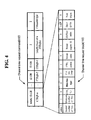
- MLME of the DEV1 receives the MLME-CREATE-STREAM.request, it sends the PNC a channel time request command 100 as shown in Figure 4.
- a bit field for defining "DirectionType" is added to the channel time request block 110 constituting the channel time request command 100.
- FIG. 5 shows the structure of a beacon frame 200, the structure of a "channel time allocation information element” field 210 of at least one "Information element' field in the beacon frame, and the structure of at least one "channel time allocation block” field 211 existing in the "channel time allocation information element” field 210.
- the "channel time allocation block" fields 211 is composed of a DestID field for indicating the ID of a receiving DEV, a SrcID field for indicating the ID of a transmitting DEV, a DirectionType field that is defined in the present invention so as to indicate whether the data transmission direction is ONE_WAY or TWO_WAY, a Stream index field for indicating the identity of a data stream to be transmitted, a CTA location field for indicating the location of CTA in the superframe, and a CTA duration field for indicating the duration of CTA.
- the beacon includes a channel time allocation block 211 in which the DEV1 that has sent the channel time request command 100 is designated by SrcID and DEV2 which is designated by DestID.
- the DEV1 designated by SrcID will first become a sender based on the beacon information.
- Figures 6 through 8 illustrate a first exemplary embodiment of the present invention
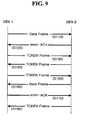
- Figures 9 through 11 illustrate a second exemplary embodiment of the present invention.
- a 'NULL' frame is transmitted when there remains no data to be transmitted by the src DEV and subsequently the dest DEV can transmit data.
- the dest DEV transmits again an Imm-ACK (Immediate ACK) to the src DEV, to thereby hand over an opportunity of transmitting the data again to the src DEV.
- the 'ACK-policy' of the NULL frame becomes 'Imm-ACK.
- the src DEV sends a 'TOKEN frame' when there remains no data to be transmitted.
- the dest DEV can transmit data.
- the dest DEV transmits again a TOKEN frame to the src DEV, to thereby hand over an opportunity of transmitting the data again to the src DEV.
- the 'ACK-policy' of the TOKEN frame becomes 'No-ACK.
- Figure 6 shows a process of exchanging data between DEV1 and DEV2 during the channel time in which DirectionType is TWO_WAY.
- DEV1 After receiving from the beacon the channel time allocation block 211 in which DEV1 that has sent the channel time request command 100 is designated by SrcID and DEV2 is designated by DestID, DEV1 first becomes a sender and transmits data to DEV2 at the designated time (S10).
- DEV2 sends an ACK frame in accordance with the ACK policy of the data frame received from DEV1.
- An Imm-ACK (Immediate ACK) policy is assumed in this example (S20). If DEV1 has no data to be sent at this time, DEV1 transmits a NULL frame to DEV2 (S30).
- the NULL frame is a frame in which only a MAC header but no frame body portion is present, the structure of which is shown in Figure 7A. If there were some frames to be sent in step S30, data frames would be sent instead of a NULL frame. If DEV2 has no data frame to be sent at the time when a NULL frame is received, an Imm-ACK is immediately transmitted (S40). After receiving the Imm-ACK in response to the previously sent NULL frame, DEV1 transmits data to DEV2 if there are any data to be sent to DEV2, or transmits a NULL frame again to DEV2 if there are no data (S50).
- DEV2 When DEV2 receives a NULL frame again and other data are then ready to be sent to DEV1, data frames, rather than an Imm-ACK are transmitted to DEV1 (S60). Since DEV1 did not receive an Imm-ACK frame but data frames in response to the previously sent NULL frame, DEV1 sends DEV2 an Imm-ACK in response to the received data frame (S70). If DEV2 that received the Imm-ACK has further data, DEV2 continuously sends data. Otherwise, DEV2 sends a NULL frame to DEV1 (S80). If DEV1 has no data frame to be sent at that time, it transmits an Imm-ACK to DEV2 (S90). The above process is repeated until the channel time allocated to the two DEVs ends.
- FIG. 7A shows a detailed structure of the "NULL frame" proposed in the present invention.
- the NULL frame corresponds to a frame having only a MAC header and no frame body and has a size of 10 octets as in a conventional MAC header.
- Each field of the NULL frame has a size of 1 octet.
- a Frame type field 710 is a field in which type values of the NULL frame are recorded.
- Figure 7B A table in which the type values of the various field frames are defined is shown in Figure 7B. These type values are recorded in b5, b4 and b3 bits of the MAC header and indicate what a relevant frame is according to the combination of the above bits.
- "000” means a beacon frame and "001" means an Imm-ACK frame.
- a new type value of NULL frame is added and specified as "101".
- type values of the ACK frame according to the ACK policy are recorded in an ACK policy field 720.
- the type values of the ACK frame are recorded in b8 and b7 bits of the MAC header, wherein "No ACK” has a value of "00", “Immediate ACK” has a value of "01” and “Delayed ACK” has a value of "10". Therefore, the ACK policy field has a value of "01" in this embodiment.
- the ID of a DEV for transmitting a relevant NULL frame is recorded in a DestID field 730, and the ID of a DEV for receiving the relevant NULL frame is recorded in a SrcID field 740.
- all field values of the MAC header become "0".
- Figure 8 is a flowchart illustrating the overall operation of the present invention.
- a first device generates a channel time request command frame, transmits the generated command frame to PNC, and receives an ACK for the transmitted command frame (S801).
- MLME-CREATE-STREAM.request is generated in DME (Device Management Entity) of the first device and then transmitted to MLME of the MAC.
- the MLME-CREATE-STREAM.request further includes a parameter of "DirectionType" in addition to the existing parameters, as defined in the above Table 1.
- the MLME generates a command frame used for requesting the channel time, i.e. a channel time request command frame, and then transmits the generated command frame to the PNC via a physical layer.
- the PNC that received the command frame determines whether there are available resources in a current channel (wireless communication medium) (S802). If it is determined that there are no resources, a reason code of a channel time response command frame is properly expressed as "priority unsupported", “channel time unavailable”, “unable to allocate as pseudo-static CTA” or the like, and the channel time response command frame is then transmitted to the first device. If it is determined that there are available resources, a command frame responding to the channel time request, i.e. the channel time response command frame with a reason code thereof expressed as "success", is transmitted to the first device and an Imm-ACK is then received from the first device (S803).
- the PNC generates a beacon frame based on information existing in the received channel time request command frame and then broadcasts the beacon frame to the DEVs that are members of the piconet (S804).
- the beacon frame includes information on channel time allocation, which in turn includes the duration of CTA, the location of CTA in a superframe, a stream index for data identification, the ID of the data transmitting device (the first device), the ID of the data receiving device (the second device), and a "DirectionType" for indicating whether the data transmission is unidirectional (ONE_WAY) or bi-directional (TWO_WAY).
- the "DirectionType" is set to bi-directional, i.e. "1".
- the first and second devices that have received the beacon frame containing the DirectionType information can know that data are exchanged between them in a bidirectional manner.
- the first device transmits a data frame to the second device and then receives an Imm-ACK frame from the second device (S806). Since the data are segmented into unit frames having a length shorter than the maximum frame length and then transmitted, the data frame transmission procedure should be preformed twice or more so as to transmit data longer than the frame unit. Further, additional frame transmission procedures should be performed in order to transfer additional data after the above data have been fully transmitted.
- the first device sends the second device a NULL frame indicating that there are no further data to be transmitted (S808).
- the second device that received the NULL frame also has no data to be transmitted (“No" in step S809)
- the second device transmits an Imm-ACK to the first device (S810) and then returns to step S807.
- the second device transmits the data frames to the first device and receives an Imm-ACK from the first device (S811).
- the data frame transmission step S811 is additionally performed.
- the second device transmits a NULL frame to the first device (S813).
- step S814 if the first device that received the NULL frame has data to be transmitted ("Yes" in step S814), the process returns to step S806. However, if there are no data, the first device transmits an Imm-ACK to the second device (S815) and the process then returns to step S812.
- Steps S806 to S815 are performed from the start time to end time of the relevant CTA. Further, if the end time of CTA arrives during any of the above steps, the process of Figure 8 is terminated.
- Figure 9 shows a process of exchanging data between DEV1 and DEV2 during the channel time in which DirectionType is TWO_WAY.
- DEV1 After receiving from the beacon the channel time allocation block 211 in which DEV1 that has sent the channel time request command 100 is designated by SrcID and DEV2 is designated by DestID, DEV1 first becomes a sender and transmits data to DEV2 at the designated time (S110).
- DEV2 sends an ACK frame in accordance with the ACK policy of the data frame received from DEV1.
- An Imm-ACK (Immediate ACK) policy is assumed in this example (S120). If DEV1 has no data to be sent at this time, DEV1 transmits a TOKEN frame to DEV2 (S130).
- the TOKEN frame is a frame in which only a MAC header but no frame body portion is present, the structure of which is shown in Figure 10a. If there were some frames to be sent in step S130, data frames would be sent instead of a TOKEN frame. If DEV2 has no data frame to be sent at the time when a TOKEN frame is received, another TOKEN frame is immediately transmitted (S140). After receiving the TOKEN frame in response to the previously sent TOKEN frame, DEV1 transmits data to DEV2 if there are any data to be sent to DEV2, or transmits a TOKEN frame again to DEV2 if there are no data (S150).
- DEV2 When DEV2 receives a TOKEN frame again and other data are then ready to be sent to DEV1, a data frame, rather than a TOKEN frame are transmitted to DEV1 (S160). Since DEV1 received a data frame in response to the previously sent TOKEN frame, DEV1 sends DEV2 an Imm-ACK in response to the received data frame (S170). If DEV2 that received the Imm-ACK has further data, DEV2 continuously sends data. Otherwise, DEV2 sends a TOKEN frame to DEV1 (S180). The above process is repeated until the channel time allocated to the two DEVs ends.
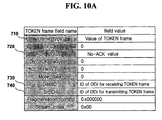
- FIG 10A shows a detailed structure of the "TOKEN frame" proposed in the present invention.
- the TOKEN frame corresponds to a frame having only a MAC header and no frame body and has a size of 10 octets as in a conventional MAC header.
- Each field of the TOKEN frame has a size of 1 octet.
- a Frame type field 710 is a field in which type values of the TOKEN frame are recorded.
- Figure 10B A table in which the type values of the various field frames are defined is shown in Figure 10B. These type values are recorded in b5, b4 and b3 bits of the MAC header and indicate what a relevant frame is according to the combination of the above bits.
- "000” means a beacon frame and "001" means an Imm-ACK frame.
- a new type value of a TOKEN frame is added and specified as "101.”
- type values of the ACK frame according to the ACK policy are recorded in an ACK policy field 720.
- the type values of the ACK frame are recorded in b8 and b7 bits of the MAC header, wherein "No ACK” has a value of "00", “Immediate ACK” has a value of "01” and “Delayed ACK” has a value of "10". Therefore, the ACK policy field has a value of "00" in this embodiment.
- the ID of a DEV for transmitting a relevant TOKEN frame is recorded in a DestID field 730, and the ID of a DEV for receiving the relevant TOKEN frame is recorded in a SrcID field 740.
- all field values of the MAC header become "0.”
- Figure 11 is a flowchart illustrating the overall operation of a second embodiment of the present invention.
- a first device generates a channel time request command frame, transmits the generated command frame to PNC, and receives an ACK for the transmitted command frame (S901).
- MLME-CREATE-STREAM.request is generated in DME of the first device and then transmitted to MLME of the MAC.
- the MLME-CREATE-STREAM.request further includes a parameter of "DirectionType" in addition to the existing parameters, as defined in the above Table 1.
- the MLME generates a command frame used for requesting the channel time, i.e. a channel time request command frame, and then transmits the generated command frame to the PNC via a physical layer.
- the PNC that received the command frame determines whether there are available resources in a current channel (wireless communication medium) (S902). If it is determined that there are no resources, a reason code of a channel time response command frame is properly expressed as "priority unsupported", “channel time unavailable”, “unable to allocate as pseudo-static CTA” or the like, and the channel time response command frame is then transmitted to the first device. If it is determined that there are available resources, a command frame responding to the channel time request, i.e. the channel time response command frame with a reason code thereof expressed as "success", is transmitted to the first device and an Imm-ACK is then received from the first device (S903).
- the PNC generates a beacon frame based on information existing in the received channel time request command frame and then broadcasts the beacon frame to the DEVs that are members of the piconet (S904).
- the beacon frame includes information on channel time allocation, which in turn includes the duration of CTA, the location of CTA in a superframe, a stream index for data identification, the ID of the data transmitting device (the first device), the ID of the data receiving device (the second device), and a "DirectionType" for indicating whether the data transmission is unidirectional (ONE_WAY) or bi-directional (TWO_WAY).
- the "DirectionType" is set to bi-directional, i.e. "1".
- the first and second devices that have received the beacon frame containing the DirectionType information can know that data are exchanged between them in a bidirectional manner.
- the first device transmits a data frame to the second device and then receives an Imm-ACK frame from the second device (S906). Since the data are segmented into unit frames having a length shorter than the maximum frame length and then transmitted, the data frame transmission procedure should be performed twice or more so as to transmit data longer than the frame unit. Further, additional frame transmission procedures should be performed in order to transfer additional data after the above data have been fully transmitted.
- the first device sends the second device a TOKEN frame indicating that there are no further data to be transmitted (S908). If the second device that received the TOKEN frame also has no data to be transmitted (“No” in step S909), the second device transmits an Imm-ACK to the first device (S910) and then returns to step S907. On the other hand, if there are any data (“Yes” in step S909), the second device transmits the data frames to the first device and receives an Imm-ACK from the first device (S911).
- step S912 if there are further data to be transmitted by the second device ("Yes" in step S912), the data frame transmission step S911 is additionally performed. However, if there are no further data to be transmitted ("No” in step S912), the second device transmits a TOKEN frame to the first device (S913). Similarly, if the first device that received the TOKEN frame has data to be transmitted ("Yes” in step S914), the process returns to step S906. However, if there are no data, the first device transmits a TOKEN frame to the second device (S915) and the process then returns to step S912.
- Steps S906 to S915 are performed from the start time to end time of the relevant CTA. Further, if the end time of the CTA arrives during any of the above steps, the process of Figure 11 is terminated.
- Figure 12 is a view showing the structure of a superframe 900 and a data transmission process when unidirectional transmission is made according to the prior art.
- a data frame is transmitted from DEV1 and DEV2 and an ACK frame for the data frame is transmitted from DEV2 to DEV1.
- an ACK policy for use in a MAC layer is an IMM-ACK policy
- the superframe duration is 10ms
- CAP is 1ms.
- the transmission rate of a MAC header is 22Mbps and the transmission rate of a frame payload is 55Mbps.
- a beacon 910 is composed of a MAC header of 10 bytes, piconet synchronization parameters of 21 bytes, a CTA IE of 16 bytes (because this example has information on two CTAs), and a BSID IE 0f 20 bytes (it is assumed that the size of BSID is 10 bytes). As a result of the calculation in the following Table 3, it takes about 0.012ms to transmit the beacon so constructed.
- the transmission durations of CTA1 930 and CTA2 940 depend on the size of the TU (time unit) and the desired number of TUs that DEV1 and DEV2 request the PNC to send, respectively.
- the TU should transmit at least one frame according to the specified ACK policy. If the remaining time except for beacon transmission time and CAP 920 is allocated to each of DEVs, CTA1 930 in which the src DEV is DEV1 and the best DEV is DEV2 and the CTA2 940 in which the src DEV is DEV2 and the dest DEV is DEV1 will be allocated as illustrated in Figure 12 because it was assumed that both DEV1 and DEV2 have requested a super-rate CTA with a rate factor of 1.
- the durations of CTA1 930 and CTA2 940 can be changed according to the channel time allocation algorithm of the PNC and the TU requested by each DEV.
- DEV1 When the start time of CTA1 930 arrives, DEV1 first transmits a first frame 950 to DEV2. At this time, a payload of the first frame 950 is a data frame of the TCP/IP. Since a maximum frame length is 2048 bytes (except for the MAC header), the transmission time of the first frame 950 is 0.3014ms as illustrated in the following Table 4 if it is assumed that a length of the first frame 950 is 2048 bytes.
- ACK1 960 is an ACK frame that is sent from DEV2 to DEV1 and transmitted according to the ACK policy of the MAC in the MAC layer. Since the ACK frame is composed of only a MAC header in IEEE 802.15.3, it will take 0.0036ms to transmit the ACK frame.
- the DEV1 can no longer transmit a new frame if it does not receive the ACK frame of a TCP/IP level from DEV2.
- DEV2 should send an ACK frame for the transmitted frame. Since this ACK frame is transmitted in the higher layer of the MAC layer separately from an ACK (for example, the Imm-ACK) that is sent in the MAC layer, it will be processed in the same way as other data frames in view of the MAC layer.
- a second frame represents an ACK frame of the TCP/IP level which DEV2 transmits to DEV1.
- ACK2 980 is an ACK frame of a MAC layer level that will be transmitted according to the ACK policy of the MAC layer.
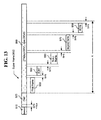
- Figure 13 is a view showing the structure of a superframe 900 and the data transmission process when bi-directional transmission is made according to the present invention.
- DEV1 requests the PNC to allocate a channel time in which DirectionType is TWO_WAY
- a relevant superframe is configured as shown in Figure 13.
- the first frame 950 is a TCP/IP data frame that will be sent from DEV1 to DEV2
- the second frame 970 is an ACK frame of a TCP/IP level that will be sent from DEV2 to DEV1.
- DEV1 can send DEV2 13 frames, each of which has a size of 2048 bytes during a unit superframe and vice versa.
- the channel time is requested to the PNC with a CTA rate factor designated as a number exceeding 1, more data than in Figure 12 can be transmitted.
- the channel time allocation can be changed according to rate factors or the channel time allocation algorithm of the PNC, and it cannot be ensured that the maximum channel time can be always available, it is more efficient to employ a channel time having a DirectionType as proposed in the present invention.
Landscapes
- Engineering & Computer Science (AREA)
- Computer Networks & Wireless Communication (AREA)
- Signal Processing (AREA)
- Mobile Radio Communication Systems (AREA)
- Small-Scale Networks (AREA)
Applications Claiming Priority (4)
| Application Number | Priority Date | Filing Date | Title |
|---|---|---|---|
| KR2003076034 | 2003-10-29 | ||
| KR20030076034 | 2003-10-29 | ||
| KR1020040049655A KR100772855B1 (ko) | 2003-10-29 | 2004-06-29 | 무선 pan상에서 디바이스 간에 효율적으로 데이터를송수신하는 방법 |
| KR2004049655 | 2004-06-29 |
Publications (2)
| Publication Number | Publication Date |
|---|---|
| EP1528733A2 true EP1528733A2 (de) | 2005-05-04 |
| EP1528733A3 EP1528733A3 (de) | 2006-06-21 |
Family
ID=34425461
Family Applications (1)
| Application Number | Title | Priority Date | Filing Date |
|---|---|---|---|
| EP04256557A Withdrawn EP1528733A3 (de) | 2003-10-29 | 2004-10-23 | Verfahren zum Austausch von Daten zwischen Geräten in einem drathlosen persönlichen Netzwerk (WPAN) |
Country Status (4)
| Country | Link |
|---|---|
| US (1) | US20050094657A1 (de) |
| EP (1) | EP1528733A3 (de) |
| JP (1) | JP2007510350A (de) |
| WO (1) | WO2005041488A1 (de) |
Cited By (3)
| Publication number | Priority date | Publication date | Assignee | Title |
|---|---|---|---|---|
| WO2008095241A1 (en) * | 2007-02-07 | 2008-08-14 | The University Of Sydney | Autonomous channel allocation for wireless ad hoc network |
| EP2206357A4 (de) * | 2006-11-10 | 2011-12-21 | Powerwave Cognition Inc | Verfahren und verfahren zur verwendung ausgewählter trägerkanäle |
| EP2025075A4 (de) * | 2006-06-05 | 2013-11-06 | Samsung Electronics Co Ltd | Kanalzuweisungsverwaltungsverfahren zur übertragung unkomprimierter isochroner daten, verfahren zur übertragung unkomprimierter isochroner daten und vorrichtung dafür |
Families Citing this family (32)
| Publication number | Priority date | Publication date | Assignee | Title |
|---|---|---|---|---|
| JP4005974B2 (ja) | 2004-01-09 | 2007-11-14 | 株式会社東芝 | 通信装置、通信方法、および通信システム |
| WO2005086802A2 (en) | 2004-03-08 | 2005-09-22 | Proxense, Llc | Linked account system using personal digital key (pdk-las) |
| AU2005319019A1 (en) | 2004-12-20 | 2006-06-29 | Proxense, Llc | Biometric personal data key (PDK) authentication |
| US7965736B2 (en) * | 2005-08-24 | 2011-06-21 | Qualcomm Incorporated | Transmission of multiplex protocol data units in physical layer packets |
| JP4906315B2 (ja) * | 2005-10-31 | 2012-03-28 | キヤノン株式会社 | 通信制御装置、コンピュータの制御方法および制御プログラム |
| US11206664B2 (en) | 2006-01-06 | 2021-12-21 | Proxense, Llc | Wireless network synchronization of cells and client devices on a network |
| US8340672B2 (en) | 2006-01-06 | 2012-12-25 | Proxense, Llc | Wireless network synchronization of cells and client devices on a network |
| TWI429219B (zh) * | 2006-05-01 | 2014-03-01 | 皇家飛利浦電子股份有限公司 | 在分散式存取無線通信網路的多重跳躍式傳輸中以最大延遲保証保留資源的方法 |
| US8412949B2 (en) | 2006-05-05 | 2013-04-02 | Proxense, Llc | Personal digital key initialization and registration for secure transactions |
| US7925269B2 (en) * | 2006-05-18 | 2011-04-12 | Samsung Electronics Co., Ltd. | Method and system for establishing a channel for a wireless video area network |
| US9269221B2 (en) | 2006-11-13 | 2016-02-23 | John J. Gobbi | Configuration of interfaces for a location detection system and application |
| JP5095751B2 (ja) * | 2006-12-13 | 2012-12-12 | トムソン ライセンシング | Tdmamac層における適応時間割り当て |
| TW200826586A (en) * | 2006-12-13 | 2008-06-16 | Inst Information Industry | Bandwidth reservation system and method of dynamically switching channels and readable-by-computer recording medium thereof |
| KR100982892B1 (ko) | 2007-06-28 | 2010-09-16 | 주식회사 케이티 | 단거리 무선네트워크의 운용채널 선택방법과 이를 이용한코디네이터 |
| US7751426B2 (en) * | 2007-08-03 | 2010-07-06 | Staccato Communications, Inc. | Token passing data transfer mechanism for reservation based protocols |
| US8659427B2 (en) | 2007-11-09 | 2014-02-25 | Proxense, Llc | Proximity-sensor supporting multiple application services |
| US8171528B1 (en) | 2007-12-06 | 2012-05-01 | Proxense, Llc | Hybrid device having a personal digital key and receiver-decoder circuit and methods of use |
| WO2009079666A1 (en) | 2007-12-19 | 2009-06-25 | Proxense, Llc | Security system and method for controlling access to computing resources |
| US8508336B2 (en) | 2008-02-14 | 2013-08-13 | Proxense, Llc | Proximity-based healthcare management system with automatic access to private information |
| US11120449B2 (en) | 2008-04-08 | 2021-09-14 | Proxense, Llc | Automated service-based order processing |
| US20090323697A1 (en) * | 2008-06-27 | 2009-12-31 | Nokia Corporation | Data payload transmission via control plane signaling |
| US8917655B2 (en) * | 2008-07-11 | 2014-12-23 | Samsung Electronics Co., Ltd. | Method and apparatus for allowing device supporting multiple PHY communication mode to communicate with device in wireless personal area network |
| US8169940B2 (en) * | 2008-11-04 | 2012-05-01 | Intel Corporation | Techniques for device and piconet controller availability notification in wireless personal area and wireless local area networks |
| KR20100052247A (ko) * | 2008-11-10 | 2010-05-19 | 삼성전자주식회사 | 무선 네트워크에서의 데이터 전송 방법 및 장치 |
| US8780869B2 (en) * | 2009-04-15 | 2014-07-15 | Qualcomm Incorporated | Method and apparatus for efficient association procedure |
| CN101610564B (zh) * | 2009-04-29 | 2015-04-01 | 中兴通讯股份有限公司 | 一种下行控制信息的发送和检测方法 |
| US9418205B2 (en) | 2010-03-15 | 2016-08-16 | Proxense, Llc | Proximity-based system for automatic application or data access and item tracking |
| US8918854B1 (en) | 2010-07-15 | 2014-12-23 | Proxense, Llc | Proximity-based system for automatic application initialization |
| US8857716B1 (en) | 2011-02-21 | 2014-10-14 | Proxense, Llc | Implementation of a proximity-based system for object tracking and automatic application initialization |
| KR20150083108A (ko) * | 2012-11-07 | 2015-07-16 | 인터디지탈 패튼 홀딩스, 인크 | P2p 통신들을 위한 신뢰성 있는 멀티캐스트/브로드캐스트 |
| US9405898B2 (en) | 2013-05-10 | 2016-08-02 | Proxense, Llc | Secure element as a digital pocket |
| US10278054B2 (en) * | 2015-04-21 | 2019-04-30 | Electronics And Telecommunications Research Institute | Method and apparatus for communicating in wireless personal area network communication system |
Citations (1)
| Publication number | Priority date | Publication date | Assignee | Title |
|---|---|---|---|---|
| US20030152059A1 (en) | 2002-01-22 | 2003-08-14 | Odman Knut T. | System and method for handling asynchronous data in a wireless network |
Family Cites Families (9)
| Publication number | Priority date | Publication date | Assignee | Title |
|---|---|---|---|---|
| US4590468A (en) * | 1983-03-10 | 1986-05-20 | Western Digital Corporation | Token access controller protocol and architecture |
| US6088337A (en) * | 1997-10-20 | 2000-07-11 | Motorola, Inc. | Method access point device and peripheral for providing space diversity in a time division duplex wireless system |
| JPH11308253A (ja) * | 1998-04-20 | 1999-11-05 | Honda Motor Co Ltd | ネットワーク・システム |
| US7024482B2 (en) * | 2001-02-28 | 2006-04-04 | Sharp Laboratories Of America, Inc. | Pseudo-random dynamic scheduler for scheduling communication periods between electronic devices |
| AU2002362420A1 (en) * | 2001-10-03 | 2003-04-14 | Xtremespectrum, Inc. | Method of operating a media access controller |
| US7349433B2 (en) * | 2001-11-01 | 2008-03-25 | Texas Instruments Incorporated | Signaling for parameterized quality of service (QoS) support |
| US7184767B2 (en) * | 2001-11-28 | 2007-02-27 | Freescale Semiconductor, Inc. | System and method of communication between multiple point-coordinated wireless networks |
| EP1470682B1 (de) * | 2002-01-22 | 2007-05-30 | Freescale Semiconductor, Inc. | System und verfahren zur handhabung von langen asynchronen daten in einem asynchronen zeitschlitz |
| WO2004093357A1 (ja) * | 2003-04-17 | 2004-10-28 | Fujitsu Limited | 伝送ネットワークシステム |
-
2004
- 2004-10-18 WO PCT/KR2004/002663 patent/WO2005041488A1/en not_active Ceased
- 2004-10-18 JP JP2006537872A patent/JP2007510350A/ja not_active Ceased
- 2004-10-22 US US10/970,467 patent/US20050094657A1/en not_active Abandoned
- 2004-10-23 EP EP04256557A patent/EP1528733A3/de not_active Withdrawn
Patent Citations (1)
| Publication number | Priority date | Publication date | Assignee | Title |
|---|---|---|---|---|
| US20030152059A1 (en) | 2002-01-22 | 2003-08-14 | Odman Knut T. | System and method for handling asynchronous data in a wireless network |
Cited By (4)
| Publication number | Priority date | Publication date | Assignee | Title |
|---|---|---|---|---|
| EP2025075A4 (de) * | 2006-06-05 | 2013-11-06 | Samsung Electronics Co Ltd | Kanalzuweisungsverwaltungsverfahren zur übertragung unkomprimierter isochroner daten, verfahren zur übertragung unkomprimierter isochroner daten und vorrichtung dafür |
| EP2206357A4 (de) * | 2006-11-10 | 2011-12-21 | Powerwave Cognition Inc | Verfahren und verfahren zur verwendung ausgewählter trägerkanäle |
| US8718555B2 (en) | 2006-11-10 | 2014-05-06 | Powerwave Cognition, Inc. | Method and system for using selected bearer channels |
| WO2008095241A1 (en) * | 2007-02-07 | 2008-08-14 | The University Of Sydney | Autonomous channel allocation for wireless ad hoc network |
Also Published As
| Publication number | Publication date |
|---|---|
| EP1528733A3 (de) | 2006-06-21 |
| US20050094657A1 (en) | 2005-05-05 |
| JP2007510350A (ja) | 2007-04-19 |
| WO2005041488A1 (en) | 2005-05-06 |
Similar Documents
| Publication | Publication Date | Title |
|---|---|---|
| WO2005041488A1 (en) | Method for exchanging data between devices on wireless personal area network | |
| CA2556062C (en) | A system and method for an ultra wide-band medium access control distributed reservation protocol | |
| EP2232938B1 (de) | Flexible mac-überrahmenstruktur und beaconing-verfahren dafür | |
| US7489646B2 (en) | Method for transmitting and receiving data bi-directionally during allocated time and wireless device using the same | |
| US20050089000A1 (en) | Method for communicating effectively between devices on wireless personal area network | |
| EP2119052B1 (de) | Drahtloses netzwerksystem und verfahren zum senden und empfangen von daten über das drahtlose netzwerksystem | |
| US20070002809A1 (en) | Recovery techniques for wireless communications networks | |
| US20060050728A1 (en) | Method for bi-directional communication between source device and destination device during allocated channel time | |
| CN101119590A (zh) | 多信道多址接入方法 | |
| US20050089002A1 (en) | Method for wireless local area network communication in distributed coordination function mode | |
| EP1774728B1 (de) | System und verfahren zur freigabe ungenutzter zeitschlitze in einem verteiltem mac-protokoll | |
| JP4064394B2 (ja) | 周波数ホッピング方式のマルチバンド超広域通信方法 | |
| CN101176304B (zh) | 控制通信终端间干扰的方法 | |
| WO2001071981A2 (en) | Multimedia extensions for wireless local area networks | |
| CA2586171C (en) | Techniques for stream handling in wireless communications networks | |
| CN1875575B (zh) | 在无线个人域网上的装置之间交换数据的方法 | |
| CN106936557B (zh) | 一种无线信道资源分配方法 | |
| KR100666127B1 (ko) | Wpan에서 동적 응답 정책을 이용한 데이터 프레임전송방법 | |
| US20050237993A1 (en) | Method and apparatus for communicating between coordinator-based wireless networks connected through a backbone network | |
| CN102439864B (zh) | 消息传输方法、信息存储方法及消息传输设备、信息存储设备 | |
| KR20240109591A (ko) | Mlsr을 지원하는 무선랜에서 자원 사용의 방법 및 장치 | |
| EP1684474A2 (de) | Verbessertes Verfahren und Vorrichtung zur Steuerung eines geteilten Übertragungsmediums basierend auf einem TDMA/TDD Schema | |
| Kim et al. | A distributed reservation protocol for collision-free three-hop mobility support in WiMedia MAC | |
| CN101427476A (zh) | 超宽带通信的媒体接入控制 | |
| Hur et al. | A Dual Channel Allocation Scheme for WiMedia Networks |
Legal Events
| Date | Code | Title | Description |
|---|---|---|---|
| PUAI | Public reference made under article 153(3) epc to a published international application that has entered the european phase |
Free format text: ORIGINAL CODE: 0009012 |
|
| 17P | Request for examination filed |
Effective date: 20041105 |
|
| AK | Designated contracting states |
Kind code of ref document: A2 Designated state(s): AT BE BG CH CY CZ DE DK EE ES FI FR GB GR HU IE IT LI LU MC NL PL PT RO SE SI SK TR |
|
| AX | Request for extension of the european patent |
Extension state: AL HR LT LV MK |
|
| PUAL | Search report despatched |
Free format text: ORIGINAL CODE: 0009013 |
|
| AK | Designated contracting states |
Kind code of ref document: A3 Designated state(s): AT BE BG CH CY CZ DE DK EE ES FI FR GB GR HU IE IT LI LU MC NL PL PT RO SE SI SK TR |
|
| AX | Request for extension of the european patent |
Extension state: AL HR LT LV MK |
|
| AKX | Designation fees paid |
Designated state(s): NL |
|
| REG | Reference to a national code |
Ref country code: DE Ref legal event code: 8566 |
|
| 17Q | First examination report despatched |
Effective date: 20110203 |
|
| RAP1 | Party data changed (applicant data changed or rights of an application transferred) |
Owner name: SAMSUNG ELECTRONICS CO., LTD. |
|
| STAA | Information on the status of an ep patent application or granted ep patent |
Free format text: STATUS: THE APPLICATION IS DEEMED TO BE WITHDRAWN |
|
| 18D | Application deemed to be withdrawn |
Effective date: 20130326 |