EP1528740A1 - OFDM-Demodulator, integrierte Schaltung zur OFDM-Demodulation sowie OFDM-Demodulationsverfahren - Google Patents
OFDM-Demodulator, integrierte Schaltung zur OFDM-Demodulation sowie OFDM-Demodulationsverfahren Download PDFInfo
- Publication number
- EP1528740A1 EP1528740A1 EP04025588A EP04025588A EP1528740A1 EP 1528740 A1 EP1528740 A1 EP 1528740A1 EP 04025588 A EP04025588 A EP 04025588A EP 04025588 A EP04025588 A EP 04025588A EP 1528740 A1 EP1528740 A1 EP 1528740A1
- Authority
- EP
- European Patent Office
- Prior art keywords
- carrier
- ofdm
- signal
- correction
- time axis
- Prior art date
- Legal status (The legal status is an assumption and is not a legal conclusion. Google has not performed a legal analysis and makes no representation as to the accuracy of the status listed.)
- Withdrawn
Links
- 238000000034 method Methods 0.000 title claims abstract description 60
- 239000002131 composite material Substances 0.000 claims description 113
- 230000005540 biological transmission Effects 0.000 claims description 48
- 238000000605 extraction Methods 0.000 claims description 46
- 238000001514 detection method Methods 0.000 claims description 42
- 238000004364 calculation method Methods 0.000 claims description 24
- 238000001914 filtration Methods 0.000 claims description 20
- 239000000969 carrier Substances 0.000 claims description 15
- 239000000284 extract Substances 0.000 claims description 4
- 230000009466 transformation Effects 0.000 claims 27
- 230000001131 transforming effect Effects 0.000 claims 9
- 230000003247 decreasing effect Effects 0.000 claims 3
- 230000000694 effects Effects 0.000 abstract description 8
- 238000005562 fading Methods 0.000 abstract description 8
- 238000010586 diagram Methods 0.000 description 27
- 230000012447 hatching Effects 0.000 description 2
- 238000000926 separation method Methods 0.000 description 2
- 230000005236 sound signal Effects 0.000 description 2
- 125000004122 cyclic group Chemical group 0.000 description 1
- 230000007423 decrease Effects 0.000 description 1
- 230000007717 exclusion Effects 0.000 description 1
- 230000010363 phase shift Effects 0.000 description 1
- 230000003595 spectral effect Effects 0.000 description 1
Images






Classifications
-
- H—ELECTRICITY
- H04—ELECTRIC COMMUNICATION TECHNIQUE
- H04L—TRANSMISSION OF DIGITAL INFORMATION, e.g. TELEGRAPHIC COMMUNICATION
- H04L25/00—Baseband systems
- H04L25/02—Details ; arrangements for supplying electrical power along data transmission lines
- H04L25/0202—Channel estimation
- H04L25/0224—Channel estimation using sounding signals
- H04L25/0228—Channel estimation using sounding signals with direct estimation from sounding signals
- H04L25/023—Channel estimation using sounding signals with direct estimation from sounding signals with extension to other symbols
- H04L25/0232—Channel estimation using sounding signals with direct estimation from sounding signals with extension to other symbols by interpolation between sounding signals
-
- H—ELECTRICITY
- H04—ELECTRIC COMMUNICATION TECHNIQUE
- H04L—TRANSMISSION OF DIGITAL INFORMATION, e.g. TELEGRAPHIC COMMUNICATION
- H04L27/00—Modulated-carrier systems
- H04L27/26—Systems using multi-frequency codes
- H04L27/2601—Multicarrier modulation systems
- H04L27/2647—Arrangements specific to the receiver only
-
- H—ELECTRICITY
- H04—ELECTRIC COMMUNICATION TECHNIQUE
- H04L—TRANSMISSION OF DIGITAL INFORMATION, e.g. TELEGRAPHIC COMMUNICATION
- H04L25/00—Baseband systems
- H04L25/02—Details ; arrangements for supplying electrical power along data transmission lines
- H04L25/0202—Channel estimation
- H04L25/022—Channel estimation of frequency response
Definitions
- the present invention relates to an Orthogonal Frequency Division Multiplexing (OFDM) demodulator, an integrated circuit for OFDM demodulation and an OFDM demodulation method used in demodulating equipment, such as terrestrial digital broadcasting.
- OFDM Orthogonal Frequency Division Multiplexing
- An OFDM system enables transmission of a large number of individual carrier waves (carriers) at a high spectral density level which are orthogonally spaced in frequency and therefore do not interfere with each other within a transmission bandwidth.
- the data streams are allocated in the amplitude and phase of each carrier.
- This transmission technique efficiently performs digital modulation which can be Phase Shift Keying (PSK), Quadrature Amplitude Modulation (QAM), etc.
- OFDM has a characteristic of being sufficiently resistant to multipath effects and fading interference (i.e., radio waves reflected bymany types of surfaces, etc.).
- ISDB-T Integrated Services Digital Broadcasting-Terrestrial developed in Japan
- DVB-T Digital Video Broadcasting-Terrestrial developed in Europe
- FIG. 12 is a line block diagram of a demodulator circuit proposed for use in a conventional terrestrial digital broadcasting receiver.
- a signal tuned in with a tuner 1 is converted into a digital signal by an Analog/Digital (A/D) converter 2
- this digital signal is then inputted into a Fast Fourier Transform (FFT) 3 to transform the signal from an OFDM symbol domain signal (time domain) to an OFDM carrier domain signal (frequency domain).
- FFT Fast Fourier Transform
- the OFDM carrier domain signal is outputted from the FFT 3 is inputted into a synchronizing signal circuit 4 and a waveform multiplication circuit 5.
- the synchronizing signal circuit 4 extracts a synchronizing signal (Scattered Pilot (SP) signal) from an OFDM carrier domain signal outputted from the FFT 3 and then outputs to a waveform multiplication circuit 5. Also, the OFDM carrier domain signal inputted into the waveform multiplication circuit 5 is outputted through a demodulator circuit 6, an error correction circuit 7, etc. after waveform equivalence processing is performed using a synchronizing signal outputted from the synchronizing signal circuit 4.
- SP System Pilot
- FIG. 13 is a drawing showing how the signal correction coefficients are derived from a constructive concept view of a received data signal in a conventional terrestrial digital broadcasting receiver.
- the horizontal direction shows the "frequency” direction which consists of different “carriers” (carrier waves).
- the vertical direction shows the "time” direction which consists of "symbols” which each define one data transmission unit.
- the "carriers” are lined up along the horizontal direction and "symbols” are lined up in the vertical direction.
- the white circles in the drawing represent a carrier for a data signal.
- the black circles represent a carrier called known power and a synchronizing signal (Scattered Pilot or SP signal) with phase information.
- the white circles with hatching are data carriers storing data, such as images and audio, with a non-inserted synchronizing signal.
- a synchronizing signal of the digital terrestrial broadcasting (ISDB-T) in Japan is inserted at intervals at the rate of one every twelve carriers in the frequency axis direction, as well as shifts and inserts in the frequency axis direction one carrier every three symbols in the time axis direction.
- the signal inserted in the transmission channels consists of segments whose parameters can be selected independently of each other.
- the ISDB-T system described above has adopted this type of Band Segmented Transmission OFDM (BST-OFDM).
- a calculation method of the "signal correction coefficients" is applied. For example, a method which derives the calculated value with a straight line filter based on a plurality of synchronizing signals within the same symbol. Specifically, the method of predicting these coefficients uses a plurality of synchronizing signals S (n, m+2) and S (n+12, m+2) within the same symbol of the carrier signal segment obj ect for correction S (n+6,m+2). Anothermethod of predicting is based on the synchronizing signals between a plurality of symbols. Specifically, the predictionmethod using the synchronizing signals S (n+6, m) and S (n+6, m+4) over a plurality of symbols.
- the prediction method based on a plurality of synchronizing signals within the same symbol is difficult to accomplish. Particularly, when a carrier signal segment object for correction is positioned close to the synchronizing signals, the proper adjustment can be performed. However, when a carrier signal segment object for correction is not positioned near the synchronizing signals, the proper adjustment is not easily established as there is a drawback of generating phasing errors.
- the prediction method based on synchronizing signals between a plurality of symbols is an effective method only when there are no timing changes. When there are timing changes, proper adjustment is problematic and contains the same fault of being susceptible to generating an unacceptable error rate.
- the overall performance of demodulating equipment deteriorates substantially under a multipath environment which is a composite waveform of two or more waves. Furthermore, as a level of Doppler phenomenon is created when a receiver shifts, the Carrier to Noise (C/N) ratio becomes higher and when significant becomes impossible to receive a signal below its C/N value.
- C/N Carrier to Noise
- the present invention features an Orthogonal Frequency DivisionMultiplexing (OFDM) demodulator, an integrated circuit for OFDM demodulation and an OFDM demodulation method.
- OFDM Orthogonal Frequency DivisionMultiplexing
- the present invention has been made in view of the conventional drawbacks mentioned above to markedly elevate reception capability in a manner executed by suitably selecting or combining the interpolation direction relative to an OFDM symbol.
- FIG. 1 is a conceptual line block diagram of a terrestrial digital broadcasting television reception apparatus.
- a television reception apparatus 10 (OFDM demodulator) comprises an integrated circuit for use in demodulation and circuits such as an antenna 11, a tuner 12, an Analog/Digital (A/D) converter 13, an orthogonal demodulation section 14, a Fast Fourier Transform (FFT) section 15, a waveform equivalence section 16, a demapping section 17, an error correction section 18, a Moving Picture Experts Group (MPEG) decoding section 19, an image andaudio separation section 20, an image decoding section 21 and an audio decoding section 22.
- FFT Fast Fourier Transform
- a terrestrial digital broadcasting signal delivered from a broadcasting station is supplied to the tuner 12 as a Radio Frequency (RF) (High Frequency (HF)) signal. Afterwards the RF signal is converted into a predetermined Intermediate Frequency (IF) (Medium Frequency (MF)) with the tuner 12 and then processed into a digital signal by the A/D converter 13. This digital signal is sent to the orthogonal demodulation section 14. Orthogonal demodulation is then implemented using a carrier signal of predetermined frequency by the orthogonal demodulation section 14 and regenerated as an OFDM baseband signal.
- the signal following orthogonal demodulation is an OFDM symbol domain signal (time domain) prior to a FFT operation.
- the OFDM symbol domain signal is a complex signal containing a real axis component (I channel signal) and an imaginary axis component (Q channel signal) by undergoing orthogonal demodulation.
- An OFDM symbol domain signal is forwarded to the FFT section 15 and transformed into an OFDM carrier domain signal (frequency domain) by the FFT section 15.
- the FFT section 15 extracts and outputs the data following orthogonal modulation of each carrier (carrier wave). Specifically, the FFT section 15 extracts the range of effective symbol length, namely, the length (for example, 2048 samples of carrier data) indicating the number of useful samples from one OFDM symbol, without the cyclic preamble or the guard interval period on the initial part of the symbol. An FFT operation is then generated relative to the OFDM symbol domain signal relative to this range.
- an OFDM carrier domain signal outputted from the FFT section 15 is also a complex signal including a real axis component (I channel signal) and an imaginary axis component (Q channel signal) as well as the above-mentioned OFDM symbol domain signal.
- the error correction section 18 performs error correction using Viterbi decoding, Reed-Solomon (RS) code, etc.
- the Moving Picture Experts Group (MPEG) decoding section 19 accomplishes MPEG expansion of the signal after error correction.
- the image and audio separation section 20 separates the image signal and audio signal from a signal after MPEG expansion.
- the image decoding section 21 performs decode processing of the image signal and the audio decoding section 22 performs decode processing of the audio signal.
- the signal is outputted to an image and audio reproduction section (or image and audio recording section) (not shown).
- FIG. 2A is a block diagram of a waveform equivalence section 16.
- the waveform equivalence section 16 includes a synchronizing signal extraction section 23, a previous symbol composite circuit section 24, a subsequent symbol composite circuit section 25, a difference calculation circuit section 26, a judgment circuit section 27, a carrier filter 28, a carrier symbol filter 29, a weighting circuit section 30, a selection circuit section 31, an equivalence circuit section.
- the weighting circuit section 30 further has two weight value generation circuits 30a, 30b, a multiplication circuit section 30c, a multiplication circuit section 30d and an addition circuit section 30e.
- the two weight value generation circuits 30a, 30b generate two weight values (Wa, Wb) as the characteristics and amount differs with regard to the output (C) of the difference calculation circuit section 26.
- the multiplication circuit section 30c performs multiplication of a first weight value Wa and the output of the carrier filter 28.
- the multiplication circuit section 30d performs multiplication of a second weight value Wb and the output of the carrier symbol filter 29.
- the addition circuit section 30e adds the multiplication result of the two multiplication circuit sections 30c, 30d.
- FIG. 2B is a characteristic diagram of two weight values (Wa, Wb).
- the vertical direction indicates weight ratio (%) and the horizontal direction indicates the amount of output (C) of the difference calculation circuit section 26.
- the first weight value Wa and the second weight value Wb represent the characteristics which intersect at about 50% within the range of a predetermined threshold value ( ⁇ , ⁇ ). Accordingly, the first weight value Wa of the difference calculation circuit section 26 output (C) increases from 0% to 100% in a range which increases from ⁇ to ⁇ . Meanwhile, the second weight value Wb has a characteristic which decreases conversely from 100% to 0% in the same range.
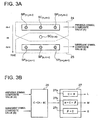
- FIG. 3A and 3B are conceptual diagrams of the previous symbol composite circuit section 24, the subsequent symbol composite circuit section 25, the difference calculation circuit section 26 and the judgment circuit section 27.
- SC (n, m) is an observation carrierwithanon-insertedsynchronizingsignal (ScatteredPilot or SP signal) distinguished as a carrier signal segment object for correction.
- the previous symbol composite circuit section 24 and the subsequent symbol composite circuit section 25 individually generate output of the two values in relation to SC (n, m).
- the two values serve as a previous symbol composite value (A) and a subsequent symbol composite value (B).
- SP (n - j, m - i) , SP (n, m - i) and SP (n + j, m - i) are synchronizing symbols inputted into the previous symbol composite circuit section 24. Also, SP (n - j, m + i), SP (n, m + i) and SP (n + j, m + i) are synchronizing signals inputted into the subsequent symbol composite circuit section 25.
- m is the symbol number of the symbol direction (time axis direction); m - i is the symbol number to which only i is situated in the previous position (past position or direction to send in terms of time) in the time axis direction from the observation carrier m; and m + 1 is the symbol number to which only i is situated in the subsequent position (future position or progress direction) from the observation carrier m.
- the previous symbol composite circuit section 24 calculates and outputs the three inputted synchronizing signals, namely, the previous symbol composite value (A) of SP (n - j, m - i), SP (n, m - i) and SP (n + j, m - i).
- the subsequent symbol composite circuit section 25 calculates and outputs the three inputted synchronizing signals, namely, the subsequent symbol composite value (B) of SP (n - j, m + i) , SP (n, m + i) and SP (n + j, m + i).
- the present invention is not limited to this quantity.
- the required number is in the range from three to six synchronizing signals.
- previous symbol composite value (A) and the subsequent symbol composite value (B) were calculated in reference to symbols in positions separated at the same interval of only i in the previous and subsequent time axis direction from a carrier signal segment obj ect for correction (observation carrier SC example above), a previous and subsequent symbol at a different interval in the time axis direction from a carrier signal segment object for correction can be utilized. For instance, a previous symbol separated at an interval of only i aheadof the time axis direction and a subsequent symbol separated at an interval of only k behind the time axis direction from a carrier signal segment object for correction may be used to calculate a composite value in each symbol.
- a judgment circuit section 27 comprises three comparison circuits 27a ⁇ 27c which compare the output (absolute value difference (C)) of the difference calculation circuit section 26 with the threshold values ⁇ , ⁇ of two amounts and outputs the comparison results (L, M, S).
- any of three cases can result: case (L) whereby the absolute value difference (C) of the previous symbol composite value (A) and the subsequent symbol composite value (B) exceeds ⁇ , case (M) is less than ⁇ and exceeds ⁇ , or case (S) is less than ⁇ .
- Signal L is outputted on occasions when a difference of a previous symbol composite value (A) and a subsequent symbol composite value (B) is extreme (i.e., when an amplitude variation and/or phase fluctuation in the time axis accompanying multipath effects and fading interference become significant).
- Signal M is outputted on occasions when a difference of a previous symbol composite value (A) and a subsequent symbol composite value (B) is not so severe (i.e., when minimal fading and multipath effects are occurring moderately).
- Signal S is outputted on occasions when a difference of a previous symbol composite value (A) and a subsequent symbol composite value (B) has not occurred in the case of zero or a level which can be disregarded (i.e., fading or multipath effects).
- FIG. 4 is a conceptual diagram of the carrier filter 28.
- the carrier filter 28 is about the observation carrier SC (n, m) of a carrier signal segment object for correction within a same symbol number m, for example, in each of the previous and subsequent three segments for a total of six synchronizing signals.
- SP (n - 3, m), SP (n - 2, m), SP (n - 1, m), SP (n + 1, m) , SP (n + 2, m) and SP (n + 3, m) are input signals and linear interpolation is performed.
- the transmission characteristic of an observation carrier SC (n, m) is predicted and output as a signal correction coefficient.
- H1 is the value of SP (n - 3, m)
- H2 is the value of SP (n - 2, m)
- H3 is the value of SP (n - 1, m)
- H4 is the value of SP (n + 1, m)
- H5 is the value of SP (n + 2, m)
- H6 is the value of SP (n + 3, m).
- a predictive value H7 of the transmission characteristic for a carrier signal segment object for correction SC (n, m) is acquired from the point above the straight line 332 which connects the values H1 ⁇ H6.
- this carrier SC (n, m) can be changed into one of the above-mentioned six synchronizing signals. Namely, SP (n - 3, m), SP (n - 2, m), SP (n - 1, m), SP (n + 1, m), SP (n + 2, m) and SP (n + 3, m) , and a predictive value of other carriers can be acquired.
- the predictive value H7 of the transmission characteristic for an observation carrier SC (n, m) can be calculated correctly, without receiving any variation effects of a carrier direction, by exclusion and performing linear interpolation on such a s igni f icantly dif ferent value H55.
- each of the previous and subsequent three segments for a total of six synchronizing signals within the same symbol number m are constituted as input signals.
- linear interpolation of these is performed and the transmission characteristic of an observation carrier SC (n, m) is predicted, the number of synchronizing signal is not limited to only six.
- FIG. 5 is a conceptual diagram of the carrier symbol filter 29.
- SC (n, m) is an observation carrier of a carrier signal segment object for correction.
- the carrier symbol filter 29 as illustrated shows each of three synchronizing signals apiece, for example, in positions separated to i symbol in the previous and subsequent time axis direction from a symbol number SC (n, m). Namely, a linear interpolation of SP (n - j, m - i) , SP (n, m - i), SP (n + j, m - i) and linear interpolation of SP (n - j, m + i), SP (n, m + i) and SP (n + j, m + i) is effected.
- a predictive value H10 of the transmission characteristic for the observation carrier SC (n, m) designated as a carrier signal segment object for correction is acquired from the point above the straight line 33 which connects the results (a first predictive value H8, a second predictive value H9) of these two linear interpolations.
- the i symbol is separated in the previous and subsequent time axis direction from the symbol number m of SC (n, m) and becomes a synchronizing signal arranged in the same position to the frequency axis direction.
- Apredictedvalue is outputted from the carrier symbol filter 29 as a signal correction coefficient.
- the first predictive value H8 is an interpolation result of three synchronizing signals in m - i symbols.
- the second predictive value H9 is an interpolation result of three synchronizing signals in m + i symbols. Therefore, the first predictive value H8 and the second predictive value H9 are both interpolation results of each frequency axis direction of all m - i symbols and m + i symbols.
- the predictive value H10 executes based on the first predictive value H8 and the second predictive value H9 which is acquired as an interpolation result between different symbols (m - i symbols and m + i symbols), that is, an interpolation result in a time axis direction).
- the carrier symbol filter 29 will execute not only in a frequency axis direction (carrier direction) , but interpolation in a time axis direction (symbol direction) as well.
- the synchronizing signals of i symbol separate SP (n, m - i) and SP (n, m + i) in the previous and subsequent time axis direction from symbol number m of a carrier SC (n, m) designated as a carrier signal segment object for correctionandpositions theminthe samepositionto the frequency axis direction.
- the number of synchronizing signals is not limited to only three.
- a previous symbol and subsequent symbol at a different interval in the time axis direction from a carrier designated as a carrier signal segment object for correction can be employed. Namely, a previous symbol separated at an interval of only i ahead of the time axis direction and a subsequent symbol separated at an interval of only k behind the time axis direction from a carrier signal segment object for correction may be used.
- the selection circuit section 31 selects at least one side of the predictive value H7 of the carrier filter 28 and the predictive value of the carrier symbol filter 29 and then outputs this selection result to the equivalence circuit section 32 as signal correction coefficients.
- the composite value (H7 x Wa + H10 x Wb) with the predetermined weight values (Wa, Wb) applied is generated in the weighting circuit section 30 and the selection result is outputted to the equivalence circuit section 32 as signal correction coefficients.
- This selection operation is executed corresponding to three determination results (L, M, S) outputted from the judgment circuit section 27. Namely, when a determination result is L, the operation presumes that the time variation of a data signal is high and the predictive value H7 of the carrier filter 28 is selected; when a determination result is S, the operation presumes that the time variation of a data signal is low and the predictive value H10 of the carrier symbol filter 29 is selected; or when a determination result is M, the composite value (H7 x Wa + H10 x Wb) with the predetermined weight values (Wa, Wb) applied to the predictive value of both filters (the carrier filter 28 and the carrier symbol filter 29) is selected.
- the equivalence circuit section 32 implements division of the carrier domain signal outputted from the FFT section 15 using these signal correction coefficients and rectifies the amplitude and phase of a carrier signal segment object for correction according to a predicted transmission characteristic, in short, amplitude equivalence and phase equivalence, of a data carrier (carrier signal segment object for correction) with a non-inserted synchronizing signal.
- the next operation is acquired in the waveform equivalence section 16 which contains the distinctive particulars of the embodiment. Specifically, when a synchronizing signal is extracted by the synchronizing signal extraction section 23 is each other inputted into the previous symbol composite circuit section 24, the subsequent symbol composite circuit section 25, the carrier filter 28 and the carrier symbol filter 29, the amount of variation in the symbol direction (time axis direction) is judged by the previous symbol composite circuit section 24, the subsequent symbol composite circuit section 25, the difference calculation circuit section 26 and the judgment circuit section 27 in three steps (L, M, S).
- At least one side of the predictive value H7 of the carrier filter 28 or the predictive value H10 of the carrier symbol filter and either of the weight composite values (H7 x Wa + H10 x Wb) in the predictive values H7 and H10 is selected in the selection circuit section 31.
- This selection result is then supplied to the equivalence circuit section 32 toperformanadjustment inthe frequency axis direction in the carrier filter 28 and to accomplish amplitude equivalence and phase equivalence of an observation carrier.
- the predictive value H7 of the carrier filter 28 is selected and supplied to the equivalence circuit section 32.
- the predictive value H7 is a predicted value based on six synchronizing signals in the same symbol number m as an observation carrier SC (n, m) ⁇ SP (n - 3, m), SP (n - 2, m), SP (n -1, m), SP (n + 1, m), SP (n + 2, m) and SP (n +3, m)J and an interpolation result in the time axis direction is not included.
- a predictive value H10 of the carrier symbol filter 29 is selected and supplied to the equivalence circuit section 32.
- the predictive value H10 interpolates two frequency interpolation results in the time direction. Accordingly, as shown in FIG.
- the first predictive value H8 which interpolated three synchronizing signals ⁇ SP (n - j, m - i), SP (n, m - i), SP (n + j, m - i) ⁇ of the previous i symbol of an observation carrier ⁇ SC (n, m) ⁇ in the carrier direction (frequency axis direction); and the second predictive value H9 which interpolated three synchronizing signals ⁇ SP (n - j, m + i), SP (n, m + i), SP (n + j, m + i) ⁇ of the subsequent i symbol of an observation carrier ⁇ SC (n, m) ⁇ in the carrier direction is interpolated in the symbol direction. Therefore, when variation in the symbol direction is low (determination result S of the judgment circuit section 27), since both interpolation results in the carrier direction and the symbol direction are included the equivalence accuracy can be improved.
- the composite value (H7 x Wa + H10 x Wb) with the predetermined weight values applied to the predictive value H7 of the carrier filter 28 and the predictive value H10 of the carrier symbol filter 29 is selected and supplied to the equivalence circuit section 32.
- equivalence accuracy similarly can be improved by adjusting the weight values (Wa, Wb).
- the first prediction means executes interpolation exclusively of the frequency axis direction.
- the second prediction means executes interpolation of the frequency axis direction of the synchronizing signal in a plurality of different symbols and interpolation of the time axis direction using those interpolation results.
- an OFDM demodulator can be provided which is not easily influenced by amplitude variations on the time axis caused by multipath interference, fading or phase fluctuations.
- the above-stated selection means selects a prediction result of the above-mentioned first prediction means when a variation of the correction value of a carrier is high in the time axis direction detected by the above-mentioned detection means or when a variation of the correction value of a carrier in the time axis direction detected with the above-described detection means is low, a prediction result of the above-mentioned second prediction means is selected. Otherwise, when a variation of the correction value of a carrier in the time axis direction detected with the above-described detection means is a moderate range, the composite value with each of the weight values applied to the prediction result of the above-mentioned first prediction means and the prediction result of the above-mentioned second prediction means is selected. In this manner, the present invention makes it feasible to select a waveform equivalence means suitable for the amount of variation of the correction value of a carrier in the time axis direction and waveform equivalence accuracy can be markedly elevated.
- FIG. 6 is a block diagram showing a modified example 1 of the waveform equivalence section 16 in FIG. 2A.
- the specific differences from FIG. 2A are that the carrier filter 28 is moved from the arrangement position in FIG. 2A and relocated to perform direct input of the output of the synchronizing signal extraction section 23 via the weighting circuit section 30, transposed the carrier symbol filter 29 to a symbol filter 100, and inserted the carrier filter 28 between the selection circuit section 31 and the equivalence circuit section 32.
- the same nomenclature and element numbers are appended as in the original embodiment.
- FIG. 7 is a conceptual diagram of a symbol filter 100.
- SC (n, m) is designated as an observation carrier of a carrier signal segment object for correction.
- a symbol filter 100 acquires a transmission characteristic H108 of the synchronizing signal SP (n, m - 1) and a transmission characteristic H109 of the synchronizing signal (SP (n, m +1) positioned separately in the previous and subsequent i symbols of the time axis direction from a symbol number m of SC (n, m), as well as a predictive value H110 of the transmission characteristic of an observation carrier SC (n, m) designatedas a carrier signal segment object for correction from a point on the straight line 133 and outputs the signal correction coefficients.
- the transmission characteristic is calculated using linear interpolation relative to a symbol positioned separating only i at the same interval in the previous and subsequent time axis direction
- a previous symbol and subsequent symbol at a different interval in the time axis direction from a carrier designated as a carrier signal segment object for correction can be employed. Namely, a previous symbol separated at an interval of only i ahead of the time axis direction and a subsequent symbol separated at an interval of only k behind the time axis direction from a carrier signal segment object for correction may be used.
- the carrier SC (n, m) when the predictive value of the transmission characteristic of a carrier SC (n, m) designated as a carrier signal segment object or correction is calculated, the carrier SC (n, m) can be changed into the above-described synchronizing signal SP (n, m - i) or the synchronizing signal SP (n, m + i) and the predictive value of the transmission characteristic of a carrier of another designated carrier signal segment object for correction can be acquired.
- the selection circuit section 31 selects a synchronizing signal outputted from the synchronizing signal extraction section 23 and at least one side of the predictive value H110 of the symbol filter 100 and then outputs upon forming the selection result into signal correction coefficients to the carrier filter 28. Otherwise, a composite value (synchronizing signal x Wa + H110 x Wb) by each of a synchronizing signal outputted from the synchronizing signal extraction section 23 and the predictive value H110 of the symbol filter 100 with application of the predetermined weight values (Wa, Wb) generated by the weighting circuit section 30 is selected and then outputted upon forming the selection result into signal correction coefficients to the carrier filter 28.
- the above-stated selection operation is performed corresponding to three determination results (L, M, S) outputted from the judgment circuit section 27.
- a determination result is L, which is deemed as high in time variation of a data signal and outputted from the synchronizing signal extraction section 23, the synchronizing signal is selected.
- a determination result is S, which is deemed as low in time variation of a data signal, the predictive value H110 of the symbol filter 100 is selected.
- a determination result is a moderate range
- a composite value (synchronizing signal x Wa + H110 x Wb) of a synchronizing signal outputted from the synchronizing signal extraction section 23 and the predictive value H110 of the symbol filter 100 with application of the weight values (Wa, Wb) is selected.
- the carrier filter 28 corrects the frequency axis direction relative to the signal coefficients outputted from the selection circuit section 31 and outputs to the equivalent circuit section 32.
- the equivalence circuit section 32 implements division of the carrier domain signal outputted from the FFT section 15 using these signal correction coefficients and rectifies the amplitude and phase of a carrier segment object for correction according to a predicted transmission characteristic, that is, amplitude equivalence and phase equivalence, of a data carrier (carrier signal segment object for correction) with a non-inserted synchronizing signal.
- FIG. 8 is a characteristic diagram showing relationship between a Doppler frequency fd and C/N assuming a case where an OFDM demodulator received shifting.
- gf1 is a Carrier to Noise (C/N) ratio characteristic in the above-mentioned modified example 1 and gf2 is the C/N characteristic in a conventional terrestrial digital broadcasting demodulator circuit.
- the C/N ratio improves improved by 14 dB as compared with a conventional terrestrial digital broadcasting demodulator circuit.
- the next operation is acquired in the waveform equivalence section 16 which has a particular characteristic. Specifically, when a synchronizing signal extracted by the synchronizing signal extraction section 23 is each other inputted into the previous symbol composite circuit section 24, the subsequent symbol composite circuit section 25 and the symbol filter 100, the amount of variation in the symbol direction (time axis direction) is judged by the previous symbol composite circuit section 24, the subsequent symbol composite circuit section 25, the difference calculation circuit section 26 and the judgment circuit section 27 in three steps (L, M, S).
- a synchronizing signal outputted from the synchronizing signal extraction section 23 or at least one side of the predictive value H110 of the symbol filter 100 or a synchronizing signal and either of the weight composite values (synchronizing signal x Wa + H110 x Wb) of the predictive value H110 is selected by the selection circuit section 31.
- This selection result is then supplied to the equivalence circuit section 32 to perform an adjustment in the frequency axis direction in the carrier filter 28 and to accomplish amplitude equivalence and phase equivalence of an observation carrier.
- a composite value (synchronizing signal x Wa + H110 x Wb) of a synchronizing signal extracted by the synchronizing signal extraction section 23 and the predictive value H110 of the symbol filter 100 with application of the predetermined weight value is selected and supplied to the carrier filter 28.
- equivalence accuracy can be similarly improved by adjusting the weight values (Wa, Wb).
- modified example 1 is based on the amount of variation of the correction value of a carrier in the time axis direction of at least among a correction value predicted by a synchronizing signal extracted by an extraction means and a time axis prediction means, as well as either of the weight composite values is selected. In this manner, waveform equivalence of a data signal comprised from a carrier of a symbol unit outputted from a transform means using a corrected result in the frequency axis direction of this selection result is achieved.
- an OFDM demodulator can be provided which is not easily influenced by amplitude variations on the time axis caused by multipath interference, fading or phase fluctuations.
- the above-mentioned selection means selects a synchronizing signal by the above-mentioned extraction means when a variation of the correction value of a carrier in the time axis direction is detected as high by the above-stated detection means; or selects the correction value predicted by the above-mentioned time axis prediction means when a variation of the correction value of a carrier in the time axis means is detected as low by the above-stated detection means; or selects a composite value of a synchronizing signal extracted by the above-mentioned extraction means and the above-mentioned time axis prediction means when a variation of the correction value of a carrier in the time axis direction is detected as moderate by the above-stated detection means.
- the present invention makes it feasible to select a waveform equivalence means suitable for the amount of variation of the correction value of a carrier in the time axis direction and waveform equivalence accuracy can be markedly elevated.
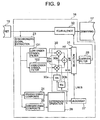
- FIG. 9 is a block diagram showing the waveform equivalence section 16 in FIG. 2A of the modified example 2.
- the specific differences from FIG. 2A are that the carrier filter 28 is displaced from the arrangement position in FIG. 2A and replaced with a low order symbol filter 101, the carrier symbol filter 29 is replaced with a high order symbol filter 102 and the carrier filter 28 is now inserted between the selection circuit section 31 and the equivalence circuit section 32.
- the same nomenclature and element numbers are appended as in the original embodiment.
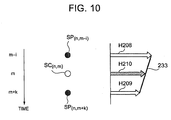
- FIG. 10 is a conceptual diagram of the low order symbol filter 101.
- SC (n, m) is designatedas an observation carrier of a carrier signal segment object for correction.
- a low order symbol filter 101 acquires a transmission characteristic H208 of the synchronizing signal SP (n, m - i) positioned separating the subsequent i symbol in the time axis direction and a transmission characteristic H209 of the synchronizing signal SP (n, m + k) positioned separating the previous k symbol in the time axis direction from a symbol m of SC (n, m).
- the transmission characteristic of the predictive value H210 of the observation carrier SC (n, m) designated as a carrier signal segment object for correction is acquired from a point on the straight line 233 and outputs the signal correction efficients.
- the low order symbol filter 101 predicts the transmission characteristic of a carrier signal segment object for correction using two synchronizing signals separated in the time axis direction to the carrier SC (n, m) of a carrier signal segment object for correction, the low order symbol filter 101 serves as a secondary symbol filter.
- the low order symbol filter 101 predicts the transmission characteristic of a correction carrier from two synchronizing signals
- the synchronizing signals are not limited only to a quantity of two, for example, instead consisting of zero, four, six, ⁇ synchronizing signals.
- a synchronizing signal which is separated in the time axis direction relative to the carrier SC (n, m) of a carrier signal segment for correction does not exist and prediction of the transmission characteristic of the carrier designated a carrier signal segment for correction is not performed.
- FIG. 6 it is supposed that a 0 th order symbol filter exists between the synchronizing signal extraction section 23 and the weighting circuit section 30.
- Calculation is also effective in a transmission characteristic using linear interpolation with respect to a symbol in positions separated at the same interval of only i in the previous and subsequent time axis direction from the carrier SC (n, m) for a carrier signal segment object for correction.
- the carrier SC (n, m) When a predictive value of the transmission characteristic of the carrier SC (n, m) is designated a carrier signal segment object for correction is calculated, the carrier SC (n, m) can be changed into the above-mentioned synchronizing signal SP (n, m - i) or the synchronization signal SP (n, m + k). Thus, a predictive value of the transmission characteristic of a carrier for another designated carrier signal segment object for correction can be acquired.
- FIG. 11 is a conceptual diagram of the high order symbol filter 102.
- SC (n, m) is designated as an observation carrier of a carrier signal segment object for correction.
- a high order symbol filter 102 acquires a transmission characteristic H308 of the synchronizing signal SP (n, m - i) positioned separating the subsequent i symbol in the time axis direction; a transmission characteristic H306 of the synchronizing signal SP (n, m - p) positioned separating the previous p symbol in the time axis direction; a transmission characteristic H309 of the synchronizing signal SP (n, m + k) positioned separating the subsequent k symbol in the time axis direction and a transmission characteristic H307 of the synchronizing signal SP (n, m + p) positioned separating the subsequent p symbol in the time axis direction from the symbol m of SC (n, m).
- the transmission characteristic of the predictive value H310 of the observation carrier SC (n, m) is designated as an
- the high order symbol filter 102 predicts the transmission characteristic of a carrier designated as a carrier signal segment object for correction using four synchronizing signals separated in the time axis direction from carrier SC (n, m) of a carrier signal segment object for correction, the high order symbol filter 102 serves as a 4 th (fourth) symbol filter.
- the high order symbol filter 101 predicts the transmission characteristic of a correction carrier based on linear interpolation in four synchronizing signals
- the synchronizing signals are not limited only to a quantity of four, for example, instead consisting of six, eight, ⁇ synchronizing signals and may be another higher order interpolation in which the order is higher than the order of the low order symbol filter 101.
- the carrier SC (n, m) When a predictive value of the transmission characteristic of the carrier SC (n, m) is designated a carrier signal segment object for correction is calculated, the carrier SC (n, m) can be changed into the above-mentioned signals SP (n, m - i), SP (n, m + k) , SP (n, m - p) or SP (n, m + p) and a predictive value of the transmission characteristic for another designated carrier signal segment object for correction can be acquired.
- the selection circuit section 31 selects at least one side of the predictive value H210 of the low order symbol filter 101 and the predictive value H310 of the high order symbol filter 102 and then outputs the selection result as signal correction coefficients to the carrier filter 28. Or else a composite value (H210 x Wa + H310 x Wb) to each of the predictive value H210 outputted from the low order symbol filter 101 and the predictive value H310 outputted from the high order filter 102 with the application of the predetermined weight values (Wa, Wb) generated in the weighting circuit section 30 is selected and then outputs the selection result as signal correction coefficients to the carrier filter 28.
- the carrier filter 28 corrects the frequency axis direction relative to the signal coefficients outputted from the selection circuit section 31 and outputs to the equivalent circuit section 32.
- the equivalence circuit section 32 implements division of the carrier domain signal outputted from the FFT section 15 using these signal correction coefficients and rectifies the amplitude and phase of a carrier segment object for correction according to a predicted transmission characteristic, that is, amplitude equivalence and phase equivalence, of a data carrier (carrier signal segment object for correction) with a non-inserted synchronizing signal.
- the next operation is acquired in the waveform equivalence section 16 which has a particular characteristic. Specifically, when a synchronizing signal extracted by the synchronizing signal extraction section 23 is each other inputted into the previous symbol composite circuit section 24, the subsequent symbol composite circuit section 25, the low order symbol filter 101 and the high order symbol filter 102, the amount of variation in the symbol direction (time axis direction) is judged by the previous symbol composite circuit section 24, the subsequent symbol composite circuit section 25, the difference calculation circuit section 26 and the judgment circuit section 27 in three steps (L, M, S).
- This selection result is then supplied to the equivalence circuit section 32 to perform an adjustment in the frequency axis direction in the carrier filter 28 and to accomplish amplitude equivalence and phase equivalence of an observation carrier.
- the low order symbol filter 101 is selected in the selection circuit section 31 and frequency axis correction is executed by the carrier filter 28 with regard to this selected predictive value H210. Therefore, when a variation in the symbol direction is high, the effects of variation in the low order symbol filter 101 can be excluded and equivalence accuracy can be improved.
- modified example 2 is based on the amount of variation of the correction value of a carrier in the time axis direction of at least one time axis filtration means among a plurality of time axis filtration means and either of the weight composite values relative to a correction value of a carrier predicted by a plurality of time axis filter means is selected. In this manner, waveform equivalence of a data signal transformed by a transform means using a correction result in the frequency axis direction of this selection result is achieved.
- an OFDM demodulator While being able to select a waveform equivalence means suitable for the amount of time variation of the correction value of a carrier in the time axis direction and being able to improve waveform equivalence accuracy, an OFDM demodulator can be provided which is not easily influenced by amplitude variations on the time axis caused by multipath interference, fading or phase fluctuations.
- this invention is not restricted by this.
- the weighting circuit section 30 is unnecessary and the selection circuit section 31 needs only to suitably select an output of the carrier filter 28 and the output of the carrier symbol filter 29 according to the situation; or suitably select output of the synchronizing signal extraction section 23 and the output of the symbol filter 100 according to the situation; or suitably select the output of the low order symbol filter 101 and the output of the low order symbol filter 102 according to the situation.
- the difference of the output of the previous symbol composite circuit section 24 and the output of the subsequent symbol composite circuit section 25 is calculated in the difference calculation circuit section 26.
- the judgment circuit section 27 "a case where the variation of a symbol direction is high” or "a case where the variation of a symbol direction is low” and the like are judged as compared with the difference and predetermined threshold values ( ⁇ , ⁇ ) and suitably selects the output of the carrier filter 28 and the output of the carrier symbol filter 29 according to those determination results; or else suitably selects the output of a synchronizing signal extraction section 23 and the output of the symbol filter 100 or the output of the low order symbol filter 101 and the output of the high order symbol filter 102, but the present invention is not limited to these embodiments.
- judging whether or not a previous or subsequent symbol in the symbol direction fluctuating in terms of time is observed by selecting the output of the carrier symbol filter 29 when not fluctuating in terms of time and selecting the output of the carrier filter 28 when fluctuating in terms of time; or selecting the output of the symbol filter 100 when not fluctuating in terms of time and selecting the output of the synchronizing signal extraction section 23; or selecting the output of the high or symbol filter 102 when not fluctuating in terms of time and selecting the output of the low order symbol filter 101.
- the operation could judge whether or not two values fluctuate in terms of time when the medium (that is, a quantity which fluctuates in terms of time at a moderate level) is also be judged and the medium determination result is obtained, along with the same weighting as the above-described embodiment and designed to select the weighting composite values.
Landscapes
- Engineering & Computer Science (AREA)
- Computer Networks & Wireless Communication (AREA)
- Signal Processing (AREA)
- Power Engineering (AREA)
- Synchronisation In Digital Transmission Systems (AREA)
- Digital Transmission Methods That Use Modulated Carrier Waves (AREA)
Applications Claiming Priority (4)
| Application Number | Priority Date | Filing Date | Title |
|---|---|---|---|
| JP2003365618 | 2003-10-27 | ||
| JP2003365618 | 2003-10-27 | ||
| JP2004288271 | 2004-09-30 | ||
| JP2004288271A JP3952203B2 (ja) | 2003-10-27 | 2004-09-30 | Ofdm復調装置、ofdm復調用集積回路、及びofdm復調方法 |
Publications (1)
| Publication Number | Publication Date |
|---|---|
| EP1528740A1 true EP1528740A1 (de) | 2005-05-04 |
Family
ID=34425389
Family Applications (1)
| Application Number | Title | Priority Date | Filing Date |
|---|---|---|---|
| EP04025588A Withdrawn EP1528740A1 (de) | 2003-10-27 | 2004-10-27 | OFDM-Demodulator, integrierte Schaltung zur OFDM-Demodulation sowie OFDM-Demodulationsverfahren |
Country Status (4)
| Country | Link |
|---|---|
| US (1) | US7580484B2 (de) |
| EP (1) | EP1528740A1 (de) |
| JP (1) | JP3952203B2 (de) |
| CN (1) | CN1612558B (de) |
Cited By (2)
| Publication number | Priority date | Publication date | Assignee | Title |
|---|---|---|---|---|
| WO2008093253A1 (en) * | 2007-01-29 | 2008-08-07 | Nxp B.V. | Channel estimation of multi-carrier signal with selection of time or frequency domain interpolation according to frequency offest of continuous pilot |
| WO2011079411A1 (en) * | 2009-12-29 | 2011-07-07 | Thomson Licensing | Method and apparatus for channel estimation |
Families Citing this family (11)
| Publication number | Priority date | Publication date | Assignee | Title |
|---|---|---|---|---|
| JP2007274217A (ja) * | 2006-03-30 | 2007-10-18 | Sharp Corp | Ofdm復調装置、ofdm復調方法、プログラム及びコンピュータ読み取り可能な記録媒体 |
| JP4905003B2 (ja) * | 2006-09-06 | 2012-03-28 | パナソニック株式会社 | Ofdm受信装置とこれを用いたofdm受信機器 |
| US7944996B2 (en) | 2006-06-07 | 2011-05-17 | Panasonic Corporation | OFDM reception device and OFDM receiver using the same |
| JP4709082B2 (ja) * | 2006-07-05 | 2011-06-22 | シャープ株式会社 | デジタル受信装置、その制御方法、デジタル受信装置用プログラム及びそのプログラムを記録した記録媒体 |
| JP4961918B2 (ja) * | 2006-09-12 | 2012-06-27 | ソニー株式会社 | Ofdm受信装置及びofdm受信方法 |
| JP4762186B2 (ja) * | 2007-03-27 | 2011-08-31 | 日本放送協会 | Ofdm受信装置 |
| US8588351B2 (en) * | 2007-08-22 | 2013-11-19 | Motorola Mobility Llc | Multi-band signal detection |
| JP2010114883A (ja) * | 2008-10-10 | 2010-05-20 | Hitachi Kokusai Electric Inc | Ofdm受信装置および中継装置 |
| CA2789648C (en) | 2010-02-11 | 2018-08-21 | Sony Corporation | Mapping apparatus and method for transmission of data in a multi-carrier broadcast system |
| RU2469488C1 (ru) * | 2011-06-08 | 2012-12-10 | Открытое акционерное общество "Научно-производственное объединение "Импульс" | Способ демодуляции радиосигналов с фазоразностной модуляцией |
| CN110089082B (zh) * | 2016-12-20 | 2020-12-15 | 华为技术有限公司 | 滤波的cp-ofdm波形的构造 |
Citations (2)
| Publication number | Priority date | Publication date | Assignee | Title |
|---|---|---|---|---|
| EP1030488A2 (de) * | 1999-02-18 | 2000-08-23 | Nippon Telegraph and Telephone Corporation | System zur kohärenten Erfassung für Mehrträgersignale |
| EP1349335A2 (de) | 2002-03-26 | 2003-10-01 | Kabushiki Kaisha Kenwood | Auswahl eines Interpolationsverfahrens zum Mehrträgerempfang |
Family Cites Families (7)
| Publication number | Priority date | Publication date | Assignee | Title |
|---|---|---|---|---|
| JPH09153882A (ja) * | 1995-09-25 | 1997-06-10 | Victor Co Of Japan Ltd | 直交周波数分割多重信号伝送方式、送信装置及び受信装置 |
| DE69940235D1 (de) * | 1998-05-26 | 2009-02-26 | Panasonic Corp | Modulator, Demodulator, und Übertragungssystem für OFDM-Übertragung |
| WO2000065756A1 (en) * | 1999-04-22 | 2000-11-02 | Nippon Telegraph And Telephone Corporation | Ofdm packet communication receiver |
| US6985432B1 (en) * | 2000-01-28 | 2006-01-10 | Zion Hadad | OFDM communication channel |
| JP2002344410A (ja) | 2001-05-11 | 2002-11-29 | Sony Corp | Ofdm復調装置 |
| JP3885657B2 (ja) * | 2002-05-10 | 2007-02-21 | Kddi株式会社 | Ofdm信号の周波数誤差を補正する受信装置 |
| US7139340B2 (en) * | 2002-06-28 | 2006-11-21 | Hitachi, Ltd. | Robust OFDM carrier recovery methods and apparatus |
-
2004
- 2004-09-30 JP JP2004288271A patent/JP3952203B2/ja not_active Expired - Fee Related
- 2004-10-26 US US10/973,859 patent/US7580484B2/en not_active Expired - Fee Related
- 2004-10-27 CN CN200410085997.1A patent/CN1612558B/zh not_active Expired - Fee Related
- 2004-10-27 EP EP04025588A patent/EP1528740A1/de not_active Withdrawn
Patent Citations (2)
| Publication number | Priority date | Publication date | Assignee | Title |
|---|---|---|---|---|
| EP1030488A2 (de) * | 1999-02-18 | 2000-08-23 | Nippon Telegraph and Telephone Corporation | System zur kohärenten Erfassung für Mehrträgersignale |
| EP1349335A2 (de) | 2002-03-26 | 2003-10-01 | Kabushiki Kaisha Kenwood | Auswahl eines Interpolationsverfahrens zum Mehrträgerempfang |
Cited By (5)
| Publication number | Priority date | Publication date | Assignee | Title |
|---|---|---|---|---|
| WO2008093253A1 (en) * | 2007-01-29 | 2008-08-07 | Nxp B.V. | Channel estimation of multi-carrier signal with selection of time or frequency domain interpolation according to frequency offest of continuous pilot |
| US8149947B2 (en) | 2007-01-29 | 2012-04-03 | Nxp B.V. | Channel estimation of multi-carrier signal with selection of time or frequency domain interpolation according to frequency offset of continuous pilot |
| EP3672180A1 (de) * | 2007-01-29 | 2020-06-24 | III Holdings 6, LLC | Kanalschätzung für ein mehrträgersignal mit zeit- oder frequenzdomäneninterpolationsauswahl entsprechend dem frequenzversatz eines kontinuierlichen pilotsignals |
| WO2011079411A1 (en) * | 2009-12-29 | 2011-07-07 | Thomson Licensing | Method and apparatus for channel estimation |
| US8934330B2 (en) | 2009-12-29 | 2015-01-13 | Thomson Licensing | Method and apparatus for channel estimation |
Also Published As
| Publication number | Publication date |
|---|---|
| CN1612558B (zh) | 2010-04-28 |
| US20050089108A1 (en) | 2005-04-28 |
| JP3952203B2 (ja) | 2007-08-01 |
| US7580484B2 (en) | 2009-08-25 |
| CN1612558A (zh) | 2005-05-04 |
| JP2005160033A (ja) | 2005-06-16 |
Similar Documents
| Publication | Publication Date | Title |
|---|---|---|
| JP4938679B2 (ja) | キャリア間干渉除去装置及びこれを用いた受信装置 | |
| EP1580951B1 (de) | Empfänger | |
| US8605835B2 (en) | Receiver device, integrated circuit, receiving method, and receiving program | |
| US9948436B2 (en) | Receiver and method of receiving | |
| EP2503749B1 (de) | OFDM-Empfänger und -Verfahren | |
| US7283598B2 (en) | OFDM receiver apparatus | |
| US9847900B2 (en) | Receiver and method of receiving | |
| US7580484B2 (en) | Orthogonal frequency division multiplexing (OFDM) demodulator, integrated circuit for OFDM demodulation and OFDM demodulation method | |
| US9942076B2 (en) | Device and method for detecting and recovering payload data from a signal | |
| EP1195960B1 (de) | Rückbildung in einem Mehrträgerempfänger | |
| JP4173460B2 (ja) | デジタル放送受信装置 | |
| US8385438B1 (en) | System and method for adaptive synchronization | |
| JP5014293B2 (ja) | Mimo−ofdm受信装置 | |
| JP3841819B1 (ja) | 直交周波数分割多重信号の受信装置および受信方法 | |
| US8005157B2 (en) | Correlation calculation unit and correlation calculation apparatus | |
| US20180145864A1 (en) | Receiver and method of receiving | |
| WO2011086609A1 (ja) | デジタル放送受信装置及び遅延プロファイル作成方法 | |
| EP1313282A1 (de) | Verfahren und Vorrichtung zur OFDM- (orthogonale Frequenzmultiplexierung) Demodulation | |
| EP1528741B1 (de) | Verfahren und Vorrichtung für OFDM Diversity-Empfang | |
| JP4684308B2 (ja) | 復調装置 | |
| JP4725356B2 (ja) | Ofdm通信装置 | |
| JP2004140739A (ja) | Ofdm受信装置 | |
| JP2007043492A (ja) | Ofdm復調装置、ofdm復調回路及びofdm復調方法 | |
| JP2002344410A (ja) | Ofdm復調装置 |
Legal Events
| Date | Code | Title | Description |
|---|---|---|---|
| PUAI | Public reference made under article 153(3) epc to a published international application that has entered the european phase |
Free format text: ORIGINAL CODE: 0009012 |
|
| 17P | Request for examination filed |
Effective date: 20041027 |
|
| AK | Designated contracting states |
Kind code of ref document: A1 Designated state(s): AT BE BG CH CY CZ DE DK EE ES FI FR GB GR HU IE IT LI LU MC NL PL PT RO SE SI SK TR |
|
| AX | Request for extension of the european patent |
Extension state: AL HR LT LV MK |
|
| AKX | Designation fees paid |
Designated state(s): DE FR GB NL |
|
| 17Q | First examination report despatched |
Effective date: 20090817 |
|
| STAA | Information on the status of an ep patent application or granted ep patent |
Free format text: STATUS: THE APPLICATION IS DEEMED TO BE WITHDRAWN |
|
| 18D | Application deemed to be withdrawn |
Effective date: 20150501 |