EP1529231B1 - Optische verzweigungskomponente mit geringer polarisationsempfindlichkeit - Google Patents
Optische verzweigungskomponente mit geringer polarisationsempfindlichkeit Download PDFInfo
- Publication number
- EP1529231B1 EP1529231B1 EP03712343A EP03712343A EP1529231B1 EP 1529231 B1 EP1529231 B1 EP 1529231B1 EP 03712343 A EP03712343 A EP 03712343A EP 03712343 A EP03712343 A EP 03712343A EP 1529231 B1 EP1529231 B1 EP 1529231B1
- Authority
- EP
- European Patent Office
- Prior art keywords
- directional couplers
- optical branching
- waveguides
- component according
- branching component
- Prior art date
- Legal status (The legal status is an assumption and is not a legal conclusion. Google has not performed a legal analysis and makes no representation as to the accuracy of the status listed.)
- Expired - Lifetime
Links
Images


Classifications
-
- G—PHYSICS
- G02—OPTICS
- G02B—OPTICAL ELEMENTS, SYSTEMS OR APPARATUS
- G02B6/00—Light guides; Structural details of arrangements comprising light guides and other optical elements, e.g. couplings
- G02B6/10—Light guides; Structural details of arrangements comprising light guides and other optical elements, e.g. couplings of the optical waveguide type
- G02B6/12—Light guides; Structural details of arrangements comprising light guides and other optical elements, e.g. couplings of the optical waveguide type of the integrated circuit kind
- G02B6/12007—Light guides; Structural details of arrangements comprising light guides and other optical elements, e.g. couplings of the optical waveguide type of the integrated circuit kind forming wavelength selective elements, e.g. multiplexer, demultiplexer
-
- G—PHYSICS
- G02—OPTICS
- G02B—OPTICAL ELEMENTS, SYSTEMS OR APPARATUS
- G02B6/00—Light guides; Structural details of arrangements comprising light guides and other optical elements, e.g. couplings
- G02B6/24—Coupling light guides
- G02B6/26—Optical coupling means
- G02B6/28—Optical coupling means having data bus means, i.e. plural waveguides interconnected and providing an inherently bidirectional system by mixing and splitting signals
- G02B6/2804—Optical coupling means having data bus means, i.e. plural waveguides interconnected and providing an inherently bidirectional system by mixing and splitting signals forming multipart couplers without wavelength selective elements, e.g. "T" couplers, star couplers
- G02B6/2821—Optical coupling means having data bus means, i.e. plural waveguides interconnected and providing an inherently bidirectional system by mixing and splitting signals forming multipart couplers without wavelength selective elements, e.g. "T" couplers, star couplers using lateral coupling between contiguous fibres to split or combine optical signals
-
- G—PHYSICS
- G02—OPTICS
- G02B—OPTICAL ELEMENTS, SYSTEMS OR APPARATUS
- G02B6/00—Light guides; Structural details of arrangements comprising light guides and other optical elements, e.g. couplings
- G02B6/24—Coupling light guides
- G02B6/26—Optical coupling means
- G02B6/28—Optical coupling means having data bus means, i.e. plural waveguides interconnected and providing an inherently bidirectional system by mixing and splitting signals
- G02B6/293—Optical coupling means having data bus means, i.e. plural waveguides interconnected and providing an inherently bidirectional system by mixing and splitting signals with wavelength selective means
- G02B6/29331—Optical coupling means having data bus means, i.e. plural waveguides interconnected and providing an inherently bidirectional system by mixing and splitting signals with wavelength selective means operating by evanescent wave coupling
- G02B6/29332—Wavelength selective couplers, i.e. based on evanescent coupling between light guides, e.g. fused fibre couplers with transverse coupling between fibres having different propagation constant wavelength dependency
-
- G—PHYSICS
- G02—OPTICS
- G02B—OPTICAL ELEMENTS, SYSTEMS OR APPARATUS
- G02B6/00—Light guides; Structural details of arrangements comprising light guides and other optical elements, e.g. couplings
- G02B6/24—Coupling light guides
- G02B6/26—Optical coupling means
- G02B6/28—Optical coupling means having data bus means, i.e. plural waveguides interconnected and providing an inherently bidirectional system by mixing and splitting signals
- G02B6/293—Optical coupling means having data bus means, i.e. plural waveguides interconnected and providing an inherently bidirectional system by mixing and splitting signals with wavelength selective means
- G02B6/29346—Optical coupling means having data bus means, i.e. plural waveguides interconnected and providing an inherently bidirectional system by mixing and splitting signals with wavelength selective means operating by wave or beam interference
- G02B6/2935—Mach-Zehnder configuration, i.e. comprising separate splitting and combining means
- G02B6/29352—Mach-Zehnder configuration, i.e. comprising separate splitting and combining means in a light guide
-
- G—PHYSICS
- G02—OPTICS
- G02B—OPTICAL ELEMENTS, SYSTEMS OR APPARATUS
- G02B6/00—Light guides; Structural details of arrangements comprising light guides and other optical elements, e.g. couplings
- G02B6/24—Coupling light guides
- G02B6/26—Optical coupling means
- G02B6/28—Optical coupling means having data bus means, i.e. plural waveguides interconnected and providing an inherently bidirectional system by mixing and splitting signals
- G02B6/293—Optical coupling means having data bus means, i.e. plural waveguides interconnected and providing an inherently bidirectional system by mixing and splitting signals with wavelength selective means
- G02B6/29379—Optical coupling means having data bus means, i.e. plural waveguides interconnected and providing an inherently bidirectional system by mixing and splitting signals with wavelength selective means characterised by the function or use of the complete device
- G02B6/29395—Optical coupling means having data bus means, i.e. plural waveguides interconnected and providing an inherently bidirectional system by mixing and splitting signals with wavelength selective means characterised by the function or use of the complete device configurable, e.g. tunable or reconfigurable
-
- G—PHYSICS
- G02—OPTICS
- G02B—OPTICAL ELEMENTS, SYSTEMS OR APPARATUS
- G02B6/00—Light guides; Structural details of arrangements comprising light guides and other optical elements, e.g. couplings
- G02B6/24—Coupling light guides
- G02B6/26—Optical coupling means
- G02B6/28—Optical coupling means having data bus means, i.e. plural waveguides interconnected and providing an inherently bidirectional system by mixing and splitting signals
- G02B6/293—Optical coupling means having data bus means, i.e. plural waveguides interconnected and providing an inherently bidirectional system by mixing and splitting signals with wavelength selective means
- G02B6/29379—Optical coupling means having data bus means, i.e. plural waveguides interconnected and providing an inherently bidirectional system by mixing and splitting signals with wavelength selective means characterised by the function or use of the complete device
- G02B6/29398—Temperature insensitivity
Definitions
- the present invention relates to optical branching devices, in particular optical branching devices provided in planar lightguide circuits (PLCs). More specifically, though not exclusively, the invention concerns an optical branching device having low polarisation dependent loss (PDL) for use as a tap device.
- PLCs planar lightguide circuits
- Optical branching components also known as optical couplers
- optical couplers are well known and used in PLC technology.
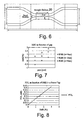
- Different types of optical couplers exist, including directional couplers (such as shown in Fig.6 ) and Y-branch couplers.
- directional couplers such as shown in Fig.6
- Y-branch couplers Y-branch couplers.
- Directional couplers tend to have lower power loss than Y-branch couplers, but have higher wavelength dependency i.e. variation in the coupling strength with different input signal wavelengths.
- US 5,044,715 describes an improved optical branching component, based on a Mach-Zender interferometer arrangement and which is designed to have low wavelength dependency.
- Fig.1 illustrates this component which comprises two waveguides which are brought into proximity with each other in two regions so as to form two directional couplers, there being an effective optical path length difference between the two waveguides where they extend between the two directional couplers.
- Such a design is proposed to have low wavelength dependency and is sometimes referred to as a Wavelength Insensitive Coupler or WINC.
- a desired application of a branching device like that described in US 5,044,715 is as an optical tap, to tap off a desired portion of the power in an optical signal input to the branching device.
- a big disadvantage of small coupling strengths is that a parameter which we refer to as the Relative Birefringence Error (RBE) becomes large, in particular where the PLC chip is fabricated in silica-on-silicon technology (which is a common technology platform for PLCs).
- RBE Relative Birefringence Error
- P split ratio, P split P 1 /(P 1 + P 2 ) where P 1 and P 2 are the power in the two output arms of the coupler respectively.
- This polarization dependence in the tap ratio we shall refer to as the Polarization Dependent Loss or PDL of the tap channel, but it will be understood that strictly speaking the total power in the component is conserved, it is simply that the power in
- US-A-5 165 001 discloses a guided-wave optical branching device which uses non-symmetric couplers to shape the wavelength response.
- said effective optical path length difference is less than the shortest operating wavelength of the component.
- An advantage of the inventive component, especially where the branching component is to be used as a tap, is that couplers with larger coupling strength can be used in the inventive component than in the WINC component of US 5,044,715 , for a given tap ratio.
- These larger coupling strength couplers can be fabricated in silica-on-silicon technology to have a lower RBE than the prior art WINC, as will be later described, which in turn enables lower PDL to be achieved.
- the coupling strength of each DC is preferably chosen sc that a desired minimum PDL is achieved for each DC.
- the effective optical path length difference between the DCs may then also be optimised by the component designer, if desired, so as to minimise any wavelength sensitivity of the device in a given operational wavelength window of the device.
- the effective optical path length difference, at a given operating wavelength e.g. the lowest operating wavelength, or the central operating wavelength
- Fig.3 illustrates an optical branching component (or "optical coupler") according to the invention.
- the component looks similar to the prior art WINC device of Fig.1 , namely comprising two waveguides 10,12 which are brought into proximity with each other in two regions 13,14 so as to form two directional couplers (DCs).
- the two waveguides have the same geometrical structure (i.e. dimensions of the core) and are made of identical materials.
- n ⁇ L an effective optical path length difference between the two waveguides where they extend between the two directional couplers
- ⁇ L is the physical length difference between the two waveguides
- n is the (effective) refractive index of each waveguide.
- the DCs are designed so that the (power) coupling strength of each of the two DCs decreases monotonically with increasing wavelength, in the operating wavelength region of the device, as illustrated in Fig.5 and as will be later explained in detail.
- the optical waveguides are silica-based waveguides formed on a silicon substrate using silica-on-silicon technology.
- Fig. 4 shows a portion (along the length) of such a waveguide comprising a core 15 etched from a core layer of silica-based material deposited on a silicon substrate 16 using Flame Hydrolysis Deposition.
- An undercladding layer 17 is commonly provided on the silicon substrate, prior to deposition of the core layer, and may be in the from of an oxide layer or a layer of silica-based material.
- An upper cladding layer 18 covers and embeds the waveguide core and is formed using Flame Hydrolysis Deposition.
- the core 15 is square in cross-section, having a core width, w (in the x and y-directions in Fig.4 )
- RBE Relative Birefringence Error
- ⁇ is the coupling coefficient at location z in the coupler (as defined in " Optical Integrated Circuits" edited by Nishihara et al., page 42, and on page 60-61, edited by Donelley & Sons company );
- L is the length over which coupling contributes to the overall phase-thickness of the coupler ;
- n 0 is the refractive index of the fundamental mode (of the optical signal beam field );
- n 1 is the refractive index of the first order mode (of the optical signal beam field);
- G(z) is a function defining the width of the gap between the waveguides, as a function of z.
- the waveguides in a DC bend away from one either on either side of a middle portion 20 of the DC in which the two waveguides are straight and parallel.
- the waveguides will remain optically coupled in the bent region as they diverge away from one another until they diverge beyond a certain distance apart, d, at which they will no longer be optically coupled.
- Fig.7 is a graph illustrating the variation in the RBE with the Gap, G, between the two waveguides, for a DC of a Power Tap device of the Mach-Zender interferometer type, in the straight section, L S , of the coupler.
- Fig.8 Shows a graph illustrating the linear relationship between PDL and RBE in a Power Tap of the Mach-Zender interferometer type, where it has been assumed for simplicity that the two DCs have identical RBE.
- the slope of the graph will depend on the tap ratio and the choice of other device parameters. This graph is again based on mode and stress computer simulations. It can clearly be seen that the PDL increases linearly with increasing RBE.
- the gap, G, between the waveguides in each DC has to be relatively large, typically greater than 3 ⁇ m), and so does the width of the waveguide cores, typically a width above the maximum width for a monomode waveguide.
- greater gap sizes, G, and/or greater core width, w gives larger RBE.
- each DC has a coupling strength which decreases monotonically with increasing wavelength, in the operating wavelength region of the device.
- the advantage of this is that even where a small tap ratio is desired (say a few percent or less), the coupling strength of the DCs will be larger than in the WINC device.
- lower gap width G and/or lower waveguide core width, w will give lower RBE, and hence lower PDL.
- the two DCs need not be identical, they may each have a different phase thickness ⁇ 1 , ⁇ 2 in which case the total coupling strength, C T , of the WINC is given by:
- phase thickness of each DC so that: 90 ⁇ ° ⁇ ⁇ 1 ⁇ 180 ⁇ ° 90 ⁇ ° ⁇ ⁇ 2 ⁇ 180 ⁇ °
- the RBE becomes small, namely less than 1%, possibly close to zero, for both the bend and straight sections of the DCs, especially if the gap, G, between the DC waveguides is reduced to about 1 ⁇ m, and the waveguide width, w, of the D waveguide cores is reduced to about 4 ⁇ m.
- the small RBE means that the PDL will be low.
- the value of ⁇ is then also chosen so that again the wavelength sensitivity of the DCs is substantially compensated for by the wavelength sensitivity of the optical path length difference, by using the appropriate above equation defining the total coupling strength C T of the overall branching device (depending on whether both DCs have identical phase thickness, or not). For example, where both DCs have the same phase thickness, and this phase thickness ⁇ is between 90° and 135°, we would make 90° ⁇ ⁇ ⁇ 180°, whereby again the increase with wavelength of the sin 2 (2 ⁇ ) term is substantially compensated for by the decrease with wavelength of the (1 + cos2 ⁇ )/2 term.
- phase thickness ⁇ is between 135° and 180° we would want to make 0° ⁇ ⁇ ⁇ 90°, whereby the decrease with wavelength of the sin 2 (2 ⁇ ) term is substantially compensated for by the increas with wavelength of the (1 + cos2 ⁇ )/2 term.
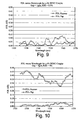
- Fig. 9 is a graph of PDL vs. wavelength, in the wavelength region between about 1520nm and 1570nm, for a PINC device according to the invention, designed as a 4% power tap with a gap between the waveguides of 1 ⁇ m in the straight section 20 of each DC, and a RBE of 0.5% in each DC of the PINC.
- the lower line shows the PDL for the express signal path through the PINC, and the upper line is for the Tap path.
- Fig.10 is a similar graph, again obtained from empirical data, this time plotted for the express and tap paths in a prior art WINC device also designed as a 4% tap, with a gap of 3 ⁇ m between the waveguides in the straight section of each DC of the WINC, and an RBE of 4% for each DC.
- the PDL values in the Tap path are much higher than in the PINC device, never being less than 0.25dB and sometimes being greater than 0.45dB, giving a variation of about 0.2dB between the minimum and maximum PDL values.
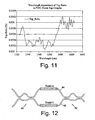
- Fig.11 illustrates the wavelength dependency of a PINC device according to one embodiment of the invention. It shows the variation in the Tap ratio of the PINC as a function of wavelength. This graph is again for a (approx.) 4% tap, gap of 1 ⁇ m, and RBE of 0.5%, same as for graph of Fig.9 .
- the tap ratio over the wavelength range 1520nm to 1640 nm is 3.57% ⁇ 0.05% which is relatively low variation.
- the PINC component has very low polarisation dependent loss (PDL) in addition to having a tap ratio which is relatively wavelength insensitive in at least the 1520nm to 1640nm region, which is the desired operating wavelength region of our component.
- PDL polarisation dependent loss
- one or more further waveguides may be incorporated into the device and arranged so that each directional coupler comprises three waveguides located in proximity to one another, in known fashion.
- one or more heater elements may be provided on the device, for varying the path length (in response to electrical signal(s) being applied to the heater(s)) of one or more of the waveguides so as to actively control the signal output(s) from the branching component, in known fashion.
- the use of such heaters can enable the branching component to be used to perform switching operations.
- Fig. 12 shows one embodiment of a switching device incorporating two PINCs 40,42 according to the invention, separated by two delay paths 44,46 formed by the two waveguides of the device respectively, and with a heater a,b provided on each delay path.
Landscapes
- Physics & Mathematics (AREA)
- General Physics & Mathematics (AREA)
- Optics & Photonics (AREA)
- Engineering & Computer Science (AREA)
- Microelectronics & Electronic Packaging (AREA)
- Optical Integrated Circuits (AREA)
- Investigating Or Analysing Materials By Optical Means (AREA)
- Polarising Elements (AREA)
- Silicon Polymers (AREA)
- Glass Compositions (AREA)
Claims (18)
- Optische Verzweigungskomponente, die zwei optische Wellenleiter beinhaltet, die in wenigstens zwei Regionen bzw. Bereichen nahe beieinander liegen, um zueinander benachbarte direktionale Koppler zu bilden, wobei die zueinander benachbarten direktionalen Koppler symmetrische Koppler sind, wobei es zwischen den direktionalen Kopplern eine effektive optische Pfadlängendifferenz zwischen den beiden Wellenleitern gibt und wobei die Kopplungsstärke jedes der direktionalen Koppler = sin2 ø ist und mit zunehmender Wellenlänge im Betriebswellenlängenbereich von 1520 nm - 1640 nm gleichförmig abnimmt, wobei ø die Phasendicke (phase thickness) ist, und
wobei die effektive optische Pfadlängendifferenz kleiner ist als die kürzeste Betriebswellenlänge der Komponente. - Optische Verzweigungskomponente nach Anspruch 1, wobei jeder der beiden direktionalen Koppler die gleiche Kopplungsstärke hat.
- Optische Verzweigungskomponente nach Anspruch 1, wobei jeder der beiden direktionalen Koppler eine unterschiedliche Kopplungsstärke hat.
- Optische Verzweigungskomponente nach einem der vorangegangenen Ansprüche, wobei die kleinste Lücke zwischen den beiden Wellenleitern in jedem der beiden direktionalen Koppler kleiner als 3 µm ist.
- Optische Verzweigungskomponente nach Anspruch 4, wobei die kleinste Lücke zwischen den beiden Wellenleitern in jedem der beiden direktionalen Koppler ungefähr 1 µm beträgt.
- Optische Verzweigungskomponente nach Anspruch 5, wobei die Breite des Kerns jedes Wellenleiters in einem geraden Abschnitt jedes der beiden direktionalen Koppler ungefähr 4 µm beträgt.
- Optische Verzweigungskomponente nach einem der vorangegangenen Ansprüche, wobei die Phasendicke jedes der beiden direktionalen Koppler zwischen 90° und 180° beträgt.
- Optische Verzweigungskomponente nach Anspruch 2, wobei die Phasendicke jedes der beiden direktionalen Koppler zwischen 90° und 135° beträgt und die Phasenverzögerung 2θ zwischen den beiden Wellenleitern zwischen den beiden direktionalen Kopplern durch 90° < θ < 180° definiert wird.
- Optische Verzweigungskomponente nach Anspruch 2, wobei die Phasendicke jedes der beiden direktionalen Koppler zwischen 135° und 180° beträgt und die Phasenverzögerung 2θ zwischen den beiden Wellenleitern zwischen den beiden direktionalen Kopplern durch 0° < θ < 90° definiert wird.
- Optische Verzweigungskomponente nach einem der vorangegangenen Ansprüche, wobei die Größe des RBE jedes der beiden direktionalen Koppler weniger als 1% beträgt.
- Optische Verzweigungskomponente nach einem der vorangegangenen Ansprüche, wobei die Größe des RBE jedes der beiden direktionalen Koppler nicht größer als 0,5% ist.
- Optische Verzweigungskomponente nach einem der vorangegangenen Ansprüche, wobei die Komponente eine Abgriffvorrichtung mit einem Abgriffverhältnis von nicht größer als 4% ist.
- Optische Verzweigungskomponente nach einem der vorangegangenen Ansprüche, wobei die Komponente eine Abgriffvorrichtung ist, wobei die Variation in dem Abgriffverhältnis mit der Wellenlänge über den Betriebswellenlängenbereich der Komponente weniger als 0,1% beträgt.
- Optische Verzweigungskomponente nach Anspruch 1, welche weiterhin wenigstens einen weiteren Wellenleiter beinhaltet.
- Optische Verzweigungskomponente nach Anspruch 1, welche weiterhin eine Heizeinrichtung beinhaltet, die auf wenigstens einem der Wellenleiter angeordnet ist.
- Optische Verzweigungskomponente nach einem der Ansprüche 1 bis 15, wobei die Wellenleiter in Silica-auf-Silicium-Technik hergestellt sind.
- Optische Schaltvorrichtung, welche zwei optische Verzweigungskomponenten nach einem der Ansprüche 1 bis 14 beinhaltet und weiterhin wenigstens eine Heizeinrichtung beinhaltet.
- Optische Schaltvorrichtung nach Anspruch 17, wobei die Wellenleiter in Silica-auf-Silicium-Technik hergestellt sind.
Applications Claiming Priority (3)
| Application Number | Priority Date | Filing Date | Title |
|---|---|---|---|
| GBGB0219141.9A GB0219141D0 (en) | 2002-08-16 | 2002-08-16 | Optical branching component with low polarisation sensitivity |
| GB0219141 | 2002-08-16 | ||
| PCT/GB2003/001071 WO2004017112A1 (en) | 2002-08-16 | 2003-03-13 | Optical branching component with low polarisation sensitivity |
Publications (2)
| Publication Number | Publication Date |
|---|---|
| EP1529231A1 EP1529231A1 (de) | 2005-05-11 |
| EP1529231B1 true EP1529231B1 (de) | 2008-11-19 |
Family
ID=9942473
Family Applications (1)
| Application Number | Title | Priority Date | Filing Date |
|---|---|---|---|
| EP03712343A Expired - Lifetime EP1529231B1 (de) | 2002-08-16 | 2003-03-13 | Optische verzweigungskomponente mit geringer polarisationsempfindlichkeit |
Country Status (5)
| Country | Link |
|---|---|
| EP (1) | EP1529231B1 (de) |
| AT (1) | ATE414922T1 (de) |
| DE (1) | DE60324804D1 (de) |
| GB (1) | GB0219141D0 (de) |
| WO (1) | WO2004017112A1 (de) |
Families Citing this family (1)
| Publication number | Priority date | Publication date | Assignee | Title |
|---|---|---|---|---|
| GB2395796A (en) * | 2002-11-27 | 2004-06-02 | Alcatel Optronics Uk Ltd | Optical waveguide branching component with MMI couplers |
Family Cites Families (3)
| Publication number | Priority date | Publication date | Assignee | Title |
|---|---|---|---|---|
| CA2009352C (en) * | 1989-02-07 | 1995-02-28 | Masao Kawachi | Guided-wave optical branching components and optical switches |
| US5066087A (en) * | 1990-03-07 | 1991-11-19 | Fujikura Ltd. | Optical fiber coupler |
| JPH07281041A (ja) * | 1994-04-07 | 1995-10-27 | Hitachi Cable Ltd | 導波路及びそれを用いたマッハツェンダ型光回路 |
-
2002
- 2002-08-16 GB GBGB0219141.9A patent/GB0219141D0/en not_active Ceased
-
2003
- 2003-03-13 AT AT03712343T patent/ATE414922T1/de not_active IP Right Cessation
- 2003-03-13 WO PCT/GB2003/001071 patent/WO2004017112A1/en not_active Ceased
- 2003-03-13 EP EP03712343A patent/EP1529231B1/de not_active Expired - Lifetime
- 2003-03-13 DE DE60324804T patent/DE60324804D1/de not_active Expired - Fee Related
Non-Patent Citations (1)
| Title |
|---|
| JINGUJI K. ET AL: "Two-Port Optical Wavelength Circuits Composed of Cascaded Mach-Zehnder Interferometers with Point-Symmetrical Configurations", JOURNAL OF LIGHTWAVE TECHNOLOGY, vol. 14, no. 10, October 1996 (1996-10-01), pages 2301 - 2310, XP000631532, DOI: doi:10.1109/50.541222 * |
Also Published As
| Publication number | Publication date |
|---|---|
| ATE414922T1 (de) | 2008-12-15 |
| EP1529231A1 (de) | 2005-05-11 |
| DE60324804D1 (de) | 2009-01-02 |
| GB0219141D0 (en) | 2002-09-25 |
| WO2004017112A1 (en) | 2004-02-26 |
Similar Documents
| Publication | Publication Date | Title |
|---|---|---|
| EP2741113B1 (de) | Integrierte photonische Bauelemente mit verminderter Empfindlichkeit für externe Einflüsse | |
| US5341444A (en) | Polarization compensated integrated optical filters and multiplexers | |
| EP1530736B1 (de) | Integrierter optischer verzweiger mit sich verjüngenden mehrmoden-interferenz wellenleitern | |
| US6704487B2 (en) | Method and system for reducing dn/dt birefringence in a thermo-optic PLC device | |
| US8218932B2 (en) | Polarization independent optical device | |
| Xu et al. | Design of polarization-insensitive ring resonators in silicon-on-insulator using MMI couplers and cladding stress engineering | |
| EP1302793A2 (de) | Ein Polarisationsstrahlteiler | |
| EP1291689A1 (de) | Verbessertes Wellenleitergitter | |
| US6522822B2 (en) | Strongly confined polarization-independent single-mode optical ridge waveguide | |
| US6950581B2 (en) | Optical coupler apparatus and methods having reduced geometry sensitivity | |
| CN102253448B (zh) | 一种阵列波导光栅实现均匀偏振补偿的方法 | |
| US7555180B2 (en) | Optical branching component with low polarisation sensitivity and increased process tolerance | |
| JPH0660982B2 (ja) | 導波形マツハ・ツエンダ光干渉計 | |
| EP1529231B1 (de) | Optische verzweigungskomponente mit geringer polarisationsempfindlichkeit | |
| US20020159702A1 (en) | Optical mach-zehnder interferometers with low polarization dependence | |
| EP1430342B1 (de) | Entzerrung des durchlassbandes in einem wellenleitergitter | |
| TW200405048A (en) | Polarization-insensitive planar lightwave circuits and method for fabricating the same | |
| US20040151459A1 (en) | Method of polarisation compensation in grating- and phasar-based devices by using over-layer deposited on the compensating region to modify local slab waveguide birefringence | |
| Takato et al. | Silica-based single-mode guided-wave devices | |
| Xu et al. | Polarization-insensitive MMI-coupled ring resonators in silicon-on-insulator using cladding stress engineering | |
| Xu et al. | Selecting the polarization in silicon photonic wire components | |
| JPH0782132B2 (ja) | 導波形偏光分離素子 | |
| JP2003222748A (ja) | 光導波路型偏波分離素子及びその製造方法 | |
| JP2000105318A (ja) | Y分岐型光導波路 | |
| Xu et al. | Design of polarization-insensitive SOI ring resonators using cladding stress-induced birefringence and MMI couplers |
Legal Events
| Date | Code | Title | Description |
|---|---|---|---|
| PUAI | Public reference made under article 153(3) epc to a published international application that has entered the european phase |
Free format text: ORIGINAL CODE: 0009012 |
|
| 17P | Request for examination filed |
Effective date: 20050204 |
|
| AK | Designated contracting states |
Kind code of ref document: A1 Designated state(s): AT BE BG CH CY CZ DE DK EE ES FI FR GB GR HU IE IT LI LU MC NL PT RO SE SI SK TR |
|
| RAP1 | Party data changed (applicant data changed or rights of an application transferred) |
Owner name: GEMFIRE EUROPE LIMITED |
|
| 17Q | First examination report despatched |
Effective date: 20060717 |
|
| 17Q | First examination report despatched |
Effective date: 20060717 |
|
| 17Q | First examination report despatched |
Effective date: 20060717 |
|
| GRAP | Despatch of communication of intention to grant a patent |
Free format text: ORIGINAL CODE: EPIDOSNIGR1 |
|
| GRAJ | Information related to disapproval of communication of intention to grant by the applicant or resumption of examination proceedings by the epo deleted |
Free format text: ORIGINAL CODE: EPIDOSDIGR1 |
|
| GRAP | Despatch of communication of intention to grant a patent |
Free format text: ORIGINAL CODE: EPIDOSNIGR1 |
|
| GRAS | Grant fee paid |
Free format text: ORIGINAL CODE: EPIDOSNIGR3 |
|
| GRAA | (expected) grant |
Free format text: ORIGINAL CODE: 0009210 |
|
| AK | Designated contracting states |
Kind code of ref document: B1 Designated state(s): AT BE BG CH CY CZ DE DK EE ES FI FR GB GR HU IE IT LI LU MC NL PT RO SE SI SK TR |
|
| REG | Reference to a national code |
Ref country code: GB Ref legal event code: FG4D |
|
| REG | Reference to a national code |
Ref country code: CH Ref legal event code: EP |
|
| REG | Reference to a national code |
Ref country code: IE Ref legal event code: FG4D |
|
| REF | Corresponds to: |
Ref document number: 60324804 Country of ref document: DE Date of ref document: 20090102 Kind code of ref document: P |
|
| PG25 | Lapsed in a contracting state [announced via postgrant information from national office to epo] |
Ref country code: AT Free format text: LAPSE BECAUSE OF FAILURE TO SUBMIT A TRANSLATION OF THE DESCRIPTION OR TO PAY THE FEE WITHIN THE PRESCRIBED TIME-LIMIT Effective date: 20081119 Ref country code: ES Free format text: LAPSE BECAUSE OF FAILURE TO SUBMIT A TRANSLATION OF THE DESCRIPTION OR TO PAY THE FEE WITHIN THE PRESCRIBED TIME-LIMIT Effective date: 20090301 |
|
| NLV1 | Nl: lapsed or annulled due to failure to fulfill the requirements of art. 29p and 29m of the patents act | ||
| PG25 | Lapsed in a contracting state [announced via postgrant information from national office to epo] |
Ref country code: NL Free format text: LAPSE BECAUSE OF FAILURE TO SUBMIT A TRANSLATION OF THE DESCRIPTION OR TO PAY THE FEE WITHIN THE PRESCRIBED TIME-LIMIT Effective date: 20081119 Ref country code: SI Free format text: LAPSE BECAUSE OF FAILURE TO SUBMIT A TRANSLATION OF THE DESCRIPTION OR TO PAY THE FEE WITHIN THE PRESCRIBED TIME-LIMIT Effective date: 20081119 Ref country code: FI Free format text: LAPSE BECAUSE OF FAILURE TO SUBMIT A TRANSLATION OF THE DESCRIPTION OR TO PAY THE FEE WITHIN THE PRESCRIBED TIME-LIMIT Effective date: 20081119 |
|
| PG25 | Lapsed in a contracting state [announced via postgrant information from national office to epo] |
Ref country code: EE Free format text: LAPSE BECAUSE OF FAILURE TO SUBMIT A TRANSLATION OF THE DESCRIPTION OR TO PAY THE FEE WITHIN THE PRESCRIBED TIME-LIMIT Effective date: 20081119 Ref country code: DK Free format text: LAPSE BECAUSE OF FAILURE TO SUBMIT A TRANSLATION OF THE DESCRIPTION OR TO PAY THE FEE WITHIN THE PRESCRIBED TIME-LIMIT Effective date: 20081119 Ref country code: BG Free format text: LAPSE BECAUSE OF FAILURE TO SUBMIT A TRANSLATION OF THE DESCRIPTION OR TO PAY THE FEE WITHIN THE PRESCRIBED TIME-LIMIT Effective date: 20090219 Ref country code: BE Free format text: LAPSE BECAUSE OF FAILURE TO SUBMIT A TRANSLATION OF THE DESCRIPTION OR TO PAY THE FEE WITHIN THE PRESCRIBED TIME-LIMIT Effective date: 20081119 Ref country code: RO Free format text: LAPSE BECAUSE OF FAILURE TO SUBMIT A TRANSLATION OF THE DESCRIPTION OR TO PAY THE FEE WITHIN THE PRESCRIBED TIME-LIMIT Effective date: 20081119 |
|
| PG25 | Lapsed in a contracting state [announced via postgrant information from national office to epo] |
Ref country code: CZ Free format text: LAPSE BECAUSE OF FAILURE TO SUBMIT A TRANSLATION OF THE DESCRIPTION OR TO PAY THE FEE WITHIN THE PRESCRIBED TIME-LIMIT Effective date: 20081119 Ref country code: PT Free format text: LAPSE BECAUSE OF FAILURE TO SUBMIT A TRANSLATION OF THE DESCRIPTION OR TO PAY THE FEE WITHIN THE PRESCRIBED TIME-LIMIT Effective date: 20090420 Ref country code: SE Free format text: LAPSE BECAUSE OF FAILURE TO SUBMIT A TRANSLATION OF THE DESCRIPTION OR TO PAY THE FEE WITHIN THE PRESCRIBED TIME-LIMIT Effective date: 20090219 |
|
| PLBE | No opposition filed within time limit |
Free format text: ORIGINAL CODE: 0009261 |
|
| STAA | Information on the status of an ep patent application or granted ep patent |
Free format text: STATUS: NO OPPOSITION FILED WITHIN TIME LIMIT |
|
| PG25 | Lapsed in a contracting state [announced via postgrant information from national office to epo] |
Ref country code: SK Free format text: LAPSE BECAUSE OF FAILURE TO SUBMIT A TRANSLATION OF THE DESCRIPTION OR TO PAY THE FEE WITHIN THE PRESCRIBED TIME-LIMIT Effective date: 20081119 |
|
| 26N | No opposition filed |
Effective date: 20090820 |
|
| PG25 | Lapsed in a contracting state [announced via postgrant information from national office to epo] |
Ref country code: MC Free format text: LAPSE BECAUSE OF NON-PAYMENT OF DUE FEES Effective date: 20090331 |
|
| REG | Reference to a national code |
Ref country code: CH Ref legal event code: PL |
|
| REG | Reference to a national code |
Ref country code: FR Ref legal event code: ST Effective date: 20091130 |
|
| PG25 | Lapsed in a contracting state [announced via postgrant information from national office to epo] |
Ref country code: DE Free format text: LAPSE BECAUSE OF NON-PAYMENT OF DUE FEES Effective date: 20091001 Ref country code: LI Free format text: LAPSE BECAUSE OF NON-PAYMENT OF DUE FEES Effective date: 20090331 Ref country code: CH Free format text: LAPSE BECAUSE OF NON-PAYMENT OF DUE FEES Effective date: 20090331 Ref country code: IE Free format text: LAPSE BECAUSE OF NON-PAYMENT OF DUE FEES Effective date: 20090313 |
|
| PG25 | Lapsed in a contracting state [announced via postgrant information from national office to epo] |
Ref country code: FR Free format text: LAPSE BECAUSE OF NON-PAYMENT OF DUE FEES Effective date: 20091123 |
|
| PG25 | Lapsed in a contracting state [announced via postgrant information from national office to epo] |
Ref country code: GR Free format text: LAPSE BECAUSE OF FAILURE TO SUBMIT A TRANSLATION OF THE DESCRIPTION OR TO PAY THE FEE WITHIN THE PRESCRIBED TIME-LIMIT Effective date: 20090220 |
|
| PG25 | Lapsed in a contracting state [announced via postgrant information from national office to epo] |
Ref country code: IT Free format text: LAPSE BECAUSE OF FAILURE TO SUBMIT A TRANSLATION OF THE DESCRIPTION OR TO PAY THE FEE WITHIN THE PRESCRIBED TIME-LIMIT Effective date: 20081119 |
|
| PG25 | Lapsed in a contracting state [announced via postgrant information from national office to epo] |
Ref country code: LU Free format text: LAPSE BECAUSE OF NON-PAYMENT OF DUE FEES Effective date: 20090313 |
|
| PG25 | Lapsed in a contracting state [announced via postgrant information from national office to epo] |
Ref country code: HU Free format text: LAPSE BECAUSE OF FAILURE TO SUBMIT A TRANSLATION OF THE DESCRIPTION OR TO PAY THE FEE WITHIN THE PRESCRIBED TIME-LIMIT Effective date: 20090520 |
|
| PG25 | Lapsed in a contracting state [announced via postgrant information from national office to epo] |
Ref country code: TR Free format text: LAPSE BECAUSE OF FAILURE TO SUBMIT A TRANSLATION OF THE DESCRIPTION OR TO PAY THE FEE WITHIN THE PRESCRIBED TIME-LIMIT Effective date: 20081119 |
|
| PG25 | Lapsed in a contracting state [announced via postgrant information from national office to epo] |
Ref country code: CY Free format text: LAPSE BECAUSE OF FAILURE TO SUBMIT A TRANSLATION OF THE DESCRIPTION OR TO PAY THE FEE WITHIN THE PRESCRIBED TIME-LIMIT Effective date: 20081119 |
|
| PGFP | Annual fee paid to national office [announced via postgrant information from national office to epo] |
Ref country code: GB Payment date: 20180413 Year of fee payment: 16 |
|
| REG | Reference to a national code |
Ref country code: GB Ref legal event code: 732E Free format text: REGISTERED BETWEEN 20190725 AND 20190731 |
|
| GBPC | Gb: european patent ceased through non-payment of renewal fee |
Effective date: 20190313 |
|
| PG25 | Lapsed in a contracting state [announced via postgrant information from national office to epo] |
Ref country code: GB Free format text: LAPSE BECAUSE OF NON-PAYMENT OF DUE FEES Effective date: 20190313 |