EP1529384B1 - Controle d'acces dans des reseaux a commutation par paquets - Google Patents
Controle d'acces dans des reseaux a commutation par paquets Download PDFInfo
- Publication number
- EP1529384B1 EP1529384B1 EP03790720A EP03790720A EP1529384B1 EP 1529384 B1 EP1529384 B1 EP 1529384B1 EP 03790720 A EP03790720 A EP 03790720A EP 03790720 A EP03790720 A EP 03790720A EP 1529384 B1 EP1529384 B1 EP 1529384B1
- Authority
- EP
- European Patent Office
- Prior art keywords
- network
- traffic
- nodes
- volume
- bbb
- Prior art date
- Legal status (The legal status is an assumption and is not a legal conclusion. Google has not performed a legal analysis and makes no representation as to the accuracy of the status listed.)
- Expired - Lifetime
Links
Images
Classifications
-
- H—ELECTRICITY
- H04—ELECTRIC COMMUNICATION TECHNIQUE
- H04L—TRANSMISSION OF DIGITAL INFORMATION, e.g. TELEGRAPHIC COMMUNICATION
- H04L47/00—Traffic control in data switching networks
- H04L47/70—Admission control; Resource allocation
- H04L47/80—Actions related to the user profile or the type of traffic
- H04L47/805—QOS or priority aware
-
- H—ELECTRICITY
- H04—ELECTRIC COMMUNICATION TECHNIQUE
- H04L—TRANSMISSION OF DIGITAL INFORMATION, e.g. TELEGRAPHIC COMMUNICATION
- H04L47/00—Traffic control in data switching networks
- H04L47/10—Flow control; Congestion control
- H04L47/11—Identifying congestion
-
- H—ELECTRICITY
- H04—ELECTRIC COMMUNICATION TECHNIQUE
- H04L—TRANSMISSION OF DIGITAL INFORMATION, e.g. TELEGRAPHIC COMMUNICATION
- H04L47/00—Traffic control in data switching networks
- H04L47/10—Flow control; Congestion control
- H04L47/15—Flow control; Congestion control in relation to multipoint traffic
-
- H—ELECTRICITY
- H04—ELECTRIC COMMUNICATION TECHNIQUE
- H04L—TRANSMISSION OF DIGITAL INFORMATION, e.g. TELEGRAPHIC COMMUNICATION
- H04L47/00—Traffic control in data switching networks
- H04L47/10—Flow control; Congestion control
- H04L47/29—Flow control; Congestion control using a combination of thresholds
-
- H—ELECTRICITY
- H04—ELECTRIC COMMUNICATION TECHNIQUE
- H04L—TRANSMISSION OF DIGITAL INFORMATION, e.g. TELEGRAPHIC COMMUNICATION
- H04L47/00—Traffic control in data switching networks
- H04L47/70—Admission control; Resource allocation
Definitions
- the invention relates to a method for traffic limitation in a packet-oriented network.
- the goal here is to be able to use as far as possible a packet-oriented network for any services.
- non-time critical data transmissions are made over packet-oriented networks, e.g. the transfer of files or electronic mail.
- Voice transmission with real-time requirements is traditionally handled over telephone networks using time-division multiplexing technology.
- TDM time division multiplexing
- the goal is to be able to carry out all services, data-related, language-related and video-information-related, via a packet-oriented network as far as possible.
- service classes are defined for the various requests for data transmission in the various services.
- the transmission with a defined quality of service, especially for services with real-time requirements, requires appropriate control or control for packet transmission over the network.
- traffic management traffic conditioning, traffic shaping, traffic engineering, policing ect.
- the Diff-Serv concept is applied to IP (Internet Protocol) networks and aims to improve the quality of service for high-quality services by introducing service classes.
- IP Internet Protocol
- CoS class of service
- the Diff-Serv concept is described in the RFCs 2474 and 2475 published by the IETF.
- a priority is set in the IP header of the data packets by setting the DSCP (DS codepoint) parameter with the aid of a DS (Differentiated Services) field. This prioritization takes place by means of a "hop" resource allocation, ie the packets undergo a different treatment at the nodes according to the class of service defined in the DS field by the DSCP parameter.
- the control of the traffic is thus made in accordance with the service classes.
- the Diff-Serv concept leads to a privileged treatment of the traffic of prioritized service classes, but not to a reliable control of the traffic volume.
- RSVP resource reservation protocol
- MPLS multi-protocol label switching
- WO 01/54448 A discloses the use of node and route related bandwidth limits for access control at the network entrance.
- Node-related bandwidth limits at the network entrance can only use the available bandwidth very incompletely, since the lack of knowledge about the destination of the traffic must be compensated for by correspondingly large reservations.
- Route-related procedures require the effort and the lack of flexibility of the path-related approaches.
- the invention has for its object to provide an efficient traffic control for a packet-oriented network, which avoids the disadvantages of conventional methods.
- the object is achieved by a method for traffic limitation in a packet-oriented network according to claim 1.
- a permissibility check is carried out for a group of data packets of a flow to be transmitted via the network.
- the admissibility check is carried out with the help of a limit for the traffic volume between the network ingress node and the network egress node of the flow.
- the transmission of the group of data packets will not be allowed if allowing the transmission would result in traffic exceeding the limit.
- the packet-oriented network can also be a subnet or subnet.
- IP Internet Protocol
- the network according to the invention can e.g. an autonomous system or part of the overall network under the responsibility of a service provider (e.g., ISP: internet service provider).
- ISP internet service provider
- service parameters for transmission over the whole network can be established via traffic control in the subnetworks and efficient communication between the subnetworks.
- flow is commonly used to denote traffic between a source and a destination.
- flow refers to the input node and the output node of the packet-oriented network, i. all packets of a flow in the sense of our usage are transmitted via the same input node and the same output node.
- the group of packets is for example associated with a connection (in the case of a TCP / IP transmission defined by IP address and port number of the originating and terminating process) and / or a service class.
- Input nodes of the packet-oriented network are nodes through which packets are routed to the network; Output nodes are nodes of the network over which packets leave the network.
- In the English literature one often speaks of ingress nodes and egress nodes.
- there may be a network comprising edge nodes and inner nodes. If, for example, all edge nodes of the network can enter packets into the network or leave the network, in this case the Edge node of the network both network input node and network output node.
- An admissibility test according to the invention can be carried out by a control entity in a node or computers upstream of the node.
- a control instance can take over control functions for several nodes.
- the admissibility check according to the invention controls the traffic volume between a network input node and a network output node. It can be prevented that between the two nodes traffic grows, which would lead to an overload in the network and thus to delays and package distortions. Traffic restriction may be made in the sense of transmission with negotiated service level agreements (SLA), e.g. according to the prioritization of traffic.
- SLA service level agreements
- the limits for the traffic volume between the respective node pair for all pairs of network input nodes and network output nodes can be related to values for the maximum traffic volume on sub-routes (often also called links).
- the maximum value for the traffic on sections will generally not only depend on the bandwidth, but also on the network technology used. For example, it will usually be necessary to consider whether it is a local area network (LAN), a metropolitan area network (MAN), a wide area network (WAN) or a backbone network.
- CSMA / CD Carrier Sense Multiple Access (with) Collision Detection
- a load level near 100% for CSMA / CD Carrier Sense Multiple Access (with) Collision Detection
- the limit values for the traffic volume between pairs of network input nodes and network output nodes can then be defined. In the preferred embodiment, this relation is based on the proportion of traffic available over the individual sections of the network for the pairs of network input nodes and network output nodes.
- the proportional traffic volumes over the individual sections of the network for the pairs of network input nodes and network output nodes can be determined on the basis of experience or known properties of nodes and links. It is also possible to measure the network in order to obtain this pro rata traffic volume over the individual sections as a function of network input nodes and network output nodes.
- traffic theory one speaks of the traffic matrix in this context.
- the invention has the advantage that information for access control need only be maintained at input nodes.
- this information includes, for an input node, the limits and current values for traffic between the input node and the various output nodes.
- the scope of information is limited.
- the updating of the traffic is little expensive.
- the inner nodes do not need to take over functions regarding the admissibility check.
- the process is thus considerably less expensive and has a lower degree of complexity than processes which provide for admissibility checks for individual sections. In contrast to conventional methods such as ATM or MPLS, no path needs to be reserved within the network.
- two further admissibility checks are additionally carried out, one of these admissibility checks being carried out with the aid of a limit value for the traffic routed via the network input node of the flow and the other with the aid of a limit value for the traffic routed via the network output node of the flow.
- the admissibility check using a threshold for the traffic routed via the network outbound node of the flow may e.g. be made at the corresponding output node.
- the auditors for the individual admissibility checks then communicate with each other in order to use the results of the individual admissibility checks to decide on the transmission of the group of data packets.
- a connection can be established between the traffic volumes between pairs of network input nodes and network output nodes and the traffic volume on partial routes of the network.
- limits can be determined for the traffic volume between the pairs of network input nodes and network output nodes as well as limits for the traffic routed via the network input nodes and traffic routed via the network output nodes.
- the relationship between the traffic volumes between pairs of network input nodes and network output nodes and the traffic volume on sub-sections of the network can be established as an optimization problem with constraints in the form of inequalities.
- the proportionate traffic flows over the individual sections of the network for formulating the relationship between the traffic between pairs of network input nodes and network outgoing nodes and the traffic on sections of the network.
- this formulation allows further criteria in the form of inequalities to be included in the determination of the limits or limits for the admissibility checks. It can e.g. in the determination of limits or limits for the admissibility checks, inequalities shall be included which result in a low traffic volume of high priority traffic on longer delays.
- Another example is that of an output node through which packets can be transmitted to multiple input nodes of other networks, i. the output node has interfaces to several other networks. If the input node of one of the subsequent networks can process a smaller data volume than the output node, it can be ensured by a further secondary condition in the form of an inequality that the traffic conducted via the output node to the input node exceeds its capacity.
- the limits or limit values for the admissibility check or the admissibility checks are set new with the condition that no packets are transmitted over the failed leg in case of failure of a leg. Restricting the boundaries will result in traffic being routed through other links that would otherwise have been transmitted over the failed link without overloading the redirected traffic. It can react so flexibly to failures.
- limits or limit values are determined for a plurality of possible incidents in which the traffic volume remains within a permissible range even in the event of a fault, ie parameters such as propagation delay and packet loss rate remain in areas defined by the quality requirements for the data transmission.
- the limits or limit values are then set to the minimum of the values for the investigated accidents. This means that each of the incidents is intercepted by the choice of limits or limits.
- the majority of incidents may include, for example, all outages of links.
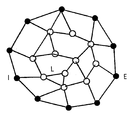
- the figure shows a network according to the invention.
- Edge nodes are characterized by filled circles, inner nodes by unfilled circles.
- Links are represented by connections between the nodes.
- an input node is denoted by I
- an output node by E
- a link by L link by L.
- Link L transfers part of the traffic between nodes I and E.
- the admissibility checks at the input node I and possibly at the output node E, together with the other admissibility checks, ensure that no overload occurs at the link L.
- the inventive method allows in a simple way, by changing the limits or limits to respond to disturbances.
- the relation or context excludes that link (e.g., by nulling all aV (i, j, L) for that link L). Due to the new formulation of the relation or the relationship, modified limits or limit values can be determined which, as admissibility criteria, prevent overload within the network.
Landscapes
- Engineering & Computer Science (AREA)
- Computer Networks & Wireless Communication (AREA)
- Signal Processing (AREA)
- Data Exchanges In Wide-Area Networks (AREA)
Abstract
Claims (10)
- Procédé pour limiter le trafic dans un réseau orienté paquets avec une pluralité de tronçons (L), dans lequel un contrôle d'admissibilité est effectué pour un groupe de paquets de données d'un flux à transmettre sur le réseau, caractérisé en ce que- le contrôle d'admissibilité est effectué à l'aide d'une valeur limite (BBB(i,j)) du volume de trafic (δ(i,j)) entre le noeud d'entrée au réseau (I) et le noeud de sortie du réseau (E) du flux et- la transmission du groupe de paquets de données n'est pas autorisée lorsque l'autorisation de transmettre entraînerait un volume de trafic (δ(i,j)) qui dépasse la valeur limite (BBB(i,j)).
- Procédé selon la revendication 1, caractérisé en ce que sont fixées, pour tous les couples ((i,j)) de noeuds d'entrée au réseau et de noeuds de sortie du réseau, des valeurs limites (BBB(i,j)) du volume de trafic (δ(i,j)) entre le couple de noeuds respectif ((i,j)).
- Procédé selon la revendication 2, caractérisé en ce que- les valeurs limites (BBB(i,j)) du volume de trafic (δ(i,j)) entre des couples ((i,j)) de noeuds d'entrée au réseau et de noeuds de sortie du réseau sont mises en relation avec le volume de trafic (c(L)) sur des tronçons (L) du réseau et- les valeurs limites (BBB(i,j)) du volume de trafic (δ(i,j)) entre noeuds d'entrée au réseau et noeuds de sortie du réseau sont fixées au moyen de valeurs de volumes de trafic maximaux (c(L)) sur les tronçons (L) du réseau.
- Procédé selon la revendication 3, caractérisé en ce que- le volume de trafic proportionnel (aV(i,j,L) passant par les différents tronçons (L) du réseau est déterminé pour les couples ((i,j)) de noeuds d'entrée au réseau et de noeuds de sortie du réseau et- les valeurs limites (BBB(i,j)) du volume de trafic (δ(i,j)) entre des couples ((i,j)) de noeuds d'entrée au réseau et de noeuds de sortie du réseau sont mises en relation avec le volume de trafic (c(L)) sur des tronçons (L) du réseau à l'aide des valeurs du volume de trafic proportionnel (aV(i,j,L)) passant par les différents tronçons (L).
- Procédé selon la revendication 1, caractérisé en ce que deux autres contrôles d'admissibilité sont effectués additionnellement, l'un de ces contrôles d'admissibilité étant effectué à l'aide d'une valeur limite (Ingress(i)) du trafic passant par le noeud d'entrée au réseau (I) du flux et l'autre, à l'aide d'une valeur limite (Egress(j)) du trafic passant par le noeud de sortie du réseau (E) du flux.
- Procédé selon la revendication 5, caractérisé en ce que- un lien est établi entre les volumes de trafic (δ(i,j)) entre des couples ((i,j)) de noeuds d'entrée au réseau et de noeuds de sortie du réseau et le volume de trafic (C(L)) sur des tronçons (L) du réseau et- des limites (BBB(i,j)) du volume de trafic entre les couples de noeuds d'entrée au réseau et de noeuds de sortie du réseau ainsi que des valeurs limites (Ingress(i), Egress(j)) du trafic passant par les noeuds d'entrée au réseau et du trafic passant par les noeuds de sortie du réseau sont fixées au moyen de valeurs d'un volume de trafic maximal sur les tronçons du réseau.
- Procédé selon la revendication 6, caractérisé en ce que- un procédé d'optimisation du volume de trafic (c(L)) est exécuté sur des tronçons (L) du réseau,-- les valeurs limites du volume de trafic entre les couples de noeuds d'entrée au réseau et de noeuds de sortie du réseau (BBB(i,j)) ainsi que du trafic passant par les noeuds d'entrée au réseau et du trafic passant par les noeuds de sortie du réseau (Ingress(i), Egress(j)) étant utilisées en tant que conditions secondaires pour l'optimisation et-- le volume de trafic proportionnel (aV(i,j,L)) passant par les différents tronçons (L) du réseau étant utilisé pour formuler le lien entre les volumes de trafic (δ(i,j)) entre couples de noeuds d'entrée au réseau et de noeuds de sortie du réseau et le volume de trafic (c(L)) sur des tronçons (L) du réseau.
- Procédé selon l'une des revendications précédentes, caractérisé en ce que, en cas de défaillance d'un tronçon (L), les limites (Ingress(i), Egress(j)) respectivement les valeurs limites (BBB(i,j)) pour le contrôle d'admissibilité resp. les contrôles d'admissibilité sont refixées avec la condition qu'aucun paquet ne soit transmis sur le tronçon défaillant (L).
- Procédé selon l'une des revendications précédentes, caractérisé en ce que sont utilisées, pour au moins un contrôle d'admissibilité, des limites (Ingress(i), Egress(j)) resp. des valeurs limites (BBB(i,j)) qui dépendent de la classe de service du groupe de paquets.
- Procédé selon l'une des revendications précédentes, caractérisé en ce que- sont déterminées, pour une pluralité de cas de perturbation possibles, respectivement des limites ou valeurs limites pour lesquelles le volume de trafic reste dans un cadre admissible même en cas de perturbation et- les limites ou valeurs limites sont fixées au minimum des valeurs pour les cas de perturbation analysés.
Applications Claiming Priority (3)
| Application Number | Priority Date | Filing Date | Title |
|---|---|---|---|
| DE10237334 | 2002-08-14 | ||
| DE10237334 | 2002-08-14 | ||
| PCT/DE2003/002736 WO2004021647A2 (fr) | 2002-08-14 | 2003-08-14 | Controle d'acces dans des reseaux a commutation par paquets |
Publications (2)
| Publication Number | Publication Date |
|---|---|
| EP1529384A2 EP1529384A2 (fr) | 2005-05-11 |
| EP1529384B1 true EP1529384B1 (fr) | 2010-10-20 |
Family
ID=31968970
Family Applications (1)
| Application Number | Title | Priority Date | Filing Date |
|---|---|---|---|
| EP03790720A Expired - Lifetime EP1529384B1 (fr) | 2002-08-14 | 2003-08-14 | Controle d'acces dans des reseaux a commutation par paquets |
Country Status (5)
| Country | Link |
|---|---|
| US (3) | US20060164983A1 (fr) |
| EP (1) | EP1529384B1 (fr) |
| CN (1) | CN1675900A (fr) |
| DE (1) | DE50313207D1 (fr) |
| WO (1) | WO2004021647A2 (fr) |
Families Citing this family (27)
| Publication number | Priority date | Publication date | Assignee | Title |
|---|---|---|---|---|
| US9019830B2 (en) | 2007-05-15 | 2015-04-28 | Imagine Communications Corp. | Content-based routing of information content |
| US8688926B2 (en) | 2010-10-10 | 2014-04-01 | Liqid Inc. | Systems and methods for optimizing data storage among a plurality of solid state memory subsystems |
| CN103181130B (zh) * | 2010-11-08 | 2017-04-05 | 瑞典爱立信有限公司 | 监测网络中的拥塞状态的方法和网络节点 |
| US9678910B2 (en) | 2014-04-25 | 2017-06-13 | Liqid Inc. | Power handling in a scalable storage system |
| US10467166B2 (en) | 2014-04-25 | 2019-11-05 | Liqid Inc. | Stacked-device peripheral storage card |
| US9645902B2 (en) | 2014-06-23 | 2017-05-09 | Liqid Inc. | Modular switched fabric for data storage systems |
| US9653124B2 (en) | 2014-09-04 | 2017-05-16 | Liqid Inc. | Dual-sided rackmount storage assembly |
| US10362107B2 (en) | 2014-09-04 | 2019-07-23 | Liqid Inc. | Synchronization of storage transactions in clustered storage systems |
| US10198183B2 (en) | 2015-02-06 | 2019-02-05 | Liqid Inc. | Tunneling of storage operations between storage nodes |
| US10191691B2 (en) | 2015-04-28 | 2019-01-29 | Liqid Inc. | Front-end quality of service differentiation in storage system operations |
| US10108422B2 (en) | 2015-04-28 | 2018-10-23 | Liqid Inc. | Multi-thread network stack buffering of data frames |
| US10019388B2 (en) | 2015-04-28 | 2018-07-10 | Liqid Inc. | Enhanced initialization for data storage assemblies |
| US10255215B2 (en) | 2016-01-29 | 2019-04-09 | Liqid Inc. | Enhanced PCIe storage device form factors |
| CN109564558A (zh) | 2016-06-10 | 2019-04-02 | 利奇得公司 | 数据存储系统中的多端口插入器架构 |
| US10592291B2 (en) | 2016-08-12 | 2020-03-17 | Liqid Inc. | Disaggregated fabric-switched computing platform |
| US11294839B2 (en) | 2016-08-12 | 2022-04-05 | Liqid Inc. | Emulated telemetry interfaces for fabric-coupled computing units |
| US11880326B2 (en) | 2016-08-12 | 2024-01-23 | Liqid Inc. | Emulated telemetry interfaces for computing units |
| WO2018200761A1 (fr) | 2017-04-27 | 2018-11-01 | Liqid Inc. | Carte d'extension de connectivité de matrice pcie |
| US10795842B2 (en) | 2017-05-08 | 2020-10-06 | Liqid Inc. | Fabric switched graphics modules within storage enclosures |
| US10660228B2 (en) | 2018-08-03 | 2020-05-19 | Liqid Inc. | Peripheral storage card with offset slot alignment |
| WO2020036686A1 (fr) | 2018-08-17 | 2020-02-20 | Auris Health, Inc. | Instrument médical bipolaire |
| US10585827B1 (en) | 2019-02-05 | 2020-03-10 | Liqid Inc. | PCIe fabric enabled peer-to-peer communications |
| US12204476B2 (en) | 2019-02-05 | 2025-01-21 | Liqid Inc. | Peer-to-peer communications initiated among communication fabric coupled endpoint devices |
| US11256649B2 (en) | 2019-04-25 | 2022-02-22 | Liqid Inc. | Machine templates for predetermined compute units |
| WO2020219807A1 (fr) | 2019-04-25 | 2020-10-29 | Liqid Inc. | Systèmes informatiques composés comprenant un groupe de composants convergés et désagrégés |
| US11442776B2 (en) | 2020-12-11 | 2022-09-13 | Liqid Inc. | Execution job compute unit composition in computing clusters |
| US12262471B2 (en) | 2022-09-26 | 2025-03-25 | Liqid Inc. | Dual-sided expansion card with offset slot alignment |
Family Cites Families (16)
| Publication number | Priority date | Publication date | Assignee | Title |
|---|---|---|---|---|
| JPH07264191A (ja) * | 1994-03-17 | 1995-10-13 | Fujitsu Ltd | コネクションレスサーバ間の帯域管理方式 |
| US6314103B1 (en) * | 1994-05-05 | 2001-11-06 | Sprint Communications Company, L.P. | System and method for allocating bandwidth for a call |
| EP0714192A1 (fr) * | 1994-11-24 | 1996-05-29 | International Business Machines Corporation | Procédé pour la préemption de connections dans un réseau de commutation de paquets à haute vitesse |
| CA2181206C (fr) * | 1995-07-24 | 2001-03-13 | Anwar Elwalid | Methode de controle d'acces et d'acheminement utilisant l'affectation des ressources du reseau aux noeuds de ce reseau |
| JPH0993261A (ja) * | 1995-09-27 | 1997-04-04 | Hitachi Ltd | Atm交換網およびatm交換機 |
| US5982748A (en) * | 1996-10-03 | 1999-11-09 | Nortel Networks Corporation | Method and apparatus for controlling admission of connection requests |
| US6061331A (en) * | 1998-07-28 | 2000-05-09 | Gte Laboratories Incorporated | Method and apparatus for estimating source-destination traffic in a packet-switched communications network |
| US6529499B1 (en) * | 1998-09-22 | 2003-03-04 | Lucent Technologies Inc. | Method for providing quality of service for delay sensitive traffic over IP networks |
| US6487170B1 (en) * | 1998-11-18 | 2002-11-26 | Nortel Networks Limited | Providing admission control and network quality of service with a distributed bandwidth broker |
| GB9909436D0 (en) * | 1999-04-23 | 1999-06-23 | Pact | Routing device |
| EP1119216A1 (fr) * | 2000-01-21 | 2001-07-25 | Siemens Aktiengesellschaft | Procédé et dispositif de controle d'acces dans un réseau de communications |
| US7796608B2 (en) * | 2001-03-20 | 2010-09-14 | Verizon Business Global Llc | Edge-based per-flow QoS admission control in a data network |
| US20030031129A1 (en) * | 2001-06-12 | 2003-02-13 | Motorola, Inc. | Network packet flow admission control |
| US7486696B2 (en) * | 2002-06-25 | 2009-02-03 | Avaya, Inc. | System and method for providing bandwidth management for VPNs |
| US7263069B2 (en) * | 2002-07-03 | 2007-08-28 | Verizon Business Global Llc | Arrangement for evaluating network capacity, network utilization, and network efficiency in a communications network |
| US7180866B1 (en) * | 2002-07-11 | 2007-02-20 | Nortel Networks Limited | Rerouting in connection-oriented communication networks and communication systems |
-
2003
- 2003-08-14 CN CNA038192497A patent/CN1675900A/zh active Pending
- 2003-08-14 EP EP03790720A patent/EP1529384B1/fr not_active Expired - Lifetime
- 2003-08-14 US US10/524,524 patent/US20060164983A1/en not_active Abandoned
- 2003-08-14 WO PCT/DE2003/002736 patent/WO2004021647A2/fr not_active Ceased
- 2003-08-14 DE DE50313207T patent/DE50313207D1/de not_active Expired - Lifetime
-
2008
- 2008-04-29 US US12/111,681 patent/US20080198744A1/en not_active Abandoned
-
2010
- 2010-05-19 US US12/783,268 patent/US20100226249A1/en not_active Abandoned
Also Published As
| Publication number | Publication date |
|---|---|
| WO2004021647A2 (fr) | 2004-03-11 |
| DE50313207D1 (de) | 2010-12-02 |
| US20080198744A1 (en) | 2008-08-21 |
| US20060164983A1 (en) | 2006-07-27 |
| EP1529384A2 (fr) | 2005-05-11 |
| CN1675900A (zh) | 2005-09-28 |
| WO2004021647A3 (fr) | 2004-09-02 |
| US20100226249A1 (en) | 2010-09-09 |
Similar Documents
| Publication | Publication Date | Title |
|---|---|---|
| EP1593241B1 (fr) | Controle d'acces a un reseau oriente paquet en fonction d'exigences de resilience | |
| EP1529384A2 (fr) | Controle d'acces dans des reseaux a commutation par paquets | |
| DE69331178T2 (de) | Verkehrsverwaltung in Paketkommunikationsnetzen | |
| DE69916747T2 (de) | Verfahren zur Bereitstellung von Dienstgüte in IP-Netzwerken für verzögerungsempfindliche Verkehr | |
| DE60102367T2 (de) | Netzoptimierungsmethode | |
| DE69920893T2 (de) | Berichtigung der Verbindungsbandbreite auf der Basis der Beobachtung der Belegung der Ressourcen des Netzes | |
| EP1428361B1 (fr) | Limitation de trafic pour reseau avec transmission a bon niveau de qualite de service | |
| DE102011003321A1 (de) | Verfahren zum Erhöhen der Qualität der Datenübertragung in einem paketbasierten Kommunikationsnetz | |
| DE69926599T2 (de) | Verfahren und Vorrichtung zur Reglementierung des Datenverkehrs | |
| EP1529385B1 (fr) | Controle d'acces dans des reseaux a commutation par paquets | |
| DE102006041058B4 (de) | Verfahren zur Nachführung von Netzparametern | |
| DE102004001008B3 (de) | Verfahren zur Bestimmung von Grenzwerten für eine Verkehrskontrolle in Kommunikationsnetzen mit Zugangskontrolle | |
| DE60319250T2 (de) | Verfahren zur routenverteilung bei der mehrdienstoptimierung eines sdh-übertragungsnetzwerks | |
| EP1119216A1 (fr) | Procédé et dispositif de controle d'acces dans un réseau de communications | |
| EP1586180B1 (fr) | Limitation du trafic dans des reseaux orientes paquets a l'aide de valeurs limites dependant des liaisons pour le trafic passant les limites du reseau | |
| EP2005666B1 (fr) | Commande d'accès réseau avec catégorie de trafic supplémentaire dans un réseau de communication | |
| EP1815648B1 (fr) | Evaluation du besoin en bande passante dans un reseau de communication a controles d'acces | |
| EP3522461A1 (fr) | Procédé de transfert de données dans un réseau basé sur ethernet pourvu de n uds de communication et n uds de communication | |
| DE602005005463T2 (de) | Ein verfahren zur ermittlung von verzögerungen in einem optischen adaptivwegnetz | |
| WO2007087952A1 (fr) | Dimensionnement à sécurité intégrée de la bande passante dans un réseau de communication | |
| EP1052859A1 (fr) | Procédé pour l'évaluation des voies de transmission dans un réseau de communication | |
| WO2000069210A2 (fr) | Procede d'evaluation de trajets dans un reseau de communication | |
| WO2006013187A1 (fr) | Controle d'acces a un reseau pour une passerelle a securite integree | |
| DE102004038475A1 (de) | Verfahren und System zur Zugangskontrolle für einen Datenstrom zu einem klassenbasierten paketvermittelnden Netzwerk | |
| DE102004018830A1 (de) | Netz-Ausgangs-bezogenes Policing |
Legal Events
| Date | Code | Title | Description |
|---|---|---|---|
| PUAI | Public reference made under article 153(3) epc to a published international application that has entered the european phase |
Free format text: ORIGINAL CODE: 0009012 |
|
| 17P | Request for examination filed |
Effective date: 20050111 |
|
| AK | Designated contracting states |
Kind code of ref document: A2 Designated state(s): AT BE BG CH CY CZ DE DK EE ES FI FR GB GR HU IE IT LI LU MC NL PT RO SE SI SK TR |
|
| RBV | Designated contracting states (corrected) |
Designated state(s): DE ES FR GB IT |
|
| RAP1 | Party data changed (applicant data changed or rights of an application transferred) |
Owner name: NOKIA SIEMENS NETWORKS GMBH & CO. KG |
|
| RAP3 | Party data changed (applicant data changed or rights of an application transferred) |
Owner name: NOKIA SIEMENS NETWORKS S.P.A. |
|
| RAP3 | Party data changed (applicant data changed or rights of an application transferred) |
Owner name: NOKIA SIEMENS NETWORKS GMBH & CO. KG |
|
| 17Q | First examination report despatched |
Effective date: 20080317 |
|
| GRAP | Despatch of communication of intention to grant a patent |
Free format text: ORIGINAL CODE: EPIDOSNIGR1 |
|
| GRAS | Grant fee paid |
Free format text: ORIGINAL CODE: EPIDOSNIGR3 |
|
| GRAA | (expected) grant |
Free format text: ORIGINAL CODE: 0009210 |
|
| AK | Designated contracting states |
Kind code of ref document: B1 Designated state(s): DE ES FR GB IT |
|
| REG | Reference to a national code |
Ref country code: GB Ref legal event code: FG4D Free format text: NOT ENGLISH |
|
| REF | Corresponds to: |
Ref document number: 50313207 Country of ref document: DE Date of ref document: 20101202 Kind code of ref document: P |
|
| PG25 | Lapsed in a contracting state [announced via postgrant information from national office to epo] |
Ref country code: ES Free format text: LAPSE BECAUSE OF FAILURE TO SUBMIT A TRANSLATION OF THE DESCRIPTION OR TO PAY THE FEE WITHIN THE PRESCRIBED TIME-LIMIT Effective date: 20110131 |
|
| PLBE | No opposition filed within time limit |
Free format text: ORIGINAL CODE: 0009261 |
|
| STAA | Information on the status of an ep patent application or granted ep patent |
Free format text: STATUS: NO OPPOSITION FILED WITHIN TIME LIMIT |
|
| 26N | No opposition filed |
Effective date: 20110721 |
|
| REG | Reference to a national code |
Ref country code: DE Ref legal event code: R097 Ref document number: 50313207 Country of ref document: DE Effective date: 20110721 |
|
| PG25 | Lapsed in a contracting state [announced via postgrant information from national office to epo] |
Ref country code: IT Free format text: LAPSE BECAUSE OF FAILURE TO SUBMIT A TRANSLATION OF THE DESCRIPTION OR TO PAY THE FEE WITHIN THE PRESCRIBED TIME-LIMIT Effective date: 20101020 |
|
| REG | Reference to a national code |
Ref country code: DE Ref legal event code: R079 Ref document number: 50313207 Country of ref document: DE Free format text: PREVIOUS MAIN CLASS: H04L0012560000 Ipc: H04L0012801000 |
|
| REG | Reference to a national code |
Ref country code: DE Ref legal event code: R081 Ref document number: 50313207 Country of ref document: DE Owner name: NOKIA SOLUTIONS AND NETWORKS GMBH & CO. KG, DE Free format text: FORMER OWNER: NOKIA SIEMENS NETWORKS GMBH & CO. KG, 81541 MUENCHEN, DE Effective date: 20140731 Ref country code: DE Ref legal event code: R079 Ref document number: 50313207 Country of ref document: DE Free format text: PREVIOUS MAIN CLASS: H04L0012560000 Ipc: H04L0012801000 Effective date: 20140801 |
|
| PGFP | Annual fee paid to national office [announced via postgrant information from national office to epo] |
Ref country code: DE Payment date: 20140821 Year of fee payment: 12 |
|
| PGFP | Annual fee paid to national office [announced via postgrant information from national office to epo] |
Ref country code: GB Payment date: 20140820 Year of fee payment: 12 Ref country code: FR Payment date: 20140821 Year of fee payment: 12 |
|
| REG | Reference to a national code |
Ref country code: FR Ref legal event code: CD Owner name: NOKIA SOLUTIONS AND NETWORKS GMBH & CO.KG, DE Effective date: 20150211 |
|
| REG | Reference to a national code |
Ref country code: DE Ref legal event code: R119 Ref document number: 50313207 Country of ref document: DE |
|
| GBPC | Gb: european patent ceased through non-payment of renewal fee |
Effective date: 20150814 |
|
| REG | Reference to a national code |
Ref country code: FR Ref legal event code: ST Effective date: 20160429 |
|
| PG25 | Lapsed in a contracting state [announced via postgrant information from national office to epo] |
Ref country code: GB Free format text: LAPSE BECAUSE OF NON-PAYMENT OF DUE FEES Effective date: 20150814 Ref country code: DE Free format text: LAPSE BECAUSE OF NON-PAYMENT OF DUE FEES Effective date: 20160301 |
|
| PG25 | Lapsed in a contracting state [announced via postgrant information from national office to epo] |
Ref country code: FR Free format text: LAPSE BECAUSE OF NON-PAYMENT OF DUE FEES Effective date: 20150831 |