EP1529808A2 - Resin sheet - Google Patents
Resin sheet Download PDFInfo
- Publication number
- EP1529808A2 EP1529808A2 EP05075247A EP05075247A EP1529808A2 EP 1529808 A2 EP1529808 A2 EP 1529808A2 EP 05075247 A EP05075247 A EP 05075247A EP 05075247 A EP05075247 A EP 05075247A EP 1529808 A2 EP1529808 A2 EP 1529808A2
- Authority
- EP
- European Patent Office
- Prior art keywords
- resin sheet
- resin
- percent
- weight
- sheet
- Prior art date
- Legal status (The legal status is an assumption and is not a legal conclusion. Google has not performed a legal analysis and makes no representation as to the accuracy of the status listed.)
- Granted
Links
Images


Classifications
-
- C—CHEMISTRY; METALLURGY
- C08—ORGANIC MACROMOLECULAR COMPOUNDS; THEIR PREPARATION OR CHEMICAL WORKING-UP; COMPOSITIONS BASED THEREON
- C08F—MACROMOLECULAR COMPOUNDS OBTAINED BY REACTIONS ONLY INVOLVING CARBON-TO-CARBON UNSATURATED BONDS
- C08F293/00—Macromolecular compounds obtained by polymerisation on to a macromolecule having groups capable of inducing the formation of new polymer chains bound exclusively at one or both ends of the starting macromolecule
-
- B—PERFORMING OPERATIONS; TRANSPORTING
- B32—LAYERED PRODUCTS
- B32B—LAYERED PRODUCTS, i.e. PRODUCTS BUILT-UP OF STRATA OF FLAT OR NON-FLAT, e.g. CELLULAR OR HONEYCOMB, FORM
- B32B27/00—Layered products comprising a layer of synthetic resin
- B32B27/36—Layered products comprising a layer of synthetic resin comprising polyesters
-
- B—PERFORMING OPERATIONS; TRANSPORTING
- B32—LAYERED PRODUCTS
- B32B—LAYERED PRODUCTS, i.e. PRODUCTS BUILT-UP OF STRATA OF FLAT OR NON-FLAT, e.g. CELLULAR OR HONEYCOMB, FORM
- B32B21/00—Layered products comprising a layer of wood, e.g. wood board, veneer, wood particle board
- B32B21/02—Layered products comprising a layer of wood, e.g. wood board, veneer, wood particle board the layer being formed of fibres, chips, or particles, e.g. MDF, HDF, OSB, chipboard, particle board, hardboard
-
- B—PERFORMING OPERATIONS; TRANSPORTING
- B32—LAYERED PRODUCTS
- B32B—LAYERED PRODUCTS, i.e. PRODUCTS BUILT-UP OF STRATA OF FLAT OR NON-FLAT, e.g. CELLULAR OR HONEYCOMB, FORM
- B32B21/00—Layered products comprising a layer of wood, e.g. wood board, veneer, wood particle board
- B32B21/04—Layered products comprising a layer of wood, e.g. wood board, veneer, wood particle board comprising wood as the main or only constituent of a layer, which is next to another layer of the same or of a different material
- B32B21/08—Layered products comprising a layer of wood, e.g. wood board, veneer, wood particle board comprising wood as the main or only constituent of a layer, which is next to another layer of the same or of a different material of synthetic resin
-
- B—PERFORMING OPERATIONS; TRANSPORTING
- B32—LAYERED PRODUCTS
- B32B—LAYERED PRODUCTS, i.e. PRODUCTS BUILT-UP OF STRATA OF FLAT OR NON-FLAT, e.g. CELLULAR OR HONEYCOMB, FORM
- B32B3/00—Layered products comprising a layer with external or internal discontinuities or unevennesses, or a layer of non-planar shape; Layered products comprising a layer having particular features of form
- B32B3/26—Layered products comprising a layer with external or internal discontinuities or unevennesses, or a layer of non-planar shape; Layered products comprising a layer having particular features of form characterised by a particular shape of the outline of the cross-section of a continuous layer; characterised by a layer with cavities or internal voids ; characterised by an apertured layer
- B32B3/30—Layered products comprising a layer with external or internal discontinuities or unevennesses, or a layer of non-planar shape; Layered products comprising a layer having particular features of form characterised by a particular shape of the outline of the cross-section of a continuous layer; characterised by a layer with cavities or internal voids ; characterised by an apertured layer characterised by a layer formed with recesses or projections, e.g. hollows, grooves, protuberances, ribs
-
- C—CHEMISTRY; METALLURGY
- C08—ORGANIC MACROMOLECULAR COMPOUNDS; THEIR PREPARATION OR CHEMICAL WORKING-UP; COMPOSITIONS BASED THEREON
- C08G—MACROMOLECULAR COMPOUNDS OBTAINED OTHERWISE THAN BY REACTIONS ONLY INVOLVING UNSATURATED CARBON-TO-CARBON BONDS
- C08G63/00—Macromolecular compounds obtained by reactions forming a carboxylic ester link in the main chain of the macromolecule
- C08G63/02—Polyesters derived from hydroxycarboxylic acids or from polycarboxylic acids and polyhydroxy compounds
- C08G63/12—Polyesters derived from hydroxycarboxylic acids or from polycarboxylic acids and polyhydroxy compounds derived from polycarboxylic acids and polyhydroxy compounds
- C08G63/46—Polyesters chemically modified by esterification
- C08G63/48—Polyesters chemically modified by esterification by unsaturated higher fatty oils or their acids; by resin acids
-
- C—CHEMISTRY; METALLURGY
- C08—ORGANIC MACROMOLECULAR COMPOUNDS; THEIR PREPARATION OR CHEMICAL WORKING-UP; COMPOSITIONS BASED THEREON
- C08J—WORKING-UP; GENERAL PROCESSES OF COMPOUNDING; AFTER-TREATMENT NOT COVERED BY SUBCLASSES C08B, C08C, C08F, C08G or C08H
- C08J5/00—Manufacture of articles or shaped materials containing macromolecular substances
- C08J5/18—Manufacture of films or sheets
-
- C—CHEMISTRY; METALLURGY
- C08—ORGANIC MACROMOLECULAR COMPOUNDS; THEIR PREPARATION OR CHEMICAL WORKING-UP; COMPOSITIONS BASED THEREON
- C08L—COMPOSITIONS OF MACROMOLECULAR COMPOUNDS
- C08L51/00—Compositions of graft polymers in which the grafted component is obtained by reactions only involving carbon-to-carbon unsaturated bonds; Compositions of derivatives of such polymers
- C08L51/04—Compositions of graft polymers in which the grafted component is obtained by reactions only involving carbon-to-carbon unsaturated bonds; Compositions of derivatives of such polymers grafted on to rubbers
-
- C—CHEMISTRY; METALLURGY
- C08—ORGANIC MACROMOLECULAR COMPOUNDS; THEIR PREPARATION OR CHEMICAL WORKING-UP; COMPOSITIONS BASED THEREON
- C08L—COMPOSITIONS OF MACROMOLECULAR COMPOUNDS
- C08L67/00—Compositions of polyesters obtained by reactions forming a carboxylic ester link in the main chain; Compositions of derivatives of such polymers
- C08L67/02—Polyesters derived from dicarboxylic acids and dihydroxy compounds
-
- B—PERFORMING OPERATIONS; TRANSPORTING
- B32—LAYERED PRODUCTS
- B32B—LAYERED PRODUCTS, i.e. PRODUCTS BUILT-UP OF STRATA OF FLAT OR NON-FLAT, e.g. CELLULAR OR HONEYCOMB, FORM
- B32B2367/00—Polyesters, e.g. PET, i.e. polyethylene terephthalate
-
- C—CHEMISTRY; METALLURGY
- C08—ORGANIC MACROMOLECULAR COMPOUNDS; THEIR PREPARATION OR CHEMICAL WORKING-UP; COMPOSITIONS BASED THEREON
- C08J—WORKING-UP; GENERAL PROCESSES OF COMPOUNDING; AFTER-TREATMENT NOT COVERED BY SUBCLASSES C08B, C08C, C08F, C08G or C08H
- C08J2367/00—Characterised by the use of polyesters obtained by reactions forming a carboxylic ester link in the main chain; Derivatives of such polymers
- C08J2367/02—Polyesters derived from dicarboxylic acids and dihydroxy compounds
-
- C—CHEMISTRY; METALLURGY
- C08—ORGANIC MACROMOLECULAR COMPOUNDS; THEIR PREPARATION OR CHEMICAL WORKING-UP; COMPOSITIONS BASED THEREON
- C08L—COMPOSITIONS OF MACROMOLECULAR COMPOUNDS
- C08L67/00—Compositions of polyesters obtained by reactions forming a carboxylic ester link in the main chain; Compositions of derivatives of such polymers
- C08L67/02—Polyesters derived from dicarboxylic acids and dihydroxy compounds
- C08L67/025—Polyesters derived from dicarboxylic acids and dihydroxy compounds containing polyether sequences
Definitions
- the present invention relates to resin compositions and resin sheets.
- laminated decorative sheets have been widely used for adhering to metal or wooden materials used for furniture, cabinets, fixtures, desks, cupboards, and the like.
- Laminated decorative sheets have also been singly or as laminated decorative sheets formed by laminating a plurality of sheets, e.g., an upper sheet, an under sheet, and in addition, an intermediate sheet.
- laminated decorative sheets are also precisely adhered by membrane pressing onto adherends having complicated curved surfaces.
- a conventional laminated decorative sheet there is a sheet disclosed in, for example, Japanese Patent Laid-Open No. 7-24979.
- the sheet mentioned above is a laminated decorative sheet composed of an opaque polyolefin resin film as a substrate layer and an amorphous polyethylene terephthalate resin film.
- amorphous polyethylene terephthalate resin film used for the sheet disclosed in Japanese Patent Laid-Open No. 7-24979 is called "amorphous". However, there is some partial crystallinity in the resin film.
- a rigid shrinkable film is disclosed in Japanese Patent Laid-Open No. 62-124928.
- This film includes an amorphous polyester resin component and a polymer component composed of a vinyl aromatic hydrocarbon, in which the polymer component comprises at least one polymeric block segment primarily composed of the vinyl aromatic hydrocarbons mentioned above and at least one polymeric block segment primarily composed of conjugated diene derivatives.
- an agent for improving impact resistance of polyalkylene terephthalate resins is disclosed.
- This is a resin composition composed of a polyalkylene terephthalate resin, such as polybutylene terephthalate and polyethylene terephthalate, and a core-shell polymer composed of a rubber elastomer as a core and a glassy polymer as a shell.
- resin sheets having colored or printed under sheets are also widely used.
- transparent sheets are generally used as upper sheets.
- the design effects have not reached a satisfactory level.
- resin sheets having colored or printed sheets used as a single sheet or used as an upper sheet have problems with regard to workability since whitening is likely to occur during bending.
- An object of the present invention is to provide a resin composition and a resin sheet specifically suitable for membrane pressing, vacuum pressing, air pressing, and the like, in which the resin composition and the resin sheet have superior properties, such as workability, moldability, impact resistance, transparency, and the like, and in which plate-out is not significantly observed, and whitening during embossing and heat-sealing is unlikely to occur.
- Membrane pressing is pressing comprising the steps of heating a thermoplastic decorative sheet having a desired colored or surface-printing, and a desired thickness to a temperature close to the softening point thereof, covering the decorative sheet on an adherend having complicated curved surfaces such as doors used in integrated kitchen systems, covering an elastic membrane (in the form of a film), for example, a rubber film, on the decorative sheet, and adhering the decorative sheet onto the adherend precisely along the contour thereof by applying air or hydraulic pressure to the elastic membrane.
- an elastic membrane in the form of a film
- the basic principles of vacuum pressing and air pressing are equivalent to that of membrane pressing.
- the former is pressing using vacuum pressure instead of a pressing rubber membrane, and the latter is pressing using air pressure.
- the present invention provides a resin composition
- a resin composition comprising 50 to 99 percent by weight of a completely amorphous polyester resin (A) and 1 to 50 percent by weight of a graft copolymer (B) obtained by graft-polymerizing a methacrylic acid ester and a vinyl aromatic compound with conjugated diene rubber particles.
- the present invention provides a resin composition
- a resin composition comprising 50 to 99 percent by weight of the completely amorphous polyester resin (A) and 1 to 50 percent by weight of a graft copolymer (C) obtained by graft-polymerizing a methacrylic acid ester and a vinyl aromatic compound with acrylic rubber particles.
- the present invention also provides a resin composition
- a resin composition comprising 50 to 98 percent by weight of the completely amorphous polyester resin (A), 1 to 49 percent by weight of the (B) graft copolymer obtained by graft-polymerizing a methacrylic acid ester with conjugated diene rubber particles, and 1 to 49 percent by weight of the graft copolymer (C) obtained by graft-polymerizing a methacrylic acid ester and a vinyl aromatic compound with acrylic rubber particles, wherein the total of the (A), (B), and (C) is 100 percent by weight.
- the present invention provides a resin sheet obtained by molding a resin composition comprising 50 to 99.9 percent by weight of the completely amorphous polyester resin (A) and 0.1 to 50 percent by weight of a thermoplastic polyester elastomer (D).
- the present invention also provides a resin sheet that is colored and/or is printed on a surface thereof.
- the present invention further provides a laminated resin sheet obtained by laminating at least two layers of the resin sheet described above.
- the present invention also provides a laminated resin sheet obtained by laminating two layers, in which the resin sheet described above is used as an upper layer and a thermoplastic resin (F) sheet is used as an under layer.
- the present invention provides a laminated resin sheet obtained by laminating two layers, in which the resin sheet described above is used as an upper layer and a resin sheet, which comprises 50 to 99 percent by weight of the completely amorphous polyester resin (A), 1 to 50 percent by weight of the (B) graft copolymer obtained by graft-polymerizing a methacrylic acid ester and a vinyl aromatic compound with conjugated diene rubber particles and/or the graft copolymer (C) obtained by graft-polymerizing a methacrylic acid ester and a vinyl aromatic compound with acrylic rubber particles, is used a colored and/or printed surface under layer.
- a resin sheet which comprises 50 to 99 percent by weight of the completely amorphous polyester resin (A), 1 to 50 percent by weight of the (B) graft copolymer obtained by graft-polymerizing a methacrylic acid ester and a vinyl aromatic compound with conjugated diene rubber particles and/or the graft copolymer (
- the present invention also provides a resin composition
- a resin composition comprising 50 to 99 percent by weight of the components (A) + (E) composed of 0.1 to 95 percent by weight of the completely amorphous polyester resin (A) and 5 to 99.9 percent by weight of the polyester resin (E) in which the degree of crystallinity thereof is nearly zero to 50%, and 1 to 50% of at least one selected from the group consisting of the (B) graft copolymer obtained by graft-polymerizing a methacrylic acid ester and a vinyl aromatic compound with conjugated diene rubber particles, the graft copolymer (C) obtained by graft-polymerizing a methacrylic acid ester and a vinyl aromatic compound with acrylic rubber particles, and the thermoplastic elastomer (D).
- the present invention further provides a resin sheet obtained by molding a resin composition described above.
- Component (A) (completely amorphous polyester resin)
- the completely amorphous polyester resin (A) used for the present invention is a resin showing no degradation in properties by recrystallization through repeated heat treatment and having no crystalline component at all therein.
- the term "crystallinity" used in the present invention is crystallinity as measured by a differential scanning calorimetric (DSC) method (Japanese Industrial Standard (JIS) K7121).
- the completely amorphous polyester resin (A) which are preferably used are produced by polycondensation through esterification, for example, primarily between terephthalic acid or dimethyl terephthalic acid and ethylene glycol.
- the completely amorphous polyester resin (A) comprises a copolymer formed by copolymerizing a third component in addition to the dicarboxylic acid component and the glycol component, and the type mentioned above is preferably used for the present invention.
- 1,4-cyclohexane dimethanol, terephthalic acid, isophthalic acid, and the like are preferable, and a glycol component composed of at least two compounds are more preferable.
- a completely amorphous polyester resin composed of a dicarboxylic acid component comprising terephthalic acid and a diol component comprising 50 to 99 mole percent of ethylene glycol and 1 to 50 mole percent of 1,4-cyclohexane dimethanol is most preferable.
- a completely amorphous polyester resin be composed of a dicarboxylic acid component comprising terephthalic acid and a diol component comprising 60 to 80 mole percent of ethylene glycol and 20 to 40 mole percent of 1,4-cyclohexane dimethanol.
- viscosity of the component (A) is preferably 0.65 to 0.85 as an intrinsic viscosity (IV) value.
- the resin compositions of the present invention can be obtained by blending the completely amorphous polyester resin component (A) with the (B) graft copolymer produced by graft-polymerizing a methacrylic acid ester and a vinyl aromatic compound with conjugated diene rubber particles, by blending the completely amorphous polyester resin (A) component with the graft copolymer (C) produced by graft-polymerizing a methacrylic acid ester with acrylic rubber particles, or by blending the completely amorphous polyester resin (A) component with the (B) graft copolymer and the graft copolymer (C). That is, the resin composition of the present invention can use two types of graft copolymers. Hereinafter, the two graft copolymers will be described.
- the graft copolymer (B) is obtained by graft-polymerizing a methacrylic acid ester and a vinyl aromatic compound with conjugated diene rubber particles.
- Conjugated dienes used for preparing the conjugated diene rubber particles are olefins having conjugated double bonds, such as 1,3-butadiene, 2-methyl-1,3-butadiene, 2,3-dimethyl-1,3-butadiene, 1,3-pentadiene, and 1,3-hexadiene.
- the conjugated diene rubber particles are prepared by polymerizing the conjugated dienes mentioned above, and in addition, the conjugated diene rubber particles may be prepared by copolymerizing the conjugated dienes mentioned above with vinyl aromatic compounds or other copolymerizable monomers.
- Vinyl aromatic compounds used for copolymerization mentioned above are styrene, ⁇ -methyl styrene, ⁇ -ethyl styrene, and substituted derivatives thereof such as vinyltoluene, isopropenyl toluene, chlorostyrene, vinylidene aromatic compounds, and the like.
- copolymerizable monomers are alkyl acrylates, such as methyl acrylate, ethyl acrylate, and butyl acrylate; vinyl cyanides, such as acrylonitrile and methacrylonitrile; vinylidene cyanides; and the like.
- cross-linking agent may be used for cross-linking.
- Cross-linkable monomers used for cross-linking are monomers having at least two double bonds having reactivities equivalent to each other, for example, divinyl aromatic monomers such as divinylbenzene; and alkanepolyol polyacrylates, such as ethyleneglycol dimethacrylate, butyleneglycol dimethacrylate, hexanediol dimethacrylate, oligo-ethyleneglycol dimethacrylates, trimethylol propanedimethacrylate, and trimethylol propanetrimethacrylate.
- butyleneglycol diacrylate and hexanediol diacrylate are preferably used.
- the conjugated diene rubber particles are preferably composed of 1 to 65 percent by weight of a conjugated diene, 0 to 35 percent by weight of a vinyl aromatic compound, and 0 to 35 percent by weight of other copolymerizable monomer.
- a small amount of a cross-linking agent is used, and a specific amount thereof is appropriately selected.
- Polymerization of the conjugated diene rubber particles can be performed by a known polymerization method, and is not specifically limited.
- the particle diameter of the resultant conjugated diene rubber particles is preferably 0.05 to 1.0 ⁇ m. More preferably, the particle diameter thereof is 0.05 to 0.5 ⁇ m.
- the graft copolymer (B) is prepared by graft-polymerizing a methacrylic acid ester and a vinyl aromatic compound with the conjugated diene rubber particles.
- the methacrylic acid esters preferably have 1 to 8 carbon atoms, for example, methyl methacrylate, ethyl methacrylate, propyl methacrylate, butyl methacrylate, cyclohexyl methacrylate, and 2-ethylhexyl methacrylate.
- the methacrylic acid esters mentioned above may also be used in combination. Specifically, methyl methacrylate is preferably used.
- the vinyl aromatic compounds mentioned above those mentioned above by way of example can be used.
- a methacrylic acid ester and a vinyl aromatic compound are graft-copolymerized
- other components that is, other copolymerizable monomers and cross-linking agents, and the like can also be copolymerized therewith.
- the copolymerizable monomers and the cross-linking agents those mentioned above by way of example can be used.
- a ratio of these other components to the total weight of the methacrylic acid ester, the vinyl aromatic compound, and the other components is preferably less than 50 percent by weight.
- a copolymerization reaction of conjugated diene rubber particles with methacrylic acid esters, vinyl aromatic compounds, and other components used when necessary, can be performed using known methods, and the methods therefor are not specifically limited.
- seed emulsion polymerization or the like can be used.
- a ratio of the conjugated diene rubber particles in the graft copolymer (B) is preferably 40 to 90 percent by weight.
- the graft copolymer (C) is obtained by graft-polymerizing a methacrylic acid ester and a vinyl aromatic compound with acrylic rubber particles.
- the acrylic rubber particles are obtained by polymerizing an acrylic acid ester.
- the acrylic esters which preferably have 2 to 8 carbon atoms in an alcohol component, are, for example, ethyl acrylate, propyl acrylate, butyl acrylate, cyclohexyl acrylate, and 2-ethylhexyl acrylate.
- the acrylic rubber particles are prepared by polymerizing the acrylic esters mentioned above, and in addition, may be prepared by copolymerizing the acrylic esters with vinyl aromatic compounds and other copolymerizable monomers. Furthermore, a cross-linking agent may be used for cross-linking. Examples of these vinyl aromatic compounds, other copolymerizable monomers, and cross-linking agents are mentioned in the description of the graft copolymer (B).
- the acrylic rubber particles are preferably composed of 1 to 65 percent by weight of an acrylic ester, 0 to 35 percent by weight of a vinyl aromatic compound, and 0 to 35 percent by weight of other copolymerizable monomers.
- a small amount of a cross-linking agent is used, and a specific amount thereof is appropriately selected.
- Polymerization of the acrylic rubber particles can be implemented by known polymerization methods, and the methods are not specifically limited.
- the particle diameter of the resultant acrylic rubber particles is preferably 0.05 to 1.0 ⁇ m. More preferably, the particle diameter is 0.05 to 0.5 ⁇ m.
- the graft copolymer (C) is prepared by graft-polymerizing a methacrylic acid ester and a vinyl aromatic compound with the acrylic rubber particles.
- the methacrylic acid esters preferably have 1 to 8 carbon atoms, and those mentioned in the description of the graft copolymer (B) are exemplified.
- the vinyl aromatic compounds are exemplified by those mentioned in the description of the graft copolymer (B).
- a methacrylic acid ester When a methacrylic acid ester is graft-polymerized, when necessary, other components, that is, other copolymerizable monomers and a cross-linking agents, and the like can be copolymerized with the methacrylic acid ester.
- the copolymerizable monomers and the cross-linking agents mentioned above by way of example can be used.
- the ratio of these other components to the total weight of the methacrylic acid ester and the other components is preferably less than 50 percent by weight.
- a copolymerization reaction of acrylic rubber particles with a methacrylic acid ester, a vinyl aromatic compound, and other components used when necessary can be performed using a known method, and the method therefore is not specifically limited.
- seed emulsion polymerization or the like can be used.
- a ratio of the acrylic rubber particles in the graft copolymer (C) is preferably 40 to 90 percent by weight.
- Glass transition temperatures of the graft components in the graft copolymer (B) and the graft copolymer (C) are preferably 40°C or above.
- the resin composition of the present invention is composed of 50 to 99 percent by weight of the completely amorphous polyester resin (A) and 1 to 50 percent by weight of the graft copolymer (B), and is preferably composed of 55 to 92 percent by weight of the completely amorphous polyester resin (A) and 8 to 45 percent by weight of the graft copolymer (B).
- the resin composition is composed of 50 to 99 percent by weight of the completely amorphous polyester resin (A) and 1 to 50 weight percent by weight of the graft copolymer (C), and is preferably composed of 55 to 92 percent by weight of the completely amorphous polyester resin (A) and 8 to 45 weight percent by weight of the graft copolymer (C).
- the resin composition is preferably composed of 50 to 98 percent by weight of the completely amorphous polyester resin (A), 1 to 49 percent by weight of the graft copolymer (B), and 1 to 49 weight percent by weight of the graft copolymer (C), wherein the total of (A), (B), and (C) is 100 percent by weight.
- the present invention provides a resin sheet obtained by molding a composition comprising 50 to 99.9 percent by weight of the completely amorphous polyester resin (A) and 0.1 to 50 percent by weight of a thermoplastic polyester elastomer (D).
- thermoplastic polyester elastomer (D) there is a segment copolyester having a molecular weight of 5,000 to 100,000 preferably composed of, for example, hard segments of terephthalic crystalline polyesters (polybutylene terephthalate (PBT) or polybutylene naphthalate (PBN)) represented by the general formula (1) or (2), and soft segments of aliphatic polyethers having a molecular weight of 600 to 6,000 (polytetramethylene diglycol (PTMG), polypropylene glycol (PPG), and polyethylene glycol (PEG)) represented by the general formula (3) in which x is an integer of 2 to 4, and p is an integer of 8 to 140.
- PBT polybutylene terephthalate
- PBN polybutylene naphthalate
- soft segments of aliphatic polyethers having a molecular weight of 600 to 6,000 polytetramethylene diglycol (PTMG), polypropylene glycol (PPG), and polyethylene
- thermoplastic polyester elastomer (D) By setting the molecular weight of the thermoplastic polyester elastomer (D) to be in the range described above, properties of the resultant resin sheet, such as impact resistance, tensile strength, low temperature resistance, and moldability, can be further improved.
- the soft segments For example, concerning the molar ratio of hard segments to soft segments, 50 mole percent or more of the soft segments is preferable.
- Copolymers are composed of, for example, an aromatic polyester as a hard component and an aliphatic polyether as a soft component, an aromatic polyester as a hard component and an aliphatic polyester (for example, aliphatic lactonic elastomer) as a soft component, and polybutylene naphthalate as a hard component and an aliphatic polyether as a soft component.
- composition of the component (A) and the component (D) is 50 to 99.9 percent by weight of the component (A) and 0.1 to 50 percent by weight, preferably, 0.5 to 30 percent by weight of the component (D). More preferably, the component (D) is 1 to 30 percent by weight.
- the component (D) When the component (D) is 0.1 percent by weight or less, the mechanical strength is poor, and when the component (D) exceeds 50 percent by weight, molding workability is poor due to poor separation thereof from rollers.
- a composition obtained by blending the component (A) and component (D) can be molded into a sheet, and the resultant sheet can be used as a monolayer resin sheet (hereinafter referred to as transparent resin sheet).
- the transparent resin sheet thus obtained has superior mechanical strength and transparency, is unlikely to whiten, and is superior in facilitating design.
- the transparent sheet can be colored using a known method, and/or the surfaces thereof may be printed.
- the laminated resin sheets of the present invention there are laminated resin sheets formed by laminating at least two transparent sheets, laminated resin sheets formed by laminating at least two transparent sheets which are colored and/or have printed surfaces, and laminated resin sheets formed by laminating a transparent resin sheet as an upper layer over a sheet with colored and/or printed surfaces as an under layer.
- laminated resin sheets formed by laminating at least two transparent sheets laminated resin sheets formed by laminating at least two transparent sheets which are colored and/or have printed surfaces
- laminated resin sheets formed by laminating a transparent resin sheet as an upper layer over a sheet with colored and/or printed surfaces as an under layer laminated resin sheets formed by laminating at least two transparent sheets
- laminated resin sheets formed by laminating at least two transparent sheets which are colored and/or have printed surfaces laminated resin sheets formed by laminating a transparent resin sheet as an upper layer over a sheet with colored and/or printed surfaces as an under layer.
- various intermediate layers can be used, and this example is within the scope of the present invention.
- thermoplastic resin (F) described below can be applied to the laminated resin sheet of the present invention as an under layer.
- thermoplastic resins used for the present invention are, in general, polyvinyl chlorides, polyolefins (polyethylenes, polypropylenes, propylene-ethylene copolymers), methacrylic acid esters, polycarbonate resins, polystyrene resins, acryl-styrene (AS) resins, acryl-butadiene-styrene (ABS) resins, polyester resins, polyurethane resins, polyamide resins, and the like.
- the component (F) can also be molded into a sheet by a method described below.
- an upper layer is preferably a transparent resin sheet or a resin sheet which is colored and/or ha printed surfaces since whitening does not occur in the upper layer even though the lower layer whitens, whitening cannot be seen from the surface.
- a sheet can be used as an under layer formed of a composition having the component (A) and the graft copolymer (B) and/or the graft copolymer (C), which are described above.
- the sheet of the present invention when used for building materials, specifically, when it is used at a place where detergents are often used, such as in a kitchen, it is preferable to blend a polyester resin (E) described below with the composition since stress-cracking resistance can be improved.
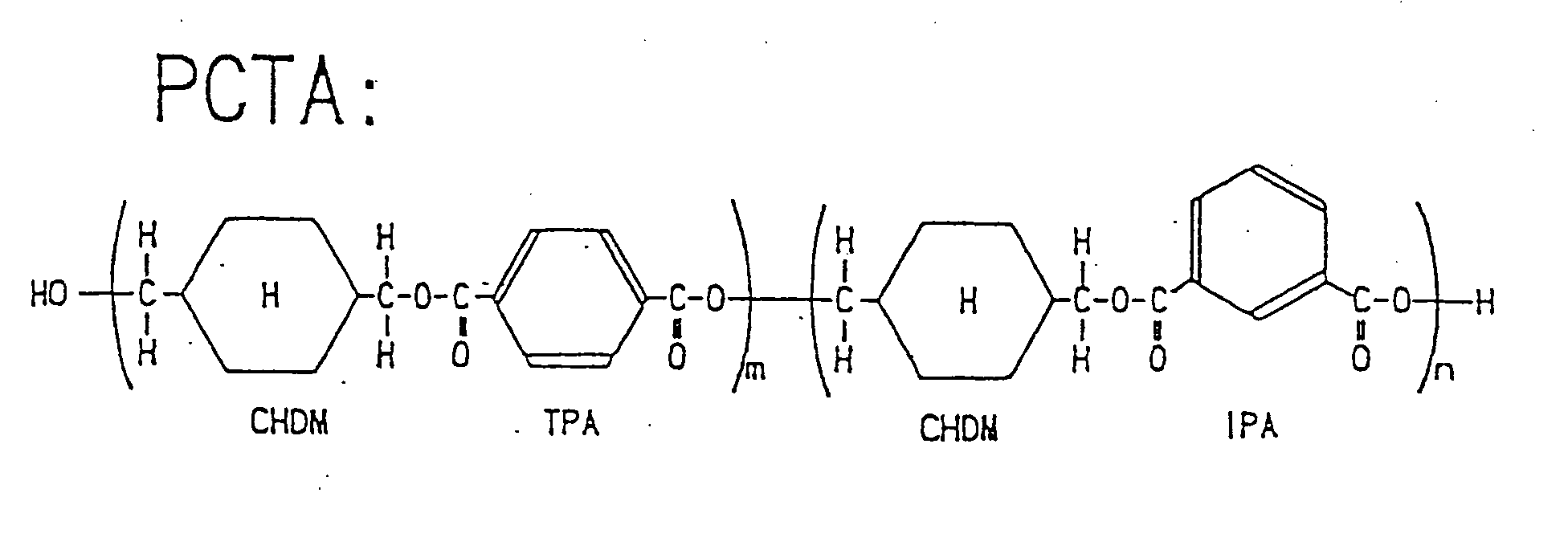
- the polyester resin (E) has a degree of crystallinity of nearly 0% to 50%, and in particular, has the formula shown below.
- the polyester resin (E) may be, for example, a glycol modified polycyclohexylene dimethylene terephthalate (PCTG) composed of 100 mole percent of terephthalic acid, 42 to 32 mole percent of ethylene glycol, and 58 to 68 mole percent of 1,4-cyclohexane dimethanol; an acid modified polycyclohexylene dimethylene terephthalate (PCTA) composed of 1 to 50 mole percent of isophthalic acid and 50 to 99 mole percent of terephthalic acid as a dicarboxylic acid component, and preferably composed of 1 to 25 mole percent of isophthalic acid and 75 to 99 mole percent of terephthalic acid; and the like.
- PCTG glycol modified polycyclohexylene dimethylene terephthalate
- PCTA acid modified polycyclohexylene dimethylene terephthalate
- PCTAs there is a copolyester 1 composed of 80 mole percent of terephthalic acid, 20 mole percent of isophthalic acid, and 100 mole percent of 1,4-cyclohexane dimethanol; and a copolyester 2 composed of 95 mole percent of terephthalic acid, 5 mole percent of isophthalic acid, and 100 mole percent of 1,4-cyclohexane dimethanol.
- polyethylene terephthalate derivatives shown by the following formulas are also preferable.
- Heat of fusion of the component (E) observed by a DSC method is not more than 15 cal/g, preferably not more than 10 cal/g, and more preferably not more than 7 cal/g.
- viscosity of the component (E) is preferably 0.65 to 0.85 as an IV value.
- at least two types of components (E) may be used in combination.
- the resin composition formed with the component (E) of the present invention comprises 50 to 99 percent by weight of the components (A) + (E) composed of 0.1 to 95 percent by weight of the completely amorphous polyester resin (A) and 5 to 99.9 percent by weight of the component (E), and 1 to 50 percent by weight of at least one selected from the group consisting of the graft copolymer (B) obtained by graft-polymerizing a methacrylic acid ester and a vinyl aromatic compound with conjugated diene rubber particles, the graft copolymer (C) obtained by graft-polymerizing a methacrylic acid ester and a vinyl aromatic compound with acrylic rubber particles, and the thermoplastic polyester elastomer (D).
- the resin composition formed with the component (E) of the present invention comprises 70 to 93 percent by weight of the components (A) and (E) composed of 20 to 93 percent by weight of the completely amorphous polyester resin (A) and 7 to 80 percent by weight of the component (E), and 7 to 30 percent by weight of at least one selected from the group consisting of the graft copolymer (B) obtained by graft-polymerizing a methacrylic acid ester and a vinyl aromatic compound with conjugated diene rubber particles, the graft copolymer (C) obtained by graft-polymerizing a methacrylic acid ester and a vinyl aromatic compound with acrylic rubber particles, and the thermoplastic polyester elastomer (D).
- the graft copolymer (B) obtained by graft-polymerizing a methacrylic acid ester and a vinyl aromatic compound with conjugated diene rubber particles
- the graft copolymer (C) obtained by graft-polymerizing a
- the resin composition formed with the component (E) of the present invention has a smaller ratio of the component (A) compared to the resin compositions described above.
- the reason for this is that the primary object of the composition is to obtain stress-cracking resistance.
- the component (A) may be set to be 0.1 to 95 percent by weight.
- the various resin compositions described above may also include appropriate amounts of additives.
- additives mentioned above there may be mentioned, for example, flame retardants, mold release agents, weather-resistant agents, antioxidation agents, antistatic agents, heat stabilizers, lubricants, coloring agents, surfactants, reinforcing agents, and fillers.
- lubricants are preferably blended in order to improve workability.
- lubricants that is, hydrocarbons (low molecular weight polyethylene and paraffins), fatty acids (stearic acid, hydroxy stearic acid, stearic acid composites, and oleic acid), aliphatic alcohols, aliphatic amides (stearoamides, oxystearic amides, oleic amides, erucic amides, ricinoleic amides, behenic amides, methylol amides, methylene bis-stearoamides, methylene bis-stearo behenic amides, bisamides of higher fatty acids, stearoamides, and amide composites), aliphatic esters (n-butyl stearate, methylhydroxy stearate, fatty acid polyols, saturated fatty esters, and ester waxes), and fatty acidic metal soaps.
- hydrocarbons and aliphatic esters are preferable, and aliphatic esters are prefer
- the resin composition of the present invention can be obtained by kneading a composition thus obtained using a Banbury mixer, or a single or double shaft kneader.
- the resin composition of the present invention can be formed into a sheet having a desired size and thickness by a calendering machine, a T-die extruder, and the like. It is difficult for whitening to occur in the resultant sheet during embossing or heat-sealing, and the sheet is specifically suitable for vacuum pressing, air pressing, and membrane pressing, and it can be used as, for example, various laminated decorative sheets.
- the thickness of the resin sheet or the laminated resin sheet of the present invention is not specifically limited.
- the transparent resin sheet may be 5 to 1,000 ⁇ m, preferably 60 to 500 ⁇ m thick.
- an upper layer is 5 to 1,000 ⁇ m thick, preferably 60 to 500 ⁇ m
- an under layer is 5 to 1,000 ⁇ m thick, preferably 60 to 500 ⁇ m
- the overall laminated sheet is 10 to 2,000 ⁇ m thick, preferably, 120 to 1,000 ⁇ m.
- a resin composition (pellets) was injection-molded under the following conditions to form a resin plate 150 mm long, 25 mm wide, and 4 mm thick. Releasing properties were evaluated by releasing the molded part from a mold.
- test piece 6.35 mm long, 12.7 mm wide, and 6.4 mm thick (provided with a notch) was prepared by injection molding, and evaluated.
- dumbbell specimens 1.0 mm thick were prepared by injection molding. The dumbbell specimens were evaluated at a temperature of 23°C and at a relative humidity of 50% (before acceleration test) and after aging for 7 days at a temperature of 60°C and relative humidity of 95% (after acceleration test).
- a predetermined amount of a resin composition was processed by calendering and formed into a film 0.2 mm thick. After holding the film at 60°C at 95% relative humidity for 7 days, the film was laminated on a medium density fiberboard (MDF) by the following method. That is, after coating 140 g/mm 2 of a two-component curable adhesive agent primarily composed of an ethylene-vinyl acetate copolymer on a 240 mm long, 1,200 mm wide, and 18 mm thick MDF with water absorption of 5 to 15% (Starwood, Hokushin Co., Ltd.), the film was laminated thereon and subsequently pressed and aged at a pressure of 1 to 5 kg/cm 2 for approximately 12 hours.
- MDF medium density fiberboard
- the MDF provided with the film was cut to a size 600 mm long and 400 mm wide, and a V-cut having an open angle of 90° was formed along the width direction at the center point in the longitudinal direction of the MDF as shown in Fig. 2.
- the MDF provided with the film was then bent at a temperature of 23 ⁇ 2°C and a bending rate of 1 mm/minute, to form a right angle shape as shown in Fig. 3.
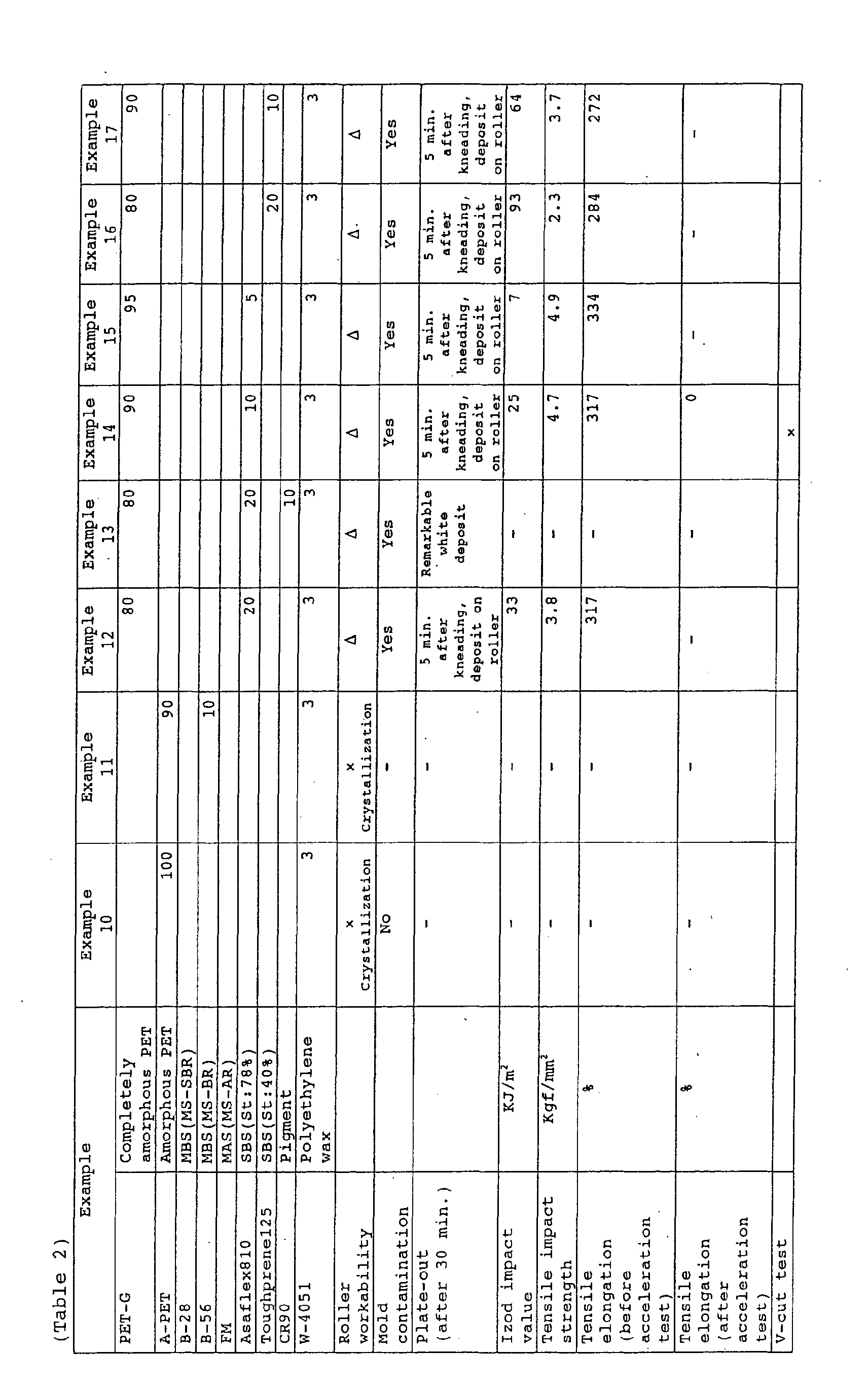
- the resin compositions of the present invention were superior in various properties; however, the compositions (examples 10 and 11) using common amorphous polyester resins instead of the completely amorphous polyester resins were noticeably inferior in roller workability.
- the compositions (examples 12 to 17) having a polymer other than the graft copolymers (B) and (C) had superior properties; however, they were inferior in roller workability, mold contamination, and plate-out.
- the composition (example 9) having only the completely amorphous polyester resin as a polymer component adequate properties could be obtained.
- Fig. 1 The results obtained are shown in Fig. 1.
- Fig. 1 #1 is for example 9, #2 is for example 8, #3 is for example 4, and #4 is for example 3.
- the torque values of the resin compositions of the present invention increased in a short time and gelation thereof rapidly occurred; however, gelation of the resin composition for the sample 9 was delayed approximately 20 minutes. Accordingly, differences in workability between two types of resin compositions was apparent. That is, the resin compositions of the present invention were readily melted by kneading and the components thereof were homogeneously dispersed in a short time. In contrast, the resin composition for sample 9 was slowly melted due to poor thermal conductivity thereof and the components thereof required a long time to disperse.
- compositions were prepared in accordance with the component contents shown in Tables 3 to 5, and various tests were performed on the compositions. The results are alos shown in Tables 3 to 5.
- Example 18 Example 19
- Example 20 Example 21
- Example 22 PET-G 95 50 70 90 95 Hytrel 4057 5 Hytrel 2551 50 30 10 5 G-78 0.7 0.7 0.7 0.7 Roller workability ⁇ ⁇ ⁇ ⁇ ⁇ Mold contamination ⁇ ⁇ ⁇ ⁇ ⁇ Izod impact value KJ/m 2 7.1 NB 20.3 7.0 6.0
- Tensile strength Kgf/mm 2 4.4 3.0 3.4 4.3 4.4 Tensile elongation before acceleration % 310 350 340 320 315
- 310 Haze value 1 mm thick % 21.1 40.3 21.2 14.2 14.0
- Flexural whitening test ⁇ ⁇ ⁇ ⁇ V-cut test ⁇ ⁇ ⁇ ⁇ ⁇ Example 23
- a 80 ⁇ m-thick resin sheet (the composition thereof being the same as for example 21) was prepared by a calendering machine followed by coloring with titanium oxide and an organic pigment, and was then provided with a printed layer 1.5 ⁇ 0.5 ⁇ m thick (Nippon Decor K.K., Woodgrain) on the upper surface thereof.
- a solvent-type two-component adhesive agent (Toyo-Morton, Ltd., AD527/CATHY-92) was coated on the upper surface of the printed layer by a gravure coating method. After coating, the solvent was vaporized in a drying oven, to thus obtain an adhesive layer (2.5 ⁇ 0.5 ⁇ thick).
- the drying oven was provided with a floating method type drying zone and the temperature therein was set to be 75 to 85°C.
- the resin sheet was passed through the drying oven in 18 to 22 seconds.
- an 80 ⁇ m-thick resin sheet of example 21 to be used as an upper layer was overlaid on the adhesive layer, and was then heat-sealed by using metal rollers.
- example 31 was not provided with a printed layer, so that the test was for a colored decorative sheet.
- Examples 35 and 36 were comparative examples, in which the materials used for examples 30 and 34 were used for examples 35 and 36, respectively, and the upper layer and the lower layer were disposed in reverse relation.
- laminated sheets for examples 35 and 36 were formed by laminating an original color sheet as an upper layer with a colored decorative sheet as an under layer. Lamination methods and measurement methods were the same as those for example 29.
- a transfer foil, (2) a 0.2 mm-thick polyester sheet, and (3) a 0.15 mm-thick polyester sheet were prepared in accordance with the compositions shown in Tables 8 to 11, (1), (2), and (3) were laminated in order, and the laminate thus formed was then heat-sealed by rollers having metallic mirror finished surfaces at 150 to 160°C for 40 seconds (nip pressure: 2.0 kg/cm, drum rotation speed: 2.0 m/min., and drum circumference: 2.0 m).
- the polyester sheet was formed by a T-die extruder to have a desired thickness.
- the adherend was plywood which was formed by finely pulverizing chips of conifers, lauan, or the like followed by solidifying by pressing.
- the adherend was cut into a shape of a door (approximately 150 mm x 200 mm, and 18 mm thick) for assembly in an integrated kitchen system or the like, and curved surfaces (approximately 3R to 10R) were formed thereon.
- Decorative grooves (called "routing") were engraved on the top surface of the adherend.
- an adhesive agent such as a urethane adhesive agent (a mixture of trade name 34333 and trade name Hardener D, Henmitine Co., in a weight ratio of 100 and 5), was coated on the door shaped MDF surface.
- a urethane adhesive agent a mixture of trade name 34333 and trade name Hardener D, Henmitine Co., in a weight ratio of 100 and 5
- a resin composition and a resin sheet specifically suitable for membrane pressing, vacuum pressing, air pressing, and the like are provided, in which the resin composition and the resin sheet have superior properties, such as workability, moldability, impact resistance, transparency, and the like, and in addition, plate-out is not significantly observed and whitening during embossing and heat-sealing is unlikely to occur.
Landscapes
- Chemical & Material Sciences (AREA)
- Medicinal Chemistry (AREA)
- Organic Chemistry (AREA)
- Polymers & Plastics (AREA)
- Health & Medical Sciences (AREA)
- Chemical Kinetics & Catalysis (AREA)
- Engineering & Computer Science (AREA)
- Manufacturing & Machinery (AREA)
- Materials Engineering (AREA)
- Wood Science & Technology (AREA)
- Life Sciences & Earth Sciences (AREA)
- General Chemical & Material Sciences (AREA)
- Oil, Petroleum & Natural Gas (AREA)
- Compositions Of Macromolecular Compounds (AREA)
- Laminated Bodies (AREA)
- Manufacture Of Macromolecular Shaped Articles (AREA)
Abstract
Description






Nissei Plastic Industrial Co., Ltd. FS-120
Molding temperature: 250°C, 260°C, and 280°C
Injection speed: 55 mm/second
Injection pressure: 800 kg/cm2
Holding pressure: 600 kg/cm2
Injection time: 8 seconds
Cooling time: 45 seconds
Manufacturing company: Kaneka Corp.
Trade name: Kaneace B-28
Composition: methacrylic acid ester·styrene/styrene · butadiene rubber graft copolymer
Rubber particle diameter: 0.1 to 0.5 µm
Manufacturing company: Kaneka Corp.
Trade name: Kaneace B-56
Composition: methacrylic acid ester·styrene / butadiene rubber graft copolymer
Rubber particle diameter: 0.1 to 0.5 µm
Manufacturing company: Asahi Chemistry Industry Co., Ltd.
Trade name: Asaflex 810
Composition: styrene/butadiene block copolymer
Styrene content 78%
Number average molecular weight 130,000
Manufacturing company: Asahi Chemistry Industry Co., Ltd.
Trade name: Toughprene 125
Composition: styrene/butadiene block copolymer Styrene content 40%
Number average molecular weight 80,000
Manufacturing company: Ishihara Sangyo Kaisha, Ltd.
Trade name: CR90
Composition: rutile titanium oxide
Manufacturing company: Mitsui Chemicals, Inc.
Trade name: W-4051
Composition: oxidized polyethylene wax

Mixer: Lab-plastomill R-30 type by Toyo Seiki Co., Ltd.
Amount of sample: 33 grams
Test temperature: 160°C
Test revolutions: 50.0 rpm
Pre-heating time: 120 seconds
Manufacturing company: Riken Vinyl Industry Co., Ltd.
Trade name: W500
Composition: Polyvinyl chloride resin
Manufacturing company: Riken Vinyl Industry Co., Ltd.
Trade name: OW
Composition: Polypropylene resin
Manufacturing company: Riken Vinyl Industry Co., Ltd.
Trade name: TPN
Composition: Polyethylene resin
| Example 18 | Example 19 | Example 20 | Example 21 | Example 22 | ||
| PET-G | 95 | 50 | 70 | 90 | 95 | |
| Hytrel 4057 | 5 | |||||
| Hytrel 2551 | 50 | 30 | 10 | 5 | ||
| G-78 | 0.7 | 0.7 | 0.7 | 0.7 | 0.7 | |
| Roller workability | ○ | ○ | ○ | ○ | ○ | |
| Mold contamination | ○ | ○ | ○ | ○ | ○ | |
| Izod impact value | KJ/m2 | 7.1 | NB | 20.3 | 7.0 | 6.0 |
| Tensile strength | Kgf/mm2 | 4.4 | 3.0 | 3.4 | 4.3 | 4.4 |
| Tensile elongation before acceleration | % | 310 | 350 | 340 | 320 | 315 |
| Tensile elongation after acceleration | % | 295 | 345 | 330 | 310 | 310 |
| Haze value 1 mm thick | % | 21.1 | 40.3 | 21.2 | 14.2 | 14.0 |
| Flexural whitening test | ○ | ○ | ○ | ○ | ○ | |
| V-cut test | ○ | ○ | ○ | ○ | ○ |
| Example 23 | Example 24 | ||
| PET-G | 99 | 99.5 | |
| Hytrel 4057 | |||
| Hytrel 2551 | 1 | 0.5 | |
| G-78 | 0.7 | 0.7 | |
| Roller workability | ○ | ○ | |
| Mold contamination | ○ | ○ | |
| Izod impact value | KJ/m2 | 5.3 | 5.2 |
| Tensile strength | Kgf/mm2 | 4.4 | 4.5 |
| Tensile elongation (before acceleration) | % | 300 | 300 |
| Tensile elongation (before acceleration) | % | 150 | 120 |
| Haze value 1 mm thick | % | 13.6 | 13.5 |
| Flexural whitening test | ○ | ○ | |
| V-cut test | ○ | ○ |
| Example 25 | Example 26 | Example 27 | Example 28 | ||
| PET-G | 90 | 95 | 100 | 90 | |
| Hytrel 4057 | |||||
| Hytrel 2551 | |||||
| B-56 | 10 | 5 | |||
| FM | 10 | ||||
| G-78 | 0.7 | 0.7 | 0.7 | 0.7 | |
| Roller workability | ○ | ○ | ○ | ○ | |
| Mold contamination | ○ | ○ | ○ | ○ | |
| Izod impact value | KJ/m2 | 83 | 10 | 5 | 7 |
| Tensile strength | Kgf/mm2 | 3.9 | 4.2 | 4.5 | 4.0 |
| Tensile elongation (before acceleration) | % | 290 | 280 | 300 | 290 |
| Tensile elongation (before acceleration) | % | 275 | 260 | 0 | 270 |
| Haze value 1 mm thick | % | 99.8 | 94.5 | 13.0 | 99.9 |
| Flexural whitening test | Δ | Δ | ○ | Δ | |
| V-cut test | ○ | ○ | × | ○ |

| Example 35 | Example 36 | |
| Upper layer | 80 µm Example 26 Composition Original color | 80 µm Riken Vinyl TPN PE Original color |
| Woodgrain Printed layer | Yes | Yes |
| Under layer | 80 µm Example 21 Composition Colored | 80 µm Example 21 Composition Colored |
| Flexural whitening test | x | x |
| V-cut test | ○ | ○ |
Type: Acrylic transfer foil, 12 µm thick
A completely amorphous polyester resin (A)
Manufacturing company: Eastman Chemical Co.
Trade name: KODAR PETG 6763 (PET-G)
Composition: copolymer type
Glycol component: 70 mole percent of ethylene glycol and 30 mole percent of 1,4-cyclohexane dimethanol
Dicarboxylic component: terephthalic acid
Crystallinity: 0%
Heat of fusion: Not measurable due to a completely amorphous structure
Graft copolymer (B)
Manufacturing company: Kaneka Corp.
Trade name: Kaneace B-56
Composition: methacrylic acid ester · styrene/butadiene rubber graft copolymer (MBS)
Rubber particle diameter: 0.1 to 0.5 µm
Thermoplastic polyester elastomer (D)
Manufacturing company: Dupont-Toray Co., Ltd.
Trade name: Hytrel 2551 (Hytrel)
Composition: Chemical structure is a copolymer composed of hard segments (PBT) and soft segments (polyether).
Polyester resin (E)
Manufacturing company: Eastman Chemical Co.
Trade name: EASTER PCTG 5445 (PCTG)
Composition: Copolymer type
Glycol modified polycyclohexylene dimethylene terephthalate composed of 100 mole percent of terephthalic acid, 42 to 32 mole percent of ethylene glycol, and 58 to 68 mole percent of 1,4-cyclohexane dimethanol
Crystalline component (Degree of crystallinity): trace
Heat of fusion: 2.6 (cal/g)
Manufacturing company: Eastman Chemical Co.
Trade name: THERMX PCTA 6761 (PCTA)
Composition: Copolymer type
Acid modified polycyclohexylene dimethylene terephthalate composed of 1 to 50 mole percent of isophthalic acid and 50 to 99 mole percent of terephthalic acid, as dicarboxylic components, and preferably, composed of 1 to 25 mole percent of isophthalic acid and 75 to 99 mole percent of terephthalic acid
Heat of fusion: 5.5 (cal/g)
Manufacturing company: Riken Vinyl Industry Co., Ltd.
Trade name: RIVESTAR SET351 FZ13359
Composition: Copolymer type
Crystalline component (Degree of crystallinity): 0%
Tests listed below were performed for obtained molded parts.
- Transparency: Determined by visual inspection. Levels of determination were as follows. Superior transparency is represented by ○, slight white turbidity is represented by Δ, and white turbidity is represented by x.
- Pencil hardness test: In accordance with JIS K5400 (loading weight: 200 g)
- Stress cracking test by detergent: Kitchen detergent (Magicline, Kao Corp.) was sufficiently coated on molded parts, and the molded parts were held at room temperature for 24 hours. Subsequently, after the molded parts were stored at 50°C for 90 minutes followed by being stored at 0°C for 90 minutes, the surfaces of the molded parts were visually inspected for cracks. Levels of determination were as follows. No cracking is represented by ○, existence of a few cracks (approximately 1 to 10) is represented by Δ, existence of a number of cracks (not less than 10) is represented by x, and existence of cracks over the entirety of the surfaces is represented by xx. The results are shown in Tables 8 to 11.


Claims (8)
- A resin sheet obtained by molding a resin composition comprising 50 to 99.9 percent by weight of a completely amorphous polyester resin (A) and 0.1 to 50 percent by weight of a thermoplastic polyester elastomer (D).
- A resin sheet according to Claim 1, wherein the resin sheet is colored and/or has a printed surface.
- A laminated resin sheet obtained by laminating at least two layers of a resin sheet according to Claim 1.
- A laminated resin sheet obtained by laminating at least two layers of a resin sheet according to Claim 2.
- A laminated resin sheet obtained by laminating two resin sheets, wherein a resin sheet according to Claim 1 is used as an upper layer and a resin sheet according to Claim 2 is used as an under layer.
- A laminated resin sheet obtained by laminating two resin sheets, wherein a resin sheet according to one of Claims 1 and 2 is used as an upper layer and a thermoplastic resin sheet is used as an under layer.
- A laminated resin sheet obtained by laminating two resin sheets, wherein a resin sheet according to Claim 1 is used as an upper layer and a resin sheet used as an under layer comprising 50 to 99 percent by weight of a completely amorphous polyester resin (A), and 1 to 50 percent by weight of at least one of a graft copolymer (B) obtained by graft-polymerizing a methacrylic acid ester and a vinyl aromatic compound with conjugated diene rubber particles and a graft copolymer (C) obtained by graft-polymerizing a methacrylic acid ester and a vinyl aromatic compound with acrylic rubber particles, in which the resin sheet used as an under layer is colored and/or has printed surface.
- A laminated resin sheet according to Claim 7, wherein a resin sheet according to Claim 2 is used as an upper layer.
Applications Claiming Priority (5)
| Application Number | Priority Date | Filing Date | Title |
|---|---|---|---|
| JP2569098 | 1998-02-06 | ||
| JP2569098 | 1998-02-06 | ||
| JP22456298 | 1998-08-07 | ||
| JP22456298 | 1998-08-07 | ||
| EP99902846A EP1054038B1 (en) | 1998-02-06 | 1999-02-05 | Resin composition and resin sheet |
Related Parent Applications (1)
| Application Number | Title | Priority Date | Filing Date |
|---|---|---|---|
| EP99902846A Division EP1054038B1 (en) | 1998-02-06 | 1999-02-05 | Resin composition and resin sheet |
Publications (3)
| Publication Number | Publication Date |
|---|---|
| EP1529808A2 true EP1529808A2 (en) | 2005-05-11 |
| EP1529808A3 EP1529808A3 (en) | 2005-05-18 |
| EP1529808B1 EP1529808B1 (en) | 2007-10-24 |
Family
ID=26363349
Family Applications (3)
| Application Number | Title | Priority Date | Filing Date |
|---|---|---|---|
| EP99902846A Expired - Lifetime EP1054038B1 (en) | 1998-02-06 | 1999-02-05 | Resin composition and resin sheet |
| EP05075248A Expired - Lifetime EP1529809B1 (en) | 1998-02-06 | 1999-02-05 | Resin composition and resin sheet |
| EP05075247A Expired - Lifetime EP1529808B1 (en) | 1998-02-06 | 1999-02-05 | Resin sheet |
Family Applications Before (2)
| Application Number | Title | Priority Date | Filing Date |
|---|---|---|---|
| EP99902846A Expired - Lifetime EP1054038B1 (en) | 1998-02-06 | 1999-02-05 | Resin composition and resin sheet |
| EP05075248A Expired - Lifetime EP1529809B1 (en) | 1998-02-06 | 1999-02-05 | Resin composition and resin sheet |
Country Status (5)
| Country | Link |
|---|---|
| US (2) | US6433081B1 (en) |
| EP (3) | EP1054038B1 (en) |
| JP (1) | JP3492318B2 (en) |
| DE (3) | DE69937418T2 (en) |
| WO (1) | WO1999040154A1 (en) |
Cited By (7)
| Publication number | Priority date | Publication date | Assignee | Title |
|---|---|---|---|---|
| US7030181B2 (en) | 2001-04-11 | 2006-04-18 | Eastman Chemical Company | Films prepared from plasticized polyesters |
| US7235623B2 (en) | 2003-11-26 | 2007-06-26 | Eastman Chemical Company | Polyester compositions for calendering |
| US7285587B2 (en) | 2002-12-20 | 2007-10-23 | Eastman Chemical Company | Flame retardant polyester compositions for calendering |
| US7354653B2 (en) | 2003-12-18 | 2008-04-08 | Eastman Chemical Company | High clarity films with improved thermal properties |
| US8071695B2 (en) | 2004-11-12 | 2011-12-06 | Eastman Chemical Company | Polyeste blends with improved stress whitening for film and sheet applications |
| US11192345B2 (en) | 2017-06-16 | 2021-12-07 | Nitto Denko Corporation | Laminate and airbag |
| US11667259B2 (en) | 2017-06-16 | 2023-06-06 | Zf Automotive Germany Gmbh | Method of manufacturing laminate, laminate, and airbag |
Families Citing this family (27)
| Publication number | Priority date | Publication date | Assignee | Title |
|---|---|---|---|---|
| US6846440B2 (en) * | 1998-03-17 | 2005-01-25 | Eastman Chemical Company | Polyester resin compositions for calendering |
| JP4562233B2 (en) * | 1999-03-09 | 2010-10-13 | リケンテクノス株式会社 | Resin composition and resin sheet |
| JP2001334624A (en) * | 2000-05-26 | 2001-12-04 | C I Kasei Co Ltd | Polyester resin wood |
| JP3429265B2 (en) | 2000-10-03 | 2003-07-22 | リケンテクノス株式会社 | Amorphous polyester resin decorative sheet and method for producing the same |
| JP2002121367A (en) * | 2000-10-10 | 2002-04-23 | Sumitomo Bakelite Co Ltd | Polyester sheet |
| JP2003020386A (en) * | 2001-07-10 | 2003-01-24 | Tsutsunaka Plast Ind Co Ltd | Method for manufacturing hot press molding noncrystalline polyester resin composition and noncrystalline polyester resin sheet |
| JP4857507B2 (en) * | 2001-09-17 | 2012-01-18 | 日立金属株式会社 | Resin-coated flexible steel pipe |
| US20030068453A1 (en) * | 2001-10-02 | 2003-04-10 | Dan-Cheng Kong | Multilayer sleeve labels |
| KR100513118B1 (en) * | 2002-10-02 | 2005-09-07 | 에스케이케미칼주식회사 | Method for preparing polyester resin copolymerized with 1,4-cyclohexanedimethanol at enhanced condensation polymerization rate |
| JP4772275B2 (en) * | 2003-02-13 | 2011-09-14 | シーアイ化成株式会社 | Decorative sheet and manufacturing method thereof |
| JP4934310B2 (en) * | 2005-10-19 | 2012-05-16 | リケンテクノス株式会社 | Resin composition, resin composition for calendar molding using the same, and sheet |
| JP4843507B2 (en) * | 2006-01-12 | 2011-12-21 | シーアイ化成株式会社 | Plastic mirror laminate |
| JP5064593B2 (en) * | 2006-01-12 | 2012-10-31 | シーアイ化成株式会社 | Plastic mirror laminate |
| JP4336994B2 (en) * | 2006-07-31 | 2009-09-30 | 三菱自動車工業株式会社 | Synthetic board with film |
| KR101004614B1 (en) * | 2007-01-23 | 2010-12-28 | (주)엘지하우시스 | PET-based molding deco sheet with similar moldability as PCC |
| JP5241190B2 (en) * | 2007-10-03 | 2013-07-17 | リケンテクノス株式会社 | Thermoplastic resin composition |
| DE102010009242A1 (en) | 2010-02-25 | 2011-08-25 | Giesecke & Devrient GmbH, 81677 | Coextruded film composite material and its use in card bodies |
| US9649829B2 (en) | 2011-08-25 | 2017-05-16 | Isao Manabe | Film for forming and forming transfer foil using same |
| KR101417250B1 (en) * | 2012-02-20 | 2014-07-08 | (주)엘지하우시스 | High temperature resistant multilayer resistant opitical multilater film and its manufacturing method |
| JP6049071B2 (en) * | 2013-02-25 | 2016-12-21 | リケンテクノス株式会社 | Polyester resin composition sheet |
| CN103554852B (en) * | 2013-10-30 | 2016-03-02 | 东莞市华炜塑胶制品有限公司 | A kind of PET heat-shrinkable T bush and preparation method thereof |
| KR20170060229A (en) * | 2015-11-23 | 2017-06-01 | 이호영 | Pet-g resin compositions |
| JP6247365B2 (en) * | 2016-09-26 | 2017-12-13 | リケンテクノス株式会社 | Polyester resin composition sheet |
| KR102161592B1 (en) * | 2017-11-09 | 2020-10-05 | 주식회사 엘지화학 | Thermoplastic resin composition |
| TWI652306B (en) * | 2017-11-28 | 2019-03-01 | 遠東新世紀股份有限公司 | Heat shrinkable polyester film |
| PH12020550972B1 (en) * | 2018-01-24 | 2024-05-22 | Denka Company Ltd | Laminated sheet and electronic component packaging container molded using same |
| FR3142194A1 (en) * | 2022-11-22 | 2024-05-24 | Aptar France Sas | Polyester composition for a dispensing device |
Family Cites Families (15)
| Publication number | Priority date | Publication date | Assignee | Title |
|---|---|---|---|---|
| JPS5713469B2 (en) * | 1974-12-19 | 1982-03-17 | ||
| CA1062390A (en) | 1975-08-11 | 1979-09-11 | Borg-Warner Corporation | Amorphous polyester graft polymer alloys |
| US4225688A (en) * | 1978-11-09 | 1980-09-30 | Baxter Travenol Laboratories, Inc. | Copolyester composition containing poly(ethylene cyclohexane dimethylene terephthalate), having superior solvent and impact resistance |
| DE3118526A1 (en) * | 1981-05-09 | 1982-12-02 | Bayer Ag, 5090 Leverkusen | "THERMOPLASTIC MOLDS OF POLYCARBONATE, POLYALKYLENE TEREPHTHALATE AND GRAFT POLYMERISATE" |
| DE3336499A1 (en) * | 1983-10-07 | 1985-04-25 | Bayer Ag, 5090 Leverkusen | MOLDING MATERIALS FROM THERMOPLASTIC POLYESTER AND GRAFT RUBBER, METHOD FOR THE PRODUCTION THEREOF AND THEIR USE FOR THE PRODUCTION OF MOLDED BODIES |
| IT1190025B (en) * | 1986-05-29 | 1988-02-10 | Ausimont Spa | POLYESTER BASED SHOCK RESISTANT COMPOSITIONS AND PROCEDURE FOR THEIR PREPARATION |
| JPS63108054A (en) * | 1986-06-05 | 1988-05-12 | Kanegafuchi Chem Ind Co Ltd | Polyethylene terephthalate resin composition for molding |
| JP2567627B2 (en) * | 1987-09-21 | 1996-12-25 | 三菱レイヨン株式会社 | Thermoplastic polyester resin composition |
| JPH04501277A (en) * | 1988-02-03 | 1992-03-05 | イーストマン コダック カンパニー | Blends of poly(ether ester) and polyester and molded products made therefrom |
| CA2002369C (en) * | 1988-11-08 | 2000-10-31 | Mikio Hashimoto | Copolyester, polyester composition containing the copolyester, and polyester laminated structure having layer composed of the copolyester or the polyester composition |
| US5162416A (en) | 1989-03-17 | 1992-11-10 | Monsanto Company | Impact resistant polyester blends |
| JPH05214228A (en) * | 1991-07-03 | 1993-08-24 | Sekisui Chem Co Ltd | Easily releasable heat-sealable resin composition, packaging film or sheet, composite packaging material and sealed container |
| US5321056A (en) * | 1992-06-19 | 1994-06-14 | Rohm And Haas Company | Amorphous, aromatic polyester containing impact modifier |
| EP0822213A4 (en) * | 1996-02-21 | 2001-03-21 | Mitsui Chemicals Inc | POLYESTER, POLYESTER COMPOSITION, POLYESTER LAMINATE AND METHOD FOR PRODUCING BIAXIALLY STRETCHED BOTTLES |
| US5859116A (en) * | 1997-01-21 | 1999-01-12 | Eastman Chemical Company | Clarity and adjustable shrinkage of shrink films using miscible polyester blends |
-
1999
- 1999-02-05 WO PCT/JP1999/000511 patent/WO1999040154A1/en not_active Ceased
- 1999-02-05 US US09/601,322 patent/US6433081B1/en not_active Expired - Lifetime
- 1999-02-05 EP EP99902846A patent/EP1054038B1/en not_active Expired - Lifetime
- 1999-02-05 DE DE69937418T patent/DE69937418T2/en not_active Expired - Lifetime
- 1999-02-05 JP JP2000530575A patent/JP3492318B2/en not_active Expired - Lifetime
- 1999-02-05 DE DE69937417T patent/DE69937417T2/en not_active Expired - Lifetime
- 1999-02-05 EP EP05075248A patent/EP1529809B1/en not_active Expired - Lifetime
- 1999-02-05 DE DE69935500T patent/DE69935500T2/en not_active Expired - Lifetime
- 1999-02-05 EP EP05075247A patent/EP1529808B1/en not_active Expired - Lifetime
-
2002
- 2002-05-21 US US10/151,311 patent/US6566447B1/en not_active Expired - Lifetime
Cited By (8)
| Publication number | Priority date | Publication date | Assignee | Title |
|---|---|---|---|---|
| US7030181B2 (en) | 2001-04-11 | 2006-04-18 | Eastman Chemical Company | Films prepared from plasticized polyesters |
| US7285587B2 (en) | 2002-12-20 | 2007-10-23 | Eastman Chemical Company | Flame retardant polyester compositions for calendering |
| US7235623B2 (en) | 2003-11-26 | 2007-06-26 | Eastman Chemical Company | Polyester compositions for calendering |
| US7354653B2 (en) | 2003-12-18 | 2008-04-08 | Eastman Chemical Company | High clarity films with improved thermal properties |
| US8071695B2 (en) | 2004-11-12 | 2011-12-06 | Eastman Chemical Company | Polyeste blends with improved stress whitening for film and sheet applications |
| US11192345B2 (en) | 2017-06-16 | 2021-12-07 | Nitto Denko Corporation | Laminate and airbag |
| US11667259B2 (en) | 2017-06-16 | 2023-06-06 | Zf Automotive Germany Gmbh | Method of manufacturing laminate, laminate, and airbag |
| US12103487B2 (en) | 2017-06-16 | 2024-10-01 | Zf Automotive Germany Gmbh | Method of manufacturing laminate, laminate, and airbag |
Also Published As
| Publication number | Publication date |
|---|---|
| DE69937418T2 (en) | 2008-07-24 |
| DE69937417T2 (en) | 2008-07-24 |
| DE69937417D1 (en) | 2007-12-06 |
| EP1529809B1 (en) | 2007-10-24 |
| EP1054038A1 (en) | 2000-11-22 |
| US6566447B1 (en) | 2003-05-20 |
| JP3492318B2 (en) | 2004-02-03 |
| EP1529809A1 (en) | 2005-05-11 |
| WO1999040154A1 (en) | 1999-08-12 |
| EP1054038A4 (en) | 2002-05-29 |
| EP1529808B1 (en) | 2007-10-24 |
| DE69937418D1 (en) | 2007-12-06 |
| EP1529808A3 (en) | 2005-05-18 |
| EP1054038B1 (en) | 2007-03-14 |
| DE69935500D1 (en) | 2007-04-26 |
| DE69935500T2 (en) | 2007-11-29 |
| US6433081B1 (en) | 2002-08-13 |
| HK1033583A1 (en) | 2001-09-07 |
Similar Documents
| Publication | Publication Date | Title |
|---|---|---|
| US6433081B1 (en) | Resin composition and resin sheet | |
| JPWO1999040154A1 (en) | Resin composition and resin sheet | |
| EP1910464B1 (en) | Multi-layer composition | |
| JP5544685B2 (en) | Multi-layer film for simultaneous injection molding | |
| JP4644219B2 (en) | Resin sheet | |
| JP2010125645A (en) | Multilayer film | |
| JP3287255B2 (en) | Acrylic film and molded article using the same | |
| JP2003183471A (en) | Acrylic resin film and injection molded product obtained by laminating it | |
| JP4369718B2 (en) | Resin sheet | |
| JP4480834B2 (en) | Vinylidene fluoride resin film | |
| US5543466A (en) | Extended flex life core and overlay compositions and laminates thereof | |
| JP2011031498A (en) | Multilayer film | |
| JP4521011B2 (en) | Laminated resin sheet | |
| HK1033583B (en) | Resin composition and resin sheet | |
| JP4888855B2 (en) | Resin laminate | |
| JPH10259303A (en) | Thermoplastic polymer composition | |
| JP2000326387A (en) | Thermoplastic acrylic sheet compositions and their use as substitutes for high pressure decorative laminates | |
| JP4562233B2 (en) | Resin composition and resin sheet | |
| JP3537619B2 (en) | Laminated structure | |
| EP3418342A1 (en) | Pressure-sensitive adhesive and articles including same | |
| JP2009248362A (en) | Laminated film | |
| JP3733080B2 (en) | Printing resin film for laminating high-design decorative metal plates and metal plates coated therewith | |
| US6306520B1 (en) | Laminated film or sheet process for producing same and laminated structure formed using same | |
| JP4816317B2 (en) | Laminated film | |
| JP2010005944A (en) | Acrylic resin multilayer film |
Legal Events
| Date | Code | Title | Description |
|---|---|---|---|
| PUAI | Public reference made under article 153(3) epc to a published international application that has entered the european phase |
Free format text: ORIGINAL CODE: 0009012 |
|
| PUAL | Search report despatched |
Free format text: ORIGINAL CODE: 0009013 |
|
| AC | Divisional application: reference to earlier application |
Ref document number: 1054038 Country of ref document: EP Kind code of ref document: P |
|
| AK | Designated contracting states |
Kind code of ref document: A2 Designated state(s): DE GB IT |
|
| AK | Designated contracting states |
Kind code of ref document: A3 Designated state(s): DE GB IT |
|
| RIN1 | Information on inventor provided before grant (corrected) |
Inventor name: YAMADA, YASUNORI,RIKEN VINYL INDUSTRY CO., LTD. Inventor name: SHIMIZU, MOTOHIRO Inventor name: NOZAWA, TAKAFUMI,RIKEN VINYL INDUSTRY CO., LTD. Inventor name: TOKUNAGA, YASUSHI,RIKEN VINYL INDUSTRY CO., LTD. Inventor name: FUKUNAGA, ETSUSHI,RIKEN VINYL INDUSTRY CO., LTD. |
|
| 17P | Request for examination filed |
Effective date: 20050610 |
|
| RBV | Designated contracting states (corrected) |
Designated state(s): DE GB IT |
|
| AKX | Designation fees paid |
Designated state(s): DE GB IT |
|
| 17Q | First examination report despatched |
Effective date: 20050715 |
|
| GRAP | Despatch of communication of intention to grant a patent |
Free format text: ORIGINAL CODE: EPIDOSNIGR1 |
|
| RIC1 | Information provided on ipc code assigned before grant |
Ipc: C08L 51/04 20060101ALI20070525BHEP Ipc: C08J 5/18 20060101ALI20070525BHEP Ipc: C08L 67/02 20060101AFI20070525BHEP Ipc: B32B 27/36 20060101ALI20070525BHEP |
|
| GRAS | Grant fee paid |
Free format text: ORIGINAL CODE: EPIDOSNIGR3 |
|
| GRAA | (expected) grant |
Free format text: ORIGINAL CODE: 0009210 |
|
| AC | Divisional application: reference to earlier application |
Ref document number: 1054038 Country of ref document: EP Kind code of ref document: P |
|
| AK | Designated contracting states |
Kind code of ref document: B1 Designated state(s): DE GB IT |
|
| REG | Reference to a national code |
Ref country code: GB Ref legal event code: FG4D |
|
| REF | Corresponds to: |
Ref document number: 69937417 Country of ref document: DE Date of ref document: 20071206 Kind code of ref document: P |
|
| PLBE | No opposition filed within time limit |
Free format text: ORIGINAL CODE: 0009261 |
|
| STAA | Information on the status of an ep patent application or granted ep patent |
Free format text: STATUS: NO OPPOSITION FILED WITHIN TIME LIMIT |
|
| 26N | No opposition filed |
Effective date: 20080725 |
|
| PGFP | Annual fee paid to national office [announced via postgrant information from national office to epo] |
Ref country code: DE Payment date: 20180216 Year of fee payment: 20 Ref country code: GB Payment date: 20180215 Year of fee payment: 20 |
|
| PGFP | Annual fee paid to national office [announced via postgrant information from national office to epo] |
Ref country code: IT Payment date: 20180222 Year of fee payment: 20 |
|
| REG | Reference to a national code |
Ref country code: DE Ref legal event code: R071 Ref document number: 69937417 Country of ref document: DE |
|
| REG | Reference to a national code |
Ref country code: GB Ref legal event code: PE20 Expiry date: 20190204 |
|
| PG25 | Lapsed in a contracting state [announced via postgrant information from national office to epo] |
Ref country code: GB Free format text: LAPSE BECAUSE OF EXPIRATION OF PROTECTION Effective date: 20190204 |